𝗙𝗨𝗟𝗟 𝗦𝗧𝗢𝗥𝗬 Someone Had Named My Road, Scheduled the Asphalt, and Somehow Forgotten the Man Who Owned Every Foot of It
𝗙𝗨𝗟𝗟 𝗦𝗧𝗢𝗥𝗬
The shortcut stayed.
At first it was only a few residents.
Someone probably saw the lane on a phone map and realized it saved several minutes getting to County Road 9.
Then more people began using it.
The pattern was gradual enough that I did what people often do with small annoyances.
I tolerated it.
Ten cars became thirty.
Thirty became fifty.
Then delivery drivers learned the route.
Then landscapers.
Contractors.
Teenagers.
Eventually the school bus.
Nobody held a meeting.
Nobody asked permission.
The lane simply became useful.
And useful things have a way of becoming invisible to the people who benefit from them.
Every spring, I graded it.
Every summer, I patched washouts.
Every fall, I ordered stone.
Every winter, I plowed it when snow got deep enough that my own trucks could not pass.
Willow Crest residents drove on it.
I maintained it.
That was the arrangement nobody had ever discussed.
For years, I told myself it was not worth creating trouble.
The traffic was irritating but manageable.
Most drivers slowed down near the cattle crossing.
Most waved.
Some did not.
That changed over time too.
The newer people did not know me.
They knew the road.
And those are not the same thing.
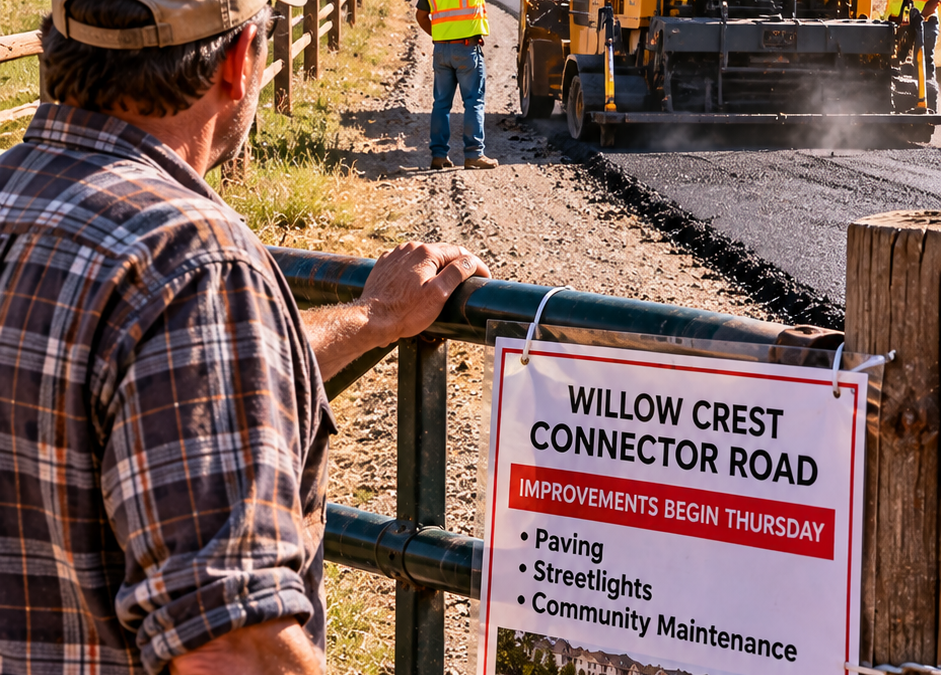
Then, one Monday morning, someone zip-tied that laminated notice to my gate.
Willow Crest Connector Road.
Connector.
As if naming it changed ownership.
I stood there reading the construction schedule and felt something I had not felt during all the years of casual traffic.
Not anger.
Not yet.
Clarity.
Somewhere along the way, my silence had been translated into consent.
A favor had become habit.
Habit had become expectation.
Expectation had become authority.
The notice was signed by Linda Pruitt, president of the Willow Crest Homeowners Association.
Crews would begin Thursday.
The lane would receive asphalt.
Streetlights would be installed.
Drainage would be modified.
The HOA would assume maintenance under what the notice called the community’s long-standing right of use.
Long-standing right of use.
That phrase bothered me more than the paving.
I went back to the house.
Made coffee.
Read the notice again.
Then I drove to the county recorder’s office.
Marcy Doyle had worked there for as long as I could remember.
She had known my parents.
She remembered when my mother brought homemade cookies into county offices at Christmas because Mom believed government employees were underfed.
I handed Marcy my parcel number.
“I need everything.”
“How far back?”
“Far enough to tell me whether somebody owns a right across Kessler Lane.”
She looked at me over her glasses.
“What happened?”
“Apparently my road has a new name.”
She did not ask what that meant.
She started searching.
For nearly an hour, she pulled deeds.
Parcel transfers.
Survey records.
Recorded rights-of-way.
Utility easements.
Agricultural access notes.
Old subdivision filings.
Then she placed a folder on the counter.
“Ray.”
I waited.
“There is no easement.”
“None?”
“Not for Willow Crest. Not for the builder. Not for an HOA.”
“What about a road dedication?”
“No.”
“Prescriptive filing?”
She shook her head.
“Nothing recorded.”
She turned one survey toward me.
“Kessler Lane is yours from the county road to the back fence.”
I stared at the map.
I had known that.
But knowing something because your father told you and knowing it because a public record says it are different feelings.
“You’re sure?”
Marcy smiled faintly.
“I’ve spent thirty-seven years telling people not to say ‘sure’ about land records.”
She tapped the deed.
“But I’m telling you what these records show. Your parcel owns that lane.”
I thanked her.
Ordered certified copies.
Then sat in my truck outside the courthouse.
I expected to be furious.
Instead, I felt calm.
Some problems become less frightening when they become specific.
Willow Crest did not have a recorded easement.
That did not mean there could never be some legal argument about long-term use.
I was not naïve.
But the notice on my gate claimed a right that nobody had ever bothered to establish.
That evening, I strapped a trail camera to the gatepost.
I had used cameras for years near the back pasture to monitor coyotes.
This one pointed toward the road.
Wednesday morning, I pulled the memory card.
Four hundred twelve vehicles.
In one day.
I thought the counter had malfunctioned.
So I checked manually.
Cars.
Pickups.
Delivery vans.
Landscapers.
Two contractor trucks.
The school bus.
Four hundred twelve.
That was when I sat down with my farm records.
Stone deliveries.
Grader fuel.
Culvert repairs.
Drainage work.
Over the previous three years, I had spent roughly six thousand dollars maintaining a road hundreds of vehicles were using every day.
No Willow Crest resident had ever offered money.
That alone was not what pushed me.
Two weeks before the notice appeared, a delivery van had come over the hill too fast while I was moving cattle.
I had four Hereford heifers crossing from the east pasture.
The van missed the last one by maybe the width of a coffee mug.
The driver braked, swerved, and kept going.
I stood in the dust afterward with my heart pounding.
I had told myself it was one bad driver.
Now the HOA wanted to pave the lane.
Pavement usually makes people faster.
Streetlights would make it feel public.
Signs would make it look official.
Give that five years and nobody would remember Kessler Lane had ever been anything except a Willow Crest street.
Wednesday afternoon, my phone rang.
“Mr. Kessler?”
“Yes.”
“This is Linda Pruitt from Willow Crest.”
Her voice was bright.
Professional.
The kind of voice used by someone who had already practiced the conversation.
“I wanted to touch base before tomorrow. We’re all very excited to finally improve the connector.”
I looked through my kitchen window toward the lane.
“Whose road, Linda?”
A pause.
“The community connector.”
“That’s not what I asked.”
Another pause.
“Kessler Lane has served Willow Crest for years.”
“It’s my lane.”
She laughed.
Not cruelly.
That almost made it worse.
It was the laugh of someone hearing an eccentric objection to an obvious fact.
“Well, everyone has used it for so long that it’s basically public at this point.”
Basically public.
I picked up the laminated notice lying beside my coffee mug and wrote those two words on the back.
“Do you have an easement?”
“The HOA has long-standing use.”
“That wasn’t my question.”
“Our attorney has reviewed the history.”
“Then send me the easement.”
“I’m not going to debate property law on the phone.”
“Good. Then don’t send a paving crew onto my property.”
Her voice lost some of its brightness.
“Mr. Kessler, the improvements are already scheduled.”
“Cancel them.”
“That would cost the association money.”
“So would paving a road you don’t own.”
She went quiet.
“We’ll talk tomorrow.”
Then she hung up.
Thursday morning, I was standing beside the gate at 7:10 when the dump truck arrived.
A paving crew followed.
Six workers.
A roller.
Equipment trailer.
The foreman looked about twenty-eight.
His name was Tyler.
He climbed out wearing a reflective vest and gave me the cheerful expression of a man expecting an ordinary day.
“Morning, sir. We need to get equipment through.”
“What are you paving?”
He pointed down Kessler Lane.
“The Willow Crest connector.”
“Who told you they own it?”
His smile faded.
“They said it’s a dedicated easement.”
“Did they give you one?”
He looked toward the project packet inside his truck.
“I have the work order.”
“Not the same thing.”
I handed him the certified folder from Marcy.
Tyler read the first page.
Then the survey.
Then the deed.
His cheerful expression lasted about ninety seconds.
He rubbed the back of his neck.
“Sir, I’m going to call my office.”
“That would be a good idea.”
I stayed beside the gate.
Did not block his truck.
Did not raise my voice.
Ten minutes later, Tyler returned.
“We’re standing down.”
“Thank you.”
“I’m sorry.”
“You didn’t know.”
“No, but still.”
He apologized again.
Then his crew began loading equipment.
As the last truck turned around, I noticed a new green metal sign planted beside my gate.
WILLOW CREST CONNECTOR
I walked over.
Pulled it from the dirt.
Tossed it into the bed of my pickup.
That evening, I sat on my porch until the sun dropped behind the barn.
The farm became quiet after dark in a way neighborhoods rarely do.
You hear insects.
Cattle shifting.
A truck on the county road.
The old barn roof clicking as it cools.
Dad had loved that porch.
He drank coffee there every morning until his hands shook too badly to carry the cup without spilling.
I kept thinking about what he would have done.
Dad had never locked the front gate in his life.
Not once.
Even after people started using the lane.
He probably would have complained.
Probably would have called somebody stubborn.
Then he would have gone back to fixing fence.
I was about to do something he never would have done.
That bothered me.
But Dad had also never seen four hundred twelve vehicles on that road in one day.
He had never watched a delivery van nearly hit a heifer.
And nobody had ever hung a sign on his gate telling him when someone else planned to pave his property.
I did not want revenge.
I did not want seventy-three families trapped.
I wanted one fact to become impossible to ignore.
At five Friday morning, I installed a steel gate across Kessler Lane.
I wrapped a chain around the post.
Snapped on a padlock.
Then hung a white sign.
PRIVATE ROAD
ACCESS BY WRITTEN AGREEMENT ONLY
My phone number was beneath it.
I looked at the sign for a long time.
Then I went to feed cattle.
The first car reached the gate at 6:40.
The driver stopped.
Backed up.
Turned around.
Then another arrived.
And another.
By seven, headlights stretched back toward Willow Crest.
At 7:30, the school bus rolled to the front of the line.
Gloria had been driving that route for three years.
She was probably sixty.
Gray hair.
Pink gloves in winter.
She waved every morning whether I looked up or not.
I walked toward the bus.
She opened the door.
“Morning, Ray.”
“Morning.”
She looked at the chain.
“Guess we’re not going through.”
“This isn’t about you.”
She sighed.
“I know.”
“I should’ve called the district.”
“They’ll survive.”
“You mad?”
“At you?”
She shook her head.
“I’m mad at whoever let it get this far.”
She closed the door.
Then turned a forty-foot school bus around on my gravel apron without touching a post.
The detour added fourteen minutes to the route.
By eight, traffic at Hollis Pike was backed up through two light cycles.
By noon, Marcy texted me a screenshot.
Willow Crest Facebook group.
DOES ANYONE KNOW THE CRAZY FARMER WHO CLOSED OUR ROAD?
Forty-one replies.
“He can’t do that.”
“We’ve used it for years.”
“Call the sheriff.”
“My kids are late to school.”
“This is extortion.”
Not one of the first forty-one comments asked whose road it was.
That hurt more than I expected.
I had waved at some of those people.
Pulled one family’s minivan out during a snowstorm.
Allowed contractors through.
Let teenagers bike the lane.
Never charged anyone.
And somehow my first serious no had erased every previous yes.
Around three, a woman named Carla Jenkins called.
She lived near the Willow Crest pool.
“Mr. Kessler, I’m not calling to yell.”
“I appreciate that.”
“I just want to understand.”
So I told her.
No easement.
No road dedication.
No maintenance agreement.
HOA scheduled paving without permission.
She listened.
Then said, “Linda told us you suddenly blocked a road the neighborhood has always had legal access to.”
“I’m looking at the county record while we talk.”
“So the HOA doesn’t own it?”
“Not according to anything the county can find.”
There was a long silence.
“My husband says years of use might still matter legally.”
“He may be right. That’s what lawyers are for.”
“Then why lock it?”
“Because they were going to pave it.”
She exhaled.
“I didn’t know that.”
“That seems to be the theme.”
Saturday morning, a black sedan pulled up.
A man stepped out in a charcoal coat.
“Ray Kessler?”
“Yes.”
“Mark Stoll. I represent Willow Crest.”
He looked at the gate.
“Can we speak?”
We sat at a picnic table beside the workshop.
Mark opened with what I expected.
Prescriptive rights.
Reliance.
Long-standing use.
Potential injunctive relief.
Community hardship.
He was calm.
Professional.
He did not threaten me.
At least not directly.
“Mr. Kessler, twenty years of continuous use can create significant legal issues.”
“The development isn’t twenty years old.”
He nodded.
“Fair point. I’m speaking generally.”
“The builder asked permission.”
His pen stopped.
“Do you have that in writing?”
“No.”
“Then that becomes a factual issue.”
“I remember the handshake.”
“The builder may describe it differently.”
“The builder left Ohio years ago.”
“That does not eliminate the issue.”
I respected that answer.
He was doing his job.
So I handed him an envelope.
“What’s this?”
“A proposal.”
He opened it.
Twenty-year recorded easement.
Guaranteed Willow Crest access.
Twenty-five dollars per home per month.
For seventy-three homes, that totaled $1,825 monthly.
There would also be a one-time payment of $60,000 toward historical road wear and deferred improvements.
The HOA would professionally pave the lane.
Install proper shoulders and drainage.
Maintain it.
Carry a $2 million liability policy naming me as an additional insured.
Traffic would be limited to fifteen miles per hour.
Cattle-crossing signs would be installed.
No streetlights without my approval.
No widening.
No utility installation.
Every sign would identify it as a private road shared by agreement.
Mark finished reading.
Then looked at me.
“That’s steep.”
“It’s an invoice.”
“For what?”
“A service your client has been taking for free.”
“The residents will see this as you monetizing their dependence.”
“I see them paving my property without permission.”
He leaned back.
“Why sixty thousand?”
“Stone, grading, culverts, maintenance.”
“You have receipts?”
“Most of them.”
“And the monthly charge?”
“For continued use.”
He studied me.
“You understand a court could disagree with your ownership position regarding access.”
“A court could.”
“You could spend more fighting this than your road is worth.”
“I could.”
“Then why not negotiate something smaller now?”
I looked toward the gate.
“Because I already negotiated something smaller.”
“When?”
“For years.”
He frowned.
“I charged nothing.”
Mark closed the envelope.
“I’ll take it to the board.”
When he left, the farm became quiet.
No vehicles.
No school bus.
No delivery vans.
No landscapers.
For the first time in years, Kessler Lane sounded the way I remembered it from childhood.
I expected that to feel good.
It did not.
The quiet was worse than the horns.
I barely slept that weekend.
Every sound woke me.
Headlights.
A vehicle slowing.
A chain moving in the wind.
I began imagining lawsuits.
Court costs.
Depositions.
Experts.
Maybe I had overreacted.
Maybe I should have left the road open while negotiating.
Maybe a judge would decide that years of use had created rights I did not understand.
Maybe my father would have hated the gate.
That thought bothered me most.
Dad never treated property lines like weapons.
But he also believed people should ask.
I remembered him once lending a neighbor our hay wagon for two months.
When the neighbor finally returned it, one tire was bald.
Dad smiled, thanked him, and replaced the tire himself.
I asked why he was not angry.
“He brought it back.”
“But he wore out the tire.”
Dad shrugged.
“That was the price of saying yes.”
I asked, “What if he never brought it back?”
Dad looked at me.
“Then it wouldn’t be the same question.”
That memory stayed with me.
For years, I had been paying the price of saying yes.
The problem was not the worn road.
The problem was that Willow Crest had stopped believing I was capable of saying no.
Monday brought two certified letters.
One from Mark.
One from the HOA management company.
Neither filed suit.
The attorney’s letter said Willow Crest disputed my right to interrupt established access and reserved all legal remedies.
The management letter called my proposal financially unreasonable.
Tuesday, someone left a bag of dog waste hanging from the gate.
Wednesday, I found a handwritten note.
THANKS FOR MAKING 73 FAMILIES SUFFER.
I threw both away.
Thursday, an older man named Frank Massey walked from Willow Crest to the gate.
He was carrying a thermos.
“You Ray?”
“Yes.”
“I live on Juniper Court.”
He held up the thermos.
“Peace offering.”
I unlocked the pedestrian side gap.
We sat beside the barn.
Frank had moved into Willow Crest fourteen years earlier.
“I thought this road belonged to the HOA.”
“I know.”
“That’s what they told us when we bought.”
That got my attention.
“Who told you?”
“Real estate agent.”
“Anything in your closing documents?”
“I looked last night.”
He shook his head.
“Nothing.”
We drank coffee.
Then he said, “My wife thinks you’re greedy.”
“That makes two of us some nights.”
He laughed.
“I don’t.”
“Why not?”
“Because if you were greedy, you would’ve started charging fourteen years ago.”
That was the first thing anyone said during those days that made me feel less alone.
Word slowly changed inside Willow Crest.
Carla shared the county deed record.
Frank posted my proposal.
A resident who worked in insurance explained why liability coverage mattered.
Someone else calculated the monthly cost.
Twenty-five dollars per house.
Less than some residents were paying for streaming services.
The $60,000 payment created more anger.
But then Marcy helped me organize three years of maintenance receipts.
Not because she took sides.
Because she liked documents.
Stone.
Fuel.
Culvert replacement.
Drainage pipe.
Rental grader parts.
Six thousand dollars direct expense over three years.
That did not justify the entire amount by itself.
I never claimed it did.
The rest represented the value of converting a private farm lane into a maintained residential connector.
Ten days passed.
No lawsuit.
No agreement.
The gate remained locked.
I began using the silence to repair things I had ignored.
A loose barn hinge.
Fence behind the pond.
One afternoon, I found myself sitting on the grader Dad had bought secondhand in 1987.
Its paint was mostly rust.
The seat had been replaced twice.
The steering wheel still had electrical tape where Dad wrapped it after the original rubber split.
The green Willow Crest Connector sign lay against the wall nearby.
I picked it up.
Somebody had spent money ordering that sign before anyone checked whether the HOA owned the road.
That was what bothered me.
The assumption had become expensive before anyone asked the first basic question.
On the eleventh morning, I heard tires on gravel.
I expected Mark’s sedan.
Instead, Linda’s black SUV stopped outside the gate.
She was alone.
No attorney.
No board member.
No folder.
She held my proposal in one hand.
I walked toward her.
“Morning.”
“Morning, Ray.”
Her voice sounded different.
No brightness.
No rehearsal.
“Can we talk?”
I opened the small side gate.
We went into the kitchen.
I made coffee because my mother would have haunted me if I let somebody sit at our table without offering something.
Linda wrapped both hands around the mug.
For almost a minute, she said nothing.
Finally, she looked toward me.
“I read your deed.”
“All of it?”
“All of it.”
“And?”
“You own the lane.”
I waited.
“Our attorney still thinks there may be arguments about continued use.”
“I know.”
“But there is no recorded easement.”
“No.”
“I should have checked before the paving notice.”
“Yes.”
She nodded slowly.
“That’s all it would have taken.”
I said nothing.
Then she gave a tired half-smile.
“You could have just told us.”
I looked at her.
“I did.”
She frowned slightly.
“Wednesday on the phone.”
She looked down at her coffee.
“Thursday with your paving crew.”
Neither of us spoke.
Finally, I said, “You answered with asphalt.”
That landed.
She did not defend herself.
“I thought the road was ours.”
“Why?”
“Because everybody said it was.”
“Who?”
“The developer. Previous boards. Residents. Management. It was on internal maps.”
“Internal maps don’t transfer land.”
“I know that now.”
She looked toward the window.
“I became president six months ago. The paving project was already in the capital schedule.”
That surprised me.
“You didn’t start it?”
“I expanded it.”
“Streetlights?”
“That was me.”
I almost smiled.
“Those were never happening.”
“I gathered that.”
She opened my proposal.
“The board met last night.”
“And?”
“We’re willing to sign.”
I did not move.
“All of it?”
“Not exactly.”
There it was.
I leaned back.
Linda slid a marked copy toward me.
They accepted the twenty-year recorded easement.
Private-road status.
Insurance.
HOA responsibility for professional paving, drainage, and maintenance.
Fifteen-mile-per-hour speed limit.
Cattle crossing.
No widening.
No utilities.
No streetlights without written permission.
They asked for the one-time payment to be reduced from sixty thousand to fifty.
Monthly cost remained twenty-five dollars per home.
I read every page.
“Why cut ten thousand?”
“Because Mark says a portion of your historical maintenance also benefited your farm.”
“He’s right.”
Linda looked surprised.
“I know.”
“You’re okay with fifty?”
“Yes.”
She stared at me for a moment.
“I expected this to be harder.”
“Why?”
“Because I thought you wanted to punish us.”
I looked around the kitchen.
Dad’s old photograph still hung above the pantry door.
He was standing beside the original grader.
Young.
Thin.
Covered in dust.
“I spent eleven days wondering whether I was punishing you.”
“Were you?”
“No.”
“How do you know?”
“Because I still want you to use the road.”
Linda nodded.
That seemed to matter.
She took a pen from her purse.
“Where do I sign?”
“Not here.”
She laughed quietly.
“Why not?”
“Because I learned something from all this.”
“What?”
“We get lawyers to write the final version.”
That afternoon, after Mark and my attorney reviewed the language, I opened the gate.
There was no ceremony.
No cheering.
No line of cars waiting.
I removed the chain.
Swung the steel gate aside.
Then went to check cattle.
Traffic returned gradually.
Within a month, the HOA paved Kessler Lane properly.
Not like a subdivision street.
Like a rural private road built for mixed use.
The contractor rebuilt drainage shoulders.
They repaired two culverts.
Installed a reinforced cattle crossing.
Fifteen-mile-per-hour signs went up.
So did a yellow livestock warning sign.
At my request, no streetlights were installed.
I did not want my fields glowing all night because people were nervous driving through darkness.
At the gate, a new marker appeared.
This time, I approved the wording.
KESSLER LANE
PRIVATE ROAD
SHARED BY RECORDED AGREEMENT
The old green WILLOW CREST CONNECTOR sign hangs in my barn now.
Right beside Dad’s grader.
I kept it because it reminds me how easily language changes the way people think.
Call something a connector long enough and people forget it is a farm road.
Call repeated use a right and people forget somebody originally said yes.
Call paving an improvement and people forget improvement still requires permission from the owner.
The traffic today is almost exactly what it was before the gate closed.
School bus.
Delivery vans.
Landscapers.
Residents.
Garbage trucks.
My feed truck.
The difference is that every vehicle now travels under an agreement instead of an assumption.
The HOA maintains the pavement.
They carry insurance.
My property is protected.
Willow Crest residents have guaranteed access for twenty years.
The monthly payment arrives automatically.
I use part of it for road-related taxes and maintenance on the rest of the farm.
Nobody has complained about the fifteen-mile-per-hour limit nearly as much as I expected.
The school bus driver loves it.
So do the cattle.
A few months after the agreement was recorded, Gloria stopped beside me while I was fixing a fence post.
She opened the bus door.
“Ray.”
“Morning.”
“Kids are asking why the sign says private road now.”
“What’d you tell them?”
“That grown-ups forgot to do their paperwork.”
I laughed.
“That’s probably the most accurate version.”
She smiled.
“Road rides better.”
“They paved it right.”
“About time.”
Then she drove away.
Linda and I are not friends.
But we are no longer enemies either.
That may be more important.
Twice a year, the HOA sends someone to inspect the drainage with me.
The first time Linda came herself.
We walked the ditch line in boots after a heavy rain.
Near the lower culvert, she stopped.
“You really used to maintain all this alone?”
“For thirty years.”
“How much time?”
“Depends on the year.”
She shook her head.
“I don’t think anybody understood.”
“No.”
“That makes me feel worse.”
“You understood eventually.”
She looked toward Willow Crest.
“I still think the gate was extreme.”
“I do too sometimes.”
She turned back.
“Would you do it again?”
I thought about that.
“Yes.”
She nodded as though she had expected it.
“Fair.”
People sometimes hear this story and assume the gate was the victory.
It was not.
The gate was pressure.
Pressure can expose a problem.
It cannot solve one by itself.
If I had kept the road locked because I enjoyed having leverage, I would have become part of the problem.
Seventy-three families had built routines around an access nobody had told them was informal.
Children rode a school bus through there.
Delivery drivers depended on it.
Emergency vehicles preferred it.
Those people were not responsible for the original mistake.
The correct outcome was never to punish them.
The correct outcome was to turn dependency into an honest agreement.
That distinction mattered to me because of my father.
For months after the dispute ended, I kept wondering what he would have thought.
Dad believed property was something you cared for, not something you worshipped.
He loaned tools.
Shared equipment.
Let neighbors cut across fields when they needed to.
But there was one thing he hated.
Someone acting entitled to what had been offered freely.
I remember an incident when I was seventeen.
A neighbor named Carl began using one of our hay wagons without asking.
Dad had loaned it to him twice before.
The third time, Carl simply came into the yard, hooked onto it, and left.
Dad followed him in the pickup.
I rode along.
Carl was loading hay when we arrived.
Dad did not yell.
He walked over and said, “You forgot to ask.”
Carl laughed.
“You always say yes.”
Dad looked at him.
“That’s why asking should be easy.”
Carl stared for a second.
Then apologized.
Dad let him keep the wagon for the day.
On the drive home, I asked why he bothered making the trip if he was still going to say yes.
Dad said, “Because yes only means something when no is still allowed.”
I had forgotten that conversation for almost forty years.
The gate brought it back.
That was the real problem with Kessler Lane.
Not asphalt.
Not money.
Not even four hundred twelve cars.
My yes had stopped meaning anything because everyone assumed my no no longer existed.
Nobody wakes up one morning and decides to become entitled.
Entitlement usually grows slowly.
A favor is available Monday.
Still available Tuesday.
Available the next year.
And the year after that.
Someone new moves in and nobody tells them it was ever a favor.
Then another person arrives.
Then another.
Eventually, the history disappears.
All that remains is expectation.
The person who kept saying yes becomes invisible.
Until the morning he finally says no.
Then suddenly everybody notices him.
Some people in Willow Crest never forgave me.
I know that.
One resident still refuses to wave when we pass on County Road 9.
Another told Frank that I had exploited a legal technicality to create income from neighbors.
Maybe that is how it looks from his side.
I can live with that.
I also understand why the $25-per-home payment bothered people.
Money changes the tone of a dispute.
If I had simply demanded a recorded easement and maintenance, I would have looked generous.
The moment I attached a price, some people decided greed must have been my motive all along.
But the road had economic value.
Seventy-three households used it.
The HOA wanted guaranteed access.
They wanted a paved route that shortened travel time and supported school buses, deliveries, contractors, and services.
A permanent benefit has value.
Pretending otherwise would have repeated the same mistake that caused the conflict.
The most important part of the final deal was not the monthly payment.
It was that Willow Crest had to acknowledge something simple.
The road belonged to somebody.
Access existed because that somebody agreed.
I did not own the residents.
I did not control their homes.
They did not own my lane.
The contract connected those two realities.
There is something else I learned.
People speak differently once responsibility is written down.
Before the agreement
𝗧𝗛𝗘 𝗘𝗡𝗗
Someone Had Named My Road, Scheduled the Asphalt, and Somehow Forgotten the Man Who Owned Every Foot of It
The morning I found a laminated notice zip-tied to my gate, I did not tear it down.
I did not call a lawyer.
I did not drive into the subdivision next door demanding to know who had decided they could pave my road.
I stood there in my work boots with one hand on the gatepost and read the notice twice.
WILLOW CREST CONNECTOR ROAD
IMPROVEMENTS BEGIN THURSDAY
Below that were three bullet points.
Paving.
Streetlights.
Community maintenance.
The words had been printed across a lane I had paid taxes on for thirty-one years.
Somebody had named my road.
Somebody had scheduled construction on it.
Somebody had hired a paving crew.
And nobody had asked me a single question.
My name is Ray Kessler.
My family has farmed outside Marlow Creek, Ohio, since 1961.
We have one hundred forty acres of hay ground, pasture, and woods, along with a red barn that leans slightly east because my father believed a structure could be straight enough without being perfect.
The road at the center of all of this is called Kessler Lane.
That name is not something I invented during the dispute.
It appears on county records.
It appears on my deed.
It appears on old farm-delivery invoices that still carry my father’s handwriting.
The lane runs a mile and a quarter from our farm to County Road 9.
Every foot of it sits on land my family owns.
My father built most of the original lane himself.
He rented an old grader from a farmer three townships over and spent nearly two weeks cutting through clay, shaping ditches, and hauling crushed limestone.
I was twelve.
My job was mostly standing around asking questions and getting in the way.
Dad never complained.
He would stop the grader, point toward the slope, and explain why water mattered more than gravel.
“Anybody can dump stone,” he told me. “The trick is giving the rain somewhere else to go.”
That was my father.
He could turn road drainage into a sermon.
For most of my life, Kessler Lane had three regular users.
Me.
The mail carrier.
And the feed truck.
Sometimes a veterinarian came through.
Sometimes a neighbor.
Nobody needed a policy for that.
You waved.
You opened the gate.
If somebody got stuck in winter, you pulled them out.
That was how things worked.
Then Willow Crest was built beyond my northern fence.
Seventy-three homes.
Stucco and stone exteriors.
Decorative entrance columns.
A clubhouse.
A swimming pool.
Sidewalks that ended abruptly where the development ended.
I had nothing against the people who lived there.
Most of them were decent.
Teachers.
Nurses.
Retired couples.
Families with children.
People who wanted a quiet neighborhood outside town.
My problem was never with seventy-three families.
My problem started with a favor.
During construction, the subdivision builder’s foreman came to my farm.
His name was Jim Harper.
I still remember because he stood in my workshop holding his hard hat under one arm like he had walked into church.
“The county road entrance is backing our trucks up,” he said. “Any chance we can use your lane for a couple months?”
“What kind of trucks?”
“Concrete, lumber, utility crews. Nothing crazy.”
“How many?”
He shrugged.
“Depends on the week.”
I should have asked for paper.
I know that now.
But I had grown up in a place where men still shook hands and then did what they said.
“How long?”
“Until we finish the north section.”
“And you’ll repair any damage?”
“Absolutely.”
I held out my hand.
“Then use it.”
That was all.
No attorney.
No easement.
No recorded right.
No payment.
A favor.
Construction trucks used Kessler Lane for several months.
The builder repaired two soft spots.
Then the heavy trucks disappeared.
I assumed that was the end of it.
The shortcut stayed.
At first it was only a few residents.
Someone probably saw the lane on a phone map and realized it saved several minutes getting to County Road 9.
Then more people began using it.
The pattern was gradual enough that I did what people often do with small annoyances.
I tolerated it.
Ten cars became thirty.
Thirty became fifty.
Then delivery drivers learned the route.
Then landscapers.
Contractors.
Teenagers.
Eventually the school bus.
Nobody held a meeting.
Nobody asked permission.
The lane simply became useful.
And useful things have a way of becoming invisible to the people who benefit from them.
Every spring, I graded it.
Every summer, I patched washouts.
Every fall, I ordered stone.
Every winter, I plowed it when snow got deep enough that my own trucks could not pass.
Willow Crest residents drove on it.
I maintained it.
That was the arrangement nobody had ever discussed.
For years, I told myself it was not worth creating trouble.
The traffic was irritating but manageable.
Most drivers slowed down near the cattle crossing.
Most waved.
Some did not.
That changed over time too.
The newer people did not know me.
They knew the road.
And those are not the same thing.
Then, one Monday morning, someone zip-tied that laminated notice to my gate.
Willow Crest Connector Road.
Connector.
As if naming it changed ownership.
I stood there reading the construction schedule and felt something I had not felt during all the years of casual traffic.
Not anger.
Not yet.
Clarity.
Somewhere along the way, my silence had been translated into consent.
A favor had become habit.
Habit had become expectation.
Expectation had become authority.
The notice was signed by Linda Pruitt, president of the Willow Crest Homeowners Association.
Crews would begin Thursday.
The lane would receive asphalt.
Streetlights would be installed.
Drainage would be modified.
The HOA would assume maintenance under what the notice called the community’s long-standing right of use.
Long-standing right of use.
That phrase bothered me more than the paving.
I went back to the house.
Made coffee.
Read the notice again.
Then I drove to the county recorder’s office.
Marcy Doyle had worked there for as long as I could remember.
She had known my parents.
She remembered when my mother brought homemade cookies into county offices at Christmas because Mom believed government employees were underfed.
I handed Marcy my parcel number.
“I need everything.”
“How far back?”
“Far enough to tell me whether somebody owns a right across Kessler Lane.”
She looked at me over her glasses.
“What happened?”
“Apparently my road has a new name.”
She did not ask what that meant.
She started searching.
For nearly an hour, she pulled deeds.
Parcel transfers.
Survey records.
Recorded rights-of-way.
Utility easements.
Agricultural access notes.
Old subdivision filings.
Then she placed a folder on the counter.
“Ray.”
I waited.
“There is no easement.”
“None?”
“Not for Willow Crest. Not for the builder. Not for an HOA.”
“What about a road dedication?”
“No.”
“Prescriptive filing?”
She shook her head.
“Nothing recorded.”
She turned one survey toward me.
“Kessler Lane is yours from the county road to the back fence.”
I stared at the map.
I had known that.
But knowing something because your father told you and knowing it because a public record says it are different feelings.
“You’re sure?”
Marcy smiled faintly.
“I’ve spent thirty-seven years telling people not to say ‘sure’ about land records.”
She tapped the deed.
“But I’m telling you what these records show. Your parcel owns that lane.”
I thanked her.
Ordered certified copies.
Then sat in my truck outside the courthouse.
I expected to be furious.
Instead, I felt calm.
Some problems become less frightening when they become specific.
Willow Crest did not have a recorded easement.
That did not mean there could never be some legal argument about long-term use.
I was not naïve.
But the notice on my gate claimed a right that nobody had ever bothered to establish.
That evening, I strapped a trail camera to the gatepost.
I had used cameras for years near the back pasture to monitor coyotes.
This one pointed toward the road.
Wednesday morning, I pulled the memory card.
Four hundred twelve vehicles.
In one day.
I thought the counter had malfunctioned.
So I checked manually.
Cars.
Pickups.
Delivery vans.
Landscapers.
Two contractor trucks.
The school bus.
Four hundred twelve.
That was when I sat down with my farm records.
Stone deliveries.
Grader fuel.
Culvert repairs.
Drainage work.
Over the previous three years, I had spent roughly six thousand dollars maintaining a road hundreds of vehicles were using every day.
No Willow Crest resident had ever offered money.
That alone was not what pushed me.
Two weeks before the notice appeared, a delivery van had come over the hill too fast while I was moving cattle.
I had four Hereford heifers crossing from the east pasture.
The van missed the last one by maybe the width of a coffee mug.
The driver braked, swerved, and kept going.
I stood in the dust afterward with my heart pounding.
I had told myself it was one bad driver.
Now the HOA wanted to pave the lane.
Pavement usually makes people faster.
Streetlights would make it feel public.
Signs would make it look official.
Give that five years and nobody would remember Kessler Lane had ever been anything except a Willow Crest street.
Wednesday afternoon, my phone rang.
“Mr. Kessler?”
“Yes.”
“This is Linda Pruitt from Willow Crest.”
Her voice was bright.
Professional.
The kind of voice used by someone who had already practiced the conversation.
“I wanted to touch base before tomorrow. We’re all very excited to finally improve the connector.”
I looked through my kitchen window toward the lane.
“Whose road, Linda?”
A pause.
“The community connector.”
“That’s not what I asked.”
Another pause.
“Kessler Lane has served Willow Crest for years.”
“It’s my lane.”
She laughed.
Not cruelly.
That almost made it worse.
It was the laugh of someone hearing an eccentric objection to an obvious fact.
“Well, everyone has used it for so long that it’s basically public at this point.”
Basically public.
I picked up the laminated notice lying beside my coffee mug and wrote those two words on the back.
“Do you have an easement?”
“The HOA has long-standing use.”
“That wasn’t my question.”
“Our attorney has reviewed the history.”
“Then send me the easement.”
“I’m not going to debate property law on the phone.”
“Good. Then don’t send a paving crew onto my property.”
Her voice lost some of its brightness.
“Mr. Kessler, the improvements are already scheduled.”
“Cancel them.”
“That would cost the association money.”
“So would paving a road you don’t own.”
She went quiet.
“We’ll talk tomorrow.”
Then she hung up.
Thursday morning, I was standing beside the gate at 7:10 when the dump truck arrived.
A paving crew followed.
Six workers.
A roller.
Equipment trailer.
The foreman looked about twenty-eight.
His name was Tyler.
He climbed out wearing a reflective vest and gave me the cheerful expression of a man expecting an ordinary day.
“Morning, sir. We need to get equipment through.”
“What are you paving?”
He pointed down Kessler Lane.
“The Willow Crest connector.”
“Who told you they own it?”
His smile faded.
“They said it’s a dedicated easement.”
“Did they give you one?”
He looked toward the project packet inside his truck.
“I have the work order.”
“Not the same thing.”
I handed him the certified folder from Marcy.
Tyler read the first page.
Then the survey.
Then the deed.
His cheerful expression lasted about ninety seconds.
He rubbed the back of his neck.
“Sir, I’m going to call my office.”
“That would be a good idea.”
I stayed beside the gate.
Did not block his truck.
Did not raise my voice.
Ten minutes later, Tyler returned.
“We’re standing down.”
“Thank you.”
“I’m sorry.”
“You didn’t know.”
“No, but still.”
He apologized again.
Then his crew began loading equipment.
As the last truck turned around, I noticed a new green metal sign planted beside my gate.
WILLOW CREST CONNECTOR
I walked over.
Pulled it from the dirt.
Tossed it into the bed of my pickup.
That evening, I sat on my porch until the sun dropped behind the barn.
The farm became quiet after dark in a way neighborhoods rarely do.
You hear insects.
Cattle shifting.
A truck on the county road.
The old barn roof clicking as it cools.
Dad had loved that porch.
He drank coffee there every morning until his hands shook too badly to carry the cup without spilling.
I kept thinking about what he would have done.
Dad had never locked the front gate in his life.
Not once.
Even after people started using the lane.
He probably would have complained.
Probably would have called somebody stubborn.
Then he would have gone back to fixing fence.
I was about to do something he never would have done.
That bothered me.
But Dad had also never seen four hundred twelve vehicles on that road in one day.
He had never watched a delivery van nearly hit a heifer.
And nobody had ever hung a sign on his gate telling him when someone else planned to pave his property.
I did not want revenge.
I did not want seventy-three families trapped.
I wanted one fact to become impossible to ignore.
At five Friday morning, I installed a steel gate across Kessler Lane.
I wrapped a chain around the post.
Snapped on a padlock.
Then hung a white sign.
PRIVATE ROAD
ACCESS BY WRITTEN AGREEMENT ONLY
My phone number was beneath it.
I looked at the sign for a long time.
Then I went to feed cattle.
The first car reached the gate at 6:40.
The driver stopped.
Backed up.
Turned around.
Then another arrived.
And another.
By seven, headlights stretched back toward Willow Crest.
At 7:30, the school bus rolled to the front of the line.
Gloria had been driving that route for three years.
She was probably sixty.
Gray hair.
Pink gloves in winter.
She waved every morning whether I looked up or not.
I walked toward the bus.
She opened the door.
“Morning, Ray.”
“Morning.”
She looked at the chain.
“Guess we’re not going through.”
“This isn’t about you.”
She sighed.
“I know.”
“I should’ve called the district.”
“They’ll survive.”
“You mad?”
“At you?”
She shook her head.
“I’m mad at whoever let it get this far.”
She closed the door.
Then turned a forty-foot school bus around on my gravel apron without touching a post.
The detour added fourteen minutes to the route.
By eight, traffic at Hollis Pike was backed up through two light cycles.
By noon, Marcy texted me a screenshot.
Willow Crest Facebook group.
DOES ANYONE KNOW THE CRAZY FARMER WHO CLOSED OUR ROAD?
Forty-one replies.
“He can’t do that.”
“We’ve used it for years.”
“Call the sheriff.”
“My kids are late to school.”
“This is extortion.”
Not one of the first forty-one comments asked whose road it was.
That hurt more than I expected.
I had waved at some of those people.
Pulled one family’s minivan out during a snowstorm.
Allowed contractors through.
Let teenagers bike the lane.
Never charged anyone.
And somehow my first serious no had erased every previous yes.
Around three, a woman named Carla Jenkins called.
She lived near the Willow Crest pool.
“Mr. Kessler, I’m not calling to yell.”
“I appreciate that.”
“I just want to understand.”
So I told her.
No easement.
No road dedication.
No maintenance agreement.
HOA scheduled paving without permission.
She listened.
Then said, “Linda told us you suddenly blocked a road the neighborhood has always had legal access to.”
“I’m looking at the county record while we talk.”
“So the HOA doesn’t own it?”
“Not according to anything the county can find.”
There was a long silence.
“My husband says years of use might still matter legally.”
“He may be right. That’s what lawyers are for.”
“Then why lock it?”
“Because they were going to pave it.”
She exhaled.
“I didn’t know that.”
“That seems to be the theme.”
Saturday morning, a black sedan pulled up.
A man stepped out in a charcoal coat.
“Ray Kessler?”
“Yes.”
“Mark Stoll. I represent Willow Crest.”
He looked at the gate.
“Can we speak?”
We sat at a picnic table beside the workshop.
Mark opened with what I expected.
Prescriptive rights.
Reliance.
Long-standing use.
Potential injunctive relief.
Community hardship.
He was calm.
Professional.
He did not threaten me.
At least not directly.
“Mr. Kessler, twenty years of continuous use can create significant legal issues.”
“The development isn’t twenty years old.”
He nodded.
“Fair point. I’m speaking generally.”
“The builder asked permission.”
His pen stopped.
“Do you have that in writing?”
“No.”
“Then that becomes a factual issue.”
“I remember the handshake.”
“The builder may describe it differently.”
“The builder left Ohio years ago.”
“That does not eliminate the issue.”
I respected that answer.
He was doing his job.
So I handed him an envelope.
“What’s this?”
“A proposal.”
He opened it.
Twenty-year recorded easement.
Guaranteed Willow Crest access.
Twenty-five dollars per home per month.
For seventy-three homes, that totaled $1,825 monthly.
There would also be a one-time payment of $60,000 toward historical road wear and deferred improvements.
The HOA would professionally pave the lane.
Install proper shoulders and drainage.
Maintain it.
Carry a $2 million liability policy naming me as an additional insured.
Traffic would be limited to fifteen miles per hour.
Cattle-crossing signs would be installed.
No streetlights without my approval.
No widening.
No utility installation.
Every sign would identify it as a private road shared by agreement.
Mark finished reading.
Then looked at me.
“That’s steep.”
“It’s an invoice.”
“For what?”
“A service your client has been taking for free.”
“The residents will see this as you monetizing their dependence.”
“I see them paving my property without permission.”
He leaned back.
“Why sixty thousand?”
“Stone, grading, culverts, maintenance.”
“You have receipts?”
“Most of them.”
“And the monthly charge?”
“For continued use.”
He studied me.
“You understand a court could disagree with your ownership position regarding access.”
“A court could.”
“You could spend more fighting this than your road is worth.”
“I could.”
“Then why not negotiate something smaller now?”
I looked toward the gate.
“Because I already negotiated something smaller.”
“When?”
“For years.”
He frowned.
“I charged nothing.”
Mark closed the envelope.
“I’ll take it to the board.”
When he left, the farm became quiet.
No vehicles.
No school bus.
No delivery vans.
No landscapers.
For the first time in years, Kessler Lane sounded the way I remembered it from childhood.
I expected that to feel good.
It did not.
The quiet was worse than the horns.
I barely slept that weekend.
Every sound woke me.
Headlights.
A vehicle slowing.
A chain moving in the wind.
I began imagining lawsuits.
Court costs.
Depositions.
Experts.
Maybe I had overreacted.
Maybe I should have left the road open while negotiating.
Maybe a judge would decide that years of use had created rights I did not understand.
Maybe my father would have hated the gate.
That thought bothered me most.
Dad never treated property lines like weapons.
But he also believed people should ask.
I remembered him once lending a neighbor our hay wagon for two months.
When the neighbor finally returned it, one tire was bald.
Dad smiled, thanked him, and replaced the tire himself.
I asked why he was not angry.
“He brought it back.”
“But he wore out the tire.”
Dad shrugged.
“That was the price of saying yes.”
I asked, “What if he never brought it back?”
Dad looked at me.
“Then it wouldn’t be the same question.”
That memory stayed with me.
For years, I had been paying the price of saying yes.
The problem was not the worn road.
The problem was that Willow Crest had stopped believing I was capable of saying no.
Monday brought two certified letters.
One from Mark.
One from the HOA management company.
Neither filed suit.
The attorney’s letter said Willow Crest disputed my right to interrupt established access and reserved all legal remedies.
The management letter called my proposal financially unreasonable.
Tuesday, someone left a bag of dog waste hanging from the gate.
Wednesday, I found a handwritten note.
THANKS FOR MAKING 73 FAMILIES SUFFER.
I threw both away.
Thursday, an older man named Frank Massey walked from Willow Crest to the gate.
He was carrying a thermos.
“You Ray?”
“Yes.”
“I live on Juniper Court.”
He held up the thermos.
“Peace offering.”
I unlocked the pedestrian side gap.
We sat beside the barn.
Frank had moved into Willow Crest fourteen years earlier.
“I thought this road belonged to the HOA.”
“I know.”
“That’s what they told us when we bought.”
That got my attention.
“Who told you?”
“Real estate agent.”
“Anything in your closing documents?”
“I looked last night.”
He shook his head.
“Nothing.”
We drank coffee.
Then he said, “My wife thinks you’re greedy.”
“That makes two of us some nights.”
He laughed.
“I don’t.”
“Why not?”
“Because if you were greedy, you would’ve started charging fourteen years ago.”
That was the first thing anyone said during those days that made me feel less alone.
Word slowly changed inside Willow Crest.
Carla shared the county deed record.
Frank posted my proposal.
A resident who worked in insurance explained why liability coverage mattered.
Someone else calculated the monthly cost.
Twenty-five dollars per house.
Less than some residents were paying for streaming services.
The $60,000 payment created more anger.
But then Marcy helped me organize three years of maintenance receipts.
Not because she took sides.
Because she liked documents.
Stone.
Fuel.
Culvert replacement.
Drainage pipe.
Rental grader parts.
Six thousand dollars direct expense over three years.
That did not justify the entire amount by itself.
I never claimed it did.
The rest represented the value of converting a private farm lane into a maintained residential connector.
Ten days passed.
No lawsuit.
No agreement.
The gate remained locked.
I began using the silence to repair things I had ignored.
A loose barn hinge.
Fence behind the pond.
One afternoon, I found myself sitting on the grader Dad had bought secondhand in 1987.
Its paint was mostly rust.
The seat had been replaced twice.
The steering wheel still had electrical tape where Dad wrapped it after the original rubber split.
The green Willow Crest Connector sign lay against the wall nearby.
I picked it up.
Somebody had spent money ordering that sign before anyone checked whether the HOA owned the road.
That was what bothered me.
The assumption had become expensive before anyone asked the first basic question.
On the eleventh morning, I heard tires on gravel.
I expected Mark’s sedan.
Instead, Linda’s black SUV stopped outside the gate.
She was alone.
No attorney.
No board member.
No folder.
She held my proposal in one hand.
I walked toward her.
“Morning.”
“Morning, Ray.”
Her voice sounded different.
No brightness.
No rehearsal.
“Can we talk?”
I opened the small side gate.
We went into the kitchen.
I made coffee because my mother would have haunted me if I let somebody sit at our table without offering something.
Linda wrapped both hands around the mug.
For almost a minute, she said nothing.
Finally, she looked toward me.
“I read your deed.”
“All of it?”
“All of it.”
“And?”
“You own the lane.”
I waited.
“Our attorney still thinks there may be arguments about continued use.”
“I know.”
“But there is no recorded easement.”
“No.”
“I should have checked before the paving notice.”
“Yes.”
She nodded slowly.
“That’s all it would have taken.”
I said nothing.
Then she gave a tired half-smile.
“You could have just told us.”
I looked at her.
“I did.”
She frowned slightly.
“Wednesday on the phone.”
She looked down at her coffee.
“Thursday with your paving crew.”
Neither of us spoke.
Finally, I said, “You answered with asphalt.”
That landed.
She did not defend herself.
“I thought the road was ours.”
“Why?”
“Because everybody said it was.”
“Who?”
“The developer. Previous boards. Residents. Management. It was on internal maps.”
“Internal maps don’t transfer land.”
“I know that now.”
She looked toward the window.
“I became president six months ago. The paving project was already in the capital schedule.”
That surprised me.
“You didn’t start it?”
“I expanded it.”
“Streetlights?”
“That was me.”
I almost smiled.
“Those were never happening.”
“I gathered that.”
She opened my proposal.
“The board met last night.”
“And?”
“We’re willing to sign.”
I did not move.
“All of it?”
“Not exactly.”
There it was.
I leaned back.
Linda slid a marked copy toward me.
They accepted the twenty-year recorded easement.
Private-road status.
Insurance.
HOA responsibility for professional paving, drainage, and maintenance.
Fifteen-mile-per-hour speed limit.
Cattle crossing.
No widening.
No utilities.
No streetlights without written permission.
They asked for the one-time payment to be reduced from sixty thousand to fifty.
Monthly cost remained twenty-five dollars per home.
I read every page.
“Why cut ten thousand?”
“Because Mark says a portion of your historical maintenance also benefited your farm.”
“He’s right.”
Linda looked surprised.
“I know.”
“You’re okay with fifty?”
“Yes.”
She stared at me for a moment.
“I expected this to be harder.”
“Why?”
“Because I thought you wanted to punish us.”
I looked around the kitchen.
Dad’s old photograph still hung above the pantry door.
He was standing beside the original grader.
Young.
Thin.
Covered in dust.
“I spent eleven days wondering whether I was punishing you.”
“Were you?”
“No.”
“How do you know?”
“Because I still want you to use the road.”
Linda nodded.
That seemed to matter.
She took a pen from her purse.
“Where do I sign?”
“Not here.”
She laughed quietly.
“Why not?”
“Because I learned something from all this.”
“What?”
“We get lawyers to write the final version.”
That afternoon, after Mark and my attorney reviewed the language, I opened the gate.
There was no ceremony.
No cheering.
No line of cars waiting.
I removed the chain.
Swung the steel gate aside.
Then went to check cattle.
Traffic returned gradually.
Within a month, the HOA paved Kessler Lane properly.
Not like a subdivision street.
Like a rural private road built for mixed use.
The contractor rebuilt drainage shoulders.
They repaired two culverts.
Installed a reinforced cattle crossing.
Fifteen-mile-per-hour signs went up.
So did a yellow livestock warning sign.
At my request, no streetlights were installed.
I did not want my fields glowing all night because people were nervous driving through darkness.
At the gate, a new marker appeared.
This time, I approved the wording.
KESSLER LANE
PRIVATE ROAD
SHARED BY RECORDED AGREEMENT
The old green WILLOW CREST CONNECTOR sign hangs in my barn now.
Right beside Dad’s grader.
I kept it because it reminds me how easily language changes the way people think.
Call something a connector long enough and people forget it is a farm road.
Call repeated use a right and people forget somebody originally said yes.
Call paving an improvement and people forget improvement still requires permission from the owner.
The traffic today is almost exactly what it was before the gate closed.
School bus.
Delivery vans.
Landscapers.
Residents.
Garbage trucks.
My feed truck.
The difference is that every vehicle now travels under an agreement instead of an assumption.
The HOA maintains the pavement.
They carry insurance.
My property is protected.
Willow Crest residents have guaranteed access for twenty years.
The monthly payment arrives automatically.
I use part of it for road-related taxes and maintenance on the rest of the farm.
Nobody has complained about the fifteen-mile-per-hour limit nearly as much as I expected.
The school bus driver loves it.
So do the cattle.
A few months after the agreement was recorded, Gloria stopped beside me while I was fixing a fence post.
She opened the bus door.
“Ray.”
“Morning.”
“Kids are asking why the sign says private road now.”
“What’d you tell them?”
“That grown-ups forgot to do their paperwork.”
I laughed.
“That’s probably the most accurate version.”
She smiled.
“Road rides better.”
“They paved it right.”
“About time.”
Then she drove away.
Linda and I are not friends.
But we are no longer enemies either.
That may be more important.
Twice a year, the HOA sends someone to inspect the drainage with me.
The first time Linda came herself.
We walked the ditch line in boots after a heavy rain.
Near the lower culvert, she stopped.
“You really used to maintain all this alone?”
“For thirty years.”
“How much time?”
“Depends on the year.”
She shook her head.
“I don’t think anybody understood.”
“No.”
“That makes me feel worse.”
“You understood eventually.”
She looked toward Willow Crest.
“I still think the gate was extreme.”
“I do too sometimes.”
She turned back.
“Would you do it again?”
I thought about that.
“Yes.”
She nodded as though she had expected it.
“Fair.”
People sometimes hear this story and assume the gate was the victory.
It was not.
The gate was pressure.
Pressure can expose a problem.
It cannot solve one by itself.
If I had kept the road locked because I enjoyed having leverage, I would have become part of the problem.
Seventy-three families had built routines around an access nobody had told them was informal.
Children rode a school bus through there.
Delivery drivers depended on it.
Emergency vehicles preferred it.
Those people were not responsible for the original mistake.
The correct outcome was never to punish them.
The correct outcome was to turn dependency into an honest agreement.
That distinction mattered to me because of my father.
For months after the dispute ended, I kept wondering what he would have thought.
Dad believed property was something you cared for, not something you worshipped.
He loaned tools.
Shared equipment.
Let neighbors cut across fields when they needed to.
But there was one thing he hated.
Someone acting entitled to what had been offered freely.
I remember an incident when I was seventeen.
A neighbor named Carl began using one of our hay wagons without asking.
Dad had loaned it to him twice before.
The third time, Carl simply came into the yard, hooked onto it, and left.
Dad followed him in the pickup.
I rode along.
Carl was loading hay when we arrived.
Dad did not yell.
He walked over and said, “You forgot to ask.”
Carl laughed.
“You always say yes.”
Dad looked at him.
“That’s why asking should be easy.”
Carl stared for a second.
Then apologized.
Dad let him keep the wagon for the day.
On the drive home, I asked why he bothered making the trip if he was still going to say yes.
Dad said, “Because yes only means something when no is still allowed.”
I had forgotten that conversation for almost forty years.
The gate brought it back.
That was the real problem with Kessler Lane.
Not asphalt.
Not money.
Not even four hundred twelve cars.
My yes had stopped meaning anything because everyone assumed my no no longer existed.
Nobody wakes up one morning and decides to become entitled.
Entitlement usually grows slowly.
A favor is available Monday.
Still available Tuesday.
Available the next year.
And the year after that.
Someone new moves in and nobody tells them it was ever a favor.
Then another person arrives.
Then another.
Eventually, the history disappears.
All that remains is expectation.
The person who kept saying yes becomes invisible.
Until the morning he finally says no.
Then suddenly everybody notices him.
Some people in Willow Crest never forgave me.
I know that.
One resident still refuses to wave when we pass on County Road 9.
Another told Frank that I had exploited a legal technicality to create income from neighbors.
Maybe that is how it looks from his side.
I can live with that.
I also understand why the $25-per-home payment bothered people.
Money changes the tone of a dispute.
If I had simply demanded a recorded easement and maintenance, I would have looked generous.
The moment I attached a price, some people decided greed must have been my motive all along.
But the road had economic value.
Seventy-three households used it.
The HOA wanted guaranteed access.
They wanted a paved route that shortened travel time and supported school buses, deliveries, contractors, and services.
A permanent benefit has value.
Pretending otherwise would have repeated the same mistake that caused the conflict.
The most important part of the final deal was not the monthly payment.
It was that Willow Crest had to acknowledge something simple.
The road belonged to somebody.
Access existed because that somebody agreed.
I did not own the residents.
I did not control their homes.
They did not own my lane.
The contract connected those two realities.
There is something else I learned.
People speak differently once responsibility is written down.
Before the agreement

