𝗙𝗨𝗟𝗟 𝗦𝗧𝗢𝗥𝗬 She Thought the Windmill Was the Problem, but the Real Danger Was Hidden Beneath It
𝗙𝗨𝗟𝗟 𝗦𝗧𝗢𝗥𝗬
The tower also marked the wellhead and supported part of that mechanical assembly.
The county approved the arrangement under strict conditions.
My property remained outside Crest View.
The well, windmill, service lane, and buried utility line were protected by a recorded agreement.
The county drainage and fire authorities retained inspection rights.
The developer paid me an annual maintenance stipend.
And any successor association using the system had to preserve access and notify the county before altering protected equipment.
I hired my own attorney before signing anything.
I had no intention of donating control of my land to a developer simply because his houses surrounded me.
The final agreement made the distinction clear.
I owned the land.
I owned the well.
I owned the windmill.
Crest View received a limited right to receive water for its fire reserve.
The HOA could inspect the connection after proper notice.
It could not regulate my house.
It could not fine me.
It could not walk onto my property whenever it felt like it.
And it absolutely could not alter the equipment.
For eleven years, that arrangement worked so quietly that most homeowners did not even know it existed.
County technicians visited every spring.
The electric transfer pump did most of the work.
The windmill turned whenever the breeze came down the valley.
No drama.
No meetings.
No threats.
Then Brittany Morris became HOA president.
Brittany was forty-three, polished, ambitious, and exceptionally good at making control sound like public service.
She sold luxury real estate.
She drove a white Lexus with her name printed beneath the brokerage logo.
During her campaign for HOA president, she promised to “protect property values,” “modernize Crest View,” and “eliminate visual inconsistencies.”
In ordinary language, that meant she wanted everything she could see to obey her.
Her first visit came on a damp April morning.
I was lubricating the windmill’s lower linkage when I heard her call from the other side of my chain-link fence.
“Mr. Kelly?”
I looked over.
She was standing in wet grass wearing a scarlet blazer, cream blouse, fitted black slacks, and heels that probably cost more than the gearbox grease in my hand.
A black binder rested against her hip.
“Yes?”
“We need to discuss this structure.”
I looked up at forty feet of steel.
“You may have to narrow that down.”
She did not smile.
“The windmill.”
“What about it?”
“It conflicts with Crest View’s updated exterior standards.”
I wiped my hands on a rag.
“My property isn’t in Crest View.”
“It is surrounded by Crest View.”
“That doesn’t make it yours.”
Her smile tightened.
She opened the binder and showed me a printed photograph.
Someone had taken a picture of my house from the street.
The windmill had been circled in red.
“The board has received complaints about rust, noise, and the impact on neighboring views.”
“I’ve received complaints about woodpeckers. I haven’t fined them yet.”
Her eyes hardened.
“The board would prefer voluntary compliance.”
“With what?”
“Removal within thirty days.”
I set down the grease gun.
Then I walked to the fence.
“Brittany, listen carefully. There is a recorded county agreement covering that tower and the equipment beneath it. Your subdivision’s fire reserve depends on this connection. Do not touch it.”
She looked up at the windmill again.
Her expression was dismissive.
“I called the city water desk.”
“You called the wrong agency.”
“They have no customer account for a windmill.”
“That’s because the agreement is with the county fire and drainage authorities.”
“How convenient.”
“It’s also true.”
She closed the binder.
“Thirty days, Mr. Kelly.”
“Read the original development agreement.”
She took one step away.
“Madam President.”
That stopped her.
She turned.
“Read it before you do something expensive.”
Then she walked back to her Lexus.
I had dealt with difficult engineers, contractors, inspectors, clients, and government officials over the years.
A person who asks sharp questions can be useful.
A person who refuses to verify the answer is dangerous.
Brittany belonged to the second category.
Exactly thirty days later, I received a five-hundred-dollar HOA violation notice.
The violation accused me of maintaining an unapproved industrial structure.
The notice cited Section Seven of the Crest View Architectural Rules.
I sent it back with three documents.
The legal description proving my parcel sat outside the association.
The recorded utility agreement.
And the county’s most recent inspection record.
I highlighted the section requiring written county approval before any alteration of the well, windmill, or associated equipment.
Two weeks later, the fine increased to one thousand dollars.
That told me this was no longer a misunderstanding.
I attended the next HOA board meeting with a complete copy of the development agreement under my arm.
Brittany sat at the center of a long folding table beneath the association seal.
Beside her were Treasurer Martin Hale, Secretary Nora Bell, and two directors who seemed to consider agreement with Brittany a form of efficient governance.
I waited through forty minutes of complaints about mailbox colors, pool furniture, and whether one family’s basketball hoop violated setback rules.
Then public comment opened.
I stood.
“My parcel is not subject to Crest View’s architectural code. I have supplied the board with my deed, the exclusion schedule, and the recorded utility agreement. The windmill is part of an active, inspected fire-water system. I want that statement entered into the minutes.”
Martin leaned toward Brittany.
“Is this the system listed in the old reserve study?”
Brittany covered her microphone with one hand.
Unfortunately for her, the room was quiet enough for several people to hear.
“It’s an abandoned agricultural well.”
I placed the current inspection sheet under the document camera.
The county seal appeared on the screen behind the board.
“Inspected March eighteenth,” I said. “That’s a remarkable level of attention for something abandoned.”
For one second, Brittany looked surprised.
Then her expression smoothed.
“Mr. Kelly, an inspection sticker does not give you permission to maintain a dangerous eyesore beside our community.”
“My deed gives me ownership.”
I pointed toward the projected document.
“The recorded agreement gives your community the water rights. And that county seal tells you exactly who you need to call before altering any of it.”
There was a murmur behind me.
Brittany struck the gavel.
“Personal threats will not be tolerated.”
“That wasn’t a threat.”
I picked up my papers.
“It was maintenance advice.”
Nora Bell asked if she could keep my copy for the official record.
Before she could reach for it, Brittany closed the folder and slid it beneath her binder.
That small movement mattered later.
Five days afterward, the meeting minutes appeared online.
My entire warning had been reduced to one sentence:
Resident disputed exterior violation.
No mention of the active fire-water system.
No mention of the county.
No mention of the utility agreement.
I emailed Nora and asked whether the omission was intentional.
She replied from her personal account.
Abraham, I included the details in my draft. The version posted is not the version I submitted.
Then she added another sentence.
Please keep this email.
I did.
The fines continued.
One thousand became twenty-five hundred.
Then five thousand.
The management company sent a letter threatening a lien against my home.
That was when I called my attorney, Lena Ortiz.
Lena’s response was three pages long, calm in tone, and expensive enough in appearance that the management company immediately stopped writing to me.
She demanded proof that my parcel belonged to the HOA.
There was none.
She demanded immediate withdrawal of every fine.
She warned the board that no one had permission to enter my property.
The management company stepped back.
Brittany did not.
She posted a fluorescent violation tag on my fence.
I removed it.
She photographed me removing it and claimed I had destroyed association records.
I mailed the tag to Lena inside an evidence envelope.
Then Brittany changed strategy.
At a summer community meeting, she unveiled something called the Western View Improvement Plan.
The presentation included ornamental evergreens, a stone wall, and new landscaping along the western edge of Crest View.
On the rendering, my windmill was gone.
Behind the proposed landscaping sat an undeveloped ridge lot owned by Gable Residential Holdings.
The planned house was enormous.
Glass.
Stone.
Infinity pool.
Panoramic valley exposure.
Expected price: more than $2.5 million.
Brittany described it as a future architectural landmark.
Then I noticed something in the lower corner of the rendering.
Her brokerage logo.
I raised my hand.
“Are you the listing agent?”
Her expression changed.
“That is irrelevant to the architectural discussion.”
In my experience, irrelevant often means please stop looking in that direction.
One week later, my neighbor Thomas Reed came to my house carrying a glossy sales brochure.
He had found it in the clubhouse.
The headline promised uninterrupted sunset views across the valley.
One photograph had been taken from approximately the position of the proposed ridge home.
There was only one problem.
My windmill should have been standing directly in the middle of the image.
Someone had digitally removed it.
At the bottom of the brochure, printed in tiny letters, was Brittany Morris’s name.
The proposed list price was approximately $2.6 million.
Her three-percent commission could have been around seventy-eight thousand dollars.
The fight suddenly made sense.
This was not really about rust.
It was about a view Brittany had already promised a buyer.
I sent the brochure to Lena.
Her answer was immediate.
“Do not confront her about motive.”
“Why?”
“Because motive is useful. Evidence is better.”
So I began building evidence.
I installed two security cameras covering the tower, the fence, and the service lane.
I photographed every county plate and warning label.
I requested the original Crest View approval documents.
And I asked David Mendoza, the county fire systems engineer, to confirm the system status and next inspection date in writing.
His response came the same afternoon.
SYSTEM ACTIVE.
NEXT SCHEDULED INSPECTION: OCTOBER 6.
NO ALTERATIONS AUTHORIZED.
I forwarded that email to every HOA director, the management company, and Brittany individually.
Martin replied.
Received. Thank you.
Brittany said nothing.
Late that August, my granddaughter Khloe completed her nursing program in Denver.
Elsie had talked about seeing that graduation from the moment Khloe started school.
Missing it was not an option.
I booked five days away.
Before leaving, I checked both cameras.
I photographed the county seal one more time.
I put a copy of the utility agreement inside the weatherproof service box at the base of the tower.
Then I emailed the entire HOA board.
I listed the dates I would be gone.
I stated clearly that no one had permission to enter my land.
Looking back, I sometimes wish I had called the county too.
But even now, I reject the idea that a homeowner should have to notify public engineers every time an HOA president dislikes something visible from the street.
My flight left Thursday morning.
That evening, at 6:14, Brittany called an emergency board meeting for Friday night.
The notice described my windmill as an “imminent structural hazard.”
Attached was a one-page letter from a company called Ridgeline Property Services.
The letter claimed the tower showed advanced corrosion and could fail during high winds.
There were three problems.
Ridgeline was not a structural engineering firm.
It was a landscaping company.
Nobody from Ridgeline had inspected my tower.
And the person whose name appeared on the letter was handling exterior work associated with Brittany’s $2.6 million ridge listing.
Martin objected during the meeting.
Nora objected too.
Brittany argued that delaying removal could expose the association to liability.
She cited thunderstorms in the forecast.
The actual forecast called for winds below twenty miles per hour.
But the meeting happened behind closed doors, and Brittany had already told the directors that my legal documents were fabricated or irrelevant.
Three board members voted for emergency removal.
Martin voted no.
Nora abstained and asked that her objection be recorded.
At 11:48 that night, Brittany texted a contractor named Calvin Dorsey.
We did not see that message until later.
It said:
Need tower gone before owner returns.
Cash.
You keep steel.
No county calls.
At 1:53 Saturday morning, Thomas Reed’s doorbell camera recorded Calvin’s flatbed entering my service lane with its headlights off.
At 2:06, three men cut the lock on my gate.
At 2:11, one of my cameras sent a motion alert to my phone in Denver.
I was asleep in a hotel after Khloe’s graduation dinner.
My phone was charging across the room.
Thomas was awake.
He saw blue-white flashes behind my house.
At first, he thought there might be an electrical fire.
Then he realized someone was using a plasma cutter.
He called 911.
After that, he began recording.
Calvin’s crew wrapped a heavy chain around the tower approximately twelve feet above the base.
One worker cut into two legs.
Another opened the service box.
He removed the county agreement I had left inside.
Then he handed it to Brittany.
The camera caught her beneath the light from her phone.
She unfolded the first page.
She read it.
Then she folded it again and placed it inside her binder.
That moment mattered more than almost anything that came afterward.
Until then, Brittany could argue she misunderstood.
She could claim my warnings were unclear.
She could say she relied on a contractor.
But she stood on my land after two in the morning holding a county document that told her exactly what the windmill was.
Thomas shouted from his fence.
“That’s county equipment! Abraham warned you!”
Brittany turned toward him.
“Go back inside, Thomas. The board authorized emergency work.”
“The board doesn’t own his land!”
“Call whoever you want.”
Calvin climbed into the truck.
The chain went tight.
The damaged legs buckled.
Thomas later told me the sound of the tower falling reminded him of a freight car being dropped from a bridge.
Forty feet of steel crashed across my garden.
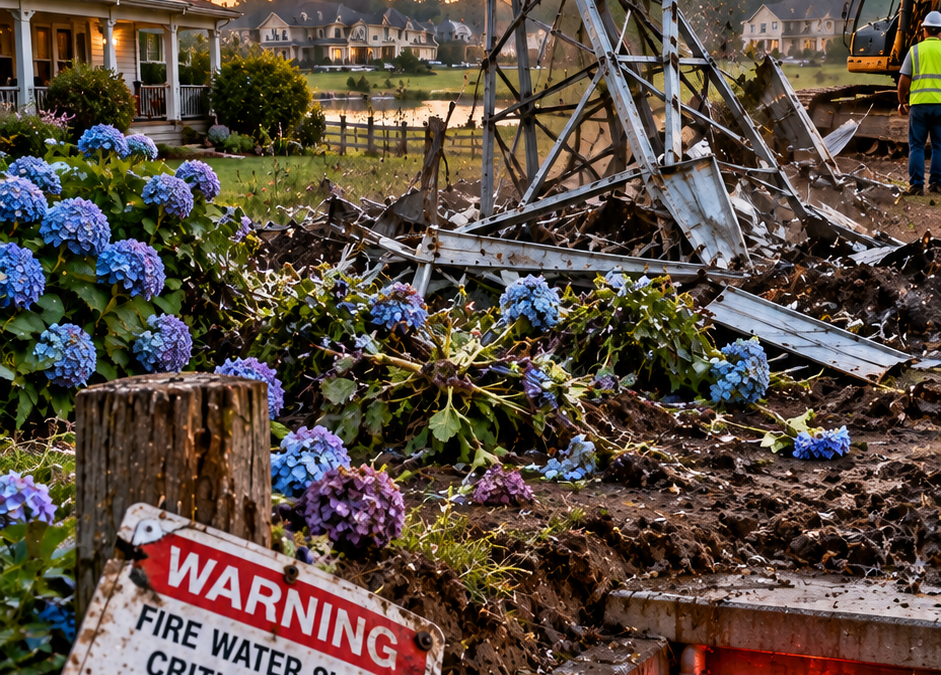
Six hydrangeas Elsie had planted disappeared beneath it.
One blade sliced through the edge of my tool shed roof.
The gearbox struck concrete hard enough to split its housing.
If they had stopped there, the damage would already have been serious.
They did not stop.
Calvin wanted to remove the drive assembly from the wellhead.
The coupling would not release.
So he used the plasma cutter again.
He severed the mechanical pump rod.
He melted part of the control conduit.
Then he cracked the sanitary cap protecting the well casing.
When his crew dragged the base assembly away, metal fragments and debris dropped toward the wellhead.
A red alarm began flashing inside the service enclosure.
One worker noticed.
“This thing is live.”
Calvin looked toward Brittany.
Thomas’s recording captured her response.
“It’s just an old pump.”
Seventeen minutes later, a sheriff’s deputy arrived.
By then, much of the tower had been cut into transportable sections.
Brittany showed him the emergency board vote.
She showed him Ridgeline’s letter.
Calvin claimed he had been told the association controlled the property.
The deputy did not try to decide a complex ownership dispute in the dark beside a broken well.
He ordered the crew to stop.
He photographed the damage.
Recorded names.
And told Calvin not to remove the pump assembly until county records could be checked.
Brittany argued that the fallen steel was a safety hazard.
Calvin loaded it anyway.
That decision created another evidence trail.
I returned Sunday afternoon.
The taxi turned onto my road.
For thirty-seven years, the windmill had been the first thing I saw above the trees.
Even before the house.
Even before the barn.
That afternoon, there was only empty sky.
I told the driver to stop.
I left my suitcase beside the driveway.
Then I walked behind the house.
Deep tire ruts crossed the lawn.
The roof of my tool shed sagged where the blade had hit it.
Galvanized fragments glittered in the grass.
Elsie’s hydrangeas were crushed flat beneath torn branches and mud.
At the center of the concrete pad stood a jagged pipe.
The county seal was broken.
Then I saw my front door.
A laminated HOA invoice had been taped to it.
Emergency removal: $2,800.
Noncompliance penalty: $500.
At the bottom, someone had written:
Have a wonderful day.
I felt anger.
Of course I did.
But anger is not a plan.
I photographed everything before touching anything.
Then I went into the basement.
County technicians had installed a monitoring panel there in 2014 because the buried transfer line passed near my foundation easement.
Normally, three lights glowed green.
Well integrity.
Transfer system.
Telemetry.
That afternoon, the first light was red.
The second was dark.
The third flashed amber.
The display showed the fire reserve at sixty-one percent.
And falling.
Crest View still had household water.
Nobody’s faucet had gone dry.
The subdivision was not facing a drinking-water emergency.
It was facing something more specific.
The system required to guarantee sustained fire flow had lost its safe source connection and mechanical backup.
Until the county inspected the well for contamination and repaired the damaged controls, the fire reserve could not be certified.
I called David Mendoza.
He answered cheerfully.
“Abraham. How’s the old tower holding up?”
“It’s lying on a scrap truck somewhere.”
Silence.
Then his voice changed.
“Tell me exactly what happened.”
I did.
“Do not operate anything.”
“I haven’t.”
“Do not reset the panel.”
“All right.”
“I’m dispatching a utility crew. I’m also notifying the fire marshal.”
I looked at the reserve reading.
“How long do they have?”
“Under normal demand? Days.”
“And under a working structure fire?”
Another pause.
“Not enough.”
Then he said something Brittany had never bothered to investigate.
“Tomorrow starts a red flag period.”
Three days of low humidity.
Dry winds.
Elevated wildfire risk.
Crest View bordered roughly forty acres of unmanaged grass and woodland.
Without its certified secondary supply, the fire department could not simply shrug and hope nothing happened.
County vehicles arrived within ninety minutes.
David inspected the broken well cap.
The severed conduit.
The scorched coupling.
The damaged pump assembly.
He found the inspection plate in the grass where Calvin’s crew had thrown it.
He held it up.
“Whoever did this cut directly through an active utility assembly.”
Fire Marshal Elaine Porter arrived next.
She opened the original development approval on the hood of her vehicle.
Then she went to the clubhouse cistern and checked the reserve herself.
At 5:40 that evening, the county issued an emergency impairment order.
It did not evacuate three hundred homes.
It did not declare Crest View uninhabitable.
Reality was less dramatic and far more expensive.
The HOA had to establish a continuous professional fire watch.
Two tanker engines had to remain staged inside the development during the red flag period.
The clubhouse, pool building, and community event hall closed because their sprinkler reserve could not be certified.
Outdoor grilling was suspended.
Open flames were prohibited.
Contractor hot work stopped.
Four pending occupancy approvals in the unfinished western phase were frozen.
And Crest View had to purchase emergency water deliveries until the reserve reached approved capacity again.
Initial estimate:
Thirty-eight thousand dollars per day.
That did not include repairing the well.
Brittany arrived in her white Lexus while tanker crews were connecting temporary equipment near the clubhouse.
She stepped out wearing another scarlet blazer.
“What is going on?”
Elaine Porter introduced herself.
“The county authorized temporary fire protection after your association impaired a required system.”
Brittany pointed toward my property.
“We removed an unsafe windmill from a noncompliant yard.”
Elaine’s expression did not change.
“No. You removed the marked wellhead structure and mechanical backup connected to the fire reserve serving your subdivision.”
Brittany turned toward me.
“He never told us that.”
I almost answered.
David beat me to it.
He opened his folder.
Then he removed a delivery receipt.
It carried Brittany’s electronic signature.
“This system summary was delivered to the HOA president’s address on June twelfth.”
She looked at the page.
“I receive hundreds of documents.”
“This one was labeled Required Fire System—Alteration Prohibited.”
“Then the management company should have flagged it.”
“It was also emailed directly to you.”
Board members were beginning to gather.
Homeowners too.
Brittany lifted her voice.
“Nobody needs to panic. The association’s insurance will handle temporary expenses.”
Martin Hale stared at the tanker engines.
“You told us the well was abandoned.”
“That was the information available to me.”
Nora Bell spoke from behind him.
“No, it wasn’t.”
The group went quiet.
Nora held up her phone.
“Abraham’s warning was in my original meeting minutes.”
Brittany stared at her.
Nora continued.
“You removed it.”
Brittany tried to end a meeting that had never officially begun.
Nobody listened.
Over the next forty-eight hours, Crest View changed.
Tankers rotated through the neighborhood.
Security officers walked common areas as part of the fire watch.
Temporary pumps transferred approved water into the reserve.
Homeowners received notices explaining why the clubhouse was closed and why the association was spending tens of thousands of dollars every day.
People began asking the questions Brittany had tried to prevent.
Thomas gave his video to investigators.
My cameras provided another angle.
The footage showed Brittany entering my property.
It showed her receiving the county document.
It showed her reading it.
It showed the demolition continuing anyway.
Calvin’s flatbed was located Monday morning at a metal recycler.
The recycler had refused to accept the steel because one section still carried a stamped county identification plate.
Calvin had taken the load back to his shop.
The gearbox was still on the truck.
So was part of the service enclosure.
The paper copy of the utility agreement was missing.
Deputies interviewed Calvin.
He insisted Brittany told him the HOA owned everything beyond my fence.
Then investigators obtained his text messages.
Need tower gone before owner returns.
No county calls.
Cash, you keep steel.
Those messages did not prove every possible claim.
Evidence rarely works that cleanly.
But they destroyed the idea that this had been an ordinary emergency repair performed in good faith.
Calvin’s attorney advised him to cooperate.
He turned over the cash job envelope.
Site photographs.
Invoices.
And a voice message Brittany sent before midnight.
Her recorded voice said:
“Do not get distracted by any stickers or papers Kelly left there. The board vote controls the property.”
She was wrong in three different ways.
The board vote did not own my land.
It did not cancel the recorded utility agreement.
And it did not overrule the county.
But Lena found something even more important.
After filing for an emergency injunction, she obtained HOA management records.
The first production included board emails, invoices, draft minutes, and project files.
Inside a folder labeled WESTERN VIEW, she found correspondence with the buyer interested in the ridge property.
The buyer liked the proposed house.
But he objected to one feature in the sunset view.
My windmill.
Brittany’s response was direct.
The tower will be removed before closing. The association has enforcement options.
That message had been sent three weeks before Brittany ever stood at my fence and claimed she was responding to resident complaints.
There was the motive.
She had not investigated my windmill and discovered a violation.
She had promised a buyer that the windmill would disappear.
Then she went searching for authority to make that promise true.
The proposed sales contract confirmed that Brittany expected a three-percent commission on roughly $2.6 million.
About seventy-eight thousand dollars.
That changed the board’s legal position immediately.
Their attorney informed the directors that he could not represent Brittany personally while also advising the association.
The management company suspended all enforcement activity involving my land.
Every fine disappeared from the online ledger.
Nobody apologized.
Not yet.
Then the insurer sent what Lena called a reservation-of-rights letter.
Brittany had told everyone insurance would handle the problem.
The insurer had a more complicated view.
The policy might cover certain negligent acts by the association.
But intentional trespass after repeated notice, destruction of protected utility equipment, undisclosed private financial interests, and alteration of official records created serious coverage questions.
It did not mean Brittany automatically owed every dollar personally.
That is not how insurance or civil law works.
But it meant “insurance will pay” was no longer a shield she could hide behind.
The county’s preliminary repair estimate eventually reached $840,000.
That number included far more than rebuilding the tower.
Crews had to remove debris from the well casing.
Test for contamination.
Repair controls.
Replace the severed pump rod.
Recover and inspect the original gearbox.
Maintain emergency fire protection during repairs.
And certify the entire system before normal operations resumed.
The HOA called an emergency membership meeting.
The clubhouse remained closed, so the meeting took place in the parking lot.
Nearly every chair was occupied.
Tanker engines idled behind temporary fencing.
County engineers had laid the broken windmill sections on supports while they documented which pieces could be saved.
Brittany took the microphone first.
She blamed outdated county records.
She blamed me.
She blamed Calvin.
She blamed the management company.
She blamed poor communication.
She blamed everyone except the woman holding the microphone.
Then Martin stood.
He connected a laptop to a portable screen.
Seven dates appeared.
March 18: County inspection.
April 7: Brittany’s first removal demand.
May 9: Recorded agreement supplied to board.
June 12: County no-alteration warning signed by Brittany.
July 3: Edited meeting minutes posted.
August 21: Ridge buyer promised unobstructed view.
August 29: Emergency demolition authorized.
Seven dates.
One pattern.
Every warning came before the tower fell.
Then Nora took the microphone.
She read from her original meeting notes.
She had preserved the document history, including the version Brittany later edited.
Thomas described what he saw that night.
David explained the fire-water system without jargon.
Then Lena played my security footage.
Brittany stood at the base of the tower.
A worker handed her the agreement.
She unfolded it under the glow of her phone.
She read it.
Then she put it into her binder.
The video ended.
Nobody shouted.
The silence was worse.
A woman near the front stood.
“Did you know removing the windmill could affect our fire protection?”
Brittany held the microphone tighter.
“I knew Mr. Kelly claimed that.”
“Did you call the county number on the warning?”
“That was not my responsibility.”
Martin looked toward the tanker engines.
“It became our responsibility the moment you ordered the cutter.”
The membership removed Brittany as HOA president that night.
The vote did not decide lawsuits.
It did not decide insurance coverage.
It did not determine criminal charges.
It simply ended her authority to speak for Crest View.
For the first time since April, Brittany Morris did not have a gavel.
The legal process moved slowly after that.
Much more slowly than the demolition.
That is where stories often become dishonest.
Someone waves a document.
A sheriff arrives.
The bad actor loses everything before sunset.
Real consequences usually arrive through reports.
Depositions.
Invoices.
Insurance letters.
Expert assessments.
And questions asked under oath.
The county ordered Crest View to restore the fire-water system and reimburse emergency response costs.
Law enforcement and prosecutors reviewed the demolition separately.
Brittany and Calvin were investigated over the unauthorized entry, property destruction, and interference with protected utility equipment.
The exact criminal consequences were for authorities to determine.
My civil case focused on what could be documented.
The destroyed windmill.
Damage to the well.
Damage to the tool shed.
The hydrangeas.
The false fines.
The unlawful entry.
And the financial losses that followed.
During Brittany’s deposition, Lena placed the ridge-home brochure in front of her.
“You expected a commission if this property sold?”
“Potentially.”
“The buyer objected to Mr. Kelly’s windmill?”
“He expressed a preference regarding the view.”
“You told him the tower would be removed.”
“I believed the association had enforcement options.”
Lena placed my deed exclusion in front of her.
“You received this?”
“I disputed its interpretation.”
Then Lena produced the county warning.
“And this?”
“I believed that referred primarily to the underground connection.”
Lena slid forward the diagram attached to the warning.
The windmill was outlined in red.
The label read:
PROTECTED MECHANICAL BACKUP AND WELLHEAD STRUCTURE.
Lena gave Brittany several seconds.
“What part of that label did you interpret as permission to cut it down?”
There was no answer.
The ridge buyer withdrew.
The sale collapsed.
Brittany’s brokerage began its own ethics review after learning that she had used HOA authority in a dispute directly connected to one of her listings.
That investigation was separate from my case.
Nobody could guarantee what it would decide.
But the seventy-eight-thousand-dollar commission was gone.
The sunset view Brittany had tried to sell had already cost Crest View far more than that.
Meanwhile, the county proposed a practical solution.
Instead of reconstructing the old windmill exactly as it had been, engineers suggested replacing the visible structure with a low modern pump enclosure.
It would be cheaper.
Faster.
Technically sufficient.
I refused.
People were not happy about that.
I understood why.
Tankers cost money every day.
Homeowners who had never supported Brittany were watching association reserves disappear while lawyers debated a steel tower that many of them had never liked.
But the original agreement did not protect only a water source.
It identified the existing windmill and protected owner equipment.
More importantly, the tower had belonged to my property long before Crest View existed.
I was not going to let Brittany’s unlawful act become the reason it disappeared permanently.
That position delayed settlement by about six weeks.
One evening, I stood beside what remained of Elsie’s hydrangeas while Thomas leaned against the fence.
“You know some of them think you’re being stubborn.”
“I am being stubborn.”
He smiled.
“At least you know.”
I looked at the empty concrete pad.
“Brittany didn’t just break a pump.”
Thomas waited.
“She decided she could erase something because it was inconvenient to a sale. If I accept that the easiest fix is to leave it erased, what exactly did I protect?”
The next morning, I called David.
I offered a compromise.
Install a modern sealed electric pump system and telemetry vault for the primary fire function.
Put as much of it underground as practical.
Give firefighters protected testing access that did not require crossing my yard.
Then restore the windmill and reconnect its mechanical drive as the passive backup required by the original agreement.
Crest View would get a safer, more modern fire-water system.
I would get my tower back.
David supported it.
The new HOA board did too.
The settlement followed the evidence instead of revenge.
Association funds and available insurance coverage paid portions of the emergency protection and system upgrades.
Claims involving intentional conduct remained reserved against those responsible.
Calvin’s company contributed through its insurer.
Brittany agreed to give up any claim that the HOA had architectural authority over my parcel.
She reimbursed specific uninsured losses and released the association from defending her private real-estate conduct.
Not every homeowner walked away happy.
Association reserves were reduced.
Special assessments were discussed.
People who had never voted for Brittany still felt the cost.
That bothered me more than I expected.
It is easy to cheer when a powerful board president loses control.
It is harder when your decent neighbors open letters showing what that loss costs them.
One reckless decision can spread through hundreds of innocent bank accounts.
The new board understood that.
Before assessing homeowners, it pursued recovery from every available contractor and professional policy.
Then it changed how Crest View operated.
Directors with private financial interests had to disclose them.
Independent legal review became mandatory before the association entered private property.
Draft meeting minutes were preserved.
Residents gained access to unedited versions.
Nora became interim president.
Martin stayed on as treasurer.
Neither one showed any interest in measuring grass height.
Restoration began in November.
County crews removed debris from the well.
Testing confirmed the aquifer had not been contaminated.
Machinists rebuilt the cracked gearbox using salvaged original components.
Two tower legs were too badly damaged to reuse, so a restoration company fabricated replacements matching the 1938 pattern.
The new control vault sat mostly below grade.
It contained redundant electric pumps.
Remote alarms.
Protected shutoffs.
And testing connections that firefighters could access without crossing my backyard.
The windmill remained mechanically separate.
Visible.
Functional.
Ready to maintain the reserve during an extended power outage.
The morning the tower went back up, half the neighborhood gathered along my fence.
I had not invited them.
They simply came.
A crane lifted the restored frame slowly from horizontal.
The steel rose against the winter-blue sky.
For months, I had trained myself not to look toward that empty space behind the house.
Now I could not look anywhere else.
Khloe stood beside me.
She had flown in from Denver.
She wore the same blue nursing-school jacket Elsie had ordered before she died.
When I saw it, I had to look away for a moment.
Workers guided each tower leg onto new anchor bolts set into reinforced concrete.
The last nut tightened.
David checked the mechanical connection.
Then he released the brake.
Nothing happened.
The air was still.
People waited.
Ten seconds.
Twenty.
Then a breeze came down the valley.
The windmill tail shifted.
One blade moved.
Then another.
The wheel made a quarter turn.
Half a turn.
The rebuilt gearbox caught.
Below us, the pump rod began its old stroke.
Click.
Pause.
Click.
I had not heard that sound in months.
But that was not why my throat closed.
I had heard it nearly every evening I spent with Elsie.
On summer nights.
In winter.
Through open windows.
During storms.
During the quiet year after her first diagnosis, when neither of us said aloud what we both feared.
Khloe took my hand.
“Grandma would love this.”
I tried to answer.
Nothing came.
Some victories are loud.
That one sounded like an old machine returning to work.
After full testing, Fire Marshal Porter lifted the impairment order.
The tankers left.
The clubhouse reopened.
The delayed occupancy approvals moved forward.
The new board placed a framed copy of the utility agreement in its records room.
I doubt any future Crest View president will need help remembering what it says.
Brittany sold her home several months later.
She left Crest View.
The civil settlement limited what could be publicly disclosed.
Other investigations followed their own timelines.
I will not invent a prison sentence that never happened simply because it would make the ending cleaner.
What happened was enough.
She lost the presidency.
She lost the ridge listing.
The commission disappeared.
Her private financial interest became part of the official record.
Her messages became evidence.
The altered minutes became evidence.
And the story she had told about herself—that authority meant she was automatically right—did not survive the documents.
The following spring, the hydrangeas returned unevenly.
Two of Elsie’s original plants survived.
Four did not.
I could have bought replacements from a nursery.
Instead, I took cuttings from the two that lived.
Khloe helped me root them in pots.
We replanted them along the edge of the garden.
They were smaller than the old bushes.
For a long time, the gaps were obvious.
I decided that was all right.
Not every repair has to hide the fact that something was damaged.
The tool shed received a new roof.
The service gate got a heavier chain.
The county mounted new warning plates low enough that nobody could pretend not to see them.
And I kept Brittany’s laminated $2,800 demolition invoice.
I framed it.
Then I hung it beside the monitoring panel in my basement.
Underneath, I mounted a small brass plaque.
It reads:
BEFORE REMOVING AN EYESORE, FIND OUT WHAT IT IS HOLDING TOGETHER.
Some mornings, I still walk behind the house before breakfast.
The valley looks different now.
Crest View is older.
The ornamental trees have grown.
The western phase is nearly finished.
The big ridge home Brittany tried to sell was eventually redesigned for another buyer.
Its view is not unobstructed.
My windmill stands exactly where it stood before.
When the wind is right, the blades begin turning before the sun reaches the top of the trees.
Then the pump rod starts.
Click.
Pause.
Click.
I used to think that sound belonged entirely to Elsie.
Now I understand it differently.
Memory is part of it.
Of course it is.
But the windmill was never valuable only because my wife loved listening to it.
It mattered because it still had work to do.
That was the mistake Brittany made from the beginning.
She saw age and assumed uselessness.
She saw rust and assumed neglect.
She saw an old man living alone and assumed resistance would be temporary.
She saw a board vote and confused it with ownership.
She saw a rulebook and treated it like a deed.
And every time someone placed evidence in front of her, she interpreted the warning as an insult to her authority.
The windmill tried to warn her in its own way.
So did the county seal.
So did my deed.
So did Martin.
So did Nora.
So did the utility agreement she held in her hands under the light of her own phone.
She ignored all of them.
Then the tower fell.
And beneath it was everything she had refused to see.
A live well.
A protected utility.
A fire reserve.
Three hundred homes depending on an agreement written before she ever became president.
My father used to say that the hardest lessons are usually the ones sitting in plain sight before anyone learns them.
I think about that sometimes when I watch new homeowners walk the Crest View trail.
A few stop near my fence.
Some ask about the windmill.
I tell them it is older than their houses.
I tell them it pumps water.
Sometimes I explain the fire reserve.
Sometimes I do not.
Most just look up at the blades and say they like it.
That always makes me smile.
Not because I need them to admire it.
I no longer care whether Crest View considers the tower beautiful.
Beauty was never the point.
The point is that it belongs where it stands.
The point is that it still works.
The point is that a thing can be old without being obsolete.
A person can be quiet without being powerless.
And an agreement can sit unnoticed in a county file for eleven years and still matter the exact second someone decides rules do not apply to them.
One evening, not long after the repairs were completed, I carried two cups of coffee onto the porch before remembering there was no one there to take the second.
That had happened to me several times after Elsie died.
At first, those moments felt like punishment.
This time, I set the extra cup on the porch rail.
The windmill turned above the hydrangeas.
Click.
Pause.
Click.
The new cuttings were beginning to leaf out.
I sat there until the coffee went cold.
For the first time in years, the sound did not make me feel only what I had lost.
It reminded me of what remained.
The house.
The land.
Khloe.
Thomas next door.
The neighbors who had eventually asked hard questions.
The county workers who rebuilt what someone else had broken.
Two surviving hydrangeas.
Four new ones growing from them.
And forty feet of old galvanized steel doing exactly the job it had always done.
That was enough.
More than enough.
Brittany thought removing the windmill would improve a view.
She never understood that some things are standing there because the people who came before us learned why they needed to be.
Sometimes the smartest thing a person can do is ask before cutting.
And sometimes, by the time you hear the warning, the most important question is whether you are wise enough to believe it.
𝗧𝗛𝗘 𝗘𝗡𝗗
She Thought the Windmill Was the Problem, but the Real Danger Was Hidden Beneath It
The first thing Brittany Morris destroyed was not my windmill.
It was the warning tag bolted to its base.
By the time I came home, eighty-seven years of steel were gone, my wife’s hydrangeas were crushed into the mud, and a red warning light was flashing in my basement for a system Brittany had never bothered to understand.
My name is Abraham Kelly.
I was sixty-eight years old that summer, and I lived on two acres of stubborn ground west of Grand Rapids, Michigan.
I bought the property in 1988, long before the stone entrance columns, artificial ponds, decorative streetlamps, and carefully trimmed lawns of Crest View Estates surrounded me.
Back then, the valley was mostly cornfields, wet meadow, scattered farmhouses, and dirt roads that turned to soup every spring.
My house was not impressive.
It was a plain cedar ranch with a green metal roof.
Behind it stood a forty-foot steel air-motor windmill installed in 1938.
Its galvanized blades had survived lake-effect ice, straight-line winds, and a tornado that once tore half the roof from a dairy barn two properties away.
The windmill survived because it had not been built to look charming.
It had been built to work.
A steel drive rod ran from the gearbox down into an artesian well beneath my property.
For decades, that well supplied livestock tanks, a small irrigation pond, and later my gardens.
The previous owner taught me how to grease the gearbox, tighten the furling cable, and listen for the first signs of trouble.
That last lesson stayed with me.
Machines usually warn you before they fail.
A different pitch.
A vibration that was not there yesterday.
A pause where there should be motion.
People give warnings too.
The difference is that some people only hear warnings that flatter them.
My wife, Elsie, loved the sound of that old windmill at night.
When the wind moved slowly through the valley, the pump rod made a steady metallic rhythm.
Click.
Pause.
Click.
She used to sit on the porch after dinner and say the sound made the whole property feel alive.
After cancer took her in 2019, I kept maintaining the windmill partly because that sound still made the place feel like home.
I will admit that openly.
To me, the tower was not rusty farm junk.
It was history.
Utility.
Memory held together by rivets.
But the reason Brittany Morris should have left it alone had nothing to do with sentiment.
That reason had been recorded in county files eleven years earlier.
In 2013, a developer named Richard Gable bought nearly two hundred acres surrounding my property.
His company planned Crest View Estates, a three-hundred-home luxury subdivision with a clubhouse, two ornamental ponds, walking trails, and brochures promising something called “elevated valley living.”
The county approved almost everything.
Almost.
There was one major problem.
The municipal water system serving that area could handle normal household demand, but the county fire review found it could not guarantee the required fire flow at the far western end of the subdivision during peak use.
Crest View would sit near dry grass and mature woods.
In bad weather, that mattered.
Without a secondary fire-water source, the county would not approve the final plan.
Gable’s engineers studied several solutions.
The obvious answer was a new deep well, a pump house, a dedicated access road, electrical service, storage capacity, and permanent inspection infrastructure.
Estimated cost: more than two million dollars.
Then one engineer noticed my old windmill.
More specifically, he noticed the well beneath it.
The artesian well reached a reliable aquifer.
Its historical water quality was clean.
Its recovery rate was strong.
And most importantly, it sat close enough to the proposed development to serve a supplemental reserve system.
That did not mean firefighters were expected to hook a hose to an eighty-year-old windmill.
The county was not insane.
Gable constructed a buried fire cistern on a common parcel near the future clubhouse.
It held approximately 250,000 gallons.
An electric transfer pump could draw water from my well through a protected underground line and maintain the required reserve.
The windmill’s mechanical pump remained connected as a passive backup.
It was slow.
Old-fashioned.
And useful.
During an extended power failure, it could continue feeding water into the system without relying on the electrical grid.
The tower also marked the wellhead and supported part of that mechanical assembly.
The county approved the arrangement under strict conditions.
My property remained outside Crest View.
The well, windmill, service lane, and buried utility line were protected by a recorded agreement.
The county drainage and fire authorities retained inspection rights.
The developer paid me an annual maintenance stipend.
And any successor association using the system had to preserve access and notify the county before altering protected equipment.
I hired my own attorney before signing anything.
I had no intention of donating control of my land to a developer simply because his houses surrounded me.
The final agreement made the distinction clear.
I owned the land.
I owned the well.
I owned the windmill.
Crest View received a limited right to receive water for its fire reserve.
The HOA could inspect the connection after proper notice.
It could not regulate my house.
It could not fine me.
It could not walk onto my property whenever it felt like it.
And it absolutely could not alter the equipment.
For eleven years, that arrangement worked so quietly that most homeowners did not even know it existed.
County technicians visited every spring.
The electric transfer pump did most of the work.
The windmill turned whenever the breeze came down the valley.
No drama.
No meetings.
No threats.
Then Brittany Morris became HOA president.
Brittany was forty-three, polished, ambitious, and exceptionally good at making control sound like public service.
She sold luxury real estate.
She drove a white Lexus with her name printed beneath the brokerage logo.
During her campaign for HOA president, she promised to “protect property values,” “modernize Crest View,” and “eliminate visual inconsistencies.”
In ordinary language, that meant she wanted everything she could see to obey her.
Her first visit came on a damp April morning.
I was lubricating the windmill’s lower linkage when I heard her call from the other side of my chain-link fence.
“Mr. Kelly?”
I looked over.
She was standing in wet grass wearing a scarlet blazer, cream blouse, fitted black slacks, and heels that probably cost more than the gearbox grease in my hand.
A black binder rested against her hip.
“Yes?”
“We need to discuss this structure.”
I looked up at forty feet of steel.
“You may have to narrow that down.”
She did not smile.
“The windmill.”
“What about it?”
“It conflicts with Crest View’s updated exterior standards.”
I wiped my hands on a rag.
“My property isn’t in Crest View.”
“It is surrounded by Crest View.”
“That doesn’t make it yours.”
Her smile tightened.
She opened the binder and showed me a printed photograph.
Someone had taken a picture of my house from the street.
The windmill had been circled in red.
“The board has received complaints about rust, noise, and the impact on neighboring views.”
“I’ve received complaints about woodpeckers. I haven’t fined them yet.”
Her eyes hardened.
“The board would prefer voluntary compliance.”
“With what?”
“Removal within thirty days.”
I set down the grease gun.
Then I walked to the fence.
“Brittany, listen carefully. There is a recorded county agreement covering that tower and the equipment beneath it. Your subdivision’s fire reserve depends on this connection. Do not touch it.”
She looked up at the windmill again.
Her expression was dismissive.
“I called the city water desk.”
“You called the wrong agency.”
“They have no customer account for a windmill.”
“That’s because the agreement is with the county fire and drainage authorities.”
“How convenient.”
“It’s also true.”
She closed the binder.
“Thirty days, Mr. Kelly.”
“Read the original development agreement.”
She took one step away.
“Madam President.”
That stopped her.
She turned.
“Read it before you do something expensive.”
Then she walked back to her Lexus.
I had dealt with difficult engineers, contractors, inspectors, clients, and government officials over the years.
A person who asks sharp questions can be useful.
A person who refuses to verify the answer is dangerous.
Brittany belonged to the second category.
Exactly thirty days later, I received a five-hundred-dollar HOA violation notice.
The violation accused me of maintaining an unapproved industrial structure.
The notice cited Section Seven of the Crest View Architectural Rules.
I sent it back with three documents.
The legal description proving my parcel sat outside the association.
The recorded utility agreement.
And the county’s most recent inspection record.
I highlighted the section requiring written county approval before any alteration of the well, windmill, or associated equipment.
Two weeks later, the fine increased to one thousand dollars.
That told me this was no longer a misunderstanding.
I attended the next HOA board meeting with a complete copy of the development agreement under my arm.
Brittany sat at the center of a long folding table beneath the association seal.
Beside her were Treasurer Martin Hale, Secretary Nora Bell, and two directors who seemed to consider agreement with Brittany a form of efficient governance.
I waited through forty minutes of complaints about mailbox colors, pool furniture, and whether one family’s basketball hoop violated setback rules.
Then public comment opened.
I stood.
“My parcel is not subject to Crest View’s architectural code. I have supplied the board with my deed, the exclusion schedule, and the recorded utility agreement. The windmill is part of an active, inspected fire-water system. I want that statement entered into the minutes.”
Martin leaned toward Brittany.
“Is this the system listed in the old reserve study?”
Brittany covered her microphone with one hand.
Unfortunately for her, the room was quiet enough for several people to hear.
“It’s an abandoned agricultural well.”
I placed the current inspection sheet under the document camera.
The county seal appeared on the screen behind the board.
“Inspected March eighteenth,” I said. “That’s a remarkable level of attention for something abandoned.”
For one second, Brittany looked surprised.
Then her expression smoothed.
“Mr. Kelly, an inspection sticker does not give you permission to maintain a dangerous eyesore beside our community.”
“My deed gives me ownership.”
I pointed toward the projected document.
“The recorded agreement gives your community the water rights. And that county seal tells you exactly who you need to call before altering any of it.”
There was a murmur behind me.
Brittany struck the gavel.
“Personal threats will not be tolerated.”
“That wasn’t a threat.”
I picked up my papers.
“It was maintenance advice.”
Nora Bell asked if she could keep my copy for the official record.
Before she could reach for it, Brittany closed the folder and slid it beneath her binder.
That small movement mattered later.
Five days afterward, the meeting minutes appeared online.
My entire warning had been reduced to one sentence:
Resident disputed exterior violation.
No mention of the active fire-water system.
No mention of the county.
No mention of the utility agreement.
I emailed Nora and asked whether the omission was intentional.
She replied from her personal account.
Abraham, I included the details in my draft. The version posted is not the version I submitted.
Then she added another sentence.
Please keep this email.
I did.
The fines continued.
One thousand became twenty-five hundred.
Then five thousand.
The management company sent a letter threatening a lien against my home.
That was when I called my attorney, Lena Ortiz.
Lena’s response was three pages long, calm in tone, and expensive enough in appearance that the management company immediately stopped writing to me.
She demanded proof that my parcel belonged to the HOA.
There was none.
She demanded immediate withdrawal of every fine.
She warned the board that no one had permission to enter my property.
The management company stepped back.
Brittany did not.
She posted a fluorescent violation tag on my fence.
I removed it.
She photographed me removing it and claimed I had destroyed association records.
I mailed the tag to Lena inside an evidence envelope.
Then Brittany changed strategy.
At a summer community meeting, she unveiled something called the Western View Improvement Plan.
The presentation included ornamental evergreens, a stone wall, and new landscaping along the western edge of Crest View.
On the rendering, my windmill was gone.
Behind the proposed landscaping sat an undeveloped ridge lot owned by Gable Residential Holdings.
The planned house was enormous.
Glass.
Stone.
Infinity pool.
Panoramic valley exposure.
Expected price: more than $2.5 million.
Brittany described it as a future architectural landmark.
Then I noticed something in the lower corner of the rendering.
Her brokerage logo.
I raised my hand.
“Are you the listing agent?”
Her expression changed.
“That is irrelevant to the architectural discussion.”
In my experience, irrelevant often means please stop looking in that direction.
One week later, my neighbor Thomas Reed came to my house carrying a glossy sales brochure.
He had found it in the clubhouse.
The headline promised uninterrupted sunset views across the valley.
One photograph had been taken from approximately the position of the proposed ridge home.
There was only one problem.
My windmill should have been standing directly in the middle of the image.
Someone had digitally removed it.
At the bottom of the brochure, printed in tiny letters, was Brittany Morris’s name.
The proposed list price was approximately $2.6 million.
Her three-percent commission could have been around seventy-eight thousand dollars.
The fight suddenly made sense.
This was not really about rust.
It was about a view Brittany had already promised a buyer.
I sent the brochure to Lena.
Her answer was immediate.
“Do not confront her about motive.”
“Why?”
“Because motive is useful. Evidence is better.”
So I began building evidence.
I installed two security cameras covering the tower, the fence, and the service lane.
I photographed every county plate and warning label.
I requested the original Crest View approval documents.
And I asked David Mendoza, the county fire systems engineer, to confirm the system status and next inspection date in writing.
His response came the same afternoon.
SYSTEM ACTIVE.
NEXT SCHEDULED INSPECTION: OCTOBER 6.
NO ALTERATIONS AUTHORIZED.
I forwarded that email to every HOA director, the management company, and Brittany individually.
Martin replied.
Received. Thank you.
Brittany said nothing.
Late that August, my granddaughter Khloe completed her nursing program in Denver.
Elsie had talked about seeing that graduation from the moment Khloe started school.
Missing it was not an option.
I booked five days away.
Before leaving, I checked both cameras.
I photographed the county seal one more time.
I put a copy of the utility agreement inside the weatherproof service box at the base of the tower.
Then I emailed the entire HOA board.
I listed the dates I would be gone.
I stated clearly that no one had permission to enter my land.
Looking back, I sometimes wish I had called the county too.
But even now, I reject the idea that a homeowner should have to notify public engineers every time an HOA president dislikes something visible from the street.
My flight left Thursday morning.
That evening, at 6:14, Brittany called an emergency board meeting for Friday night.
The notice described my windmill as an “imminent structural hazard.”
Attached was a one-page letter from a company called Ridgeline Property Services.
The letter claimed the tower showed advanced corrosion and could fail during high winds.
There were three problems.
Ridgeline was not a structural engineering firm.
It was a landscaping company.
Nobody from Ridgeline had inspected my tower.
And the person whose name appeared on the letter was handling exterior work associated with Brittany’s $2.6 million ridge listing.
Martin objected during the meeting.
Nora objected too.
Brittany argued that delaying removal could expose the association to liability.
She cited thunderstorms in the forecast.
The actual forecast called for winds below twenty miles per hour.
But the meeting happened behind closed doors, and Brittany had already told the directors that my legal documents were fabricated or irrelevant.
Three board members voted for emergency removal.
Martin voted no.
Nora abstained and asked that her objection be recorded.
At 11:48 that night, Brittany texted a contractor named Calvin Dorsey.
We did not see that message until later.
It said:
Need tower gone before owner returns.
Cash.
You keep steel.
No county calls.
At 1:53 Saturday morning, Thomas Reed’s doorbell camera recorded Calvin’s flatbed entering my service lane with its headlights off.
At 2:06, three men cut the lock on my gate.
At 2:11, one of my cameras sent a motion alert to my phone in Denver.
I was asleep in a hotel after Khloe’s graduation dinner.
My phone was charging across the room.
Thomas was awake.
He saw blue-white flashes behind my house.
At first, he thought there might be an electrical fire.
Then he realized someone was using a plasma cutter.
He called 911.
After that, he began recording.
Calvin’s crew wrapped a heavy chain around the tower approximately twelve feet above the base.
One worker cut into two legs.
Another opened the service box.
He removed the county agreement I had left inside.
Then he handed it to Brittany.
The camera caught her beneath the light from her phone.
She unfolded the first page.
She read it.
Then she folded it again and placed it inside her binder.
That moment mattered more than almost anything that came afterward.
Until then, Brittany could argue she misunderstood.
She could claim my warnings were unclear.
She could say she relied on a contractor.
But she stood on my land after two in the morning holding a county document that told her exactly what the windmill was.
Thomas shouted from his fence.
“That’s county equipment! Abraham warned you!”
Brittany turned toward him.
“Go back inside, Thomas. The board authorized emergency work.”
“The board doesn’t own his land!”
“Call whoever you want.”
Calvin climbed into the truck.
The chain went tight.
The damaged legs buckled.
Thomas later told me the sound of the tower falling reminded him of a freight car being dropped from a bridge.
Forty feet of steel crashed across my garden.
Six hydrangeas Elsie had planted disappeared beneath it.
One blade sliced through the edge of my tool shed roof.
The gearbox struck concrete hard enough to split its housing.
If they had stopped there, the damage would already have been serious.
They did not stop.
Calvin wanted to remove the drive assembly from the wellhead.
The coupling would not release.
So he used the plasma cutter again.
He severed the mechanical pump rod.
He melted part of the control conduit.
Then he cracked the sanitary cap protecting the well casing.
When his crew dragged the base assembly away, metal fragments and debris dropped toward the wellhead.
A red alarm began flashing inside the service enclosure.
One worker noticed.
“This thing is live.”
Calvin looked toward Brittany.
Thomas’s recording captured her response.
“It’s just an old pump.”
Seventeen minutes later, a sheriff’s deputy arrived.
By then, much of the tower had been cut into transportable sections.
Brittany showed him the emergency board vote.
She showed him Ridgeline’s letter.
Calvin claimed he had been told the association controlled the property.
The deputy did not try to decide a complex ownership dispute in the dark beside a broken well.
He ordered the crew to stop.
He photographed the damage.
Recorded names.
And told Calvin not to remove the pump assembly until county records could be checked.
Brittany argued that the fallen steel was a safety hazard.
Calvin loaded it anyway.
That decision created another evidence trail.
I returned Sunday afternoon.
The taxi turned onto my road.
For thirty-seven years, the windmill had been the first thing I saw above the trees.
Even before the house.
Even before the barn.
That afternoon, there was only empty sky.
I told the driver to stop.
I left my suitcase beside the driveway.
Then I walked behind the house.
Deep tire ruts crossed the lawn.
The roof of my tool shed sagged where the blade had hit it.
Galvanized fragments glittered in the grass.
Elsie’s hydrangeas were crushed flat beneath torn branches and mud.
At the center of the concrete pad stood a jagged pipe.
The county seal was broken.
Then I saw my front door.
A laminated HOA invoice had been taped to it.
Emergency removal: $2,800.
Noncompliance penalty: $500.
At the bottom, someone had written:
Have a wonderful day.
I felt anger.
Of course I did.
But anger is not a plan.
I photographed everything before touching anything.
Then I went into the basement.
County technicians had installed a monitoring panel there in 2014 because the buried transfer line passed near my foundation easement.
Normally, three lights glowed green.
Well integrity.
Transfer system.
Telemetry.
That afternoon, the first light was red.
The second was dark.
The third flashed amber.
The display showed the fire reserve at sixty-one percent.
And falling.
Crest View still had household water.
Nobody’s faucet had gone dry.
The subdivision was not facing a drinking-water emergency.
It was facing something more specific.
The system required to guarantee sustained fire flow had lost its safe source connection and mechanical backup.
Until the county inspected the well for contamination and repaired the damaged controls, the fire reserve could not be certified.
I called David Mendoza.
He answered cheerfully.
“Abraham. How’s the old tower holding up?”
“It’s lying on a scrap truck somewhere.”
Silence.
Then his voice changed.
“Tell me exactly what happened.”
I did.
“Do not operate anything.”
“I haven’t.”
“Do not reset the panel.”
“All right.”
“I’m dispatching a utility crew. I’m also notifying the fire marshal.”
I looked at the reserve reading.
“How long do they have?”
“Under normal demand? Days.”
“And under a working structure fire?”
Another pause.
“Not enough.”
Then he said something Brittany had never bothered to investigate.
“Tomorrow starts a red flag period.”
Three days of low humidity.
Dry winds.
Elevated wildfire risk.
Crest View bordered roughly forty acres of unmanaged grass and woodland.
Without its certified secondary supply, the fire department could not simply shrug and hope nothing happened.
County vehicles arrived within ninety minutes.
David inspected the broken well cap.
The severed conduit.
The scorched coupling.
The damaged pump assembly.
He found the inspection plate in the grass where Calvin’s crew had thrown it.
He held it up.
“Whoever did this cut directly through an active utility assembly.”
Fire Marshal Elaine Porter arrived next.
She opened the original development approval on the hood of her vehicle.
Then she went to the clubhouse cistern and checked the reserve herself.
At 5:40 that evening, the county issued an emergency impairment order.
It did not evacuate three hundred homes.
It did not declare Crest View uninhabitable.
Reality was less dramatic and far more expensive.
The HOA had to establish a continuous professional fire watch.
Two tanker engines had to remain staged inside the development during the red flag period.
The clubhouse, pool building, and community event hall closed because their sprinkler reserve could not be certified.
Outdoor grilling was suspended.
Open flames were prohibited.
Contractor hot work stopped.
Four pending occupancy approvals in the unfinished western phase were frozen.
And Crest View had to purchase emergency water deliveries until the reserve reached approved capacity again.
Initial estimate:
Thirty-eight thousand dollars per day.
That did not include repairing the well.
Brittany arrived in her white Lexus while tanker crews were connecting temporary equipment near the clubhouse.
She stepped out wearing another scarlet blazer.
“What is going on?”
Elaine Porter introduced herself.
“The county authorized temporary fire protection after your association impaired a required system.”
Brittany pointed toward my property.
“We removed an unsafe windmill from a noncompliant yard.”
Elaine’s expression did not change.
“No. You removed the marked wellhead structure and mechanical backup connected to the fire reserve serving your subdivision.”
Brittany turned toward me.
“He never told us that.”
I almost answered.
David beat me to it.
He opened his folder.
Then he removed a delivery receipt.
It carried Brittany’s electronic signature.
“This system summary was delivered to the HOA president’s address on June twelfth.”
She looked at the page.
“I receive hundreds of documents.”
“This one was labeled Required Fire System—Alteration Prohibited.”
“Then the management company should have flagged it.”
“It was also emailed directly to you.”
Board members were beginning to gather.
Homeowners too.
Brittany lifted her voice.
“Nobody needs to panic. The association’s insurance will handle temporary expenses.”
Martin Hale stared at the tanker engines.
“You told us the well was abandoned.”
“That was the information available to me.”
Nora Bell spoke from behind him.
“No, it wasn’t.”
The group went quiet.
Nora held up her phone.
“Abraham’s warning was in my original meeting minutes.”
Brittany stared at her.
Nora continued.
“You removed it.”
Brittany tried to end a meeting that had never officially begun.
Nobody listened.
Over the next forty-eight hours, Crest View changed.
Tankers rotated through the neighborhood.
Security officers walked common areas as part of the fire watch.
Temporary pumps transferred approved water into the reserve.
Homeowners received notices explaining why the clubhouse was closed and why the association was spending tens of thousands of dollars every day.
People began asking the questions Brittany had tried to prevent.
Thomas gave his video to investigators.
My cameras provided another angle.
The footage showed Brittany entering my property.
It showed her receiving the county document.
It showed her reading it.
It showed the demolition continuing anyway.
Calvin’s flatbed was located Monday morning at a metal recycler.
The recycler had refused to accept the steel because one section still carried a stamped county identification plate.
Calvin had taken the load back to his shop.
The gearbox was still on the truck.
So was part of the service enclosure.
The paper copy of the utility agreement was missing.
Deputies interviewed Calvin.
He insisted Brittany told him the HOA owned everything beyond my fence.
Then investigators obtained his text messages.
Need tower gone before owner returns.
No county calls.
Cash, you keep steel.
Those messages did not prove every possible claim.
Evidence rarely works that cleanly.
But they destroyed the idea that this had been an ordinary emergency repair performed in good faith.
Calvin’s attorney advised him to cooperate.
He turned over the cash job envelope.
Site photographs.
Invoices.
And a voice message Brittany sent before midnight.
Her recorded voice said:
“Do not get distracted by any stickers or papers Kelly left there. The board vote controls the property.”
She was wrong in three different ways.
The board vote did not own my land.
It did not cancel the recorded utility agreement.
And it did not overrule the county.
But Lena found something even more important.
After filing for an emergency injunction, she obtained HOA management records.
The first production included board emails, invoices, draft minutes, and project files.
Inside a folder labeled WESTERN VIEW, she found correspondence with the buyer interested in the ridge property.
The buyer liked the proposed house.
But he objected to one feature in the sunset view.
My windmill.
Brittany’s response was direct.
The tower will be removed before closing. The association has enforcement options.
That message had been sent three weeks before Brittany ever stood at my fence and claimed she was responding to resident complaints.
There was the motive.
She had not investigated my windmill and discovered a violation.
She had promised a buyer that the windmill would disappear.
Then she went searching for authority to make that promise true.
The proposed sales contract confirmed that Brittany expected a three-percent commission on roughly $2.6 million.
About seventy-eight thousand dollars.
That changed the board’s legal position immediately.
Their attorney informed the directors that he could not represent Brittany personally while also advising the association.
The management company suspended all enforcement activity involving my land.
Every fine disappeared from the online ledger.
Nobody apologized.
Not yet.
Then the insurer sent what Lena called a reservation-of-rights letter.
Brittany had told everyone insurance would handle the problem.
The insurer had a more complicated view.
The policy might cover certain negligent acts by the association.
But intentional trespass after repeated notice, destruction of protected utility equipment, undisclosed private financial interests, and alteration of official records created serious coverage questions.
It did not mean Brittany automatically owed every dollar personally.
That is not how insurance or civil law works.
But it meant “insurance will pay” was no longer a shield she could hide behind.
The county’s preliminary repair estimate eventually reached $840,000.
That number included far more than rebuilding the tower.
Crews had to remove debris from the well casing.
Test for contamination.
Repair controls.
Replace the severed pump rod.
Recover and inspect the original gearbox.
Maintain emergency fire protection during repairs.
And certify the entire system before normal operations resumed.
The HOA called an emergency membership meeting.
The clubhouse remained closed, so the meeting took place in the parking lot.
Nearly every chair was occupied.
Tanker engines idled behind temporary fencing.
County engineers had laid the broken windmill sections on supports while they documented which pieces could be saved.
Brittany took the microphone first.
She blamed outdated county records.
She blamed me.
She blamed Calvin.
She blamed the management company.
She blamed poor communication.
She blamed everyone except the woman holding the microphone.
Then Martin stood.
He connected a laptop to a portable screen.
Seven dates appeared.
March 18: County inspection.
April 7: Brittany’s first removal demand.
May 9: Recorded agreement supplied to board.
June 12: County no-alteration warning signed by Brittany.
July 3: Edited meeting minutes posted.
August 21: Ridge buyer promised unobstructed view.
August 29: Emergency demolition authorized.
Seven dates.
One pattern.
Every warning came before the tower fell.
Then Nora took the microphone.
She read from her original meeting notes.
She had preserved the document history, including the version Brittany later edited.
Thomas described what he saw that night.
David explained the fire-water system without jargon.
Then Lena played my security footage.
Brittany stood at the base of the tower.
A worker handed her the agreement.
She unfolded it under the glow of her phone.
She read it.
Then she put it into her binder.
The video ended.
Nobody shouted.
The silence was worse.
A woman near the front stood.
“Did you know removing the windmill could affect our fire protection?”
Brittany held the microphone tighter.
“I knew Mr. Kelly claimed that.”
“Did you call the county number on the warning?”
“That was not my responsibility.”
Martin looked toward the tanker engines.
“It became our responsibility the moment you ordered the cutter.”
The membership removed Brittany as HOA president that night.
The vote did not decide lawsuits.
It did not decide insurance coverage.
It did not determine criminal charges.
It simply ended her authority to speak for Crest View.
For the first time since April, Brittany Morris did not have a gavel.
The legal process moved slowly after that.
Much more slowly than the demolition.
That is where stories often become dishonest.
Someone waves a document.
A sheriff arrives.
The bad actor loses everything before sunset.
Real consequences usually arrive through reports.
Depositions.
Invoices.
Insurance letters.
Expert assessments.
And questions asked under oath.
The county ordered Crest View to restore the fire-water system and reimburse emergency response costs.
Law enforcement and prosecutors reviewed the demolition separately.
Brittany and Calvin were investigated over the unauthorized entry, property destruction, and interference with protected utility equipment.
The exact criminal consequences were for authorities to determine.
My civil case focused on what could be documented.
The destroyed windmill.
Damage to the well.
Damage to the tool shed.
The hydrangeas.
The false fines.
The unlawful entry.
And the financial losses that followed.
During Brittany’s deposition, Lena placed the ridge-home brochure in front of her.
“You expected a commission if this property sold?”
“Potentially.”
“The buyer objected to Mr. Kelly’s windmill?”
“He expressed a preference regarding the view.”
“You told him the tower would be removed.”
“I believed the association had enforcement options.”
Lena placed my deed exclusion in front of her.
“You received this?”
“I disputed its interpretation.”
Then Lena produced the county warning.
“And this?”
“I believed that referred primarily to the underground connection.”
Lena slid forward the diagram attached to the warning.
The windmill was outlined in red.
The label read:
PROTECTED MECHANICAL BACKUP AND WELLHEAD STRUCTURE.
Lena gave Brittany several seconds.
“What part of that label did you interpret as permission to cut it down?”
There was no answer.
The ridge buyer withdrew.
The sale collapsed.
Brittany’s brokerage began its own ethics review after learning that she had used HOA authority in a dispute directly connected to one of her listings.
That investigation was separate from my case.
Nobody could guarantee what it would decide.
But the seventy-eight-thousand-dollar commission was gone.
The sunset view Brittany had tried to sell had already cost Crest View far more than that.
Meanwhile, the county proposed a practical solution.
Instead of reconstructing the old windmill exactly as it had been, engineers suggested replacing the visible structure with a low modern pump enclosure.
It would be cheaper.
Faster.
Technically sufficient.
I refused.
People were not happy about that.
I understood why.
Tankers cost money every day.
Homeowners who had never supported Brittany were watching association reserves disappear while lawyers debated a steel tower that many of them had never liked.
But the original agreement did not protect only a water source.
It identified the existing windmill and protected owner equipment.
More importantly, the tower had belonged to my property long before Crest View existed.
I was not going to let Brittany’s unlawful act become the reason it disappeared permanently.
That position delayed settlement by about six weeks.
One evening, I stood beside what remained of Elsie’s hydrangeas while Thomas leaned against the fence.
“You know some of them think you’re being stubborn.”
“I am being stubborn.”
He smiled.
“At least you know.”
I looked at the empty concrete pad.
“Brittany didn’t just break a pump.”
Thomas waited.
“She decided she could erase something because it was inconvenient to a sale. If I accept that the easiest fix is to leave it erased, what exactly did I protect?”
The next morning, I called David.
I offered a compromise.
Install a modern sealed electric pump system and telemetry vault for the primary fire function.
Put as much of it underground as practical.
Give firefighters protected testing access that did not require crossing my yard.
Then restore the windmill and reconnect its mechanical drive as the passive backup required by the original agreement.
Crest View would get a safer, more modern fire-water system.
I would get my tower back.
David supported it.
The new HOA board did too.
The settlement followed the evidence instead of revenge.
Association funds and available insurance coverage paid portions of the emergency protection and system upgrades.
Claims involving intentional conduct remained reserved against those responsible.
Calvin’s company contributed through its insurer.
Brittany agreed to give up any claim that the HOA had architectural authority over my parcel.
She reimbursed specific uninsured losses and released the association from defending her private real-estate conduct.
Not every homeowner walked away happy.
Association reserves were reduced.
Special assessments were discussed.
People who had never voted for Brittany still felt the cost.
That bothered me more than I expected.
It is easy to cheer when a powerful board president loses control.
It is harder when your decent neighbors open letters showing what that loss costs them.
One reckless decision can spread through hundreds of innocent bank accounts.
The new board understood that.
Before assessing homeowners, it pursued recovery from every available contractor and professional policy.
Then it changed how Crest View operated.
Directors with private financial interests had to disclose them.
Independent legal review became mandatory before the association entered private property.
Draft meeting minutes were preserved.
Residents gained access to unedited versions.
Nora became interim president.
Martin stayed on as treasurer.
Neither one showed any interest in measuring grass height.
Restoration began in November.
County crews removed debris from the well.
Testing confirmed the aquifer had not been contaminated.
Machinists rebuilt the cracked gearbox using salvaged original components.
Two tower legs were too badly damaged to reuse, so a restoration company fabricated replacements matching the 1938 pattern.
The new control vault sat mostly below grade.
It contained redundant electric pumps.
Remote alarms.
Protected shutoffs.
And testing connections that firefighters could access without crossing my backyard.
The windmill remained mechanically separate.
Visible.
Functional.
Ready to maintain the reserve during an extended power outage.
The morning the tower went back up, half the neighborhood gathered along my fence.
I had not invited them.
They simply came.
A crane lifted the restored frame slowly from horizontal.
The steel rose against the winter-blue sky.
For months, I had trained myself not to look toward that empty space behind the house.
Now I could not look anywhere else.
Khloe stood beside me.
She had flown in from Denver.
She wore the same blue nursing-school jacket Elsie had ordered before she died.
When I saw it, I had to look away for a moment.
Workers guided each tower leg onto new anchor bolts set into reinforced concrete.
The last nut tightened.
David checked the mechanical connection.
Then he released the brake.
Nothing happened.
The air was still.
People waited.
Ten seconds.
Twenty.
Then a breeze came down the valley.
The windmill tail shifted.
One blade moved.
Then another.
The wheel made a quarter turn.
Half a turn.
The rebuilt gearbox caught.
Below us, the pump rod began its old stroke.
Click.
Pause.
Click.
I had not heard that sound in months.
But that was not why my throat closed.
I had heard it nearly every evening I spent with Elsie.
On summer nights.
In winter.
Through open windows.
During storms.
During the quiet year after her first diagnosis, when neither of us said aloud what we both feared.
Khloe took my hand.
“Grandma would love this.”
I tried to answer.
Nothing came.
Some victories are loud.
That one sounded like an old machine returning to work.
After full testing, Fire Marshal Porter lifted the impairment order.
The tankers left.
The clubhouse reopened.
The delayed occupancy approvals moved forward.
The new board placed a framed copy of the utility agreement in its records room.
I doubt any future Crest View president will need help remembering what it says.
Brittany sold her home several months later.
She left Crest View.
The civil settlement limited what could be publicly disclosed.
Other investigations followed their own timelines.
I will not invent a prison sentence that never happened simply because it would make the ending cleaner.
What happened was enough.
She lost the presidency.
She lost the ridge listing.
The commission disappeared.
Her private financial interest became part of the official record.
Her messages became evidence.
The altered minutes became evidence.
And the story she had told about herself—that authority meant she was automatically right—did not survive the documents.
The following spring, the hydrangeas returned unevenly.
Two of Elsie’s original plants survived.
Four did not.
I could have bought replacements from a nursery.
Instead, I took cuttings from the two that lived.
Khloe helped me root them in pots.
We replanted them along the edge of the garden.
They were smaller than the old bushes.
For a long time, the gaps were obvious.
I decided that was all right.
Not every repair has to hide the fact that something was damaged.
The tool shed received a new roof.
The service gate got a heavier chain.
The county mounted new warning plates low enough that nobody could pretend not to see them.
And I kept Brittany’s laminated $2,800 demolition invoice.
I framed it.
Then I hung it beside the monitoring panel in my basement.
Underneath, I mounted a small brass plaque.
It reads:
BEFORE REMOVING AN EYESORE, FIND OUT WHAT IT IS HOLDING TOGETHER.
Some mornings, I still walk behind the house before breakfast.
The valley looks different now.
Crest View is older.
The ornamental trees have grown.
The western phase is nearly finished.
The big ridge home Brittany tried to sell was eventually redesigned for another buyer.
Its view is not unobstructed.
My windmill stands exactly where it stood before.
When the wind is right, the blades begin turning before the sun reaches the top of the trees.
Then the pump rod starts.
Click.
Pause.
Click.
I used to think that sound belonged entirely to Elsie.
Now I understand it differently.
Memory is part of it.
Of course it is.
But the windmill was never valuable only because my wife loved listening to it.
It mattered because it still had work to do.
That was the mistake Brittany made from the beginning.
She saw age and assumed uselessness.
She saw rust and assumed neglect.
She saw an old man living alone and assumed resistance would be temporary.
She saw a board vote and confused it with ownership.
She saw a rulebook and treated it like a deed.
And every time someone placed evidence in front of her, she interpreted the warning as an insult to her authority.
The windmill tried to warn her in its own way.
So did the county seal.
So did my deed.
So did Martin.
So did Nora.
So did the utility agreement she held in her hands under the light of her own phone.
She ignored all of them.
Then the tower fell.
And beneath it was everything she had refused to see.
A live well.
A protected utility.
A fire reserve.
Three hundred homes depending on an agreement written before she ever became president.
My father used to say that the hardest lessons are usually the ones sitting in plain sight before anyone learns them.
I think about that sometimes when I watch new homeowners walk the Crest View trail.
A few stop near my fence.
Some ask about the windmill.
I tell them it is older than their houses.
I tell them it pumps water.
Sometimes I explain the fire reserve.
Sometimes I do not.
Most just look up at the blades and say they like it.
That always makes me smile.
Not because I need them to admire it.
I no longer care whether Crest View considers the tower beautiful.
Beauty was never the point.
The point is that it belongs where it stands.
The point is that it still works.
The point is that a thing can be old without being obsolete.
A person can be quiet without being powerless.
And an agreement can sit unnoticed in a county file for eleven years and still matter the exact second someone decides rules do not apply to them.
One evening, not long after the repairs were completed, I carried two cups of coffee onto the porch before remembering there was no one there to take the second.
That had happened to me several times after Elsie died.
At first, those moments felt like punishment.
This time, I set the extra cup on the porch rail.
The windmill turned above the hydrangeas.
Click.
Pause.
Click.
The new cuttings were beginning to leaf out.
I sat there until the coffee went cold.
For the first time in years, the sound did not make me feel only what I had lost.
It reminded me of what remained.
The house.
The land.
Khloe.
Thomas next door.
The neighbors who had eventually asked hard questions.
The county workers who rebuilt what someone else had broken.
Two surviving hydrangeas.
Four new ones growing from them.
And forty feet of old galvanized steel doing exactly the job it had always done.
That was enough.
More than enough.
Brittany thought removing the windmill would improve a view.
She never understood that some things are standing there because the people who came before us learned why they needed to be.
Sometimes the smartest thing a person can do is ask before cutting.
And sometimes, by the time you hear the warning, the most important question is whether you are wise enough to believe it.

