𝗙𝗨𝗟𝗟 𝗦𝗧𝗢𝗥𝗬 She Thought the Quiet Old Man on the Bench Had No One Behind Him
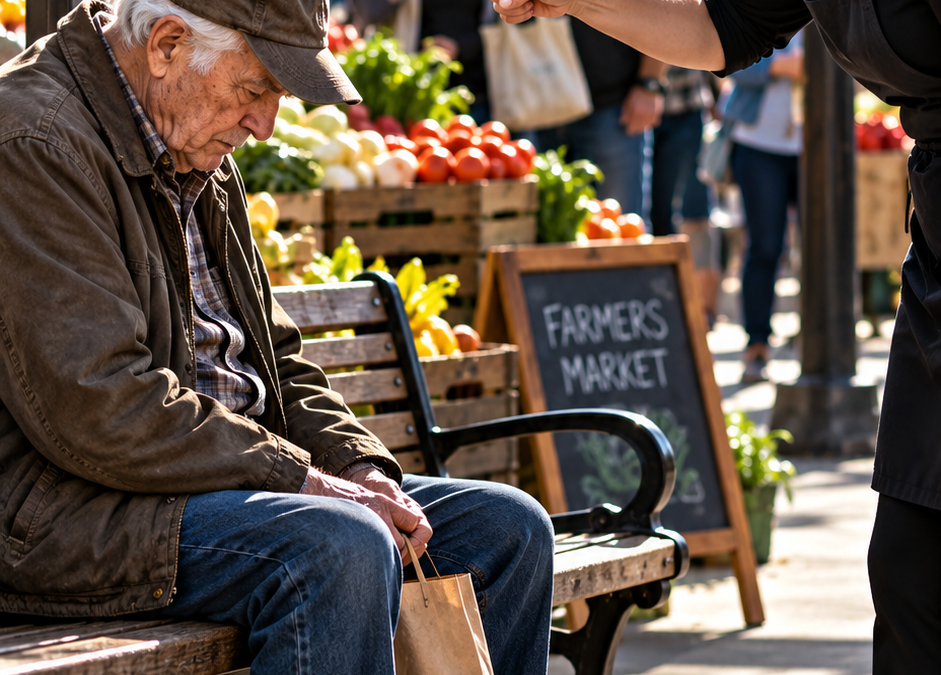
𝗙𝗨𝗟𝗟 𝗦𝗧𝗢𝗥𝗬
Then through the side entrance of the market.
He bought almost the same things every week.
Tomatoes.
A block of sharp cheddar.
Sometimes eggs.
Sometimes apples.
And one pastry chosen entirely according to what looked best that morning.
Maria, who ran the bakery stall, kept a sourdough loaf behind the counter for him.
Dave at the honey stand always found an excuse to give him a sample.
“New batch,” Dave would say.
“You said that last week,” Pop would answer.
“Different flowers.”
“They’re bees, Dave.”
“Exactly. Very complicated operation.”
Pop liked routine.
At his age, routine was not boredom.
Routine was freedom.
He did not have to ask one of us to drive him somewhere.
He did not have to wait until a granddaughter finished work or a son finished errands.
He could put on his hat, carry his bag, and go buy his tomatoes.
That sounds small until you watch somebody get old.
Age takes things quietly.
First, maybe, the ladder.
Then night driving.
Then long trips.
Then stairs.
Then lifting.
Then places you once visited alone become places people insist on escorting you.
A person who spent his life deciding for himself eventually starts hearing:
Let me do that for you.
Sit down.
Wait here.
I’ll get it.
For Pop, the farmers market was one place where he still moved at his own speed and belonged without needing help.
And there was another reason that market mattered to me.
Four years earlier, I had bought the building.
I never told many people.
There was no reason to.
The property had come onto the market after the former owner retired.
The farmers market had been operating there for years.
It was one of those old converted commercial spaces that did not look impressive from outside.
Brick.
Tall industrial windows.
Steel rafters.
Concrete floors worn smooth by decades of foot traffic.
But every weekend, it came alive.
Coffee.
Bread.
Cheese.
Vegetables.
Flowers.
Soap.
Honey.
Local meat.
Handmade preserves.
People from the neighborhood wandered through even when they did not need anything.
I loved the place.
So when the previous owner started talking about selling to a developer who might convert it into boutique offices, I made an offer.
The deal worked.
I bought it.
Quietly.
I did not rename the building.
Did not put my photograph in the lobby.
Did not hang some ridiculous sign saying UNDER NEW OWNERSHIP.
Most vendors barely noticed anything had changed.
That was exactly what I wanted.
The market worked because it already belonged emotionally to the community.
I owned the real estate.
I did not need everyone to know it.
Day-to-day operation remained under a local community association that worked closely with the surrounding HOA.
They handled vendor applications.
Stall scheduling.
Basic market rules.
Cleaning arrangements.
Weekend staff.
Guest conduct.
The operating agreement was straightforward.
They had broad authority over normal operations.
I retained control over the property itself, major policy changes, permanent exclusions, structural decisions, and anything that created significant liability.
For years, the arrangement worked.
I collected rent.
Paid building expenses.
Approved repairs.
And mostly stayed out of their way.
The vendors knew me better than the board did because I occasionally came through to check maintenance or buy groceries.
Some people probably assumed I was a manager.
That was fine with me.
Then Diane Mercer became president.
Within six weeks, people started calling me.
Not formal complaints at first.
Comments.
Questions.
Things people said while pretending they were not complaining.
“Have you seen the new visitor rules?”
“Diane says vendors need to qualify for different approval tiers now.”
“She told Mrs. Jenkins she couldn’t sit near the coffee stall unless she was buying something.”
“Do we really need written approval to rearrange tables?”
I heard all of it.
And I made a mistake.
I assumed it would settle down.
New board presidents sometimes overcorrect.
They arrive believing leadership requires visibly changing things.
They make policies.
Hold meetings.
Send emails.
Eventually they discover that most successful places work because people have already developed habits that make sense.
I thought Diane would discover that.
Instead, every week she became more confident.
She introduced a vendor approval tier system no one had requested.
Priority vendors.
Standard vendors.
Conditional vendors.
Nobody could explain what practical problem the categories solved.
She revised the guest conduct policy.
She created rules about where people could stand while waiting.
How long visitors could occupy benches.
When sampling without purchase became “non-commercial use.”
The language sounded as though a farmers market had become an airport.
Two elderly visitors were escorted out during her first month.
The incident report described them as “loitering near the cheese vendor without active purchasing behavior.”
I remember reading that phrase later.
Active purchasing behavior.
They were standing beside cheese.
At a farmers market.
I should have intervened then.
That part is on me.
I had given the association room to operate because I believed local people managing a community market should not need the property owner breathing down their necks.
But distance can become neglect if you refuse to recognize when authority starts hurting people.
I learned that the morning Maria called me.
It was Saturday.
A little after nine.
My phone rang while I was at home.
I almost let it go to voicemail.
Then I saw Maria’s name.
She never called me on weekends unless the building had a problem.
I answered.
“Hey, Maria. Everything okay?”
She did not say hello.
“Are you near the market?”
Her voice was shaking.
I stood up.
“What happened?”
“It’s Pop.”
Everything inside me tightened.
“Is he hurt?”
“No. No, he’s not hurt.”
“What happened?”
“It’s Diane.”
I was already reaching for my keys.
“What did she do?”
Maria hesitated.
“She threw him out.”
I stopped.
“What?”
“She banned him.”
For a second, I genuinely could not process the sentence.
“Banned him from what?”
“The market.”
“My grandfather?”
“Yes.”
“Why?”
“He was sitting.”
I thought I had misheard her.
“He was what?”
“He was sitting on the bench.”
I grabbed my shoes.
“Tell me exactly what happened.”
“I think you need to come here.”
“I’m coming.”
I did not grab a jacket.
I barely tied my shoes.
I ran.
By the time I reached the building, Pop was already gone.
That hurt worse than if I had found him arguing.
The market looked normal.
People buying bread.
Children carrying cups of cider.
Vendors arranging produce.
But the atmosphere near the entrance was wrong.
Quiet.
Maria saw me and immediately came from behind her stall.
She still had flour on one sleeve.
“Where is he?”
“He left.”
“Which way?”
“Home, I think.”
“What happened?”
She looked toward the entrance bench.
“Diane came over while he was resting.”
That bench had been there before I bought the building.
Heavy wooden seat.
Iron arms.
Nothing special.
Pop usually stopped there after walking from home.
Five minutes.
Sometimes ten.
Then he stood and made his rounds.
Maria continued.
“She asked if he’d bought anything yet.”
I stared at her.
“What did he say?”
“He smiled. Said he was resting his knees before shopping.”
That sounded exactly like Pop.
“And then?”
“She told him the bench was for paying customers.”
I looked toward the aisle.
People were pretending not to listen.
“And?”
“She said he needed to make a purchase or leave.”
My anger rose quickly.
But Maria was not finished.
“Pop stood up.”
“He didn’t argue?”
“You know him.”
I did.
“Then he said he was going to get tomatoes.”
Maria’s voice broke slightly.
“He took maybe two steps.”
I felt something cold settle in my chest.
“What did Diane do?”
“She stepped in front of him.”
Maria swallowed.
“She said she’d seen him here before without making substantial purchases.”
“What does that even mean?”
“I don’t know.”
“What exactly did she say?”
Maria looked at me.
“Under the new conduct policy, I’m issuing you a formal visitor restriction. You are no longer welcome at this market.”
For a moment, the sounds of the market seemed to disappear.
All I could picture was Pop.
Seventy-nine.
Brown cap.
Canvas grocery bag.
Standing there while someone half his age publicly explained that he no longer belonged in one of the few places left in his weekly life.
“What did he do?”
Maria looked down.
“He nodded.”
Of course he did.
“He didn’t say anything?”
“No.”
“He just left?”
“Yes.”
I turned toward the entrance.
There was something about that that made me angrier than shouting would have.
Pop had spent his entire life avoiding scenes.
Not because he was weak.
Because dignity mattered to him.
He would rather absorb embarrassment than make a room uncomfortable.
People often mistake that kind of restraint for surrender.
“Where’s Diane?”
“Back office.”
I almost walked straight there.
Then I stopped.
Because I realized there was something I needed first.
“Did the cameras catch it?”
Maria looked toward the ceiling.
“They should have.”
The market had six main security cameras.
I had upgraded the system eighteen months earlier after a vendor reported cash missing during setup.
Four covered interior aisles.
One covered the loading entrance.
One covered the main entrance and bench area.
All recorded audio only in specific administrative zones where lawful notices were posted; the main visitor cameras were video-only.
The bench sat inside the clearest angle of Camera Two.
I went upstairs to the property office.
Logged into the security system.
Pulled the footage.
8:47 a.m.
Pop entered.
Brown cap.
Canvas bag.
He stopped at Maria’s stall.
She waved.
He lifted one hand.
Then he walked toward the bench.
Slowly.
I watched him lower himself carefully.
One hand on the armrest.
The other on his knee.
He sat.
Three minutes later, Diane entered the frame.
Clipboard tucked under one arm.
She stopped in front of him.
I could not hear the conversation from that camera.
But body language says plenty.
She pointed toward the stalls.
Pop nodded.
Placed both hands on the bench.
Pushed himself upright.
He adjusted his bag.
Started to walk.
Diane moved sideways.
Blocked him.
She raised one hand.
Pop stopped.
People nearby turned.
Maria froze behind her display.
Dave leaned forward from the honey stall.
Diane spoke for almost twenty seconds.
Pop did not interrupt.
Then he nodded.
Just once.
He turned around.
Walked toward the door.
The camera caught him from behind.
He moved more slowly than usual.
At the entrance, he paused.
Not long.
Maybe two seconds.
Then he walked outside.
I watched it again.
Then again.
On the third viewing, I noticed something I had missed.
When he stood from the bench, his grocery bag was empty.
When he left, it was still empty.
He had not even bought his tomatoes.
I sat there staring at the monitor.
For a full minute, maybe longer.
Anger makes you want immediate movement.
Confrontation.
Answers.
Consequences.
But I have learned that the most important moment in a conflict is often the one where you decide whether you want relief or a result.
I could have walked downstairs and fired Diane from the building in front of everyone.
That would have felt good.
It also would have allowed the rest of the board to claim she had been punished for one emotional misunderstanding involving the owner’s grandfather.
I wanted to know how far this had gone.
So I opened the incident system.
Diane had already filed her report.
Visitor:
Henry Lawson.
Age:
Unknown.
Violation:
Repeated non-commercial occupancy of customer seating.
Action:
Permanent visitor restriction.
Basis:
Failure to demonstrate regular substantial purchasing activity and prior observation of extended inactive use.
I read the phrase twice.
Regular substantial purchasing activity.
Pop bought tomatoes, cheese, bread, honey, eggs, and pastries almost every Saturday.
But even if he had bought nothing, that bench was not a toll booth.
Then I searched Diane’s earlier visitor restrictions.
Eleven.
Eleven people in six weeks.
Most were older.
One was a man who waited every Saturday while his wife shopped because standing aggravated a spinal injury.
Another was a retired teacher who met her daughter near the coffee stall.
Two were the visitors from the cheese incident.
Several reports used nearly identical language.
Loitering.
Non-purchasing occupancy.
Insufficient commercial activity.
None of those permanent restrictions had come to me for approval.
That mattered.
I opened the operating agreement.
Section 7.
The association could manage ordinary guest conduct.
Temporary removal for immediate safety issues.
Same-day restrictions in cases of disruption.
But permanent exclusion from the property required written owner approval except where law enforcement or a court order imposed restrictions.
No approval request had ever reached me.
Then I opened the revised conduct policy Diane had distributed six weeks earlier.
I checked my email.
Nothing.
Property manager’s email.
Nothing.
Owner review folder.
Nothing.
The operating agreement required any material change affecting visitor access or vendor rights to be submitted to ownership before enforcement.
It had not been.
I printed the relevant pages.
Then I called my property manager.
“Can you set a meeting for tomorrow morning?”
“With Diane?”
“With the full board.”
“Sunday?”
“Yes.”
“Mandatory?”
“Every member.”
“What should I tell them it’s about?”
“Operating compliance.”
There was a pause.
“Is this about what happened today?”
“Yes.”
“All right.”
“And don’t give Diane anything else.”
I hung up.
Then I finally went to Pop’s house.
He lived three blocks from the market in the same small brick home where my mother had grown up.
I knocked.
He opened the door wearing his undershirt and house pants.
The brown cap sat on the table behind him.
He looked surprised.
“What are you doing here?”
“I heard what happened.”
His expression changed.
Not much.
Enough.
“Maria called you.”
“Yes.”
“She shouldn’t have bothered you.”
“She didn’t bother me.”
Pop walked back toward the kitchen.
I followed.
His empty grocery bag sat folded on a chair.
That image made something in my throat tighten.
“You didn’t get your groceries.”
“I have food.”
“That isn’t the point.”
He opened the refrigerator.
“See? Food.”
“Pop.”
He closed it.
“What?”
“Why didn’t you call me?”
“For what?”
“You were thrown out.”
He frowned slightly.
“I was told not to come back.”
“Same thing.”
“It’s their place.”
“No.”
He looked at me.
“What?”
“It’s not their place.”
He knew I owned the building, but I had never discussed the operating agreement with him.
To Pop, the market was simply the market.
“I own the property.”
“I know.”
“Then why would you think Diane gets to decide whether you’re allowed there?”
He sat at the kitchen table.
“I don’t want trouble over tomatoes.”
That sentence almost broke me.
“It isn’t about tomatoes.”
“It is a little about tomatoes.”
I sat across from him.
“Were you embarrassed?”
He looked away.
That answered me.
“Pop.”
“People were watching.”
“I know.”
“I didn’t like that.”
His voice was very quiet.
I had seen him at funerals where he held other people upright.
Seen him endure surgeries without complaining.
Watched him bury my grandmother and spend the entire service asking whether everyone else had eaten.
But embarrassment is strange.
Physical pain gives you something to fight.
Humiliation makes you wonder whether you somehow deserved it.
“She said I wasn’t buying enough,” he said.
“You buy something every week.”
“Maybe not enough for the bench.”
I stared at him.
“There is no minimum purchase for the bench.”
He shrugged.
“Apparently there is now.”
“No.”
I leaned forward.
“There isn’t.”
Pop looked at me carefully.
I think he understood from my tone that something larger was happening.
“Don’t get mean about it.”
I almost smiled.
“You think I’m mean?”
“When you’re quiet.”
“I learned that from you.”
“That was your first mistake.”
I laughed despite myself.
Then he reached across the table and tapped my hand.
“Listen to me.”
“I am.”
“That woman was rude.”
“Yes.”
“She embarrassed me.”
“Yes.”
“I don’t like her.”
“Good.”
“But don’t tear the whole place apart because somebody was rude to an old man.”
I swallowed.
“What if she did it to eleven people?”
His hand stopped.
“What?”
“She issued eleven visitor restrictions.”
Pop looked toward the window.
“For sitting?”
“Different reasons. Same pattern.”
He sighed.
Then leaned back.
“That changes it.”
“Yes.”
After a moment, he said:
“Still don’t get mean.”
“I’ll try.”
“I mean it.”
“I know.”
The next morning, six board members sat around the conference table in the market’s back office.
The market was closed on Sundays, so the building felt completely different.
No vendors.
No children.
No coffee grinder.
Just fluorescent lights and chairs scraping across concrete.
I arrived last.
Diane was already there.
Clipboard.
Lanyard.
Red blazer.
She looked irritated by the inconvenience of a Sunday meeting.
I had met two board members before.
The others knew my name but apparently not my face.
Diane looked at me as though I were another consultant.
She asked the property manager:
“Are we waiting for the owner?”
I closed the door.
“No.”
She glanced at me.
“We should probably start when ownership arrives.”
“I am ownership.”
Silence.
It was almost physical.
Diane’s eyes narrowed.
I gave my name.
Then my role.
“Four years ago, I purchased this building and the parcel beneath it. The market association operates here under an agreement with me.”
One board member sat straighter.
Another looked at Diane.
Diane recovered quickly.
“I wasn’t aware we’d be discussing property matters.”
“We’re discussing operations.”
I took my seat.
Placed three things on the table.
The security footage timestamp log.
The original operating agreement.
Diane’s incident report regarding Pop.
Then another stack.
The eleven visitor restrictions.
I did not mention that Henry Lawson was my grandfather.
Not yet.
I wanted to hear how they defended the policy without knowing that.
I slid Diane’s incident report across the table.
“Can you explain this?”
She read the heading.
“Yes. We recently strengthened visitor standards because people have been treating the market as a social space rather than a commercial one.”
A board member named Linda frowned.
“It is a social space.”
Diane ignored her.
“Seating has been abused. Vendors have complained about blocked areas.”
“Which vendors?”
“I’d have to review the feedback.”
“I have.”
Diane looked at me.
“I spoke to fourteen vendors yesterday.”
That was true.
After leaving Pop’s house, I had called or visited every permanent vendor.
“Not one said seventy-nine-year-old Henry Lawson created a problem.”
Diane’s expression shifted.
“Henry?”
“Yes.”
I waited.
“You issued him a permanent visitor restriction yesterday.”
“I don’t know visitors personally.”
“I do.”
She set the report down.
“If he violated the conduct policy, age doesn’t exempt him.”
“I didn’t say it did.”
There was a small pause.
Then I said:
“He’s my grandfather.”
That changed the room.
Not because it changed the rule.
It should not have.
If what Diane did was improper, it was improper whether Pop was related to me or not.
But human beings react to connections.
Diane’s face went still.
One board member whispered:
“Oh.”
I continued.
“The relationship is why I learned about this quickly. It is not why we’re here.”
I placed the security timestamp log beside the report.
“We’re here because your report says he was permanently restricted from property you don’t have authority to permanently restrict people from.”
Diane crossed her arms.
“The revised conduct policy gives the president discretion.”
“No.”
“It does.”
“Show me.”
She opened her clipboard.
Pulled out the new policy.
Pointed to a section.
The board president may restrict access for repeated conduct inconsistent with market use.
I nodded.
“Who approved this policy?”
“The board.”
“When?”
“Six weeks ago.”
“Did you submit it for owner review?”
Her eyes shifted.
“Day-to-day rules don’t require owner approval.”
“Material changes affecting visitor access do.”
“We considered it an operational clarification.”
I opened the operating agreement.
Section 7.
Read it aloud.
Any policy creating continuing or permanent restrictions on visitor access required written approval from property ownership.
Then I looked around the table.
“Did anyone send this policy to me?”
Nobody answered.
I looked at the property manager.
“No,” he said.
Diane leaned forward.
“We were responding to real concerns.”
“That’s possible.”
“The market had become disorderly.”
“That’s your opinion.”
“It’s what I was elected to address.”
“Then address it within your authority.”
Her cheeks reddened.
“I did.”
“No, Diane. You didn’t.”
I kept my voice level.
“I watched the footage.”
That was the first time she looked uncomfortable.
I continued.
“A seventy-nine-year-old man sat on a bench to rest his knees. You asked whether he had made a purchase. He said he was about to shop. He stood when you told him the bench was for customers. Then you physically stepped into his path and issued a permanent restriction.”
“I did not physically touch him.”
“I didn’t say you did.”
“The policy allows intervention before conduct becomes chronic.”
“Eleven permanent restrictions in six weeks.”
I pushed the other reports toward the center of the table.
One board member picked them up.
“Eleven?”
“Yes.”
Diane looked at him.
“Those were documented violations.”
Linda took one.
“This woman was banned for waiting near the coffee stall?”
“She repeatedly remained without purchasing.”
Linda looked at her.
“She’s seventy-two.”
“Again, age is not—”
“What did she do?”
“She occupied vendor-adjacent space.”
Linda stared at the paper.
Another board member opened the cheese-stall report.
“Loitering?”
“Yes.”
“For how long?”
“I don’t recall.”
“You signed it.”
“I sign many reports.”
That was when the board started shifting.
Not dramatically.
Nobody stood up and denounced Diane.
They simply began looking at the papers instead of at her.
That is usually how authority starts leaving someone.
Not with noise.
With attention.
I read Pop’s incident report aloud.
Every word.
Repeated non-commercial occupancy.
Failure to demonstrate substantial purchasing activity.
Prior observation of inactive use.
Formal permanent visitor restriction.
When I finished, I placed the page down.
“Would anyone like to explain why sitting on a bench without having purchased something in the previous few minutes became grounds for permanent exclusion?”
Silence.
Diane broke it.
“The market exists to support vendors.”
“I agree.”
“Visitors who use limited seating without buying reduce customer turnover.”
“Was there anyone waiting for his seat?”
“That isn’t the point.”
“It is one point.”
“Policies have to be applied consistently.”
“Then let’s discuss consistency.”
I handed out vendor sales records.
Maria had pulled them at my request.
Several vendors used loyalty notes for regular customers.
Pop’s name appeared regularly.
Cheese.
Bread.
Honey.
Produce.
I slid the pages toward Diane.
“Your incident report says he repeatedly visited without substantial purchasing.”
She looked at the sheets.
“He often sits before purchasing.”
“Yes.”
“That creates an enforcement problem.”
“No. It creates a chair.”
One board member looked down, hiding what may have been a smile.
Diane did not.
“This market cannot function if everyone treats it like a public lounge.”
“The market has functioned for years with people sitting on that bench.”
“We’re trying to professionalize operations.”
I looked around the empty market beyond the office window.
Wooden stalls.
Handwritten signs.
Flower buckets.
The entire place existed because people enjoyed being there.
“Professionalize it into what?”
She did not answer.
I opened the operating agreement again.
“This board is a tenant-operator. It manages the market under authority delegated by ownership.”
Diane stiffened.
“Tenant-operator is an oversimplification.”
“It is the legal relationship.”
“We represent the community.”
“Yes.”
“That matters.”
“It does.”
“And as elected representatives, we have to be able to set standards without interference every time somebody dislikes enforcement.”
“Also true.”
She looked almost relieved.
Then I continued.
“But you cannot give yourself powers the agreement does not delegate.”
Her expression hardened.
“I did not.”
“You permanently banned eleven people.”
“Under the revised policy.”
“A policy that never received required approval.”
“The board approved it.”
“The board cannot amend my property rights by voting among itself.”
Silence again.
I pulled out the clause requiring owner review.
“The revised policy is non-binding as to any provision that exceeds your delegated authority.”
Diane looked toward the property manager.
He did not rescue her.
“So effective immediately,” I continued, “all permanent visitor restrictions issued under that policy are suspended.”
Diane sat upright.
“You can’t simply override board enforcement.”
“I can when it involves access to my property beyond the authority granted in your operating agreement.”
“This creates a governance crisis.”
“No. It corrects one.”
I turned toward the other board members.
“The market association can still remove anyone creating a safety problem. It can contact police. It can impose same-day conduct restrictions under the agreement. It can manage vendor operations.”
Then I tapped the reports.
“What it cannot do is permanently exile people because the president decided their purchasing activity was insufficient.”
Linda looked at me.
“What happens to these eleven?”
“They’re rescinded unless there is a separate lawful basis for restriction.”
She nodded.
Diane looked furious now.
“This undermines me in front of the entire community.”
I met her eyes.
“You did that yourself.”
She stared at me.
I continued.
“This could have been solved weeks ago if the revised policy had been submitted properly. I would have rejected the permanent-ban section. We could have discussed whatever legitimate crowding concerns existed. Instead, you enforced a policy you did not have authority to enforce.”
Diane said nothing.
“So I have one question.”
I looked around the table.
“Does this board intend to continue operating under the agreement as written?”
One by one, they said yes.
Linda first.
Then Robert.
Then Charles.
Then the others.
Diane remained silent.
I turned toward her.
“Diane?”
She looked at the stack of incident reports.
Then at me.
“This arrangement makes meaningful leadership impossible.”
“No. It makes meaningful leadership accountable.”
She closed her clipboard.
“I won’t operate under those conditions.”
“That is your decision.”
She stood.
Nobody stopped her.
By the end of the afternoon, Diane submitted a two-line resignation email.
No apology.
No explanation.
No admission.
Something about differing views regarding governance and operational authority.
I did not care.
The board met again after she left.
This time, the conversation was better.
Less defensive.
They formally rescinded all eleven visitor restrictions.
They agreed to review every conduct rule.
The vendor tier system was suspended pending vendor input.
Permanent access restrictions would require proper review.
Benches would remain open to visitors.
Most importantly, the board agreed that the market did not exist only as a place where money changed hands.
That may sound obvious.
It had apparently stopped being obvious.
I called each affected visitor personally.
Some were surprised.
One laughed.
One did not want to return.
That bothered me.
The retired teacher said:
“I’ve already found another place to meet my daughter.”
I apologized.
She thanked me.
But she still did not come back.
That was a consequence no policy reversal could erase.
People remember where they were made to feel unwanted.
When I called Pop, he answered on the fourth ring.
“Yeah?”
“It’s me.”
“I know who it is.”
“Diane resigned.”
Silence.
Then:
“You didn’t fire her?”
“No.”
“Good.”
“The board rescinded your restriction.”
“Okay.”
“And the other ten.”
That interested him more.
“They did?”
“Yes.”
“Good.”
“You can come back.”
“I know.”
“How?”
“You wouldn’t be calling otherwise.”
I smiled.
“I’m picking you up Saturday.”
“I can walk.”
“I know.”
“Then why are you picking me up?”
“Because I want to.”
He sighed.
“You’re becoming difficult.”
“Family trait.”
That week, I ordered a small brass plaque.
Nothing grand.
No reference to Diane.
No mention of Pop.
No dedication.
I had it installed on the wooden bench near the entrance.
Four words.
REST A WHILE.
YOU’RE WELCOME HERE.
Saturday morning, I pulled up outside Pop’s house at 7:45.
He was already waiting.
Good shirt.
Brown cap.
Canvas bag.
He climbed into the passenger seat slowly.
“I still could’ve walked.”
“I know.”
“You wasted gas.”
“Three blocks.”
“Still gas.”
We drove in silence.
When we reached the market, he looked out the window.
More cars than usual.
I had not announced his return.
I had asked everyone else not to either.
I did not want to turn Pop into a symbol.
He hated attention.
We entered through the side door.
Maria spotted him first.
Her face changed immediately.
“Henry.”
Pop smiled.
“You still selling bread?”
“Only to approved customers.”
He stopped.
Maria stared at him.
Then they both laughed.
She reached under her counter.
“Your sourdough.”
“I haven’t paid.”
“You will.”
“That sounds better.”
Dave leaned over from the honey stand.
“New sample.”
Pop shook his head.
“Same bees.”
“Different week.”
A few vendors quietly said hello.
Nobody applauded.
Thank God.
Pop would have turned around again if they had.
Then he reached the entrance bench.
He saw the plaque.
Stopped.
Read it.
REST A WHILE.
YOU’RE WELCOME HERE.
He stood there longer than I expected.
Then he sat.
I stayed beside him.
People moved through the entrance.
A young mother helped her child zip a jacket.
Someone carried flowers.
Coffee steamed from paper cups.
The market sounded like itself again.
Pop ran one thumb across the brass plaque.
“You did this.”
“Yes.”
“You didn’t have to.”
“Yeah, Pop.”
I looked at him.
“I really did.”
He shook his head.
“You always make things bigger.”
“She made it bigger.”
“Maybe.”
“She told you that you didn’t belong somewhere you had been coming for eleven years.”
“People say stupid things.”
“She used authority to make it official.”
He looked at me.
“That bothered you.”
“Yes.”
“More than what she said to me?”
I thought about it.
“Yes.”
Pop nodded slowly.
“Good.”
I frowned.
“Good?”
He leaned back against the bench.
“People are rude every day. You can’t fix all of them.”
Then he tapped the brass sign.
“But rules last longer than rude people.”
That sounded exactly like something Pop would say and then pretend wasn’t wise.
“You could’ve told me that before I spent two days buried in operating agreements.”
“You needed the practice.”
I laughed.
Then he stood.
“Tomatoes.”
“Want me to get them?”
He looked offended.
“No.”
I watched him walk down the aisle.
Slow.
Careful.
Independent.
The same way he had walked it hundreds of times.
Maria waved from the bread stall.
Dave prepared his ridiculous honey sample.
At the produce stand, Pop picked up three tomatoes.
Turned each one in his hand.
Rejected the first.
Kept the second.
Put the third back.
No rush.
No clipboard.
No one measuring whether his visit generated enough revenue per minute.
Just an old man choosing tomatoes.
I stayed near the entrance for a while.
Not because I thought he needed watching.
Because I needed to see the place through his eyes.
The market was never successful because every person moved efficiently from stall to stall and completed transactions.
It worked because people lingered.
They asked vendors questions.
They met neighbors.
Children sampled fruit.
Retired people sat down.
Somebody came in for bread and spent twenty minutes talking about weather.
A customer who bought nothing one Saturday might buy fifty dollars of groceries the next.
That was community.
Messy.
Slow.
Impossible to reduce to “active purchasing behavior.”
Diane had looked at the same place and seen inefficiency.
People occupying space.
Visitors who needed monitoring.
Benches that needed turnover.
Vendors that needed ranking.
She believed control would improve everything.
Instead, control slowly removed the thing worth protecting.
That is what stayed with me after she was gone.
Not the meeting.
Not the operating agreement.
Not even the video.
The dangerous part was how reasonable each small step probably sounded when presented alone.
We need clearer conduct rules.
Reasonable.
We need to prevent seating abuse.
Maybe reasonable.
We need stronger vendor standards.
Possibly.
We need the president to enforce policies consistently.
Of course.
Then six weeks later, a seventy-nine-year-old man resting his knees had become a rule violation.
Two elderly people talking beside a cheese stall had become loiterers.
Eleven human beings had become incident reports.
Authority rarely wakes up one morning and announces that it intends to become cruel.
Usually it calls itself efficiency first.
Structure.
Standards.
Professionalism.
Safety.
Consistency.
Then, somewhere along the way, the people affected become less important than the system being enforced.
I thought about my own responsibility too.
It would be easy to tell this story as though I were the hero who appeared at exactly the right moment.
I wasn’t.
I owned the building.
People had warned me that Diane was becoming overbearing.
Vendors had mentioned discomfort.
I heard about the visitor restrictions.
I thought the board would handle it.
I stayed hands-off because hands-off had worked before.
That choice gave bad policy six weeks to become normal.
Eleven people were embarrassed before the problem touched my family.
That matters.
If Maria had called me about somebody else’s grandfather, would I have moved as fast?
I would like to say yes.
I am not completely sure.
That question bothered me enough that I changed how I manage the property.
Not by taking over everything.
That would repeat Diane’s mistake in a different direction.
The board still runs the market.
Vendors still choose representatives.
Management still handles applications and weekend logistics.
But major policy changes are now posted for vendor comment before adoption.
Anything affecting public access receives owner review as the agreement always required.
Permanent exclusions require documented cause and proper approval.
And once every quarter, I attend a market meeting.
Mostly I listen.
The new board president is Linda.
She lasted about ten minutes into her first meeting before saying:
“I would like to formally ban the phrase active purchasing behavior.”
Everyone laughed.
Even me.
She did not actually need a motion for that.
Still, somebody seconded it.
The market settled again.
That spring, the retired teacher who had refused to return eventually came back.
Not because I convinced her.
Her daughter did.
They met near the coffee stall.
Nobody asked them what they planned to purchase.
The man with the spinal injury returned too.
His wife shopped.
He sat.
Sometimes for forty minutes.
Nobody timed him.
A few months later, we added another bench.
Pop complained.
“Waste of money.”
“Why?”
“One bench was enough.”
“Apparently not.”
He looked at the new one.
“Too fancy.”
“It was on sale.”
“That usually means nobody else wanted it.”
I stopped arguing.
Pop still goes almost every Saturday.
His knees are worse now.
Some mornings I drive him.
Others he insists on walking.
He still wears the brown cap.
Still buys tomatoes as though choosing them involves national security.
Still pretends Dave’s honey samples are unnecessary before trying every one.
And he still sits on that bench.
Sometimes five minutes.
Sometimes fifteen.
Sometimes longer.
No one asks whether he has purchased enough to deserve it.
The brass plaque has darkened slightly with age.
REST A WHILE.
YOU’RE WELCOME HERE.
A few people have asked whether it was installed because of some particular incident.
I usually say yes.
If they ask what happened, I tell them only enough.
Someone once forgot what the market was for.
That is the simplest version.
Because the longer version is not really about my grandfather.
Not entirely.
It is about what happens when people confuse a position with ownership.
Diane had a title.
President.
A clipboard.
Policies.
Meeting authority.
An incident form with boxes she could check.
Those things made her feel powerful.
But none of them made the market hers.
I owned the property, and even that did not make the market entirely mine in the way that mattered most.
The vendors had built relationships there for years.
Customers had created habits.
Families had traditions.
People had memories tied to that building long before my name appeared on a deed.
Ownership gave me legal authority.
It did not give me the right to treat everyone inside like pieces of furniture.
Pop understood that naturally.
He had spent forty years selling produce.
He knew a customer could walk around your stand for twenty minutes and buy nothing.
That did not make them worthless.
He knew somebody might come just to talk.
Someone might be lonely.
Someone might be counting the cash in their pocket before deciding what they could afford.
You never knew.
So you treated them decently first and worried about the sale second.
Diane looked at an old man sitting on a bench and saw a person failing to contribute enough.
She did not know he had spent forty years contributing to people who could never repay him.
She did not know he had raised four children.
Buried his wife.
Worked until his knees stopped cooperating.
She did not know he had been walking through that market for eleven years.
She did not know the bread lady saved him a loaf.
She did not know that a honey vendor watched for him every Saturday.
And she certainly did not know that his granddaughter owned the building.
But that last fact should not have mattered.
I remind myself of that constantly.
Pop deserved dignity before anyone knew who I was.
So did the other ten people.
Power should not become kinder only after it discovers a connection.
That is not kindness.
That is fear of consequences.
The better lesson came from Pop himself.
He never asked me to punish Diane.
He barely wanted me involved.
When I told him eleven people had been restricted, that was when he cared.
Because suddenly it was not about his pride.
It was about a pattern.
That was his whole life.
He could tolerate unfairness aimed at him more easily than unfairness aimed at someone else.
I wish he had defended himself more.
Maybe that is selfish.
Watching someone you love accept humiliation quietly is painful.
You want them to fight.
To say something sharp.
To make the person hurting them understand who they are dealing with.
But Pop has never needed the last word to know his worth.
The morning after his return, I went back through the footage one final time.
I watched Diane approach.
Watched Pop stand.
Watched her stop him.
Watched him leave.
Then I pulled the camera from the following Saturday.
Same entrance.
Same bench.
Pop walked in beside me.
Maria waved.
He sat beneath the brass plaque.
People passed around him.
Nothing dramatic.
No confrontation.
No victory speech.
Just an old man resting his knees before buying tomatoes.
I saved both clips.
Not for revenge.
Not to post them.
I keep them because they remind me how easily a place can change depending on who is allowed to define belonging.
In the first clip, one person with a clipboard decided that sitting without purchasing made someone unwelcome.
In the second, the same bench told everyone the opposite.
Rest.
You are welcome.
The wood was the same.
The building was the same.
The difference was the rule.
Pop turned eighty not long after that.
We held a small family dinner at my house.
His children came.
Grandchildren.
Two great-grandchildren who were more interested in cake than family history.
At one point, someone brought up the market incident.
Pop groaned.
“Can we stop talking about that woman?”
My uncle laughed.
“You became famous.”
“I sat on a bench.”
“You got banned.”
“I got unbanned.”
“You caused a board president to resign.”
Pop pointed at me.
“She did that.”
Everyone looked at me.
I shook my head.
“No. Diane did that herself.”
Pop nodded.
“See?”
Then he went back to his cake.
That was the end of the conversation for him.
Maybe that is why the story still matters so much to me.
Pop did not need the ending.
I did.
I needed to know the place had been corrected.
I needed to know the other restrictions were gone.
I needed to see him walk through those doors again without wondering whether somebody would stop him.
And maybe I needed to undo a little of my own guilt for not acting earlier.
I cannot erase the moment Diane embarrassed him.
The video exists.
The people who watched remember it.
Pop remembers it even if he pretends not to.
But a bad moment does not have to become the permanent meaning of a place.
The market is still there.
Saturday mornings are still crowded.
Maria still saves sourdough.
Dave still invents reasons that this week’s honey is different from last week’s.
The benches are often full.
Sometimes with paying customers.
Sometimes with husbands waiting for wives.
Sometimes with teenagers drinking coffee.
Sometimes with people who came in because it was raining.
Nobody checks.
That is exactly how I want it.
And every once in a while, I stand near the entrance and watch Pop sit beneath that little brass sign.
He usually rests one hand on the handle of his grocery bag.
His cap tilted slightly forward.
People move around him.
Most have no idea who he is.
They do not know the story.
They do not know his granddaughter owns the property.
They do not know anyone was ever told they needed to buy something before they were allowed to sit there.
To them, he is simply an elderly man taking a break at a farmers market.
That is all he ever wanted to be.
And that is the part Diane never understood.
Quiet people are not empty people.
Slow people are not useless people.
An old man sitting on a bench may have spent a lifetime standing for everybody else.
You do not know.
So before you decide somebody is taking up space, you might want to ask what that space is for.
Pop spent forty years behind a produce stand learning something Diane never learned from all her policies.
A market is not only where people buy things.
It is where people come.
And sometimes, being allowed to come is the most valuable thing being offered.
𝗧𝗛𝗘 𝗘𝗡𝗗
She Thought the Quiet Old Man on the Bench Had No One Behind Him
She looked my seventy-nine-year-old grandfather directly in the eyes and said, “You are no longer welcome here.”
He did not argue.
He did not demand a manager.
He did not raise his voice or ask the people watching to take his side.
He simply adjusted the worn brown cap on his head, picked up his empty grocery bag, nodded once, and walked away.
What she did not know was that I watched the entire thing afterward from six security cameras.
What she also did not know was that every wall around her, every vendor stall, every light fixture hanging above the aisle, every bench she had decided she controlled, and every square foot beneath her shoes belonged to me.
But before I tell you what happened the next morning, you need to understand the man she humiliated.
We call him Pop.
His real name is Henry, but I cannot remember the last time anyone in our family called him that.
To me, he has always been Pop.
He is the kind of man who wakes up at five in the morning even when he has nowhere to go.
Not because he is trying to be productive.
Not because he thinks sleeping late is lazy.
His body simply spent too many decades believing that daylight meant work.
For most of his adult life, he ran a small produce stand.
Nothing fancy.
A wooden counter.
Hand-painted prices.
Crates stacked beneath folding tables.
Tomatoes in summer.
Apples when the weather cooled.
Potatoes, onions, squash, peppers, and whatever local growers could get him at a price that allowed ordinary families to afford dinner.
He was never wealthy.
But he had a reputation.
If Pop told you a melon was sweet, it was sweet.
If he said peaches needed another two days, you waited two days.
If someone came up five dollars short at the end of the week, he somehow forgot to collect it.
When I was little, I thought he knew everyone in town.
Later I understood that he did not.
He just treated strangers like people worth remembering.
For forty years, he stood behind that produce counter.
Rainy mornings.
Summer heat.
Cold days when his fingers cracked around the knuckles.
He raised four children.
Buried my grandmother.
Helped pay hospital bills for relatives who never knew where the money came from.
Showed up at graduations.
Funerals.
Birthdays.
School plays.
He gave more rides than I can count and accepted almost none in return.
That was Pop.
Independent almost to a fault.
By seventy-nine, his knees had taken most of the punishment his pride refused to acknowledge.
He could still walk.
He just walked slowly.
Stairs took planning.
Long parking lots annoyed him.
He no longer drove because he had voluntarily handed over his keys two years earlier after admitting that night glare bothered him more than he liked.
That decision cost him.
Driving had always represented independence to him.
Once the car was gone, his world became smaller.
Three blocks one way to the pharmacy.
Four blocks another way to the diner.
The park.
The church.
And every Saturday morning, our local farmers market.
That market mattered to him more than I realized until someone tried to take it away.
Saturday was his ritual.
He would wake early.
Shave.
Put on a clean shirt.
Then choose the same worn brown flat cap he had owned since the 1980s.
My grandmother used to hate that hat.
She tried to replace it twice.
Pop refused.
After she died, nobody ever suggested throwing it away again.
By eight in the morning, he would leave his house carrying a reusable canvas grocery bag.
He walked three blocks.
Slowly.
Past the pharmacy.
Past the little insurance office.
Across Maple Street.
Then through the side entrance of the market.
He bought almost the same things every week.
Tomatoes.
A block of sharp cheddar.
Sometimes eggs.
Sometimes apples.
And one pastry chosen entirely according to what looked best that morning.
Maria, who ran the bakery stall, kept a sourdough loaf behind the counter for him.
Dave at the honey stand always found an excuse to give him a sample.
“New batch,” Dave would say.
“You said that last week,” Pop would answer.
“Different flowers.”
“They’re bees, Dave.”
“Exactly. Very complicated operation.”
Pop liked routine.
At his age, routine was not boredom.
Routine was freedom.
He did not have to ask one of us to drive him somewhere.
He did not have to wait until a granddaughter finished work or a son finished errands.
He could put on his hat, carry his bag, and go buy his tomatoes.
That sounds small until you watch somebody get old.
Age takes things quietly.
First, maybe, the ladder.
Then night driving.
Then long trips.
Then stairs.
Then lifting.
Then places you once visited alone become places people insist on escorting you.
A person who spent his life deciding for himself eventually starts hearing:
Let me do that for you.
Sit down.
Wait here.
I’ll get it.
For Pop, the farmers market was one place where he still moved at his own speed and belonged without needing help.
And there was another reason that market mattered to me.
Four years earlier, I had bought the building.
I never told many people.
There was no reason to.
The property had come onto the market after the former owner retired.
The farmers market had been operating there for years.
It was one of those old converted commercial spaces that did not look impressive from outside.
Brick.
Tall industrial windows.
Steel rafters.
Concrete floors worn smooth by decades of foot traffic.
But every weekend, it came alive.
Coffee.
Bread.
Cheese.
Vegetables.
Flowers.
Soap.
Honey.
Local meat.
Handmade preserves.
People from the neighborhood wandered through even when they did not need anything.
I loved the place.
So when the previous owner started talking about selling to a developer who might convert it into boutique offices, I made an offer.
The deal worked.
I bought it.
Quietly.
I did not rename the building.
Did not put my photograph in the lobby.
Did not hang some ridiculous sign saying UNDER NEW OWNERSHIP.
Most vendors barely noticed anything had changed.
That was exactly what I wanted.
The market worked because it already belonged emotionally to the community.
I owned the real estate.
I did not need everyone to know it.
Day-to-day operation remained under a local community association that worked closely with the surrounding HOA.
They handled vendor applications.
Stall scheduling.
Basic market rules.
Cleaning arrangements.
Weekend staff.
Guest conduct.
The operating agreement was straightforward.
They had broad authority over normal operations.
I retained control over the property itself, major policy changes, permanent exclusions, structural decisions, and anything that created significant liability.
For years, the arrangement worked.
I collected rent.
Paid building expenses.
Approved repairs.
And mostly stayed out of their way.
The vendors knew me better than the board did because I occasionally came through to check maintenance or buy groceries.
Some people probably assumed I was a manager.
That was fine with me.
Then Diane Mercer became president.
Within six weeks, people started calling me.
Not formal complaints at first.
Comments.
Questions.
Things people said while pretending they were not complaining.
“Have you seen the new visitor rules?”
“Diane says vendors need to qualify for different approval tiers now.”
“She told Mrs. Jenkins she couldn’t sit near the coffee stall unless she was buying something.”
“Do we really need written approval to rearrange tables?”
I heard all of it.
And I made a mistake.
I assumed it would settle down.
New board presidents sometimes overcorrect.
They arrive believing leadership requires visibly changing things.
They make policies.
Hold meetings.
Send emails.
Eventually they discover that most successful places work because people have already developed habits that make sense.
I thought Diane would discover that.
Instead, every week she became more confident.
She introduced a vendor approval tier system no one had requested.
Priority vendors.
Standard vendors.
Conditional vendors.
Nobody could explain what practical problem the categories solved.
She revised the guest conduct policy.
She created rules about where people could stand while waiting.
How long visitors could occupy benches.
When sampling without purchase became “non-commercial use.”
The language sounded as though a farmers market had become an airport.
Two elderly visitors were escorted out during her first month.
The incident report described them as “loitering near the cheese vendor without active purchasing behavior.”
I remember reading that phrase later.
Active purchasing behavior.
They were standing beside cheese.
At a farmers market.
I should have intervened then.
That part is on me.
I had given the association room to operate because I believed local people managing a community market should not need the property owner breathing down their necks.
But distance can become neglect if you refuse to recognize when authority starts hurting people.
I learned that the morning Maria called me.
It was Saturday.
A little after nine.
My phone rang while I was at home.
I almost let it go to voicemail.
Then I saw Maria’s name.
She never called me on weekends unless the building had a problem.
I answered.
“Hey, Maria. Everything okay?”
She did not say hello.
“Are you near the market?”
Her voice was shaking.
I stood up.
“What happened?”
“It’s Pop.”
Everything inside me tightened.
“Is he hurt?”
“No. No, he’s not hurt.”
“What happened?”
“It’s Diane.”
I was already reaching for my keys.
“What did she do?”
Maria hesitated.
“She threw him out.”
I stopped.
“What?”
“She banned him.”
For a second, I genuinely could not process the sentence.
“Banned him from what?”
“The market.”
“My grandfather?”
“Yes.”
“Why?”
“He was sitting.”
I thought I had misheard her.
“He was what?”
“He was sitting on the bench.”
I grabbed my shoes.
“Tell me exactly what happened.”
“I think you need to come here.”
“I’m coming.”
I did not grab a jacket.
I barely tied my shoes.
I ran.
By the time I reached the building, Pop was already gone.
That hurt worse than if I had found him arguing.
The market looked normal.
People buying bread.
Children carrying cups of cider.
Vendors arranging produce.
But the atmosphere near the entrance was wrong.
Quiet.
Maria saw me and immediately came from behind her stall.
She still had flour on one sleeve.
“Where is he?”
“He left.”
“Which way?”
“Home, I think.”
“What happened?”
She looked toward the entrance bench.
“Diane came over while he was resting.”
That bench had been there before I bought the building.
Heavy wooden seat.
Iron arms.
Nothing special.
Pop usually stopped there after walking from home.
Five minutes.
Sometimes ten.
Then he stood and made his rounds.
Maria continued.
“She asked if he’d bought anything yet.”
I stared at her.
“What did he say?”
“He smiled. Said he was resting his knees before shopping.”
That sounded exactly like Pop.
“And then?”
“She told him the bench was for paying customers.”
I looked toward the aisle.
People were pretending not to listen.
“And?”
“She said he needed to make a purchase or leave.”
My anger rose quickly.
But Maria was not finished.
“Pop stood up.”
“He didn’t argue?”
“You know him.”
I did.
“Then he said he was going to get tomatoes.”
Maria’s voice broke slightly.
“He took maybe two steps.”
I felt something cold settle in my chest.
“What did Diane do?”
“She stepped in front of him.”
Maria swallowed.
“She said she’d seen him here before without making substantial purchases.”
“What does that even mean?”
“I don’t know.”
“What exactly did she say?”
Maria looked at me.
“Under the new conduct policy, I’m issuing you a formal visitor restriction. You are no longer welcome at this market.”
For a moment, the sounds of the market seemed to disappear.
All I could picture was Pop.
Seventy-nine.
Brown cap.
Canvas grocery bag.
Standing there while someone half his age publicly explained that he no longer belonged in one of the few places left in his weekly life.
“What did he do?”
Maria looked down.
“He nodded.”
Of course he did.
“He didn’t say anything?”
“No.”
“He just left?”
“Yes.”
I turned toward the entrance.
There was something about that that made me angrier than shouting would have.
Pop had spent his entire life avoiding scenes.
Not because he was weak.
Because dignity mattered to him.
He would rather absorb embarrassment than make a room uncomfortable.
People often mistake that kind of restraint for surrender.
“Where’s Diane?”
“Back office.”
I almost walked straight there.
Then I stopped.
Because I realized there was something I needed first.
“Did the cameras catch it?”
Maria looked toward the ceiling.
“They should have.”
The market had six main security cameras.
I had upgraded the system eighteen months earlier after a vendor reported cash missing during setup.
Four covered interior aisles.
One covered the loading entrance.
One covered the main entrance and bench area.
All recorded audio only in specific administrative zones where lawful notices were posted; the main visitor cameras were video-only.
The bench sat inside the clearest angle of Camera Two.
I went upstairs to the property office.
Logged into the security system.
Pulled the footage.
8:47 a.m.
Pop entered.
Brown cap.
Canvas bag.
He stopped at Maria’s stall.
She waved.
He lifted one hand.
Then he walked toward the bench.
Slowly.
I watched him lower himself carefully.
One hand on the armrest.
The other on his knee.
He sat.
Three minutes later, Diane entered the frame.
Clipboard tucked under one arm.
She stopped in front of him.
I could not hear the conversation from that camera.
But body language says plenty.
She pointed toward the stalls.
Pop nodded.
Placed both hands on the bench.
Pushed himself upright.
He adjusted his bag.
Started to walk.
Diane moved sideways.
Blocked him.
She raised one hand.
Pop stopped.
People nearby turned.
Maria froze behind her display.
Dave leaned forward from the honey stall.
Diane spoke for almost twenty seconds.
Pop did not interrupt.
Then he nodded.
Just once.
He turned around.
Walked toward the door.
The camera caught him from behind.
He moved more slowly than usual.
At the entrance, he paused.
Not long.
Maybe two seconds.
Then he walked outside.
I watched it again.
Then again.
On the third viewing, I noticed something I had missed.
When he stood from the bench, his grocery bag was empty.
When he left, it was still empty.
He had not even bought his tomatoes.
I sat there staring at the monitor.
For a full minute, maybe longer.
Anger makes you want immediate movement.
Confrontation.
Answers.
Consequences.
But I have learned that the most important moment in a conflict is often the one where you decide whether you want relief or a result.
I could have walked downstairs and fired Diane from the building in front of everyone.
That would have felt good.
It also would have allowed the rest of the board to claim she had been punished for one emotional misunderstanding involving the owner’s grandfather.
I wanted to know how far this had gone.
So I opened the incident system.
Diane had already filed her report.
Visitor:
Henry Lawson.
Age:
Unknown.
Violation:
Repeated non-commercial occupancy of customer seating.
Action:
Permanent visitor restriction.
Basis:
Failure to demonstrate regular substantial purchasing activity and prior observation of extended inactive use.
I read the phrase twice.
Regular substantial purchasing activity.
Pop bought tomatoes, cheese, bread, honey, eggs, and pastries almost every Saturday.
But even if he had bought nothing, that bench was not a toll booth.
Then I searched Diane’s earlier visitor restrictions.
Eleven.
Eleven people in six weeks.
Most were older.
One was a man who waited every Saturday while his wife shopped because standing aggravated a spinal injury.
Another was a retired teacher who met her daughter near the coffee stall.
Two were the visitors from the cheese incident.
Several reports used nearly identical language.
Loitering.
Non-purchasing occupancy.
Insufficient commercial activity.
None of those permanent restrictions had come to me for approval.
That mattered.
I opened the operating agreement.
Section 7.
The association could manage ordinary guest conduct.
Temporary removal for immediate safety issues.
Same-day restrictions in cases of disruption.
But permanent exclusion from the property required written owner approval except where law enforcement or a court order imposed restrictions.
No approval request had ever reached me.
Then I opened the revised conduct policy Diane had distributed six weeks earlier.
I checked my email.
Nothing.
Property manager’s email.
Nothing.
Owner review folder.
Nothing.
The operating agreement required any material change affecting visitor access or vendor rights to be submitted to ownership before enforcement.
It had not been.
I printed the relevant pages.
Then I called my property manager.
“Can you set a meeting for tomorrow morning?”
“With Diane?”
“With the full board.”
“Sunday?”
“Yes.”
“Mandatory?”
“Every member.”
“What should I tell them it’s about?”
“Operating compliance.”
There was a pause.
“Is this about what happened today?”
“Yes.”
“All right.”
“And don’t give Diane anything else.”
I hung up.
Then I finally went to Pop’s house.
He lived three blocks from the market in the same small brick home where my mother had grown up.
I knocked.
He opened the door wearing his undershirt and house pants.
The brown cap sat on the table behind him.
He looked surprised.
“What are you doing here?”
“I heard what happened.”
His expression changed.
Not much.
Enough.
“Maria called you.”
“Yes.”
“She shouldn’t have bothered you.”
“She didn’t bother me.”
Pop walked back toward the kitchen.
I followed.
His empty grocery bag sat folded on a chair.
That image made something in my throat tighten.
“You didn’t get your groceries.”
“I have food.”
“That isn’t the point.”
He opened the refrigerator.
“See? Food.”
“Pop.”
He closed it.
“What?”
“Why didn’t you call me?”
“For what?”
“You were thrown out.”
He frowned slightly.
“I was told not to come back.”
“Same thing.”
“It’s their place.”
“No.”
He looked at me.
“What?”
“It’s not their place.”
He knew I owned the building, but I had never discussed the operating agreement with him.
To Pop, the market was simply the market.
“I own the property.”
“I know.”
“Then why would you think Diane gets to decide whether you’re allowed there?”
He sat at the kitchen table.
“I don’t want trouble over tomatoes.”
That sentence almost broke me.
“It isn’t about tomatoes.”
“It is a little about tomatoes.”
I sat across from him.
“Were you embarrassed?”
He looked away.
That answered me.
“Pop.”
“People were watching.”
“I know.”
“I didn’t like that.”
His voice was very quiet.
I had seen him at funerals where he held other people upright.
Seen him endure surgeries without complaining.
Watched him bury my grandmother and spend the entire service asking whether everyone else had eaten.
But embarrassment is strange.
Physical pain gives you something to fight.
Humiliation makes you wonder whether you somehow deserved it.
“She said I wasn’t buying enough,” he said.
“You buy something every week.”
“Maybe not enough for the bench.”
I stared at him.
“There is no minimum purchase for the bench.”
He shrugged.
“Apparently there is now.”
“No.”
I leaned forward.
“There isn’t.”
Pop looked at me carefully.
I think he understood from my tone that something larger was happening.
“Don’t get mean about it.”
I almost smiled.
“You think I’m mean?”
“When you’re quiet.”
“I learned that from you.”
“That was your first mistake.”
I laughed despite myself.
Then he reached across the table and tapped my hand.
“Listen to me.”
“I am.”
“That woman was rude.”
“Yes.”
“She embarrassed me.”
“Yes.”
“I don’t like her.”
“Good.”
“But don’t tear the whole place apart because somebody was rude to an old man.”
I swallowed.
“What if she did it to eleven people?”
His hand stopped.
“What?”
“She issued eleven visitor restrictions.”
Pop looked toward the window.
“For sitting?”
“Different reasons. Same pattern.”
He sighed.
Then leaned back.
“That changes it.”
“Yes.”
After a moment, he said:
“Still don’t get mean.”
“I’ll try.”
“I mean it.”
“I know.”
The next morning, six board members sat around the conference table in the market’s back office.
The market was closed on Sundays, so the building felt completely different.
No vendors.
No children.
No coffee grinder.
Just fluorescent lights and chairs scraping across concrete.
I arrived last.
Diane was already there.
Clipboard.
Lanyard.
Red blazer.
She looked irritated by the inconvenience of a Sunday meeting.
I had met two board members before.
The others knew my name but apparently not my face.
Diane looked at me as though I were another consultant.
She asked the property manager:
“Are we waiting for the owner?”
I closed the door.
“No.”
She glanced at me.
“We should probably start when ownership arrives.”
“I am ownership.”
Silence.
It was almost physical.
Diane’s eyes narrowed.
I gave my name.
Then my role.
“Four years ago, I purchased this building and the parcel beneath it. The market association operates here under an agreement with me.”
One board member sat straighter.
Another looked at Diane.
Diane recovered quickly.
“I wasn’t aware we’d be discussing property matters.”
“We’re discussing operations.”
I took my seat.
Placed three things on the table.
The security footage timestamp log.
The original operating agreement.
Diane’s incident report regarding Pop.
Then another stack.
The eleven visitor restrictions.
I did not mention that Henry Lawson was my grandfather.
Not yet.
I wanted to hear how they defended the policy without knowing that.
I slid Diane’s incident report across the table.
“Can you explain this?”
She read the heading.
“Yes. We recently strengthened visitor standards because people have been treating the market as a social space rather than a commercial one.”
A board member named Linda frowned.
“It is a social space.”
Diane ignored her.
“Seating has been abused. Vendors have complained about blocked areas.”
“Which vendors?”
“I’d have to review the feedback.”
“I have.”
Diane looked at me.
“I spoke to fourteen vendors yesterday.”
That was true.
After leaving Pop’s house, I had called or visited every permanent vendor.
“Not one said seventy-nine-year-old Henry Lawson created a problem.”
Diane’s expression shifted.
“Henry?”
“Yes.”
I waited.
“You issued him a permanent visitor restriction yesterday.”
“I don’t know visitors personally.”
“I do.”
She set the report down.
“If he violated the conduct policy, age doesn’t exempt him.”
“I didn’t say it did.”
There was a small pause.
Then I said:
“He’s my grandfather.”
That changed the room.
Not because it changed the rule.
It should not have.
If what Diane did was improper, it was improper whether Pop was related to me or not.
But human beings react to connections.
Diane’s face went still.
One board member whispered:
“Oh.”
I continued.
“The relationship is why I learned about this quickly. It is not why we’re here.”
I placed the security timestamp log beside the report.
“We’re here because your report says he was permanently restricted from property you don’t have authority to permanently restrict people from.”
Diane crossed her arms.
“The revised conduct policy gives the president discretion.”
“No.”
“It does.”
“Show me.”
She opened her clipboard.
Pulled out the new policy.
Pointed to a section.
The board president may restrict access for repeated conduct inconsistent with market use.
I nodded.
“Who approved this policy?”
“The board.”
“When?”
“Six weeks ago.”
“Did you submit it for owner review?”
Her eyes shifted.
“Day-to-day rules don’t require owner approval.”
“Material changes affecting visitor access do.”
“We considered it an operational clarification.”
I opened the operating agreement.
Section 7.
Read it aloud.
Any policy creating continuing or permanent restrictions on visitor access required written approval from property ownership.
Then I looked around the table.
“Did anyone send this policy to me?”
Nobody answered.
I looked at the property manager.
“No,” he said.
Diane leaned forward.
“We were responding to real concerns.”
“That’s possible.”
“The market had become disorderly.”
“That’s your opinion.”
“It’s what I was elected to address.”
“Then address it within your authority.”
Her cheeks reddened.
“I did.”
“No, Diane. You didn’t.”
I kept my voice level.
“I watched the footage.”
That was the first time she looked uncomfortable.
I continued.
“A seventy-nine-year-old man sat on a bench to rest his knees. You asked whether he had made a purchase. He said he was about to shop. He stood when you told him the bench was for customers. Then you physically stepped into his path and issued a permanent restriction.”
“I did not physically touch him.”
“I didn’t say you did.”
“The policy allows intervention before conduct becomes chronic.”
“Eleven permanent restrictions in six weeks.”
I pushed the other reports toward the center of the table.
One board member picked them up.
“Eleven?”
“Yes.”
Diane looked at him.
“Those were documented violations.”
Linda took one.
“This woman was banned for waiting near the coffee stall?”
“She repeatedly remained without purchasing.”
Linda looked at her.
“She’s seventy-two.”
“Again, age is not—”
“What did she do?”
“She occupied vendor-adjacent space.”
Linda stared at the paper.
Another board member opened the cheese-stall report.
“Loitering?”
“Yes.”
“For how long?”
“I don’t recall.”
“You signed it.”
“I sign many reports.”
That was when the board started shifting.
Not dramatically.
Nobody stood up and denounced Diane.
They simply began looking at the papers instead of at her.
That is usually how authority starts leaving someone.
Not with noise.
With attention.
I read Pop’s incident report aloud.
Every word.
Repeated non-commercial occupancy.
Failure to demonstrate substantial purchasing activity.
Prior observation of inactive use.
Formal permanent visitor restriction.
When I finished, I placed the page down.
“Would anyone like to explain why sitting on a bench without having purchased something in the previous few minutes became grounds for permanent exclusion?”
Silence.
Diane broke it.
“The market exists to support vendors.”
“I agree.”
“Visitors who use limited seating without buying reduce customer turnover.”
“Was there anyone waiting for his seat?”
“That isn’t the point.”
“It is one point.”
“Policies have to be applied consistently.”
“Then let’s discuss consistency.”
I handed out vendor sales records.
Maria had pulled them at my request.
Several vendors used loyalty notes for regular customers.
Pop’s name appeared regularly.
Cheese.
Bread.
Honey.
Produce.
I slid the pages toward Diane.
“Your incident report says he repeatedly visited without substantial purchasing.”
She looked at the sheets.
“He often sits before purchasing.”
“Yes.”
“That creates an enforcement problem.”
“No. It creates a chair.”
One board member looked down, hiding what may have been a smile.
Diane did not.
“This market cannot function if everyone treats it like a public lounge.”
“The market has functioned for years with people sitting on that bench.”
“We’re trying to professionalize operations.”
I looked around the empty market beyond the office window.
Wooden stalls.
Handwritten signs.
Flower buckets.
The entire place existed because people enjoyed being there.
“Professionalize it into what?”
She did not answer.
I opened the operating agreement again.
“This board is a tenant-operator. It manages the market under authority delegated by ownership.”
Diane stiffened.
“Tenant-operator is an oversimplification.”
“It is the legal relationship.”
“We represent the community.”
“Yes.”
“That matters.”
“It does.”
“And as elected representatives, we have to be able to set standards without interference every time somebody dislikes enforcement.”
“Also true.”
She looked almost relieved.
Then I continued.
“But you cannot give yourself powers the agreement does not delegate.”
Her expression hardened.
“I did not.”
“You permanently banned eleven people.”
“Under the revised policy.”
“A policy that never received required approval.”
“The board approved it.”
“The board cannot amend my property rights by voting among itself.”
Silence again.
I pulled out the clause requiring owner review.
“The revised policy is non-binding as to any provision that exceeds your delegated authority.”
Diane looked toward the property manager.
He did not rescue her.
“So effective immediately,” I continued, “all permanent visitor restrictions issued under that policy are suspended.”
Diane sat upright.
“You can’t simply override board enforcement.”
“I can when it involves access to my property beyond the authority granted in your operating agreement.”
“This creates a governance crisis.”
“No. It corrects one.”
I turned toward the other board members.
“The market association can still remove anyone creating a safety problem. It can contact police. It can impose same-day conduct restrictions under the agreement. It can manage vendor operations.”
Then I tapped the reports.
“What it cannot do is permanently exile people because the president decided their purchasing activity was insufficient.”
Linda looked at me.
“What happens to these eleven?”
“They’re rescinded unless there is a separate lawful basis for restriction.”
She nodded.
Diane looked furious now.
“This undermines me in front of the entire community.”
I met her eyes.
“You did that yourself.”
She stared at me.
I continued.
“This could have been solved weeks ago if the revised policy had been submitted properly. I would have rejected the permanent-ban section. We could have discussed whatever legitimate crowding concerns existed. Instead, you enforced a policy you did not have authority to enforce.”
Diane said nothing.
“So I have one question.”
I looked around the table.
“Does this board intend to continue operating under the agreement as written?”
One by one, they said yes.
Linda first.
Then Robert.
Then Charles.
Then the others.
Diane remained silent.
I turned toward her.
“Diane?”
She looked at the stack of incident reports.
Then at me.
“This arrangement makes meaningful leadership impossible.”
“No. It makes meaningful leadership accountable.”
She closed her clipboard.
“I won’t operate under those conditions.”
“That is your decision.”
She stood.
Nobody stopped her.
By the end of the afternoon, Diane submitted a two-line resignation email.
No apology.
No explanation.
No admission.
Something about differing views regarding governance and operational authority.
I did not care.
The board met again after she left.
This time, the conversation was better.
Less defensive.
They formally rescinded all eleven visitor restrictions.
They agreed to review every conduct rule.
The vendor tier system was suspended pending vendor input.
Permanent access restrictions would require proper review.
Benches would remain open to visitors.
Most importantly, the board agreed that the market did not exist only as a place where money changed hands.
That may sound obvious.
It had apparently stopped being obvious.
I called each affected visitor personally.
Some were surprised.
One laughed.
One did not want to return.
That bothered me.
The retired teacher said:
“I’ve already found another place to meet my daughter.”
I apologized.
She thanked me.
But she still did not come back.
That was a consequence no policy reversal could erase.
People remember where they were made to feel unwanted.
When I called Pop, he answered on the fourth ring.
“Yeah?”
“It’s me.”
“I know who it is.”
“Diane resigned.”
Silence.
Then:
“You didn’t fire her?”
“No.”
“Good.”
“The board rescinded your restriction.”
“Okay.”
“And the other ten.”
That interested him more.
“They did?”
“Yes.”
“Good.”
“You can come back.”
“I know.”
“How?”
“You wouldn’t be calling otherwise.”
I smiled.
“I’m picking you up Saturday.”
“I can walk.”
“I know.”
“Then why are you picking me up?”
“Because I want to.”
He sighed.
“You’re becoming difficult.”
“Family trait.”
That week, I ordered a small brass plaque.
Nothing grand.
No reference to Diane.
No mention of Pop.
No dedication.
I had it installed on the wooden bench near the entrance.
Four words.
REST A WHILE.
YOU’RE WELCOME HERE.
Saturday morning, I pulled up outside Pop’s house at 7:45.
He was already waiting.
Good shirt.
Brown cap.
Canvas bag.
He climbed into the passenger seat slowly.
“I still could’ve walked.”
“I know.”
“You wasted gas.”
“Three blocks.”
“Still gas.”
We drove in silence.
When we reached the market, he looked out the window.
More cars than usual.
I had not announced his return.
I had asked everyone else not to either.
I did not want to turn Pop into a symbol.
He hated attention.
We entered through the side door.
Maria spotted him first.
Her face changed immediately.
“Henry.”
Pop smiled.
“You still selling bread?”
“Only to approved customers.”
He stopped.
Maria stared at him.
Then they both laughed.
She reached under her counter.
“Your sourdough.”
“I haven’t paid.”
“You will.”
“That sounds better.”
Dave leaned over from the honey stand.
“New sample.”
Pop shook his head.
“Same bees.”
“Different week.”
A few vendors quietly said hello.
Nobody applauded.
Thank God.
Pop would have turned around again if they had.
Then he reached the entrance bench.
He saw the plaque.
Stopped.
Read it.
REST A WHILE.
YOU’RE WELCOME HERE.
He stood there longer than I expected.
Then he sat.
I stayed beside him.
People moved through the entrance.
A young mother helped her child zip a jacket.
Someone carried flowers.
Coffee steamed from paper cups.
The market sounded like itself again.
Pop ran one thumb across the brass plaque.
“You did this.”
“Yes.”
“You didn’t have to.”
“Yeah, Pop.”
I looked at him.
“I really did.”
He shook his head.
“You always make things bigger.”
“She made it bigger.”
“Maybe.”
“She told you that you didn’t belong somewhere you had been coming for eleven years.”
“People say stupid things.”
“She used authority to make it official.”
He looked at me.
“That bothered you.”
“Yes.”
“More than what she said to me?”
I thought about it.
“Yes.”
Pop nodded slowly.
“Good.”
I frowned.
“Good?”
He leaned back against the bench.
“People are rude every day. You can’t fix all of them.”
Then he tapped the brass sign.
“But rules last longer than rude people.”
That sounded exactly like something Pop would say and then pretend wasn’t wise.
“You could’ve told me that before I spent two days buried in operating agreements.”
“You needed the practice.”
I laughed.
Then he stood.
“Tomatoes.”
“Want me to get them?”
He looked offended.
“No.”
I watched him walk down the aisle.
Slow.
Careful.
Independent.
The same way he had walked it hundreds of times.
Maria waved from the bread stall.
Dave prepared his ridiculous honey sample.
At the produce stand, Pop picked up three tomatoes.
Turned each one in his hand.
Rejected the first.
Kept the second.
Put the third back.
No rush.
No clipboard.
No one measuring whether his visit generated enough revenue per minute.
Just an old man choosing tomatoes.
I stayed near the entrance for a while.
Not because I thought he needed watching.
Because I needed to see the place through his eyes.
The market was never successful because every person moved efficiently from stall to stall and completed transactions.
It worked because people lingered.
They asked vendors questions.
They met neighbors.
Children sampled fruit.
Retired people sat down.
Somebody came in for bread and spent twenty minutes talking about weather.
A customer who bought nothing one Saturday might buy fifty dollars of groceries the next.
That was community.
Messy.
Slow.
Impossible to reduce to “active purchasing behavior.”
Diane had looked at the same place and seen inefficiency.
People occupying space.
Visitors who needed monitoring.
Benches that needed turnover.
Vendors that needed ranking.
She believed control would improve everything.
Instead, control slowly removed the thing worth protecting.
That is what stayed with me after she was gone.
Not the meeting.
Not the operating agreement.
Not even the video.
The dangerous part was how reasonable each small step probably sounded when presented alone.
We need clearer conduct rules.
Reasonable.
We need to prevent seating abuse.
Maybe reasonable.
We need stronger vendor standards.
Possibly.
We need the president to enforce policies consistently.
Of course.
Then six weeks later, a seventy-nine-year-old man resting his knees had become a rule violation.
Two elderly people talking beside a cheese stall had become loiterers.
Eleven human beings had become incident reports.
Authority rarely wakes up one morning and announces that it intends to become cruel.
Usually it calls itself efficiency first.
Structure.
Standards.
Professionalism.
Safety.
Consistency.
Then, somewhere along the way, the people affected become less important than the system being enforced.
I thought about my own responsibility too.
It would be easy to tell this story as though I were the hero who appeared at exactly the right moment.
I wasn’t.
I owned the building.
People had warned me that Diane was becoming overbearing.
Vendors had mentioned discomfort.
I heard about the visitor restrictions.
I thought the board would handle it.
I stayed hands-off because hands-off had worked before.
That choice gave bad policy six weeks to become normal.
Eleven people were embarrassed before the problem touched my family.
That matters.
If Maria had called me about somebody else’s grandfather, would I have moved as fast?
I would like to say yes.
I am not completely sure.
That question bothered me enough that I changed how I manage the property.
Not by taking over everything.
That would repeat Diane’s mistake in a different direction.
The board still runs the market.
Vendors still choose representatives.
Management still handles applications and weekend logistics.
But major policy changes are now posted for vendor comment before adoption.
Anything affecting public access receives owner review as the agreement always required.
Permanent exclusions require documented cause and proper approval.
And once every quarter, I attend a market meeting.
Mostly I listen.
The new board president is Linda.
She lasted about ten minutes into her first meeting before saying:
“I would like to formally ban the phrase active purchasing behavior.”
Everyone laughed.
Even me.
She did not actually need a motion for that.
Still, somebody seconded it.
The market settled again.
That spring, the retired teacher who had refused to return eventually came back.
Not because I convinced her.
Her daughter did.
They met near the coffee stall.
Nobody asked them what they planned to purchase.
The man with the spinal injury returned too.
His wife shopped.
He sat.
Sometimes for forty minutes.
Nobody timed him.
A few months later, we added another bench.
Pop complained.
“Waste of money.”
“Why?”
“One bench was enough.”
“Apparently not.”
He looked at the new one.
“Too fancy.”
“It was on sale.”
“That usually means nobody else wanted it.”
I stopped arguing.
Pop still goes almost every Saturday.
His knees are worse now.
Some mornings I drive him.
Others he insists on walking.
He still wears the brown cap.
Still buys tomatoes as though choosing them involves national security.
Still pretends Dave’s honey samples are unnecessary before trying every one.
And he still sits on that bench.
Sometimes five minutes.
Sometimes fifteen.
Sometimes longer.
No one asks whether he has purchased enough to deserve it.
The brass plaque has darkened slightly with age.
REST A WHILE.
YOU’RE WELCOME HERE.
A few people have asked whether it was installed because of some particular incident.
I usually say yes.
If they ask what happened, I tell them only enough.
Someone once forgot what the market was for.
That is the simplest version.
Because the longer version is not really about my grandfather.
Not entirely.
It is about what happens when people confuse a position with ownership.
Diane had a title.
President.
A clipboard.
Policies.
Meeting authority.
An incident form with boxes she could check.
Those things made her feel powerful.
But none of them made the market hers.
I owned the property, and even that did not make the market entirely mine in the way that mattered most.
The vendors had built relationships there for years.
Customers had created habits.
Families had traditions.
People had memories tied to that building long before my name appeared on a deed.
Ownership gave me legal authority.
It did not give me the right to treat everyone inside like pieces of furniture.
Pop understood that naturally.
He had spent forty years selling produce.
He knew a customer could walk around your stand for twenty minutes and buy nothing.
That did not make them worthless.
He knew somebody might come just to talk.
Someone might be lonely.
Someone might be counting the cash in their pocket before deciding what they could afford.
You never knew.
So you treated them decently first and worried about the sale second.
Diane looked at an old man sitting on a bench and saw a person failing to contribute enough.
She did not know he had spent forty years contributing to people who could never repay him.
She did not know he had raised four children.
Buried his wife.
Worked until his knees stopped cooperating.
She did not know he had been walking through that market for eleven years.
She did not know the bread lady saved him a loaf.
She did not know that a honey vendor watched for him every Saturday.
And she certainly did not know that his granddaughter owned the building.
But that last fact should not have mattered.
I remind myself of that constantly.
Pop deserved dignity before anyone knew who I was.
So did the other ten people.
Power should not become kinder only after it discovers a connection.
That is not kindness.
That is fear of consequences.
The better lesson came from Pop himself.
He never asked me to punish Diane.
He barely wanted me involved.
When I told him eleven people had been restricted, that was when he cared.
Because suddenly it was not about his pride.
It was about a pattern.
That was his whole life.
He could tolerate unfairness aimed at him more easily than unfairness aimed at someone else.
I wish he had defended himself more.
Maybe that is selfish.
Watching someone you love accept humiliation quietly is painful.
You want them to fight.
To say something sharp.
To make the person hurting them understand who they are dealing with.
But Pop has never needed the last word to know his worth.
The morning after his return, I went back through the footage one final time.
I watched Diane approach.
Watched Pop stand.
Watched her stop him.
Watched him leave.
Then I pulled the camera from the following Saturday.
Same entrance.
Same bench.
Pop walked in beside me.
Maria waved.
He sat beneath the brass plaque.
People passed around him.
Nothing dramatic.
No confrontation.
No victory speech.
Just an old man resting his knees before buying tomatoes.
I saved both clips.
Not for revenge.
Not to post them.
I keep them because they remind me how easily a place can change depending on who is allowed to define belonging.
In the first clip, one person with a clipboard decided that sitting without purchasing made someone unwelcome.
In the second, the same bench told everyone the opposite.
Rest.
You are welcome.
The wood was the same.
The building was the same.
The difference was the rule.
Pop turned eighty not long after that.
We held a small family dinner at my house.
His children came.
Grandchildren.
Two great-grandchildren who were more interested in cake than family history.
At one point, someone brought up the market incident.
Pop groaned.
“Can we stop talking about that woman?”
My uncle laughed.
“You became famous.”
“I sat on a bench.”
“You got banned.”
“I got unbanned.”
“You caused a board president to resign.”
Pop pointed at me.
“She did that.”
Everyone looked at me.
I shook my head.
“No. Diane did that herself.”
Pop nodded.
“See?”
Then he went back to his cake.
That was the end of the conversation for him.
Maybe that is why the story still matters so much to me.
Pop did not need the ending.
I did.
I needed to know the place had been corrected.
I needed to know the other restrictions were gone.
I needed to see him walk through those doors again without wondering whether somebody would stop him.
And maybe I needed to undo a little of my own guilt for not acting earlier.
I cannot erase the moment Diane embarrassed him.
The video exists.
The people who watched remember it.
Pop remembers it even if he pretends not to.
But a bad moment does not have to become the permanent meaning of a place.
The market is still there.
Saturday mornings are still crowded.
Maria still saves sourdough.
Dave still invents reasons that this week’s honey is different from last week’s.
The benches are often full.
Sometimes with paying customers.
Sometimes with husbands waiting for wives.
Sometimes with teenagers drinking coffee.
Sometimes with people who came in because it was raining.
Nobody checks.
That is exactly how I want it.
And every once in a while, I stand near the entrance and watch Pop sit beneath that little brass sign.
He usually rests one hand on the handle of his grocery bag.
His cap tilted slightly forward.
People move around him.
Most have no idea who he is.
They do not know the story.
They do not know his granddaughter owns the property.
They do not know anyone was ever told they needed to buy something before they were allowed to sit there.
To them, he is simply an elderly man taking a break at a farmers market.
That is all he ever wanted to be.
And that is the part Diane never understood.
Quiet people are not empty people.
Slow people are not useless people.
An old man sitting on a bench may have spent a lifetime standing for everybody else.
You do not know.
So before you decide somebody is taking up space, you might want to ask what that space is for.
Pop spent forty years behind a produce stand learning something Diane never learned from all her policies.
A market is not only where people buy things.
It is where people come.
And sometimes, being allowed to come is the most valuable thing being offered.

