.She Fined Me for Camping at My Own Lakehouse, Then the HOA Learned She Wasn’t on the Board at All
Part 2
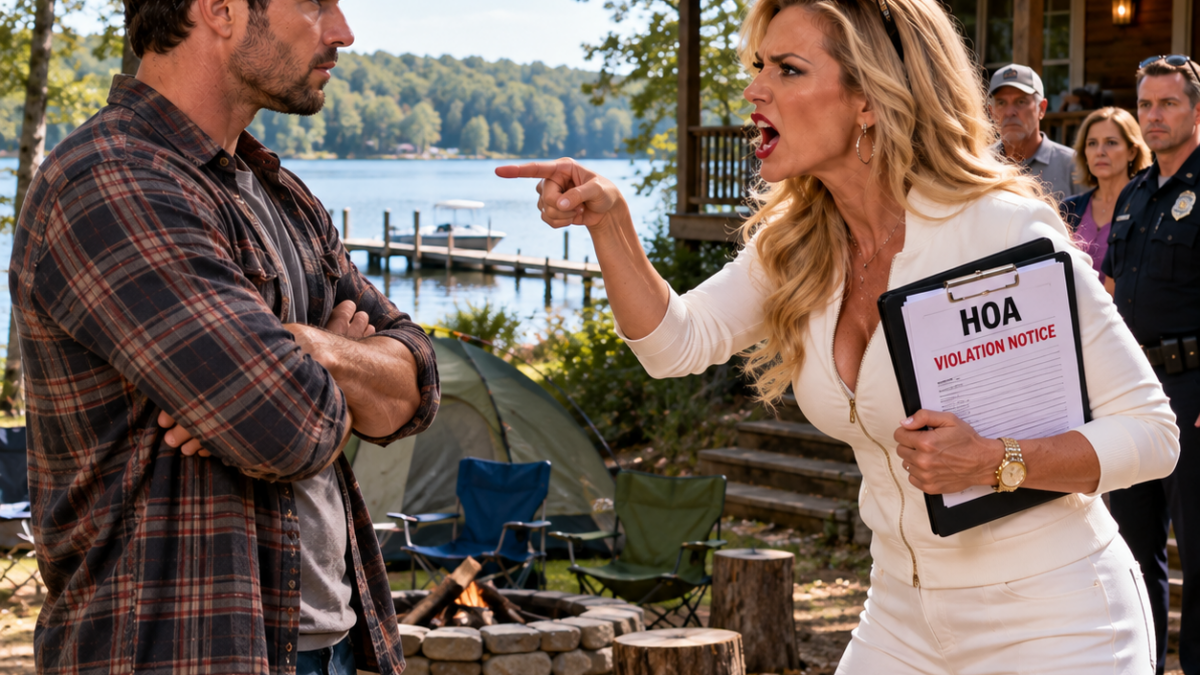
I was cleaning leaves and pine needles out of the backyard firepit when I heard the doorbell.
The sound startled me.
The lakehouse did not get visitors. Not random ones, anyway. My friends usually texted first. My parents called before driving out. Old neighbors of my grandfather sometimes stopped by, but they knocked at the side door because that was what people around the lake had always done.
The front doorbell felt formal.
Suspiciously formal.
I wiped my hands on my jeans and walked through the house. When I opened the door, a woman I had never seen before stood on the porch.
She was in her mid-forties, maybe, with the kind of polished suburban confidence that made her look slightly overdressed for a dirt road near the woods. Her hair was a glossy chestnut bob, curled under perfectly at the ends. She wore fitted white capri pants, a pale blue blouse, wedge sandals, and oversized sunglasses pushed up on her head like she had arrived expecting sunlight, admiration, or both. A gold bracelet flashed on one wrist. Her nails were painted a shade of pink so pale it looked expensive.
She was beautiful in the way some people weaponize beauty: every detail controlled, every smile practiced, every gesture suggesting she expected the world to move slightly out of her way.
“Can I help you?” I asked.
Her eyes swept past me into the house before returning to my face.
“You’re the one staying here on weekends.”
It was not a question.
I opened the door only a little wider.
“I own the house.”
She gave me a tight smile.
“My name is Karen Whitmore. I’m with the neighborhood association.”
That phrase was vague enough to be deliberate.
“The HOA?” I asked.
“Yes. The homeowners association.”
“I’m not part of the HOA.”
She continued as if I had not spoken.
“I’ve been observing this property for a while.”
That sentence, delivered calmly by a stranger on my porch, should have been my first warning that something was very wrong.
“Observing it,” I repeated.
“Yes. There have been repeated overnight stays, open fires, camping activity, smoke visible from community lots, and possible unauthorized use of the surrounding woods.”
I stared at her.
For a second, I wondered if this was some kind of prank.
“I’m sorry,” I said. “You’ve been watching me?”
“I monitor community compliance.”
“This isn’t your community.”
Her smile sharpened.
“This property directly affects our community.”
“No, it doesn’t.”
“It is adjacent.”
“That doesn’t make it part of your HOA.”
“You’ve also missed multiple meetings,” she said. “And our records indicate unpaid dues.”
I almost laughed.
“Your records are wrong.”
Her chin lifted.
“You will need to bring your account current immediately.”
“I don’t have an account.”
“Everyone in the lake district is expected to comply.”
“No,” I said. “Everyone in your HOA is expected to comply. I’m not in your HOA.”
“You need to stop being difficult.”
That was when I understood what kind of person I was dealing with.
Not confused.
Not misinformed.
Entitled.
There is a difference.
A confused person asks questions. An entitled person issues commands and treats facts as rudeness.
I took a breath.
“My grandfather owned this property before that neighborhood existed. It is separate. I have the deed. I pay taxes. I maintain the house. I camp on my land. I use my firepit. I fish from my dock. None of that involves you.”
Her eyes narrowed.
“Do not get snarky with me.”
“Do not show up at my house telling me you’ve been watching me.”
“I am an HOA board member.”
“Good for you.”
“And you are violating community standards.”
“I’m going back to cleaning my yard.”
“If you violate again, fines will be issued.”
I looked at her for a long moment.
Then I smiled politely.
“Have a good day.”
I closed the door before she could answer.
For a few seconds, I stood there in the entryway, listening.
Nothing.
Then her heels clicked across the porch boards and down the steps.
I thought that would be the end of it.
That was my mistake.
The next weekend, I found a note taped to the front door.
NOTICE OF VIOLATION.
It was printed on plain white paper with what appeared to be the HOA’s logo at the top. The letter stated that I had violated overnight occupancy standards, open flame restrictions, and community quiet enjoyment provisions. It demanded payment of unpaid dues and warned that further enforcement actions would follow.
I read it twice.
Then I laughed once and tossed it into the firepit.
It helped start the evening fire.
The next weekend, there were five notes taped to the door.
That meant she had come by every day I was gone.
Each one had a different tone, like Karen was workshopping authority. Some were stiff and official. Some were threatening. One claimed I had ignored “repeated board communications.” Another said failure to remit payment could result in fines, liens, or legal action. Another demanded I cease all camping activity immediately.
I kept one.
Burned the rest.
The fines began after that.
Twenty-five dollars for smoke visible from community property.
Fifty dollars for unauthorized overnight camping.
Seventy-five dollars for failure to attend a compliance hearing I had never been invited to.
One hundred dollars for unpaid association dues.
Then two hundred.
Then more.
At first, I ignored them because they were absurd. I was not part of the HOA. They had no power over me. I figured Karen would eventually tire herself out.
Instead, she escalated.
Every weekend I came to the lakehouse, she showed up.
Sometimes she rang the bell. Sometimes she knocked. Sometimes she stood on the porch and called my name even though I had never given it to her. Once, I found her walking near the edge of my property line, peering through the trees toward my backyard like she was on safari for violations.
I started keeping a folder.
Not because I planned to sue anyone yet.
Because Grandpa had taught me something else besides fishing.
“Paper beats shouting,” he used to say whenever someone tried to settle a dispute with volume instead of proof.
So I saved the fines.
Took pictures of the notes.
Wrote down dates and times.
Photographed Karen when she came onto the porch.
Still, I hesitated to do anything formal.
I do not like confrontation. I know some people thrive on it, but I am not one of them. The lakehouse was supposed to be peaceful. Dragging police, lawyers, or HOA offices into it felt like letting Karen contaminate the one place I went to escape people like her.
My friends told me I was being too patient.
“She’s harassing you,” one said.
“She’s trespassing,” another said.
“She’s probably doing this to other people,” a third said.
That last one stuck with me, though I did not know why yet.
I was still deciding what to do when Karen called the police on me first.
It happened on a Friday night in early fall.
The air had just started turning cool after sunset. I had built a small campfire in the fire ring behind the house and set up a chair near the lake. Nothing wild. Nothing loud. Just me, two beers, a blanket, and the sound of water nudging the shore.
The sky was clear enough that the stars looked almost fake.
I remember thinking Grandpa would have liked that night.
Then blue and red lights flashed through the trees.
My stomach tightened before I heard the knock.
I knew.
Of course I knew.
Still, I tried to convince myself maybe there had been an accident on the road. Maybe the police were checking something unrelated. Maybe someone needed directions.
Then the doorbell rang.
I put out the fire properly because Grandpa’s voice still lived in my head when it came to fire safety, then walked to the front door.
Two officers stood on the porch.
Karen waited near the road, arms crossed, her silhouette stiff beneath the flashing lights.
“Evening,” one officer said. “Are you the owner of this residence?”
“Yes.”
Karen shouted from the road, “He is not compliant!”
The officer turned slightly.
“Ma’am, please wait over there.”
She huffed.
I looked back at him.
“What’s the problem?”
“We received a report that someone has been illegally occupying this property on weekends, lighting fires, and refusing to comply with HOA guidelines.”
I almost laughed.
Not at the officers.
At the sheer ridiculousness of being accused of illegally occupying my own inheritance.
“I own the property,” I said.
“Do you have identification?”
“Yes.”
“And proof of ownership?”
“As a matter of fact, yes.”
Because Karen had been leaving her fake fines for weeks, I had already put copies of the deed, tax records, and probate transfer documents into a folder near the front hall. I retrieved it slowly, handed everything over, and let the officers read.
The older officer’s expression shifted after about thirty seconds.
Then he looked toward Karen.
Then back at the paperwork.
“This property was transferred to you from your grandfather?”
“Yes.”
“And you’re not part of the HOA?”
“No.”
“You’re not renting?”
“No.”
“You’re not trespassing?”
“Only if inheritance became illegal without anyone telling me.”
The younger officer tried not to smile.
The older one handed back the folder.
“Everything appears to be in order. You have the right to be here.”
“Thank you.”
He turned and walked toward Karen.
I could not hear every word, but I heard enough.
No violation.
Private property.
Civil issue at most.
No basis for police action.
Karen did not accept it gracefully.
She exploded.
“You’re being manipulated!” she yelled. “He has fake documents. He has been avoiding dues for over a year. He is using our lake access without approval.”
The officer said something calm.
Karen pointed at me.
“He is making a mockery of this community!”
The officer’s voice hardened.
“Ma’am, we are done here.”
“You’re useless!”
“Have a good evening.”
They left.
Karen stayed.
For one long moment, she stood near the road, lit by the fading flash of taillights, staring at me like I had personally betrayed her by owning land.
I walked down the porch steps.
“Are you going to leave me alone now?”
She smiled.
Not a normal smile.
A promise.
“No,” she said. “I won’t stop until you comply. I will make your life a living hell.”
Then she turned and walked away.
That was the moment I stopped feeling annoyed and started feeling curious.
Because her confidence did not make sense.
If she were truly an HOA board member, she should have known better than to call police on a non-member with deed paperwork. If she were acting officially, there should have been records. Letters. Proper contact. A real process. Something more than taped notes, porch ambushes, and fines printed on paper from a home printer.
The next morning, I opened my laptop and searched the HOA’s website.
It was not hard to find.
The luxury neighborhood was proud of itself. The website had photos of landscaped entrances, pool rules, meeting minutes, committee updates, and a page listing the board members.
President.
Vice president.
Treasurer.
Secretary.
Architectural committee chair.
Compliance chair.
There were names and headshots.
Karen was not there.
I checked twice.
Then a third time.
Nothing.
No Karen Whitmore.
No woman who looked like her.
No title. No role. No mention in meeting minutes. No board listing. No committee.
I sat back slowly.
For weeks, she had been standing on my porch claiming authority she did not have.
But if she was not on the board, what exactly was she doing?
I drove to the HOA office that afternoon.
I almost did not. Part of me wanted to just send an email and avoid the awkwardness. But I had learned enough by then to understand paper trails worked better when paired with human faces.
The office was in a small administrative building near the neighborhood entrance. Inside, everything smelled like printer toner and artificial lemon cleaner. A woman at the front desk looked up when I walked in.
“Can I help you?”
“I hope so,” I said. “I’m not a member of your HOA, but someone claiming to represent you has been sending me fines.”
Her expression changed immediately.
Not confusion.
Recognition.
“Who?”
I pulled out my phone and showed her a photo of Karen standing on my porch, one hand on her hip, sunglasses on her head, looking like she had just discovered a weed in the garden of civilization.
The secretary’s mouth tightened.
“Oh.”
That was not nothing.
“You know her,” I said.
“I know who she is.”
“She says she’s on the board.”
“She is not.”
I waited.
The secretary looked toward the back hallway, then lowered her voice slightly.
“She applied for board membership two years ago and again last year. She was not selected.”
“Why?”
Her professional expression cracked just enough.
“Concerns about temperament.”
I almost smiled.
If an HOA thinks you are too rude for the HOA, that is an accomplishment.
“She has been leaving notices at my property,” I said. “Fines. Dues. Threats. She called the police on me last night for camping on land I own.”
The secretary’s face darkened.
“Do you have the notices?”
“Yes.”
I had brought the folder.
When I laid everything out on the desk, she stopped trying to hide her reaction.
There were dozens of them.
Fines with the HOA logo.
Payment instructions.
A return address.
Warnings.
Late fees.
Threats of liens.
The secretary picked up one notice and stared at it.
“This is not our current fine schedule,” she said.
She picked up another.
“This is not our standard template.”
Then another.
“This return address is not ours.”
Something cold moved through me.
“What do you mean?”
“I mean,” she said carefully, “these payments are not being directed to the HOA.”
For a second, neither of us spoke.
Then she asked if I would be willing to provide a written statement.
Absolutely.
She made copies of everything and asked detailed questions. Dates. Times. What Karen said. Whether I had paid anything. Whether Karen had approached me in person. Whether police responded. Whether I had contact information for the officers.
I answered everything I could.
Before I left, she said, “We’ll need to look into this internally.”
“Do you think she’s doing it to other people?”
The secretary did not answer directly.
That was answer enough.
A week later, I got a call from the HOA office asking if I could come in again.
When I arrived, the secretary was there with the HOA president, a gray-haired man named Daniel Price, and another board member who looked deeply unhappy.
Daniel shook my hand and said, “First, I want to apologize.”
That surprised me.
“You don’t owe me an apology if she’s not part of the HOA.”
“We may not have authorized her,” he said, “but she used our name. That matters.”
Then they told me what they had found.
After reviewing my documents, the board sent out a notice to homeowners asking residents to report any suspicious fines or payment requests not issued through the official HOA portal. They kept the language careful because they did not want to create panic before they knew what they were dealing with.
Responses flooded in.
About a third of the neighborhood had received similar notices.
Not all at once.
That was why nobody caught it earlier.
Karen had been smart enough, at least at first, to move sporadically. A fine here. A late fee there. A warning to one house about landscaping. A notice to another about garbage bins. A demand for payment from someone behind on actual dues, making the fake fee look plausible. Small amounts mostly. Fifty dollars. Seventy-five. One hundred. Enough to annoy people, not enough to make most of them fight.
The payment instructions led to a private mailbox and an account Karen controlled.
She had been impersonating an HOA board member for months.
Maybe longer.
And because people feared late fees, liens, and board retaliation, many had simply paid.
“She made thousands,” Daniel said, disgusted.
I sat there, stunned.
I had thought Karen was a power-tripping neighbor.
She was worse.
She was running a scam in pearls and wedge sandals.
The HOA had already contacted police.
This time, Karen was not the caller.
She was the target.
The investigation moved quickly after that, probably because the evidence was embarrassingly clear. Fake notices. Payment records. Witness statements. My police call. Photos. Copies of letters. The private return address. The non-HOA account. Residents willing to testify they had paid because they believed the notices were official.
When officers arrested Karen, she apparently tried the same routine she had used on my porch.
Outrage.
Authority.
Denial.
Victimhood.
She claimed she was “helping the HOA enforce neglected standards.” She claimed residents had voluntarily paid. She claimed the board had always disrespected her and that she had done more for community order than they ever had. She claimed I had framed her because I hated rules.
None of it helped.
You can argue about tone.
You can argue about intentions.
You cannot argue your way out of a bank account full of money collected through fake fines.
Karen was charged with fraud and theft, among other things. The exact legal process took time, as legal processes always do, but the outcome eventually became clear: she had impersonated HOA authority, collected money under false pretenses, and targeted both actual HOA residents and me, a non-member, because she believed nobody would push hard enough to expose her.
She was sentenced to a year in jail and ordered to pay restitution.
The first time I heard that, I sat on the porch of the lakehouse and listened to the wind move through the trees.
A year.
It sounded both huge and small.
Huge because this all started with a woman showing up at my door complaining about smoke from a campfire.
Small because she had turned people’s peace into profit and fear.
The HOA sent a formal apology to the neighborhood.
Then Daniel and the secretary apologized to me personally again.
I told them, honestly, that I did not blame them for Karen’s actions. She had not been on the board. She had been denied membership. She had forged or fabricated her authority.
Daniel shook his head.
“We still should have caught it sooner.”
Maybe he was right.
Maybe not.
But I respected that he said it.
The HOA refunded what it could, assisted police with restitution records, and changed its procedures. All official fines would now come only through the online portal and certified mail. Payment instructions were standardized. Residents were warned never to send money to private addresses. Board member names and photos were updated publicly. They also created a dedicated email address for verifying any compliance notice.
Then Daniel asked if there was anything they could do regarding my property boundary.
“We know your land is separate,” he said. “But clearly the proximity has caused confusion.”
“Karen caused confusion,” I said.
He smiled slightly.
“Fair.”
Still, I thought about the teenagers who occasionally wandered too far through the trees, assuming the forest between the HOA and my land was common space. They were usually harmless, but boundaries that exist only on paper tend to invite future problems.
“A formal statement would help,” I said. “Something confirming my property is not part of the HOA.”
“Done.”
“And maybe a sign near the wooded boundary. Nothing hostile. Just private property beyond this point.”
“Also done.”
True to his word, the HOA sent residents a statement clarifying that my lakehouse parcel was private property, not common land, not subject to HOA rules, and not available for community access. A small sign went up near the trail edge where people sometimes crossed by mistake.
PRIVATE PROPERTY BEYOND THIS POINT.
Simple.
Clear.
More polite than I felt.
After that, the lakehouse became quiet again.
At least mostly.
Peace never returns all at once after someone disturbs it. For a while, every unexpected sound made me look toward the road. Every envelope on the porch made my shoulders tighten. Every stranger near the property line made me wonder whether Karen had inspired some new form of stupidity.
But slowly, the place became itself again.
The porch creaked.
The lake glittered.
The firepit smoked in the evenings.
I stopped expecting a woman in wedge sandals to appear with a fake fine and a threat.
One Friday night, months after everything ended, I set up a small campfire in the backyard.
It was cooler than usual. The kind of night Grandpa would have called good sleeping weather. I had brought his old tackle box outside, not because I needed it, but because I liked having it nearby. Some of his lures were still inside, along with a rusted pair of pliers and a folded paper packet of hooks that looked older than me.
I roasted a marshmallow.
Burned it black by accident.
Then laughed.
“Still perfect,” I said softly, because I could almost hear him.
The fire cracked.
The lake moved in the dark.
No doorbell rang.
No headlights appeared.
No one shouted about dues or standards or violations.
For the first time in months, I felt the old peace settle back over the property.
That was what Karen had almost stolen from me.
Not money. I never paid her a cent.
Not access. She never had the authority.
Not ownership. My deed was always stronger than her delusion.
She almost stole the feeling of safety from the place where I remembered my grandfather best.
That was the part I could not forgive.
But there was comfort in knowing her arrogance had taken her down. She could have chosen anyone in the neighborhood to scam quietly. She could have continued collecting small fake fines from people too busy or intimidated to fight. But she got greedy. She targeted the one property outside the HOA entirely. She pushed too hard. She called police. She forced me to start asking questions.
Grandpa would have appreciated the irony.
He always said overconfident people make the best knots because they tie themselves.
Karen tied herself beautifully.
Now, I keep an even better folder than before.
The deed.
The probate transfer.
Tax records.
HOA boundary statement.
Police report.
Photos of Karen’s fake fines.
The formal HOA apology.
A copy of the private property notice.
Maybe that sounds excessive.
It is not.
It is a small price for peace.
And when I sit by the lake now, I understand something I did not before. Inheritance is not just receiving something from the past. It is defending it from the present. It is keeping faith with the people who trusted you to care for what they loved.
My grandfather left me the lakehouse because he knew what it meant to me.
Karen saw it as a target.
A loophole.
A place to extend authority she did not even have.
She looked at my campfire and saw a violation. She looked at my weekends and saw unpaid dues. She looked at land my family had held for generations and saw an opportunity to play queen of a neighborhood that had already refused her a crown.
In the end, she got exactly the title she earned.
Defendant.
The lakehouse is still mine.
The woods are still quiet.
The firepit still works.
The sign at the boundary still stands.
And every time I strike a match out there, I think about Karen’s first fake fine curling into ash in the flames and smile.
She wanted me to pay for camping on my own land.
Instead, she paid for pretending she owned authority over it.
𝗧𝗛𝗘 𝗘𝗡𝗗
She Fined Me for Camping at My Own Lakehouse, Then the HOA Learned She Wasn’t on the Board at All
She said I had been avoiding HOA dues for long enough and threatened to fine me for sleeping on land my grandfather left me.
By the time I found out she was not even on the board, she had already scammed half the neighborhood.
The lakehouse never felt like property to me.
It felt like memory.
That is probably why I did not think of it in legal terms at first. Deed. Boundary. Ownership. Liability. Easement. HOA jurisdiction. Those were words for lawyers and real estate offices, not for the place where my grandfather taught me how to bait a hook without flinching. Not for the porch where my grandmother used to sit with a sweater over her shoulders even in July because she insisted lake air had “teeth.” Not for the stretch of water that turned gold at sunset and black at night, where frogs and crickets made so much noise you could forget the rest of the world existed.
When I was a kid, that lakehouse was my favorite place on earth.
My parents were not nature people. They liked clean hotels, room service, reliable Wi-Fi, and vacations where nothing had the chance to crawl into your shoes. My grandfather was the opposite. He believed children should know how to start a fire, identify poison ivy, gut a fish, and sit quietly long enough for deer to forget you were there. He had hands like old leather, a laugh that came from somewhere deep in his chest, and a patience I have spent my whole life trying to inherit.
Every weekend I could, I went to him.
My grandmother would pack sandwiches and pretend not to notice when Grandpa slipped candy into my jacket pocket. Then he and I would head toward the lake, poles over our shoulders, his tackle box knocking against his knee. He never cared whether we caught much. Sometimes we brought back fish. Sometimes we brought back nothing but mosquito bites and stories. Either way, he would say, “Good day’s work,” and I believed him.
We camped too, though he called it “practice camping.”
He would take me into the woods around the house, far enough that it felt like wilderness to a child, close enough that Grandma could call us back if supper was ready. We set up a little tent, gathered sticks, roasted hot dogs, and stared up through the trees. The first time I roasted a marshmallow, I was terrified of the flame. Grandpa put his hand over mine, steadying the stick.
“Fire’s like most things,” he said. “Respect it, don’t fear it.”
I burned the marshmallow black anyway.
He ate it like it was perfect.
When Grandma died, the house changed.
Not physically. The porch still creaked. The kitchen still smelled like coffee and lake damp. The old cedar chest still sat under the front window. But something in Grandpa became quieter. He still fished. Still made campfires. Still told stories. But sometimes I would catch him looking toward Grandma’s empty chair like he was waiting for her to say something.
I visited more after that.
Not out of duty.
Because I loved him.
Because grief is easier to bear beside water.
Grandpa lived long enough that when he finally passed, nobody could say it was unfair in the usual way. He died old, peacefully, in his home, surrounded by family. The doctor said it was gentle. My mother cried. My father stood in the corner pretending he had something in his eye. I sat beside Grandpa’s bed and held his hand until someone told me it was time to let go.
I thought he might leave me his fishing rods.
Maybe the tackle box.
Maybe one of the pocketknives he had promised I was “almost responsible enough” to own when I was ten.
I did not expect the lakehouse.
When the lawyer read the will, I heard the words but did not understand them at first.
The house. The land. The lake access. Everything.
To me.
My parents were surprised but not upset. They were not attached to the place the way I was. They respected it, but they would never use it. My mother actually squeezed my hand and said, “He knew.”
I think he did.
Still, inheriting that house felt less like receiving a gift and more like being trusted with someone’s heart.
The lakehouse had been in our family for generations. It was not fancy. It did not have marble counters or a wine fridge or any of the things people now seem to expect when the word lakehouse is used. It had uneven floors, old beams, a stone fireplace, a screened porch, and windows that stuck when the weather was humid. It had been built by family hands long before I came along, added onto over time, repaired with whatever money and skill were available.
I promised myself I would take care of it.
For the first year after I inherited it, that was exactly what I did.
I lived in the city during the week, close enough that driving out on weekends was easy. Every Friday evening or Saturday morning, I packed a bag, bought groceries, and headed to the lake. I checked the roof, cleaned gutters, swept leaves from the porch, inspected pipes, tested lights, and made sure the place did not slide into neglect.
Then, after the chores, I let myself remember.
I fished from the dock.
I sat by the campfire.
Sometimes I set up a tent near the trees just because sleeping outdoors made me feel closer to the boy I had been and the man who had raised parts of me my parents never understood.
The land around the house was mostly wooded, with the lake on one side and a luxury neighborhood set back beyond the trees on the other. That neighborhood had been built about ten years earlier, when my grandfather was still alive. Big houses. Stone entrances. Decorative streetlights. Matching mailboxes. The kind of development that looks peaceful from a distance because all the conflict has been folded into bylaws.
It had an HOA.
My grandfather’s property did not.
That was important.
The lakehouse predated the development by decades. Its parcel was separate. Its access road was separate. Its deed was separate. We were near the HOA, but not inside it. Grandpa had made that clear more than once, usually with a snort and some comment about paying dues to be told what color his canoe was allowed to be.
For a little over a year, nobody bothered me.
Then Karen appeared at my front door.
Part 2
I was cleaning leaves and pine needles out of the backyard firepit when I heard the doorbell.
The sound startled me.
The lakehouse did not get visitors. Not random ones, anyway. My friends usually texted first. My parents called before driving out. Old neighbors of my grandfather sometimes stopped by, but they knocked at the side door because that was what people around the lake had always done.
The front doorbell felt formal.
Suspiciously formal.
I wiped my hands on my jeans and walked through the house. When I opened the door, a woman I had never seen before stood on the porch.
She was in her mid-forties, maybe, with the kind of polished suburban confidence that made her look slightly overdressed for a dirt road near the woods. Her hair was a glossy chestnut bob, curled under perfectly at the ends. She wore fitted white capri pants, a pale blue blouse, wedge sandals, and oversized sunglasses pushed up on her head like she had arrived expecting sunlight, admiration, or both. A gold bracelet flashed on one wrist. Her nails were painted a shade of pink so pale it looked expensive.
She was beautiful in the way some people weaponize beauty: every detail controlled, every smile practiced, every gesture suggesting she expected the world to move slightly out of her way.
“Can I help you?” I asked.
Her eyes swept past me into the house before returning to my face.
“You’re the one staying here on weekends.”
It was not a question.
I opened the door only a little wider.
“I own the house.”
She gave me a tight smile.
“My name is Karen Whitmore. I’m with the neighborhood association.”
That phrase was vague enough to be deliberate.
“The HOA?” I asked.
“Yes. The homeowners association.”
“I’m not part of the HOA.”
She continued as if I had not spoken.
“I’ve been observing this property for a while.”
That sentence, delivered calmly by a stranger on my porch, should have been my first warning that something was very wrong.
“Observing it,” I repeated.
“Yes. There have been repeated overnight stays, open fires, camping activity, smoke visible from community lots, and possible unauthorized use of the surrounding woods.”
I stared at her.
For a second, I wondered if this was some kind of prank.
“I’m sorry,” I said. “You’ve been watching me?”
“I monitor community compliance.”
“This isn’t your community.”
Her smile sharpened.
“This property directly affects our community.”
“No, it doesn’t.”
“It is adjacent.”
“That doesn’t make it part of your HOA.”
“You’ve also missed multiple meetings,” she said. “And our records indicate unpaid dues.”
I almost laughed.
“Your records are wrong.”
Her chin lifted.
“You will need to bring your account current immediately.”
“I don’t have an account.”
“Everyone in the lake district is expected to comply.”
“No,” I said. “Everyone in your HOA is expected to comply. I’m not in your HOA.”
“You need to stop being difficult.”
That was when I understood what kind of person I was dealing with.
Not confused.
Not misinformed.
Entitled.
There is a difference.
A confused person asks questions. An entitled person issues commands and treats facts as rudeness.
I took a breath.
“My grandfather owned this property before that neighborhood existed. It is separate. I have the deed. I pay taxes. I maintain the house. I camp on my land. I use my firepit. I fish from my dock. None of that involves you.”
Her eyes narrowed.
“Do not get snarky with me.”
“Do not show up at my house telling me you’ve been watching me.”
“I am an HOA board member.”
“Good for you.”
“And you are violating community standards.”
“I’m going back to cleaning my yard.”
“If you violate again, fines will be issued.”
I looked at her for a long moment.
Then I smiled politely.
“Have a good day.”
I closed the door before she could answer.
For a few seconds, I stood there in the entryway, listening.
Nothing.
Then her heels clicked across the porch boards and down the steps.
I thought that would be the end of it.
That was my mistake.
The next weekend, I found a note taped to the front door.
NOTICE OF VIOLATION.
It was printed on plain white paper with what appeared to be the HOA’s logo at the top. The letter stated that I had violated overnight occupancy standards, open flame restrictions, and community quiet enjoyment provisions. It demanded payment of unpaid dues and warned that further enforcement actions would follow.
I read it twice.
Then I laughed once and tossed it into the firepit.
It helped start the evening fire.
The next weekend, there were five notes taped to the door.
That meant she had come by every day I was gone.
Each one had a different tone, like Karen was workshopping authority. Some were stiff and official. Some were threatening. One claimed I had ignored “repeated board communications.” Another said failure to remit payment could result in fines, liens, or legal action. Another demanded I cease all camping activity immediately.
I kept one.
Burned the rest.
The fines began after that.
Twenty-five dollars for smoke visible from community property.
Fifty dollars for unauthorized overnight camping.
Seventy-five dollars for failure to attend a compliance hearing I had never been invited to.
One hundred dollars for unpaid association dues.
Then two hundred.
Then more.
At first, I ignored them because they were absurd. I was not part of the HOA. They had no power over me. I figured Karen would eventually tire herself out.
Instead, she escalated.
Every weekend I came to the lakehouse, she showed up.
Sometimes she rang the bell. Sometimes she knocked. Sometimes she stood on the porch and called my name even though I had never given it to her. Once, I found her walking near the edge of my property line, peering through the trees toward my backyard like she was on safari for violations.
I started keeping a folder.
Not because I planned to sue anyone yet.
Because Grandpa had taught me something else besides fishing.
“Paper beats shouting,” he used to say whenever someone tried to settle a dispute with volume instead of proof.
So I saved the fines.
Took pictures of the notes.
Wrote down dates and times.
Photographed Karen when she came onto the porch.
Still, I hesitated to do anything formal.
I do not like confrontation. I know some people thrive on it, but I am not one of them. The lakehouse was supposed to be peaceful. Dragging police, lawyers, or HOA offices into it felt like letting Karen contaminate the one place I went to escape people like her.
My friends told me I was being too patient.
“She’s harassing you,” one said.
“She’s trespassing,” another said.
“She’s probably doing this to other people,” a third said.
That last one stuck with me, though I did not know why yet.
I was still deciding what to do when Karen called the police on me first.
It happened on a Friday night in early fall.
The air had just started turning cool after sunset. I had built a small campfire in the fire ring behind the house and set up a chair near the lake. Nothing wild. Nothing loud. Just me, two beers, a blanket, and the sound of water nudging the shore.
The sky was clear enough that the stars looked almost fake.
I remember thinking Grandpa would have liked that night.
Then blue and red lights flashed through the trees.
My stomach tightened before I heard the knock.
I knew.
Of course I knew.
Still, I tried to convince myself maybe there had been an accident on the road. Maybe the police were checking something unrelated. Maybe someone needed directions.
Then the doorbell rang.
I put out the fire properly because Grandpa’s voice still lived in my head when it came to fire safety, then walked to the front door.
Two officers stood on the porch.
Karen waited near the road, arms crossed, her silhouette stiff beneath the flashing lights.
“Evening,” one officer said. “Are you the owner of this residence?”
“Yes.”
Karen shouted from the road, “He is not compliant!”
The officer turned slightly.
“Ma’am, please wait over there.”
She huffed.
I looked back at him.
“What’s the problem?”
“We received a report that someone has been illegally occupying this property on weekends, lighting fires, and refusing to comply with HOA guidelines.”
I almost laughed.
Not at the officers.
At the sheer ridiculousness of being accused of illegally occupying my own inheritance.
“I own the property,” I said.
“Do you have identification?”
“Yes.”
“And proof of ownership?”
“As a matter of fact, yes.”
Because Karen had been leaving her fake fines for weeks, I had already put copies of the deed, tax records, and probate transfer documents into a folder near the front hall. I retrieved it slowly, handed everything over, and let the officers read.
The older officer’s expression shifted after about thirty seconds.
Then he looked toward Karen.
Then back at the paperwork.
“This property was transferred to you from your grandfather?”
“Yes.”
“And you’re not part of the HOA?”
“No.”
“You’re not renting?”
“No.”
“You’re not trespassing?”
“Only if inheritance became illegal without anyone telling me.”
The younger officer tried not to smile.
The older one handed back the folder.
“Everything appears to be in order. You have the right to be here.”
“Thank you.”
He turned and walked toward Karen.
I could not hear every word, but I heard enough.
No violation.
Private property.
Civil issue at most.
No basis for police action.
Karen did not accept it gracefully.
She exploded.
“You’re being manipulated!” she yelled. “He has fake documents. He has been avoiding dues for over a year. He is using our lake access without approval.”
The officer said something calm.
Karen pointed at me.
“He is making a mockery of this community!”
The officer’s voice hardened.
“Ma’am, we are done here.”
“You’re useless!”
“Have a good evening.”
They left.
Karen stayed.
For one long moment, she stood near the road, lit by the fading flash of taillights, staring at me like I had personally betrayed her by owning land.
I walked down the porch steps.
“Are you going to leave me alone now?”
She smiled.
Not a normal smile.
A promise.
“No,” she said. “I won’t stop until you comply. I will make your life a living hell.”
Then she turned and walked away.
That was the moment I stopped feeling annoyed and started feeling curious.
Because her confidence did not make sense.
If she were truly an HOA board member, she should have known better than to call police on a non-member with deed paperwork. If she were acting officially, there should have been records. Letters. Proper contact. A real process. Something more than taped notes, porch ambushes, and fines printed on paper from a home printer.
The next morning, I opened my laptop and searched the HOA’s website.
It was not hard to find.
The luxury neighborhood was proud of itself. The website had photos of landscaped entrances, pool rules, meeting minutes, committee updates, and a page listing the board members.
President.
Vice president.
Treasurer.
Secretary.
Architectural committee chair.
Compliance chair.
There were names and headshots.
Karen was not there.
I checked twice.
Then a third time.
Nothing.
No Karen Whitmore.
No woman who looked like her.
No title. No role. No mention in meeting minutes. No board listing. No committee.
I sat back slowly.
For weeks, she had been standing on my porch claiming authority she did not have.
But if she was not on the board, what exactly was she doing?
I drove to the HOA office that afternoon.
I almost did not. Part of me wanted to just send an email and avoid the awkwardness. But I had learned enough by then to understand paper trails worked better when paired with human faces.
The office was in a small administrative building near the neighborhood entrance. Inside, everything smelled like printer toner and artificial lemon cleaner. A woman at the front desk looked up when I walked in.
“Can I help you?”
“I hope so,” I said. “I’m not a member of your HOA, but someone claiming to represent you has been sending me fines.”
Her expression changed immediately.
Not confusion.
Recognition.
“Who?”
I pulled out my phone and showed her a photo of Karen standing on my porch, one hand on her hip, sunglasses on her head, looking like she had just discovered a weed in the garden of civilization.
The secretary’s mouth tightened.
“Oh.”
That was not nothing.
“You know her,” I said.
“I know who she is.”
“She says she’s on the board.”
“She is not.”
I waited.
The secretary looked toward the back hallway, then lowered her voice slightly.
“She applied for board membership two years ago and again last year. She was not selected.”
“Why?”
Her professional expression cracked just enough.
“Concerns about temperament.”
I almost smiled.
If an HOA thinks you are too rude for the HOA, that is an accomplishment.
“She has been leaving notices at my property,” I said. “Fines. Dues. Threats. She called the police on me last night for camping on land I own.”
The secretary’s face darkened.
“Do you have the notices?”
“Yes.”
I had brought the folder.
When I laid everything out on the desk, she stopped trying to hide her reaction.
There were dozens of them.
Fines with the HOA logo.
Payment instructions.
A return address.
Warnings.
Late fees.
Threats of liens.
The secretary picked up one notice and stared at it.
“This is not our current fine schedule,” she said.
She picked up another.
“This is not our standard template.”
Then another.
“This return address is not ours.”
Something cold moved through me.
“What do you mean?”
“I mean,” she said carefully, “these payments are not being directed to the HOA.”
For a second, neither of us spoke.
Then she asked if I would be willing to provide a written statement.
Absolutely.
She made copies of everything and asked detailed questions. Dates. Times. What Karen said. Whether I had paid anything. Whether Karen had approached me in person. Whether police responded. Whether I had contact information for the officers.
I answered everything I could.
Before I left, she said, “We’ll need to look into this internally.”
“Do you think she’s doing it to other people?”
The secretary did not answer directly.
That was answer enough.
A week later, I got a call from the HOA office asking if I could come in again.
When I arrived, the secretary was there with the HOA president, a gray-haired man named Daniel Price, and another board member who looked deeply unhappy.
Daniel shook my hand and said, “First, I want to apologize.”
That surprised me.
“You don’t owe me an apology if she’s not part of the HOA.”
“We may not have authorized her,” he said, “but she used our name. That matters.”
Then they told me what they had found.
After reviewing my documents, the board sent out a notice to homeowners asking residents to report any suspicious fines or payment requests not issued through the official HOA portal. They kept the language careful because they did not want to create panic before they knew what they were dealing with.
Responses flooded in.
About a third of the neighborhood had received similar notices.
Not all at once.
That was why nobody caught it earlier.
Karen had been smart enough, at least at first, to move sporadically. A fine here. A late fee there. A warning to one house about landscaping. A notice to another about garbage bins. A demand for payment from someone behind on actual dues, making the fake fee look plausible. Small amounts mostly. Fifty dollars. Seventy-five. One hundred. Enough to annoy people, not enough to make most of them fight.
The payment instructions led to a private mailbox and an account Karen controlled.
She had been impersonating an HOA board member for months.
Maybe longer.
And because people feared late fees, liens, and board retaliation, many had simply paid.
“She made thousands,” Daniel said, disgusted.
I sat there, stunned.
I had thought Karen was a power-tripping neighbor.
She was worse.
She was running a scam in pearls and wedge sandals.
The HOA had already contacted police.
This time, Karen was not the caller.
She was the target.
The investigation moved quickly after that, probably because the evidence was embarrassingly clear. Fake notices. Payment records. Witness statements. My police call. Photos. Copies of letters. The private return address. The non-HOA account. Residents willing to testify they had paid because they believed the notices were official.
When officers arrested Karen, she apparently tried the same routine she had used on my porch.
Outrage.
Authority.
Denial.
Victimhood.
She claimed she was “helping the HOA enforce neglected standards.” She claimed residents had voluntarily paid. She claimed the board had always disrespected her and that she had done more for community order than they ever had. She claimed I had framed her because I hated rules.
None of it helped.
You can argue about tone.
You can argue about intentions.
You cannot argue your way out of a bank account full of money collected through fake fines.
Karen was charged with fraud and theft, among other things. The exact legal process took time, as legal processes always do, but the outcome eventually became clear: she had impersonated HOA authority, collected money under false pretenses, and targeted both actual HOA residents and me, a non-member, because she believed nobody would push hard enough to expose her.
She was sentenced to a year in jail and ordered to pay restitution.
The first time I heard that, I sat on the porch of the lakehouse and listened to the wind move through the trees.
A year.
It sounded both huge and small.
Huge because this all started with a woman showing up at my door complaining about smoke from a campfire.
Small because she had turned people’s peace into profit and fear.
The HOA sent a formal apology to the neighborhood.
Then Daniel and the secretary apologized to me personally again.
I told them, honestly, that I did not blame them for Karen’s actions. She had not been on the board. She had been denied membership. She had forged or fabricated her authority.
Daniel shook his head.
“We still should have caught it sooner.”
Maybe he was right.
Maybe not.
But I respected that he said it.
The HOA refunded what it could, assisted police with restitution records, and changed its procedures. All official fines would now come only through the online portal and certified mail. Payment instructions were standardized. Residents were warned never to send money to private addresses. Board member names and photos were updated publicly. They also created a dedicated email address for verifying any compliance notice.
Then Daniel asked if there was anything they could do regarding my property boundary.
“We know your land is separate,” he said. “But clearly the proximity has caused confusion.”
“Karen caused confusion,” I said.
He smiled slightly.
“Fair.”
Still, I thought about the teenagers who occasionally wandered too far through the trees, assuming the forest between the HOA and my land was common space. They were usually harmless, but boundaries that exist only on paper tend to invite future problems.
“A formal statement would help,” I said. “Something confirming my property is not part of the HOA.”
“Done.”
“And maybe a sign near the wooded boundary. Nothing hostile. Just private property beyond this point.”
“Also done.”
True to his word, the HOA sent residents a statement clarifying that my lakehouse parcel was private property, not common land, not subject to HOA rules, and not available for community access. A small sign went up near the trail edge where people sometimes crossed by mistake.
PRIVATE PROPERTY BEYOND THIS POINT.
Simple.
Clear.
More polite than I felt.
After that, the lakehouse became quiet again.
At least mostly.
Peace never returns all at once after someone disturbs it. For a while, every unexpected sound made me look toward the road. Every envelope on the porch made my shoulders tighten. Every stranger near the property line made me wonder whether Karen had inspired some new form of stupidity.
But slowly, the place became itself again.
The porch creaked.
The lake glittered.
The firepit smoked in the evenings.
I stopped expecting a woman in wedge sandals to appear with a fake fine and a threat.
One Friday night, months after everything ended, I set up a small campfire in the backyard.
It was cooler than usual. The kind of night Grandpa would have called good sleeping weather. I had brought his old tackle box outside, not because I needed it, but because I liked having it nearby. Some of his lures were still inside, along with a rusted pair of pliers and a folded paper packet of hooks that looked older than me.
I roasted a marshmallow.
Burned it black by accident.
Then laughed.
“Still perfect,” I said softly, because I could almost hear him.
The fire cracked.
The lake moved in the dark.
No doorbell rang.
No headlights appeared.
No one shouted about dues or standards or violations.
For the first time in months, I felt the old peace settle back over the property.
That was what Karen had almost stolen from me.
Not money. I never paid her a cent.
Not access. She never had the authority.
Not ownership. My deed was always stronger than her delusion.
She almost stole the feeling of safety from the place where I remembered my grandfather best.
That was the part I could not forgive.
But there was comfort in knowing her arrogance had taken her down. She could have chosen anyone in the neighborhood to scam quietly. She could have continued collecting small fake fines from people too busy or intimidated to fight. But she got greedy. She targeted the one property outside the HOA entirely. She pushed too hard. She called police. She forced me to start asking questions.
Grandpa would have appreciated the irony.
He always said overconfident people make the best knots because they tie themselves.
Karen tied herself beautifully.
Now, I keep an even better folder than before.
The deed.
The probate transfer.
Tax records.
HOA boundary statement.
Police report.
Photos of Karen’s fake fines.
The formal HOA apology.
A copy of the private property notice.
Maybe that sounds excessive.
It is not.
It is a small price for peace.
And when I sit by the lake now, I understand something I did not before. Inheritance is not just receiving something from the past. It is defending it from the present. It is keeping faith with the people who trusted you to care for what they loved.
My grandfather left me the lakehouse because he knew what it meant to me.
Karen saw it as a target.
A loophole.
A place to extend authority she did not even have.
She looked at my campfire and saw a violation. She looked at my weekends and saw unpaid dues. She looked at land my family had held for generations and saw an opportunity to play queen of a neighborhood that had already refused her a crown.
In the end, she got exactly the title she earned.
Defendant.
The lakehouse is still mine.
The woods are still quiet.
The firepit still works.
The sign at the boundary still stands.
And every time I strike a match out there, I think about Karen’s first fake fine curling into ash in the flames and smile.
She wanted me to pay for camping on my own land.
Instead, she paid for pretending she owned authority over it.

