𝗙𝗨𝗟𝗟 𝗦𝗧𝗢𝗥𝗬 She Dialed 911 From My Driveway Certain the System Would Take Her Side
𝗙𝗨𝗟𝗟 𝗦𝗧𝗢𝗥𝗬
The problem was that somewhere along the way, usefulness became entitlement.
Deborah stopped thinking of the HOA rules as responsibilities she had agreed to help administer.
She started treating them as evidence that she was personally in charge of the neighborhood.
And then there was Tyler.
Tyler was sixteen.
Tall for his age.
Broad through the shoulders.
The kind of teenager strangers assumed played football even if they had never seen him near a field.
Tyler carried himself with the confidence of somebody who had spent most of his life believing consequences were things that happened to other children.
I remembered the first time I noticed him.
Mrs. Perez had a flower garden along the front edge of her yard.
She was proud of it.
Roses.
Marigolds.
Tulips in spring.
She had spent years getting that little strip of soil exactly the way she wanted it.
One afternoon, I watched Tyler ride his bicycle directly through the flowers.
Not accidentally.
He turned onto the grass.
Looked toward Mrs. Perez’s window.
Then rode through the bed.
Two plants snapped under his tires.
Deborah stood on the sidewalk.
She saw the whole thing.
I expected her to call him back.
Instead, she smiled.
Not embarrassed.
Not apologetic.
Proud.
Mrs. Perez came outside a minute later.
“What happened?”
Tyler laughed.
Deborah told her, “They’re just flowers.”
I watched Mrs. Perez kneel beside one broken plant after they left.
That image stayed with me.
Not because of the plant.
Because of Deborah’s expression.
There are parents who defend their children because they love them.
Then there are parents who defend every behavior because admitting their child is wrong feels like losing status.
Those are not the same thing.
Two weeks before the grocery incident, Deborah and I had a disagreement at an HOA meeting.
Nothing dramatic at first.
The board was discussing parking enforcement and whether residents should receive warnings before towing became an option.
I argued for written warnings except in situations involving safety.
Deborah wanted immediate enforcement.
“If the rule exists,” she said, “people already know.”
“Not always.”
“They signed the covenants.”
“So did I.”
She looked at me.
“Then you understand the importance of compliance.”
“I understand the importance of proportionality.”
A few people nodded.
Deborah did not like that.
The discussion continued.
Eventually, she made the kind of statement people often wish they could take back once they understand who heard it.
She leaned across the conference table and said quietly enough that it sounded almost personal.
“People like you need to learn their place in this community.”
I looked at her.
The room went still.
“What exactly does that mean?”
She immediately softened her tone.
“It means residents who constantly question board enforcement make everyone’s job harder.”
“That isn’t what you said.”
“It’s what I meant.”
I held her gaze for another second.
Then let it go.
I had learned years earlier that demanding an explanation from someone who had already decided to be vague rarely produces honesty.
But I remembered the sentence.
People like you need to learn their place.
I did not know that two weeks later she would stand in my driveway and demonstrate exactly what she meant.
Saturday morning started normally.
I woke early.
Made coffee.
Checked a few emails.
Ignored several more.
Then realized I had almost nothing in the refrigerator.
I went to the grocery store around eight.
No department vehicle.
No security detail.
No uniform.
Just my personal car.
I bought eggs.
Bread.
Orange juice.
Apples.
Coffee.
Milk.
A few things for dinner.
And one bag of kettle chips I had been thinking about for several days.
I have spent enough of my life making serious decisions that I refuse to apologize for taking potato chips seriously.
I pulled into my driveway at about 8:45.
The morning was already warm.
A sprinkler clicked somewhere down the street.
Someone was mowing two blocks away.
I opened the trunk.
Picked up two grocery bags.
Then heard footsteps.
Tyler appeared at the end of the driveway.
He did not greet me.
He just walked toward the car with both hands inside his hoodie pockets.
I remember thinking that it was too warm for the sweatshirt.
Teenagers have their own climate.
He stopped about six feet away.
His eyes went straight to the grocery bag.
Then he looked at me.
“Yo.”
“Morning.”
He nodded toward the bag.
“Give me those chips.”
At first, I thought I had misunderstood him.
“Excuse me?”
“The chips.”
He pointed.
“Hand them over. I’m hungry.”
I stared at him.
There are moments when thirty-one years of police work are useless because ordinary behavior is simply too strange to process immediately.
A sixteen-year-old had walked onto my driveway and demanded my groceries.
Not asked.
Demanded.
I could have laughed.
I almost did.
Instead, I kept my voice calm.
“Son, those are my groceries.”
“So?”
“I just bought them.”
He shrugged.
“I want the chips.”
“Then you need to go buy some chips.”
His expression changed.
He was not used to the conversation ending there.
“Come on, man.”
“No.”
“It’s just a bag of chips.”
“Exactly.”
He looked at me as if that should somehow help his argument.
“So give them to me.”
“No.”
I started toward the front door.
Tyler moved slightly into my path.
Not aggressively enough that I thought he planned to attack me.
Just enough to challenge whether I would walk around him.
I stopped.
“Move.”
His eyes narrowed.
“You don’t gotta talk to me like that.”
“I told you no. Now go home.”
That was when Deborah appeared.
She had been standing on her porch across the street.
Watching.
Not arriving because she heard raised voices.
Watching from the beginning.
She came down the sidewalk with her arms crossed.
“What is going on?”
Tyler answered immediately.
“He’s being a jerk.”
Deborah looked at me.
“You don’t talk to my son that way.”
I shifted the grocery bags in my hands.
“Your son walked onto my driveway and demanded my food.”
“He asked you for chips.”
“He told me to give them to him.”
“He’s sixteen.”
“Yes.”
“He’s hungry.”
“Then feed him.”
Her eyes widened.
“Excuse me?”
“You’re his mother. If Tyler is hungry, that sounds like your responsibility.”
Tyler laughed under his breath.
Wrong choice.
Deborah looked at him, then back at me.
“He asked you nicely.”
“No, he didn’t.”
“You’re making a big deal out of nothing.”
“I’m carrying groceries into my house.”
“Then why are you arguing with a child?”
“I’m not.”
“You obviously are.”
I felt the familiar mental shift that came from years in law enforcement.
Observe.
Do not match emotion.
Pay attention to hands.
Distance.
Words.
Witnesses.
I did not need that training for my safety.
I needed it because I could see Deborah escalating something ridiculous, and I did not want to give her anything she could distort later.
So I lowered my voice instead of raising it.
“Deborah, Tyler asked for my groceries. I said no. That is the entire situation.”
She stared at me.
Then pulled out her phone.
“Fine.”
I waited.
“I’m calling the police.”
Tyler’s face brightened.
Deborah expected me to panic.
That was obvious.
She held the phone where I could see it.
“We’ll see who they listen to.”
I almost told her not to waste emergency resources.
Then I stopped myself.
This had gone far enough that anything I said might become part of whatever version she planned to tell the dispatcher.
So I said nothing.
She dialed 911.
I stood there holding eggs and orange juice while Deborah reported me to my own department.
“Yes, hi. I need officers sent immediately.”
Pause.
“There’s a man in the neighborhood acting threatening and aggressive toward my son.”
I watched her.
She gave the dispatcher my address.
My address.
The house I owned.
The driveway I was standing in.
She continued.
“No, I don’t know if he has a weapon.”
That part changed something inside me.
Not anger.
Concern.
Words matter when you call 911.
Especially words involving weapons.
Especially when officers are being sent into a situation with incomplete information.
I had spent years teaching our department that people can be frightened, confused, angry, or mistaken when they call.
Dispatch information is a starting point.
Not a verdict.
Now I was standing on the other side of that system.
Deborah ended the call.
A satisfied smile crossed her face.
“They’re coming.”
“I heard.”
“You might want to think about how you speak to people.”
Tyler smirked.
I looked at both of them.
Then carried my groceries inside.
I put the eggs in the refrigerator.
Set the chips on the counter.
For a second, I stood alone in the kitchen listening to my own house.
Part of me wanted to stay inside.
Let officers arrive.
Walk over.
Take statements.
Finish it.
But another part of me knew disappearing into the house might allow Deborah to shape the scene before anyone spoke with me.
So I went back outside.
I sat on the porch steps.
Hands visible.
Nothing in them.
And waited.
I was not nervous.
But I was thinking.
The strangest part was not that Deborah had called the police.
People call police for foolish reasons every day.
The strangest part was how certain she looked.
Certain that officers would arrive and see the situation exactly as she had described it.
Certain her version carried more weight.
Certain that the system belonged to her.
I thought about her comment at the HOA meeting.
People like you need to learn their place.
Maybe that sentence had not been about one disagreement.
Maybe it was simply how Deborah moved through the world.
People existed inside categories.
Useful.
Unimportant.
Authority.
Resident.
Board member.
Child.
Problem.
She looked at what someone was wearing, where they were standing, what title she believed they had, and decided how much dignity they deserved.
I had met people like that throughout my career.
Some were wealthy.
Some were poor.
Some wore uniforms.
Some distrusted uniforms.
Entitlement is not tied to one class of person.
It is a belief that your needs automatically become other people’s obligations.
Nine minutes after the 911 call, two patrol cars turned onto our street.
No sirens.
No emergency speed.
Good.
Dispatch had apparently not upgraded the call into something more serious.
The cars pulled to the curb.
The first officer out was Martinez.
Twelve years with the department.
Steady.
Professional.
The kind of officer I trusted around people on their worst days because he did not need to prove he was in charge.
The second officer stepped out behind him.
Deborah moved immediately.
She walked straight toward them.
“Officers, thank you for coming so quickly.”
Martinez nodded.
“Ma’am.”
“That man right there.”
She pointed directly at me.
“He was harassing my child and refusing to leave the area.”
Refusing to leave the area.
I was sitting on my own porch.
Martinez looked past her.
His eyes landed on me.
He stopped walking.
The second officer followed his gaze.
He stopped too.
Then both men straightened almost simultaneously.
Not theatrically.
Habit.
Professional recognition.
Martinez said, “Chief Whitaker.”
His partner nodded.
“Chief. Good morning, sir.”
The silence afterward was remarkable.
Deborah stopped speaking.
Tyler’s smirk disappeared.
He took one step backward.
Then another.
Deborah looked at Martinez.
Then at me.
Then back at Martinez.
“His what?”
Martinez’s expression remained neutral.
“Chief James Whitaker.”
Deborah said nothing.
Martinez continued.
“He is the police chief of this department.”
I saw the exact moment the information reached her.
The color left her face.
It was not satisfying in the way people might imagine.
I did not suddenly feel taller.
I did not feel victorious.
What I felt was disappointment.
Because Deborah’s expression told me something important.
She was embarrassed because I had status.
Not because she had lied about a neighbor.
That distinction mattered.
If I had been a retired mechanic, would she have regretted the call?
If I had been a school custodian?
A delivery driver?
An unemployed man?
A stranger renting the house?
Would the false accusation suddenly have been more acceptable?
That was the real problem.
Martinez looked at Deborah.
“Tell me what happened.”
Her confidence returned in fragments.
“Well, my son approached him.”
“For what?”
“He was hungry.”
Martinez waited.
Deborah continued.
“He asked for some food.”
Tyler stared at the pavement.
“What food?”
“A bag of chips.”
Martinez glanced toward me.
Then back to her.
“And?”
“He became hostile.”
“How?”
“He told Tyler to leave.”
Martinez paused.
“From Chief Whitaker’s property?”
Deborah realized the direction the questions were going.
“It wasn’t like that.”
“Then explain it.”
“He was rude.”
“Did he threaten Tyler?”
“I felt threatened by his tone.”
“That wasn’t my question.”
I almost smiled.
Not because of Deborah.
Because I had heard myself say those exact words to subordinates during report reviews.
Martinez continued.
“Did he threaten your son?”
Deborah hesitated.
“No.”
“Did he touch him?”
“No.”
“Did he approach your property?”
“No.”
“Did Tyler approach his driveway?”
“He was just asking for chips.”
Martinez looked toward Tyler.
“Is that what happened?”
Tyler mumbled.
“Yeah.”
“Speak up.”
“I asked him for chips.”
“How?”
Tyler looked uncomfortable.
“I just asked.”
I stood.
“I can give my statement separately if you prefer.”
Martinez nodded.
“That would be best, Chief.”
And that was another moment I appreciated.
He did not treat me as his boss first.
He treated me as one party in a call.
That was exactly what he should have done.
I walked to the other officer.
He opened his notebook.
I told him what happened from the beginning.
Grocery run.
Tyler approaching.
Demanding the chips.
My refusal.
Deborah intervening.
911 call.
I included her description of me as threatening and aggressive.
I did not tell him what conclusion to reach.
I did not ask for an arrest.
I did not say, “You know who I am.”
Because who I was professionally should not decide whether the report was accurate.
When I finished, the officer asked, “Do you want to make a complaint for false reporting?”
“No.”
“You’re sure?”
“I want the incident documented completely.”
He nodded.
“Understood.”
I looked toward Tyler.
He was sixteen.
Stupid behavior at sixteen should not automatically define the rest of your life.
I had arrested teenagers before.
Sometimes it was necessary.
Sometimes a juvenile needed a consequence much larger than a conversation.
This was not one of those times.
A bag of chips did not need to become a criminal record.
I told the officer exactly that.
“I don’t want to ruin a kid’s future because he acted entitled in a driveway.”
“What about Mrs. Deborah?”
“Document what she reported and what your investigation found.”
“That’s all?”
“That’s all.”
He studied me.
Then nodded.
When I returned toward the porch, Martinez was explaining the situation to Deborah.
She was backpedaling hard.
“It was a misunderstanding.”
Martinez said, “You reported threatening behavior.”
“I was upset.”
“You also indicated you were unsure whether he was armed.”
“Well, I didn’t know.”
“He was carrying groceries.”
“I understand that now.”
Tyler finally spoke.
“I was joking about the chips.”
I looked at him.
“No, you weren’t.”
He went quiet.
Deborah turned to me.
“James, I think this has gotten completely out of proportion.”
I almost laughed at the use of my first name.
Ten minutes earlier, I had been “that man.”
Now I was James.
“No,” I said. “It became exactly as serious as you made it when you called 911 and described me as threatening.”
“I didn’t know you were—”
She stopped.
There it was.
I finished the sentence for her.
“The police chief?”
Her mouth closed.
“That should not matter.”
“I didn’t mean—”
“If I were anyone else standing on this porch, would your report have been more truthful?”
She had no answer.
Martinez shifted slightly.
I could tell he wanted to remain outside the personal exchange.
Fair enough.
I ended it.
“Officer Martinez, thank you.”
“Yes, sir.”
“Finish the report exactly as you would for anyone else.”
“Of course.”
“And no special treatment.”
He nodded.
I shook both officers’ hands.
Then went inside.
The groceries were still on the kitchen counter.
I put away the milk.
The bread.
The apples.
Then I looked at the kettle chips.
I started laughing.
Not loudly.
Just enough to release the absurdity of the morning.
Thirty-one years in law enforcement.
Two military tours.
Four years as chief.
And my Saturday had almost become an emergency over potato chips.
I made breakfast.
Eggs.
Toast.
Orange juice.
I left the chips alone.
They had been through enough.
But the morning did not simply disappear.
I could have ignored what happened.
Part of me wanted to.
Chiefs already deal with enough complaints without importing neighborhood drama into their weekend.
But Deborah was an HOA board member.
Two weeks earlier, she had told me people like me needed to learn their place.
Now she had knowingly used emergency services in a private dispute after watching her son demand someone else’s property.
That was no longer just an unpleasant neighbor interaction.
It was relevant to whether she should exercise authority over other residents.
That afternoon, I called Gerald.
Gerald was the HOA board president.
He was reasonable.
Not perfect.
Reasonable is better.
He answered on the second ring.
“James?”
“Gerald, I need to tell you about something that happened this morning.”
“What kind of something?”
“Deborah kind.”
He sighed.
“That bad?”
“Listen first.”
So I told him.
I kept it simple.
Tyler.
The groceries.
Deborah.
The officers.
The false characterization.
Then I reminded him what she had said during the HOA meeting two weeks earlier.
People like you need to learn their place.
Gerald remained quiet for several seconds.
Finally he said, “Did you make a police complaint?”
“The incident is documented.”
“Are you pressing charges?”
“No.”
“Why not?”
“Because I don’t think a bad morning needs to destroy a sixteen-year-old’s future.”
“I mean Deborah.”
“I’m not using the department to settle an HOA problem.”
Gerald understood immediately.
“So you’re calling me as a resident.”
“Exactly.”
Another pause.
Then he said, “James, I’ll handle it.”
I did not ask what that meant.
I did not need to.
The HOA board already had its own procedures.
Within seventy-two hours, Deborah was removed from the board.
The vote was not close.
I later learned that my incident was not the only complaint considered.
Residents had their own stories.
Aggressive violation notices.
Selective enforcement.
Arguments at the pool.
Threats about fines that had never been approved.
Mrs. Perez spoke about Tyler riding through her flowers and Deborah dismissing the damage.
Another neighbor described Deborah ordering a contractor onto private landscaping without permission.
None of those events had seemed large enough individually to trigger a confrontation.
Together, they showed a pattern.
That is another thing I learned during my career.
Patterns often stay invisible because people experience them separately.
One person thinks, Maybe I’m overreacting.
Another thinks, It isn’t worth complaining.
Another decides, I’m probably the only one.
Then eventually everybody ends up in the same room and realizes they were not imagining it.
Deborah’s removal did not bring me joy.
Relief, maybe.
I believed Maplewood Estates would be healthier without her exercising board authority.
But humiliation was not the goal.
I did not want her family chased from the neighborhood.
I did not want Tyler bullied at school.
I did not want officers gossiping about the chief’s potato-chip incident.
I spoke privately with Martinez the following Monday.
“Keep the report professional.”
“It is.”
“Good.”
He smiled.
“I resisted the urge to title it Operation Kettle Chip.”
I gave him a look.
“Sir.”
“Martinez.”
“Yes, Chief.”
“You have twelve years on this department.”
“Yes, sir.”
“You want thirteen?”
He laughed.
“Yes, Chief.”
Then his expression became serious.
“You handled it right.”
“I did what?”
“The call.”
“I sat on my porch.”
“You know what I mean.”
I did.
But I did not want the officers around me learning the wrong lesson.
“Martinez, what would you have done if you didn’t recognize me?”
“Investigated.”
“That’s the answer.”
He nodded.
“Recognition changed Deborah’s attitude. It should not change our standard.”
“It didn’t.”
“I know.”
I looked at him.
“But make sure the younger officers understand that.”
That conversation mattered to me.
It would have been easy to turn the incident into one of those stories where the satisfying twist is that a rude person accidentally targeted someone powerful.
I understand why people enjoy those stories.
They offer instant symmetry.
You thought I was nobody.
Surprise.
I outrank you.
But I dislike that lesson.
Because it quietly suggests disrespect would have been less wrong if I actually had been nobody important.
It would not have been.
My badge did not make Tyler’s demand inappropriate.
My title did not make Deborah’s false description wrong.
My authority did not create my dignity.
Those things already existed.
They would have existed if I cleaned offices for a living.
If I drove a bus.
If I stocked grocery shelves.
If I had been retired with no title at all.
That was the lesson I wanted people in my department to understand.
And it was the lesson I hoped Tyler might eventually learn.
Three days after Deborah lost her board seat, Mrs. Perez knocked on my door.
She was holding an apple pie.
Not store-bought.
Real pie.
Flaky crust.
Still warm.
I opened the door.
“What is this?”
“I heard about Saturday.”
“I figured.”
She held the pie higher.
“This is for you.”
“Mrs. Perez, I didn’t do anything.”
“You told that boy no.”
“I think society can survive teenagers hearing no occasionally.”
She smiled.
“His mother never tells him.”
“That’s obvious.”
She stepped onto the porch.
“Can I sit?”
“Of course.”
I brought out two plates.
We ate pie while the sun dropped behind the roofs across Maplewood Estates.
For a while, neither of us talked about Deborah.
Mrs. Perez told me about her granddaughter starting college.
I told her my daughter had called that morning and laughed for five straight minutes when she heard about the kettle chips.
Finally, Mrs. Perez looked across the street.
“I thought about saying something sooner.”
“About Tyler?”
“About both of them.”
“You didn’t have to.”
“I know.”
She put down her fork.
“When he ruined the flowers, Deborah made me feel stupid for caring.”
“That was the point.”
Mrs. Perez looked at me.
“What do you mean?”
“People who don’t want accountability often make the injured person defend why the injury mattered.”
She nodded slowly.
“She said they were just flowers.”
“And suddenly you were explaining why flowers mattered instead of Tyler explaining why he destroyed them.”
Mrs. Perez was quiet.
Then she smiled sadly.
“You really have been a policeman a long time.”
“Too long.”
“No.”
She looked at the empty pie plate.
“Maybe exactly long enough.”
That evening stayed with me more than the moment the officers recognized me.
The patrol cars were dramatic.
Mrs. Perez sitting on my porch was important.
Entitlement rarely affects only the person who finally confronts it.
It leaves smaller marks everywhere.
A broken flower bed.
A resident afraid to question a fine.
A teenager who learns that his mother will turn every refusal into someone else’s wrongdoing.
A neighbor who begins believing peace requires surrender.
Those are not spectacular harms.
That is why they accumulate.
A week later, I saw Tyler again.
I was washing my car.
He rode past on his bicycle.
At first, I thought he would keep going.
Then he slowed.
Stopped.
Stayed in the street.
I turned off the hose.
“Morning.”
He stared at the handlebars.
“Hey.”
Neither of us spoke for several seconds.
Then he said, “My mom says you got her kicked off the board.”
“I told Gerald what happened.”
“That’s basically the same thing.”
“No.”
He looked at me.
“The board voted.”
“She says you used your job.”
“I did not.”
“She says everyone was scared of you.”
“Were you?”
He did not answer.
I leaned against the car.
“Tyler, your mother called the police because I wouldn’t give you my groceries.”
“I know.”
“You told the officers you were joking.”
“I was.”
“No.”
His face hardened.
I continued before he could leave.
“You expected me to give you the chips.”
“So what?”
“So why?”
He shrugged.
“I don’t know.”
“That’s probably worth thinking about.”
He kicked one pedal backward.
“You hate me?”
“No.”
He looked surprised.
“Why not?”
“Because you’re sixteen.”
“That doesn’t mean anything.”
“It means you still have time to become a different kind of man.”
His eyes dropped again.
“You think I’m a bad person.”
“I think you acted badly.”
“That’s the same thing.”
“No.”
I shook my head.
“One describes what you did. The other claims it’s everything you are.”
He finally looked at me.
“My job taught me the difference.”
Tyler did not apologize.
Not then.
He simply nodded once and rode away.
That was enough for me.
I did not need a scripted redemption scene.
People rarely transform because somebody gives a perfect speech.
Sometimes they just hear one sentence at the right age and remember it years later.
A month passed.
Maplewood Estates became boring again.
That was a compliment.
The HOA appointed another member to Deborah’s seat.
Gerald proposed additional board training on enforcement authority and resident complaints.
Warning letters required two-person review for anything beyond routine maintenance.
Emergency services were not to be used as extensions of HOA conflict.
The changes were not dramatic.
Nobody made a speech about justice.
Nobody printed my face in a newsletter.
The community simply became a little more careful about who could claim authority and how.
Deborah still lived across the street.
For several weeks, she avoided me completely.
If I walked outside, she went inside.
If we arrived at the mailbox at the same time, she waited.
I did not chase her down.
I did not need an apology.
Then one evening in early fall, I was bringing my trash bin back from the curb when Deborah came out of her house.
She stopped on the sidewalk.
“James.”
I stopped.
“Deborah.”
She looked different without an audience.
No board table.
No Tyler beside her.
No phone.
“I suppose you’re happy.”
“About what?”
“You know.”
“Losing your board position?”
“Yes.”
“No.”
She gave me a skeptical look.
“You expect me to believe that?”
“I didn’t want you on the board after what happened.”
“That sounds like happiness.”
“No. It sounds like a conclusion.”
She folded her arms.
“You embarrassed me in front of my son.”
“You called the police.”
“I didn’t know who you were.”
There it was again.
I sighed.
“That is still the part you don’t understand.”
She looked irritated.
“What part?”
“You think the mistake was not knowing I was chief.”
“You can’t deny that changed the situation.”
“It changed your reaction.”
I stepped closer, but kept my voice quiet.
“The situation was already wrong.”
“I was protecting my child.”
“From what?”
She opened her mouth.
Nothing came out.
I waited.
“From being told no?”
Her eyes narrowed.
“You have no children at home. You don’t understand.”
“I raised children.”
“That’s not what I meant.”
“I know.”
I looked toward her house.
“Tyler is going to be an adult soon.”
“He’s a good kid.”
“I hope so.”
“He is.”
“Then teach him that another person saying no is not an attack.”
She was silent.
I continued.
“And teach him that authority isn’t something you borrow to punish somebody for refusing you.”
Her expression hardened again.
“You really think you’re better than us.”
“No.”
I picked up the trash bin.
“That’s the whole point.”
Then I went inside.
That was the last serious conversation Deborah and I had.
Over time, the tension faded.
Not because we became friends.
Because most neighborhoods cannot sustain dramatic hostility forever without exhausting everyone involved.
Tyler matured.
At least from what I saw.
He stopped riding through Mrs. Perez’s yard.
He started working part-time at an auto-parts store the following summer.
Once, I saw him carrying an elderly man’s battery to a car in the parking lot.
Maybe it meant nothing.
Maybe it meant something.
I chose not to turn him permanently into the worst thing he did at sixteen.
I would want the same mercy for almost anyone.
Years in law enforcement made me suspicious of simple stories.
The victim is always perfect.
The offender is always evil.
The authority figure always knows exactly what happened.
Life is rarely that cooperative.
Deborah was not a monster.
She was entitled.
Controlling.
Too willing to use systems as weapons when she believed those systems would support her.
That was serious enough.
Tyler was not irredeemable.
He was a sixteen-year-old who had learned bad lessons from a parent who confused defending him with never correcting him.
I was not a superhero.
I was a man who happened to have thirty-one years of training that made remaining calm easier.
Even the officers were not supporting characters in a revenge fantasy.
Martinez and his partner did what they were supposed to do.
They arrived.
Separated stories.
Asked questions.
Documented facts.
If there was anything satisfying about that morning, it was not that Deborah accidentally called my own officers.
It was that the system worked because those officers did not simply accept the first confident person’s version.
That matters.
I have spent much of my career trying to build a department around exactly that principle.
A uniform gives an officer authority.
It does not give him omniscience.
A 911 caller deserves to be heard.
She does not automatically deserve to be believed over everyone else.
A title deserves professional respect.
It should not determine who receives basic dignity.
The moment police forget those distinctions, small mistakes become dangerous.
I thought about that more after the incident than I expected.
What if I had reacted differently?
What if, when Tyler blocked my path, I had shoved past him?
What if Deborah called and said I assaulted her child?
What if I had gone into the house angry and returned carrying my service weapon?
What if the responding officers were young, nervous, and unfamiliar with me?
What if dispatch had told them there was an armed aggressive male threatening a juvenile?
The outcome might have been completely different.
That is why words matter.
It is why restraint matters.
And it is why lying to emergency services over a personal disagreement is not funny.
I chose not to pursue charges because of the circumstances.
That did not make the behavior harmless.
Several months later, I spoke at a department training session for new supervisors.
I did not use Deborah’s name.
I described a hypothetical.
An officer arrives at a neighborhood complaint.
One party is confident.
Polished.
Insistent.
The other is casually dressed.
Quiet.
Perhaps irritated.
“Who looks more credible?” I asked.
Nobody answered.
“Come on.”
One sergeant said, “Depends.”
“Correct.”
I walked across the room.
“What if the caller says the other person was aggressive?”
“Get specifics.”
“What does aggressive mean?”
“Actions.”
“Exactly.”
I wrote the word on the board.
AGGRESSIVE.
Then underneath:
WHAT DID HE DO?
“What if the caller says she felt threatened?”
Another supervisor answered.
“Ask what created the fear.”
“Good.”
“What if the alleged offender is the police chief?”
They laughed.
I let them.
Then I said, “Investigate anyway.”
The room quieted.
“Recognition is not evidence.”
I looked around.
“Neither is clothing.”
I pointed toward the board.
“Neither is confidence.”
Then I added one last line.
STATUS DOES NOT CREATE DIGNITY.
That was the part I wanted them to remember.
Because my story became funny around the department.
Of course it did.
Police officers survive difficult careers partly through humor.
Someone left a bag of kettle chips on my desk with a sticky note:
PROPERTY OF THE CHIEF — DO NOT APPROACH WITHOUT WARRANT.
Martinez denied involvement.
He was lying.
I kept the chips.
But underneath the joke was something serious.
That morning could easily have become a story about rank.
Woman calls cops on stranger.
Surprise.
Stranger is police chief.
Woman humiliated.
That version is satisfying.
It is also incomplete.
Because if the only reason Deborah deserved embarrassment was that I outranked the officers she called, then the story teaches exactly the wrong lesson.
She should have treated me decently before knowing anything about me.
Tyler should have respected the word no before learning what I did for work.
The officers should have investigated fairly whether I was their chief or a man they had never seen.
Gerald should have addressed board misconduct because it violated community trust, not because the resident involved happened to be powerful.
Mrs. Perez’s flowers should have mattered even though she had no badge at all.
That is the version I believe.
One Saturday almost a year later, I drove to the grocery store again.
Same time.
Same store.
I bought eggs.
Bread.
Orange juice.
Apples.
And, because apparently I refuse to learn from history, kettle chips.
When I returned to Maplewood Estates, Tyler was outside washing his mother’s car.
He saw the grocery bag.
Then he looked at me.
For one second, neither of us said anything.
Then he grinned.
“Those chips safe?”
I laughed.
“Depends.”
“On what?”
“You planning another robbery?”
He shook his head.
“Nah.”
Then, after a short pause, he said, “Sorry about that.”
I looked at him.
He kept his eyes on the car.
“For real.”
There was no audience.
No mother.
No police.
No HOA meeting.
No reason for him to say it except that he had decided to.
I nodded.
“Thank you.”
“That’s it?”
“What do you want me to do?”
“I don’t know.”
“Confetti?”
He laughed.
“I guess.”
“You apologized. I accepted.”
I started toward my house.
Tyler called after me.
“Chief?”
I turned.
“Yeah?”
“I didn’t know.”
“Know what?”
“That you were the chief.”
I smiled.
“You still don’t get it.”
He thought for a second.
Then nodded.
“Yeah.”
This time, I think he did.
I carried the groceries inside.
Put away the eggs.
Poured myself a glass of orange juice.
Then opened the chips.
They tasted exactly like they were supposed to.
Nothing dramatic happened.
No squad cars arrived.
No HOA board meeting followed.
No one learned a lesson in front of an audience.
And maybe that ordinary ending was the best outcome possible.
Because justice is not always somebody losing everything.
Sometimes it is a teenager learning to apologize.
A board learning to limit its own power.
A neighbor learning that being challenged is not the same as being threatened.
A police department remembering that titles do not determine whose story deserves to be heard.
And a community returning to the kind of boring Saturday morning it should have had all along.
I spent thirty-one years wearing authority in one form or another.
Army uniform.
Patrol badge.
Sergeant stripes.
Lieutenant bars.
Deputy chief insignia.
Chief’s badge.
Those things mattered.
They came with responsibility.
But none of them ever made me more deserving of basic respect than the man I was standing in my driveway that morning.
Basketball shorts.
White T-shirt.
Grocery bags.
No visible title at all.
That man deserved to hear no accusation invented around him simply because someone else expected the system to take her side.
So did Mrs. Perez when Tyler rode through her flowers.
So would any stranger.
That was the lesson Deborah missed when Martinez stepped out of the patrol car and called me Chief.
She believed the surprising thing was who I turned out to be.
It wasn’t.
The important thing was who I had already been before she knew.
A neighbor.
A homeowner.
A human being standing on his own property.
That should have been enough.
𝗧𝗛𝗘 𝗘𝗡𝗗
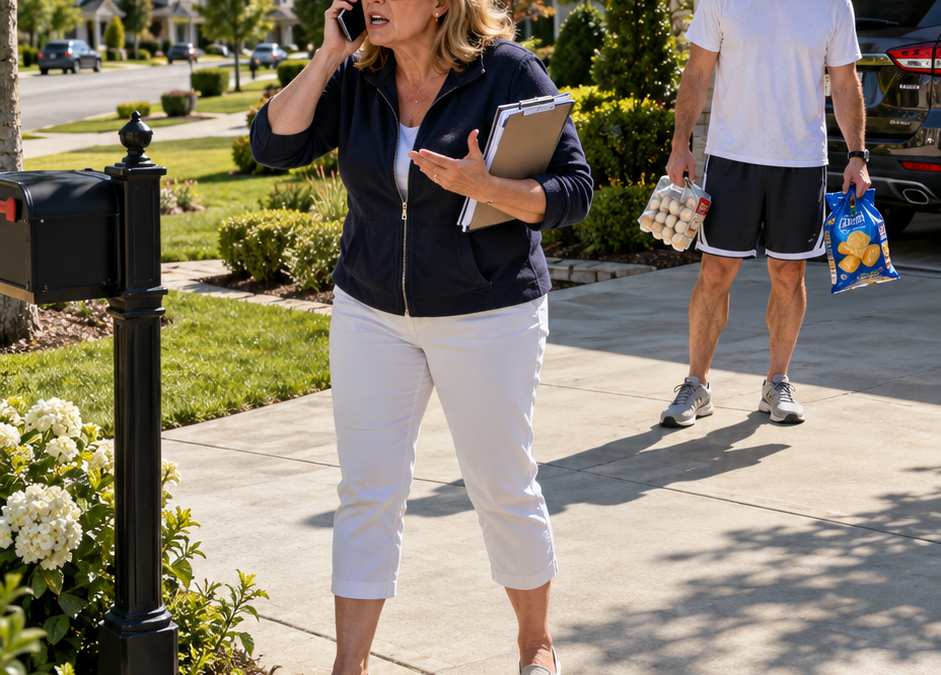
She Dialed 911 From My Driveway Certain the System Would Take Her Side
The morning Deborah called the police on me, I was standing in my own driveway holding a bag of eggs in one hand and a bag of kettle chips in the other.
I was wearing basketball shorts, an old white T-shirt, and a pair of running shoes that had seen better days.
No uniform.
No badge.
No radio.
Nothing about me suggested authority.
And that was exactly why Deborah believed she could treat me the way she did.
What she did not understand was that authority had nothing to do with why she was wrong.
My name is James Whitaker.
I had spent thirty-one years in law enforcement.
I started as a patrol officer young enough to think I understood people.
Then I became a sergeant and discovered I understood almost nothing.
Lieutenant taught me patience.
Deputy chief taught me politics.
And for the previous four years, I had served as chief of police for the city.
Before all of that, I had served in the Army.
Two tours.
Different kind of uniform.
Different kind of responsibility.
By the time I reached my late fifties, I had spent more of my adult life in some form of public service than outside it.
I had seen armed robberies.
Domestic violence.
Fatal crashes.
Missing children.
Officers make courageous decisions.
Officers make bad decisions.
People behave with unbelievable compassion.
People destroy their own lives over ten seconds of anger.
Thirty-one years had taught me one lesson more reliably than any other.
The person standing in front of you is rarely exactly who you think they are.
That lesson mattered on that Saturday morning.
Deborah had never learned it.
I lived in Maplewood Estates.
It was the kind of neighborhood that looked almost artificially peaceful from the main road.
Trimmed lawns.
Matching mailboxes.
Young trees planted at identical distances from the sidewalk.
A community pool near the entrance.
Flower beds around the HOA clubhouse.
People walked dogs before work and pushed strollers after dinner.
Kids left bicycles in driveways.
Neighbors complained about trash collection and then borrowed each other’s ladders.
It was comfortable.
Predictable.
Exactly what I wanted when I bought the house.
After spending decades walking into other people’s worst moments, I valued boring.
I wanted a place where the biggest problem on Saturday morning was deciding whether I should mow the yard before breakfast or after.
I did not tell most neighbors what I did for a living unless it came up naturally.
It was not a secret.
My name had appeared in newspapers.
I attended public meetings.
Anybody who cared enough could have searched it.
But Maplewood Estates was home.
At home, I did not want to be Chief Whitaker.
I wanted to be James.
The guy who brought Mrs. Perez’s trash cans back when she forgot them.
The man who helped Gerald from three houses down replace a broken garage-door spring.
The neighbor who kept extra jumper cables.
The person children occasionally asked to retrieve basketballs from my backyard.
Most people treated me exactly that way.
Then Deborah moved in.
She arrived two summers before the grocery incident.
Within three weeks, she had joined the HOA board.
That was impressive in a way.
Most new residents needed three months just to learn which night the recycling went out.
Deborah apparently needed twenty-one days to conclude that Maplewood Estates had survived only because nobody had given her authority sooner.
She had opinions about everything.
Grass height.
Trash cans.
Holiday lights.
Garage doors.
Cars parked overnight on the street.
Pool guest limits.
Fence stain.
Mailbox paint.
Porch furniture.
She carried HOA regulations the way some people carried scripture.
Except she usually quoted only the parts that supported whatever she already wanted.
To be fair, Deborah was not incompetent.
That would have made her easier to dismiss.
She was organized.
Persistent.
Comfortable speaking in front of groups.
She read board packets.
She answered emails quickly.
If a light was broken near the pool, she noticed.
If a landscaping contractor skipped a section, she complained until it was corrected.
Those qualities could have made her useful.
The problem was that somewhere along the way, usefulness became entitlement.
Deborah stopped thinking of the HOA rules as responsibilities she had agreed to help administer.
She started treating them as evidence that she was personally in charge of the neighborhood.
And then there was Tyler.
Tyler was sixteen.
Tall for his age.
Broad through the shoulders.
The kind of teenager strangers assumed played football even if they had never seen him near a field.
Tyler carried himself with the confidence of somebody who had spent most of his life believing consequences were things that happened to other children.
I remembered the first time I noticed him.
Mrs. Perez had a flower garden along the front edge of her yard.
She was proud of it.
Roses.
Marigolds.
Tulips in spring.
She had spent years getting that little strip of soil exactly the way she wanted it.
One afternoon, I watched Tyler ride his bicycle directly through the flowers.
Not accidentally.
He turned onto the grass.
Looked toward Mrs. Perez’s window.
Then rode through the bed.
Two plants snapped under his tires.
Deborah stood on the sidewalk.
She saw the whole thing.
I expected her to call him back.
Instead, she smiled.
Not embarrassed.
Not apologetic.
Proud.
Mrs. Perez came outside a minute later.
“What happened?”
Tyler laughed.
Deborah told her, “They’re just flowers.”
I watched Mrs. Perez kneel beside one broken plant after they left.
That image stayed with me.
Not because of the plant.
Because of Deborah’s expression.
There are parents who defend their children because they love them.
Then there are parents who defend every behavior because admitting their child is wrong feels like losing status.
Those are not the same thing.
Two weeks before the grocery incident, Deborah and I had a disagreement at an HOA meeting.
Nothing dramatic at first.
The board was discussing parking enforcement and whether residents should receive warnings before towing became an option.
I argued for written warnings except in situations involving safety.
Deborah wanted immediate enforcement.
“If the rule exists,” she said, “people already know.”
“Not always.”
“They signed the covenants.”
“So did I.”
She looked at me.
“Then you understand the importance of compliance.”
“I understand the importance of proportionality.”
A few people nodded.
Deborah did not like that.
The discussion continued.
Eventually, she made the kind of statement people often wish they could take back once they understand who heard it.
She leaned across the conference table and said quietly enough that it sounded almost personal.
“People like you need to learn their place in this community.”
I looked at her.
The room went still.
“What exactly does that mean?”
She immediately softened her tone.
“It means residents who constantly question board enforcement make everyone’s job harder.”
“That isn’t what you said.”
“It’s what I meant.”
I held her gaze for another second.
Then let it go.
I had learned years earlier that demanding an explanation from someone who had already decided to be vague rarely produces honesty.
But I remembered the sentence.
People like you need to learn their place.
I did not know that two weeks later she would stand in my driveway and demonstrate exactly what she meant.
Saturday morning started normally.
I woke early.
Made coffee.
Checked a few emails.
Ignored several more.
Then realized I had almost nothing in the refrigerator.
I went to the grocery store around eight.
No department vehicle.
No security detail.
No uniform.
Just my personal car.
I bought eggs.
Bread.
Orange juice.
Apples.
Coffee.
Milk.
A few things for dinner.
And one bag of kettle chips I had been thinking about for several days.
I have spent enough of my life making serious decisions that I refuse to apologize for taking potato chips seriously.
I pulled into my driveway at about 8:45.
The morning was already warm.
A sprinkler clicked somewhere down the street.
Someone was mowing two blocks away.
I opened the trunk.
Picked up two grocery bags.
Then heard footsteps.
Tyler appeared at the end of the driveway.
He did not greet me.
He just walked toward the car with both hands inside his hoodie pockets.
I remember thinking that it was too warm for the sweatshirt.
Teenagers have their own climate.
He stopped about six feet away.
His eyes went straight to the grocery bag.
Then he looked at me.
“Yo.”
“Morning.”
He nodded toward the bag.
“Give me those chips.”
At first, I thought I had misunderstood him.
“Excuse me?”
“The chips.”
He pointed.
“Hand them over. I’m hungry.”
I stared at him.
There are moments when thirty-one years of police work are useless because ordinary behavior is simply too strange to process immediately.
A sixteen-year-old had walked onto my driveway and demanded my groceries.
Not asked.
Demanded.
I could have laughed.
I almost did.
Instead, I kept my voice calm.
“Son, those are my groceries.”
“So?”
“I just bought them.”
He shrugged.
“I want the chips.”
“Then you need to go buy some chips.”
His expression changed.
He was not used to the conversation ending there.
“Come on, man.”
“No.”
“It’s just a bag of chips.”
“Exactly.”
He looked at me as if that should somehow help his argument.
“So give them to me.”
“No.”
I started toward the front door.
Tyler moved slightly into my path.
Not aggressively enough that I thought he planned to attack me.
Just enough to challenge whether I would walk around him.
I stopped.
“Move.”
His eyes narrowed.
“You don’t gotta talk to me like that.”
“I told you no. Now go home.”
That was when Deborah appeared.
She had been standing on her porch across the street.
Watching.
Not arriving because she heard raised voices.
Watching from the beginning.
She came down the sidewalk with her arms crossed.
“What is going on?”
Tyler answered immediately.
“He’s being a jerk.”
Deborah looked at me.
“You don’t talk to my son that way.”
I shifted the grocery bags in my hands.
“Your son walked onto my driveway and demanded my food.”
“He asked you for chips.”
“He told me to give them to him.”
“He’s sixteen.”
“Yes.”
“He’s hungry.”
“Then feed him.”
Her eyes widened.
“Excuse me?”
“You’re his mother. If Tyler is hungry, that sounds like your responsibility.”
Tyler laughed under his breath.
Wrong choice.
Deborah looked at him, then back at me.
“He asked you nicely.”
“No, he didn’t.”
“You’re making a big deal out of nothing.”
“I’m carrying groceries into my house.”
“Then why are you arguing with a child?”
“I’m not.”
“You obviously are.”
I felt the familiar mental shift that came from years in law enforcement.
Observe.
Do not match emotion.
Pay attention to hands.
Distance.
Words.
Witnesses.
I did not need that training for my safety.
I needed it because I could see Deborah escalating something ridiculous, and I did not want to give her anything she could distort later.
So I lowered my voice instead of raising it.
“Deborah, Tyler asked for my groceries. I said no. That is the entire situation.”
She stared at me.
Then pulled out her phone.
“Fine.”
I waited.
“I’m calling the police.”
Tyler’s face brightened.
Deborah expected me to panic.
That was obvious.
She held the phone where I could see it.
“We’ll see who they listen to.”
I almost told her not to waste emergency resources.
Then I stopped myself.
This had gone far enough that anything I said might become part of whatever version she planned to tell the dispatcher.
So I said nothing.
She dialed 911.
I stood there holding eggs and orange juice while Deborah reported me to my own department.
“Yes, hi. I need officers sent immediately.”
Pause.
“There’s a man in the neighborhood acting threatening and aggressive toward my son.”
I watched her.
She gave the dispatcher my address.
My address.
The house I owned.
The driveway I was standing in.
She continued.
“No, I don’t know if he has a weapon.”
That part changed something inside me.
Not anger.
Concern.
Words matter when you call 911.
Especially words involving weapons.
Especially when officers are being sent into a situation with incomplete information.
I had spent years teaching our department that people can be frightened, confused, angry, or mistaken when they call.
Dispatch information is a starting point.
Not a verdict.
Now I was standing on the other side of that system.
Deborah ended the call.
A satisfied smile crossed her face.
“They’re coming.”
“I heard.”
“You might want to think about how you speak to people.”
Tyler smirked.
I looked at both of them.
Then carried my groceries inside.
I put the eggs in the refrigerator.
Set the chips on the counter.
For a second, I stood alone in the kitchen listening to my own house.
Part of me wanted to stay inside.
Let officers arrive.
Walk over.
Take statements.
Finish it.
But another part of me knew disappearing into the house might allow Deborah to shape the scene before anyone spoke with me.
So I went back outside.
I sat on the porch steps.
Hands visible.
Nothing in them.
And waited.
I was not nervous.
But I was thinking.
The strangest part was not that Deborah had called the police.
People call police for foolish reasons every day.
The strangest part was how certain she looked.
Certain that officers would arrive and see the situation exactly as she had described it.
Certain her version carried more weight.
Certain that the system belonged to her.
I thought about her comment at the HOA meeting.
People like you need to learn their place.
Maybe that sentence had not been about one disagreement.
Maybe it was simply how Deborah moved through the world.
People existed inside categories.
Useful.
Unimportant.
Authority.
Resident.
Board member.
Child.
Problem.
She looked at what someone was wearing, where they were standing, what title she believed they had, and decided how much dignity they deserved.
I had met people like that throughout my career.
Some were wealthy.
Some were poor.
Some wore uniforms.
Some distrusted uniforms.
Entitlement is not tied to one class of person.
It is a belief that your needs automatically become other people’s obligations.
Nine minutes after the 911 call, two patrol cars turned onto our street.
No sirens.
No emergency speed.
Good.
Dispatch had apparently not upgraded the call into something more serious.
The cars pulled to the curb.
The first officer out was Martinez.
Twelve years with the department.
Steady.
Professional.
The kind of officer I trusted around people on their worst days because he did not need to prove he was in charge.
The second officer stepped out behind him.
Deborah moved immediately.
She walked straight toward them.
“Officers, thank you for coming so quickly.”
Martinez nodded.
“Ma’am.”
“That man right there.”
She pointed directly at me.
“He was harassing my child and refusing to leave the area.”
Refusing to leave the area.
I was sitting on my own porch.
Martinez looked past her.
His eyes landed on me.
He stopped walking.
The second officer followed his gaze.
He stopped too.
Then both men straightened almost simultaneously.
Not theatrically.
Habit.
Professional recognition.
Martinez said, “Chief Whitaker.”
His partner nodded.
“Chief. Good morning, sir.”
The silence afterward was remarkable.
Deborah stopped speaking.
Tyler’s smirk disappeared.
He took one step backward.
Then another.
Deborah looked at Martinez.
Then at me.
Then back at Martinez.
“His what?”
Martinez’s expression remained neutral.
“Chief James Whitaker.”
Deborah said nothing.
Martinez continued.
“He is the police chief of this department.”
I saw the exact moment the information reached her.
The color left her face.
It was not satisfying in the way people might imagine.
I did not suddenly feel taller.
I did not feel victorious.
What I felt was disappointment.
Because Deborah’s expression told me something important.
She was embarrassed because I had status.
Not because she had lied about a neighbor.
That distinction mattered.
If I had been a retired mechanic, would she have regretted the call?
If I had been a school custodian?
A delivery driver?
An unemployed man?
A stranger renting the house?
Would the false accusation suddenly have been more acceptable?
That was the real problem.
Martinez looked at Deborah.
“Tell me what happened.”
Her confidence returned in fragments.
“Well, my son approached him.”
“For what?”
“He was hungry.”
Martinez waited.
Deborah continued.
“He asked for some food.”
Tyler stared at the pavement.
“What food?”
“A bag of chips.”
Martinez glanced toward me.
Then back to her.
“And?”
“He became hostile.”
“How?”
“He told Tyler to leave.”
Martinez paused.
“From Chief Whitaker’s property?”
Deborah realized the direction the questions were going.
“It wasn’t like that.”
“Then explain it.”
“He was rude.”
“Did he threaten Tyler?”
“I felt threatened by his tone.”
“That wasn’t my question.”
I almost smiled.
Not because of Deborah.
Because I had heard myself say those exact words to subordinates during report reviews.
Martinez continued.
“Did he threaten your son?”
Deborah hesitated.
“No.”
“Did he touch him?”
“No.”
“Did he approach your property?”
“No.”
“Did Tyler approach his driveway?”
“He was just asking for chips.”
Martinez looked toward Tyler.
“Is that what happened?”
Tyler mumbled.
“Yeah.”
“Speak up.”
“I asked him for chips.”
“How?”
Tyler looked uncomfortable.
“I just asked.”
I stood.
“I can give my statement separately if you prefer.”
Martinez nodded.
“That would be best, Chief.”
And that was another moment I appreciated.
He did not treat me as his boss first.
He treated me as one party in a call.
That was exactly what he should have done.
I walked to the other officer.
He opened his notebook.
I told him what happened from the beginning.
Grocery run.
Tyler approaching.
Demanding the chips.
My refusal.
Deborah intervening.
911 call.
I included her description of me as threatening and aggressive.
I did not tell him what conclusion to reach.
I did not ask for an arrest.
I did not say, “You know who I am.”
Because who I was professionally should not decide whether the report was accurate.
When I finished, the officer asked, “Do you want to make a complaint for false reporting?”
“No.”
“You’re sure?”
“I want the incident documented completely.”
He nodded.
“Understood.”
I looked toward Tyler.
He was sixteen.
Stupid behavior at sixteen should not automatically define the rest of your life.
I had arrested teenagers before.
Sometimes it was necessary.
Sometimes a juvenile needed a consequence much larger than a conversation.
This was not one of those times.
A bag of chips did not need to become a criminal record.
I told the officer exactly that.
“I don’t want to ruin a kid’s future because he acted entitled in a driveway.”
“What about Mrs. Deborah?”
“Document what she reported and what your investigation found.”
“That’s all?”
“That’s all.”
He studied me.
Then nodded.
When I returned toward the porch, Martinez was explaining the situation to Deborah.
She was backpedaling hard.
“It was a misunderstanding.”
Martinez said, “You reported threatening behavior.”
“I was upset.”
“You also indicated you were unsure whether he was armed.”
“Well, I didn’t know.”
“He was carrying groceries.”
“I understand that now.”
Tyler finally spoke.
“I was joking about the chips.”
I looked at him.
“No, you weren’t.”
He went quiet.
Deborah turned to me.
“James, I think this has gotten completely out of proportion.”
I almost laughed at the use of my first name.
Ten minutes earlier, I had been “that man.”
Now I was James.
“No,” I said. “It became exactly as serious as you made it when you called 911 and described me as threatening.”
“I didn’t know you were—”
She stopped.
There it was.
I finished the sentence for her.
“The police chief?”
Her mouth closed.
“That should not matter.”
“I didn’t mean—”
“If I were anyone else standing on this porch, would your report have been more truthful?”
She had no answer.
Martinez shifted slightly.
I could tell he wanted to remain outside the personal exchange.
Fair enough.
I ended it.
“Officer Martinez, thank you.”
“Yes, sir.”
“Finish the report exactly as you would for anyone else.”
“Of course.”
“And no special treatment.”
He nodded.
I shook both officers’ hands.
Then went inside.
The groceries were still on the kitchen counter.
I put away the milk.
The bread.
The apples.
Then I looked at the kettle chips.
I started laughing.
Not loudly.
Just enough to release the absurdity of the morning.
Thirty-one years in law enforcement.
Two military tours.
Four years as chief.
And my Saturday had almost become an emergency over potato chips.
I made breakfast.
Eggs.
Toast.
Orange juice.
I left the chips alone.
They had been through enough.
But the morning did not simply disappear.
I could have ignored what happened.
Part of me wanted to.
Chiefs already deal with enough complaints without importing neighborhood drama into their weekend.
But Deborah was an HOA board member.
Two weeks earlier, she had told me people like me needed to learn their place.
Now she had knowingly used emergency services in a private dispute after watching her son demand someone else’s property.
That was no longer just an unpleasant neighbor interaction.
It was relevant to whether she should exercise authority over other residents.
That afternoon, I called Gerald.
Gerald was the HOA board president.
He was reasonable.
Not perfect.
Reasonable is better.
He answered on the second ring.
“James?”
“Gerald, I need to tell you about something that happened this morning.”
“What kind of something?”
“Deborah kind.”
He sighed.
“That bad?”
“Listen first.”
So I told him.
I kept it simple.
Tyler.
The groceries.
Deborah.
The officers.
The false characterization.
Then I reminded him what she had said during the HOA meeting two weeks earlier.
People like you need to learn their place.
Gerald remained quiet for several seconds.
Finally he said, “Did you make a police complaint?”
“The incident is documented.”
“Are you pressing charges?”
“No.”
“Why not?”
“Because I don’t think a bad morning needs to destroy a sixteen-year-old’s future.”
“I mean Deborah.”
“I’m not using the department to settle an HOA problem.”
Gerald understood immediately.
“So you’re calling me as a resident.”
“Exactly.”
Another pause.
Then he said, “James, I’ll handle it.”
I did not ask what that meant.
I did not need to.
The HOA board already had its own procedures.
Within seventy-two hours, Deborah was removed from the board.
The vote was not close.
I later learned that my incident was not the only complaint considered.
Residents had their own stories.
Aggressive violation notices.
Selective enforcement.
Arguments at the pool.
Threats about fines that had never been approved.
Mrs. Perez spoke about Tyler riding through her flowers and Deborah dismissing the damage.
Another neighbor described Deborah ordering a contractor onto private landscaping without permission.
None of those events had seemed large enough individually to trigger a confrontation.
Together, they showed a pattern.
That is another thing I learned during my career.
Patterns often stay invisible because people experience them separately.
One person thinks, Maybe I’m overreacting.
Another thinks, It isn’t worth complaining.
Another decides, I’m probably the only one.
Then eventually everybody ends up in the same room and realizes they were not imagining it.
Deborah’s removal did not bring me joy.
Relief, maybe.
I believed Maplewood Estates would be healthier without her exercising board authority.
But humiliation was not the goal.
I did not want her family chased from the neighborhood.
I did not want Tyler bullied at school.
I did not want officers gossiping about the chief’s potato-chip incident.
I spoke privately with Martinez the following Monday.
“Keep the report professional.”
“It is.”
“Good.”
He smiled.
“I resisted the urge to title it Operation Kettle Chip.”
I gave him a look.
“Sir.”
“Martinez.”
“Yes, Chief.”
“You have twelve years on this department.”
“Yes, sir.”
“You want thirteen?”
He laughed.
“Yes, Chief.”
Then his expression became serious.
“You handled it right.”
“I did what?”
“The call.”
“I sat on my porch.”
“You know what I mean.”
I did.
But I did not want the officers around me learning the wrong lesson.
“Martinez, what would you have done if you didn’t recognize me?”
“Investigated.”
“That’s the answer.”
He nodded.
“Recognition changed Deborah’s attitude. It should not change our standard.”
“It didn’t.”
“I know.”
I looked at him.
“But make sure the younger officers understand that.”
That conversation mattered to me.
It would have been easy to turn the incident into one of those stories where the satisfying twist is that a rude person accidentally targeted someone powerful.
I understand why people enjoy those stories.
They offer instant symmetry.
You thought I was nobody.
Surprise.
I outrank you.
But I dislike that lesson.
Because it quietly suggests disrespect would have been less wrong if I actually had been nobody important.
It would not have been.
My badge did not make Tyler’s demand inappropriate.
My title did not make Deborah’s false description wrong.
My authority did not create my dignity.
Those things already existed.
They would have existed if I cleaned offices for a living.
If I drove a bus.
If I stocked grocery shelves.
If I had been retired with no title at all.
That was the lesson I wanted people in my department to understand.
And it was the lesson I hoped Tyler might eventually learn.
Three days after Deborah lost her board seat, Mrs. Perez knocked on my door.
She was holding an apple pie.
Not store-bought.
Real pie.
Flaky crust.
Still warm.
I opened the door.
“What is this?”
“I heard about Saturday.”
“I figured.”
She held the pie higher.
“This is for you.”
“Mrs. Perez, I didn’t do anything.”
“You told that boy no.”
“I think society can survive teenagers hearing no occasionally.”
She smiled.
“His mother never tells him.”
“That’s obvious.”
She stepped onto the porch.
“Can I sit?”
“Of course.”
I brought out two plates.
We ate pie while the sun dropped behind the roofs across Maplewood Estates.
For a while, neither of us talked about Deborah.
Mrs. Perez told me about her granddaughter starting college.
I told her my daughter had called that morning and laughed for five straight minutes when she heard about the kettle chips.
Finally, Mrs. Perez looked across the street.
“I thought about saying something sooner.”
“About Tyler?”
“About both of them.”
“You didn’t have to.”
“I know.”
She put down her fork.
“When he ruined the flowers, Deborah made me feel stupid for caring.”
“That was the point.”
Mrs. Perez looked at me.
“What do you mean?”
“People who don’t want accountability often make the injured person defend why the injury mattered.”
She nodded slowly.
“She said they were just flowers.”
“And suddenly you were explaining why flowers mattered instead of Tyler explaining why he destroyed them.”
Mrs. Perez was quiet.
Then she smiled sadly.
“You really have been a policeman a long time.”
“Too long.”
“No.”
She looked at the empty pie plate.
“Maybe exactly long enough.”
That evening stayed with me more than the moment the officers recognized me.
The patrol cars were dramatic.
Mrs. Perez sitting on my porch was important.
Entitlement rarely affects only the person who finally confronts it.
It leaves smaller marks everywhere.
A broken flower bed.
A resident afraid to question a fine.
A teenager who learns that his mother will turn every refusal into someone else’s wrongdoing.
A neighbor who begins believing peace requires surrender.
Those are not spectacular harms.
That is why they accumulate.
A week later, I saw Tyler again.
I was washing my car.
He rode past on his bicycle.
At first, I thought he would keep going.
Then he slowed.
Stopped.
Stayed in the street.
I turned off the hose.
“Morning.”
He stared at the handlebars.
“Hey.”
Neither of us spoke for several seconds.
Then he said, “My mom says you got her kicked off the board.”
“I told Gerald what happened.”
“That’s basically the same thing.”
“No.”
He looked at me.
“The board voted.”
“She says you used your job.”
“I did not.”
“She says everyone was scared of you.”
“Were you?”
He did not answer.
I leaned against the car.
“Tyler, your mother called the police because I wouldn’t give you my groceries.”
“I know.”
“You told the officers you were joking.”
“I was.”
“No.”
His face hardened.
I continued before he could leave.
“You expected me to give you the chips.”
“So what?”
“So why?”
He shrugged.
“I don’t know.”
“That’s probably worth thinking about.”
He kicked one pedal backward.
“You hate me?”
“No.”
He looked surprised.
“Why not?”
“Because you’re sixteen.”
“That doesn’t mean anything.”
“It means you still have time to become a different kind of man.”
His eyes dropped again.
“You think I’m a bad person.”
“I think you acted badly.”
“That’s the same thing.”
“No.”
I shook my head.
“One describes what you did. The other claims it’s everything you are.”
He finally looked at me.
“My job taught me the difference.”
Tyler did not apologize.
Not then.
He simply nodded once and rode away.
That was enough for me.
I did not need a scripted redemption scene.
People rarely transform because somebody gives a perfect speech.
Sometimes they just hear one sentence at the right age and remember it years later.
A month passed.
Maplewood Estates became boring again.
That was a compliment.
The HOA appointed another member to Deborah’s seat.
Gerald proposed additional board training on enforcement authority and resident complaints.
Warning letters required two-person review for anything beyond routine maintenance.
Emergency services were not to be used as extensions of HOA conflict.
The changes were not dramatic.
Nobody made a speech about justice.
Nobody printed my face in a newsletter.
The community simply became a little more careful about who could claim authority and how.
Deborah still lived across the street.
For several weeks, she avoided me completely.
If I walked outside, she went inside.
If we arrived at the mailbox at the same time, she waited.
I did not chase her down.
I did not need an apology.
Then one evening in early fall, I was bringing my trash bin back from the curb when Deborah came out of her house.
She stopped on the sidewalk.
“James.”
I stopped.
“Deborah.”
She looked different without an audience.
No board table.
No Tyler beside her.
No phone.
“I suppose you’re happy.”
“About what?”
“You know.”
“Losing your board position?”
“Yes.”
“No.”
She gave me a skeptical look.
“You expect me to believe that?”
“I didn’t want you on the board after what happened.”
“That sounds like happiness.”
“No. It sounds like a conclusion.”
She folded her arms.
“You embarrassed me in front of my son.”
“You called the police.”
“I didn’t know who you were.”
There it was again.
I sighed.
“That is still the part you don’t understand.”
She looked irritated.
“What part?”
“You think the mistake was not knowing I was chief.”
“You can’t deny that changed the situation.”
“It changed your reaction.”
I stepped closer, but kept my voice quiet.
“The situation was already wrong.”
“I was protecting my child.”
“From what?”
She opened her mouth.
Nothing came out.
I waited.
“From being told no?”
Her eyes narrowed.
“You have no children at home. You don’t understand.”
“I raised children.”
“That’s not what I meant.”
“I know.”
I looked toward her house.
“Tyler is going to be an adult soon.”
“He’s a good kid.”
“I hope so.”
“He is.”
“Then teach him that another person saying no is not an attack.”
She was silent.
I continued.
“And teach him that authority isn’t something you borrow to punish somebody for refusing you.”
Her expression hardened again.
“You really think you’re better than us.”
“No.”
I picked up the trash bin.
“That’s the whole point.”
Then I went inside.
That was the last serious conversation Deborah and I had.
Over time, the tension faded.
Not because we became friends.
Because most neighborhoods cannot sustain dramatic hostility forever without exhausting everyone involved.
Tyler matured.
At least from what I saw.
He stopped riding through Mrs. Perez’s yard.
He started working part-time at an auto-parts store the following summer.
Once, I saw him carrying an elderly man’s battery to a car in the parking lot.
Maybe it meant nothing.
Maybe it meant something.
I chose not to turn him permanently into the worst thing he did at sixteen.
I would want the same mercy for almost anyone.
Years in law enforcement made me suspicious of simple stories.
The victim is always perfect.
The offender is always evil.
The authority figure always knows exactly what happened.
Life is rarely that cooperative.
Deborah was not a monster.
She was entitled.
Controlling.
Too willing to use systems as weapons when she believed those systems would support her.
That was serious enough.
Tyler was not irredeemable.
He was a sixteen-year-old who had learned bad lessons from a parent who confused defending him with never correcting him.
I was not a superhero.
I was a man who happened to have thirty-one years of training that made remaining calm easier.
Even the officers were not supporting characters in a revenge fantasy.
Martinez and his partner did what they were supposed to do.
They arrived.
Separated stories.
Asked questions.
Documented facts.
If there was anything satisfying about that morning, it was not that Deborah accidentally called my own officers.
It was that the system worked because those officers did not simply accept the first confident person’s version.
That matters.
I have spent much of my career trying to build a department around exactly that principle.
A uniform gives an officer authority.
It does not give him omniscience.
A 911 caller deserves to be heard.
She does not automatically deserve to be believed over everyone else.
A title deserves professional respect.
It should not determine who receives basic dignity.
The moment police forget those distinctions, small mistakes become dangerous.
I thought about that more after the incident than I expected.
What if I had reacted differently?
What if, when Tyler blocked my path, I had shoved past him?
What if Deborah called and said I assaulted her child?
What if I had gone into the house angry and returned carrying my service weapon?
What if the responding officers were young, nervous, and unfamiliar with me?
What if dispatch had told them there was an armed aggressive male threatening a juvenile?
The outcome might have been completely different.
That is why words matter.
It is why restraint matters.
And it is why lying to emergency services over a personal disagreement is not funny.
I chose not to pursue charges because of the circumstances.
That did not make the behavior harmless.
Several months later, I spoke at a department training session for new supervisors.
I did not use Deborah’s name.
I described a hypothetical.
An officer arrives at a neighborhood complaint.
One party is confident.
Polished.
Insistent.
The other is casually dressed.
Quiet.
Perhaps irritated.
“Who looks more credible?” I asked.
Nobody answered.
“Come on.”
One sergeant said, “Depends.”
“Correct.”
I walked across the room.
“What if the caller says the other person was aggressive?”
“Get specifics.”
“What does aggressive mean?”
“Actions.”
“Exactly.”
I wrote the word on the board.
AGGRESSIVE.
Then underneath:
WHAT DID HE DO?
“What if the caller says she felt threatened?”
Another supervisor answered.
“Ask what created the fear.”
“Good.”
“What if the alleged offender is the police chief?”
They laughed.
I let them.
Then I said, “Investigate anyway.”
The room quieted.
“Recognition is not evidence.”
I looked around.
“Neither is clothing.”
I pointed toward the board.
“Neither is confidence.”
Then I added one last line.
STATUS DOES NOT CREATE DIGNITY.
That was the part I wanted them to remember.
Because my story became funny around the department.
Of course it did.
Police officers survive difficult careers partly through humor.
Someone left a bag of kettle chips on my desk with a sticky note:
PROPERTY OF THE CHIEF — DO NOT APPROACH WITHOUT WARRANT.
Martinez denied involvement.
He was lying.
I kept the chips.
But underneath the joke was something serious.
That morning could easily have become a story about rank.
Woman calls cops on stranger.
Surprise.
Stranger is police chief.
Woman humiliated.
That version is satisfying.
It is also incomplete.
Because if the only reason Deborah deserved embarrassment was that I outranked the officers she called, then the story teaches exactly the wrong lesson.
She should have treated me decently before knowing anything about me.
Tyler should have respected the word no before learning what I did for work.
The officers should have investigated fairly whether I was their chief or a man they had never seen.
Gerald should have addressed board misconduct because it violated community trust, not because the resident involved happened to be powerful.
Mrs. Perez’s flowers should have mattered even though she had no badge at all.
That is the version I believe.
One Saturday almost a year later, I drove to the grocery store again.
Same time.
Same store.
I bought eggs.
Bread.
Orange juice.
Apples.
And, because apparently I refuse to learn from history, kettle chips.
When I returned to Maplewood Estates, Tyler was outside washing his mother’s car.
He saw the grocery bag.
Then he looked at me.
For one second, neither of us said anything.
Then he grinned.
“Those chips safe?”
I laughed.
“Depends.”
“On what?”
“You planning another robbery?”
He shook his head.
“Nah.”
Then, after a short pause, he said, “Sorry about that.”
I looked at him.
He kept his eyes on the car.
“For real.”
There was no audience.
No mother.
No police.
No HOA meeting.
No reason for him to say it except that he had decided to.
I nodded.
“Thank you.”
“That’s it?”
“What do you want me to do?”
“I don’t know.”
“Confetti?”
He laughed.
“I guess.”
“You apologized. I accepted.”
I started toward my house.
Tyler called after me.
“Chief?”
I turned.
“Yeah?”
“I didn’t know.”
“Know what?”
“That you were the chief.”
I smiled.
“You still don’t get it.”
He thought for a second.
Then nodded.
“Yeah.”
This time, I think he did.
I carried the groceries inside.
Put away the eggs.
Poured myself a glass of orange juice.
Then opened the chips.
They tasted exactly like they were supposed to.
Nothing dramatic happened.
No squad cars arrived.
No HOA board meeting followed.
No one learned a lesson in front of an audience.
And maybe that ordinary ending was the best outcome possible.
Because justice is not always somebody losing everything.
Sometimes it is a teenager learning to apologize.
A board learning to limit its own power.
A neighbor learning that being challenged is not the same as being threatened.
A police department remembering that titles do not determine whose story deserves to be heard.
And a community returning to the kind of boring Saturday morning it should have had all along.
I spent thirty-one years wearing authority in one form or another.
Army uniform.
Patrol badge.
Sergeant stripes.
Lieutenant bars.
Deputy chief insignia.
Chief’s badge.
Those things mattered.
They came with responsibility.
But none of them ever made me more deserving of basic respect than the man I was standing in my driveway that morning.
Basketball shorts.
White T-shirt.
Grocery bags.
No visible title at all.
That man deserved to hear no accusation invented around him simply because someone else expected the system to take her side.
So did Mrs. Perez when Tyler rode through her flowers.
So would any stranger.
That was the lesson Deborah missed when Martinez stepped out of the patrol car and called me Chief.
She believed the surprising thing was who I turned out to be.
It wasn’t.
The important thing was who I had already been before she knew.
A neighbor.
A homeowner.
A human being standing on his own property.
That should have been enough.

