𝗙𝗨𝗟𝗟 𝗦𝗧𝗢𝗥𝗬 Rex Had Been Retired for Years, but I Knew That Look in His Eyes Before Anyone Else Did
𝗙𝗨𝗟𝗟 𝗦𝗧𝗢𝗥𝗬
“That is enough.”
Silence returned.
She looked at Rex.
I watched her face.
Something in it softened.
Only slightly.
Then she looked back at me.
“Mr. O’Brien, can you get the file away from him without force?”
“I can try.”
“Do that.”
I lowered myself onto the floor beside Rex.
The courtroom disappeared around us.
That sounds strange.
But every K9 handler knows the feeling.
When you are working with a dog you trust, the human world becomes background noise.
I placed one hand on Rex’s shoulder.
His muscles were relaxed.
Not defensive.
Not excited.
Focused.
“Easy, buddy.”
He leaned against my knee.
I waited.
“You know you’re retired, right?”
His eyes moved toward me.
“Retired dogs are supposed to embarrass their owners by stealing food. Not court exhibits.”
The corner of Judge Holloway’s mouth moved.
Barely.
Rex did not release the folder.
I watched his nose.
That was when I noticed it.
Rapid movement.
Short pulls of air.
Then his head turned toward the judge’s table.
He sniffed again.
Something there had his attention.
I felt the old professional instinct rise inside me.
“Your Honor.”
“Yes?”
“I think he’s scenting.”
Elizabeth shook her head.
“Of course he’s scenting. He’s a dog.”
I ignored her.
Judge Holloway asked, “Scenting what?”
“I don’t know.”
That was the honest answer.
Rex had received several types of specialized training during his career.
Tracking.
Area search.
Article detection.
He had an unusually sensitive response to certain chemical residues.
That ability had helped us locate objects suspects tried to clean, conceal, or discard.
It was not magic.
Dogs do not understand legal significance.
They understand odor.
Association.
Pattern.
Memory.
Rex had not worked professionally in years, but retirement does not erase a nose.
I looked toward the bench.
Several folders remained there.
A sealed brown evidence envelope sat near the corner.
Rex’s nostrils moved faster.
“Your Honor, may I approach the bench?”
Judge Holloway hesitated.
The bailiff looked at her.
She thought for a moment.
“Slowly.”
I stood.
Rex remained where he was.
Still holding the blue folder.
I approached the judge’s table.
At first, nothing appeared unusual.
Case files.
Notes.
A glass of water.
Pens.
Evidence bags.
Then my eyes stopped on a large brown envelope.
EXHIBIT 47.
Sealed.
I picked it up carefully.
“May I?”
Judge Holloway nodded.
I held the envelope at chest level.
Rex changed immediately.
He dropped the blue folder.
It landed flat on the carpet.
Then he stood.
Tail moving.
Nose high.
His entire posture sharpened.
The retired dog disappeared.
For one moment, the working K9 returned.
“Rex.”
He walked toward me.
Sniffed the air.
Then the envelope.
Once.
Again.
Again.
He looked at me.
Then sat.
My heart started beating harder.
I knew that response.
“There’s something about this envelope.”
Elizabeth Thompson had gone pale.
Judge Holloway noticed.
“So it appears.”
Elizabeth stepped forward.
“Your Honor, Exhibit 47 was supposed to remain sealed until the final evidentiary stage.”
“What is inside?”
Elizabeth hesitated.
“An expert examination item.”
“What item?”
“A letter.”
The judge looked at her.
Elizabeth continued.
“A copy of a letter allegedly written approximately ten years ago by the deceased principal involved in the underlying dispute.”
Robert Green stood.
“The authenticity has been contested from the beginning.”
Judge Holloway looked at the envelope.
“The ink analysis?”
“Yes, Your Honor.”
The disputed letter had become one of the most important pieces of evidence in the case.
The civil dispute itself was complicated.
Money.
Promises.
A former business partnership.
An estate.
A claim that the deceased man had acknowledged a financial obligation before his death.
One side relied heavily on the letter.
The other argued it was fabricated.
For three months, lawyers had fought over dates, witnesses, handwriting, accounting records, and expert opinions.
Exhibit 47 contained material connected to the disputed letter.
Now my dog was sitting beneath it as if it were a bag of explosives.
Judge Holloway made a decision.
“Open it.”
Elizabeth’s eyes widened.
“Your Honor—”
“It is already an admitted exhibit under seal. I am modifying the sequence.”
She looked toward her papers.
Then back at the judge.
“Yes, Your Honor.”
The clerk documented the change.
Judge Holloway watched me.
“Mr. O’Brien, place it on the evidence table.”
I did.
The bailiff opened the envelope under the judge’s direction.
Inside was a clear plastic sleeve.
Inside that sleeve was an old yellowed piece of paper.
The disputed letter.
The writing had faded.
Ink lines ran across the page in narrow, careful strokes.
Rex stood beside me.
He sniffed once.
Then twice.
Then something unexpected happened.
He turned away.
His head lifted.
His nose worked the air.
I knew better than to interrupt.
He stepped into the aisle.
Walked toward the back of the courtroom.
People moved their legs out of his path.
He ignored everyone.
Judge Holloway said nothing.
Neither did I.
Rex stopped near the last two rows.
An elderly man sat there.
William Thompson.
No relation to attorney Elizabeth Thompson, despite the shared surname.
William had been one of the central witnesses in the case.
He had once been a business associate of the deceased man whose supposed letter sat inside Exhibit 47.
William had testified twice.
He claimed the letter was consistent with discussions he remembered from years earlier.
He had always looked uncomfortable on the stand.
I had assumed age.
Courtrooms do that to people.
Now he looked terrified.
Rex walked directly toward him.
Then sat.
William stared at the dog.
His hands were folded so tightly together his knuckles had turned white.
Judge Holloway leaned forward.
“Mr. Thompson.”
He looked toward the bench.
“Yes, Your Honor?”
“Why is the dog sitting in front of you?”
William swallowed.
“I have no idea.”
His voice trembled.
Rex did not move.
I approached slowly.
“Mr. Thompson.”
He looked at me.
“Would you allow Rex to smell your hands?”
Elizabeth stood again.
“What possible evidentiary value—”
Judge Holloway interrupted.
“Ms. Thompson.”
Elizabeth stopped.
The judge looked at William.
“You do not have to agree.”
William stared at Rex.
Then at me.
Finally, he held out both hands.
I gave Rex a quiet command.
He moved forward.
First the right hand.
Slow inhale.
Left hand.
Another.
Then Rex took one step backward.
Sat.
Raised one paw.
My mouth went dry.
That was one of his old trained alert behaviors.
I looked toward Judge Holloway.
“Your Honor.”
She was already watching.
“He’s indicating odor association.”
“With the envelope?”
“I believe so.”
Robert Green whispered something to his co-counsel.
Elizabeth did not move.
Judge Holloway looked at William.
Her voice changed.
Not softer exactly.
More careful.
“Mr. Thompson.”
He stared at the floor.
“You are not required to incriminate yourself.”
His shoulders began shaking.
The judge continued.
“But I need to ask whether there is something about Exhibit 47 you believe this court should know.”
No answer.
“Mr. Thompson?”
He started crying.
Not loudly.
That made it harder to watch.
There are different ways human beings cry.
Some crying is sudden.
Some desperate.
Some angry.
William Thompson cried like a man who had spent years holding shut a door that had finally become too heavy.
“I lied.”
Nobody moved.
The clerk’s fingers hovered above the keyboard.
Judge Holloway asked, “About what?”
William looked at the letter.
“That.”
Elizabeth slowly sat down.
William wiped his face.
“I lied for three months.”
Judge Holloway’s expression became unreadable.
“Is the letter authentic?”
William shook his head.
“No.”
Someone in the gallery gasped.
He continued before anyone could interrupt.
“I wrote it.”
My hand moved unconsciously to Rex’s back.
The dog remained completely calm.
William looked toward the judge.
“I made it.”
“Why?”
He pressed both palms against his eyes.
When he lowered them, he looked twenty years older.
“Because I hated him.”
The courtroom disappeared into silence again.
William pointed weakly toward the evidence table.
“He accused me years ago.”
“Accused you of what?” Judge Holloway asked.
“Something I didn’t do.”
His voice broke.
“He destroyed my reputation. My business. My relationship with people who had known me half my life.”
Elizabeth’s face changed.
This was not merely evidence anymore.
It had become personal.
The deceased man connected to the letter had been central to her own family history and to the case she had spent months pursuing.
William looked toward her.
“When he died, I told myself it was over.”
He shook his head.
“But it wasn’t.”
He took a breath that seemed painful.
“I wanted his family to lose something too.”
Elizabeth whispered:
“Why?”
William could barely look at her.
“Because I was angry.”
“That’s not an answer.”
“You’re right.”
He wiped his face again.
“I wanted to punish someone who couldn’t defend himself anymore.”
He looked toward the floor.
“And I convinced myself the people he left behind were the same as him.”
Elizabeth’s eyes filled.
William continued.
“I created the letter.”
“How?”
Judge Holloway asked the question firmly.
William hesitated.
“I had access to old correspondence. Samples of his writing. Documents from the partnership.”
Robert Green’s co-counsel began taking furious notes.
“I copied the style.”
“The signature?”
William nodded.
“The language?”
“Yes.”
“The age of the paper?”
Another nod.
“I had old stationery.”
“And Exhibit 47?”
William looked toward it.
“That is the copy I helped introduce.”
Judge Holloway leaned back.
“What about the expert examination?”
“I was afraid it would expose me.”
“Then why did you allow it to proceed?”
William laughed once.
It was a broken sound.
“I kept thinking I could survive one more day.”
I knew that psychology.
I had watched suspects live inside it.
One more day.
One more lie.
One more explanation.
People often believe confession arrives because guilt suddenly becomes unbearable.
Sometimes it arrives because maintaining the structure around the lie becomes more exhausting than letting it fall.
William looked toward Rex.
“This dog…”
He stopped.
Rex tilted his head.
William cried harder.
“He didn’t know any of us.”
No one answered.
“He didn’t know the case.”
His voice shook.
“He didn’t hate me.”
William pressed one hand against his chest.
“He just walked over and sat down.”
I understood what he meant.
There was no accusation in Rex.
No anger.
No moral judgment.
A dog does not understand fraud.
He does not understand revenge.
He does not understand estates or civil liability.
Rex smelled something familiar.
That was all.
But perhaps that simplicity was exactly what broke William.
Judge Holloway called for a recess.
The courtroom emptied slowly.
Nobody wanted to leave.
People moved as though sudden motion might disturb whatever had happened.
I took Rex into the hallway.
He drank water from a collapsible bowl.
Then sat beside my leg.
I crouched.
“You’re unbelievable.”
He looked at me.
“You know that?”
Tail.
One thump.
“I spent years trying to teach you courtroom manners.”
Another thump.
“And this is what retirement looks like?”
He leaned his shoulder into me.
I scratched behind his ears.
My hands were shaking.
That surprised me.
I had spent years around evidence.
Confessions.
Searches.
Arrests.
But I was not shaking because of William Thompson.
I was shaking because Rex had become his old self for a few minutes.
And for those minutes, I had become mine.
There is something cruel about retirement when your identity was built around a partner.
People told me I would enjoy the quiet.
No radio calls.
No midnight searches.
No court appearances.
No standing in freezing rain while your dog followed a scent through a drainage ditch.
They were wrong about part of it.
I enjoyed sleeping.
I enjoyed not wondering whether every doorway concealed somebody armed.
But I missed purpose.
Rex missed it too.
For months after retirement, he would wake whenever I put on work boots.
He would run to the door.
Wait.
Then look confused when I did not clip on his harness.
Eventually he stopped.
That hurt worse.
I started taking him everywhere I reasonably could.
Parks.
Outdoor cafés.
Visits with former officers.
Court appointments where dogs were permitted.
He became my shadow.
That day, he had reminded both of us who he used to be.
Maybe who he still was.
The courtroom reconvened forty minutes later.
William returned with counsel.
The mood had changed entirely.
The case no longer revolved around competing interpretations of a letter.
The letter’s own supporting witness had admitted fabricating it.
Judge Holloway addressed the attorneys.
“Before we proceed, I want the record clear.”
Everyone listened.
“The dog’s behavior is not itself a judicial finding.”
That mattered.
I appreciated her saying it.
“Mr. Thompson’s confession must be evaluated independently.”
She looked toward William’s counsel.
“Do you understand?”
“Yes, Your Honor.”
She continued.
“The court will not substitute an animal alert for evidence.”
Again:
“Yes, Your Honor.”
“But Mr. Thompson has now voluntarily made statements in open court concerning the origin of Exhibit 47.”
William nodded.
Judge Holloway turned toward Elizabeth.
“Ms. Thompson.”
Elizabeth rose slowly.
“Your Honor.”
“Do you wish to proceed with the claim as currently presented?”
Elizabeth looked toward William.
Then at the letter.
Then down at the documents she had spent months assembling.
“No.”
Her voice was barely audible.
The judge waited.
Elizabeth spoke again.
“No, Your Honor.”
She closed her folder.
“I cannot proceed on evidence I now believe was fabricated.”
Robert Green stood.
“Defense moves for dismissal.”
Judge Holloway looked at Elizabeth.
“Objection?”
Elizabeth shook her head.
“No objection.”
The judge granted dismissal of the claim insofar as it depended upon the falsified evidence, consistent with the admissions placed before the court.
She also directed that the matter surrounding the fabricated exhibit be documented properly and referred for whatever further handling the law required.
The original story people later told simplified that moment.
They liked to say the judge simply forgave William and ordered an apology.
The reality inside the room felt more complicated.
Judge Holloway understood that courts cannot erase legal consequences because a confession is emotional.
But she also understood that the immediate civil dispute had collapsed.
And in that moment, she chose something unusual.
She looked at William.
“You have caused real harm.”
He nodded.
“You allowed a lie to consume months of other people’s lives.”
“Yes.”
“You attempted to use this courtroom to give that lie authority.”
William closed his eyes.
“Yes, Your Honor.”
She paused.
“Whatever additional legal consequences follow will be handled through the proper process.”
Then she looked toward Elizabeth.
“But this court also recognizes that not every wound between human beings can be repaired with an order.”
Elizabeth stared ahead.
Judge Holloway continued.
“If the Thompson family is willing, I strongly encourage you, Mr. Thompson, to begin with the truth you should have offered years ago.”
William’s face crumpled again.
“I will.”
Elizabeth stood.
For several seconds, I thought she intended to leave.
Instead, she walked toward William.
He could not look at her.
“Look at me.”
He did.
She asked:
“Was any of it true?”
“The letter?”
“All of it.”
He shook his head.
“No.”
“My father never wrote that?”
“No.”
“He never promised what the letter says?”
“No.”
Her lower lip trembled.
“Then why me?”
William whispered:
“Because you were there.”
Elizabeth stared at him.
“I was a child when most of this happened.”
“I know.”
“You hated him.”
“Yes.”
“So you punished me.”
William nodded.
“I am sorry.”
The words sounded too small.
Everyone knew it.
William knew it most of all.
Elizabeth stood there with her arms at her sides.
Then something happened I did not expect.
She sat beside him.
Not touching him.
Not yet.
She looked forward.
For almost a minute, neither spoke.
Finally:
“My father made mistakes.”
William looked at her.
“I know he did.”
She continued.
“I spent years defending a version of him that was easier to live with.”
William said nothing.
“But whatever he did to you…”
Her eyes filled.
“…I didn’t do it.”
“I know.”
“You knew then too.”
“Yes.”
She turned toward him.
“That is the part I don’t know how to forgive.”
He looked down.
“You don’t have to.”
Elizabeth closed her eyes.
When she opened them, she reached for his hand.
Not forgiveness.
Not completely.
Something earlier than forgiveness.
The decision not to make hatred the next inheritance.
William sobbed.
Elizabeth moved closer.
Then embraced him.
Some people in the courtroom cried.
I did not.
Not then.
I looked at Rex.
He was lying beside my feet.
Head on his paws.
The great courtroom disruption had apparently exhausted him.
Judge Holloway descended from the bench after proceedings concluded.
Judges rarely look smaller when they leave the bench.
She did.
Not weak.
Human.
She approached me.
“Mr. O’Brien.”
“Yes, Your Honor?”
She looked down at Rex.
“May I?”
I smiled.
“He’ll be offended if you don’t.”
She crouched.
Rex lifted his head.
Judge Holloway scratched the side of his neck.
He leaned into her hand immediately.
Traitor.
She smiled.
Then looked at me.
“How long did you work together?”
“Almost nine years.”
“That long?”
“Yes.”
“How many people did he find?”
“Enough that I stopped counting numbers and started remembering faces.”
She nodded.
“Today was extraordinary.”
“It was.”
She looked at the dog.
“But I want to say this carefully.”
I knew what she meant.
“Rex didn’t solve the case.”
“No.”
“He alerted to something.”
“Yes.”
“And people followed it.”
“Yes.”
She smiled.
“That distinction matters.”
“It does.”
Then she said something I remembered for the rest of Rex’s life.
“Still, sometimes truth needs somebody stubborn enough to refuse to walk past it.”
I looked at him.
“He was always good at stubborn.”
Judge Holloway laughed.
She stood.
“Bring him back sometime.”
“He might steal another file.”
“Then perhaps leave the exhibits secured.”
For the first time all day, I laughed without tension beneath it.
News of what happened spread quickly.
Not nationally.
Not at first.
Court staff talked.
Lawyers talked.
Someone told a local reporter.
By the following week, a story had appeared about the retired police dog who disrupted a civil hearing and helped expose a fabricated letter.
The headlines made Rex sound almost supernatural.
RETIRED K9 CRACKS COURT CASE.
FORMER POLICE DOG SNIFFS OUT FALSE EVIDENCE.
DOG EXPOSES COURTROOM LIE.
I hated most of them.
Rex was remarkable.
But truth did not need mythology.
He smelled an odor.
He followed it.
William confessed.
Experts and lawyers did the rest.
Still, people loved the story.
Letters arrived at the courthouse.
Children sent drawings.
Someone mailed Rex a box of dog biscuits addressed:
OFFICER REX
COURTROOM 309
The clerk called me.
“You need to come get your dog’s mail.”
“My dog gets mail?”
“More than some attorneys.”
I brought Rex.
The staff made a ridiculous ceremony of opening the box.
He ate two treats.
Then tried to steal a third.
Judge Holloway eventually approved a small plaque near the entrance to Courtroom 309.
Nothing grand.
Brass.
A simple image of a German shepherd.
The inscription read:
HE WHO REMAINS FAITHFUL TO THE TRUTH WILL ALWAYS FIND A WAY.
I stood in front of it longer than I expected.
Rex sat beside me.
I read the words twice.
“You understand none of this, do you?”
He looked at me.
I pointed.
“That’s you.”
He sniffed the wall.
“Impressive.”
He sat.
I touched the edge of the plaque.
For years, I had defined Rex by what he did.
Track.
Find.
Alert.
Protect.
After retirement, I had to learn another version of him.
Companion.
Routine.
Warm body beside the bed.
Slow morning walks.
Gray around the muzzle.
Arthritis beginning in his hips.
Sleeping through sounds that once would have brought him instantly upright.
That is the quiet cruelty of loving a working dog.
Their careers are short.
Their lives are shorter.
And the part of you that depends on them never understands either fact.
After the courtroom incident, Rex did not become a working dog again.
I would not have allowed it.
He had earned retirement.
Instead, we returned to our ordinary life.
Breakfast at six.
Walk at seven.
Nap by nine.
Another walk in the afternoon if his joints felt good.
He had medication now.
I hid it in cheese.
He pretended not to know.
We both participated in the lie.
Occasionally, Judge Holloway invited us to courthouse events.
Rex became a kind of unofficial mascot.
Children wanted photographs.
Attorneys bent down in suits that cost more than my first car and let him cover them with hair.
Robert Green brought treats every time he saw us.
Elizabeth Thompson came only once.
About six months after the case ended.
I was sitting outside the courthouse with Rex when she approached.
She looked different.
Less sharp around the edges.
“Mr. O’Brien.”
“James.”
She smiled.
“James.”
She crouched in front of Rex.
“Do you remember me?”
Rex sniffed her hand.
Then leaned forward.
She laughed softly.
“I’ll take that as yes.”
I asked how she was doing.
“Better.”
“And Mr. Thompson?”
Her smile faded.
“Trying.”
That was enough.
She sat beside me.
For a while, we watched people enter the courthouse.
Finally she said:
“I hated that dog for about three minutes.”
I laughed.
“That’s generous.”
“I thought he was destroying my case.”
“He was.”
She looked at me.
“Exactly.”
I stopped laughing.
Elizabeth rubbed Rex’s head.
“I built everything around that letter.”
“I know.”
“I wanted it to be real.”
“That’s different from knowing it was.”
“Yes.”
She stared across the parking lot.
“That’s the part that bothers me.”
“What?”
“How much easier evidence becomes when it says what you need.”
I understood.
Every investigator understands eventually.
Evidence that confirms your belief feels cleaner.
Evidence that contradicts it feels irritating.
Good investigators learn to distrust that emotional difference.
Bad ones call it intuition.
Elizabeth looked down at Rex.
“He didn’t care what I wanted.”
“No.”
“He didn’t care what William wanted.”
“No.”
“He didn’t care who won.”
I smiled.
“He cared about whatever smelled interesting.”
She laughed.
Then became serious again.
“Maybe that was enough.”
We sat quietly.
Before she left, she hugged Rex.
Then me.
William Thompson eventually wrote me a letter.
I almost threw it away.
I opened it instead.
James,
I do not know whether a dog can understand what shame is.
I hope he cannot.
I hope animals are spared some of the things people create for themselves.
I have spent months thinking about the moment Rex sat in front of me.
He did not growl.
He did not bark.
He did not accuse.
He simply waited.
I had spent years telling myself that what I had done was justified because another man had once harmed me.
Sitting across from that animal, I realized I had become the thing I hated.
I do not expect forgiveness.
I am working to repair what I can.
Please give Rex something he likes and tell him it is from a coward who finally stopped lying.
William
I read it twice.
Then went into the kitchen.
Rex was sleeping beside the refrigerator.
I opened the drawer.
Took out a piece of chicken.
He woke instantly.
Of course.
“From William.”
He took the chicken.
No hesitation.
“Your moral standards are embarrassingly flexible.”
Tail.
Thump.
I sat on the floor beside him.
For a while, I rested one hand against his ribs.
Breathing.
Warm.
Steady.
“You did good, buddy.”
He looked at me.
I remembered the warehouse.
The missing boy.
Rex pushing between pallets until we found him.
I remembered a winter search for an elderly woman with dementia.
A suspect who abandoned a gun beneath a drainage culvert.
A child’s backpack located after hours in the woods.
I remembered hospital visits.
Ceremonies.
Long nights in the patrol vehicle.
Bad coffee.
Radio calls.
My hand resting on his back while we waited.
People liked to say handlers trained dogs.
That is true.
It is also incomplete.
Rex trained me.
Patience.
Attention.
The discipline of trusting information I could not personally perceive.
He taught me that certainty does not need volume.
That loyalty can be quiet.
That fear has a smell.
That grief does too, probably.
Most importantly, he taught me to watch before deciding.
Humans are obsessed with explanation.
We want meaning before observation.
Dogs reverse the order.
They notice.
Then respond.
Maybe that is why Rex saw things I missed.
His world began with what was there.
Mine too often began with what I expected.
Rex lived another three years after the courtroom incident.
Good years.
Mostly.
His muzzle went almost completely white.
His hearing faded.
His hips worsened.
Stairs became difficult.
I built a ramp beside the back porch.
He refused to use it for a week.
Pride, apparently, is not exclusively human.
Eventually cheese persuaded him.
Toward the end, our morning walks became very short.
Mailbox.
Corner.
Home.
Sometimes only the yard.
I learned to stop measuring a good day by distance.
If he ate, good.
If he slept comfortably, good.
If he wanted to sit outside in the sun, very good.
One autumn afternoon, I took him back to the courthouse.
Not for a hearing.
Just because I wanted to.
Courtroom 309 was empty.
Judge Holloway had retired by then.
A new judge occupied the chambers.
But the plaque remained.
I walked Rex down the hallway.
His nails clicked slowly on the tile.
We stopped beneath the brass image.
I sat beside him.
“You remember?”
He smelled the baseboard.
“Apparently not.”
I laughed.
Then I looked at the closed courtroom doors.
For some reason, I suddenly remembered the exact sound of the blue folder falling onto the carpet.
Years had passed.
But I could hear it.
Soft.
Almost nothing.
A small sound beneath a huge silence.
That was the moment the case changed.
Not because Rex understood law.
Not because he knew William was guilty.
Because he refused to let go of something his instincts told him mattered.
I put my arm around his neck.
He leaned into me.
“That was a hell of a day.”
His tail moved once.
We stayed there until the courthouse lights shifted automatically into evening mode.
When Rex died, it happened at home.
That was what I wanted.
What he deserved.
His veterinarian came to us.
I placed his bed beside the fireplace.
Rex rested his head in my lap.
I had prepared myself.
I thought I had.
There is no preparing.
Not really.
You can know an ending is coming.
You can understand the biology.
You can sign forms.
You can tell yourself mercy is love.
The heart does not care.
I talked to him until the end.
About nothing important.
The old patrol car.
The warehouse.
The courthouse.
Chicken.
How terrible he was at retirement.
How I had never deserved him.
His breathing slowed.
Then stopped.
The house became silent.
I had lived alone before Rex.
I did not remember it feeling like that.
For weeks afterward, I still stepped around the place where his water bowl had been.
I woke expecting to hear his nails on the floor.
I opened the refrigerator and automatically reached toward the cheese drawer.
Grief is repetition without the person you repeated life with.
Judge Holloway attended the small memorial the department held for him.
So did Elizabeth.
Robert Green.
Several former handlers.
Officers Rex had worked beside.
People whose names I barely remembered.
One family drove three hours.
I recognized the father.
Then the son.
The boy from the warehouse.
Except he was no longer eight.
He was in his twenties.
Tall.
College sweatshirt.
He stood in front of me holding an old photograph.
Rex beside an ambulance.
The boy wrapped in a blanket.
“You probably don’t remember me.”
“I do.”
He swallowed.
“My mom said I should come.”
“I’m glad you did.”
He looked at the photograph.
“I don’t remember much from that night.”
“That’s probably good.”
“I remember him.”
I could not speak for a moment.
He continued.
“I remember hearing something outside the wall.”
“Rex.”
“Yes.”
He smiled.
“I thought it was a wolf.”
That made me laugh through tears.
“He would have liked that.”
The young man handed me the photograph.
On the back, he had written:
For Rex. He found me when everyone was running out of places to look.
I framed it.
It sits beside another photograph now.
Rex in Courtroom 309.
Blue folder between his teeth.
Judge Holloway staring down at him.
Me standing in the doorway with my face apparently caught somewhere between terror and disbelief.
People still tell the courtroom story.
Every version changes.
Some say Rex tore open the evidence bag.
He did not.
Some say he attacked William.
Never.
Some say the judge immediately declared the entire case solved because a dog smelled the truth.
Absolutely not.
The real story was less dramatic.
And better.
A retired police dog noticed something.
His former handler paid attention.
A judge allowed an unusual moment without abandoning procedure.
A witness broke under the weight of his own lie.
A lawyer chose truth over winning.
And a courtroom full of people watched revenge finally become too heavy for one old man to carry.
Rex did not understand any of that.
Maybe that was why he mattered.
He had no side.
No argument.
No inheritance.
No reputation.
No need to be right.
He simply followed what his senses told him.
The rest was ours.
Years later, when I visit the courthouse, I still stop at the plaque.
The brass has begun to dull slightly.
I like that.
Rex aged honestly too.
Gray fur.
Slow legs.
Clouded eyes.
No effort to pretend time had not touched him.
The inscription still reads:
HE WHO REMAINS FAITHFUL TO THE TRUTH WILL ALWAYS FIND A WAY.
I used to think the plaque honored Rex.
Now I think it warns the rest of us.
Truth does not always arrive dramatically.
Sometimes it sits quietly beneath anger.
Sometimes beneath grief.
Sometimes beneath ten years of resentment.
Sometimes inside a sealed brown envelope everyone has already argued about too long.
And sometimes the first creature to notice it has four legs, gray around the muzzle, and no idea why an entire courtroom has suddenly stopped breathing.
I spent years believing my job was to teach Rex how to search.
In the end, the most important lesson went the other direction.
He taught me that when something refuses to fit the story everyone has already accepted, you do not force it back into place.
You stop.
You look.
You listen.
And you follow the truth wherever it goes.
Even if it walks away from the judge’s bench with a blue folder in its mouth.
𝗧𝗛𝗘 𝗘𝗡𝗗
Rex Had Been Retired for Years, but I Knew That Look in His Eyes Before Anyone Else Did
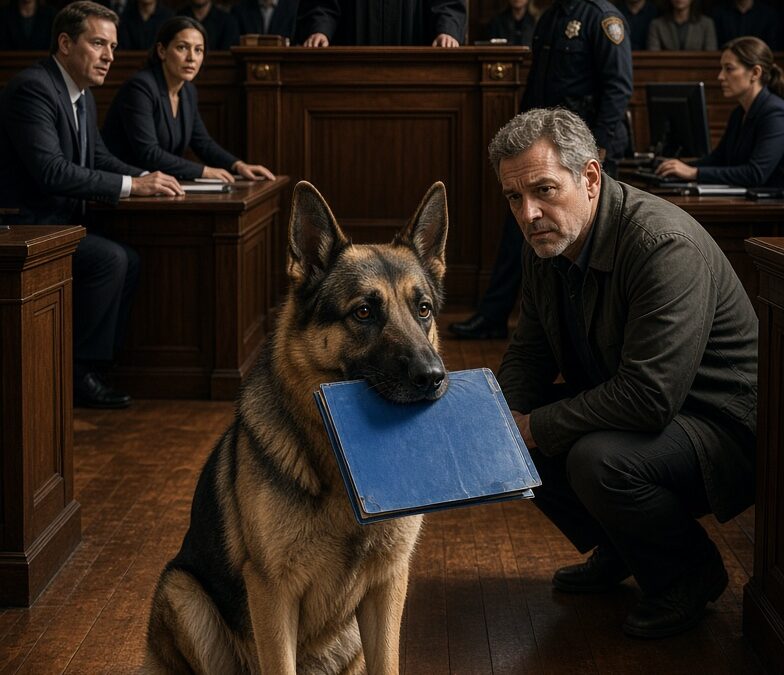
Rex had been retired for years, but I knew that look in his eyes before anyone else did.
It was the same look he had worn the night he found a missing child in an abandoned warehouse when every human search team had already begun to lose hope.
And when he planted himself in the center of Courtroom 309 with the judge’s blue folder locked between his teeth, I understood one thing before anyone said a word.
He had not done it by accident.
My name is James O’Brien.
For most of my adult life, I had worn a badge.
Rex had worn one too, in his own way.
He had served beside me during the years when my knees were stronger, my hair was darker, and I still believed experience could prepare a man for almost anything.
It cannot.
Experience teaches you patterns.
It gives you instincts.
It shows you how people behave when they are afraid, guilty, angry, desperate, or lying.
But every once in a while, life places something in front of you that does not fit any pattern you know.
That afternoon in Judge Eleanor Holloway’s courtroom was one of those moments.
I was standing in the doorway when I realized something had gone terribly wrong.
The room was frozen.
Not quiet in the ordinary courtroom sense.
Frozen.
Lawyers were half-standing behind their tables.
A clerk had stopped with one hand above her keyboard.
A bailiff looked uncertain whether he should intervene.
Judge Holloway had risen from the bench.
And in the center aisle sat Rex.
My Rex.
My retired police dog.
The eighty-pound German shepherd who had spent years tracking suspects, locating evidence, searching buildings, finding missing people, and following commands with a discipline better than some officers I had known.
He sat perfectly still.
Between his teeth was a blue case folder that had been sitting moments earlier on the judge’s desk.
I stopped breathing.
“Rex.”
His ears turned toward me.
His eyes did not.
They remained fixed on the folder.
“Rex,” I repeated.
Still nothing.
I had seen that expression before.
Years earlier, we had been searching an abandoned warehouse for an eight-year-old boy who disappeared while walking home from school.
The search had been going on for nearly eleven hours.
Rain had destroyed much of the outdoor scent trail.
Two teams had already cleared the building.
A supervisor was preparing to move us to another location.
Rex refused.
He stopped near an old freight elevator.
Sat.
Stared at a concrete wall.
His whole body became quiet in a way I had learned to trust.
One officer said, “There’s nothing there.”
Rex did not move.
We searched again.
Behind stacked shipping panels was a maintenance recess nobody had noticed.
The boy was inside.
Cold.
Dehydrated.
Terrified.
Alive.
That was the look Rex had now.
Quiet pride.
Absolute certainty.
And something deeper.
Something that always made me feel as though he had entered a room the rest of us had not reached yet.
But this was not a warehouse.
Rex was no longer an active K9.
He was retired.
He slept at the foot of my bed.
He begged for pieces of chicken when he thought I was not watching.
He groaned dramatically when I made him get off the couch.
On bad nights, when old memories kept me awake, he rested his head against my knee without being asked.
He was no longer supposed to discover evidence.
He definitely was not supposed to steal documents from a judge.
Judge Holloway stepped away from the bench.
She was in her early sixties and had spent decades in courtrooms.
Her reputation was one of the reasons lawyers prepared twice as hard when appearing before her.
She rarely raised her voice.
She did not need to.
The room adjusted itself around her.
That afternoon, even she looked confused.
“Mr. O’Brien.”
I stepped inside.
“Your Honor.”
“I would appreciate an explanation.”
I looked at Rex.
“I wish I had one.”
A few nervous laughs moved through the gallery.
Judge Holloway did not smile.
“Did you instruct your dog to retrieve that file?”
“No, ma’am.”
“Was he trained to retrieve documents?”
“No.”
I walked slowly toward Rex.
He watched me now.
His tail touched the floor once.
Then stopped.
I crouched.
“Buddy.”
His ears lifted.
“What are you doing?”
He breathed through his nose.
Once.
Twice.
Fast.
I reached for the folder.
Rex tightened his jaw.
Not enough to damage it.
Enough to tell me no.
I pulled my hand back.
That sent another murmur through the courtroom.
Elizabeth Thompson stood from the plaintiff’s table.
She was young compared with most of the attorneys in that courtroom, probably early thirties, but there was nothing inexperienced about the way she moved.
She had spent the previous three months fighting the case with remarkable focus.
“This is unacceptable, Your Honor.”
Judge Holloway looked toward her.
“Ms. Thompson.”
“We cannot allow an animal to interfere with admitted evidence.”
“He has not damaged the file.”
“That is not the point.”
Robert Green, counsel on the other side, leaned back in his chair.
Robert had practiced law long enough to develop the dangerous confidence of a man who no longer cared whether everyone liked him.
“Maybe the dog understands the exhibits better than the rest of us.”
Elizabeth turned.
“This is not funny.”
“I didn’t say it was.”
Judge Holloway raised one hand.
“That is enough.”
Silence returned.
She looked at Rex.
I watched her face.
Something in it softened.
Only slightly.
Then she looked back at me.
“Mr. O’Brien, can you get the file away from him without force?”
“I can try.”
“Do that.”
I lowered myself onto the floor beside Rex.
The courtroom disappeared around us.
That sounds strange.
But every K9 handler knows the feeling.
When you are working with a dog you trust, the human world becomes background noise.
I placed one hand on Rex’s shoulder.
His muscles were relaxed.
Not defensive.
Not excited.
Focused.
“Easy, buddy.”
He leaned against my knee.
I waited.
“You know you’re retired, right?”
His eyes moved toward me.
“Retired dogs are supposed to embarrass their owners by stealing food. Not court exhibits.”
The corner of Judge Holloway’s mouth moved.
Barely.
Rex did not release the folder.
I watched his nose.
That was when I noticed it.
Rapid movement.
Short pulls of air.
Then his head turned toward the judge’s table.
He sniffed again.
Something there had his attention.
I felt the old professional instinct rise inside me.
“Your Honor.”
“Yes?”
“I think he’s scenting.”
Elizabeth shook her head.
“Of course he’s scenting. He’s a dog.”
I ignored her.
Judge Holloway asked, “Scenting what?”
“I don’t know.”
That was the honest answer.
Rex had received several types of specialized training during his career.
Tracking.
Area search.
Article detection.
He had an unusually sensitive response to certain chemical residues.
That ability had helped us locate objects suspects tried to clean, conceal, or discard.
It was not magic.
Dogs do not understand legal significance.
They understand odor.
Association.
Pattern.
Memory.
Rex had not worked professionally in years, but retirement does not erase a nose.
I looked toward the bench.
Several folders remained there.
A sealed brown evidence envelope sat near the corner.
Rex’s nostrils moved faster.
“Your Honor, may I approach the bench?”
Judge Holloway hesitated.
The bailiff looked at her.
She thought for a moment.
“Slowly.”
I stood.
Rex remained where he was.
Still holding the blue folder.
I approached the judge’s table.
At first, nothing appeared unusual.
Case files.
Notes.
A glass of water.
Pens.
Evidence bags.
Then my eyes stopped on a large brown envelope.
EXHIBIT 47.
Sealed.
I picked it up carefully.
“May I?”
Judge Holloway nodded.
I held the envelope at chest level.
Rex changed immediately.
He dropped the blue folder.
It landed flat on the carpet.
Then he stood.
Tail moving.
Nose high.
His entire posture sharpened.
The retired dog disappeared.
For one moment, the working K9 returned.
“Rex.”
He walked toward me.
Sniffed the air.
Then the envelope.
Once.
Again.
Again.
He looked at me.
Then sat.
My heart started beating harder.
I knew that response.
“There’s something about this envelope.”
Elizabeth Thompson had gone pale.
Judge Holloway noticed.
“So it appears.”
Elizabeth stepped forward.
“Your Honor, Exhibit 47 was supposed to remain sealed until the final evidentiary stage.”
“What is inside?”
Elizabeth hesitated.
“An expert examination item.”
“What item?”
“A letter.”
The judge looked at her.
Elizabeth continued.
“A copy of a letter allegedly written approximately ten years ago by the deceased principal involved in the underlying dispute.”
Robert Green stood.
“The authenticity has been contested from the beginning.”
Judge Holloway looked at the envelope.
“The ink analysis?”
“Yes, Your Honor.”
The disputed letter had become one of the most important pieces of evidence in the case.
The civil dispute itself was complicated.
Money.
Promises.
A former business partnership.
An estate.
A claim that the deceased man had acknowledged a financial obligation before his death.
One side relied heavily on the letter.
The other argued it was fabricated.
For three months, lawyers had fought over dates, witnesses, handwriting, accounting records, and expert opinions.
Exhibit 47 contained material connected to the disputed letter.
Now my dog was sitting beneath it as if it were a bag of explosives.
Judge Holloway made a decision.
“Open it.”
Elizabeth’s eyes widened.
“Your Honor—”
“It is already an admitted exhibit under seal. I am modifying the sequence.”
She looked toward her papers.
Then back at the judge.
“Yes, Your Honor.”
The clerk documented the change.
Judge Holloway watched me.
“Mr. O’Brien, place it on the evidence table.”
I did.
The bailiff opened the envelope under the judge’s direction.
Inside was a clear plastic sleeve.
Inside that sleeve was an old yellowed piece of paper.
The disputed letter.
The writing had faded.
Ink lines ran across the page in narrow, careful strokes.
Rex stood beside me.
He sniffed once.
Then twice.
Then something unexpected happened.
He turned away.
His head lifted.
His nose worked the air.
I knew better than to interrupt.
He stepped into the aisle.
Walked toward the back of the courtroom.
People moved their legs out of his path.
He ignored everyone.
Judge Holloway said nothing.
Neither did I.
Rex stopped near the last two rows.
An elderly man sat there.
William Thompson.
No relation to attorney Elizabeth Thompson, despite the shared surname.
William had been one of the central witnesses in the case.
He had once been a business associate of the deceased man whose supposed letter sat inside Exhibit 47.
William had testified twice.
He claimed the letter was consistent with discussions he remembered from years earlier.
He had always looked uncomfortable on the stand.
I had assumed age.
Courtrooms do that to people.
Now he looked terrified.
Rex walked directly toward him.
Then sat.
William stared at the dog.
His hands were folded so tightly together his knuckles had turned white.
Judge Holloway leaned forward.
“Mr. Thompson.”
He looked toward the bench.
“Yes, Your Honor?”
“Why is the dog sitting in front of you?”
William swallowed.
“I have no idea.”
His voice trembled.
Rex did not move.
I approached slowly.
“Mr. Thompson.”
He looked at me.
“Would you allow Rex to smell your hands?”
Elizabeth stood again.
“What possible evidentiary value—”
Judge Holloway interrupted.
“Ms. Thompson.”
Elizabeth stopped.
The judge looked at William.
“You do not have to agree.”
William stared at Rex.
Then at me.
Finally, he held out both hands.
I gave Rex a quiet command.
He moved forward.
First the right hand.
Slow inhale.
Left hand.
Another.
Then Rex took one step backward.
Sat.
Raised one paw.
My mouth went dry.
That was one of his old trained alert behaviors.
I looked toward Judge Holloway.
“Your Honor.”
She was already watching.
“He’s indicating odor association.”
“With the envelope?”
“I believe so.”
Robert Green whispered something to his co-counsel.
Elizabeth did not move.
Judge Holloway looked at William.
Her voice changed.
Not softer exactly.
More careful.
“Mr. Thompson.”
He stared at the floor.
“You are not required to incriminate yourself.”
His shoulders began shaking.
The judge continued.
“But I need to ask whether there is something about Exhibit 47 you believe this court should know.”
No answer.
“Mr. Thompson?”
He started crying.
Not loudly.
That made it harder to watch.
There are different ways human beings cry.
Some crying is sudden.
Some desperate.
Some angry.
William Thompson cried like a man who had spent years holding shut a door that had finally become too heavy.
“I lied.”
Nobody moved.
The clerk’s fingers hovered above the keyboard.
Judge Holloway asked, “About what?”
William looked at the letter.
“That.”
Elizabeth slowly sat down.
William wiped his face.
“I lied for three months.”
Judge Holloway’s expression became unreadable.
“Is the letter authentic?”
William shook his head.
“No.”
Someone in the gallery gasped.
He continued before anyone could interrupt.
“I wrote it.”
My hand moved unconsciously to Rex’s back.
The dog remained completely calm.
William looked toward the judge.
“I made it.”
“Why?”
He pressed both palms against his eyes.
When he lowered them, he looked twenty years older.
“Because I hated him.”
The courtroom disappeared into silence again.
William pointed weakly toward the evidence table.
“He accused me years ago.”
“Accused you of what?” Judge Holloway asked.
“Something I didn’t do.”
His voice broke.
“He destroyed my reputation. My business. My relationship with people who had known me half my life.”
Elizabeth’s face changed.
This was not merely evidence anymore.
It had become personal.
The deceased man connected to the letter had been central to her own family history and to the case she had spent months pursuing.
William looked toward her.
“When he died, I told myself it was over.”
He shook his head.
“But it wasn’t.”
He took a breath that seemed painful.
“I wanted his family to lose something too.”
Elizabeth whispered:
“Why?”
William could barely look at her.
“Because I was angry.”
“That’s not an answer.”
“You’re right.”
He wiped his face again.
“I wanted to punish someone who couldn’t defend himself anymore.”
He looked toward the floor.
“And I convinced myself the people he left behind were the same as him.”
Elizabeth’s eyes filled.
William continued.
“I created the letter.”
“How?”
Judge Holloway asked the question firmly.
William hesitated.
“I had access to old correspondence. Samples of his writing. Documents from the partnership.”
Robert Green’s co-counsel began taking furious notes.
“I copied the style.”
“The signature?”
William nodded.
“The language?”
“Yes.”
“The age of the paper?”
Another nod.
“I had old stationery.”
“And Exhibit 47?”
William looked toward it.
“That is the copy I helped introduce.”
Judge Holloway leaned back.
“What about the expert examination?”
“I was afraid it would expose me.”
“Then why did you allow it to proceed?”
William laughed once.
It was a broken sound.
“I kept thinking I could survive one more day.”
I knew that psychology.
I had watched suspects live inside it.
One more day.
One more lie.
One more explanation.
People often believe confession arrives because guilt suddenly becomes unbearable.
Sometimes it arrives because maintaining the structure around the lie becomes more exhausting than letting it fall.
William looked toward Rex.
“This dog…”
He stopped.
Rex tilted his head.
William cried harder.
“He didn’t know any of us.”
No one answered.
“He didn’t know the case.”
His voice shook.
“He didn’t hate me.”
William pressed one hand against his chest.
“He just walked over and sat down.”
I understood what he meant.
There was no accusation in Rex.
No anger.
No moral judgment.
A dog does not understand fraud.
He does not understand revenge.
He does not understand estates or civil liability.
Rex smelled something familiar.
That was all.
But perhaps that simplicity was exactly what broke William.
Judge Holloway called for a recess.
The courtroom emptied slowly.
Nobody wanted to leave.
People moved as though sudden motion might disturb whatever had happened.
I took Rex into the hallway.
He drank water from a collapsible bowl.
Then sat beside my leg.
I crouched.
“You’re unbelievable.”
He looked at me.
“You know that?”
Tail.
One thump.
“I spent years trying to teach you courtroom manners.”
Another thump.
“And this is what retirement looks like?”
He leaned his shoulder into me.
I scratched behind his ears.
My hands were shaking.
That surprised me.
I had spent years around evidence.
Confessions.
Searches.
Arrests.
But I was not shaking because of William Thompson.
I was shaking because Rex had become his old self for a few minutes.
And for those minutes, I had become mine.
There is something cruel about retirement when your identity was built around a partner.
People told me I would enjoy the quiet.
No radio calls.
No midnight searches.
No court appearances.
No standing in freezing rain while your dog followed a scent through a drainage ditch.
They were wrong about part of it.
I enjoyed sleeping.
I enjoyed not wondering whether every doorway concealed somebody armed.
But I missed purpose.
Rex missed it too.
For months after retirement, he would wake whenever I put on work boots.
He would run to the door.
Wait.
Then look confused when I did not clip on his harness.
Eventually he stopped.
That hurt worse.
I started taking him everywhere I reasonably could.
Parks.
Outdoor cafés.
Visits with former officers.
Court appointments where dogs were permitted.
He became my shadow.
That day, he had reminded both of us who he used to be.
Maybe who he still was.
The courtroom reconvened forty minutes later.
William returned with counsel.
The mood had changed entirely.
The case no longer revolved around competing interpretations of a letter.
The letter’s own supporting witness had admitted fabricating it.
Judge Holloway addressed the attorneys.
“Before we proceed, I want the record clear.”
Everyone listened.
“The dog’s behavior is not itself a judicial finding.”
That mattered.
I appreciated her saying it.
“Mr. Thompson’s confession must be evaluated independently.”
She looked toward William’s counsel.
“Do you understand?”
“Yes, Your Honor.”
She continued.
“The court will not substitute an animal alert for evidence.”
Again:
“Yes, Your Honor.”
“But Mr. Thompson has now voluntarily made statements in open court concerning the origin of Exhibit 47.”
William nodded.
Judge Holloway turned toward Elizabeth.
“Ms. Thompson.”
Elizabeth rose slowly.
“Your Honor.”
“Do you wish to proceed with the claim as currently presented?”
Elizabeth looked toward William.
Then at the letter.
Then down at the documents she had spent months assembling.
“No.”
Her voice was barely audible.
The judge waited.
Elizabeth spoke again.
“No, Your Honor.”
She closed her folder.
“I cannot proceed on evidence I now believe was fabricated.”
Robert Green stood.
“Defense moves for dismissal.”
Judge Holloway looked at Elizabeth.
“Objection?”
Elizabeth shook her head.
“No objection.”
The judge granted dismissal of the claim insofar as it depended upon the falsified evidence, consistent with the admissions placed before the court.
She also directed that the matter surrounding the fabricated exhibit be documented properly and referred for whatever further handling the law required.
The original story people later told simplified that moment.
They liked to say the judge simply forgave William and ordered an apology.
The reality inside the room felt more complicated.
Judge Holloway understood that courts cannot erase legal consequences because a confession is emotional.
But she also understood that the immediate civil dispute had collapsed.
And in that moment, she chose something unusual.
She looked at William.
“You have caused real harm.”
He nodded.
“You allowed a lie to consume months of other people’s lives.”
“Yes.”
“You attempted to use this courtroom to give that lie authority.”
William closed his eyes.
“Yes, Your Honor.”
She paused.
“Whatever additional legal consequences follow will be handled through the proper process.”
Then she looked toward Elizabeth.
“But this court also recognizes that not every wound between human beings can be repaired with an order.”
Elizabeth stared ahead.
Judge Holloway continued.
“If the Thompson family is willing, I strongly encourage you, Mr. Thompson, to begin with the truth you should have offered years ago.”
William’s face crumpled again.
“I will.”
Elizabeth stood.
For several seconds, I thought she intended to leave.
Instead, she walked toward William.
He could not look at her.
“Look at me.”
He did.
She asked:
“Was any of it true?”
“The letter?”
“All of it.”
He shook his head.
“No.”
“My father never wrote that?”
“No.”
“He never promised what the letter says?”
“No.”
Her lower lip trembled.
“Then why me?”
William whispered:
“Because you were there.”
Elizabeth stared at him.
“I was a child when most of this happened.”
“I know.”
“You hated him.”
“Yes.”
“So you punished me.”
William nodded.
“I am sorry.”
The words sounded too small.
Everyone knew it.
William knew it most of all.
Elizabeth stood there with her arms at her sides.
Then something happened I did not expect.
She sat beside him.
Not touching him.
Not yet.
She looked forward.
For almost a minute, neither spoke.
Finally:
“My father made mistakes.”
William looked at her.
“I know he did.”
She continued.
“I spent years defending a version of him that was easier to live with.”
William said nothing.
“But whatever he did to you…”
Her eyes filled.
“…I didn’t do it.”
“I know.”
“You knew then too.”
“Yes.”
She turned toward him.
“That is the part I don’t know how to forgive.”
He looked down.
“You don’t have to.”
Elizabeth closed her eyes.
When she opened them, she reached for his hand.
Not forgiveness.
Not completely.
Something earlier than forgiveness.
The decision not to make hatred the next inheritance.
William sobbed.
Elizabeth moved closer.
Then embraced him.
Some people in the courtroom cried.
I did not.
Not then.
I looked at Rex.
He was lying beside my feet.
Head on his paws.
The great courtroom disruption had apparently exhausted him.
Judge Holloway descended from the bench after proceedings concluded.
Judges rarely look smaller when they leave the bench.
She did.
Not weak.
Human.
She approached me.
“Mr. O’Brien.”
“Yes, Your Honor?”
She looked down at Rex.
“May I?”
I smiled.
“He’ll be offended if you don’t.”
She crouched.
Rex lifted his head.
Judge Holloway scratched the side of his neck.
He leaned into her hand immediately.
Traitor.
She smiled.
Then looked at me.
“How long did you work together?”
“Almost nine years.”
“That long?”
“Yes.”
“How many people did he find?”
“Enough that I stopped counting numbers and started remembering faces.”
She nodded.
“Today was extraordinary.”
“It was.”
She looked at the dog.
“But I want to say this carefully.”
I knew what she meant.
“Rex didn’t solve the case.”
“No.”
“He alerted to something.”
“Yes.”
“And people followed it.”
“Yes.”
She smiled.
“That distinction matters.”
“It does.”
Then she said something I remembered for the rest of Rex’s life.
“Still, sometimes truth needs somebody stubborn enough to refuse to walk past it.”
I looked at him.
“He was always good at stubborn.”
Judge Holloway laughed.
She stood.
“Bring him back sometime.”
“He might steal another file.”
“Then perhaps leave the exhibits secured.”
For the first time all day, I laughed without tension beneath it.
News of what happened spread quickly.
Not nationally.
Not at first.
Court staff talked.
Lawyers talked.
Someone told a local reporter.
By the following week, a story had appeared about the retired police dog who disrupted a civil hearing and helped expose a fabricated letter.
The headlines made Rex sound almost supernatural.
RETIRED K9 CRACKS COURT CASE.
FORMER POLICE DOG SNIFFS OUT FALSE EVIDENCE.
DOG EXPOSES COURTROOM LIE.
I hated most of them.
Rex was remarkable.
But truth did not need mythology.
He smelled an odor.
He followed it.
William confessed.
Experts and lawyers did the rest.
Still, people loved the story.
Letters arrived at the courthouse.
Children sent drawings.
Someone mailed Rex a box of dog biscuits addressed:
OFFICER REX
COURTROOM 309
The clerk called me.
“You need to come get your dog’s mail.”
“My dog gets mail?”
“More than some attorneys.”
I brought Rex.
The staff made a ridiculous ceremony of opening the box.
He ate two treats.
Then tried to steal a third.
Judge Holloway eventually approved a small plaque near the entrance to Courtroom 309.
Nothing grand.
Brass.
A simple image of a German shepherd.
The inscription read:
HE WHO REMAINS FAITHFUL TO THE TRUTH WILL ALWAYS FIND A WAY.
I stood in front of it longer than I expected.
Rex sat beside me.
I read the words twice.
“You understand none of this, do you?”
He looked at me.
I pointed.
“That’s you.”
He sniffed the wall.
“Impressive.”
He sat.
I touched the edge of the plaque.
For years, I had defined Rex by what he did.
Track.
Find.
Alert.
Protect.
After retirement, I had to learn another version of him.
Companion.
Routine.
Warm body beside the bed.
Slow morning walks.
Gray around the muzzle.
Arthritis beginning in his hips.
Sleeping through sounds that once would have brought him instantly upright.
That is the quiet cruelty of loving a working dog.
Their careers are short.
Their lives are shorter.
And the part of you that depends on them never understands either fact.
After the courtroom incident, Rex did not become a working dog again.
I would not have allowed it.
He had earned retirement.
Instead, we returned to our ordinary life.
Breakfast at six.
Walk at seven.
Nap by nine.
Another walk in the afternoon if his joints felt good.
He had medication now.
I hid it in cheese.
He pretended not to know.
We both participated in the lie.
Occasionally, Judge Holloway invited us to courthouse events.
Rex became a kind of unofficial mascot.
Children wanted photographs.
Attorneys bent down in suits that cost more than my first car and let him cover them with hair.
Robert Green brought treats every time he saw us.
Elizabeth Thompson came only once.
About six months after the case ended.
I was sitting outside the courthouse with Rex when she approached.
She looked different.
Less sharp around the edges.
“Mr. O’Brien.”
“James.”
She smiled.
“James.”
She crouched in front of Rex.
“Do you remember me?”
Rex sniffed her hand.
Then leaned forward.
She laughed softly.
“I’ll take that as yes.”
I asked how she was doing.
“Better.”
“And Mr. Thompson?”
Her smile faded.
“Trying.”
That was enough.
She sat beside me.
For a while, we watched people enter the courthouse.
Finally she said:
“I hated that dog for about three minutes.”
I laughed.
“That’s generous.”
“I thought he was destroying my case.”
“He was.”
She looked at me.
“Exactly.”
I stopped laughing.
Elizabeth rubbed Rex’s head.
“I built everything around that letter.”
“I know.”
“I wanted it to be real.”
“That’s different from knowing it was.”
“Yes.”
She stared across the parking lot.
“That’s the part that bothers me.”
“What?”
“How much easier evidence becomes when it says what you need.”
I understood.
Every investigator understands eventually.
Evidence that confirms your belief feels cleaner.
Evidence that contradicts it feels irritating.
Good investigators learn to distrust that emotional difference.
Bad ones call it intuition.
Elizabeth looked down at Rex.
“He didn’t care what I wanted.”
“No.”
“He didn’t care what William wanted.”
“No.”
“He didn’t care who won.”
I smiled.
“He cared about whatever smelled interesting.”
She laughed.
Then became serious again.
“Maybe that was enough.”
We sat quietly.
Before she left, she hugged Rex.
Then me.
William Thompson eventually wrote me a letter.
I almost threw it away.
I opened it instead.
James,
I do not know whether a dog can understand what shame is.
I hope he cannot.
I hope animals are spared some of the things people create for themselves.
I have spent months thinking about the moment Rex sat in front of me.
He did not growl.
He did not bark.
He did not accuse.
He simply waited.
I had spent years telling myself that what I had done was justified because another man had once harmed me.
Sitting across from that animal, I realized I had become the thing I hated.
I do not expect forgiveness.
I am working to repair what I can.
Please give Rex something he likes and tell him it is from a coward who finally stopped lying.
William
I read it twice.
Then went into the kitchen.
Rex was sleeping beside the refrigerator.
I opened the drawer.
Took out a piece of chicken.
He woke instantly.
Of course.
“From William.”
He took the chicken.
No hesitation.
“Your moral standards are embarrassingly flexible.”
Tail.
Thump.
I sat on the floor beside him.
For a while, I rested one hand against his ribs.
Breathing.
Warm.
Steady.
“You did good, buddy.”
He looked at me.
I remembered the warehouse.
The missing boy.
Rex pushing between pallets until we found him.
I remembered a winter search for an elderly woman with dementia.
A suspect who abandoned a gun beneath a drainage culvert.
A child’s backpack located after hours in the woods.
I remembered hospital visits.
Ceremonies.
Long nights in the patrol vehicle.
Bad coffee.
Radio calls.
My hand resting on his back while we waited.
People liked to say handlers trained dogs.
That is true.
It is also incomplete.
Rex trained me.
Patience.
Attention.
The discipline of trusting information I could not personally perceive.
He taught me that certainty does not need volume.
That loyalty can be quiet.
That fear has a smell.
That grief does too, probably.
Most importantly, he taught me to watch before deciding.
Humans are obsessed with explanation.
We want meaning before observation.
Dogs reverse the order.
They notice.
Then respond.
Maybe that is why Rex saw things I missed.
His world began with what was there.
Mine too often began with what I expected.
Rex lived another three years after the courtroom incident.
Good years.
Mostly.
His muzzle went almost completely white.
His hearing faded.
His hips worsened.
Stairs became difficult.
I built a ramp beside the back porch.
He refused to use it for a week.
Pride, apparently, is not exclusively human.
Eventually cheese persuaded him.
Toward the end, our morning walks became very short.
Mailbox.
Corner.
Home.
Sometimes only the yard.
I learned to stop measuring a good day by distance.
If he ate, good.
If he slept comfortably, good.
If he wanted to sit outside in the sun, very good.
One autumn afternoon, I took him back to the courthouse.
Not for a hearing.
Just because I wanted to.
Courtroom 309 was empty.
Judge Holloway had retired by then.
A new judge occupied the chambers.
But the plaque remained.
I walked Rex down the hallway.
His nails clicked slowly on the tile.
We stopped beneath the brass image.
I sat beside him.
“You remember?”
He smelled the baseboard.
“Apparently not.”
I laughed.
Then I looked at the closed courtroom doors.
For some reason, I suddenly remembered the exact sound of the blue folder falling onto the carpet.
Years had passed.
But I could hear it.
Soft.
Almost nothing.
A small sound beneath a huge silence.
That was the moment the case changed.
Not because Rex understood law.
Not because he knew William was guilty.
Because he refused to let go of something his instincts told him mattered.
I put my arm around his neck.
He leaned into me.
“That was a hell of a day.”
His tail moved once.
We stayed there until the courthouse lights shifted automatically into evening mode.
When Rex died, it happened at home.
That was what I wanted.
What he deserved.
His veterinarian came to us.
I placed his bed beside the fireplace.
Rex rested his head in my lap.
I had prepared myself.
I thought I had.
There is no preparing.
Not really.
You can know an ending is coming.
You can understand the biology.
You can sign forms.
You can tell yourself mercy is love.
The heart does not care.
I talked to him until the end.
About nothing important.
The old patrol car.
The warehouse.
The courthouse.
Chicken.
How terrible he was at retirement.
How I had never deserved him.
His breathing slowed.
Then stopped.
The house became silent.
I had lived alone before Rex.
I did not remember it feeling like that.
For weeks afterward, I still stepped around the place where his water bowl had been.
I woke expecting to hear his nails on the floor.
I opened the refrigerator and automatically reached toward the cheese drawer.
Grief is repetition without the person you repeated life with.
Judge Holloway attended the small memorial the department held for him.
So did Elizabeth.
Robert Green.
Several former handlers.
Officers Rex had worked beside.
People whose names I barely remembered.
One family drove three hours.
I recognized the father.
Then the son.
The boy from the warehouse.
Except he was no longer eight.
He was in his twenties.
Tall.
College sweatshirt.
He stood in front of me holding an old photograph.
Rex beside an ambulance.
The boy wrapped in a blanket.
“You probably don’t remember me.”
“I do.”
He swallowed.
“My mom said I should come.”
“I’m glad you did.”
He looked at the photograph.
“I don’t remember much from that night.”
“That’s probably good.”
“I remember him.”
I could not speak for a moment.
He continued.
“I remember hearing something outside the wall.”
“Rex.”
“Yes.”
He smiled.
“I thought it was a wolf.”
That made me laugh through tears.
“He would have liked that.”
The young man handed me the photograph.
On the back, he had written:
For Rex. He found me when everyone was running out of places to look.
I framed it.
It sits beside another photograph now.
Rex in Courtroom 309.
Blue folder between his teeth.
Judge Holloway staring down at him.
Me standing in the doorway with my face apparently caught somewhere between terror and disbelief.
People still tell the courtroom story.
Every version changes.
Some say Rex tore open the evidence bag.
He did not.
Some say he attacked William.
Never.
Some say the judge immediately declared the entire case solved because a dog smelled the truth.
Absolutely not.
The real story was less dramatic.
And better.
A retired police dog noticed something.
His former handler paid attention.
A judge allowed an unusual moment without abandoning procedure.
A witness broke under the weight of his own lie.
A lawyer chose truth over winning.
And a courtroom full of people watched revenge finally become too heavy for one old man to carry.
Rex did not understand any of that.
Maybe that was why he mattered.
He had no side.
No argument.
No inheritance.
No reputation.
No need to be right.
He simply followed what his senses told him.
The rest was ours.
Years later, when I visit the courthouse, I still stop at the plaque.
The brass has begun to dull slightly.
I like that.
Rex aged honestly too.
Gray fur.
Slow legs.
Clouded eyes.
No effort to pretend time had not touched him.
The inscription still reads:
HE WHO REMAINS FAITHFUL TO THE TRUTH WILL ALWAYS FIND A WAY.
I used to think the plaque honored Rex.
Now I think it warns the rest of us.
Truth does not always arrive dramatically.
Sometimes it sits quietly beneath anger.
Sometimes beneath grief.
Sometimes beneath ten years of resentment.
Sometimes inside a sealed brown envelope everyone has already argued about too long.
And sometimes the first creature to notice it has four legs, gray around the muzzle, and no idea why an entire courtroom has suddenly stopped breathing.
I spent years believing my job was to teach Rex how to search.
In the end, the most important lesson went the other direction.
He taught me that when something refuses to fit the story everyone has already accepted, you do not force it back into place.
You stop.
You look.
You listen.
And you follow the truth wherever it goes.
Even if it walks away from the judge’s bench with a blue folder in its mouth.

