𝗙𝗨𝗟𝗟 𝗦𝗧𝗢𝗥𝗬 My Neighbor Told Police I Was Firing a Gun at Someone—And I Had No Idea How Dangerous Her Lie Was About to Become
𝗣𝗔𝗥𝗧 𝟮
I hated answering.
Accusing somebody without proof is serious.
But I wasn’t going to lie either.
“I have a suspicion.”
“Who?”
“The neighbors across from us.”
“Why?”
I explained the layout.
The cameras.
The fact that nobody else had been seen entering or leaving the area.
The officer glanced toward Karen’s door.
“Any history?”
I hesitated.
“Police are over there fairly often.”
“What kind of calls?”
“I don’t know all the details.”
That was true.
“I’ve seen at least one of them taken away before.”
The officer wrote something.
I immediately added, “I’m not saying they definitely stole it.”
“I understand.”
“I don’t have proof.”
“You’re giving us information. We’ll handle the rest.”
That should have been it.
A theft report.
Maybe nothing would ever come from it.
Maybe the package would never turn up.
I expected to lose the money and become more careful about deliveries.
Instead, the police discovered something completely unrelated.
There was an active protective order involving Derek.
It had been issued about two weeks earlier after one of his arrests.
I did not know the specific details.
I did not ask.
What mattered was that the order apparently prohibited him from being where he currently was.
The police put the situation together.
My theft report had brought officers back to an address where Derek wasn’t supposed to be.
A patrol unit came.
Derek was found there.
And suddenly, what had started as a missing box became another law-enforcement problem for Karen and Derek.
I did not create the protective order.
I did not tell Derek to violate it.
I didn’t even know it existed.
But Karen decided the entire thing was my fault.
The first sign came the next morning.
I opened our front door to take my daughter outside.
Karen’s door flew open.
She stepped into the breezeway.
White fitted jacket.
Deep neckline.
Blonde hair pulled back.
Arms folded under her chest.
“You happy?”
I stopped.
My daughter was holding my hand.
“Excuse me?”
Karen stared at me.
“You know exactly what you did.”
“I honestly don’t.”
She laughed.
“Don’t play innocent.”
I shifted my daughter slightly behind me.
“Karen, if you want to talk, don’t do it in front of my child.”
“Oh, please.”
Her voice sharpened.
“You’re the one who brought police into this.”
“I reported stolen property.”
“You accused us.”
“I told them who I suspected when they asked.”
“You had Derek arrested.”
“No.”
“Yes, you did.”
“He was violating a court order.”
Her face changed instantly.
“That order is none of your business.”
“Exactly.”
She took one step closer.
“So stay out of our lives.”
I almost laughed at the contradiction.
“My package disappeared from my front door.”
“We didn’t take your stupid package.”
“Then you have nothing to worry about.”
“You think you’re better than us?”
“No.”
“Because that’s the attitude you’re giving.”
“I want my stuff back.”
“You don’t know we touched it.”
“I never said I knew.”
“You told police.”
“They asked who I suspected.”
Karen’s eyes narrowed.
I could see she wasn’t listening anymore.
She had already decided what the story was.
I was the nosy neighbor.
I called police.
I caused Derek’s problems.
Therefore whatever happened next was justified.
My daughter tugged my hand.
“Mommy?”
That snapped me back.
I looked down.
“Come on, sweetheart.”
Karen called after me as we walked away.
“This isn’t over.”
I stopped.
Just for a second.
Then I kept walking.
I told my husband that night.
He became immediately serious.
“She said that?”
“Exactly.”
“Don’t engage with them anymore.”
“Wasn’t planning to.”
“If anything happens, document it.”
“I know.”
“We’ve got a kid.”
“I know.”
That phrase became the center of everything.
We’ve got a kid.
If it had been just my husband and me, maybe I would have argued harder.
Maybe I would have told Karen exactly what I thought of her.
But once you’re responsible for a child, every confrontation gets filtered differently.
What if yelling becomes violence?
What if somebody damages the car?
What if they wait outside?
What if your daughter hears something she shouldn’t?
So we tried to avoid them.
Karen and Derek didn’t return the favor.
The retaliation began small enough that I occasionally wondered whether I was imagining it.
They would shout insults when we entered the breezeway.
Nothing specific enough to call police over.
Just comments.
“Snitch.”
“Nosy.”
“Mind your business.”
Sometimes laughter after we passed.
Then their security system started becoming a weapon.
They had some kind of alarm or camera setup near their front door.
Every time I stepped outside, it suddenly chirped.
Then beeped.
Then blasted a warning tone.
At first I thought it was automatic.
Then I noticed it didn’t happen when my husband went out.
Or when other neighbors walked past.
Only me.
I’d open our door.
Alarm.
Take my daughter to the car.
Alarm.
Carry groceries inside.
Alarm.
Walk to the mailbox.
Alarm.
One afternoon, Karen was sitting outside when it happened.
She smiled.
That confirmed it.
I looked directly at her.
“Really?”
Karen crossed her legs.
Her white fitted trousers looked absurdly immaculate compared with the dusty concrete breezeway.
“I don’t know what you’re talking about.”
“The alarm.”
“It’s security.”
“It only goes off when I leave my apartment.”
“Maybe you’re making it nervous.”
She smiled again.
I went inside.
My husband wanted to contact management immediately.
I resisted.
“I don’t want to escalate every stupid thing.”
“They’re already escalating.”
“It’s noise.”
“For now.”
I knew he was right.
I just wanted life to return to normal.
For about a week, it remained in that miserable gray zone.
Not quite dangerous enough to justify major action.
Not harmless enough to ignore.
Every trip through the breezeway became uncomfortable.
I checked outside before leaving.
I kept my daughter close.
I stopped allowing packages to sit outside.
We changed our routines.
Karen saw it.
I think she enjoyed that.
People like Karen don’t always need to win something tangible.
Sometimes making someone else uncomfortable is enough.
Then came the afternoon she crossed a line I still can’t think about without feeling cold.
It was a regular school day.
My husband was working.
Our daughter needed to be picked up.
I left the apartment shortly before dismissal.
Nothing unusual happened.
I drove to her school.
Waited through the pickup line.
Signed her out.
Helped her into the car.
She spent most of the drive home telling me something extremely important about crayons, a classmate, and why purple was apparently superior to red.
Normal five-year-old conversation.
We stopped briefly.
Then headed home.
Altogether, I was gone somewhere between an hour and ninety minutes.
As I approached the apartment complex, I noticed a patrol car.
That didn’t immediately surprise me.
Police had been around enough because of Karen and Derek that a cruiser wasn’t extraordinary anymore.
Then I saw Derek.
He was near the entrance with their dogs.
Talking to one of the officers.
He looked toward my car.
His entire body changed.
He pointed.
Not casually.
Violently.
His arm shot out.
Finger aimed directly at me.
His mouth was moving fast.
The officer turned.
My stomach tightened.
My daughter was in the back seat.
“Mommy, what is he doing?”
“I don’t know, baby.”
Another patrol vehicle was farther inside the parking area.
I slowed.
For half a second, I considered parking somewhere else.
Then the officer raised his hand toward me.
I lowered my window.
“Can I help you?”
His expression was serious.
“Ma’am, park over there near my partner.”
My heart started pounding.
“Is something wrong?”
“Please park near my partner.”
Every part of my body went cold.
I did what he said.
I parked.
Put the car in park.
Then turned toward my daughter.
“Stay buckled, okay?”
“Why?”
“Mommy needs to talk to the police.”
“Am I in trouble?”
That question hurt.
“No.”
I forced a smile.
“Nobody’s in trouble.”
At that moment, I didn’t know whether that was true.
An officer approached my driver’s-side window.
“Are you [name]?”
“Yes.”
“Can you step out for me?”
I looked toward my daughter.
“Can she stay in the car?”
“Yes. You’re fine.”
The words you’re fine helped slightly.
I stepped out.
I kept my hands visible without consciously deciding to.
Maybe because police were involved.
Maybe because Derek had pointed at me like I had done something terrible.
The officer lowered his voice.
“We received a call from this complex.”
“Okay.”
“Your neighbors reported hearing gunshots through their security system.”
I stared at him.
“Gunshots?”
“Yes.”
“And they gave a description matching you.”
For a moment, I honestly stopped understanding English.
“Me?”
“They said you may have fired at someone.”
Everything around me seemed to get quieter.
The mountains.
Cars.
My daughter’s movement inside the back seat.
I heard my own voice ask:
“They said I shot somebody?”
“Possibly.”
“I don’t own a gun.”
The officer watched me.
“I don’t own any firearm.”
“Okay.”
“I have never owned one.”
“Where have you been?”
“Picking up my daughter.”
“How long?”
“An hour. Maybe an hour and a half.”
“Anyone who can confirm?”
I pointed toward the back seat.
“My five-year-old.”
Despite the situation, his expression softened slightly.
“Anyone else?”
“The school.”
I grabbed my phone.
“I have pickup records. Location history. Probably receipts from the stop we made.”
“That’s fine. Slow down.”
I realized my hands were shaking.
Then I looked toward Karen’s apartment.
She was outside.
Of course she was.
Standing several yards away.
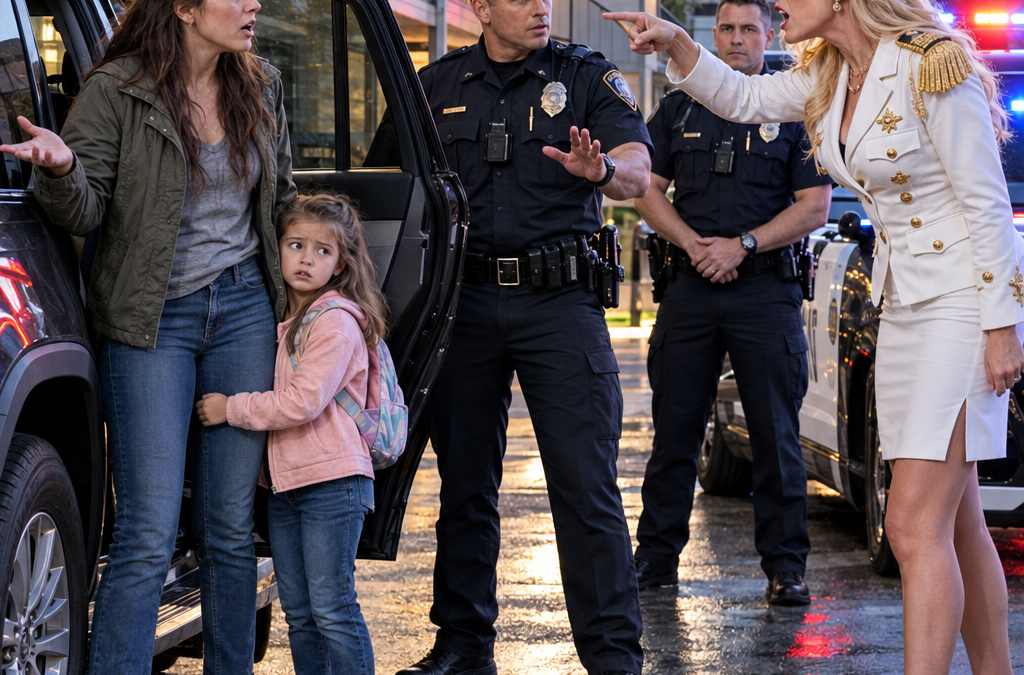
White military-style jacket.
Deep-cut collar.
Blonde hair loose around her shoulders.
Arms crossed.
Watching.
She had wanted to see this.
That realization hit me harder than the accusation itself.
This wasn’t an impulsive complaint.
She was waiting.
Waiting to watch the police confront me.
Waiting to see whether I would be handcuffed.
Waiting to see my daughter watch it happen.
My fear turned into anger.
“Officer.”
“Yes?”
“This is retaliation.”
“What do you mean?”
“A week ago, I filed a theft report.”
He listened.
“I told police I suspected those neighbors because nobody else was seen going into our breezeway.”
His eyes moved toward Karen and Derek.
“When officers followed up, they discovered he was violating a protective order.”
The officer’s expression changed.
“You mean him?”
He pointed subtly toward Derek.
“Yes.”
“And you’re saying this started after that?”
“Immediately.”
“Tell me what they’ve done.”
I explained.
The screaming.
The comments.
The security alarm.
Karen confronting me.
The threat.
“This isn’t over.”
The officer looked toward his partner.
Then back at me.
“You said you’ve been gone ninety minutes?”
“Approximately.”
“Did you hear any gunshots before you left?”
“No.”
“Do you own firearms?”
“No.”
“Does your husband?”
“No.”
“Any guns inside your apartment?”
“No.”
He nodded.
“Stay here.”
I stood beside my car.
My daughter pressed her face near the window.
I walked closer.
She cracked the door.
“Mommy?”
“I’m okay.”
“Why are the police here?”
“They’re asking questions.”
“About what?”
I couldn’t tell her.
Not then.
“Something somebody heard.”
She looked frightened.
I opened the rear door and crouched beside her.
“I’m okay.”
“Can we go home?”
“Soon.”
I kissed her forehead.
Across the lot, Karen was talking quickly to another officer.
Even from the distance, I could recognize her style.
Pointing.
Shaking her head.
Performing outrage.
Derek stood near the dogs.
His face was red.
Then the officer asked him something.
Derek’s posture changed.
He started arguing.
Karen stepped closer.
The officer held up a hand.
Derek kept talking.
I couldn’t hear the words.
But I knew that body language.
I’d seen it across the breezeway.
Aggression disguised as indignation.
The first officer returned to me.
“Your timeline checks out.”
I let out a breath I hadn’t realized I was holding.
“The school confirmed pickup time?”
“We have enough.”
“Did anyone actually get shot?”
“No indication of that.”
I stared toward Karen.
“So they lied.”
He didn’t answer directly.
“We’re sorting out what happened.”
“She told you I might have shot someone.”
“That’s what was reported.”
I felt sick.
Not because I thought I’d be arrested anymore.
Because I understood what could have happened.
A report of gunshots isn’t like a noise complaint.
It isn’t somebody saying my music is loud.
Police hear shots fired and possible armed person, and they respond to danger.
What if officers had arrived while I was home?
What if I’d stepped outside quickly?
What if I had something in my hand?
A phone.
Keys.
A dark object.
What if my husband answered the door?
What if my daughter ran outside?
Karen hadn’t just told a lie.
She had created a situation where armed officers could have arrived expecting a shooter.
I looked at her.
She was still arguing.
My hands stopped shaking.
Something colder replaced the fear.
The officer beside me seemed to understand exactly what I was thinking.
He said quietly, “You’re doing the right thing staying calm.”
“I didn’t do anything.”
“I know.”
“My daughter is sitting in that car.”
“I know.”
“They knew she would be with me.”
He didn’t answer.
Across the parking lot, the second officer moved closer to Derek.
Another patrol car had arrived.
Then something changed.
The officers weren’t looking toward me anymore.
They were focused on Derek.
One said something.
Derek shook his head.
The officer repeated it.
Karen stepped in.
She pointed toward me.
Her voice carried this time.
“She’s the problem!”
Everyone heard it.
Karen marched several steps toward us.
The officer blocked her path.
“This started because of her!”
I could feel other residents watching from balconies and windows.
Karen didn’t care.
She pointed at me again.
“She has been harassing us for a week.”
I finally spoke.
“I reported stolen property.”
Karen shouted back.
“You got him arrested!”
“I didn’t create his protective order.”
Her face twisted.
“Don’t talk about things you don’t understand.”
“Then stop involving me in them.”
The officer between us raised his voice.
“Enough.”
Karen froze.
“Both of you, stop.”
I immediately did.
Karen didn’t.
“You don’t understand what she’s been doing.”
The officer turned toward her.
“I said stop.”
Karen’s mouth snapped shut.
It may have been the first time I’d ever seen someone issue her a command that she actually obeyed.
Derek tried walking toward their apartment.
An officer stopped him.
“Stay here.”
“I’m done talking.”
“You need to stay here.”
“I didn’t do anything.”
“Stay here.”
Karen stepped forward.
“He doesn’t have to—”
The officer turned.
“Ma’am.”
She stopped.
Something was happening that had nothing to do with me anymore.
I looked at the officer beside my car.
“What’s going on?”
He hesitated.
Then said, “They have other issues we’re addressing.”
I knew what that probably meant.
The protective order.
Derek wasn’t supposed to be there.
Again.
And in trying to use the police against me, he had apparently invited police attention directly back onto himself.
The irony was so perfect I almost couldn’t process it.
Karen could.
Her face changed when one officer told Derek to turn around.
“What are you doing?”
Derek started arguing.
The dogs began barking.
Karen rushed closer.
“Why are you touching him?”
The officer repeated:
“Sir, turn around.”
“This is bullshit.”
Derek looked toward me.
“This is her fault!”
I said nothing.
I didn’t smile.
Didn’t react.
My daughter was watching.
I wasn’t going to give them anything.
The officer took Derek by the arm.
Karen’s voice became shrill.
“No. No, you’re here because of HER.”
One of the officers said, “Ma’am, back up.”
“She fired a gun!”
The officer looked directly at her.
“There is no evidence she fired anything.”
Karen’s face went white beneath her makeup.
“Your system recorded it.”
“We are investigating the report.”
“We heard shots.”
“When?”
Karen hesitated.
That hesitation was tiny.
Barely a second.
But everybody noticed.
“What time?”
She gave an answer.
The officer glanced toward me.
Then at something on his notepad.
“She wasn’t here.”
Karen immediately recovered.
“She could have come back.”
“I drove in while you were standing here.”
“You could have left again.”
The officer’s tone flattened.
“Ma’am.”
Karen crossed her arms.
Her fitted jacket pulled tight across her chest.
“I know what I heard.”
“Then we’ll document that.”
She didn’t like the answer.
“I want her apartment searched.”
“You don’t decide that.”
“She could be hiding something.”
“You just said she fired outside.”
“I said she might have.”
The lie was collapsing.
Not dramatically.
Piece by piece.
Every extra sentence made it worse.
Karen looked toward me.
Hatred.
Not fear.
Not embarrassment.
Hatred.
Because somehow my absence during the time she accused me of shooting someone was another offense against her.
Derek was detained.
The dogs became another problem.
They were large enough and agitated enough that nobody could simply leave them loose while officers dealt with Derek.
Animal control was called.
When the vehicle arrived, Karen completely lost whatever restraint remained.
“You are not taking my dogs.”
The animal-control officer spoke calmly.
“They cannot remain unsecured.”
“They’re secured.”
“They were under his control.”
“I’ll take them.”
There was discussion I couldn’t fully hear.
Questions about who legally owned them.
Whether Karen could safely handle them.
What the situation was inside the residence.
Whatever the exact details, the outcome was that the dogs were taken by animal control.
Karen stood in the parking lot as they loaded them.
Her face looked almost unreal.
Red around the eyes.
Hair no longer perfect.
White jacket slightly wrinkled.
All that carefully controlled beauty and authority stripped away by panic.
Then she turned toward me.
“You.”
The word came out low.
My husband wasn’t there.
My daughter was still in the car.
I immediately stepped closer to the officer.
Karen pointed.
“You did this.”
I couldn’t believe her.
“I wasn’t even here.”
“You got him arrested.”
“No.”
“You got my dogs taken.”
“No.”
“You called the cops last week.”
“About my stolen property.”
“This is all because of you.”
The officer stepped between us.
“Ma’am, that’s enough.”
Karen tried to look around him.
“You couldn’t mind your own damn business.”
Something in me finally broke.
Not into rage.
Into clarity.
“Karen, you called the police today.”
She stopped.
Silence.
I continued.
“I didn’t.”
Her mouth opened.
“You brought them here.”
Her face changed.
“You told them someone fired a gun.”
“I heard—”
“You gave them my description.”
“You’ve been—”
“I was picking up my daughter.”
She looked toward the car.
For the first time, I saw hesitation.
Just a flicker.
I kept my voice steady.
“You wanted the police here.”
Karen said nothing.
“You wanted them waiting when I came home.”
Her jaw tightened.
“And now you’re blaming me because they found your problems instead.”
The officer turned slightly toward me.
Not warning.
More like reminding me to stop before the confrontation escalated.
So I did.
Karen didn’t have an answer anyway.
Derek was taken away.
The dogs left with animal control.
The police finished documenting the situation.
One officer gave me information for the report.
I asked if I was free to take my daughter inside.
“Yes.”
“Am I being accused of anything?”
“No.”
“Do you need anything else from me?”
“Not right now.”
I nodded.
Then I opened my daughter’s door.
She climbed out and wrapped both arms around me.
“Are we going home now?”
“Yeah.”
“Why did they take the dogs?”
I looked toward Karen.
She was standing near her apartment.
Alone.
“We’ll talk inside.”
My daughter held my hand.
We walked across the parking lot.
Karen watched us the entire way.
She didn’t say another word.
The moment our front door closed behind us, my knees almost gave out.
Adrenaline does strange things.
While everything was happening, I had been focused.
Answer questions.
Keep my hands visible.
Protect my daughter.
Don’t yell.
Don’t give Karen anything she could twist.
Once I was inside, my body realized it was allowed to react.
My hands started shaking again.
My daughter noticed.
“Mommy?”
“I’m okay.”
“Are you scared?”
That question nearly broke me.
I knelt in front of her.
“A little.”
“Did that lady tell the police something bad?”
Children understand more than adults like to admit.
“Yes.”
“Was it true?”
“No.”
She wrapped her arms around my neck.
I held her.
And that’s when the full danger of Karen’s lie finally hit me.
She hadn’t just wanted to annoy me.
She wanted to frighten me.
Maybe humiliate me.
Maybe see me in handcuffs.
Maybe convince management and neighbors that I was dangerous.
I don’t know exactly what outcome she imagined.
But she’d used the most dangerous accusation she could think of.
Gunshots.
Possible shooter.
Possible victim.
Police.
She had turned a petty apartment dispute into something that could have gone catastrophically wrong.
My husband came home furious.
I told him everything.
He listened without interrupting.
That scared me more than if he’d yelled.
When I finished, he walked to the window and looked across the breezeway.
“She said you fired a gun.”
“Yes.”
“And gave them your description.”
“Yes.”
“While you had our daughter.”
“She probably expected me to come home with her.”
He closed his eyes.
“Jesus.”
“I know.”
“We’re documenting everything.”
“I know.”
“No, I mean everything.”
He turned toward me.
“Dates. Times. The theft report. Protective-order incident. Alarm stuff. Today. Report numbers.”
I nodded.
“Everything.”
For once, I didn’t argue about not escalating.
Karen had ended that debate.
Later that evening, I heard voices outside.
Karen.
Talking to another neighbor.
I couldn’t hear every word through the door.
I didn’t need to.
The parts I heard were enough.
“She got him arrested.”
Pause.
“Yes, again.”
Pause.
“And they took the dogs because of her.”
I almost opened the door.
My husband stopped me.
“Don’t.”
“She’s telling people—”
“I know.”
“It’s not true.”
“I know.”
“She called them.”
“I know.”
He took my hand.
“Let her talk.”
That was difficult.
Much harder than people imagine.
When someone is spreading lies about you ten feet from your own front door, every instinct wants to respond.
But we’d finally understood the game.
Karen wanted reaction.
Reaction created confrontation.
Confrontation created material she could use.
So we gave her nothing.
The funny thing was, she couldn’t make her story make sense.
She told neighbors I got Derek arrested.
But I hadn’t called police that day.
She had.
She told people I got the dogs taken.
But the dogs were taken because Derek was detained and animal control had been called.
She told people the officers targeted them because of my previous theft report.
Maybe that report had started the chain a week earlier.
But the protective order existed before I reported anything.
Derek’s decision to violate it belonged to Derek.
And the fake gunshot allegation belonged to whoever made it.
Not me.
Some neighbors clearly believed Karen.
Or pretended to.
Others looked uncomfortable around her afterward.
Nobody confronted us directly.
I could feel the atmosphere change.
Before, Karen had been the intimidating neighbor people avoided because she was loud, attractive, aggressive, and always ready to make a scene.
Afterward, people seemed to look at her differently.
She had called police to report a possible shooting.
The woman she described as the shooter wasn’t even home.
That was difficult to explain away.
For several nights, I barely slept.
Every noise outside made me tense.
A car door.
Footsteps.
The security system.
A dog barking somewhere else in the complex.
I kept thinking about the officer saying:
They reported gunshots.
Then:
They gave your description.
I imagined other versions of that afternoon.
Versions where I came home before officers had spoken calmly to everyone.
Versions where they approached my car believing I might be armed.
Versions where my daughter opened the door unexpectedly.
Versions where my husband happened to be outside carrying a tool.
One neighbor later said something that captured exactly why the incident bothered me more than the theft ever had.
“That kind of report can get somebody hurt.”
Yes.
That was it.
The missing car supplies cost money.
Karen’s retaliation created danger.
Real danger.
Over time, my fear became determination.
We stopped treating the situation like normal neighbor conflict.
We recorded dates.
Saved police information.
Documented interactions.
Avoided unnecessary contact.
Made sure our daughter understood that she was never to go near Karen or Derek’s door.
We kept our own behavior painfully clean.
No shouting through walls.
No revenge.
No touching their property.
No threats.
Nothing Karen could point toward and say, See?
It wasn’t satisfying in the dramatic sense.
There was no moment where I screamed a perfect speech and everyone applauded.
Real life usually doesn’t work that way.
Sometimes the best revenge is leaving the other person alone with their own decisions.
And Karen’s decisions had done enough damage already.
The thing she had wanted most that afternoon was police attention focused on me.
She got police attention.
She got more of it than she wanted.
She wanted officers to arrive believing her neighbor was dangerous.
Instead, they discovered her accusation didn’t match my location.
She wanted them to look at me.
Instead, they looked harder at Derek.
She wanted me to be the person standing beside a patrol car explaining myself.
For a few minutes, I was.
Then Derek was the one being detained.
Karen wanted control of the story.
By the end of the afternoon, she couldn’t even control what happened to her dogs.
And still, she blamed me.
That’s what I remember most.
Not the police cars.
Not Derek pointing at my vehicle.
Not the animal-control truck.
Karen standing there in that tight white military-style jacket, looking at me with absolute fury and saying:
“You did this.”
I hadn’t.
That was the whole point.
For weeks, Karen had acted as if every consequence in her life originated with somebody else.
Derek violated a protective order?
My fault because I reported stolen property.
Police discovered him?
My fault.
Their security system became harassment?
Apparently justified because of me.
Someone reported gunshots while I wasn’t home?
Somehow I was still the villain.
Police detained Derek again?
My fault.
Dogs taken?
My fault.
Anything except looking at the decisions being made inside their own apartment.
I used to wonder whether I should have handled the original theft differently.
Maybe I could have simply accepted the loss.
Maybe I shouldn’t have named anyone I suspected.
Maybe if I hadn’t filed the report, none of the later conflict would have happened.
That thought bothered me for a while.
Then I realized what it required me to believe.
That I should accept theft from my own front door because reporting it might reveal that somebody else was violating a court order.
That I was responsible for protecting Derek from consequences I didn’t even know existed.
That Karen was entitled to retaliation because police connected facts I merely gave them.
No.
I wasn’t responsible.
And I didn’t need to apologize for protecting my family.
Neither did my husband.
Neither did my daughter.
Our home was supposed to be the safe place.
Karen turned walking through our own breezeway into something we had to think about.
She turned taking packages inside into a security calculation.
Then she tried to use police as a weapon.
That was the point where any remaining sympathy disappeared.
I never found out with certainty who took the original car supplies.
Maybe it was Karen.
Maybe Derek.
Maybe somehow somebody else reached the breezeway without appearing on the camera.
I can’t prove it.
And I won’t pretend I can.
But in the end, the missing package became almost irrelevant.
The real story was what happened after I reported it.
A neighbor who believed she could punish me for involving police decided the smartest retaliation was to involve police again.
Karen wanted to see me in trouble.
She gave officers my description.
She attached that description to gunfire.
She waited outside while I returned from picking up my child.
She watched the patrol car stop me.
For a few minutes, she probably thought she’d won.
Then facts entered the conversation.
I didn’t own a gun.
I hadn’t been home.
My daughter had been with me.
The school could verify where I was.
There was no shooting victim.
There was no evidence connecting me to gunfire.
And Derek, the man standing there eagerly pointing at my car, had his own unresolved legal problem waiting for police attention.
Karen lit the match.
Then stood too close to the fire.
Months later, whenever I thought about the incident, one image stayed with me more clearly than any other.
Not Derek being detained.
Karen.
Standing outside after the dogs were gone.
No audience she could control.
No triumphant smile.
No polished authority.
Just a furious woman watching me take my daughter’s hand and walk into my own apartment.
That day taught me something about people who use intimidation.
They depend on you being more afraid of conflict than they are afraid of consequences.
For a while, I was.
I wanted peace so badly that I tolerated things I shouldn’t have.
The insults.
The alarm.
The threats.
The constant tension.
I kept hoping ignoring it would make it disappear.
Karen mistook that for weakness.
Then she made the one accusation impossible to ignore.
She told armed police officers there might be a shooter.
She described me.
A mother driving home with a five-year-old in the back seat.
That was when peace stopped meaning silence.
Peace started meaning documentation.
Boundaries.
Reports.
Distance.
Protecting my family even if somebody across the breezeway called me the villain for doing it.
Karen continued telling people that I had gotten Derek arrested.
She could repeat that story as many times as she wanted.
It never changed the simplest fact.
On the day everything blew up, I never called the police.
She did.
She wanted them there.
She wanted them waiting for me.
And when the officers finally figured out what was actually happening, the person Karen hoped to watch being taken away wasn’t the one who left with them.
I walked inside holding my daughter’s hand.
Karen stayed behind in the parking lot, surrounded by the consequences of a call she had made herself.
𝗧𝗛𝗘 𝗘𝗡𝗗
My Neighbor Told Police I Was Firing a Gun at Someone—And I Had No Idea How Dangerous Her Lie Was About to Become
I didn’t own a gun, but my neighbor told police she’d heard shots and gave them my description as the person who might have fired them.
I had spent the previous ninety minutes picking up my five-year-old daughter from school.
By the time I pulled back into our apartment complex, Karen was standing beside a patrol car waiting to watch me get taken away.
I was twenty-six then.
My husband was thirty-two, our daughter had just turned five, and most of our decisions revolved around one basic goal: give her as peaceful a childhood as we could manage.
That was one of the reasons we’d chosen the apartment complex.
It sat in a mountain town where the air was cooler than the city, pine-covered slopes rose behind the buildings, and the evenings could become so quiet that you heard car doors closing three buildings away.
Our unit was on the ground floor.
That mattered because our daughter was young, we carried groceries constantly, and neither my husband nor I wanted to drag strollers, bags, or sleeping children up stairs.
The building had another advantage.
Our breezeway was partially enclosed by the mountain-facing side of the structure, which meant only one other apartment shared the little recessed area outside our front door.
When we first moved in, I thought that would mean privacy.
Instead, it meant there was nowhere to escape our neighbors.
Karen lived directly across the breezeway.
She was around forty, maybe forty-one or forty-two, and she was the kind of woman who looked carefully assembled even when she was supposedly doing nothing.
Long blonde hair.
Bright makeup.
Expensive perfume.
A very curvy figure with a particularly large chest she emphasized with the strangest clothes I had ever seen someone wear around an apartment complex.
Karen loved white military-style outfits.
Not actual military uniforms.
More like fashion versions of them.
Tight white jackets with shiny silver or gold buttons, fitted white trousers, tall boots, and deep-cut collars that showed so much cleavage that the first time I saw her dressed that way I assumed she was going to some themed event.
She wasn’t.
That was simply Karen.
She walked around the complex dressed like she was commanding a yacht.
And in her mind, I think she believed she commanded far more than that.
Karen was beautiful.
She was also one of the most controlling people I had ever met.
She spoke to maintenance workers like they were incompetent employees.
She criticized where people parked.
She complained about children making noise outside during the afternoon.
She had an opinion about everybody’s pets.
Everybody’s guests.
Everybody’s schedules.
If Karen saw something she didn’t like, she didn’t ask whether it concerned her.
She decided it did.
Her boyfriend, Derek, was different.
Where Karen was polished and calculating, Derek was unstable.
He was loud.
Quick-tempered.
Frequently drinking.
And police cars were not unusual visitors to their side of the breezeway.
I learned that within the first few months.
One night there would be screaming.
Another night, banging.
Sometimes Karen would be outside in one of her white outfits shouting into her phone.
Sometimes Derek would disappear for several days.
Then he’d come back.
My husband and I stayed out of it.
That was deliberate.
We had a little girl.
We didn’t want drama.
If Karen wanted to command her apartment like a military base and Derek wanted to spend half his life fighting with her, that was their business as long as it stayed across the breezeway.
For the most part, we were polite.
A nod.
A hello.
That’s it.
We never became friends.
Karen didn’t seem to mind at first.
Then something changed.
About a week before the incident that finally exploded everything, I ordered some car supplies.
Nothing exciting.
Cleaning products.
A few tools.
Fluids.
Replacement parts.
Altogether, maybe a hundred to two hundred dollars.
The package was delivered outside our front door.
I knew approximately when it arrived because I received the delivery notification.
I wasn’t home.
When I returned about three hours later, the package was gone.
Not moved.
Not tucked somewhere safer.
Gone.
I checked around the entrance.
Nothing.
I asked my husband.
He hadn’t touched it.
I contacted the delivery company.
Their photo showed the box sitting directly outside our apartment.
Somebody had taken it.
I was angry, but more than that, I felt exposed.
The breezeway wasn’t a public sidewalk.
To reach our door, someone had to enter that recessed area deliberately.
And because one side was enclosed, there were only a few realistic possibilities.
I went to another neighbor in the complex who happened to be a police officer.
He had exterior cameras.
I asked whether he would mind checking the relevant window of time.
He did.
No stranger walked into the breezeway.
No random vehicle stopped nearby.
No delivery person returned.
Nobody came in or out that he could see.
That narrowed things considerably.
When I called the police to make a theft report, the responding officer asked the standard question.
“Do you suspect anyone?”
I hated answering.
Accusing somebody without proof is serious.
But I wasn’t going to lie either.
“I have a suspicion.”
“Who?”
“The neighbors across from us.”
“Why?”
I explained the layout.
The cameras.
The fact that nobody else had been seen entering or leaving the area.
The officer glanced toward Karen’s door.
“Any history?”
I hesitated.
“Police are over there fairly often.”
“What kind of calls?”
“I don’t know all the details.”
That was true.
“I’ve seen at least one of them taken away before.”
The officer wrote something.
I immediately added, “I’m not saying they definitely stole it.”
“I understand.”
“I don’t have proof.”
“You’re giving us information. We’ll handle the rest.”
That should have been it.
A theft report.
Maybe nothing would ever come from it.
Maybe the package would never turn up.
I expected to lose the money and become more careful about deliveries.
Instead, the police discovered something completely unrelated.
There was an active protective order involving Derek.
It had been issued about two weeks earlier after one of his arrests.
I did not know the specific details.
I did not ask.
What mattered was that the order apparently prohibited him from being where he currently was.
The police put the situation together.
My theft report had brought officers back to an address where Derek wasn’t supposed to be.
A patrol unit came.
Derek was found there.
And suddenly, what had started as a missing box became another law-enforcement problem for Karen and Derek.
I did not create the protective order.
I did not tell Derek to violate it.
I didn’t even know it existed.
But Karen decided the entire thing was my fault.
The first sign came the next morning.
I opened our front door to take my daughter outside.
Karen’s door flew open.
She stepped into the breezeway.
White fitted jacket.
Deep neckline.
Blonde hair pulled back.
Arms folded under her chest.
“You happy?”
I stopped.
My daughter was holding my hand.
“Excuse me?”
Karen stared at me.
“You know exactly what you did.”
“I honestly don’t.”
She laughed.
“Don’t play innocent.”
I shifted my daughter slightly behind me.
“Karen, if you want to talk, don’t do it in front of my child.”
“Oh, please.”
Her voice sharpened.
“You’re the one who brought police into this.”
“I reported stolen property.”
“You accused us.”
“I told them who I suspected when they asked.”
“You had Derek arrested.”
“No.”
“Yes, you did.”
“He was violating a court order.”
Her face changed instantly.
“That order is none of your business.”
“Exactly.”
She took one step closer.
“So stay out of our lives.”
I almost laughed at the contradiction.
“My package disappeared from my front door.”
“We didn’t take your stupid package.”
“Then you have nothing to worry about.”
“You think you’re better than us?”
“No.”
“Because that’s the attitude you’re giving.”
“I want my stuff back.”
“You don’t know we touched it.”
“I never said I knew.”
“You told police.”
“They asked who I suspected.”
Karen’s eyes narrowed.
I could see she wasn’t listening anymore.
She had already decided what the story was.
I was the nosy neighbor.
I called police.
I caused Derek’s problems.
Therefore whatever happened next was justified.
My daughter tugged my hand.
“Mommy?”
That snapped me back.
I looked down.
“Come on, sweetheart.”
Karen called after me as we walked away.
“This isn’t over.”
I stopped.
Just for a second.
Then I kept walking.
I told my husband that night.
He became immediately serious.
“She said that?”
“Exactly.”
“Don’t engage with them anymore.”
“Wasn’t planning to.”
“If anything happens, document it.”
“I know.”
“We’ve got a kid.”
“I know.”
That phrase became the center of everything.
We’ve got a kid.
If it had been just my husband and me, maybe I would have argued harder.
Maybe I would have told Karen exactly what I thought of her.
But once you’re responsible for a child, every confrontation gets filtered differently.
What if yelling becomes violence?
What if somebody damages the car?
What if they wait outside?
What if your daughter hears something she shouldn’t?
So we tried to avoid them.
Karen and Derek didn’t return the favor.
The retaliation began small enough that I occasionally wondered whether I was imagining it.
They would shout insults when we entered the breezeway.
Nothing specific enough to call police over.
Just comments.
“Snitch.”
“Nosy.”
“Mind your business.”
Sometimes laughter after we passed.
Then their security system started becoming a weapon.
They had some kind of alarm or camera setup near their front door.
Every time I stepped outside, it suddenly chirped.
Then beeped.
Then blasted a warning tone.
At first I thought it was automatic.
Then I noticed it didn’t happen when my husband went out.
Or when other neighbors walked past.
Only me.
I’d open our door.
Alarm.
Take my daughter to the car.
Alarm.
Carry groceries inside.
Alarm.
Walk to the mailbox.
Alarm.
One afternoon, Karen was sitting outside when it happened.
She smiled.
That confirmed it.
I looked directly at her.
“Really?”
Karen crossed her legs.
Her white fitted trousers looked absurdly immaculate compared with the dusty concrete breezeway.
“I don’t know what you’re talking about.”
“The alarm.”
“It’s security.”
“It only goes off when I leave my apartment.”
“Maybe you’re making it nervous.”
She smiled again.
I went inside.
My husband wanted to contact management immediately.
I resisted.
“I don’t want to escalate every stupid thing.”
“They’re already escalating.”
“It’s noise.”
“For now.”
I knew he was right.
I just wanted life to return to normal.
For about a week, it remained in that miserable gray zone.
Not quite dangerous enough to justify major action.
Not harmless enough to ignore.
Every trip through the breezeway became uncomfortable.
I checked outside before leaving.
I kept my daughter close.
I stopped allowing packages to sit outside.
We changed our routines.
Karen saw it.
I think she enjoyed that.
People like Karen don’t always need to win something tangible.
Sometimes making someone else uncomfortable is enough.
Then came the afternoon she crossed a line I still can’t think about without feeling cold.
It was a regular school day.
My husband was working.
Our daughter needed to be picked up.
I left the apartment shortly before dismissal.
Nothing unusual happened.
I drove to her school.
Waited through the pickup line.
Signed her out.
Helped her into the car.
She spent most of the drive home telling me something extremely important about crayons, a classmate, and why purple was apparently superior to red.
Normal five-year-old conversation.
We stopped briefly.
Then headed home.
Altogether, I was gone somewhere between an hour and ninety minutes.
As I approached the apartment complex, I noticed a patrol car.
That didn’t immediately surprise me.
Police had been around enough because of Karen and Derek that a cruiser wasn’t extraordinary anymore.
Then I saw Derek.
He was near the entrance with their dogs.
Talking to one of the officers.
He looked toward my car.
His entire body changed.
He pointed.
Not casually.
Violently.
His arm shot out.
Finger aimed directly at me.
His mouth was moving fast.
The officer turned.
My stomach tightened.
My daughter was in the back seat.
“Mommy, what is he doing?”
“I don’t know, baby.”
Another patrol vehicle was farther inside the parking area.
I slowed.
For half a second, I considered parking somewhere else.
Then the officer raised his hand toward me.
I lowered my window.
“Can I help you?”
His expression was serious.
“Ma’am, park over there near my partner.”
My heart started pounding.
“Is something wrong?”
“Please park near my partner.”
Every part of my body went cold.
I did what he said.
I parked.
Put the car in park.
Then turned toward my daughter.
“Stay buckled, okay?”
“Why?”
“Mommy needs to talk to the police.”
“Am I in trouble?”
That question hurt.
“No.”
I forced a smile.
“Nobody’s in trouble.”
At that moment, I didn’t know whether that was true.
An officer approached my driver’s-side window.
“Are you [name]?”
“Yes.”
“Can you step out for me?”
I looked toward my daughter.
“Can she stay in the car?”
“Yes. You’re fine.”
The words you’re fine helped slightly.
I stepped out.
I kept my hands visible without consciously deciding to.
Maybe because police were involved.
Maybe because Derek had pointed at me like I had done something terrible.
The officer lowered his voice.
“We received a call from this complex.”
“Okay.”
“Your neighbors reported hearing gunshots through their security system.”
I stared at him.
“Gunshots?”
“Yes.”
“And they gave a description matching you.”
For a moment, I honestly stopped understanding English.
“Me?”
“They said you may have fired at someone.”
Everything around me seemed to get quieter.
The mountains.
Cars.
My daughter’s movement inside the back seat.
I heard my own voice ask:
“They said I shot somebody?”
“Possibly.”
“I don’t own a gun.”
The officer watched me.
“I don’t own any firearm.”
“Okay.”
“I have never owned one.”
“Where have you been?”
“Picking up my daughter.”
“How long?”
“An hour. Maybe an hour and a half.”
“Anyone who can confirm?”
I pointed toward the back seat.
“My five-year-old.”
Despite the situation, his expression softened slightly.
“Anyone else?”
“The school.”
I grabbed my phone.
“I have pickup records. Location history. Probably receipts from the stop we made.”
“That’s fine. Slow down.”
I realized my hands were shaking.
Then I looked toward Karen’s apartment.
She was outside.
Of course she was.
Standing several yards away.
White military-style jacket.
Deep-cut collar.
Blonde hair loose around her shoulders.
Arms crossed.
Watching.
She had wanted to see this.
That realization hit me harder than the accusation itself.
This wasn’t an impulsive complaint.
She was waiting.
Waiting to watch the police confront me.
Waiting to see whether I would be handcuffed.
Waiting to see my daughter watch it happen.
My fear turned into anger.
“Officer.”
“Yes?”
“This is retaliation.”
“What do you mean?”
“A week ago, I filed a theft report.”
He listened.
“I told police I suspected those neighbors because nobody else was seen going into our breezeway.”
His eyes moved toward Karen and Derek.
“When officers followed up, they discovered he was violating a protective order.”
The officer’s expression changed.
“You mean him?”
He pointed subtly toward Derek.
“Yes.”
“And you’re saying this started after that?”
“Immediately.”
“Tell me what they’ve done.”
I explained.
The screaming.
The comments.
The security alarm.
Karen confronting me.
The threat.
“This isn’t over.”
The officer looked toward his partner.
Then back at me.
“You said you’ve been gone ninety minutes?”
“Approximately.”
“Did you hear any gunshots before you left?”
“No.”
“Do you own firearms?”
“No.”
“Does your husband?”
“No.”
“Any guns inside your apartment?”
“No.”
He nodded.
“Stay here.”
I stood beside my car.
My daughter pressed her face near the window.
I walked closer.
She cracked the door.
“Mommy?”
“I’m okay.”
“Why are the police here?”
“They’re asking questions.”
“About what?”
I couldn’t tell her.
Not then.
“Something somebody heard.”
She looked frightened.
I opened the rear door and crouched beside her.
“I’m okay.”
“Can we go home?”
“Soon.”
I kissed her forehead.
Across the lot, Karen was talking quickly to another officer.
Even from the distance, I could recognize her style.
Pointing.
Shaking her head.
Performing outrage.
Derek stood near the dogs.
His face was red.
Then the officer asked him something.
Derek’s posture changed.
He started arguing.
Karen stepped closer.
The officer held up a hand.
Derek kept talking.
I couldn’t hear the words.
But I knew that body language.
I’d seen it across the breezeway.
Aggression disguised as indignation.
The first officer returned to me.
“Your timeline checks out.”
I let out a breath I hadn’t realized I was holding.
“The school confirmed pickup time?”
“We have enough.”
“Did anyone actually get shot?”
“No indication of that.”
I stared toward Karen.
“So they lied.”
He didn’t answer directly.
“We’re sorting out what happened.”
“She told you I might have shot someone.”
“That’s what was reported.”
I felt sick.
Not because I thought I’d be arrested anymore.
Because I understood what could have happened.
A report of gunshots isn’t like a noise complaint.
It isn’t somebody saying my music is loud.
Police hear shots fired and possible armed person, and they respond to danger.
What if officers had arrived while I was home?
What if I’d stepped outside quickly?
What if I had something in my hand?
A phone.
Keys.
A dark object.
What if my husband answered the door?
What if my daughter ran outside?
Karen hadn’t just told a lie.
She had created a situation where armed officers could have arrived expecting a shooter.
I looked at her.
She was still arguing.
My hands stopped shaking.
Something colder replaced the fear.
The officer beside me seemed to understand exactly what I was thinking.
He said quietly, “You’re doing the right thing staying calm.”
“I didn’t do anything.”
“I know.”
“My daughter is sitting in that car.”
“I know.”
“They knew she would be with me.”
He didn’t answer.
Across the parking lot, the second officer moved closer to Derek.
Another patrol car had arrived.
Then something changed.
The officers weren’t looking toward me anymore.
They were focused on Derek.
One said something.
Derek shook his head.
The officer repeated it.
Karen stepped in.
She pointed toward me.
Her voice carried this time.
“She’s the problem!”
Everyone heard it.
Karen marched several steps toward us.
The officer blocked her path.
“This started because of her!”
I could feel other residents watching from balconies and windows.
Karen didn’t care.
She pointed at me again.
“She has been harassing us for a week.”
I finally spoke.
“I reported stolen property.”
Karen shouted back.
“You got him arrested!”
“I didn’t create his protective order.”
Her face twisted.
“Don’t talk about things you don’t understand.”
“Then stop involving me in them.”
The officer between us raised his voice.
“Enough.”
Karen froze.
“Both of you, stop.”
I immediately did.
Karen didn’t.
“You don’t understand what she’s been doing.”
The officer turned toward her.
“I said stop.”
Karen’s mouth snapped shut.
It may have been the first time I’d ever seen someone issue her a command that she actually obeyed.
Derek tried walking toward their apartment.
An officer stopped him.
“Stay here.”
“I’m done talking.”
“You need to stay here.”
“I didn’t do anything.”
“Stay here.”
Karen stepped forward.
“He doesn’t have to—”
The officer turned.
“Ma’am.”
She stopped.
Something was happening that had nothing to do with me anymore.
I looked at the officer beside my car.
“What’s going on?”
He hesitated.
Then said, “They have other issues we’re addressing.”
I knew what that probably meant.
The protective order.
Derek wasn’t supposed to be there.
Again.
And in trying to use the police against me, he had apparently invited police attention directly back onto himself.
The irony was so perfect I almost couldn’t process it.
Karen could.
Her face changed when one officer told Derek to turn around.
“What are you doing?”
Derek started arguing.
The dogs began barking.
Karen rushed closer.
“Why are you touching him?”
The officer repeated:
“Sir, turn around.”
“This is bullshit.”
Derek looked toward me.
“This is her fault!”
I said nothing.
I didn’t smile.
Didn’t react.
My daughter was watching.
I wasn’t going to give them anything.
The officer took Derek by the arm.
Karen’s voice became shrill.
“No. No, you’re here because of HER.”
One of the officers said, “Ma’am, back up.”
“She fired a gun!”
The officer looked directly at her.
“There is no evidence she fired anything.”
Karen’s face went white beneath her makeup.
“Your system recorded it.”
“We are investigating the report.”
“We heard shots.”
“When?”
Karen hesitated.
That hesitation was tiny.
Barely a second.
But everybody noticed.
“What time?”
She gave an answer.
The officer glanced toward me.
Then at something on his notepad.
“She wasn’t here.”
Karen immediately recovered.
“She could have come back.”
“I drove in while you were standing here.”
“You could have left again.”
The officer’s tone flattened.
“Ma’am.”
Karen crossed her arms.
Her fitted jacket pulled tight across her chest.
“I know what I heard.”
“Then we’ll document that.”
She didn’t like the answer.
“I want her apartment searched.”
“You don’t decide that.”
“She could be hiding something.”
“You just said she fired outside.”
“I said she might have.”
The lie was collapsing.
Not dramatically.
Piece by piece.
Every extra sentence made it worse.
Karen looked toward me.
Hatred.
Not fear.
Not embarrassment.
Hatred.
Because somehow my absence during the time she accused me of shooting someone was another offense against her.
Derek was detained.
The dogs became another problem.
They were large enough and agitated enough that nobody could simply leave them loose while officers dealt with Derek.
Animal control was called.
When the vehicle arrived, Karen completely lost whatever restraint remained.
“You are not taking my dogs.”
The animal-control officer spoke calmly.
“They cannot remain unsecured.”
“They’re secured.”
“They were under his control.”
“I’ll take them.”
There was discussion I couldn’t fully hear.
Questions about who legally owned them.
Whether Karen could safely handle them.
What the situation was inside the residence.
Whatever the exact details, the outcome was that the dogs were taken by animal control.
Karen stood in the parking lot as they loaded them.
Her face looked almost unreal.
Red around the eyes.
Hair no longer perfect.
White jacket slightly wrinkled.
All that carefully controlled beauty and authority stripped away by panic.
Then she turned toward me.
“You.”
The word came out low.
My husband wasn’t there.
My daughter was still in the car.
I immediately stepped closer to the officer.
Karen pointed.
“You did this.”
I couldn’t believe her.
“I wasn’t even here.”
“You got him arrested.”
“No.”
“You got my dogs taken.”
“No.”
“You called the cops last week.”
“About my stolen property.”
“This is all because of you.”
The officer stepped between us.
“Ma’am, that’s enough.”
Karen tried to look around him.
“You couldn’t mind your own damn business.”
Something in me finally broke.
Not into rage.
Into clarity.
“Karen, you called the police today.”
She stopped.
Silence.
I continued.
“I didn’t.”
Her mouth opened.
“You brought them here.”
Her face changed.
“You told them someone fired a gun.”
“I heard—”
“You gave them my description.”
“You’ve been—”
“I was picking up my daughter.”
She looked toward the car.
For the first time, I saw hesitation.
Just a flicker.
I kept my voice steady.
“You wanted the police here.”
Karen said nothing.
“You wanted them waiting when I came home.”
Her jaw tightened.
“And now you’re blaming me because they found your problems instead.”
The officer turned slightly toward me.
Not warning.
More like reminding me to stop before the confrontation escalated.
So I did.
Karen didn’t have an answer anyway.
Derek was taken away.
The dogs left with animal control.
The police finished documenting the situation.
One officer gave me information for the report.
I asked if I was free to take my daughter inside.
“Yes.”
“Am I being accused of anything?”
“No.”
“Do you need anything else from me?”
“Not right now.”
I nodded.
Then I opened my daughter’s door.
She climbed out and wrapped both arms around me.
“Are we going home now?”
“Yeah.”
“Why did they take the dogs?”
I looked toward Karen.
She was standing near her apartment.
Alone.
“We’ll talk inside.”
My daughter held my hand.
We walked across the parking lot.
Karen watched us the entire way.
She didn’t say another word.
The moment our front door closed behind us, my knees almost gave out.
Adrenaline does strange things.
While everything was happening, I had been focused.
Answer questions.
Keep my hands visible.
Protect my daughter.
Don’t yell.
Don’t give Karen anything she could twist.
Once I was inside, my body realized it was allowed to react.
My hands started shaking again.
My daughter noticed.
“Mommy?”
“I’m okay.”
“Are you scared?”
That question nearly broke me.
I knelt in front of her.
“A little.”
“Did that lady tell the police something bad?”
Children understand more than adults like to admit.
“Yes.”
“Was it true?”
“No.”
She wrapped her arms around my neck.
I held her.
And that’s when the full danger of Karen’s lie finally hit me.
She hadn’t just wanted to annoy me.
She wanted to frighten me.
Maybe humiliate me.
Maybe see me in handcuffs.
Maybe convince management and neighbors that I was dangerous.
I don’t know exactly what outcome she imagined.
But she’d used the most dangerous accusation she could think of.
Gunshots.
Possible shooter.
Possible victim.
Police.
She had turned a petty apartment dispute into something that could have gone catastrophically wrong.
My husband came home furious.
I told him everything.
He listened without interrupting.
That scared me more than if he’d yelled.
When I finished, he walked to the window and looked across the breezeway.
“She said you fired a gun.”
“Yes.”
“And gave them your description.”
“Yes.”
“While you had our daughter.”
“She probably expected me to come home with her.”
He closed his eyes.
“Jesus.”
“I know.”
“We’re documenting everything.”
“I know.”
“No, I mean everything.”
He turned toward me.
“Dates. Times. The theft report. Protective-order incident. Alarm stuff. Today. Report numbers.”
I nodded.
“Everything.”
For once, I didn’t argue about not escalating.
Karen had ended that debate.
Later that evening, I heard voices outside.
Karen.
Talking to another neighbor.
I couldn’t hear every word through the door.
I didn’t need to.
The parts I heard were enough.
“She got him arrested.”
Pause.
“Yes, again.”
Pause.
“And they took the dogs because of her.”
I almost opened the door.
My husband stopped me.
“Don’t.”
“She’s telling people—”
“I know.”
“It’s not true.”
“I know.”
“She called them.”
“I know.”
He took my hand.
“Let her talk.”
That was difficult.
Much harder than people imagine.
When someone is spreading lies about you ten feet from your own front door, every instinct wants to respond.
But we’d finally understood the game.
Karen wanted reaction.
Reaction created confrontation.
Confrontation created material she could use.
So we gave her nothing.
The funny thing was, she couldn’t make her story make sense.
She told neighbors I got Derek arrested.
But I hadn’t called police that day.
She had.
She told people I got the dogs taken.
But the dogs were taken because Derek was detained and animal control had been called.
She told people the officers targeted them because of my previous theft report.
Maybe that report had started the chain a week earlier.
But the protective order existed before I reported anything.
Derek’s decision to violate it belonged to Derek.
And the fake gunshot allegation belonged to whoever made it.
Not me.
Some neighbors clearly believed Karen.
Or pretended to.
Others looked uncomfortable around her afterward.
Nobody confronted us directly.
I could feel the atmosphere change.
Before, Karen had been the intimidating neighbor people avoided because she was loud, attractive, aggressive, and always ready to make a scene.
Afterward, people seemed to look at her differently.
She had called police to report a possible shooting.
The woman she described as the shooter wasn’t even home.
That was difficult to explain away.
For several nights, I barely slept.
Every noise outside made me tense.
A car door.
Footsteps.
The security system.
A dog barking somewhere else in the complex.
I kept thinking about the officer saying:
They reported gunshots.
Then:
They gave your description.
I imagined other versions of that afternoon.
Versions where I came home before officers had spoken calmly to everyone.
Versions where they approached my car believing I might be armed.
Versions where my daughter opened the door unexpectedly.
Versions where my husband happened to be outside carrying a tool.
One neighbor later said something that captured exactly why the incident bothered me more than the theft ever had.
“That kind of report can get somebody hurt.”
Yes.
That was it.
The missing car supplies cost money.
Karen’s retaliation created danger.
Real danger.
Over time, my fear became determination.
We stopped treating the situation like normal neighbor conflict.
We recorded dates.
Saved police information.
Documented interactions.
Avoided unnecessary contact.
Made sure our daughter understood that she was never to go near Karen or Derek’s door.
We kept our own behavior painfully clean.
No shouting through walls.
No revenge.
No touching their property.
No threats.
Nothing Karen could point toward and say, See?
It wasn’t satisfying in the dramatic sense.
There was no moment where I screamed a perfect speech and everyone applauded.
Real life usually doesn’t work that way.
Sometimes the best revenge is leaving the other person alone with their own decisions.
And Karen’s decisions had done enough damage already.
The thing she had wanted most that afternoon was police attention focused on me.
She got police attention.
She got more of it than she wanted.
She wanted officers to arrive believing her neighbor was dangerous.
Instead, they discovered her accusation didn’t match my location.
She wanted them to look at me.
Instead, they looked harder at Derek.
She wanted me to be the person standing beside a patrol car explaining myself.
For a few minutes, I was.
Then Derek was the one being detained.
Karen wanted control of the story.
By the end of the afternoon, she couldn’t even control what happened to her dogs.
And still, she blamed me.
That’s what I remember most.
Not the police cars.
Not Derek pointing at my vehicle.
Not the animal-control truck.
Karen standing there in that tight white military-style jacket, looking at me with absolute fury and saying:
“You did this.”
I hadn’t.
That was the whole point.
For weeks, Karen had acted as if every consequence in her life originated with somebody else.
Derek violated a protective order?
My fault because I reported stolen property.
Police discovered him?
My fault.
Their security system became harassment?
Apparently justified because of me.
Someone reported gunshots while I wasn’t home?
Somehow I was still the villain.
Police detained Derek again?
My fault.
Dogs taken?
My fault.
Anything except looking at the decisions being made inside their own apartment.
I used to wonder whether I should have handled the original theft differently.
Maybe I could have simply accepted the loss.
Maybe I shouldn’t have named anyone I suspected.
Maybe if I hadn’t filed the report, none of the later conflict would have happened.
That thought bothered me for a while.
Then I realized what it required me to believe.
That I should accept theft from my own front door because reporting it might reveal that somebody else was violating a court order.
That I was responsible for protecting Derek from consequences I didn’t even know existed.
That Karen was entitled to retaliation because police connected facts I merely gave them.
No.
I wasn’t responsible.
And I didn’t need to apologize for protecting my family.
Neither did my husband.
Neither did my daughter.
Our home was supposed to be the safe place.
Karen turned walking through our own breezeway into something we had to think about.
She turned taking packages inside into a security calculation.
Then she tried to use police as a weapon.
That was the point where any remaining sympathy disappeared.
I never found out with certainty who took the original car supplies.
Maybe it was Karen.
Maybe Derek.
Maybe somehow somebody else reached the breezeway without appearing on the camera.
I can’t prove it.
And I won’t pretend I can.
But in the end, the missing package became almost irrelevant.
The real story was what happened after I reported it.
A neighbor who believed she could punish me for involving police decided the smartest retaliation was to involve police again.
Karen wanted to see me in trouble.
She gave officers my description.
She attached that description to gunfire.
She waited outside while I returned from picking up my child.
She watched the patrol car stop me.
For a few minutes, she probably thought she’d won.
Then facts entered the conversation.
I didn’t own a gun.
I hadn’t been home.
My daughter had been with me.
The school could verify where I was.
There was no shooting victim.
There was no evidence connecting me to gunfire.
And Derek, the man standing there eagerly pointing at my car, had his own unresolved legal problem waiting for police attention.
Karen lit the match.
Then stood too close to the fire.
Months later, whenever I thought about the incident, one image stayed with me more clearly than any other.
Not Derek being detained.
Karen.
Standing outside after the dogs were gone.
No audience she could control.
No triumphant smile.
No polished authority.
Just a furious woman watching me take my daughter’s hand and walk into my own apartment.
That day taught me something about people who use intimidation.
They depend on you being more afraid of conflict than they are afraid of consequences.
For a while, I was.
I wanted peace so badly that I tolerated things I shouldn’t have.
The insults.
The alarm.
The threats.
The constant tension.
I kept hoping ignoring it would make it disappear.
Karen mistook that for weakness.
Then she made the one accusation impossible to ignore.
She told armed police officers there might be a shooter.
She described me.
A mother driving home with a five-year-old in the back seat.
That was when peace stopped meaning silence.
Peace started meaning documentation.
Boundaries.
Reports.
Distance.
Protecting my family even if somebody across the breezeway called me the villain for doing it.
Karen continued telling people that I had gotten Derek arrested.
She could repeat that story as many times as she wanted.
It never changed the simplest fact.
On the day everything blew up, I never called the police.
She did.
She wanted them there.
She wanted them waiting for me.
And when the officers finally figured out what was actually happening, the person Karen hoped to watch being taken away wasn’t the one who left with them.
I walked inside holding my daughter’s hand.
Karen stayed behind in the parking lot, surrounded by the consequences of a call she had made herself.

