My Husband Put a Pen in My Hand and Smiled Like My Future Already Belonged to Him
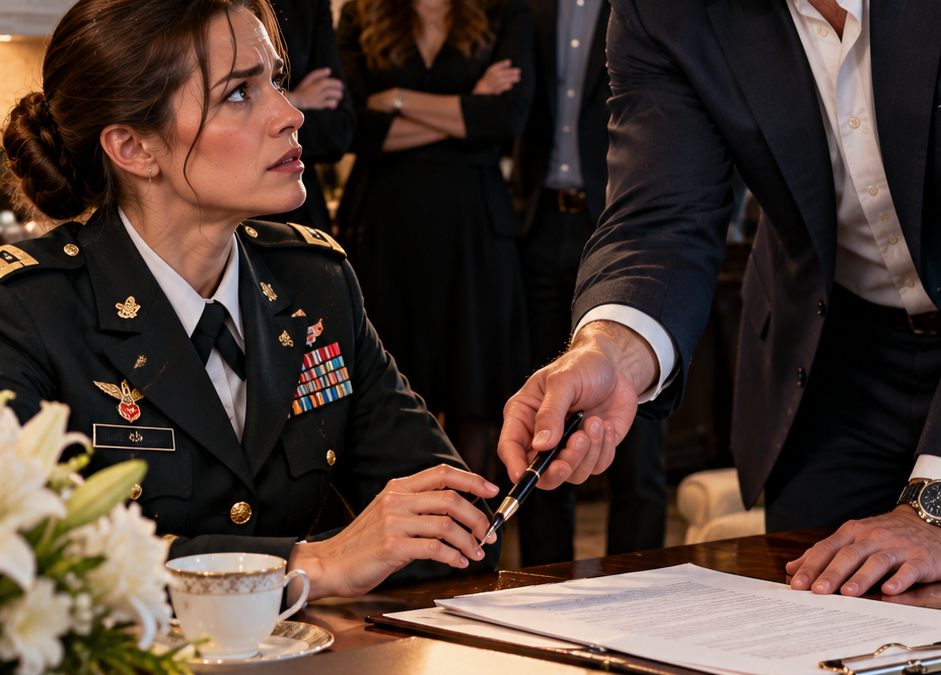
My Husband Put a Pen in My Hand and Smiled Like My Future Already Belonged to Him
Three days after we buried my father, my husband quit his job and told me I should leave the Army too.
Before the estate lawyer had even explained the will, Daniel was already promising my father’s money to people who had never earned a dollar of it.
What frightened me most was not his greed—it was realizing my father had apparently seen it long before I had.
My name is Linda Mercer.
I was thirty-four years old when my father died, and by then I had spent twelve years in the United States Army.
Twelve years teaches you things most people never need to learn.
How to sleep through noise but wake instantly when the wrong sound enters a room.
How to read a face before a person speaks.
How to keep your breathing steady while somebody else is losing control.
How to make decisions when fear is present but useless.
I had deployed overseas. I had buried friends. I had sat beside soldiers who were waiting for news that would change their lives and learned that sometimes the only useful thing you can give another human being is your presence.
But none of that prepared me for the phone call telling me my father was dead.
I was at Fort Bragg in the middle of a training briefing when my phone lit up with my aunt’s name.
I almost let it ring.
Almost.
We were reviewing a logistics problem involving three units, an equipment delay, and a timeline that already had too many red marks on it. Personal calls could wait.
Then she called again.
I stepped into the hallway.
The fluorescent lights overhead buzzed with that flat electrical hum every military building seemed to have.
“Linda?”
Her voice was shaking.
I straightened instinctively.
“What happened?”
“There was an accident.”
I remember those words.
Everything after them came in pieces.
My father.
A truck.
An intersection.
Emergency room.
They tried.
He was gone.
I leaned one shoulder against the wall because suddenly the floor did not feel trustworthy.
My father, Richard Mercer, had been the strongest constant in my life.
He had served during the Vietnam era, though he rarely talked about it. He believed men who spoke the loudest about courage were usually the ones who understood it least.
He taught me to change a tire before I learned to drive.
He taught me how to balance a checkbook.
He taught me never to sign anything I had not read.
Most of all, he taught me that your word mattered more than the image you built around yourself.
When I told him years earlier that I wanted to join the Army, my mother cried.
My father did not.
He sat across from me at the kitchen table, studied my face, and said, “Then do it right, Linda.”
That was his way.
No speeches.
No dramatic embrace.
Just a standard.
Do it right.
I received emergency leave within twenty-four hours.
I flew home in uniform because I did not have time to change.
During the flight, I sat by the window with my forehead against the cold glass and replayed every conversation I had had with him during the previous month.
He had sounded healthy.
Annoyed about weeds in the garden.
Proud that a neighbor’s boy had enlisted in the Marines.
I had teased him for refusing to replace a twenty-year-old refrigerator.
Nothing had sounded final.
That was the cruelty of it.
Sometimes the last conversation does not announce itself.
Sometimes someone says, “Call me Sunday,” and there is never another Sunday.
The funeral was held on a gray Tuesday.
The church was full.
My father had run a contracting business in our North Carolina town for decades, but business did not explain the crowd.
People came because he remembered names.
Because he had fixed a widow’s porch and never sent the second invoice.
Because he still showed up at youth baseball games long after I had grown up.
Because if somebody called him at two in the morning with a broken pipe, a dead battery, or a child stuck on the side of the road, Richard Mercer got dressed.
I delivered the eulogy in my dress blues.
I did not cry.
I told everyone about the man who taught me that keeping your word when nobody was watching was the foundation of character.
I told them he hated waste, loved black coffee, and believed duct tape had more legitimate uses than modern engineering had yet discovered.
People laughed softly.
Then I looked down at the polished wood of his casket and nearly lost the next sentence.
Daniel squeezed my hand.
My husband of six years.
He stood beside me through the entire service.
He looked devastated.
If someone had told me at that moment that within weeks I would barely recognize him, I would have called them cruel.
At the reception afterward, I began noticing things.
Small things.
Daniel kept drifting toward my father’s old business partner.
Then my uncle.
Then one of the men who handled payroll for Dad’s company years earlier.
He asked questions carefully.
Not enough to sound inappropriate.
Just enough.
Had Dad ever sold his business interests?
Was the property paid off?
Had he kept investments?
Had he ever talked about estate planning?
The word estate appeared again and again.
I noticed it.
Then I excused it.
Daniel was practical.
That was what I told myself.
Maybe he thought paperwork would become my responsibility.
Maybe he was trying to help.
Grief makes you protective of familiar things.
I think that was why I defended him in my own head.
I had already lost my father.
I did not want to discover something ugly about my husband at the same time.
Three days after the funeral, I was standing in my father’s kitchen.
A cardboard box sat open on the table.
I had found old photographs in his study, and I was sorting through them slowly because every picture felt like opening a door into a house I could no longer enter.
Dad at twenty-five.
Dad holding me when I was six months old.
My mother laughing beside him before illness took her from us years later.
I was holding a photograph of my father as a young man when Daniel walked in.
He put his coffee mug beside the box.
“I quit my job.”
I thought I had misheard him.
“What?”
“I handed in my notice.”
I lowered the photograph.
“Why?”
He leaned against the counter.
“Linda, we need to start thinking differently now.”
“Differently how?”
He smiled as though he was about to give me good news.
“Your inheritance.”
I stared at him.
“My father has been dead three days.”
“I know.”
“Then why are we talking about inheritance?”
“Because life keeps moving.”
That sentence landed strangely.
He continued.
“You don’t need the Army anymore either.”
I actually laughed once because I thought he had to be joking.
He was not.
“You should put in your papers,” he said. “Once everything settles, we’ll never need to work again.”
I looked at the man I had slept beside for six years.
“What exactly do you think my father left me?”
Daniel shrugged.
“Enough.”
“Enough for what?”
“For us to enjoy life.”
“My father’s body is barely cold.”
His expression tightened.
“That’s not fair.”
“What isn’t fair?”
“Making me sound greedy because I’m trying to think about our future.”
Our future.
He said it smoothly.
But something in his eyes did not match the words.
“What would you do?” I asked.
“If you quit working.”
He shrugged again.
“We could travel.”
“And?”
“Buy somewhere nicer.”
“And?”
“Help family.”
There it was.
“What family?”
He frowned.
“Our family.”
I returned the photograph to the box.
“The estate lawyer hasn’t even called.”
“He will.”
“Or she.”
“Whatever.”
I looked at him.
He smiled again.
“Linda, your father worked hard. Don’t you think he’d want you to enjoy what he built?”
My father had spent his life telling me work was not punishment.
He would have hated that sentence.
That evening Daniel behaved as though nothing unusual had happened.
He ordered dinner.
Watched television.
Asked whether I wanted to open a bottle of wine.
I could not sleep.
Around midnight, I got up for water.
On my way back from the kitchen, I heard Daniel’s voice coming from the guest room.
He was on the phone.
His tone was low and cheerful.
“I told you, Mom, stop worrying.”
I stopped in the hallway.
“I’m going to take care of you and Dad.”
Silence.
Then he laughed.
“No, seriously. We can buy you a place somewhere nice. There’s that retirement community outside Raleigh. Or Florida if you want.”
My fingers tightened around the water glass.
He continued.
“And Aunt Carol’s been struggling. I’m thinking maybe half a million to help everyone settle.”
Half a million dollars.
My father had been dead less than a week.
Daniel did not know what the estate contained.
Neither did I.
Yet he was giving away five hundred thousand dollars of it.
Then he said something I never forgot.
“Linda won’t fight it. She’s got millions coming. She won’t even notice.”
I stood barefoot in the dark hallway and felt something inside me become very still.
Not broken.
Still.
There is a difference.
I could have entered the room.
I could have demanded an explanation.
Instead, I returned quietly to bed.
When Daniel came in twenty minutes later, I pretended to be asleep.
He kissed my shoulder.
Then he slept peacefully beside me.
I stared into the darkness.
My father had always warned me against making important decisions while angry.
“Anger wants movement,” he used to say. “Sometimes the smartest thing you can do is stand still until you know where you’re going.”
So I stood still.
And Daniel kept talking.
Within days, his entire family seemed to know about an inheritance nobody had confirmed.
His mother called me about a gated retirement community.
She spoke for nearly ten minutes about the clubhouse, the walking trails, and a unit with a sunroom.
Then she asked, “Do you think quartz or granite would be better?”
“For what?”
“The kitchen.”
I closed my eyes.
“Whose kitchen?”
There was a pause.
“Well… ours. When everything settles.”
“Who told you I was buying you a house?”
Another pause.
“Daniel said you two wanted to help us.”
I looked across my father’s kitchen.
A coffee cup still sat on the drying rack where he had left it.
“I haven’t agreed to buy anyone anything.”
Her voice cooled.
“Oh.”
“That’s probably something Daniel should have mentioned.”
“Well, Linda, we’re family.”
I did not answer.
Then came the cousin who texted me a truck dealership link.
An uncle who mentioned he had always dreamed of taking his wife to Italy.
A nephew who suddenly wanted to discuss college.
Every interaction had the same shape.
Concern first.
Money second.
“How are you holding up?”
Then:
“By the way…”
Daniel’s aunt Carol was the first person to say what everyone else was thinking openly.
We were at a family dinner I did not want to attend.
She caught me alone in the hallway.
“Linda.”
I turned.
Carol put her hand gently on my forearm.
“Family has to take care of family.”
I waited.
“That’s what your father would have wanted.”
Something inside me hardened.
“What family?”
She blinked.
“I’m sorry?”
“What family would my father have wanted me to take care of?”
“Well… all of us.”
“My father barely knew you.”
Her hand dropped.
Across the room, Daniel heard enough to turn toward us.
His face tightened immediately.
On the drive home, he exploded.
“What the hell was that?”
I looked out the passenger window.
“What?”
“You embarrassed Carol.”
“She asked me for my father’s money.”
“She did not.”
“She told me Dad would want me to support your family.”
“She was making conversation.”
“Interesting conversation.”
“You’ve become cold.”
I turned toward him.
“My father died.”
“I know.”
“Do you?”
His hands tightened on the steering wheel.
“I have been doing everything I can to support you.”
“By promising money to people?”
“I’m thinking ahead.”
“With assets you haven’t seen.”
“We both know your father was worth millions.”
“No. You decided he was.”
Daniel let out a hard breath.
Then he changed tactics.
“You need to get out of the Army.”
I stared at him.
“There it is.”
“There what is?”
“The thing you actually care about.”
“I care about you.”
“Then stop asking me to abandon a career I spent twelve years building.”
“It’s not abandoning anything.”
“It is to me.”
“You won’t need the salary.”
“The Army isn’t just a salary.”
Daniel laughed once.
Not kindly.
“You say that because you’ve been institutionalized by it.”
The sentence hit harder than I expected.
“You think my service is a habit I’m too stupid to break?”
“I think you don’t know when to move on.”
I looked at him for several seconds.
“No.”
“No what?”
“No, I’m not leaving.”
He stared ahead.
Then smiled.
A small, confident smile.
“You’ll change your mind.”
That smile frightened me more than anger.
Because he was not asking.
He had already decided my refusal was temporary.
That night, after he fell asleep, I went into my father’s study.
Dad had kept paperwork like he was preparing for an audit by God.
Every receipt labeled.
Every deed filed.
Every insurance policy copied.
I began sorting through the file boxes.
That was when I found correspondence from a law office I did not recognize.
Collins & Barrett.
The letters went back almost a year.
One referenced a family trust.
Beside the correspondence was a sealed folder.
My name was written across the front in my father’s handwriting.
LINDA.
Nothing else.
The next morning, I called the number on the letterhead.
A receptionist transferred me to Margaret Collins.
Her voice was measured and precise.
“Linda. I’m very sorry about Richard.”
“You knew my father?”
“For many years.”
I frowned.
“He never mentioned you.”
“That doesn’t surprise me.”
“Why?”
“Your father was private about certain matters.”
I looked at the folder.
“What’s in his estate?”
She paused.
“I would rather not discuss details over the phone.”
“Can you give me a general idea?”
“No.”
“Why?”
Another pause.
Then she said, “I think you should come to my office alone.”
The way she said alone changed the room around me.
“Why can’t Daniel come?”
Silence.
Long enough that I checked whether the call had disconnected.
Then Margaret spoke.
“Your father wanted to make certain you understood several things before anyone else became involved.”
Anyone else.
I stared through the study window.
Daniel was outside on the porch, laughing into his phone.
“Tomorrow?” I asked.
“Two o’clock.”
I told Daniel I had errands.
Margaret’s office was on the third floor of an old brick building downtown.
Dark wood.
Books.
The faint smell of paper.
She was around sixty, silver-haired, dressed simply, with the kind of eyes that made unnecessary lying feel embarrassing.
She invited me to sit.
A thick folder waited between us.
“Your father came to me eleven months ago,” she said.
“He wanted to restructure his estate.”
“Why?”
Margaret studied me.
“He was worried about your marriage.”
My stomach tightened.
“What exactly did he say?”
“He was concerned that if something happened to him, assets he intended for you might eventually be controlled by someone else.”
“Daniel?”
“I’m telling you what your father told me.”
“That means Daniel.”
She did not answer.
She opened the file.
My father had left me far more than I expected.
Cash.
Investment accounts.
Property interests.
But much of it was held in a trust naming me as the sole beneficiary.
Margaret explained the legal structure carefully.
The assets were intended to remain separate.
They were not to be deposited into joint accounts.
They were not to be pledged casually.
They were not designed to become marital property simply because I was married when I inherited them.
“Your father was extremely deliberate,” Margaret said.
Then she turned one page toward me.
“He gave me a sentence he wanted preserved in my notes.”
I looked down.
Margaret read it aloud.
“If my daughter needs money, help her. But don’t let anyone turn her love into a wallet.”
My throat closed.
Until that moment, I had not truly cried since Dad died.
I had delivered the eulogy.
Shaken hands.
Accepted casseroles.
Signed funeral paperwork.
Folded his flag.
But hearing his words in that quiet office cracked something open.
I looked away.
“He knew.”
Margaret waited.
“He knew what Daniel was doing?”
“I don’t know how much he knew.”
“But enough.”
“Yes.”
I wiped my face.
“Why didn’t he tell me?”
“Perhaps because he knew you would defend your husband.”
That hurt because it was true.
Margaret continued.
“There are conditions attached to some assets.”
“What conditions?”
“Your father was particularly concerned you might be pressured into leaving the Army.”
I stared at her.
“How could he know that?”
“He told me your husband had made comments about your career before.”
I remembered conversations.
Daniel complaining about deployments.
Daniel asking why I still wanted promotion boards.
Daniel joking that I cared more about the Army than being normal.
I had dismissed all of it.
Margaret folded her hands.
“Richard wanted your decisions about service to remain yours.”
I sat back.
My father had been building a wall while I was still telling myself there was no enemy approaching.
When I came home, Daniel was waiting in the kitchen.
“So?”
“So what?”
“The lawyer.”
I removed my coat.
“How did you know I saw a lawyer?”
His expression flickered.
Then recovered.
“You had estate paperwork in the study.”
I stared at him.
“How much?” he asked.
“Not much.”
That was all I gave him.
His face showed disappointment.
Only briefly.
Then he smiled.
“There’s probably more coming.”
I watched him.
No question about what my father wanted.
No question about whether I was all right.
Just numbers.
That night, after Daniel fell asleep, I opened a note on my phone.
I wrote:
Three days after funeral: Daniel quit job.
Told me to leave Army.
Promised parents house.
Promised Aunt Carol approximately $500,000.
Said: “Linda won’t fight it.”
Then I started saving messages.
Emails.
Screenshots.
Dates.
Not because I had decided to divorce him.
Not yet.
Because the soldier in me had finally understood what my grieving daughter’s heart had refused to see.
Information first.
Action second.
Weeks passed.
Daniel’s family became bolder.
His parents hosted a “planning dinner.”
They actually called it that.
I went because I needed to hear them.
Daniel’s mother used her good china.
His father had printed floor plans for the retirement community.
Unit 14.
Sunroom.
Two bedrooms.
Golf course access.
Daniel’s cousin had screenshots of a pickup truck.
Aunt Carol mentioned the half million again.
Then Daniel announced, “Linda’s going to help everybody.”
He did not even look at me.
“She’s got more money than she could ever use.”
I set down my fork.
Nobody noticed at first.
Then Aunt Carol smiled.
“You’re awfully quiet, sweetheart.”
“I’m listening.”
“To what?”
“To everyone planning how to spend my father’s money.”
Silence.
Daniel laughed.
“She’s joking.”
I looked directly at him.
“No.”
His laughter died.
His mother looked down at her plate.
His father cleared his throat.
I picked up my water.
“Please continue.”
Nobody did.
That night Daniel accused me of humiliating him.
“What was I supposed to do?” I asked.
“Sit there while everyone divided my inheritance?”
“They’re my family.”
“And that makes the money theirs?”
“You know what I mean.”
“I actually don’t.”
His face darkened.
“If you loved me, you’d trust me.”
“With what?”
“With our future.”
“Our future or your budget?”
“Jesus, Linda.”
He paced.
“You’ve changed.”
“My father died.”
“This isn’t grief.”
“What is it?”
“You’ve become suspicious.”
I almost laughed.
Then Daniel said, “Maybe we should talk about divorce.”
He watched me carefully.
Not like a man ending a marriage.
Like someone testing a weapon.
I let the silence stretch.
“Is that what you want?”
His confidence wavered.
“I’m saying maybe that’s where this goes if you keep shutting me out.”
“Okay.”
He stared at me.
“What?”
“If that’s what you want, okay.”
“That isn’t what I said.”
“It’s what you threatened.”
His face hardened.
“You’re impossible.”
He walked out.
The following week, I met Renee Foster, a divorce attorney with no connection to Dad’s estate.
She was direct.
I liked her immediately.
I explained everything.
She listened.
Then said, “Do not commingle the inheritance.”
“I won’t.”
“Do not sign anything Daniel brings you without independent review.”
“I won’t.”
“Do not make threats.”
“I haven’t.”
“Good.”
She reviewed the trust documents Margaret provided.
“Your father knew what he was doing.”
“He usually did.”
Renee leaned back.
“What does your husband think is happening?”
“He thinks he’s about to become rich.”
“That may be useful.”
I looked at her.
“Meaning?”
“People who believe they’re about to get what they want tend to document their intentions.”
She was right.
Two days later, I picked up Daniel’s tablet from the kitchen counter because water had spilled near it.
The screen was awake.
An email was open.
To a real-estate agent.
My wife is about to come into a large inheritance.
We are waiting for the funds to be released.
My parents are ready to move quickly.
I read it twice.
Then saw another line.
Once I have authority over the accounts, financing will not be an issue.
Authority.
My pulse slowed.
I photographed the screen.
Then set the tablet down exactly where I found it.
I said nothing.
Margaret called again the following Thursday.
“I need you to come in.”
“Something happened?”
“No.”
Her tone changed slightly.
“It’s time for you to see the rest.”
The rest.
I arrived that afternoon.
A different folder was waiting.
Thicker.
More worn.
Margaret opened it.
My father had not simply accumulated savings through contracting.
Decades earlier, he had invested in a manufacturing company with two men he trusted.
The business had grown.
Then grown again.
Dad had quietly retained a controlling interest through a series of holding entities.
Margaret pushed a valuation across the desk.
I stared at it.
For several seconds, the number did not mean anything.
Then it did.
“Are you sure?”
“Yes.”
“Daniel knows nothing about this?”
“No.”
“Did Dad?”
“Of course.”
I laughed weakly.
“He drove a fifteen-year-old pickup.”
Margaret smiled.
“He disliked wasting money.”
“That truck had duct tape holding one mirror together.”
“I know.”
I covered my mouth.
For one precious second, grief and humor occupied the same place.
Then Margaret handed me an envelope.
Dad’s handwriting.
I opened it.
Linda,
If you’re reading this, I’m probably not around to explain myself, which is unfortunate because you know I’ve never trusted lawyers to make me sound sensible.
I laughed through tears.
That was him.
The letter continued.
He wrote that he had watched me build my life through discipline.
That he had been proud when I enlisted.
Proud when I stayed.
Proud when I earned responsibility rather than demanded recognition.
Then the letter changed.
He wrote that love should never require surrendering the parts of yourself that took years to build.
He said he had seen me making excuses for people when I should have been paying attention to what those excuses cost me.
He never named Daniel.
He did not need to.
The final sentence read:
I’m not leaving you money so you can buy happiness, Linda. I’m leaving you enough freedom that you never have to sell it.
I read the sentence again.
And again.
Margaret waited.
Finally, she asked, “What do you think your husband would do if he knew the actual value?”
I thought about the retirement home.
The truck.
Italy.
Five hundred thousand dollars.
The email.
“He’d push harder.”
He did.
Within days, Daniel came home carrying a legal folder.
He placed it on the kitchen table.
“What’s this?”
“Just planning.”
I opened it.
Power of attorney.
I read the first page.
“This gives you financial authority.”
“In case something happens.”
“To me?”
“To either of us.”
“Then where is the document giving me authority over you?”
He paused.
“We can do that later.”
I almost smiled.
“Interesting.”
“Linda, don’t turn this into another fight.”
“I’m reading.”
“You don’t trust me.”
“I didn’t say that.”
“You’re acting like it.”
I closed the folder.
“I need a few days.”
His shoulders relaxed.
“Okay.”
Then he kissed my forehead.
That kiss told me everything.
He believed resistance had ended.
Two nights later, at his parents’ house, I heard him say, “It’s basically done.”
His mother looked delighted.
“What is?”
“The paperwork. I’ll be managing the assets.”
I sat six feet away.
No one asked whether I had agreed.
His father lifted his drink.
“To new beginnings.”
I looked down at my hands.
Dad’s words returned.
Enough freedom that you never have to sell it.
The following Saturday, Daniel announced there would be a family meeting.
He did not ask me.
He informed me.
“We need to finalize everything.”
“Everything?”
“The power of attorney. Family plans. What we’re doing with the estate.”
I nodded.
“What time?”
“Three.”
He looked surprised by my cooperation.
“Three is fine.”
I called Renee.
Then Margaret.
Saturday arrived.
Daniel wore the blue shirt he saved for important occasions.
He arranged drinks.
Straightened chairs.
Checked the time repeatedly.
His parents arrived first.
Then Aunt Carol.
Then two cousins.
His mother carried a folder filled with paint samples.
Paint samples.
She had already selected colors for a house I had never offered to buy.
Everyone sat around the dining table.
Daniel stood at the head.
For a moment, watching him, I remembered our wedding reception.
The same confidence.
The same ability to hold a room.
Back then, I had believed confidence meant strength.
Now I understood confidence can also come from never imagining anyone will tell you no.
Daniel smiled.
“Everything is finally about to be settled.”
His mother smiled back.
“Linda’s stepping away from the Army.”
I looked at him.
He continued.
“We’ll have the freedom to help everybody the way we planned.”
Aunt Carol nodded.
His cousin grinned.
Daniel opened the legal folder.
He removed the power-of-attorney document.
Placed it in front of me.
Then placed a pen on top.
“Ready?”
Everyone watched.
I looked down at the pen.
Then at him.
“Daniel.”
“Yes?”
“You really thought I was going to sign this?”
His smile remained for another second.
Then disappeared.
“We talked about it.”
“No. You talked about it.”
His jaw tightened.
“Linda.”
“I listened.”
“This isn’t the place.”
“You invited everyone.”
“So we could celebrate.”
“What?”
He looked at the table.
“Our future.”
I picked up the document.
Folded it once.
Set it back down.
“I’m not signing it.”
His mother’s expression changed.
Aunt Carol shifted in her chair.
Daniel stared at me.
“You’re being ridiculous.”
“No.”
“After everything I’ve done for you?”
“What have you done?”
His face reddened.
“I supported your career for years.”
“You complained about deployments.”
“I stayed married to you.”
I almost could not believe he had said it.
“You think remaining married to me was a service you performed?”
“That’s not what I meant.”
“Then explain it.”
He pushed both hands against the table.
“You are sitting on more money than any of us will ever need, and you are acting like sharing it is some kind of personal attack.”
“Sharing?”
“Yes.”
“With people Dad barely knew?”
“They’re my family.”
“And Dad was mine.”
His father spoke.
“Linda, maybe everyone should calm down.”
I looked at him.
“I am calm.”
That was true.
Daniel was not.
“If you’re going to behave this way,” he snapped, “maybe we should just get divorced.”
There it was again.
Except this time, he had an audience.
He expected me to panic.
I nodded.
“Okay.”
His mouth opened.
“What?”
“Okay.”
He stared at me.
I heard the doorbell.
Right on time.
“I think that’s my attorney.”
Every face at the table changed.
Renee entered carrying a briefcase.
Daniel stepped toward me.
“You called a lawyer?”
“Yes.”
“For what?”
“The divorce you keep threatening.”
“I wasn’t—”
“You were.”
Renee set her briefcase on the table.
“Mr. Mercer—”
“His last name isn’t Mercer,” I said quietly.
Daniel looked at me sharply.
It was a tiny correction.
But it mattered.
My father’s name was not his property either.
Renee continued.
“Daniel, my client asked that I be present while several matters are clarified.”
His mother stood.
“This is a family meeting.”
Renee looked at her.
“I’m aware.”
Then she began laying out copies.
Text messages.
Emails.
Real-estate inquiries.
Promises.
Screenshots.
Daniel stared at the email to the agent.
“You went through my tablet?”
“It was open.”
“That’s private.”
“Like my inheritance?”
His face tightened.
Renee tapped another document.
“This communication indicates you represented to third parties that you expected control of your wife’s inheritance.”
“I meant we.”
“No,” I said. “You wrote you.”
He looked at me.
Renee placed another page down.
“Here are messages discussing a five-hundred-thousand-dollar transfer to relatives.”
Aunt Carol shifted.
“That was hypothetical.”
Renee nodded.
“Then there should be no difficulty understanding that no such transfer will occur.”
Carol looked at Daniel.
His mother sat very still.
Then the doorbell rang again.
Margaret Collins entered.
I watched Daniel.
He recognized the name immediately.
“The estate lawyer,” he said.
Margaret nodded.
“Yes.”
He straightened.
For one second, hope returned to his face.
Maybe he thought she had come with numbers.
In a sense, she had.
Margaret sat beside Renee.
“Linda authorized me to explain the relevant estate structure in broad terms.”
Daniel’s family leaned closer.
“The estate is substantially larger than any estimate that appears to have been discussed within this family.”
Nobody moved.
Daniel swallowed.
“How large?”
Margaret looked at me.
I nodded.
She gave the figure.
Silence.
Daniel’s mother’s mouth opened.
Aunt Carol whispered, “Oh my God.”
Daniel looked at me as though I had personally hidden treasure from him.
“You knew?”
“Yes.”
“For how long?”
“Long enough.”
His anger disappeared.
Greed replaced it so quickly it was almost frightening.
“Linda, why didn’t you tell me?”
I stared at him.
“That is your first question?”
“We’re married.”
“You quit your job before I knew the number.”
“That doesn’t mean—”
“You promised half a million dollars before I knew the number.”
“Linda—”
“You asked me to leave the Army before I knew the number.”
His eyes moved toward the documents.
I continued.
“You gave people money in your head that my father spent his entire life earning.”
His mother interrupted.
“We didn’t know there was tension between you two.”
I turned toward her.
“You were choosing kitchen countertops.”
She went silent.
Margaret opened the trust documents.
“There is another fact everyone here should understand.”
Daniel looked toward her.
“The inheritance has been structured as Linda’s separate property.”
His expression changed.
“What?”
“The trust names Linda as sole beneficiary. The assets have not been commingled. The controlling interest in the business is similarly held within protected structures.”
Daniel stared.
“We’re married.”
“That fact does not automatically give you ownership of these assets.”
“What about divorce?”
Renee answered.
“You should discuss the specifics with your own counsel.”
“But I’m entitled to something.”
Renee’s expression did not change.
“You may have rights concerning marital property accumulated during the marriage. You do not acquire a claim to protected inherited assets merely because you expected to spend them.”
His mother whispered, “Daniel…”
He ignored her.
“What about the power of attorney?”
I slid the unsigned document toward him.
“This one?”
He stared at it.
“You said you needed time.”
“I did.”
“And?”
“And the answer is no.”
He looked around the table.
All the confidence was gone.
His entire plan had depended on one assumption.
That because I loved him, I would eventually surrender.
Dad had understood what Daniel never did.
Love and surrender are not the same thing.
Daniel pointed toward Renee.
“You planned this.”
I nodded.
“Yes.”
“For how long?”
“Since I started hearing you promise my inheritance to people while I was grieving.”
“I was trying to help my family.”
“You never once asked what I wanted.”
“I’m your husband.”
“And I’m your wife. Not your account.”
His voice broke.
“You think you’re better than all of us because you wear that uniform.”
I stood.
“No.”
The room became silent.
“I think I finally understand why you wanted me to take it off.”
His eyes narrowed.
“You wanted me home because the Army reminded me I had a life that existed outside you.”
“That’s insane.”
“You wanted me dependent.”
“No.”
“You wanted authority over my finances.”
“To help us.”
“You quit your job before there was any money.”
He had no answer.
I looked at him.
“You didn’t make a mistake after Dad died, Daniel. You revealed a plan.”
His face hardened.
“So that’s it?”
I thought about six years.
Our first apartment.
Sunday mornings.
His hand in mine at my mother’s memorial years earlier.
The way he had once waited four hours at an airport because my flight home from training was delayed.
Not every memory had been false.
That was what made leaving painful.
People want betrayal to erase love retroactively.
It does not.
You can remember good days and still recognize the person beside you has become someone you cannot trust.
“Yes,” I said.
“I think this is it.”
He stared at me.
Then at Margaret.
Then at the papers.
His mother started crying.
Not because my marriage had ended.
I realized that almost immediately.
She was staring at the estate valuation.
Grieving a house she had never owned.
That hurt in a strangely clarifying way.
The divorce was filed three weeks later.
There was no dramatic final explosion.
No broken furniture.
No public scene.
Just documents.
Meetings.
Financial disclosures.
Attorneys.
Daniel hired counsel and discovered the same thing Renee had told me.
Dad’s trust protections were real.
The manufacturing interest remained mine.
The inheritance remained separate because I followed Margaret’s advice and never commingled it.
Daniel’s own financial situation was far less comfortable than he had expected because, of course, he had quit his job voluntarily.
He returned to work within two months.
His relatives stopped calling me.
Some stopped calling him too.
The retirement-community unit his mother had selected was sold to someone else.
Aunt Carol never received five hundred thousand dollars.
The cousin never got his truck.
Italy remained Italy.
At first, I expected satisfaction.
Instead, I mostly felt grief.
Not for the money.
For the marriage I had thought I had.
There are losses that come with funerals.
And there are losses that happen while everyone involved is still alive.
The second kind can be harder to explain.
I stayed in the Army.
That mattered more than Daniel ever understood.
Putting on my uniform after everything was not about proving something to him.
It was about returning to a version of myself that existed before he began telling me my ambitions were inconvenient.
My father had understood that.
He had not protected my career because he worshiped the military.
He protected my ability to choose.
That was the inheritance.
Not the company.
Not the investment accounts.
Not the land.
Choice.
Months after the estate was fully secured, I created a memorial fund in Dad’s name.
The Richard Mercer Family Assistance Fund focused on military households facing temporary financial crises.
Deployment emergencies.
Education assistance.
Veterans rebuilding after transition.
Spouses suddenly carrying everything alone.
Children who needed help because a parent had not come home.
When I signed the first grant authorization, I sat for a long time looking at my father’s name on the letterhead.
He would have complained about the money spent on designing the logo.
Then he would have quietly donated more.
That was Dad.
Margaret called me several months later.
“I found something else.”
I laughed.
“Please don’t tell me Dad owned an airline.”
“No.”
“A mine?”
“No.”
“A baseball team?”
She actually laughed.
“Just another letter.”
I went to her office.
The envelope was thinner than the others.
Dad had instructed her to give it to me only after the estate was fully protected.
I took it home.
I waited until evening.
Then I sat on the back porch of the house where I had grown up.
The same porch where Daniel once stood on the phone promising his parents a retirement home with money he did not own.
I opened the letter.
Dad wrote:
Linda,
If Margaret is giving you this one, then the paperwork is done, and knowing Margaret, she has probably explained everything three times.
I smiled.
He continued.
I know you.
You are going to wonder whether protecting yourself made you selfish.
It didn’t.
Generosity only means something when it is chosen.
If somebody takes away the choice, it isn’t generosity anymore.
It’s surrender.
I stopped reading.
The porch blurred.
I wiped my eyes and continued.
He wrote that money had never impressed him.
That people often became strange around it.
That some would mistake kindness for access.
That others would call boundaries cruelty because boundaries prevented them from taking what they wanted.
Then came the line that stayed with me.
Do not measure love by how much of yourself someone asks you to give away.
I folded the letter against my chest.
For months, I had thought Dad’s final gift was foresight.
I was wrong.
His final gift was permission.
Permission to say no.
Permission to protect what I built.
Permission to remain a soldier because I chose to remain one.
Permission to leave a marriage that had turned my grief into someone else’s opportunity.
A few weeks later, I visited his grave.
I wore my uniform.
Not because ceremony required it.
Because he had been proud of it.
The cemetery was almost empty.
Wind moved through the oak trees.
I stood in front of his stone for a long time.
“I’m still in,” I said.
My voice sounded strange in the quiet.
“I know you’d ask whether I’m doing it right.”
I smiled.
“I’m trying.”
Then I told him about the fund.
About the first family we helped.
About a young Army spouse whose car transmission failed while her husband was deployed and who had been trying to figure out whether to pay rent or fix the car.
The fund covered the repair.
She got to work.
Her children got to school.
No miracle.
Just help at the moment help mattered.
Dad would have understood that.
My phone buzzed as I walked back toward the car.
A message from Margaret.
The estate is fully secured.
I stopped.
Read it once.
Then again.
There had been a time when those words would have made me think about numbers.
The company.
Accounts.
Property.
Now I thought about my father sitting at his kitchen table almost a year before his death, quietly signing documents because he saw danger approaching his daughter and knew she was not ready to see it herself.
I thought about Daniel handing me a pen.
About that smile.
About an entire table of people waiting for me to surrender something simply because they had already decided I would.
And I thought about how close I had come to confusing love with obligation.
I put the phone back in my pocket.
Then I looked once more toward Dad’s grave.
For years, I had believed strength meant enduring difficult things.
The Army had taught me endurance.
Loss taught me something else.
Sometimes strength is leaving.
Sometimes it is refusing to sign.
Sometimes it is disappointing people who benefited from your silence.
Sometimes it is standing in a room full of people who have already spent your future and saying one word.
No.
My father did leave me money.
A great deal of it.
But money was never the part of his estate that changed my life.
He left me proof that somebody had seen me clearly enough to protect the choices I had not yet realized I was in danger of losing.
He left me the ability to walk away before love became ownership.
He left me a reminder that generosity without consent is not generosity.
And he left me something Daniel could never take, no matter how many papers he put in front of me.
The certainty that my life still belonged to me.
What do you think of this story? Please leave a like and share your thoughts in the comments. Your support means a lot to us and inspires us to keep writing more meaningful and powerful stories. Thank you! 👍
𝗧𝗛𝗘 𝗘𝗡𝗗
My Husband Put a Pen in My Hand and Smiled Like My Future Already Belonged to Him
Three days after we buried my father, my husband quit his job and told me I should leave the Army too.
Before the estate lawyer had even explained the will, Daniel was already promising my father’s money to people who had never earned a dollar of it.
What frightened me most was not his greed—it was realizing my father had apparently seen it long before I had.
My name is Linda Mercer.
I was thirty-four years old when my father died, and by then I had spent twelve years in the United States Army.
Twelve years teaches you things most people never need to learn.
How to sleep through noise but wake instantly when the wrong sound enters a room.
How to read a face before a person speaks.
How to keep your breathing steady while somebody else is losing control.
How to make decisions when fear is present but useless.
I had deployed overseas. I had buried friends. I had sat beside soldiers who were waiting for news that would change their lives and learned that sometimes the only useful thing you can give another human being is your presence.
But none of that prepared me for the phone call telling me my father was dead.
I was at Fort Bragg in the middle of a training briefing when my phone lit up with my aunt’s name.
I almost let it ring.
Almost.
We were reviewing a logistics problem involving three units, an equipment delay, and a timeline that already had too many red marks on it. Personal calls could wait.
Then she called again.
I stepped into the hallway.
The fluorescent lights overhead buzzed with that flat electrical hum every military building seemed to have.
“Linda?”
Her voice was shaking.
I straightened instinctively.
“What happened?”
“There was an accident.”
I remember those words.
Everything after them came in pieces.
My father.
A truck.
An intersection.
Emergency room.
They tried.
He was gone.
I leaned one shoulder against the wall because suddenly the floor did not feel trustworthy.
My father, Richard Mercer, had been the strongest constant in my life.
He had served during the Vietnam era, though he rarely talked about it. He believed men who spoke the loudest about courage were usually the ones who understood it least.
He taught me to change a tire before I learned to drive.
He taught me how to balance a checkbook.
He taught me never to sign anything I had not read.
Most of all, he taught me that your word mattered more than the image you built around yourself.
When I told him years earlier that I wanted to join the Army, my mother cried.
My father did not.
He sat across from me at the kitchen table, studied my face, and said, “Then do it right, Linda.”
That was his way.
No speeches.
No dramatic embrace.
Just a standard.
Do it right.
I received emergency leave within twenty-four hours.
I flew home in uniform because I did not have time to change.
During the flight, I sat by the window with my forehead against the cold glass and replayed every conversation I had had with him during the previous month.
He had sounded healthy.
Annoyed about weeds in the garden.
Proud that a neighbor’s boy had enlisted in the Marines.
I had teased him for refusing to replace a twenty-year-old refrigerator.
Nothing had sounded final.
That was the cruelty of it.
Sometimes the last conversation does not announce itself.
Sometimes someone says, “Call me Sunday,” and there is never another Sunday.
The funeral was held on a gray Tuesday.
The church was full.
My father had run a contracting business in our North Carolina town for decades, but business did not explain the crowd.
People came because he remembered names.
Because he had fixed a widow’s porch and never sent the second invoice.
Because he still showed up at youth baseball games long after I had grown up.
Because if somebody called him at two in the morning with a broken pipe, a dead battery, or a child stuck on the side of the road, Richard Mercer got dressed.
I delivered the eulogy in my dress blues.
I did not cry.
I told everyone about the man who taught me that keeping your word when nobody was watching was the foundation of character.
I told them he hated waste, loved black coffee, and believed duct tape had more legitimate uses than modern engineering had yet discovered.
People laughed softly.
Then I looked down at the polished wood of his casket and nearly lost the next sentence.
Daniel squeezed my hand.
My husband of six years.
He stood beside me through the entire service.
He looked devastated.
If someone had told me at that moment that within weeks I would barely recognize him, I would have called them cruel.
At the reception afterward, I began noticing things.
Small things.
Daniel kept drifting toward my father’s old business partner.
Then my uncle.
Then one of the men who handled payroll for Dad’s company years earlier.
He asked questions carefully.
Not enough to sound inappropriate.
Just enough.
Had Dad ever sold his business interests?
Was the property paid off?
Had he kept investments?
Had he ever talked about estate planning?
The word estate appeared again and again.
I noticed it.
Then I excused it.
Daniel was practical.
That was what I told myself.
Maybe he thought paperwork would become my responsibility.
Maybe he was trying to help.
Grief makes you protective of familiar things.
I think that was why I defended him in my own head.
I had already lost my father.
I did not want to discover something ugly about my husband at the same time.
Three days after the funeral, I was standing in my father’s kitchen.
A cardboard box sat open on the table.
I had found old photographs in his study, and I was sorting through them slowly because every picture felt like opening a door into a house I could no longer enter.
Dad at twenty-five.
Dad holding me when I was six months old.
My mother laughing beside him before illness took her from us years later.
I was holding a photograph of my father as a young man when Daniel walked in.
He put his coffee mug beside the box.
“I quit my job.”
I thought I had misheard him.
“What?”
“I handed in my notice.”
I lowered the photograph.
“Why?”
He leaned against the counter.
“Linda, we need to start thinking differently now.”
“Differently how?”
He smiled as though he was about to give me good news.
“Your inheritance.”
I stared at him.
“My father has been dead three days.”
“I know.”
“Then why are we talking about inheritance?”
“Because life keeps moving.”
That sentence landed strangely.
He continued.
“You don’t need the Army anymore either.”
I actually laughed once because I thought he had to be joking.
He was not.
“You should put in your papers,” he said. “Once everything settles, we’ll never need to work again.”
I looked at the man I had slept beside for six years.
“What exactly do you think my father left me?”
Daniel shrugged.
“Enough.”
“Enough for what?”
“For us to enjoy life.”
“My father’s body is barely cold.”
His expression tightened.
“That’s not fair.”
“What isn’t fair?”
“Making me sound greedy because I’m trying to think about our future.”
Our future.
He said it smoothly.
But something in his eyes did not match the words.
“What would you do?” I asked.
“If you quit working.”
He shrugged again.
“We could travel.”
“And?”
“Buy somewhere nicer.”
“And?”
“Help family.”
There it was.
“What family?”
He frowned.
“Our family.”
I returned the photograph to the box.
“The estate lawyer hasn’t even called.”
“He will.”
“Or she.”
“Whatever.”
I looked at him.
He smiled again.
“Linda, your father worked hard. Don’t you think he’d want you to enjoy what he built?”
My father had spent his life telling me work was not punishment.
He would have hated that sentence.
That evening Daniel behaved as though nothing unusual had happened.
He ordered dinner.
Watched television.
Asked whether I wanted to open a bottle of wine.
I could not sleep.
Around midnight, I got up for water.
On my way back from the kitchen, I heard Daniel’s voice coming from the guest room.
He was on the phone.
His tone was low and cheerful.
“I told you, Mom, stop worrying.”
I stopped in the hallway.
“I’m going to take care of you and Dad.”
Silence.
Then he laughed.
“No, seriously. We can buy you a place somewhere nice. There’s that retirement community outside Raleigh. Or Florida if you want.”
My fingers tightened around the water glass.
He continued.
“And Aunt Carol’s been struggling. I’m thinking maybe half a million to help everyone settle.”
Half a million dollars.
My father had been dead less than a week.
Daniel did not know what the estate contained.
Neither did I.
Yet he was giving away five hundred thousand dollars of it.
Then he said something I never forgot.
“Linda won’t fight it. She’s got millions coming. She won’t even notice.”
I stood barefoot in the dark hallway and felt something inside me become very still.
Not broken.
Still.
There is a difference.
I could have entered the room.
I could have demanded an explanation.
Instead, I returned quietly to bed.
When Daniel came in twenty minutes later, I pretended to be asleep.
He kissed my shoulder.
Then he slept peacefully beside me.
I stared into the darkness.
My father had always warned me against making important decisions while angry.
“Anger wants movement,” he used to say. “Sometimes the smartest thing you can do is stand still until you know where you’re going.”
So I stood still.
And Daniel kept talking.
Within days, his entire family seemed to know about an inheritance nobody had confirmed.
His mother called me about a gated retirement community.
She spoke for nearly ten minutes about the clubhouse, the walking trails, and a unit with a sunroom.
Then she asked, “Do you think quartz or granite would be better?”
“For what?”
“The kitchen.”
I closed my eyes.
“Whose kitchen?”
There was a pause.
“Well… ours. When everything settles.”
“Who told you I was buying you a house?”
Another pause.
“Daniel said you two wanted to help us.”
I looked across my father’s kitchen.
A coffee cup still sat on the drying rack where he had left it.
“I haven’t agreed to buy anyone anything.”
Her voice cooled.
“Oh.”
“That’s probably something Daniel should have mentioned.”
“Well, Linda, we’re family.”
I did not answer.
Then came the cousin who texted me a truck dealership link.
An uncle who mentioned he had always dreamed of taking his wife to Italy.
A nephew who suddenly wanted to discuss college.
Every interaction had the same shape.
Concern first.
Money second.
“How are you holding up?”
Then:
“By the way…”
Daniel’s aunt Carol was the first person to say what everyone else was thinking openly.
We were at a family dinner I did not want to attend.
She caught me alone in the hallway.
“Linda.”
I turned.
Carol put her hand gently on my forearm.
“Family has to take care of family.”
I waited.
“That’s what your father would have wanted.”
Something inside me hardened.
“What family?”
She blinked.
“I’m sorry?”
“What family would my father have wanted me to take care of?”
“Well… all of us.”
“My father barely knew you.”
Her hand dropped.
Across the room, Daniel heard enough to turn toward us.
His face tightened immediately.
On the drive home, he exploded.
“What the hell was that?”
I looked out the passenger window.
“What?”
“You embarrassed Carol.”
“She asked me for my father’s money.”
“She did not.”
“She told me Dad would want me to support your family.”
“She was making conversation.”
“Interesting conversation.”
“You’ve become cold.”
I turned toward him.
“My father died.”
“I know.”
“Do you?”
His hands tightened on the steering wheel.
“I have been doing everything I can to support you.”
“By promising money to people?”
“I’m thinking ahead.”
“With assets you haven’t seen.”
“We both know your father was worth millions.”
“No. You decided he was.”
Daniel let out a hard breath.
Then he changed tactics.
“You need to get out of the Army.”
I stared at him.
“There it is.”
“There what is?”
“The thing you actually care about.”
“I care about you.”
“Then stop asking me to abandon a career I spent twelve years building.”
“It’s not abandoning anything.”
“It is to me.”
“You won’t need the salary.”
“The Army isn’t just a salary.”
Daniel laughed once.
Not kindly.
“You say that because you’ve been institutionalized by it.”
The sentence hit harder than I expected.
“You think my service is a habit I’m too stupid to break?”
“I think you don’t know when to move on.”
I looked at him for several seconds.
“No.”
“No what?”
“No, I’m not leaving.”
He stared ahead.
Then smiled.
A small, confident smile.
“You’ll change your mind.”
That smile frightened me more than anger.
Because he was not asking.
He had already decided my refusal was temporary.
That night, after he fell asleep, I went into my father’s study.
Dad had kept paperwork like he was preparing for an audit by God.
Every receipt labeled.
Every deed filed.
Every insurance policy copied.
I began sorting through the file boxes.
That was when I found correspondence from a law office I did not recognize.
Collins & Barrett.
The letters went back almost a year.
One referenced a family trust.
Beside the correspondence was a sealed folder.
My name was written across the front in my father’s handwriting.
LINDA.
Nothing else.
The next morning, I called the number on the letterhead.
A receptionist transferred me to Margaret Collins.
Her voice was measured and precise.
“Linda. I’m very sorry about Richard.”
“You knew my father?”
“For many years.”
I frowned.
“He never mentioned you.”
“That doesn’t surprise me.”
“Why?”
“Your father was private about certain matters.”
I looked at the folder.
“What’s in his estate?”
She paused.
“I would rather not discuss details over the phone.”
“Can you give me a general idea?”
“No.”
“Why?”
Another pause.
Then she said, “I think you should come to my office alone.”
The way she said alone changed the room around me.
“Why can’t Daniel come?”
Silence.
Long enough that I checked whether the call had disconnected.
Then Margaret spoke.
“Your father wanted to make certain you understood several things before anyone else became involved.”
Anyone else.
I stared through the study window.
Daniel was outside on the porch, laughing into his phone.
“Tomorrow?” I asked.
“Two o’clock.”
I told Daniel I had errands.
Margaret’s office was on the third floor of an old brick building downtown.
Dark wood.
Books.
The faint smell of paper.
She was around sixty, silver-haired, dressed simply, with the kind of eyes that made unnecessary lying feel embarrassing.
She invited me to sit.
A thick folder waited between us.
“Your father came to me eleven months ago,” she said.
“He wanted to restructure his estate.”
“Why?”
Margaret studied me.
“He was worried about your marriage.”
My stomach tightened.
“What exactly did he say?”
“He was concerned that if something happened to him, assets he intended for you might eventually be controlled by someone else.”
“Daniel?”
“I’m telling you what your father told me.”
“That means Daniel.”
She did not answer.
She opened the file.
My father had left me far more than I expected.
Cash.
Investment accounts.
Property interests.
But much of it was held in a trust naming me as the sole beneficiary.
Margaret explained the legal structure carefully.
The assets were intended to remain separate.
They were not to be deposited into joint accounts.
They were not to be pledged casually.
They were not designed to become marital property simply because I was married when I inherited them.
“Your father was extremely deliberate,” Margaret said.
Then she turned one page toward me.
“He gave me a sentence he wanted preserved in my notes.”
I looked down.
Margaret read it aloud.
“If my daughter needs money, help her. But don’t let anyone turn her love into a wallet.”
My throat closed.
Until that moment, I had not truly cried since Dad died.
I had delivered the eulogy.
Shaken hands.
Accepted casseroles.
Signed funeral paperwork.
Folded his flag.
But hearing his words in that quiet office cracked something open.
I looked away.
“He knew.”
Margaret waited.
“He knew what Daniel was doing?”
“I don’t know how much he knew.”
“But enough.”
“Yes.”
I wiped my face.
“Why didn’t he tell me?”
“Perhaps because he knew you would defend your husband.”
That hurt because it was true.
Margaret continued.
“There are conditions attached to some assets.”
“What conditions?”
“Your father was particularly concerned you might be pressured into leaving the Army.”
I stared at her.
“How could he know that?”
“He told me your husband had made comments about your career before.”
I remembered conversations.
Daniel complaining about deployments.
Daniel asking why I still wanted promotion boards.
Daniel joking that I cared more about the Army than being normal.
I had dismissed all of it.
Margaret folded her hands.
“Richard wanted your decisions about service to remain yours.”
I sat back.
My father had been building a wall while I was still telling myself there was no enemy approaching.
When I came home, Daniel was waiting in the kitchen.
“So?”
“So what?”
“The lawyer.”
I removed my coat.
“How did you know I saw a lawyer?”
His expression flickered.
Then recovered.
“You had estate paperwork in the study.”
I stared at him.
“How much?” he asked.
“Not much.”
That was all I gave him.
His face showed disappointment.
Only briefly.
Then he smiled.
“There’s probably more coming.”
I watched him.
No question about what my father wanted.
No question about whether I was all right.
Just numbers.
That night, after Daniel fell asleep, I opened a note on my phone.
I wrote:
Three days after funeral: Daniel quit job.
Told me to leave Army.
Promised parents house.
Promised Aunt Carol approximately $500,000.
Said: “Linda won’t fight it.”
Then I started saving messages.
Emails.
Screenshots.
Dates.
Not because I had decided to divorce him.
Not yet.
Because the soldier in me had finally understood what my grieving daughter’s heart had refused to see.
Information first.
Action second.
Weeks passed.
Daniel’s family became bolder.
His parents hosted a “planning dinner.”
They actually called it that.
I went because I needed to hear them.
Daniel’s mother used her good china.
His father had printed floor plans for the retirement community.
Unit 14.
Sunroom.
Two bedrooms.
Golf course access.
Daniel’s cousin had screenshots of a pickup truck.
Aunt Carol mentioned the half million again.
Then Daniel announced, “Linda’s going to help everybody.”
He did not even look at me.
“She’s got more money than she could ever use.”
I set down my fork.
Nobody noticed at first.
Then Aunt Carol smiled.
“You’re awfully quiet, sweetheart.”
“I’m listening.”
“To what?”
“To everyone planning how to spend my father’s money.”
Silence.
Daniel laughed.
“She’s joking.”
I looked directly at him.
“No.”
His laughter died.
His mother looked down at her plate.
His father cleared his throat.
I picked up my water.
“Please continue.”
Nobody did.
That night Daniel accused me of humiliating him.
“What was I supposed to do?” I asked.
“Sit there while everyone divided my inheritance?”
“They’re my family.”
“And that makes the money theirs?”
“You know what I mean.”
“I actually don’t.”
His face darkened.
“If you loved me, you’d trust me.”
“With what?”
“With our future.”
“Our future or your budget?”
“Jesus, Linda.”
He paced.
“You’ve changed.”
“My father died.”
“This isn’t grief.”
“What is it?”
“You’ve become suspicious.”
I almost laughed.
Then Daniel said, “Maybe we should talk about divorce.”
He watched me carefully.
Not like a man ending a marriage.
Like someone testing a weapon.
I let the silence stretch.
“Is that what you want?”
His confidence wavered.
“I’m saying maybe that’s where this goes if you keep shutting me out.”
“Okay.”
He stared at me.
“What?”
“If that’s what you want, okay.”
“That isn’t what I said.”
“It’s what you threatened.”
His face hardened.
“You’re impossible.”
He walked out.
The following week, I met Renee Foster, a divorce attorney with no connection to Dad’s estate.
She was direct.
I liked her immediately.
I explained everything.
She listened.
Then said, “Do not commingle the inheritance.”
“I won’t.”
“Do not sign anything Daniel brings you without independent review.”
“I won’t.”
“Do not make threats.”
“I haven’t.”
“Good.”
She reviewed the trust documents Margaret provided.
“Your father knew what he was doing.”
“He usually did.”
Renee leaned back.
“What does your husband think is happening?”
“He thinks he’s about to become rich.”
“That may be useful.”
I looked at her.
“Meaning?”
“People who believe they’re about to get what they want tend to document their intentions.”
She was right.
Two days later, I picked up Daniel’s tablet from the kitchen counter because water had spilled near it.
The screen was awake.
An email was open.
To a real-estate agent.
My wife is about to come into a large inheritance.
We are waiting for the funds to be released.
My parents are ready to move quickly.
I read it twice.
Then saw another line.
Once I have authority over the accounts, financing will not be an issue.
Authority.
My pulse slowed.
I photographed the screen.
Then set the tablet down exactly where I found it.
I said nothing.
Margaret called again the following Thursday.
“I need you to come in.”
“Something happened?”
“No.”
Her tone changed slightly.
“It’s time for you to see the rest.”
The rest.
I arrived that afternoon.
A different folder was waiting.
Thicker.
More worn.
Margaret opened it.
My father had not simply accumulated savings through contracting.
Decades earlier, he had invested in a manufacturing company with two men he trusted.
The business had grown.
Then grown again.
Dad had quietly retained a controlling interest through a series of holding entities.
Margaret pushed a valuation across the desk.
I stared at it.
For several seconds, the number did not mean anything.
Then it did.
“Are you sure?”
“Yes.”
“Daniel knows nothing about this?”
“No.”
“Did Dad?”
“Of course.”
I laughed weakly.
“He drove a fifteen-year-old pickup.”
Margaret smiled.
“He disliked wasting money.”
“That truck had duct tape holding one mirror together.”
“I know.”
I covered my mouth.
For one precious second, grief and humor occupied the same place.
Then Margaret handed me an envelope.
Dad’s handwriting.
I opened it.
Linda,
If you’re reading this, I’m probably not around to explain myself, which is unfortunate because you know I’ve never trusted lawyers to make me sound sensible.
I laughed through tears.
That was him.
The letter continued.
He wrote that he had watched me build my life through discipline.
That he had been proud when I enlisted.
Proud when I stayed.
Proud when I earned responsibility rather than demanded recognition.
Then the letter changed.
He wrote that love should never require surrendering the parts of yourself that took years to build.
He said he had seen me making excuses for people when I should have been paying attention to what those excuses cost me.
He never named Daniel.
He did not need to.
The final sentence read:
I’m not leaving you money so you can buy happiness, Linda. I’m leaving you enough freedom that you never have to sell it.
I read the sentence again.
And again.
Margaret waited.
Finally, she asked, “What do you think your husband would do if he knew the actual value?”
I thought about the retirement home.
The truck.
Italy.
Five hundred thousand dollars.
The email.
“He’d push harder.”
He did.
Within days, Daniel came home carrying a legal folder.
He placed it on the kitchen table.
“What’s this?”
“Just planning.”
I opened it.
Power of attorney.
I read the first page.
“This gives you financial authority.”
“In case something happens.”
“To me?”
“To either of us.”
“Then where is the document giving me authority over you?”
He paused.
“We can do that later.”
I almost smiled.
“Interesting.”
“Linda, don’t turn this into another fight.”
“I’m reading.”
“You don’t trust me.”
“I didn’t say that.”
“You’re acting like it.”
I closed the folder.
“I need a few days.”
His shoulders relaxed.
“Okay.”
Then he kissed my forehead.
That kiss told me everything.
He believed resistance had ended.
Two nights later, at his parents’ house, I heard him say, “It’s basically done.”
His mother looked delighted.
“What is?”
“The paperwork. I’ll be managing the assets.”
I sat six feet away.
No one asked whether I had agreed.
His father lifted his drink.
“To new beginnings.”
I looked down at my hands.
Dad’s words returned.
Enough freedom that you never have to sell it.
The following Saturday, Daniel announced there would be a family meeting.
He did not ask me.
He informed me.
“We need to finalize everything.”
“Everything?”
“The power of attorney. Family plans. What we’re doing with the estate.”
I nodded.
“What time?”
“Three.”
He looked surprised by my cooperation.
“Three is fine.”
I called Renee.
Then Margaret.
Saturday arrived.
Daniel wore the blue shirt he saved for important occasions.
He arranged drinks.
Straightened chairs.
Checked the time repeatedly.
His parents arrived first.
Then Aunt Carol.
Then two cousins.
His mother carried a folder filled with paint samples.
Paint samples.
She had already selected colors for a house I had never offered to buy.
Everyone sat around the dining table.
Daniel stood at the head.
For a moment, watching him, I remembered our wedding reception.
The same confidence.
The same ability to hold a room.
Back then, I had believed confidence meant strength.
Now I understood confidence can also come from never imagining anyone will tell you no.
Daniel smiled.
“Everything is finally about to be settled.”
His mother smiled back.
“Linda’s stepping away from the Army.”
I looked at him.
He continued.
“We’ll have the freedom to help everybody the way we planned.”
Aunt Carol nodded.
His cousin grinned.
Daniel opened the legal folder.
He removed the power-of-attorney document.
Placed it in front of me.
Then placed a pen on top.
“Ready?”
Everyone watched.
I looked down at the pen.
Then at him.
“Daniel.”
“Yes?”
“You really thought I was going to sign this?”
His smile remained for another second.
Then disappeared.
“We talked about it.”
“No. You talked about it.”
His jaw tightened.
“Linda.”
“I listened.”
“This isn’t the place.”
“You invited everyone.”
“So we could celebrate.”
“What?”
He looked at the table.
“Our future.”
I picked up the document.
Folded it once.
Set it back down.
“I’m not signing it.”
His mother’s expression changed.
Aunt Carol shifted in her chair.
Daniel stared at me.
“You’re being ridiculous.”
“No.”
“After everything I’ve done for you?”
“What have you done?”
His face reddened.
“I supported your career for years.”
“You complained about deployments.”
“I stayed married to you.”
I almost could not believe he had said it.
“You think remaining married to me was a service you performed?”
“That’s not what I meant.”
“Then explain it.”
He pushed both hands against the table.
“You are sitting on more money than any of us will ever need, and you are acting like sharing it is some kind of personal attack.”
“Sharing?”
“Yes.”
“With people Dad barely knew?”
“They’re my family.”
“And Dad was mine.”
His father spoke.
“Linda, maybe everyone should calm down.”
I looked at him.
“I am calm.”
That was true.
Daniel was not.
“If you’re going to behave this way,” he snapped, “maybe we should just get divorced.”
There it was again.
Except this time, he had an audience.
He expected me to panic.
I nodded.
“Okay.”
His mouth opened.
“What?”
“Okay.”
He stared at me.
I heard the doorbell.
Right on time.
“I think that’s my attorney.”
Every face at the table changed.
Renee entered carrying a briefcase.
Daniel stepped toward me.
“You called a lawyer?”
“Yes.”
“For what?”
“The divorce you keep threatening.”
“I wasn’t—”
“You were.”
Renee set her briefcase on the table.
“Mr. Mercer—”
“His last name isn’t Mercer,” I said quietly.
Daniel looked at me sharply.
It was a tiny correction.
But it mattered.
My father’s name was not his property either.
Renee continued.
“Daniel, my client asked that I be present while several matters are clarified.”
His mother stood.
“This is a family meeting.”
Renee looked at her.
“I’m aware.”
Then she began laying out copies.
Text messages.
Emails.
Real-estate inquiries.
Promises.
Screenshots.
Daniel stared at the email to the agent.
“You went through my tablet?”
“It was open.”
“That’s private.”
“Like my inheritance?”
His face tightened.
Renee tapped another document.
“This communication indicates you represented to third parties that you expected control of your wife’s inheritance.”
“I meant we.”
“No,” I said. “You wrote you.”
He looked at me.
Renee placed another page down.
“Here are messages discussing a five-hundred-thousand-dollar transfer to relatives.”
Aunt Carol shifted.
“That was hypothetical.”
Renee nodded.
“Then there should be no difficulty understanding that no such transfer will occur.”
Carol looked at Daniel.
His mother sat very still.
Then the doorbell rang again.
Margaret Collins entered.
I watched Daniel.
He recognized the name immediately.
“The estate lawyer,” he said.
Margaret nodded.
“Yes.”
He straightened.
For one second, hope returned to his face.
Maybe he thought she had come with numbers.
In a sense, she had.
Margaret sat beside Renee.
“Linda authorized me to explain the relevant estate structure in broad terms.”
Daniel’s family leaned closer.
“The estate is substantially larger than any estimate that appears to have been discussed within this family.”
Nobody moved.
Daniel swallowed.
“How large?”
Margaret looked at me.
I nodded.
She gave the figure.
Silence.
Daniel’s mother’s mouth opened.
Aunt Carol whispered, “Oh my God.”
Daniel looked at me as though I had personally hidden treasure from him.
“You knew?”
“Yes.”
“For how long?”
“Long enough.”
His anger disappeared.
Greed replaced it so quickly it was almost frightening.
“Linda, why didn’t you tell me?”
I stared at him.
“That is your first question?”
“We’re married.”
“You quit your job before I knew the number.”
“That doesn’t mean—”
“You promised half a million dollars before I knew the number.”
“Linda—”
“You asked me to leave the Army before I knew the number.”
His eyes moved toward the documents.
I continued.
“You gave people money in your head that my father spent his entire life earning.”
His mother interrupted.
“We didn’t know there was tension between you two.”
I turned toward her.
“You were choosing kitchen countertops.”
She went silent.
Margaret opened the trust documents.
“There is another fact everyone here should understand.”
Daniel looked toward her.
“The inheritance has been structured as Linda’s separate property.”
His expression changed.
“What?”
“The trust names Linda as sole beneficiary. The assets have not been commingled. The controlling interest in the business is similarly held within protected structures.”
Daniel stared.
“We’re married.”
“That fact does not automatically give you ownership of these assets.”
“What about divorce?”
Renee answered.
“You should discuss the specifics with your own counsel.”
“But I’m entitled to something.”
Renee’s expression did not change.
“You may have rights concerning marital property accumulated during the marriage. You do not acquire a claim to protected inherited assets merely because you expected to spend them.”
His mother whispered, “Daniel…”
He ignored her.
“What about the power of attorney?”
I slid the unsigned document toward him.
“This one?”
He stared at it.
“You said you needed time.”
“I did.”
“And?”
“And the answer is no.”
He looked around the table.
All the confidence was gone.
His entire plan had depended on one assumption.
That because I loved him, I would eventually surrender.
Dad had understood what Daniel never did.
Love and surrender are not the same thing.
Daniel pointed toward Renee.
“You planned this.”
I nodded.
“Yes.”
“For how long?”
“Since I started hearing you promise my inheritance to people while I was grieving.”
“I was trying to help my family.”
“You never once asked what I wanted.”
“I’m your husband.”
“And I’m your wife. Not your account.”
His voice broke.
“You think you’re better than all of us because you wear that uniform.”
I stood.
“No.”
The room became silent.
“I think I finally understand why you wanted me to take it off.”
His eyes narrowed.
“You wanted me home because the Army reminded me I had a life that existed outside you.”
“That’s insane.”
“You wanted me dependent.”
“No.”
“You wanted authority over my finances.”
“To help us.”
“You quit your job before there was any money.”
He had no answer.
I looked at him.
“You didn’t make a mistake after Dad died, Daniel. You revealed a plan.”
His face hardened.
“So that’s it?”
I thought about six years.
Our first apartment.
Sunday mornings.
His hand in mine at my mother’s memorial years earlier.
The way he had once waited four hours at an airport because my flight home from training was delayed.
Not every memory had been false.
That was what made leaving painful.
People want betrayal to erase love retroactively.
It does not.
You can remember good days and still recognize the person beside you has become someone you cannot trust.
“Yes,” I said.
“I think this is it.”
He stared at me.
Then at Margaret.
Then at the papers.
His mother started crying.
Not because my marriage had ended.
I realized that almost immediately.
She was staring at the estate valuation.
Grieving a house she had never owned.
That hurt in a strangely clarifying way.
The divorce was filed three weeks later.
There was no dramatic final explosion.
No broken furniture.
No public scene.
Just documents.
Meetings.
Financial disclosures.
Attorneys.
Daniel hired counsel and discovered the same thing Renee had told me.
Dad’s trust protections were real.
The manufacturing interest remained mine.
The inheritance remained separate because I followed Margaret’s advice and never commingled it.
Daniel’s own financial situation was far less comfortable than he had expected because, of course, he had quit his job voluntarily.
He returned to work within two months.
His relatives stopped calling me.
Some stopped calling him too.
The retirement-community unit his mother had selected was sold to someone else.
Aunt Carol never received five hundred thousand dollars.
The cousin never got his truck.
Italy remained Italy.
At first, I expected satisfaction.
Instead, I mostly felt grief.
Not for the money.
For the marriage I had thought I had.
There are losses that come with funerals.
And there are losses that happen while everyone involved is still alive.
The second kind can be harder to explain.
I stayed in the Army.
That mattered more than Daniel ever understood.
Putting on my uniform after everything was not about proving something to him.
It was about returning to a version of myself that existed before he began telling me my ambitions were inconvenient.
My father had understood that.
He had not protected my career because he worshiped the military.
He protected my ability to choose.
That was the inheritance.
Not the company.
Not the investment accounts.
Not the land.
Choice.
Months after the estate was fully secured, I created a memorial fund in Dad’s name.
The Richard Mercer Family Assistance Fund focused on military households facing temporary financial crises.
Deployment emergencies.
Education assistance.
Veterans rebuilding after transition.
Spouses suddenly carrying everything alone.
Children who needed help because a parent had not come home.
When I signed the first grant authorization, I sat for a long time looking at my father’s name on the letterhead.
He would have complained about the money spent on designing the logo.
Then he would have quietly donated more.
That was Dad.
Margaret called me several months later.
“I found something else.”
I laughed.
“Please don’t tell me Dad owned an airline.”
“No.”
“A mine?”
“No.”
“A baseball team?”
She actually laughed.
“Just another letter.”
I went to her office.
The envelope was thinner than the others.
Dad had instructed her to give it to me only after the estate was fully protected.
I took it home.
I waited until evening.
Then I sat on the back porch of the house where I had grown up.
The same porch where Daniel once stood on the phone promising his parents a retirement home with money he did not own.
I opened the letter.
Dad wrote:
Linda,
If Margaret is giving you this one, then the paperwork is done, and knowing Margaret, she has probably explained everything three times.
I smiled.
He continued.
I know you.
You are going to wonder whether protecting yourself made you selfish.
It didn’t.
Generosity only means something when it is chosen.
If somebody takes away the choice, it isn’t generosity anymore.
It’s surrender.
I stopped reading.
The porch blurred.
I wiped my eyes and continued.
He wrote that money had never impressed him.
That people often became strange around it.
That some would mistake kindness for access.
That others would call boundaries cruelty because boundaries prevented them from taking what they wanted.
Then came the line that stayed with me.
Do not measure love by how much of yourself someone asks you to give away.
I folded the letter against my chest.
For months, I had thought Dad’s final gift was foresight.
I was wrong.
His final gift was permission.
Permission to say no.
Permission to protect what I built.
Permission to remain a soldier because I chose to remain one.
Permission to leave a marriage that had turned my grief into someone else’s opportunity.
A few weeks later, I visited his grave.
I wore my uniform.
Not because ceremony required it.
Because he had been proud of it.
The cemetery was almost empty.
Wind moved through the oak trees.
I stood in front of his stone for a long time.
“I’m still in,” I said.
My voice sounded strange in the quiet.
“I know you’d ask whether I’m doing it right.”
I smiled.
“I’m trying.”
Then I told him about the fund.
About the first family we helped.
About a young Army spouse whose car transmission failed while her husband was deployed and who had been trying to figure out whether to pay rent or fix the car.
The fund covered the repair.
She got to work.
Her children got to school.
No miracle.
Just help at the moment help mattered.
Dad would have understood that.
My phone buzzed as I walked back toward the car.
A message from Margaret.
The estate is fully secured.
I stopped.
Read it once.
Then again.
There had been a time when those words would have made me think about numbers.
The company.
Accounts.
Property.
Now I thought about my father sitting at his kitchen table almost a year before his death, quietly signing documents because he saw danger approaching his daughter and knew she was not ready to see it herself.
I thought about Daniel handing me a pen.
About that smile.
About an entire table of people waiting for me to surrender something simply because they had already decided I would.
And I thought about how close I had come to confusing love with obligation.
I put the phone back in my pocket.
Then I looked once more toward Dad’s grave.
For years, I had believed strength meant enduring difficult things.
The Army had taught me endurance.
Loss taught me something else.
Sometimes strength is leaving.
Sometimes it is refusing to sign.
Sometimes it is disappointing people who benefited from your silence.
Sometimes it is standing in a room full of people who have already spent your future and saying one word.
No.
My father did leave me money.
A great deal of it.
But money was never the part of his estate that changed my life.
He left me proof that somebody had seen me clearly enough to protect the choices I had not yet realized I was in danger of losing.
He left me the ability to walk away before love became ownership.
He left me a reminder that generosity without consent is not generosity.
And he left me something Daniel could never take, no matter how many papers he put in front of me.
The certainty that my life still belonged to me.

