My Father Thought My Silence Would Convict Me Before the Sealed Case Ever Reached the Courtroom
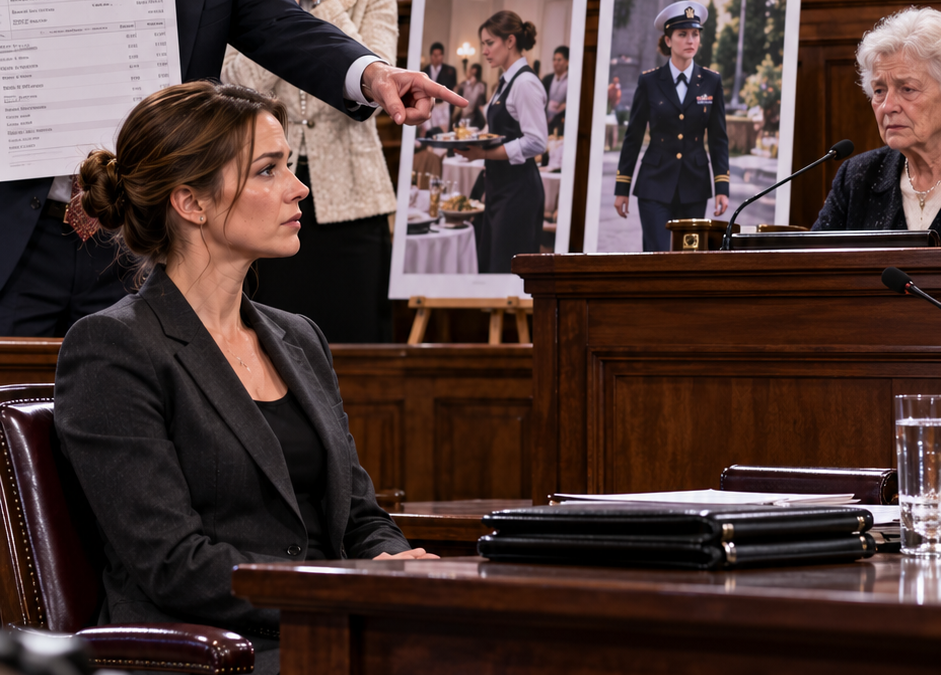
My Father Thought My Silence Would Convict Me Before the Sealed Case Ever Reached the Courtroom
My father had already told the reporters I was a fraud before the judge asked me my first question. He believed the plain charcoal suit, the missing uniform, and the years I refused to explain would make his story stronger than mine. What he did not understand was that silence had never meant I had nothing to prove.
“Put her in custody before she disappears again!”
My father’s voice carried across the courtroom with the same authority he had used when I was a child.
Three local reporters turned their cameras toward me.
My stepmother, Denise, covered her mouth with both hands as though she were watching a stranger attack her family.
Beside my father, his attorney, Edwin Pike, lifted a bank statement above the counsel table.
“Forty thousand dollars,” he announced. “Forty thousand dollars disappeared from retired First Sergeant Harold Mercer’s military pension account, Your Honor. His daughter took it while pretending to be a service member.”
Pens began moving.
Camera shutters clicked.
My father looked at me and smiled.
Not openly.
Just enough for me to see it.
He thought he had already won.
My name is Julia Mercer.
I was thirty-six years old, and I had served in the United States Navy for fourteen years.
At that moment, however, I wore no uniform.
No ribbons.
No rank insignia.
Nothing visible that would tell anyone in the gallery who I was.
That was not an accident.
My father had counted on it.
He had spent weeks building his case around the fact that most people in our hometown had never seen me serve.
They had seen photographs of me carrying trays at hotel banquets.
They had seen me disappear for months and return without explanations.
They had watched me enter my mother’s old house once wearing a Navy service uniform.
Those fragments were enough for Harold Mercer to build a story.
According to him, I had never truly served.
The uniform was fake.
The deployments were invented.
The rank was something I had bought online to impress people.
The money in the account was his military pension.
And I was the daughter who had stolen it.
Judge Rebecca Sloan looked down from the bench.
“Ms. Mercer, do you deny accessing the account in question?”
“I deny that the money belonged to him.”
My father laughed loudly.
“Listen to that.”
Judge Sloan’s eyes shifted toward him.
“Mr. Mercer, you will allow your daughter to answer.”
He raised his hands.
“I’m just saying, Your Honor, she talks like some kind of attorney now.”
His gaze moved toward the reporters.
“Five years pouring drinks at hotel banquets, and suddenly she knows federal finance law.”
A few people in the gallery whispered.
I kept my face still.
The banquet work was real.
That was what made the lie effective.
Years earlier, during advanced language training and an assignment that required a civilian cover, I had worked occasional events at hotels.
Nothing glamorous.
Wedding receptions.
Corporate dinners.
Retirement banquets.
Sometimes carrying trays was exactly what the assignment required me to be seen doing.
My father had found old photographs online.
One showed me carrying champagne.
Another showed me setting plates at a military retirement dinner.
He had enlarged them.
Mounted them on foam board.
Placed them beside the judge like exhibits in a museum dedicated to proving my worthlessness.
Pike stood.
“Your Honor, may I?”
Judge Sloan nodded.
He approached the easel.
“This photograph was taken six years ago.”
He pointed toward the image of me holding a tray.
“The respondent claims she was serving in a sensitive military capacity during that period.”
I said nothing.
He moved to the second photograph.
It showed me walking toward my mother’s house in a Navy service uniform.
“A costume purchased online,” he said.
My father shook his head sadly.
The performance was almost impressive.
Pike continued.
“Several neighbors believed Ms. Mercer was deployed because she encouraged them to believe she was in the armed services.”
“That is not what the evidence says,” I replied.
Pike turned.
“Then perhaps you can explain the uniform.”
“I can.”
“Please do.”
“My counsel will.”
He smiled.
“Your counsel isn’t here.”
The courtroom door remained closed behind us.
Captain Daniel Shaw, a Navy JAG attorney with the clearances required to carry the documents I needed, had been delayed at the federal security checkpoint downstairs.
He had texted me fifteen minutes earlier.
Held at entry. Resolving now.
I had read the message and placed my phone away.
I knew what was inside the black case he was carrying.
My father did not.
That was the only advantage I had.
For the moment.
Pike called the next witness.
Mrs. Nolan.
She had lived three houses down from my parents for nearly thirty years.
She was seventy-eight now, thin and careful, with white curls tucked neatly around her ears.
I remembered her giving me cookies when I was ten.
I remembered raking her leaves after her husband died.
Now she sat in the witness chair and avoided looking at me.
“Mrs. Nolan,” Pike said gently, “did Julia Mercer ever represent herself to you as a Navy officer?”
She looked toward my father first.
Then toward me.
“Harold told us she was unstable.”
The answer hit differently than I expected.
Not because I cared whether Mrs. Nolan believed me.
Because I suddenly understood how long my father had been working.
This did not begin with the money.
He had been preparing people to doubt me before there was ever a lawsuit.
I stood.
Judge Sloan nodded.
I approached carefully.
“Mrs. Nolan, you’ve known me since childhood.”
“Yes.”
“Did I ever personally tell you I held a rank I did not have?”
She hesitated.
“Your father said—”
“I’m asking what I said.”
Her hands tightened.
“No.”
“Did you ever see me ask anyone for money based on military status?”
“No.”
“Did I ever ask you to believe I had been deployed?”
“No.”
“Did I show you false documents?”
“No.”
My father leaned forward.
“Stop intimidating her.”
Judge Sloan’s expression hardened.
“Mr. Mercer.”
“She’s twisting everything.”
“I will decide what is relevant.”
He muttered something I could not hear.
I returned to my seat.
As I passed him, he stepped sideways.
His shoulder struck mine.
Hard.
It was disguised well enough that anyone watching casually might have believed it was an accident.
I knew better.
He had done that my entire childhood.
Never enough to leave proof.
Always enough to remind you who was allowed to take up space.
The bailiff immediately stepped between us.
Judge Sloan’s voice turned cold.
“One more physical contact and you will be removed from my courtroom.”
My father lifted both hands.
“I’m a retired soldier, Your Honor. I’m protecting my pension.”
There it was again.
Retired soldier.
He used the phrase like armor.
My father had served.
That part was true.
First Sergeant Harold Mercer had worn Army green with pride.
When I was little, I believed that made him one of the strongest men alive.
I polished his boots when I was seven.
I watched him pin ribbons above his pocket.
I thought rank meant character.
Growing older corrected that misunderstanding.
The account at the center of the lawsuit contained $52,417.
My mother, Laura Mercer, had opened it when I was a child.
Her parents left her their house.
She sold part of the inherited property years later and placed money into a custodial trust structure for me.
My father remained listed as a custodial contact.
Not owner.
Not beneficiary.
Contact.
When I became an adult, nobody corrected the old paperwork.
For years, that mistake meant nothing.
Then I began depositing my own money into the account.
Special-duty compensation.
Combat-zone savings.
Several back-pay adjustments.
And an insurance payment connected to an operation I was not authorized to discuss publicly.
The balance grew.
My father found it after Denise’s son, Caleb Price, wrecked a leased sports car.
Caleb owed almost forty thousand dollars.
Repossession threatened.
So did a civil judgment.
My father saw the account.
Then he saw a solution.
He did not ask me.
He did not call.
He built a lie.
Judge Sloan turned toward me.
“Ms. Mercer, the response filed by your attorney identifies your occupation only as ‘federal service.’”
“Yes, Your Honor.”
“That is not sufficient to establish lawful source of funds against a specific allegation of pension theft.”
“I understand.”
“Can you produce documentation?”
“My counsel is bringing authenticated records.”
Pike stood.
“Again, conveniently absent.”
Judge Sloan ignored him.
“Where is your counsel?”
“Delayed at federal security downstairs.”
“How long?”
“I don’t know.”
My father leaned toward Denise.
She whispered loudly enough for everyone to hear.
“She finally got caught.”
The words were familiar.
My father had used versions of them for years.
Whenever I refused to explain my absences.
Whenever I missed holidays.
Whenever I told him a question touched work I could not discuss.
He would smile.
“You always have an excuse.”
I eventually stopped defending myself.
That became his evidence.
Judge Sloan removed her glasses.
“Ms. Mercer, I need to be very clear.”
I nodded.
“If you cannot establish lawful ownership of these funds today, I am prepared to freeze the account pending further proceedings.”
My father’s smile widened.
She continued.
“I would also refer both the financial allegations and the stolen-valor allegations for appropriate investigation.”
The courtroom seemed to tighten around me.
I could hear one reporter typing.
My father leaned closer.
Coffee was on his breath.
“Give us the account,” he whispered.
I looked at him.
He kept smiling.
“I can make this humiliation stop.”
I studied his face.
Once, that face had appeared above me when he taught me to ride a bicycle.
His hand had been on the back of the seat.
“Don’t look down,” he had said.
I was eight.
I trusted him completely.
Now he was trying to use public shame to steal from me.
“You created it,” I said quietly.
His smile disappeared.
“What?”
“You created the humiliation.”
Judge Sloan lifted her gavel.
“Ms. Mercer, this is your final opportunity.”
The courtroom doors opened.
Everyone turned.
Captain Daniel Shaw entered in Navy dress blues carrying a sealed black case.
Behind him walked a woman in a dark suit displaying credentials.
Department of Defense Inspector General.
Captain Shaw approached the bench.
“Your Honor.”
Pike stood immediately.
“This is a county civil matter, not a military ceremony.”
Judge Sloan looked at him.
“Sit down, Mr. Pike.”
Then she turned toward Shaw.
“Counsel, approach.”
He placed the black case on the clerk’s desk.
My father stopped smiling.
Shaw entered a security code.
The locks released.
Inside were certified service records.
Transfer authorizations.
Financial verification.
And a sealed letter bearing the Department of Defense seal.
He removed one page.
Handed it to Judge Sloan.
Her eyes moved across the first paragraph.
Then the second.
Her face changed.
She looked at me.
Then back at the document.
“Commander Mercer?”
The gallery fell silent.
My father stood.
“She’s lying.”
Judge Sloan did not even look at him.
She read again.
“Commander Julia Mercer, United States Navy.”
“Yes, Your Honor.”
Her eyes continued downward.
“You serve as operations commander for Joint Intelligence Task Unit Sentinel?”
“I do.”
Pike stared at me.
Denise stopped breathing.
My father’s face turned pale.
He pointed toward the document.
“That’s fake.”
Judge Sloan looked at Shaw.
“Authentication?”
“Already transmitted through the secured channel to your clerk.”
The clerk nodded.
Judge Sloan checked the electronic confirmation.
Then she ordered the document marked under seal.
For several seconds, she said nothing.
Then something happened I had not expected.
Judge Sloan stepped down from the bench.
Pike looked confused.
The reporters stopped typing.
She came to a stop several feet in front of me.
Her shoulders straightened.
Then she raised a precise salute.
The room froze.
“I served eighteen years as a Navy JAG officer,” she said.
I had not known.
Her eyes remained on mine.
“Commander, this court recognizes your service and regrets allowing an unsupported accusation of stolen valor to be repeated as fact before authentication was available.”
I stood.
Returned the salute.
“Thank you, Your Honor.”
Somewhere behind me, a camera shutter clicked.
My father’s face had gone completely colorless.
But the salute was not the evidence.
Captain Shaw understood that.
So did I.
He turned toward the judge.
“Your Honor, every recent deposit into the account originated from Commander Mercer’s pay, special-duty entitlements, combat-zone savings, or personal insurance benefits.”
He placed records on the clerk’s desk.
“None came from Harold Mercer’s Army retirement.”
Judge Sloan looked toward Pike.
Pike looked at my father.
Denise suddenly found her voice.
“Then why was Harold’s name attached to the account?”
Shaw answered.
“Because he was listed as custodian when Commander Mercer was nine years old.”
“That means it was his.”
“No.”
His voice remained calm.
“Custodial access does not transfer ownership.”
My father sat down heavily.
I thought that would be the end.
Account verified.
Case dismissed.
Reporters corrected.
My mistake was assuming the worst thing my father had done was lie about the $52,417.
The woman who entered with Captain Shaw stepped forward.
“Your Honor, Special Agent Lena Ortiz, Department of Defense Office of Inspector General.”
Judge Sloan nodded.
Agent Ortiz opened her folder.
“Mr. Mercer’s complaint triggered federal review because he alleged theft of military retirement funds.”
My father stared at her.
Ortiz continued.
“During that review, we identified a transaction the plaintiffs did not disclose in their filings.”
Pike slowly turned toward my father.
“What transaction?”
Agent Ortiz placed a report before the judge.
“Last month, Harold Mercer and Denise Mercer attempted to withdraw forty thousand dollars from Commander Mercer’s account.”
The courtroom erupted in whispers.
Judge Sloan struck the gavel once.
“Continue.”
Ortiz did.
“The attempted withdrawal relied on a notarized power of attorney supposedly executed by Commander Mercer.”
Pike turned fully toward his clients.
“You told me she authorized that document.”
Denise spoke first.
“She did.”
I looked at her.
“No, I didn’t.”
“You signed it.”
“I have never signed a power of attorney giving either of you access to that account.”
Agent Ortiz removed another page.
“Our document examination indicates the signature was digitally reproduced from a high-school-era trust form.”
Pike backed half a step away from the table.
My father said nothing.
I stared at the forged signature.
My name.
My handwriting.
Taken from a form I signed when I was seventeen.
Copied years later.
Used to manufacture consent.
I thought that was the second betrayal.
It wasn’t.
Agent Ortiz looked at me.
“Commander Mercer, the review uncovered an older use of the same access information.”
Something in her expression warned me.
“When?”
“Seven years ago.”
My chest tightened.
She continued.
“Sixty-three thousand eight hundred dollars was removed from the estate account created following your mother’s death.”
I stopped breathing.
For years, I believed my mother died with almost nothing.
She had been sick.
Treatment was expensive.
My father repeatedly told me medical debts consumed what remained.
I had accepted that story because I was young and grieving.
My father had told it so many times it became family history.
Judge Sloan looked at him.
“Where did that money go?”
My father finally exploded.
“She abandoned us.”
Everyone stared.
He pointed at me.
“She left.”
I could barely understand what he was saying.
“I joined the Navy.”
“You chose them.”
“I served.”
“You left your family.”
Ortiz did not raise her voice.
“Bank records show the estate funds were used for a boat, purchases from Denise Mercer’s jewelry account, and financing connected to Caleb Price’s first sports car.”
Caleb sat in the rear gallery.
Until that moment, he had said nothing.
He was thirty now.
When our parents married, he was already an adult.
We had never been close.
He benefited from my father and Denise, but I never knew how much he understood.
Now Caleb stood.
Denise twisted around.
“Sit down.”
He looked at her.
“I’m done sitting down.”
The reporters turned their cameras toward him.
Caleb walked toward the aisle.
His phone was in his hand.
“Dad told me Julia owed us.”
My father shouted.
“Caleb.”
Caleb kept moving.
“He said she chose the Navy over the family.”
“Shut your mouth.”
The bailiff moved closer.
Caleb looked at me once.
Then toward Agent Ortiz.
“He made me sign the new loan application.”
My father lunged.
The bailiff blocked him.
“Back!”
Caleb held out the phone.
“There are messages.”
Agent Ortiz took it carefully.
“He said the lawsuit would scare her.”
My stomach turned.
Caleb continued.
“He said Julia would settle before anybody looked at the old account.”
Pike stepped away from the counsel table.
“Your Honor, I request permission to withdraw.”
Judge Sloan stared at him.
“Denied.”
Pike’s face tightened.
“Your Honor—”
“Not until this court determines what statements were presented under your signature and what representations your clients made to you.”
My father was breathing hard now.
His eyes moved toward the sealed black case.
Captain Shaw removed another document.
“There is also the purported power of attorney.”
My father snapped, “We already talked about that.”
Shaw looked at him.
“The document states Commander Mercer appeared before an Ohio notary on March ninth.”
“So?”
Shaw turned toward Judge Sloan.
“On March ninth, Commander Mercer was aboard a United States Navy vessel operating beneath Arctic ice.”
Silence.
I saw Denise’s mouth open.
Nothing came out.
Shaw continued.
“Her presence is confirmed by classified operational logs this court has reviewed under appropriate procedure.”
Judge Sloan looked down at the forged document.
“Ohio.”
“Yes, Your Honor.”
Then at the sealed logs.
“Arctic operational area.”
“Yes.”
Two federal marshals entered through the side door.
Denise began crying.
My father shoved his chair backward.
He moved toward me so quickly the bailiff did not anticipate it.
His hand closed around my wrist.
“You did this.”
His face was inches from mine.
“You did this to your own family.”
The grip tightened.
At the same time, his other hand reached toward the sealed evidence case.
Training takes over before anger.
I turned my wrist toward the gap in his thumb.
Pulled down and back.
His grip broke.
He stumbled.
His hip struck the counsel table.
Captain Shaw seized the evidence case and moved it out of reach.
The marshals grabbed my father by both arms.
“Do not resist.”
Denise screamed.
“Don’t touch my husband!”
Agent Ortiz turned toward her.
“Mrs. Mercer.”
Denise froze.
“You are also named in the federal warrant.”
The room exploded.
Questions.
Camera shutters.
People standing.
Judge Sloan struck the gavel.
“Silence!”
Again.
“Silence in this courtroom!”
Gradually, the noise stopped.
My father twisted against the marshals.
“Julia is punishing me because I asked questions.”
I looked at him.
For years, I imagined what I would say if he ever pushed too far.
The speeches in my head were always longer.
Angrier.
Now I needed only one truth.
“No.”
He stared at me.
“You filed sworn statements you knew were false because you believed public humiliation would make me surrender.”
His mouth opened.
For the first time all day, no words came out.
Agent Ortiz read the allegations attached to the federal warrants.
Attempted bank fraud.
Use of a forged financial instrument.
Conspiracy.
False statements connected to federally sourced compensation.
She also made something clear.
“These are allegations. Guilt will be determined in the proper court.”
That mattered.
Even after everything my father had done, process mattered.
Evidence mattered.
Not anger.
Not revenge.
Denise’s crying stopped when the marshal secured her wrists.
The expression on her face changed from grief to calculation.
Pike asked again to withdraw.
Judge Sloan ordered him to preserve every email, affidavit draft, billing record, and communication connected to the matter.
Whether he had knowingly participated would be reviewed separately.
Then Judge Sloan returned to the case actually before her.
She looked at the complaint.
Then at my father.
Then at me.
“The plaintiffs have produced no evidence that Commander Mercer stole retirement funds.”
She turned a page.
“The verified banking records establish the opposite.”
Pike said nothing.
“This complaint is dismissed with prejudice.”
The words were almost quiet.
But I felt them.
Not triumph.
Release.
Judge Sloan vacated the requested freeze.
Referred the false testimony and supporting filings for appropriate review.
Ordered Harold and Denise responsible for my legal costs subject to the outcome of the related proceedings.
And then it was over.
At least, the courtroom part.
My father was led toward the side door.
Denise followed.
She never looked at me.
Harold did.
For one moment, our eyes met.
There was rage in his.
But beneath it, something more familiar.
Disbelief.
He genuinely could not understand why the daughter he had controlled through guilt for years had finally stopped cooperating.
Caleb remained beside the gallery rail.
He looked smaller than he had that morning.
“I’m sorry,” he said.
I gathered my documents.
“For what part?”
His face tightened.
“I knew the car money wasn’t right.”
I waited.
“I didn’t know about your mom’s estate.”
“You knew enough to ask questions.”
He looked down.
“Yes.”
“You didn’t.”
“No.”
I could have humiliated him.
There were reporters ten feet away.
I understood exactly how easy it would have been.
That realization made me feel sick.
Humiliation was my father’s language.
I had no interest in becoming fluent.
Caleb nodded.
“I should have.”
“Yes.”
That was all I said.
The sports car was repossessed the following week.
Its financing had relied on false information connected to the same pattern of financial manipulation.
A court-appointed receiver froze the remaining disputed assets while investigators traced the money taken from my mother’s estate.
The public drama faded.
The legal process did not.
Months passed.
Records were examined.
Accounts reconstructed.
Emails recovered.
Signatures compared.
My father and Denise eventually entered plea agreements.
Restitution orders recovered most of the estate money.
The boat was sold.
Jewelry was liquidated.
Other assets were used to satisfy portions of the restitution.
I did not recover every dollar.
Money had moved too many times.
Some value was gone permanently.
For a long time, I thought that would make me angrier than it did.
It didn’t.
The money mattered.
Of course it did.
It was my mother’s.
It should have been protected.
But once I knew the truth, I realized the greater theft had already happened years earlier.
My father had stolen my understanding of her final years.
He made me believe she had left us nothing because illness had consumed everything.
He took a financial crime and turned it into family history.
That was harder to restore.
Pike was eventually cleared of criminal participation.
But he was sanctioned for repeating significant claims publicly without verifying basic facts that should have been checked.
He had trusted his clients too much.
Or questioned them too little.
Either way, he had helped turn accusation into spectacle.
The reporters who arrived expecting to film my humiliation published corrections.
One ran a headline about the “secret commander.”
Another focused on Judge Sloan’s salute.
A third printed an apology for describing me as an alleged military impersonator.
I did not read any of them.
I had already spent too much of my life allowing other people to decide whether I existed correctly.
My father wrote three letters from federal detention.
The first blamed Denise.
I returned it unopened.
The second blamed Caleb.
I returned that too.
The third envelope sat on my desk for almost an hour.
His handwriting was familiar.
Harold Mercer.
My father.
I nearly opened it.
Instead, I asked Captain Shaw to have someone tell me only the first line.
A few hours later, he called.
“You sure?”
“Yes.”
“He asks you to remember that he taught you to ride a bicycle.”
I closed my eyes.
Of course he did.
He reached backward for the kindest memory he could find.
Maybe he thought love could erase evidence.
Maybe he thought one good fatherhood moment purchased permanent access.
I remembered the bicycle.
I remembered his hand on the seat.
I remembered him running beside me.
I remembered looking back and realizing he had let go.
I loved that memory.
I still returned the letter unopened.
Forgiveness, I learned, was not the same thing as renewed access.
You could remember someone’s good moments and still refuse to hand them the keys to your life again.
Judge Sloan requested a private meeting after the proceedings were formally concluded.
We met in chambers.
No reporters.
No salute.
No spectacle.
She poured coffee.
“I owe you another apology.”
I shook my head.
“You did not create the evidence.”
“No.”
“You did not create their lies.”
“No.”
“You stopped them when the records arrived.”
She studied me.
“I allowed the hearing to become more public than it should have.”
“That is different.”
“Yes.”
She nodded.
“I should have controlled it sooner.”
I respected that.
Responsibility without excuses had become rare in my family.
Judge Sloan looked toward the window.
“You stood still while everyone misunderstood you.”
I thought about that.
“My job teaches patience.”
“That was more than patience.”
“No.”
I smiled faintly.
“Standing still is not the same as surrendering.”
She smiled too.
“I’ll remember that.”
One year later, I changed directions.
Not because the courtroom defeated me.
Not because I wanted to disappear.
I transferred into the Navy Reserve.
Then accepted a civilian position as director of operations for an American aerospace-intelligence company working in rescue coordination and aviation safety.
The work still mattered.
The mission still mattered.
I simply wanted to build a life where my identity belonged to more than what I was allowed to explain.
I used part of the money recovered from my mother’s estate to restore her house.
Not remodel.
Restore.
There was a difference.
I kept the old wooden floors.
Repaired the porch.
Repainted the kitchen the pale blue she loved.
Replaced the roof.
Fixed the study window that had leaked every winter since I was thirteen.
While clearing her old desk, I found a slim folder wedged behind a drawer.
Inside were trust records.
And a folded note.
My name was on the front.
Julia.
My hands shook before I opened it.
The message was short.
Julia, protect what is yours without becoming hard enough to forget who you are.
I sat on the floor.
For a long time, I did nothing.
My mother had no idea what would happen later.
She did not know my father would take money from her estate.
She did not know he would eventually accuse me in open court.
She did not know I would spend years serving in places I could not explain.
But somehow the words reached exactly the woman I had become.
Protect what is yours.
Without becoming hard enough to forget who you are.
I framed the note.
Placed it beside my command photograph.
Not the photograph from the courtroom.
Not Judge Sloan saluting.
A simple command photograph.
Uniform.
Neutral background.
My name.
My rank.
No story.
No defense.
Just truth.
Caleb and I never became close.
He eventually paid his own debts.
Entered a financial accountability program as part of resolving the consequences of the fraudulent financing surrounding his car.
He found work.
Started rebuilding.
Occasionally, he called.
Our conversations were short.
Honest.
That was enough.
For years, our family specialized in pretending.
Pretending money came from one place when it came from another.
Pretending cruelty was discipline.
Pretending silence meant guilt.
Pretending loyalty required obedience.
Honesty felt almost radical by comparison.
People who hear the story usually remember one moment.
Judge Sloan standing.
The salute.
The courtroom going silent.
My father’s face.
I understand why.
It was dramatic.
A woman everyone had been told was a fraud suddenly being recognized as a Navy commander.
It sounds like the moment everything changed.
But it wasn’t.
The salute changed the atmosphere.
The records changed the case.
That distinction matters.
If Judge Sloan had saluted me and the financial evidence showed I stole my father’s money, I would still have been responsible.
Rank does not make wrongdoing disappear.
A uniform does not turn accusation into falsehood.
The truth was much simpler.
The money was mine.
The signature was forged.
The pension story was false.
The old estate transfer existed.
The spending records existed.
Caleb’s messages existed.
My location on March ninth existed.
Evidence did what spectacle could not.
My father had spent years teaching me a different lesson.
He believed if you controlled the story loudly enough, eventually people would stop checking facts.
He knew how to use reputation.
He was the respected retired first sergeant.
I was the absent daughter.
He lived locally.
I disappeared for months.
He attended neighborhood events.
I avoided questions.
He gave people simple explanations.
I gave them none.
He had turned every constraint of my work into an advantage for himself.
When I could not say where I had been, he called that proof I had not served.
When I refused to discuss operations, he called it proof I was lying.
When I worked undercover assignments that looked ordinary from the outside, he used the photographs as evidence of failure.
When I stopped defending myself, he called the silence confession.
That strategy almost worked.
Not because the lie was brilliant.
Because people are comfortable with stories that fit what they already think they see.
A waitress.
A daughter who rarely visits.
A uniform appearing suddenly.
A retired father saying he has been betrayed.
It creates a picture.
My father understood pictures.
What he forgot was that pictures are not records.
A photograph of me carrying a tray was real.
His interpretation was false.
The account existed.
His interpretation was false.
His name appeared on old paperwork.
His interpretation was false.
I had spent years learning something he never did.
Information is not the same as truth.
Context matters.
Verification matters.
Evidence matters.
One of the strangest emotions I experienced afterward was grief.
Not for the court case.
Not even for the money.
For the father I had spent years trying to believe existed.
The bicycle father.
The man who showed me how to change oil.
The retired first sergeant who once told me, “Your word is the only thing nobody can take from you.”
I thought about that sentence often.
He taught it.
Then spent years violating it.
For a while, that hypocrisy made every good memory feel contaminated.
My therapist challenged that.
“You don’t have to rewrite your entire childhood because you learned something terrible about him as an adult.”
I hated hearing it.
Which usually meant it was useful.
“So what am I supposed to do?”
“Let two things be true.”
I laughed bitterly.
“What two things?”
“He sometimes loved you.”
I said nothing.
“And he later chose to harm you.”
That answer hurt.
Because I wanted simplicity.
Good father.
Bad father.
Love.
No love.
Truth rarely cooperates.
He taught me to ride a bicycle.
And he forged my signature.
He served honorably for years.
And he lied under oath.
He may have believed some part of him deserved the money.
And he knew enough to hide what he was doing.
Both things could be true.
Understanding that did not excuse him.
It simply freed me from needing every memory to testify for one side.
I stopped asking whether my father had ever loved me.
The better question was whether love gave him permission to violate me.
It did not.
That was where my boundary became simple.
Years after the case, I attended a Navy event in Washington.
Nothing classified.
Nothing dramatic.
Several young officers approached afterward.
One of them knew the courtroom story.
“Commander Mercer?”
I turned.
He was a lieutenant.
Maybe twenty-seven.
“You’re the officer from that case.”
“I was.”
He smiled awkwardly.
“My mother sent me the article.”
“I’m sorry.”
He laughed.
“She sends everything.”
Then his expression changed.
“Can I ask you something?”
“Sure.”
“How did you stay calm?”
I almost gave him the standard answer.
Training.
Discipline.
Experience.
Instead, I told him the truth.
“I wasn’t calm.”
He looked surprised.
“You looked calm.”
“That’s different.”
I remembered my father whispering that he could make the humiliation stop.
The reporters.
Mrs. Nolan.
The fake uniform accusation.
Judge Sloan preparing to freeze the account.
“I was angry.”
I continued.
“I was scared.”
His face changed.
“I knew the evidence was coming. But until it arrived, I also knew the lie was winning.”
“So how did you stay still?”
“Because reacting emotionally would not have made the documents arrive faster.”
He nodded slowly.
I added, “And because people who want to control you through shame are often waiting for you to explode.”
That was something I understood only later.
My father wanted anger.
He wanted me to yell.
To insult him.
To look unstable.
To prove the person he had described.
Silence denied him that.
But silence alone was not enough.
Evidence had to follow.
That was the difference.
There are people who romanticize silence.
They call it strength.
Sometimes it is.
Sometimes silence is fear wearing elegant clothing.
Sometimes it is avoidance.
Sometimes it is surrender.
The silence I chose in that courtroom had a purpose.
I knew Captain Shaw was coming.
I knew the documents existed.
I knew the truth could survive a few more minutes without me turning myself into the spectacle my father wanted.
That is not the same as letting someone abuse you indefinitely.
I had done too much of that already.
When Harold first discovered the account and began demanding access, I tried to handle it privately.
He called.
I explained it was not his pension.
He said I was confused.
I sent him documentation showing the source of the funds.
He ignored it.
He demanded forty thousand dollars.
I refused.
Then he threatened court.
I told him to speak to my attorney.
He laughed.
“You think you can hide behind lawyers?”
I remember staring at the phone after that call.
Hide.
That word fascinated me.
My entire adult life, he accused me of hiding.
Hiding my work.
Hiding my rank.
Hiding money.
Hiding the truth.
In reality, I had spent fourteen years learning how to protect information responsibly.
My father had spent years confusing access with entitlement.
If he wanted to know something, he believed withholding it was betrayal.
If he wanted money, refusing it was cruelty.
If he wanted obedience, boundaries were disrespect.
That worldview finally collapsed in court.
Not because I defeated him.
Because there was nowhere left for it to go once records entered the room.
The money recovered from my mother’s estate changed my finances, but not my life as dramatically as people imagine.
I paid legal expenses.
Restored the house.
Invested carefully.
Created long-term savings.
I did not buy a luxury car.
I did not celebrate with a vacation.
The first thing I purchased after the case was actually a new lock for my mother’s study.
Not because anyone was trying to enter.
Because I wanted one door in that house whose key belonged only to me.
It cost less than two hundred dollars.
It felt priceless.
I began spending occasional weekends there.
At first, the house was painful.
Every room contained a version of me that no longer existed.
The hallway where Dad used to line up his boots.
The kitchen where Mom cut apples for school lunches.
The stairwell where Caleb once punched a hole in the wall during an argument.
The dining room where Denise sat after Mom was gone and rearranged things without asking.
I changed some rooms.
Left others.
Healing, I discovered, was not restoring the house to the exact way it looked before damage.
That would have been impossible.
It was deciding which parts still belonged to me.
The same was true of family.
Caleb eventually came to the house one afternoon.
He stood on the porch holding a cardboard box.
“What is that?”
“Some things from storage.”
I did not invite him in immediately.
He noticed.
That was good.
Old Caleb would have walked past me.
The newer version waited.
“What things?”
“Your mom’s.”
I opened the box.
Photographs.
Letters.
A scarf.
Two recipe cards.
A small wooden jewelry case.
My chest tightened.
“Where did you get these?”
“Mom had them.”
Denise.
Of course.
Caleb looked ashamed.
“I found the box after everything.”
“Why didn’t you bring it sooner?”
“I thought you’d think I wanted something.”
“Do you?”
“No.”
I studied him.
Then stepped aside.
“Come in.”
He entered carefully.
We sat at the kitchen table.
The conversation was uncomfortable.
That was okay.
Honesty often is.
He looked around.
“You fixed the place.”
“I repaired it.”
“Same thing.”
“Not to me.”
He nodded.
Then said, “I believed him too.”
I knew who he meant.
“My father?”
“Yes.”
“He was your stepfather.”
“He was still the person who told me what was true.”
I waited.
“He said you hated us.”
“I didn’t.”
“I know.”
“He said you thought you were better than everyone because you joined the Navy.”
“I didn’t.”
“I know.”
“He said the money was his.”
“You signed loan documents anyway.”
Caleb looked down.
“I did.”
I did not rescue him from the discomfort.
Finally he said, “I kept taking whatever version made my life easier.”
That was more self-awareness than I expected.
“Yes.”
He nodded.
“I’m trying not to do that anymore.”
I believed he was trying.
Trying did not erase what happened.
But it mattered.
We never became siblings in the sentimental sense.
No weekly dinners.
No matching holiday photographs.
But we stopped lying to each other.
Sometimes that is the most mature relationship people can manage.
Captain Shaw remained in my life too.
He joked for years that the federal security guard who delayed him nearly ruined his career.
“You should have seen Pike’s face when you walked in,” I told him once.
“I saw your father’s.”
“That was worse.”
“Better, depending on perspective.”
I laughed.
Shaw grew serious.
“You know the story people tell is wrong.”
“Which part?”
“They say I saved you.”
“You brought the documents.”
“You already had the truth.”
“Truth sitting outside the courtroom does not help much.”
“Still.”
He shook his head.
“I was logistics.”
“That may be the most Navy JAG thing you’ve ever said.”
He smiled.
Then said something I remembered.
“You survived the part before the case.”
“What part?”
“Years of being doubted.”
I looked at him.
“That was harder than the hearing.”
He nodded.
“I know.”
The courtroom lasted hours.
Being misunderstood by family lasted years.
One ends when a judge speaks.
The other stays in your nervous system.
For months after the case, I still felt the urge to explain myself whenever anyone asked an innocent question.
“What do you do?”
I would tense.
Because for years, every question from my father came with an accusation hiding behind it.
Eventually, I learned to answer without defending.
“I work in operations.”
Sometimes people asked more.
Sometimes I said what I could.
Sometimes I said, “I can’t discuss that.”
And then I let the silence remain.
No apology.
No nervous laugh.
No effort to make them comfortable.
That was new.
My mother’s note helped.
Protect what is yours without becoming hard enough to forget who you are.
For a long time, I thought boundaries meant becoming colder.
They didn’t.
They allowed me to become softer with people who had earned access.
I could be generous without being exploitable.
Private without being ashamed.
Forgiving without becoming available to harm again.
That was the difference my father never understood.
He believed family meant permanent access.
To money.
To information.
To emotion.
To forgiveness.
But family is not ownership.
When he reached for my wrist in court, he was expressing the same belief that existed underneath the financial fraud.
This is mine.
My daughter.
My money.
My authority.
My story.
He was wrong about all four.
The last time I thought seriously about Harold was several years after the case.
I received notice that he had completed part of his sentence and was seeking to rebuild contact with relatives.
No direct letter.
No phone call.
Just information passed through proper channels.
I sat at my desk for almost an hour.
Part of me wondered whether refusing contact made me cruel.
That question used to control me.
Then I looked at my mother’s note.
Protect what is yours.
I finally understood that she was not only talking about property.
Your peace is yours.
Your reputation is yours.
Your boundaries are yours.
Your memories are yours.
Your future is yours.
So is your forgiveness.
You decide where it goes.
I did not contact him.
Maybe someday that will change.
Maybe it will not.
I no longer build my life around proving which answer makes me a better daughter.
One evening, I stood in my mother’s restored study looking at two frames.
One contained her note.
The other contained my command photograph.
For years, I thought those images represented two different versions of me.
The daughter.
The commander.
The woman raised in a complicated home.
The officer who led people through complicated missions.
But they were never separate.
Everything I survived at home shaped the officer.
Everything the Navy taught me eventually helped the daughter survive the courtroom.
Patience.
Verification.
Control what you can control.
Do not confuse noise with information.
Do not act only because someone is pressuring you to act.
And when the evidence changes, change your decision.
Those lessons sound military.
They are also deeply human.
People often ask what I felt when Judge Sloan saluted.
The answer disappoints them.
I felt exposed.
Not triumphant.
For years, my work existed behind controlled doors.
Then suddenly a courtroom full of strangers knew enough to understand that my father’s story was false.
The respect in the room changed instantly.
That bothered me.
Because I had been the same person ten seconds earlier.
Before the judge read the document.
Before anyone knew my rank.
Before the salute.
The truth of my character had not changed.
Only their information had.
That became one of the most important lessons I carried out of the courtroom.
Respect should not require impressive credentials.
My father’s accusation would have been wrong if I had actually spent five years working hotel banquets.
The forged signature would still have been fraud.
The stolen estate money would still have belonged to my mother.
His attempt to shame me would still have been abuse.
The uniform did not make me worthy of dignity.
It only destroyed one of his lies.
That distinction mattered.
Especially later, when I became responsible for employees who did not have titles people saluted.
Analysts.
Dispatchers.
Maintenance specialists.
Junior coordinators.
People whose work became visible only when something failed.
I never wanted them to feel they needed a dramatic revelation before someone listened.
I had lived through that mistake.
Years after the hearing, one of our youngest operations coordinators came into my office visibly shaken.
A senior manager had dismissed her concerns about a flight-support discrepancy.
She had data.
He had experience.
The old pattern.
I looked at her report.
“Are you sure?”
“Yes.”
“Show me.”
She did.
Her concern was valid.
We corrected the issue before it affected an aircraft.
Later, she thanked me for believing her.
I told her something Judge Sloan’s courtroom taught me.
“I didn’t believe you because you were junior.”
She looked confused.
“I didn’t believe him because he was senior.”
I tapped the report.
“I believed the evidence.”
She smiled.
“That simple?”
“No.”
I smiled back.
“Simple and easy are different things.”
That became almost a private rule in my life.
Evidence before ego.
Boundaries before appearances.
Truth before family mythology.
My father thought a courtroom full of people would frighten me into surrender.
He thought reporters would make me ashamed.
He thought my classified silence had made me defenseless.
He thought his military retirement gave him more credibility than the daughter he described as unstable.
Most of all, he thought family history belonged to whoever told it loudest.
He was wrong.
The truth was quieter.
It arrived late.
Carried in a sealed black case.
Verified one record at a time.
The account.
The deposits.
The forged signature.
The impossible Ohio notarization.
The missing estate funds.
The text messages.
No shouting required.
I sometimes think about the moment before Captain Shaw opened the courtroom door.
Judge Sloan’s gavel was raised.
My father believed he had cornered me.
He leaned over and offered to make my humiliation stop if I surrendered the account.
Years earlier, I might have done it.
Not because I thought he was right.
Because I was tired.
Tired people sometimes pay extraordinary prices for temporary peace.
That day, I finally understood something.
Peace purchased with your dignity is not peace.
It is surrender with better marketing.
So I waited.
The doors opened.
The truth walked in.
Not perfectly.
Not magically.
But enough.
My father lost the lawsuit.
Then he faced the consequences of everything the lawsuit exposed.
I recovered most of what had been taken from my mother.
I restored her home.
I changed careers without abandoning service.
I rebuilt relationships selectively.
I let others end.
And I learned that forgiveness can exist at a distance.
The story people remember is about a judge standing at attention.
Mine is different.
I remember my father whispering that he could make the humiliation stop.
I remember realizing I no longer needed him to.
I remember my mother’s note.
I remember the quiet click of the new lock on her study.
I remember walking away from the courthouse while reporters called my name behind me.
I did not turn around.
For fourteen years, I had served under rules requiring me to protect information even when revealing it might have made my personal life easier.
My father mistook that restraint for weakness.
What he never understood was that I had already learned the difference between secrecy and shame.
I had nothing to be ashamed of.
Not the banquet photographs.
Not the assignments I could not explain.
Not the money I earned.
Not the uniform.
Not my refusal to give him forty thousand dollars.
Not my decision to return his letters.
And not the boundary that remained after the courtroom was empty.
My mother had written that I should protect what was mine without becoming so hard that I forgot who I was.
It took me years to understand the full meaning.
Protecting what was mine did not only mean an account balance.
It meant my name.
My history.
My right to tell the truth about what happened.
My right to refuse access to people who repeatedly used love as leverage.
My right to remember good things without allowing them to cancel bad ones.
My right to leave.
My right to stay silent.
My right to speak.
The courtroom restored my legal ownership.
The years afterward restored something harder.
Ownership of myself.
And that was the one thing my father could never forge a document to take from me.
What do you think of this story? Please leave a like and share your thoughts in the comments. Your support means a lot to us and inspires us to keep writing more meaningful and powerful stories. Thank you! 👍
h𝗧𝗛𝗘 𝗘𝗡𝗗
My Father Thought My Silence Would Convict Me Before the Sealed Case Ever Reached the Courtroom
My father had already told the reporters I was a fraud before the judge asked me my first question. He believed the plain charcoal suit, the missing uniform, and the years I refused to explain would make his story stronger than mine. What he did not understand was that silence had never meant I had nothing to prove.
“Put her in custody before she disappears again!”
My father’s voice carried across the courtroom with the same authority he had used when I was a child.
Three local reporters turned their cameras toward me.
My stepmother, Denise, covered her mouth with both hands as though she were watching a stranger attack her family.
Beside my father, his attorney, Edwin Pike, lifted a bank statement above the counsel table.
“Forty thousand dollars,” he announced. “Forty thousand dollars disappeared from retired First Sergeant Harold Mercer’s military pension account, Your Honor. His daughter took it while pretending to be a service member.”
Pens began moving.
Camera shutters clicked.
My father looked at me and smiled.
Not openly.
Just enough for me to see it.
He thought he had already won.
My name is Julia Mercer.
I was thirty-six years old, and I had served in the United States Navy for fourteen years.
At that moment, however, I wore no uniform.
No ribbons.
No rank insignia.
Nothing visible that would tell anyone in the gallery who I was.
That was not an accident.
My father had counted on it.
He had spent weeks building his case around the fact that most people in our hometown had never seen me serve.
They had seen photographs of me carrying trays at hotel banquets.
They had seen me disappear for months and return without explanations.
They had watched me enter my mother’s old house once wearing a Navy service uniform.
Those fragments were enough for Harold Mercer to build a story.
According to him, I had never truly served.
The uniform was fake.
The deployments were invented.
The rank was something I had bought online to impress people.
The money in the account was his military pension.
And I was the daughter who had stolen it.
Judge Rebecca Sloan looked down from the bench.
“Ms. Mercer, do you deny accessing the account in question?”
“I deny that the money belonged to him.”
My father laughed loudly.
“Listen to that.”
Judge Sloan’s eyes shifted toward him.
“Mr. Mercer, you will allow your daughter to answer.”
He raised his hands.
“I’m just saying, Your Honor, she talks like some kind of attorney now.”
His gaze moved toward the reporters.
“Five years pouring drinks at hotel banquets, and suddenly she knows federal finance law.”
A few people in the gallery whispered.
I kept my face still.
The banquet work was real.
That was what made the lie effective.
Years earlier, during advanced language training and an assignment that required a civilian cover, I had worked occasional events at hotels.
Nothing glamorous.
Wedding receptions.
Corporate dinners.
Retirement banquets.
Sometimes carrying trays was exactly what the assignment required me to be seen doing.
My father had found old photographs online.
One showed me carrying champagne.
Another showed me setting plates at a military retirement dinner.
He had enlarged them.
Mounted them on foam board.
Placed them beside the judge like exhibits in a museum dedicated to proving my worthlessness.
Pike stood.
“Your Honor, may I?”
Judge Sloan nodded.
He approached the easel.
“This photograph was taken six years ago.”
He pointed toward the image of me holding a tray.
“The respondent claims she was serving in a sensitive military capacity during that period.”
I said nothing.
He moved to the second photograph.
It showed me walking toward my mother’s house in a Navy service uniform.
“A costume purchased online,” he said.
My father shook his head sadly.
The performance was almost impressive.
Pike continued.
“Several neighbors believed Ms. Mercer was deployed because she encouraged them to believe she was in the armed services.”
“That is not what the evidence says,” I replied.
Pike turned.
“Then perhaps you can explain the uniform.”
“I can.”
“Please do.”
“My counsel will.”
He smiled.
“Your counsel isn’t here.”
The courtroom door remained closed behind us.
Captain Daniel Shaw, a Navy JAG attorney with the clearances required to carry the documents I needed, had been delayed at the federal security checkpoint downstairs.
He had texted me fifteen minutes earlier.
Held at entry. Resolving now.
I had read the message and placed my phone away.
I knew what was inside the black case he was carrying.
My father did not.
That was the only advantage I had.
For the moment.
Pike called the next witness.
Mrs. Nolan.
She had lived three houses down from my parents for nearly thirty years.
She was seventy-eight now, thin and careful, with white curls tucked neatly around her ears.
I remembered her giving me cookies when I was ten.
I remembered raking her leaves after her husband died.
Now she sat in the witness chair and avoided looking at me.
“Mrs. Nolan,” Pike said gently, “did Julia Mercer ever represent herself to you as a Navy officer?”
She looked toward my father first.
Then toward me.
“Harold told us she was unstable.”
The answer hit differently than I expected.
Not because I cared whether Mrs. Nolan believed me.
Because I suddenly understood how long my father had been working.
This did not begin with the money.
He had been preparing people to doubt me before there was ever a lawsuit.
I stood.
Judge Sloan nodded.
I approached carefully.
“Mrs. Nolan, you’ve known me since childhood.”
“Yes.”
“Did I ever personally tell you I held a rank I did not have?”
She hesitated.
“Your father said—”
“I’m asking what I said.”
Her hands tightened.
“No.”
“Did you ever see me ask anyone for money based on military status?”
“No.”
“Did I ever ask you to believe I had been deployed?”
“No.”
“Did I show you false documents?”
“No.”
My father leaned forward.
“Stop intimidating her.”
Judge Sloan’s expression hardened.
“Mr. Mercer.”
“She’s twisting everything.”
“I will decide what is relevant.”
He muttered something I could not hear.
I returned to my seat.
As I passed him, he stepped sideways.
His shoulder struck mine.
Hard.
It was disguised well enough that anyone watching casually might have believed it was an accident.
I knew better.
He had done that my entire childhood.
Never enough to leave proof.
Always enough to remind you who was allowed to take up space.
The bailiff immediately stepped between us.
Judge Sloan’s voice turned cold.
“One more physical contact and you will be removed from my courtroom.”
My father lifted both hands.
“I’m a retired soldier, Your Honor. I’m protecting my pension.”
There it was again.
Retired soldier.
He used the phrase like armor.
My father had served.
That part was true.
First Sergeant Harold Mercer had worn Army green with pride.
When I was little, I believed that made him one of the strongest men alive.
I polished his boots when I was seven.
I watched him pin ribbons above his pocket.
I thought rank meant character.
Growing older corrected that misunderstanding.
The account at the center of the lawsuit contained $52,417.
My mother, Laura Mercer, had opened it when I was a child.
Her parents left her their house.
She sold part of the inherited property years later and placed money into a custodial trust structure for me.
My father remained listed as a custodial contact.
Not owner.
Not beneficiary.
Contact.
When I became an adult, nobody corrected the old paperwork.
For years, that mistake meant nothing.
Then I began depositing my own money into the account.
Special-duty compensation.
Combat-zone savings.
Several back-pay adjustments.
And an insurance payment connected to an operation I was not authorized to discuss publicly.
The balance grew.
My father found it after Denise’s son, Caleb Price, wrecked a leased sports car.
Caleb owed almost forty thousand dollars.
Repossession threatened.
So did a civil judgment.
My father saw the account.
Then he saw a solution.
He did not ask me.
He did not call.
He built a lie.
Judge Sloan turned toward me.
“Ms. Mercer, the response filed by your attorney identifies your occupation only as ‘federal service.’”
“Yes, Your Honor.”
“That is not sufficient to establish lawful source of funds against a specific allegation of pension theft.”
“I understand.”
“Can you produce documentation?”
“My counsel is bringing authenticated records.”
Pike stood.
“Again, conveniently absent.”
Judge Sloan ignored him.
“Where is your counsel?”
“Delayed at federal security downstairs.”
“How long?”
“I don’t know.”
My father leaned toward Denise.
She whispered loudly enough for everyone to hear.
“She finally got caught.”
The words were familiar.
My father had used versions of them for years.
Whenever I refused to explain my absences.
Whenever I missed holidays.
Whenever I told him a question touched work I could not discuss.
He would smile.
“You always have an excuse.”
I eventually stopped defending myself.
That became his evidence.
Judge Sloan removed her glasses.
“Ms. Mercer, I need to be very clear.”
I nodded.
“If you cannot establish lawful ownership of these funds today, I am prepared to freeze the account pending further proceedings.”
My father’s smile widened.
She continued.
“I would also refer both the financial allegations and the stolen-valor allegations for appropriate investigation.”
The courtroom seemed to tighten around me.
I could hear one reporter typing.
My father leaned closer.
Coffee was on his breath.
“Give us the account,” he whispered.
I looked at him.
He kept smiling.
“I can make this humiliation stop.”
I studied his face.
Once, that face had appeared above me when he taught me to ride a bicycle.
His hand had been on the back of the seat.
“Don’t look down,” he had said.
I was eight.
I trusted him completely.
Now he was trying to use public shame to steal from me.
“You created it,” I said quietly.
His smile disappeared.
“What?”
“You created the humiliation.”
Judge Sloan lifted her gavel.
“Ms. Mercer, this is your final opportunity.”
The courtroom doors opened.
Everyone turned.
Captain Daniel Shaw entered in Navy dress blues carrying a sealed black case.
Behind him walked a woman in a dark suit displaying credentials.
Department of Defense Inspector General.
Captain Shaw approached the bench.
“Your Honor.”
Pike stood immediately.
“This is a county civil matter, not a military ceremony.”
Judge Sloan looked at him.
“Sit down, Mr. Pike.”
Then she turned toward Shaw.
“Counsel, approach.”
He placed the black case on the clerk’s desk.
My father stopped smiling.
Shaw entered a security code.
The locks released.
Inside were certified service records.
Transfer authorizations.
Financial verification.
And a sealed letter bearing the Department of Defense seal.
He removed one page.
Handed it to Judge Sloan.
Her eyes moved across the first paragraph.
Then the second.
Her face changed.
She looked at me.
Then back at the document.
“Commander Mercer?”
The gallery fell silent.
My father stood.
“She’s lying.”
Judge Sloan did not even look at him.
She read again.
“Commander Julia Mercer, United States Navy.”
“Yes, Your Honor.”
Her eyes continued downward.
“You serve as operations commander for Joint Intelligence Task Unit Sentinel?”
“I do.”
Pike stared at me.
Denise stopped breathing.
My father’s face turned pale.
He pointed toward the document.
“That’s fake.”
Judge Sloan looked at Shaw.
“Authentication?”
“Already transmitted through the secured channel to your clerk.”
The clerk nodded.
Judge Sloan checked the electronic confirmation.
Then she ordered the document marked under seal.
For several seconds, she said nothing.
Then something happened I had not expected.
Judge Sloan stepped down from the bench.
Pike looked confused.
The reporters stopped typing.
She came to a stop several feet in front of me.
Her shoulders straightened.
Then she raised a precise salute.
The room froze.
“I served eighteen years as a Navy JAG officer,” she said.
I had not known.
Her eyes remained on mine.
“Commander, this court recognizes your service and regrets allowing an unsupported accusation of stolen valor to be repeated as fact before authentication was available.”
I stood.
Returned the salute.
“Thank you, Your Honor.”
Somewhere behind me, a camera shutter clicked.
My father’s face had gone completely colorless.
But the salute was not the evidence.
Captain Shaw understood that.
So did I.
He turned toward the judge.
“Your Honor, every recent deposit into the account originated from Commander Mercer’s pay, special-duty entitlements, combat-zone savings, or personal insurance benefits.”
He placed records on the clerk’s desk.
“None came from Harold Mercer’s Army retirement.”
Judge Sloan looked toward Pike.
Pike looked at my father.
Denise suddenly found her voice.
“Then why was Harold’s name attached to the account?”
Shaw answered.
“Because he was listed as custodian when Commander Mercer was nine years old.”
“That means it was his.”
“No.”
His voice remained calm.
“Custodial access does not transfer ownership.”
My father sat down heavily.
I thought that would be the end.
Account verified.
Case dismissed.
Reporters corrected.
My mistake was assuming the worst thing my father had done was lie about the $52,417.
The woman who entered with Captain Shaw stepped forward.
“Your Honor, Special Agent Lena Ortiz, Department of Defense Office of Inspector General.”
Judge Sloan nodded.
Agent Ortiz opened her folder.
“Mr. Mercer’s complaint triggered federal review because he alleged theft of military retirement funds.”
My father stared at her.
Ortiz continued.
“During that review, we identified a transaction the plaintiffs did not disclose in their filings.”
Pike slowly turned toward my father.
“What transaction?”
Agent Ortiz placed a report before the judge.
“Last month, Harold Mercer and Denise Mercer attempted to withdraw forty thousand dollars from Commander Mercer’s account.”
The courtroom erupted in whispers.
Judge Sloan struck the gavel once.
“Continue.”
Ortiz did.
“The attempted withdrawal relied on a notarized power of attorney supposedly executed by Commander Mercer.”
Pike turned fully toward his clients.
“You told me she authorized that document.”
Denise spoke first.
“She did.”
I looked at her.
“No, I didn’t.”
“You signed it.”
“I have never signed a power of attorney giving either of you access to that account.”
Agent Ortiz removed another page.
“Our document examination indicates the signature was digitally reproduced from a high-school-era trust form.”
Pike backed half a step away from the table.
My father said nothing.
I stared at the forged signature.
My name.
My handwriting.
Taken from a form I signed when I was seventeen.
Copied years later.
Used to manufacture consent.
I thought that was the second betrayal.
It wasn’t.
Agent Ortiz looked at me.
“Commander Mercer, the review uncovered an older use of the same access information.”
Something in her expression warned me.
“When?”
“Seven years ago.”
My chest tightened.
She continued.
“Sixty-three thousand eight hundred dollars was removed from the estate account created following your mother’s death.”
I stopped breathing.
For years, I believed my mother died with almost nothing.
She had been sick.
Treatment was expensive.
My father repeatedly told me medical debts consumed what remained.
I had accepted that story because I was young and grieving.
My father had told it so many times it became family history.
Judge Sloan looked at him.
“Where did that money go?”
My father finally exploded.
“She abandoned us.”
Everyone stared.
He pointed at me.
“She left.”
I could barely understand what he was saying.
“I joined the Navy.”
“You chose them.”
“I served.”
“You left your family.”
Ortiz did not raise her voice.
“Bank records show the estate funds were used for a boat, purchases from Denise Mercer’s jewelry account, and financing connected to Caleb Price’s first sports car.”
Caleb sat in the rear gallery.
Until that moment, he had said nothing.
He was thirty now.
When our parents married, he was already an adult.
We had never been close.
He benefited from my father and Denise, but I never knew how much he understood.
Now Caleb stood.
Denise twisted around.
“Sit down.”
He looked at her.
“I’m done sitting down.”
The reporters turned their cameras toward him.
Caleb walked toward the aisle.
His phone was in his hand.
“Dad told me Julia owed us.”
My father shouted.
“Caleb.”
Caleb kept moving.
“He said she chose the Navy over the family.”
“Shut your mouth.”
The bailiff moved closer.
Caleb looked at me once.
Then toward Agent Ortiz.
“He made me sign the new loan application.”
My father lunged.
The bailiff blocked him.
“Back!”
Caleb held out the phone.
“There are messages.”
Agent Ortiz took it carefully.
“He said the lawsuit would scare her.”
My stomach turned.
Caleb continued.
“He said Julia would settle before anybody looked at the old account.”
Pike stepped away from the counsel table.
“Your Honor, I request permission to withdraw.”
Judge Sloan stared at him.
“Denied.”
Pike’s face tightened.
“Your Honor—”
“Not until this court determines what statements were presented under your signature and what representations your clients made to you.”
My father was breathing hard now.
His eyes moved toward the sealed black case.
Captain Shaw removed another document.
“There is also the purported power of attorney.”
My father snapped, “We already talked about that.”
Shaw looked at him.
“The document states Commander Mercer appeared before an Ohio notary on March ninth.”
“So?”
Shaw turned toward Judge Sloan.
“On March ninth, Commander Mercer was aboard a United States Navy vessel operating beneath Arctic ice.”
Silence.
I saw Denise’s mouth open.
Nothing came out.
Shaw continued.
“Her presence is confirmed by classified operational logs this court has reviewed under appropriate procedure.”
Judge Sloan looked down at the forged document.
“Ohio.”
“Yes, Your Honor.”
Then at the sealed logs.
“Arctic operational area.”
“Yes.”
Two federal marshals entered through the side door.
Denise began crying.
My father shoved his chair backward.
He moved toward me so quickly the bailiff did not anticipate it.
His hand closed around my wrist.
“You did this.”
His face was inches from mine.
“You did this to your own family.”
The grip tightened.
At the same time, his other hand reached toward the sealed evidence case.
Training takes over before anger.
I turned my wrist toward the gap in his thumb.
Pulled down and back.
His grip broke.
He stumbled.
His hip struck the counsel table.
Captain Shaw seized the evidence case and moved it out of reach.
The marshals grabbed my father by both arms.
“Do not resist.”
Denise screamed.
“Don’t touch my husband!”
Agent Ortiz turned toward her.
“Mrs. Mercer.”
Denise froze.
“You are also named in the federal warrant.”
The room exploded.
Questions.
Camera shutters.
People standing.
Judge Sloan struck the gavel.
“Silence!”
Again.
“Silence in this courtroom!”
Gradually, the noise stopped.
My father twisted against the marshals.
“Julia is punishing me because I asked questions.”
I looked at him.
For years, I imagined what I would say if he ever pushed too far.
The speeches in my head were always longer.
Angrier.
Now I needed only one truth.
“No.”
He stared at me.
“You filed sworn statements you knew were false because you believed public humiliation would make me surrender.”
His mouth opened.
For the first time all day, no words came out.
Agent Ortiz read the allegations attached to the federal warrants.
Attempted bank fraud.
Use of a forged financial instrument.
Conspiracy.
False statements connected to federally sourced compensation.
She also made something clear.
“These are allegations. Guilt will be determined in the proper court.”
That mattered.
Even after everything my father had done, process mattered.
Evidence mattered.
Not anger.
Not revenge.
Denise’s crying stopped when the marshal secured her wrists.
The expression on her face changed from grief to calculation.
Pike asked again to withdraw.
Judge Sloan ordered him to preserve every email, affidavit draft, billing record, and communication connected to the matter.
Whether he had knowingly participated would be reviewed separately.
Then Judge Sloan returned to the case actually before her.
She looked at the complaint.
Then at my father.
Then at me.
“The plaintiffs have produced no evidence that Commander Mercer stole retirement funds.”
She turned a page.
“The verified banking records establish the opposite.”
Pike said nothing.
“This complaint is dismissed with prejudice.”
The words were almost quiet.
But I felt them.
Not triumph.
Release.
Judge Sloan vacated the requested freeze.
Referred the false testimony and supporting filings for appropriate review.
Ordered Harold and Denise responsible for my legal costs subject to the outcome of the related proceedings.
And then it was over.
At least, the courtroom part.
My father was led toward the side door.
Denise followed.
She never looked at me.
Harold did.
For one moment, our eyes met.
There was rage in his.
But beneath it, something more familiar.
Disbelief.
He genuinely could not understand why the daughter he had controlled through guilt for years had finally stopped cooperating.
Caleb remained beside the gallery rail.
He looked smaller than he had that morning.
“I’m sorry,” he said.
I gathered my documents.
“For what part?”
His face tightened.
“I knew the car money wasn’t right.”
I waited.
“I didn’t know about your mom’s estate.”
“You knew enough to ask questions.”
He looked down.
“Yes.”
“You didn’t.”
“No.”
I could have humiliated him.
There were reporters ten feet away.
I understood exactly how easy it would have been.
That realization made me feel sick.
Humiliation was my father’s language.
I had no interest in becoming fluent.
Caleb nodded.
“I should have.”
“Yes.”
That was all I said.
The sports car was repossessed the following week.
Its financing had relied on false information connected to the same pattern of financial manipulation.
A court-appointed receiver froze the remaining disputed assets while investigators traced the money taken from my mother’s estate.
The public drama faded.
The legal process did not.
Months passed.
Records were examined.
Accounts reconstructed.
Emails recovered.
Signatures compared.
My father and Denise eventually entered plea agreements.
Restitution orders recovered most of the estate money.
The boat was sold.
Jewelry was liquidated.
Other assets were used to satisfy portions of the restitution.
I did not recover every dollar.
Money had moved too many times.
Some value was gone permanently.
For a long time, I thought that would make me angrier than it did.
It didn’t.
The money mattered.
Of course it did.
It was my mother’s.
It should have been protected.
But once I knew the truth, I realized the greater theft had already happened years earlier.
My father had stolen my understanding of her final years.
He made me believe she had left us nothing because illness had consumed everything.
He took a financial crime and turned it into family history.
That was harder to restore.
Pike was eventually cleared of criminal participation.
But he was sanctioned for repeating significant claims publicly without verifying basic facts that should have been checked.
He had trusted his clients too much.
Or questioned them too little.
Either way, he had helped turn accusation into spectacle.
The reporters who arrived expecting to film my humiliation published corrections.
One ran a headline about the “secret commander.”
Another focused on Judge Sloan’s salute.
A third printed an apology for describing me as an alleged military impersonator.
I did not read any of them.
I had already spent too much of my life allowing other people to decide whether I existed correctly.
My father wrote three letters from federal detention.
The first blamed Denise.
I returned it unopened.
The second blamed Caleb.
I returned that too.
The third envelope sat on my desk for almost an hour.
His handwriting was familiar.
Harold Mercer.
My father.
I nearly opened it.
Instead, I asked Captain Shaw to have someone tell me only the first line.
A few hours later, he called.
“You sure?”
“Yes.”
“He asks you to remember that he taught you to ride a bicycle.”
I closed my eyes.
Of course he did.
He reached backward for the kindest memory he could find.
Maybe he thought love could erase evidence.
Maybe he thought one good fatherhood moment purchased permanent access.
I remembered the bicycle.
I remembered his hand on the seat.
I remembered him running beside me.
I remembered looking back and realizing he had let go.
I loved that memory.
I still returned the letter unopened.
Forgiveness, I learned, was not the same thing as renewed access.
You could remember someone’s good moments and still refuse to hand them the keys to your life again.
Judge Sloan requested a private meeting after the proceedings were formally concluded.
We met in chambers.
No reporters.
No salute.
No spectacle.
She poured coffee.
“I owe you another apology.”
I shook my head.
“You did not create the evidence.”
“No.”
“You did not create their lies.”
“No.”
“You stopped them when the records arrived.”
She studied me.
“I allowed the hearing to become more public than it should have.”
“That is different.”
“Yes.”
She nodded.
“I should have controlled it sooner.”
I respected that.
Responsibility without excuses had become rare in my family.
Judge Sloan looked toward the window.
“You stood still while everyone misunderstood you.”
I thought about that.
“My job teaches patience.”
“That was more than patience.”
“No.”
I smiled faintly.
“Standing still is not the same as surrendering.”
She smiled too.
“I’ll remember that.”
One year later, I changed directions.
Not because the courtroom defeated me.
Not because I wanted to disappear.
I transferred into the Navy Reserve.
Then accepted a civilian position as director of operations for an American aerospace-intelligence company working in rescue coordination and aviation safety.
The work still mattered.
The mission still mattered.
I simply wanted to build a life where my identity belonged to more than what I was allowed to explain.
I used part of the money recovered from my mother’s estate to restore her house.
Not remodel.
Restore.
There was a difference.
I kept the old wooden floors.
Repaired the porch.
Repainted the kitchen the pale blue she loved.
Replaced the roof.
Fixed the study window that had leaked every winter since I was thirteen.
While clearing her old desk, I found a slim folder wedged behind a drawer.
Inside were trust records.
And a folded note.
My name was on the front.
Julia.
My hands shook before I opened it.
The message was short.
Julia, protect what is yours without becoming hard enough to forget who you are.
I sat on the floor.
For a long time, I did nothing.
My mother had no idea what would happen later.
She did not know my father would take money from her estate.
She did not know he would eventually accuse me in open court.
She did not know I would spend years serving in places I could not explain.
But somehow the words reached exactly the woman I had become.
Protect what is yours.
Without becoming hard enough to forget who you are.
I framed the note.
Placed it beside my command photograph.
Not the photograph from the courtroom.
Not Judge Sloan saluting.
A simple command photograph.
Uniform.
Neutral background.
My name.
My rank.
No story.
No defense.
Just truth.
Caleb and I never became close.
He eventually paid his own debts.
Entered a financial accountability program as part of resolving the consequences of the fraudulent financing surrounding his car.
He found work.
Started rebuilding.
Occasionally, he called.
Our conversations were short.
Honest.
That was enough.
For years, our family specialized in pretending.
Pretending money came from one place when it came from another.
Pretending cruelty was discipline.
Pretending silence meant guilt.
Pretending loyalty required obedience.
Honesty felt almost radical by comparison.
People who hear the story usually remember one moment.
Judge Sloan standing.
The salute.
The courtroom going silent.
My father’s face.
I understand why.
It was dramatic.
A woman everyone had been told was a fraud suddenly being recognized as a Navy commander.
It sounds like the moment everything changed.
But it wasn’t.
The salute changed the atmosphere.
The records changed the case.
That distinction matters.
If Judge Sloan had saluted me and the financial evidence showed I stole my father’s money, I would still have been responsible.
Rank does not make wrongdoing disappear.
A uniform does not turn accusation into falsehood.
The truth was much simpler.
The money was mine.
The signature was forged.
The pension story was false.
The old estate transfer existed.
The spending records existed.
Caleb’s messages existed.
My location on March ninth existed.
Evidence did what spectacle could not.
My father had spent years teaching me a different lesson.
He believed if you controlled the story loudly enough, eventually people would stop checking facts.
He knew how to use reputation.
He was the respected retired first sergeant.
I was the absent daughter.
He lived locally.
I disappeared for months.
He attended neighborhood events.
I avoided questions.
He gave people simple explanations.
I gave them none.
He had turned every constraint of my work into an advantage for himself.
When I could not say where I had been, he called that proof I had not served.
When I refused to discuss operations, he called it proof I was lying.
When I worked undercover assignments that looked ordinary from the outside, he used the photographs as evidence of failure.
When I stopped defending myself, he called the silence confession.
That strategy almost worked.
Not because the lie was brilliant.
Because people are comfortable with stories that fit what they already think they see.
A waitress.
A daughter who rarely visits.
A uniform appearing suddenly.
A retired father saying he has been betrayed.
It creates a picture.
My father understood pictures.
What he forgot was that pictures are not records.
A photograph of me carrying a tray was real.
His interpretation was false.
The account existed.
His interpretation was false.
His name appeared on old paperwork.
His interpretation was false.
I had spent years learning something he never did.
Information is not the same as truth.
Context matters.
Verification matters.
Evidence matters.
One of the strangest emotions I experienced afterward was grief.
Not for the court case.
Not even for the money.
For the father I had spent years trying to believe existed.
The bicycle father.
The man who showed me how to change oil.
The retired first sergeant who once told me, “Your word is the only thing nobody can take from you.”
I thought about that sentence often.
He taught it.
Then spent years violating it.
For a while, that hypocrisy made every good memory feel contaminated.
My therapist challenged that.
“You don’t have to rewrite your entire childhood because you learned something terrible about him as an adult.”
I hated hearing it.
Which usually meant it was useful.
“So what am I supposed to do?”
“Let two things be true.”
I laughed bitterly.
“What two things?”
“He sometimes loved you.”
I said nothing.
“And he later chose to harm you.”
That answer hurt.
Because I wanted simplicity.
Good father.
Bad father.
Love.
No love.
Truth rarely cooperates.
He taught me to ride a bicycle.
And he forged my signature.
He served honorably for years.
And he lied under oath.
He may have believed some part of him deserved the money.
And he knew enough to hide what he was doing.
Both things could be true.
Understanding that did not excuse him.
It simply freed me from needing every memory to testify for one side.
I stopped asking whether my father had ever loved me.
The better question was whether love gave him permission to violate me.
It did not.
That was where my boundary became simple.
Years after the case, I attended a Navy event in Washington.
Nothing classified.
Nothing dramatic.
Several young officers approached afterward.
One of them knew the courtroom story.
“Commander Mercer?”
I turned.
He was a lieutenant.
Maybe twenty-seven.
“You’re the officer from that case.”
“I was.”
He smiled awkwardly.
“My mother sent me the article.”
“I’m sorry.”
He laughed.
“She sends everything.”
Then his expression changed.
“Can I ask you something?”
“Sure.”
“How did you stay calm?”
I almost gave him the standard answer.
Training.
Discipline.
Experience.
Instead, I told him the truth.
“I wasn’t calm.”
He looked surprised.
“You looked calm.”
“That’s different.”
I remembered my father whispering that he could make the humiliation stop.
The reporters.
Mrs. Nolan.
The fake uniform accusation.
Judge Sloan preparing to freeze the account.
“I was angry.”
I continued.
“I was scared.”
His face changed.
“I knew the evidence was coming. But until it arrived, I also knew the lie was winning.”
“So how did you stay still?”
“Because reacting emotionally would not have made the documents arrive faster.”
He nodded slowly.
I added, “And because people who want to control you through shame are often waiting for you to explode.”
That was something I understood only later.
My father wanted anger.
He wanted me to yell.
To insult him.
To look unstable.
To prove the person he had described.
Silence denied him that.
But silence alone was not enough.
Evidence had to follow.
That was the difference.
There are people who romanticize silence.
They call it strength.
Sometimes it is.
Sometimes silence is fear wearing elegant clothing.
Sometimes it is avoidance.
Sometimes it is surrender.
The silence I chose in that courtroom had a purpose.
I knew Captain Shaw was coming.
I knew the documents existed.
I knew the truth could survive a few more minutes without me turning myself into the spectacle my father wanted.
That is not the same as letting someone abuse you indefinitely.
I had done too much of that already.
When Harold first discovered the account and began demanding access, I tried to handle it privately.
He called.
I explained it was not his pension.
He said I was confused.
I sent him documentation showing the source of the funds.
He ignored it.
He demanded forty thousand dollars.
I refused.
Then he threatened court.
I told him to speak to my attorney.
He laughed.
“You think you can hide behind lawyers?”
I remember staring at the phone after that call.
Hide.
That word fascinated me.
My entire adult life, he accused me of hiding.
Hiding my work.
Hiding my rank.
Hiding money.
Hiding the truth.
In reality, I had spent fourteen years learning how to protect information responsibly.
My father had spent years confusing access with entitlement.
If he wanted to know something, he believed withholding it was betrayal.
If he wanted money, refusing it was cruelty.
If he wanted obedience, boundaries were disrespect.
That worldview finally collapsed in court.
Not because I defeated him.
Because there was nowhere left for it to go once records entered the room.
The money recovered from my mother’s estate changed my finances, but not my life as dramatically as people imagine.
I paid legal expenses.
Restored the house.
Invested carefully.
Created long-term savings.
I did not buy a luxury car.
I did not celebrate with a vacation.
The first thing I purchased after the case was actually a new lock for my mother’s study.
Not because anyone was trying to enter.
Because I wanted one door in that house whose key belonged only to me.
It cost less than two hundred dollars.
It felt priceless.
I began spending occasional weekends there.
At first, the house was painful.
Every room contained a version of me that no longer existed.
The hallway where Dad used to line up his boots.
The kitchen where Mom cut apples for school lunches.
The stairwell where Caleb once punched a hole in the wall during an argument.
The dining room where Denise sat after Mom was gone and rearranged things without asking.
I changed some rooms.
Left others.
Healing, I discovered, was not restoring the house to the exact way it looked before damage.
That would have been impossible.
It was deciding which parts still belonged to me.
The same was true of family.
Caleb eventually came to the house one afternoon.
He stood on the porch holding a cardboard box.
“What is that?”
“Some things from storage.”
I did not invite him in immediately.
He noticed.
That was good.
Old Caleb would have walked past me.
The newer version waited.
“What things?”
“Your mom’s.”
I opened the box.
Photographs.
Letters.
A scarf.
Two recipe cards.
A small wooden jewelry case.
My chest tightened.
“Where did you get these?”
“Mom had them.”
Denise.
Of course.
Caleb looked ashamed.
“I found the box after everything.”
“Why didn’t you bring it sooner?”
“I thought you’d think I wanted something.”
“Do you?”
“No.”
I studied him.
Then stepped aside.
“Come in.”
He entered carefully.
We sat at the kitchen table.
The conversation was uncomfortable.
That was okay.
Honesty often is.
He looked around.
“You fixed the place.”
“I repaired it.”
“Same thing.”
“Not to me.”
He nodded.
Then said, “I believed him too.”
I knew who he meant.
“My father?”
“Yes.”
“He was your stepfather.”
“He was still the person who told me what was true.”
I waited.
“He said you hated us.”
“I didn’t.”
“I know.”
“He said you thought you were better than everyone because you joined the Navy.”
“I didn’t.”
“I know.”
“He said the money was his.”
“You signed loan documents anyway.”
Caleb looked down.
“I did.”
I did not rescue him from the discomfort.
Finally he said, “I kept taking whatever version made my life easier.”
That was more self-awareness than I expected.
“Yes.”
He nodded.
“I’m trying not to do that anymore.”
I believed he was trying.
Trying did not erase what happened.
But it mattered.
We never became siblings in the sentimental sense.
No weekly dinners.
No matching holiday photographs.
But we stopped lying to each other.
Sometimes that is the most mature relationship people can manage.
Captain Shaw remained in my life too.
He joked for years that the federal security guard who delayed him nearly ruined his career.
“You should have seen Pike’s face when you walked in,” I told him once.
“I saw your father’s.”
“That was worse.”
“Better, depending on perspective.”
I laughed.
Shaw grew serious.
“You know the story people tell is wrong.”
“Which part?”
“They say I saved you.”
“You brought the documents.”
“You already had the truth.”
“Truth sitting outside the courtroom does not help much.”
“Still.”
He shook his head.
“I was logistics.”
“That may be the most Navy JAG thing you’ve ever said.”
He smiled.
Then said something I remembered.
“You survived the part before the case.”
“What part?”
“Years of being doubted.”
I looked at him.
“That was harder than the hearing.”
He nodded.
“I know.”
The courtroom lasted hours.
Being misunderstood by family lasted years.
One ends when a judge speaks.
The other stays in your nervous system.
For months after the case, I still felt the urge to explain myself whenever anyone asked an innocent question.
“What do you do?”
I would tense.
Because for years, every question from my father came with an accusation hiding behind it.
Eventually, I learned to answer without defending.
“I work in operations.”
Sometimes people asked more.
Sometimes I said what I could.
Sometimes I said, “I can’t discuss that.”
And then I let the silence remain.
No apology.
No nervous laugh.
No effort to make them comfortable.
That was new.
My mother’s note helped.
Protect what is yours without becoming hard enough to forget who you are.
For a long time, I thought boundaries meant becoming colder.
They didn’t.
They allowed me to become softer with people who had earned access.
I could be generous without being exploitable.
Private without being ashamed.
Forgiving without becoming available to harm again.
That was the difference my father never understood.
He believed family meant permanent access.
To money.
To information.
To emotion.
To forgiveness.
But family is not ownership.
When he reached for my wrist in court, he was expressing the same belief that existed underneath the financial fraud.
This is mine.
My daughter.
My money.
My authority.
My story.
He was wrong about all four.
The last time I thought seriously about Harold was several years after the case.
I received notice that he had completed part of his sentence and was seeking to rebuild contact with relatives.
No direct letter.
No phone call.
Just information passed through proper channels.
I sat at my desk for almost an hour.
Part of me wondered whether refusing contact made me cruel.
That question used to control me.
Then I looked at my mother’s note.
Protect what is yours.
I finally understood that she was not only talking about property.
Your peace is yours.
Your reputation is yours.
Your boundaries are yours.
Your memories are yours.
Your future is yours.
So is your forgiveness.
You decide where it goes.
I did not contact him.
Maybe someday that will change.
Maybe it will not.
I no longer build my life around proving which answer makes me a better daughter.
One evening, I stood in my mother’s restored study looking at two frames.
One contained her note.
The other contained my command photograph.
For years, I thought those images represented two different versions of me.
The daughter.
The commander.
The woman raised in a complicated home.
The officer who led people through complicated missions.
But they were never separate.
Everything I survived at home shaped the officer.
Everything the Navy taught me eventually helped the daughter survive the courtroom.
Patience.
Verification.
Control what you can control.
Do not confuse noise with information.
Do not act only because someone is pressuring you to act.
And when the evidence changes, change your decision.
Those lessons sound military.
They are also deeply human.
People often ask what I felt when Judge Sloan saluted.
The answer disappoints them.
I felt exposed.
Not triumphant.
For years, my work existed behind controlled doors.
Then suddenly a courtroom full of strangers knew enough to understand that my father’s story was false.
The respect in the room changed instantly.
That bothered me.
Because I had been the same person ten seconds earlier.
Before the judge read the document.
Before anyone knew my rank.
Before the salute.
The truth of my character had not changed.
Only their information had.
That became one of the most important lessons I carried out of the courtroom.
Respect should not require impressive credentials.
My father’s accusation would have been wrong if I had actually spent five years working hotel banquets.
The forged signature would still have been fraud.
The stolen estate money would still have belonged to my mother.
His attempt to shame me would still have been abuse.
The uniform did not make me worthy of dignity.
It only destroyed one of his lies.
That distinction mattered.
Especially later, when I became responsible for employees who did not have titles people saluted.
Analysts.
Dispatchers.
Maintenance specialists.
Junior coordinators.
People whose work became visible only when something failed.
I never wanted them to feel they needed a dramatic revelation before someone listened.
I had lived through that mistake.
Years after the hearing, one of our youngest operations coordinators came into my office visibly shaken.
A senior manager had dismissed her concerns about a flight-support discrepancy.
She had data.
He had experience.
The old pattern.
I looked at her report.
“Are you sure?”
“Yes.”
“Show me.”
She did.
Her concern was valid.
We corrected the issue before it affected an aircraft.
Later, she thanked me for believing her.
I told her something Judge Sloan’s courtroom taught me.
“I didn’t believe you because you were junior.”
She looked confused.
“I didn’t believe him because he was senior.”
I tapped the report.
“I believed the evidence.”
She smiled.
“That simple?”
“No.”
I smiled back.
“Simple and easy are different things.”
That became almost a private rule in my life.
Evidence before ego.
Boundaries before appearances.
Truth before family mythology.
My father thought a courtroom full of people would frighten me into surrender.
He thought reporters would make me ashamed.
He thought my classified silence had made me defenseless.
He thought his military retirement gave him more credibility than the daughter he described as unstable.
Most of all, he thought family history belonged to whoever told it loudest.
He was wrong.
The truth was quieter.
It arrived late.
Carried in a sealed black case.
Verified one record at a time.
The account.
The deposits.
The forged signature.
The impossible Ohio notarization.
The missing estate funds.
The text messages.
No shouting required.
I sometimes think about the moment before Captain Shaw opened the courtroom door.
Judge Sloan’s gavel was raised.
My father believed he had cornered me.
He leaned over and offered to make my humiliation stop if I surrendered the account.
Years earlier, I might have done it.
Not because I thought he was right.
Because I was tired.
Tired people sometimes pay extraordinary prices for temporary peace.
That day, I finally understood something.
Peace purchased with your dignity is not peace.
It is surrender with better marketing.
So I waited.
The doors opened.
The truth walked in.
Not perfectly.
Not magically.
But enough.
My father lost the lawsuit.
Then he faced the consequences of everything the lawsuit exposed.
I recovered most of what had been taken from my mother.
I restored her home.
I changed careers without abandoning service.
I rebuilt relationships selectively.
I let others end.
And I learned that forgiveness can exist at a distance.
The story people remember is about a judge standing at attention.
Mine is different.
I remember my father whispering that he could make the humiliation stop.
I remember realizing I no longer needed him to.
I remember my mother’s note.
I remember the quiet click of the new lock on her study.
I remember walking away from the courthouse while reporters called my name behind me.
I did not turn around.
For fourteen years, I had served under rules requiring me to protect information even when revealing it might have made my personal life easier.
My father mistook that restraint for weakness.
What he never understood was that I had already learned the difference between secrecy and shame.
I had nothing to be ashamed of.
Not the banquet photographs.
Not the assignments I could not explain.
Not the money I earned.
Not the uniform.
Not my refusal to give him forty thousand dollars.
Not my decision to return his letters.
And not the boundary that remained after the courtroom was empty.
My mother had written that I should protect what was mine without becoming so hard that I forgot who I was.
It took me years to understand the full meaning.
Protecting what was mine did not only mean an account balance.
It meant my name.
My history.
My right to tell the truth about what happened.
My right to refuse access to people who repeatedly used love as leverage.
My right to remember good things without allowing them to cancel bad ones.
My right to leave.
My right to stay silent.
My right to speak.
The courtroom restored my legal ownership.
The years afterward restored something harder.
Ownership of myself.
And that was the one thing my father could never forge a document to take from me.

