My Father Mocked Me Seconds Before the Medal Was Pinned to My Chest, Never Knowing What the Sealed File Beside the General Contained
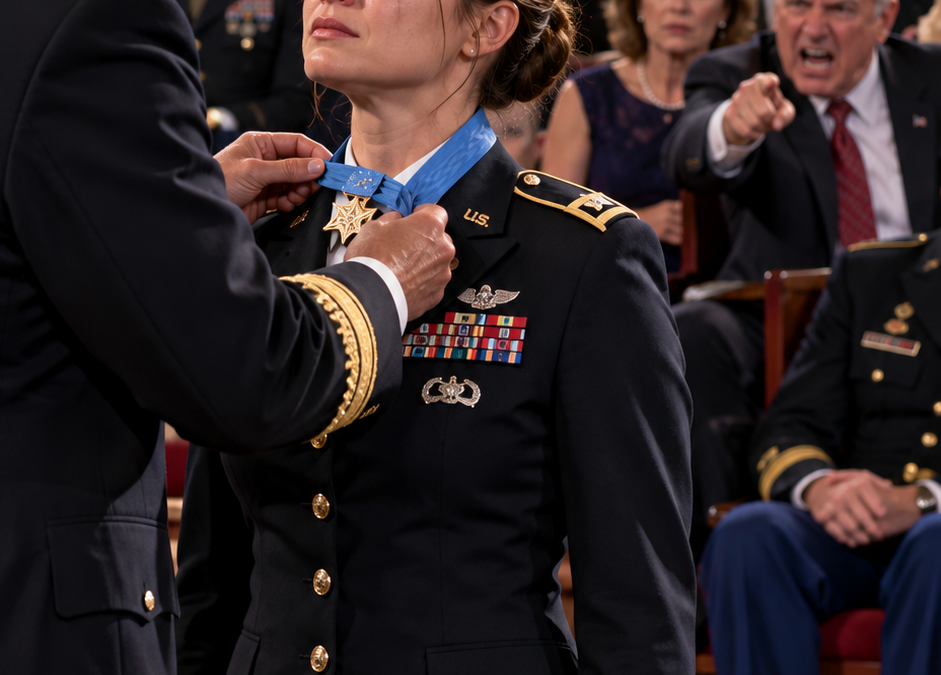
My Father Mocked Me Seconds Before the Medal Was Pinned to My Chest, Never Knowing What the Sealed File Beside the General Contained
The Medal of Honor was only inches from my chest when my father leaned forward from the third row and said, loud enough for half the auditorium to hear, “She didn’t earn any of this.”
The room went silent.
I had survived ambushes, casualty reports, deployments, and nights when men died while I was trying to get them home.
None of that prepared me for looking past the commanding general and seeing my own family staring back at me like I was still the daughter who had spent her entire life being told she was never quite as important as she believed.
My name is Captain Taylor Morgan.
I was thirty years old that day, with twelve years in the United States Army behind me.
People assume courage becomes easier after enough years in uniform.
It doesn’t.
You simply learn how to function while afraid.
You learn how to breathe when your lungs want to lock.
How to keep your voice steady when your mind is racing.
How to look at the person beside you and make them believe there is still a plan even when you are trying desperately to find one.
I understood that kind of pressure.
I understood the pressure of incoming fire.
I understood the responsibility of knowing one decision could determine whether someone’s husband, daughter, brother, or father came home.
What I never learned was how to stand beneath bright auditorium lights while my own father tried to reduce the greatest honor of my military career to luck.
I stood in full dress uniform at the front of the room.
Chin level.
Shoulders square.
Hands at my sides.
Senior officers filled the first rows.
Soldiers I had served beside sat farther back.
Families of the men we had lost were there too.
That was the part that mattered most.
Sergeant First Class Daniel Reeves.
Staff Sergeant Omar Bell.
Specialist Marcus Hale.
Three men who had been alive at the beginning of one terrible night near Fort Irwin, California.
Three men whose photographs I still could not look at without remembering blood, smoke, and the weight of bodies becoming heavier in my arms as strength left them.
Their families deserved every word of that ceremony.
The medal around my neck would have my name attached to it.
The reason it existed belonged to more than me.
My family sat in the third row.
Mom had her hands clasped together so tightly her knuckles were pale.
My younger brother Ryan slouched beside her with a faint half-smile that looked almost bored.
Dad sat on the aisle.
He looked irritated.
Not emotional.
Not proud.
Irritated.
I knew that expression.
I had seen it when I brought home straight A’s in high school and he said, “Nobody cares about report cards once you enter the real world.”
I saw it when I graduated early.
When I enlisted.
When I completed training.
When I received my first promotion.
When I came home from my first deployment.
No accomplishment was allowed to remain an accomplishment for long.
Dad always found a way to shrink it.
If I succeeded academically, I was trying too hard.
If I succeeded in the Army, standards must have dropped.
If someone praised me, I was getting attention because I was a woman.
If I received a promotion, I had probably been in the right place at the right time.
I spent years pretending it did not hurt.
That was one of the skills I learned before the Army ever taught me discipline.
The aide began reading my citation.
The language was formal.
Controlled.
Clean.
An ambush during a classified training operation near Fort Irwin.
Hostile fire from elevated positions.
A disabled vehicle.
A blocked route.
Personnel trapped.
Captain Morgan repeatedly exposed herself to hostile fire while coordinating the evacuation of wounded soldiers.
The words sounded almost sterile.
Nothing about that road had been sterile.
I remembered darkness lit by fire.
Rounds cracking through the air.
Someone screaming for a medic.
The smell of fuel.
The sound of tires grinding against dirt when the lead vehicle stopped moving.
A burning vehicle trapped partly sideways across the road.
Radio traffic colliding in my headset.
Men shouting over one another.
I remembered dropping behind the engine block of our vehicle and seeing Daniel Reeves twenty yards away trying to drag one of our people toward cover.
Then he went down.
I remembered thinking:
Move.
That was all.
Not strategy.
Not heroism.
Move.
I ran.
The citation said I “advanced under direct hostile fire.”
What I remembered was my lungs tearing against smoke.
My knees hitting gravel.
A bullet striking metal somewhere to my left.
Daniel’s body heavier than it should have been because unconscious men cannot help you carry them.
Omar Bell screaming at me to get down.
Marcus Hale moving toward the burning vehicle even after I ordered him back.
Three men did not leave that road alive.
The military eventually told me what I had done deserved the nation’s highest military decoration.
For years, all I could think was that three families still had empty chairs.
The aide kept reading.
Then my father spoke.
“She didn’t earn it.”
His voice carried.
Several people turned.
I felt something tighten beneath my ribs.
I did not look back.
The aide hesitated but continued.
Dad spoke again.
“She got lucky. She always knew how to make herself look important.”
Someone shifted in the third row.
A colonel near the front turned slowly.
I kept my eyes forward.
Strangers had insulted me before.
Men had questioned whether I deserved command.
I had sat at tables where I needed to prove myself twice before being believed once.
Those moments were unpleasant.
But strangers did not know which words had been used against you since childhood.
My father did.
That was why his words still found places no enemy ever had.
The citation ended.
The commanding general stepped forward.
The Medal of Honor rested inside a dark velvet case held by an aide.
I took one step toward him.
Then Dad laughed under his breath.
“She’s just a tool.”
The general stopped.
Completely.
His hands froze above the case.
The air changed.
He slowly turned toward the third row.
“Sir.”
Dad’s half-smile faded.
The general’s voice was calm.
“Would you repeat what you just said?”
Mom went pale.
Ryan straightened slightly.
Dad looked around as if suddenly realizing the people surrounding him were no longer family members he could dismiss.
“I said nothing.”
The general stared at him.
For a second, I expected anger.
Instead, I saw something stranger.
Recognition.
Like a man hearing a phrase that fit somewhere inside a puzzle he had been studying for years.
He turned toward an aide.
“Bring me the Morgan file.”
My stomach dropped.
An aide left through a side door.
I looked toward the general.
“Sir?”
He did not answer.
A minute later, the aide returned carrying a sealed folder.
The general accepted it.
Opened it.
Read the first page.
Then another.
When he looked at me again, something in his expression made the room disappear around me.
“Captain Morgan.”
“Yes, sir.”
“The official investigation into the ambush near Fort Irwin was never fully closed.”
I stopped breathing.
I had known certain aspects remained under review.
Every serious operational failure gets examined.
Communications.
Movement.
Security.
Procedures.
Equipment.
Threat reporting.
But years had passed.
I believed whatever remained unresolved was technical.
The general turned another page.
“The hostile element knew details concerning your route.”
My heartbeat changed.
“They knew your approximate departure time.”
Another page.
“They had information regarding vehicle movement.”
My fingers went cold.
Ryan moved in the third row.
Mom whispered, “Oh God.”
The general looked toward my father.
“The information did not originate solely from within Captain Morgan’s unit.”
Dad leaned forward.
“What does that mean?”
The general closed the folder.
“Some information connected to the compromise passed through members of Captain Morgan’s family.”
For three seconds, nobody moved.
Then Dad laughed.
Too quickly.
Too loudly.
“That’s absurd.”
The general’s face hardened.
“No, sir.”
“You’re accusing us of terrorism in front of everyone?”
“I said nothing of the kind.”
His voice remained measured.
“I stated that information associated with Captain Morgan’s family entered the chain that ultimately contributed to the compromise of her movements.”
That distinction mattered.
Even in the shock of that moment, it mattered.
I turned toward my family.
Mom was not looking at Dad.
She was staring at Ryan.
Ryan’s half-smile was gone.
His right leg bounced underneath his chair.
“Ryan?” Mom whispered.
He stared at the floor.
Something inside me went cold.
I did not know what he had done.
I only knew he knew something.
I looked at the general.
“Sir, permission to speak privately.”
He nodded immediately.
“The ceremony will pause.”
A murmur moved across the auditorium.
The Medal of Honor remained inside its velvet case.
Unpinned.
Unfinished.
For some reason, that bothered me.
Not because I needed the medal.
Because Daniel’s widow was still sitting there.
Omar’s father was there.
Marcus’s mother had traveled hundreds of miles.
My family had already taken enough space inside that room.
I would not let them take the rest.
“Sir.”
The general looked at me.
“I would like the ceremony completed first.”
His brows drew together.
“Captain—”
“The families are here.”
I looked toward them.
“This is not only mine.”
The general studied me.
Then his expression softened.
“Understood.”
The aide stepped forward again.
My father said nothing.
Ryan said nothing.
The general lifted the medal.
He placed it around my neck.
The ribbon settled against my collar.
The medal itself was surprisingly light.
That disturbed me.
Nothing connected to that night should have weighed so little.
Applause rose.
People stood.
I barely heard them.
I looked beyond the general.
Daniel Reeves’s widow, Marissa, was crying.
Omar Bell’s father stood with both hands at his sides.
Marcus Hale’s mother pressed her fingers over her mouth.
I raised my hand.
Saluted.
Not my family.
Them.
Twenty-two minutes later, I sat inside a secure conference room.
The commanding general sat across from me.
Beside him was a military attorney.
Two investigators occupied the far side.
A representative from Army counterintelligence sat nearest the door.
My family was not present.
That was deliberate.
The door closed.
The medal was still around my neck.
I wanted to remove it.
I didn’t.
One investigator introduced herself.
“Special Agent Rebecca Shaw.”
She placed the sealed folder between us.
“Captain Morgan, before we proceed, I need to clarify something said in the auditorium.”
I looked at the general.
He nodded once.
Shaw continued.
“The general’s statement was broader than investigators would normally characterize our findings.”
The general did not defend himself.
“I made an inference based on information in the file and the reaction I observed.”
He looked directly at me.
“I should have been more precise.”
It was a small moment.
But it mattered.
Rank had never impressed me as much as accountability.
“What do you actually know?” I asked.
Shaw opened the folder.
“We know that information concerning your movements left protected environments through several sources.”
“My family?”
“We know some fragments later associated with the compromise passed through devices, accounts, photographs, or communications connected to members of your family.”
“Which members?”
She paused.
“Your brother is one.”
Ryan.
For one second, the thirty-year-old man in the auditorium disappeared.
I saw him at twelve.
Skinny.
Missing one front tooth.
Standing outside my bedroom during thunderstorms because he was too embarrassed to tell Mom he was scared.
I used to let him sleep on my floor.
I would throw him a blanket and say nothing.
Then I saw him again in the third row.
Smirking while Dad insulted me.
“What did he send?”
“We need to walk through what has been verified before we characterize his conduct.”
“Did he send someone my route?”
“Not in a message stating a specific route.”
Relief came too quickly.
I hated myself for it.
“Then what?”
Shaw turned the first pages toward me.
Most identifying information had been redacted.
Dates.
Times.
Fragments of communication.
Screenshots.
Photographs.
Several months before the ambush, Ryan had become active in a private online community.
Military collectibles.
Defense news.
Gaming.
Veterans.
People trading patches and insignia.
People arguing about weapons systems they had never touched.
At first, nothing about it appeared especially sinister.
Ryan liked having a sister in the Army.
Not because he was proud of me.
Because it made him interesting.
He posted old family photographs.
Images Mom had sent him.
Pictures from promotion ceremonies.
One image showed me beside a military vehicle during a training rotation.
Another captured part of a unit patch.
Another showed a printed schedule on a board in the background.
Nothing in any single photograph exposed the Fort Irwin operation.
Together, they revealed patterns.
Unit affiliation.
Training cycles.
Locations.
Movement habits.
My throat tightened.
“I sent that one to Mom.”
“Yes.”
“How did he get it?”
“We have not established whether your mother forwarded it intentionally, whether he accessed it from a shared family account, or whether it was transferred through another device.”
Unknown.
That mattered too.
I had spent enough years in investigations to know the danger of turning suspicion into certainty because certainty hurt less.
“What else?”
“Ryan answered questions.”
“What kind?”
Shaw looked down.
“Where you were stationed. Whether you were returning to California. How long certain rotations usually lasted. Whether officers used different vehicles. Whether you complained about early movement times. General details about training.”
“Enough to plan an ambush?”
“No.”
The answer was immediate.
I looked at her.
“No?”
“No single set of communications from Ryan contained enough information to construct the attack.”
My shoulders loosened for perhaps half a second.
Then Shaw continued.
“But those communications appear to have helped identify you as a useful indirect information source.”
The relief disappeared.
Someone eventually contacted Ryan privately.
A man calling himself Cole Archer.
Investigators did not believe the name was real.
At first, Cole was friendly.
He flattered Ryan.
Told him he had unusually good military knowledge.
Asked questions about equipment.
Army culture.
Training.
He bought a collectible from him.
Then another.
Eventually, he offered Ryan money for what he described as research.
“How much?”
“The first payment was two hundred dollars.”
I stared at her.
Two hundred dollars.
Daniel dead.
Omar dead.
Marcus dead.
My first thought was irrational and ugly.
Three men for two hundred dollars.
Shaw seemed to understand.
“The payments increased.”
“How much total?”
“Just under eighteen thousand dollars over approximately eleven months.”
I felt sick.
“He took money for talking about me.”
“Eventually, yes.”
“Did he know what it was for?”
Shaw’s expression changed.
There it was.
The real question.
Did Ryan knowingly help someone put us on that road?
“We have not concluded that your brother knew the information would be used to carry out a physical attack.”
I stood.
Nobody stopped me.
I walked to the far end of the room and put both hands on the conference table.
Breathe.
Once.
Twice.
Again.
“What did he think he was being paid for?”
“He has provided several explanations.”
Of course.
Market research.
Then a documentary project.
Then a private security consultancy.
Later, Ryan claimed he believed Cole worked with an American defense contractor.
Each explanation arrived at a different point in the investigation.
That did not automatically prove the worst.
But it proved he knew he needed a story.
“Why wasn’t I told?”
The military attorney answered.
“Because until recently, investigators could not establish whether the family-linked information had any real connection to the ambush or was merely general exposure unrelated to the attack.”
“Recently?”
“Three weeks ago.”
“What changed?”
Shaw opened another section.
“A recovered device.”
Not Ryan’s.
A device linked to an intermediary connected to Cole.
Investigators recovered communications that helped assemble the broader chain.
Ryan was not the only source.
That fact mattered.
A civilian contractor had exposed logistics information.
A compromised commercial account revealed vehicle servicing data.
A poorly secured scheduling system provided pieces of timing information.
Ryan’s communications helped connect my identity to several fragments.
No single person handed over the entire route.
The ambush had been built the way many compromises are built.
Piece by piece.
One fact that seems harmless.
Then another.
Then another.
Until someone looking from the outside sees a picture nobody on the inside realizes they have created.
I returned to my chair.
“So Ryan didn’t cause the ambush.”
Shaw took her time.
“We cannot support that conclusion.”
My jaw tightened.
“Did he contribute?”
“Yes.”
“How much?”
“We may never be able to quantify that.”
I hated the answer.
It was probably the most honest one anyone could give.
I looked toward the general.
“Why did Dad react?”
Shaw opened another section.
“That is one reason we wanted this discussion.”
She showed me an email.
Ryan to Dad.
Dad, if anyone asks, I don’t talk to people about Taylor’s work.
My father replied:
Then stop putting it in writing.
My blood went cold.
Another conversation.
Ryan:
It’s not classified. She tells Mom half this stuff anyway.
Dad:
I don’t care what she calls classified. You’re an adult. Don’t be stupid.
Ryan:
Easy money. Relax.
Dad:
Then don’t tell me about it.
I stared at the screen.
Some sentences sound ordinary until people die.
After that, every word becomes heavier.
“Dad knew.”
“He knew your brother was receiving money in connection with information related to military life and, eventually, information associated with you.”
“Did he know who Cole was?”
“We have no evidence of that.”
“Was Dad paid?”
“No evidence.”
“Did he tell Ryan to stop?”
Shaw pointed toward the message.
“He cautioned him.”
“That is not what I asked.”
She held my gaze.
“No.”
“Did he tell me?”
“No.”
I thought about Dad in the auditorium.
She’s just a tool.
The words sounded different now.
Not simply cruel.
A tool.
Something valuable only because someone else could use it.
“What about Mom?”
“No evidence she was paid.”
“Did she know?”
“That is less clear.”
Mom had sent Ryan photographs.
Normal mother things.
Pictures from promotions.
Family images.
She answered questions.
Is Taylor home?
When is she leaving?
Is she in California?
Mostly ordinary conversation between a mother and son.
Until somebody else was collecting the answers.
One exchange made my stomach tighten.
Ryan:
Taylor heading west again?
Mom:
Thursday. She said she’ll barely have phone service for about two weeks. Don’t bother her.
Ryan:
Early flight?
Mom:
Military. They never tell me anything until the last minute.
Not a route.
Not a grid coordinate.
Not a vehicle.
Just a mother answering a son.
But context changes harmless information.
“Does she know?”
“Not yet.”
“I want to see Ryan.”
“No.”
I looked at Shaw.
“He is being interviewed separately. Your father as well. Your mother has access to counsel. We cannot allow family contact while interviews are ongoing.”
Part of me wanted to argue.
The officer in me knew she was right.
The Medal of Honor did not allow me to bend an investigation around my grief.
I was grateful for that.
I returned to my hotel after midnight.
The medal rested in its presentation case on the desk.
I had finally taken it off.
My phone showed seventy-three missed calls and messages.
Reporters.
Army contacts.
Friends.
Relatives.
Dad.
Mom.
Ryan.
I placed it face down.
At 1:14 in the morning, security called my room.
“Captain Morgan, your mother is downstairs.”
I nearly said no.
Then I let her come up.
She looked twenty years older when I opened the door.
“Taylor.”
I stepped aside.
She entered.
No hug.
No small talk.
“Did you know?”
Her eyes filled.
“No.”
I believed that she believed her answer.
That did not yet mean I knew it was true.
“Did Ryan ask about my movements?”
“Sometimes.”
“Did you send him photographs?”
“He’s your brother.”
“That isn’t an answer.”
“Yes.”
“Did Dad know Ryan was talking to someone?”
Her face changed.
A fraction.
Enough.
“How much did you know?”
“I knew they argued.”
“About what?”
“Money.”
“What money?”
“I don’t know.”
“Mom.”
“I swear.”
She sat down.
“Your father found deposits in Ryan’s account.”
“When?”
She looked at the carpet.
“About two years ago.”
Before the ambush.
My fingertips went numb.
“What did Ryan say?”
“That someone was paying him for online research.”
“And Dad?”
“He said Ryan was going to get himself in trouble.”
“Then what happened?”
Mom cried.
“Nothing.”
Nothing.
One of the most destructive words any family can use.
“What do you mean nothing?”
“They argued. Ryan left. Your father was furious.”
“And?”
“That was it.”
“Why didn’t you tell me?”
“I didn’t know it involved you.”
“Did you ask what the money was for?”
“No.”
“Why?”
Her shoulders began shaking.
“Because every time your father and Ryan fought, the whole house became unbearable.”
I stared at her.
“So you chose quiet.”
She closed her eyes.
“Yes.”
Mom had spent my childhood calling herself the peacemaker.
That night, I finally understood what that often meant.
She did not stop the conflict.
She waited until the person most capable of enduring it absorbed the cost.
Usually me.
“You knew Ryan was receiving suspicious money.”
“I knew your father thought it was suspicious.”
“And you did nothing because asking questions might start another fight.”
“Yes.”
I nodded slowly.
“Thank you.”
She looked up.
“For what?”
“For finally saying it correctly.”
She reached toward me.
I stepped away.
Her hand dropped.
“Taylor, I would never knowingly put you in danger.”
“I believe you.”
Relief appeared too quickly on her face.
I continued.
“But you do not have to intend the final harm to be responsible for ignoring warnings that came before it.”
She began crying harder.
I did not comfort her.
Not that night.
Dad’s fuller explanation came through investigators and later through his attorney.
He had discovered Ryan’s unexplained deposits.
Ryan told him he was providing military background information to a private risk-analysis company.
Dad suspected something was wrong.
But my father had another problem.
He resented my career.
Investigators recovered messages.
Dad to Ryan:
Your sister acts like the Army made her royalty. If some idiot wants to pay you for stories about military life, take his money. Just don’t give him anything actually secret.
Ryan:
Nothing she tells us is secret anyway.
Dad:
Exactly.
I read the exchange alone.
Three times.
Then I threw up in the trash can beside my desk.
My father had not planned an ambush.
He had not selected the route.
He had not knowingly helped anyone attack soldiers.
Those distinctions were important.
But he had seen enough warning signs to question what Ryan was doing.
Instead, contempt won.
Respecting my profession would have required believing that information boundaries existed for reasons he did not understand.
Dad preferred to believe I exaggerated the importance of everything.
So when Ryan found a way to make money from proximity to me, Dad minimized that too.
He had not caused the ambush.
But when he had a chance to stop something reckless, he normalized it.
I requested ten days of leave.
My commander approved it.
Then I did something I had been afraid to do since learning the truth.
I visited the families of the three men who died.
Alone.
No public affairs officer.
No ceremony.
No dress uniform.
Daniel Reeves’s widow, Marissa, opened the door.
Two daughters lived with her.
The younger barely remembered her father.
That fact lodged under my ribs.
We sat at her kitchen table.
I explained that investigators had uncovered additional information.
I did not reveal protected details.
I did not exaggerate what investigators knew.
Then I said the sentence I had rehearsed fifty times.
“My brother may have contributed information that became part of the compromise.”
Marissa stared at me.
I waited for anger.
I expected it.
Maybe I wanted it.
Instead she asked, “Did you know?”
“No.”
“Could you have stopped him?”
“No.”
“Then why are you apologizing?”
I opened my mouth.
Nothing came.
Marissa answered for me.
“Because you lived.”
That destroyed whatever discipline I had left.
I cried.
Not the controlled tears people allow themselves at ceremonies.
I folded over at a stranger’s kitchen table and cried against the shoulder of a woman whose husband I had not brought home.
She held me.
There is no medal heavy enough for that moment.
The investigation lasted another fourteen months.
People outside the system expected something cleaner.
A dramatic arrest.
A confession.
A single villain.
Reality was slower.
Financial records.
Devices.
Interviews.
Legal thresholds.
Classification reviews.
What Ryan knew at each moment mattered.
What Cole claimed to be mattered.
The difference between public, sensitive, protected, and classified information mattered.
Intent mattered.
Money mattered.
Timing mattered.
Ryan eventually admitted he had lied.
Not about everything.
Enough.
He knew Cole was not simply a collector.
He knew the questions became more specific over time.
He knew access to me made the information valuable.
He claimed he never believed anyone would physically attack American soldiers.
Investigators had to evaluate whether that claim matched the evidence.
I did not.
That was not my job.
One message stayed with me.
Cole:
When does she usually move during those desert exercises?
Ryan:
Why? Planning to send her flowers?
Cole:
Something like that.
Ryan:
Early. Before sunrise usually. She hates it.
No route.
No coordinates.
No vehicle number.
Just a brother being clever.
Two days later, Ryan received fifteen hundred dollars.
When I read that, something inside me closed.
Not permanently.
But for a long time.
The legal consequences were complicated.
Some of Ryan’s conduct supported charges.
Some did not.
Some information had been sensitive without being classified.
Other evidence belonged to broader investigations I was never fully briefed on.
Ryan eventually faced serious federal consequences for what prosecutors could prove.
Not for the worst thing grieving people imagined.
I did not ask prosecutors for the maximum punishment.
I did not write a mercy letter.
When investigators asked questions, I told the truth.
That was enough.
Dad was not charged as though he had planned the attack.
Because he had not.
Investigators documented his communications and knowledge.
His employer learned that some conversations had occurred using company systems.
After more than two decades in the same position, Dad lost his job.
He blamed me.
His first letter said:
I hope you’re happy. Your medal cost me my career and my son his future.
I did not answer.
The second:
You know I never wanted anyone hurt.
That one I answered.
Four words.
That wasn’t the standard.
He called immediately.
I let voicemail take it.
Months passed.
Then another letter arrived.
The tone was different.
I spent your whole life treating your achievements like insults directed at me.
I stopped reading for a moment.
Then continued.
When Ryan started making money because of what he knew through you, part of me liked it. It made your career seem less special. Something the rest of us could profit from too.
I put the letter down.
That hurt more than the insult at the ceremony.
Then:
I told myself nothing Ryan knew could matter because you weren’t stupid enough to tell us secrets. That allowed me to avoid asking why strangers were paying him for scraps.
And finally:
I did not set up the ambush. But I helped create the attitude that made Ryan believe using you was harmless.
For the first time, Dad had given me something honest.
Not forgiveness.
Not reconciliation.
Something I could work with.
Mom entered counseling.
So did I.
Separately.
Two years later, she told me something I had waited my entire life to hear.
“I wasn’t keeping peace.”
I waited.
“I was protecting myself from discomfort.”
My throat tightened.
She continued.
“You were always the strongest one. So I assumed you could absorb whatever I didn’t want to confront.”
There it was.
My childhood in one sentence.
Straight A’s dismissed.
Dad excused.
Ryan rescued.
Taylor can handle it.
Taylor always handles it.
I told her, “Being able to carry weight does not mean people are entitled to load me.”
Mom nodded.
“I know.”
My relationship with Ryan disappeared for almost four years.
No birthdays.
No Christmas calls.
No messages through Mom.
I made one rule.
If he needed to say something, he could write.
I might read it.
I did not promise to answer.
His first letter was twenty pages.
I read two.
Excuses.
Cole manipulated him.
Money was tight.
Dad encouraged him.
He never knew.
He never intended.
I put it away.
Nine months later, another came.
Three pages.
Better.
Then a third.
One page.
The first sentence stopped me.
I knew you would tell me to stop if I asked whether what I was doing was safe.
I sat down.
That was the sentence underneath so many betrayals.
You would have said no.
So he never asked.
Ryan continued.
I used the fact that you never told us classified information as permission to sell everything else I could learn about you.
Then:
I kept moving the line because every individual thing looked small.
Fragments.
Exactly what investigators had concluded.
Finally:
Three men died in an ambush built out of fragments. I do not know which fragment mattered. I have to live without knowing.
I cried.
Not for Ryan.
Not yet.
For Daniel.
Omar.
Marcus.
For the possibility that nobody would ever be able to say which careless detail connected to which decision on that road.
I wrote back one sentence.
I read your letter.
That was all I could give.
Years passed.
I was promoted again.
Not because of the medal.
If anything, the Medal of Honor complicated my career.
People assume visible heroism translates automatically into leadership.
It doesn’t.
Leadership is usually boring.
Paperwork.
Training.
Accountability.
Listening.
Telling somebody they are wrong without humiliating them.
Admitting your own error before rank makes it impossible to hide.
Making decisions when nobody applauds.
The ambush changed how I taught operational security.
I never used Ryan’s name.
I never told soldiers:
My brother did this.
I told them:
“Compromise rarely introduces itself as compromise.”
A photograph.
A schedule barely visible in the background.
A casual question.
A mother saying her daughter is leaving Thursday.
A brother bragging online.
A stranger flattering him.
A payment small enough to seem harmless.
Fragments.
But I refused to teach paranoia.
That distinction mattered.
Mom had not knowingly betrayed me.
Dad had not planned an attack.
Ryan had not possessed the entire route.
Different conduct.
Different responsibility.
Pain makes people want simple categories.
Villain.
Victim.
Guilty.
Innocent.
But truth often survives only when you resist that temptation.
Five years after the Medal of Honor ceremony, I returned to Fort Irwin.
There was a memorial.
Three names.
Reeves.
Bell.
Hale.
I stood in front of them alone.
No cameras.
No uniform.
No medal.
Only me.
The desert wind moved dust across the concrete.
“I know more now,” I said.
Nothing answered.
“I still don’t know enough.”
Wind.
“I don’t know whether Ryan’s information changed exactly what happened.”
I swallowed.
“But I’m sorry he gave anyone the chance to use it.”
That was the apology I could make honestly.
No more.
No less.
When I returned home, a package waited outside my door.
From Dad.
Inside was the printed program from my Medal of Honor ceremony.
He had kept it.
Across the page containing my citation, he had written three words.
I was wrong.
Nothing else.
I stared at the handwriting for a long time.
Then I called him.
Our first real conversation in almost six years.
He answered on the first ring.
“Taylor?”
“Yes.”
He started crying.
I let him.
Then he said something I could not accept.
“I was proud of you.”
I closed my eyes.
“Don’t.”
Silence.
“Don’t rewrite it now.”
His breathing trembled.
“I understand.”
“You weren’t proud.”
“No.”
“You resented me.”
“Yes.”
“You humiliated me during the biggest ceremony of my military career.”
“Yes.”
“You knew Ryan was receiving suspicious money and chose contempt over caution.”
“Yes.”
A long silence.
Then:
“I am ashamed.”
That I believed.
We spoke for eleven minutes.
No dramatic reconciliation.
No sudden restoration.
Eleven minutes.
Three months later, another call.
Later, coffee.
A public place.
Forty-five minutes.
That was how the relationship returned.
Slowly.
Awkwardly.
Boundaries are rarely dramatic when they work.
Ryan took longer.
Much longer.
Eventually, after the legal restrictions were gone and enough years had passed, we met.
He looked older.
So did I.
We sat across from each other in a quiet restaurant.
He noticed the small medal ribbon pin on my civilian coat.
“You still wear that?”
“Sometimes.”
He nodded.
“I used to think you liked people knowing.”
“I do.”
He looked surprised.
I held his gaze.
“I earned it.”
That sentence felt good.
Not arrogant.
Not defensive.
True.
Ryan looked down.
“Dad made everything you accomplished sound like arrogance.”
“I know.”
“I believed him.”
“I know.”
He rubbed his hands together.
“I think part of why I took Cole’s money was because your career finally made me feel important.”
I said nothing.
“That’s disgusting.”
“Yes.”
He looked at me.
I did not soften it.
He had not come for softness.
“Do you forgive me?”
“No.”
His face changed.
Then I continued.
“I don’t know yet.”
He nodded.
“Okay.”
That was the first time in years Ryan had accepted one of my answers without trying to negotiate it.
We have a relationship now.
Small.
Careful.
Real.
He never asks about my work.
If I mention travel, he changes the subject unless I explicitly tell him details are fine.
At first, it felt exaggerated.
Eventually, I understood what he was doing.
He was practicing respect until it became instinct.
Sometimes that is what change looks like.
Dad never attended another military ceremony.
His choice.
Mom did.
Years later, when I retired, she sat in the front row.
No Dad.
No Ryan.
Only Mom.
When the speaker summarized my career, she cried quietly.
Afterward, she hugged me.
Then said:
“I am proud of you.”
I believed her.
Not because the sentence was perfect.
Because she had spent years behaving like it was true.
I retired with more ribbons than I ever knew what to do with.
But there was only one medal I refused to store in a drawer.
The Medal of Honor remained in its case beside three photographs.
Daniel Reeves.
Omar Bell.
Marcus Hale.
The medal had been awarded to me.
In my mind, the case belonged to four people.
Sometimes people ask whether discovering the truth destroyed the ceremony.
No.
Dad tried to ruin it.
The investigation interrupted it.
The truth changed it.
But none of them could take it away.
That distinction took me years to understand.
For too long, Dad’s words from the third row followed me.
She’s just a tool.
At first, I thought the cruelty was that my father did not understand my value.
Eventually, I realized something worse.
He did understand value.
He simply defined it as usefulness.
My achievements were useful when the family wanted to brag.
My knowledge was useful when Ryan could turn it into money.
My resilience was useful to Mom because it allowed her to avoid confrontation.
Even my silence was useful.
Taylor can handle it.
Taylor always handles it.
I stopped being useful that way.
That change disturbed my family more than any medal ever could.
I stopped carrying conversations other adults refused to have.
I stopped explaining Dad’s cruelty through his childhood.
Stopped protecting Mom from the consequences of silence.
Stopped translating Ryan’s choices into excuses about money and insecurity.
They were adults.
So was I.
And I stopped apologizing for the medal.
That took longer.
Whenever somebody called me heroic, my instinct had always been to correct them.
I would think about the men who died.
About mistakes.
Fear.
Everything I could not control.
Survivor’s guilt contains a strange arrogance.
It convinces you that if you had been better, faster, stronger, nobody around you would ever have died.
War does not work that way.
Neither does leadership.
I did what I could on that road.
So did Daniel.
So did Omar.
So did Marcus.
The citation never claimed I was perfect.
It described what I did.
Eventually, I learned to let the words stand.
The last time Dad saw the medal, he was visiting my home.
He stopped in front of the display case.
Looked at it.
Then at the three photographs beside it.
“Do you ever wish the general hadn’t opened that file that day?”
I thought about the question.
“No.”
“Even knowing what happened afterward?”
“Yes.”
He frowned.
I explained.
“The truth didn’t create the cost.”
He looked at me.
“It showed me who had already been paying it.”
Dad lowered his head.
That was the lesson my family had avoided for years.
Silence does not prevent consequences.
Sometimes it only decides who carries them.
Mom’s silence protected Ryan from questions.
Dad’s contempt protected him from admitting my work had boundaries worth respecting.
Ryan’s secrecy protected his money.
And the risk went somewhere else.
To me.
To my soldiers.
To three families who sat in an auditorium applauding while my own father called me a tool.
I cannot change that road in California.
I cannot reconstruct every fragment.
I cannot prove which fragment mattered most.
I cannot give three men back to the people who loved them.
And I cannot turn my father into the man I needed him to be when I was twelve.
Those things are not failures.
They are limits.
There is freedom in finally knowing the difference.
The Medal of Honor still feels heavier in memory than it ever did around my neck.
Not because of Dad.
Not because of Ryan.
Because it reminds me of three men whose names deserve to be spoken before mine.
Daniel Reeves.
Omar Bell.
Marcus Hale.
My family spent years treating my service as something they could minimize, borrow from, profit from, or use to settle their own feelings about me.
They were wrong.
My service never belonged to them.
Neither did my information.
Neither did my achievements.
Neither did my silence.
And when Dad called me a tool beneath those auditorium lights, he accidentally gave me the word I needed to understand my entire family.
A tool exists to be used.
That was what they had expected me to be.
Strong enough to carry whatever they refused to carry.
Quiet enough to accept whatever they refused to confront.
Successful enough to be useful, but never proud enough to demand respect.
I was done.
I was a soldier.
A daughter.
A sister.
A leader.
A survivor.
And after thirty years of being valued according to how much weight I could carry for everyone else, I finally became something my family had never learned how to handle.
A woman who could look at the people she loved and say, without anger and without apology:
You do not get to use me anymore.
What do you think of this story? Please leave a like and share your thoughts in the comments. Your support means a lot to us and inspires us to keep writing more meaningful and powerful stories. Thank you! 👍
𝗧𝗛𝗘 𝗘𝗡𝗗
My Father Mocked Me Seconds Before the Medal Was Pinned to My Chest, Never Knowing What the Sealed File Beside the General Contained
The Medal of Honor was only inches from my chest when my father leaned forward from the third row and said, loud enough for half the auditorium to hear, “She didn’t earn any of this.”
The room went silent.
I had survived ambushes, casualty reports, deployments, and nights when men died while I was trying to get them home.
None of that prepared me for looking past the commanding general and seeing my own family staring back at me like I was still the daughter who had spent her entire life being told she was never quite as important as she believed.
My name is Captain Taylor Morgan.
I was thirty years old that day, with twelve years in the United States Army behind me.
People assume courage becomes easier after enough years in uniform.
It doesn’t.
You simply learn how to function while afraid.
You learn how to breathe when your lungs want to lock.
How to keep your voice steady when your mind is racing.
How to look at the person beside you and make them believe there is still a plan even when you are trying desperately to find one.
I understood that kind of pressure.
I understood the pressure of incoming fire.
I understood the responsibility of knowing one decision could determine whether someone’s husband, daughter, brother, or father came home.
What I never learned was how to stand beneath bright auditorium lights while my own father tried to reduce the greatest honor of my military career to luck.
I stood in full dress uniform at the front of the room.
Chin level.
Shoulders square.
Hands at my sides.
Senior officers filled the first rows.
Soldiers I had served beside sat farther back.
Families of the men we had lost were there too.
That was the part that mattered most.
Sergeant First Class Daniel Reeves.
Staff Sergeant Omar Bell.
Specialist Marcus Hale.
Three men who had been alive at the beginning of one terrible night near Fort Irwin, California.
Three men whose photographs I still could not look at without remembering blood, smoke, and the weight of bodies becoming heavier in my arms as strength left them.
Their families deserved every word of that ceremony.
The medal around my neck would have my name attached to it.
The reason it existed belonged to more than me.
My family sat in the third row.
Mom had her hands clasped together so tightly her knuckles were pale.
My younger brother Ryan slouched beside her with a faint half-smile that looked almost bored.
Dad sat on the aisle.
He looked irritated.
Not emotional.
Not proud.
Irritated.
I knew that expression.
I had seen it when I brought home straight A’s in high school and he said, “Nobody cares about report cards once you enter the real world.”
I saw it when I graduated early.
When I enlisted.
When I completed training.
When I received my first promotion.
When I came home from my first deployment.
No accomplishment was allowed to remain an accomplishment for long.
Dad always found a way to shrink it.
If I succeeded academically, I was trying too hard.
If I succeeded in the Army, standards must have dropped.
If someone praised me, I was getting attention because I was a woman.
If I received a promotion, I had probably been in the right place at the right time.
I spent years pretending it did not hurt.
That was one of the skills I learned before the Army ever taught me discipline.
The aide began reading my citation.
The language was formal.
Controlled.
Clean.
An ambush during a classified training operation near Fort Irwin.
Hostile fire from elevated positions.
A disabled vehicle.
A blocked route.
Personnel trapped.
Captain Morgan repeatedly exposed herself to hostile fire while coordinating the evacuation of wounded soldiers.
The words sounded almost sterile.
Nothing about that road had been sterile.
I remembered darkness lit by fire.
Rounds cracking through the air.
Someone screaming for a medic.
The smell of fuel.
The sound of tires grinding against dirt when the lead vehicle stopped moving.
A burning vehicle trapped partly sideways across the road.
Radio traffic colliding in my headset.
Men shouting over one another.
I remembered dropping behind the engine block of our vehicle and seeing Daniel Reeves twenty yards away trying to drag one of our people toward cover.
Then he went down.
I remembered thinking:
Move.
That was all.
Not strategy.
Not heroism.
Move.
I ran.
The citation said I “advanced under direct hostile fire.”
What I remembered was my lungs tearing against smoke.
My knees hitting gravel.
A bullet striking metal somewhere to my left.
Daniel’s body heavier than it should have been because unconscious men cannot help you carry them.
Omar Bell screaming at me to get down.
Marcus Hale moving toward the burning vehicle even after I ordered him back.
Three men did not leave that road alive.
The military eventually told me what I had done deserved the nation’s highest military decoration.
For years, all I could think was that three families still had empty chairs.
The aide kept reading.
Then my father spoke.
“She didn’t earn it.”
His voice carried.
Several people turned.
I felt something tighten beneath my ribs.
I did not look back.
The aide hesitated but continued.
Dad spoke again.
“She got lucky. She always knew how to make herself look important.”
Someone shifted in the third row.
A colonel near the front turned slowly.
I kept my eyes forward.
Strangers had insulted me before.
Men had questioned whether I deserved command.
I had sat at tables where I needed to prove myself twice before being believed once.
Those moments were unpleasant.
But strangers did not know which words had been used against you since childhood.
My father did.
That was why his words still found places no enemy ever had.
The citation ended.
The commanding general stepped forward.
The Medal of Honor rested inside a dark velvet case held by an aide.
I took one step toward him.
Then Dad laughed under his breath.
“She’s just a tool.”
The general stopped.
Completely.
His hands froze above the case.
The air changed.
He slowly turned toward the third row.
“Sir.”
Dad’s half-smile faded.
The general’s voice was calm.
“Would you repeat what you just said?”
Mom went pale.
Ryan straightened slightly.
Dad looked around as if suddenly realizing the people surrounding him were no longer family members he could dismiss.
“I said nothing.”
The general stared at him.
For a second, I expected anger.
Instead, I saw something stranger.
Recognition.
Like a man hearing a phrase that fit somewhere inside a puzzle he had been studying for years.
He turned toward an aide.
“Bring me the Morgan file.”
My stomach dropped.
An aide left through a side door.
I looked toward the general.
“Sir?”
He did not answer.
A minute later, the aide returned carrying a sealed folder.
The general accepted it.
Opened it.
Read the first page.
Then another.
When he looked at me again, something in his expression made the room disappear around me.
“Captain Morgan.”
“Yes, sir.”
“The official investigation into the ambush near Fort Irwin was never fully closed.”
I stopped breathing.
I had known certain aspects remained under review.
Every serious operational failure gets examined.
Communications.
Movement.
Security.
Procedures.
Equipment.
Threat reporting.
But years had passed.
I believed whatever remained unresolved was technical.
The general turned another page.
“The hostile element knew details concerning your route.”
My heartbeat changed.
“They knew your approximate departure time.”
Another page.
“They had information regarding vehicle movement.”
My fingers went cold.
Ryan moved in the third row.
Mom whispered, “Oh God.”
The general looked toward my father.
“The information did not originate solely from within Captain Morgan’s unit.”
Dad leaned forward.
“What does that mean?”
The general closed the folder.
“Some information connected to the compromise passed through members of Captain Morgan’s family.”
For three seconds, nobody moved.
Then Dad laughed.
Too quickly.
Too loudly.
“That’s absurd.”
The general’s face hardened.
“No, sir.”
“You’re accusing us of terrorism in front of everyone?”
“I said nothing of the kind.”
His voice remained measured.
“I stated that information associated with Captain Morgan’s family entered the chain that ultimately contributed to the compromise of her movements.”
That distinction mattered.
Even in the shock of that moment, it mattered.
I turned toward my family.
Mom was not looking at Dad.
She was staring at Ryan.
Ryan’s half-smile was gone.
His right leg bounced underneath his chair.
“Ryan?” Mom whispered.
He stared at the floor.
Something inside me went cold.
I did not know what he had done.
I only knew he knew something.
I looked at the general.
“Sir, permission to speak privately.”
He nodded immediately.
“The ceremony will pause.”
A murmur moved across the auditorium.
The Medal of Honor remained inside its velvet case.
Unpinned.
Unfinished.
For some reason, that bothered me.
Not because I needed the medal.
Because Daniel’s widow was still sitting there.
Omar’s father was there.
Marcus’s mother had traveled hundreds of miles.
My family had already taken enough space inside that room.
I would not let them take the rest.
“Sir.”
The general looked at me.
“I would like the ceremony completed first.”
His brows drew together.
“Captain—”
“The families are here.”
I looked toward them.
“This is not only mine.”
The general studied me.
Then his expression softened.
“Understood.”
The aide stepped forward again.
My father said nothing.
Ryan said nothing.
The general lifted the medal.
He placed it around my neck.
The ribbon settled against my collar.
The medal itself was surprisingly light.
That disturbed me.
Nothing connected to that night should have weighed so little.
Applause rose.
People stood.
I barely heard them.
I looked beyond the general.
Daniel Reeves’s widow, Marissa, was crying.
Omar Bell’s father stood with both hands at his sides.
Marcus Hale’s mother pressed her fingers over her mouth.
I raised my hand.
Saluted.
Not my family.
Them.
Twenty-two minutes later, I sat inside a secure conference room.
The commanding general sat across from me.
Beside him was a military attorney.
Two investigators occupied the far side.
A representative from Army counterintelligence sat nearest the door.
My family was not present.
That was deliberate.
The door closed.
The medal was still around my neck.
I wanted to remove it.
I didn’t.
One investigator introduced herself.
“Special Agent Rebecca Shaw.”
She placed the sealed folder between us.
“Captain Morgan, before we proceed, I need to clarify something said in the auditorium.”
I looked at the general.
He nodded once.
Shaw continued.
“The general’s statement was broader than investigators would normally characterize our findings.”
The general did not defend himself.
“I made an inference based on information in the file and the reaction I observed.”
He looked directly at me.
“I should have been more precise.”
It was a small moment.
But it mattered.
Rank had never impressed me as much as accountability.
“What do you actually know?” I asked.
Shaw opened the folder.
“We know that information concerning your movements left protected environments through several sources.”
“My family?”
“We know some fragments later associated with the compromise passed through devices, accounts, photographs, or communications connected to members of your family.”
“Which members?”
She paused.
“Your brother is one.”
Ryan.
For one second, the thirty-year-old man in the auditorium disappeared.
I saw him at twelve.
Skinny.
Missing one front tooth.
Standing outside my bedroom during thunderstorms because he was too embarrassed to tell Mom he was scared.
I used to let him sleep on my floor.
I would throw him a blanket and say nothing.
Then I saw him again in the third row.
Smirking while Dad insulted me.
“What did he send?”
“We need to walk through what has been verified before we characterize his conduct.”
“Did he send someone my route?”
“Not in a message stating a specific route.”
Relief came too quickly.
I hated myself for it.
“Then what?”
Shaw turned the first pages toward me.
Most identifying information had been redacted.
Dates.
Times.
Fragments of communication.
Screenshots.
Photographs.
Several months before the ambush, Ryan had become active in a private online community.
Military collectibles.
Defense news.
Gaming.
Veterans.
People trading patches and insignia.
People arguing about weapons systems they had never touched.
At first, nothing about it appeared especially sinister.
Ryan liked having a sister in the Army.
Not because he was proud of me.
Because it made him interesting.
He posted old family photographs.
Images Mom had sent him.
Pictures from promotion ceremonies.
One image showed me beside a military vehicle during a training rotation.
Another captured part of a unit patch.
Another showed a printed schedule on a board in the background.
Nothing in any single photograph exposed the Fort Irwin operation.
Together, they revealed patterns.
Unit affiliation.
Training cycles.
Locations.
Movement habits.
My throat tightened.
“I sent that one to Mom.”
“Yes.”
“How did he get it?”
“We have not established whether your mother forwarded it intentionally, whether he accessed it from a shared family account, or whether it was transferred through another device.”
Unknown.
That mattered too.
I had spent enough years in investigations to know the danger of turning suspicion into certainty because certainty hurt less.
“What else?”
“Ryan answered questions.”
“What kind?”
Shaw looked down.
“Where you were stationed. Whether you were returning to California. How long certain rotations usually lasted. Whether officers used different vehicles. Whether you complained about early movement times. General details about training.”
“Enough to plan an ambush?”
“No.”
The answer was immediate.
I looked at her.
“No?”
“No single set of communications from Ryan contained enough information to construct the attack.”
My shoulders loosened for perhaps half a second.
Then Shaw continued.
“But those communications appear to have helped identify you as a useful indirect information source.”
The relief disappeared.
Someone eventually contacted Ryan privately.
A man calling himself Cole Archer.
Investigators did not believe the name was real.
At first, Cole was friendly.
He flattered Ryan.
Told him he had unusually good military knowledge.
Asked questions about equipment.
Army culture.
Training.
He bought a collectible from him.
Then another.
Eventually, he offered Ryan money for what he described as research.
“How much?”
“The first payment was two hundred dollars.”
I stared at her.
Two hundred dollars.
Daniel dead.
Omar dead.
Marcus dead.
My first thought was irrational and ugly.
Three men for two hundred dollars.
Shaw seemed to understand.
“The payments increased.”
“How much total?”
“Just under eighteen thousand dollars over approximately eleven months.”
I felt sick.
“He took money for talking about me.”
“Eventually, yes.”
“Did he know what it was for?”
Shaw’s expression changed.
There it was.
The real question.
Did Ryan knowingly help someone put us on that road?
“We have not concluded that your brother knew the information would be used to carry out a physical attack.”
I stood.
Nobody stopped me.
I walked to the far end of the room and put both hands on the conference table.
Breathe.
Once.
Twice.
Again.
“What did he think he was being paid for?”
“He has provided several explanations.”
Of course.
Market research.
Then a documentary project.
Then a private security consultancy.
Later, Ryan claimed he believed Cole worked with an American defense contractor.
Each explanation arrived at a different point in the investigation.
That did not automatically prove the worst.
But it proved he knew he needed a story.
“Why wasn’t I told?”
The military attorney answered.
“Because until recently, investigators could not establish whether the family-linked information had any real connection to the ambush or was merely general exposure unrelated to the attack.”
“Recently?”
“Three weeks ago.”
“What changed?”
Shaw opened another section.
“A recovered device.”
Not Ryan’s.
A device linked to an intermediary connected to Cole.
Investigators recovered communications that helped assemble the broader chain.
Ryan was not the only source.
That fact mattered.
A civilian contractor had exposed logistics information.
A compromised commercial account revealed vehicle servicing data.
A poorly secured scheduling system provided pieces of timing information.
Ryan’s communications helped connect my identity to several fragments.
No single person handed over the entire route.
The ambush had been built the way many compromises are built.
Piece by piece.
One fact that seems harmless.
Then another.
Then another.
Until someone looking from the outside sees a picture nobody on the inside realizes they have created.
I returned to my chair.
“So Ryan didn’t cause the ambush.”
Shaw took her time.
“We cannot support that conclusion.”
My jaw tightened.
“Did he contribute?”
“Yes.”
“How much?”
“We may never be able to quantify that.”
I hated the answer.
It was probably the most honest one anyone could give.
I looked toward the general.
“Why did Dad react?”
Shaw opened another section.
“That is one reason we wanted this discussion.”
She showed me an email.
Ryan to Dad.
Dad, if anyone asks, I don’t talk to people about Taylor’s work.
My father replied:
Then stop putting it in writing.
My blood went cold.
Another conversation.
Ryan:
It’s not classified. She tells Mom half this stuff anyway.
Dad:
I don’t care what she calls classified. You’re an adult. Don’t be stupid.
Ryan:
Easy money. Relax.
Dad:
Then don’t tell me about it.
I stared at the screen.
Some sentences sound ordinary until people die.
After that, every word becomes heavier.
“Dad knew.”
“He knew your brother was receiving money in connection with information related to military life and, eventually, information associated with you.”
“Did he know who Cole was?”
“We have no evidence of that.”
“Was Dad paid?”
“No evidence.”
“Did he tell Ryan to stop?”
Shaw pointed toward the message.
“He cautioned him.”
“That is not what I asked.”
She held my gaze.
“No.”
“Did he tell me?”
“No.”
I thought about Dad in the auditorium.
She’s just a tool.
The words sounded different now.
Not simply cruel.
A tool.
Something valuable only because someone else could use it.
“What about Mom?”
“No evidence she was paid.”
“Did she know?”
“That is less clear.”
Mom had sent Ryan photographs.
Normal mother things.
Pictures from promotions.
Family images.
She answered questions.
Is Taylor home?
When is she leaving?
Is she in California?
Mostly ordinary conversation between a mother and son.
Until somebody else was collecting the answers.
One exchange made my stomach tighten.
Ryan:
Taylor heading west again?
Mom:
Thursday. She said she’ll barely have phone service for about two weeks. Don’t bother her.
Ryan:
Early flight?
Mom:
Military. They never tell me anything until the last minute.
Not a route.
Not a grid coordinate.
Not a vehicle.
Just a mother answering a son.
But context changes harmless information.
“Does she know?”
“Not yet.”
“I want to see Ryan.”
“No.”
I looked at Shaw.
“He is being interviewed separately. Your father as well. Your mother has access to counsel. We cannot allow family contact while interviews are ongoing.”
Part of me wanted to argue.
The officer in me knew she was right.
The Medal of Honor did not allow me to bend an investigation around my grief.
I was grateful for that.
I returned to my hotel after midnight.
The medal rested in its presentation case on the desk.
I had finally taken it off.
My phone showed seventy-three missed calls and messages.
Reporters.
Army contacts.
Friends.
Relatives.
Dad.
Mom.
Ryan.
I placed it face down.
At 1:14 in the morning, security called my room.
“Captain Morgan, your mother is downstairs.”
I nearly said no.
Then I let her come up.
She looked twenty years older when I opened the door.
“Taylor.”
I stepped aside.
She entered.
No hug.
No small talk.
“Did you know?”
Her eyes filled.
“No.”
I believed that she believed her answer.
That did not yet mean I knew it was true.
“Did Ryan ask about my movements?”
“Sometimes.”
“Did you send him photographs?”
“He’s your brother.”
“That isn’t an answer.”
“Yes.”
“Did Dad know Ryan was talking to someone?”
Her face changed.
A fraction.
Enough.
“How much did you know?”
“I knew they argued.”
“About what?”
“Money.”
“What money?”
“I don’t know.”
“Mom.”
“I swear.”
She sat down.
“Your father found deposits in Ryan’s account.”
“When?”
She looked at the carpet.
“About two years ago.”
Before the ambush.
My fingertips went numb.
“What did Ryan say?”
“That someone was paying him for online research.”
“And Dad?”
“He said Ryan was going to get himself in trouble.”
“Then what happened?”
Mom cried.
“Nothing.”
Nothing.
One of the most destructive words any family can use.
“What do you mean nothing?”
“They argued. Ryan left. Your father was furious.”
“And?”
“That was it.”
“Why didn’t you tell me?”
“I didn’t know it involved you.”
“Did you ask what the money was for?”
“No.”
“Why?”
Her shoulders began shaking.
“Because every time your father and Ryan fought, the whole house became unbearable.”
I stared at her.
“So you chose quiet.”
She closed her eyes.
“Yes.”
Mom had spent my childhood calling herself the peacemaker.
That night, I finally understood what that often meant.
She did not stop the conflict.
She waited until the person most capable of enduring it absorbed the cost.
Usually me.
“You knew Ryan was receiving suspicious money.”
“I knew your father thought it was suspicious.”
“And you did nothing because asking questions might start another fight.”
“Yes.”
I nodded slowly.
“Thank you.”
She looked up.
“For what?”
“For finally saying it correctly.”
She reached toward me.
I stepped away.
Her hand dropped.
“Taylor, I would never knowingly put you in danger.”
“I believe you.”
Relief appeared too quickly on her face.
I continued.
“But you do not have to intend the final harm to be responsible for ignoring warnings that came before it.”
She began crying harder.
I did not comfort her.
Not that night.
Dad’s fuller explanation came through investigators and later through his attorney.
He had discovered Ryan’s unexplained deposits.
Ryan told him he was providing military background information to a private risk-analysis company.
Dad suspected something was wrong.
But my father had another problem.
He resented my career.
Investigators recovered messages.
Dad to Ryan:
Your sister acts like the Army made her royalty. If some idiot wants to pay you for stories about military life, take his money. Just don’t give him anything actually secret.
Ryan:
Nothing she tells us is secret anyway.
Dad:
Exactly.
I read the exchange alone.
Three times.
Then I threw up in the trash can beside my desk.
My father had not planned an ambush.
He had not selected the route.
He had not knowingly helped anyone attack soldiers.
Those distinctions were important.
But he had seen enough warning signs to question what Ryan was doing.
Instead, contempt won.
Respecting my profession would have required believing that information boundaries existed for reasons he did not understand.
Dad preferred to believe I exaggerated the importance of everything.
So when Ryan found a way to make money from proximity to me, Dad minimized that too.
He had not caused the ambush.
But when he had a chance to stop something reckless, he normalized it.
I requested ten days of leave.
My commander approved it.
Then I did something I had been afraid to do since learning the truth.
I visited the families of the three men who died.
Alone.
No public affairs officer.
No ceremony.
No dress uniform.
Daniel Reeves’s widow, Marissa, opened the door.
Two daughters lived with her.
The younger barely remembered her father.
That fact lodged under my ribs.
We sat at her kitchen table.
I explained that investigators had uncovered additional information.
I did not reveal protected details.
I did not exaggerate what investigators knew.
Then I said the sentence I had rehearsed fifty times.
“My brother may have contributed information that became part of the compromise.”
Marissa stared at me.
I waited for anger.
I expected it.
Maybe I wanted it.
Instead she asked, “Did you know?”
“No.”
“Could you have stopped him?”
“No.”
“Then why are you apologizing?”
I opened my mouth.
Nothing came.
Marissa answered for me.
“Because you lived.”
That destroyed whatever discipline I had left.
I cried.
Not the controlled tears people allow themselves at ceremonies.
I folded over at a stranger’s kitchen table and cried against the shoulder of a woman whose husband I had not brought home.
She held me.
There is no medal heavy enough for that moment.
The investigation lasted another fourteen months.
People outside the system expected something cleaner.
A dramatic arrest.
A confession.
A single villain.
Reality was slower.
Financial records.
Devices.
Interviews.
Legal thresholds.
Classification reviews.
What Ryan knew at each moment mattered.
What Cole claimed to be mattered.
The difference between public, sensitive, protected, and classified information mattered.
Intent mattered.
Money mattered.
Timing mattered.
Ryan eventually admitted he had lied.
Not about everything.
Enough.
He knew Cole was not simply a collector.
He knew the questions became more specific over time.
He knew access to me made the information valuable.
He claimed he never believed anyone would physically attack American soldiers.
Investigators had to evaluate whether that claim matched the evidence.
I did not.
That was not my job.
One message stayed with me.
Cole:
When does she usually move during those desert exercises?
Ryan:
Why? Planning to send her flowers?
Cole:
Something like that.
Ryan:
Early. Before sunrise usually. She hates it.
No route.
No coordinates.
No vehicle number.
Just a brother being clever.
Two days later, Ryan received fifteen hundred dollars.
When I read that, something inside me closed.
Not permanently.
But for a long time.
The legal consequences were complicated.
Some of Ryan’s conduct supported charges.
Some did not.
Some information had been sensitive without being classified.
Other evidence belonged to broader investigations I was never fully briefed on.
Ryan eventually faced serious federal consequences for what prosecutors could prove.
Not for the worst thing grieving people imagined.
I did not ask prosecutors for the maximum punishment.
I did not write a mercy letter.
When investigators asked questions, I told the truth.
That was enough.
Dad was not charged as though he had planned the attack.
Because he had not.
Investigators documented his communications and knowledge.
His employer learned that some conversations had occurred using company systems.
After more than two decades in the same position, Dad lost his job.
He blamed me.
His first letter said:
I hope you’re happy. Your medal cost me my career and my son his future.
I did not answer.
The second:
You know I never wanted anyone hurt.
That one I answered.
Four words.
That wasn’t the standard.
He called immediately.
I let voicemail take it.
Months passed.
Then another letter arrived.
The tone was different.
I spent your whole life treating your achievements like insults directed at me.
I stopped reading for a moment.
Then continued.
When Ryan started making money because of what he knew through you, part of me liked it. It made your career seem less special. Something the rest of us could profit from too.
I put the letter down.
That hurt more than the insult at the ceremony.
Then:
I told myself nothing Ryan knew could matter because you weren’t stupid enough to tell us secrets. That allowed me to avoid asking why strangers were paying him for scraps.
And finally:
I did not set up the ambush. But I helped create the attitude that made Ryan believe using you was harmless.
For the first time, Dad had given me something honest.
Not forgiveness.
Not reconciliation.
Something I could work with.
Mom entered counseling.
So did I.
Separately.
Two years later, she told me something I had waited my entire life to hear.
“I wasn’t keeping peace.”
I waited.
“I was protecting myself from discomfort.”
My throat tightened.
She continued.
“You were always the strongest one. So I assumed you could absorb whatever I didn’t want to confront.”
There it was.
My childhood in one sentence.
Straight A’s dismissed.
Dad excused.
Ryan rescued.
Taylor can handle it.
Taylor always handles it.
I told her, “Being able to carry weight does not mean people are entitled to load me.”
Mom nodded.
“I know.”
My relationship with Ryan disappeared for almost four years.
No birthdays.
No Christmas calls.
No messages through Mom.
I made one rule.
If he needed to say something, he could write.
I might read it.
I did not promise to answer.
His first letter was twenty pages.
I read two.
Excuses.
Cole manipulated him.
Money was tight.
Dad encouraged him.
He never knew.
He never intended.
I put it away.
Nine months later, another came.
Three pages.
Better.
Then a third.
One page.
The first sentence stopped me.
I knew you would tell me to stop if I asked whether what I was doing was safe.
I sat down.
That was the sentence underneath so many betrayals.
You would have said no.
So he never asked.
Ryan continued.
I used the fact that you never told us classified information as permission to sell everything else I could learn about you.
Then:
I kept moving the line because every individual thing looked small.
Fragments.
Exactly what investigators had concluded.
Finally:
Three men died in an ambush built out of fragments. I do not know which fragment mattered. I have to live without knowing.
I cried.
Not for Ryan.
Not yet.
For Daniel.
Omar.
Marcus.
For the possibility that nobody would ever be able to say which careless detail connected to which decision on that road.
I wrote back one sentence.
I read your letter.
That was all I could give.
Years passed.
I was promoted again.
Not because of the medal.
If anything, the Medal of Honor complicated my career.
People assume visible heroism translates automatically into leadership.
It doesn’t.
Leadership is usually boring.
Paperwork.
Training.
Accountability.
Listening.
Telling somebody they are wrong without humiliating them.
Admitting your own error before rank makes it impossible to hide.
Making decisions when nobody applauds.
The ambush changed how I taught operational security.
I never used Ryan’s name.
I never told soldiers:
My brother did this.
I told them:
“Compromise rarely introduces itself as compromise.”
A photograph.
A schedule barely visible in the background.
A casual question.
A mother saying her daughter is leaving Thursday.
A brother bragging online.
A stranger flattering him.
A payment small enough to seem harmless.
Fragments.
But I refused to teach paranoia.
That distinction mattered.
Mom had not knowingly betrayed me.
Dad had not planned an attack.
Ryan had not possessed the entire route.
Different conduct.
Different responsibility.
Pain makes people want simple categories.
Villain.
Victim.
Guilty.
Innocent.
But truth often survives only when you resist that temptation.
Five years after the Medal of Honor ceremony, I returned to Fort Irwin.
There was a memorial.
Three names.
Reeves.
Bell.
Hale.
I stood in front of them alone.
No cameras.
No uniform.
No medal.
Only me.
The desert wind moved dust across the concrete.
“I know more now,” I said.
Nothing answered.
“I still don’t know enough.”
Wind.
“I don’t know whether Ryan’s information changed exactly what happened.”
I swallowed.
“But I’m sorry he gave anyone the chance to use it.”
That was the apology I could make honestly.
No more.
No less.
When I returned home, a package waited outside my door.
From Dad.
Inside was the printed program from my Medal of Honor ceremony.
He had kept it.
Across the page containing my citation, he had written three words.
I was wrong.
Nothing else.
I stared at the handwriting for a long time.
Then I called him.
Our first real conversation in almost six years.
He answered on the first ring.
“Taylor?”
“Yes.”
He started crying.
I let him.
Then he said something I could not accept.
“I was proud of you.”
I closed my eyes.
“Don’t.”
Silence.
“Don’t rewrite it now.”
His breathing trembled.
“I understand.”
“You weren’t proud.”
“No.”
“You resented me.”
“Yes.”
“You humiliated me during the biggest ceremony of my military career.”
“Yes.”
“You knew Ryan was receiving suspicious money and chose contempt over caution.”
“Yes.”
A long silence.
Then:
“I am ashamed.”
That I believed.
We spoke for eleven minutes.
No dramatic reconciliation.
No sudden restoration.
Eleven minutes.
Three months later, another call.
Later, coffee.
A public place.
Forty-five minutes.
That was how the relationship returned.
Slowly.
Awkwardly.
Boundaries are rarely dramatic when they work.
Ryan took longer.
Much longer.
Eventually, after the legal restrictions were gone and enough years had passed, we met.
He looked older.
So did I.
We sat across from each other in a quiet restaurant.
He noticed the small medal ribbon pin on my civilian coat.
“You still wear that?”
“Sometimes.”
He nodded.
“I used to think you liked people knowing.”
“I do.”
He looked surprised.
I held his gaze.
“I earned it.”
That sentence felt good.
Not arrogant.
Not defensive.
True.
Ryan looked down.
“Dad made everything you accomplished sound like arrogance.”
“I know.”
“I believed him.”
“I know.”
He rubbed his hands together.
“I think part of why I took Cole’s money was because your career finally made me feel important.”
I said nothing.
“That’s disgusting.”
“Yes.”
He looked at me.
I did not soften it.
He had not come for softness.
“Do you forgive me?”
“No.”
His face changed.
Then I continued.
“I don’t know yet.”
He nodded.
“Okay.”
That was the first time in years Ryan had accepted one of my answers without trying to negotiate it.
We have a relationship now.
Small.
Careful.
Real.
He never asks about my work.
If I mention travel, he changes the subject unless I explicitly tell him details are fine.
At first, it felt exaggerated.
Eventually, I understood what he was doing.
He was practicing respect until it became instinct.
Sometimes that is what change looks like.
Dad never attended another military ceremony.
His choice.
Mom did.
Years later, when I retired, she sat in the front row.
No Dad.
No Ryan.
Only Mom.
When the speaker summarized my career, she cried quietly.
Afterward, she hugged me.
Then said:
“I am proud of you.”
I believed her.
Not because the sentence was perfect.
Because she had spent years behaving like it was true.
I retired with more ribbons than I ever knew what to do with.
But there was only one medal I refused to store in a drawer.
The Medal of Honor remained in its case beside three photographs.
Daniel Reeves.
Omar Bell.
Marcus Hale.
The medal had been awarded to me.
In my mind, the case belonged to four people.
Sometimes people ask whether discovering the truth destroyed the ceremony.
No.
Dad tried to ruin it.
The investigation interrupted it.
The truth changed it.
But none of them could take it away.
That distinction took me years to understand.
For too long, Dad’s words from the third row followed me.
She’s just a tool.
At first, I thought the cruelty was that my father did not understand my value.
Eventually, I realized something worse.
He did understand value.
He simply defined it as usefulness.
My achievements were useful when the family wanted to brag.
My knowledge was useful when Ryan could turn it into money.
My resilience was useful to Mom because it allowed her to avoid confrontation.
Even my silence was useful.
Taylor can handle it.
Taylor always handles it.
I stopped being useful that way.
That change disturbed my family more than any medal ever could.
I stopped carrying conversations other adults refused to have.
I stopped explaining Dad’s cruelty through his childhood.
Stopped protecting Mom from the consequences of silence.
Stopped translating Ryan’s choices into excuses about money and insecurity.
They were adults.
So was I.
And I stopped apologizing for the medal.
That took longer.
Whenever somebody called me heroic, my instinct had always been to correct them.
I would think about the men who died.
About mistakes.
Fear.
Everything I could not control.
Survivor’s guilt contains a strange arrogance.
It convinces you that if you had been better, faster, stronger, nobody around you would ever have died.
War does not work that way.
Neither does leadership.
I did what I could on that road.
So did Daniel.
So did Omar.
So did Marcus.
The citation never claimed I was perfect.
It described what I did.
Eventually, I learned to let the words stand.
The last time Dad saw the medal, he was visiting my home.
He stopped in front of the display case.
Looked at it.
Then at the three photographs beside it.
“Do you ever wish the general hadn’t opened that file that day?”
I thought about the question.
“No.”
“Even knowing what happened afterward?”
“Yes.”
He frowned.
I explained.
“The truth didn’t create the cost.”
He looked at me.
“It showed me who had already been paying it.”
Dad lowered his head.
That was the lesson my family had avoided for years.
Silence does not prevent consequences.
Sometimes it only decides who carries them.
Mom’s silence protected Ryan from questions.
Dad’s contempt protected him from admitting my work had boundaries worth respecting.
Ryan’s secrecy protected his money.
And the risk went somewhere else.
To me.
To my soldiers.
To three families who sat in an auditorium applauding while my own father called me a tool.
I cannot change that road in California.
I cannot reconstruct every fragment.
I cannot prove which fragment mattered most.
I cannot give three men back to the people who loved them.
And I cannot turn my father into the man I needed him to be when I was twelve.
Those things are not failures.
They are limits.
There is freedom in finally knowing the difference.
The Medal of Honor still feels heavier in memory than it ever did around my neck.
Not because of Dad.
Not because of Ryan.
Because it reminds me of three men whose names deserve to be spoken before mine.
Daniel Reeves.
Omar Bell.
Marcus Hale.
My family spent years treating my service as something they could minimize, borrow from, profit from, or use to settle their own feelings about me.
They were wrong.
My service never belonged to them.
Neither did my information.
Neither did my achievements.
Neither did my silence.
And when Dad called me a tool beneath those auditorium lights, he accidentally gave me the word I needed to understand my entire family.
A tool exists to be used.
That was what they had expected me to be.
Strong enough to carry whatever they refused to carry.
Quiet enough to accept whatever they refused to confront.
Successful enough to be useful, but never proud enough to demand respect.
I was done.
I was a soldier.
A daughter.
A sister.
A leader.
A survivor.
And after thirty years of being valued according to how much weight I could carry for everyone else, I finally became something my family had never learned how to handle.
A woman who could look at the people she loved and say, without anger and without apology:
You do not get to use me anymore.

