𝗙𝗨𝗟𝗟 𝗦𝗧𝗢𝗥𝗬 My Father Left Me One Last Inheritance, and It Was Waiting Alone in the Dark Corner of His House
𝗙𝗨𝗟𝗟 𝗦𝗧𝗢𝗥𝗬
The morning was cool.
The air smelled like wet soil and old leaves.
I walked up the path.
The front door wasn’t locked.
Warren had told me it wouldn’t be.
I opened it.
“Hello?”
Ridiculous.
I knew nobody would answer.
Still, the word came out automatically.
The silence inside felt heavy.
Dust floated in shafts of light coming through the windows.
The furniture was still there.
Dad’s old chair.
The table near the wall.
Photographs.
Books.
A mug beside the kitchen sink.
For one terrible second, I could imagine him simply being out somewhere.
At the store.
In the garden.
Coming back any minute.
Then I remembered.
I set my bag down.
Warren had said Dad left me something.
I started looking.
Desk drawers.
Shelves.
Kitchen cabinets.
I expected an envelope.
Maybe an old watch.
A photograph.
Dad had been sentimental in private and sarcastic in public.
He was capable of turning an ordinary object into some final lesson.
I was examining a row of framed pictures when I heard something.
A soft scrape.
I froze.
The sound came from the living room.
“Who’s there?”
No answer.
I stepped around the doorway.
At first, I saw nothing.
Then something moved in the far corner.
My entire body tightened.
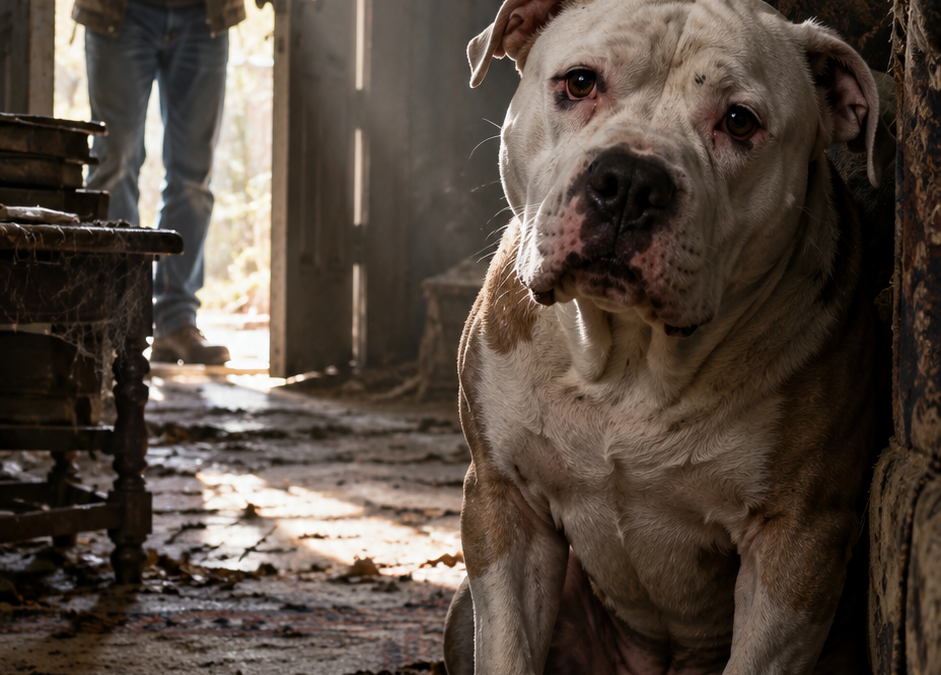
A dog was sitting there.
A very large dog.
Pit bull.
Broad chest.
Thick neck.
Heavy head.
Once, he must have been tremendously powerful.
Now age had softened him.
His muzzle was almost completely white.
Gray had spread around his eyes.
His coat looked dull.
He was thin enough that I could see the outline of his ribs.
But he was still large.
And I had never been comfortable around pit bulls.
That’s putting it mildly.
Like a lot of people, most of what I knew came from news stories.
Attacks.
Warnings.
Headlines.
Photographs chosen specifically because they looked frightening.
I stopped moving.
The dog didn’t growl.
Didn’t bark.
Didn’t stand.
He simply looked at me.
There was an old wool blanket beneath him.
Beside it sat an empty food bowl.
Another bowl contained a little water.
Someone had clearly been feeding him.
Probably Warren.
Maybe neighbors.
But judging by the condition of the room, nobody had been staying with him.
“Easy,” I whispered.
The dog blinked.
Something about his eyes unsettled me.
Not because they were threatening.
Because they weren’t.
They looked tired.
Deeply tired.
And there was something else.
Recognition.
That was impossible.
We had never met.
Yet he stared at me as though he’d been waiting for my face specifically.
Then I noticed the paper.
A folded sheet rested on the floor beside the blanket.
My name was written across the front.
James.
I knew the handwriting immediately.
My father’s.
My hands began shaking before I even picked it up.
The dog watched me.
I lowered myself slowly onto the floor, keeping several feet between us.
“You’re the inheritance, aren’t you?”
His ears shifted slightly.
I almost laughed.
Then I unfolded the letter.
The first line read:
James, this is Bruce. I know you probably don’t understand why I’m leaving you a dog.
I looked up.
Bruce.
He remained motionless.
“Hello, Bruce.”
Nothing.
I looked back at the page.
Dad’s handwriting was uneven.
The letters shook more than I remembered.
He must have written it near the end.
I continued.
Before you decide anything, let me tell you how he came here.
I settled against the wall.
And my father’s voice returned to me through ink.
He wrote about the period after I’d left for work.
How quiet the house had become.
How he watched the neighbors through the window.
Children riding bicycles.
Couples walking.
Families coming and going.
Life continuing while his own world grew smaller.
Then one afternoon, he took a walk near the woods.
That was where he found Bruce.
According to Dad, a group of teenage boys were standing in a clearing.
At first, he couldn’t see what they were doing.
Then he heard laughter.
Something hit a tree.
Another object flew through the air.
And there was Bruce.
Chained to the trunk.
The chain was so short he could barely move.
His ribs showed beneath his coat.
Dad wrote that Bruce looked as though he’d been standing there for hours.
The boys were throwing things at him.
Rocks.
Sticks.
Garbage.
Anything they could pick up.
My jaw tightened as I read.
I looked across the room.
Bruce had scars on his legs.
Thin pale lines that disappeared beneath his fur.
He was still watching me.
Dad wrote:
The thing that bothered me most wasn’t that he barked or tried to attack them.
He didn’t.
He just stood there.
He had already given up expecting anybody to stop it.
Dad confronted the boys.
They ran.
Typical.
Then he approached the dog.
Bruce didn’t growl.
Didn’t pull against the chain.
Didn’t seem relieved.
He just looked at him.
Dad wrote that the emptiness in Bruce’s eyes was worse than fear.
Fear means some part of you still believes something matters.
Bruce seemed beyond it.
My father removed the chain.
Then he brought him home.
The first week wasn’t easy.
Bruce barely ate.
He chose one corner of the living room and faced the wall.
If Dad moved too quickly, the dog flinched.
If someone raised a voice outside, he froze.
If an object dropped, he pressed himself against the floor.
Dad did the only thing he could think of.
He sat near him.
And read.
The newspaper.
Old books.
Instructions from appliance manuals.
Anything.
He talked too.
About his childhood.
About my mother.
About me.
About the stupid arguments we’d had.
About the bridges I designed.
About how proud he was.
I had to stop reading.
That line destroyed me.
About how proud he was.
My father rarely said that directly.
Not because he wasn’t proud.
Because men from his generation often treated affection like classified information.
You were expected to infer it.
A nod.
A hand on the shoulder.
A comment such as, “Could’ve been worse.”
That meant love.
I rubbed my eyes.
Bruce still hadn’t moved.
“What did he tell you about me?”
The dog blinked.
“Hopefully not everything.”
I returned to the letter.
One morning, Dad woke and felt something warm against the foot of his bed.
Bruce.
The dog had left the corner.
Crossed the hallway.
Entered the bedroom.
And slept near him.
That was the beginning.
From that day forward, they became inseparable.
Dad wrote:
He taught me something I should have learned a long time ago.
Trust doesn’t arrive because you demand it.
You build it slowly.
One quiet day at a time.
I looked around the dusty room.
I could picture them.
Dad in his chair.
Bruce at his feet.
Dad talking.
The dog listening.
Two lonely creatures pretending they had rescued only one another.
The next section of the letter became harder to read.
Dad explained that when he understood his time was running out, he began thinking about what he could leave me.
He had little money.
The house needed work.
His belongings were ordinary.
But there was one thing he considered more valuable than everything else.
Bruce.
I read that sentence twice.
Then Dad wrote:
He was my friend when this house became too quiet.
He was my reason to get out of bed on mornings when my body hurt and I wasn’t sure there was much point.
He protected me, but more than that, he made me feel necessary.
That is a gift people underestimate.
Bruce shifted.
His nails scratched softly against the floor.
I looked up.
He turned his head toward the front door.
Listened.
For several seconds, he remained like that.
Waiting.
Then he looked at me again.
I understood.
Even after three years, some part of him was still waiting for my father to come home.
My chest tightened.
Three years.
Someone had brought him food.
Water.
Probably taken him outside.
But according to Warren later, Bruce always returned to that room.
To that corner.
Waiting.
Dad’s letter continued.
I know you are busy.
You’ve always been busy.
That line stung.
You build bridges for a living.
That’s important work.
You’ve built things thousands of people will use without ever knowing your name.
I’m proud of you.
There it was again.
I had to lower the page.
I breathed slowly.
Then continued.
But sometimes, James, I worry that you have become so good at building bridges between places that you’ve forgotten how to build one back to your own heart.
I actually laughed.
A broken, painful laugh.
“That sounds like him.”
Bruce lifted his head.
“He saved the dramatic line for the letter.”
Bruce stared.
“Yeah. I know.”
The next paragraph addressed what Dad knew would be my biggest hesitation.
I know you’re nervous around pit bulls.
Understatement.
I know the stories you’ve heard.
Do me one favor.
Don’t judge Bruce by the shape of his head.
Judge him by what he does with his heart.
I looked at the dog.
He had not moved toward me once.
He wasn’t demanding affection.
Wasn’t growling.
Wasn’t avoiding me.
He was waiting.
Again.
Always waiting.
Dad wrote that Bruce had never harmed him.
Had never shown aggression toward anyone in the house.
That beneath the scars and muscle was one of the gentlest creatures he’d known.
Then came the line that stayed with me forever:
He has bitten fewer people than most humans I know.
I laughed aloud.
“Definitely Dad.”
For the first time, Bruce’s ears rose slightly.
The letter became softer near the end.
Dad wrote that Bruce had spent his entire life waiting.
Waiting for pain to stop.
Waiting for somebody to remove the chain.
Waiting to learn whether kindness was real.
Waiting beside my father after loneliness entered the house.
And when Dad was gone, Bruce would wait again.
This time, I want him to wait for you.
My vision blurred.
I want you to be the man worth waiting for.
Because you’re my son.
And I know you’re a good man.
You’ve just forgotten sometimes.
I couldn’t read the next line immediately.
I stared at the handwriting until the ink stopped swimming.
Then I continued.
The final paragraph was barely legible.
Dad’s hand had clearly been failing.
I love you, son.
Don’t be afraid of Bruce.
He’s mostly a very large hug waiting for somewhere to land.
That was it.
No signature beyond:
Dad.
I folded the letter.
And sat there.
For a long time.
The sun moved across the floor.
Dust floated through the light.
Somewhere outside, birds called from the trees.
I didn’t know what to do.
Then Bruce stood.
Slowly.
His joints looked stiff.
His back legs shook slightly.
He walked toward me.
Every instinct I had told me to tense.
I forced myself not to.
“Okay.”
One step.
Then another.
He stopped directly in front of me.
His head was enormous.
I could see every scar.
Every white hair.
I held out my hand.
Bruce sniffed it.
Then, with almost painful slowness, he lowered his head.
I touched the fur behind his ear.
He didn’t react.
I stroked him again.
His eyes closed.
His entire body seemed to soften.
Then he leaned his head into my palm.
I felt something inside me crack.
Not fear.
Something harder.
For the first time since Dad’s death, I cried.
Really cried.
Not the controlled grief I’d allowed myself at the funeral.
Not the quiet moment in an airport bathroom.
Not the tears I wiped away before anyone could notice.
I bent forward until my forehead rested against Bruce’s.
“I’m sorry.”
I wasn’t sure which of them I was talking to.
Dad.
Bruce.
Myself.
Probably all three.
Bruce stayed there.
That night, I didn’t go back to the hotel.
I called and canceled the reservation.
The clerk didn’t care.
I found fresh dog food.
Cleaned Bruce’s bowls.
Opened windows.
Swept one bedroom.
Changed the bedding.
Bruce watched me from the hallway.
He followed, but always at a distance.
Never entering the room unless invited.
“Come on.”
He stayed at the threshold.
“Seriously?”
Nothing.
I patted the floor.
He took one step.
Then stopped.
“Fine.”
I sat down on the floor.
My forty-two-year-old knees immediately objected.
Bruce looked at me.
“Your turn.”
He didn’t move.
So I talked.
The way Dad had.
I told him about the project.
About the bridge.
About the three years.
About every excuse I’d used for not returning sooner.
I told him about Dad.
How our calls had become shorter.
How sometimes I’d see his number and think, I’ll call back later.
How later became tomorrow.
Tomorrow became Sunday.
Sunday became next week.
“I kept thinking there would be more time.”
Bruce lay down near the doorway.
His head rested on his paws.
I continued.
“I build things that are supposed to last a hundred years.”
My voice broke.
“And I couldn’t make time for one old man.”
Bruce’s eyes stayed on me.
That was the strange thing about talking to a dog.
He couldn’t forgive me.
Couldn’t accuse me.
Couldn’t tell me I was being too hard on myself.
He just listened.
Somehow that was better.
I slept badly.
At around three in the morning, I woke.
For a moment, I didn’t know where I was.
Then I heard breathing.
Bruce was lying beside the bed.
Not on it.
Not touching me.
Just there.
I lowered my hand.
After several seconds, he moved one paw.
It rested against my fingers.
I didn’t move.
Neither did he.
In the morning, I called my company.
My supervisor answered.
“James? Everything okay?”
“No.”
Silence.
That wasn’t a word I used often.
He knew it.
“What happened?”
“I’m staying here a while.”
“How long?”
“I don’t know.”
“James, we’ve got—”
“I know what we’ve got.”
I looked toward Bruce.
He was watching me from the doorway.
“I haven’t taken real leave in years.”
“That’s true.”
“I need some now.”
My supervisor sighed.
Then surprised me.
“Take it.”
I said nothing.
“Seriously. Take the time.”
“What about the next project?”
“It’ll exist when you get back.”
That sentence bothered me because I had treated work for years as though the opposite were true.
As if every bridge would collapse personally unless James Peterson was standing beside it.
I thanked him.
Then I stayed.
The first week with Bruce felt like negotiations between two suspicious governments.
He accepted food from me.
He let me touch him.
But affection happened according to his schedule.
If I entered a room too quickly, his body tensed.
If I reached over his head suddenly, he ducked.
Whenever I noticed, guilt rose in me toward people whose names I would never know.
The boys in the woods.
Whoever had hurt him before Dad found him.
I wanted to tell Bruce nobody would do that again.
Words weren’t enough.
So I showed him.
Routine.
Breakfast at the same time.
Walk at the same time.
Water always available.
No shouting.
No punishment.
No sudden hands.
And every morning, when I woke, I held out one hand.
At first, he stayed by the door.
Then he came halfway.
Then all the way.
One week after I arrived, I woke during the night and felt warm breath against my fingers.
Bruce was asleep beside the bed.
His paw rested on my hand.
Just as Dad had described.
I stared at the ceiling in the darkness.
“Dad would’ve enjoyed this.”
Bruce snored.
“I’ll take that as agreement.”
Two weeks passed.
One afternoon, I returned from the hardware store carrying paint and repair supplies.
Bruce was in the living room.
When he saw me, his tail moved.
Once.
A weak little sweep against the floor.
I stopped.
“Did you just wag your tail?”
Bruce stared at me.
“Do it again.”
Nothing.
“Come on.”
He turned his head.
I started laughing.
Then crying.
At the same time.
I put the paint down and sat beside him.
“You don’t make anything easy, do you?”
His tail moved once more.
That was the day I decided the house couldn’t remain a tomb.
I started repairs.
First the simple things.
Broken fixtures.
Leaking faucet.
Peeling paint.
Then larger jobs.
The porch railing.
A window frame.
Overgrown garden.
Bruce followed me everywhere.
If I hammered, he lay several feet away and watched.
If I painted, he tried to investigate the bucket.
“That’s not food.”
Sniff.
“Bruce.”
Sniff.
“You’re going to become blue.”
He backed away.
“Finally, good judgment.”
At night, we sat on the porch.
Bruce rested his head on my knee.
I talked.
He listened.
Sometimes silence was enough.
That was new for me.
My entire career had been built around solving things.
Measurements.
Forces.
Materials.
Schedules.
Problems had answers.
Grief didn’t.
Neither did love.
Bruce was teaching me to stop treating life like an engineering report.
Some things didn’t need optimization.
They needed presence.
We started walking in the woods.
The same woods where Dad had found him.
The first time, Bruce stopped near the tree line.
His body stiffened.
I wondered if he remembered.
Maybe the exact place.
Maybe only the smell of damp earth and leaves.
I waited.
“Want to go back?”
Bruce looked ahead.
Then walked forward.
Slowly.
His gait was stiff with age.
Sometimes he limped.
But once we were among the trees, something changed.
His nose came alive.
He investigated everything.
Rocks.
Bushes.
Old logs.
Trails.
He moved like a dog discovering freedom again even though he’d already had it for years.
I followed.
For once, I didn’t check my phone.
Didn’t think about work.
Didn’t calculate how much time the walk was costing me.
We just walked.
Three months after I returned, Bruce looked like a different dog.
Not young.
Age doesn’t reverse because somebody loves you.
But healthier.
His coat shone.
He had gained weight.
His eyes were brighter.
His tail moved more often.
And one afternoon, he brought me a ball.
It was ancient.
Chewed.
Nearly colorless.
Probably something Dad had bought years earlier.
Bruce walked into the living room carrying it.
Dropped it at my feet.
I stared.
“You want me to throw that?”
He stared.
“You’re approximately ninety in dog years.”
Still staring.
I rolled the ball across the floor.
Bruce went after it.
Not fast.
His back legs weren’t built for speed anymore.
But he followed it.
Picked it up.
Returned.
Dropped it.
I rolled it again.
After the fifth time, I was laughing so hard I had to sit down.
Bruce’s tail wagged.
I realized I hadn’t laughed like that in years.
Not socially.
Not politely.
Not because somebody at work said something funny.
Really laughed.
Dad had been right.
The dog wasn’t replacing him.
Nothing could.
Bruce was doing something different.
He was reopening parts of me that had closed while I was too busy to notice.
One evening, we sat on the porch beneath a clear sky.
Bruce lay beside my chair.
I held Dad’s letter.
By then I’d read it so many times I nearly knew every sentence by memory.
“What would he say if he saw us?”
Bruce lifted his head.
“I know what he’d say.”
I imitated Dad’s voice.
“‘Told you so.'”
Bruce gave one soft bark.
I laughed.
“Exactly.”
I looked at the stars.
“Yeah, Dad. You were right.”
The wind moved through the trees.
Bruce rested his head on my leg.
For once, the silence didn’t feel empty.
Eventually, I had to return to work.
But I returned differently.
I found a small house near my office where dogs were allowed.
It had a yard and woods nearby.
Bruce came with me.
There was no discussion.
I changed my work schedule.
Not dramatically.
I still cared about my career.
Still loved engineering.
Still loved the moment two sections of a structure finally connected after months or years of planning.
But I stopped staying at the office simply because everyone expected James to be the last one there.
At six, I went home.
Sometimes earlier.
Bruce waited near the door.
On weekends, we walked.
I called friends.
Actual friends.
Not colleagues I only saw at meetings.
I began saying yes when people invited me somewhere.
And no when work tried to consume every empty hour.
The bridges continued to get built without me sacrificing my entire life to them.
Imagine that.
Bruce lived another two years.
Two full years.
In that time, he saw me become somebody I hadn’t realized I’d lost.
He saw me smile more.
Sleep better.
Call people back.
Take vacations.
Then he saw me fall in love.
Her name was Sarah.
The first time she came to my house, I warned her.
“Bruce is big.”
She looked at me.
“How big?”
“Large.”
“That’s not a measurement, Mr. Engineer.”
“About seventy pounds.”
“That’s better.”
“And he’s a pit bull.”
“Okay.”
“You’re not nervous?”
“Should I be?”
“No.”
“Then why are you?”
I didn’t have a good answer.
When Sarah entered, Bruce approached slowly.
He stared at her.
She didn’t reach for him immediately.
That impressed me.
She let him sniff.
Then sat on the couch.
Bruce stood in front of her for several seconds.
Finally, he placed his head on her lap.
Sarah looked at me.
“Did I pass?”
“Apparently.”
She scratched behind his ears.
“High standards?”
“Extremely.”
Bruce closed his eyes.
That was it.
Approval granted.
I joked later that Bruce had chosen her before I did.
There was some truth to it.
Sarah understood things I was still learning.
How to be present.
How not to fill every silence.
How to stay.
She didn’t treat Bruce like a frightening dog.
Or an old dog.
Or a rescue story.
She treated him like Bruce.
He adored her.
Eventually, so did I.
The final day came quietly.
Bruce had been slowing down for weeks.
His appetite decreased.
His walks became shorter.
One morning, he went into the garden and lay beneath the sun.
Sarah and I sat beside him.
His head rested across my feet.
I knew.
Maybe people expect you to panic in moments like that.
I didn’t.
Neither did Sarah.
We stayed.
Bruce breathed slowly.
The sun warmed his white muzzle.
I stroked the same place behind his ears I’d touched the first day in Dad’s house.
“You did good, buddy.”
Bruce opened his eyes.
Looked at me.
Then Sarah.
Then back at me.
His tail moved once.
One slow sweep against the grass.
I smiled through tears.
“I know.”
He closed his eyes.
And rested.
He was gone.
I kept my hand on him for a long time.
Sarah held my shoulder.
I thought losing Bruce would reopen every wound.
Dad.
Regret.
The years I’d missed.
In some ways, it did.
Grief never becomes easy.
But Dad had given me something more than Bruce.
He had given me a different way to understand loss.
Loving someone does not become a mistake because you eventually have to lose them.
That was the lesson Dad had struggled with.
That Bruce had taught him.
And then taught me.
We didn’t sell my father’s house.
Sarah understood why without needing much explanation.
Eventually, it became our summer place.
Later, after we married and had children, it became theirs too.
Every year we returned.
I cut the grass.
Fixed whatever winter had damaged.
Sarah planted flowers where Dad’s old garden had nearly disappeared.
Our children ran through rooms that had once been silent.
Sometimes one of them would ask about Grandpa.
Sometimes about Bruce.
I told them both stories.
Especially Bruce.
I showed them the corner where I’d first seen him.
The old blanket is gone now.
The bowls are gone.
Dust no longer covers the room.
But every time I enter that living room after months away, I still stop.
For one second, I see him there.
White muzzle.
Broad head.
Tired eyes.
Waiting.
That corner doesn’t feel sad anymore.
It’s full.
Dad gave me Bruce because he thought a dog could teach me what he had learned too late.
He was right.
Again.
I spent my adult life designing structures meant to connect one place to another.
After Bruce, I understood that connection isn’t the same thing as proximity.
I had lived in the same world as my father and still let distance grow between us.
I had phones.
Planes.
Money.
Time, if I had chosen to make it.
None of that built the bridge I needed.
Bruce did.
An old pit bull who had once been chained to a tree.
A dog people had thrown rocks at.
A dog who had every reason not to trust humans.
He became the bridge between my father’s final years and the rest of my life.
Between who I had become and who I still had time to be.
I never forgot that.
There is one strange thing I started doing after Bruce died.
On every major bridge project I design, I hide a tiny dog face somewhere in the plans.
Nothing structural.
Nothing visible to drivers.
Just a small personal mark tucked into a place almost nobody would ever notice.
Sometimes inside an access panel.
Sometimes on a maintenance plate.
Sometimes buried in a detail drawing.
Nobody knows why it’s there.
My little secret.
A reminder.
Steel matters.
Concrete matters.
Load paths matter.
But even the strongest structure depends on connections.
The small things holding everything together.
Years have passed.
Sometimes I still work too much.
Old habits don’t disappear completely.
Sometimes Sarah has to tell me to close the laptop.
Sometimes my children drag me outside because I’ve forgotten what time it is.
When that happens, I try to listen.
Dad doesn’t get another phone call.
Bruce doesn’t get another walk.
Time doesn’t negotiate.
That may be the most important thing either of them taught me.
Some nights, when everyone else is asleep, I step onto the balcony.
I look up at the stars.
For a few minutes, I let myself remember.
Dad sitting in that old house reading aloud because a terrified dog wouldn’t come near him.
Bruce sleeping beside my bed.
The first tail wag.
The old ball rolling across the floor.
Sarah’s hand on his back.
That final afternoon in the garden.
Then I say the same thing every time.
“Thanks, Dad.”
Pause.
“Thanks, Bruce.”
Sometimes the wind moves through the trees and sounds almost like a soft bark somewhere far away.
I know it’s probably only wind.
I’m an engineer.
I believe in things that can be measured.
Usually.
But I don’t need to measure everything anymore.
Some things are allowed to exist simply because they matter.
My father left me an old dog.
That was the inheritance.
At least, that’s what I thought when I first opened his letter.
I understand it differently now.
He left me time.
He left me permission to stop.
He left me a reason to come home before home became another place I was always planning to visit later.
And through Bruce, he left me one final bridge.
Not made of steel.
Not concrete.
Nothing I could calculate.
Just trust built slowly between two wounded hearts until the distance between them disappeared.
It was the most important bridge I ever crossed.
𝗧𝗛𝗘 𝗘𝗡𝗗
My Father Left Me One Last Inheritance, and It Was Waiting Alone in the Dark Corner of His House
Three years after my father died, I finally unlocked the house he’d left behind and went searching for the inheritance his lawyer had refused to explain.
I expected a box, an old document, maybe something my father had hidden away because he knew I would understand its value someday.
Instead, I found an enormous white-faced pit bull sitting silently in the corner of the living room beside a letter with my name on it.
My name is James Peterson.
I’m forty-two years old, and for most of my adult life, I have built bridges.
Real ones.
Steel.
Concrete.
Suspension cables.
Foundations driven deep into riverbeds.
Structures meant to survive storms, traffic, earthquakes, corrosion, and the endless punishment of time.
I’ve spent years calculating exactly how much weight a structure can carry before something begins to fail.
What I never learned was how to calculate the weight of regret.
My father died while I was thousands of miles away.
That sentence still sounds simple when I say it.
Too simple.
The reality was messier.
Two weeks before his health took its final turn, my company had sent me across the continent to oversee one of the largest projects of my career.
It wasn’t the kind of assignment you abandoned halfway through.
Hundreds of people depended on my decisions.
Millions of dollars were committed.
Schedules had been negotiated years in advance.
One mistake could delay the project for months.
At least that’s what I told myself.
There is always a respectable reason not to come home when you’re afraid of what coming home will force you to feel.
My father and I hadn’t fought.
Sometimes I wish we had.
A fight gives you something clear to remember.
A sentence.
A slammed door.
A wrong that can be named.
What happened between us was quieter.
We drifted.
A phone call every Sunday became every other Sunday.
Then once a month.
Then, “I’ll call you next week.”
Next week became another month.
Whenever Dad asked when I was coming home, I had an answer.
After this project.
After this inspection.
After the contract is signed.
After winter.
After summer.
After things calm down.
Things never calm down unless you decide they will.
Then one morning, I received the call.
My father was gone.
I sat in a temporary project office overlooking a half-finished bridge and listened while an attorney explained practical matters in a voice designed for bad news.
I remember staring through the window at two unfinished spans reaching toward each other across open water.
They were close.
Not connected.
That image stayed with me.
I couldn’t leave immediately.
Then immediately became weeks.
Weeks became months.
The project expanded.
A structural problem surfaced.
Then a contractor dispute.
Then another deadline.
The house remained where it had always been.
My father’s belongings remained where he had left them.
And I kept working.
It took me three years to finish everything and finally get on a plane.
Three years.
I don’t defend that anymore.
At the time, I did.
Now I simply say what happened.
My father’s lawyer, Mr. Warren, met me the morning after I arrived in town.
He was an older man who had known Dad for years.
We sat across from one another in his cramped office while he pushed a folder toward me.
Most of it was what you’d expect.
The house.
A small savings account.
Personal belongings.
Nothing substantial.
Dad had never been wealthy.
Then Warren handed me a separate envelope.
“There is one other thing.”
“What?”
He smiled strangely.
“Your father wanted you to go to the house.”
“I was planning to.”
“He left something there specifically for you.”
“What is it?”
Warren leaned back.
“He asked me not to tell you.”
I stared at him.
“He’s dead, Warren.”
“I am aware.”
“So the dramatic mystery is unnecessary.”
“He was very specific.”
“Of course he was.”
That sounded like Dad.
He loved making a point in the most inconvenient way possible.
I picked up the envelope.
“Is it valuable?”
Warren’s expression changed.
“To your father?”
“Yes.”
“Extremely.”
That should have warned me.
The house sat near the edge of town, where pavement gradually gave way to narrower roads and scattered patches of woodland.
I had grown up there.
Not entirely.
My parents moved several times when I was young, but that house was the one Dad chose after retirement.
Stone exterior.
Small porch.
Large yard.
Too much maintenance for one aging man.
Exactly the kind of property he loved.
When I pulled into the driveway, I sat in the rental car for several minutes.
The grass had grown almost to my knees.
Weeds pushed through cracks in the walkway.
The porch railing needed paint.
One shutter hung slightly crooked.
It looked abandoned.
That hurt more than I expected.
A house doesn’t know the person inside it is gone.
It simply waits.
Eventually the roof leaks.
Dust gathers.
Paint fades.
Grass grows.
Time continues its work whether anyone is ready or not.
I stepped out.
The morning was cool.
The air smelled like wet soil and old leaves.
I walked up the path.
The front door wasn’t locked.
Warren had told me it wouldn’t be.
I opened it.
“Hello?”
Ridiculous.
I knew nobody would answer.
Still, the word came out automatically.
The silence inside felt heavy.
Dust floated in shafts of light coming through the windows.
The furniture was still there.
Dad’s old chair.
The table near the wall.
Photographs.
Books.
A mug beside the kitchen sink.
For one terrible second, I could imagine him simply being out somewhere.
At the store.
In the garden.
Coming back any minute.
Then I remembered.
I set my bag down.
Warren had said Dad left me something.
I started looking.
Desk drawers.
Shelves.
Kitchen cabinets.
I expected an envelope.
Maybe an old watch.
A photograph.
Dad had been sentimental in private and sarcastic in public.
He was capable of turning an ordinary object into some final lesson.
I was examining a row of framed pictures when I heard something.
A soft scrape.
I froze.
The sound came from the living room.
“Who’s there?”
No answer.
I stepped around the doorway.
At first, I saw nothing.
Then something moved in the far corner.
My entire body tightened.
A dog was sitting there.
A very large dog.
Pit bull.
Broad chest.
Thick neck.
Heavy head.
Once, he must have been tremendously powerful.
Now age had softened him.
His muzzle was almost completely white.
Gray had spread around his eyes.
His coat looked dull.
He was thin enough that I could see the outline of his ribs.
But he was still large.
And I had never been comfortable around pit bulls.
That’s putting it mildly.
Like a lot of people, most of what I knew came from news stories.
Attacks.
Warnings.
Headlines.
Photographs chosen specifically because they looked frightening.
I stopped moving.
The dog didn’t growl.
Didn’t bark.
Didn’t stand.
He simply looked at me.
There was an old wool blanket beneath him.
Beside it sat an empty food bowl.
Another bowl contained a little water.
Someone had clearly been feeding him.
Probably Warren.
Maybe neighbors.
But judging by the condition of the room, nobody had been staying with him.
“Easy,” I whispered.
The dog blinked.
Something about his eyes unsettled me.
Not because they were threatening.
Because they weren’t.
They looked tired.
Deeply tired.
And there was something else.
Recognition.
That was impossible.
We had never met.
Yet he stared at me as though he’d been waiting for my face specifically.
Then I noticed the paper.
A folded sheet rested on the floor beside the blanket.
My name was written across the front.
James.
I knew the handwriting immediately.
My father’s.
My hands began shaking before I even picked it up.
The dog watched me.
I lowered myself slowly onto the floor, keeping several feet between us.
“You’re the inheritance, aren’t you?”
His ears shifted slightly.
I almost laughed.
Then I unfolded the letter.
The first line read:
James, this is Bruce. I know you probably don’t understand why I’m leaving you a dog.
I looked up.
Bruce.
He remained motionless.
“Hello, Bruce.”
Nothing.
I looked back at the page.
Dad’s handwriting was uneven.
The letters shook more than I remembered.
He must have written it near the end.
I continued.
Before you decide anything, let me tell you how he came here.
I settled against the wall.
And my father’s voice returned to me through ink.
He wrote about the period after I’d left for work.
How quiet the house had become.
How he watched the neighbors through the window.
Children riding bicycles.
Couples walking.
Families coming and going.
Life continuing while his own world grew smaller.
Then one afternoon, he took a walk near the woods.
That was where he found Bruce.
According to Dad, a group of teenage boys were standing in a clearing.
At first, he couldn’t see what they were doing.
Then he heard laughter.
Something hit a tree.
Another object flew through the air.
And there was Bruce.
Chained to the trunk.
The chain was so short he could barely move.
His ribs showed beneath his coat.
Dad wrote that Bruce looked as though he’d been standing there for hours.
The boys were throwing things at him.
Rocks.
Sticks.
Garbage.
Anything they could pick up.
My jaw tightened as I read.
I looked across the room.
Bruce had scars on his legs.
Thin pale lines that disappeared beneath his fur.
He was still watching me.
Dad wrote:
The thing that bothered me most wasn’t that he barked or tried to attack them.
He didn’t.
He just stood there.
He had already given up expecting anybody to stop it.
Dad confronted the boys.
They ran.
Typical.
Then he approached the dog.
Bruce didn’t growl.
Didn’t pull against the chain.
Didn’t seem relieved.
He just looked at him.
Dad wrote that the emptiness in Bruce’s eyes was worse than fear.
Fear means some part of you still believes something matters.
Bruce seemed beyond it.
My father removed the chain.
Then he brought him home.
The first week wasn’t easy.
Bruce barely ate.
He chose one corner of the living room and faced the wall.
If Dad moved too quickly, the dog flinched.
If someone raised a voice outside, he froze.
If an object dropped, he pressed himself against the floor.
Dad did the only thing he could think of.
He sat near him.
And read.
The newspaper.
Old books.
Instructions from appliance manuals.
Anything.
He talked too.
About his childhood.
About my mother.
About me.
About the stupid arguments we’d had.
About the bridges I designed.
About how proud he was.
I had to stop reading.
That line destroyed me.
About how proud he was.
My father rarely said that directly.
Not because he wasn’t proud.
Because men from his generation often treated affection like classified information.
You were expected to infer it.
A nod.
A hand on the shoulder.
A comment such as, “Could’ve been worse.”
That meant love.
I rubbed my eyes.
Bruce still hadn’t moved.
“What did he tell you about me?”
The dog blinked.
“Hopefully not everything.”
I returned to the letter.
One morning, Dad woke and felt something warm against the foot of his bed.
Bruce.
The dog had left the corner.
Crossed the hallway.
Entered the bedroom.
And slept near him.
That was the beginning.
From that day forward, they became inseparable.
Dad wrote:
He taught me something I should have learned a long time ago.
Trust doesn’t arrive because you demand it.
You build it slowly.
One quiet day at a time.
I looked around the dusty room.
I could picture them.
Dad in his chair.
Bruce at his feet.
Dad talking.
The dog listening.
Two lonely creatures pretending they had rescued only one another.
The next section of the letter became harder to read.
Dad explained that when he understood his time was running out, he began thinking about what he could leave me.
He had little money.
The house needed work.
His belongings were ordinary.
But there was one thing he considered more valuable than everything else.
Bruce.
I read that sentence twice.
Then Dad wrote:
He was my friend when this house became too quiet.
He was my reason to get out of bed on mornings when my body hurt and I wasn’t sure there was much point.
He protected me, but more than that, he made me feel necessary.
That is a gift people underestimate.
Bruce shifted.
His nails scratched softly against the floor.
I looked up.
He turned his head toward the front door.
Listened.
For several seconds, he remained like that.
Waiting.
Then he looked at me again.
I understood.
Even after three years, some part of him was still waiting for my father to come home.
My chest tightened.
Three years.
Someone had brought him food.
Water.
Probably taken him outside.
But according to Warren later, Bruce always returned to that room.
To that corner.
Waiting.
Dad’s letter continued.
I know you are busy.
You’ve always been busy.
That line stung.
You build bridges for a living.
That’s important work.
You’ve built things thousands of people will use without ever knowing your name.
I’m proud of you.
There it was again.
I had to lower the page.
I breathed slowly.
Then continued.
But sometimes, James, I worry that you have become so good at building bridges between places that you’ve forgotten how to build one back to your own heart.
I actually laughed.
A broken, painful laugh.
“That sounds like him.”
Bruce lifted his head.
“He saved the dramatic line for the letter.”
Bruce stared.
“Yeah. I know.”
The next paragraph addressed what Dad knew would be my biggest hesitation.
I know you’re nervous around pit bulls.
Understatement.
I know the stories you’ve heard.
Do me one favor.
Don’t judge Bruce by the shape of his head.
Judge him by what he does with his heart.
I looked at the dog.
He had not moved toward me once.
He wasn’t demanding affection.
Wasn’t growling.
Wasn’t avoiding me.
He was waiting.
Again.
Always waiting.
Dad wrote that Bruce had never harmed him.
Had never shown aggression toward anyone in the house.
That beneath the scars and muscle was one of the gentlest creatures he’d known.
Then came the line that stayed with me forever:
He has bitten fewer people than most humans I know.
I laughed aloud.
“Definitely Dad.”
For the first time, Bruce’s ears rose slightly.
The letter became softer near the end.
Dad wrote that Bruce had spent his entire life waiting.
Waiting for pain to stop.
Waiting for somebody to remove the chain.
Waiting to learn whether kindness was real.
Waiting beside my father after loneliness entered the house.
And when Dad was gone, Bruce would wait again.
This time, I want him to wait for you.
My vision blurred.
I want you to be the man worth waiting for.
Because you’re my son.
And I know you’re a good man.
You’ve just forgotten sometimes.
I couldn’t read the next line immediately.
I stared at the handwriting until the ink stopped swimming.
Then I continued.
The final paragraph was barely legible.
Dad’s hand had clearly been failing.
I love you, son.
Don’t be afraid of Bruce.
He’s mostly a very large hug waiting for somewhere to land.
That was it.
No signature beyond:
Dad.
I folded the letter.
And sat there.
For a long time.
The sun moved across the floor.
Dust floated through the light.
Somewhere outside, birds called from the trees.
I didn’t know what to do.
Then Bruce stood.
Slowly.
His joints looked stiff.
His back legs shook slightly.
He walked toward me.
Every instinct I had told me to tense.
I forced myself not to.
“Okay.”
One step.
Then another.
He stopped directly in front of me.
His head was enormous.
I could see every scar.
Every white hair.
I held out my hand.
Bruce sniffed it.
Then, with almost painful slowness, he lowered his head.
I touched the fur behind his ear.
He didn’t react.
I stroked him again.
His eyes closed.
His entire body seemed to soften.
Then he leaned his head into my palm.
I felt something inside me crack.
Not fear.
Something harder.
For the first time since Dad’s death, I cried.
Really cried.
Not the controlled grief I’d allowed myself at the funeral.
Not the quiet moment in an airport bathroom.
Not the tears I wiped away before anyone could notice.
I bent forward until my forehead rested against Bruce’s.
“I’m sorry.”
I wasn’t sure which of them I was talking to.
Dad.
Bruce.
Myself.
Probably all three.
Bruce stayed there.
That night, I didn’t go back to the hotel.
I called and canceled the reservation.
The clerk didn’t care.
I found fresh dog food.
Cleaned Bruce’s bowls.
Opened windows.
Swept one bedroom.
Changed the bedding.
Bruce watched me from the hallway.
He followed, but always at a distance.
Never entering the room unless invited.
“Come on.”
He stayed at the threshold.
“Seriously?”
Nothing.
I patted the floor.
He took one step.
Then stopped.
“Fine.”
I sat down on the floor.
My forty-two-year-old knees immediately objected.
Bruce looked at me.
“Your turn.”
He didn’t move.
So I talked.
The way Dad had.
I told him about the project.
About the bridge.
About the three years.
About every excuse I’d used for not returning sooner.
I told him about Dad.
How our calls had become shorter.
How sometimes I’d see his number and think, I’ll call back later.
How later became tomorrow.
Tomorrow became Sunday.
Sunday became next week.
“I kept thinking there would be more time.”
Bruce lay down near the doorway.
His head rested on his paws.
I continued.
“I build things that are supposed to last a hundred years.”
My voice broke.
“And I couldn’t make time for one old man.”
Bruce’s eyes stayed on me.
That was the strange thing about talking to a dog.
He couldn’t forgive me.
Couldn’t accuse me.
Couldn’t tell me I was being too hard on myself.
He just listened.
Somehow that was better.
I slept badly.
At around three in the morning, I woke.
For a moment, I didn’t know where I was.
Then I heard breathing.
Bruce was lying beside the bed.
Not on it.
Not touching me.
Just there.
I lowered my hand.
After several seconds, he moved one paw.
It rested against my fingers.
I didn’t move.
Neither did he.
In the morning, I called my company.
My supervisor answered.
“James? Everything okay?”
“No.”
Silence.
That wasn’t a word I used often.
He knew it.
“What happened?”
“I’m staying here a while.”
“How long?”
“I don’t know.”
“James, we’ve got—”
“I know what we’ve got.”
I looked toward Bruce.
He was watching me from the doorway.
“I haven’t taken real leave in years.”
“That’s true.”
“I need some now.”
My supervisor sighed.
Then surprised me.
“Take it.”
I said nothing.
“Seriously. Take the time.”
“What about the next project?”
“It’ll exist when you get back.”
That sentence bothered me because I had treated work for years as though the opposite were true.
As if every bridge would collapse personally unless James Peterson was standing beside it.
I thanked him.
Then I stayed.
The first week with Bruce felt like negotiations between two suspicious governments.
He accepted food from me.
He let me touch him.
But affection happened according to his schedule.
If I entered a room too quickly, his body tensed.
If I reached over his head suddenly, he ducked.
Whenever I noticed, guilt rose in me toward people whose names I would never know.
The boys in the woods.
Whoever had hurt him before Dad found him.
I wanted to tell Bruce nobody would do that again.
Words weren’t enough.
So I showed him.
Routine.
Breakfast at the same time.
Walk at the same time.
Water always available.
No shouting.
No punishment.
No sudden hands.
And every morning, when I woke, I held out one hand.
At first, he stayed by the door.
Then he came halfway.
Then all the way.
One week after I arrived, I woke during the night and felt warm breath against my fingers.
Bruce was asleep beside the bed.
His paw rested on my hand.
Just as Dad had described.
I stared at the ceiling in the darkness.
“Dad would’ve enjoyed this.”
Bruce snored.
“I’ll take that as agreement.”
Two weeks passed.
One afternoon, I returned from the hardware store carrying paint and repair supplies.
Bruce was in the living room.
When he saw me, his tail moved.
Once.
A weak little sweep against the floor.
I stopped.
“Did you just wag your tail?”
Bruce stared at me.
“Do it again.”
Nothing.
“Come on.”
He turned his head.
I started laughing.
Then crying.
At the same time.
I put the paint down and sat beside him.
“You don’t make anything easy, do you?”
His tail moved once more.
That was the day I decided the house couldn’t remain a tomb.
I started repairs.
First the simple things.
Broken fixtures.
Leaking faucet.
Peeling paint.
Then larger jobs.
The porch railing.
A window frame.
Overgrown garden.
Bruce followed me everywhere.
If I hammered, he lay several feet away and watched.
If I painted, he tried to investigate the bucket.
“That’s not food.”
Sniff.
“Bruce.”
Sniff.
“You’re going to become blue.”
He backed away.
“Finally, good judgment.”
At night, we sat on the porch.
Bruce rested his head on my knee.
I talked.
He listened.
Sometimes silence was enough.
That was new for me.
My entire career had been built around solving things.
Measurements.
Forces.
Materials.
Schedules.
Problems had answers.
Grief didn’t.
Neither did love.
Bruce was teaching me to stop treating life like an engineering report.
Some things didn’t need optimization.
They needed presence.
We started walking in the woods.
The same woods where Dad had found him.
The first time, Bruce stopped near the tree line.
His body stiffened.
I wondered if he remembered.
Maybe the exact place.
Maybe only the smell of damp earth and leaves.
I waited.
“Want to go back?”
Bruce looked ahead.
Then walked forward.
Slowly.
His gait was stiff with age.
Sometimes he limped.
But once we were among the trees, something changed.
His nose came alive.
He investigated everything.
Rocks.
Bushes.
Old logs.
Trails.
He moved like a dog discovering freedom again even though he’d already had it for years.
I followed.
For once, I didn’t check my phone.
Didn’t think about work.
Didn’t calculate how much time the walk was costing me.
We just walked.
Three months after I returned, Bruce looked like a different dog.
Not young.
Age doesn’t reverse because somebody loves you.
But healthier.
His coat shone.
He had gained weight.
His eyes were brighter.
His tail moved more often.
And one afternoon, he brought me a ball.
It was ancient.
Chewed.
Nearly colorless.
Probably something Dad had bought years earlier.
Bruce walked into the living room carrying it.
Dropped it at my feet.
I stared.
“You want me to throw that?”
He stared.
“You’re approximately ninety in dog years.”
Still staring.
I rolled the ball across the floor.
Bruce went after it.
Not fast.
His back legs weren’t built for speed anymore.
But he followed it.
Picked it up.
Returned.
Dropped it.
I rolled it again.
After the fifth time, I was laughing so hard I had to sit down.
Bruce’s tail wagged.
I realized I hadn’t laughed like that in years.
Not socially.
Not politely.
Not because somebody at work said something funny.
Really laughed.
Dad had been right.
The dog wasn’t replacing him.
Nothing could.
Bruce was doing something different.
He was reopening parts of me that had closed while I was too busy to notice.
One evening, we sat on the porch beneath a clear sky.
Bruce lay beside my chair.
I held Dad’s letter.
By then I’d read it so many times I nearly knew every sentence by memory.
“What would he say if he saw us?”
Bruce lifted his head.
“I know what he’d say.”
I imitated Dad’s voice.
“‘Told you so.'”
Bruce gave one soft bark.
I laughed.
“Exactly.”
I looked at the stars.
“Yeah, Dad. You were right.”
The wind moved through the trees.
Bruce rested his head on my leg.
For once, the silence didn’t feel empty.
Eventually, I had to return to work.
But I returned differently.
I found a small house near my office where dogs were allowed.
It had a yard and woods nearby.
Bruce came with me.
There was no discussion.
I changed my work schedule.
Not dramatically.
I still cared about my career.
Still loved engineering.
Still loved the moment two sections of a structure finally connected after months or years of planning.
But I stopped staying at the office simply because everyone expected James to be the last one there.
At six, I went home.
Sometimes earlier.
Bruce waited near the door.
On weekends, we walked.
I called friends.
Actual friends.
Not colleagues I only saw at meetings.
I began saying yes when people invited me somewhere.
And no when work tried to consume every empty hour.
The bridges continued to get built without me sacrificing my entire life to them.
Imagine that.
Bruce lived another two years.
Two full years.
In that time, he saw me become somebody I hadn’t realized I’d lost.
He saw me smile more.
Sleep better.
Call people back.
Take vacations.
Then he saw me fall in love.
Her name was Sarah.
The first time she came to my house, I warned her.
“Bruce is big.”
She looked at me.
“How big?”
“Large.”
“That’s not a measurement, Mr. Engineer.”
“About seventy pounds.”
“That’s better.”
“And he’s a pit bull.”
“Okay.”
“You’re not nervous?”
“Should I be?”
“No.”
“Then why are you?”
I didn’t have a good answer.
When Sarah entered, Bruce approached slowly.
He stared at her.
She didn’t reach for him immediately.
That impressed me.
She let him sniff.
Then sat on the couch.
Bruce stood in front of her for several seconds.
Finally, he placed his head on her lap.
Sarah looked at me.
“Did I pass?”
“Apparently.”
She scratched behind his ears.
“High standards?”
“Extremely.”
Bruce closed his eyes.
That was it.
Approval granted.
I joked later that Bruce had chosen her before I did.
There was some truth to it.
Sarah understood things I was still learning.
How to be present.
How not to fill every silence.
How to stay.
She didn’t treat Bruce like a frightening dog.
Or an old dog.
Or a rescue story.
She treated him like Bruce.
He adored her.
Eventually, so did I.
The final day came quietly.
Bruce had been slowing down for weeks.
His appetite decreased.
His walks became shorter.
One morning, he went into the garden and lay beneath the sun.
Sarah and I sat beside him.
His head rested across my feet.
I knew.
Maybe people expect you to panic in moments like that.
I didn’t.
Neither did Sarah.
We stayed.
Bruce breathed slowly.
The sun warmed his white muzzle.
I stroked the same place behind his ears I’d touched the first day in Dad’s house.
“You did good, buddy.”
Bruce opened his eyes.
Looked at me.
Then Sarah.
Then back at me.
His tail moved once.
One slow sweep against the grass.
I smiled through tears.
“I know.”
He closed his eyes.
And rested.
He was gone.
I kept my hand on him for a long time.
Sarah held my shoulder.
I thought losing Bruce would reopen every wound.
Dad.
Regret.
The years I’d missed.
In some ways, it did.
Grief never becomes easy.
But Dad had given me something more than Bruce.
He had given me a different way to understand loss.
Loving someone does not become a mistake because you eventually have to lose them.
That was the lesson Dad had struggled with.
That Bruce had taught him.
And then taught me.
We didn’t sell my father’s house.
Sarah understood why without needing much explanation.
Eventually, it became our summer place.
Later, after we married and had children, it became theirs too.
Every year we returned.
I cut the grass.
Fixed whatever winter had damaged.
Sarah planted flowers where Dad’s old garden had nearly disappeared.
Our children ran through rooms that had once been silent.
Sometimes one of them would ask about Grandpa.
Sometimes about Bruce.
I told them both stories.
Especially Bruce.
I showed them the corner where I’d first seen him.
The old blanket is gone now.
The bowls are gone.
Dust no longer covers the room.
But every time I enter that living room after months away, I still stop.
For one second, I see him there.
White muzzle.
Broad head.
Tired eyes.
Waiting.
That corner doesn’t feel sad anymore.
It’s full.
Dad gave me Bruce because he thought a dog could teach me what he had learned too late.
He was right.
Again.
I spent my adult life designing structures meant to connect one place to another.
After Bruce, I understood that connection isn’t the same thing as proximity.
I had lived in the same world as my father and still let distance grow between us.
I had phones.
Planes.
Money.
Time, if I had chosen to make it.
None of that built the bridge I needed.
Bruce did.
An old pit bull who had once been chained to a tree.
A dog people had thrown rocks at.
A dog who had every reason not to trust humans.
He became the bridge between my father’s final years and the rest of my life.
Between who I had become and who I still had time to be.
I never forgot that.
There is one strange thing I started doing after Bruce died.
On every major bridge project I design, I hide a tiny dog face somewhere in the plans.
Nothing structural.
Nothing visible to drivers.
Just a small personal mark tucked into a place almost nobody would ever notice.
Sometimes inside an access panel.
Sometimes on a maintenance plate.
Sometimes buried in a detail drawing.
Nobody knows why it’s there.
My little secret.
A reminder.
Steel matters.
Concrete matters.
Load paths matter.
But even the strongest structure depends on connections.
The small things holding everything together.
Years have passed.
Sometimes I still work too much.
Old habits don’t disappear completely.
Sometimes Sarah has to tell me to close the laptop.
Sometimes my children drag me outside because I’ve forgotten what time it is.
When that happens, I try to listen.
Dad doesn’t get another phone call.
Bruce doesn’t get another walk.
Time doesn’t negotiate.
That may be the most important thing either of them taught me.
Some nights, when everyone else is asleep, I step onto the balcony.
I look up at the stars.
For a few minutes, I let myself remember.
Dad sitting in that old house reading aloud because a terrified dog wouldn’t come near him.
Bruce sleeping beside my bed.
The first tail wag.
The old ball rolling across the floor.
Sarah’s hand on his back.
That final afternoon in the garden.
Then I say the same thing every time.
“Thanks, Dad.”
Pause.
“Thanks, Bruce.”
Sometimes the wind moves through the trees and sounds almost like a soft bark somewhere far away.
I know it’s probably only wind.
I’m an engineer.
I believe in things that can be measured.
Usually.
But I don’t need to measure everything anymore.
Some things are allowed to exist simply because they matter.
My father left me an old dog.
That was the inheritance.
At least, that’s what I thought when I first opened his letter.
I understand it differently now.
He left me time.
He left me permission to stop.
He left me a reason to come home before home became another place I was always planning to visit later.
And through Bruce, he left me one final bridge.
Not made of steel.
Not concrete.
Nothing I could calculate.
Just trust built slowly between two wounded hearts until the distance between them disappeared.
It was the most important bridge I ever crossed.

