My Brother’s Hand Was Still Clamped Around My Arm When the Entire Promotion Hall Suddenly Went Silent
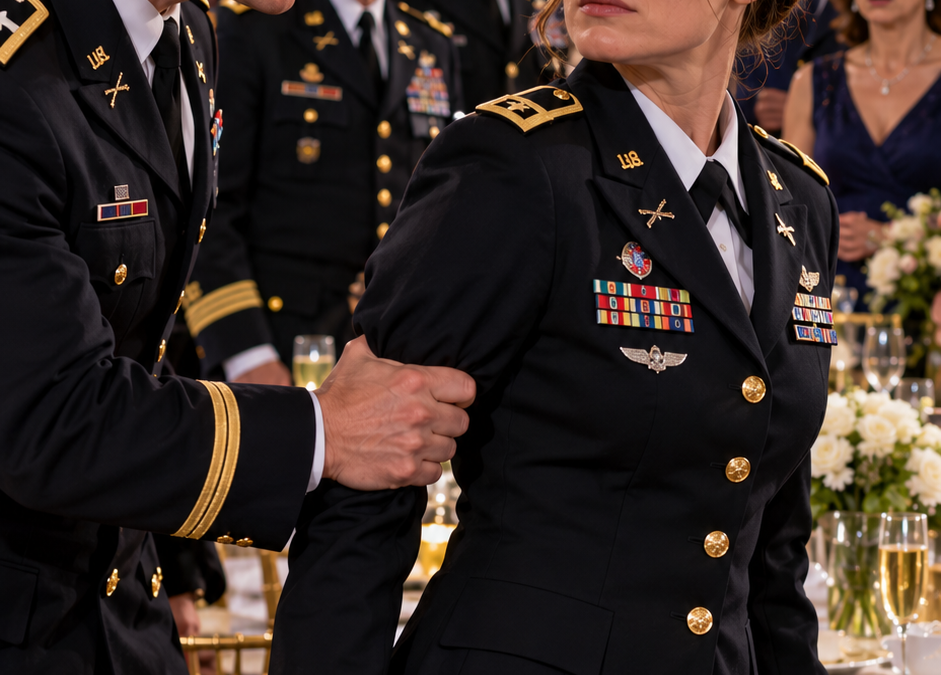
My Brother’s Hand Was Still Clamped Around My Arm When the Entire Promotion Hall Suddenly Went Silent
My brother’s fingers were digging into my arm when he hissed that I was humiliating him in front of his unit.
I could have told him who I was, what rank I held, or why several of the senior officers behind him had suddenly stopped talking, but after a lifetime of being underestimated by my own family, I had learned not to rescue people from assumptions they had chosen for themselves.
Then Nolan looked over my shoulder, released me as if my skin had burned him, and I knew the evening was about to uncover far more than a family’s old favoritism.
My name is Evelyn Hart.
By the time my younger brother tried to throw me out of his promotion party, I had spent more than twenty years in the United States Army learning how to remain calm when other people lost control.
What I had never learned was how to stop wanting my own family to see me.
I grew up outside Staunton, Virginia, in a white house with green shutters and a gravel driveway that washed into uneven trenches whenever the rain came down hard.
My father, Grant Hart, owned a hardware store on Miller Street. The place smelled permanently of sawdust, fertilizer, brass keys, motor oil, and the coffee Dad kept in a dented thermos behind the counter.
He believed worth should be visible.
A successful business.
A trophy.
A good car.
A title people recognized.
My mother, Elaine, measured people differently but arrived at the same place. To her, success was something you could mention at church and watch other women react to.
By both of their standards, my little brother Nolan arrived in this world already ahead of me.
He was eight years younger.
Blond.
Loud.
Charming.
He had the kind of smile that made adults forgive him before he had done anything wrong.
I still remember Dad carrying him into the house in a blue blanket like he had personally won something.
“Look at him, Evie,” he told me.
I did.
Nolan opened his tiny hand.
Dad laughed.
“Strong grip.”
He was three days old.
That was the first of thousands of things Nolan would somehow be praised for simply because they belonged to Nolan.
I never hated him.
That part matters.
Children usually do not recognize favoritism as a system. They experience it as weather.
You do not hate the favored child because sunshine falls on him.
You simply learn where the shadows are.
So I became useful.
At eleven, I found a bookkeeping error in Dad’s store records. A small amount had been disappearing every Friday for nearly three months because an employee was entering cash returns incorrectly.
Dad checked my numbers.
“Good eye, Evie.”
Pride rose inside me.
Then he closed the ledger and shouted across the shop.
“Nolan! Come here, buddy. Let me show you how to use this hammer.”
Nolan was three.
I remained beside the books.
That became the pattern.
When the furnace stopped working one freezing winter night, I figured out how to restart it until the repairman could come.
Mom said, “That’s Evelyn being Evelyn.”
When Nolan hit a baseball over the fence during practice, Dad talked about it for three days.
I remembered birthdays.
Scheduled dentist appointments.
Reset clocks after outages.
Found tax forms.
Helped Mom with bills.
Wrote thank-you cards my parents signed without reading.
I became the person everybody relied on and nobody celebrated.
Only one person seemed to notice what that was doing to me.
My grandfather Walter Hart lived in a small brick bungalow behind Dad’s store after Grandma died.
Grandpa had served in the Army long before I was born.
He rarely talked about it.
There were photographs of him in uniform, but almost no stories.
He had the quiet discipline of a man who had spent enough years around responsibility to stop announcing it.
When I visited, he never asked whether I had a boyfriend.
Never asked why I did not wear dresses like some of the girls Mom admired.
Never told me to smile more.
He asked one question.
“What did you fix today?”
Sometimes I had an answer.
Sometimes I didn’t.
He asked anyway.
When I was fourteen, Nolan completed a youth baseball season in which he spent more time sitting on the bench than playing.
The coach still gave every child a trophy.
Dad placed Nolan’s trophy on the dining room table like it belonged in Cooperstown.
Mom called two relatives.
Nolan ate cake.
Nobody had done anything wrong.
That was almost what made the ache worse.
I walked to Grandpa Walter’s bungalow after dinner and sat on his porch.
He brought out two glasses of lemonade.
His lemonade was terrible.
Too much water.
Not enough sugar.
I drank it anyway.
He studied me.
“You look like somebody stole your dog.”
“I don’t have a dog.”
“Then you look like somebody stole the dog you would’ve had.”
I laughed despite myself.
We watched the sun drop behind the Virginia hills.
Finally, he said, “You want them to notice.”
I stared into my glass.
“Who?”
“You know who.”
I shrugged.
Grandpa waited.
That was another thing he did better than most people.
He could outwait dishonesty.
“I don’t need them to notice.”
“Didn’t say you needed it.”
My eyes burned.
Across the yard, through the hardware-store window, I could see Dad showing Nolan something on the wall.
“Maybe I’m just not interesting.”
Grandpa turned sharply.
“Don’t ever confuse loud with important.”
I looked at him.
He leaned back.
“One day your family is going to understand exactly who you are.”
“And if they don’t?”
His face changed.
Not angry.
Serious.
“Then you make sure you do.”
I did not fully understand.
He added, “Never beg people to see your value, Evie. Build something so undeniable they’ll have to salute it.”
At fourteen, I thought Grandpa meant I needed to become successful enough to prove everybody wrong.
It took me almost four decades to understand that was only half of what he meant.
At eighteen, I left Staunton with a scholarship, one suitcase, and parents who treated my departure like a logistical inconvenience.
Dad hugged me.
Mom cried briefly.
Then she asked whether I had remembered to leave Nolan’s school immunization form on the kitchen counter.
I had.
Of course I had.
I entered the Army quietly.
Then I stayed.
One assignment became another.
I discovered quickly that military life did not care whether my parents thought I was impressive.
A poor decision remained poor regardless of who made it.
Responsibility did not disappear because you were tired.
People depended on you whether you felt recognized or not.
I liked that clarity.
I learned logistics.
Planning.
Command.
I learned how to make decisions when information was incomplete and time was worse.
I learned that supplying people correctly could matter as much as anything happening at the front.
Food.
Fuel.
Medical equipment.
Communications gear.
Replacement parts.
The unglamorous things people rarely celebrate until they fail.
Years became decades.
Rank accumulated.
So did responsibility.
My family knew I was in the Army.
They simply never asked enough questions to understand what I actually did.
To them, I was still Evelyn.
Dependable.
Serious.
Always away on “some Army thing.”
Then Nolan joined.
Suddenly, military service became fascinating.
Mom framed his commissioning photograph and put it in the living room.
Dad told hardware-store customers, “My son is an officer.”
Every promotion brought champagne.
Photographs.
Social media posts.
Proud speeches.
I was already far senior to Nolan by then.
Nobody asked.
At first, the situation amused me.
Later, it hurt.
Then eventually it became background noise.
When Dad needed help sorting out Medicare paperwork, he called me.
When Mom had a car accident, she called me.
When Nolan wanted advice on an application, he called me.
When the roof leaked, Dad somehow called me from three states away as if Army command experience had turned me into a roofing contractor.
In every crisis, I was suddenly valuable.
Once the crisis passed, I became invisible again.
I allowed it.
That is something I had to admit later.
Being useful can become addictive when usefulness is the closest thing you receive to affection.
Nolan’s promotion to lieutenant colonel was different.
The family acted as though one of us had reached the moon.
Dad bought a new suit.
Mom planned photographs.
Nolan invited relatives, colleagues, senior officers, spouses, and everyone whose opinion mattered to him.
I received an invitation too.
I almost did not attend.
I was scheduled for a classified briefing nearby that afternoon and had another meeting in Washington the next morning.
But Nolan was my brother.
Whatever lived between us, I wanted to be there.
I arrived in civilian clothes because I came directly from the closed briefing.
Dark slacks.
Plain blouse.
Low shoes.
No uniform.
No stars.
Nothing that announced rank.
The event hall was already crowded.
Officers stood in small groups holding drinks.
Spouses talked near decorated tables.
A banner congratulated Nolan.
I entered quietly and spotted Mom immediately.
She was showing someone photographs on her phone.
Dad stood beside the bar.
Nolan was near the front of the room surrounded by officers.
For one second, I felt proud.
He looked confident.
He had worked for that promotion.
Whatever our history, I knew military advancement was not handed out because your parents liked posting photographs.
Then Nolan saw me.
His smile disappeared.
He crossed the room.
“What are you doing here?”
I thought he was joking.
“You invited the family.”
“Why are you dressed like that?”
I looked down.
“Like what?”
“Civilian.”
“I came from work.”
His jaw tightened.
“You can’t just walk into a unit function looking like you came from the grocery store.”
I almost laughed.
My blouse probably cost more than his tie.
“Nolan, nobody cares.”
“I care.”
He glanced behind him.
Several officers were watching.
His embarrassment increased.
“Who let you in?”
“The person checking invitations.”
“Evelyn.”
“What?”
“Go.”
I stared at him.
“You want me to leave your promotion celebration?”
“Not like this.”
Something old moved inside me.
Fourteen years old.
Sitting on Grandpa Walter’s porch.
Watching my family celebrate a trophy.
I forced that memory down.
“I’m your sister.”
“And right now you’re embarrassing me.”
He reached for my arm.
His fingers closed above my elbow.
I looked down at his hand.
“Nolan.”
“Just come outside.”
“Let go.”
“Stop making a scene.”
“I am not making one.”
He pulled harder.
“Who let you in? Get out. Now. You’re humiliating me in front of my unit.”
I looked at him.
Not angry.
Not yet.
Mostly sad.
My little brother, nearly fifty years old, was still terrified of losing approval.
“Nolan. Let go.”
Then the room changed.
Conversation stopped.
A chair scraped.
Someone’s glass touched a table too loudly.
Nolan noticed before I did.
He looked over my shoulder.
His grip vanished.
Brigadier General Marcus Cole stood in the entrance.
Nolan’s brigade commander.
Marcus and I had known each other professionally for years.
He straightened immediately.
Then he saluted me.
“General, is there a problem?”
If Nolan had been struck, he could not have looked more shocked.
Behind him, Dad dropped his champagne glass.
It shattered.
Mom stared at me.
Nolan’s mouth opened.
Nothing came out.
I returned Marcus’s greeting.
“No problem that can’t be handled.”
Nolan looked from him to me.
“General?”
Marcus glanced at him.
Then back at me.
“Ma’am, Washington called.”
His expression changed.
“They approved the appointment.”
That caught even me by surprise.
I had known I was being considered to lead a special logistics modernization task group, but final approval was not expected until the next week.
“What appointment?” Nolan asked.
Marcus did not answer him.
Instead, he carried a sealed folder.
And the expression on his face told me whatever was inside it had nothing to do with celebration.
“Ma’am,” he said quietly, “there’s another issue.”
We moved into the hallway.
Nolan followed.
So did my parents.
Marcus looked at Nolan.
“Lieutenant Colonel, perhaps you should explain first.”
Nolan went pale.
“Explain what?” I asked.
For the first time that night, arrogance vanished from my brother’s face.
“There was an incident during my last deployment.”
“What kind?”
“A convoy was diverted.”
“Whose convoy?”
“Logistics.”
“Why?”
He rubbed his face.
“That’s the problem.”
“Nolan.”
“It shouldn’t have been diverted.”
Dad stepped between us emotionally before anyone asked him.
“This is ridiculous. He just got promoted.”
Marcus turned.
“Mr. Hart, promotion does not erase an investigation.”
Mom’s hand flew to her chest.
“Investigation?”
Nolan snapped, “Mom, go back inside.”
Dad immediately bristled.
“Don’t speak to your mother that way.”
I nearly laughed.
Minutes earlier, Dad had watched Nolan drag me toward a door without saying a word.
Now disrespect mattered.
Marcus led us into a small conference room.
My parents sat together.
Nolan sat across from me.
Marcus remained standing.
He placed the folder on the table.
“General Hart, your new appointment puts you over the task group reviewing irregularities in the logistics modernization program.”
“I understand.”
“You haven’t received names connected to the internal review.”
“No.”
“You were deliberately isolated because one name created a potential conflict.”
I looked at Nolan.
“His.”
Marcus nodded.
Dad frowned.
“But she’s his sister.”
“Yes, sir,” Marcus said. “That is the conflict.”
The details came slowly.
Unauthorized routing changes.
Contract irregularities.
Missing documentation.
Restricted-system access.
Nolan suddenly said, “I didn’t steal anything.”
Nobody had accused him of stealing.
Marcus’s eyes narrowed.
I leaned forward.
“What did you do?”
Nolan swallowed.
“I authorized a route change.”
“Knowing it was improper?”
His eyes dropped.
“Yes.”
Mom began crying.
Dad looked furious.
“Why?”
“Colonel Mercer told me to.”
Douglas Mercer.
The name was familiar.
Very familiar.
A senior officer who had spent years near procurement and logistics.
Polished.
Connected.
Careful.
The kind of man people occasionally called untouchable when they thought senior leadership could not hear them.
“Nolan,” I said, “did you know the authorization violated normal procedure?”
“I suspected.”
“That was not my question.”
His face reddened.
“Yes.”
Dad slapped a palm against the table.
“Why would you sign something you knew was wrong?”
Nolan turned on him.
“Because that’s how things work sometimes.”
“No,” I said.
Everyone looked at me.
“That is not how they work.”
Nolan gave a bitter laugh.
“You wouldn’t understand.”
I stared.
“I wouldn’t?”
“You’ve had a perfect career.”
“Perfect?”
“You know what I mean. Everybody respects you. You always know what to say and who to call.”
I let the silence stretch.
“You did not know what I did fifteen minutes ago.”
He looked away.
“That’s different.”
“How?”
“You never told me.”
“I told you my rank.”
“I thought you were exaggerating.”
That hurt.
Not because I needed his admiration.
Because he meant it.
My family had spent so many years shrinking me that reality itself had become unbelievable.
Marcus opened the file.
The route Nolan authorized sent equipment through a civilian subcontractor named Vanguard Meridian.
The shipment disappeared from verified tracking for eleven hours.
Some of it was recovered.
Not all.
Nolan looked genuinely horrified.
“I didn’t know anything disappeared.”
“I believe you,” I said.
Relief flooded his face.
Then I finished.
“But not knowing the final result does not erase the choice you made.”
His relief vanished.
“Mercer pressured me.”
“That matters.”
“He said refusing would end my career.”
“That matters too.”
“Then help me.”
“I am.”
His eyes sharpened.
“By investigating me?”
“By refusing to lie to you.”
Mom looked at me as though I had betrayed the family.
“He is your brother.”
“I know.”
“That should mean something.”
“It does. It means I owe him honesty.”
Marcus then revealed there was evidence Mercer had directly pressured Nolan.
An archived audio recording had captured part of the conversation.
Dad immediately relaxed.
“There. Then Nolan is cleared.”
“No,” I said.
My father stared at me.
“Pressure explains a decision. It doesn’t erase the decision.”
Nolan stood.
“I don’t need to sit here for this.”
Marcus blocked the door.
“Sit down, Lieutenant Colonel.”
Nolan sat.
Then the investigation changed.
A second authorization had used Nolan’s encrypted credentials three weeks after the first.
“I didn’t sign that,” he said.
“It carries your authentication.”
“I don’t care. I didn’t do it.”
I studied the timestamp.
02:14 Eastern.
Something felt wrong.
“Where were you March fourteenth?”
Nolan frowned.
“Germany.”
“What time did you land?”
His expression changed.
“About 0700 local.”
I calculated mentally.
At 02:14 Eastern, Nolan had been aboard military transport over the Atlantic.
No terminal.
No secure network.
No way he personally authenticated that authorization.
Marcus saw it too.
Then I noticed something buried in the digital routing sequence.
An old notation style.
Three digits followed by seven letters.
I had seen it before.
Not in modern systems.
In Grandpa Walter’s papers.
My skin went cold.
“Marcus, find out where Vanguard Meridian got its name.”
Dad suddenly became quiet.
Too quiet.
I turned.
“Dad?”
He looked away.
“What did Grandpa tell you?”
“Nothing.”
“Dad.”
He slammed his hand against the table.
“Walter made me promise.”
The room stopped.
“Promise what?”
Dad’s anger collapsed into fear.
“Your grandfather wasn’t just an ordinary soldier.”
“What was he?”
He looked directly at me.
“He helped create Vanguard Meridian.”
Within an hour, Nolan’s celebration was over.
Guests were told an urgent command matter had arisen.
Nobody received details.
Dad finally explained that after leaving active service, Grandpa Walter worked on a government logistics project called the Meridian Initiative.
The concept had been created near the end of the Cold War.
Its purpose was practical and brilliant.
If normal communications failed, military supplies still had to move.
Roads could disappear.
Headquarters could lose connectivity.
Orders could be delayed.
Meridian created redundant routing systems and emergency authority structures so logistics would not collapse simply because one normal channel failed.
The danger was obvious.
A system designed to bypass normal restrictions during emergencies could also be abused by people who wanted to avoid oversight.
Private contractors became involved.
Money followed.
Grandpa grew disgusted.
Dad told us Walter believed people were using the system to hide contracts and movements.
“Did he leave records?” I asked.
Dad hesitated.
“Where?”
“The hardware store.”
I stared at him.
“You’ve had his records since he died?”
“He told me not to open them.”
“So you never did?”
“No.”
For once, Dad’s stubborn obedience might have protected something.
We drove to Staunton after midnight.
The hardware store looked exactly as it had when I was a child.
The broken neon sign.
Shelves of screws.
Gardening supplies.
Paint.
The smell of sawdust and metal.
Dad led us into the back office.
Beneath a photograph of Nolan in uniform sat an old green safe.
No photograph of me anywhere.
I almost smiled.
Some patterns survive even spectacular revelations.
Dad opened the safe.
Inside was a wooden box.
Grandpa’s handwriting covered the lid.
FOR EVELYN.
My breath stopped.
Dad would not look at me.
“How long?”
“Since Walter died.”
“He left this to me?”
“Yes.”
“And you kept it?”
Dad sat down.
“I was angry.”
“With me?”
“With him.”
I did not understand.
He looked older than he had an hour earlier.
“My father trusted you more.”
The words stunned me.
Dad had spent my entire childhood choosing Nolan, yet he had carried resentment because his own father chose me.
“His will said the box was yours,” he continued. “He wrote that you should receive it when you were ready.”
“And you decided I wasn’t?”
Dad shook his head.
“I decided I wasn’t ready to watch my father choose you again.”
There are moments when anger becomes too complicated to stay simple.
I wanted to shout.
I also saw, suddenly, the wounded son beneath my father’s stubbornness.
That did not excuse him.
But it explained something.
I opened the box.
Inside were Grandpa’s military insignia, photographs, notebooks, and a sealed envelope.
Across the front:
EVELYN — WHEN THEY FINALLY SALUTE YOU.
My vision blurred.
I opened it.
Grandpa wrote that I once asked what would happen if my family never understood who I was.
He reminded me that he had given me only half the answer.
The rest was simple.
Never build your life around being understood.
Build it around being useful to something larger than yourself.
Then he told me about Meridian.
He explained why they created it.
How it had been corrupted.
And one warning stood out:
Trust the compass. Look for NORTHSTAR.
At the bottom of the box was a black notebook.
Names.
Dates.
Companies.
Transactions.
A page written in red identified Northstar not as a person but as the original ledger.
The record designed to survive if official evidence disappeared.
One name appeared repeatedly.
Douglas Mercer.
Beside it was a reference to his father, Raymond Mercer.
Then another name stopped all of us.
Grant Hart.
My father.
Dad stepped backward.
Beside his name was a date.
And one word:
SAFEKEEPER.
His face collapsed.
“I remember.”
“What?”
“Walter gave me a key.”
We found it hidden in the attic.
A rusted metal key with a wooden tag.
NORTHSTAR 17.
It belonged to a safety-deposit box originally held at Blue Ridge Community Bank.
The bank had closed years earlier, but its vault records survived through mergers.
By morning, officials arranged access to the archived vault in Richmond.
Box 17 held a cassette tape.
A photograph.
A letter.
The photograph showed Grandpa Walter in 1987 beside Raymond Mercer and another man I did not immediately recognize.
Marcus did.
His face drained.
“My father.”
Benjamin Cole.
Marcus’s father had known Grandpa.
The tape made the connection worse.
Walter’s voice filled the small archive room.
“If you’re hearing this, Meridian survived us.”
He described Raymond Mercer as a man who believed systems belonged to whoever controlled access.
Benjamin Cole believed institutions would eventually correct themselves.
Grandpa distrusted both assumptions.
Institutions were people, he said.
Systems were people.
People had to choose.
Northstar existed because evidence disappeared when powerful people controlled the cabinets where it was stored.
Then he explained that opening the complete archive required legacy verification from three families.
Hart.
Cole.
Mercer.
The implication was immediate.
Douglas Mercer had inherited more than a name.
He had inherited access.
The investigation expanded faster than any of us anticipated.
Vanguard Meridian had been formally created in 1992 under Raymond Mercer.
The public government project ended.
The private network did not.
Fragments of old routing architecture remained buried inside defense procurement for decades.
Douglas had spent years exploiting those weaknesses.
The diversion Nolan signed was one of many.
Some cost money.
Others involved missing equipment.
Two cases appeared connected to overseas incidents where delayed supplies contributed to personnel being injured.
When I read those reports, my anger stopped being about family.
This was bigger than Nolan.
Bigger than Dad.
Bigger than Grandpa.
People had trusted a system to work.
Someone had learned how to turn that trust into profit.
Marcus’s mother found Benjamin Cole’s verification key in an old box.
Then Douglas Mercer disappeared.
Government phone on his desk.
Car in the Pentagon garage.
No travel booking.
Nothing.
Nolan requested a private meeting.
He looked exhausted.
“Mercer chose me because of you.”
I stared.
“What?”
“He knew who you were before I did.”
That sentence chilled me.
“For two years he kept asking questions.”
“What questions?”
“About Grandpa. Whether he left papers. Whether Dad had anything from his Army career.”
“And you answered?”
Nolan shut his eyes.
“Yes.”
“What else?”
“He asked whether Grandpa gave you anything.”
My hand moved unconsciously toward my purse.
Inside was Walter’s old compass.
Nolan saw the movement.
“I told him you still carried the compass.”
Anger surged.
“Do you understand what you gave him?”
“I didn’t know.”
“You keep saying that.”
“I know.”
He looked ashamed.
Then he confessed something deeper.
Mercer had cultivated him by feeding the oldest weakness in our family.
Competition.
He offered assignments.
Visibility.
The promise of promotion.
Not directly enough to prove corruption at first.
Just enough to make Nolan feel he could finally surpass the sister he had been taught did not matter.
“I wanted to catch you,” he admitted.
The words hurt.
“All my life Mom and Dad told everyone I was the successful one,” he said. “But every time something actually went wrong, they called you.”
Taxes.
Illness.
Insurance.
Roof leaks.
Applications.
Emergencies.
He had noticed what I thought nobody noticed.
“The person they treated like an extra was the person holding everything together.”
His eyes filled.
“And I hated you for it.”
I did not speak.
“Mercer told me you manipulated people. That your career came from making everyone depend on you.”
“That doesn’t even make sense.”
“I know now.”
“Did you know then?”
He shook his head.
“No. I wanted something to be wrong with you because the alternative was admitting something was wrong with me.”
Before I could answer, my aide, Captain Leah Price, entered.
“We found Mercer.”
“Where?”
“At your parents’ house.”
Mercer had broken in while Mom and Dad were away.
He searched my childhood bedroom.
He left one thing behind.
A photograph of Grandpa holding me when I was about six.
On the back:
YOU HAVE THE WRONG KEY.
I took Walter’s compass from my purse.
For the first time, I examined it carefully instead of sentimentally.
A tiny notch sat beneath the hinge.
I pressed it.
The back opened.
Inside was a thin metal strip stamped with an alphanumeric sequence.
A verification key.
Then Leah received another report.
Northstar itself had just received an access request.
From Fort Blackwood.
There was no active Fort Blackwood.
Officially.
Grandpa once showed me an old map containing that name.
I had laughed.
“It sounds like something from a spy novel.”
He had answered, “Some places are safer when nobody believes they’re real.”
By sunrise, we found it.
Fort Blackwood was an old continuity site hidden in the Blue Ridge Mountains.
Decommissioned officially after the Cold War.
Forgotten almost entirely.
Our vehicles moved through fog until a steel gate opened along what looked like an abandoned forestry road.
Concrete buildings emerged from the mountain.
No flags.
No signs.
Inside, an old terminal displayed Northstar’s authorization screen.
One key had already been accepted.
Hart.
I touched my compass.
I had not inserted mine.
Someone else possessed another Hart key.
Then my father’s voice came from the doorway.
“Yes.”
I turned.
Mom and Dad stood there.
They had ignored instructions to remain behind.
Marcus was furious.
Dad didn’t care.
“Walter made two Hart keys,” he said.
“One for you. One for me.”
“Did you activate the system?”
“No.”
“Then where is yours?”
Dad looked at Mom.
My mother began crying.
“I gave it away.”
“To whom?”
“Douglas Mercer.”
The answer landed harder than I expected.
She had given him the key the previous year.
Why?
Because Mercer told her it could help Nolan’s career.
Of course.
Once again, everything had been negotiable if Nolan might benefit.
“Did you ask Dad?”
“No.”
“Did you ask me?”
“No.”
“He said it belonged to his family.”
“And that was enough?”
Her crying deepened.
“I thought it was an old keepsake.”
For decades I had wanted my mother to finally understand what she had done to me.
Standing inside that forgotten installation, I discovered understanding did not immediately heal anything.
“Later,” I told her.
She blinked.
“What?”
“We deal with us later.”
Because Douglas Mercer was somewhere inside the facility.
We found him in a secondary archive room.
He stood beside a terminal.
No gun.
No dramatic escape attempt.
He looked almost relieved.
“General Hart.”
“Colonel Mercer.”
“Congratulations.”
“Step away from the terminal.”
He smiled.
“You don’t understand Northstar.”
“I understand enough.”
“No. Walter lied to you.”
He slowly removed a photograph from his coat and slid it across the floor.
I looked down.
Grandpa Walter.
Benjamin Cole.
Raymond Mercer.
And a young blond woman holding a baby.
On the back:
ELAINE MERCER — 1962.
My mother made a sound behind me.
I turned.
She had gone completely white.
“Mom?”
Douglas smiled.
“Ask her who her father was.”
Mom shook her head.
“No.”
“Tell them.”
Tears ran down her face.
“My mother told me my father left before I was born.”
Douglas answered for her.
“Raymond Mercer.”
Nolan whispered, “Mom is Raymond’s daughter.”
The missing Mercer key suddenly made sense.
Douglas was not Raymond’s biological heir.
My mother was.
Which made Nolan and me Raymond Mercer’s grandchildren.
The system’s inheritance architecture could recognize that bloodline.
But another truth emerged.
Grandpa Walter had known who Elaine was before she married Dad.
Douglas insisted Walter had not been protecting anyone.
He claimed Grandpa stole Meridian from Raymond Mercer and built Northstar to protect himself.
Dad nearly lunged at him.
I stopped listening to loyalty.
Grandpa once taught me not to confuse affection with truth.
No human being deserves blind worship.
Especially the people we love.
“Prove it,” I told Douglas.
He smiled.
“Open Northstar.”
So we did.
Mom completed the Mercer lineage verification.
Marcus used Benjamin Cole’s key.
I inserted the strip hidden inside Grandpa’s compass.
The system rejected it.
Douglas laughed.
“Wrong key.”
Then I remembered Walter’s exact words.
Trust the compass.
Not use the compass.
Trust it.
I turned it in my hand.
The needle settled north.
A tiny number was etched beneath it.
Leah entered the number.
The screen changed.
NORTHSTAR OPEN.
Hundreds of files appeared.
Contracts.
Audio recordings.
Financial records.
Videos.
Internal memoranda.
We opened footage from 1989.
Four people sat at a table.
Walter Hart.
Benjamin Cole.
Raymond Mercer.
A civilian attorney.
Raymond argued that Meridian’s routing architecture could be privatized beyond normal congressional oversight.
Grandpa refused.
Raymond told him they had built an empire.
Grandpa slammed his palm onto the table.
“No. You see an empire because everything looks like ownership to you.”
Then Raymond threatened to move the program through private companies regardless.
Grandpa answered that if he did, Walter would copy every contract, ledger, and authorization and build a record even Raymond’s descendants could open.
Douglas’s story collapsed.
We opened more files.
Raymond created the private network.
Benjamin Cole quietly fed evidence toward federal auditors.
Grandpa built Northstar to prevent the original evidence from disappearing.
Then we found a letter written by Raymond to Elaine.
My mother shook as she read.
Raymond admitted he had no right to call himself her father.
He had spent his life confusing financial provision with love.
Walter had told him that was not enough.
Raymond wrote that Walter had been right.
If Elaine ever discovered the truth, she should not inherit his shame.
Only the chance to choose differently.
Mom covered her face.
And for the first time in my life, I saw her as someone other than my mother.
I saw a little girl abandoned by a father she never knew.
A girl who later became a woman obsessed with visible success because invisible love had once failed her.
That explained her.
It did not excuse what she had done to me.
But explanation and excuse are not the same thing.
Douglas Mercer was taken into custody.
The broader investigation tore through Washington quietly before it ever became public.
Contracts were frozen.
Audits opened.
Officials were removed from sensitive roles.
Civilian executives resigned.
Douglas faced allegations involving fraud, conspiracy, unauthorized access, obstruction, and misuse of government property.
Nolan cooperated.
Completely.
His testimony helped investigators understand how Mercer identified officers who were ambitious enough to pressure and insecure enough to manipulate.
But cooperation did not erase Nolan’s original decision.
A month later, his promotion was suspended.
He called me.
“I lost it.”
“Yes.”
“I may lose command.”
“Yes.”
“You sound cold.”
“No.”
I closed my office door.
“I sound like someone who respects you enough not to lie.”
Silence.
“Dad says I should fight it.”
“Fight what?”
“The consequences.”
“What do you think?”
He breathed for several seconds.
“I signed the authorization.”
“Yes.”
“I knew it was wrong.”
“Yes.”
“And if I spend the rest of my career pretending Mercer made every choice for me, then he still owns part of me.”
I smiled.
“Nolan?”
“Yeah?”
“That may be the first truly senior-officer thing I’ve ever heard you say.”
He laughed.
No arrogance.
No bitterness.
Just exhaustion and something healthier underneath.
The Army retained him.
Barely.
His promotion was revoked.
A formal reprimand entered his record.
He moved into a non-command position while the investigation continued.
Dad called it humiliation.
Nolan surprised him.
“I earned it.”
Dad looked as if someone had spoken a foreign language in his house.
Our family began changing.
Slowly.
Dad removed Nolan’s enormous commissioning photograph from behind the hardware-store counter.
A week later, he mailed me an enlarged photograph from my brigadier general ceremony.
On the back he wrote:
Should’ve had this up years ago.
I called.
“You do not need to replace Nolan with me.”
He was quiet.
“I know.”
“Do you?”
“I’m trying.”
For Dad, that was almost revolutionary.
Mom came to Washington.
No carefully planned church outfit.
No perfect hair.
No speech.
She sat at my kitchen table and stared at her hands.
“I made Nolan responsible for proving my life had value.”
I said nothing.
“And I made you responsible for everything else.”
Still I waited.
“I’m sorry.”
Tears filled her eyes.
“I saw how capable you were and convinced myself that meant you needed less.”
That sentence reached somewhere deep.
“Capable people still need love, Mom.”
“I know.”
“You know now.”
“Yes.”
We cried quietly.
Not like a movie.
No instant repair.
Years of grief rarely leave in one dramatic moment.
They drain.
Slowly.
Then, three months after Blackwood, Marcus entered my office carrying another envelope.
I looked at him.
“If you say I should sit down, I’m transferring you.”
He smiled.
“You’re going to want to sit down.”
I sighed and sat.
Northstar contained a succession document tied to Vanguard Meridian’s controlling trust.
In 1990, Raymond transferred forty-nine percent of his private holdings into a trust.
For Elaine.
My mother.
The woman who spent her life measuring success through other people’s approval had unknowingly inherited an empire from the father who abandoned her.
But Raymond had attached a condition.
If Elaine ever rejected Vanguard’s business model, control of that ownership block would pass to her eldest child.
Me.
“How much?”
Marcus hesitated.
“Potentially hundreds of millions.”
I stared.
“No.”
“Yes.”
“Absolutely not.”
“You technically control the largest surviving ownership block in Vanguard Meridian.”
I started laughing.
Marcus joined me.
There are moments when reality exceeds the human ability to respond with dignity.
“What are you going to do?” he asked.
I looked out toward Washington.
I already knew.
“Dismantle it.”
Everyone expected me to take the money.
Lawyers.
Bankers.
Executives.
Even Dad.
“You could retire tomorrow,” he said.
“I don’t want to retire.”
“You could buy anything.”
“I don’t want anything.”
He stared.
“Whose daughter are you?”
I smiled.
“Apparently several generations of complicated people.”
Destroying Vanguard entirely would have been satisfying.
It would also have hurt thousands of employees who had nothing to do with Douglas Mercer.
Some divisions were legitimate.
Families depended on those salaries.
So I did what Grandpa had always taught me.
I fixed what could be fixed.
My ownership interest went into an independently governed public-benefit trust.
Legitimate logistics operations were separated from the corrupted contracting structures.
Profits funded emergency transportation for military families.
Supply assistance.
Whistleblower legal support.
Scholarships for children of service members.
There was one permanent restriction.
No Hart family member could personally profit from the trust.
Dad almost fell out of his chair.
“You gave it away?”
“No.”
“What do you call this?”
“I made it useful.”
He stared at me.
Then he smiled.
“Walter would’ve liked that.”
That mattered more than the money ever could.
We named it Northstar.
Mom applied for a position on its ethics board.
I made sure she received no automatic seat because of family.
She went through the process like anyone else.
After her first meeting she called me.
“I think everyone in that room was smarter than I am.”
“Welcome to leadership.”
She laughed.
Nolan rebuilt his career too.
It was not easy.
People whispered.
Some officers avoided him.
Mercer’s name followed him.
For the first time in his life, Nolan could not smile his way beyond reputation.
He stopped trying.
A year later, he volunteered for a miserable logistics assignment nobody wanted.
No glamour.
No promotion advantage.
Broken processes.
Overworked soldiers.
Old systems.
Six months into it, he called.
“You know what’s weird?”
“What?”
“I like fixing things.”
I smiled.
“Runs in the family.”
He became quiet.
“Grandpa used to ask you that, didn’t he?”
“What did you fix today?”
“Yeah.”
I looked at Walter’s compass on my desk.
“Yes.”
“Wish he’d asked me.”
The sadness in his voice surprised me.
“Maybe nobody taught him you needed the question.”
Nolan was quiet for a long time.
Then he asked, “What did you fix today?”
“A budget dispute.”
“That sounds terrible.”
“It was.”
“Good.”
Two years later, my second star came quietly.
This time my family attended.
Dad wore the same suit he had worn decades earlier at my commissioning.
It barely fit.
Mom started crying before anything happened.
Nolan stood in the front row.
When the insignia was pinned onto my uniform, I looked toward them.
Nobody compared us.
Nobody asked whose achievement mattered more.
Afterward, Dad approached.
“General Hart.”
I raised an eyebrow.
“Now you’re formal?”
He smiled.
Then saluted.
It was the worst salute I had seen from a grown man in years.
His elbow was low.
His hand crooked.
I started laughing while tears ran down my face.
“Dad.”
“What?”
“That is awful.”
“I own a hardware store.”
“You were raised by a soldier.”
“Apparently not well enough.”
Nolan stepped over.
“Move your elbow.”
Dad snapped, “I know what I’m doing.”
“You clearly don’t.”
Mom groaned.
And suddenly all four of us were laughing.
Not healed perfectly.
Families rarely become perfect.
But honest.
If they are fortunate.
And honesty gives love somewhere to breathe.
Three months later, Northstar opened its first emergency logistics center outside Staunton.
Dad donated the land.
Mom organized volunteers.
Nolan helped design the routing structure.
He suggested Meridian 2.0.
I refused immediately.
“That name is cursed.”
A little girl visiting with her military family overheard us.
She pointed to the compass logo.
“Northstar.”
Nolan looked at me.
“She’s smarter than both of us.”
The mission was simple.
When military families faced natural disasters, emergency deployment, sudden relocation, or other crises, they would not be abandoned inside impossible systems.
No hidden contracts.
No private empire.
No manipulation.
Just help.
On opening day, the property filled with veterans, families, volunteers, local officials, reporters, and soldiers.
Dad’s hardware-store employees carried folding chairs.
I was near the entrance when an elderly man approached with a wooden cane and an old Army cap.
“General Hart?”
“Yes?”
“Samuel Reed.”
We shook hands.
“I knew Walter.”
My chest tightened.
“From Meridian?”
He smiled.
“Yes.”
Nolan came closer.
Samuel looked toward the new center.
“Walter told me someday you’d fix it.”
I almost laughed.
“He talked about me?”
“Constantly.”
“That doesn’t sound like Grandpa.”
“Oh, he was unbearable.”
I stared.
“Walter Hart?”
“He showed everybody your college letters.”
My eyes started burning.
“He said you were going to become a general.”
“He couldn’t know that.”
Samuel smiled.
“No. But Walter enjoyed being right.”
He reached into his coat and handed me a folded sheet of old paper.
Grandpa’s handwriting.
The ink had faded.
I read.
Evie will think this whole thing is about rank.
It isn’t.
One day, somebody may salute her.
That won’t be the important part.
The important part will be whether she remembers the people nobody notices.
Because she knows exactly what that feels like.
I could not speak.
Nolan read over my shoulder.
His eyes filled too.
Samuel rested a hand lightly on my arm.
“He was proud of you long before anybody saluted.”
That broke me.
Not dramatically.
I simply cried.
At fifty-two years old.
Two stars on my shoulders.
Standing outside a multimillion-dollar center.
Surrounded by officers and reporters and people waiting to hear me speak.
I cried like the fourteen-year-old girl sitting on Grandpa’s porch wondering why nobody saw her.
Mom hugged me first.
Then Dad.
Then Nolan.
Nobody took a photograph.
Nobody posted it.
Nobody made a speech.
For once, the moment did not need witnesses to matter.
Later that afternoon, Nolan and I walked behind the center.
A small orchard had been planted along the property line.
The mountains glowed orange beneath the setting sun.
Nolan shoved his hands into his pockets.
“So.”
“So?”
“You are technically my boss’s boss’s boss’s something.”
“Probably.”
“Do I have to salute you at Thanksgiving?”
“Yes.”
He laughed.
“You’re joking.”
“I am not.”
We walked farther.
Then his expression changed.
“Evelyn.”
“What?”
“I’m sorry.”
“For what?”
“All of it.”
He looked at the ground.
“The party. Mercer. Growing up.”
“You were a child for much of growing up.”
“I wasn’t a child at my promotion party.”
“No.”
“I grabbed you.”
“Yes.”
“I told you that you were humiliating me.”
“Yes.”
“Then Cole walked in.”
I smiled.
“His timing was excellent.”
Nolan laughed once.
Then became serious again.
“I’ve replayed that moment a thousand times.”
“So have I.”
“What would you have done if he hadn’t walked in?”
“I would have left.”
He stared.
“No argument?”
“No.”
“You wouldn’t have told me your rank?”
“No.”
“Why?”
I stopped walking.
“Because I already knew who I was.”
His eyes dropped.
“That was always the difference between us.”
“It was.”
He looked up.
“Was?”
I smiled.
“Past tense.”
At the end of the orchard stood a wooden bench.
Dad had placed a brass plaque on it.
WALTER HART
WHAT DID YOU FIX TODAY?
Nolan sat.
I joined him.
After a while, he said, “I fixed a routing conflict this morning.”
“Good.”
“What did you fix?”
I thought about the question.
Grandpa’s secret.
Raymond Mercer’s failure.
Douglas Mercer’s manipulation.
Mom’s abandonment.
Dad’s resentment.
Nolan’s pride.
My own lifelong hunger to be seen.
Some things cannot be repaired like furnaces or spreadsheets.
You understand them.
Forgive them carefully, if forgiveness is deserved.
Carry them differently.
“I think I finally stopped trying to fix the wrong thing.”
Nolan looked at me.
“What was the wrong thing?”
“My family’s opinion of me.”
“And the right thing?”
I smiled.
“My relationship with you.”
His eyes filled.
“Damn.”
“What?”
“You’ve become sentimental.”
“Don’t tell anyone.”
“Could destroy your reputation.”
Footsteps approached.
Mom and Dad were carrying four cups of lemonade.
I stared suspiciously.
“Is that Grandpa’s recipe?”
Dad drank first.
“Too much water. Not enough sugar.”
I took mine.
“Perfect.”
We sat beneath the orchard trees.
Nobody discussed promotion.
Nobody discussed money.
Nobody asked who was more successful.
Dad complained about hardware prices.
Mom complained that Dad complained too much.
Nolan told us about a lieutenant who had accidentally ordered hundreds of left-handed work gloves.
I laughed until my stomach hurt.
As darkness settled across Staunton, Northstar Center’s lights came on one row at a time.
Military families walked through the doors.
Volunteers carried boxes.
Soldiers unloaded supplies.
Someone inside cheered.
I looked at the compass mounted on the wall.
For most of my life, I had misunderstood what Grandpa Walter wanted for me.
I thought he wanted me to become so important my family would finally have no choice but to recognize me.
Become exceptional.
Earn rank.
Earn respect.
Build something undeniable.
But the compass had never been about status.
A compass does not tell you how important you are.
It tells you whether you are still moving in the right direction.
Grandpa had spent his life trying to stop people from getting lost.
In the end, he had done the same for us.
Dad raised his cup.
“To Walter.”
Mom raised hers.
“To second chances.”
Nolan looked at me.
“To the general who still can’t make lemonade.”
I stared at him.
“You’re demoted.”
He laughed.
“You have no authority over family rank.”
“I absolutely do.”
Dad groaned.
“Here we go.”
Our cups touched.
And for the first time in my life, I was not sitting at the edge of somebody else’s celebration.
I was not the useful daughter waiting to be noticed.
Not the invisible sister.
Not the officer my family forgot to ask about.
Not the girl trying to become extraordinary enough to deserve recognition.
I was simply Evelyn.
Daughter.
Sister.
Soldier.
Leader.
And finally, completely, myself.
Years later, people would tell the story differently.
Some would say it began at my brother’s promotion party when a lieutenant colonel grabbed his sister’s arm and a brigade commander walked into the room.
Others would say it began with a corrupted logistics network buried beneath decades of classified history.
Some would point to Fort Blackwood.
Some to Vanguard Meridian.
Some to the fortune I refused to keep.
They would all be wrong.
The story began on a porch outside Staunton when a fourteen-year-old girl asked her grandfather what would happen if her family never understood who she was.
For most of my life, I thought his answer meant I had to build something so extraordinary that nobody could ignore me.
It took thirty-eight years for me to understand.
Build something undeniable.
Not a rank.
Not a reputation.
Not an empire.
A life.
Build it honestly.
Build it usefully.
Build it so that even if nobody applauds, nobody salutes, nobody says they are proud, and nobody notices how much work it took, you still know exactly who you are.
That was Grandpa Walter’s final lesson.
And of every promotion I ever received, it was the only one that truly mattered.
What do you think of this story? Please leave a like and share your thoughts in the comments. Your support means a lot to us and inspires us to keep writing more meaningful and powerful stories. Thank you! 👍
𝗧𝗛𝗘 𝗘𝗡𝗗
My Brother’s Hand Was Still Clamped Around My Arm When the Entire Promotion Hall Suddenly Went Silent
My brother’s fingers were digging into my arm when he hissed that I was humiliating him in front of his unit.
I could have told him who I was, what rank I held, or why several of the senior officers behind him had suddenly stopped talking, but after a lifetime of being underestimated by my own family, I had learned not to rescue people from assumptions they had chosen for themselves.
Then Nolan looked over my shoulder, released me as if my skin had burned him, and I knew the evening was about to uncover far more than a family’s old favoritism.
My name is Evelyn Hart.
By the time my younger brother tried to throw me out of his promotion party, I had spent more than twenty years in the United States Army learning how to remain calm when other people lost control.
What I had never learned was how to stop wanting my own family to see me.
I grew up outside Staunton, Virginia, in a white house with green shutters and a gravel driveway that washed into uneven trenches whenever the rain came down hard.
My father, Grant Hart, owned a hardware store on Miller Street. The place smelled permanently of sawdust, fertilizer, brass keys, motor oil, and the coffee Dad kept in a dented thermos behind the counter.
He believed worth should be visible.
A successful business.
A trophy.
A good car.
A title people recognized.
My mother, Elaine, measured people differently but arrived at the same place. To her, success was something you could mention at church and watch other women react to.
By both of their standards, my little brother Nolan arrived in this world already ahead of me.
He was eight years younger.
Blond.
Loud.
Charming.
He had the kind of smile that made adults forgive him before he had done anything wrong.
I still remember Dad carrying him into the house in a blue blanket like he had personally won something.
“Look at him, Evie,” he told me.
I did.
Nolan opened his tiny hand.
Dad laughed.
“Strong grip.”
He was three days old.
That was the first of thousands of things Nolan would somehow be praised for simply because they belonged to Nolan.
I never hated him.
That part matters.
Children usually do not recognize favoritism as a system. They experience it as weather.
You do not hate the favored child because sunshine falls on him.
You simply learn where the shadows are.
So I became useful.
At eleven, I found a bookkeeping error in Dad’s store records. A small amount had been disappearing every Friday for nearly three months because an employee was entering cash returns incorrectly.
Dad checked my numbers.
“Good eye, Evie.”
Pride rose inside me.
Then he closed the ledger and shouted across the shop.
“Nolan! Come here, buddy. Let me show you how to use this hammer.”
Nolan was three.
I remained beside the books.
That became the pattern.
When the furnace stopped working one freezing winter night, I figured out how to restart it until the repairman could come.
Mom said, “That’s Evelyn being Evelyn.”
When Nolan hit a baseball over the fence during practice, Dad talked about it for three days.
I remembered birthdays.
Scheduled dentist appointments.
Reset clocks after outages.
Found tax forms.
Helped Mom with bills.
Wrote thank-you cards my parents signed without reading.
I became the person everybody relied on and nobody celebrated.
Only one person seemed to notice what that was doing to me.
My grandfather Walter Hart lived in a small brick bungalow behind Dad’s store after Grandma died.
Grandpa had served in the Army long before I was born.
He rarely talked about it.
There were photographs of him in uniform, but almost no stories.
He had the quiet discipline of a man who had spent enough years around responsibility to stop announcing it.
When I visited, he never asked whether I had a boyfriend.
Never asked why I did not wear dresses like some of the girls Mom admired.
Never told me to smile more.
He asked one question.
“What did you fix today?”
Sometimes I had an answer.
Sometimes I didn’t.
He asked anyway.
When I was fourteen, Nolan completed a youth baseball season in which he spent more time sitting on the bench than playing.
The coach still gave every child a trophy.
Dad placed Nolan’s trophy on the dining room table like it belonged in Cooperstown.
Mom called two relatives.
Nolan ate cake.
Nobody had done anything wrong.
That was almost what made the ache worse.
I walked to Grandpa Walter’s bungalow after dinner and sat on his porch.
He brought out two glasses of lemonade.
His lemonade was terrible.
Too much water.
Not enough sugar.
I drank it anyway.
He studied me.
“You look like somebody stole your dog.”
“I don’t have a dog.”
“Then you look like somebody stole the dog you would’ve had.”
I laughed despite myself.
We watched the sun drop behind the Virginia hills.
Finally, he said, “You want them to notice.”
I stared into my glass.
“Who?”
“You know who.”
I shrugged.
Grandpa waited.
That was another thing he did better than most people.
He could outwait dishonesty.
“I don’t need them to notice.”
“Didn’t say you needed it.”
My eyes burned.
Across the yard, through the hardware-store window, I could see Dad showing Nolan something on the wall.
“Maybe I’m just not interesting.”
Grandpa turned sharply.
“Don’t ever confuse loud with important.”
I looked at him.
He leaned back.
“One day your family is going to understand exactly who you are.”
“And if they don’t?”
His face changed.
Not angry.
Serious.
“Then you make sure you do.”
I did not fully understand.
He added, “Never beg people to see your value, Evie. Build something so undeniable they’ll have to salute it.”
At fourteen, I thought Grandpa meant I needed to become successful enough to prove everybody wrong.
It took me almost four decades to understand that was only half of what he meant.
At eighteen, I left Staunton with a scholarship, one suitcase, and parents who treated my departure like a logistical inconvenience.
Dad hugged me.
Mom cried briefly.
Then she asked whether I had remembered to leave Nolan’s school immunization form on the kitchen counter.
I had.
Of course I had.
I entered the Army quietly.
Then I stayed.
One assignment became another.
I discovered quickly that military life did not care whether my parents thought I was impressive.
A poor decision remained poor regardless of who made it.
Responsibility did not disappear because you were tired.
People depended on you whether you felt recognized or not.
I liked that clarity.
I learned logistics.
Planning.
Command.
I learned how to make decisions when information was incomplete and time was worse.
I learned that supplying people correctly could matter as much as anything happening at the front.
Food.
Fuel.
Medical equipment.
Communications gear.
Replacement parts.
The unglamorous things people rarely celebrate until they fail.
Years became decades.
Rank accumulated.
So did responsibility.
My family knew I was in the Army.
They simply never asked enough questions to understand what I actually did.
To them, I was still Evelyn.
Dependable.
Serious.
Always away on “some Army thing.”
Then Nolan joined.
Suddenly, military service became fascinating.
Mom framed his commissioning photograph and put it in the living room.
Dad told hardware-store customers, “My son is an officer.”
Every promotion brought champagne.
Photographs.
Social media posts.
Proud speeches.
I was already far senior to Nolan by then.
Nobody asked.
At first, the situation amused me.
Later, it hurt.
Then eventually it became background noise.
When Dad needed help sorting out Medicare paperwork, he called me.
When Mom had a car accident, she called me.
When Nolan wanted advice on an application, he called me.
When the roof leaked, Dad somehow called me from three states away as if Army command experience had turned me into a roofing contractor.
In every crisis, I was suddenly valuable.
Once the crisis passed, I became invisible again.
I allowed it.
That is something I had to admit later.
Being useful can become addictive when usefulness is the closest thing you receive to affection.
Nolan’s promotion to lieutenant colonel was different.
The family acted as though one of us had reached the moon.
Dad bought a new suit.
Mom planned photographs.
Nolan invited relatives, colleagues, senior officers, spouses, and everyone whose opinion mattered to him.
I received an invitation too.
I almost did not attend.
I was scheduled for a classified briefing nearby that afternoon and had another meeting in Washington the next morning.
But Nolan was my brother.
Whatever lived between us, I wanted to be there.
I arrived in civilian clothes because I came directly from the closed briefing.
Dark slacks.
Plain blouse.
Low shoes.
No uniform.
No stars.
Nothing that announced rank.
The event hall was already crowded.
Officers stood in small groups holding drinks.
Spouses talked near decorated tables.
A banner congratulated Nolan.
I entered quietly and spotted Mom immediately.
She was showing someone photographs on her phone.
Dad stood beside the bar.
Nolan was near the front of the room surrounded by officers.
For one second, I felt proud.
He looked confident.
He had worked for that promotion.
Whatever our history, I knew military advancement was not handed out because your parents liked posting photographs.
Then Nolan saw me.
His smile disappeared.
He crossed the room.
“What are you doing here?”
I thought he was joking.
“You invited the family.”
“Why are you dressed like that?”
I looked down.
“Like what?”
“Civilian.”
“I came from work.”
His jaw tightened.
“You can’t just walk into a unit function looking like you came from the grocery store.”
I almost laughed.
My blouse probably cost more than his tie.
“Nolan, nobody cares.”
“I care.”
He glanced behind him.
Several officers were watching.
His embarrassment increased.
“Who let you in?”
“The person checking invitations.”
“Evelyn.”
“What?”
“Go.”
I stared at him.
“You want me to leave your promotion celebration?”
“Not like this.”
Something old moved inside me.
Fourteen years old.
Sitting on Grandpa Walter’s porch.
Watching my family celebrate a trophy.
I forced that memory down.
“I’m your sister.”
“And right now you’re embarrassing me.”
He reached for my arm.
His fingers closed above my elbow.
I looked down at his hand.
“Nolan.”
“Just come outside.”
“Let go.”
“Stop making a scene.”
“I am not making one.”
He pulled harder.
“Who let you in? Get out. Now. You’re humiliating me in front of my unit.”
I looked at him.
Not angry.
Not yet.
Mostly sad.
My little brother, nearly fifty years old, was still terrified of losing approval.
“Nolan. Let go.”
Then the room changed.
Conversation stopped.
A chair scraped.
Someone’s glass touched a table too loudly.
Nolan noticed before I did.
He looked over my shoulder.
His grip vanished.
Brigadier General Marcus Cole stood in the entrance.
Nolan’s brigade commander.
Marcus and I had known each other professionally for years.
He straightened immediately.
Then he saluted me.
“General, is there a problem?”
If Nolan had been struck, he could not have looked more shocked.
Behind him, Dad dropped his champagne glass.
It shattered.
Mom stared at me.
Nolan’s mouth opened.
Nothing came out.
I returned Marcus’s greeting.
“No problem that can’t be handled.”
Nolan looked from him to me.
“General?”
Marcus glanced at him.
Then back at me.
“Ma’am, Washington called.”
His expression changed.
“They approved the appointment.”
That caught even me by surprise.
I had known I was being considered to lead a special logistics modernization task group, but final approval was not expected until the next week.
“What appointment?” Nolan asked.
Marcus did not answer him.
Instead, he carried a sealed folder.
And the expression on his face told me whatever was inside it had nothing to do with celebration.
“Ma’am,” he said quietly, “there’s another issue.”
We moved into the hallway.
Nolan followed.
So did my parents.
Marcus looked at Nolan.
“Lieutenant Colonel, perhaps you should explain first.”
Nolan went pale.
“Explain what?” I asked.
For the first time that night, arrogance vanished from my brother’s face.
“There was an incident during my last deployment.”
“What kind?”
“A convoy was diverted.”
“Whose convoy?”
“Logistics.”
“Why?”
He rubbed his face.
“That’s the problem.”
“Nolan.”
“It shouldn’t have been diverted.”
Dad stepped between us emotionally before anyone asked him.
“This is ridiculous. He just got promoted.”
Marcus turned.
“Mr. Hart, promotion does not erase an investigation.”
Mom’s hand flew to her chest.
“Investigation?”
Nolan snapped, “Mom, go back inside.”
Dad immediately bristled.
“Don’t speak to your mother that way.”
I nearly laughed.
Minutes earlier, Dad had watched Nolan drag me toward a door without saying a word.
Now disrespect mattered.
Marcus led us into a small conference room.
My parents sat together.
Nolan sat across from me.
Marcus remained standing.
He placed the folder on the table.
“General Hart, your new appointment puts you over the task group reviewing irregularities in the logistics modernization program.”
“I understand.”
“You haven’t received names connected to the internal review.”
“No.”
“You were deliberately isolated because one name created a potential conflict.”
I looked at Nolan.
“His.”
Marcus nodded.
Dad frowned.
“But she’s his sister.”
“Yes, sir,” Marcus said. “That is the conflict.”
The details came slowly.
Unauthorized routing changes.
Contract irregularities.
Missing documentation.
Restricted-system access.
Nolan suddenly said, “I didn’t steal anything.”
Nobody had accused him of stealing.
Marcus’s eyes narrowed.
I leaned forward.
“What did you do?”
Nolan swallowed.
“I authorized a route change.”
“Knowing it was improper?”
His eyes dropped.
“Yes.”
Mom began crying.
Dad looked furious.
“Why?”
“Colonel Mercer told me to.”
Douglas Mercer.
The name was familiar.
Very familiar.
A senior officer who had spent years near procurement and logistics.
Polished.
Connected.
Careful.
The kind of man people occasionally called untouchable when they thought senior leadership could not hear them.
“Nolan,” I said, “did you know the authorization violated normal procedure?”
“I suspected.”
“That was not my question.”
His face reddened.
“Yes.”
Dad slapped a palm against the table.
“Why would you sign something you knew was wrong?”
Nolan turned on him.
“Because that’s how things work sometimes.”
“No,” I said.
Everyone looked at me.
“That is not how they work.”
Nolan gave a bitter laugh.
“You wouldn’t understand.”
I stared.
“I wouldn’t?”
“You’ve had a perfect career.”
“Perfect?”
“You know what I mean. Everybody respects you. You always know what to say and who to call.”
I let the silence stretch.
“You did not know what I did fifteen minutes ago.”
He looked away.
“That’s different.”
“How?”
“You never told me.”
“I told you my rank.”
“I thought you were exaggerating.”
That hurt.
Not because I needed his admiration.
Because he meant it.
My family had spent so many years shrinking me that reality itself had become unbelievable.
Marcus opened the file.
The route Nolan authorized sent equipment through a civilian subcontractor named Vanguard Meridian.
The shipment disappeared from verified tracking for eleven hours.
Some of it was recovered.
Not all.
Nolan looked genuinely horrified.
“I didn’t know anything disappeared.”
“I believe you,” I said.
Relief flooded his face.
Then I finished.
“But not knowing the final result does not erase the choice you made.”
His relief vanished.
“Mercer pressured me.”
“That matters.”
“He said refusing would end my career.”
“That matters too.”
“Then help me.”
“I am.”
His eyes sharpened.
“By investigating me?”
“By refusing to lie to you.”
Mom looked at me as though I had betrayed the family.
“He is your brother.”
“I know.”
“That should mean something.”
“It does. It means I owe him honesty.”
Marcus then revealed there was evidence Mercer had directly pressured Nolan.
An archived audio recording had captured part of the conversation.
Dad immediately relaxed.
“There. Then Nolan is cleared.”
“No,” I said.
My father stared at me.
“Pressure explains a decision. It doesn’t erase the decision.”
Nolan stood.
“I don’t need to sit here for this.”
Marcus blocked the door.
“Sit down, Lieutenant Colonel.”
Nolan sat.
Then the investigation changed.
A second authorization had used Nolan’s encrypted credentials three weeks after the first.
“I didn’t sign that,” he said.
“It carries your authentication.”
“I don’t care. I didn’t do it.”
I studied the timestamp.
02:14 Eastern.
Something felt wrong.
“Where were you March fourteenth?”
Nolan frowned.
“Germany.”
“What time did you land?”
His expression changed.
“About 0700 local.”
I calculated mentally.
At 02:14 Eastern, Nolan had been aboard military transport over the Atlantic.
No terminal.
No secure network.
No way he personally authenticated that authorization.
Marcus saw it too.
Then I noticed something buried in the digital routing sequence.
An old notation style.
Three digits followed by seven letters.
I had seen it before.
Not in modern systems.
In Grandpa Walter’s papers.
My skin went cold.
“Marcus, find out where Vanguard Meridian got its name.”
Dad suddenly became quiet.
Too quiet.
I turned.
“Dad?”
He looked away.
“What did Grandpa tell you?”
“Nothing.”
“Dad.”
He slammed his hand against the table.
“Walter made me promise.”
The room stopped.
“Promise what?”
Dad’s anger collapsed into fear.
“Your grandfather wasn’t just an ordinary soldier.”
“What was he?”
He looked directly at me.
“He helped create Vanguard Meridian.”
Within an hour, Nolan’s celebration was over.
Guests were told an urgent command matter had arisen.
Nobody received details.
Dad finally explained that after leaving active service, Grandpa Walter worked on a government logistics project called the Meridian Initiative.
The concept had been created near the end of the Cold War.
Its purpose was practical and brilliant.
If normal communications failed, military supplies still had to move.
Roads could disappear.
Headquarters could lose connectivity.
Orders could be delayed.
Meridian created redundant routing systems and emergency authority structures so logistics would not collapse simply because one normal channel failed.
The danger was obvious.
A system designed to bypass normal restrictions during emergencies could also be abused by people who wanted to avoid oversight.
Private contractors became involved.
Money followed.
Grandpa grew disgusted.
Dad told us Walter believed people were using the system to hide contracts and movements.
“Did he leave records?” I asked.
Dad hesitated.
“Where?”
“The hardware store.”
I stared at him.
“You’ve had his records since he died?”
“He told me not to open them.”
“So you never did?”
“No.”
For once, Dad’s stubborn obedience might have protected something.
We drove to Staunton after midnight.
The hardware store looked exactly as it had when I was a child.
The broken neon sign.
Shelves of screws.
Gardening supplies.
Paint.
The smell of sawdust and metal.
Dad led us into the back office.
Beneath a photograph of Nolan in uniform sat an old green safe.
No photograph of me anywhere.
I almost smiled.
Some patterns survive even spectacular revelations.
Dad opened the safe.
Inside was a wooden box.
Grandpa’s handwriting covered the lid.
FOR EVELYN.
My breath stopped.
Dad would not look at me.
“How long?”
“Since Walter died.”
“He left this to me?”
“Yes.”
“And you kept it?”
Dad sat down.
“I was angry.”
“With me?”
“With him.”
I did not understand.
He looked older than he had an hour earlier.
“My father trusted you more.”
The words stunned me.
Dad had spent my entire childhood choosing Nolan, yet he had carried resentment because his own father chose me.
“His will said the box was yours,” he continued. “He wrote that you should receive it when you were ready.”
“And you decided I wasn’t?”
Dad shook his head.
“I decided I wasn’t ready to watch my father choose you again.”
There are moments when anger becomes too complicated to stay simple.
I wanted to shout.
I also saw, suddenly, the wounded son beneath my father’s stubbornness.
That did not excuse him.
But it explained something.
I opened the box.
Inside were Grandpa’s military insignia, photographs, notebooks, and a sealed envelope.
Across the front:
EVELYN — WHEN THEY FINALLY SALUTE YOU.
My vision blurred.
I opened it.
Grandpa wrote that I once asked what would happen if my family never understood who I was.
He reminded me that he had given me only half the answer.
The rest was simple.
Never build your life around being understood.
Build it around being useful to something larger than yourself.
Then he told me about Meridian.
He explained why they created it.
How it had been corrupted.
And one warning stood out:
Trust the compass. Look for NORTHSTAR.
At the bottom of the box was a black notebook.
Names.
Dates.
Companies.
Transactions.
A page written in red identified Northstar not as a person but as the original ledger.
The record designed to survive if official evidence disappeared.
One name appeared repeatedly.
Douglas Mercer.
Beside it was a reference to his father, Raymond Mercer.
Then another name stopped all of us.
Grant Hart.
My father.
Dad stepped backward.
Beside his name was a date.
And one word:
SAFEKEEPER.
His face collapsed.
“I remember.”
“What?”
“Walter gave me a key.”
We found it hidden in the attic.
A rusted metal key with a wooden tag.
NORTHSTAR 17.
It belonged to a safety-deposit box originally held at Blue Ridge Community Bank.
The bank had closed years earlier, but its vault records survived through mergers.
By morning, officials arranged access to the archived vault in Richmond.
Box 17 held a cassette tape.
A photograph.
A letter.
The photograph showed Grandpa Walter in 1987 beside Raymond Mercer and another man I did not immediately recognize.
Marcus did.
His face drained.
“My father.”
Benjamin Cole.
Marcus’s father had known Grandpa.
The tape made the connection worse.
Walter’s voice filled the small archive room.
“If you’re hearing this, Meridian survived us.”
He described Raymond Mercer as a man who believed systems belonged to whoever controlled access.
Benjamin Cole believed institutions would eventually correct themselves.
Grandpa distrusted both assumptions.
Institutions were people, he said.
Systems were people.
People had to choose.
Northstar existed because evidence disappeared when powerful people controlled the cabinets where it was stored.
Then he explained that opening the complete archive required legacy verification from three families.
Hart.
Cole.
Mercer.
The implication was immediate.
Douglas Mercer had inherited more than a name.
He had inherited access.
The investigation expanded faster than any of us anticipated.
Vanguard Meridian had been formally created in 1992 under Raymond Mercer.
The public government project ended.
The private network did not.
Fragments of old routing architecture remained buried inside defense procurement for decades.
Douglas had spent years exploiting those weaknesses.
The diversion Nolan signed was one of many.
Some cost money.
Others involved missing equipment.
Two cases appeared connected to overseas incidents where delayed supplies contributed to personnel being injured.
When I read those reports, my anger stopped being about family.
This was bigger than Nolan.
Bigger than Dad.
Bigger than Grandpa.
People had trusted a system to work.
Someone had learned how to turn that trust into profit.
Marcus’s mother found Benjamin Cole’s verification key in an old box.
Then Douglas Mercer disappeared.
Government phone on his desk.
Car in the Pentagon garage.
No travel booking.
Nothing.
Nolan requested a private meeting.
He looked exhausted.
“Mercer chose me because of you.”
I stared.
“What?”
“He knew who you were before I did.”
That sentence chilled me.
“For two years he kept asking questions.”
“What questions?”
“About Grandpa. Whether he left papers. Whether Dad had anything from his Army career.”
“And you answered?”
Nolan shut his eyes.
“Yes.”
“What else?”
“He asked whether Grandpa gave you anything.”
My hand moved unconsciously toward my purse.
Inside was Walter’s old compass.
Nolan saw the movement.
“I told him you still carried the compass.”
Anger surged.
“Do you understand what you gave him?”
“I didn’t know.”
“You keep saying that.”
“I know.”
He looked ashamed.
Then he confessed something deeper.
Mercer had cultivated him by feeding the oldest weakness in our family.
Competition.
He offered assignments.
Visibility.
The promise of promotion.
Not directly enough to prove corruption at first.
Just enough to make Nolan feel he could finally surpass the sister he had been taught did not matter.
“I wanted to catch you,” he admitted.
The words hurt.
“All my life Mom and Dad told everyone I was the successful one,” he said. “But every time something actually went wrong, they called you.”
Taxes.
Illness.
Insurance.
Roof leaks.
Applications.
Emergencies.
He had noticed what I thought nobody noticed.
“The person they treated like an extra was the person holding everything together.”
His eyes filled.
“And I hated you for it.”
I did not speak.
“Mercer told me you manipulated people. That your career came from making everyone depend on you.”
“That doesn’t even make sense.”
“I know now.”
“Did you know then?”
He shook his head.
“No. I wanted something to be wrong with you because the alternative was admitting something was wrong with me.”
Before I could answer, my aide, Captain Leah Price, entered.
“We found Mercer.”
“Where?”
“At your parents’ house.”
Mercer had broken in while Mom and Dad were away.
He searched my childhood bedroom.
He left one thing behind.
A photograph of Grandpa holding me when I was about six.
On the back:
YOU HAVE THE WRONG KEY.
I took Walter’s compass from my purse.
For the first time, I examined it carefully instead of sentimentally.
A tiny notch sat beneath the hinge.
I pressed it.
The back opened.
Inside was a thin metal strip stamped with an alphanumeric sequence.
A verification key.
Then Leah received another report.
Northstar itself had just received an access request.
From Fort Blackwood.
There was no active Fort Blackwood.
Officially.
Grandpa once showed me an old map containing that name.
I had laughed.
“It sounds like something from a spy novel.”
He had answered, “Some places are safer when nobody believes they’re real.”
By sunrise, we found it.
Fort Blackwood was an old continuity site hidden in the Blue Ridge Mountains.
Decommissioned officially after the Cold War.
Forgotten almost entirely.
Our vehicles moved through fog until a steel gate opened along what looked like an abandoned forestry road.
Concrete buildings emerged from the mountain.
No flags.
No signs.
Inside, an old terminal displayed Northstar’s authorization screen.
One key had already been accepted.
Hart.
I touched my compass.
I had not inserted mine.
Someone else possessed another Hart key.
Then my father’s voice came from the doorway.
“Yes.”
I turned.
Mom and Dad stood there.
They had ignored instructions to remain behind.
Marcus was furious.
Dad didn’t care.
“Walter made two Hart keys,” he said.
“One for you. One for me.”
“Did you activate the system?”
“No.”
“Then where is yours?”
Dad looked at Mom.
My mother began crying.
“I gave it away.”
“To whom?”
“Douglas Mercer.”
The answer landed harder than I expected.
She had given him the key the previous year.
Why?
Because Mercer told her it could help Nolan’s career.
Of course.
Once again, everything had been negotiable if Nolan might benefit.
“Did you ask Dad?”
“No.”
“Did you ask me?”
“No.”
“He said it belonged to his family.”
“And that was enough?”
Her crying deepened.
“I thought it was an old keepsake.”
For decades I had wanted my mother to finally understand what she had done to me.
Standing inside that forgotten installation, I discovered understanding did not immediately heal anything.
“Later,” I told her.
She blinked.
“What?”
“We deal with us later.”
Because Douglas Mercer was somewhere inside the facility.
We found him in a secondary archive room.
He stood beside a terminal.
No gun.
No dramatic escape attempt.
He looked almost relieved.
“General Hart.”
“Colonel Mercer.”
“Congratulations.”
“Step away from the terminal.”
He smiled.
“You don’t understand Northstar.”
“I understand enough.”
“No. Walter lied to you.”
He slowly removed a photograph from his coat and slid it across the floor.
I looked down.
Grandpa Walter.
Benjamin Cole.
Raymond Mercer.
And a young blond woman holding a baby.
On the back:
ELAINE MERCER — 1962.
My mother made a sound behind me.
I turned.
She had gone completely white.
“Mom?”
Douglas smiled.
“Ask her who her father was.”
Mom shook her head.
“No.”
“Tell them.”
Tears ran down her face.
“My mother told me my father left before I was born.”
Douglas answered for her.
“Raymond Mercer.”
Nolan whispered, “Mom is Raymond’s daughter.”
The missing Mercer key suddenly made sense.
Douglas was not Raymond’s biological heir.
My mother was.
Which made Nolan and me Raymond Mercer’s grandchildren.
The system’s inheritance architecture could recognize that bloodline.
But another truth emerged.
Grandpa Walter had known who Elaine was before she married Dad.
Douglas insisted Walter had not been protecting anyone.
He claimed Grandpa stole Meridian from Raymond Mercer and built Northstar to protect himself.
Dad nearly lunged at him.
I stopped listening to loyalty.
Grandpa once taught me not to confuse affection with truth.
No human being deserves blind worship.
Especially the people we love.
“Prove it,” I told Douglas.
He smiled.
“Open Northstar.”
So we did.
Mom completed the Mercer lineage verification.
Marcus used Benjamin Cole’s key.
I inserted the strip hidden inside Grandpa’s compass.
The system rejected it.
Douglas laughed.
“Wrong key.”
Then I remembered Walter’s exact words.
Trust the compass.
Not use the compass.
Trust it.
I turned it in my hand.
The needle settled north.
A tiny number was etched beneath it.
Leah entered the number.
The screen changed.
NORTHSTAR OPEN.
Hundreds of files appeared.
Contracts.
Audio recordings.
Financial records.
Videos.
Internal memoranda.
We opened footage from 1989.
Four people sat at a table.
Walter Hart.
Benjamin Cole.
Raymond Mercer.
A civilian attorney.
Raymond argued that Meridian’s routing architecture could be privatized beyond normal congressional oversight.
Grandpa refused.
Raymond told him they had built an empire.
Grandpa slammed his palm onto the table.
“No. You see an empire because everything looks like ownership to you.”
Then Raymond threatened to move the program through private companies regardless.
Grandpa answered that if he did, Walter would copy every contract, ledger, and authorization and build a record even Raymond’s descendants could open.
Douglas’s story collapsed.
We opened more files.
Raymond created the private network.
Benjamin Cole quietly fed evidence toward federal auditors.
Grandpa built Northstar to prevent the original evidence from disappearing.
Then we found a letter written by Raymond to Elaine.
My mother shook as she read.
Raymond admitted he had no right to call himself her father.
He had spent his life confusing financial provision with love.
Walter had told him that was not enough.
Raymond wrote that Walter had been right.
If Elaine ever discovered the truth, she should not inherit his shame.
Only the chance to choose differently.
Mom covered her face.
And for the first time in my life, I saw her as someone other than my mother.
I saw a little girl abandoned by a father she never knew.
A girl who later became a woman obsessed with visible success because invisible love had once failed her.
That explained her.
It did not excuse what she had done to me.
But explanation and excuse are not the same thing.
Douglas Mercer was taken into custody.
The broader investigation tore through Washington quietly before it ever became public.
Contracts were frozen.
Audits opened.
Officials were removed from sensitive roles.
Civilian executives resigned.
Douglas faced allegations involving fraud, conspiracy, unauthorized access, obstruction, and misuse of government property.
Nolan cooperated.
Completely.
His testimony helped investigators understand how Mercer identified officers who were ambitious enough to pressure and insecure enough to manipulate.
But cooperation did not erase Nolan’s original decision.
A month later, his promotion was suspended.
He called me.
“I lost it.”
“Yes.”
“I may lose command.”
“Yes.”
“You sound cold.”
“No.”
I closed my office door.
“I sound like someone who respects you enough not to lie.”
Silence.
“Dad says I should fight it.”
“Fight what?”
“The consequences.”
“What do you think?”
He breathed for several seconds.
“I signed the authorization.”
“Yes.”
“I knew it was wrong.”
“Yes.”
“And if I spend the rest of my career pretending Mercer made every choice for me, then he still owns part of me.”
I smiled.
“Nolan?”
“Yeah?”
“That may be the first truly senior-officer thing I’ve ever heard you say.”
He laughed.
No arrogance.
No bitterness.
Just exhaustion and something healthier underneath.
The Army retained him.
Barely.
His promotion was revoked.
A formal reprimand entered his record.
He moved into a non-command position while the investigation continued.
Dad called it humiliation.
Nolan surprised him.
“I earned it.”
Dad looked as if someone had spoken a foreign language in his house.
Our family began changing.
Slowly.
Dad removed Nolan’s enormous commissioning photograph from behind the hardware-store counter.
A week later, he mailed me an enlarged photograph from my brigadier general ceremony.
On the back he wrote:
Should’ve had this up years ago.
I called.
“You do not need to replace Nolan with me.”
He was quiet.
“I know.”
“Do you?”
“I’m trying.”
For Dad, that was almost revolutionary.
Mom came to Washington.
No carefully planned church outfit.
No perfect hair.
No speech.
She sat at my kitchen table and stared at her hands.
“I made Nolan responsible for proving my life had value.”
I said nothing.
“And I made you responsible for everything else.”
Still I waited.
“I’m sorry.”
Tears filled her eyes.
“I saw how capable you were and convinced myself that meant you needed less.”
That sentence reached somewhere deep.
“Capable people still need love, Mom.”
“I know.”
“You know now.”
“Yes.”
We cried quietly.
Not like a movie.
No instant repair.
Years of grief rarely leave in one dramatic moment.
They drain.
Slowly.
Then, three months after Blackwood, Marcus entered my office carrying another envelope.
I looked at him.
“If you say I should sit down, I’m transferring you.”
He smiled.
“You’re going to want to sit down.”
I sighed and sat.
Northstar contained a succession document tied to Vanguard Meridian’s controlling trust.
In 1990, Raymond transferred forty-nine percent of his private holdings into a trust.
For Elaine.
My mother.
The woman who spent her life measuring success through other people’s approval had unknowingly inherited an empire from the father who abandoned her.
But Raymond had attached a condition.
If Elaine ever rejected Vanguard’s business model, control of that ownership block would pass to her eldest child.
Me.
“How much?”
Marcus hesitated.
“Potentially hundreds of millions.”
I stared.
“No.”
“Yes.”
“Absolutely not.”
“You technically control the largest surviving ownership block in Vanguard Meridian.”
I started laughing.
Marcus joined me.
There are moments when reality exceeds the human ability to respond with dignity.
“What are you going to do?” he asked.
I looked out toward Washington.
I already knew.
“Dismantle it.”
Everyone expected me to take the money.
Lawyers.
Bankers.
Executives.
Even Dad.
“You could retire tomorrow,” he said.
“I don’t want to retire.”
“You could buy anything.”
“I don’t want anything.”
He stared.
“Whose daughter are you?”
I smiled.
“Apparently several generations of complicated people.”
Destroying Vanguard entirely would have been satisfying.
It would also have hurt thousands of employees who had nothing to do with Douglas Mercer.
Some divisions were legitimate.
Families depended on those salaries.
So I did what Grandpa had always taught me.
I fixed what could be fixed.
My ownership interest went into an independently governed public-benefit trust.
Legitimate logistics operations were separated from the corrupted contracting structures.
Profits funded emergency transportation for military families.
Supply assistance.
Whistleblower legal support.
Scholarships for children of service members.
There was one permanent restriction.
No Hart family member could personally profit from the trust.
Dad almost fell out of his chair.
“You gave it away?”
“No.”
“What do you call this?”
“I made it useful.”
He stared at me.
Then he smiled.
“Walter would’ve liked that.”
That mattered more than the money ever could.
We named it Northstar.
Mom applied for a position on its ethics board.
I made sure she received no automatic seat because of family.
She went through the process like anyone else.
After her first meeting she called me.
“I think everyone in that room was smarter than I am.”
“Welcome to leadership.”
She laughed.
Nolan rebuilt his career too.
It was not easy.
People whispered.
Some officers avoided him.
Mercer’s name followed him.
For the first time in his life, Nolan could not smile his way beyond reputation.
He stopped trying.
A year later, he volunteered for a miserable logistics assignment nobody wanted.
No glamour.
No promotion advantage.
Broken processes.
Overworked soldiers.
Old systems.
Six months into it, he called.
“You know what’s weird?”
“What?”
“I like fixing things.”
I smiled.
“Runs in the family.”
He became quiet.
“Grandpa used to ask you that, didn’t he?”
“What did you fix today?”
“Yeah.”
I looked at Walter’s compass on my desk.
“Yes.”
“Wish he’d asked me.”
The sadness in his voice surprised me.
“Maybe nobody taught him you needed the question.”
Nolan was quiet for a long time.
Then he asked, “What did you fix today?”
“A budget dispute.”
“That sounds terrible.”
“It was.”
“Good.”
Two years later, my second star came quietly.
This time my family attended.
Dad wore the same suit he had worn decades earlier at my commissioning.
It barely fit.
Mom started crying before anything happened.
Nolan stood in the front row.
When the insignia was pinned onto my uniform, I looked toward them.
Nobody compared us.
Nobody asked whose achievement mattered more.
Afterward, Dad approached.
“General Hart.”
I raised an eyebrow.
“Now you’re formal?”
He smiled.
Then saluted.
It was the worst salute I had seen from a grown man in years.
His elbow was low.
His hand crooked.
I started laughing while tears ran down my face.
“Dad.”
“What?”
“That is awful.”
“I own a hardware store.”
“You were raised by a soldier.”
“Apparently not well enough.”
Nolan stepped over.
“Move your elbow.”
Dad snapped, “I know what I’m doing.”
“You clearly don’t.”
Mom groaned.
And suddenly all four of us were laughing.
Not healed perfectly.
Families rarely become perfect.
But honest.
If they are fortunate.
And honesty gives love somewhere to breathe.
Three months later, Northstar opened its first emergency logistics center outside Staunton.
Dad donated the land.
Mom organized volunteers.
Nolan helped design the routing structure.
He suggested Meridian 2.0.
I refused immediately.
“That name is cursed.”
A little girl visiting with her military family overheard us.
She pointed to the compass logo.
“Northstar.”
Nolan looked at me.
“She’s smarter than both of us.”
The mission was simple.
When military families faced natural disasters, emergency deployment, sudden relocation, or other crises, they would not be abandoned inside impossible systems.
No hidden contracts.
No private empire.
No manipulation.
Just help.
On opening day, the property filled with veterans, families, volunteers, local officials, reporters, and soldiers.
Dad’s hardware-store employees carried folding chairs.
I was near the entrance when an elderly man approached with a wooden cane and an old Army cap.
“General Hart?”
“Yes?”
“Samuel Reed.”
We shook hands.
“I knew Walter.”
My chest tightened.
“From Meridian?”
He smiled.
“Yes.”
Nolan came closer.
Samuel looked toward the new center.
“Walter told me someday you’d fix it.”
I almost laughed.
“He talked about me?”
“Constantly.”
“That doesn’t sound like Grandpa.”
“Oh, he was unbearable.”
I stared.
“Walter Hart?”
“He showed everybody your college letters.”
My eyes started burning.
“He said you were going to become a general.”
“He couldn’t know that.”
Samuel smiled.
“No. But Walter enjoyed being right.”
He reached into his coat and handed me a folded sheet of old paper.
Grandpa’s handwriting.
The ink had faded.
I read.
Evie will think this whole thing is about rank.
It isn’t.
One day, somebody may salute her.
That won’t be the important part.
The important part will be whether she remembers the people nobody notices.
Because she knows exactly what that feels like.
I could not speak.
Nolan read over my shoulder.
His eyes filled too.
Samuel rested a hand lightly on my arm.
“He was proud of you long before anybody saluted.”
That broke me.
Not dramatically.
I simply cried.
At fifty-two years old.
Two stars on my shoulders.
Standing outside a multimillion-dollar center.
Surrounded by officers and reporters and people waiting to hear me speak.
I cried like the fourteen-year-old girl sitting on Grandpa’s porch wondering why nobody saw her.
Mom hugged me first.
Then Dad.
Then Nolan.
Nobody took a photograph.
Nobody posted it.
Nobody made a speech.
For once, the moment did not need witnesses to matter.
Later that afternoon, Nolan and I walked behind the center.
A small orchard had been planted along the property line.
The mountains glowed orange beneath the setting sun.
Nolan shoved his hands into his pockets.
“So.”
“So?”
“You are technically my boss’s boss’s boss’s something.”
“Probably.”
“Do I have to salute you at Thanksgiving?”
“Yes.”
He laughed.
“You’re joking.”
“I am not.”
We walked farther.
Then his expression changed.
“Evelyn.”
“What?”
“I’m sorry.”
“For what?”
“All of it.”
He looked at the ground.
“The party. Mercer. Growing up.”
“You were a child for much of growing up.”
“I wasn’t a child at my promotion party.”
“No.”
“I grabbed you.”
“Yes.”
“I told you that you were humiliating me.”
“Yes.”
“Then Cole walked in.”
I smiled.
“His timing was excellent.”
Nolan laughed once.
Then became serious again.
“I’ve replayed that moment a thousand times.”
“So have I.”
“What would you have done if he hadn’t walked in?”
“I would have left.”
He stared.
“No argument?”
“No.”
“You wouldn’t have told me your rank?”
“No.”
“Why?”
I stopped walking.
“Because I already knew who I was.”
His eyes dropped.
“That was always the difference between us.”
“It was.”
He looked up.
“Was?”
I smiled.
“Past tense.”
At the end of the orchard stood a wooden bench.
Dad had placed a brass plaque on it.
WALTER HART
WHAT DID YOU FIX TODAY?
Nolan sat.
I joined him.
After a while, he said, “I fixed a routing conflict this morning.”
“Good.”
“What did you fix?”
I thought about the question.
Grandpa’s secret.
Raymond Mercer’s failure.
Douglas Mercer’s manipulation.
Mom’s abandonment.
Dad’s resentment.
Nolan’s pride.
My own lifelong hunger to be seen.
Some things cannot be repaired like furnaces or spreadsheets.
You understand them.
Forgive them carefully, if forgiveness is deserved.
Carry them differently.
“I think I finally stopped trying to fix the wrong thing.”
Nolan looked at me.
“What was the wrong thing?”
“My family’s opinion of me.”
“And the right thing?”
I smiled.
“My relationship with you.”
His eyes filled.
“Damn.”
“What?”
“You’ve become sentimental.”
“Don’t tell anyone.”
“Could destroy your reputation.”
Footsteps approached.
Mom and Dad were carrying four cups of lemonade.
I stared suspiciously.
“Is that Grandpa’s recipe?”
Dad drank first.
“Too much water. Not enough sugar.”
I took mine.
“Perfect.”
We sat beneath the orchard trees.
Nobody discussed promotion.
Nobody discussed money.
Nobody asked who was more successful.
Dad complained about hardware prices.
Mom complained that Dad complained too much.
Nolan told us about a lieutenant who had accidentally ordered hundreds of left-handed work gloves.
I laughed until my stomach hurt.
As darkness settled across Staunton, Northstar Center’s lights came on one row at a time.
Military families walked through the doors.
Volunteers carried boxes.
Soldiers unloaded supplies.
Someone inside cheered.
I looked at the compass mounted on the wall.
For most of my life, I had misunderstood what Grandpa Walter wanted for me.
I thought he wanted me to become so important my family would finally have no choice but to recognize me.
Become exceptional.
Earn rank.
Earn respect.
Build something undeniable.
But the compass had never been about status.
A compass does not tell you how important you are.
It tells you whether you are still moving in the right direction.
Grandpa had spent his life trying to stop people from getting lost.
In the end, he had done the same for us.
Dad raised his cup.
“To Walter.”
Mom raised hers.
“To second chances.”
Nolan looked at me.
“To the general who still can’t make lemonade.”
I stared at him.
“You’re demoted.”
He laughed.
“You have no authority over family rank.”
“I absolutely do.”
Dad groaned.
“Here we go.”
Our cups touched.
And for the first time in my life, I was not sitting at the edge of somebody else’s celebration.
I was not the useful daughter waiting to be noticed.
Not the invisible sister.
Not the officer my family forgot to ask about.
Not the girl trying to become extraordinary enough to deserve recognition.
I was simply Evelyn.
Daughter.
Sister.
Soldier.
Leader.
And finally, completely, myself.
Years later, people would tell the story differently.
Some would say it began at my brother’s promotion party when a lieutenant colonel grabbed his sister’s arm and a brigade commander walked into the room.
Others would say it began with a corrupted logistics network buried beneath decades of classified history.
Some would point to Fort Blackwood.
Some to Vanguard Meridian.
Some to the fortune I refused to keep.
They would all be wrong.
The story began on a porch outside Staunton when a fourteen-year-old girl asked her grandfather what would happen if her family never understood who she was.
For most of my life, I thought his answer meant I had to build something so extraordinary that nobody could ignore me.
It took thirty-eight years for me to understand.
Build something undeniable.
Not a rank.
Not a reputation.
Not an empire.
A life.
Build it honestly.
Build it usefully.
Build it so that even if nobody applauds, nobody salutes, nobody says they are proud, and nobody notices how much work it took, you still know exactly who you are.
That was Grandpa Walter’s final lesson.
And of every promotion I ever received, it was the only one that truly mattered.

