𝗙𝗨𝗟𝗟 𝗦𝗧𝗢𝗥𝗬 I Went to the Shelter Looking for a New Dog, and One Pair of Eyes Dragged Me Six Years Back Into the Life I Thought I Had Left Behind
𝗙𝗨𝗟𝗟 𝗦𝗧𝗢𝗥𝗬
That word became the enemy of our marriage.
Nothing.
How was work?
Fine.
Are you upset?
No.
Did I do something?
No.
What do you need?
Nothing.
Eventually I believed him.
I believed there really was nothing inside him he wanted to share with me.
And a marriage cannot survive forever on guesses.
The night I finally told him I wanted to separate, we were sitting at the kitchen table.
Benji was asleep between our chairs.
I had rehearsed the speech for weeks.
I had imagined anger.
Begging.
Questions.
Maybe even relief.
Instead, when I said, “Michael, I think we need to separate,” he looked at me for a long time.
Then he nodded.
“If that’s what you want.”
I remember the exact feeling those words gave me.
Not freedom.
Not relief.
Something colder.
Proof.
I thought they proved he had stopped loving me.
I waited for him to say something else.
He didn’t.
“So that’s it?” I asked.
He looked confused.
“What do you want me to say?”
“I don’t know.”
“Sarah—”
“Do you even care?”
His face changed.
Only slightly.
“I care.”
“Then why does it always feel like I’m standing outside a locked door with you?”
He looked down.
“I don’t know.”
“That’s the problem.”
Silence.
Of course.
Always silence.
I cried in the bathroom later.
Michael slept on the couch.
Benji spent half the night outside the bathroom door and the other half next to Michael.
A month later, I moved across the city.
There was one terrible conversation about Benji.
I wanted him.
Michael wanted him.
Neither of us said it directly.
Instead, we discussed schedules.
My new apartment was smaller.
Michael worked from home two days a week.
The old neighborhood had more green space.
Benji knew the building.
It made sense for him to stay.
Practical reasons.
Reasonable reasons.
The kind of reasons adults use when they are trying not to admit something hurts.
The morning I left, I knelt in the hallway and held Benji’s face in both hands.
He licked my chin.
“Be good.”
His tail wagged.
I looked at Michael.
“Take care of him.”
His expression tightened.
“You know I will.”
I did know.
That was why I could leave.
Michael may have failed me as a husband in ways I still didn’t understand then, but I never doubted him with Benji.
He remembered vet appointments.
Bought the right food.
Walked him in the rain.
Brushed his coat.
Checked his paws after long walks.
He once drove across town at midnight because Benji had swallowed half a sock.
If there was one thing Michael knew how to do, it was care for someone through actions.
I just hadn’t yet understood that actions were his language.
I left anyway.
Michael and I never spoke again.
Not once.
At first, I expected him to call.
Then I was angry that he didn’t.
Then proud enough not to call him either.
Months became years.
Eventually, we became two separate lives.
Sometimes I thought about Benji.
More often than I admitted.
I imagined him sitting beside Michael’s bed in the morning.
I imagined the two of them walking the same route around the neighborhood.
I wondered if he still slept with one paw stretched out.
I wondered whether he remembered me.
Those thoughts always led to Michael.
So I learned not to stay inside them for long.
Then six years passed.
I turned thirty-eight.
My bookstore changed ownership and I became manager.
I moved again.
My apartment was brighter.
There was a park nearby.
One Sunday afternoon, I watched a woman walking an old beagle beneath my window.
Something inside me shifted.
I missed having a dog.
Not Benji exactly.
I told myself that.
I missed the companionship.
The routine.
The sound of paws moving through a room.
A week later, a friend sent me the address of a local shelter.
“Just look,” she said.
“That’s how people end up with dogs.”
“Good.”
So I went.
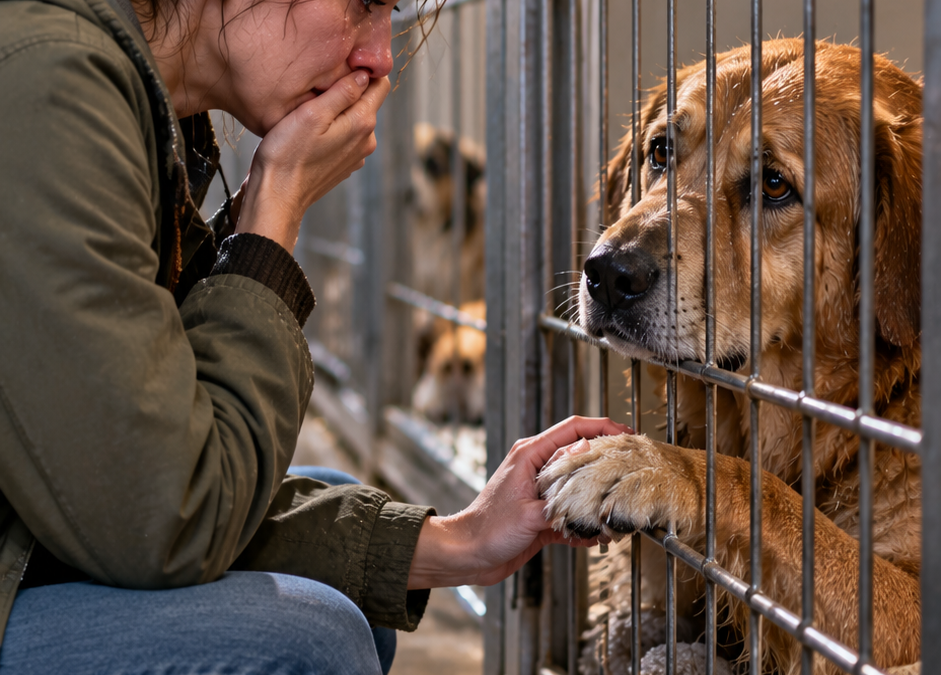
The shelter smelled like disinfectant, damp fur, and something warm underneath both.
A young woman named Jessica met me at the desk.
“Looking for anything specific?”
“Not really.”
“Big? Small?”
“Medium, maybe.”
“Young?”
“Not a puppy.”
She smiled.
“Experienced dog owner?”
I hesitated.
“Yes.”
The answer hurt more than I expected.
Jessica didn’t notice.
She led me past rows of kennels.
Dogs barked.
Some jumped.
Some pressed themselves against the gates.
Some stayed in corners, watching.
I stopped at several.
A shy black dog.
A cheerful terrier mix.
An older shepherd whose tag said he was gentle with children.
Then I reached the end of the second row.
And my entire body stopped.
The dog in the kennel was lying with his back toward me.
He was older.
Thinner.
His coat lacked the shine it once had.
There was gray around his muzzle.
But there was a white patch behind his left ear shaped like a crooked comma.
My hand went cold around the strap of my purse.
No.
That was impossible.
“Jessica.”
She turned.
“Yes?”
“What is this dog’s name?”
She glanced at the clipboard.
“Benji.”
My breath disappeared.
The dog lifted his head.
Slowly.
He turned.
Our eyes met.
Six years vanished.
“Benji?”
His ears rose.
He froze.
For half a second, neither of us moved.
Then he came toward the gate.
Not running.
At first.
One step.
Two.
Then his entire body seemed to recognize me at once.
His tail slammed against the kennel wall.
He whined.
A sound so sharp and desperate that Jessica looked startled.
I dropped to my knees.
“Benji.”
He pushed his nose through the bars.
I put both hands against the gate.
He licked my fingers frantically.
“Oh my God.”
My voice broke.
“Oh my God, Benji.”
He whined again.
Then barked.
Then began pacing in tight circles because he couldn’t reach me properly.
Jessica stared.
“You know him?”
I was already crying.
“He’s mine.”
The words came out automatically.
Then I corrected myself.
“He was ours.”
“Yours?”
“My ex-husband’s.”
I looked at her.
“I left him with my ex six years ago.”
Jessica’s expression changed.
“You’re sure?”
I laughed once through tears.
“There’s a scar on his right front paw.”
Jessica checked.
There it was.
“He cut it on a broken bottle when he was two.”
Benji pressed against the bars again.
“How did he get here?”
Jessica looked toward the desk.
“I can check.”
“Please.”
She returned a few minutes later with a file.
“He was surrendered about three months ago.”
“By Michael?”
“The paperwork says a woman named Emily Johnson brought him in.”
I frowned.
“I don’t know that name.”
“She said the owner could no longer care for him.”
My stomach dropped.
“What does that mean?”
“That’s all it says.”
“Was he abandoned?”
“No.”
Jessica shook her head quickly.
“Not exactly. The woman said she was acting for the owner.”
“Why didn’t Michael bring him himself?”
“I don’t know.”
I looked back at Benji.
Three months.
He had been there three months.
Michael had kept that dog through our divorce.
Through six years.
He had loved him like family.
There was no world in which Michael casually gave Benji away.
Something had happened.
Something serious.
“Can I see the surrender form?”
Jessica hesitated.
“I can’t give you personal information.”
“I don’t need all of it.”
My voice became urgent.
“I need to know what happened to my ex-husband.”
She looked at Benji.
Then at me.
“I’ll get my supervisor.”
That afternoon became the first step backward into a life I thought was finished.
I left the shelter with no useful address for Michael.
But I had a name.
Emily Johnson.
And fear.
A lot of fear.
I called David.
David had been a casual friend years earlier.
We had known each other through mutual friends, and he now worked with the police department.
I hadn’t spoken to him in months.
When he answered, I didn’t bother with small talk.
“I need help finding someone.”
“Sarah?”
“Yes.”
“You okay?”
“No.”
He became serious immediately.
“Who are we looking for?”
“My ex-husband.”
There was a pause.
“Michael?”
“Yes.”
“Why?”
I told him about Benji.
By the time I finished, David was quiet.
“That’s strange.”
“I know.”
“You haven’t spoken in six years?”
“No.”
“Any family?”
“His parents are dead. He had a cousin somewhere, but they weren’t close.”
“Workplace?”
“I called.”
“And?”
“He left months ago.”
“Left?”
“They said medical leave first. Then he resigned.”
David exhaled.
“All right.”
“I don’t need anything illegal.”
“Good, because I wasn’t offering.”
“I just need help knowing where to start.”
He did help.
Not by magically accessing secret records.
By making calls, pointing me toward public information, and reminding me what questions to ask.
The last address we had for Michael was our old apartment.
I went there the next morning.
Standing in front of that building felt like walking into a photograph.
The lobby had been repainted.
The mailboxes were different.
But I could still see us there.
Michael carrying grocery bags.
Benji pulling toward the stairs.
Me complaining about the elevator.
I knocked on the apartment door even though I knew someone else lived there.
A young couple answered.
“Sorry,” I said. “I’m looking for the previous tenant. Michael Thompson.”
The man shook his head.
“We moved in two months ago.”
“Do you know where he went?”
“No.”
A voice behind me said, “He moved before they came.”
I turned.
An elderly woman stood halfway down the hallway.
Mrs. Patterson.
I recognized her immediately.
She looked older.
Smaller.
But the same sharp eyes studied me.
“Sarah?”
I almost cried just hearing my name from someone connected to that life.
“Mrs. Patterson.”
She came closer.
“I thought that was you.”
She took my hands.
“It’s been years.”
“Six.”
“Too many.”
I swallowed.
“Do you know where Michael went?”
Her face changed.
Concern.
“Oh.”
That one sound frightened me.
“What?”
She looked toward the apartment door.
“Come to my place.”
Inside her apartment, everything was almost exactly as I remembered.
Same floral curtains.
Same porcelain birds.
She made tea even after I told her I didn’t need any.
Old women like Mrs. Patterson don’t ask whether tea will help.
They make it anyway because making something is better than watching someone worry.
“Michael moved about three months ago,” she said.
“Do you know where?”
“No.”
“Why?”
She looked at me carefully.
“He was sick.”
My stomach tightened.
“What kind of sick?”
“I don’t know.”
“He didn’t talk about it.”
Of course he didn’t.
“How did he look?”
Mrs. Patterson’s face softened.
“Thin.”
I gripped the teacup.
“He lost a lot of weight.”
“How much?”
“I can’t tell you.”
“Enough that I noticed.”
She touched her own cheek.
“His face had gone yellow.”
My heart began pounding.
“Yellow?”
“Yes.”
“I told him to see a doctor.”
“What did he say?”
Mrs. Patterson gave me a sad smile.
“You know Michael.”
I did.
“He said he was fine.”
“Exactly.”
I looked down at my tea.
Fine.
That word.
Six years fell away again.
How was work?
Fine.
Are you unhappy?
No.
Are we okay?
Fine.
Something inside me twisted.
“When was the last time you saw him?”
“A few months ago.”
“Benji?”
Her face tightened.
“That poor dog.”
“What happened?”
“Michael couldn’t walk him much near the end.”
My eyes burned.
“Near the end?”
“I don’t mean—”
She reached for my hand.
“I only mean before he moved.”
I breathed again.
Barely.
“Mrs. Patterson, did you know a woman named Emily Johnson?”
She thought.
“Emily?”
“Yes.”
Then she nodded.
“She lived two buildings over.”
“Did she know Michael?”
“Neighbor. Kind woman.”
“Would he trust her with Benji?”
“Oh yes.”
That explained something.
Not enough.
I left Mrs. Patterson’s apartment with three thoughts repeating inside me.
Weight loss.
Yellow skin.
Medical leave.
That evening, I sat at my kitchen table with my phone in front of me.
I began calling hospitals.
The first hospital had no record they could disclose.
The second found nothing.
The third couldn’t help.
By the fourth call, I was shaking.
“St. Mary’s Hospital.”
I gave Michael’s full name.
“Robert Michael Thompson.”
I heard typing.
“Date of birth?”
I gave it.
A pause.
Then the woman’s voice changed slightly.
“Yes. We had a patient by that name.”
Had.
The word hit me.
“Had?”
“He was discharged two weeks ago.”
I closed my eyes.
Alive.
At least two weeks ago.
“Can you tell me what happened?”
“I’m sorry, I can’t disclose medical information.”
“I’m his ex-wife.”
“I understand.”
“We were married ten years.”
“I’m sorry.”
“Please.”
My voice broke.
“I found his dog in a shelter. Nobody knows where Michael is. I just need to know whether he’s okay.”
There was a long pause.
The nurse’s voice became softer.
“I really cannot discuss his diagnosis.”
“I understand.”
“If you are family, you could come speak to his physician, but authorization rules still apply.”
“I’m not family anymore.”
I hated how those words sounded.
The nurse was quiet.
Then she said, “He was very alone.”
My throat closed.
“What?”
“I probably shouldn’t say even that.”
“Please.”
She sighed.
“He didn’t have visitors.”
I covered my mouth.
“We asked who we could call.”
“What did he say?”
“That there was no one.”
I stopped breathing properly.
No one.
I sat in my kitchen long after the call ended.
I thought about Michael in a hospital bed.
Sick.
Alone.
Without Benji.
No one.
Six years earlier, I had believed his silence meant he didn’t need me.
Now I was beginning to understand that Michael had built silence around himself precisely because needing someone frightened him.
I remembered our marriage differently that night.
Not better.
The pain didn’t disappear.
But scenes began changing shape.
Michael sitting alone in the dark after his father died.
I had asked, “Do you want to talk?”
He said, “No.”
I became hurt.
Maybe he had been terrified that if he started, he wouldn’t stop.
The last year of our marriage.
I had accused him of shutting me out.
He had said, “I’m trying not to make things worse.”
At the time I heard dismissal.
Now I heard fear.
Michael had grown up in a house where weakness was private.
His father never cried.
Never apologized.
Never hugged him except maybe once when Michael was too young to remember.
His mother cried behind closed doors and came out smiling.
Problems were managed silently.
Pain was handled alone.
I had known all of that intellectually.
I had never understood what it had done to him emotionally.
Michael learned that love meant protecting other people from your suffering.
I had grown up in the opposite world.
My family yelled.
Cried.
Talked over each other.
Apologized loudly.
Hugged after arguments.
We believed love meant bringing pain into the room so nobody had to carry it alone.
Michael and I had entered marriage speaking different emotional languages.
Then we blamed each other for not understanding.
That realization did not excuse him.
But it cracked something open in me.
The next morning, I went back to the shelter.
Benji recognized me before I reached his row.
He began barking.
Jessica smiled.
“He’s been different since yesterday.”
“How?”
“Waiting.”
The word almost undid me.
I stood beside the kennel.
“Can I take him?”
Jessica hesitated.
“Technically, there’s paperwork.”
“I’ll fill out anything.”
“We normally need to follow the adoption process.”
“I understand.”
I told her everything.
Michael’s illness.
The hospital.
Mrs. Patterson.
The fact that Benji had been our dog.
By the end, Jessica had tears in her eyes.
She wiped them quickly.
“Give me ten minutes.”
I signed forms.
Answered questions.
Paid the required fees even though Jessica tried to waive part of them.
Then they brought Benji out.
The moment the leash was clipped on, he dragged Jessica toward me.
I dropped down.
He hit me with enough force to nearly knock me backward.
“Hey.”
I laughed through tears.
“Easy.”
He licked my face.
My neck.
My hands.
I buried my fingers in his fur.
“You remember me.”
Of course he did.
That was the cruelest beautiful thing about dogs.
They remember without demanding explanations.
I had disappeared for six years.
Benji greeted me as though I had gone to the store.
At the car, he bounced like a puppy despite his age.
He jumped into the back seat.
Turned in a circle.
Then sat upright.
Watching me.
I started the engine.
He stared.
I looked at him in the mirror.
“What?”
His head tilted.
“We’re going to find him.”
His ears lifted.
“That’s what you want, isn’t it?”
His tail hit the seat.
“Okay.”
I gripped the steering wheel.
“We’re going to find Michael.”
The hospital could not legally hand me a private address.
But after enough calls and publicly available records, with David helping me navigate what information could be found appropriately, I located a recent address associated with Michael.
North side of the city.
A small house.
I drove there that afternoon.
Benji became restless before we reached the street.
At first, I thought he needed to go outside.
Then he stood.
His nose pressed toward the window.
“Benji?”
His tail began moving.
Fast.
My heart started pounding.
“You know this place?”
He whined.
I turned onto the street.
Benji erupted.
One bark.
Then another.
His entire body shook with excitement.
“Oh my God.”
The house was small.
Single story.
Neat.
Almost painfully neat.
Of course it was.
The lawn was trimmed.
The mailbox straight.
One front curtain was black and fully closed.
I parked.
My hands were trembling.
For six years, I had imagined meeting Michael again in dozens of accidental ways.
A grocery store.
A restaurant.
A train station.
With another woman.
With children.
Happy.
Indifferent.
Older.
I had never imagined standing outside his house holding our old dog’s leash because I was afraid he might be dying.
Benji nearly pulled me up the walkway.
“Slow down.”
He didn’t.
At the door, he barked.
Once.
Twice.
Then scratched.
“Benji.”
Another bark.
I knocked.
Nothing.
My heart dropped.
I knocked harder.
“Michael?”
Silence.
“Michael, it’s Sarah.”
Saying my own name felt surreal.
I heard movement.
Slow.
Uneven.
Then the lock turned.
The door opened several inches.
Michael stood there.
For six years, I had carried a version of his face in my memory.
Dark hair.
Strong jaw.
Blue eyes.
A calm expression that often looked almost detached.
The man in the doorway had the same eyes.
Everything else had changed.
He was thin.
Painfully thin.
His cheeks had hollowed.
Dark circles sat beneath his eyes.
His skin had a faint yellow cast.
He wore a loose gray sweater that seemed one size too big because his body had disappeared inside it.
For several seconds, he stared at me.
No words.
Then he looked down.
Benji made a sound I had never heard from him before.
Half bark.
Half cry.
Michael’s face broke.
Not softened.
Not changed.
Broke.
His mouth opened.
His knees seemed to give out.
He dropped down just as Benji lunged toward him.
I let go of the leash.
Benji slammed into his chest.
Michael wrapped both arms around him.
And sobbed.
I had known Michael for twelve years.
Loved him for almost ten.
Married him for seven.
I had never seen him cry like that.
Not when his father died.
Not when we divorced.
Not once.
Now six years of restraint seemed to collapse in seconds.
“Benji.”
His voice cracked.
“Oh God.”
The dog licked his face frantically.
Whined.
Barked.
Pressed himself into Michael as though trying to crawl inside him.
Michael buried his face in Benji’s neck.
“I’m sorry.”
He kept saying it.
“I’m sorry.”
“I’m sorry.”
“I’m sorry.”
I stood on the porch and cried.
Not gracefully.
Not quietly.
The sight of them reopened something I had sealed badly years ago.
Eventually Michael looked up at me.
His face was wet.
“How?”
One word.
I crouched near him.
“How what?”
“How did you find me?”
I told him.
The shelter.
Jessica.
Emily Johnson’s name.
Mrs. Patterson.
The hospital.
His expression changed when I mentioned Emily.
“Emily brought him in.”
“So you knew?”
He nodded.
“I asked her.”
“Why?”
He looked away.
“Michael.”
No answer.
“Why did you send Benji to a shelter?”
His hand remained buried in the dog’s fur.
“I couldn’t take care of him.”
“What happened?”
He closed his eyes.
“Come inside.”
The house smelled faintly of antiseptic and tea.
Everything was neat.
Of course.
A blanket folded exactly over the couch.
Medication bottles lined up on the kitchen counter.
Hospital paperwork stacked beside them.
A glass of water.
Half a piece of toast.
Benji moved through the rooms frantically, sniffing everything.
Then he returned to Michael as though afraid he might disappear.
I sat on the couch.
Michael sat in a chair opposite me.
For a few seconds, we were husband and wife again in the worst possible way.
Two people separated by silence.
I refused to let it happen.
“Tell me.”
He looked at his hands.
“Liver problems.”
My stomach tightened.
“What kind?”
“Complicated.”
“Michael.”
He sighed.
“Surgery.”
“When?”
“Two months ago.”
“You were in the hospital three months.”
“Almost.”
“Why?”
“Things got worse before they got better.”
I stared at him.
“Were you dying?”
He did not answer quickly enough.
“Michael.”
“They weren’t sure.”
My eyes filled.
“And you didn’t call me.”
He looked away.
“Sarah—”
“You didn’t call anyone.”
“No.”
“The nurse said you told them there was no one.”
His face tightened.
“That was easier.”
“Easier?”
My anger arrived so fast it surprised me.
“Easier for who?”
He flinched.
Good.
For years I had been afraid anger would drive him farther away.
That day, I no longer cared.
“Do you understand what I thought when I found Benji?”
“I didn’t expect you to find him.”
“Obviously.”
“I didn’t know you were looking for a dog.”
“I wasn’t looking for him.”
My voice broke.
“I walked into a shelter and found the dog we raised sitting behind metal bars, and nobody could tell me where you were.”
Michael closed his eyes.
“I’m sorry.”
“Stop.”
He looked at me.
“Stop saying sorry like it fixes the part where you decided everyone else was better off not knowing you might die.”
His jaw tightened.
“I wasn’t trying to hurt you.”
“That sentence was practically the theme of our marriage.”
He stared.
I stood.
“You always decided what I could handle.”
“What I should know.”
“How much of you I was allowed to see.”
“You called it protecting me.”
“You were protecting yourself.”
His face changed.
I knew immediately I had hit something true.
“Maybe.”
The word was barely audible.
I sat again.
Benji came between us.
Placed his head on Michael’s knee.
Then looked at me.
Michael stroked his ear.
“I was sick, Sarah.”
“I know.”
“I was losing weight.”
“I couldn’t eat.”
“I couldn’t walk him.”
His voice started shaking.
“Some days I couldn’t get from the bed to the kitchen without sitting down.”
He looked at Benji.
“He waited by the door.”
My anger weakened.
“I kept thinking I’d get better.”
“Then I didn’t.”
“I went into the hospital.”
“What happened to Benji while you were there?”
“Emily.”
“The neighbor?”
He nodded.
“She took him.”
“Why the shelter?”
Michael’s eyes filled.
“Because I didn’t know if I was coming home.”
Silence.
This time, silence wasn’t a wall.
It was devastation.
He continued.
“I couldn’t ask Emily to keep him indefinitely.”
“Her apartment doesn’t allow dogs long-term.”
“I called rescues.”
“Most were full.”
“The shelter said they could take him.”
He swallowed.
“I thought someone would adopt him.”
“You thought he would be better off with strangers?”
“Than waiting for someone who might not come back?”
His voice broke.
I had no answer.
Michael wiped at his face.
“I couldn’t let him watch me disappear.”
Something in me fractured.
“Do you hear yourself?”
He looked at me.
“You did it again.”
“What?”
“You decided for him.”
I pointed at Benji.
“You decided he would rather lose you than stay beside you while you were sick.”
Michael looked down.
“And you decided for me.”
His breathing changed.
“You decided I would rather not know.”
“I didn’t want you there out of pity.”
“Who said pity?”
“You left me, Sarah.”
The words were not angry.
They were wounded.
Six years old and still alive.
“I gave you reasons.”
“I gave you six years of reasons.”
His voice shook.
“I shut down.”
“I know that.”
“I watched you become lonely next to me and didn’t know how to stop it.”
“So when you finally left…”
He rubbed his hands together.
“I thought the kindest thing I could do was let you.”
I stared at him.
“I didn’t leave because you were weak.”
“I know.”
“No.”
I leaned forward.
“I don’t think you do.”
Michael looked at me.
“I left because I could never find you.”
His eyes filled.
“You were in the room, but you were always somewhere I couldn’t reach.”
“I asked if you were afraid.”
“You said no.”
“I asked if you were unhappy.”
“You said no.”
“I asked whether you still loved me.”
He closed his eyes.
“You remember that?”
“Every word.”
It had been one of our last nights.
I had stood beside the bedroom door.
“Do you still love me?”
Michael had been sitting on the bed.
He stared down at his hands for so long that I answered for him.
“Fine.”
Then walked away.
Now he said, “I was terrified.”
I froze.
“What?”
“That night.”
He looked directly at me.
“You asked whether I loved you.”
“Yes.”
“I did.”
“Then why didn’t you say it?”
His face twisted.
“Because I thought if I said yes, you’d ask why I was treating you like I didn’t.”
Tears filled his eyes.
“And I didn’t have an answer.”
I couldn’t move.
He continued.
“I didn’t understand myself.”
“My father taught me that if something hurts, you get quieter.”
“If you’re afraid, you work.”
“If you’re overwhelmed, you handle it.”
“You don’t put it on someone else.”
His voice lowered.
“I thought being a good husband meant not making you carry my problems.”
“But you weren’t giving me peace.”
I whispered.
“You were giving me absence.”
He nodded.
“I know now.”
Benji shifted between us.
Michael stared at him.
“When I got sick, I did exactly the same thing.”
“Of course.”
“You shut the door.”
“Yes.”
“Why?”
His eyes met mine.
“Because I was afraid if I called you, you’d come.”
That answer hit harder than if he’d said he hated me.
“You didn’t want me to?”
“I wanted you to so badly that I couldn’t risk it.”
My throat closed.
“Explain that.”
Michael took a shaky breath.
“If I called and you came because you still cared, I knew I would want you to stay.”
He stared at the floor.
“And what if you were only staying because I was sick?”
“What if you looked at me and saw a responsibility?”
“What if I survived and realized the only reason you were beside me was guilt?”
He shook his head.
“I couldn’t do that to either of us.”
“You didn’t trust me enough to choose.”
“No.”
He said it immediately.
Then corrected himself.
“I didn’t trust myself enough to hear your choice.”
That silenced me.
For years, I had believed Michael’s greatest problem was emotional indifference.
Sitting there, I finally saw the opposite.
He felt deeply.
So deeply that he controlled every expression of it.
He didn’t withdraw because nothing mattered.
He withdrew because vulnerability felt dangerous.
Love did not make him open.
It made him defensive.
The more he cared, the more he tried to control what could hurt him.
And eventually, he controlled our marriage to death.
I looked around the room.
That was when I noticed the photographs.
I hadn’t seen them at first because I was focused on him.
There were several on the wall.
One of Michael and me at a street festival the year we met.
One from our wedding.
Another from a trip to the coast.
And one I had forgotten existed.
I was asleep on our old couch.
Benji was stretched across my chest.
My hair was a mess.
My mouth slightly open.
I looked ridiculous.
Michael had loved that picture.
I stared at it.
“You kept these?”
He followed my gaze.
“Yes.”
“For six years?”
“Yes.”
“Why?”
His answer was quiet.
“Because being over didn’t mean it wasn’t real.”
I looked at him.
He swallowed.
“I couldn’t take them down.”
“At first because it hurt too much.”
“Later because…”
He paused.
“I didn’t want to rewrite our marriage as something that had only been bad.”
That sentence nearly broke me more than the hospital story.
For six years, I had done exactly that.
I had reduced our marriage to silence because silence was how it ended.
I had forgotten laughter.
Late-night takeout.
Michael building shelves for my books because I kept stacking them on the floor.
The first winter Benji slept between us.
Dancing in the kitchen.
Michael pretending to hate my music but knowing every song.
We had loved each other.
Badly, at times.
Imperfectly.
But truly.
I looked at the photographs.
“I didn’t take ours with me.”
“I know.”
“I thought leaving them would make it easier.”
“Did it?”
“No.”
His smile was sad.
“Me neither.”
Benji moved from Michael to me.
Then back again.
As if physically refusing to let us return to separate corners.
I looked at Michael.
“Why didn’t you contact me after the divorce?”
“I thought you wanted me gone.”
“You could have asked.”
“So could you.”
Fair.
Painfully fair.
We sat there.
Six years of mutual pride between us.
Finally I said, “I’m angry with you.”
“I know.”
“No.”
I shook my head.
“I need you to hear it.”
He nodded.
“I’m angry you hid this.”
“I’m angry you let yourself lie in a hospital thinking there was no one.”
“I’m angry you gave Benji away without calling me.”
His eyes lowered.
“I’m angry that even when you thought you might die, you still couldn’t let someone see you need them.”
My voice shook.
“And I’m angry because part of me understands why.”
Michael wiped his eyes.
“I don’t know how to do this differently.”
“Learn.”
He looked up.
“That’s it?”
“No.”
I almost laughed.
“It’s not that simple.”
“But learn.”
“Talk.”
“Say you’re scared when you’re scared.”
“Say you don’t know when you don’t know.”
“Let people be disappointed.”
“Let them worry.”
“Let them help.”
His mouth trembled.
“That sounds terrifying.”
“It probably is.”
A tiny smile appeared.
“You’re still pushy.”
“And you’re still impossible.”
Benji placed one paw over my hand.
Then over Michael’s.
We both looked down.
His paw rested partly on each of us.
I laughed.
Michael did too.
And there it was.
His laugh.
I had forgotten what it sounded like.
Warm.
Deep.
Almost boyish.
For one second, I was twenty-eight again, standing in a tiny kitchen while Michael burned pancakes and blamed the pan.
I looked at him.
He stopped laughing.
“What?”
“Nothing.”
“Sarah.”
“I forgot your laugh.”
His eyes filled again.
“I didn’t.”
That night, I stayed.
Not as his wife.
Not as his girlfriend.
Not because illness erased history.
I stayed because six years earlier, I had wanted Michael to let me sit beside his pain.
He hadn’t known how.
Now, finally, he was trying.
We ate soup.
Benji followed Michael everywhere.
When Michael went to the bathroom, Benji waited outside the door.
When Michael sat, Benji pressed against his feet.
At one point Michael whispered, “He probably hates me.”
I stared at him.
“Have you learned nothing about dogs?”
He smiled.
“No.”
“He doesn’t hate you.”
“I left him.”
“You were sick.”
“He doesn’t know that.”
“He knows you’re here.”
That seemed to matter.
Later, Michael showed me the spare room.
“You can sleep here.”
I nodded.
At two in the morning, I heard movement.
I walked into the hallway.
Michael stood leaning against the wall.
“You okay?”
“Just dizzy.”
I moved toward him.
He immediately straightened.
“I’m fine.”
I stopped.
He stopped.
We stared at each other.
Then, slowly, his expression changed.
He closed his eyes.
“No.”
“What?”
“I’m not fine.”
It was such a small sentence.
For Michael, it was a revolution.
I walked over.
“What do you need?”
He looked uncertain.
“Can you just…”
He swallowed.
“Stay here for a minute?”
I nodded.
“Yes.”
So I stood beside him.
No fixing.
No questions.
Eventually he steadied.
“Thank you.”
“You’re welcome.”
That was how we began again.
Not romantically.
Not yet.
With sentences.
The next week, I went with him to a medical appointment.
When the doctor asked how Michael felt, he said, “Fine.”
I looked at him.
Michael sighed.
“Tired.”
The doctor waited.
“And scared about the blood work.”
The doctor nodded.
“That’s understandable.”
Michael looked at me.
I smiled.
He rolled his eyes.
But he kept talking.
Over the following months, his health slowly improved.
Treatment continued.
Some days were good.
Some were frightening.
I learned not to interpret every quiet moment as withdrawal.
He learned to tell me what kind of quiet he needed.
Sometimes he would say, “I don’t want to talk, but I’m not shutting you out.”
That sentence became one of the most comforting things anyone had ever said to me.
Other days, he would call.
“I’m afraid.”
“Of what?”
“The results.”
“Okay.”
Not fixing.
Not explaining.
Just staying.
Benji became our constant witness.
He slept in Michael’s room at first.
Then began dividing nights between us.
If Michael was having a bad day, Benji stayed with him.
If I cried in the kitchen, Benji appeared beside me.
He had apparently decided that six years of separation was enough and he would personally supervise the repair.
Three months after I found Benji, Michael and I had our first real argument.
A normal argument.
It was beautiful.
I had scheduled a medical appointment without asking him.
He became angry.
“You can’t manage me.”
“I’m not managing you.”
“You called the clinic.”
“Because you said you needed—”
“I said I might.”
“You would’ve waited another week.”
“That’s my choice.”
I stopped.
The old version of me would have pushed harder.
The old version of Michael would have gone silent.
Instead I said, “You’re right.”
He froze.
“But I’m scared.”
His expression softened.
“I know.”
“When you delay things, I remember the hospital.”
“I know.”
“But it’s still your body.”
“Yes.”
“So next time I’ll ask.”
Michael looked down.
“And next time I’ll tell you if I’m avoiding something because I’m scared instead of pretending I forgot.”
I stared at him.
“Was that emotional maturity?”
“Don’t get used to it.”
I laughed.
We were learning.
Slowly.
Messily.
Six months after I found him, Michael asked me to go to the park.
Not just any park.
The park where we used to walk during the first years of our relationship.
Autumn had turned the trees gold and orange.
Benji moved ahead of us, slower than he once had but still stubbornly determined to inspect every bush.
Michael and I walked side by side.
Not holding hands.
There had been small touches by then.
A hand on my shoulder.
A hug after good test results.
Once, his fingers had brushed mine while reaching for coffee and neither of us moved away immediately.
But we had not named anything.
That afternoon, Michael stopped beside an old wooden bench.
“Sit?”
I sat.
Benji lay at our feet.
Michael stared ahead.
I recognized the expression.
He was preparing to say something difficult.
Six years earlier, I might have filled the silence.
Now I waited.
Finally he said, “I want to ask you something.”
“Okay.”
“I’m going to say it badly.”
“Probably.”
He smiled.
“Helpful.”
“Anytime.”
Then the smile disappeared.
“I know I don’t have a right to ask for our marriage back.”
I felt my heartbeat change.
“I don’t think either of us could bring that marriage back.”
“I know.”
He nodded.
“I don’t want that one.”
That surprised me.
He continued.
“I loved you.”
“I still…”
He stopped.
Closed his eyes.
Started again.
“I still love you.”
There it was.
A sentence he once could not say when our marriage was dying.
Now he said it sitting beside me with visible fear.
I didn’t rescue him from the discomfort.
He needed to finish.
“But loving you wasn’t enough before.”
He looked at me.
“I didn’t know how to let you know me.”
“I thought giving you stability was love.”
“Working.”
“Fixing things.”
“Not burdening you.”
“I didn’t understand that you needed me to tell you what was happening inside me.”
His eyes lowered.
“I’m trying to learn.”
“I see that.”
“I don’t know if it’s enough.”
“I don’t know either.”
He nodded.
“That’s fair.”
He took a breath.
“I want to ask if we can start again.”
My eyes filled.
“Not move in.”
“Not get remarried.”
“Not pretend six years didn’t happen.”
He smiled nervously.
“Coffee.”
“Walks.”
“Maybe dinner.”
“More walks.”
“Very ambitious.”
“I’m an architect.”
“Incremental planning.”
I laughed.
Michael’s voice softened.
“I want to learn who you are now.”
“And I want you to learn who I am.”
He looked at Benji.
“And maybe sometimes we can sit together without talking.”
“But this time, if I’m quiet, I’ll tell you whether I’m peaceful or hiding.”
That was the sentence that made me cry.
I took his hand.
“You know I never stopped thinking about you.”
Michael looked at me.
“I tried.”
“I dated.”
“So did I.”
That startled me.
“You did?”
“Three times.”
“Only three?”
“I was sick for part of the six years.”
I laughed through tears.
“Fair.”
“I compared everyone to you.”
He smiled sadly.
“I did too.”
I looked across the park.
“I don’t think we can go back.”
“I don’t want to.”
“Good.”
I squeezed his hand.
“But maybe we can start somewhere else.”
His eyes filled.
“Slowly?”
“Very slowly.”
“I can do slow.”
“You overthink everything. Slow is your specialty.”
He laughed.
Then leaned toward me.
He did not kiss my mouth.
He kissed my forehead.
It was exactly right.
Benji stood suddenly.
He stared at us.
Then ran toward a nearby tree, grabbed a fallen branch far too large for him, and dragged it back.
He dropped it onto our feet.
Michael stared.
“Subtle.”
“He’s tired of our emotional development.”
Benji barked.
I picked up the branch.
“You want this?”
Tail wag.
I threw it.
Benji ran.
Not fast.
Not like the young dog in my memory.
But joyfully.
Michael and I watched him.
Then Michael laughed again.
And I laughed with him.
The sound moved through the park.
For the first time, our laughter didn’t feel like nostalgia.
It felt new.
A year later, Michael’s health had improved significantly.
Not magically.
There were still medications.
Appointments.
Blood tests.
Diet changes.
Days when fatigue flattened him.
But he returned to architecture part-time.
The first project he took on was small.
A renovation.
He came home furious about a wall someone had moved without consulting the plans.
I smiled through his entire complaint.
“What?”
he asked.
“Nothing.”
“You’re smiling.”
“You’re complaining about a wall.”
“So?”
“You sound normal.”
He stared at me.
Then smiled too.
I opened a small bookstore around that time.
My own.
It had been a dream for years.
Michael designed the shelves.
I told him I wanted them warm and imperfect.
He said shelves are not supposed to be imperfect.
I said neither are marriages, apparently, and look how that went.
He stopped arguing.
The shelves were beautiful.
We eventually moved into a small house outside the city.
Not because moving back together proved anything.
We waited until it felt safe.
The house had a little garden.
Benji loved it.
By then, his muzzle had turned almost completely white.
His hips bothered him on cold mornings.
He could no longer jump onto the bed without help.
So Michael built a small wooden ramp.
Of course he did.
“It looks overengineered,” I told him.
“It has proper support.”
“It’s for a forty-pound dog.”
“It needs proper support.”
Benji used it once.
Then demanded to be lifted.
I laughed until Michael threatened to remove the ramp.
He never did.
Our second life together was nothing like our first.
It was less romantic in some ways.
More honest.
There were pill organizers on the counter.
Arguments about money.
Dog hair everywhere.
Work stress.
Old fears that returned at inconvenient moments.
Sometimes Michael still shut down.
Sometimes I still interpreted quiet as abandonment before catching myself.
But now we had language.
“You’re disappearing.”
“I know.”
“Do you need space or help?”
“Space for twenty minutes.”
“Okay.”
Then twenty minutes later:
“I’m ready.”
Other times:
“You’re asking me the same question six ways.”
“Because you’re not answering.”
“I’m scared.”
“Thank you.”
It wasn’t perfect.
That was the point.
We had spent too much of our first marriage believing love should make understanding automatic.
Now we understood that love without communication is interpretation.
And interpretation is often wrong.
One evening, years after the shelter, Michael and I sat in the garden.
Benji was between us.
Old now.
Very old.
His breathing slower.
His body thinner.
Michael’s hand rested on his back.
My fingers were intertwined with Michael’s.
The sun was setting.
Benji opened his eyes and looked at us.
Michael smiled.
“You know this is his fault.”
“What?”
“Us.”
I looked down.
“Completely.”
“He planned the whole thing.”
“Spent three months in a shelter just to force us to communicate.”
“Very manipulative.”
“Always was.”
Benji’s tail tapped once against the grass.
I leaned my head on Michael’s shoulder.
For years, I had believed home was the apartment we left behind.
Then I believed home was something I needed to rebuild alone.
Now I understood that home had never been walls.
It was the place where I no longer had to guess whether the person beside me was willing to stay.
It was Michael saying, “I’m scared,” before shutting down.
It was me hearing silence without immediately assuming rejection.
It was Benji asleep between us.
It was imperfection with the door left open.
Sometimes I still think about the morning I entered that shelter.
I remember walking past kennel after kennel.
I remember telling Jessica I wasn’t looking for anything specific.
That makes me laugh now.
I thought I was looking for a new dog.
Instead, I found the last living thread connecting me to a life I had cut away but never fully buried.
Benji didn’t return me to the past.
That would have been impossible.
The marriage Michael and I lost stayed lost.
We didn’t repair it.
We built something else.
Something slower.
More deliberate.
Less dependent on assumptions.
Finding Michael sick did not erase why I left.
His illness did not make his old behavior acceptable.
My love for him did not mean I had been wrong to protect myself from years of emotional loneliness.
Both things could be true.
He had loved me.
And he had hurt me.
I had loved him.
And I had left.
We had failed each other.
And we were capable of learning.
That complexity became the foundation of our second chance.
One night, shortly after we moved into the house, I woke and found Michael sitting at the edge of the bed.
The room was dark.
His shoulders were tense.
The old fear hit me immediately.
He’s closing again.
I almost said, “What’s wrong?”
Instead, I waited.
Michael stared at the floor.
Then said, “I’m afraid the illness will come back.”
I sat up.
“Okay.”
“I think about it every time I’m tired.”
He rubbed his face.
“I don’t want to become that sick again.”
“Okay.”
“I don’t want you to have to take care of me.”
There it was.
The old pattern.
I took his hand.
“Michael.”
He looked at me.
“You don’t get to decide that alone anymore.”
His eyes filled.
“I know.”
“If it happens, we’ll deal with it.”
“What if it’s awful?”
“Then it will be awful.”
“What if you’re tired of it?”
“Then I’ll tell you I’m tired.”
“What if you’re scared?”
“I’ll tell you.”
“What if—”
I squeezed his hand.
“And you’ll do the same.”
He breathed slowly.
Then nodded.
“Okay.”
Benji lifted his head from the foot of the bed.
Looked at us.
Then went back to sleep.
Michael smiled.
“He thinks we’re idiots.”
“He’s correct.”
We lay down.
Michael reached for my hand beneath the blanket.
In the darkness, he said, “I’m glad you found him.”
I knew he wasn’t only talking about Benji.
“So am I.”
Years earlier, Michael would have stopped there.
That night, after a pause, he added:
“I’m glad you found me too.”
I turned toward him.
He looked terrified by his own honesty.
I kissed his forehead.
“So am I.”
That was our life now.
Not dramatic revelations every day.
Just one honest sentence after another.
Benji grew older.
His walks became shorter.
Then slower.
Michael bought him orthopedic beds.
I accused him of spending more money on the dog’s mattress than ours.
He denied it.
He was lying.
One morning, I woke to find Benji’s muzzle resting on the edge of our bed.
Exactly as he had done years before.
His eyes were cloudy with age.
His tail moved.
Michael opened one eye.
“Five more minutes.”
Benji stared.
“He’s not negotiating,” I said.
“He never negotiates.”
I got up.
Benji turned toward the door.
Michael groaned.
“Traitor.”
I laughed.
And suddenly I remembered the shelter.
The metal bars.
His thinner body.
Those eyes meeting mine after six years.
Where were you?
That was what I thought he had been asking.
Now I wasn’t so sure.
Dogs don’t seem to waste much time judging where you’ve been.
They care that you’ve arrived.
Maybe that was the final thing Benji taught me.
Michael and I had spent six years trapped inside the question of why we had failed.
Why didn’t you talk?
Why didn’t you stay?
Why didn’t you call?
Why didn’t I come back?
Those questions mattered.
We needed to answer them.
But eventually, another question became more useful.
What do we do now?
Now, Michael tells me when he’s afraid.
Now, I ask before assuming.
Now, we argue and return.
Now, silence can mean rest instead of punishment.
Now, the man who once believed weakness made him unworthy of love will sometimes walk into the kitchen and simply say, “Bad day.”
And I will say, “Come sit.”
No performance.
No rescue.
No armor.
Just presence.
And every time that happens, I think of the man I found behind that door.
Thin.
Sick.
Alone.
Crying into the fur of a dog he thought he had lost forever.
I think of how close we came to never finding each other again.
If I had chosen a different shelter.
If I had gone a week later.
If Benji had already been adopted.
If I had walked past his kennel without looking closely.
Life can turn on such small hinges.
A white mark behind an ear.
A familiar name on a card.
A dog remembering a woman who left six years earlier.
I don’t believe fate fixes everything.
That idea is too simple for me now.
Benji brought us back into the same room.
He did not heal us.
We had to do that work ourselves.
He opened a door.
We chose whether to walk through it.
That distinction matters.
Love gave us another chance.
It did not guarantee we would use it well.
We had to become people capable of meeting each other differently.
Michael had to learn that vulnerability was not a debt he placed on me.
I had to learn that silence was not always rejection.
He had to let me decide whether I could stay.
I had to stop trying to force emotion out of him on my schedule.
He had to speak before the wall became permanent.
I had to listen without always demanding resolution.
Somewhere in the middle, we finally met.
Years too late for our first marriage.
Just in time for something new.
Sometimes, in the evening, we sit outside.
Michael reads.
I usually pretend to read and end up watching the garden.
Benji lies between our chairs.
His body has slowed, but his presence still fills the space.
Michael will reach down without looking and rest one hand on Benji’s back.
I will reach across and touch Michael’s fingers.
No words.
Years ago, silence like that would have frightened me.
Now I know the difference.
There is empty silence.
And there is safe silence.
Empty silence says, You cannot reach me.
Safe silence says, You don’t have to.
I’m already here.
It took us years to learn that.
Sometimes I resent how long.
Sometimes Michael does too.
But regret is another room you can lock yourself inside forever if you’re not careful.
We lost six years.
That is true.
We also found the years after them.
That is true too.
And Benji, somehow, sits at the center of both truths.
The dog I once left behind became the reason I returned.
Not to my old marriage.
Not to the woman I used to be.
Not to the man Michael used to be.
To a new home.
A smaller one.
An imperfect one.
A place where fear is allowed to speak.
Where weakness is not treated like failure.
Where silence has meaning because it is chosen, not imposed.
Where an old dog sleeps wherever he wants because, after everything he carried between us, he has earned that right.
If you had told me the morning I walked into that shelter that I would eventually be sitting in a garden beside Michael again, I would have laughed.
If you had told me we would learn to love each other better after failing so completely the first time, I wouldn’t have believed you.
And if you had told me the path back would begin with Benji looking at me through kennel bars, older but unmistakably himself, I might have turned around before reaching the last row.
I am glad I didn’t.
Because sometimes life does not return what you lost in the form you remember.
Sometimes it brings it back older.
Changed.
Scarred.
More fragile.
Sometimes it places it behind a metal door and waits to see whether you recognize it.
I recognized Benji.
Then, slowly, I recognized Michael.
Not the husband I had accused of not caring.
Not the sick man who thought he had to disappear.
But the human being beneath both versions.
A frightened man who had spent his whole life believing love meant carrying pain alone.
And he finally recognized me too.
Not the wife who left.
Not the woman he imagined would pity him.
But someone who had always wanted one thing from him.
To be allowed inside.
Benji did not fix our story.
He simply refused to let it end where we had left it.
And sometimes, when he lifts his white muzzle from the grass and looks from Michael to me with those same patient eyes, I think he knows exactly what he did.
He brought us home.
Not to where we were.
To where we finally learned how to stay.

