𝗙𝗨𝗟𝗟 𝗦𝗧𝗢𝗥𝗬 I Walked Into a Shelter Looking for a Dog, and One Familiar Pair of Eyes Forced Me to Call the Woman I Hadn’t Spoken to in Seven Years
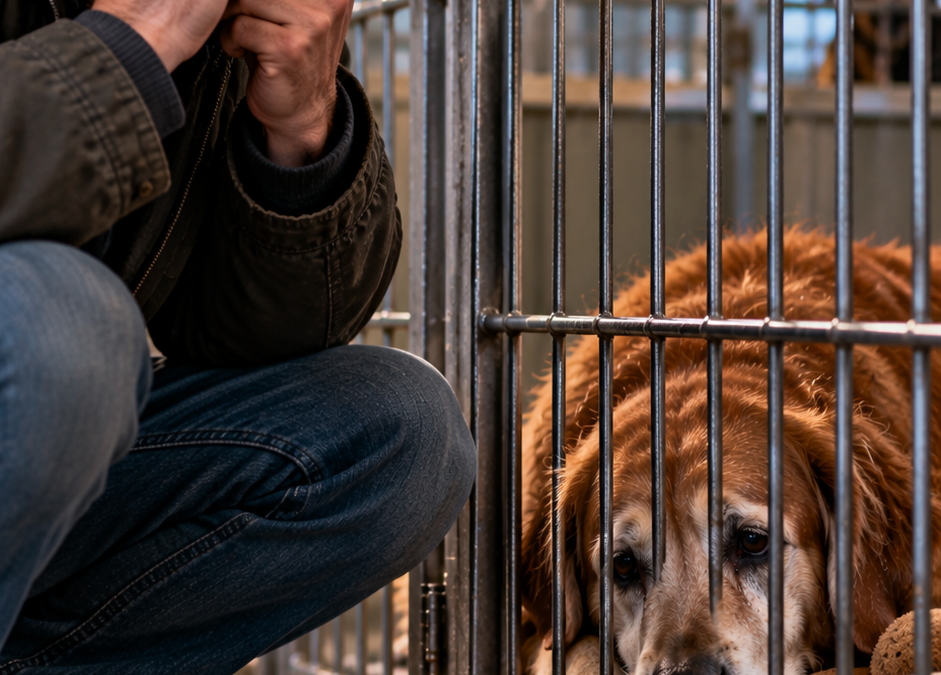
𝗙𝗨𝗟𝗟 𝗦𝗧𝗢𝗥𝗬
More crying.
That was when something inside me shifted.
Sarah would never have abandoned Max casually.
Of all the things I had believed about her after our divorce, cruelty had never been one of them.
She had loved that dog with a devotion that sometimes made me jealous.
If Max ended up in a shelter, there had to be a reason.
“Tell me what happened.”
Nothing.
“Sarah.”
“Please don’t.”
“You haven’t spoken to me in seven years.”
I looked at the kennel.
“I’m not asking about us.”
“I need to understand why Max is here.”
She took a shaky breath.
“You really found him?”
“Yes.”
“How does he look?”
The question hurt.
“Older.”
A pause.
“Thin.”
Another pause.
“But he’s okay.”
“Is he scared?”
“A little.”
“Does he still hate metal bowls?”
I looked at the water dish inside the kennel.
It was plastic.
“I don’t know.”
“He hated the sound when his tags hit them.”
Her voice broke again.
“I used to put his water in ceramic bowls.”
I sat slowly.
There it was.
Not the voice of someone who had forgotten her dog.
The voice of someone who had remembered every detail.
“Sarah.”
“What happened?”
For a long time, she said nothing.
Then I heard her inhale slowly.
When she spoke again, her voice had changed.
She sounded like someone opening a door she had kept locked for years.
“I’m sick.”
I stared straight ahead.
“What?”
“I’ve been sick.”
My hand tightened around the phone.
“What do you mean?”
“There was a diagnosis two years ago.”
“What diagnosis?”
She hesitated.
“It’s complicated.”
I almost snapped at her.
That word.
Complicated.
It was exactly the kind of word Sarah used when she didn’t want to frighten someone.
“Sarah.”
“I’m listening.”
“Don’t protect me from the truth.”
The irony of that sentence would only become clear later.
She was quiet.
Then she said, “I got very sick.”
Her voice lowered.
“I had six months of treatment.”
“Some of it worked.”
“Some of it didn’t.”
“I was in and out of the hospital.”
I could barely breathe.
“Why didn’t anyone tell me?”
She let out a broken laugh.
“Who would?”
“You.”
The word came out before I could stop it.
Another silence.
“We were divorced.”
“That doesn’t mean I would have wanted you to go through that alone.”
“You don’t know that.”
“I do.”
“No, David.”
Her voice hardened for the first time.
“You know how you wish you would have acted.”
“That’s not the same thing.”
The words hit cleanly.
Because they were true.
Seven years earlier, I might not have known what to do with her illness.
I had barely known what to do with her sadness.
I had loved Sarah.
I know that now.
I knew it then too, in my way.
But love and presence are not automatically the same thing.
During our marriage, I worked constantly.
I was an architect.
Not the glamorous version people imagine.
Not standing in sunlight beside beautiful models of buildings.
Mostly deadlines.
Drawings.
Corrections.
Clients changing their minds.
Contractors calling at midnight.
Years of telling Sarah:
“Just this project.”
“Just this week.”
“After the deadline.”
“Next month will be easier.”
Next month was never easier.
Sarah waited.
Until eventually she stopped.
I looked at Max again.
“Tell me about him.”
Her voice softened immediately.
“What happened with Max?”
She cried quietly for several seconds before answering.
“At first I managed.”
“I arranged walks.”
“Neighbors helped.”
“I hired someone when I could.”
“But treatment got worse.”
She inhaled.
“There were days I couldn’t get out of bed.”
My chest tightened.
“Max stayed beside me.”
“Of course he did.”
“He stopped bringing me his leash.”
That detail destroyed me more than anything else she had said.
I remembered Max younger.
Leash in his mouth every morning.
Throwing it against our knees.
Insisting the day could not begin until one of us took him outside.
Sarah continued.
“He learned.”
Her voice was barely above a whisper.
“He knew I couldn’t do it.”
“So he stopped asking.”
I closed my eyes.
“One night I had a fever.”
“Almost 104.”
“I couldn’t stand.”
“I was lying on the bathroom floor because the tile was cold.”
“Max found me.”
She stopped.
I heard her crying again.
“He lay beside me.”
“All night?”
“All night.”
“And most of the next day.”
“He didn’t eat.”
“Wouldn’t leave.”
“Every time I opened my eyes, he was there.”
I rubbed one hand across my face.
The shelter around me disappeared.
All I could see was Sarah on a bathroom floor.
Max pressed beside her.
No one else there.
“Why didn’t you call someone?”
“I did.”
“Eventually.”
“Who?”
“A neighbor drove me to the hospital.”
“And Max?”
“The neighbor took him for a few days.”
She swallowed.
“But it kept happening.”
“I’d improve.”
“Then I’d get sick again.”
“He was alone too much.”
“I stopped being able to give him what he needed.”
“You could have found someone temporarily.”
“I tried.”
Her voice sharpened with pain.
“Do you think I didn’t try?”
I immediately regretted the question.
“No.”
“I’m sorry.”
“I called rescues.”
“Friends.”
“People from work.”
“Nobody could take him long-term.”
“And I didn’t know how long treatment would last.”
She paused.
“I didn’t know if I was going to survive.”
That sentence froze me.
I lowered my voice.
“Were you…”
I couldn’t finish.
“Yes.”
Sarah said it for me.
“There were times the doctors weren’t sure.”
I stared at my own reflection in the shelter window.
Seven years since our divorce.
Two years since she had nearly died.
And I had been living less than forty minutes away.
Going to work.
Buying groceries.
Complaining about traffic.
Sleeping normally.
Not knowing that the woman I once promised to stay beside in sickness was actually facing sickness without me.
The divorce changed the legal promise.
It did not erase the memory of making it.
“So you brought Max here.”
“Yes.”
“How long ago?”
“Two months.”
I looked through the glass.
Two months.
He had spent two months sleeping behind metal bars while Sarah sat somewhere alone convincing herself this was love.
“Why didn’t you come back for him when treatment ended?”
The line went quiet.
Then she whispered:
“Shame.”
That answer surprised me.
“Sarah.”
“I couldn’t.”
“What are you ashamed of?”
“I abandoned him.”
“You were sick.”
“He doesn’t know that.”
“He’s a dog.”
“Exactly.”
Her voice broke.
“He doesn’t understand treatment.”
“He doesn’t understand that I thought I might die.”
“He just knows I left him somewhere and didn’t come back.”
I looked at Max.
He had stood.
Slowly, stiffly.
He walked toward the kennel door.
“I don’t think dogs keep accounts the way we do.”
“You don’t know.”
“Neither do you.”
“He trusted me.”
Sarah was crying again.
“And when things got hard, I sent him away.”
“Because you couldn’t care for him.”
“Because I was afraid.”
“Of dying?”
“No.”
Her answer came immediately.
“Of him watching me die.”
I closed my eyes.
There it was.
The real reason.
Not only practicality.
Fear.
She continued.
“He would look at me like I was his whole world.”
“I couldn’t stand the idea that his world might disappear in front of him.”
“So I thought if he found another family first…”
Her breath caught.
“Maybe it wouldn’t destroy him.”
I rested my forehead against my hand.
“Sarah.”
“I know.”
“I know how stupid that sounds.”
“No.”
“It sounds like you.”
She became quiet.
“What does that mean?”
“You always did that.”
“Did what?”
“Decided what pain everyone else could handle.”
She didn’t answer.
“And I always did the opposite.”
I added.
“I decided work couldn’t wait but you could.”
That silence lasted longer.
Seven years earlier, we could have turned those two sentences into a fight.
Now neither of us did.
Maybe time had taken some of the sharpness out of us.
Maybe suffering had.
Maybe Max had somehow placed us back in the same conversation with no patience left for pride.
I took a breath.
“I’m coming to get you.”
“What?”
“I’m driving to your place.”
“No.”
“Sarah.”
“I look terrible.”
I nearly laughed.
“I’ve seen you with food poisoning.”
“David.”
“I’m serious.”
“I don’t care what you look like.”
“I do.”
“That’s your problem.”
She gave a tiny sound that might have been the beginning of a laugh.
The first familiar sound I had heard from her.
I continued.
“We’ll come here together.”
“I can’t.”
“Yes, you can.”
“What if he doesn’t come to me?”
I looked at Max.
His eyes were on me.
“He will.”
“You can’t promise that.”
“No.”
“I can’t.”
I paused.
“But if he doesn’t, then we’ll deal with that too.”
She whispered, “I don’t think I can survive him rejecting me.”
Something in me tightened.
“Sarah.”
“Listen to me.”
She did.
“You survived treatment.”
“You survived being alone.”
“You survived giving up something you loved because you thought it was best for him.”
“You can survive walking into this shelter.”
Silence.
Then:
“Why are you doing this?”
That was the question I wasn’t ready for.
Why was I doing it?
Because of Max?
Yes.
Because Sarah sounded broken?
Yes.
Because hearing her voice made seven years feel suddenly less permanent?
Also yes.
Because somewhere beneath all the resentment I had carried after our divorce was a truth I had spent years avoiding?
Absolutely.
I had never stopped caring.
Maybe caring wasn’t enough to make a marriage work.
But it didn’t disappear when the judge signed the papers.
“I don’t know.”
I said honestly.
“But I’m coming.”
She exhaled.
“Give me an hour.”
“Two.”
“Why two?”
“Because you will spend at least forty minutes deciding you shouldn’t come.”
That time she actually laughed.
Very faintly.
“You still think you know me.”
“I used to.”
The laughter disappeared.
“Yeah.”
I looked at Max.
“Maybe we can start there.”
I ended the call.
For several seconds, I simply sat.
Then a voice behind me said, “That sounded intense.”
I turned.
Emily, one of the shelter workers, stood near the desk.
She had been the person who first brought me through the kennels.
She knew I had recognized Max.
She didn’t know the history.
“Ex-wife.”
Emily nodded slowly.
“Ah.”
“That’s all you have to say?”
“I work in an animal shelter.”
She shrugged.
“I’ve learned not to ask human relationship questions unless someone volunteers the answer.”
“Smart.”
She looked toward Max.
“She’s coming?”
“Yes.”
“I think.”
Emily smiled.
“He’s been here almost two months.”
“How’s he been?”
She considered.
“Quiet.”
“Not aggressive.”
“Good with people.”
“Doesn’t play much.”
“Doesn’t engage with most dogs.”
My chest tightened.
“Was he like that when he came?”
“Worse.”
“First week, he barely ate.”
I looked sharply at her.
“The surrender notes said his owner was seriously ill.”
So Sarah had told them.
Emily continued.
“He would sit by the gate every afternoon.”
“Waiting?”
“That’s what it looked like.”
I swallowed.
“Did anyone try to adopt him?”
“A few people met him.”
“What happened?”
“He was polite.”
“Polite?”
She smiled sadly.
“That’s the only word.”
“He let them touch him.”
“He walked with them.”
“But he never connected.”
“One family almost took him.”
“What stopped them?”
“Their younger dog wouldn’t settle around him.”
Part of me was relieved.
I hated that about myself.
Emily noticed.
“You’re glad.”
“No.”
“Little bit.”
“Maybe.”
She nodded toward a chair.
“You’ve got time.”
So I sat outside Max’s kennel.
For the next two hours, I talked to him.
At first, I felt ridiculous.
Then I remembered this dog had once been part of my family.
Before Sarah became my ex-wife.
Before I became the man who worked through every anniversary except one.
Before our apartment became two separate addresses.
Before seven years of silence.
There had been Max.
“You remember me?”
He watched.
“I don’t blame you if you don’t.”
His ears lifted.
I smiled.
“Remember the winter you escaped?”
One ear tilted.
“You nearly killed us.”
I leaned toward the bars.
“Three hours, Max.”
“We searched three hours.”
“Sarah was crying.”
“I was calling every shelter in the city.”
“And where were you?”
His tail moved once.
“The Hendersons’ front porch.”
I laughed.
“They were frying pork chops.”
Max raised his head.
“That’s right.”
“You remembered food.”
His tail moved again.
“We found you sitting there like you’d made a perfectly reasonable decision.”
I put my hand near the bars.
“Sarah hugged you so hard you squealed.”
“Then she yelled at me because she said I hadn’t latched the gate.”
“It was probably her.”
Max stood.
Slowly.
Age showed in the movement.
He stretched.
Then walked toward me.
I kept my hand still.
His nose reached through the bars.
He smelled my fingers.
For several seconds, nothing happened.
Then he placed one paw against the gate.
I turned my hand.
His paw settled against my palm through the bars.
That almost broke me.
“Yeah.”
My voice went rough.
“I remember too.”
I stayed there.
I told him stories.
Some he could not possibly remember.
Some maybe he could.
The time Sarah put a birthday hat on him and he ate the elastic.
The road trip when he vomited in my new car.
The thunderstorm when he somehow climbed into bed despite us having a strict no-dog-on-the-bed rule.
The night Sarah and I had our first real fight and Max sat between us until we both stopped shouting.
I had forgotten that.
Or perhaps I had chosen to forget.
Max had always hated conflict.
Near the end of the marriage, he spent a lot of time moving from one room to another.
Sarah in the bedroom.
Me in the office.
Dog in the hallway.
Looking back, I wondered if he had understood the separation before we admitted it.
I had gone to the shelter that morning because I thought adopting a dog might make my apartment feel less empty.
That fact now seemed almost absurd.
I was forty-six.
Divorced.
No children.
Successful enough professionally that people assumed my life had gone according to plan.
It hadn’t.
I had dated after Sarah.
A few women seriously.
More casually.
Nothing lasted.
The easy explanation was work.
Again.
Always work.
The harder explanation was that part of me had become suspicious of intimacy after the divorce.
I told myself Sarah and I had simply been wrong for each other.
That she needed more than I could give.
That I needed more independence than she allowed.
For years, those explanations protected me from asking a more uncomfortable question.
What if I had actually loved her enough and simply failed to behave like someone who did?
I looked at Max.
“You probably know the answer.”
He blinked.
“Very judgmental.”
His tail touched the floor once.
At one point Emily brought me coffee.
“He looks different with you.”
“How?”
“Awake.”
I looked at Max.
He was lying directly against the kennel gate now.
“I don’t know if that’s good or terrible.”
“Usually good.”
“What happens if Sarah wants him back?”
“If her medical situation allows it, we can review the surrender circumstances.”
“She voluntarily surrendered him.”
“Yes.”
“So legally, she can’t simply take him?”
Emily shook her head.
“There’ll be paperwork.”
“Of course.”
“But because you came intending to adopt and both of you have history with him, we’ll work through it.”
“We?”
She smiled.
“You already said ‘we.'”
I stared at her.
She walked away before I could answer.
At exactly two hours, the shelter door opened.
I knew it was Sarah before I turned around.
Some recognition happens below thought.
A rhythm.
A presence.
The way a person pauses when entering an unfamiliar room.
I stood.
For seven years, I had imagined seeing her again.
Never deliberately.
Just flashes.
A restaurant.
Airport.
Sidewalk.
Conference.
I imagined her remarried.
Happy.
Maybe with children.
Maybe heavier.
Maybe unchanged.
The woman standing near the entrance was none of those imagined versions.
Her hair, once long enough to fall past her shoulders, had been cut short.
Very short.
Probably because of treatment.
She was thinner.
Much thinner.
Her face had sharpened.
There were dark circles beneath her eyes.
She wore a simple sweater, jeans, and a coat that seemed slightly too large.
But her eyes were the same.
Blue.
Always too expressive for someone who tried so hard to hide what she felt.
For several seconds, we only stared.
“Hi.”
I said.
She looked almost amused by the inadequacy of the word.
“Hi.”
Seven years.
One syllable each.
She looked past me.
Toward Max.
Her hands began trembling.
I saw it immediately.
“Sarah.”
She shook her head.
“I can’t.”
“Yes.”
“No.”
“He’ll hate me.”
“He doesn’t hate anybody.”
“You don’t know.”
“I’ve been sitting with him two hours.”
“That makes you an expert?”
“No.”
I stepped closer.
“It makes me slightly more informed than you were when you imagined the worst.”
She looked at me.
That had been a pattern too.
Sarah anticipated abandonment.
I anticipated criticism.
Then we behaved as if what we feared had already happened.
I softened my voice.
“Come on.”
“I can’t move.”
“Then don’t.”
She looked confused.
“We’ll stand here.”
“What?”
“Nobody’s rushing you.”
Her eyes filled.
“I forgot that you could be patient.”
That landed.
“I learned late.”
“Apparently.”
Emily approached quietly.
“Sarah?”
She nodded.
“I’m Emily.”
“We spoke during the surrender.”
Recognition crossed Sarah’s face.
“Oh.”
Emily didn’t judge her.
Didn’t ask why she had waited.
She simply said, “He’s through here.”
Sarah followed us.
Each step seemed harder than the one before.
When we reached the kennel, Max was still lying near the gate.
He saw Emily first.
Then me.
Then Sarah.
His entire body changed.
He didn’t stand immediately.
His head lifted.
His eyes fixed on her.
Sarah stopped breathing.
“Max.”
One word.
Soft.
His ears moved forward.
She covered her mouth.
“Oh God.”
Max stood.
Slowly at first.
Sarah began crying.
“I’m sorry.”
He walked toward the gate.
“I’m so sorry.”
She dropped to her knees.
“I should’ve come.”
Max’s tail moved.
Once.
Twice.
Then faster.
Emily unlocked the kennel.
Sarah looked at her in panic.
“Wait.”
“You asked to see him.”
“I know.”
“But—”
Emily opened the door.
Max stepped out.
He stood maybe fifteen feet from Sarah.
For several seconds, nobody moved.
I counted later.
Seven seconds.
Maybe it was six.
Maybe eight.
Memory stretches moments that matter.
But in my mind, it will always be seven.
One second for every year Sarah and I had been apart.
Max looked at her.
Sarah looked at him.
Then she whispered:
“Baby.”
Max ran.
Not walked.
Ran.
Old legs.
Stiff hips.
None of it mattered.
For those few steps, he became the dog I remembered.
He hit Sarah with enough force to push her backward.
She laughed and screamed at the same time.
Her arms wrapped around his neck.
Max licked her face.
Her hands.
Her ears.
Anything he could reach.
Sarah buried her face in his fur.
“I’m sorry.”
Over and over.
“I’m sorry.”
“I’m sorry.”
“I didn’t want to leave you.”
Max’s tail struck the floor.
His entire body twisted with joy.
“He doesn’t care.”
I whispered.
Sarah looked up.
Tears covered her face.
“What?”
“He doesn’t care about the explanation.”
She looked down at him.
“He just knows you’re here.”
That was the first time I truly understood forgiveness.
Not intellectually.
I had used the word hundreds of times.
I had told myself I forgave Sarah for leaving.
I had told myself she probably forgave me for failing the marriage.
But human forgiveness is complicated.
We remember dates.
Sentences.
Patterns.
Who apologized first.
Who suffered more.
Who owes what.
Dogs seem to have a simpler accounting system.
You came back.
You’re here.
I love you.
The rest can wait.
Sarah sat on the floor with Max for nearly twenty minutes.
Eventually, I joined them.
Max positioned himself between us.
Exactly as he used to.
I looked at Sarah.
She was stroking the white fur around his muzzle.
“He got old.”
“So did we.”
She smiled weakly.
“Speak for yourself.”
“There she is.”
“What?”
“Nothing.”
For a moment, I saw the woman I had married.
Not because she looked younger.
Because the old humor had returned for half a second.
Emily went to handle the paperwork.
Sarah looked at me.
“Why did you come here today?”
The question caught me off guard.
“To adopt.”
“A dog?”
“That is generally what one adopts at an animal shelter.”
She rolled her eyes.
That familiar expression did something dangerous to my chest.
“Why?”
I hesitated.
“My apartment is quiet.”
Her smile faded.
“Still working all the time?”
“Less.”
“That’s surprising.”
“People change.”
She studied me.
“Do they?”
“I hope so.”
Max shifted.
His head landed on Sarah’s thigh.
She stroked him.
“You never remarried?”
“No.”
Her eyes moved to mine.
“Why?”
“That’s a very large question for a shelter floor.”
“Sorry.”
“No.”
I exhaled.
“I almost did once.”
“What happened?”
“I realized I was repeating myself.”
Sarah frowned.
“Working constantly.”
“Being present physically and somewhere else mentally.”
“I ended it before we got far enough to hate each other.”
She looked at Max.
“I didn’t know.”
“We stopped exchanging Christmas cards after divorce year two.”
“We exchanged Christmas cards?”
“Email counts.”
She smiled.
“Fair.”
“What about you?”
“No.”
“No what?”
“No marriage.”
“Relationships?”
“A few.”
“Nothing serious?”
“One could have been.”
“What happened?”
Sarah’s fingers stopped moving.
“I got sick.”
I regretted asking.
“I’m sorry.”
“Don’t be.”
She resumed stroking Max.
“He was kind.”
“But?”
“I didn’t want someone staying because I was ill.”
I stared at her.
“Sarah.”
She looked up.
“What?”
“That’s exactly what you told me on the phone.”
“I know.”
“You think anyone who stays when you’re vulnerable must be staying out of obligation.”
Her face tightened.
“Maybe.”
“Why?”
“David.”
“No.”
I shook my head.
“We did seven years of not talking.”
“I think we’ve used our quota.”
That surprised a laugh out of her.
Then she became serious.
“I don’t know.”
“You do.”
She looked away.
“My mother got sick when I was fourteen.”
I remembered.
Breast cancer.
She survived, but treatment had been brutal.
Sarah continued.
“My father became her nurse.”
“Everything became the illness.”
“Every dinner.”
“Every plan.”
“Every conversation.”
“When she recovered, their marriage never did.”
I had heard pieces of that story during our marriage.
Never this conclusion.
Sarah swallowed.
“I promised myself I would never become somebody else’s burden.”
“You weren’t.”
“You don’t know.”
“I know because you never gave me the choice.”
That sounded harsher than I intended.
Sarah flinched.
“I’m sorry.”
“No.”
She nodded.
“You’re right.”
We sat quietly.
Then she said, “I didn’t give Max the choice either.”
I looked down at him.
He was asleep with his head on her lap.
“He seems to have made his opinion clear.”
She smiled through tears.
The shelter approved the return arrangement after reviewing Sarah’s medical status, current ability to care for him, and my willingness to help during her continued recovery.
My willingness.
The phrase appeared on a form before Sarah and I had discussed anything.
She pointed at it.
“What exactly did you tell them?”
“That I can help.”
“David.”
“What?”
“You don’t have to.”
“I know.”
“I mean it.”
“So do I.”
She stared at me.
“I don’t want charity.”
“It’s not charity.”
“What is it?”
I looked at Max.
“I don’t know yet.”
That was the most honest answer.
We walked out of the shelter together near sunset.
Max moved slowly between us.
The sky had turned orange and pale pink.
The light made the white around his muzzle glow.
Sarah stopped beside my car.
“You’re driving me home?”
“Unless you want to carry him onto a bus.”
She looked at Max.
“No.”
I opened the back door.
Max tried to jump.
His legs failed.
I caught him under the chest.
“Easy.”
Sarah immediately moved closer.
“His hips.”
“I know.”
“He needs a ramp.”
“We’ll get one.”
She looked at me.
“We?”
There was Emily’s word again.
I smiled.
“Apparently.”
The ride to Sarah’s house was quiet.
Max lay across the back seat.
Every few minutes, Sarah turned around to check him.
At one red light, she said, “I used to dream about him.”
“I know.”
“Did I tell you?”
“On the phone.”
“Right.”
She looked embarrassed.
“Sorry.”
“Why?”
“I said a lot.”
“I noticed.”
“I hadn’t slept.”
“Also noticed.”
She looked out the window.
“I dreamed we were in the park.”
“The one by our first apartment?”
“Yeah.”
“He would run ahead.”
“I’d call him.”
“He’d turn around.”
“Then I’d wake up before he reached me.”
I glanced at her.
“Tonight you won’t.”
She wiped one eye.
“You’re different.”
“So are you.”
“Mine wasn’t voluntary.”
The words were quiet.
I tightened my grip on the wheel.
“You’re still here.”
“Yeah.”
“That’s not nothing.”
We reached her house.
Small.
One story.
Neat.
I remembered how Sarah used to fill rooms with objects.
Books.
Plants.
Blankets.
Photographs.
This house looked stripped down.
Maybe illness had done that too.
Max entered cautiously.
Sniffed the doorway.
Hall.
Living room.
Then he found something.
A basket in the corner.
Inside was an old red blanket.
His blanket.
I recognized it immediately.
Sarah had kept it.
Max pressed his nose into it.
Then circled twice.
Lay down.
Sarah covered her mouth.
“I washed it every month.”
I stared at her.
“Why?”
“I don’t know.”
Yes, she did.
She simply couldn’t say it.
That night, I stayed for dinner.
Not because we planned it.
Because Max fell asleep and neither of us wanted to move him.
Sarah heated soup.
I fixed a loose cabinet hinge while waiting.
She noticed.
“You still do that.”
“What?”
“Repair things without being asked.”
“You used to complain.”
“I complained because you fixed cabinets instead of talking about our marriage.”
“Fair.”
We both laughed.
Then the laughter faded.
For the first time, talking about our marriage did not feel like touching an exposed electrical wire.
Maybe because enough time had passed.
Maybe because illness had reduced Sarah’s interest in pretending.
Maybe because I was finally old enough to listen without immediately preparing a defense.
We ate at the kitchen table.
Max slept nearby.
Sarah said, “Do you want to know why I really left?”
I put down my spoon.
“I thought I knew.”
“You thought I was tired of being alone.”
“Weren’t you?”
“Yes.”
She looked at me.
“But that wasn’t the only thing.”
I waited.
“I was becoming someone I didn’t like.”
“How?”
“Every night I waited for you.”
“When you came home late, I was angry.”
“If you came home on time, I was already angry because I expected you to leave mentally.”
“If you checked your phone, I hated you.”
“If you didn’t check your phone, I wondered how long until you did.”
Her eyes filled.
“I was measuring my entire life by whether you were paying attention to me.”
I looked down.
“I’m sorry.”
“I know.”
“No.”
I met her eyes.
“I need to say it properly.”
Sarah went still.
“I made work more important than our marriage because work rewarded me for showing up.”
“You didn’t.”
The truth came out before I could soften it.
“At work, if I worked harder, something improved.”
“Projects moved.”
“People praised me.”
“Money came.”
“At home, the harder things became between us, the more useless I felt.”
“So I went where I felt competent.”
Sarah stared.
I had never explained that.
Not even to myself.
“I thought you didn’t care.”
“I cared too much.”
I gave a bitter laugh.
“Apparently my response to caring badly is avoidance.”
“Apparently mine is leaving before someone can leave me emotionally.”
We both looked toward Max.
“Very healthy pair.”
Sarah said.
“Excellent.”
“Should’ve written a marriage manual.”
“We could call it What Not to Do.”
She laughed.
I had forgotten how much I loved making her laugh.
That realization frightened me.
Not because love itself frightened me.
Because suddenly seven years did not feel like protection anymore.
They felt like lost time.
But lost time is dangerous territory.
You can become so obsessed with what should have happened that you destroy what can happen next.
So I didn’t say anything dramatic.
I washed the dishes.
Before leaving, I knelt beside Max.
“Stay out of trouble.”
His tail moved.
Sarah leaned against the doorway.
“Thank you.”
“For what?”
“Finding him.”
“I didn’t know I was looking for him.”
“Maybe he was looking for you.”
“That’s sentimental.”
“You always hated sentimental things.”
“I came to adopt a dog because my apartment was lonely.”
She smiled.
“You’re getting soft.”
“Age.”
I hesitated near the door.
“Sarah.”
“Yeah?”
“I meant what I said.”
“About helping.”
“You don’t have to decide anything.”
“I’m not asking for anything.”
“But if you need rides to appointments.”
“Dog walks.”
“Groceries.”
“Whatever.”
Her eyes dropped.
“Why?”
I answered more honestly this time.
“Because seven years ago, I left you alone while standing right beside you.”
“I don’t want to do that again.”
Her eyes filled.
“Good night, David.”
“Good night.”
The next morning, she texted.
First message between us in seven years.
Max woke me at 5:42 by breathing directly into my face. Some things never change.
I replied:
He used to do 5:30. He’s becoming considerate.
Three dots appeared.
Then:
He needs a walk. My legs aren’t great today.
I stared at the message.
There it was.
The simplest test of whether either of us had actually changed.
Sarah asking for help.
Me deciding whether I was too busy.
I looked at the architectural plans on my desk.
Then at the clock.
I typed:
I’ll be there in twenty minutes.
It became a pattern.
Not every day.
Not immediately romantic.
That mattered.
I walked Max when Sarah was tired.
Drove her to a follow-up appointment when she asked.
Sometimes brought dinner.
Sometimes stayed for coffee.
Sometimes left after ten minutes.
I had to learn not to turn help into control.
That was difficult.
The old me fixed things.
Sarah’s illness could not be fixed by replacing a hinge or redrawing a plan.
One afternoon after a medical appointment, she came out pale.
I stood.
“What did they say?”
“Can we just go home?”
“Sarah.”
“Please.”
Every instinct told me to question.
Results?
Numbers?
Next steps?
Instead, I nodded.
“Okay.”
We drove silently.
At her house, she sat on the couch.
Max put his head in her lap.
I sat in the chair across from her.
Ten minutes passed.
Then she said, “The tests were good.”
I exhaled.
“But?”
“They want another scan in three months.”
“Okay.”
“I’m scared.”
There it was.
A sentence Sarah once would have swallowed.
I didn’t say, “Don’t be.”
I didn’t say, “Everything will be fine.”
I had learned enough by then to understand those sentences are often for the comfort of the listener.
“What part scares you?”
“That it comes back.”
I nodded.
“What else?”
“That I finally got Max back.”
She stroked his head.
“That I’m letting myself have a life again.”
“And something will take it.”
I moved beside her.
Not touching yet.
“What do you need from me?”
She thought.
“Can you just stay?”
So I stayed.
That was all.
It felt more intimate than half the things we had done while married.
Months passed.
Sarah grew stronger.
Not in a straight line.
Recovery rarely works like that.
Good week.
Bad week.
Two energetic days followed by one where she barely got dressed.
The difference was that now she told me.
Bad day.
I would answer:
Need anything?
Sometimes:
No. Just wanted someone to know.
That sentence taught me more about intimacy than years of marriage had.
Sometimes people do not need rescue.
They need witness.
I reorganized work.
Not dramatically.
I did not quit architecture.
I still cared about it.
But I stopped treating every request as an emergency.
One evening, my partner at the firm said, “You’re leaving at six?”
“Yes.”
“We’ve got the revised plans.”
“They’ll still exist tomorrow.”
He stared as though I had announced a religious conversion.
“Who are you?”
“Working on it.”
I went to Sarah’s.
We walked Max in the park where Sarah and I had first met years earlier.
Max couldn’t go far.
His hips were worse.
We moved slowly.
At one point, Sarah said, “You never walked slowly.”
“What?”
“Even when we dated.”
“You always walked like you were late.”
“I probably was.”
“To what?”
“Apparently the next thing.”
She smiled.
“Exactly.”
We sat on a bench.
Max lay at our feet.
Sarah looked across the pond.
“You know what the hardest part was?”
“The treatment?”
She shook her head.
“Being alone.”
I didn’t speak.
“Pain was terrible.”
“Nausea.”
“The hospital.”
“Losing my hair.”
“All of it.”
She looked at me.
“But the worst was waking at three in the morning and realizing there was nobody I could say I was scared to.”
My chest tightened.
“Sarah.”
“I’m not blaming you.”
“I know.”
“I made choices too.”
“I shut people out.”
“I didn’t call.”
She looked down.
“But being strong all the time is exhausting.”
I reached for her hand.
Slowly.
Gave her time to pull away.
She didn’t.
“You’re not alone now.”
Her fingers tightened around mine.
“No.”
We sat like that.
No kiss.
No declaration.
Max snored.
Romance, apparently, had matured.
The first time I kissed Sarah again happened nearly four months after finding Max.
It wasn’t dramatic.
We had spent the day at the veterinarian because Max had hurt his leg.
Nothing serious.
Arthritis flare.
Pain medication.
Rest.
By evening, Sarah was exhausted.
I carried Max’s food inside.
She stood by the kitchen counter.
“Thank you.”
“You’ve said that forty times.”
“I’m aiming for fifty.”
“Overachiever.”
She smiled.
Then suddenly she began crying.
I put the bag down.
“What?”
“I was thinking about the shelter.”
“Okay.”
“If you hadn’t gone…”
I knew where the sentence was heading.
I stepped closer.
“Don’t.”
“But—”
“You went through enough without living in alternate timelines.”
She looked at me.
“You’re the one who used to calculate every possible scenario.”
“Growth.”
She laughed through tears.
I wiped one tear from her cheek without thinking.
My hand stayed there.
Sarah became very still.
So did I.
Seven years existed between us.
So did ten years before them.
Every argument.
Every morning.
Every promise.
Every silence.
Every separate birthday.
Every person we had dated.
Every night she had been sick.
Every night I had worked late in another apartment without knowing.
I could have kissed her.
I didn’t.
I waited.
Sarah moved first.
Barely.
One step.
Her forehead rested against mine.
“Slowly.”
She whispered.
“Very.”
I kissed her.
Softly.
Once.
Nothing like our first kiss.
That one had been hungry and careless.
This one felt like holding something breakable with both hands.
When we separated, Max barked from the living room.
Sarah laughed.
“Judgment.”
“Jealousy.”
We found him standing beside his empty water bowl.
“Neither.”
Sarah said.
“Service complaint.”
I filled it.
Max drank.
Then looked at us as if his work was complete.
We started dating again.
I hated the phrase.
It made us sound like strangers.
We weren’t strangers.
That was the problem and the advantage.
We knew each other’s weak points.
We also knew which weapons not to pick up again.
When I worked late without telling her, she said:
“This feels familiar.”
The old me would have defended the deadline.
Instead I said:
“You’re right.”
“I should’ve called.”
When she canceled plans because she was tired and then insisted she was fine, I said:
“You don’t need to pretend with me.”
She replied:
“I’m afraid you’ll get tired of this.”
I said:
“Then let me tell you if I get tired.”
“Don’t decide for me.”
She cried.
Then apologized.
I told her crying was not a criminal offense.
She told me sarcasm was still annoying.
Normal.
Messy.
Good.
Max improved too.
The hollow expression he had carried in the shelter disappeared.
His age remained.
His arthritis remained.
But happiness changes how an animal inhabits its body.
His tail returned.
His appetite strengthened.
He waited at the window when I arrived.
That became one of my favorite sights.
Sarah once said, “He thinks you live here.”
“He’s optimistic.”
“Or manipulative.”
“Also possible.”
Six months after the shelter, I asked Sarah to marry me again.
That statement makes the moment sound more dramatic than it was.
There was no restaurant.
No hidden photographer.
No ring inside dessert.
We were in the park.
Same park.
Cold morning.
Max was wearing a ridiculous blue jacket because Sarah said old dogs get cold.
I had mocked it.
Then bought him a second one.
We sat on a bench.
Sarah was drinking coffee.
Max slept near our feet.
I had a ring in my pocket.
Not her old ring.
I considered using it.
That felt wrong.
Our old marriage had ended.
I did not want to pretend we were restoring an object to its original condition.
Architecture had taught me something useful after all.
Sometimes a damaged structure should not be rebuilt exactly as it was.
You preserve what still has integrity.
Remove what failed.
Strengthen the foundation.
Then build something that acknowledges what happened.
I reached into my pocket.
Sarah saw the movement.
Her eyes widened.
“David.”
“Don’t panic.”
“That is not something you say before pulling out a ring.”
“I rehearsed this better.”
She started laughing.
“Clearly.”
I held the small box.
Her laughter stopped.
“I don’t want our old marriage back.”
She stared.
“Excellent proposal.”
“Wait.”
I took a breath.
“I loved you then.”
“I love you now.”
“But I don’t want to pretend love was enough.”
“It wasn’t.”
Sarah’s eyes filled.
“I want to build something different.”
“Something where work doesn’t automatically win.”
“Where you tell me you’re afraid before you disappear.”
“Where I listen before I fix.”
“Where neither of us decides what the other person can handle.”
I looked at Max.
“And where apparently this dog controls the schedule.”
Max remained asleep.
Sarah laughed through tears.
I opened the box.
“I’m not asking you to erase seven years.”
“I’m asking whether we can let them teach us something.”
“Sarah…”
My voice failed for a second.
“Will you marry me again?”
She covered her mouth.
For a terrifying five seconds, she said nothing.
Then:
“Yes.”
I exhaled.
She laughed.
“Did you think I was going to say no?”
“Five seconds is a long time when you’re holding a ring.”
“You made me wait years for dinner.”
“Fair.”
I slid the ring onto her finger.
Then kissed her.
Max woke.
Looked up.
Sneezed.
Sarah stared at him.
“That’s your blessing?”
He stood, stretched, and put one paw on my shoe.
“Good enough.”
Our second wedding was small.
That was Sarah’s decision.
And mine.
No elaborate venue.
No hundreds of guests.
No attempt to prove anything.
Two witnesses.
A simple ceremony.
Max beside us.
Sarah wore a pale dress.
Her hair had grown back, softer and slightly different than before.
She looked healthier.
Not untouched by illness.
That wasn’t possible.
But alive.
Fully, unmistakably alive.
Before the ceremony, I found her alone in a side room.
“You okay?”
She nodded.
Then shook her head.
“Both?”
“Both.”
I stood beside her.
“I keep thinking we’re insane.”
“Probably.”
“Helpful.”
“I promised honesty.”
She smiled.
Then became serious.
“What if we fail again?”
That question deserved more than reassurance.
“We might.”
She looked at me.
“That’s your answer?”
“We might hurt each other.”
“We’ll make mistakes.”
“I’ll probably work too late sometimes.”
“You’ll probably decide what I’m feeling before asking.”
“You’re very confident.”
“I have evidence.”
She smiled.
I took her hand.
“But this time, I know what happens when I keep choosing everything except us.”
She looked down.
“And I know what happens when I leave before asking if someone will stay.”
“So?”
She breathed.
“We try differently.”
“Exactly.”
At the ceremony, when I was asked whether I accepted Sarah as my wife, I looked at her.
Then at Max.
He was sitting beside one of our witnesses wearing a simple collar Sarah had bought for the day.
He looked deeply unimpressed by the entire institution of marriage.
I smiled.
“I do.”
Then I added, because apparently once you reach forty-six you stop caring about perfectly scripted ceremonies:
“And this time, I promise not to confuse providing for you with being present for you.”
Sarah’s eyes filled.
“I promise work will not get every version of me except the tired one.”
“I promise that if I’m afraid, I’ll tell you.”
“If I’m overwhelmed, I’ll tell you.”
“And if I don’t know what to do…”
I smiled.
“I’ll stay long enough to figure it out.”
Sarah was crying.
So was one of the witnesses.
The officiant looked at Sarah.
She laughed.
“How am I supposed to follow that?”
“Improvise.”
She looked at me.
“I promise not to disappear just because I’m scared you might leave.”
“I promise not to decide that protecting you means hiding the truth.”
“I promise to ask for help before I convince myself I shouldn’t need it.”
She glanced at Max.
“And I promise never to voluntarily surrender our dog again unless he personally submits the paperwork.”
Everyone laughed.
Max barked once.
The officiant said, “I believe that’s an objection.”
Sarah wiped her tears.
“Overruled.”
We remarried.
People like to call stories like ours second chances.
I understand why.
But I don’t think that’s exactly what happened.
A second chance sounds like repeating the first test.
This wasn’t repetition.
We were different people.
Our relationship was different.
Our circumstances were different.
Even Max was different.
Older.
Slower.
Wiser, if dogs can be called wise.
We were not returning to the beginning.
We were starting from where we had ended.
That distinction mattered.
Sarah’s health continued improving.
There were still scans.
Appointments.
Fear.
Good results did not erase anxiety.
Every time she had a follow-up test, she became quieter.
One morning, she sat at the kitchen table staring at her coffee.
I knew.
“Scan?”
“Thursday.”
“You want me there?”
She hesitated.
Then smiled faintly.
“I’m practicing.”
“Practicing what?”
“Asking.”
She took a breath.
“Yes.”
“Please come.”
“I’ll be there.”
Simple.
That was marriage now.
Not grand declarations every day.
Requests.
Answers.
Presence.
We moved into a small house together.
Not my apartment.
Not Sarah’s.
Something new.
The place had a yard just large enough for Max.
I made one mistake.
I drew up plans for renovating half of it.
Sarah saw the sketches.
“No.”
“What?”
“We have owned the house twelve days.”
“The kitchen wall is structurally unnecessary.”
“I don’t care.”
“It would open the room.”
“David.”
“Yes?”
“Sit down.”
I sat.
“We’re living first.”
“Renovating later.”
I considered arguing.
Then looked at Max lying in a patch of sunlight.
“Fine.”
Sarah smiled.
“Growth.”
“Don’t abuse it.”
I reduced my hours eventually.
Not because Sarah asked.
Because I realized I did not want to reach sixty with a portfolio of buildings and no memory of the ordinary evenings around them.
That was the hidden tragedy of my first marriage.
Nothing catastrophic had destroyed it.
I simply kept postponing participation.
One project at a time.
Max became my clock.
Every afternoon around five-thirty, he stood near my home office door.
At first, I tried ignoring him.
He stared.
I continued drawing.
He sighed.
Loudly.
Then sat directly between me and the door.
“You learned this from Sarah.”
No response.
“Five more minutes.”
Stare.
“Two.”
Stare.
“Fine.”
I shut the laptop.
He walked away.
I followed.
That became our arrangement.
Sarah joked Max had succeeded where marriage counseling failed.
She wasn’t entirely wrong.
One evening, about a year after our second wedding, Sarah and I sat outside.
Max was asleep on the grass.
His muzzle had gone nearly white.
His breathing was slow.
Sarah rested her head on my shoulder.
“You know what’s strange?”
“Many things.”
“About us.”
“Still many.”
She nudged me.
“I spent years thinking our marriage ended because you didn’t love me enough.”
I looked at her.
“And now?”
“I think you loved me.”
“You just didn’t know how to organize your life around what you said mattered.”
That was fair.
“I thought you left because you stopped loving me.”
“And now?”
“I think you left because staying had started hurting you more than leaving.”
Sarah nodded.
“That’s probably true.”
We sat quietly.
Then she said, “Do you regret the seven years?”
Of course I did.
But regret is rarely a useful answer by itself.
“Yes.”
I said.
“Sometimes.”
“Me too.”
“But?”
She knew me.
“But if I spend the years we have now punishing myself for the ones we lost, then I lose these too.”
She took my hand.
“That’s annoyingly wise.”
“Age.”
“Again?”
“It’s doing excellent work.”
Max opened one eye.
Sarah smiled.
“He agrees.”
As Max grew older, we adjusted the house around him.
Rugs on the floors so he wouldn’t slip.
A ramp near the back steps.
Raised food bowls.
Pain medication hidden inside cheese.
He knew the sound of the cheese wrapper and could apparently regain twenty percent of his youthful mobility instantly.
Sarah accused him of fraud.
I defended him.
“Medical necessity.”
“He’s manipulating you.”
“He’s elderly.”
“So are you.”
“Uncalled for.”
Max got the cheese.
Of course.
There were nights when Sarah woke because Max was restless.
Sometimes because he needed outside.
Sometimes pain.
Sometimes nothing we could identify.
We took turns.
One night around three, I found Sarah lying on the floor beside him.
Max’s head rested on her chest.
For a second, the image terrified me because it mirrored the story she had told me from treatment.
Her lying sick.
Max beside her.
I knelt.
“You okay?”
She nodded.
“He couldn’t settle.”
I lay down on the other side.
“You’re going to destroy my back.”
“You chose the floor.”
“We all make sacrifices.”
Max sighed between us.
Sarah whispered, “I used to think loving him meant making sure he didn’t see me suffer.”
I looked at her.
“I know.”
“I was wrong.”
“Probably.”
She ran her fingers through his fur.
“He didn’t need me perfect.”
“No.”
“He just needed me there.”
I stared at the ceiling.
“Apparently dogs understand marriage.”
Sarah laughed quietly.
“Maybe we should have asked him sooner.”
Max eventually stopped being able to walk far.
The park became a once-a-week trip.
Then once every few weeks.
I bought a wagon.
Sarah laughed at me.
“You mocked people who did this.”
“I have evolved.”
“You said dogs have legs.”
“He did.”
“Past tense.”
“Now he has transportation.”
Max loved the wagon.
Or tolerated it because it resulted in park visits.
We would pull him along the same path where Sarah and I had walked years earlier.
Children pointed.
Strangers smiled.
Max accepted admiration as his birthright.
One afternoon, we reached the bench where I had proposed the second time.
Sarah sat.
I parked Max’s wagon beside us.
She said, “This place has seen too much.”
“Should we find a less emotionally loaded park?”
“Too late.”
Max lifted his head.
Sarah scratched his ears.
“You did all this.”
I said.
She looked at me.
“Don’t give him too much credit.”
“I’m serious.”
“If I hadn’t gone to the shelter…”
“Don’t.”
Sarah interrupted.
I smiled.
“You learned that from me.”
“Unfortunately.”
“No alternate timelines.”
“Exactly.”
She took my hand.
“We got this one.”
Max’s tail moved slowly.
This one.
That became enough.
Max lived with us longer than the veterinarian originally expected.
Maybe happiness.
Maybe good care.
Maybe luck.
Eventually, though, age wins.
His final decline was gradual.
Then suddenly not.
One week he was eating less.
The next he struggled to stand.
The veterinarian examined him.
Sarah sat beside me.
Max lay between us.
The vet spoke gently.
We both knew.
The drive home was silent.
At the house, Sarah opened the back door.
I lifted Max out.
He rested his head against my chest.
For years, I had thought of him as Sarah’s dog.
Then our dog.
Then the dog who accidentally repaired a marriage.
In that moment, he was simply my friend.
We gave him two good days.
Cheese without medication.
Chicken.
Sunlight.
The park in the wagon one final time.
Sarah cried almost constantly.
She apologized to him again.
Not only for the shelter.
For everything.
“I should’ve come sooner.”
Max licked her wrist.
I touched her shoulder.
“He answered you years ago.”
“I know.”
“Then stop asking the same question.”
She looked at me.
“What?”
“He forgave you.”
“Believe him.”
She cried harder.
But nodded.
When the time came, we stayed beside him.
Sarah held his head.
I kept one hand on his back.
He was not alone.
That mattered more than anything.
Afterward, the house became impossibly quiet.
I understood why I had gone to the shelter years earlier.
I had been afraid of quiet.
Then I found Max.
And Max brought Sarah back.
Now the quiet felt different.
Not empty exactly.
Full of absence.
For weeks, I expected him at five-thirty outside my office.
I would look at the doorway.
Nothing.
Sarah kept his red blanket folded beside the couch.
Neither of us suggested moving it.
Grief has its own schedule.
We respected it.
Months later, Sarah came into my office.
“You’re still working?”
“Almost done.”
She looked at the clock.
5:47.
I followed her eyes.
“No dog.”
“No.”
She smiled sadly.
“Then I’m taking over.”
“What?”
“Close the laptop.”
I looked at the screen.
Then at her.
“Five minutes?”
She raised one eyebrow.
I laughed.
“Okay.”
Closed it.
That was one more thing Max left behind.
The habit of coming back to life at the end of the workday.
Today, as I write this, Sarah is in the kitchen.
She is making coffee and singing an old song she loved when we were young.
Her voice is not perfect.
Never was.
I used to tease her.
I don’t anymore.
I like hearing it move through the house.
There is another dog sleeping near my desk now.
A rescue.
Older when we adopted him.
Sarah insisted.
“No puppies.”
“Why?”
“Because old dogs deserve someone waiting too.”
His name is Charlie.
He snores louder than Max ever did.
We did not adopt him to replace Max.
You cannot replace a relationship.
You can only make room for another one.
Max’s collar hangs near the back door.
His photograph is in the living room.
Sarah sometimes touches the frame when she passes.
Neither of us pretends the shelter was some magical destiny that erased everything painful before it.
Our first marriage still failed.
Sarah still got sick.
She still went through months of treatment alone.
She still surrendered Max.
I still lost seven years with a woman I loved because I had not understood how to make love visible in daily life.
Those things remain true.
A happy ending does not rewrite the beginning.
It simply means the story continued.
That’s what Max gave us.
Continuation.
I went to that shelter because I wanted a dog to make my apartment less lonely.
I found the dog who belonged to the loneliest chapter of Sarah’s life.
I almost walked past his kennel.
That’s the detail that still frightens me.
The shelter was crowded.
Dogs barking everywhere.
I had already looked at six.
I was tired.
Max was lying at the back, not trying to attract anyone.
Another few seconds and I might have continued walking.
Then he lifted his head.
I saw the white patch near his chest.
The old scar near his left eye.
And I knew.
Sometimes life does not knock loudly.
Sometimes it simply looks up from behind metal bars and waits to see whether you are paying attention.
I was paying attention that day.
Barely.
Enough.
People have asked whether Sarah and I would have found each other again without Max.
I don’t know.
Maybe.
Probably not.
We had both become very good at protecting ourselves with silence.
Seven years is long enough for distance to become identity.
We were no longer people who happened not to speak.
We were people who did not speak.
Max broke that definition.
Not deliberately.
He was simply there.
Alive.
Waiting.
Connected to both of us.
A living piece of a life we had divided.
He forced the first call.
The rest was ours.
That distinction matters.
Dogs do not fix marriages.
Illness does not make old incompatibilities vanish.
Nostalgia is not a relationship plan.
What saved Sarah and me the second time was not rediscovering that we loved each other.
We had loved each other the first time.
What changed was behavior.
She asked.
I answered.
I came home.
She spoke before withdrawing.
I listened before solving.
We apologized earlier.
We argued more honestly.
We stopped imagining love could survive indefinitely without maintenance.
Architects understand maintenance better than anyone, which makes my first marriage especially embarrassing.
You can design the strongest building in the world.
Then ignore small failures long enough and damage spreads.
A crack.
A leak.
A joint under stress.
Nothing dramatic.
Until it is.
Relationships are not buildings.
But neglect behaves similarly.
The first time, Sarah and I assumed love itself was structure enough.
The second time, we paid attention.
Maybe that is what maturity really is.
Not learning how never to fail.
Learning what must be maintained.
There is one conversation with Sarah I return to more than any other.
It happened years after we remarried.
We were sitting outside after Max had died.
She asked:
“Do you think he knew?”
“Knew what?”
“That bringing us back together was what happened.”
I laughed.
“No.”
She looked disappointed.
“You don’t think dogs understand those things?”
“I think Max understood food, walks, safety, us, and whether his bed was occupied.”
“Very romantic.”
“I think he knew we belonged together when we were together.”
She looked at me.
“That’s more romantic.”
“Don’t spread it around.”
She smiled.
Then said, “Maybe that’s enough.”
It is.
Max did not need to understand divorce.
Cancer treatment.
Regret.
Second marriages.
Workaholism.
Fear of dependence.
He understood people.
Who felt safe.
Who belonged in the room.
Who came back.
When Sarah walked into the shelter after seven years, Max did not ask why she had taken so long.
He ran.
That moment remains one of the purest things I have ever witnessed.
Not because I think humans should forgive everything without thought.
We shouldn’t.
Boundaries matter.
Accountability matters.
Some harm requires distance.
But sometimes we use analysis to avoid love that is still safe enough to receive.
Sarah’s greatest punishment after surrendering Max had not come from him.
It came from her imagination.
For two months, she imagined his judgment.
His anger.
His rejection.
Max had none of those things waiting.
He had recognition.
That taught me something too.
For seven years, I had imagined what Sarah thought of me.
Selfish.
Absent.
Cold.
Married to my work.
Some of those descriptions had truth in them.
But when we finally talked, she also remembered my kindness.
The shelves I built.
Coffee I made.
The way I took care of Max.
The nights I stayed with her mother in the hospital years earlier.
I had reduced myself in her memory to my failures.
She had done the same to herself.
Max remembered differently.
Maybe animals have an advantage because they cannot construct identity out of one bad chapter.
They remember patterns.
Presence.
Smell.
Safety.
Love.
Years later, Sarah once asked me whether I regretted going to the shelter to adopt a dog.
I told her, “It was the most expensive adoption attempt in history.”
She frowned.
“Why?”
“I left with a dog, a wife, a mortgage, and reduced working hours.”
She hit me with a pillow.
Charlie barked.
For one moment, I heard Max in the sound.
Not literally.
Memory simply overlaps sometimes.
I smiled.
Sarah noticed.
“What?”
“Nothing.”
“You were thinking about him.”
“Yeah.”
She leaned against me.
“So was I.”
We sat there.
Quiet.
Not the silence that ended our first marriage.
A different silence.
The kind that contains understanding instead of absence.
Seven years earlier, Sarah’s voice on the phone had sounded exhausted beyond anything I knew.
Now, when she calls from the grocery store because she forgot which coffee I wanted, her voice carries life again.
Sometimes I answer and remember that first call.
“Hello?”
One word.
So much pain.
Then:
“David?”
I think of how afraid I was to press the button.
We imagine courage in grand terms.
But some of the most consequential courage in my life has been embarrassingly small.
Making one call.
Walking into one room.
Saying:
“I’m scared.”
Asking:
“Can you stay?”
Closing a laptop.
Taking someone’s hand.
Returning to a shelter.
Letting a dog decide that seven years do not matter as much as the fact that someone has finally come through the door.
If I had to reduce everything Max taught me to one thing, it would be this:
Coming back does not erase leaving.
But leaving does not always make coming back meaningless.
Sometimes you return too late.
Sometimes the damage cannot be repaired.
Sometimes it should not be.
And sometimes, if the door is still open and everyone involved has changed enough to walk through it differently, returning becomes the beginning of something new.
Sarah and I did not receive our old life back.
Thank God.
We received another life.
One we almost missed.
One Max, in his quiet stubborn way, placed directly in front of us.
I still visit shelters sometimes.
Not because we’re looking for another dog.
Just to donate.
Walk dogs.
Help.
Every time I pass a kennel with an older animal lying quietly at the back, I stop.
The loud dogs attract attention.
The puppies attract attention.
The dogs who jump against the bars attract attention.
Max had not.
He was waiting without demanding.
I nearly missed him.
So now I notice the quiet ones.
Maybe that is sentimental.
I don’t care.
One afternoon, a shelter worker asked why I always preferred older dogs.
I told her:
“Because sometimes the one who doesn’t ask you for anything is carrying the biggest story.”
She smiled.
“Sounds specific.”
“It is.”
I did not tell the whole story.
Some stories don’t need to be repeated every time to remain important.
But sometimes, late in the evening, when Sarah is making coffee and Charlie is asleep beside my chair, I think about that shelter.
The smell of disinfectant.
Metal gates.
Sunlight through the high windows.
Max lying in the back of a kennel.
My hand holding a phone.
My thumb hovering over a name I had not touched in seven years.
All the lives contained inside one decision.
Call.
Don’t call.
Walk away.
Stay.
Take the risk.
I called.
Sarah answered.
And somewhere between her first exhausted “Hello” and Max running into her arms two hours later, the life I thought was permanently over opened again.
Not unchanged.
Not easy.
Not guaranteed.
Just open.
That was enough.
I don’t believe dogs possess some mystical ability to repair every human mistake.
I do believe they often see clearly what we complicate.
Max did not care whose fault the divorce had been.
He did not care who called first.
He did not know how long seven years was.
He did not know whether Sarah’s surrender was morally justified.
He knew her.
He knew me.
He knew home.
And when all three appeared in the same place again, he responded with his entire body.
Maybe that is why the memory still humbles me.
I had spent seven years building arguments.
Max needed seven seconds.
Seven seconds of looking at Sarah.
Then he ran.
Today, his collar hangs beside our back door.
Sometimes Charlie bumps it and the tags make a small metallic sound.
Every time, I look up.
Sarah does too.
Neither of us says anything.
We don’t need to.
We remember the dog who was left in a shelter because someone loved him badly but sincerely.
The man who walked into that shelter because he was lonely.
The woman too ashamed to return.
And the moment an old dog refused to care about any of our excuses.
He just ran toward the person he had been waiting for.
In the end, maybe Max did not teach us that dogs forgive better than humans.
Maybe he taught us something harder.
That love becomes meaningful only when we stop treating it as a feeling and start turning it into action.
Sarah loved Max when she gave him up.
That love hurt him anyway.
I loved Sarah during our first marriage.
That love left her lonely anyway.
Love without presence can still fail.
Love without communication can still wound.
Love without courage can still disappear behind fear.
The second time, we tried to do more than feel.
We stayed.
We asked.
We answered.
We showed up.
And whenever one of us forgot, an old golden-brown dog would appear between us, lean against a leg, and remind us—without saying a single word—that the people you love should never have to wonder forever whether you’re coming back.
I went to the shelter that day because I wanted to adopt a dog.
Instead, I found Max.
Then Sarah.
Then the part of myself I had spent seven years avoiding.
And somehow, because an old dog still recognized us both, three lives that had gone in separate directions found the same road again.
Max is gone now.
The years moved faster than I wanted.
But the life he returned to us is still here.
Sarah is still in the kitchen.
Coffee is almost ready.
Charlie has started snoring.
My laptop is open, but I’ll close it in a minute.
I learned.
Eventually.
Sarah just called my name.
“I’m coming.”
And these days, when she calls, I do.

