𝗙𝗨𝗟𝗟 𝗦𝗧𝗢𝗥𝗬 I Thought I Was Covering an Ordinary Dog-Theft Case Until Max Broke Free in the Courtroom
𝗙𝗨𝗟𝗟 𝗦𝗧𝗢𝗥𝗬
Hair trimmed so precisely it seemed drawn.
His wife sat beside him wearing a cream-colored coat and an expression of cold irritation.
Neither looked at Daniel as if he were a person.
They looked at him the way people look at damage.
Something unpleasant that had happened to their property.
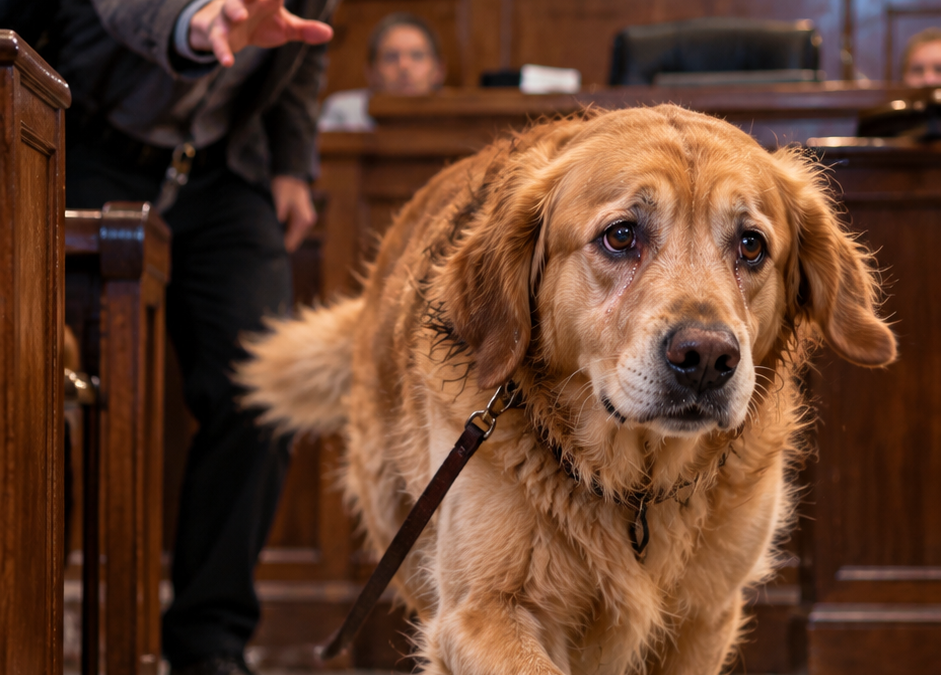
And at Harrison’s feet sat Max.
The dog.
A beautiful golden retriever.
Large.
Golden coat.
Dark eyes.
Expensive leather collar.
He should have looked like the healthiest animal in the room.
Instead, something about him bothered me immediately.
I couldn’t identify it.
He wasn’t visibly injured.
He wasn’t dirty.
He wasn’t emaciated.
But he could not settle.
He sat.
Stood.
Sat again.
Turned his head.
Every few seconds, his eyes found Daniel.
Not Harrison.
Not the judge.
Not the prosecutor.
Daniel.
I watched him for several minutes.
Daniel tried not to look back.
But every time he did, his entire face changed.
It was subtle.
His mouth softened.
His shoulders loosened.
His eyes became warmer.
That was the first thing that made me put my pen down.
People who steal expensive objects usually look at them with possession in their eyes.
Calculation.
Fear of losing them.
Greed.
Sometimes guilt.
Daniel looked at Max the way someone looks across a hospital room at a person they love but aren’t allowed to touch.
Judge Bennett entered shortly after nine-thirty.
He was in his late fifties, maybe early sixties, with gray hair and a face that seemed permanently skeptical.
I knew his reputation.
Twenty years on the bench.
Strict but rarely theatrical.
He disliked attorneys who wasted time and defendants who lied badly.
He was not known for sentiment.
Everyone stood.
Then the hearing began.
The prosecutor presented the case as though nothing about it required thought.
Daniel had entered private property without permission.
Surveillance footage placed him in the Harrison family yard late at night.
Max was there.
Security personnel had detained Daniel before he left.
Therefore, according to the prosecution, Daniel had entered with the intention of stealing the dog.
Simple.
Clean.
Logical.
The prosecutor even used the phrase “an uncomplicated case.”
Those words made me glance at Daniel.
He was staring at the table.
Mr. Harrison testified.
He spoke confidently.
“Our security staff found him in our rear courtyard shortly after midnight.”
The prosecutor nodded.
“And was he authorized to be there?”
“Absolutely not.”
“Had you ever invited him onto your property?”
“No.”
“Did you know him?”
“I had never seen him before in my life.”
“And the dog?”
“My family’s dog.”
“Value?”
Harrison paused.
“The purchase price isn’t really the issue.”
The prosecutor gave him a sympathetic expression.
“Of course.”
“But several thousand euros.”
A few people in the gallery shifted.
The prosecutor continued.
“Did you fear Mr. Daniel intended to remove Max from your property?”
“What else would he have been doing?”
Daniel’s attorney looked up.
I wrote that line down.
What else would he have been doing?
Sometimes an entire case hides inside the assumptions people don’t realize they’re making.
Harrison leaned slightly toward the microphone.
“We take security seriously. My wife and I travel often. We have valuables in the house. When our guard found a stranger in the yard with our dog, the situation was obvious.”
The prosecutor nodded.
“Thank you.”
Daniel’s attorney stood.
“Mr. Harrison, did my client have a leash?”
“No.”
“A vehicle?”
“Not that I know of.”
“Any equipment for restraining the dog?”
“He didn’t need equipment. Max is friendly.”
“Was my client physically holding Max when security found him?”
Harrison’s jaw tightened.
“He was beside him.”
“Was he attempting to leave the property?”
“He was in my yard illegally.”
“That wasn’t my question.”
The prosecutor objected.
Judge Bennett looked over his glasses.
“Overruled. Answer.”
Harrison exhaled.
“No. Not at that exact moment.”
“Was the gate open?”
“I don’t remember.”
“Did Max appear frightened?”
Harrison glanced down at the dog.
“No.”
“Did Max bark at my client?”
“No.”
“Growl?”
“No.”
“Attempt to get away?”
“No.”
“Thank you.”
It wasn’t much.
Not yet.
The prosecution still had the stronger visual argument.
A poor stranger.
Private yard.
Middle of the night.
Expensive dog.
Security footage.
People love simple stories, especially when the social roles are familiar.
The wealthy property owner.
The desperate young man.
The stolen valuable.
You can almost write the ending before anyone speaks.
But Max kept watching Daniel.
That bothered me.
I had grown up with dogs.
Not enough to pretend I was an expert, but enough to know fear when I saw it.
A dog afraid of someone does not usually spend an entire hearing trying to move closer to them.
Every time Daniel shifted in his chair, Max’s ears lifted.
When Daniel coughed, Max stood.
Mrs. Harrison tugged lightly on his leash.
“Sit.”
Max obeyed.
But his eyes stayed fixed on Daniel.
I leaned toward another reporter beside me.
“Are you seeing this?”
She whispered, “The dog?”
“Yeah.”
“He’s restless.”
“Not restless.”
I nodded toward Daniel.
“Focused.”
She watched for several seconds.
“Huh.”
The prosecutor began discussing surveillance video.
There were multiple recordings, he explained.
The night of Daniel’s arrest.
Previous activity.
Entry points.
The implication was that Daniel had been watching the property before making his move.
Then Harrison asked to speak again.
His attorney whispered something, but Harrison raised a hand.
Judge Bennett frowned.
“What is it, Mr. Harrison?”
Harrison stood.
“Your Honor, before the footage is shown, I think it would be useful for the court to understand the value of what this young man attempted to take.”
Daniel’s head dropped slightly.
Judge Bennett’s expression hardened.
“We have already established that Max is a valuable dog.”
“Yes, Your Honor, but perhaps if Max were brought forward—”
“For what purpose?”
“So everyone can see him clearly.”
I saw Daniel’s attorney close his eyes.
Harrison continued.
“This is not some stray animal. Max is a pedigreed golden retriever. He has been part of our family for years.”
Something in Daniel’s face moved at the words part of our family.
Not anger.
Pain.
Judge Bennett looked toward the dog.
Then toward Daniel.
Finally, he nodded.
“Briefly.”
One of Harrison’s assistants stood with Max.
The leash loosened.
Maybe the assistant expected the dog to walk calmly toward the center of the courtroom.
Max had other plans.
The instant the grip on the leash relaxed, he moved.
Not walked.
Ran.
His nails struck the polished courtroom floor in a rapid series of clicks.
For half a second, nobody understood what was happening.
Then someone gasped.
Mrs. Harrison shouted, “Max!”
Harrison stood.
“Grab him!”
Daniel’s attorney jerked backward.
A court officer stepped forward as if expecting an attack.
I stopped breathing.
Max crossed the room directly toward Daniel.
Daniel did not move.
That may have been the strangest detail.
Everyone else reacted.
Daniel simply looked up.
Max skidded to a stop against him.
His entire body began wagging.
Not just his tail.
His whole back half.
Daniel’s mouth opened.
“Max.”
It was the first time I had heard him say the dog’s name.
Not the dog.
Not him.
Max.
The dog pressed against Daniel’s legs.
Daniel’s eyes filled instantly.
Then, before anyone could restore order, Max lifted one hind leg.
And urinated on Daniel’s trousers.
For one perfect second, the entire courtroom became silent.
No cough.
No whisper.
Nothing.
Daniel stared down.
Max looked completely satisfied.
Somebody in the gallery choked back a laugh.
Then another person did.
Even Judge Bennett’s mouth twitched before he forced his expression back into judicial neutrality.
Harrison’s face turned deep red.
“This is outrageous.”
Daniel wasn’t laughing.
He was crying.
Not from humiliation.
He put one trembling hand on Max’s head.
The dog leaned into him and made a low whining sound that seemed almost joyful.
Daniel whispered something I barely heard.
“Hey, buddy.”
Max pushed harder against his knee.
That was the moment my entire understanding of the case changed.
I looked toward Judge Bennett.
His had too.
He struck the gavel once.
“Order.”
The laughter disappeared.
“Harrison, sit down.”
“Your Honor, the dog—”
“Sit.”
Harrison sat.
Judge Bennett watched Daniel for several seconds.
Then he spoke more quietly.
“Young man.”
Daniel looked up.
“Yes, sir?”
“Please move to the witness chair.”
The prosecutor stood.
“Your Honor—”
“I have questions.”
Daniel’s attorney whispered to him.
Daniel wiped his face and walked toward the witness chair with Max trying to follow.
A court officer reached for the leash.
Daniel flinched.
“Please.”
Everyone looked at him.
“Can he stay?”
Harrison immediately said, “Absolutely not.”
Judge Bennett’s eyes shifted toward him.
“Mr. Harrison.”
Harrison stopped.
The judge looked at Max.
Then Daniel.
“Let the dog sit beside the witness box.”
Max settled at Daniel’s feet as if he had been waiting for permission all morning.
The judge leaned forward.
“Daniel, I’m going to ask you something very directly.”
Daniel nodded.
“Look at me.”
He did.
“Why were you in Mr. Harrison’s yard?”
Daniel swallowed.
For several seconds, no sound came out.
The room seemed to hold itself still.
Finally, he said, “I wasn’t stealing Max.”
“Then why were you there?”
Daniel looked down at the dog.
Max raised his head.
Daniel’s fingers moved gently over his fur.
“I came to say goodbye.”
A murmur moved through the gallery.
Judge Bennett frowned.
“Goodbye?”
“Yes, sir.”
“Why would you need to say goodbye to a dog that does not belong to you?”
Daniel’s lips trembled.
He closed his eyes.
When he opened them again, something in him seemed to have changed.
Maybe he had reached the point where losing quietly no longer seemed better than telling the truth.
“It started three months ago.”
His voice shook.
“I was delivering a package.”
The judge nodded for him to continue.
“It was winter. One of the really cold nights.”
I remembered the week immediately.
Temperatures had dropped below freezing.
Public shelters had opened emergency beds.
The city had issued warnings about pets left outside overnight.
Daniel continued.
“My phone was almost dead, and the GPS kept sending me in circles. I was trying to find an address in Mr. Harrison’s neighborhood.”
He rubbed one hand over the other.
“I saw lights in the yard.”
“So you entered?”
“I walked toward the gate because I thought maybe someone could give me directions.”
Harrison shifted sharply.
Daniel noticed but kept speaking.
“I called out.”
“No one answered?”
“No, sir.”
“And then?”
“I saw Max.”
His voice softened when he said the name.
“He was chained near a doghouse.”
Mrs. Harrison shook her head.
Harrison whispered something to his lawyer.
Judge Bennett noticed.
“Continue.”
Daniel looked at the floor.
“The chain was short.”
“How short?”
“He could move around the doghouse, but not far.”
“Was that unusual?”
Daniel hesitated.
“I don’t know what is normal for them.”
“What did you observe?”
Daniel took a breath.
“His water bowl was out of reach.”
There was movement in the gallery.
“The bowl?”
“Yes.”
“Why couldn’t he reach it?”
“The chain wouldn’t let him.”
“And the water?”
“Frozen.”
Judge Bennett’s pen stopped.
Daniel continued.
“Max was shaking.”
“From fear?”
“Cold, I think.”
“Anything else?”
Daniel’s jaw tightened.
“I could see his ribs.”
Harrison stood abruptly.
“That is a lie.”
Judge Bennett’s head snapped toward him.
“Sit down.”
“We have never neglected our animal.”
“Mr. Harrison.”
“Our gardener—”
“Sit down.”
Harrison remained standing.
The judge’s voice became colder.
“If you interrupt this witness again, I will have you removed from my courtroom. Sit.”
For the first time that morning, Harrison looked less powerful.
He sat.
Judge Bennett turned back.
“Daniel.”
“Yes, sir.”
“What did you do?”
Daniel stared at Max.
“I walked toward him.”
“Were you afraid?”
“A little.”
“Why?”
“He didn’t know me.”
“And?”
“He didn’t bark.”
Daniel’s eyes became distant, as though he were standing in that frozen yard again.
“He just watched me.”
“What happened when you got close?”
“I crouched.”
Daniel demonstrated unconsciously, his shoulders moving forward.
“I held out my hand. He sniffed it.”
His voice broke.
“And then he pushed his head against me.”
Max responded to the memory by pressing his muzzle into Daniel’s leg.
Daniel gave a tiny, devastated smile.
The courtroom was completely silent.
“I tried to move the water bowl closer,” he said, “but it was frozen to the ground.”
“So what did you do?”
“I had a bottle.”
“Water?”
Daniel nodded.
“It was my last bottle for the delivery shift.”
“You gave it to the dog?”
“Yes.”
“How?”
“I poured it into my hand at first.”
His cheeks flushed, perhaps embarrassed by the detail.
“He drank from my palm.”
Someone behind me sniffed.
Daniel continued.
“Then I found a plastic container near the doghouse and poured the rest into that.”
“And then you left?”
Daniel shook his head.
“Not immediately.”
“Why?”
“He wouldn’t stop shaking.”
The words came out almost apologetically.
“I sat beside him.”
“For how long?”
“I don’t know. Maybe forty minutes. Maybe an hour.”
“What about your delivery?”
Daniel looked down.
“I missed it.”
“You abandoned the delivery?”
“Yes.”
“Why?”
He seemed genuinely confused by the question.
“Because Max was cold.”
It was such a simple answer that no one knew what to do with it.
Judge Bennett watched him carefully.
“And after that night?”
“I went back.”
“When?”
“The next night.”
“Why?”
Daniel hesitated.
“To see if he was okay.”
“What did you find?”
“Same place.”
“Chained?”
“Yes.”
“Water?”
Daniel’s silence answered.
The judge’s eyebrows drew together.
“You gave him water again?”
“Yes.”
“And then?”
“I started bringing food.”
“What kind?”
Daniel looked uncomfortable.
“Whatever I had.”
“Be specific.”
He swallowed.
“Sometimes bread.”
There was a long pause.
“Cheese if I had some.”
“Dog food?”
“When I could afford it.”
“And how often did you visit?”
Daniel stared at his hands.
“Almost every night.”
The prosecutor finally rose.
“Your Honor, there is no independent verification—”
Judge Bennett held up one hand.
“We are about to view surveillance footage.”
The prosecutor sat.
The judge returned to Daniel.
“You said almost every night.”
“Yes.”
“For three months?”
“Not every night for all three months. But a lot.”
“At what time?”
“After my shift.”
“When did that end?”
“Usually one or two in the morning.”
“So after working all day as a bicycle courier, you rode to Mr. Harrison’s property in winter weather?”
“Yes.”
“To feed his dog?”
Daniel nodded.
The judge leaned back.
“Why?”
There it was.
The question that mattered.
Daniel’s face tightened.
He looked at Max.
Then at Judge Bennett.
“Because he waited for me.”
The judge said nothing.
Daniel’s voice became quieter.
“I don’t have anyone here.”
His attorney looked toward him.
Daniel continued before anyone could stop him.
“My family lives far away.”
“How far?”
“Another country.”
“Do you speak with them?”
“Sometimes.”
“What about friends?”
Daniel gave a small, embarrassed shrug.
“I work.”
“That wasn’t my question.”
“No.”
“No friends?”
“Not really.”
His eyes filled again.
“I moved here because I thought I could make better money. I send some home when I can.”
He rubbed his thumb across the seam of his trousers.
“My room is very small. I work most days. When I finish, everyone else is asleep.”
He looked down.
“Nobody waits for me.”
Max’s ears lifted.
Daniel smiled through tears.
“Except him.”
I stopped writing.
There are moments when taking notes feels obscene.
I had spent ten years recording tragedy.
Dates.
Names.
Charges.
Amounts.
Statements.
But there are sentences that do not belong immediately inside a notebook.
They belong first inside the person hearing them.
Nobody waits for me.
Except him.
Daniel stroked Max’s head.
“The second night, when I came back, he recognized the sound of my bike.”
“How do you know?”
“He stood up before I reached the gate.”
A few people smiled.
“After a week, he would start wagging his tail when he heard me.”
His voice became steadier now.
“I talked to him.”
“About what?”
“Everything.”
A faint laugh came from someone in the room, but it wasn’t cruel.
Daniel gave a shy smile.
“My deliveries.”
“My landlord.”
“How cold it was.”
“People who didn’t tip.”
Even Judge Bennett almost smiled.
“I told him about my mother.”
Daniel looked down.
“About home.”
He paused.
“I know he couldn’t understand the words.”
Max put one paw against Daniel’s shoe.
Daniel’s expression collapsed again.
“But it felt like he did.”
Judge Bennett allowed the silence to remain.
Then he asked, “And the night of your arrest?”
Daniel breathed deeply.
“I had heard they were moving.”
Harrison looked toward him sharply.
“How?”
Daniel glanced at him.
“One of the workers mentioned it.”
He turned back to the judge.
“He said the family was moving to another city.”
“And Max?”
“They were taking him.”
“How did that make you feel?”
Daniel tried to answer.
Couldn’t.
His mouth opened twice.
Finally he whispered, “I knew I wouldn’t see him again.”
The room had changed by then.
Not legally.
Not yet.
Emotion is not evidence.
But courtrooms are occupied by human beings, and human beings cannot entirely separate fact from what facts mean.
Daniel took another breath.
“I wasn’t going to take him.”
He looked directly at Harrison.
“I knew he wasn’t mine.”
Then back to the judge.
“I just wanted to say goodbye.”
“What did you intend to do?”
“Sit with him.”
“Anything else?”
“Hug him.”
“And then?”
“Leave.”
“You were arrested before that?”
Daniel nodded.
“The security guard came out.”
“What happened?”
“He grabbed me.”
“Did you run?”
“No.”
“Fight?”
“No.”
“Did you try to release Max?”
“No.”
“Was Max chained?”
“Yes.”
“Did you remove the chain?”
“No.”
The judge looked toward the prosecutor.
“Let’s see the footage.”
The lights dimmed.
A monitor was turned toward the courtroom.
The first clip showed the night Daniel had been arrested.
Grainy.
Black and white.
Timestamp shortly after midnight.
Daniel entered the courtyard.
Not running.
Not hiding.
He moved toward the doghouse.
Max appeared.
Even through poor video quality, his reaction was unmistakable.
The dog ran toward Daniel.
Daniel crouched.
Max jumped against him.
Daniel wrapped both arms around his neck.
Nobody spoke.
The clip continued.
Daniel sat beside the doghouse.
Max settled against him.
Minutes passed.
No attempt to leave.
No effort to remove the dog.
No checking of windows.
No searching around the property.
Nothing resembling theft.
Then a security guard entered.
Daniel stood.
Raised his hands.
The video ended.
Judge Bennett stared at the monitor.
“Next.”
Another recording.
Different date.
Daniel entered.
Max ran to him.
Daniel placed something into a bowl.
Sat.
Left.
Next.
Another night.
Same thing.
Another.
And another.
By the sixth clip, the room had become uncomfortable in a new way.
Because now everyone understood something.
This was not one impulsive visit.
This was a relationship.
The prosecutor requested a pause.
Judge Bennett shook his head.
“How many recordings were submitted?”
The court clerk checked.
“Twenty-three dates, Your Honor.”
The judge turned slowly toward Harrison.
“Twenty-three?”
Harrison looked tense.
“Apparently.”
“You supplied these recordings?”
“My security team did.”
“Your evidence shows this young man entering your yard on twenty-three separate nights?”
“Yes.”
“And you never noticed?”
Harrison hesitated.
“We travel frequently.”
The judge’s voice sharpened.
“You testified this is a family dog.”
“He is.”
“Yet a stranger visited him twenty-three nights, and no one in your family knew?”
“Our staff handles the property when we’re away.”
“The gardener?”
“Among others.”
Judge Bennett looked at the screen.
“Who feeds the dog?”
“The gardener.”
“Every day?”
“Yes.”
“Who checks his water?”
“The staff.”
“In freezing weather?”
Harrison’s face changed.
“I assume so.”
“You assume.”
“My employees are paid to—”
Judge Bennett interrupted.
“I’m not asking what they’re paid to do. I’m asking what you know happened.”
Harrison had no answer.
The judge glanced toward Daniel.
Then toward Max, who remained pressed against Daniel’s leg.
“Mr. Harrison, did you ever ask why your dog greeted this alleged thief as though he were family?”
Harrison’s wife looked down.
Harrison’s jaw tightened.
“I don’t pretend to understand animal behavior.”
“No?”
“No.”
Judge Bennett removed his glasses.
“Neither do I professionally.”
He looked at Max.
“But I recognize familiarity.”
The prosecutor stood again.
“Your Honor, regardless of emotional circumstances, unlawful entry remains—”
“I am aware of the law.”
The judge’s tone ended the interruption.
He turned back toward Daniel.
“Young man, why didn’t you report what you believed was neglect?”
Daniel looked ashamed.
“I don’t know.”
“You didn’t think of it?”
“I did.”
“Then why not?”
Daniel hesitated.
“I was afraid they would take Max somewhere.”
“Who?”
“I don’t know. Animal control.”
“And?”
“I thought if I kept coming, I could make sure he had food and water.”
“That wasn’t necessarily the best decision.”
“I know.”
“You also entered private property repeatedly.”
“I know.”
“Did you know that was illegal?”
“Yes.”
“Then why continue?”
Daniel looked at Max.
“Because knowing something is illegal doesn’t make it easy to leave a dog freezing.”
That sentence changed the temperature of the room again.
Judge Bennett’s face didn’t soften.
Not visibly.
But his eyes did.
I looked at Daniel’s hands.
I had noticed them earlier, but now I saw them properly.
Cracked skin.
Cuts across the knuckles.
Dark marks under his nails.
Hands of someone who spent winter gripping bicycle handlebars.
His jacket had been repaired at one elbow with thread that didn’t match.
His shoes were nearly finished.
This young man had almost nothing.
And according to the video playing in front of us, he had been sharing some portion of that nothing with a dog whose owners could purchase anything they wanted.
Money had bought Max a pedigree.
A large courtyard.
An expensive collar.
A landscaped property.
But on those winter nights, money had not walked outside and sat beside him.
Daniel had.
Judge Bennett asked for a recess.
The room erupted into whispers the moment he left.
I remained seated.
My colleague leaned toward me.
“This is not the story we came for.”
“No.”
“What are you writing?”
“I don’t know anymore.”
Across the room, Harrison stood with his lawyer.
He was furious.
His wife whispered sharply to him.
The prosecutor looked through documents.
Daniel sat alone again.
Max had been returned to Harrison’s side.
But the dog refused to lie down.
He stared across the room at Daniel.
I watched Daniel stare back.
For a moment, I considered approaching him.
Journalistic instinct.
Get a quote before everyone else.
I didn’t.
Something told me he had spent enough of that morning being examined.
Twenty minutes later, Judge Bennett returned.
Everyone stood.
He sat.
The first thing he did was look at the prosecutor.
“Has the state reviewed the full surveillance record?”
“Yes, Your Honor.”
“Do you have evidence showing Mr. Daniel attempting to remove the dog from the property?”
The prosecutor paused.
“Not directly.”
“Any statement in which he expressed intent to steal Max?”
“No.”
“Any equipment suggesting he planned to transport the dog?”
“No.”
“Any sale arrangement? Communication with buyers?”
“No.”
“Any evidence he attempted to flee when security arrived?”
“No.”
The judge turned to Daniel’s lawyer.
“Anything further?”
The attorney stood.
“Only that my client has maintained from the beginning that he never intended to steal the animal.”
Judge Bennett nodded.
Then he looked at Harrison.
“Mr. Harrison, you accused this young man of attempting to steal your dog.”
“Yes.”
“On what basis beyond his presence on the property?”
“He was trespassing.”
“That establishes trespass. It does not automatically establish theft.”
“He was beside the dog.”
“So were you this morning.”
A few people shifted in their seats.
Harrison’s face hardened.
Judge Bennett continued.
“I understand why your security staff questioned him. I understand why you were concerned. But criminal intent requires more than suspicion.”
Harrison leaned forward.
“He had no right to be there.”
“That issue is separate.”
“He entered my property twenty-three times.”
“Yes.”
“Surely that matters.”
“It does.”
The judge paused.
“So does why he entered.”
Harrison stared at him.
Judge Bennett’s voice remained measured.
“The evidence submitted by your own representatives shows repeated contact between Daniel and Max. It shows feeding. It shows Daniel providing water. It shows long periods of sitting with the animal. It does not show an attempt to remove him.”
Harrison looked toward Max.
For perhaps the first time, he seemed uncertain.
Judge Bennett turned toward Daniel.
“Stand.”
Daniel stood.
His knees were visibly shaking now.
Max stood too.
The judge looked at the prosecutor.
Then at Daniel.
“The theft allegation is dismissed for insufficient evidence.”
Daniel blinked.
His lawyer touched his arm.
“Did he say—”
“Yes,” the attorney whispered.
Daniel’s mouth opened.
No sound came.
The judge raised one hand.
“I’m not finished.”
Daniel froze.
Judge Bennett leaned forward.
“Your repeated unauthorized entry onto private property was unwise.”
Daniel nodded quickly.
“Yes, sir.”
“Potentially dangerous.”
“Yes, sir.”
“If you believe an animal is being neglected, there are lawful channels.”
“I understand.”
“You should use them.”
“I will.”
The judge watched him.
“But this court is not going to transform an act of concern into a theft conviction simply because the person showing concern had little money and the owner had a great deal.”
Nobody moved.
I wrote that sentence down exactly.
Judge Bennett looked at Max.
Then back at Daniel.
“There is something else.”
The prosecutor glanced at him.
Even Daniel’s attorney looked confused.
The judge folded his hands.
“Ten years ago, before I became a judge, I handled a case that forced me to confront a simple fact.”
He paused.
“The law must be consistent.”
“That is essential.”
“But justice is administered to human beings.”
His eyes settled on Daniel.
“And if we lose sight of that, consistency becomes machinery.”
Daniel listened as though afraid the words might disappear if he breathed too loudly.
“My wife works with an animal welfare organization.”
Judge Bennett continued.
“They operate a shelter outside the city.”
Daniel glanced at Max.
“They are currently looking for an assistant.”
His eyes widened.
“The pay is not impressive.”
A few people smiled.
“But the position includes accommodation.”
Daniel did not move.
Judge Bennett’s expression softened slightly.
“I cannot order them to hire you.”
“I cannot promise anything.”
“But I can make a telephone call.”
Daniel stared.
“If you want me to.”
The silence stretched.
Judge Bennett waited.
Daniel seemed unable to process what he had heard.
His attorney leaned toward him.
“Answer.”
Daniel swallowed.
“I…”
His voice disappeared.
He tried again.
“Yes.”
Judge Bennett raised an eyebrow.
“Yes, what?”
Daniel let out a broken laugh through tears.
“Yes, sir.”
“Good.”
Daniel covered his mouth.
He looked down.
His shoulders shook.
Max whined.
The dog pulled against the leash again.
This time, Mrs. Harrison did not stop him.
The leash slipped from her hand.
Max crossed the small distance to Daniel and pushed his head beneath Daniel’s palm.
Daniel crouched and buried his face against the dog’s neck.
Nobody laughed now.
I looked at Harrison.
He had been watching the entire exchange.
His expression had changed.
The anger was still there, but something else had entered beneath it.
Recognition, perhaps.
Or shame.
I am cautious using that word.
As a journalist, I have learned not to claim knowledge of what happens inside another person’s conscience.
But I know what I saw.
Harrison looked at Daniel.
Then at the dog.
Then at the surveillance monitor, frozen on an image of Daniel sitting beside Max on a cold night.
For the first time all morning, he seemed to see the scene rather than the trespass.
He stood.
His attorney reached for his sleeve.
Harrison shook him off.
“Your Honor.”
Judge Bennett looked up.
“What now?”
Harrison’s voice was quieter.
“I’d like to speak.”
The judge studied him.
“Briefly.”
Harrison walked toward Daniel.
A court officer watched carefully.
Daniel stood.
Max remained between them.
For several seconds, Harrison said nothing.
Up close, the difference between the two men was almost cruel.
Perfect suit.
Torn jacket.
Polished shoes.
Worn sneakers.
A man whose watch probably cost more than Daniel earned in months facing a young man who had spent his own food money on someone else’s dog.
Harrison looked down at Max.
Then he said, “I didn’t know.”
Daniel didn’t answer.
“I didn’t know you were feeding him.”
Daniel’s eyes stayed on Harrison.
“I didn’t know the water was freezing.”
Still nothing.
Harrison swallowed.
“We have people.”
His voice sounded almost defensive.
“Staff.”
“The gardener.”
“I assumed…”
He stopped.
Perhaps hearing the weakness of the sentence.
Daniel spoke quietly.
“I know.”
Harrison looked at him.
“You know?”
“You weren’t there.”
There was no accusation in Daniel’s voice.
That made the words harder.
Harrison’s face tightened.
“I thought you were stealing from me.”
Daniel looked down at Max.
“I wasn’t.”
“I see that now.”
A long pause.
Then Harrison said the words I least expected to hear from him.
“I was wrong.”
The room stayed silent.
Harrison glanced toward his wife.
She looked away.
He returned his attention to Daniel.
“I saw someone in my yard.”
“Someone who didn’t look like he belonged there.”
His jaw worked.
“And I decided what kind of person you were before asking why you came.”
Daniel’s eyes lowered.
Harrison continued.
“I am sorry.”
Daniel stared at him.
For the first time that morning, I saw something like anger enter his expression.
Only briefly.
Then exhaustion replaced it.
“You thought you were protecting your home.”
Harrison nodded.
Daniel looked at Max.
“I just wish someone had protected him from the cold.”
Harrison closed his eyes for half a second.
No one said anything.
Then he did something even more unexpected.
He removed Max’s leash from Mrs. Harrison’s hand.
He held it.
Looked at Daniel.
Then extended it toward him.
Daniel didn’t take it.
“What are you doing?”
Harrison looked at Max.
“We’re moving next week.”
Daniel’s face tightened.
“I know.”
“I was going to take him.”
Harrison breathed deeply.
Then he looked at Daniel.
“But I’m beginning to think that would be taking him away from the person he chose.”
Daniel shook his head immediately.
“No.”
“Why not?”
“He’s yours.”
Harrison looked almost bitterly amused.
“Legally.”
Daniel’s eyes filled again.
“I can’t buy him.”
“I’m not selling him.”
The courtroom seemed to disappear around the two of them.
Harrison lowered the leash slightly.
“I’ve spent a great deal of money on this dog.”
He looked at Max.
“Food.”
“Vet bills.”
“Training.”
“Everything.”
Then he looked at Daniel.
“But apparently I confused paying for him with being there for him.”
Daniel said nothing.
Harrison extended the leash again.
“He should stay with you.”
Daniel stepped backward.
“I don’t have a place.”
Judge Bennett cleared his throat.
“That may be changing.”
Several people laughed softly.
Daniel looked toward the judge.
Then toward Harrison.
Then at Max.
The dog had already made his decision.
He sat directly on Daniel’s shoe.
Daniel let out a sound halfway between a laugh and a sob.
Harrison’s hand trembled slightly as he held out the leash.
“Take him.”
Daniel finally did.
The moment his fingers closed around it, Max jumped up against him.
Daniel wrapped both arms around the dog.
He buried his face in Max’s fur and cried openly.
No effort to hide it.
No embarrassment.
Nothing.
At twenty-one, Daniel had spent months with almost no one waiting for him.
Now the one living creature who had was being placed into his hands.
I looked down at my notebook because suddenly I didn’t want anyone to see my face.
When I looked up again, Harrison was walking toward the exit.
He stopped once.
Without turning, he said, “Take care of him.”
Daniel answered through tears.
“I already do.”
Harrison left.
His wife followed.
The courtroom slowly emptied.
The prosecutor gathered his files.
Attorneys spoke quietly.
People who had laughed when Max urinated on Daniel now walked past him with expressions they could not quite name.
I remained.
I wasn’t ready to leave.
Daniel sat on a wooden bench with Max’s head in his lap.
He ran his fingers through the dog’s fur again and again, as if confirming the animal would not vanish.
Judge Bennett was still at his desk reviewing papers.
Finally, I walked toward Daniel.
He looked up.
Immediately cautious.
I hated that I understood why.
“Daniel?”
“Yes?”
I showed him my press identification.
“My name is—”
“I know.”
That surprised me.
“You do?”
“I’ve seen your articles.”
I smiled.
“Hopefully not all of them.”
He gave a small smile back.
Max sniffed my hand.
I crouched.
“Can I pet him?”
Daniel looked at the dog.
“If Max lets you.”
I held out my hand.
Max sniffed.
Then allowed me to touch his head.
“Apparently I’ve passed.”
Daniel smiled again.
It transformed him.
For the first time, he looked twenty-one.
“I wanted to ask you something.”
His smile disappeared slightly.
“About the case?”
“About you.”
He became guarded.
I immediately added, “You can say no.”
He looked at me.
“I’d like to write what happened today.”
He glanced at Max.
“Why?”
“Because what people thought when they walked into this courtroom isn’t what they know now.”
He said nothing.
“I don’t want to turn you into a symbol.”
I meant it.
“I don’t want to write a story that says poor boy good, rich man bad.”
Daniel listened.
“That’s too easy.”
“What do you want to write?”
“The truth.”
He gave me a skeptical look.
“Journalists always say that.”
“Fair.”
That earned a faint smile.
I sat beside him.
“What would you want people to understand?”
He stared at Max for a long time.
When he finally answered, his voice was quiet.
“That being poor doesn’t mean you’re dangerous.”
I didn’t interrupt.
“People look at my clothes.”
“My bike.”
“My job.”
“The way I speak.”
He swallowed.
“And they decide I want what they have.”
His hand moved over Max’s ear.
“I didn’t want Mr. Harrison’s house.”
“I didn’t want his money.”
“I didn’t even want to take Max.”
His voice broke again.
“I just didn’t want him cold.”
I nodded.
Daniel continued.
“I know I shouldn’t have gone into the yard.”
“I know.”
“But when you’re standing outside and you see an animal shaking…”
He looked at me.
“What are you supposed to do?”
“Walk away because the fence belongs to someone with more money than you?”
There was no easy answer.
So I didn’t give one.
Instead, I asked, “Would you let me tell the story?”
He looked down.
Max placed his head on Daniel’s thigh.
Daniel smiled.
“Yes.”
Then his expression became serious again.
“But don’t make me sound like some hero.”
“Why?”
“Because I’m not.”
“What should I call what you did?”
He thought.
“I was lonely.”
I waited.
“So was he.”
Daniel scratched gently beneath Max’s chin.
“We helped each other.”
That became the center of my article.
Not the urine.
Though my editor loved that part.
Not the wealthy owner.
Not even the judge’s offer.
The story was about two lonely creatures finding each other on opposite sides of a fence.
I interviewed Daniel again two days later.
We met at a café he chose because it sold the cheapest coffee near his room.
His room was temporary, he explained.
Barely bigger than some people’s closets.
He lived above a noisy shop.
The radiator failed regularly.
He stored his bicycle inside because someone had tried to steal it twice.
“Max can’t stay there,” he said.
“Not yet.”
He looked worried.
“The shelter job?”
“Judge Bennett called.”
“And?”
Daniel’s face brightened.
“They want to meet me tomorrow.”
I smiled.
“Nervous?”
“Terrified.”
“You handled court.”
“Court wasn’t a job interview.”
“Fair point.”
He looked out the window.
“What if they think I’m not qualified?”
“You’ve spent three months biking across the city after midnight to care for a dog that wasn’t yours.”
“That isn’t a qualification.”
“For an animal shelter?”
I raised an eyebrow.
“Might be.”
He laughed.
A week later, he got the job.
The salary really was modest.
Judge Bennett had not exaggerated.
But the shelter provided a small room on the property.
It had a window overlooking the kennels.
Daniel sent me a photograph the day he moved in.
One mattress.
One desk.
One chair.
Max asleep in the middle of the floor.
The message read:
He already thinks he owns the place.
I wrote back:
Given his courtroom performance, I wouldn’t challenge him.
The article was published that Sunday.
My editor put it on the front page of the weekend section.
Not because I asked.
Because by then, everyone in the newsroom understood what kind of story it had become.
The headline mentioned the theft accusation.
It did not call Daniel a hero.
I was grateful for that.
Within hours, the article spread far beyond the city.
Emails arrived.
Then messages.
Then phone calls.
People offered Daniel clothes.
Food.
Money.
A better bicycle.
Someone offered veterinary care for Max.
A local pet-supply shop sent six months of dog food to the shelter.
Another reader wanted to pay Daniel’s rent.
Daniel refused most of the cash.
“Why?”
I asked him during a phone call.
“Because I have a job now.”
“You could use it.”
“So can other people.”
“What are you going to do?”
He asked the shelter if donations could be redirected toward emergency veterinary treatment for animals whose owners couldn’t afford care.
That became another article.
But I remember the first month most clearly.
I visited the shelter on a cold but bright morning.
Daniel was in one of the outdoor runs kneeling beside an old shepherd mix that growled whenever anyone approached.
Max sat nearby.
“What are you doing?”
I asked.
Daniel looked over.
“Nothing.”
“You’ve been sitting here twenty minutes.”
“That’s the point.”
The shepherd growled again.
Daniel stayed still.
“He doesn’t trust people.”
“So you’re sitting there.”
“Yeah.”
“How long?”
He shrugged.
“As long as it takes.”
I looked at Max.
The golden retriever wagged his tail.
“You taught him that?”
I asked.
Daniel laughed.
“No.”
“He taught me.”
That answer stayed with me.
Over the months that followed, Daniel changed.
Not into someone else.
Into more of himself.
The hunch in his shoulders eased.
He gained weight.
His face became less hollow.
He spoke more easily.
He made friends at the shelter.
People who noticed when he arrived.
People who asked how he was doing and waited for the real answer.
Max went everywhere he legally could.
The shelter office.
The exercise yard.
Training sessions.
The park.
On days off, Daniel and Max sometimes walked through the city for hours.
I saw them occasionally.
Sometimes accidentally.
Sometimes because Daniel would message me:
Max wants to see the journalist he embarrassed in court.
I would answer:
He embarrassed you, not me.
He disagrees.
A year after the trial, I met them in the park.
Spring.
Warm afternoon.
Families on blankets.
Children chasing pigeons.
Daniel looked healthy.
Not wealthy.
Not transformed into some fairy-tale version of success.
He still worked at the shelter.
Still counted money carefully.
Still rode a bicycle more often than he used public transit.
His clothes were better.
His shoes weren’t falling apart.
But what had changed most was harder to photograph.
He no longer looked like a person preparing to apologize for existing.
Max came running toward me.
I bent down.
“Careful.”
I pointed at him.
“I remember what happened last time you got excited.”
Daniel laughed.
“He only does that to people he loves.”
“I don’t know if that’s comforting.”
We walked together.
After a while, I asked Daniel if he ever thought about Harrison.
“Sometimes.”
“Angry?”
Daniel considered.
“No.”
“Not at all?”
“I was.”
“When?”
“After court.”
That surprised me.
“You didn’t look angry.”
“I didn’t want anyone to see.”
“Why?”
He looked at Max.
“Because everyone wanted a good ending.”
The sentence hit me harder than I expected.
“What do you mean?”
“The judge helped me.”
“I got the job.”
“I got Max.”
“Mr. Harrison apologized.”
Daniel kicked a small stone off the path.
“So everyone wanted that to mean everything was okay.”
“And it wasn’t?”
He stopped walking.
“No.”
Max stopped too.
Daniel looked at me.
“I still remember him shaking.”
His voice lowered.
“The bowl frozen.”
“The chain.”
“Me wondering whether he’d still be there the next night.”
I said nothing.
Daniel continued.
“Forgiving someone doesn’t erase what happened.”
“No.”
“But staying angry forever doesn’t feed Max either.”
He smiled slightly.
“So I let it go.”
We resumed walking.
That conversation changed how I remembered the courtroom.
In my first article, I had written about kindness finding its way.
I still believed that.
But I had become wary of clean lessons.
Life rarely turns in a single moment.
Courtroom decisions matter.
Apologies matter.
Opportunities matter.
But none of them erase what came before.
Daniel’s story wasn’t important because kindness magically defeated cruelty.
It was important because several people had the chance to respond differently once the truth became visible.
Judge Bennett could have treated Daniel as a case number.
He didn’t.
The prosecutor could have forced a weak theory because charges had already been filed.
He didn’t.
Harrison could have protected his pride after realizing he had been wrong.
He didn’t.
And Daniel, perhaps most remarkably, could have used his new position to humiliate the man who accused him.
He didn’t.
None of that made anyone perfect.
It simply meant that, for a few hours, people changed direction.
Sometimes that is enough to alter a life.
Years have passed since that hearing.
I have covered hundreds of cases since.
More serious ones.
Cases involving far larger sums of money.
Cases that changed laws.
Cases that dominated headlines for weeks.
Yet if someone asks which courtroom moment I remember most clearly, I don’t think about a murder confession or a politician’s conviction.
I remember a golden retriever running across polished floors.
I remember everyone thinking he might attack Daniel.
I remember Harrison shouting.
I remember Daniel lifting his face.
And I remember Max stopping in front of the young man he supposedly feared.
Then lifting his leg.
I still laugh when I think about it.
Daniel does too.
Judge Bennett, according to Daniel, tells the story at dinner parties.
I’m not sure whether he includes the urine.
I suspect he does.
But what happened after the laughter is the part that matters.
A dog did what evidence had not yet managed to do.
He made everyone hesitate.
Not decide.
Not acquit.
Not ignore law or facts.
Just hesitate.
For one moment, the simple story stopped making sense.
Why would a dog run with joy toward the man accused of stealing him?
Why would a supposed thief cry when the dog touched him?
Why did surveillance show twenty-three nights of feeding instead of one night of escape?
Why had a family with enormous resources failed to notice what a courier with almost nothing noticed immediately?
Once those questions entered the room, certainty became impossible.
And truth finally had somewhere to stand.
People often tell me the urine changed everything.
It didn’t.
Not really.
The truth already existed before Max crossed that courtroom.
It existed in the frozen water.
In the short chain.
In Daniel’s cracked hands.
In the pieces of bread.
In twenty-three nights of surveillance footage nobody had bothered to interpret beyond suspicion.
Max didn’t create the truth.
He made people look at it.
That distinction matters to me.
Because most injustice doesn’t survive because truth is completely absent.
Often the truth is present.
Visible.
Recorded.
Standing in front of us.
We simply interpret it through whatever story we already believe.
Harrison saw a poor young man entering his property and saw danger.
The prosecution saw repeated visits and initially saw planning.
Security saw an intruder.
Daniel saw a cold dog.
Max saw the person who came back.
Same yard.
Same nights.
Same facts.
Different meanings.
Journalism taught me to distrust anyone who says facts speak for themselves.
Facts need context.
Without context, a man beside a dog becomes a thief.
With context, he becomes the only person who noticed the dog could not reach his water.
I still see Daniel sometimes.
He is older now.
More confident.
He eventually moved into a small apartment of his own, though he continued working with animals.
Max grew gray around the muzzle.
Slower.
He no longer raced across parks the way he used to.
But when Daniel called his name, his head always lifted.
Always.
That bond never disappeared.
Once, years after the trial, I visited Daniel at the shelter.
Max was lying beneath a desk.
I crouched beside him.
“Remember me?”
His tail thumped once.
Daniel said, “He remembers everyone.”
“I’m offended.”
“You wanted special treatment?”
“After everything I’ve written about him?”
Daniel laughed.
I sat on the floor.
Max placed his head across my shoe.
For several minutes, neither Daniel nor I spoke.
Then I asked, “Do you ever think about that first night?”
“All the time.”
“Why did you go into the yard?”
He gave me a strange look.
“You know why.”
“I know what you told the judge.”
“Same answer.”
“You could’ve kept walking.”
Daniel looked down at Max.
“Yeah.”
“Most people probably would have.”
“Maybe.”
“So why didn’t you?”
He thought for a long time.
Then he said, “Because I knew what it felt like to be somewhere nobody was coming.”
That was the sentence I wish I had known on the first day.
Everything Daniel had done became understandable inside it.
He hadn’t saved Max because he was fearless.
He hadn’t entered that yard because he believed himself morally superior.
He recognized something.
Isolation.
Cold.
Waiting.
When Max lay alone in that courtyard, Daniel saw a version of himself.
When Daniel arrived night after night, perhaps Max did too.
Two living creatures.
Different species.
Same need.
Someone who comes back.
I looked down at the old dog resting on my shoe.
“You saved each other.”
Daniel smiled.
“Yeah.”
Then Max’s tail moved again.
Daniel added, “Mostly he saved me.”
When Max eventually died, Daniel called me.
It was early in the morning.
I knew before he said it.
His voice sounded emptied out.
“He went last night.”
I sat on the edge of my bed.
“I’m sorry.”
Daniel breathed shakily.
“He was old.”
“I know.”
“He had a good life.”
“I know.”
“I was with him.”
“Good.”
There was silence.
Then Daniel said, “I don’t know why I’m calling you.”
“You don’t need a reason.”
Another silence.
“He waited for me.”
My throat tightened.
“What do you mean?”
“I was working late.”
“The vet said he might not last.”
“I got home…”
Daniel stopped.
I heard him cry.
“He lifted his head when I came in.”
I closed my eyes.
“I sat down beside him.”
“He put his head on my lap.”
Daniel’s voice broke completely.
“Just like the first winter.”
I couldn’t speak.
“He waited until I got there.”
Then I understood.
Of course he had.
That was what they had always done for each other.
Waited.
Daniel cried quietly.
I stayed on the phone.
There was nothing intelligent to say.
Journalists spend their lives looking for words.
Grief teaches you when words become unnecessary.
Eventually Daniel whispered, “Do you remember the courtroom?”
“Every detail.”
“He peed on me.”
I laughed through tears.
Daniel laughed too.
For a few seconds, grief and absurdity lived together.
Exactly as they had that first morning.
“He really did.”
“My only good trousers.”
“They were terrible trousers.”
“They were all I had.”
“Then I withdraw the criticism.”
Daniel laughed harder.
When the laughter faded, he said, “That was the best thing he ever did.”
“The urine?”
“Running to me.”
His voice softened.
“Everyone thought I was lying.”
“Then he ran to me.”
I understood.
In a room full of evidence, titles, money, authority, and suspicion, the one creature who could not testify had given Daniel the first sign that someone believed him.
Maybe that was why Daniel cried.
Not humiliation.
Recognition.
Max had chosen him publicly.
Without shame.
Without caution.
Without checking which side of the courtroom held power.
I wrote Max’s obituary for the newspaper.
Not because golden retrievers usually receive newspaper obituaries.
Because he had become part of the city’s memory.
I kept it short.
I wrote about the shelter.
About Daniel.
About the hearing.
I did not write that Max proved Daniel innocent.
That would not have been legally accurate.
I wrote something closer to the truth.
That Max forced a room full of people to ask better questions.
Daniel framed the article.
He sent me a photograph of it hanging beside Max’s collar.
Months later, he adopted another dog from the shelter.
Not a golden retriever.
An old black mixed-breed female with a scar across her nose and no interest in impressing anyone.
“What did you name her?”
I asked.
“June.”
“Why?”
“No reason.”
“That’s disappointing.”
“Not everything needs a story.”
He said it jokingly.
But he was right.
Still, some stories stay.
This one stayed with me.
Not because a rich man was humbled.
Not because a poor young man was rewarded.
Not because a judge delivered a perfect speech.
Life is more complicated than that.
It stayed because the courtroom exposed how quickly human beings confuse ownership with care.
Harrison owned Max.
The paperwork said so.
He paid for him.
Licensed him.
Bought his food.
Provided the property where he lived.
Daniel owned nothing connected to Max.
Not the collar.
Not the kennel.
Not the yard.
Not even the food he sometimes fed him, because much of it had been taken from his own dinner.
Yet when Max had the freedom to choose where to run, he ran to Daniel.
That doesn’t mean property law should be replaced by animal preference.
Of course not.
But it revealed something law alone could not measure.
Presence.
The simplest form of love.
Showing up.
Daniel showed up when there was no audience.
No newspaper.
No judge.
No possibility of praise.
At one in the morning after hours on a bicycle.
In freezing weather.
Carrying bread he could have eaten himself.
That is the detail I return to most often.
Goodness performed in public is easy to misunderstand.
Goodness repeated privately is harder to dismiss.
Daniel didn’t know security cameras were building a record in his favor.
He thought nobody was watching.
Maybe that is why the footage mattered so much.
It showed who he was when he expected nothing in return.
I once asked Judge Bennett why he offered Daniel the shelter interview.
We met years afterward for another story.
He remembered the case immediately.
“Daniel and Max?”
“Exactly.”
He smiled.
“Hard one to forget.”
“What made you do it?”
He considered the question.
“The job?”
“Yes.”
“Wasn’t that unusual?”
“Very.”
“Then why?”
He leaned back.
“Because I looked at that young man and realized the system had spent all morning asking what he might have taken.”
He paused.
“Nobody had asked what he had been giving.”
I wrote that sentence down.
He continued.
“Judges have limits.”
“I couldn’t hand him someone else’s dog.”
“I couldn’t erase every consequence.”
“I couldn’t employ him.”
“But I knew someone who needed a worker who cared about animals.”
He shrugged.
“Making an introduction isn’t judicial philosophy.”
“It’s a telephone call.”
“Did you know Harrison would give Max to him?”
“No.”
“Were you surprised?”
“Yes.”
He smiled faintly.
“And no.”
“What does that mean?”
“I think Mr. Harrison saw the dog differently by the end.”
The judge looked at me.
“Maybe himself too.”
I did not ask more.
Some conclusions belong to the people involved.
I have no idea whether Harrison became a different man afterward.
I know only what happened that day.
He made a serious accusation based on an assumption.
He was confronted with evidence that complicated that assumption.
He apologized.
And he gave Max to Daniel.
Those acts do not erase what came before.
They matter anyway.
That too became part of what the case taught me.
We often demand that people be entirely good or entirely bad before deciding whether their actions have meaning.
Real life rarely cooperates.
People fail.
Then sometimes they correct course.
Sometimes too late.
Sometimes incompletely.
Sometimes enough to change someone else’s future.
Daniel did not need Harrison to become a saint.
He needed him to drop the accusation.
Recognize what had happened.
And release Max.
That was enough for that day.
My editor once asked why readers still emailed us about the story years later.
I told him I thought it was because of the dog.
He disagreed.
“People like reversals.”
“What?”
“Poor kid looks guilty. Rich guy looks right. Dog flips the room.”
“That’s very cynical.”
“I’m an editor.”
“Occupational hazard.”
But later I thought about it.
He was partly right.
People do like reversals.
But I think there is another reason.
Most of us fear being misunderstood.
Not in the small ways.
In the devastating ways.
Being seen at the worst possible angle.
Being judged by where we were rather than why we were there.
Having our poverty mistaken for criminality.
Our fear for dishonesty.
Our silence for guilt.
Daniel stood in that courtroom with almost nothing capable of making people believe him.
Then Max ran to him.
For one moment, Daniel didn’t have to explain himself.
The dog did not care about testimony.
Social class.
Property lines.
Legal strategy.
He recognized the person who had brought water when his bowl was frozen.
He recognized the lap he had slept against in the cold.
He recognized the bicycle sound from those midnight visits.
He recognized Daniel.
Sometimes being recognized is the beginning of being saved.
I entered Courtroom Four that morning expecting an ordinary theft story.
I left carrying a question that has followed me through every story since:
What if the obvious explanation is only the explanation available to the person with the loudest voice?
When I interview someone now, especially someone with little power, I think of Daniel.
I slow down.
I ask one more question.
Why were you there?
What happened before that?
Who else was present?
What does the video not show?
What did you think you were doing?
What are we assuming?
It doesn’t mean I believe everyone.
Journalism requires skepticism.
So does justice.
But skepticism applied only downward becomes prejudice.
Power deserves questions too.
That may be the most professional lesson Max ever taught me.
The personal lesson was simpler.
When someone has almost nothing, never assume they have nothing to give.
Daniel had no house.
No influential family in the city.
No savings worth mentioning.
No car.
No lawyer of his choosing.
No reputation powerful enough to protect him.
But he had water.
Bread.
Time.
Warmth.
And the willingness to return.
For Max, those things mattered more than the value written on his purchase documents.
I sometimes think back to the frozen courtyard.
Daniel sitting on the ground beside a dog that wasn’t his.
Two lonely creatures in the dark.
Neither could possibly know that months later they would stand together in a courtroom.
Neither knew a judge would offer a job connection.
Neither knew Harrison would hand over a leash.
Neither knew strangers would read their story.
There was no promised reward on that first night.
That is why the first night matters most.
Daniel stayed because Max was cold.
Nothing more.
Years after I first wrote his story, I asked Daniel one final question.
“If you could go back to that first night, knowing everything that happened afterward, would you do anything differently?”
We were standing outside the shelter.
June slept beside his feet.
Daniel thought.
“I’d bring more water.”
I laughed.
“I’m serious.”
“I know.”
He looked toward the kennel buildings.
“I’d still go in.”
“Even knowing you’d be arrested later?”
“Yeah.”
“The court?”
“Yeah.”
“The accusation?”
“Yeah.”
“Why?”
Daniel looked at me as if the answer should have been obvious.
“Because he was still cold that night.”
There are people who need years of philosophy to explain who they are.
Daniel did it in one sentence.
Because he was still cold that night.
I drove home afterward thinking about all the ways we postpone kindness.
When it’s safer.
When it’s convenient.
When someone else authorizes it.
When we have more money.
More time.
More certainty.
Daniel had none of those things.
He had a nearly dead phone, a bicycle, a bottle of water, and a delivery he was supposed to complete.
He stopped anyway.
That decision cost him something.
Several decisions afterward cost him more.
But it also led him toward the first real home he built in the city.
Not the shelter room.
Not the later apartment.
I mean something less physical.
A place where someone expected him.
At first that someone was a dog.
Then coworkers.
Friends.
Eventually a whole community.
The young man who once told a judge, “Nobody waits for me,” became a man animals waited for every morning at the shelter.
I once arrived before opening time and saw him walking between kennels.
The dogs heard his footsteps.
One by one, tails began thumping against floors.
Barks started.
Whines.
Movement.
Daniel opened the first kennel.
“Morning, old man.”
Then the next.
“Hey, sweetheart.”
Then another.
The entire building came alive around him.
I stood in the doorway and thought about Courtroom Four.
Nobody waits for me.
Except him.
Not anymore.
A dozen dogs waited for Daniel.
Coworkers waited.
Friends waited.
Life waited.
And all of it could be traced, in some strange way, back to one night when he noticed a golden retriever shivering alone in a wealthy man’s courtyard.
People ask journalists whether we become cynical.
Yes.
Sometimes.
You see enough dishonesty and you begin to assume motives.
You hear enough rehearsed statements and sincerity starts sounding like another public-relations strategy.
But then a case appears that pushes in the opposite direction.
For me, it was Daniel and Max.
They did not convince me the world is always fair.
It isn’t.
They did not convince me kindness always wins.
It doesn’t.
I have covered too many stories to believe either of those things.
What they taught me was more useful.
Kindness creates evidence.
Maybe not immediately.
Maybe not in the way we expect.
But repeated kindness leaves traces.
A dog that recognizes you.
Surveillance footage of twenty-three visits.
An empty bottle of water.
Cracked hands.
A place beside an animal where it feels safe enough to sleep.
Daniel entered that courtroom looking like the easiest person in the room to disbelieve.
By the end, the evidence of who he had been when no one was watching was everywhere.
And all because Max ran toward him.
Even now, years later, I can close my eyes and see it.
The courtroom.
Harrison standing.
The judge watching.
Daniel frozen beside the defense table.
Max running.
For one second, every person there expected violence.
Then the dog reached Daniel.
Pressed against him.
Lifted his leg.
And destroyed the story everyone had prepared to believe.
It was funny.
Absurd.
Embarrassing.
And somehow deeply human, though the one who did it wasn’t human at all.
The courtroom laughed.
Then it listened.
Sometimes that is how truth enters.
Not with thunder.
Not with a perfect speech.
Sometimes it arrives on four paws, ignores the rules, chooses the person everyone suspects—
and forces the entire room to look again.

