𝗙𝗨𝗟𝗟 𝗦𝗧𝗢𝗥𝗬 I Hadn’t Heard My Grandfather Speak in Six Years Until He Saw One Old German Shepherd Behind a Shelter Gate
𝗙𝗨𝗟𝗟 𝗦𝗧𝗢𝗥𝗬
That frightened me more than if he had cried.
We learned a new language around him.
One raised eyebrow meant skepticism.
Two taps on the table meant yes.
A small circle with his index finger meant continue.
If he squeezed my hand twice, it meant he was okay.
Or at least okay enough.
He still hugged us.
Still came to birthdays.
Still sat through Thanksgiving dinners.
Still looked at old photographs.
But there was always an invisible wall between him and the rest of the room.
His silence had weight.
You could feel it.
I grew older inside that silence.
By the sixth year, I had almost stopped expecting it to end.
That sounds terrible.
Maybe it was.
But families adapt to things because they have to.
At some point, hope stops being dramatic.
It becomes quieter.
Less like, Today will be the day.
More like, Maybe someday.
The Saturday we went to the animal shelter began with no sense that anything important was about to happen.
It was Mom’s idea.
She had been saying for months that Grandpa needed more companionship.
Not because we didn’t visit.
We did.
But he lived alone, and loneliness has a way of expanding inside a house.
Mom had mentioned getting him a dog before.
Grandpa always shook his head.
Not angrily.
Just no.
Then one Friday evening, while we were eating dinner at his house, Mom tried again.
“What about just looking?”
Grandpa raised one eyebrow.
“I’m serious,” she said.
He stared at her.
“You don’t have to adopt one.”
Another stare.
“We could go to the shelter tomorrow.”
He reached for his coffee.
Mom looked at me.
“Help me.”
I laughed.
“Grandpa, she’s not going to stop.”
He glanced at me.
I pointed toward Mom.
“You know this.”
The corner of his mouth moved.
Mom leaned forward.
“One hour.”
Grandpa looked down at his coffee.
Then he gave the smallest shrug.
That was enough.
Mom smiled like she’d won a Supreme Court case.
“Ten o’clock.”
Grandpa held up one finger.
“What?”
He pointed toward the clock.
Then toward himself.
“You want to go earlier?”
He nodded.
Mom looked at me.
“Your grandfather hasn’t spoken in six years and somehow he’s still bossy.”
Grandpa smiled.
The shelter was on the eastern edge of town.
Our town wasn’t large—maybe twenty thousand people if you counted everyone living just outside the city limits.
Grandpa’s house was on the north side.
The shelter sat beyond a line of older warehouses near a road we rarely used.
I had heard about it from a coworker.
She said the staff were patient and treated difficult animals well.
That mattered because I didn’t think Grandpa needed a young, hyperactive dog bouncing off the walls.
I imagined an older Labrador.
Something gentle.
Easy.
Something that might sleep beside his chair.
We arrived shortly after nine.
A young woman named Emily greeted us.
She had her hair tied back, a sweatshirt with the shelter’s logo, and the tired but kind expression of someone who had already cleaned up three disasters before breakfast.
“Looking for anything specific?” she asked.
Mom glanced at Grandpa.
“Companionship.”
Emily smiled.
“That’s a good category.”
Grandpa’s mouth twitched.
I noticed.
Emily did too.
“We’ve got plenty of experts in that department.”
The shelter smelled like disinfectant, old wood, dog food, and damp grass from the outdoor runs.
The barking started the moment we entered the main kennel hallway.
Every dog seemed convinced we were there specifically for them.
Some jumped.
Some spun in circles.
Some pressed against the gates.
Grandpa walked slowly.
He was in his seventies by then, and one knee bothered him badly, especially in cold weather.
He stopped at the first kennel.
A young mixed-breed dog bounced against the gate.
Grandpa smiled.
He shook his head.
The next dog was quieter.
He watched her for a moment.
Moved on.
Then another.
Nothing.
We walked halfway down the corridor.
I had begun thinking the whole trip might be pointless.
Then Grandpa stopped.
Not slowed.
Stopped.
I nearly walked into him.
“Grandpa?”
He didn’t move.
I followed his gaze.
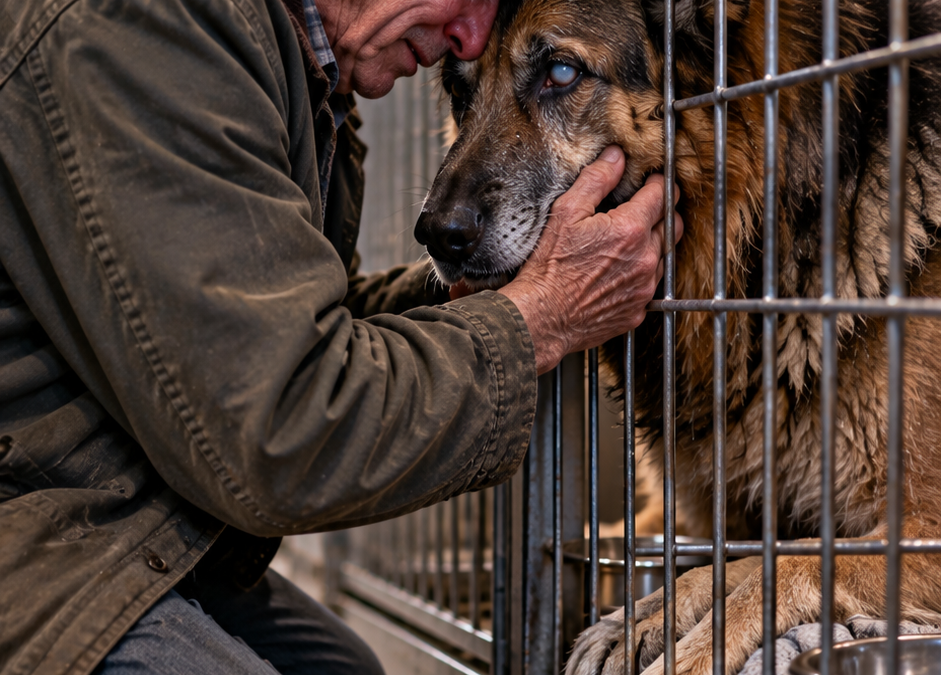
Inside the kennel sat an old German Shepherd.
He was large even in old age.
His coat had gone gray around the muzzle and eyebrows.
One eye was clear and dark.
The other was cloudy, perhaps partly blind.
His ears still stood upright, although one tilted slightly outward.
He wasn’t barking.
He wasn’t pacing.
He simply sat at the back of the kennel.
Watching us.
No.
Watching Grandpa.
Everything else in the hallway seemed to disappear.
Grandpa took one step closer.
The dog lifted his head.
Mom stopped beside me.
I looked at her.
Her face had changed.
“Mom?”
She didn’t answer.
Grandpa’s hand began to tremble.
That scared me.
I moved closer.
“Grandpa, are you okay?”
He didn’t look at me.
His eyes never left the dog.
The German Shepherd stood.
Slowly.
Stiffly.
He took one step toward the gate.
Then another.
Grandpa’s breathing changed.
I could hear it.
Shallow.
Uneven.
He reached for the metal railing beside the kennel.
For a second I thought he was losing his balance.
Then he lowered himself.
Painfully.
Slowly.
Onto one knee.
Then both.
His bad knee hit the concrete, but he seemed not to feel it.
The dog came closer.
They were maybe two feet apart now, separated only by metal bars.
I remember thinking that something about the dog’s face had changed.
He wasn’t simply curious anymore.
He looked stunned.
If a dog can be stunned, that’s what I saw.
Grandpa’s lips parted.
My entire body went cold.
For six years, those lips had opened only for food, water, breathing, silent laughter.
Then a sound came out.
Rough.
Broken.
Barely more than gravel pushed through an old door.
“Do you remember me…”
Mom grabbed my arm.
Grandpa swallowed.
The dog stepped closer.
Grandpa tried again.
“Do you remember me, old war buddy?”
I stopped breathing.
The hallway disappeared.
The barking disappeared.
Everything disappeared except that voice.
His voice.
Older than I remembered.
Lower.
Rusted by six years of silence.
But his.
I heard my mother gasp.
Her hand flew to her mouth.
Tears filled her eyes instantly.
I couldn’t move.
Grandpa stared through the bars.
The German Shepherd reached the gate.
He didn’t bark.
He pressed his nose between the bars.
Then he made a sound I had never heard from a dog before.
Not a growl.
Not a whine.
Something low and trembling.
A broken sound.
Almost like crying.
Grandpa pushed one hand through the bars.
The dog pressed his head into it.
Grandpa’s fingers moved slowly over one ear.
Across the forehead.
Down the muzzle.
His hand shook so badly I thought he might have to pull it back.
Instead, he whispered another word.
“Rex.”
The dog froze.
Then pushed harder against his hand.
Grandpa’s face folded.
Not dramatically.
That made it worse.
His eyes closed.
His forehead rested against the bars.
“Rex…”
I looked at Mom.
She was crying.
But there was something else in her expression.
Recognition.
“Mom,” I whispered. “Who is Rex?”
She squeezed my hand.
“Just listen.”
Grandpa opened his eyes.
“Is it really you?”
Rex made that sound again.
His tail moved once.
Then again.
Grandpa laughed.
There was sound in it.
A raw, cracked laugh.
I hadn’t heard it since I was a child.
One of the shelter employees stopped at the end of the corridor.
Then another.
The barking around us seemed to soften, although maybe I only remember it that way because nothing else mattered.
Grandpa lowered himself fully onto the concrete floor.
Rex lay down on the other side of the gate.
Their faces were almost level.
For several seconds, Grandpa simply touched him.
Then he started talking.
At first, the words came slowly.
Each one seemed difficult.
As though his mind remembered language but his throat had forgotten how to carry it.
“I thought you were gone.”
Pause.
“I thought…”
He cleared his throat.
“I thought I’d lost you.”
Rex kept his head pressed against the bars.
Grandpa’s fingers moved through the gray fur around his muzzle.
“Look at you.”
His voice cracked.
“Old man.”
Rex’s tail thumped once.
Grandpa smiled.
“So am I.”
That was the first joke.
Six years of silence.
And my grandfather’s first joke was to an elderly dog.
I started crying.
I couldn’t help it.
Mom put an arm around me.
Grandpa kept talking.
Slowly, the words became easier.
He told Rex things.
Not us.
Rex.
“I’m sorry.”
“I tried to find you.”
“They told me you were transferred.”
“I wrote.”
“I asked everyone I knew.”
“They said records were gone.”
Rex didn’t move.
Grandpa looked over at us.
For the first time, he seemed to realize we were there.
He wiped his face with the back of his hand.
“This is Rex.”
Three words.
Simple.
But hearing Grandpa introduce anyone again felt impossible.
I knelt beside him.
“You know him?”
Grandpa gave me a look that almost felt like the old days.
Then he looked back at Rex.
“I knew him before your mother was born.”
Mom crouched beside us.
I stared.
“How?”
Grandpa took a breath.
And then, sitting on the concrete floor of an animal shelter, he told me a story I’d never heard.
Years earlier, Grandpa had been stationed at a military base in Bavaria.
He had been much younger.
Lonely.
Far from home.
The kind of young man who thought admitting loneliness was the same as admitting weakness.
Someone assigned him a military working dog.
A young German Shepherd.
Two years old.
Full of energy.
Too smart for his own good.
“First time I saw him,” Grandpa said, “I thought they had made a mistake.”
Rex’s ears moved.
Grandpa smiled.
“I did.”
I wiped my face.
“What happened?”
“He proved me wrong.”
Grandpa looked at Rex.
“Quickly.”
The stories came faster now.
Long night patrols.
Cold weather.
Rain.
Training exercises.
Hours spent waiting in places where there was nothing to do except listen to your own thoughts.
Rex had always been there.
Grandpa described one night when everything had gone wrong.
He didn’t give us details.
Maybe some memories were still private.
But he said he had been sitting outside in the rain after a mission, exhausted and convinced he had failed everyone.
Rex had walked over.
Placed his head on Grandpa’s knee.
And stayed there until sunrise.
“He didn’t say anything,” Grandpa told me.
His hand moved over Rex’s head.
“But I heard him.”
That sentence broke something in Mom.
She turned away.
I understood why.
For six years, we had been sitting beside Grandpa in exactly the same way.
Loving him without words.
Maybe Rex had taught him that language long before we did.
Grandpa told us about another time he became badly ill.
A fever had kept him in bed for days.
Rex stayed nearby.
Refused to leave.
Barely ate.
“You were stubborn then too,” Grandpa whispered.
Rex blinked.
Grandpa smiled.
“More human than some people I served with.”
I laughed through my tears.
Then Grandpa’s smile faded.
“When I came home, they told me Rex wasn’t coming.”
He looked down.
“He still had service time.”
His hand stopped moving.
“I thought I’d get a chance to say goodbye.”
His voice became quieter.
“I didn’t.”
One day Rex was there.
Then he wasn’t.
Transferred.
No proper farewell.
No final walk.
No explanation a young soldier could live with.
Grandpa wrote letters.
Made calls.
Asked people.
But records moved slowly then.
There were no smartphones.
No social media.
No easy databases available to ordinary people.
Eventually the trail disappeared.
“I thought I’d find him,” Grandpa said.
“I really did.”
He looked at the gray dog behind the gate.
“Then enough years passed that I decided there was nobody left to find.”
I thought about Rex’s age.
“He must be very old.”
Grandpa nodded.
“Very.”
He touched Rex’s nose.
“Too stubborn to leave.”
That was when Emily, the shelter employee who had greeted us, quietly approached.
She had been standing several feet away.
Her eyes were wet.
“I’ve worked here three years,” she said.
Grandpa looked up at her.
“Three?”
She nodded.
“Rex has been here that entire time.”
Grandpa stared.
Emily continued.
“He came to us after several placements didn’t work out.”
“What happened?”
“He wasn’t aggressive.”
She shook her head.
“Never.”
“Then why?”
“He didn’t connect.”
She glanced toward Rex.
“People adopted him. He behaved. Ate. Slept. Followed commands. But they said he always seemed like he was waiting for someone.”
Grandpa’s eyes closed.
Emily continued softly.
“One older couple brought him back after a few weeks. They said he would sit by the front door for hours and stare outside.”
I felt chills run through me.
Grandpa looked at Rex.
“You waited?”
Rex pressed closer.
Emily crouched.
“We thought he was withdrawn.”
She wiped one eye.
“Maybe he wasn’t.”
Grandpa looked at her.
“He remembered.”
“I think so.”
That realization settled over all of us.
For years, Grandpa and Rex had lived in the same small town.
Grandpa on the north side.
Rex at the shelter on the east.
Miles apart.
Close enough to reach in fifteen minutes by car.
Far enough that neither knew the other existed.
Grandpa had never traveled this road.
We had never visited this shelter.
Until that Saturday.
Until Mom suggested a dog.
Until a coworker mentioned this particular place.
Until an ordinary morning carried us through an ordinary door.
I don’t know what to call things like that.
Chance.
Luck.
Timing.
Grace.
Maybe some events are too large for the words we use to explain them.
Grandpa turned toward me.
His voice was getting stronger.
“My granddaughter.”
I started crying again simply because he had said it.
“My granddaughter,” he repeated, almost amused by my reaction, “I thought my story was finished.”
I wiped my cheeks.
He looked at Rex.
“Apparently some roads just take a long way around.”
Emily stood.
“I can open the kennel.”
Grandpa looked at her.
“Please.”
The lock clicked.
The gate opened.
Rex did not rush out.
He stood.
Looked at the open door.
Then at Grandpa.
One careful step.
Another.
He crossed the threshold.
Grandpa opened his arms.
Rex walked directly into them.
That was when Grandpa truly cried.
Not quietly.
Not politely.
Six years of grief came out of him all at once.
He buried his face against Rex’s neck.
Rex leaned his entire weight against him.
Mom knelt beside them.
Then I did.
For a minute, all four of us were tangled together on the shelter floor around one very confused-looking old German Shepherd.
Eventually, Emily asked the question none of us needed to discuss.
“Would you like to adopt him?”
Grandpa looked up.
“Is that even a question?”
His voice was still rough.
But the old humor was there.
Emily laughed.
“No, sir.”
“Good.”
We completed the paperwork that afternoon.
Grandpa signed his name slowly.
His hand had trembled earlier.
It didn’t now.
He looked at the signature.
Then at Emily.
“Haven’t signed anything important in six years.”
Emily smiled.
“Looks like you still remember how.”
Grandpa studied the page.
“My handwriting’s still terrible.”
I laughed.
Mom cried again.
At that point, crying had become our family activity.
When everything was finished, Emily clipped a leash to Rex’s collar.
Then she handed it to Grandpa.
Rex walked out of the kennel hallway.
Halfway down, he stopped.
Looked back.
Then raised his head.
And barked.
Loud.
Clear.
One single bark that echoed through the corridor.
Other dogs answered.
For a few seconds, the entire shelter erupted.
Grandpa laughed.
“Show-off.”
Rex looked at him.
“Yeah, yeah. Let’s go home.”
Home.
It sounded different in Grandpa’s voice.
On the drive back, Mom drove because none of us trusted our emotions enough to operate machinery responsibly.
Grandpa sat in the back seat with Rex.
I sat in front.
For the entire trip, Grandpa talked.
He told Rex about the house.
The yard.
The old maple tree.
The neighbor who complained about squirrels.
He told him about Mom growing up.
About me.
About my brothers.
About Frank.
About people who had died.
About people who were still here.
Six years of silence came pouring out in pieces.
Sometimes he stopped to cough because his throat wasn’t accustomed to so much use.
Then he’d start again.
Rex rested his head on Grandpa’s leg.
Listening.
Exactly as he had years before.
I watched them in the mirror.
Tears ran down my face.
I didn’t wipe them away.
When we reached Grandpa’s house, Rex stood on the front walk and stared at everything.
Grandpa opened the door.
“Come on.”
Rex hesitated.
Grandpa waited.
Then Rex stepped inside.
He inspected every room.
The kitchen.
Hallway.
Living room.
Eventually, he stopped beside Grandpa’s chair.
He sniffed it.
Circled once.
Lay down beside it.
Grandpa stared at him.
“Still know where to park yourself, huh?”
Rex sighed.
That evening, Mom made dinner.
I don’t remember what we ate.
I remember Grandpa talking.
I remember Mom staring at him every few minutes like she was afraid he might disappear.
I remember Rex sleeping beneath the table.
Later, Grandpa moved to his old chair.
Rex settled across his shoes.
The house became quiet.
Then Grandpa began to sing.
I didn’t recognize the song.
Something old.
Military.
His voice shook.
Several notes cracked completely.
But he kept going.
Mom stood in the kitchen crying.
I sat on the floor with my back against the couch.
Rex lifted his head.
His ears rose.
Then he began to howl.
A low, steady sound.
Not loud.
Almost musical.
Grandpa stopped.
Looked down.
Then laughed.
“You still can’t sing.”
Rex howled again.
Grandpa continued.
And suddenly, the house I had known as a place of silence for six years was full of music.
The first week wasn’t magically easy.
Real healing rarely is.
Grandpa’s voice hurt after long conversations.
Some mornings he still didn’t talk much.
Sometimes Rex woke confused.
Sometimes he paced.
The adjustment took time.
But they had a rhythm.
Every morning at six, Grandpa picked up the leash.
Rex was ready before he reached the door.
They walked to the park.
Rain or shine.
Every evening around nine, Rex placed one paw on Grandpa’s knee.
That meant one thing.
Walk.
“No,” Grandpa would say.
Rex stared.
“It’s raining.”
Stare.
“I’m seventy-something years old.”
Stare.
“You don’t care.”
Rex’s tail moved.
Grandpa stood.
“Fine.”
I watched Grandpa change over the next several months.
Not overnight.
Gradually.
His voice grew stronger.
He called people.
Old friends.
Relatives.
Men he hadn’t spoken to in years.
The first calls were awkward.
“What do you say to someone after six years?” he asked me.
“The truth.”
“Which truth?”
“Start with ‘hello.'”
He smiled.
“Complicated strategy.”
“It works.”
It did.
People cried when they heard him.
Some asked questions.
Some didn’t.
The good ones didn’t.
One afternoon, I asked him what I had wanted to ask for years.
“Grandpa?”
“Yeah?”
“Why did you stop talking?”
He didn’t answer immediately.
Rex was lying beside his chair.
Grandpa rested one hand on his head.
For a moment, I wondered if my question had been unfair.
Then Grandpa spoke.
“Sometimes you don’t lose your voice because you have nothing to say.”
I waited.
“You lose it because there’s too much.”
He looked toward the window.
“Too many names.”
“Too many goodbyes.”
His fingers moved slowly through Rex’s fur.
“And you think if you start saying one thing, all the rest will come with it.”
I sat quietly.
“Frank was the last one.”
I nodded.
“When he died, it felt like a door shut.”
He looked at me.
“And I was tired of saying goodbye.”
My throat tightened.
“So you stopped saying anything.”
“Yeah.”
He smiled sadly.
“Not a particularly clever solution.”
“I don’t think grief cares about clever.”
“No.”
He looked down at Rex.
“It doesn’t.”
Rex lifted his head.
Grandpa smiled.
“This idiot listened to my silence before any of you were born.”
I laughed.
Rex’s tail moved.
“He remembered me.”
“Yes.”
“I think maybe that was what I needed.”
“What?”
“Proof that I hadn’t disappeared.”
I never forgot that sentence.
Over the next year, Grandpa started writing again.
He had kept journals throughout much of his life, but after Frank died, the notebooks stopped.
Now they returned.
Every morning after walking Rex, he sat at the kitchen table and wrote.
Memories.
Names.
Stories.
Things he had never told us.
Sometimes he asked me questions.
“What year did you graduate high school?”
“You were there.”
“I was silent, not dead.”
“2018.”
He wrote it down.
Sometimes he’d read a passage aloud.
His voice became clearer.
Steadier.
The stories weren’t all about military service.
Many were about Mom as a child.
Grandma.
His parents.
Old jobs.
Mistakes.
Regrets.
Small moments.
But one entire chapter was about Rex.
He titled it:
My Four-Legged Savior.
I teased him.
“A little dramatic.”
Grandpa looked offended.
“The dog earned it.”
Rex slept beside his feet.
“He’s unconscious.”
“War hero.”
“He’s snoring.”
“Decorated war hero.”
Rex snored louder.
Grandpa pointed.
“See? Humble.”
Those two years became some of the happiest I remember.
Rex was old.
We all knew that.
His hips grew weaker.
His cloudy eye worsened.
He slept more.
But every morning at six, he still went to the door.
Grandpa slowed his pace.
Their walks became shorter.
A loop around the park.
Then half a loop.
Then sometimes simply down the sidewalk and back.
Grandpa talked the entire time.
Rex listened.
One morning, I joined them.
The sky was pale.
Leaves had begun turning.
Grandpa moved slowly beside Rex.
“You know,” he said, “he used to outrun everybody.”
“I believe you.”
“He was impossible.”
Rex glanced at him.
“You were.”
Rex kept walking.
Grandpa looked at me.
“That face means he’s pretending not to hear.”
“Maybe he’s old.”
“No. He’s rude.”
I laughed.
Then I noticed something.
Grandpa wasn’t afraid anymore.
Not of talking.
Not of remembering.
And, eventually, not even of losing Rex again.
That last part mattered.
Because the day came.
Rex stopped eating.
The veterinarian examined him.
There wasn’t one dramatic diagnosis.
Just age.
His body was tired.
We had known the day would arrive.
Knowing didn’t make it easier.
Grandpa sat beside him that final afternoon.
Rex’s head rested on his leg.
I expected Grandpa to fall apart.
Instead, he talked.
He told Rex everything he hadn’t been able to say the first time they were separated.
“Thank you.”
“I’m sorry.”
“You were a good partner.”
“The best.”
“You were an absolute pain.”
Rex breathed slowly.
Grandpa smiled through tears.
“I should’ve found you sooner.”
Mom sat beside him.
I sat on the other side.
Grandpa placed one hand against Rex’s face.
“But you found me.”
Rex died peacefully.
Grandpa’s hand never left him.
I was afraid of what would happen afterward.
I think all of us were.
Six years earlier, one death had taken Grandpa’s voice.
What would this one take?
We buried Rex near the edge of the park with permission from the appropriate people, close to the path they had walked every morning.
Autumn leaves drifted around us.
Grandpa stood beside the fresh earth.
For a long time, nobody spoke.
Then Grandpa did.
“Thank you for giving me back to myself.”
His voice was strong.
“Thank you for waiting.”
A tear ran down his face.
“Thank you for not giving up when I already had.”
He touched the earth.
“Rest now, partner.”
That night, we returned to Grandpa’s house.
Rex’s bowl was still in the kitchen.
The leash still hung by the door.
His bed sat beside Grandpa’s chair.
Every object hurt to look at.
Grandpa sat down.
I sat on the floor with my back against the couch.
Exactly where I’d been the first night Rex came home.
For several minutes, the house remained silent.
I felt fear creeping into my chest.
Then Grandpa began singing.
The same old military song.
His voice was clear.
Steady.
There was no answering howl this time.
That absence nearly broke me.
But Grandpa kept singing.
He finished every verse.
When he stopped, I realized I was crying.
So was Mom.
Grandpa looked at Rex’s empty place beside his chair.
Then he whispered,
“Good night, old friend.”
And the next morning, Grandpa spoke.
The morning after that, he spoke.
And the one after that.
He never returned to those six years of silence.
He kept writing.
Eventually, he finished his memoir.
He spoke at a local school about friendship, grief, and service.
He wrote a long letter to the shelter thanking them for caring for Rex during the years when Rex had seemed unreachable.
He visited Emily several times.
Every visit began the same way.
“You kept my dog alive.”
And every time Emily answered,
“No, Mr. James. I think he was keeping himself alive for you.”
Grandpa never knew what to say to that.
So he’d smile.
Every morning at six, he still went walking.
Same park.
Same path.
No leash.
No dog.
I joined him once months after Rex died.
“Why six?” I asked.
He looked at me.
“What?”
“You don’t have to walk at six anymore.”
“I know.”
“Then why do you?”
Grandpa smiled.
“Because that’s when we walk.”
We.
Not walked.
Walk.
I didn’t correct him.
We moved along the path while autumn leaves turned beneath our shoes.
Grandpa told me a story.
Then another.
Then another.
Exactly as he had when I was a child.
At one point, he stopped near the place where Rex was buried.
His face softened.
“You know what I spent six years believing?”
“What?”
“That losing people meant pieces of you disappeared with them.”
He looked toward the trees.
“I was wrong.”
I waited.
“Some people take pieces.”
He smiled.
“Some give them back.”
I thought about an old German Shepherd sitting silently behind a metal gate.
Three years in a shelter.
Returned by families who thought he couldn’t bond.
Watching doors.
Watching roads.
Waiting for something nobody around him understood.
And I thought about my grandfather sitting in his chair.
Six years without words.
Looking through photographs.
Remembering people who were gone.
Waiting too.
Two old soldiers.
Two kinds of silence.
Living only a few miles apart.
Neither knowing the other was there.
Until one ordinary Saturday.
I used to think the miracle was that Grandpa spoke again.
Maybe that was only part of it.
The real miracle was recognition.
Rex recognized Grandpa.
And somehow, through Rex, Grandpa recognized himself.
The man who laughed.
The man who sang.
The man who told stories.
The man we had believed was still somewhere inside him.
He hadn’t vanished.
He had simply become lost behind too much grief.
Rex found the way back.
Years later, I can still hear Grandpa’s first words whenever I think about that shelter.
Do you remember me, old war buddy?
I remember the cracked sound of his voice.
Mom’s hand covering her mouth.
Rex pressing his muzzle against the bars.
Grandpa dropping to his knees even though it hurt.
I remember realizing that six years of silence could end with one familiar face.
Not a human face.
A gray muzzle.
One cloudy eye.
Two ears that still remembered a voice from decades before.
And a heart stubborn enough to keep waiting.
Grandpa once told me that silence isn’t always emptiness.
Sometimes silence is crowded.
Crowded with memories.
Names.
Regrets.
Love.
Things we meant to say.
Things we never got the chance to say.
Things we are afraid will destroy us if we finally let them out.
For six years, Grandpa carried all of that alone.
Then one old dog looked at him through a shelter gate and seemed to say the one thing none of us could.
I remember who you were.
And somehow that was enough.
Enough for one word.
Then another.
Then a story.
Then a song.
Rex lived only two more years after they found each other again.
Some people might call that unfair.
Grandpa never did.
“Two years is more than zero,” he once told me.
Then he smiled.
“And after waiting that long, I’ll take every day I can get.”
That’s how I think about it now.
Not as a sad story about an old man losing a dog twice.
As a story about two lives taking the longest road imaginable back to each other.
A soldier who had forgotten how to speak.
A dog who had never forgotten how to wait.
And one Saturday morning when neither of them had to wait anymore.
𝗧𝗛𝗘 𝗘𝗡𝗗
I Hadn’t Heard My Grandfather Speak in Six Years Until He Saw One Old German Shepherd Behind a Shelter Gate
For six years, my grandfather never spoke a single word to us, no matter how desperately we tried to reach him.
Then one Saturday morning at an animal shelter, he stopped in front of an old German Shepherd with one cloudy eye, dropped painfully to his knees, and stared through the bars as if he had just seen a ghost.
When Grandpa finally opened his mouth, the first words he spoke were not to me, my mother, or any doctor who had tried to help him—they were to the dog.
I had almost forgotten the sound of my grandfather’s voice.
Not completely.
Some memories refuse to disappear no matter how many years pass.
I could still remember the way he used to laugh from deep in his chest whenever one of us told a terrible joke. I remembered him humming while he washed dishes, singing old songs while he fixed things in the garage, and telling stories at the dinner table until my grandmother finally pointed at the clock and said, “James, these children have school tomorrow.”
Grandpa always had one more story.
One more joke.
One more memory.
When I was little, I thought adults simply came in different types.
Some were quiet.
Some were loud.
And then there was Grandpa James, who seemed physically incapable of letting silence last longer than thirty seconds.
He could turn a trip to the hardware store into a history lesson.
He could meet a stranger in line at the pharmacy and know half that person’s life story before reaching the register.
He knew old military songs, ridiculous limericks, bad jokes from the 1970s, and more stories about Europe than I could keep straight.
At night, when my brothers and I stayed at his house, he’d sit beside the bed and invent stories for us.
Never read them.
Invent them.
Pirates who hated the ocean.
Soldiers who were afraid of spiders.
Dogs smarter than generals.
He changed the ending every night, mostly because he couldn’t remember what he had said the night before.
That was Grandpa.
Words followed him everywhere.
Until one day, they stopped.
It happened after the death of his last surviving military friend.
His name was Frank.
I didn’t know much about their service together because Grandpa rarely talked about the worst parts of those years. He would tell funny stories, stories about bad food, impossible weather, broken equipment, and officers who could get lost walking across a parking lot.
But whenever conversations drifted toward men he had lost, something in his face changed.
Frank was different.
Frank was the last one.
The last person who had known Grandpa before he became my grandfather.
Before my mother was born.
Before the gray hair.
Before the old house.
Before all of us.
When Frank died, Grandpa attended the funeral.
He came home.
Took off his coat.
Sat in his chair.
And stopped talking.
At first, nobody realized what was happening.
The next morning, Mom asked him whether he wanted coffee.
He nodded.
She asked whether he had slept.
He shrugged.
She thought he was grieving.
We all did.
For several days, we gave him space.
Then days became weeks.
Weeks became months.
Grandpa didn’t speak.
He communicated with nods.
Small gestures.
Sometimes he wrote short sentences on a pad.
Mostly, he didn’t.
Doctors examined him.
His hearing was fine.
His vocal cords were fine.
Neurologically, nothing obvious explained it.
Eventually, they described what he was experiencing as a form of selective mutism connected to grief and psychological trauma.
The explanation gave us a name.
It did not give us his voice back.
That distinction mattered.
People often believe that once something has a name, it becomes easier.
Sometimes it doesn’t.
Sometimes you simply learn the correct term for the thing breaking your heart.
The first year was the hardest.
Mom kept trying.
She would sit with him at the kitchen table and talk about ordinary things.
Bills.
Weather.
Neighbors.
My classes.
My brothers.
Sometimes she told stories from childhood in the hope that one would make him respond.
Grandpa smiled.
Occasionally his eyes filled with tears.
But he never spoke.
I tried too.
I told him jokes.
Bad ones, because those had always been his specialty.
He would grin.
Once, he laughed silently—his shoulders shook, his mouth opened, but no sound came out.
That frightened me more than if he had cried.
We learned a new language around him.
One raised eyebrow meant skepticism.
Two taps on the table meant yes.
A small circle with his index finger meant continue.
If he squeezed my hand twice, it meant he was okay.
Or at least okay enough.
He still hugged us.
Still came to birthdays.
Still sat through Thanksgiving dinners.
Still looked at old photographs.
But there was always an invisible wall between him and the rest of the room.
His silence had weight.
You could feel it.
I grew older inside that silence.
By the sixth year, I had almost stopped expecting it to end.
That sounds terrible.
Maybe it was.
But families adapt to things because they have to.
At some point, hope stops being dramatic.
It becomes quieter.
Less like, Today will be the day.
More like, Maybe someday.
The Saturday we went to the animal shelter began with no sense that anything important was about to happen.
It was Mom’s idea.
She had been saying for months that Grandpa needed more companionship.
Not because we didn’t visit.
We did.
But he lived alone, and loneliness has a way of expanding inside a house.
Mom had mentioned getting him a dog before.
Grandpa always shook his head.
Not angrily.
Just no.
Then one Friday evening, while we were eating dinner at his house, Mom tried again.
“What about just looking?”
Grandpa raised one eyebrow.
“I’m serious,” she said.
He stared at her.
“You don’t have to adopt one.”
Another stare.
“We could go to the shelter tomorrow.”
He reached for his coffee.
Mom looked at me.
“Help me.”
I laughed.
“Grandpa, she’s not going to stop.”
He glanced at me.
I pointed toward Mom.
“You know this.”
The corner of his mouth moved.
Mom leaned forward.
“One hour.”
Grandpa looked down at his coffee.
Then he gave the smallest shrug.
That was enough.
Mom smiled like she’d won a Supreme Court case.
“Ten o’clock.”
Grandpa held up one finger.
“What?”
He pointed toward the clock.
Then toward himself.
“You want to go earlier?”
He nodded.
Mom looked at me.
“Your grandfather hasn’t spoken in six years and somehow he’s still bossy.”
Grandpa smiled.
The shelter was on the eastern edge of town.
Our town wasn’t large—maybe twenty thousand people if you counted everyone living just outside the city limits.
Grandpa’s house was on the north side.
The shelter sat beyond a line of older warehouses near a road we rarely used.
I had heard about it from a coworker.
She said the staff were patient and treated difficult animals well.
That mattered because I didn’t think Grandpa needed a young, hyperactive dog bouncing off the walls.
I imagined an older Labrador.
Something gentle.
Easy.
Something that might sleep beside his chair.
We arrived shortly after nine.
A young woman named Emily greeted us.
She had her hair tied back, a sweatshirt with the shelter’s logo, and the tired but kind expression of someone who had already cleaned up three disasters before breakfast.
“Looking for anything specific?” she asked.
Mom glanced at Grandpa.
“Companionship.”
Emily smiled.
“That’s a good category.”
Grandpa’s mouth twitched.
I noticed.
Emily did too.
“We’ve got plenty of experts in that department.”
The shelter smelled like disinfectant, old wood, dog food, and damp grass from the outdoor runs.
The barking started the moment we entered the main kennel hallway.
Every dog seemed convinced we were there specifically for them.
Some jumped.
Some spun in circles.
Some pressed against the gates.
Grandpa walked slowly.
He was in his seventies by then, and one knee bothered him badly, especially in cold weather.
He stopped at the first kennel.
A young mixed-breed dog bounced against the gate.
Grandpa smiled.
He shook his head.
The next dog was quieter.
He watched her for a moment.
Moved on.
Then another.
Nothing.
We walked halfway down the corridor.
I had begun thinking the whole trip might be pointless.
Then Grandpa stopped.
Not slowed.
Stopped.
I nearly walked into him.
“Grandpa?”
He didn’t move.
I followed his gaze.
Inside the kennel sat an old German Shepherd.
He was large even in old age.
His coat had gone gray around the muzzle and eyebrows.
One eye was clear and dark.
The other was cloudy, perhaps partly blind.
His ears still stood upright, although one tilted slightly outward.
He wasn’t barking.
He wasn’t pacing.
He simply sat at the back of the kennel.
Watching us.
No.
Watching Grandpa.
Everything else in the hallway seemed to disappear.
Grandpa took one step closer.
The dog lifted his head.
Mom stopped beside me.
I looked at her.
Her face had changed.
“Mom?”
She didn’t answer.
Grandpa’s hand began to tremble.
That scared me.
I moved closer.
“Grandpa, are you okay?”
He didn’t look at me.
His eyes never left the dog.
The German Shepherd stood.
Slowly.
Stiffly.
He took one step toward the gate.
Then another.
Grandpa’s breathing changed.
I could hear it.
Shallow.
Uneven.
He reached for the metal railing beside the kennel.
For a second I thought he was losing his balance.
Then he lowered himself.
Painfully.
Slowly.
Onto one knee.
Then both.
His bad knee hit the concrete, but he seemed not to feel it.
The dog came closer.
They were maybe two feet apart now, separated only by metal bars.
I remember thinking that something about the dog’s face had changed.
He wasn’t simply curious anymore.
He looked stunned.
If a dog can be stunned, that’s what I saw.
Grandpa’s lips parted.
My entire body went cold.
For six years, those lips had opened only for food, water, breathing, silent laughter.
Then a sound came out.
Rough.
Broken.
Barely more than gravel pushed through an old door.
“Do you remember me…”
Mom grabbed my arm.
Grandpa swallowed.
The dog stepped closer.
Grandpa tried again.
“Do you remember me, old war buddy?”
I stopped breathing.
The hallway disappeared.
The barking disappeared.
Everything disappeared except that voice.
His voice.
Older than I remembered.
Lower.
Rusted by six years of silence.
But his.
I heard my mother gasp.
Her hand flew to her mouth.
Tears filled her eyes instantly.
I couldn’t move.
Grandpa stared through the bars.
The German Shepherd reached the gate.
He didn’t bark.
He pressed his nose between the bars.
Then he made a sound I had never heard from a dog before.
Not a growl.
Not a whine.
Something low and trembling.
A broken sound.
Almost like crying.
Grandpa pushed one hand through the bars.
The dog pressed his head into it.
Grandpa’s fingers moved slowly over one ear.
Across the forehead.
Down the muzzle.
His hand shook so badly I thought he might have to pull it back.
Instead, he whispered another word.
“Rex.”
The dog froze.
Then pushed harder against his hand.
Grandpa’s face folded.
Not dramatically.
That made it worse.
His eyes closed.
His forehead rested against the bars.
“Rex…”
I looked at Mom.
She was crying.
But there was something else in her expression.
Recognition.
“Mom,” I whispered. “Who is Rex?”
She squeezed my hand.
“Just listen.”
Grandpa opened his eyes.
“Is it really you?”
Rex made that sound again.
His tail moved once.
Then again.
Grandpa laughed.
There was sound in it.
A raw, cracked laugh.
I hadn’t heard it since I was a child.
One of the shelter employees stopped at the end of the corridor.
Then another.
The barking around us seemed to soften, although maybe I only remember it that way because nothing else mattered.
Grandpa lowered himself fully onto the concrete floor.
Rex lay down on the other side of the gate.
Their faces were almost level.
For several seconds, Grandpa simply touched him.
Then he started talking.
At first, the words came slowly.
Each one seemed difficult.
As though his mind remembered language but his throat had forgotten how to carry it.
“I thought you were gone.”
Pause.
“I thought…”
He cleared his throat.
“I thought I’d lost you.”
Rex kept his head pressed against the bars.
Grandpa’s fingers moved through the gray fur around his muzzle.
“Look at you.”
His voice cracked.
“Old man.”
Rex’s tail thumped once.
Grandpa smiled.
“So am I.”
That was the first joke.
Six years of silence.
And my grandfather’s first joke was to an elderly dog.
I started crying.
I couldn’t help it.
Mom put an arm around me.
Grandpa kept talking.
Slowly, the words became easier.
He told Rex things.
Not us.
Rex.
“I’m sorry.”
“I tried to find you.”
“They told me you were transferred.”
“I wrote.”
“I asked everyone I knew.”
“They said records were gone.”
Rex didn’t move.
Grandpa looked over at us.
For the first time, he seemed to realize we were there.
He wiped his face with the back of his hand.
“This is Rex.”
Three words.
Simple.
But hearing Grandpa introduce anyone again felt impossible.
I knelt beside him.
“You know him?”
Grandpa gave me a look that almost felt like the old days.
Then he looked back at Rex.
“I knew him before your mother was born.”
Mom crouched beside us.
I stared.
“How?”
Grandpa took a breath.
And then, sitting on the concrete floor of an animal shelter, he told me a story I’d never heard.
Years earlier, Grandpa had been stationed at a military base in Bavaria.
He had been much younger.
Lonely.
Far from home.
The kind of young man who thought admitting loneliness was the same as admitting weakness.
Someone assigned him a military working dog.
A young German Shepherd.
Two years old.
Full of energy.
Too smart for his own good.
“First time I saw him,” Grandpa said, “I thought they had made a mistake.”
Rex’s ears moved.
Grandpa smiled.
“I did.”
I wiped my face.
“What happened?”
“He proved me wrong.”
Grandpa looked at Rex.
“Quickly.”
The stories came faster now.
Long night patrols.
Cold weather.
Rain.
Training exercises.
Hours spent waiting in places where there was nothing to do except listen to your own thoughts.
Rex had always been there.
Grandpa described one night when everything had gone wrong.
He didn’t give us details.
Maybe some memories were still private.
But he said he had been sitting outside in the rain after a mission, exhausted and convinced he had failed everyone.
Rex had walked over.
Placed his head on Grandpa’s knee.
And stayed there until sunrise.
“He didn’t say anything,” Grandpa told me.
His hand moved over Rex’s head.
“But I heard him.”
That sentence broke something in Mom.
She turned away.
I understood why.
For six years, we had been sitting beside Grandpa in exactly the same way.
Loving him without words.
Maybe Rex had taught him that language long before we did.
Grandpa told us about another time he became badly ill.
A fever had kept him in bed for days.
Rex stayed nearby.
Refused to leave.
Barely ate.
“You were stubborn then too,” Grandpa whispered.
Rex blinked.
Grandpa smiled.
“More human than some people I served with.”
I laughed through my tears.
Then Grandpa’s smile faded.
“When I came home, they told me Rex wasn’t coming.”
He looked down.
“He still had service time.”
His hand stopped moving.
“I thought I’d get a chance to say goodbye.”
His voice became quieter.
“I didn’t.”
One day Rex was there.
Then he wasn’t.
Transferred.
No proper farewell.
No final walk.
No explanation a young soldier could live with.
Grandpa wrote letters.
Made calls.
Asked people.
But records moved slowly then.
There were no smartphones.
No social media.
No easy databases available to ordinary people.
Eventually the trail disappeared.
“I thought I’d find him,” Grandpa said.
“I really did.”
He looked at the gray dog behind the gate.
“Then enough years passed that I decided there was nobody left to find.”
I thought about Rex’s age.
“He must be very old.”
Grandpa nodded.
“Very.”
He touched Rex’s nose.
“Too stubborn to leave.”
That was when Emily, the shelter employee who had greeted us, quietly approached.
She had been standing several feet away.
Her eyes were wet.
“I’ve worked here three years,” she said.
Grandpa looked up at her.
“Three?”
She nodded.
“Rex has been here that entire time.”
Grandpa stared.
Emily continued.
“He came to us after several placements didn’t work out.”
“What happened?”
“He wasn’t aggressive.”
She shook her head.
“Never.”
“Then why?”
“He didn’t connect.”
She glanced toward Rex.
“People adopted him. He behaved. Ate. Slept. Followed commands. But they said he always seemed like he was waiting for someone.”
Grandpa’s eyes closed.
Emily continued softly.
“One older couple brought him back after a few weeks. They said he would sit by the front door for hours and stare outside.”
I felt chills run through me.
Grandpa looked at Rex.
“You waited?”
Rex pressed closer.
Emily crouched.
“We thought he was withdrawn.”
She wiped one eye.
“Maybe he wasn’t.”
Grandpa looked at her.
“He remembered.”
“I think so.”
That realization settled over all of us.
For years, Grandpa and Rex had lived in the same small town.
Grandpa on the north side.
Rex at the shelter on the east.
Miles apart.
Close enough to reach in fifteen minutes by car.
Far enough that neither knew the other existed.
Grandpa had never traveled this road.
We had never visited this shelter.
Until that Saturday.
Until Mom suggested a dog.
Until a coworker mentioned this particular place.
Until an ordinary morning carried us through an ordinary door.
I don’t know what to call things like that.
Chance.
Luck.
Timing.
Grace.
Maybe some events are too large for the words we use to explain them.
Grandpa turned toward me.
His voice was getting stronger.
“My granddaughter.”
I started crying again simply because he had said it.
“My granddaughter,” he repeated, almost amused by my reaction, “I thought my story was finished.”
I wiped my cheeks.
He looked at Rex.
“Apparently some roads just take a long way around.”
Emily stood.
“I can open the kennel.”
Grandpa looked at her.
“Please.”
The lock clicked.
The gate opened.
Rex did not rush out.
He stood.
Looked at the open door.
Then at Grandpa.
One careful step.
Another.
He crossed the threshold.
Grandpa opened his arms.
Rex walked directly into them.
That was when Grandpa truly cried.
Not quietly.
Not politely.
Six years of grief came out of him all at once.
He buried his face against Rex’s neck.
Rex leaned his entire weight against him.
Mom knelt beside them.
Then I did.
For a minute, all four of us were tangled together on the shelter floor around one very confused-looking old German Shepherd.
Eventually, Emily asked the question none of us needed to discuss.
“Would you like to adopt him?”
Grandpa looked up.
“Is that even a question?”
His voice was still rough.
But the old humor was there.
Emily laughed.
“No, sir.”
“Good.”
We completed the paperwork that afternoon.
Grandpa signed his name slowly.
His hand had trembled earlier.
It didn’t now.
He looked at the signature.
Then at Emily.
“Haven’t signed anything important in six years.”
Emily smiled.
“Looks like you still remember how.”
Grandpa studied the page.
“My handwriting’s still terrible.”
I laughed.
Mom cried again.
At that point, crying had become our family activity.
When everything was finished, Emily clipped a leash to Rex’s collar.
Then she handed it to Grandpa.
Rex walked out of the kennel hallway.
Halfway down, he stopped.
Looked back.
Then raised his head.
And barked.
Loud.
Clear.
One single bark that echoed through the corridor.
Other dogs answered.
For a few seconds, the entire shelter erupted.
Grandpa laughed.
“Show-off.”
Rex looked at him.
“Yeah, yeah. Let’s go home.”
Home.
It sounded different in Grandpa’s voice.
On the drive back, Mom drove because none of us trusted our emotions enough to operate machinery responsibly.
Grandpa sat in the back seat with Rex.
I sat in front.
For the entire trip, Grandpa talked.
He told Rex about the house.
The yard.
The old maple tree.
The neighbor who complained about squirrels.
He told him about Mom growing up.
About me.
About my brothers.
About Frank.
About people who had died.
About people who were still here.
Six years of silence came pouring out in pieces.
Sometimes he stopped to cough because his throat wasn’t accustomed to so much use.
Then he’d start again.
Rex rested his head on Grandpa’s leg.
Listening.
Exactly as he had years before.
I watched them in the mirror.
Tears ran down my face.
I didn’t wipe them away.
When we reached Grandpa’s house, Rex stood on the front walk and stared at everything.
Grandpa opened the door.
“Come on.”
Rex hesitated.
Grandpa waited.
Then Rex stepped inside.
He inspected every room.
The kitchen.
Hallway.
Living room.
Eventually, he stopped beside Grandpa’s chair.
He sniffed it.
Circled once.
Lay down beside it.
Grandpa stared at him.
“Still know where to park yourself, huh?”
Rex sighed.
That evening, Mom made dinner.
I don’t remember what we ate.
I remember Grandpa talking.
I remember Mom staring at him every few minutes like she was afraid he might disappear.
I remember Rex sleeping beneath the table.
Later, Grandpa moved to his old chair.
Rex settled across his shoes.
The house became quiet.
Then Grandpa began to sing.
I didn’t recognize the song.
Something old.
Military.
His voice shook.
Several notes cracked completely.
But he kept going.
Mom stood in the kitchen crying.
I sat on the floor with my back against the couch.
Rex lifted his head.
His ears rose.
Then he began to howl.
A low, steady sound.
Not loud.
Almost musical.
Grandpa stopped.
Looked down.
Then laughed.
“You still can’t sing.”
Rex howled again.
Grandpa continued.
And suddenly, the house I had known as a place of silence for six years was full of music.
The first week wasn’t magically easy.
Real healing rarely is.
Grandpa’s voice hurt after long conversations.
Some mornings he still didn’t talk much.
Sometimes Rex woke confused.
Sometimes he paced.
The adjustment took time.
But they had a rhythm.
Every morning at six, Grandpa picked up the leash.
Rex was ready before he reached the door.
They walked to the park.
Rain or shine.
Every evening around nine, Rex placed one paw on Grandpa’s knee.
That meant one thing.
Walk.
“No,” Grandpa would say.
Rex stared.
“It’s raining.”
Stare.
“I’m seventy-something years old.”
Stare.
“You don’t care.”
Rex’s tail moved.
Grandpa stood.
“Fine.”
I watched Grandpa change over the next several months.
Not overnight.
Gradually.
His voice grew stronger.
He called people.
Old friends.
Relatives.
Men he hadn’t spoken to in years.
The first calls were awkward.
“What do you say to someone after six years?” he asked me.
“The truth.”
“Which truth?”
“Start with ‘hello.'”
He smiled.
“Complicated strategy.”
“It works.”
It did.
People cried when they heard him.
Some asked questions.
Some didn’t.
The good ones didn’t.
One afternoon, I asked him what I had wanted to ask for years.
“Grandpa?”
“Yeah?”
“Why did you stop talking?”
He didn’t answer immediately.
Rex was lying beside his chair.
Grandpa rested one hand on his head.
For a moment, I wondered if my question had been unfair.
Then Grandpa spoke.
“Sometimes you don’t lose your voice because you have nothing to say.”
I waited.
“You lose it because there’s too much.”
He looked toward the window.
“Too many names.”
“Too many goodbyes.”
His fingers moved slowly through Rex’s fur.
“And you think if you start saying one thing, all the rest will come with it.”
I sat quietly.
“Frank was the last one.”
I nodded.
“When he died, it felt like a door shut.”
He looked at me.
“And I was tired of saying goodbye.”
My throat tightened.
“So you stopped saying anything.”
“Yeah.”
He smiled sadly.
“Not a particularly clever solution.”
“I don’t think grief cares about clever.”
“No.”
He looked down at Rex.
“It doesn’t.”
Rex lifted his head.
Grandpa smiled.
“This idiot listened to my silence before any of you were born.”
I laughed.
Rex’s tail moved.
“He remembered me.”
“Yes.”
“I think maybe that was what I needed.”
“What?”
“Proof that I hadn’t disappeared.”
I never forgot that sentence.
Over the next year, Grandpa started writing again.
He had kept journals throughout much of his life, but after Frank died, the notebooks stopped.
Now they returned.
Every morning after walking Rex, he sat at the kitchen table and wrote.
Memories.
Names.
Stories.
Things he had never told us.
Sometimes he asked me questions.
“What year did you graduate high school?”
“You were there.”
“I was silent, not dead.”
“2018.”
He wrote it down.
Sometimes he’d read a passage aloud.
His voice became clearer.
Steadier.
The stories weren’t all about military service.
Many were about Mom as a child.
Grandma.
His parents.
Old jobs.
Mistakes.
Regrets.
Small moments.
But one entire chapter was about Rex.
He titled it:
My Four-Legged Savior.
I teased him.
“A little dramatic.”
Grandpa looked offended.
“The dog earned it.”
Rex slept beside his feet.
“He’s unconscious.”
“War hero.”
“He’s snoring.”
“Decorated war hero.”
Rex snored louder.
Grandpa pointed.
“See? Humble.”
Those two years became some of the happiest I remember.
Rex was old.
We all knew that.
His hips grew weaker.
His cloudy eye worsened.
He slept more.
But every morning at six, he still went to the door.
Grandpa slowed his pace.
Their walks became shorter.
A loop around the park.
Then half a loop.
Then sometimes simply down the sidewalk and back.
Grandpa talked the entire time.
Rex listened.
One morning, I joined them.
The sky was pale.
Leaves had begun turning.
Grandpa moved slowly beside Rex.
“You know,” he said, “he used to outrun everybody.”
“I believe you.”
“He was impossible.”
Rex glanced at him.
“You were.”
Rex kept walking.
Grandpa looked at me.
“That face means he’s pretending not to hear.”
“Maybe he’s old.”
“No. He’s rude.”
I laughed.
Then I noticed something.
Grandpa wasn’t afraid anymore.
Not of talking.
Not of remembering.
And, eventually, not even of losing Rex again.
That last part mattered.
Because the day came.
Rex stopped eating.
The veterinarian examined him.
There wasn’t one dramatic diagnosis.
Just age.
His body was tired.
We had known the day would arrive.
Knowing didn’t make it easier.
Grandpa sat beside him that final afternoon.
Rex’s head rested on his leg.
I expected Grandpa to fall apart.
Instead, he talked.
He told Rex everything he hadn’t been able to say the first time they were separated.
“Thank you.”
“I’m sorry.”
“You were a good partner.”
“The best.”
“You were an absolute pain.”
Rex breathed slowly.
Grandpa smiled through tears.
“I should’ve found you sooner.”
Mom sat beside him.
I sat on the other side.
Grandpa placed one hand against Rex’s face.
“But you found me.”
Rex died peacefully.
Grandpa’s hand never left him.
I was afraid of what would happen afterward.
I think all of us were.
Six years earlier, one death had taken Grandpa’s voice.
What would this one take?
We buried Rex near the edge of the park with permission from the appropriate people, close to the path they had walked every morning.
Autumn leaves drifted around us.
Grandpa stood beside the fresh earth.
For a long time, nobody spoke.
Then Grandpa did.
“Thank you for giving me back to myself.”
His voice was strong.
“Thank you for waiting.”
A tear ran down his face.
“Thank you for not giving up when I already had.”
He touched the earth.
“Rest now, partner.”
That night, we returned to Grandpa’s house.
Rex’s bowl was still in the kitchen.
The leash still hung by the door.
His bed sat beside Grandpa’s chair.
Every object hurt to look at.
Grandpa sat down.
I sat on the floor with my back against the couch.
Exactly where I’d been the first night Rex came home.
For several minutes, the house remained silent.
I felt fear creeping into my chest.
Then Grandpa began singing.
The same old military song.
His voice was clear.
Steady.
There was no answering howl this time.
That absence nearly broke me.
But Grandpa kept singing.
He finished every verse.
When he stopped, I realized I was crying.
So was Mom.
Grandpa looked at Rex’s empty place beside his chair.
Then he whispered,
“Good night, old friend.”
And the next morning, Grandpa spoke.
The morning after that, he spoke.
And the one after that.
He never returned to those six years of silence.
He kept writing.
Eventually, he finished his memoir.
He spoke at a local school about friendship, grief, and service.
He wrote a long letter to the shelter thanking them for caring for Rex during the years when Rex had seemed unreachable.
He visited Emily several times.
Every visit began the same way.
“You kept my dog alive.”
And every time Emily answered,
“No, Mr. James. I think he was keeping himself alive for you.”
Grandpa never knew what to say to that.
So he’d smile.
Every morning at six, he still went walking.
Same park.
Same path.
No leash.
No dog.
I joined him once months after Rex died.
“Why six?” I asked.
He looked at me.
“What?”
“You don’t have to walk at six anymore.”
“I know.”
“Then why do you?”
Grandpa smiled.
“Because that’s when we walk.”
We.
Not walked.
Walk.
I didn’t correct him.
We moved along the path while autumn leaves turned beneath our shoes.
Grandpa told me a story.
Then another.
Then another.
Exactly as he had when I was a child.
At one point, he stopped near the place where Rex was buried.
His face softened.
“You know what I spent six years believing?”
“What?”
“That losing people meant pieces of you disappeared with them.”
He looked toward the trees.
“I was wrong.”
I waited.
“Some people take pieces.”
He smiled.
“Some give them back.”
I thought about an old German Shepherd sitting silently behind a metal gate.
Three years in a shelter.
Returned by families who thought he couldn’t bond.
Watching doors.
Watching roads.
Waiting for something nobody around him understood.
And I thought about my grandfather sitting in his chair.
Six years without words.
Looking through photographs.
Remembering people who were gone.
Waiting too.
Two old soldiers.
Two kinds of silence.
Living only a few miles apart.
Neither knowing the other was there.
Until one ordinary Saturday.
I used to think the miracle was that Grandpa spoke again.
Maybe that was only part of it.
The real miracle was recognition.
Rex recognized Grandpa.
And somehow, through Rex, Grandpa recognized himself.
The man who laughed.
The man who sang.
The man who told stories.
The man we had believed was still somewhere inside him.
He hadn’t vanished.
He had simply become lost behind too much grief.
Rex found the way back.
Years later, I can still hear Grandpa’s first words whenever I think about that shelter.
Do you remember me, old war buddy?
I remember the cracked sound of his voice.
Mom’s hand covering her mouth.
Rex pressing his muzzle against the bars.
Grandpa dropping to his knees even though it hurt.
I remember realizing that six years of silence could end with one familiar face.
Not a human face.
A gray muzzle.
One cloudy eye.
Two ears that still remembered a voice from decades before.
And a heart stubborn enough to keep waiting.
Grandpa once told me that silence isn’t always emptiness.
Sometimes silence is crowded.
Crowded with memories.
Names.
Regrets.
Love.
Things we meant to say.
Things we never got the chance to say.
Things we are afraid will destroy us if we finally let them out.
For six years, Grandpa carried all of that alone.
Then one old dog looked at him through a shelter gate and seemed to say the one thing none of us could.
I remember who you were.
And somehow that was enough.
Enough for one word.
Then another.
Then a story.
Then a song.
Rex lived only two more years after they found each other again.
Some people might call that unfair.
Grandpa never did.
“Two years is more than zero,” he once told me.
Then he smiled.
“And after waiting that long, I’ll take every day I can get.”
That’s how I think about it now.
Not as a sad story about an old man losing a dog twice.
As a story about two lives taking the longest road imaginable back to each other.
A soldier who had forgotten how to speak.
A dog who had never forgotten how to wait.
And one Saturday morning when neither of them had to wait anymore.

