𝗙𝗨𝗟𝗟 𝗦𝗧𝗢𝗥𝗬 I Came Home to Find My Dog Had Destroyed the One Place I Still Felt Safe, and I Had No Idea What He Had Been Trying to Reach
𝗙𝗨𝗟𝗟 𝗦𝗧𝗢𝗥𝗬
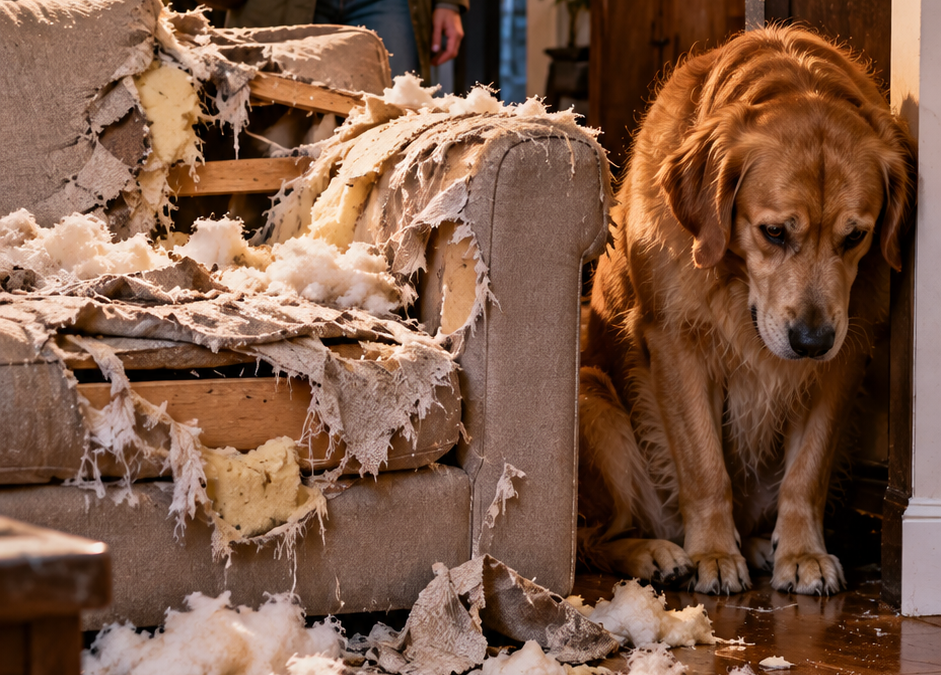
He lowered his head.
I threw the torn fabric onto the floor.
“Get out of my sight.”
The second the words left my mouth, something inside me winced.
Max stood.
He hesitated.
“Go.”
He moved slowly toward the hallway.
Not running.
Not resisting.
Just walking with his head down as if I had become someone he did not understand.
He disappeared into the bedroom.
I stood in the middle of the destroyed living room.
Then I started crying.
Not because of the couch.
Not completely.
The couch was just the object unlucky enough to break at the exact moment I was already breaking.
The previous few months had been terrible.
Not catastrophic.
Sometimes I think catastrophic would have been easier.
Catastrophe gives you permission to collapse.
My life had simply been grinding me down.
Work had become unbearable.
Our publishing deadlines kept shortening while the workload increased.
Two people had left the department.
Neither had been replaced.
I had inherited half of one person’s responsibilities and all of another’s mistakes.
My manager said things like, “We all need to be flexible,” which apparently meant I should answer emails at eleven at night.
Three months earlier, my relationship had ended.
Not dramatically.
No betrayal.
No screaming.
Just one awful conversation in my kitchen.
“We don’t want the same things anymore.”
That was what Daniel had said.
I remember staring at him.
“What things?”
He couldn’t answer.
He packed over the next week.
The day he left, Max sat beside me at the window and watched his car disappear.
Daniel had loved Max.
Max had loved him too.
For weeks afterward, Max waited near the door around six in the evening.
He eventually stopped.
I didn’t.
Not really.
I stopped waiting for Daniel physically.
But some part of me still waited for the life I had thought I was building to come back.
It never did.
So I worked.
Worked late.
Worked weekends.
Answered messages.
Fixed manuscripts.
Corrected other people’s sentences because controlling commas was easier than thinking about my own future.
And every evening, I came home to the couch.
That stupid beige couch.
It had been with me six years.
Long before Daniel.
Long before this apartment.
I had bought it with my first real paycheck after getting promoted.
It had moved with me twice.
My mother had slept on it when she visited.
Daniel and I had watched terrible movies there.
I had recovered from the flu there.
I had cried there after my father’s surgery.
I had sat there the night my relationship ended with Max’s head in my lap.
It wasn’t an expensive couch anymore.
It wasn’t even especially beautiful.
But it was mine.
It had become the physical center of every version of my life that still felt safe.
And now Max had destroyed it.
Completely.
I sank onto the floor between piles of stuffing.
The room looked absurd.
Like a snowstorm had somehow happened indoors.
I buried my face in my hands.
“What am I doing?”
I whispered.
No answer.
The apartment felt wrong without Max beside me.
Usually, if I cried, he appeared.
Always.
Even from another room.
He would walk over, push his head under my arm, and sit there until I touched him.
This time he stayed in the bedroom.
Because I had told him to go.
The realization made my chest hurt.
I wiped my face.
“Max?”
Nothing.
I almost got up.
Pride stopped me.
Which is embarrassing to admit.
Pride against a dog.
I told myself he needed to understand he had done something wrong.
He needed consequences.
That was what responsible dog owners did.
Except I didn’t know what those consequences were supposed to accomplish after the fact.
The couch was already destroyed.
Max was already terrified.
My shouting had repaired nothing.
Still, I stayed where I was.
Eventually, anger cooled into exhaustion.
The late afternoon light faded.
The room darkened.
I stood and began picking up pieces of foam.
Every movement revealed more destruction.
One torn seam.
Then another.
I muttered under my breath.
“Unbelievable.”
I collected stuffing into garbage bags.
The couch was too damaged to save.
I knew that.
The cushions were torn open.
The back lining had been ripped apart.
One internal support had shifted.
It looked as if Max had attacked one particular section with obsessive determination.
Mostly the back left corner.
That struck me as strange.
If he had simply become bored, why destroy one area so much more severely than the rest?
I remembered the vet talking about destructive behavior.
Anxiety.
Stress.
Understimulation.
Maybe Daniel leaving had affected him more than I realized.
Maybe my work hours had.
Guilt tried to push through the remaining anger.
I resisted.
Then I noticed something else.
The smell.
At first, I thought it came from the shredded couch.
Foam can smell strange once exposed.
Old fabric.
Dust.
Dog saliva.
I kept cleaning.
A few minutes later, I stopped.
There it was again.
Faint.
Sharp.
Chemical.
I stood still.
Sniffed.
Nothing.
Then again.
A hot, bitter odor.
I frowned.
“What is that?”
I walked toward the kitchen.
Nothing there.
I checked the trash.
Nothing.
Returned to the living room.
The smell became stronger.
Not much.
But enough.
I moved closer to the ruined couch.
Then I recognized it.
Burning plastic.
My body went rigid.
I knew that smell.
Years earlier, a power strip had overheated under my desk at work.
The smell had been almost identical.
Hot wiring.
Melting insulation.
I dropped the garbage bag.
“Wait.”
I walked around the back of the couch.
The worst damage was there.
Max had torn a wide section almost completely open.
I moved loose fabric aside.
More stuffing.
More foam.
Then I saw the wall.
A dark mark.
Small.
Easy to miss.
I knelt.
The wall outlet sat almost directly behind the couch.
I rarely saw it because the couch had been pushed against that wall for years.
A lamp had once been plugged into it, but I had moved the lamp months earlier.
I leaned closer.
The smell intensified.
Then I heard it.
Crack.
Tiny.
Barely audible.
I froze.
A second later:
Crackle.
My heart began hammering.
The outlet plate was discolored.
One corner had turned brown.
Along the edge, there was a faint black streak.
“Oh my God.”
I pulled my hand back before touching anything.
The plastic looked warped.
Part of it had softened from heat.
Behind the plate, something was making a quiet electrical snapping sound.
Suddenly the destroyed couch no longer looked like random destruction.
It looked like an excavation.
I stared at the torn back.
At the exposed outlet.
At the distance between them.
Then toward the hallway.
“Max?”
No response.
I looked again at the outlet.
A memory flashed into my mind.
Three nights earlier.
Max standing beside the couch.
Nose pressed against the back corner.
I had been reading an email.
“Leave it alone.”
He had whined.
I assumed he heard something in the wall.
A mouse, maybe.
The next evening, he scratched the side of the couch.
“Max.”
He stopped.
Then went back and sniffed behind it.
I pulled him away.
“There’s nothing there.”
The night before, he had paced.
Couch.
Hallway.
Couch.
Me.
Couch.
He whined several times.
I was on a work call.
I had muted my microphone.
“Go lie down.”
He didn’t.
I pointed toward his bed.
“Max, please.”
Eventually he went.
All those moments rearranged themselves at once.
He had been trying to tell me.
I stood so quickly I became dizzy.
The outlet crackled again.
I ran to the electrical panel.
My hands shook so badly I flipped the wrong breaker first.
Then another.
Finally, I shut off the main power.
Everything died.
Lights.
Refrigerator hum.
Heating fan.
The apartment dropped into silence.
I stood there listening.
No crackling.
I went back to the living room using my phone flashlight.
The burning smell remained.
But no new sound came from the wall.
Then I understood one more thing.
The couch had not merely hidden the outlet.
The couch itself was fuel.
Dry fabric.
Foam.
Stuffing.
Wood.
All packed against a failing electrical connection.
My legs weakened.
I sat on the floor.
I imagined coming home later.
Or not noticing the smell.
Making tea.
Sitting on the couch.
Maybe falling asleep there.
I had done that countless times.
Or going to bed while the wiring continued overheating behind the furniture.
One spark.
One piece of foam.
Fire.
The thought made my stomach turn.
“Max.”
This time, I said his name differently.
Not angry.
Terrified.
“Max?”
I went toward the bedroom.
He was beside the bed.
Curled tightly.
He looked up when I entered, then immediately lowered his eyes.
I stopped in the doorway.
All the anger inside me disappeared so completely it left shame behind.
“Oh, Max.”
His ears moved.
I crouched.
He didn’t come.
That hurt more than I deserved to say.
Normally, if I crouched and opened my arms, he came immediately.
Now he watched me.
Unsure.
Because twenty minutes earlier, I had screamed at him.
I had told the one creature who had apparently been trying desperately to protect me to get out of my sight.
I moved closer on my knees.
“Buddy.”
His head lifted slightly.
“I’m sorry.”
I know dogs don’t understand apologies the way humans do.
But tone matters.
Bodies matter.
Intent matters.
And if ever I needed him to understand me, it was then.
“I didn’t know.”
My voice broke.
“You were trying to tell me.”
His eyes stayed on mine.
“I didn’t listen.”
Tears came again.
Stronger this time.
I reached toward him but stopped before touching.
“You were trying to get to the outlet.”
He sniffed my fingers.
“That’s why you tore it.”
His tail moved once.
Very slightly.
That tiny movement broke me.
I leaned forward and wrapped my arms around his neck.
At first, he stayed rigid.
My face pressed into his fur.
“I’m sorry.”
I cried into his shoulder.
“I’m so sorry.”
His body slowly relaxed.
“You saved me.”
My voice barely worked.
“And I screamed at you.”
He shifted.
Then his tongue touched my ear.
I laughed and cried at the same time.
“Of course.”
His tail moved again.
Once.
Twice.
Then harder.
Soon his entire back half was moving.
He pushed himself against me.
No punishment.
No resentment.
No demand that I suffer as long as he had suffered.
Dogs are unfairly generous that way.
Human beings can preserve a sentence for twenty years.
A dog can be frightened by you and still come back the moment your voice becomes safe again.
I held him for a long time.
Then I remembered the outlet.
I called James.
Not my ex.
A friend who worked as an electrician.
He answered on the fourth ring.
His voice was thick with sleep.
“Hello?”
“James?”
“Do you know what time it is?”
“I think something is burning inside my wall.”
He woke instantly.
“What?”
I explained.
Outlet.
Burning smell.
Melting plastic.
Crackling.
“I shut the main breaker off.”
“Good.”
“Do not turn it back on.”
“I’m not.”
“Do not touch the outlet.”
“I’m not.”
“Any smoke?”
“No.”
“Wall hot?”
“I haven’t touched it.”
“Good.”
Pause.
“What happened?”
I looked at Max.
“My dog destroyed my couch.”
Silence.
“Emily, I’m going to need the middle part of that story.”
“I think he was trying to reach the outlet.”
Another pause.
“I’m coming.”
“James, it’s after midnight.”
“I know.”
“You don’t have to—”
“If the wiring is melting inside the wall, yes, I do.”
He arrived about forty minutes later carrying tools and wearing old jeans, boots, and an expression that suggested I owed him breakfast for a month.
Max greeted him at the door.
James looked past him into the living room.
Then stopped.
“What the hell?”
“I told you.”
“You said destroyed.”
“Yes.”
“This dog declared war.”
Max wagged his tail.
James pointed.
“Don’t look proud.”
I almost laughed.
Then he smelled the air.
His expression changed.
“Okay.”
He put down his bag.
“Keep the main off.”
He moved the remaining couch frame away from the wall.
The extent of Max’s work became even clearer.
He had torn through the upholstery exactly where it covered the outlet.
Not across the entire back.
Not randomly.
There.
James crouched.
Used a flashlight.
Removed the outlet cover carefully.
Then became very still.
“How bad?”
He didn’t answer immediately.
“James.”
He leaned closer.
“Bad.”
My stomach tightened.
He showed me without letting me get too close.
The insulation around the wiring had melted.
Parts of the wire had darkened.
There were carbon marks inside the electrical box.
The plastic had partially fused.
“What caused it?”
“Could be a loose connection.”
“Age.”
“Damage.”
“Hard to say without opening more.”
He examined the surrounding wall.
“But this has been heating.”
“For how long?”
“Not sure.”
“Hours?”
“Probably longer.”
I looked at Max.
“Days?”
James shrugged.
“Possible.”
I remembered the sniffing.
The whining.
The scratching.
My knees felt weak again.
“Could it have caught fire?”
James looked at me.
Not dramatically.
Not trying to scare me.
Just honestly.
“Yes.”
“How easily?”
He glanced toward the destroyed couch.
“With that foam pressed right against it?”
He exhaled.
“You got lucky.”
I shook my head.
“No.”
He looked at me.
I pointed at Max.
“He knew.”
James stared at the dog.
Max sat beside me.
“What do you mean?”
I told him everything.
The strange behavior.
The sniffing.
The whining.
How Max had been focused on this exact corner for days.
How I had dismissed him.
How I came home to the couch destroyed.
How I yelled.
James listened.
Then looked at the outlet again.
Then at Max.
Finally he said, “Dogs can smell electrical overheating.”
I stared.
“Really?”
“Some can.”
“They pick up things way before we do.”
He gestured toward the damaged wiring.
“Insulation heating.”
“Plastic changing.”
“Maybe tiny amounts of smoke you couldn’t detect yet.”
“His nose is obviously better than yours.”
“Thanks.”
“Scientific fact.”
I looked at Max.
James continued.
“If he was trying to get behind the couch…”
He stopped.
I waited.
He nodded slowly.
“Yeah.”
“What?”
“Your dog may have saved your house.”
My eyes filled again.
James looked toward the foam spread across the floor.
“Maybe more than the house.”
I couldn’t speak.
He pointed at the couch frame.
“If that outlet arced against combustible material while you were sleeping…”
He shook his head.
“Don’t think about it too much.”
Too late.
I already was.
I imagined flames traveling through the underside of the couch.
Smoke filling the apartment.
Max barking.
Me asleep.
Or Max trapped.
That thought was worse.
I looked down and put my hand on his head.
He leaned into me.
James glanced between us.
“You yelled at him, didn’t you?”
I gave him a look.
“Do we need to discuss that?”
“Your face says yes.”
“I screamed at him.”
“Poor guy.”
“I know.”
“How bad?”
“James.”
“Just asking.”
“I told him to get out of my sight.”
James winced.
“Ouch.”
“Thank you.”
“Helpful?”
“Extremely.”
Max wagged his tail at James.
“Don’t take his side.”
James laughed.
“I’m absolutely taking his side.”
He spent nearly two hours working.
He isolated the damaged circuit, inspected additional wiring, and made the area safe enough to leave the main power partially restored while keeping the affected circuit off until repairs could be completed properly.
By then, it was almost three in the morning.
I made coffee.
James accepted it without complaint.
We stood in the kitchen.
Max lay at my feet.
James looked toward the living room.
“You’re going to need a new couch.”
“I noticed.”
“Insurance?”
“Probably not for dog demolition.”
“You could list cause as heroic intervention.”
I laughed.
For the first time all night, genuinely laughed.
James pointed toward Max.
“Honestly, buy him steak.”
“He’ll get sick.”
“Fine.”
“Fancy dog food.”
“He deserves a medal.”
Max lifted his head when he heard his name.
James crouched.
“You, sir, have expensive communication methods.”
Max licked his chin.
“Okay.”
James stood.
“Definitely a hero.”
After he left, I did not go to bed.
I couldn’t.
The living room was still full of stuffing.
The couch frame sat several feet from the wall.
A warning tag James had placed on the damaged outlet looked small and ridiculous compared with what might have happened.
I sat on the rug.
Max walked over.
He turned twice.
Then lay beside me.
I rested my head against his side.
For years, I had thought of myself as the person responsible for him.
I fed him.
Took him to the veterinarian.
Bought his medicine.
Walked him.
Paid for his toys.
Made sure he was safe.
That night forced me to admit something I had never seriously considered.
Protection moved both ways.
I wasn’t the only one watching over someone.
Max had been watching over me too.
How many times had he noticed things I missed?
How many times had I assumed a whine meant boredom?
A stare meant hunger?
Restlessness meant he needed a walk?
Dogs live inside worlds we barely perceive.
Smell.
Sound.
Changes in pressure.
Changes in bodies.
Changes in us.
Max knew when I was about to cry before I did.
He knew when I was sick.
He knew when Daniel was moving out before I seemed willing to accept it.
And now he had known something inside the wall was dangerous before I could smell it.
The most painful part wasn’t that I had misunderstood.
It was how confident I had been while misunderstanding.
I hadn’t paused.
I hadn’t asked why a dog with four years of good behavior had suddenly become destructive.
I went straight to anger.
Straight to judgment.
Straight to assuming the worst.
That realization reached beyond Max.
I sat there in the dark thinking about how often I had done the same thing with people.
Daniel withdrawing and me deciding it meant he didn’t care.
My mother criticizing something and me deciding she was trying to control me.
A coworker missing a deadline and me assuming laziness before learning her father was in the hospital.
We are fast creatures when it comes to judgment.
Understanding is slower.
Anger feels efficient.
Curiosity takes time.
Max shifted.
I stroked his head.
“You knew, didn’t you?”
His eyes opened.
“Of course you did.”
His tail tapped softly.
“I am never winning an argument with you again.”
Another tap.
“Don’t get arrogant.”
He sighed.
We slept on the floor that night.
Or morning.
Whatever it was.
I spread blankets across the rug because I couldn’t bring myself to go to the bedroom.
The ruined couch had been my safe place for years.
Now the safest place in the apartment was beside Max.
I woke with sunlight across my face.
Something heavy rested on my chest.
Max’s head.
He was asleep.
His whiskers moved occasionally.
His paws twitched as though he were running.
Around us, pieces of white stuffing glowed in the morning light.
The entire room looked ridiculous.
And beautiful.
I lay still.
For the first time in months, I smiled before checking my phone.
My couch was destroyed.
My living room was a disaster.
I needed electrical repairs.
I probably needed to spend money I didn’t want to spend.
None of it mattered as much as it had twelve hours earlier.
I was alive.
Max was alive.
The apartment was still standing.
Objects suddenly returned to their proper place in the hierarchy of things.
Replaceable.
That realization sounds obvious.
Of course a couch is less important than a life.
Everyone knows that intellectually.
But we don’t always live as though we know it.
We attach ourselves to objects.
Not because of the material.
Because of what we store inside them.
Memory.
Security.
Identity.
The couch represented six years of my life.
So when Max destroyed it, I felt as though he had destroyed those years.
He hadn’t.
Nothing that mattered had disappeared.
The memories remained.
The person remained.
The dog remained.
The house remained.
The couch had simply done one final useful thing.
It had gotten torn apart before it could burn.
Cleaning took most of the morning.
I filled bag after bag with stuffing.
Max helped.
By “helped,” I mean he repeatedly stole pieces of foam and ran around the apartment with them.
The first time, I stared at him.
“Really?”
He stopped.
Foam hanging from his mouth.
I pointed.
“Drop it.”
He wagged.
“Max.”
He ran.
I chased him into the hallway.
He circled the dining table.
I started laughing.
Couldn’t stop.
Eventually he dropped the foam and looked delighted with himself.
“You nearly gave me a heart attack yesterday.”
He wagged harder.
“Now you’re proud?”
He play-bowed.
I threw a soft toy at him.
He caught it.
That was the moment I knew something inside me had changed.
Twenty-four hours earlier, disorder felt like another thing life was doing to me.
Now the mess felt survivable.
More than survivable.
Temporary.
That afternoon, I went shopping for a new couch.
I refused anything expensive.
The salesperson showed me a beautiful large sectional.
“No.”
“It’s one of our most popular—”
“No.”
He looked confused.
“Budget?”
“Not the issue.”
“Size?”
“I need something simple.”
I chose a smaller couch.
Durable fabric.
Easy to clean.
Nothing sentimental attached to it.
Yet.
When it was delivered, I made the workers place it several inches away from the wall.
One of them said, “We can push it closer.”
“No.”
“It’ll look cleaner.”
“I want access behind it.”
He shrugged.
“Your call.”
I also made sure the outlet remained fully visible after James finished the electrical repair.
New wiring.
New outlet.
Inspection.
Everything safe.
Still, every morning before work, I looked.
At first, obsessively.
I touched the wall.
Sniffed.
Checked for discoloration.
Max watched.
One morning he came beside me.
“Anything?”
He sniffed the outlet.
Then walked away.
“Good enough for me.”
That became our routine for a while.
Eventually I stopped checking every day.
But I never completely ignored Max’s behavior again.
That was the real change.
If he stood near something and stared, I investigated.
If he whined unexpectedly, I paid attention.
If he refused to enter a room, I didn’t drag him.
If he became restless without obvious reason, I looked around before assuming he was being difficult.
Most of the time, the explanation was ordinary.
Squirrel outside.
Food under furniture.
Neighbor’s cat.
Trash truck.
Once, his great emergency was a potato that had rolled beneath a cabinet.
But I listened.
Because once, what looked like bad behavior had been warning.
People who heard the story reacted differently.
My mother said, “I told you dogs know things.”
She had never told me that.
James told everyone Max was a certified electrician.
My coworkers asked for photographs of the couch.
One said, “I would have killed him.”
She meant it jokingly.
Still, something about the comment bothered me.
Not because I believed she would actually hurt a dog.
Because I understood the impulse.
We look at damage first.
Then motive.
Sometimes we never reach motive.
The incident made me curious, so I started reading about dogs alerting people to danger.
Gas leaks.
Smoke.
Electrical problems.
Medical events.
Low blood sugar.
Seizures.
There were countless stories.
Some dogs were trained.
Many were not.
They simply perceived something.
Then behaved differently.
Humans later interpreted the behavior as extraordinary.
But from the dog’s perspective, maybe it was simple.
Something is wrong.
My person doesn’t know.
Make them know.
Max had tried.
He sniffed.
Whined.
Scratched.
Paced.
I ignored every subtle signal.
So he escalated.
When whining didn’t work, he damaged the obstacle.
He didn’t have language.
He had teeth.
And I had punished him for using the only tools available.
That thought stayed with me.
Months passed.
My life improved slowly.
Work remained busy, but I stopped answering every email after hours.
The first time my manager sent a request at ten-thirty at night, I stared at the screen.
Then put the phone down.
The world did not end.
The relationship with Daniel remained over.
That took longer to accept.
For months, I had kept parts of my life arranged around the possibility that he might return.
Not consciously.
A shelf of his books still sat in the bedroom.
A jacket remained in the closet.
I still knew his work schedule.
Still sometimes wondered what he was doing on Friday evenings.
One Sunday, I packed the remaining things into a box.
Max watched from the doorway.
“Don’t make that face.”
He tilted his head.
“I’m fine.”
He stared.
I laughed.
“Okay.”
I sat on the floor.
“I’m sad.”
Max came immediately.
Pressed against me.
“I know.”
I wrapped my arms around him.
“You’ve heard this speech.”
He rested his chin on my shoulder.
For years, I had believed strength meant continuing without interruption.
Max had taught me something else.
Sometimes strength was paying attention to the warning before something inside you overheated.
An electrical wire does not fail all at once.
Heat builds.
Insulation breaks down.
A connection worsens.
Warning signs appear.
My life had looked like that too.
Work stress.
Exhaustion.
Relationship grief.
Loneliness.
I had kept pushing furniture in front of every problem and calling the room clean.
Eventually something always starts to burn.
I began therapy.
That surprised even me.
The first time my therapist asked why I had come, I almost said, “My dog destroyed my couch.”
Technically true.
Instead I said, “I think I’ve been ignoring warning signs.”
She smiled slightly.
“Whose?”
“Everyone’s.”
Then after a pause:
“Mine too.”
We talked about anger.
Why the couch triggered such an extreme reaction.
How objects can hold emotional meaning.
How exhaustion narrows empathy.
How people under stress interpret disruption as threat.
I told her about Max.
She asked, “When did you realize he had been trying to protect you?”
“After I smelled the outlet.”
“What did you feel?”
“Shame.”
“Anything else?”
“Gratitude.”
“Which came first?”
“Shame.”
She nodded.
“Why?”
“Because I hurt him.”
“Did you hurt him physically?”
“No.”
“But you frightened him.”
“Yes.”
“Did he forgive you?”
“Immediately.”
“What did you learn from that?”
I sat quietly.
Finally I said, “That I don’t forgive myself as quickly as he does.”
That became another lesson.
Guilt is useful only if it changes behavior.
After that, it becomes self-indulgence.
Max didn’t need me to spend years punishing myself for yelling at him.
He needed me to listen the next time.
So I tried.
A year after the incident, James came over for dinner.
He looked behind the couch almost immediately.
I laughed.
“What are you doing?”
“Inspection.”
“You’re off duty.”
“Your dog is my assistant.”
Max followed him.
James checked the outlet.
“Looks good.”
“Max already approved it.”
“He’s not licensed.”
“His record is better than yours.”
James looked offended.
Max wagged.
During dinner, James raised his glass.
“To Max.”
I rolled my eyes.
“Again?”
“Hero dog.”
“He has an ego now because of you.”
Max was lying beneath the table.
James dropped a piece of chicken.
“Earned.”
“You are the reason he begs.”
“I am the reason heroes are compensated.”
I laughed.
That night, after James left, I sat on the floor beside the new couch.
Max climbed onto it.
Technically, he wasn’t supposed to.
Technically had become flexible.
I put one hand on his side.
His fur was warm.
He was older now.
Not old.
But no longer the clumsy puppy I had raised.
I thought about how many years I might still have with him.
Then immediately wished I hadn’t.
Dogs make us confront time.
They enter our lives full of energy.
Then we watch seasons move through their bodies faster than they move through ours.
White hairs.
Slower mornings.
Longer naps.
That knowledge can make love frightening if you let it.
Or it can make ordinary evenings sacred.
Max opened one eye.
“What?”
His tail moved.
“You want something?”
Nothing.
I leaned closer.
“Outlet?”
He closed his eye again.
“Okay.”
I smiled.
Sometimes I would catch myself looking at the couch and remembering the old one.
For a while, I missed it.
Then new memories began collecting.
Max asleep across the cushions.
My mother visiting.
A friend crying after her divorce while I made tea.
Sunday mornings.
Books.
Movies.
One Christmas.
Then another.
That is what happens with replacement things.
At first they feel empty because they have no history.
Then life fills them.
I realized safety had never belonged to the furniture.
I had brought safety to it.
Max had too.
Years later, someone asked me what the most expensive thing Max ever destroyed was.
I said, “A couch.”
They laughed.
“How mad were you?”
“Furious.”
“What did you do?”
I paused.
Then told the story.
Their expression changed halfway through.
At the end, they said, “That’s incredible.”
“Yeah.”
“You think he really knew?”
I understood the question.
Did Max know there was an electrical fault?
Not in human terms.
He didn’t understand volts.
Wiring.
Fire risk.
Combustion.
He didn’t know a couch could ignite at a particular temperature.
He knew something smelled wrong.
Something dangerous was behind an obstacle.
His person wasn’t responding.
So he acted.
Do I know with scientific certainty what intention existed in his mind?
No.
I don’t need to invent human reasoning for him.
The physical facts were enough.
He had focused on that location for days.
He had tried to access it.
The wiring was overheating.
His destruction exposed the problem.
And the electrician believed a fire could have resulted.
That was enough for me.
Max did not need to understand electricity to save me from it.
We often confuse understanding mechanism with recognizing danger.
Animals don’t need our explanations to notice what we miss.
Sometimes their senses are simply better suited to the problem.
And sometimes humans are too distracted to believe them.
That was me.
The distracted human.
The one answering work emails while a dog scratched near an overheating outlet.
The one saying, “There’s nothing there.”
I still cringe when I remember that sentence.
There’s nothing there.
We say that too easily.
To animals.
To children.
To ourselves.
You’re imagining it.
You’re overreacting.
It’s probably nothing.
Most of the time, maybe it is nothing.
But listening costs less than ignoring the one time it isn’t.
That became one of the quiet rules of my life.
Pause before judgment.
Look twice.
Ask why.
Not every problem is secretly heroic.
Sometimes a dog destroys a pillow because he is bored.
Sometimes a chewed shoe is simply a chewed shoe.
But sudden changes in behavior mean something.
Not necessarily danger.
Something.
Pain.
Fear.
Stress.
Need.
Curiosity.
Signal.
Our responsibility is not to romanticize every action.
It is to remain curious long enough to understand before we punish.
I failed at that once.
Max gave me another chance.
He gave me thousands after that.
Every morning.
Every walk.
Every time he placed his head on my knee as though nothing bad had ever passed between us.
Dogs don’t erase memory.
But they seem less interested than humans in turning memory into weapons.
That may be one reason we trust them.
One evening, years after the fire scare, I came home later than expected.
Max did not meet me at the door.
Instantly, I felt the old fear.
“Max?”
Nothing.
My stomach dropped.
I found him in the living room.
Standing beside the couch.
Staring at the wall.
My heart exploded.
I didn’t take off my coat.
“What?”
He looked at me.
I moved beside him.
“Show me.”
He sniffed beneath the couch.
I crouched immediately.
Outlet looked normal.
No smell.
No heat.
No discoloration.
“What is it?”
Max shoved his nose farther underneath.
I got a flashlight.
Nothing electrical.
Then I saw something.
A tennis ball.
I stared at him.
He stared at me.
“You’ve got to be kidding.”
Tail wag.
I reached under the couch.
Couldn’t reach.
He whined.
“Is this the emergency?”
Wag.
I moved the couch six inches.
The ball rolled out.
Max grabbed it and ran.
I stood there laughing so hard I had to sit down.
“Unbelievable.”
He brought the ball back.
I threw it.
He returned.
We played for twenty minutes.
Later, I thought about how differently I had reacted.
Years earlier: Stop.
Leave it.
Nothing’s there.
That night: Show me.
Sometimes growth is that small.
One different sentence.
Show me.
I wish human relationships worked that easily.
Maybe they can, more often than we think.
Something’s wrong.
Show me.
You’re quiet.
Show me.
You’re angry.
Show me.
You’re afraid.
Show me.
Not so I can control it.
So I can understand.
Max had been asking me to understand long before I learned how.
As he aged, he became even more expressive.
Or maybe I simply became better at reading him.
There was a look for water.
A look for walks.
A look for pain.
A look that meant someone was outside.
A very specific dramatic sigh that meant I had failed to share food quickly enough.
He never destroyed another couch.
For which I remained grateful.
When he was around ten, he developed arthritis.
Nothing severe at first.
Just stiffness after sleeping.
He stopped jumping into the car.
I began lifting him.
The first time, he looked embarrassed.
“You carried me through four years of emotional instability.”
I told him.
“I can carry you into a Honda.”
He accepted the logic.
I bought rugs for slippery floors.
A ramp for the car.
Orthopedic bedding.
James visited and said, “So the dog has better furniture than you.”
“Obviously.”
Max’s golden coat had faded around his face.
White fur spread across his muzzle.
His eyes remained the same.
Soft.
Observant.
Patient.
Sometimes he lay on the couch and I sat on the floor, my back against it, exactly as I had the night after the wiring incident.
My hand would rest on his fur.
I would think about the young dog tearing through upholstery with frantic determination.
About the woman screaming at him.
About the outlet crackling behind the wall.
I would still feel ashamed.
But not destroyed by it.
Because the story didn’t end with my mistake.
That matters.
Human beings are obsessed with the worst thing we have done.
We freeze ourselves there.
But love continues afterward.
Repair continues.
Learning continues.
I was not forever the woman who yelled at Max when he saved her.
I became the woman who learned to listen because of it.
He gave me that opportunity.
That may have been the greater rescue.
The electrical fire never happened.
My apartment never burned.
I never ended up in the hospital.
Those dangers vanished before they became visible enough to feel real.
But the emotional lesson stayed.
For years afterward, whenever I found myself becoming angry at something I did not understand, I would see the destroyed couch.
Not literally.
Just an image.
White stuffing everywhere.
Max trembling in the corner.
And I would ask myself one question.
What am I missing?
That question saved relationships.
Saved arguments.
Maybe saved parts of me.
When my mother became forgetful and repeated herself, irritation came first.
Then:
What am I missing?
Fear.
She knew something was changing.
When a coworker became unreliable:
What am I missing?
Her husband was leaving.
When I found myself exhausted and snapping at everyone:
What am I missing?
I was burned out.
Signals.
Everywhere.
Some louder than others.
Some disguised as destruction.
The original couch had been my refuge because I believed safety meant nothing changing.
Max destroyed that illusion in one afternoon.
Real safety is not the absence of disruption.
It is knowing you can survive disruption.
A couch can be destroyed.
A relationship can end.
A job can overwhelm you.
A wall can hide danger.
Safety comes from attention.
Connection.
Response.
Knowing when something is wrong and being willing to act.
Max knew that instinctively.
I had to learn it.
The last years of his life were gentler.
He slept more.
Walked slowly.
Still loved food with embarrassing intensity.
Still believed every visitor had come specifically to see him.
When he became too old for long walks, we sat outside together.
He watched people.
I read.
Sometimes he rested his head on my foot.
I never stopped thinking of him as the dog who saved me.
But I also didn’t want that to become his entire identity.
He was more than the heroic couch destroyer.
He was annoying.
Stubborn.
Greedy.
Affectionate.
Terrified of vacuum cleaners.
Obsessed with socks.
A terrible swimmer for a golden retriever.
He once barked at a statue for fifteen minutes.
He snored.
He stole carrots but refused to eat them.
He loved children.
He hated thunder.
He knew exactly when I needed him.
He was Max.
That was enough.
One night, many years after the incident, a storm moved through the city.
Thunder shook the windows.
Max was old by then.
He no longer paced during storms.
He simply wanted contact.
I sat beside him on the couch.
Yes, he was allowed on it permanently by then.
A loud crack of thunder came.
He pressed against me.
“It’s okay.”
I put my hand over his chest.
His heart beat beneath my palm.
“You know something?”
His eyes opened.
“You saved this couch too.”
He sighed.
“By not destroying it.”
Another thunderclap.
He leaned closer.
I smiled.
“I never thanked you enough.”
He looked at me.
Maybe I was imagining meaning.
Humans do that.
We place stories in animals’ eyes because we need stories.
But sometimes a gaze doesn’t need translation.
It simply says:
I’m here.
And I was.
So was he.
That was what mattered.
When Max eventually died, he was old.
Loved.
At home.
Nothing dramatic.
No heroic ending.
He had already given me enough drama.
His body slowed.
Then one week, it slowed more.
The veterinarian told me what I already knew.
I stayed with him.
My hand on his fur.
His head against me.
At some point, I whispered the sentence I had carried for years.
“Thank you, my hero.”
His breathing softened.
I kissed his muzzle.
“I understand now.”
That was the gift I wanted him to leave with.
Not my first reaction.
Not the shouting.
Understanding.
Afterward, the house was unbearably quiet.
I kept expecting nails on the floor.
A sigh from the couch.
A head pressing against my knee.
For weeks, I avoided sitting in his usual spot.
Then one evening, I did.
I put my hand where his back used to rest.
I cried.
But beneath the grief was gratitude.
Not just because Max had saved my life.
Because he had changed how I lived it.
There is a difference.
Saving someone’s life once is extraordinary.
Teaching them to live differently afterward may be even more powerful.
Max taught me to pay attention before deciding.
To respect behavior I did not understand.
To remember that love isn’t always gentle in appearance.
Sometimes love scratches.
Whines.
Paces.
Tears apart fabric.
Makes a terrible mess.
Sometimes love disrupts the room because something more important is wrong behind the wall.
I still live by that.
The electrical outlet was replaced years ago.
The apartment eventually became someone else’s.
The couch after the couch eventually wore out too.
Objects came and went.
Max’s lesson stayed.
I sometimes tell people the story when they notice his photograph on my shelf.
He’s standing in a park.
Golden fur bright in the sunlight.
Mouth open.
Ridiculously happy.
They’ll say, “Beautiful dog.”
I say, “He saved my life.”
Then they expect a dramatic story about an attacker.
A drowning.
A car.
I tell them about a couch.
They laugh at first.
Then I explain.
By the end, they usually look at his photograph differently.
So do I.
Every time.
I see the dog trembling in the corner.
The dog I misunderstood.
The dog who forgave me before I deserved it.
The dog whose nose caught danger my eyes could not see.
The dog who had tried subtlety first.
Who sniffed.
Whined.
Scratched.
Paced.
And when none of that worked, apparently decided:
Fine.
I’ll destroy the furniture.
It makes me laugh now.
Sometimes I imagine what Max would have said if he had possessed human language.
“Emily, there is an electrical fault behind the couch.”
I probably would have replied, “I’m on a call.”
“Emily, it is getting worse.”
“Not now.”
“Emily.”
“Max, go lie down.”
Then maybe:
“All right.”
“Plan B.”
And the couch explodes.
I laugh.
Then I usually cry a little.
Because comedy and grief live surprisingly close together once enough years have passed.
There is one part of the story I never soften.
My anger.
I could rewrite myself as more understanding.
Say I was merely startled.
Say I raised my voice once.
That would make the story easier to tell.
It would also make it less useful.
I was angry.
I shouted.
I scared him.
I assumed guilt before understanding motive.
That mistake is part of the lesson.
Love does not make us automatically wise.
We can love someone deeply and still misunderstand them.
We can be cared for and mistake care for inconvenience.
We can punish the messenger because we do not recognize the warning.
The answer is not to pretend we never fail.
The answer is to become slower before judgment the next time.
Max never needed a perfect owner.
He needed one willing to learn.
He gave me that chance.
Again and again.
I hope I used it well.
Sometimes, late at night, I still think about the alternate version of that Friday.
The version where Max did nothing.
I come home.
The couch is intact.
I make tea.
Sit down.
Maybe smell something odd and ignore it.
Maybe fall asleep.
Maybe go to bed.
The outlet continues heating.
One spark.
One flame.
Smoke.
I stop the thought there.
There is no point living inside a disaster that didn’t happen.
Because Max did something.
The couch was destroyed.
The wall was exposed.
The danger was found.
That is the real timeline.
And in the real timeline, the thing I thought I had lost that night was never the important thing.
The important things remained.
My life.
My home.
My dog.
I didn’t understand that immediately.
I do now.
That may be why, even after all these years, whenever something suddenly goes wrong—something breaks, someone reacts strangely, a plan collapses—I try not to let anger be the first and only story.
I stop.
Look.
Listen.
Ask:
What is this trying to tell me?
Sometimes the answer is nothing profound.
Sometimes a problem is simply a problem.
A mistake is a mistake.
A dog has stolen a sock.
But once, something that looked exactly like destruction was actually rescue.
Once, I came home believing my safest place had been ruined.
In reality, the creature I loved had torn apart an object because something hidden behind it threatened everything.
He couldn’t explain.
He couldn’t point.
He couldn’t call an electrician.
So he used what he had.
His nose.
His paws.
His teeth.
His loyalty.
And he kept going until the danger was exposed.
That is how I remember Max now.
Not as a perfect dog.
Not as some magical animal who understood electricity.
As a dog who noticed something was wrong and refused to ignore it.
A dog who tried to warn me quietly.
Then loudly.
Then destructively.
A dog who loved me enough to become a problem until I finally saw the real problem.
There are worse definitions of love.
Years ago, I believed love should feel like comfort.
A warm couch.
Tea.
Quiet.
Someone waiting at the door.
Max taught me that comfort is only one form.
Sometimes love feels like interruption.
Chaos.
Damage.
A ruined plan.
Something forcing you to pay attention.
And sometimes, when the mess finally settles and you understand what almost happened, you realize the thing you were furious about was the very thing that kept you alive.
I lost a couch that Friday.
Nothing more.
I gained years with Max.
Years I might never have had.
Years in the apartment.
Years of mornings, workdays, arguments, friendships, healing, books, laughter, grief, and ordinary life.
All because a golden retriever refused to leave a dangerous smell alone.
If I could go back to the moment I first opened the door and saw the wreckage, I know exactly what I would change.
I wouldn’t shout.
I wouldn’t point.
I wouldn’t tell him to get out of my sight.
I would look at the dog who had never destroyed anything in four years and ask the question I should have asked first.
“Max, what are you trying to tell me?”
Maybe he would have run straight to the ruined corner.
Maybe not.
But I like to think he would.
And I would follow.
That is the version I carry now.
Not because I can change the past.
Because I can change what I do with every warning that comes after it.
Max’s photograph sits near my desk as I write this.
Golden coat.
Bright eyes.
That ridiculous smile.
Sometimes I catch myself speaking to him.
“Still listening, buddy.”
And in the silence that follows, I can almost feel that old tail beating against the floor.
The couch is long gone.
The wiring is long repaired.
The anger lasted minutes.
The lesson lasted the rest of my life.
And when I think of that living room covered in white stuffing like snow, I no longer see destruction.
I see the evidence of a dog who had run out of quieter ways to save me.

