𝗙𝗨𝗟𝗟 𝗦𝗧𝗢𝗥𝗬 Four Days After I Brought a Dying Dog Home, Three Animal Protection Officers Knocked on My Door and Accused Me of Stealing Him
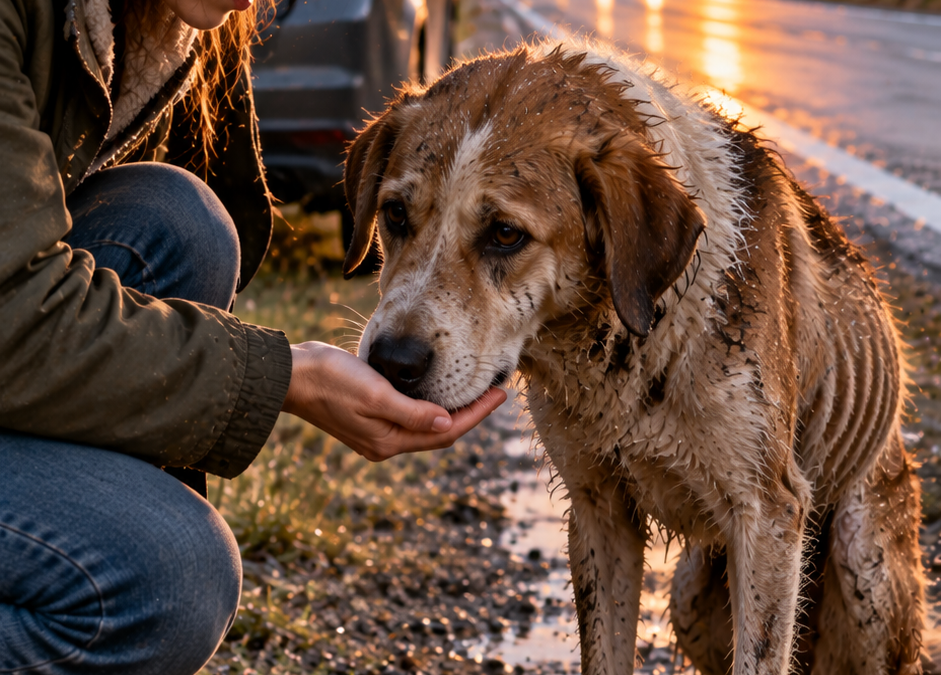
𝗙𝗨𝗟𝗟 𝗦𝗧𝗢𝗥𝗬
His tail moved once.
Barely.
I looked toward the empty road.
No house nearby.
No person calling.
No collar.
Nothing.
I opened the back door of my car.
The dog stared at it.
“Can you get in?”
He tried.
His front paws reached the seat.
His back legs failed.
I caught him under the chest.
He made a tiny sound.
Not aggression.
Pain.
“I’m sorry.”
I lifted as gently as I could.
He weighed almost nothing.
That frightened me more than anything else.
At home, James was in the kitchen when I walked in.
He looked up.
Then looked past me.
Then looked at me again.
“Emily.”
“I know.”
“What is that?”
“A dog.”
“I can see it’s a dog.”
Our nine-year-old son, Thomas, appeared from the hallway.
Then Lily, six years old, came running after him.
“Oh my gosh!”
“Stay back.”
My voice came out sharper than I meant.
Both children froze.
The dog stood behind my legs.
“It’s okay,” I said more gently. “He’s scared and very weak.”
Lily crouched immediately.
“Is he ours?”
“No.”
James answered before I could.
I gave him a look.
He crossed his arms.
“Emily.”
“I found him beside the road.”
“Did you call anyone?”
“Not yet.”
“Vet?”
“That was my next step.”
“Animal services?”
“James.”
“I’m asking.”
“I know.”
He looked at the dog more closely.
His expression changed.
“Oh.”
That was when he saw the ribs.
The hips.
The condition of the fur.
The dog took one shaky step toward the kitchen and sat.
Lily’s hands flew to her mouth.
“He’s so skinny.”
“I know.”
“Is he dying?”
That question nearly broke me.
“I don’t know.”
James exhaled.
“Okay.”
He was quiet for a moment.
“Let’s get him water.”
We called a nearby veterinary clinic.
They couldn’t see us until the next morning unless it was an immediate emergency, but they gave me instructions.
Small amounts of water.
Small meals.
Nothing heavy.
Keep him warm.
Monitor breathing.
If he collapsed, vomited repeatedly, or became unresponsive, go to emergency care.
I boiled chicken and rice.
When I placed the bowl down, the dog approached so quickly that I had to pull it back.
“Slow.”
He stared at the food.
His entire body trembled.
The desperation in his eyes made me want to put the whole pot down and let him eat until there was nothing left.
But the vet had warned me.
Small portions.
I fed him a little.
He swallowed almost without chewing.
Then another small portion.
Then water.
James brought out an old blanket.
We made a bed in the corner of the living room.
The dog walked over.
Circled once.
Lay down.
Within thirty seconds, he was asleep.
Deeply asleep.
The kind of sleep that looks almost like surrender.
The children sat near him.
Not touching.
Just watching.
Lily whispered, “Can I read him something?”
I almost laughed.
“Quietly.”
She brought one of her favorite picture books and sat cross-legged beside the blanket.
Thomas joined her with another book.
For the next hour, they took turns reading to a dog who was too tired to lift his head.
That night, we began calling him Oliver.
The name came from Thomas.
“Because he looks like an Oliver.”
James raised an eyebrow.
“What does an Oliver look like?”
“Like him.”
Apparently that settled it.
I slept badly.
Twice, I got up to check that Oliver was breathing.
Both times, he opened one eye and looked at me.
By morning, his tail moved when I entered the room.
At the veterinarian, we learned what we already suspected.
Malnutrition.
Dehydration.
Minor skin irritation.
Old marks around his neck consistent with a collar or chain.
No fresh major injuries.
No obvious fracture.
The veterinarian scanned him for a microchip.
Nothing.
“Someone had this dog,” she said.
“How can you tell?”
She touched the fur around his neck.
“He isn’t feral.”
“He knows people.”
“He knows doors.”
“He let you handle him.”
She examined his teeth.
“He’s probably four or five.”
“Was he neglected?”
She paused.
“I can tell you he’s underweight.”
“Significantly.”
“Could that happen from being lost?”
“Yes.”
“For how long?”
“Depends.”
That answer bothered me.
I wanted certainty.
I wanted the veterinarian to say someone had obviously abused him.
Then I would know exactly how to feel.
But life rarely gives us the moral clarity we think we want.
“Report that you found him,” she advised.
“Shelters, local animal services, online lost-pet notices.”
“If someone owns him, they may be looking.”
I nodded.
I did all of it.
Called local shelters.
Filed a found-animal notice.
Checked missing-dog pages.
Posted a vague description without identifying details so that anyone claiming him would need proof.
Nothing.
Day one passed.
Then day two.
Oliver ate carefully.
Slept constantly.
Followed me from room to room.
He became especially attached to Lily.
She would sit beside him and tell him stories that made no sense.
He listened like a professor.
Thomas made him a cardboard sign that said:
OLIVER’S CORNER
James pretended not to become attached.
This was obvious because he became the person most concerned with the dog’s feeding schedule.
“Don’t give him too much.”
“I know.”
“The vet said small meals.”
“James, I was there.”
“I’m just saying.”
That evening, I found him kneeling beside Oliver, scratching behind his ear.
I stood in the doorway.
James looked up.
“Temporary.”
“Of course.”
“Just until he’s stronger.”
“Absolutely.”
Oliver rolled onto his side.
James continued scratching.
“Very temporary.”
On the third day, Lily brought him a tennis ball.
Oliver stared at it.
Then at her.
She rolled it.
The ball moved two feet.
For a moment, nothing happened.
Then Oliver stood.
He walked after it.
Picked it up.
And his tail wagged.
Not once.
Not weakly.
A real wag.
Lily screamed.
“He did it!”
Oliver startled.
She covered her mouth.
“Sorry.”
Then she whispered with the intensity of a stage actor.
“He wagged his tail.”
I laughed.
Thomas came running.
James stood at the kitchen entrance.
All four of us watched Oliver hold the tennis ball as if he had just performed surgery.
That was when I allowed myself to believe he would be all right.
I made a mistake that afternoon.
I imagined the story had reached its happy middle.
A starving dog found on the road.
A family.
Food.
Warmth.
Recovery.
Maybe eventually adoption.
Maybe ours.
I forgot that stories are easiest when nobody contests who the victim is.
The doorbell rang just after nine the next morning.
I was still in my robe.
James was preparing coffee.
Thomas and Lily were eating cereal.
Oliver was asleep near Lily’s chair.
I opened the door.
Three people stood outside.
Two men and one woman.
Uniforms.
Badges.
Official vehicle at the curb.
The man in front appeared to be in his forties or early fifties.
His expression was serious but not hostile.
“Mrs. Emily Hartley?”
“Yes?”
He showed identification.
“Jonathan Cole. Special Animal Protection Service.”
I looked at the others.
The young woman beside him introduced herself as Hannah.
The third officer gave his name, though I barely registered it.
Something in my stomach tightened.
“Is this about the dog?”
Jonathan looked at the paperwork in his hand.
“We received a complaint concerning a dog believed to be currently inside this residence.”
James had come up behind me.
“What kind of complaint?”
Jonathan looked at us both.
“An allegation that the dog belongs to another individual.”
I stared.
“Yes, maybe. I found him.”
Jonathan continued.
“The complainant alleges that the dog was taken.”
I almost laughed.
Not because it was funny.
Because the statement was so absurd my brain rejected it.
“Taken?”
“From her possession.”
“What are you saying?”
Hannah spoke more gently.
“Mrs. Hartley, the allegation is that you are unlawfully keeping someone else’s dog.”
I felt heat rush into my face.
“You’re accusing me of stealing a dog?”
“We are investigating a complaint.”
“I found him on the side of a road.”
Jonathan’s tone remained calm.
“We understand that is your account.”
“My account?”
James put one hand on my shoulder.
“Emily.”
I shook him off without meaning to.
“No. I want to understand this.”
I pointed toward the road.
“Three days ago, that dog could barely stand.”
“He was skin and bone.”
“I took him to a vet.”
“I reported him found.”
“I called shelters.”
“And now somebody says I stole him?”
Jonathan’s expression shifted slightly.
Not disbelief.
Concern.
“We need to verify ownership.”
Behind me, Lily said, “Mom?”
I turned.
She was standing near the kitchen entrance holding Oliver around the neck.
He looked sleepy.
Safe.
For one second, I saw the whole situation through her eyes.
Strangers in uniforms.
Her mother angry.
A dog she had spent three days nursing back to life.
I lowered my voice.
“It’s okay.”
Jonathan looked toward Oliver.
His posture changed.
Oliver’s head lifted.
Then he stood.
His ears went forward.
Before anyone could stop him, he slipped from Lily’s arms.
“Oliver.”
He ran toward the door.
Straight at Jonathan.
I froze.
For one terrible second, I thought he might be aggressive.
Instead, Oliver began jumping around Jonathan’s legs.
Tail whipping.
Whole body moving.
He made a happy whining sound.
Jonathan stepped back in surprise.
“Well.”
My heart dropped.
James went still beside me.
Hannah looked at Oliver.
Then at Jonathan.
“You know him?”
Jonathan crouched.
Oliver pushed his face into his hands.
“I’ve seen him.”
The words hit me like ice water.
“What does that mean?”
Jonathan stood.
“It means this dog has been involved in previous reports.”
“Previous reports?”
He glanced at Hannah.
She opened the folder.
“We believe his previous name may have been Buddy.”
Oliver ignored the name completely.
“He was associated with an address outside the city.”
I looked down at him.
“Then why did you say I stole him?”
Hannah hesitated.
“Because the woman at that address filed a complaint.”
“Against me personally?”
“She obtained your information through the found-dog notice.”
That explained the timing.
I wished it didn’t.
Jonathan said, “The complainant is Margaret Bennett.”
“She described the dog in detail.”
“Brown-and-cream coat.”
“White marking on the neck.”
“Approximate age and size.”
I crossed my arms.
“That proves she has seen him.”
“It doesn’t prove I stole him.”
“No,” Jonathan said.
“It doesn’t.”
His tone had changed.
That mattered.
I looked at Oliver.
He was sitting beside Jonathan as though greeting someone from his past.
“You’ve met him before.”
Jonathan nodded.
“Two years ago.”
“Why?”
Another silence.
I felt the answer before he gave it.
“Animal welfare check.”
James spoke.
“What kind of check?”
Jonathan chose his words carefully.
“There had been concerns about dogs at Ms. Bennett’s property.”
My anger became something colder.
“What concerns?”
“We can’t discuss everything from prior investigations.”
“Then tell me what you can.”
Hannah closed the folder slightly.
“Insufficient food.”
My stomach turned.
“Water?”
“At times.”
“Shelter?”
“Minimal.”
I looked at Oliver’s ribs.
The old marks around his neck.
The way he had sat beside the road as though waiting to die.
“Why did she still have dogs?”
Jonathan’s jaw tightened.
“Because suspicion and evidence are not the same thing.”
I hated the answer.
Maybe because I understood it.
Documentation matters.
Proof matters.
Due process matters.
But standing there with Oliver’s thin body against my leg, law felt unbearably slow.
Jonathan continued.
“Mrs. Hartley, we need to take Oliver temporarily.”
Lily screamed.
“No.”
She ran to the dog.
“No, he’s ours.”
I crouched.
“Lily.”
“No.”
She wrapped both arms around Oliver.
“He was dying.”
Hannah’s face softened.
“I know, sweetheart.”
“You can’t take him back there.”
“We’re not.”
Lily looked at her.
“Promise?”
Hannah nodded.
“He is not going directly to anyone.”
Jonathan said, “He will be placed at our temporary care facility while ownership and welfare concerns are investigated.”
I stood.
“I can keep him here.”
“Not while there is a disputed ownership claim.”
“Why not?”
“Because we’re required to control access to the animal until the complaint is resolved.”
“He trusts us.”
“I can see that.”
“Then leave him.”
“I can’t.”
That simple sentence made me furious.
For three days, I had been the one waking up at night.
Feeding him.
Cleaning him.
Taking him to the vet.
Watching my children fall in love with him.
Now people who had not seen him sitting at the edge of death were telling me procedure mattered more.
James touched my arm.
“Emily.”
I looked at him.
His expression said what I did not want to hear.
Don’t make this worse.
I knelt beside Oliver.
He licked my chin.
My vision blurred.
“I’ll come get you.”
Lily was sobbing.
Thomas stood against the wall, trying not to cry because he was nine and had recently decided nine-year-old boys should control these things.
I looked at him.
He looked away.
That hurt even more.
Jonathan clipped a leash to Oliver.
Oliver resisted immediately.
Not violently.
He planted his feet.
Looked at me.
“Go.”
I hated myself for saying it.
“Go with him.”
Oliver took one step.
Then another.
At the vehicle, he looked back.
Lily called his name.
His tail moved.
Then the door closed.
Our house felt empty before the vehicle reached the corner.
Lily didn’t speak to me for twenty minutes.
When she finally did, she asked, “Why did you let them take him?”
There are questions children ask that expose every weakness in adult explanations.
“Because I had to.”
“Why?”
“Because somebody says he’s theirs.”
“But he’s not.”
“We don’t know that legally.”
“What does legally mean?”
I closed my eyes.
“It means there are rules for figuring out who he belongs to.”
Lily’s face crumpled.
“He belongs where people feed him.”
I had no answer.
That evening, nobody ate much.
Oliver’s blanket remained in the corner.
His bowl beside it.
The tennis ball under the table.
James found me standing there after the children were asleep.
“You okay?”
“No.”
“Neither am I.”
I looked at him.
“You were supposed to be the one who didn’t want the dog.”
“I didn’t want a dog.”
“And?”
He glanced at the empty blanket.
“I wanted that one.”
I started crying.
James pulled me against him.
“What if they give him back?”
“They won’t.”
“You don’t know that.”
“No.”
He held me tighter.
“But we’re going to find out everything we can.”
The next three days were some of the longest I can remember.
I went to the animal protection center every day.
The first visit, Oliver nearly knocked over the kennel gate when he saw me.
“Easy.”
I knelt outside.
He pressed his body against the bars.
I pushed my fingers through.
“Hi.”
His tail beat against the floor.
Jonathan approached.
“He likes you.”
“He knows who feeds him.”
Jonathan almost smiled.
Then his face became serious again.
“We looked into Margaret Bennett.”
“And?”
“She has reported four dogs missing in roughly ten years.”
I stared.
“Four?”
“Yes.”
“All stolen?”
“According to her.”
“Were any ever found?”
“One.”
“What condition?”
Jonathan didn’t answer immediately.
That told me enough.
“Poor.”
My stomach tightened.
Hannah came over carrying a folder.
“Mrs. Bennett claims all of the dogs escaped or were taken.”
“Any proof?”
“No direct proof.”
“What about Oliver?”
“She can establish prior possession.”
That phrase bothered me.
“Possession.”
Not care.
Not love.
Possession.
“Does she have vet records?”
“Very limited.”
“Photos?”
“A few.”
“Chip?”
“No.”
“Training records?”
“No.”
“Food receipts?”
“Nothing useful.”
“Then how can she claim him?”
Jonathan sighed.
“Because knowing a dog and owning a dog are not always documented the way people assume.”
I looked at Oliver.
“Can I ask something?”
“Sure.”
“You’ve seen him around her.”
“Yes.”
“Does he act happy to see her?”
Jonathan paused.
“That’s not legally decisive.”
“I didn’t ask if it was legally decisive.”
He looked at me.
“No.”
The answer gave me hope.
Maybe too much.
He continued.
“But dogs can react unpredictably.”
“So what?”
“So we build cases from more than emotion.”
I knew he was right.
I hated that he was right.
That night, I kept replaying everything.
Margaret knew the markings.
Jonathan knew the dog.
So she had possessed him.
But something didn’t fit.
If Oliver had been loved and lost, why had he looked like that?
Why hadn’t he been chipped?
Why had four dogs disappeared from the same woman?
Why did animal services already know her address?
The next afternoon, I sat beside Oliver’s enclosure while Hannah updated paperwork nearby.
I watched Oliver.
He watched me.
Then I had an idea.
“If she says she owns him…”
Hannah looked up.
“Yes?”
“Then she should know him.”
“She does know his appearance.”
“No.”
I shook my head.
“Not his appearance.”
“Him.”
Jonathan walked over.
“What are you suggesting?”
“If she’s lived with him, she should know what he responds to.”
“His commands.”
“His habits.”
“His food.”
“What he does when he’s nervous.”
“What he does before he eats.”
“Where he likes to be scratched.”
“What words make his ears go up.”
Jonathan listened.
I continued.
“Ask her to interact with him.”
Hannah looked interested.
Jonathan was cautious.
“This isn’t a legal ownership test.”
“I know.”
“But you’ve already told me the case isn’t only about ownership.”
“There are welfare concerns too.”
He nodded slowly.
“If he lived with her for years, she should know something beyond the color of his fur.”
Jonathan looked through the glass toward Oliver.
Then back at me.
“Maybe.”
The meeting was arranged the next day.
I barely slept.
James wanted to come.
I told him to stay with the children.
“If she’s lying, I don’t want Lily seeing it.”
“If she’s not lying?”
I looked at him.
“I don’t know.”
That frightened me more.
What if Margaret walked in and Oliver exploded with joy?
What if he had been deeply loved and somehow simply escaped for weeks?
What if I had built an entire story around his condition because I wanted to believe I had saved him?
What if rescuing him meant returning him?
I hated myself for even thinking it.
But caring about an animal means sometimes asking whether your own desire is actually what is best for them.
The center had a large evaluation room.
Bare floor.
Chairs along the wall.
A water bowl.
Two doors.
Oliver was brought in first.
He ran to me.
I crouched.
“Hi.”
He leaned against my chest.
My heart pounded.
Then the door opened.
Margaret Bennett entered.
She was older than I expected.
Late sixties, perhaps.
Gray-blond hair arranged carefully.
An elegant coat.
Leather bag.
Clean shoes.
Nothing about her appearance fit the picture I had built in my head.
That unsettled me.
I had imagined someone obviously neglectful.
Life is easier when bad behavior comes dressed like a warning.
Margaret looked at Jonathan.
Not Oliver.
“Can we finish this quickly?”
Her voice was clipped.
Jonathan gestured toward the dog.
“Ms. Bennett, please identify him.”
She barely glanced down.
“That’s Buddy.”
Oliver’s ears moved.
Nothing else.
“What name did you say?”
I asked.
She looked at me as though noticing me for the first time.
“Buddy.”
I looked at Oliver.
No reaction.
Margaret frowned.
“Buddy.”
Still nothing.
She slapped her thigh.
“Come.”
Oliver looked at me.
Then back at her.
He remained seated.
Margaret’s mouth tightened.
“He always was stubborn.”
Jonathan asked, “What commands does he know?”
“Normal ones.”
“Which?”
“Sit.”
“Stay.”
“Come.”
Margaret pointed.
“Buddy, come.”
Oliver stared.
“Come.”
Nothing.
She raised her voice.
“Buddy!”
Oliver flinched.
I saw it.
So did Hannah.
His ears went back.
His body lowered slightly.
My stomach twisted.
Margaret stepped closer.
“Come here.”
Oliver stood.
For half a second, I thought he was going to her.
Instead, he walked behind me.
I felt his shoulder press against my legs.
Margaret’s face reddened.
“This is ridiculous.”
Jonathan remained neutral.
“What food did you use?”
“What?”
“What did he eat?”
“Dog food.”
“What brand?”
She waved one hand.
“Whatever was available.”
“How much per day?”
“I don’t measure every bite.”
“When did he last see a veterinarian?”
“I don’t remember.”
“Any medical condition?”
“No.”
“Any allergies?”
“No.”
“How long did you own him?”
“Years.”
“How many?”
She paused.
“Three or four.”
“Where did you get him?”
“A friend.”
“Name?”
“Why does that matter?”
Jonathan’s voice hardened slightly.
“We are verifying your claim.”
Margaret’s irritation grew.
“This animal was mine.”
I finally spoke.
“When I found him, he could barely stand.”
She looked at me.
“That’s not my fault.”
“His ribs were visible.”
“He ran away.”
“For how long?”
“I don’t know.”
“Three days?”
“Weeks?”
“Months?”
“I said I don’t know.”
“You reported him stolen three days ago.”
Her eyes narrowed.
“Yes.”
“When did he disappear?”
Silence.
Jonathan looked at her.
“Ms. Bennett?”
She adjusted her bag.
“A few weeks ago.”
“How many?”
“I don’t remember.”
Hannah was writing.
I watched Margaret’s face.
There was annoyance.
Not grief.
Not relief.
Not recognition.
Maybe I was biased.
Of course I was.
But if someone had found Benji after he disappeared from my life, I would have been on the floor with him.
Margaret had not touched Oliver once.
Jonathan said, “Show us how you usually interacted.”
Margaret laughed sharply.
“He’s a dog.”
No one responded.
She looked around the room.
“What exactly do you want?”
“Call him in the way you normally called him.”
“I already did.”
“Show us where he likes to be touched.”
Her face hardened.
“This is absurd.”
“Ms. Bennett—”
“I have paperwork proving he was at my property.”
“That establishes possession.”
Jonathan’s tone changed.
“It does not resolve welfare concerns.”
She stared at him.
“What welfare concerns?”
“The dog’s physical condition.”
“He ran away.”
“His prior records.”
“What prior records?”
“The previous inspections at your residence.”
For the first time, Margaret’s confidence cracked.
“Those were closed.”
“Those specific complaints were closed.”
Jonathan corrected her.
“That does not erase them.”
Margaret looked at me.
I saw anger.
Real anger.
“This woman took my dog.”
“I picked him up off a highway.”
“You should have called authorities.”
“I did.”
“You took him home first.”
“Because he was collapsing.”
“You had no right.”
Something inside me snapped.
“No right?”
I stepped toward her.
Jonathan raised one hand.
“Mrs. Hartley.”
I stopped.
But I couldn’t stay silent.
“He was starving.”
Margaret laughed.
“You don’t know anything.”
“Then explain it.”
“I don’t owe you—”
“Explain why a dog you supposedly loved looked like he had been forgotten for months.”
Her face flushed.
“He was difficult.”
Oliver moved closer against me.
“What does that mean?”
“He wouldn’t eat properly.”
Hannah looked up.
“Medical evaluation found normal appetite after controlled refeeding.”
Margaret’s eyes shifted.
“Then he was doing it for attention.”
That sentence silenced the room.
Even she seemed to realize too late how it sounded.
Jonathan spoke quietly.
“A dog starved himself for attention?”
Margaret grabbed her bag.
“I’ve had enough.”
“Ms. Bennett, we are not finished.”
“I am.”
She looked down at Oliver.
For the first time, she addressed him directly without commanding him.
“You stupid dog.”
Oliver lowered his head.
My entire body went cold.
Margaret pointed toward him.
“Keep him.”
We all stared.
“What?”
I whispered.
“Keep him.”
Her voice was full of disgust.
“If he wants to stay with strangers, let him.”
Jonathan stepped forward.
“Ms. Bennett, are you voluntarily relinquishing your claim?”
She laughed bitterly.
“Yes.”
“Put it in writing.”
“Fine.”
She signed.
Quickly.
Without reading much.
Without touching Oliver.
Without kneeling.
Without saying goodbye.
Then she picked up her expensive bag and walked out.
The door closed.
The room went silent.
I looked at Oliver.
He was staring at the door.
My heart hurt.
Because even unwanted dogs understand leaving.
I crouched.
He looked at me.
“Hey.”
His body leaned forward.
I wrapped both arms around him.
“You don’t have to go back.”
He exhaled.
A long, deep breath.
Then lay against me.
Hannah turned away and wiped her eyes.
Jonathan was still looking at the signed form.
Finally, he put it down.
“Mrs. Hartley.”
I looked up.
“Yes?”
“The ownership complaint is resolved.”
I couldn’t speak.
He continued.
“We will also be filing a formal welfare report based on the dog’s condition and the history associated with Ms. Bennett.”
“Does that mean…”
My voice failed.
Jonathan smiled for the first time since I had met him.
“It means you did not steal this dog.”
Hannah opened the enclosure gate.
“And if you still want him…”
I stared at her.
“Still?”
She smiled.
“Some people change their minds after four days of government paperwork.”
I laughed.
Then cried at the same time.
“I want him.”
Oliver stood.
Hannah unclipped the center’s lead and handed it to me.
“Then let’s get the adoption transfer completed properly.”
I looked down.
Oliver’s tail had started moving.
“Oliver.”
He looked up immediately.
Jonathan noticed.
“Interesting.”
“What?”
“That name.”
“He responds to it.”
I smiled.
“He chose it.”
“Your son did.”
“Same thing.”
The drive home remains one of my favorite memories.
James brought Lily and Thomas with him to pick us up.
The moment Oliver came through the doors, Lily screamed.
“OLIVER!”
He ran.
She dropped to her knees.
Oliver launched himself into her arms.
Thomas tried to act older.
He failed.
He wrapped his arms around both of them.
James looked at me.
“Permanent?”
I held up the paperwork.
“Permanent.”
He shook his head slowly.
“I knew this would happen.”
“You said temporary.”
“I was lying to myself.”
On the ride home, Oliver sat between the children.
His head rested first on Lily’s lap.
Then Thomas’s.
Then back to Lily.
James kept looking at him through the mirror.
At one point he said, “You know you’re not sleeping in our bed.”
I looked at him.
“Who are you talking to?”
“Both of you.”
That night, Oliver slept outside our bedroom door.
The following night, he slept beside the bed.
By the end of the month, James had lost the argument.
Recovery took time.
That part never appears in simple rescue stories.
People like beginnings and endings.
Starving dog found.
Dog becomes healthy.
Happy family.
But bodies remember deprivation.
So do animals.
Oliver ate too quickly for months.
We bought a slow-feeder bowl.
He guarded food at first.
Not aggressively.
Fearfully.
If someone walked near him while he ate, his whole body tightened.
So we taught the children to give him space.
Then slowly taught Oliver that nobody was going to take his bowl.
We fed him on schedule.
Every day.
Same place.
Same time.
Enough food.
Always enough.
After a while, he stopped checking the bowl after meals.
Then he stopped sleeping beside it.
Then one afternoon, he left half a piece of food and walked away.
I almost cried.
It seems ridiculous until you understand what it means for a formerly starving animal to believe there will be another meal.
He gained weight.
His coat changed completely.
The dull brown became rich.
The cream markings brightened.
The white patch on his neck became almost beautiful.
His eyes changed too.
That mattered most.
The exhaustion disappeared.
Then the fear.
What remained was mischief.
We discovered Oliver was a thief after all.
Socks.
Only socks.
Clean or dirty.
He didn’t discriminate.
Thomas lost one before school.
Lily found three beneath Oliver’s blanket.
James accused him of organized crime.
Oliver looked unrepentant.
He learned the sound of the school bus.
Every afternoon, five minutes before it arrived, he sat at the front window.
The first day Lily saw him waiting, she ran inside shouting, “He knows we’re coming.”
Thomas corrected her.
“He knows you’re coming.”
“I am also coming.”
“You get off first.”
Their argument continued while Oliver ran circles around both.
I stood in the kitchen watching them.
I thought about the day I had found him beside the road.
The same dog.
Same body.
Same heart.
Only now he expected people to return.
That is what safety does.
It teaches the body to expect tomorrow.
About a week after Oliver officially became ours, a package arrived.
No return address I recognized.
Inside was a letter from the animal protection office.
Signed by Jonathan and Hannah.
It thanked our family for cooperating with the investigation and for acting to protect a vulnerable animal.
There was also a small printed certificate.
Kind Heart Recognition
I laughed when I saw it.
James read over my shoulder.
“Very official.”
“It has a seal.”
“Then obviously we frame it.”
I rolled my eyes.
But we did.
Inside the package was something else.
A new microchip registration tag.
Oliver’s number.
Our contact information.
My name listed as registered owner.
I held that little piece of metal longer than I expected.
Owner.
The word felt strange.
I did not think Oliver belonged to me.
Not really.
I thought we belonged to one another in the way families do.
Less possession.
More promise.
That evening, we celebrated.
Not with anything dramatic.
Homemade dinner.
The children made decorations.
Lily drew Oliver wearing a crown.
The crown was enormous.
Under the drawing, she wrote:
KING OLIVER, SAVED DOG
Thomas wrote a poem.
It did not rhyme consistently.
He claimed that was intentional.
James baked dog biscuits after finding a recipe online.
He complained they smelled terrible.
Oliver disagreed.
I sat on the floor with my back against the couch.
Oliver lay at my feet.
Not beside the bowl.
Not near the door.
At my feet.
Relaxed.
Full.
Safe.
I looked at the old children’s manuscript on my laptop.
The one I had edited on the day I found him.
The sad fox story.
The ending still bothered me.
The fox survived, but the final pages were too bleak.
The author had written that sometimes being alone made an animal stronger.
Maybe.
But I had learned something different.
Sometimes survival is not about becoming strong enough to need no one.
Sometimes survival begins when someone stops.
I opened the file.
I didn’t rewrite the author’s story, of course.
Editors aren’t supposed to do that.
But I wrote a note.
What if the emotional resolution is not that he learns to live alone, but that he learns he is allowed to trust again?
Then I looked at Oliver.
His eyes were half closed.
Lily was brushing his fur.
Thomas was arguing with James about whether dogs could understand poetry.
For the first time since I found him, I allowed myself to think about the road not as the beginning of his suffering, but as the end of it.
I still thought about Margaret Bennett.
More often than I wanted.
Part of me hated her.
That was easy.
Then another part of me wondered what kind of person looks at a hungry dog and sees inconvenience.
What happened inside someone before compassion disappears?
I never learned.
Maybe there was no satisfying explanation.
Some people neglect animals because they are overwhelmed.
Some because they lack resources.
Some because they are ignorant.
Some because control matters more to them than care.
Whatever Margaret’s reasons were, they did not change Oliver’s experience.
That distinction mattered.
Understanding does not require excusing.
Jonathan later told me that their report would remain part of the agency’s record and could affect future decisions involving animals in her care.
I hoped that meant no other dog would sit beside an empty bowl in her yard.
I couldn’t control that.
What I could control was Oliver’s next meal.
His next walk.
His next year.
The children asked difficult questions.
Lily asked, “Why would someone not feed their dog?”
I said, “Sometimes people fail the animals they’re supposed to protect.”
“Why?”
“I don’t know.”
“Was she bad?”
I hesitated.
Children want categories.
Good person.
Bad person.
Good dog.
Bad dog.
Stories encourage that because clarity is comforting.
Real life is harder.
“I think what she did was wrong.”
Lily accepted that.
Thomas asked, “If she hadn’t given him up, would they have sent him back?”
That question hurt.
“I don’t know.”
“But maybe?”
“Maybe.”
He frowned.
“That’s stupid.”
James looked at me.
I said, “Rules can be imperfect.”
“Then fix them.”
Nine-year-olds have a ruthless relationship with bureaucracy.
“People try.”
Thomas looked at Oliver.
“They should try faster.”
I couldn’t argue.
Months passed.
Oliver became a different dog.
Or perhaps he became the dog he had always been before fear took over.
He loved car rides, which surprised me after the way I found him.
He sat upright in the back seat and watched everything.
He hated rain.
He loved cheese.
He was terrified of garden hoses.
That told us something we didn’t want to know.
He slept badly during storms.
He would pace from room to room until one of us sat with him.
He did not like raised voices.
The first time James and I argued loudly in the kitchen, Oliver crawled beneath the table.
We stopped immediately.
Not because couples should never argue.
Because we suddenly understood what our volume meant to him.
After that, Oliver taught us to disagree more carefully.
James joked that the dog had improved our marriage.
I told him therapy would have been cheaper.
He disagreed.
Oliver’s veterinary bills were impressive.
But I never regretted them.
Not once.
One year after I found him, I drove that same road again.
I hadn’t planned it.
A work meeting took me outside the city.
On the way back, I recognized the curve.
The shoulder.
The stretch of asphalt.
My hands tightened on the wheel.
For months, I had imagined that day from Oliver’s perspective.
Had someone left him there?
Had he escaped?
Had he walked for days?
Had he waited for cars?
Had people passed him?
How many?
I pulled over.
Same place.
I got out.
There was nothing remarkable there.
Grass.
Gravel.
Road.
No marker explaining that a life had changed.
That’s the thing about important places.
Most of them look ordinary to everyone else.
I stood there for several minutes.
Then I heard movement inside the car.
Oliver had come with me.
His head appeared at the window.
I opened the door.
He jumped down.
For one second, I regretted it.
What if he remembered?
His body stiffened.
He sniffed the air.
Walked several feet.
Stopped.
I watched carefully.
“Oliver?”
He looked at me.
Then walked back.
No fear.
No trembling.
He pressed against my leg.
I placed my hand on his head.
“This is where I found you.”
His tail moved.
“I almost kept driving.”
Another wag.
“I know.”
I crouched.
“Terrible decision.”
He licked my face.
I laughed.
“Okay.”
“Good talk.”
We drove home.
That evening, he waited at the school bus window.
Lily came in carrying a drawing.
Thomas complained about homework.
James burned part of dinner.
Oliver stole a sock.
Ordinary chaos.
I loved every second of it.
Two years after his rescue, Hannah called.
I recognized her voice immediately.
“Is everything okay?”
“Yes.”
She laughed.
“Nothing bad.”
“Sorry.”
“Occupational conditioning.”
She told me the agency was putting together training material for new animal welfare officers.
Cases involving disputed ownership.
Neglect indicators.
Found animals.
She wanted permission to use parts of Oliver’s case anonymously.
“Why?”
“Because it shows something important.”
“What?”
She paused.
“That possession and welfare can conflict.”
“And that people who find animals aren’t always stealing them.”
“And people claiming animals aren’t automatically good caretakers.”
I looked across the room.
Oliver was asleep beside Thomas.
“Use it.”
“Thank you.”
Before hanging up, Hannah asked, “How is he?”
“Fat.”
She laughed.
“Healthy fat?”
“Vet-approved.”
“Good.”
“He’s gray around the muzzle now.”
“Already?”
“Apparently raising children ages dogs.”
“Understandable.”
I smiled.
“He’s happy.”
There was a pause.
“That’s good.”
I knew what she meant.
Not medically good.
Morally good.
Necessary.
Years later, when Lily was old enough to understand more of the story, she asked why Oliver had run to Jonathan that first morning.
I had wondered that too.
At the time, his joyful reaction had terrified me because I thought it proved he belonged to someone else.
Later, Jonathan explained.
He had been one of the officers who visited Margaret’s property during an earlier welfare check.
He had given Oliver treats.
Spent time near him.
Spoken gently.
In a life with very little reliable kindness, Oliver had remembered him.
That realization changed the memory completely.
Oliver had not recognized authority.
He had recognized safety.
Of course he had.
Dogs remember who frightens them.
They also remember who doesn’t.
I started noticing that pattern everywhere.
At the veterinarian, Oliver leaned toward technicians who approached slowly.
At the park, he avoided people who reached too quickly over his head.
He trusted children more than adults.
He always trusted Lily.
Maybe because she never tried to own him.
She simply sat beside him and read.
The first promise our family made to Oliver wasn’t spoken.
It was repetition.
Breakfast comes every morning.
The leash means a walk, not punishment.
Hands touch gently.
People leave and return.
Beds belong to you.
Water bowls stay full.
Food appears again.
No one shouts your old name.
No one calls you worthless.
No one abandons you because you are inconvenient.
That is how trust returned.
Not through one dramatic rescue.
Through hundreds of ordinary days.
I think people underestimate ordinary days.
They are where healing happens.
A rescue is a moment.
Recovery is a routine.
One morning, several years after Oliver came home, I woke before everyone else.
The house was quiet.
I went downstairs.
Oliver was sleeping on the couch.
This was technically forbidden.
Had been forbidden for years.
Nobody enforced it.
His body was older now.
He had gained the soft heaviness of a dog who had never missed a meal in a long time.
I sat beside him.
He opened one eye.
“Don’t get up.”
He didn’t.
I ran my hand over the white patch on his neck.
The mark Margaret had used to identify him.
The mark that had once been evidence of her claim.
I thought about how strange ownership is.
The law needs names.
Records.
Registration.
Proof.
Those things matter.
They protect animals when used well.
But none of them can fully describe relationship.
Margaret knew the color of Oliver’s coat.
She knew his size.
She knew the white mark.
My children knew he hated thunderstorms.
James knew he would refuse medicine unless it was hidden in cheese.
I knew the small sound he made before falling asleep.
Thomas knew exactly where to scratch his chest to make one back leg kick.
Lily knew that when Oliver became anxious, reading aloud calmed him.
Who knew the dog?
That question stayed with me.
Not because I wanted to erase the law.
Because care is also knowledge.
Real care creates intimacy with details.
How someone eats.
Sleeps.
Fears.
Recovers.
What their body does when safe.
Margaret called him Buddy.
Maybe that had once been his name.
Maybe he had known it.
But by the time she called him across that room, it seemed to mean nothing.
When I said Oliver, he looked at me.
Not because the sound itself was magical.
Because everything attached to that sound had changed.
Food.
Warmth.
Children.
A house.
A family.
A future.
Sometimes I think names become meaningful only through what follows them.
“Oliver.”
Dinner.
“Oliver.”
Walk.
“Oliver.”
Come here, you’re safe.
“Oliver.”
We’re home.
That is what he learned.
And perhaps that is what we learned too.
Kindness is rarely a single act.
It is a pattern.
One decision repeated enough times that another living creature begins to trust it.
I still edit children’s books.
I still receive stories about abandoned animals.
Lost children.
Lonely monsters.
Broken toys.
Characters who believe nobody wants them.
Whenever I read those stories now, I pay attention to the ending.
Not whether everything becomes perfect.
Children are smarter than that.
What matters is whether the ending gives the character something they did not have before.
Safety.
Connection.
Agency.
Hope.
A reason to expect tomorrow.
Oliver gave me a better understanding of happy endings.
A happy ending is not the moment the danger stops.
It is the moment someone begins to believe the danger will not return.
There is a difference.
On the day I found him, Oliver climbed into my car because he was too tired to run.
Years later, if I opened the door, he jumped in because he knew where we were going.
Home.
That transformation is the story.
Not the accusation.
Not Margaret.
Not the officers on my porch.
Those were part of it.
But the real story was a dog who had stopped expecting anything learning to expect us.
One Sunday, Lily found the old drawing she had made after Oliver came home.
The one with the crown.
She was older now and embarrassed by the spelling.
“Why did you keep this?”
“Because it’s perfect.”
“It’s terrible.”
“You were six.”
“I gave him purple legs.”
“Artistic choice.”
Oliver was asleep nearby.
She sat beside him.
“Do you remember when they took him?”
“Yes.”
“I thought they were never bringing him back.”
“So did I.”
She became quiet.
“Was I annoying?”
“When?”
“When I cried.”
“No.”
“You looked scared.”
“I was.”
“I thought moms weren’t scared.”
I laughed softly.
“Moms are scared all the time.”
“Really?”
“Constantly.”
“Then how do you know what to do?”
“We don’t.”
She looked suspicious.
“We just do the next thing.”
Her eyes moved to Oliver.
“Like stopping the car?”
“Exactly.”
That answer stayed with me because it was the simplest explanation of what happened.
I did not know the future.
I did not know Margaret Bennett existed.
I did not know officers would knock on my door.
I did not know we would fight to keep the dog.
I did not know the children would fall in love with him.
I didn’t even know whether he would survive.
I knew one thing.
There was a starving dog beside the road.
And I could stop.
So I did.
Everything else came afterward.
People sometimes tell rescue stories as though the rescuer possesses unusual courage.
I didn’t.
I was scared.
Confused.
Angry.
Sometimes selfish.
When animal protection took Oliver, part of my anger came from believing he was already ours after only three days.
That was not completely rational.
But love does not always wait for paperwork.
The courage came later.
Calling.
Showing up.
Asking questions.
Listening when answers frustrated me.
Allowing a process I did not fully trust to continue because there had to be evidence.
Standing in the evaluation room wondering whether Oliver might choose someone else.
Being prepared, at least in theory, to accept the truth if the truth did not favor me.
That was harder than stopping the car.
In the end, Oliver chose the floor beside my feet.
People called it a choice.
I’m careful with that word.
Dogs don’t decide legal ownership.
But he did communicate something.
He told us where he felt safe.
And sometimes safety is the loudest truth an animal has.
Margaret left without looking back.
I still remember that.
For a long time, I was angry on Oliver’s behalf.
Then eventually, the memory became smaller.
She became less important to his story.
Maybe that’s one of the best things about healing.
The person who caused the wound does not have to remain the center of the narrative forever.
Oliver’s life became bigger than what happened before us.
He became the dog who stole socks.
The dog who waited for the bus.
The dog who slept through children’s stories.
The dog who hated rain.
The dog who followed James around the kitchen.
The dog who sat beside me while I edited books late at night.
The dog who had his own Christmas stocking because Thomas insisted.
The dog who once ate half a birthday cake and then looked offended when we took away the other half.
Margaret became a footnote.
Oliver became himself.
That, perhaps, was the greatest victory.
Not proving she was wrong.
Not proving I was right.
Giving him enough good years that the bad years stopped defining him.
One evening, much later, I was working at the dining table.
The children were upstairs.
James was reading.
Oliver lay with his head on my feet.
I was editing another story.
A frightened dog in that one too.
I looked down.
Oliver opened his eyes.
“You’ve really ruined my objectivity.”
His tail moved.
“I can’t edit sad dog stories anymore.”
Another wag.
“Very unprofessional.”
He sighed and closed his eyes.
I smiled.
On my screen, the final paragraph of the manuscript described the dog walking into a new house for the first time.
The author had written:
He did not know whether he was home yet.
I stared at the sentence.
Then at Oliver.
I added a comment for the writer.
Maybe home is not the house. Maybe home is the first place where he finally stops waiting to be sent away.
I read it again.
Then looked at the dog sleeping against my feet.
That was it.
That was the ending I had been trying to understand since the day I found him.
Home was not my address.
Home was what happened inside Oliver when he realized nobody was coming to take his food.
Nobody was going to chain him.
Nobody would call him worthless.
Nobody would leave him on the road.
Even if officials knocked on the door.
Even if someone claimed him.
Even if the past tried to reach back and pull him away.
We would show up.
We would ask questions.
We would fight in every lawful way available.
We would not disappear.
Years have passed since that fourth morning when three officers stood on my porch.
I can still remember Jonathan’s first words.
The document in his hand.
Lily holding Oliver.
James’s hand on my shoulder.
The accusation.
Dog theft.
At the time, I thought that was the worst thing that could happen.
Now, strangely, I am grateful for part of what followed.
Not the fear.
Not Oliver being taken.
But the truth becoming documented.
The previous concerns.
The failed care.
The signed relinquishment.
The microchip.
The record that said, clearly and permanently, that Oliver belonged with us now.
Sometimes love begins emotionally before the world catches up legally.
That week, both did.
The old microchip tag still sits in a small box in my desk.
Oliver doesn’t need it anymore.
I keep it anyway.
Not as proof of ownership.
As proof of a promise.
One day, a dying dog was sitting beside a road.
I stopped.
A few days later, someone tried to turn that act into suspicion.
For a while, I was afraid compassion had made everything worse.
It hadn’t.
Compassion had simply led us into a messier story than I expected.
A story with officers.
Paperwork.
Accusations.
Evidence.
Anger.
A woman who knew Oliver’s markings but not his heart.
And a dog who eventually laid down beside me and answered the only question that mattered to our family.
Are you staying?
Yes.
We stayed.
So did he.
And every peaceful year that followed became another answer.

