𝗙𝗨𝗟𝗟 𝗦𝗧𝗢𝗥𝗬 For Two Weeks, My Adopted German Shepherd Stood at the Same Window With His Back to Me
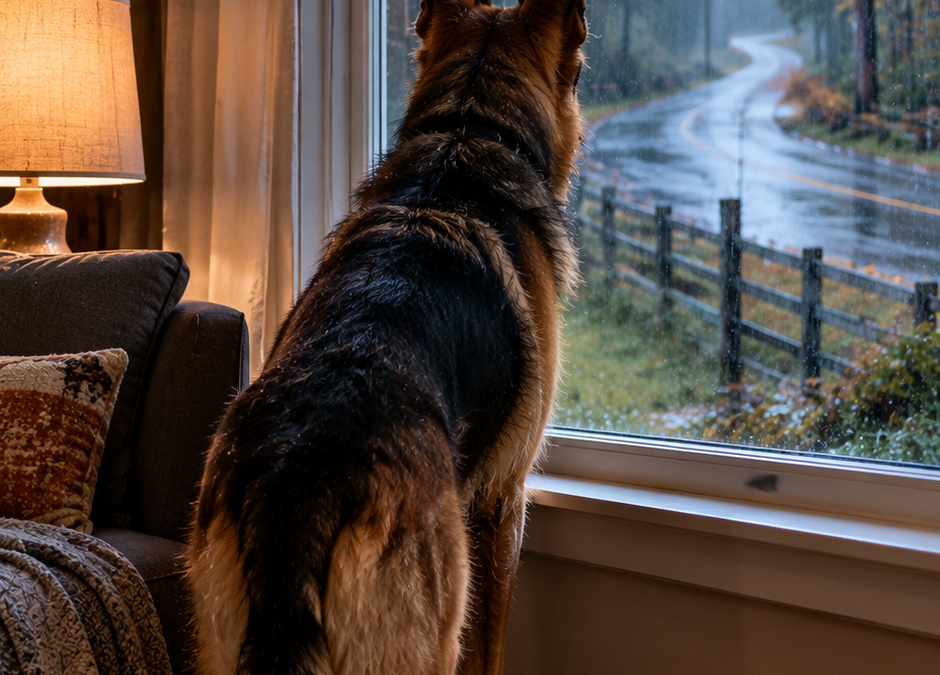
𝗙𝗨𝗟𝗟 𝗦𝗧𝗢𝗥𝗬
She hesitated just enough for me to notice.
“Is something wrong?”
“No.”
Her expression softened.
“He’s just had a difficult time.”
I crouched outside the kennel.
“Bruno?”
His ear moved.
Nothing else.
I waited.
“Hey, handsome.”
Slowly, he lifted his head.
Then he turned.
His eyes met mine.
Brown.
Deep.
Quiet.
There was something in that look that made me forget all the barking around us.
He didn’t look frightened exactly.
He looked tired.
Not physically.
Emotionally.
As if he’d been waiting for something long enough to stop expecting it.
“What happened to him?”
Linda folded her arms.
“He was found tied to a tree.”
My stomach tightened.
“How long?”
“At least three days.”
“What?”
“Someone spotted him from the road.”
“Without food?”
“Without much of anything.”
I looked at Bruno.
“Who does that?”
Linda sighed.
“We know who his owner was.”
That surprised me.
“You do?”
“His chip was registered.”
“And?”
“We contacted the man.”
“What did he say?”
Linda’s mouth hardened.
“He’d moved.”
I stared at her.
“Moved?”
“To an apartment in the city. Said he couldn’t take Bruno.”
“So he tied him to a tree?”
“That’s what it looks like.”
I felt anger rise immediately.
“Why didn’t he bring him here?”
“I wish I could answer that.”
“Did Bruno know him long?”
“Most of his life.”
I looked back through the kennel.
Bruno was watching me now.
Linda lowered her voice.
“He loved that man.”
“After what he did?”
“Dogs don’t always stop loving someone just because the person stopped deserving it.”
That sentence stayed with me.
I reached my fingers toward the metal gate.
Bruno didn’t approach.
“It’s okay.”
I didn’t know whether I was speaking to him or myself.
“I’m not going to make you do anything.”
I sat there.
Linda gave me several minutes.
Eventually, Bruno stood.
He walked forward slowly.
Stopped halfway.
Then came closer.
His nose touched the air.
He sniffed my hand through the gate.
I didn’t move.
After several seconds, he lowered his head slightly.
I touched the fur between his ears.
His eyes closed.
Only for a moment.
But that was enough.
Something in me shifted.
“I think I want him.”
Linda smiled.
“Meet him outside first.”
We did.
Bruno didn’t play.
He didn’t jump.
He walked beside me around a fenced yard.
Sometimes he looked at me.
Mostly he watched everything else.
Birds.
Trees.
The shelter entrance.
Cars pulling into the parking lot.
Every time a car door closed, his ears lifted.
I noticed.
“What is he doing?”
Linda followed my gaze.
“Watching.”
“For his old owner?”
“Maybe.”
“Does he still expect him?”
Linda was quiet.
“Sometimes hope takes longer to disappear than trust.”
I almost changed my mind then.
Not because I didn’t want Bruno.
Because I suddenly understood that adopting him wasn’t going to mean bringing home a happy dog who instantly loved us.
He came with history.
Loss.
Habits I didn’t understand.
Expectations formed before I existed.
Could I handle that?
Then Bruno walked toward me.
Without being called.
He stopped beside my leg.
Not touching me.
Just standing there.
I looked at Linda.
She smiled.
“He doesn’t do that with everybody.”
I signed the papers.
Two mornings later, I brought Bruno home.
The day was cold but bright.
Michael had bought bowls, a bed, toys, food, and enough treats to feed a dog for six months.
When I opened the car door, Bruno hesitated.
“Come on.”
He looked at the house.
Then at me.
“This is home.”
The word felt too big.
I wondered whether I had the right to use it yet.
He stepped out.
Inside, Bruno moved room by room.
Slowly.
Carefully.
He sniffed the kitchen.
The hallway.
The stairs.
The couch.
The back door.
Then he entered the living room.
A fire burned in the fireplace.
Bruno stood in front of it.
Turned twice.
Lay down.
Then released the deepest sigh I’d ever heard.
Michael laughed.
“Well.”
“What?”
“I think he approves.”
I sat on the floor near Bruno.
“Do you?”
His eyes opened.
His tail tapped once against the rug.
I smiled.
For the first week, everything seemed almost too easy.
Bruno followed me everywhere.
When I went to the kitchen, he came.
When I worked, he lay near my desk.
When I took laundry upstairs, he followed.
He didn’t like being left in a room alone.
That made sense.
After what had happened, I didn’t mind.
Actually, I liked it.
The house no longer felt empty.
I started talking to him constantly.
“Do you think this color works?”
Bruno would look up.
“No? Me neither.”
Or:
“We’re ignoring that email until after lunch.”
Tail tap.
“Exactly.”
At noon, we walked near the forest.
He was strong but gentle.
He never pulled hard.
He seemed happiest beneath the trees.
Sometimes he stopped and lifted his nose into the wind.
I wondered what memories lived inside smells I couldn’t detect.
At night, he lay near the couch while Michael and I watched television.
By the fourth night, Bruno rested his head on my knee.
I nearly cried.
Michael noticed.
“Don’t move.”
“I’m not moving.”
“If your leg dies, that’s your problem.”
“I know.”
Twenty minutes later, my foot was numb.
I didn’t care.
“You see?” Michael whispered.
“What?”
“He picked you.”
I looked down at Bruno.
His eyes were closed.
For the first time, I allowed myself to believe Michael was right.
Then, almost exactly two weeks after the adoption, everything changed.
I woke around seven.
Michael had already left.
Usually Bruno was near my bedroom door.
Not that morning.
“Bruno?”
Nothing.
I went downstairs.
He wasn’t in the kitchen.
Then I entered the living room.
There he was.
Standing at the large front window.
His back was turned to me.
His legs were slightly apart.
Head lifted.
Eyes fixed on the road outside.
“Bruno?”
One ear moved backward.
He didn’t turn.
I walked closer.
“What are you looking at?”
Nothing obvious was outside.
The road was empty.
The forest beyond it was still.
Maybe he’d seen a deer.
I touched his shoulder.
He glanced at me.
Then returned his attention to the window.
“Okay.”
I went to make coffee.
Twenty minutes later, he was still there.
“Breakfast.”
That worked.
Bruno immediately left the window and followed me.
He ate normally.
Drank.
Then walked back into the living room.
Returned to the exact same place.
I laughed.
“You’re weird today.”
He stood there for most of the morning.
Around noon, I picked up his leash.
He came immediately.
Our walk seemed normal.
He sniffed trees.
Watched birds.
Urinated on approximately every plant in the county.
Nothing seemed wrong.
But when we came home, he returned to the window.
That was the first day.
The second day, he did it again.
Same window.
Same posture.
Same distant stare.
“Bruno.”
I rolled a tennis ball across the floor.
He looked at it.
Then looked back outside.
“Come on.”
I picked up the ball.
Bounced it.
He came two steps toward me.
Then stopped.
Turned.
Walked back to the glass.
A strange discomfort moved through me.
That evening, I told Michael.
“He’s waiting for something.”
Michael looked toward the living room.
“For what?”
“I don’t know.”
“A rabbit?”
“For eight hours?”
“Persistent rabbit.”
“I’m serious.”
“So am I, mostly.”
I lowered my voice.
“Do you think he misses his old owner?”
Michael looked at Bruno.
The question seemed to bother him too.
“Maybe.”
My stomach tightened.
“What if he’s unhappy here?”
“Emily.”
“What?”
“It’s been two weeks.”
“Exactly.”
“That’s nothing.”
“It doesn’t feel like nothing.”
I looked at Bruno.
“What if the first week was just him being scared? What if now he realizes this isn’t where he wants to be?”
Michael frowned.
“He’s a dog. Not a college student regretting his housing assignment.”
“That’s not funny.”
“I’m not trying to be funny.”
I crossed my arms.
“Maybe I pushed him too quickly.”
“You didn’t push anything.”
“I kept giving him toys. Calling him. Touching him.”
“You’re describing having a dog.”
“A traumatized dog.”
Michael walked over and put a hand on my shoulder.
“Stop turning this into something you did wrong.”
I wanted to believe him.
I couldn’t.
By the third day, my anxiety had grown enough that I called the veterinarian.
They examined Bruno that afternoon.
Heart.
Joints.
Eyes.
Ears.
Bloodwork.
Everything normal.
The vet, Dr. Harris, sat across from me.
“Physically, he’s healthy.”
“Then why is he standing at a window all day?”
She shrugged gently.
“Behavior isn’t always medical.”
“Could he be depressed?”
“Possibly.”
The word frightened me.
“Because of me?”
“I didn’t say that.”
“He was abandoned.”
“Yes.”
“Could he be waiting for the man who left him?”
Dr. Harris considered it.
“Dogs can grieve.”
“So he could be waiting.”
“He could.”
My eyes burned.
“What am I supposed to do?”
“Give him time.”
“How much?”
“There isn’t a schedule.”
“Should I stop him from going to the window?”
“No.”
“What if it makes him worse?”
“Then we reassess.”
She leaned forward.
“Emily, trauma isn’t something you love out of an animal in two weeks.”
I knew she was right.
That didn’t make it easier.
The days continued.
Bruno ate.
Walked.
Slept.
Followed me sometimes.
But every afternoon, he stood at the window.
Watching.
Waiting.
I started studying him.
Was he sad?
His tail rarely moved.
His eyes seemed distant.
His ears shifted occasionally when cars passed.
Every engine made him slightly more alert.
That confirmed my worst fear.
His old owner.
Of course.
Somewhere inside Bruno, perhaps the betrayal hadn’t become real.
Maybe he believed the man would drive up our road.
Open the door.
Call his name.
Take him back.
What could I possibly compete with?
Three years of history?
A familiar voice?
The person Bruno had trusted before someone tied him to a tree and drove away?
Love isn’t rational.
Linda had told me that.
Dogs don’t stop loving someone simply because that person stops deserving it.
By the seventh day, I stopped throwing the ball.
By the eighth, I stopped trying to distract him.
Instead, I sat beside him.
Bruno stood.
I sat on the floor next to his front legs.
“What do you see?”
He didn’t answer, obviously.
“I wish you could tell me.”
His ear moved.
“Do you miss him?”
Nothing.
“I won’t be angry.”
I rested my hand against his shoulder.
“If you love him, you love him.”
My voice trembled.
“You don’t have to pretend for me.”
Bruno glanced down.
Then looked outside.
That hurt more than it should have.
“I just want you to be happy.”
Every day, I talked to him.
Because I didn’t know what else to do.
I told Bruno about Daisy.
I told him about growing up.
My first apartment.
How scared I’d been when I started freelancing.
How Michael proposed in the parking lot of a grocery store because he’d hidden the ring in his coat and became convinced I’d discover it.
I told him things I hadn’t said out loud in years.
Bruno listened with his back to me.
Sometimes an ear shifted toward my voice.
I didn’t notice the importance of that then.
I noticed only that he didn’t turn around.
At night, I cried.
Quietly.
Embarrassed by how deeply the situation affected me.
One night Michael woke and found me staring at the ceiling.
“You’re thinking about Bruno.”
“Yes.”
“He isn’t rejecting you.”
“How do you know?”
“Because he follows you upstairs when you’re crying.”
I turned toward him.
“What?”
“You don’t notice?”
“No.”
“He comes halfway down the hall and lies there.”
I swallowed.
“Then why won’t he look at me during the day?”
“Maybe because whatever he’s doing isn’t about you.”
I closed my eyes.
“What if it is?”
Michael sighed.
“You want certainty from an animal who can’t explain himself.”
“I want him to know this is his home.”
“He will.”
“What if he never does?”
“Then we keep showing him.”
That sounded noble at midnight.
The next afternoon, Bruno stood at the window again.
Day ten.
I sat beside him.
“I don’t know what you want.”
My voice cracked.
For the first time, frustration crept in.
“I’ve tried everything.”
Bruno turned his head slightly.
“I feed you. I walk you. I play with you.”
I hated myself immediately.
Those were the words of someone keeping score.
I lowered my head.
“I’m sorry.”
Bruno’s ear turned toward me.
“I’m not buying your love.”
My eyes filled.
“I know that.”
I wrapped my arms loosely around his chest.
He allowed it.
“I just wish I knew how to reach you.”
His body remained still.
Outside, a truck passed.
Bruno’s head rose.
My heart sank.
“There.”
I whispered.
“You’re waiting for him.”
That belief took root.
After that, every car became evidence.
Bruno lifted his head.
He misses him.
Bruno watched the road.
He wants him back.
Bruno didn’t play.
He’s unhappy.
I stopped interpreting Bruno.
I started interpreting my fear.
There’s a difference.
I just didn’t know it yet.
On the thirteenth night, Michael found me standing in the living room after midnight.
Bruno was asleep near the fireplace.
I was watching him.
“What are you doing?”
“Thinking.”
“That’s dangerous.”
I didn’t smile.
“I want to take him back tomorrow.”
Michael’s expression changed immediately.
“Take him back?”
“To the shelter.”
“No.”
“Not return him.”
He exhaled.
“Okay.”
“I need to talk to Linda.”
“About what?”
“Everything.”
I sat on the couch.
“Maybe they know something about this.”
Michael joined me.
“That makes sense.”
“Maybe he did this there.”
“Maybe.”
“Maybe there’s something in his history she didn’t tell me.”
I looked at Bruno.
“I can’t keep guessing.”
The next morning, I took out the leash.
Bruno came immediately.
That surprised me.
Usually, when I had to put him in the car, he hesitated.
Not that morning.
“Want to go somewhere?”
Tail movement.
Tiny.
But there.
I almost missed it.
The drive to the shelter took thirty-five minutes.
Bruno watched through the window.
As soon as we turned onto the shelter road, his posture changed.
He sat taller.
Ears forward.
Nose working rapidly.
He knew.
“You remember this place.”
I suddenly felt guilty.
What if he thought I was returning him?
“No.”
I reached back.
“We’re not leaving you.”
His eyes met mine in the rearview mirror.
“I’m not doing that.”
At the shelter parking lot, Bruno jumped out eagerly.
His tail rose.
He pulled toward the entrance.
That was the first time I’d seen genuine energy from him in days.
My fear intensified.
He was happier here.
Maybe I’d been right.
Maybe my house had never become home.
Linda saw us immediately.
“Emily!”
Her smile vanished when she saw my face.
“Is something wrong?”
“I don’t know.”
She looked at Bruno.
“He looks good.”
“He is good.”
“Then?”
I told her.
Everything.
The window.
The road.
The stillness.
The ball.
The veterinarian.
My fear that he was waiting for his old owner.
Linda listened without interrupting.
When I finished, she was quiet.
Then something changed in her expression.
Not concern.
Recognition.
“What time?”
I frowned.
“What?”
“What time does Bruno usually go to the window?”
“Around four.”
“Every day?”
“Pretty much.”
Linda smiled.
I didn’t understand.
“Why are you smiling?”
“Come with me.”
She led us down the corridor toward the kennels.
Bruno followed eagerly.
Then Linda opened a side room used by volunteers.
There was a large window overlooking the shelter’s front gate.
She pointed.
“That window.”
I stared.
“What about it?”
“Bruno used to stand there.”
My skin prickled.
“Like at my house?”
“Exactly like that.”
She demonstrated.
“Front paws slightly apart. Head up. Sometimes ears back.”
I stared at Bruno.
“He was waiting for his owner.”
Linda shook her head.
“At first.”
I looked at her.
“What do you mean?”
“When Bruno first arrived, yes. He watched every vehicle.”
Her expression softened.
“He spent days waiting for that man.”
My chest tightened.
“Then why are you smiling?”
“Because after a while, the behavior changed.”
“How?”
“He stopped waiting for his old owner.”
“How do you know?”
“Because I was the person he started waiting for.”
I didn’t understand.
Linda leaned against the wall.
“My shift usually changed around three-thirty. Every afternoon around four, I took Bruno outside.”
I stared at her.
“Every day?”
“Almost.”
“For a walk?”
“Sometimes a walk. Sometimes the yard.”
She smiled.
“We played ball.”
I looked down at Bruno.
His tail moved.
Linda continued.
“He learned my routine.”
“And the window?”
“From there, he could see the parking lot and the side path I used when I arrived.”
I felt something shift inside me.
“But at my house, the window looks toward the road.”
“Okay.”
“He stands there for hours.”
“What happens around four at your house?”
I opened my mouth.
Closed it.
“What do you mean?”
“What are you usually doing?”
“Working.”
“And afterward?”
I thought.
“I finish around four-thirty.”
“Then?”
“I usually…”
I stopped.
Linda waited.
“I go outside.”
“With Bruno?”
“Yes.”
Something cold moved through my chest.
“Usually.”
“What do you do?”
“I throw the ball.”
Linda’s smile grew.
“No.”
I whispered it.
“Emily.”
“No.”
My eyes filled.
“You’re telling me…”
“He’s probably waiting for you.”
I stared at her.
“He has his back to me.”
“Because he’s watching where he expects the activity to start.”
“But I’m behind him.”
“His ears?”
“What?”
“Do they move when you talk?”
I remembered.
Yes.
Every time.
“They turn backward.”
“Tail?”
“Sometimes the tip moves.”
Linda nodded.
“He’s listening to you.”
My throat tightened.
“But why doesn’t he come to me?”
“Maybe because he learned something here.”
“What?”
“That waiting works.”
I looked at Bruno.
He had walked to the shelter window.
He stood there.
Same posture.
The sight nearly stopped my heart.
Linda pointed.
“Watch.”
She walked toward a side door.
Bruno’s ears went back.
Not toward the road.
Toward her.
Linda touched the door handle.
Bruno’s tail moved.
Slowly.
Then faster.
She opened the door.
Bruno spun around.
His whole body changed.
Linda smiled at me.
“He’s not ignoring you.”
I covered my mouth.
“Oh, God.”
“He isn’t shutting you out.”
“I thought…”
“I know.”
“He was waiting for me?”
“That’s what it looks like.”
My eyes burned.
“For two weeks?”
“Emily, you’ve only had him a month.”
I started crying.
Not delicately.
Not the kind where tears simply roll down your face.
The kind where relief collides with shame.
“I kept thinking he wanted that man back.”
Linda approached.
“Part of him may always remember that man.”
“I know.”
“But memory isn’t the same as longing.”
I looked at Bruno.
“He learned a routine with you.”
My voice shook.
“I thought his silence meant he was sad.”
“Maybe sometimes he is.”
Linda crouched beside Bruno.
“But quiet isn’t always sadness.”
I sank to my knees.
“Bruno.”
He turned.
This time, I really looked.
Not at what I feared.
At him.
His ears were slightly backward.
Focused on me.
The tip of his tail moved.
One small sweep.
Then another.
“Come here.”
I whispered it.
Bruno approached.
His head lowered.
I took his face between my hands.
“I’m sorry.”
He licked my cheek.
That destroyed me.
“I’m so sorry.”
I buried my face against his neck.
“I thought you didn’t want me.”
Bruno leaned against me.
Linda knelt nearby.
“He wouldn’t lean like that if he didn’t trust you.”
“I couldn’t read him.”
“You will.”
“What if I get it wrong again?”
“You will.”
I looked up.
She smiled.
“We all do.”
I laughed through tears.
“That’s not comforting.”
“It should be.”
She scratched Bruno’s chest.
“Relationships aren’t built by understanding everything immediately.”
Her eyes met mine.
“They’re built by staying long enough to learn.”
I looked down.
Bruno stared at me.
For the first time, I didn’t see sadness.
Maybe it had never been absent.
Maybe I had simply stopped assuming it was the only thing inside him.
On the drive home, Bruno sat behind me with his head between the front seats.
I touched his nose.
“So.”
He sniffed my hand.
“You’ve been waiting for me.”
Tail thump.
“I’ve been sitting three feet behind you having an emotional collapse.”
Tail thump.
“You’re not even embarrassed.”
He licked my fingers.
I laughed.
When we arrived home, Bruno went inside.
He walked directly into the living room.
Directly to the window.
I stopped.
For one second, old fear returned.
Then I looked properly.
His ears angled backward when I entered.
The tip of his tail moved.
Invitation.
Not rejection.
I understood.
“Wait.”
I moved the armchair away from the window.
Then I sat on the floor.
I placed Bruno’s tennis ball between my knees.
He watched through the glass.
I said nothing.
Eventually, one ear rotated toward me.
Then the other.
I touched the ball.
Bruno turned his head.
“There you are.”
He looked back outside.
I rolled the ball a few inches.
It stopped near his front paw.
He stared at it.
Then at me.
“Your move.”
He lifted one paw.
Touched the ball.
It rolled toward me.
My heart jumped.
“Oh.”
Bruno’s tail moved.
Just once.
I rolled it back.
He stopped it.
Pushed it again.
We did that several times.
No running.
No barking.
Just a giant German Shepherd tapping a tennis ball across my living room floor.
But to me, it felt enormous.
I rolled it farther.
Bruno followed.
I stood.
“Want it?”
His ears lifted.
I tossed the ball toward the hallway.
Bruno looked.
Then at me.
Then ran.
I laughed.
“Go!”
He caught it.
For a moment, he simply stood there holding the ball.
Then he came back.
Dropped it at my feet.
I picked it up.
“Again?”
His tail moved.
Not a tiny movement this time.
A full wag.
Left.
Right.
Left.
I covered my mouth.
“Oh, Bruno.”
I threw the ball.
He ran.
Again.
He came back.
Again.
Faster.
By the fifth throw, he barked.
One sharp, deep sound.
I froze.
Bruno froze too.
Then I laughed.
“You have a voice.”
He barked again.
I sat on the floor.
Bruno came charging toward me.
He pushed his head against my chest hard enough to knock me backward.
I wrapped both arms around him.
“Okay.”
I was laughing and crying at the same time.
“I understand.”
Maybe not everything.
But enough.
That night, Michael came home and found us on the living room rug surrounded by tennis balls.
Bruno’s head rested across my stomach.
“What happened?”
I looked up.
“He wasn’t waiting for his old owner.”
Michael took off his coat.
“What?”
“He was waiting for me.”
I explained everything.
Halfway through, Michael smiled.
“Don’t.”
“What?”
“Say it.”
“Say what?”
“You told me so.”
“I wasn’t going to.”
“You were thinking it.”
“Absolutely.”
I threw a tennis ball at him.
Bruno immediately jumped up and chased it.
Michael caught the ball.
“Traitor.”
Bruno stared.
Michael threw it.
Bruno ran.
“Great.”
I sat up.
“Now there are two of you.”
That night, something else changed.
Usually, Bruno slept beside our bed.
I woke around two in the morning feeling pressure across my chest.
I opened my eyes.
A German Shepherd’s head was resting directly on me.
“Bruno.”
One ear moved.
“You weigh eighty pounds.”
Nothing.
“You’re crushing me.”
Tail movement.
Michael opened one eye.
“Move him.”
“You move him.”
“No chance.”
I looked down.
Bruno’s eyes were closed.
His breathing was slow.
Warm.
Steady.
I placed my hand against his neck.
I didn’t move him.
The next morning, Bruno returned to the window.
For half a second, my stomach tightened automatically.
Then I stopped myself.
I watched.
He wasn’t standing.
He sat.
His ears turned when I entered.
His tail moved.
I walked to the back door.
Bruno immediately turned.
His whole body became alert.
“Want to go out?”
He stood.
I opened the door.
He looked back at me.
For the first time, I saw the expression clearly.
Joy.
Not dramatic.
Not wild.
But unmistakable.
We went outside.
I threw the ball.
Bruno ran beneath the trees.
When he brought it back, he didn’t immediately release it.
“Give.”
He held tighter.
“Oh, now you want to play games.”
I pulled.
He pulled harder.
“You’re impossible.”
His tail flew back and forth.
I laughed.
That afternoon, around four, I deliberately stayed at my desk longer.
I wanted to test what Linda had told me.
At 4:05, Bruno entered the office.
He looked at me.
Then walked away.
At 4:10, I found him at the window.
At 4:15, he looked over his shoulder.
I pretended not to notice.
At 4:20, he walked into my office.
Stared.
“What?”
He walked out.
Back to the window.
At 4:25, he returned and nudged my elbow.
I started laughing.
“Okay.”
His ears rose.
“So the window wasn’t working fast enough?”
Tail.
“Now we’re escalating.”
He nudged me again.
“Fine.”
I closed the laptop.
“Bossy.”
Bruno sprinted toward the back door.
I followed.
From that day forward, four-thirty became Bruno time.
No matter how busy I was.
No matter how many emails waited.
No matter what deadline seemed urgent.
At four-thirty, I closed the computer.
Some afternoons we played fetch.
Some days we walked through the forest.
Sometimes I sat on the back steps while Bruno explored the yard.
It didn’t matter.
What mattered was that I came.
And he learned that I came.
That became important in ways I hadn’t expected.
A month later, Michael and I went out to dinner.
It was the first time we’d left Bruno home alone for several hours.
I worried the entire meal.
“What if he thinks we abandoned him?”
Michael cut into his steak.
“We’ve been gone forty minutes.”
“He doesn’t know that.”
“Emily.”
“What?”
“We’re coming back.”
“I know.”
“So will he.”
When we returned, Bruno was standing at the window.
My heart clenched.
Then our headlights crossed the room.
His body changed instantly.
Tail.
Ears.
Movement.
By the time I opened the door, he was there.
I knelt.
“We came back.”
Bruno pushed his face into my chest.
I repeated it.
“We came back.”
Maybe I needed to hear it too.
The truth was, Bruno wasn’t the only one learning.
I had spent years believing love was expressed through obvious things.
Words.
Affection.
Attention.
People saying what they felt.
Bruno taught me something more difficult.
Love has dialects.
Some are loud.
Some are quiet.
Some run to the door.
Others stand at windows.
Some ask directly.
Others simply wait nearby and trust that eventually you will understand.
The problem wasn’t that Bruno didn’t love me.
The problem was that I expected his love to look like mine.
I wanted eye contact.
Excitement.
Tail wagging.
Visible reassurance.
Bruno had come from a different history.
He had learned caution.
He had learned waiting.
He had learned that people could disappear.
So his love was careful.
Structured.
Quiet.
At first.
Over time, it became louder.
Three months after we adopted him, Bruno began bringing me toys while I worked.
Six months later, he slept pressed against my side whenever Michael traveled.
He started barking at delivery drivers and then immediately looking at me as if waiting for approval.
He learned which cabinet held treats.
He learned that Michael was easier to manipulate.
“Stop giving him cheese.”
“It’s a tiny piece.”
“You said that four tiny pieces ago.”
Bruno sat beside Michael with the expression of a starving orphan.
“You see?” Michael said.
“He’s hungry.”
“He ate dinner fourteen minutes ago.”
“He has a fast metabolism.”
“He has you trained.”
Michael looked at Bruno.
Bruno stared back.
“That’s possible.”
The first anniversary of Bruno’s adoption surprised me emotionally.
I woke before sunrise.
Bruno was sleeping beside the bed.
I reached down and touched his head.
“A year.”
His eyes opened.
“Do you remember that shelter?”
He yawned.
“Do you remember Linda?”
Tail movement.
“Of course you remember Linda.”
We visited that afternoon.
The moment Bruno saw her, he pulled toward her.
Linda dropped to her knees.
“There he is.”
Bruno pressed against her.
I smiled.
A year earlier, that affection might have made me jealous.
Now it didn’t.
Love didn’t have to erase what came before.
Linda had been part of Bruno’s healing.
I was grateful.
She looked him over.
“He’s changed.”
“How?”
“His face.”
“What about it?”
“Relaxed.”
I looked at him.
She was right.
His eyes were softer.
His body less rigid.
“He still stands at the window.”
Linda laughed.
“I figured.”
“Every afternoon.”
“And?”
“I know what it means now.”
“What?”
I smiled.
“Move faster.”
Linda laughed.
Bruno barked.
“Apparently I translated correctly.”
We walked past the same shelter window.
Bruno paused.
I felt something in my chest.
He looked through the glass.
For several seconds, he was very still.
I wondered what he remembered.
The gate.
The cars.
Linda arriving.
The owner who never returned.
Maybe dogs don’t remember stories the way we do.
Maybe memory comes to them through smell, place, feeling.
I don’t know.
Then Bruno turned toward me.
Just like that.
No hesitation.
He walked away from the window.
Came to my side.
Leaned against my leg.
Linda saw it.
“Well.”
“What?”
“I’d say he knows where he’s going.”
I swallowed.
“Yeah.”
I knelt.
“You ready to go home?”
Bruno’s tail moved.
Home.
This time, the word didn’t feel too big.
It belonged to him now.
The years that followed weren’t perfect.
No relationship is.
Bruno remained terrified of being tied anywhere alone.
We discovered that when Michael tried attaching his leash outside a coffee shop while he stepped three feet away to throw something in the trash.
Bruno panicked immediately.
After that, we never did it again.
Certain trucks made him nervous.
Thunder bothered him.
And if one of us left unexpectedly with a suitcase, Bruno paced.
The first time that happened, I was packing for a two-day work conference.
Bruno watched from the bedroom doorway.
As soon as I zipped the suitcase, he stood.
His body went rigid.
My heart broke.
“Oh.”
I sat on the floor.
Bruno didn’t approach.
I remembered the tree.
The abandoned dog.
The owner who had packed up and left.
“You’re worried.”
I patted the floor.
He came slowly.
“I’m coming back.”
His ears moved.
“Two nights.”
I touched his chest.
“Michael will be here.”
Bruno leaned forward.
I hugged him.
“I’m coming back.”
The next morning, he watched me leave.
I cried in the car.
Michael called ten minutes later.
“He’s okay.”
“Really?”
“He’s lying by the front window.”
My heart hurt.
“Of course he is.”
“Go to your conference.”
“Tell him I’ll be back.”
“I don’t think he speaks English.”
“Michael.”
“I’m telling him.”
When I returned two days later, Bruno was at the window.
The moment my car entered the driveway, he disappeared.
Then the front door opened.
Michael barely had time to hold him.
Bruno ran toward me.
I dropped my bag.
He hit me like a furry missile.
I laughed.
“I’m here.”
Bruno whined.
“I told you.”
He pushed against me.
“I came back.”
That became the sentence I repeated most often throughout his life.
I’m coming back.
I’m here.
I came back.
They seem like ordinary words.
They aren’t ordinary to a creature who has once waited for someone who never returned.
Years later, I finally understood something about those first two weeks.
I had assumed Bruno was the wounded one.
And of course he was.
But so was I, in a quieter way.
Not because anyone had abandoned me.
Because I was afraid of being unwanted.
I had brought Bruno home partly because I was lonely.
I wanted companionship.
Affection.
Connection.
And when he didn’t express those things the way I expected, I immediately concluded I had failed.
His back became rejection.
His silence became disappointment.
His waiting became evidence that somebody else mattered more.
I wasn’t reading Bruno.
I was reading my own insecurity projected onto him.
That’s a dangerous thing to do with anyone.
Human or animal.
We often see people through the fear of what we think they feel about us.
Someone gets quiet.
They must be angry.
Someone needs space.
They must be leaving.
Someone loves differently.
They must love less.
Bruno taught me patience before he taught me anything else.
Not passive patience.
Attentive patience.
The kind where you stay.
Observe.
Learn.
Adjust.
You don’t demand that another heart speak your language.
You learn theirs.
Today, Bruno still stands at the living room window every afternoon.
He’s older now.
Gray around the muzzle.
A little slower rising from the floor.
His hips aren’t what they used to be.
Sometimes I have to help him into the car.
But at four-thirty, somehow, he always remembers.
I’ll be working.
Then I hear the soft click of his nails across the floor.
He goes to the window.
Sits.
Waits.
Some days, I deliberately watch him for a minute before getting up.
His ears turn toward every sound I make.
The tail tip moves.
I close my laptop.
“You ready?”
Instantly, his whole body changes.
That’s the moment.
The moment I failed to recognize all those years ago.
Expectation becoming joy.
I take the ball.
Or the leash.
Or sometimes nothing.
We go outside.
Bruno walks more slowly now.
I don’t throw the ball as far.
He can’t run like he once did.
Sometimes he picks it up and decides bringing it back is optional.
“You know the rules.”
He looks at me.
“Bring it.”
Nothing.
“Bruno.”
He lies down with the ball.
I laugh.
“Fine.”
I walk to him.
Maybe that’s appropriate.
At the beginning, he waited for me to come to him.
Now I do.
Every time.
One evening recently, Michael stood beside me at the kitchen window while Bruno slept near the fireplace.
“Do you remember when you almost had a breakdown because he stared out the window?”
“I did have a breakdown.”
“Fair.”
“I thought he hated me.”
Michael laughed.
“Not funny.”
“A little funny now.”
“Maybe.”
We looked at Bruno.
“Would you do anything differently?” Michael asked.
I thought about it.
“Yes.”
“What?”
“I’d stop trying to make him prove he loved me.”
Michael nodded.
“That’s a good one.”
“I wasted so much time asking what I meant to him.”
“And?”
“I should’ve been asking what he needed from me.”
Bruno stirred.
His eyes opened.
He looked toward us.
His tail tapped once.
Michael smiled.
“Pretty sure he thinks he needs cheese.”
“He does not need cheese.”
Bruno stood.
Walked into the kitchen.
Sat beside Michael.
I pointed.
“See?”
Michael opened the refrigerator.
“He’s persuasive.”
“You’re weak.”
“Also true.”
Bruno got his tiny piece of cheese.
Of course he did.
Later that night, I sat on the living room floor with him.
The same place I’d sat years earlier with the tennis ball between my knees.
I rested my head against his shoulder.
Outside, the forest was dark.
Occasionally headlights passed along the road.
Bruno barely noticed anymore.
I thought about the man who had tied him to a tree.
For years, I carried anger toward that stranger.
Part of me still does.
I couldn’t understand how anyone could walk away from a dog who trusted him.
But I eventually stopped letting that man occupy the center of Bruno’s story.
Abandonment was something that happened to Bruno.
It wasn’t who Bruno was.
His story wasn’t about the person who left.
It was about what Bruno did after.
He waited.
He survived.
He trusted Linda.
Then he came home with me.
Then, slowly, carefully, he trusted again.
That mattered more.
I stroked the gray fur beneath his chin.
“You did pretty well, buddy.”
His eyes closed.
“I was slow.”
Tail tap.
“Very slow.”
Another tap.
“But I figured you out.”
He sighed.
“No?”
I smiled.
“Still learning.”
That was probably the truth.
Because love isn’t a lesson you finish.
It’s a language you keep learning.
Bruno taught me that without ever saying a word.
The first time I saw him at the shelter, Linda told me dogs sometimes keep loving people who no longer deserve it.
Years later, I understood the other side of that truth.
Dogs can also learn to trust people who do.
It doesn’t happen because you demand it.
Or because you provide food.
Or because you call yourself their owner.
Trust grows through repetition.
The door opens.
You come back.
Morning arrives.
You’re still there.
The leash appears.
You go together.
Four-thirty comes.
You close your computer.
A dog waits by a window.
And you notice.
Every single day.
Sometimes I wonder what would have happened if I hadn’t taken Bruno back to the shelter that fourteenth morning.
Eventually, I probably would have figured it out.
Maybe.
But I might also have spent weeks trying to correct a behavior that needed no correction.
I might have pulled him away from the window.
Closed the curtains.
Distracted him.
Tried harder and harder to make him happy while ignoring the thing he was quietly asking me for.
Come with me.
That’s all.
He wasn’t mourning at that window.
He wasn’t choosing his past over me.
He wasn’t wishing for another home.
He was inviting me into his routine.
And because his invitation didn’t look the way I expected love to look, I nearly missed it.
I don’t anymore.
Now, every afternoon, when Bruno takes his place near the glass, I know exactly what he’s saying.
His back may be turned toward me.
His eyes may be on the door.
His body may be perfectly still.
But his ears are listening.
His tail is waiting.
And somewhere inside that old shepherd’s patient heart is the certainty that wasn’t there when I first met him.
She’s coming.
She always comes.
So I close whatever I’m doing.
I stand.
I pick up the ball.
And I say the words that have become part of our life.
“I’m here, Bruno.”
His tail starts moving before he turns around.
And every single time, I go with him.
𝗧𝗛𝗘 𝗘𝗡𝗗
For Two Weeks, My Adopted German Shepherd Stood at the Same Window With His Back to Me
For two straight weeks, my adopted German Shepherd stood at the same living room window with his back to me.
Every afternoon, almost at the same time, he took his place in front of the glass and stared toward the narrow road that disappeared into the forest.
At first, I thought he had seen a squirrel.
Then I thought he was watching deer.
By the fifth day, I was worried.
By the tenth, I was convinced he hated living with me.
And by the fourteenth, I had decided I needed to take him back to the shelter—not to return him, but because I was terrified that I had misunderstood him so completely that I was making him miserable.
What I learned that morning changed the way I understood love.
Not just a dog’s love.
All of it.
My name is Emily. I was thirty-two when Michael and I adopted Bruno.
We lived in a small house near the edge of a forest, the kind of place people imagine when they talk about wanting a quiet life.
Tall pines behind the backyard.
A narrow two-lane road in front.
Mornings that smelled like damp earth and wood smoke in the fall.
At night, if the windows were open, we could hear owls.
Michael loved the house immediately.
I did too.
At least at first.
But after the first year, I began noticing something about quiet.
Quiet can be peaceful.
It can also be lonely.
Michael worked long hours for a construction company in town. He left early, usually before seven, and often didn’t return until after six.
I worked from home as a freelance designer.
On paper, my life was comfortable.
I had work I enjoyed.
A house I loved.
A husband I loved.
No commute.
No office politics.
No traffic.
But most days, after Michael left, the house became almost unnaturally still.
I would sit in front of my computer for hours.
Coffee.
Emails.
Design drafts.
Client calls.
Lunch alone.
More work.
Sometimes I realized at four in the afternoon that I hadn’t spoken out loud since Michael kissed me goodbye that morning.
The silence started to feel physical.
Like another piece of furniture in the room.
One morning, I was drinking coffee near the kitchen window when I remembered a dog from my childhood.
Her name was Daisy.
She belonged to our neighbors, but as far as I was concerned, she belonged partly to me too.
Daisy was a shepherd mix with one floppy ear and a habit of waiting by the fence after school.
I would throw my backpack inside my house and spend the next hour playing with her through the gate.
When I was upset, she seemed to know.
When I was happy, she became happy too.
When I was ten, I thought dogs possessed some kind of secret emotional intelligence adults had lost.
Sitting in my kitchen twenty-two years later, I suddenly missed that feeling.
Someone waiting.
Someone noticing.
Someone simply being there.
That evening, I mentioned it to Michael.
“I think I want a dog.”
He looked up from his dinner.
“A dog?”
“Yes.”
He smiled.
“You’ve been thinking about this for how long?”
“Since about nine-thirty this morning.”
He laughed.
“So this is a carefully researched decision.”
“I’ve wanted one for years.”
“That’s different.”
I leaned across the table.
“I’m serious.”
Michael studied my face.
“Okay.”
“Okay?”
“If you’re serious, I’m serious.”
I expected an argument.
Instead, he shrugged.
“I grew up with dogs.”
“You never told me that.”
“You never asked.”
“What kind?”
“A mutt named Charlie who hated mailmen and once ate an entire Thanksgiving pie.”
I smiled.
“I would’ve liked Charlie.”
“Charlie would’ve liked anyone holding food.”
Then Michael became more serious.
“But if we’re doing this, I want to adopt.”
“I was thinking the same thing.”
Two days later, I drove to the county shelter.
I had imagined walking in, meeting a dog, falling in love, and walking out.
It wasn’t like that.
It was overwhelming.
The barking hit me first.
Then the smell.
Then the eyes.
So many eyes.
Large dogs.
Small dogs.
Young ones pressing excitedly against kennel doors.
Older dogs lying quietly on blankets.
Every enclosure seemed to contain a question.
Will you choose me?
I wasn’t prepared for that.
A volunteer named Linda walked with me.
She was in her fifties, with silver-streaked hair pulled into a ponytail and the calm voice of someone who had spent years around frightened animals.
“Don’t rush,” she said.
“I’m already feeling guilty.”
“About what?”
“Not taking all of them.”
She smiled.
“Everybody feels that the first time.”
“How do you deal with it?”
“One dog at a time.”
We passed several kennels.
A beagle jumped against the gate.
A black Lab spun in circles.
A tiny terrier barked as if personally offended by my existence.
Then we reached the far end.
That’s where I saw Bruno.
He wasn’t barking.
He wasn’t jumping.
He wasn’t trying to get my attention.
He was lying near the back of the kennel, facing away from us.
A large German Shepherd.
Black and tan.
Broad chest.
Powerful shoulders.
One ear tilted slightly sideways.
“Who’s that?”
Linda stopped.
“Bruno.”
“How old?”
“About three.”
“Can I meet him?”
She hesitated just enough for me to notice.
“Is something wrong?”
“No.”
Her expression softened.
“He’s just had a difficult time.”
I crouched outside the kennel.
“Bruno?”
His ear moved.
Nothing else.
I waited.
“Hey, handsome.”
Slowly, he lifted his head.
Then he turned.
His eyes met mine.
Brown.
Deep.
Quiet.
There was something in that look that made me forget all the barking around us.
He didn’t look frightened exactly.
He looked tired.
Not physically.
Emotionally.
As if he’d been waiting for something long enough to stop expecting it.
“What happened to him?”
Linda folded her arms.
“He was found tied to a tree.”
My stomach tightened.
“How long?”
“At least three days.”
“What?”
“Someone spotted him from the road.”
“Without food?”
“Without much of anything.”
I looked at Bruno.
“Who does that?”
Linda sighed.
“We know who his owner was.”
That surprised me.
“You do?”
“His chip was registered.”
“And?”
“We contacted the man.”
“What did he say?”
Linda’s mouth hardened.
“He’d moved.”
I stared at her.
“Moved?”
“To an apartment in the city. Said he couldn’t take Bruno.”
“So he tied him to a tree?”
“That’s what it looks like.”
I felt anger rise immediately.
“Why didn’t he bring him here?”
“I wish I could answer that.”
“Did Bruno know him long?”
“Most of his life.”
I looked back through the kennel.
Bruno was watching me now.
Linda lowered her voice.
“He loved that man.”
“After what he did?”
“Dogs don’t always stop loving someone just because the person stopped deserving it.”
That sentence stayed with me.
I reached my fingers toward the metal gate.
Bruno didn’t approach.
“It’s okay.”
I didn’t know whether I was speaking to him or myself.
“I’m not going to make you do anything.”
I sat there.
Linda gave me several minutes.
Eventually, Bruno stood.
He walked forward slowly.
Stopped halfway.
Then came closer.
His nose touched the air.
He sniffed my hand through the gate.
I didn’t move.
After several seconds, he lowered his head slightly.
I touched the fur between his ears.
His eyes closed.
Only for a moment.
But that was enough.
Something in me shifted.
“I think I want him.”
Linda smiled.
“Meet him outside first.”
We did.
Bruno didn’t play.
He didn’t jump.
He walked beside me around a fenced yard.
Sometimes he looked at me.
Mostly he watched everything else.
Birds.
Trees.
The shelter entrance.
Cars pulling into the parking lot.
Every time a car door closed, his ears lifted.
I noticed.
“What is he doing?”
Linda followed my gaze.
“Watching.”
“For his old owner?”
“Maybe.”
“Does he still expect him?”
Linda was quiet.
“Sometimes hope takes longer to disappear than trust.”
I almost changed my mind then.
Not because I didn’t want Bruno.
Because I suddenly understood that adopting him wasn’t going to mean bringing home a happy dog who instantly loved us.
He came with history.
Loss.
Habits I didn’t understand.
Expectations formed before I existed.
Could I handle that?
Then Bruno walked toward me.
Without being called.
He stopped beside my leg.
Not touching me.
Just standing there.
I looked at Linda.
She smiled.
“He doesn’t do that with everybody.”
I signed the papers.
Two mornings later, I brought Bruno home.
The day was cold but bright.
Michael had bought bowls, a bed, toys, food, and enough treats to feed a dog for six months.
When I opened the car door, Bruno hesitated.
“Come on.”
He looked at the house.
Then at me.
“This is home.”
The word felt too big.
I wondered whether I had the right to use it yet.
He stepped out.
Inside, Bruno moved room by room.
Slowly.
Carefully.
He sniffed the kitchen.
The hallway.
The stairs.
The couch.
The back door.
Then he entered the living room.
A fire burned in the fireplace.
Bruno stood in front of it.
Turned twice.
Lay down.
Then released the deepest sigh I’d ever heard.
Michael laughed.
“Well.”
“What?”
“I think he approves.”
I sat on the floor near Bruno.
“Do you?”
His eyes opened.
His tail tapped once against the rug.
I smiled.
For the first week, everything seemed almost too easy.
Bruno followed me everywhere.
When I went to the kitchen, he came.
When I worked, he lay near my desk.
When I took laundry upstairs, he followed.
He didn’t like being left in a room alone.
That made sense.
After what had happened, I didn’t mind.
Actually, I liked it.
The house no longer felt empty.
I started talking to him constantly.
“Do you think this color works?”
Bruno would look up.
“No? Me neither.”
Or:
“We’re ignoring that email until after lunch.”
Tail tap.
“Exactly.”
At noon, we walked near the forest.
He was strong but gentle.
He never pulled hard.
He seemed happiest beneath the trees.
Sometimes he stopped and lifted his nose into the wind.
I wondered what memories lived inside smells I couldn’t detect.
At night, he lay near the couch while Michael and I watched television.
By the fourth night, Bruno rested his head on my knee.
I nearly cried.
Michael noticed.
“Don’t move.”
“I’m not moving.”
“If your leg dies, that’s your problem.”
“I know.”
Twenty minutes later, my foot was numb.
I didn’t care.
“You see?” Michael whispered.
“What?”
“He picked you.”
I looked down at Bruno.
His eyes were closed.
For the first time, I allowed myself to believe Michael was right.
Then, almost exactly two weeks after the adoption, everything changed.
I woke around seven.
Michael had already left.
Usually Bruno was near my bedroom door.
Not that morning.
“Bruno?”
Nothing.
I went downstairs.
He wasn’t in the kitchen.
Then I entered the living room.
There he was.
Standing at the large front window.
His back was turned to me.
His legs were slightly apart.
Head lifted.
Eyes fixed on the road outside.
“Bruno?”
One ear moved backward.
He didn’t turn.
I walked closer.
“What are you looking at?”
Nothing obvious was outside.
The road was empty.
The forest beyond it was still.
Maybe he’d seen a deer.
I touched his shoulder.
He glanced at me.
Then returned his attention to the window.
“Okay.”
I went to make coffee.
Twenty minutes later, he was still there.
“Breakfast.”
That worked.
Bruno immediately left the window and followed me.
He ate normally.
Drank.
Then walked back into the living room.
Returned to the exact same place.
I laughed.
“You’re weird today.”
He stood there for most of the morning.
Around noon, I picked up his leash.
He came immediately.
Our walk seemed normal.
He sniffed trees.
Watched birds.
Urinated on approximately every plant in the county.
Nothing seemed wrong.
But when we came home, he returned to the window.
That was the first day.
The second day, he did it again.
Same window.
Same posture.
Same distant stare.
“Bruno.”
I rolled a tennis ball across the floor.
He looked at it.
Then looked back outside.
“Come on.”
I picked up the ball.
Bounced it.
He came two steps toward me.
Then stopped.
Turned.
Walked back to the glass.
A strange discomfort moved through me.
That evening, I told Michael.
“He’s waiting for something.”
Michael looked toward the living room.
“For what?”
“I don’t know.”
“A rabbit?”
“For eight hours?”
“Persistent rabbit.”
“I’m serious.”
“So am I, mostly.”
I lowered my voice.
“Do you think he misses his old owner?”
Michael looked at Bruno.
The question seemed to bother him too.
“Maybe.”
My stomach tightened.
“What if he’s unhappy here?”
“Emily.”
“What?”
“It’s been two weeks.”
“Exactly.”
“That’s nothing.”
“It doesn’t feel like nothing.”
I looked at Bruno.
“What if the first week was just him being scared? What if now he realizes this isn’t where he wants to be?”
Michael frowned.
“He’s a dog. Not a college student regretting his housing assignment.”
“That’s not funny.”
“I’m not trying to be funny.”
I crossed my arms.
“Maybe I pushed him too quickly.”
“You didn’t push anything.”
“I kept giving him toys. Calling him. Touching him.”
“You’re describing having a dog.”
“A traumatized dog.”
Michael walked over and put a hand on my shoulder.
“Stop turning this into something you did wrong.”
I wanted to believe him.
I couldn’t.
By the third day, my anxiety had grown enough that I called the veterinarian.
They examined Bruno that afternoon.
Heart.
Joints.
Eyes.
Ears.
Bloodwork.
Everything normal.
The vet, Dr. Harris, sat across from me.
“Physically, he’s healthy.”
“Then why is he standing at a window all day?”
She shrugged gently.
“Behavior isn’t always medical.”
“Could he be depressed?”
“Possibly.”
The word frightened me.
“Because of me?”
“I didn’t say that.”
“He was abandoned.”
“Yes.”
“Could he be waiting for the man who left him?”
Dr. Harris considered it.
“Dogs can grieve.”
“So he could be waiting.”
“He could.”
My eyes burned.
“What am I supposed to do?”
“Give him time.”
“How much?”
“There isn’t a schedule.”
“Should I stop him from going to the window?”
“No.”
“What if it makes him worse?”
“Then we reassess.”
She leaned forward.
“Emily, trauma isn’t something you love out of an animal in two weeks.”
I knew she was right.
That didn’t make it easier.
The days continued.
Bruno ate.
Walked.
Slept.
Followed me sometimes.
But every afternoon, he stood at the window.
Watching.
Waiting.
I started studying him.
Was he sad?
His tail rarely moved.
His eyes seemed distant.
His ears shifted occasionally when cars passed.
Every engine made him slightly more alert.
That confirmed my worst fear.
His old owner.
Of course.
Somewhere inside Bruno, perhaps the betrayal hadn’t become real.
Maybe he believed the man would drive up our road.
Open the door.
Call his name.
Take him back.
What could I possibly compete with?
Three years of history?
A familiar voice?
The person Bruno had trusted before someone tied him to a tree and drove away?
Love isn’t rational.
Linda had told me that.
Dogs don’t stop loving someone simply because that person stops deserving it.
By the seventh day, I stopped throwing the ball.
By the eighth, I stopped trying to distract him.
Instead, I sat beside him.
Bruno stood.
I sat on the floor next to his front legs.
“What do you see?”
He didn’t answer, obviously.
“I wish you could tell me.”
His ear moved.
“Do you miss him?”
Nothing.
“I won’t be angry.”
I rested my hand against his shoulder.
“If you love him, you love him.”
My voice trembled.
“You don’t have to pretend for me.”
Bruno glanced down.
Then looked outside.
That hurt more than it should have.
“I just want you to be happy.”
Every day, I talked to him.
Because I didn’t know what else to do.
I told Bruno about Daisy.
I told him about growing up.
My first apartment.
How scared I’d been when I started freelancing.
How Michael proposed in the parking lot of a grocery store because he’d hidden the ring in his coat and became convinced I’d discover it.
I told him things I hadn’t said out loud in years.
Bruno listened with his back to me.
Sometimes an ear shifted toward my voice.
I didn’t notice the importance of that then.
I noticed only that he didn’t turn around.
At night, I cried.
Quietly.
Embarrassed by how deeply the situation affected me.
One night Michael woke and found me staring at the ceiling.
“You’re thinking about Bruno.”
“Yes.”
“He isn’t rejecting you.”
“How do you know?”
“Because he follows you upstairs when you’re crying.”
I turned toward him.
“What?”
“You don’t notice?”
“No.”
“He comes halfway down the hall and lies there.”
I swallowed.
“Then why won’t he look at me during the day?”
“Maybe because whatever he’s doing isn’t about you.”
I closed my eyes.
“What if it is?”
Michael sighed.
“You want certainty from an animal who can’t explain himself.”
“I want him to know this is his home.”
“He will.”
“What if he never does?”
“Then we keep showing him.”
That sounded noble at midnight.
The next afternoon, Bruno stood at the window again.
Day ten.
I sat beside him.
“I don’t know what you want.”
My voice cracked.
For the first time, frustration crept in.
“I’ve tried everything.”
Bruno turned his head slightly.
“I feed you. I walk you. I play with you.”
I hated myself immediately.
Those were the words of someone keeping score.
I lowered my head.
“I’m sorry.”
Bruno’s ear turned toward me.
“I’m not buying your love.”
My eyes filled.
“I know that.”
I wrapped my arms loosely around his chest.
He allowed it.
“I just wish I knew how to reach you.”
His body remained still.
Outside, a truck passed.
Bruno’s head rose.
My heart sank.
“There.”
I whispered.
“You’re waiting for him.”
That belief took root.
After that, every car became evidence.
Bruno lifted his head.
He misses him.
Bruno watched the road.
He wants him back.
Bruno didn’t play.
He’s unhappy.
I stopped interpreting Bruno.
I started interpreting my fear.
There’s a difference.
I just didn’t know it yet.
On the thirteenth night, Michael found me standing in the living room after midnight.
Bruno was asleep near the fireplace.
I was watching him.
“What are you doing?”
“Thinking.”
“That’s dangerous.”
I didn’t smile.
“I want to take him back tomorrow.”
Michael’s expression changed immediately.
“Take him back?”
“To the shelter.”
“No.”
“Not return him.”
He exhaled.
“Okay.”
“I need to talk to Linda.”
“About what?”
“Everything.”
I sat on the couch.
“Maybe they know something about this.”
Michael joined me.
“That makes sense.”
“Maybe he did this there.”
“Maybe.”
“Maybe there’s something in his history she didn’t tell me.”
I looked at Bruno.
“I can’t keep guessing.”
The next morning, I took out the leash.
Bruno came immediately.
That surprised me.
Usually, when I had to put him in the car, he hesitated.
Not that morning.
“Want to go somewhere?”
Tail movement.
Tiny.
But there.
I almost missed it.
The drive to the shelter took thirty-five minutes.
Bruno watched through the window.
As soon as we turned onto the shelter road, his posture changed.
He sat taller.
Ears forward.
Nose working rapidly.
He knew.
“You remember this place.”
I suddenly felt guilty.
What if he thought I was returning him?
“No.”
I reached back.
“We’re not leaving you.”
His eyes met mine in the rearview mirror.
“I’m not doing that.”
At the shelter parking lot, Bruno jumped out eagerly.
His tail rose.
He pulled toward the entrance.
That was the first time I’d seen genuine energy from him in days.
My fear intensified.
He was happier here.
Maybe I’d been right.
Maybe my house had never become home.
Linda saw us immediately.
“Emily!”
Her smile vanished when she saw my face.
“Is something wrong?”
“I don’t know.”
She looked at Bruno.
“He looks good.”
“He is good.”
“Then?”
I told her.
Everything.
The window.
The road.
The stillness.
The ball.
The veterinarian.
My fear that he was waiting for his old owner.
Linda listened without interrupting.
When I finished, she was quiet.
Then something changed in her expression.
Not concern.
Recognition.
“What time?”
I frowned.
“What?”
“What time does Bruno usually go to the window?”
“Around four.”
“Every day?”
“Pretty much.”
Linda smiled.
I didn’t understand.
“Why are you smiling?”
“Come with me.”
She led us down the corridor toward the kennels.
Bruno followed eagerly.
Then Linda opened a side room used by volunteers.
There was a large window overlooking the shelter’s front gate.
She pointed.
“That window.”
I stared.
“What about it?”
“Bruno used to stand there.”
My skin prickled.
“Like at my house?”
“Exactly like that.”
She demonstrated.
“Front paws slightly apart. Head up. Sometimes ears back.”
I stared at Bruno.
“He was waiting for his owner.”
Linda shook her head.
“At first.”
I looked at her.
“What do you mean?”
“When Bruno first arrived, yes. He watched every vehicle.”
Her expression softened.
“He spent days waiting for that man.”
My chest tightened.
“Then why are you smiling?”
“Because after a while, the behavior changed.”
“How?”
“He stopped waiting for his old owner.”
“How do you know?”
“Because I was the person he started waiting for.”
I didn’t understand.
Linda leaned against the wall.
“My shift usually changed around three-thirty. Every afternoon around four, I took Bruno outside.”
I stared at her.
“Every day?”
“Almost.”
“For a walk?”
“Sometimes a walk. Sometimes the yard.”
She smiled.
“We played ball.”
I looked down at Bruno.
His tail moved.
Linda continued.
“He learned my routine.”
“And the window?”
“From there, he could see the parking lot and the side path I used when I arrived.”
I felt something shift inside me.
“But at my house, the window looks toward the road.”
“Okay.”
“He stands there for hours.”
“What happens around four at your house?”
I opened my mouth.
Closed it.
“What do you mean?”
“What are you usually doing?”
“Working.”
“And afterward?”
I thought.
“I finish around four-thirty.”
“Then?”
“I usually…”
I stopped.
Linda waited.
“I go outside.”
“With Bruno?”
“Yes.”
Something cold moved through my chest.
“Usually.”
“What do you do?”
“I throw the ball.”
Linda’s smile grew.
“No.”
I whispered it.
“Emily.”
“No.”
My eyes filled.
“You’re telling me…”
“He’s probably waiting for you.”
I stared at her.
“He has his back to me.”
“Because he’s watching where he expects the activity to start.”
“But I’m behind him.”
“His ears?”
“What?”
“Do they move when you talk?”
I remembered.
Yes.
Every time.
“They turn backward.”
“Tail?”
“Sometimes the tip moves.”
Linda nodded.
“He’s listening to you.”
My throat tightened.
“But why doesn’t he come to me?”
“Maybe because he learned something here.”
“What?”
“That waiting works.”
I looked at Bruno.
He had walked to the shelter window.
He stood there.
Same posture.
The sight nearly stopped my heart.
Linda pointed.
“Watch.”
She walked toward a side door.
Bruno’s ears went back.
Not toward the road.
Toward her.
Linda touched the door handle.
Bruno’s tail moved.
Slowly.
Then faster.
She opened the door.
Bruno spun around.
His whole body changed.
Linda smiled at me.
“He’s not ignoring you.”
I covered my mouth.
“Oh, God.”
“He isn’t shutting you out.”
“I thought…”
“I know.”
“He was waiting for me?”
“That’s what it looks like.”
My eyes burned.
“For two weeks?”
“Emily, you’ve only had him a month.”
I started crying.
Not delicately.
Not the kind where tears simply roll down your face.
The kind where relief collides with shame.
“I kept thinking he wanted that man back.”
Linda approached.
“Part of him may always remember that man.”
“I know.”
“But memory isn’t the same as longing.”
I looked at Bruno.
“He learned a routine with you.”
My voice shook.
“I thought his silence meant he was sad.”
“Maybe sometimes he is.”
Linda crouched beside Bruno.
“But quiet isn’t always sadness.”
I sank to my knees.
“Bruno.”
He turned.
This time, I really looked.
Not at what I feared.
At him.
His ears were slightly backward.
Focused on me.
The tip of his tail moved.
One small sweep.
Then another.
“Come here.”
I whispered it.
Bruno approached.
His head lowered.
I took his face between my hands.
“I’m sorry.”
He licked my cheek.
That destroyed me.
“I’m so sorry.”
I buried my face against his neck.
“I thought you didn’t want me.”
Bruno leaned against me.
Linda knelt nearby.
“He wouldn’t lean like that if he didn’t trust you.”
“I couldn’t read him.”
“You will.”
“What if I get it wrong again?”
“You will.”
I looked up.
She smiled.
“We all do.”
I laughed through tears.
“That’s not comforting.”
“It should be.”
She scratched Bruno’s chest.
“Relationships aren’t built by understanding everything immediately.”
Her eyes met mine.
“They’re built by staying long enough to learn.”
I looked down.
Bruno stared at me.
For the first time, I didn’t see sadness.
Maybe it had never been absent.
Maybe I had simply stopped assuming it was the only thing inside him.
On the drive home, Bruno sat behind me with his head between the front seats.
I touched his nose.
“So.”
He sniffed my hand.
“You’ve been waiting for me.”
Tail thump.
“I’ve been sitting three feet behind you having an emotional collapse.”
Tail thump.
“You’re not even embarrassed.”
He licked my fingers.
I laughed.
When we arrived home, Bruno went inside.
He walked directly into the living room.
Directly to the window.
I stopped.
For one second, old fear returned.
Then I looked properly.
His ears angled backward when I entered.
The tip of his tail moved.
Invitation.
Not rejection.
I understood.
“Wait.”
I moved the armchair away from the window.
Then I sat on the floor.
I placed Bruno’s tennis ball between my knees.
He watched through the glass.
I said nothing.
Eventually, one ear rotated toward me.
Then the other.
I touched the ball.
Bruno turned his head.
“There you are.”
He looked back outside.
I rolled the ball a few inches.
It stopped near his front paw.
He stared at it.
Then at me.
“Your move.”
He lifted one paw.
Touched the ball.
It rolled toward me.
My heart jumped.
“Oh.”
Bruno’s tail moved.
Just once.
I rolled it back.
He stopped it.
Pushed it again.
We did that several times.
No running.
No barking.
Just a giant German Shepherd tapping a tennis ball across my living room floor.
But to me, it felt enormous.
I rolled it farther.
Bruno followed.
I stood.
“Want it?”
His ears lifted.
I tossed the ball toward the hallway.
Bruno looked.
Then at me.
Then ran.
I laughed.
“Go!”
He caught it.
For a moment, he simply stood there holding the ball.
Then he came back.
Dropped it at my feet.
I picked it up.
“Again?”
His tail moved.
Not a tiny movement this time.
A full wag.
Left.
Right.
Left.
I covered my mouth.
“Oh, Bruno.”
I threw the ball.
He ran.
Again.
He came back.
Again.
Faster.
By the fifth throw, he barked.
One sharp, deep sound.
I froze.
Bruno froze too.
Then I laughed.
“You have a voice.”
He barked again.
I sat on the floor.
Bruno came charging toward me.
He pushed his head against my chest hard enough to knock me backward.
I wrapped both arms around him.
“Okay.”
I was laughing and crying at the same time.
“I understand.”
Maybe not everything.
But enough.
That night, Michael came home and found us on the living room rug surrounded by tennis balls.
Bruno’s head rested across my stomach.
“What happened?”
I looked up.
“He wasn’t waiting for his old owner.”
Michael took off his coat.
“What?”
“He was waiting for me.”
I explained everything.
Halfway through, Michael smiled.
“Don’t.”
“What?”
“Say it.”
“Say what?”
“You told me so.”
“I wasn’t going to.”
“You were thinking it.”
“Absolutely.”
I threw a tennis ball at him.
Bruno immediately jumped up and chased it.
Michael caught the ball.
“Traitor.”
Bruno stared.
Michael threw it.
Bruno ran.
“Great.”
I sat up.
“Now there are two of you.”
That night, something else changed.
Usually, Bruno slept beside our bed.
I woke around two in the morning feeling pressure across my chest.
I opened my eyes.
A German Shepherd’s head was resting directly on me.
“Bruno.”
One ear moved.
“You weigh eighty pounds.”
Nothing.
“You’re crushing me.”
Tail movement.
Michael opened one eye.
“Move him.”
“You move him.”
“No chance.”
I looked down.
Bruno’s eyes were closed.
His breathing was slow.
Warm.
Steady.
I placed my hand against his neck.
I didn’t move him.
The next morning, Bruno returned to the window.
For half a second, my stomach tightened automatically.
Then I stopped myself.
I watched.
He wasn’t standing.
He sat.
His ears turned when I entered.
His tail moved.
I walked to the back door.
Bruno immediately turned.
His whole body became alert.
“Want to go out?”
He stood.
I opened the door.
He looked back at me.
For the first time, I saw the expression clearly.
Joy.
Not dramatic.
Not wild.
But unmistakable.
We went outside.
I threw the ball.
Bruno ran beneath the trees.
When he brought it back, he didn’t immediately release it.
“Give.”
He held tighter.
“Oh, now you want to play games.”
I pulled.
He pulled harder.
“You’re impossible.”
His tail flew back and forth.
I laughed.
That afternoon, around four, I deliberately stayed at my desk longer.
I wanted to test what Linda had told me.
At 4:05, Bruno entered the office.
He looked at me.
Then walked away.
At 4:10, I found him at the window.
At 4:15, he looked over his shoulder.
I pretended not to notice.
At 4:20, he walked into my office.
Stared.
“What?”
He walked out.
Back to the window.
At 4:25, he returned and nudged my elbow.
I started laughing.
“Okay.”
His ears rose.
“So the window wasn’t working fast enough?”
Tail.
“Now we’re escalating.”
He nudged me again.
“Fine.”
I closed the laptop.
“Bossy.”
Bruno sprinted toward the back door.
I followed.
From that day forward, four-thirty became Bruno time.
No matter how busy I was.
No matter how many emails waited.
No matter what deadline seemed urgent.
At four-thirty, I closed the computer.
Some afternoons we played fetch.
Some days we walked through the forest.
Sometimes I sat on the back steps while Bruno explored the yard.
It didn’t matter.
What mattered was that I came.
And he learned that I came.
That became important in ways I hadn’t expected.
A month later, Michael and I went out to dinner.
It was the first time we’d left Bruno home alone for several hours.
I worried the entire meal.
“What if he thinks we abandoned him?”
Michael cut into his steak.
“We’ve been gone forty minutes.”
“He doesn’t know that.”
“Emily.”
“What?”
“We’re coming back.”
“I know.”
“So will he.”
When we returned, Bruno was standing at the window.
My heart clenched.
Then our headlights crossed the room.
His body changed instantly.
Tail.
Ears.
Movement.
By the time I opened the door, he was there.
I knelt.
“We came back.”
Bruno pushed his face into my chest.
I repeated it.
“We came back.”
Maybe I needed to hear it too.
The truth was, Bruno wasn’t the only one learning.
I had spent years believing love was expressed through obvious things.
Words.
Affection.
Attention.
People saying what they felt.
Bruno taught me something more difficult.
Love has dialects.
Some are loud.
Some are quiet.
Some run to the door.
Others stand at windows.
Some ask directly.
Others simply wait nearby and trust that eventually you will understand.
The problem wasn’t that Bruno didn’t love me.
The problem was that I expected his love to look like mine.
I wanted eye contact.
Excitement.
Tail wagging.
Visible reassurance.
Bruno had come from a different history.
He had learned caution.
He had learned waiting.
He had learned that people could disappear.
So his love was careful.
Structured.
Quiet.
At first.
Over time, it became louder.
Three months after we adopted him, Bruno began bringing me toys while I worked.
Six months later, he slept pressed against my side whenever Michael traveled.
He started barking at delivery drivers and then immediately looking at me as if waiting for approval.
He learned which cabinet held treats.
He learned that Michael was easier to manipulate.
“Stop giving him cheese.”
“It’s a tiny piece.”
“You said that four tiny pieces ago.”
Bruno sat beside Michael with the expression of a starving orphan.
“You see?” Michael said.
“He’s hungry.”
“He ate dinner fourteen minutes ago.”
“He has a fast metabolism.”
“He has you trained.”
Michael looked at Bruno.
Bruno stared back.
“That’s possible.”
The first anniversary of Bruno’s adoption surprised me emotionally.
I woke before sunrise.
Bruno was sleeping beside the bed.
I reached down and touched his head.
“A year.”
His eyes opened.
“Do you remember that shelter?”
He yawned.
“Do you remember Linda?”
Tail movement.
“Of course you remember Linda.”
We visited that afternoon.
The moment Bruno saw her, he pulled toward her.
Linda dropped to her knees.
“There he is.”
Bruno pressed against her.
I smiled.
A year earlier, that affection might have made me jealous.
Now it didn’t.
Love didn’t have to erase what came before.
Linda had been part of Bruno’s healing.
I was grateful.
She looked him over.
“He’s changed.”
“How?”
“His face.”
“What about it?”
“Relaxed.”
I looked at him.
She was right.
His eyes were softer.
His body less rigid.
“He still stands at the window.”
Linda laughed.
“I figured.”
“Every afternoon.”
“And?”
“I know what it means now.”
“What?”
I smiled.
“Move faster.”
Linda laughed.
Bruno barked.
“Apparently I translated correctly.”
We walked past the same shelter window.
Bruno paused.
I felt something in my chest.
He looked through the glass.
For several seconds, he was very still.
I wondered what he remembered.
The gate.
The cars.
Linda arriving.
The owner who never returned.
Maybe dogs don’t remember stories the way we do.
Maybe memory comes to them through smell, place, feeling.
I don’t know.
Then Bruno turned toward me.
Just like that.
No hesitation.
He walked away from the window.
Came to my side.
Leaned against my leg.
Linda saw it.
“Well.”
“What?”
“I’d say he knows where he’s going.”
I swallowed.
“Yeah.”
I knelt.
“You ready to go home?”
Bruno’s tail moved.
Home.
This time, the word didn’t feel too big.
It belonged to him now.
The years that followed weren’t perfect.
No relationship is.
Bruno remained terrified of being tied anywhere alone.
We discovered that when Michael tried attaching his leash outside a coffee shop while he stepped three feet away to throw something in the trash.
Bruno panicked immediately.
After that, we never did it again.
Certain trucks made him nervous.
Thunder bothered him.
And if one of us left unexpectedly with a suitcase, Bruno paced.
The first time that happened, I was packing for a two-day work conference.
Bruno watched from the bedroom doorway.
As soon as I zipped the suitcase, he stood.
His body went rigid.
My heart broke.
“Oh.”
I sat on the floor.
Bruno didn’t approach.
I remembered the tree.
The abandoned dog.
The owner who had packed up and left.
“You’re worried.”
I patted the floor.
He came slowly.
“I’m coming back.”
His ears moved.
“Two nights.”
I touched his chest.
“Michael will be here.”
Bruno leaned forward.
I hugged him.
“I’m coming back.”
The next morning, he watched me leave.
I cried in the car.
Michael called ten minutes later.
“He’s okay.”
“Really?”
“He’s lying by the front window.”
My heart hurt.
“Of course he is.”
“Go to your conference.”
“Tell him I’ll be back.”
“I don’t think he speaks English.”
“Michael.”
“I’m telling him.”
When I returned two days later, Bruno was at the window.
The moment my car entered the driveway, he disappeared.
Then the front door opened.
Michael barely had time to hold him.
Bruno ran toward me.
I dropped my bag.
He hit me like a furry missile.
I laughed.
“I’m here.”
Bruno whined.
“I told you.”
He pushed against me.
“I came back.”
That became the sentence I repeated most often throughout his life.
I’m coming back.
I’m here.
I came back.
They seem like ordinary words.
They aren’t ordinary to a creature who has once waited for someone who never returned.
Years later, I finally understood something about those first two weeks.
I had assumed Bruno was the wounded one.
And of course he was.
But so was I, in a quieter way.
Not because anyone had abandoned me.
Because I was afraid of being unwanted.
I had brought Bruno home partly because I was lonely.
I wanted companionship.
Affection.
Connection.
And when he didn’t express those things the way I expected, I immediately concluded I had failed.
His back became rejection.
His silence became disappointment.
His waiting became evidence that somebody else mattered more.
I wasn’t reading Bruno.
I was reading my own insecurity projected onto him.
That’s a dangerous thing to do with anyone.
Human or animal.
We often see people through the fear of what we think they feel about us.
Someone gets quiet.
They must be angry.
Someone needs space.
They must be leaving.
Someone loves differently.
They must love less.
Bruno taught me patience before he taught me anything else.
Not passive patience.
Attentive patience.
The kind where you stay.
Observe.
Learn.
Adjust.
You don’t demand that another heart speak your language.
You learn theirs.
Today, Bruno still stands at the living room window every afternoon.
He’s older now.
Gray around the muzzle.
A little slower rising from the floor.
His hips aren’t what they used to be.
Sometimes I have to help him into the car.
But at four-thirty, somehow, he always remembers.
I’ll be working.
Then I hear the soft click of his nails across the floor.
He goes to the window.
Sits.
Waits.
Some days, I deliberately watch him for a minute before getting up.
His ears turn toward every sound I make.
The tail tip moves.
I close my laptop.
“You ready?”
Instantly, his whole body changes.
That’s the moment.
The moment I failed to recognize all those years ago.
Expectation becoming joy.
I take the ball.
Or the leash.
Or sometimes nothing.
We go outside.
Bruno walks more slowly now.
I don’t throw the ball as far.
He can’t run like he once did.
Sometimes he picks it up and decides bringing it back is optional.
“You know the rules.”
He looks at me.
“Bring it.”
Nothing.
“Bruno.”
He lies down with the ball.
I laugh.
“Fine.”
I walk to him.
Maybe that’s appropriate.
At the beginning, he waited for me to come to him.
Now I do.
Every time.
One evening recently, Michael stood beside me at the kitchen window while Bruno slept near the fireplace.
“Do you remember when you almost had a breakdown because he stared out the window?”
“I did have a breakdown.”
“Fair.”
“I thought he hated me.”
Michael laughed.
“Not funny.”
“A little funny now.”
“Maybe.”
We looked at Bruno.
“Would you do anything differently?” Michael asked.
I thought about it.
“Yes.”
“What?”
“I’d stop trying to make him prove he loved me.”
Michael nodded.
“That’s a good one.”
“I wasted so much time asking what I meant to him.”
“And?”
“I should’ve been asking what he needed from me.”
Bruno stirred.
His eyes opened.
He looked toward us.
His tail tapped once.
Michael smiled.
“Pretty sure he thinks he needs cheese.”
“He does not need cheese.”
Bruno stood.
Walked into the kitchen.
Sat beside Michael.
I pointed.
“See?”
Michael opened the refrigerator.
“He’s persuasive.”
“You’re weak.”
“Also true.”
Bruno got his tiny piece of cheese.
Of course he did.
Later that night, I sat on the living room floor with him.
The same place I’d sat years earlier with the tennis ball between my knees.
I rested my head against his shoulder.
Outside, the forest was dark.
Occasionally headlights passed along the road.
Bruno barely noticed anymore.
I thought about the man who had tied him to a tree.
For years, I carried anger toward that stranger.
Part of me still does.
I couldn’t understand how anyone could walk away from a dog who trusted him.
But I eventually stopped letting that man occupy the center of Bruno’s story.
Abandonment was something that happened to Bruno.
It wasn’t who Bruno was.
His story wasn’t about the person who left.
It was about what Bruno did after.
He waited.
He survived.
He trusted Linda.
Then he came home with me.
Then, slowly, carefully, he trusted again.
That mattered more.
I stroked the gray fur beneath his chin.
“You did pretty well, buddy.”
His eyes closed.
“I was slow.”
Tail tap.
“Very slow.”
Another tap.
“But I figured you out.”
He sighed.
“No?”
I smiled.
“Still learning.”
That was probably the truth.
Because love isn’t a lesson you finish.
It’s a language you keep learning.
Bruno taught me that without ever saying a word.
The first time I saw him at the shelter, Linda told me dogs sometimes keep loving people who no longer deserve it.
Years later, I understood the other side of that truth.
Dogs can also learn to trust people who do.
It doesn’t happen because you demand it.
Or because you provide food.
Or because you call yourself their owner.
Trust grows through repetition.
The door opens.
You come back.
Morning arrives.
You’re still there.
The leash appears.
You go together.
Four-thirty comes.
You close your computer.
A dog waits by a window.
And you notice.
Every single day.
Sometimes I wonder what would have happened if I hadn’t taken Bruno back to the shelter that fourteenth morning.
Eventually, I probably would have figured it out.
Maybe.
But I might also have spent weeks trying to correct a behavior that needed no correction.
I might have pulled him away from the window.
Closed the curtains.
Distracted him.
Tried harder and harder to make him happy while ignoring the thing he was quietly asking me for.
Come with me.
That’s all.
He wasn’t mourning at that window.
He wasn’t choosing his past over me.
He wasn’t wishing for another home.
He was inviting me into his routine.
And because his invitation didn’t look the way I expected love to look, I nearly missed it.
I don’t anymore.
Now, every afternoon, when Bruno takes his place near the glass, I know exactly what he’s saying.
His back may be turned toward me.
His eyes may be on the door.
His body may be perfectly still.
But his ears are listening.
His tail is waiting.
And somewhere inside that old shepherd’s patient heart is the certainty that wasn’t there when I first met him.
She’s coming.
She always comes.
So I close whatever I’m doing.
I stand.
I pick up the ball.
And I say the words that have become part of our life.
“I’m here, Bruno.”
His tail starts moving before he turns around.
And every single time, I go with him.

