𝗙𝗨𝗟𝗟 𝗦𝗧𝗢𝗥𝗬 For Two Hours, a Dog Barked Into My Headset, and Something in That Sound Wouldn’t Let Me Hang Up
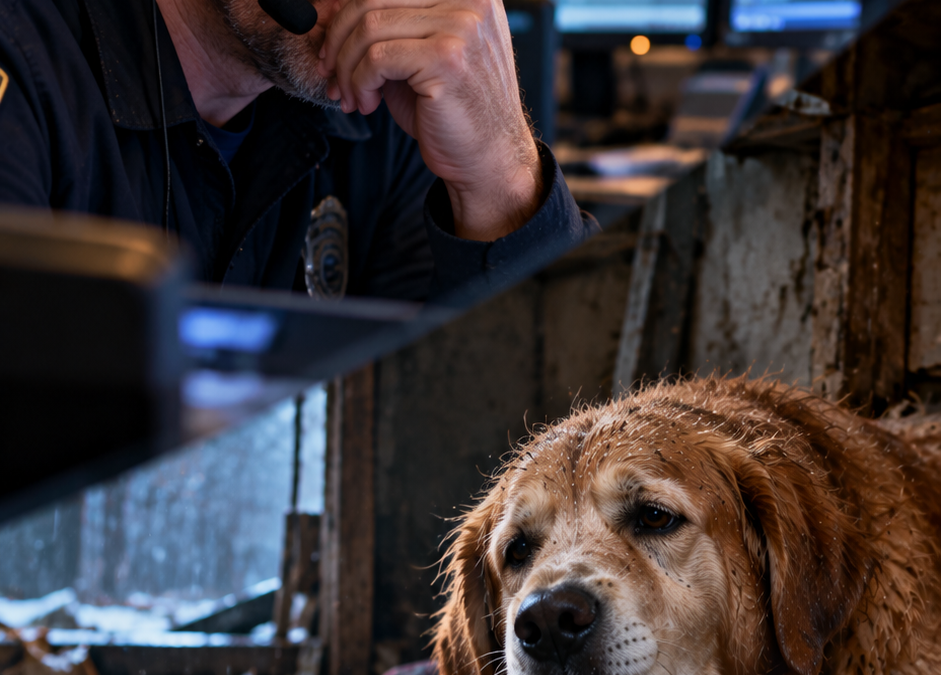
𝗙𝗨𝗟𝗟 𝗦𝗧𝗢𝗥𝗬
There was a faint indoor echo.
The dog sounded as though it was in a room rather than outside.
“Can anyone hear me?”
Bark.
Bark.
Bark.
I tried a callback.
The call reconnected.
Same thing.
Dog barking.
I sat back.
Under normal circumstances, I might have coded the incident as an accidental or open-line call, documented the number, and moved on unless additional information became available.
That isn’t negligence.
Emergency systems operate on evidence.
Every unit sent blindly is a unit unavailable somewhere else.
Dispatching means making choices with incomplete information.
People imagine the job is simply answering phones and sending help.
It isn’t.
It is deciding where limited help goes when several people may need it at once.
Still, I didn’t disconnect.
The barking bothered me.
I couldn’t explain why.
It wasn’t unusually loud.
Not at first.
It wasn’t aggressive.
It was repetitive.
Almost rhythmic.
The dog barked several times.
Paused.
Then started again.
As if waiting for something.
As if expecting someone to respond.
“All right,” I muttered.
“What are you doing?”
Jessica asked.
“Listening.”
She smiled slightly.
“Excellent job description.”
I ignored her.
Another bark.
Something moved against the phone.
A faint scrape.
Then breathing.
Dog breathing.
Close.
Very close.
The animal may actually have been beside the phone.
That changed things.
“Buddy,” I said before thinking about it.
The barking stopped.
I felt ridiculous.
Jessica looked at me.
“Are you talking to the dog?”
“Apparently.”
“You’ve officially been here too long.”
“Probably.”
Into the headset, I said, “If somebody there needs help, I need something.”
Silence.
Then the dog barked sharply.
Once.
Twice.
Three times.
I stared at the screen.
Coincidence.
Obviously.
Dogs bark.
My words didn’t mean anything to him.
Still, a strange feeling moved through me.
I tried calling again.
The line remained open.
No person.
I checked the number against available databases.
Nothing.
No useful address.
No recent incident connected to it.
No immediately identifiable subscriber location precise enough to send responders.
I submitted a trace request through the channels available to us.
That would take time.
Time emergency calls usually don’t have.
Ten minutes passed.
Then fifteen.
The barking continued.
At some point I started keeping a rough pattern in my head.
Several barks.
Pause.
Movement.
Several more.
The dog seemed to leave the phone occasionally, then return.
Once I heard claws tapping rapidly across a hard floor.
Then the barking became distant.
Thirty seconds later it came close again.
I imagined a dog running between a person and a phone.
That image arrived without permission.
I pushed it away.
Speculation is dangerous in dispatch.
You cannot build a response around a story your mind invents.
Yet intuition is part of the job too.
You hear enough emergencies and patterns settle somewhere beneath conscious thought.
Something about this wasn’t normal.
At twenty minutes, I said, “Listen to me, pal.”
Jessica looked over again.
“Pal?”
“I don’t know his name.”
She shook her head.
I spoke into the microphone.
“If somebody in that house isn’t okay, bark again.”
Immediately, the barking changed.
Shorter.
Sharper.
Faster.
I stopped moving.
The sound was different.
Not random.
Desperate.
Jessica saw my expression.
“What?”
“Listen.”
I switched the call to monitored audio for her station.
The room filled faintly with the dog’s barking.
She listened for ten seconds.
Her smile disappeared.
“That’s not normal.”
“Exactly.”
“What do you hear?”
“I don’t know.”
“That’s useful.”
“I know.”
I closed my eyes.
Five years earlier, my dog Bailey had died.
I rarely talked about him at work.
There wasn’t much to say that wouldn’t make me sound ridiculous.
Bailey had been a black Labrador mix with one white paw and an absolute refusal to understand personal space.
He had been with us through both my children’s early school years.
He slept outside their bedrooms when they were sick.
Waited by the garage when I worked nights.
Could hear my car before anyone else in the house.
The year he died, I had kept telling my wife I was fine.
I wasn’t.
There are certain kinds of grief adults feel embarrassed admitting.
Losing a dog can be one of them.
People say, “At least it wasn’t a person.”
As if love measures itself according to species.
Bailey had been family.
On his last day, he could barely stand.
But when I came home, he lifted his head.
Tail moved once against the floor.
That one movement stayed with me.
Faithful until the very end.
Listening to the dog on the line, I thought about Bailey.
I wondered whether another animal was somewhere in the dark trying to do the only thing it knew how to do.
Make noise.
Get someone.
Refuse to leave.
I opened my eyes.
“I’m staying on.”
Jessica looked at the clock.
“Until?”
“I know something’s wrong.”
“Robert.”
“I know.”
We both understood what she wasn’t saying.
Knowing wasn’t enough.
I needed location information.
I sent another request.
Attempted another callback.
No improvement.
The dog kept barking.
At thirty-five minutes, another emergency call came into my queue.
I placed the dog line in a monitored hold state while dealing with it.
A man had fallen from a motorcycle.
Conscious.
Bleeding from his arm.
No immediate life-threatening signs reported.
I dispatched appropriate response.
All the while, the dog’s barking remained visible as an active line on my screen.
The second I cleared the motorcycle incident, I returned.
“I’m back.”
The dog barked.
I almost laughed.
Not because it was funny.
Because it felt absurdly like an answer.
“Yeah,” I said. “I know.”
His voice sounded rougher.
That concerned me.
Dogs can bark themselves hoarse.
How long had he been barking before the call?
Ten minutes?
An hour?
Had he somehow activated the phone?
Had someone called emergency services before becoming unable to speak?
That seemed more likely.
Maybe an older person had dialed and collapsed.
Maybe someone was injured.
Maybe someone had had a medical emergency while holding the phone.
The dog could be beside them.
I checked the device again.
Still nothing useful.
This is the part people find difficult to understand.
They imagine emergency communications as omniscient.
A person calls and instantly we know exactly where they are.
Sometimes we do.
Sometimes technology gives us very precise information.
Sometimes it does not.
Sometimes buildings interfere.
Privacy settings matter.
Old systems matter.
Network conditions matter.
And sometimes the difference between knowing there is danger and knowing where that danger is becomes unbearable.
That night, I knew almost nothing.
A telephone number.
An open line.
A dog.
And a feeling I couldn’t document in any official incident field.
At forty-five minutes, my supervisor walked behind us.
He glanced at my screen.
“That line still active?”
“Yes.”
“Any voice?”
“No.”
“Location?”
“Working on it.”
“Nearly an hour.”
“I know.”
He listened through a secondary monitor.
The dog barked.
His expression remained neutral.
“What are we treating it as?”
“Possible medical emergency.”
“Based on?”
“The dog.”
He looked at me.
I understood how weak it sounded.
“Robert.”
“I know what it sounds like.”
“We’ve got calls stacking.”
“I can work the stack and keep the line.”
“For now.”
That phrase mattered.
For now.
He walked away.
Jessica leaned toward me.
“He’s going to make you release it eventually.”
“I know.”
“What if it’s nothing?”
“Then I’ve spent an hour listening to a dog.”
“And if it isn’t?”
I looked at the line.
“Exactly.”
At one hour, the barking continued.
The dog sounded more exhausted now.
Sometimes several seconds passed before another bark came.
Each time silence stretched too long, I felt my chest tighten.
“Come on.”
Bark.
“There you go.”
Jessica stared at me.
“You’re encouraging him.”
“I think he needs it.”
“He can’t understand you.”
“Maybe not.”
I didn’t believe the words completely.
Dogs understand more than we give them credit for.
Not language in the way humans understand it.
Tone.
Attention.
Presence.
Maybe the animal could hear a voice coming from the phone and knew someone was still there.
Maybe that mattered.
Or maybe I needed to believe it mattered because otherwise I was simply powerless.
That is one of the hardest parts of emergency dispatch.
You are close to every disaster and physically present at none of them.
Your entire job happens through sound.
People think that distance protects you.
Sometimes it makes things worse.
You can hear a person drowning without being able to reach into the water.
Hear someone hiding while footsteps approach.
Hear a mother screaming but never see the child she’s holding.
You give instructions.
Coordinate.
Send people.
Stay calm.
But your hands remain on a keyboard.
That night, my hands were useless because I did not know where to send anyone.
Jessica tapped my shoulder.
“Break.”
I shook my head.
“Not yet.”
“Robert, you’re scheduled.”
“Cover me.”
“You’re going to need coffee.”
“I need the address.”
She pulled off one side of her headset.
“You’ve been on this call an hour.”
“I know.”
“The dog is still barking.”
“I know.”
She watched me.
Then nodded.
“I’ll cover your break.”
“Thanks.”
She didn’t argue again.
Jessica had known me for ten years.
We had worked nights when the city seemed determined to fall apart one block at a time.
She knew when I was being stubborn.
She also knew when something had gotten under my skin.
This was both.
One hour and ten minutes.
The barking became hoarse.
I heard water somewhere.
Maybe the dog knocking against a bowl.
Then claws.
Then a faint thud.
I leaned closer.
“Hello?”
Nothing human.
“Can anyone hear me?”
The dog began barking again.
I whispered, “Good boy.”
I had no idea whether the dog was male.
For some reason, I imagined he was.
I would later learn how wrong I was.
At one hour and twenty minutes, my supervisor returned.
“Anything?”
“No.”
He exhaled.
“We can’t keep this open indefinitely.”
“Why not?”
“You know why.”
“I can manage other calls.”
“That’s not the point.”
“Then what is?”
He lowered his voice.
“Resources.”
There it was.
I hated the word at that moment, though I had used it myself hundreds of times.
Resources.
Bandwidth.
Staff.
Lines.
Priority.
Everything in emergency response eventually becomes an allocation problem.
“This could be somebody unconscious.”
“Could be.”
“The dog could be trying to get help.”
“Could be.”
“Then give me more time.”
“How much?”
I looked at the call timer.
One hour, twenty-two minutes.
“I don’t know.”
He studied me.
“You’ve got thirty more.”
“That’s it?”
“For now.”
He walked away.
I muttered something under my breath.
Jessica heard.
“Professional.”
“I’m trying.”
She glanced toward my screen.
“Do you really think someone’s there?”
“Yes.”
“Why?”
I didn’t answer immediately.
Then I said, “Because the dog won’t stop.”
She considered that.
Dogs bark for countless reasons.
Fear.
Territory.
Loneliness.
Noise.
Excitement.
But this dog wasn’t barking toward a street.
He was barking near a phone.
Leaving.
Returning.
Getting weaker.
Continuing anyway.
“Maybe you’re right,” Jessica said.
“I hope I’m wrong.”
That was the contradiction.
If I was wrong, I’d wasted time.
If I was right, someone had been lying helpless somewhere for more than an hour.
At one hour thirty, the dog’s voice was nearly raw.
Each bark sounded painful.
I closed my eyes again.
An image formed.
A dark living room.
An older person on the floor.
A German shepherd.
I don’t know why I imagined a German shepherd.
Maybe because the bark was deep.
The dog pacing.
Touching the person.
Running to the phone.
Barking.
Waiting.
Going back.
That scene became so vivid I could almost see it.
I hated myself for imagining details.
I hated the fact that I could do nothing.
“Come on,” I whispered.
“Somebody hear her.”
Her.
At some point, without knowing why, I had started thinking of the dog as female.
“Somebody nearby has to hear you.”
The dog barked again.
I looked at the clock.
1:36 a.m.
The city outside remained indifferent.
Somewhere, rain had begun lightly against the building windows.
Jessica took another call.
I answered two more without releasing the dog line.
One involved a teenager having a severe panic episode.
Another was an elderly woman who had fallen in her bathroom but remained conscious and able to unlock the door remotely.
Help went to both.
The contrast tormented me.
Those callers could give addresses.
Names.
Symptoms.
They could answer questions.
I could act.
The dog gave me everything she had.
And it still wasn’t enough.
At one hour forty-five minutes, the room supervisor stood near my desk.
He didn’t say anything.
He just looked at the timer.
I knew what was coming.
“Give me fifteen,” I said.
“Robert.”
“Fifteen.”
His jaw tightened.
“You’ve already had more than that.”
“Then don’t make me hang up yet.”
“This isn’t personal.”
That sentence irritated me more than it should have.
“No,” I said. “It might be life or death.”
“Based on barking.”
“Yes.”
He stared.
I expected the order.
Disconnect.
Document.
Move on.
Instead, he said, “Fifteen.”
Then walked away.
Jessica exhaled.
“You owe him.”
“I’ll buy him coffee.”
“He hates your coffee.”
“Everybody hates our coffee.”
The dog barked.
I smiled despite myself.
“Even she agrees.”
1:50 a.m.
Ten minutes.
I spoke into the microphone.
“Listen, sweetheart.”
I had officially abandoned any pretense of procedural dignity.
“I need help here too.”
Bark.
“If there’s somebody in that house, somebody has to find you.”
Bark.
“Keep going.”
The dog barked twice.
Then silence.
I waited.
Five seconds.
Ten.
“Come on.”
Nothing.
Fifteen seconds.
My chest tightened.
“Hey.”
I turned up the monitor slightly.
Then I heard claws.
Slow this time.
The dog returned to the phone.
One bark.
Weak.
I swallowed.
“That’s it.”
I don’t know why I felt emotional.
The dog wasn’t mine.
I didn’t even know where she was.
But something about that one exhausted bark reached straight through me.
“Don’t quit.”
Jessica looked over.
I didn’t care.
“Don’t quit on me.”
At 1:57 a.m., something changed.
At first, I thought it was interference.
A metallic sound.
Then another.
I sat forward.
A door.
It sounded like a door opening.
The dog erupted.
Not the same barking.
This was louder.
Faster.
Excited.
There were footsteps.
Human footsteps.
I raised one hand toward Jessica without looking at her.
She immediately switched to monitor.
A woman’s voice sounded faintly in the background.
“Oh my God.”
I froze.
The woman said something else.
Closer now.
“Emma, what are you doing?”
Emma.
The dog’s name.
My heart began pounding.
“Hello?” I called.
The barking continued wildly.
Footsteps crossed the room.
Then the woman’s voice changed.
Not irritation.
Fear.
“Oh my God.”
A pause.
“James?”
I stood from my chair without realizing it.
“Ma’am!”
More movement.
“James!”
“Ma’am, if you can hear me, pick up the phone.”
The dog barked.
Then a hand scraped against the device.
Finally:
“Hello?”
A human voice.
After nearly two hours, a human voice.
I went instantly from emotionally invested idiot talking to a dog into dispatcher mode.
“Ma’am, this is emergency services. Tell me your name.”
The woman was breathing fast.
“Margaret.”
“Margaret what?”
“Margaret Thompson—no, sorry, Margaret Lewis.”
Confusion from panic.
“Margaret, stay with me. Tell me where you are.”
“I’m at James’s house.”
“I need the exact address.”
“247 Elm Street.”
My fingers hit the keyboard.
Address.
Finally.
I entered it.
Jessica was already alerting medical dispatch while I continued speaking.
“Margaret, what happened?”
“I don’t know.”
“Tell me what you see.”
“James is on the floor.”
“Is he awake?”
“No.”
“Is he breathing?”
She started crying.
“I don’t know.”
“Margaret, listen to me.”
My voice became slower.
“Go close to him.”
“Okay.”
“Look at his chest.”
I heard her moving.
Emma was whining now rather than barking.
“Is his chest moving?”
A few seconds.
“Yes.”
“You’re sure?”
“Yes.”
“He’s breathing, but it’s weak.”
“Good. Help is on the way.”
I signaled the ambulance request.
The address appeared on our map.
Units were moving.
For two hours I had stared at a blank location field.
Now there it was.
247 Elm Street.
I wanted to shout.
Instead, I said, “Margaret, I need you to stay beside James.”
“I’m here.”
“Do not give him food or water.”
“Okay.”
“Tell me if his breathing changes.”
“Okay.”
“How old is James?”
“Seventy-five.”
“Medical history?”
“I don’t know everything.”
“Does he live alone?”
“Yes.”
“Who’s Emma?”
“His dog.”
I almost laughed from relief.
“What kind of dog?”
“German shepherd.”
My imagined scene had been right.
That unnerved me.
Margaret continued.
“They’re always together.”
“How did you get inside?”
“The back door.”
“Was it unlocked?”
“James always leaves it unlocked at night because sometimes I bring him groceries in the morning.”
“How did you know something was wrong?”
“Emma.”
The dog whined near the phone.
“She woke me up.”
“You heard her?”
“For hours.”
I stopped typing for half a second.
“For how long?”
“I don’t know.”
Margaret was crying now.
“At first, I was angry.”
“She barks sometimes if a cat gets near the yard.”
“I put a pillow over my head.”
“Gosh.”
Her voice broke.
“I should’ve come sooner.”
“Margaret.”
“I should’ve known.”
“Don’t do that right now.”
“But—”
“You came.”
I knew those words mattered.
“You are there now. Focus on James.”
She took a breath.
“Okay.”
“Tell me about Emma.”
“James’s wife died three years ago.”
“Emma’s all he has.”
My throat tightened.
“He’s had her since she was a puppy.”
“She’s never like this.”
“I’ve never heard her bark this long.”
“Did she touch the phone?”
“I think James’s phone was on the floor.”
“Emma must have hit it somehow.”
Or James had begun the call before collapsing.
We never established that with certainty.
Maybe he dialed and dropped it.
Maybe the emergency function had been activated during the fall.
Maybe Emma had stepped on the device.
What mattered was that the line opened.
And Emma used it.
Sirens became audible faintly in the background.
“Margaret, you’re going to hear responders arriving.”
“I hear them.”
“Can you unlock the front door?”
“It is.”
“Good.”
The dog started barking again.
This time it sounded almost frantic with relief.
“They’re here,” Margaret said.
Doors opened.
Footsteps.
Male voices.
“Emergency medical services!”
“In here!”
Margaret shouted.
I stayed on the line.
We are often told that once responders arrive, our role is finished.
Technically, sometimes it is.
Emotionally, not always.
After two hours of listening to Emma, I needed to know what happened.
I heard the paramedics enter.
One asked Margaret to step back.
Another began assessing James.
Short, professional language.
Breathing.
Pulse.
Response.
Time last seen normal.
Medication nearby.
Possible neurological event.
I caught only fragments.
Emma barked until one responder apparently moved her away.
Then she began whining.
“Easy, girl,” someone said.
That sentence almost undid me.
Easy, girl.
For two hours, she had refused to be easy.
Thank God.
Several minutes passed.
Then one of the paramedics came to the phone.
“Dispatch?”
“Here.”
“We’ve got him.”
“Status?”
“Unconscious but breathing. Signs consistent with a possible minor stroke or related event. We’re transporting.”
“Understood.”
He paused.
“How long was this line open?”
“Just over two hours.”
“Who called?”
I looked at the incident record.
“That’s complicated.”
I heard him laugh once.
“Dog?”
“Mostly.”
“No kidding.”
“No.”
He became serious again.
“Good job staying with it.”
“How bad?”
There was a pause.
“He needs the hospital.”
Then he added quietly, “We got here in time.”
The phrase stayed with me.
In time.
I did not ask what would have happened if we had arrived later.
I didn’t need to.
James was moved onto a stretcher.
Margaret asked whether she could follow.
A responder told her where they were going.
Emma became increasingly distressed.
“Can someone stay with the dog?” I asked.
Margaret heard me.
“I will.”
I smiled.
“Good.”
James left for the hospital.
The call finally ended at 2:18 a.m.
For the first time in more than two hours, there was silence in my headset.
Real silence.
I took it off.
My ears rang.
Jessica looked at me.
Neither of us spoke.
Then she said, “German shepherd.”
“Yeah.”
“You guessed that.”
“I didn’t guess.”
“You absolutely guessed.”
“Fine.”
She smiled.
Then her eyes became wet.
“You okay?”
“No idea.”
Our supervisor approached.
I expected some lecture about procedure.
Instead, he put one hand on the back of my chair.
“Good call.”
Two words.
That was all.
Coming from him, it was enough.
I stood.
My legs felt strangely weak.
“I’m taking my break.”
Jessica laughed.
“Now?”
“Now.”
I walked to the break room.
The coffee machine buzzed.
I made a fresh cup.
Didn’t drink it.
I just stood there holding it.
For two hours, I had been almost completely powerless.
That’s what stayed with me.
Not the heroism people later wanted to attach to the story.
I didn’t save James with my hands.
I didn’t diagnose him.
I didn’t perform medical treatment.
I couldn’t even find his house.
I listened.
That was all.
Emma did the hard part.
She stayed beside him.
She found the phone.
She barked until her voice began to fail.
She barked until a neighbor finally got out of bed.
She refused to accept silence.
I thought about Bailey.
I imagined him doing the same thing.
Maybe that was sentimental.
I didn’t care.
At home that morning, my wife was already awake when I came in.
Claire took one look at me.
“Bad shift?”
“Strange.”
“How strange?”
I put my keys down.
“A dog called 911.”
She stared.
“What?”
I sat at the kitchen table.
Then I told her.
Not the full technical details.
Just the story.
Phone.
Barking.
Two hours.
Neighbor.
Older man unconscious.
Ambulance.
By the end, Claire’s eyes were wet.
“Did he make it?”
“I don’t know yet.”
“Can you find out?”
“Maybe.”
“You will.”
It wasn’t a question.
“Yeah.”
My daughter came into the kitchen halfway through.
She was sixteen then and perpetually unimpressed by everything.
“What are you guys talking about?”
“Your father spent two hours talking to a dog.”
Claire said.
My daughter looked at me.
“Honestly, that tracks.”
“Thank you.”
“What kind of dog?”
“German shepherd.”
“Did she understand you?”
“I don’t know.”
She grabbed juice from the refrigerator.
“She probably understood more than some of your callers.”
Claire laughed.
So did I.
That helped.
Then my daughter asked, “What was her name?”
“Emma.”
She nodded.
“Good dog.”
I thought about those words for the rest of the morning.
Good dog.
Such a small phrase for what she had done.
I slept for four hours.
Then woke up thinking about James.
I tried to tell myself to leave it alone.
Professional boundaries exist for a reason.
Dispatchers cannot personally follow every case.
You’d never survive emotionally.
But this one had become personal somewhere around the ninety-minute mark when Emma’s bark started cracking.
I called the hospital through proper channels.
It took time.
Eventually, I learned James was alive.
Awake.
Weak.
Stable enough to speak.
That should have been enough.
It wasn’t.
The next day, when I returned to work, I asked whether there had been any update.
Someone said James had regained consciousness.
Possible minor stroke.
Treatment underway.
Good prognosis compared with what might have happened with a longer delay.
I sat down at my station.
Looked at my screen.
Then at the phone.
Jessica rolled over in her chair.
“You look disappointed.”
“He’s alive.”
“That’s usually good news.”
“I want to talk to him.”
She raised her eyebrows.
“Boundary.”
“I know.”
“You’re going to do it anyway.”
“Probably.”
“At least pretend I tried.”
Later, I was able to speak with James briefly.
His voice sounded older than I expected.
Weak.
But alert.
“Mr. Thompson?”
“Yes?”
“My name is Robert. I’m an emergency dispatcher.”
Silence.
Then:
“The dog.”
I smiled.
“Yes.”
“Emma.”
“That’s right.”
James didn’t say anything for several seconds.
When he finally spoke, his voice shook.
“I don’t remember calling.”
“We’re not sure exactly how the call started.”
“I remember the floor.”
He breathed.
“I was in the living room.”
“I stood up.”
“Then everything went strange.”
“What do you remember after that?”
“Emma.”
His voice softened.
“Barking.”
“Like from far away.”
“I couldn’t move.”
“I thought I was dreaming.”
I closed my eyes.
“She stayed with you.”
“I know.”
“Mr. Thompson, she did more than stay.”
He was quiet.
“Emma barked into that phone for more than two hours.”
Nothing.
I continued.
“I kept the line open.”
“Eventually your neighbor Margaret heard her and came inside.”
Another long silence.
Then I heard James crying.
Quietly.
The kind of crying people do when they’re trying to prevent another person from hearing.
“She didn’t leave me.”
“No.”
“She never does.”
His voice broke.
“My wife died three years ago.”
“Margaret told me.”
“I wasn’t doing very well after.”
He took a breath.
“Emma made me get up.”
“Walk.”
“Feed someone.”
“Go outside.”
“You understand?”
“I do.”
“Everyone kept saying I rescued her.”
He gave a faint laugh.
“We got her from a shelter when she was young.”
“But that’s backwards.”
I smiled.
“Sounds like she returned the favor.”
James became quiet again.
“Thank you.”
“Emma did the hard work.”
“You listened.”
That stopped me.
He repeated it.
“You listened.”
I had no clever answer.
“It’s my job.”
“No.”
His voice was weak but firm.
“Maybe.”
“But you listened to a dog for two hours.”
I thought of my supervisor.
Resources.
Procedure.
The blank address field.
All the moments I could have decided there was nothing actionable.
“I’m glad you’re okay.”
“I am too.”
Then James said, “Emma’s staying with Margaret until I get home.”
“Good.”
“Margaret says she sits by the front door.”
“Waiting?”
“Always.”
I imagined the dog.
After two hours of barking until her voice failed, now sitting silently by a door.
Waiting for her person to return.
“Tell her she’s a good dog.”
James laughed softly.
“I think she knows.”
A month passed.
Work went back to normal.
Normal for us meant chaos.
A kitchen fire.
A child locked inside a bathroom.
A missing elderly man found two streets from home.
A car accident.
False alarms.
Real emergencies.
People angry because we asked questions they believed wasted time.
People grateful because someone answered.
I thought about Emma less often.
Then one afternoon, a yellow envelope appeared near my station.
Handwritten address.
My name.
No idea who had sent it.
I opened it.
Inside was a drawing.
At first, I thought a child had made it.
The lines were uneven.
Simple house.
A black-and-tan dog sitting beside a telephone.
Little marks around her mouth to represent barking.
An ambulance outside.
At the bottom, written in shaky adult handwriting:
Because of Emma, I’m still here. Thank you for listening.
James and Emma
I stared at it.
Jessica leaned over.
“What is that?”
I turned it toward her.
She read.
Her expression softened.
“Oh.”
“Yeah.”
“You gonna cry?”
“No.”
“You look like you’re going to cry.”
“I’m forty-seven.”
“That has historically not prevented crying.”
I laughed.
Then wiped my eye.
“Shut up.”
I taped the drawing beside my desk.
Technically, we weren’t supposed to clutter the workstations too much.
Nobody asked me to remove it.
For years afterward, that picture stayed close enough that I could see it every shift.
On difficult nights, I looked at Emma.
Not because her story made emergency work easier.
It didn’t.
There were still calls that ended badly.
Calls where responders didn’t arrive in time.
Calls where no amount of listening changed the outcome.
That is the truth.
Not every emergency becomes a miracle.
You cannot survive this job if you expect one.
Emma reminded me of something different.
That you don’t always get to decide which sound deserves attention based on whether you understand it immediately.
Distress has many languages.
Crying.
Silence.
A shaky breath.
A child saying, “Mom won’t wake up.”
An old man insisting, “I’m fine,” when he clearly isn’t.
A phone dropped on a floor.
And sometimes barking.
A few months after James came home, I was invited to stop by Elm Street.
At first, I refused.
Dispatchers don’t usually visit callers.
But James kept asking through Margaret.
Eventually Claire told me, “Go.”
“So now you’re managing my professional boundaries?”
“Yes.”
“Excellent.”
“Take cookies.”
So I did.
247 Elm Street was smaller than I had imagined.
A modest one-story house with pale siding and a narrow porch.
Margaret lived next door.
I parked.
Before I reached the steps, barking erupted inside.
For one second, my body reacted exactly as it had that night.
Heart rate up.
Attention sharpened.
Then the door opened.
Emma appeared.
German shepherd.
Large.
Dark saddle across her back.
Alert ears.
She looked older than the dog in my imagination.
James stood behind her with one hand on the doorframe.
He was thin.
Walked with a cane.
But he was smiling.
“Robert?”
“James.”
Emma stared at me.
I suddenly felt ridiculous.
“Does she like strangers?”
“Depends.”
“That’s reassuring.”
James laughed.
“Emma.”
He spoke softly.
“Friend.”
The dog’s posture changed.
She walked toward me.
Sniffed my shoes.
Then my trousers.
Then sat.
I crouched.
“You’re the one.”
Her ears moved.
I put out my hand.
She sniffed it.
Then pressed her head underneath my palm.
I froze.
James smiled.
“She approves.”
I scratched behind her ears.
“Emma.”
Her tail moved.
“You caused a lot of trouble.”
Another wag.
“Two hours.”
She leaned harder against my hand.
“You know how many forms that call generated?”
James laughed.
For the first time, I could connect the bark in my headset to a living animal.
Warm fur.
Brown eyes.
Real weight beneath my hand.
I felt something tighten in my throat.
James noticed.
“So.”
He nodded toward the house.
“Tea?”
Margaret was already inside.
She called from the kitchen, “I made too much.”
James smiled.
“She always makes too much.”
Margaret shouted, “You always complain and drink all of it.”
I looked at Emma.
“Sounds dangerous.”
She led us inside.
The living room was ordinary.
That struck me.
A couch.
Books.
Television.
Fireplace.
A small side table.
And near one chair, the place where James had collapsed.
I recognized nothing visually because I had never seen it.
Yet emotionally, I felt as though I had been in that room before.
For two hours.
Through sound.
I stared at the floor.
James noticed.
“Right there.”
He pointed.
I nodded.
“Emma was beside me when Margaret found me.”
Margaret carried tea in.
“She was nearly frantic.”
She sat.
“I’d heard her for so long.”
Guilt crossed her face.
“I still hate that I waited.”
James shook his head.
“Margaret.”
“I should’ve checked sooner.”
“You checked.”
“After two hours.”
“You checked.”
The repetition sounded familiar.
Maybe I had told her the same thing that night.
She looked at me.
“I thought she was barking at a cat.”
“Or someone walking.”
“We’re neighbors.”
“I hear her sometimes.”
“But that night…”
Margaret looked at Emma.
“She wouldn’t stop.”
Emma lay beside James.
Her head rested on his shoe.
“At some point,” Margaret continued, “the bark changed.”
I leaned forward.
“Changed how?”
“I don’t know.”
“More desperate.”
“Hoarse.”
“Like she was hurting herself.”
I nodded.
“I heard that too.”
Margaret looked surprised.
“You were really there the entire time?”
“On the line.”
“For two hours?”
“Almost.”
She stared.
Then whispered, “My God.”
James reached down and stroked Emma’s neck.
“She knew.”
“Yeah.”
Margaret said, “Do dogs know when something like that happens?”
I gave the only answer I could honestly give.
“I don’t know exactly what she understood.”
James looked down.
“She knew enough.”
That was true.
Maybe Emma didn’t know what a stroke was.
Maybe she didn’t know what emergency services were.
Maybe she didn’t understand the telephone.
She understood one essential fact.
James was wrong.
James wasn’t responding.
And she needed someone.
Everything else was detail.
Before I left, James showed me something.
His phone.
The same phone from the call.
Screen cracked along one edge.
“I keep it charged now.”
“Good plan.”
“And Margaret has a key.”
“Better plan.”
Margaret called from the kitchen, “I had a key before.”
James rolled his eyes.
“Now she actually uses it.”
Emma followed me to the door.
I crouched again.
“I won’t be answering another two-hour call from you, okay?”
She licked my wrist.
“That’s not legally binding.”
James laughed.
As I walked to my car, Emma stood behind the screen door.
Watching.
For a second, I thought about Bailey.
I wished dogs lived as long as the love people had for them.
They don’t.
Maybe that’s part of why their loyalty feels so urgent.
They have less time.
So they waste less of it pretending not to care.
Years passed.
I stayed in emergency communications.
Jessica eventually moved to a supervisory role and became exactly the kind of supervisor she used to complain about.
I reminded her often.
She reminded me she could change my schedule.
Fair.
My children grew older.
Bailey’s collar remained in a drawer at home.
Emma’s drawing remained beside my desk.
The paper faded.
The tape had to be replaced twice.
But I kept it.
New dispatchers sometimes asked about it.
“Your kid draw that?”
“No.”
“Then who?”
“A stroke survivor.”
That always got their attention.
I would tell them enough of the story to make the point.
Open line.
Dog barking.
No address.
Stay curious.
Listen to background noise.
Don’t assume silence means nothing.
Don’t assume strange means unimportant.
I was careful not to teach recklessness.
There is a difference between intuition and ignoring procedure.
We need procedure.
Without it, emergency response becomes chaos.
But procedures are tools.
They are not substitutes for judgment.
That night taught me that the information you have may look insignificant until you understand what it means.
A barking dog was not an address.
But it was information.
Persistence was information.
The changing bark was information.
The dog’s proximity to the phone was information.
The fact that the line stayed open was information.
Together, those small pieces told me something was wrong long before I knew exactly what.
One night, years after the incident, a trainee sitting beside me asked a question.
“How do you know when to trust your gut?”
I hated the phrase.
Trust your gut.
It sounds mystical.
Emergency work shouldn’t be mystical.
So I told him, “Your gut is often your brain recognizing a pattern before you can explain the pattern.”
He nodded.
“Then you always trust it?”
“No.”
“You test it.”
“How?”
“You keep asking questions.”
“Look for evidence.”
“Use procedure.”
“Get another set of ears.”
“Don’t turn intuition into certainty.”
He looked at Emma’s drawing.
“Like the dog?”
“Exactly.”
“I believed something was wrong.”
“I did not know what.”
“That’s an important difference.”
He studied the picture.
“Two hours.”
“Yeah.”
“Would you do it again?”
I thought about the question.
Resource constraints.
Supervisor pressure.
Possibility of an accidental call.
The helplessness.
Emma barking herself hoarse.
Margaret opening the door.
James breathing weakly on the floor.
“Yes.”
I answered.
“Absolutely.”
Many years later, I ran into Margaret at a grocery store.
I recognized her first.
She squinted at me.
Then smiled.
“Robert.”
“Margaret.”
We hugged, which surprised both of us.
“How’s James?”
Her smile changed.
“Older.”
“Aren’t we all?”
“Still stubborn.”
“Good sign.”
“And Emma?”
Margaret became quiet.
I knew before she answered.
“She died last winter.”
My chest tightened.
“I’m sorry.”
“She was old.”
Margaret smiled through tears.
“James was with her.”
“Of course.”
“He sat on the floor beside her all night.”
I looked away for a second.
“What happened?”
“Nothing dramatic.”
“She just got old.”
“Slowed down.”
“Stopped eating much.”
“Then one night she couldn’t stand.”
Margaret wiped her eyes.
“James called the vet.”
“They kept her comfortable.”
“He wouldn’t leave.”
I imagined the scene.
The roles reversed.
James beside Emma.
Waiting.
Refusing to leave.
Margaret continued.
“Near the end, she kept looking at him.”
“Like she wanted to make sure he was there.”
I swallowed.
“He was.”
“Every second.”
We stood beside the produce section surrounded by people choosing vegetables while an old story reopened between us.
“How is he now?”
“Lonely.”
She paused.
“But not alone.”
“You’re still checking on him?”
“Every day.”
I smiled.
“Tea?”
“Every evening.”
“Good.”
She touched my arm.
“He still has your name written near the phone.”
“What?”
“Emergency contacts.”
She laughed.
“You’re not actually an emergency contact.”
“I should hope not.”
“But he wrote Robert—dispatcher beside the number for emergency services.”
“That seems unnecessary.”
“It makes him happy.”
I shook my head.
“Tell him I said hello.”
“I will.”
That night, I went home and opened the drawer where Bailey’s collar was.
I sat on the bed holding it.
Claire came in.
“What happened?”
“Emma died.”
She remembered immediately.
“The dog from the call?”
“Yeah.”
“I’m sorry.”
We sat together.
After a while, Claire said, “She had a good life.”
“She did.”
“And James?”
“Still alive.”
Claire smiled.
“Then she did her job.”
I looked at the collar.
Dogs don’t think in those terms.
Jobs.
Duty.
Heroism.
They simply attach themselves to us.
And somehow that attachment becomes action.
Wait by the door.
Wake the family when something burns.
Stand between a child and danger.
Refuse to leave someone who has fallen.
Bark until your throat hurts.
Humans create medals and certificates and stories because we need language for extraordinary things.
Emma just needed James.
Years after that night, I sometimes wonder what would have happened if I had disconnected after five minutes.
Or twenty.
Would Margaret still have eventually heard Emma?
Probably.
Would she have gone over at the same time?
Maybe.
Would James have survived?
I don’t know.
Those questions can become dangerous if you live inside them too long.
Emergency workers know that better than most.
You can destroy yourself replaying the versions of events that didn’t happen.
What if I’d asked one more question?
What if we’d sent someone faster?
What if the caller had called ten minutes earlier?
What if?
What if?
The mind loves alternate timelines because they create the illusion that somewhere there was a perfect decision.
There rarely is.
There is only the next decision.
That night, mine was simple.
Don’t hang up yet.
Then again.
Don’t hang up yet.
Again.
Stay another ten minutes.
Listen.
Wait.
Talk to the dog even though you feel stupid.
Keep the line.
Keep listening.
And finally:
There.
A door.
Footsteps.
A voice.
An address.
Help.
I used to think emergency work was about speed.
And it is.
Seconds matter.
But Emma taught me another part.
Sometimes emergency work is about patience.
Staying present long enough for the missing piece to appear.
Not every crisis announces itself clearly.
Not every person can explain what is happening.
Sometimes the only evidence you have is persistence.
Something keeps happening.
A sound.
A pattern.
A feeling that does not fit.
You do not have to turn that feeling into certainty.
You just have to respect it enough to keep looking.
That is what I tell new dispatchers.
Listen to what callers say.
Also listen to what they can’t say.
Listen behind them.
Listen to silence.
Listen to the television.
The breathing.
The footsteps.
The change in tone.
The child whispering.
The dog barking.
Information does not always arrive in complete sentences.
I retired from full-time dispatch years later.
On my final shift, the staff gave me a box.
Inside were the usual gifts.
A mug.
A ridiculous T-shirt.
A framed photograph of the team.
Then Jessica handed me something separately.
A new frame.
Inside it was James’s old drawing.
Emma beside the phone.
The paper carefully preserved.
At the bottom:
Because of Emma, I’m still here. Thank you for listening.
I stared at it.
“You took this down?”
“Only to frame it.”
“You could’ve asked.”
“You would’ve said no.”
“Correct.”
Jessica smiled.
“Thought you’d want it at home.”
I nodded.
For a moment, I couldn’t speak.
Twelve years became twenty and then more.
Thousands of calls.
Thousands of voices.
Many names forgotten.
Some impossible to forget.
My last shift ended quietly.
No dramatic final emergency.
No speech.
I removed my headset.
Set it on the desk.
Looked at the empty chair.
Then at Emma’s picture.
The strangest call of my career had not begun with a scream.
It had begun with nothing.
Silence.
Then one bark.
Then another.
A dog somewhere in the city refusing to accept that the person she loved might disappear while the world slept.
I carried the picture home.
It hangs near my desk now.
Sometimes one of my grandchildren asks about the dog.
“Was she a police dog?”
“No.”
“Rescue dog?”
I think about that.
“Yes.”
“What did she rescue?”
“A man.”
“How?”
“She called for help.”
They laugh.
“Dogs can’t call 911.”
I smile.
“Usually.”
Then I tell the story.
About James.
About Margaret.
About the phone.
About the long night.
About the dispatcher who almost had nothing useful to work with.
And about Emma, who never stopped.
I don’t tell them every technical detail.
Children don’t need that.
I tell them the most important part.
“She knew her person needed help, and she kept making noise until somebody listened.”
One of my grandchildren once asked, “Was she scared?”
I had never considered the question that way.
“Probably.”
“Then why didn’t she hide?”
I looked at the drawing.
“Because sometimes loving someone makes you stay even when you’re scared.”
The child accepted that more easily than adults usually do.
Maybe children’s stories get some things right after all.
James eventually passed away many years after that night.
Margaret sent me a note.
It was brief.
He had been comfortable.
She had been with him.
A photograph of Emma sat beside his bed.
That detail mattered to me.
James lived years longer than he might have if Emma had stopped barking.
What did he do with those years?
Nothing the newspapers would call extraordinary.
He drank tea with Margaret.
Walked when his health allowed.
Fed birds.
Read.
Complained about the weather.
Missed his wife.
Missed Emma.
Lived.
People misunderstand rescue when they imagine every saved life must later become impressive.
Living is impressive enough.
Another morning.
Another cup of coffee.
Another conversation.
Another winter.
Another birthday.
Another ordinary Tuesday.
Emma gave James more ordinary Tuesdays.
There is enormous beauty in that.
Sometimes I think about her on the carpet beside the telephone, barking into a voice she couldn’t understand.
Was my voice comforting?
Confusing?
Irrelevant?
Did she even realize sound was coming from the device?
I’ll never know.
But she stayed near it.
And I stayed on the other end.
Two living creatures who could not understand each other’s language connected by a line because both refused to give up on the same invisible person.
That is still one of the strangest and most moving things I have ever experienced.
I spent decades believing my job was answering people.
Emma taught me it was something broader.
My job was to listen.
Sometimes those are different things.
Answering requires a question you understand.
Listening asks less.
It asks you to remain present long enough to discover what the sound means.
That night, for almost two hours, all I had was barking.
No name.
No address.
No explanation.
Just a German shepherd named Emma wearing out her voice because the man who had become her whole world was lying on a floor and wasn’t getting up.
She could not explain stroke symptoms.
She could not tell me 247 Elm Street.
She could not say James was seventy-five.
She couldn’t say his wife had died three years earlier.
She couldn’t tell me he lived alone.
She couldn’t say, “Please hurry.”
So she said the only thing she could.
Bark.
Again.
Again.
Again.
Until Margaret woke up.
Until a door opened.
Until human language finally entered the line.
Until an ambulance had somewhere to go.
Until James had another morning.
For years, people called Emma a miracle.
Maybe she was.
But I think calling something a miracle can sometimes hide the harder truth.
Emma did not perform magic.
She paid attention.
She recognized that someone she loved was in trouble.
She stayed.
She tried.
She kept trying after the first attempt failed.
And eventually, someone responded.
There is a lesson in that I still carry.
Most of us will never have to bark into a telephone to save someone’s life.
But we will have moments when something feels wrong.
A neighbor we haven’t seen.
A parent whose voice sounds different.
A friend who says they’re fine too quickly.
A dog barking for far too long in the middle of the night.
Most of those moments will be nothing.
Sometimes one won’t.
We do not need to become paranoid.
We need to become attentive.
There is a difference.
Margaret could have rolled over and gone back to sleep.
She almost did.
I could have marked the call accidental.
I almost did.
James could not help himself.
Emma would not stop trying.
That chain of imperfect decisions was enough.
A dog barked.
A dispatcher listened.
A neighbor got out of bed.
A door opened.
An ambulance arrived.
A man survived.
No single person owned the rescue.
That’s another thing emergency work taught me.
Saving a life is often a relay.
Someone notices.
Someone calls.
Someone listens.
Someone sends.
Someone arrives.
Someone treats.
We like heroes because stories become easier when one person receives the credit.
Real life is usually messier.
Emma began the chain.
The rest of us simply refused to break it.
Whenever I look at that drawing now, I don’t first see the telephone.
I see the space around the dog.
The empty room a shaky hand tried to draw.
A dog beside a person who couldn’t speak.
A city asleep beyond the walls.
And somewhere miles away, a man wearing a headset saying:
“I’m here.”
Maybe Emma didn’t understand the words.
But I like to think she understood something.
Someone had heard her.
Someone was still there.
Sometimes that is all any frightened creature needs in order to keep trying.
And sometimes, that is enough to keep a person alive until help finally finds the door.

