𝗙𝗨𝗟𝗟 𝗦𝗧𝗢𝗥𝗬 For Two Days I Kept Seeing the Same Stray Dog Guarding a Torn Box, but on the Third Morning I Finally Heard What Was Inside
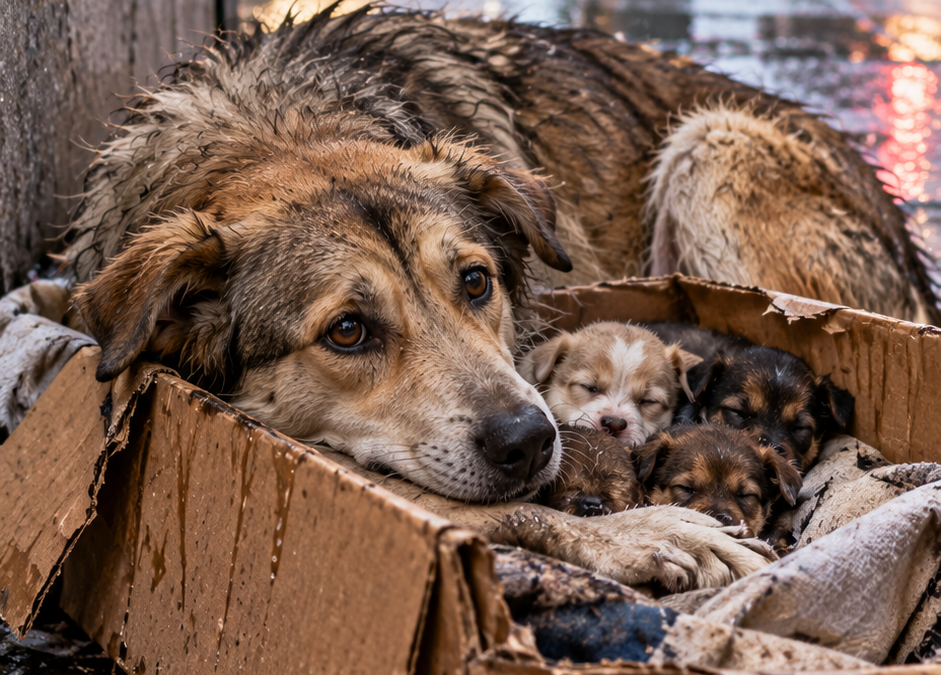
𝗙𝗨𝗟𝗟 𝗦𝗧𝗢𝗥𝗬
Obviously, she didn’t answer.
I took another step.
She rose.
That was enough.
I stopped.
The box sat behind her.
It was in worse condition than the day before. One side was crushed. The bottom appeared damp from the rain.
She positioned herself directly in front of it.
That’s when something finally clicked.
She wasn’t staying near the box because it offered shelter.
She was protecting it.
Whatever was inside mattered more to her than food.
More than comfort.
Maybe even more than her own safety.
I stood there longer than I should have.
Then a horn sounded behind me, startling both of us.
The dog flinched.
I backed away.
“I won’t take it.”
She stared at me.
I had no idea why I said that.
Maybe I was trying to reassure her.
Maybe I was trying to reassure myself.
I went to work, but I couldn’t concentrate.
Every time I looked at my computer screen, I saw her standing over that ruined cardboard box.
That night, I barely slept.
I kept asking myself the same questions.
What was inside?
Why was she moving it?
Where did she sleep?
Why wouldn’t she eat?
At around five in the morning, I gave up trying to rest.
I got out of bed.
I made coffee.
Then I did something that would have sounded ridiculous if somebody had asked me about it the week before.
I packed sandwiches.
I filled a bottle with water.
I grabbed my warm jacket.
And before sunrise, I went looking for a dog.
The streets were still dark from the overnight rain.
Cars passed occasionally, tires hissing over wet pavement.
I first checked the grocery store.
Nothing.
The patch of sidewalk where she’d been lying was empty.
Only a faint rectangular mark remained where the cardboard had kept the concrete slightly drier beneath it.
An older man walked past me with a small terrier on a leash.
He noticed me staring at the pavement.
“Lose something?” he asked.
“Maybe.”
He looked at me strangely.
“I’m looking for a stray dog. Medium-sized. Gray and gold. She has a cardboard box.”
“A box?”
“Yeah.”
He shrugged.
“Can’t say I’ve seen her.”
“Thanks.”
I headed toward the subway station.
Nothing there either.
I walked the surrounding blocks.
Twenty minutes passed.
Then thirty.
I started thinking I had missed my chance.
Maybe she had left the neighborhood.
Maybe someone from animal control had picked her up.
Maybe the box had finally fallen apart.
Then, near a small residential park several blocks away, I saw movement beneath an old wooden bench.
My heart jumped.
There she was.
The box too.
I stopped about thirty feet away.
She noticed me immediately.
Her head came up.
Her body stiffened.
Even from that distance, I could see how tired she was.
She looked worse than the previous day.
Her coat was damp.
Mud covered her legs.
The fur around her belly looked matted.
Yet she was still guarding the box.
“Found you,” I whispered.
She stood.
I didn’t move closer.
The previous two days had taught me at least one thing.
I wasn’t going to earn her trust by forcing myself into her space.
So instead of approaching, I sat down on another bench about twenty feet away.
I took out one of the sandwiches.
I unwrapped it slowly.
The smell immediately caught her attention.
Her nose lifted.
But she stayed beside the box.
I ate.
Pretended not to watch her.
For ten minutes, neither of us moved much.
Then I broke off a small piece of bread.
I rolled it across the wet pavement.
It stopped several feet from her.
She looked at it.
Then at me.
Then at the box.
She didn’t touch it.
“You’re really committed to whatever you’ve got in there,” I said.
Her ears twitched.
I waited another twenty minutes.
More people entered the park.
A mother passed with a little boy.
The boy pointed.
“Mom, look at the dog!”
His mother pulled him closer.
“Don’t go near it. It’s a stray. It might bite.”
The dog’s body tightened.
Her head lowered slightly.
I watched the woman and child disappear down the path.
Something about the moment bothered me.
Maybe because the dog looked less dangerous than exhausted.
Maybe because I realized how easily fear becomes an excuse not to look any closer.
Then the dog turned toward the box.
She lowered her head.
And I heard it.
At first I thought it was a bird.
A weak, tiny squeak.
Then another.
I froze.
The sound came from inside the cardboard.
It was so faint I might have missed it if traffic had been louder.
I leaned forward.
Another tiny cry.
And suddenly everything made sense.
“Oh my God.”
The dog immediately looked at me.
I stared at the box.
“You’re a mother.”
She didn’t move.
I felt my throat tighten.
There were puppies inside.
That was why she had refused the bread.
Why she’d moved across the city.
Why she always positioned herself between strangers and the box.
She hadn’t been guarding garbage.
She had been carrying her babies.
For two days, maybe longer, she had dragged them from one place to another searching for somewhere safe.
Whenever the city became too noisy or too dangerous, she moved again.
She was hungry.
Wet.
Probably dehydrated.
And she still wouldn’t abandon them long enough to eat.
I thought about my own mother.
When I was eight, I once ran a fever so high that she sat beside my bed the entire night, changing cold towels on my forehead.
I remembered waking at three in the morning and seeing her still there.
Her eyes had been red from exhaustion.
But she hadn’t slept.
At eight years old, I hadn’t understood it.
Sitting in that park, watching a starving dog guard a box of newborn puppies, I finally did.
I couldn’t walk away.
The problem was figuring out what I could do without frightening her.
I couldn’t grab the box.
She would never allow it.
I couldn’t carry the puppies away.
And if I called animal control immediately, strangers approaching with equipment might send her running.
The temperature was supposed to drop that night.
The puppies needed warmth.
I looked down at the jacket I was wearing.
My wife had given it to me for Christmas.
It was one of my favorites.
Warm.
Soft.
Thick enough to block the damp coming through the ground.
I slowly stood.
The dog’s head snapped up.
“It’s okay.”
She rose too.
I stopped.
Then I lowered myself onto my knees.
Yes, right there on the wet pavement.
My jeans immediately soaked through.
I didn’t care.
I took off the jacket.
The dog’s eyes followed every movement.
I placed it on the ground.
Then I slid it forward.
Not toward her.
Just halfway between us.
I backed away.
“This is yours.”
She stared.
“It’s warm.”
Her nose moved.
“You don’t have to trust me.”
I sat down again.
“But you can trust that.”
For almost a minute, nothing happened.
Then she stood.
Her legs trembled.
That was when I understood how exhausted she really was.
She walked toward the box.
Gripped one edge carefully between her teeth.
And pulled.
The cardboard moved several inches.
She stopped.
Breathed.
Pulled again.
She was trying to move the box onto my jacket.
My chest tightened.
She had understood.
Or at least she had decided to accept what I was offering.
The cardboard scraped across the pavement.
One damaged corner ripped wider.
Something tiny slipped partly through the opening.
A paw.
Smaller than my thumb.
I held my breath.
The side of the box collapsed.
And finally I saw them.
Three puppies.
Newborns.
Their eyes were still closed.
One was dark gray, nearly black.
Another was light brown with white markings.
The third was golden, almost the same color as their mother’s coat beneath the dirt.
They were pressed together in one trembling pile.
Their bodies were so small that each breath looked fragile.
The mother pulled the box the final few inches until it touched my jacket.
Then she did something that nearly broke me.
She climbed inside.
Very carefully, she took the first puppy in her mouth.
She carried it onto the jacket.
Set it down.
Went back.
Second puppy.
Then the third.
She arranged herself around them.
Her body curled into a protective circle.
The puppies immediately pressed against her belly.
And for the first time since I’d started watching her, she closed her eyes.
Not for a second.
She actually slept.
I realized then that she hadn’t trusted the world enough to rest.
Not until now.
I sat absolutely still.
The sandwich remained beside me.
She didn’t care about it.
Neither did I.
I needed help.
Luckily, I knew someone.
His name was James.
We had met several months earlier at a community event. He worked with one of the city’s animal rescue centers.
At the time, he’d given me a business card.
I had put it in my wallet and forgotten about it.
Until that morning.
I pulled it out.
Still there.
I called.
He answered on the second ring.
“James?”
“Yeah?”
“It’s Daniel. We met at the neighborhood volunteer event a few months ago.”
There was a pause.
“Daniel—yeah. I remember.”
“I need your help.”
“What happened?”
I lowered my voice.
“I’ve got a stray mother dog in a park with three newborn puppies.”
His tone changed immediately.
“Are the puppies exposed?”
“They were in a cardboard box. The box is falling apart. I put my jacket underneath them.”
“Is the mother aggressive?”
“No. Scared. Exhausted. She won’t leave them.”
“Have you touched the puppies?”
“No.”
“Good. Don’t.”
“I wasn’t planning to.”
“Where are you?”
I gave him the location.
“Stay there,” he said. “I’ll come to you.”
“How long?”
“About half an hour.”
He arrived in twenty-five minutes.
Those twenty-five minutes felt longer than my entire workweek.
I stayed several yards away.
The mother slept.
Occasionally, one of the puppies made a tiny noise, and she’d wake instantly, check them, then settle again.
Watching her, I wondered what she had experienced before I found her.
Had someone abandoned her while she was pregnant?
Had she given birth somewhere unsafe?
Had people chased her away?
How many times had she moved those puppies already?
There was no way to know.
James pulled up near the park carrying a large soft-sided carrier.
The sound of the vehicle woke her immediately.
Her head came up.
Her eyes widened.
The peaceful dog vanished.
The guardian returned.
James began walking toward us.
I held up a hand.
“Stop.”
He stopped.
“She trusted me enough to sleep,” I said quietly. “Give her a minute.”
James nodded.
He understood immediately.
I turned toward the dog.
“It’s okay.”
She watched James.
“He’s my friend.”
Her body remained tense.
“He’s here to help you.”
I don’t believe dogs understand English the way we do.
But I absolutely believe they understand intention.
Tone.
Posture.
Whether your hands are gentle or impatient.
Whether you’re giving them a choice.
James lowered himself onto the pavement several feet from me.
He didn’t look directly at her.
Didn’t reach.
Didn’t talk loudly.
After a few minutes, he placed the carrier on the ground and opened it.
Then he put a small piece of cheese inside.
“We let her decide,” he whispered.
“She’s hungry.”
“Exactly.”
The mother smelled it immediately.
She looked at the carrier.
Then at the puppies.
Then at us.
She stood.
Took one step.
Stopped.
Another.
Her nose reached inside the carrier.
Then her head.
Her front legs.
Finally, her entire body.
She ate the cheese.
Then immediately turned around.
Her eyes went back to the puppies.
James smiled.
“Smart girl.”
He slowly picked up the remains of the cardboard beneath the puppies, keeping them together, and placed them inside beside her.
The mother immediately curled around them.
James secured the carrier.
He moved slowly enough that she never panicked.
Within minutes, we were in his vehicle.
He drove.
I sat in the passenger seat but spent almost the entire trip turned around.
The mother’s eyes stayed on me.
She wasn’t relaxed exactly.
But the terror I’d seen in the park was fading.
At the rescue center, James took us into a quiet room away from the other animals.
Blankets had already been prepared.
There was clean water.
Food formulated for a nursing mother.
A thick bed.
Heating equipment for the puppies if they needed it.
When James opened the carrier, she hesitated.
Then stepped out.
She sniffed everything.
Every wall.
Every bowl.
Every corner.
Then she went back for her puppies.
One by one, she moved them from the ruined cardboard onto the clean blankets.
Only after all three were together did she lie down.
The puppies began nursing.
I watched her shoulders finally relax.
A veterinarian named Sarah came in shortly afterward.
She was probably in her late fifties, with silver beginning to show in her hair and the kind of calm voice animals seemed to recognize immediately.
She examined the mother first.
Underweight.
Dehydrated.
Exhausted.
But otherwise stable.
Then she checked the puppies.
Each heart.
Each tiny belly.
Their temperature.
Their breathing.
I stood beside the wall, afraid to interrupt.
Finally, Sarah smiled.
“They’re okay.”
My shoulders dropped.
“All three?”
“All three.”
She touched one of the puppies gently.
“They’re a little small and they need warmth, nutrition, and monitoring, but I don’t see anything alarming right now.”
She looked toward their mother.
“She did an incredible job.”
The dog watched her.
Sarah smiled.
“You’re one tough little lady.”
The mother wagged her tail once.
Just once.
But after two days of seeing nothing except fear and determination in her, that tiny movement felt enormous.
James looked at me.
“Did you see that?”
“I did.”
“She approves of the medical staff.”
“High standards.”
That was the first time either of us laughed that morning.
Before leaving, I stood outside the room.
The mother was eating.
Finally.
She swallowed mouthful after mouthful as if her body had only now given her permission to be hungry.
The puppies slept beside her.
I looked down at myself.
My pants were muddy.
My shoes were wet.
My favorite jacket was still beneath a family of dogs.
And I couldn’t remember the last time I’d felt so useful.
“Can I come back?” I asked James.
He looked almost surprised.
“Of course.”
So I did.
The next afternoon.
And the one after that.
Eventually, every day.
The rescue staff started joking that I practically worked there.
I learned that they had named the mother Bella.
It suited her.
Once she was clean and eating regularly, the change was remarkable.
Her coat was far more golden than I had realized.
Her eyes looked softer.
The sharp outline of her ribs slowly began disappearing.
But what surprised me most was her personality.
Bella wasn’t naturally fearful.
She was affectionate.
Patient.
Gentle.
What I had mistaken for wildness in the park had simply been motherhood mixed with terror.
Take away the danger, and the dog beneath it returned.
A week later, I walked into the rescue center and James met me at the hallway.
“Good timing.”
“Why?”
“Come see.”
I followed him.
Bella heard me before she saw me.
The moment I entered the room, she stood.
Her tail began moving.
Not the single cautious wag from the first day.
A real wag.
She walked toward the gate and gave one soft bark.
“Hey, girl.”
I crouched.
James opened the enclosure.
Bella came straight to me.
She rested her head across my knee.
I stroked her ears.
“You remember me?”
Her eyes closed.
James smiled.
“I’d say that’s a yes.”
Then I noticed the puppies.
Their eyes had opened.
They weren’t just sleeping lumps anymore.
They were beginning to explore.
The gray puppy was the boldest.
He stumbled toward me on oversized paws, climbed halfway over my shoe, lost his balance, and rolled onto his side.
I laughed.
The golden puppy stayed closer to Bella.
The brown-and-white one hid partly beneath his mother’s belly and watched everything from there.
Three personalities already forming.
Three lives that had nearly begun inside a wet cardboard box beneath a park bench.
I sat on the floor for almost an hour.
The gray puppy eventually climbed onto my leg.
“That one’s trouble,” James said.
“I can tell.”
“He likes you.”
“He likes my shoelaces.”
“Same thing at his age.”
Over the next several weeks, I watched them grow.
They learned to walk properly.
Then run badly.
Then wrestle constantly.
The rescue center began accepting adoption applications.
I knew it was coming.
Still, the idea of walking away from all of them felt strange.
One afternoon, Sarah found me sitting on the floor with the gray puppy asleep against my ankle.
“You know,” she said, “you don’t actually have to leave here alone.”
I looked at her.
Then at the puppy.
“I’ve never owned a dog.”
“Most dogs have never owned a Daniel either. Everybody starts somewhere.”
I laughed.
“James put you up to this?”
“No. James thinks you’re already doomed.”
She wasn’t wrong.
A few days later, I filled out the adoption paperwork.
The gray puppy was coming home with me.
I named him Hope.
Some people might think it was sentimental.
They’d be right.
Because that’s exactly what the whole experience had given me.
Hope.
Not the dramatic kind.
Not the kind where your entire life changes in one cinematic moment.
The quieter kind.
The kind that begins when you notice something you would normally ignore.
Bella and the other two puppies eventually found homes too.
The golden puppy went to a family with two young children.
I was there the afternoon they met him.
The children sat on the floor while he stumbled between them.
The younger girl started crying.
Her father knelt beside her.
“What’s wrong?”
She wiped her face.
“Nothing. I’m happy.”
The brown-and-white puppy was adopted by an older couple whose adult son had recently moved across the country.
The woman held him against her chest for nearly twenty minutes before they even finished the paperwork.
“He makes the house feel less empty,” she told me.
I understood exactly what she meant.
Bella’s adoption took a little longer.
James was careful.
After everything she’d survived, he wanted the right home.
Eventually, a couple with a quiet house and a fenced yard applied.
They had owned dogs before.
No small children.
Plenty of patience.
Bella met them three times before the adoption was approved.
On the final day, I went to say goodbye.
She recognized me immediately.
Of course she did.
I sat on the floor.
She came over and placed her head on my lap just as she’d done the first week.
I stroked the fur between her ears.
“You did it, girl.”
She looked up at me.
I thought about the dog I’d first seen beside the subway station.
Starving.
Wet.
Ignoring bread because nothing mattered except three tiny lives hidden inside a damaged box.
Nobody watching her that morning could have known how much strength was inside that tired body.
“You kept them alive.”
Her tail moved against the floor.
“And you managed to make my life a lot more complicated.”
Another wag.
I smiled.
“You’re welcome.”
Her new family took her home that afternoon.
I watched their car disappear from the parking lot.
I expected to feel sad.
I did.
But mostly, I felt relieved.
For once, leaving meant something good.
Bella wasn’t dragging a cardboard box from street to street anymore.
She was going home.
Hope was around three months old when my apartment officially stopped belonging to me.
He claimed the couch.
My bed.
Three pairs of socks.
One kitchen towel.
Two shoes that fortunately did not belong to the same pair.
And most of my free time.
He had Bella’s determination.
If Hope wanted something, giving up simply wasn’t part of his strategy.
He also had her curiosity.
Every bag needed inspection.
Every door needed investigation.
Every pigeon in the park represented a personal challenge to his authority.
Working from home became interesting.
I’d be halfway through an email and feel him settle across my feet.
Sometimes he barked in his sleep.
His paws would twitch.
His nose would move.
And every time it happened, I thought about Bella sleeping on my jacket in the park.
I still had the jacket.
The rescue staff washed it before returning it.
There were small scratches in the fabric.
A couple of stains never completely disappeared.
I considered replacing it.
I never did.
Some things become more valuable after they’re damaged.
Every once in a while, Hope and I went back to that little park.
He had no memory of it, of course.
At least I don’t think he did.
To him, it was simply another place with trees, smells, grass, and birds worth chasing.
But I remembered.
I remembered the broken bench.
The wet pavement.
The torn cardboard.
The mother who wouldn’t eat.
The sound of a puppy crying from inside a box.
Sometimes I sat on the same bench and watched people rushing past.
Headphones in.
Phones in their hands.
Eyes somewhere else.
Just like I used to be.
I never judged them.
I understood.
Life trains us to hurry.
We’re always heading toward the next responsibility.
The next meeting.
The next train.
The next message.
We become so efficient at moving forward that we stop seeing what’s beside us.
I almost did.
If that first morning had been slightly busier, maybe I wouldn’t have noticed Bella.
If I’d been a few minutes later, maybe I wouldn’t have seen her outside the grocery store.
If I’d decided work mattered more on Wednesday morning, I might never have understood she was protecting something.
And if I hadn’t gone looking for her that final morning, I don’t know what would have happened.
The temperature dropped sharply that night.
I don’t like imagining three newborn puppies inside a wet cardboard box in that cold.
But that’s not what happened.
Because I stopped.
That’s the part I remember.
Not that I did something heroic.
I didn’t.
James knew what to do.
Sarah knew how to examine them.
The rescue center had the equipment.
Bella had already done the hardest work herself.
All I really did was stop long enough to notice.
I sat down.
I waited.
I offered a jacket.
I made a phone call.
Sometimes helping isn’t dramatic.
Sometimes nobody applauds.
Sometimes there’s no grand sacrifice.
Sometimes kindness is just refusing to keep walking.
Hope is older now.
He still likes sleeping under my desk while I work.
He still steals socks.
He still looks at me with the same stubborn expression his mother had whenever I get distracted and forget his evening walk.
And every night, before going to bed, I usually find him somewhere nearby.
Sometimes stretched across the rug.
Sometimes curled against the couch.
Sometimes directly in the middle of the hallway because apparently that is the safest possible place to sleep.
I kneel down.
Scratch his head.
He usually opens one eye.
“You’re a lot of trouble,” I tell him.
His tail taps the floor.
“But I’m glad you’re here.”
Somewhere else in the city, Bella sleeps in a warm house with people who love her.
The other two puppies have families of their own.
None of them have to wonder where they’ll sleep when the rain starts.
None of them have to hide beneath a bench.
None of them have to live inside a cardboard box.
And occasionally, when Hope is asleep beside me, I think about that Tuesday morning outside the subway.
I remember how easily I almost walked past.
Maybe that’s what stays with me most.
Not guilt.
Gratitude.
Because the city was exactly as loud as it had always been.
People were still rushing.
Cars were still moving.
My phone was still buzzing.
Nothing around me had changed.
I had.
For once, I looked.
And because I looked, I heard.
Because I heard, I stayed.
And because I stayed, four lives reached safety.
Maybe five, if I count my own.
I don’t believe every difficult moment has some hidden purpose.
I don’t believe the world arranges everything neatly for us.
But I do believe there are moments when life quietly asks us a question.
Are you paying attention?
That morning, for once, my answer was yes.
And whenever Hope rests his head across my feet while I’m working, I look down at him and remember his mother dragging three newborn puppies through a cold city inside a ruined cardboard box.
I remember how she kept going when nobody understood what she was protecting.
I remember the moment she finally trusted my jacket enough to sleep.
And I remember that sometimes hope doesn’t arrive looking the way you expect.
Sometimes it’s exhausted.
Sometimes it’s frightened.
Sometimes it’s covered in mud.
And sometimes it’s small enough to fit inside a torn cardboard box.
𝗧𝗛𝗘 𝗘𝗡𝗗
For Two Days I Kept Seeing the Same Stray Dog Guarding a Torn Box, but on the Third Morning I Finally Heard What Was Inside
For two days, I saw the same exhausted stray dog in three different parts of the city, always guarding the same battered cardboard box as if her life depended on it.
She wouldn’t eat the food people tossed her, wouldn’t let anyone get close, and somehow kept dragging that collapsing box wherever she went.
On the third morning, I finally sat still long enough to hear a tiny sound coming from inside—and suddenly I understood why she had refused to leave it behind.
I had spent years learning how not to notice things.
That’s what city life does to you if you let it.
You learn to walk fast.
You learn to keep your eyes down.
You learn to put headphones in your ears even when nothing is playing, because it gives strangers one less reason to talk to you.
Every morning, I followed the same routine.
Apartment.
Coffee.
Subway.
Office.
Subway.
Apartment.
I moved through thousands of people every week without really seeing any of them.
Then, on a wet Tuesday morning, I saw her.
I was walking toward the subway station when something beside the entrance caught my attention.
A dog was lying on the pavement.
She wasn’t particularly large. Medium-sized, maybe forty pounds if she’d been healthy, though she was clearly underweight. Her coat was a dull mixture of gray and pale gold beneath a layer of dirt.
There was no collar around her neck.
No leash.
No person waiting nearby.
She was lying beside a torn cardboard box.
At first, I assumed she was simply another stray looking for shelter.
Our city had plenty of them.
Most people walked around her without slowing down.
A teenager glanced at her and kept moving.
A businessman stepped farther toward the curb as he passed.
A young boy broke off a piece of bread and tossed it toward her.
The bread landed only a few feet away.
The dog looked at it.
Then she looked back toward the box.
She didn’t move.
That caught my attention.
A dog that thin should have gone after food immediately.
Instead, she stayed pressed against the cardboard.
Her head was up.
Her eyes followed everyone who came within ten feet.
Not aggressive.
Watchful.
There was a difference.
I slowed down.
For a second, our eyes met.
I still remember that look.
It wasn’t the hopeful look of a stray begging to be fed.
It wasn’t fear either.
It felt more like a warning.
Don’t come closer.
My phone buzzed in my pocket.
I checked the time.
I was already running late.
So I did what almost everyone else had done.
I walked away.
But I thought about her on the train.
I thought about the bread she had refused.
I thought about that box.
Then work swallowed the rest of my day.
By six that evening, I had almost convinced myself the entire thing had meant nothing.
I stopped at a grocery store on my way home.
And there she was again.
Same dog.
Same box.
This time she had positioned herself near the side wall of the store, partially sheltered beneath an overhang.
I stopped so suddenly that someone behind me nearly walked into my back.
“Sorry,” I muttered.
The dog saw me.
Her ears lifted.
I looked around, wondering if someone had moved her there.
Nobody seemed to be paying attention.
The grocery store was nearly a mile from the subway station.
Yet somehow this dog had traveled across the neighborhood while dragging—or guarding—the same piece of cardboard.
I took one cautious step toward her.
She immediately stood.
Her body shifted between me and the box.
That was deliberate.
I stopped.
“Okay,” I said quietly. “Message received.”
She watched me.
People passed between us.
I bought groceries.
When I came back outside, she was still there.
I considered buying something for her to eat, but there were already scraps near the wall.
She hadn’t touched any of them.
I went home.
That night, for the first time in years, I found myself thinking about a creature I’d passed on the street.
The next morning, Wednesday, I saw her again.
Different block.
Different street.
Same dog.
Same box.
At that point, coincidence stopped feeling like the right word.
I was walking toward work when I noticed the familiar gray-gold shape near an intersection several blocks from my apartment.
She was crouched beside the torn cardboard, exhausted but alert.
I checked the time.
Then I looked at her.
For once, work lost.
I crossed the street.
When I came within fifteen feet, she lifted her head.
“Hey,” I said.
Her eyes fixed on me.
“I’ve seen you before.”
Obviously, she didn’t answer.
I took another step.
She rose.
That was enough.
I stopped.
The box sat behind her.
It was in worse condition than the day before. One side was crushed. The bottom appeared damp from the rain.
She positioned herself directly in front of it.
That’s when something finally clicked.
She wasn’t staying near the box because it offered shelter.
She was protecting it.
Whatever was inside mattered more to her than food.
More than comfort.
Maybe even more than her own safety.
I stood there longer than I should have.
Then a horn sounded behind me, startling both of us.
The dog flinched.
I backed away.
“I won’t take it.”
She stared at me.
I had no idea why I said that.
Maybe I was trying to reassure her.
Maybe I was trying to reassure myself.
I went to work, but I couldn’t concentrate.
Every time I looked at my computer screen, I saw her standing over that ruined cardboard box.
That night, I barely slept.
I kept asking myself the same questions.
What was inside?
Why was she moving it?
Where did she sleep?
Why wouldn’t she eat?
At around five in the morning, I gave up trying to rest.
I got out of bed.
I made coffee.
Then I did something that would have sounded ridiculous if somebody had asked me about it the week before.
I packed sandwiches.
I filled a bottle with water.
I grabbed my warm jacket.
And before sunrise, I went looking for a dog.
The streets were still dark from the overnight rain.
Cars passed occasionally, tires hissing over wet pavement.
I first checked the grocery store.
Nothing.
The patch of sidewalk where she’d been lying was empty.
Only a faint rectangular mark remained where the cardboard had kept the concrete slightly drier beneath it.
An older man walked past me with a small terrier on a leash.
He noticed me staring at the pavement.
“Lose something?” he asked.
“Maybe.”
He looked at me strangely.
“I’m looking for a stray dog. Medium-sized. Gray and gold. She has a cardboard box.”
“A box?”
“Yeah.”
He shrugged.
“Can’t say I’ve seen her.”
“Thanks.”
I headed toward the subway station.
Nothing there either.
I walked the surrounding blocks.
Twenty minutes passed.
Then thirty.
I started thinking I had missed my chance.
Maybe she had left the neighborhood.
Maybe someone from animal control had picked her up.
Maybe the box had finally fallen apart.
Then, near a small residential park several blocks away, I saw movement beneath an old wooden bench.
My heart jumped.
There she was.
The box too.
I stopped about thirty feet away.
She noticed me immediately.
Her head came up.
Her body stiffened.
Even from that distance, I could see how tired she was.
She looked worse than the previous day.
Her coat was damp.
Mud covered her legs.
The fur around her belly looked matted.
Yet she was still guarding the box.
“Found you,” I whispered.
She stood.
I didn’t move closer.
The previous two days had taught me at least one thing.
I wasn’t going to earn her trust by forcing myself into her space.
So instead of approaching, I sat down on another bench about twenty feet away.
I took out one of the sandwiches.
I unwrapped it slowly.
The smell immediately caught her attention.
Her nose lifted.
But she stayed beside the box.
I ate.
Pretended not to watch her.
For ten minutes, neither of us moved much.
Then I broke off a small piece of bread.
I rolled it across the wet pavement.
It stopped several feet from her.
She looked at it.
Then at me.
Then at the box.
She didn’t touch it.
“You’re really committed to whatever you’ve got in there,” I said.
Her ears twitched.
I waited another twenty minutes.
More people entered the park.
A mother passed with a little boy.
The boy pointed.
“Mom, look at the dog!”
His mother pulled him closer.
“Don’t go near it. It’s a stray. It might bite.”
The dog’s body tightened.
Her head lowered slightly.
I watched the woman and child disappear down the path.
Something about the moment bothered me.
Maybe because the dog looked less dangerous than exhausted.
Maybe because I realized how easily fear becomes an excuse not to look any closer.
Then the dog turned toward the box.
She lowered her head.
And I heard it.
At first I thought it was a bird.
A weak, tiny squeak.
Then another.
I froze.
The sound came from inside the cardboard.
It was so faint I might have missed it if traffic had been louder.
I leaned forward.
Another tiny cry.
And suddenly everything made sense.
“Oh my God.”
The dog immediately looked at me.
I stared at the box.
“You’re a mother.”
She didn’t move.
I felt my throat tighten.
There were puppies inside.
That was why she had refused the bread.
Why she’d moved across the city.
Why she always positioned herself between strangers and the box.
She hadn’t been guarding garbage.
She had been carrying her babies.
For two days, maybe longer, she had dragged them from one place to another searching for somewhere safe.
Whenever the city became too noisy or too dangerous, she moved again.
She was hungry.
Wet.
Probably dehydrated.
And she still wouldn’t abandon them long enough to eat.
I thought about my own mother.
When I was eight, I once ran a fever so high that she sat beside my bed the entire night, changing cold towels on my forehead.
I remembered waking at three in the morning and seeing her still there.
Her eyes had been red from exhaustion.
But she hadn’t slept.
At eight years old, I hadn’t understood it.
Sitting in that park, watching a starving dog guard a box of newborn puppies, I finally did.
I couldn’t walk away.
The problem was figuring out what I could do without frightening her.
I couldn’t grab the box.
She would never allow it.
I couldn’t carry the puppies away.
And if I called animal control immediately, strangers approaching with equipment might send her running.
The temperature was supposed to drop that night.
The puppies needed warmth.
I looked down at the jacket I was wearing.
My wife had given it to me for Christmas.
It was one of my favorites.
Warm.
Soft.
Thick enough to block the damp coming through the ground.
I slowly stood.
The dog’s head snapped up.
“It’s okay.”
She rose too.
I stopped.
Then I lowered myself onto my knees.
Yes, right there on the wet pavement.
My jeans immediately soaked through.
I didn’t care.
I took off the jacket.
The dog’s eyes followed every movement.
I placed it on the ground.
Then I slid it forward.
Not toward her.
Just halfway between us.
I backed away.
“This is yours.”
She stared.
“It’s warm.”
Her nose moved.
“You don’t have to trust me.”
I sat down again.
“But you can trust that.”
For almost a minute, nothing happened.
Then she stood.
Her legs trembled.
That was when I understood how exhausted she really was.
She walked toward the box.
Gripped one edge carefully between her teeth.
And pulled.
The cardboard moved several inches.
She stopped.
Breathed.
Pulled again.
She was trying to move the box onto my jacket.
My chest tightened.
She had understood.
Or at least she had decided to accept what I was offering.
The cardboard scraped across the pavement.
One damaged corner ripped wider.
Something tiny slipped partly through the opening.
A paw.
Smaller than my thumb.
I held my breath.
The side of the box collapsed.
And finally I saw them.
Three puppies.
Newborns.
Their eyes were still closed.
One was dark gray, nearly black.
Another was light brown with white markings.
The third was golden, almost the same color as their mother’s coat beneath the dirt.
They were pressed together in one trembling pile.
Their bodies were so small that each breath looked fragile.
The mother pulled the box the final few inches until it touched my jacket.
Then she did something that nearly broke me.
She climbed inside.
Very carefully, she took the first puppy in her mouth.
She carried it onto the jacket.
Set it down.
Went back.
Second puppy.
Then the third.
She arranged herself around them.
Her body curled into a protective circle.
The puppies immediately pressed against her belly.
And for the first time since I’d started watching her, she closed her eyes.
Not for a second.
She actually slept.
I realized then that she hadn’t trusted the world enough to rest.
Not until now.
I sat absolutely still.
The sandwich remained beside me.
She didn’t care about it.
Neither did I.
I needed help.
Luckily, I knew someone.
His name was James.
We had met several months earlier at a community event. He worked with one of the city’s animal rescue centers.
At the time, he’d given me a business card.
I had put it in my wallet and forgotten about it.
Until that morning.
I pulled it out.
Still there.
I called.
He answered on the second ring.
“James?”
“Yeah?”
“It’s Daniel. We met at the neighborhood volunteer event a few months ago.”
There was a pause.
“Daniel—yeah. I remember.”
“I need your help.”
“What happened?”
I lowered my voice.
“I’ve got a stray mother dog in a park with three newborn puppies.”
His tone changed immediately.
“Are the puppies exposed?”
“They were in a cardboard box. The box is falling apart. I put my jacket underneath them.”
“Is the mother aggressive?”
“No. Scared. Exhausted. She won’t leave them.”
“Have you touched the puppies?”
“No.”
“Good. Don’t.”
“I wasn’t planning to.”
“Where are you?”
I gave him the location.
“Stay there,” he said. “I’ll come to you.”
“How long?”
“About half an hour.”
He arrived in twenty-five minutes.
Those twenty-five minutes felt longer than my entire workweek.
I stayed several yards away.
The mother slept.
Occasionally, one of the puppies made a tiny noise, and she’d wake instantly, check them, then settle again.
Watching her, I wondered what she had experienced before I found her.
Had someone abandoned her while she was pregnant?
Had she given birth somewhere unsafe?
Had people chased her away?
How many times had she moved those puppies already?
There was no way to know.
James pulled up near the park carrying a large soft-sided carrier.
The sound of the vehicle woke her immediately.
Her head came up.
Her eyes widened.
The peaceful dog vanished.
The guardian returned.
James began walking toward us.
I held up a hand.
“Stop.”
He stopped.
“She trusted me enough to sleep,” I said quietly. “Give her a minute.”
James nodded.
He understood immediately.
I turned toward the dog.
“It’s okay.”
She watched James.
“He’s my friend.”
Her body remained tense.
“He’s here to help you.”
I don’t believe dogs understand English the way we do.
But I absolutely believe they understand intention.
Tone.
Posture.
Whether your hands are gentle or impatient.
Whether you’re giving them a choice.
James lowered himself onto the pavement several feet from me.
He didn’t look directly at her.
Didn’t reach.
Didn’t talk loudly.
After a few minutes, he placed the carrier on the ground and opened it.
Then he put a small piece of cheese inside.
“We let her decide,” he whispered.
“She’s hungry.”
“Exactly.”
The mother smelled it immediately.
She looked at the carrier.
Then at the puppies.
Then at us.
She stood.
Took one step.
Stopped.
Another.
Her nose reached inside the carrier.
Then her head.
Her front legs.
Finally, her entire body.
She ate the cheese.
Then immediately turned around.
Her eyes went back to the puppies.
James smiled.
“Smart girl.”
He slowly picked up the remains of the cardboard beneath the puppies, keeping them together, and placed them inside beside her.
The mother immediately curled around them.
James secured the carrier.
He moved slowly enough that she never panicked.
Within minutes, we were in his vehicle.
He drove.
I sat in the passenger seat but spent almost the entire trip turned around.
The mother’s eyes stayed on me.
She wasn’t relaxed exactly.
But the terror I’d seen in the park was fading.
At the rescue center, James took us into a quiet room away from the other animals.
Blankets had already been prepared.
There was clean water.
Food formulated for a nursing mother.
A thick bed.
Heating equipment for the puppies if they needed it.
When James opened the carrier, she hesitated.
Then stepped out.
She sniffed everything.
Every wall.
Every bowl.
Every corner.
Then she went back for her puppies.
One by one, she moved them from the ruined cardboard onto the clean blankets.
Only after all three were together did she lie down.
The puppies began nursing.
I watched her shoulders finally relax.
A veterinarian named Sarah came in shortly afterward.
She was probably in her late fifties, with silver beginning to show in her hair and the kind of calm voice animals seemed to recognize immediately.
She examined the mother first.
Underweight.
Dehydrated.
Exhausted.
But otherwise stable.
Then she checked the puppies.
Each heart.
Each tiny belly.
Their temperature.
Their breathing.
I stood beside the wall, afraid to interrupt.
Finally, Sarah smiled.
“They’re okay.”
My shoulders dropped.
“All three?”
“All three.”
She touched one of the puppies gently.
“They’re a little small and they need warmth, nutrition, and monitoring, but I don’t see anything alarming right now.”
She looked toward their mother.
“She did an incredible job.”
The dog watched her.
Sarah smiled.
“You’re one tough little lady.”
The mother wagged her tail once.
Just once.
But after two days of seeing nothing except fear and determination in her, that tiny movement felt enormous.
James looked at me.
“Did you see that?”
“I did.”
“She approves of the medical staff.”
“High standards.”
That was the first time either of us laughed that morning.
Before leaving, I stood outside the room.
The mother was eating.
Finally.
She swallowed mouthful after mouthful as if her body had only now given her permission to be hungry.
The puppies slept beside her.
I looked down at myself.
My pants were muddy.
My shoes were wet.
My favorite jacket was still beneath a family of dogs.
And I couldn’t remember the last time I’d felt so useful.
“Can I come back?” I asked James.
He looked almost surprised.
“Of course.”
So I did.
The next afternoon.
And the one after that.
Eventually, every day.
The rescue staff started joking that I practically worked there.
I learned that they had named the mother Bella.
It suited her.
Once she was clean and eating regularly, the change was remarkable.
Her coat was far more golden than I had realized.
Her eyes looked softer.
The sharp outline of her ribs slowly began disappearing.
But what surprised me most was her personality.
Bella wasn’t naturally fearful.
She was affectionate.
Patient.
Gentle.
What I had mistaken for wildness in the park had simply been motherhood mixed with terror.
Take away the danger, and the dog beneath it returned.
A week later, I walked into the rescue center and James met me at the hallway.
“Good timing.”
“Why?”
“Come see.”
I followed him.
Bella heard me before she saw me.
The moment I entered the room, she stood.
Her tail began moving.
Not the single cautious wag from the first day.
A real wag.
She walked toward the gate and gave one soft bark.
“Hey, girl.”
I crouched.
James opened the enclosure.
Bella came straight to me.
She rested her head across my knee.
I stroked her ears.
“You remember me?”
Her eyes closed.
James smiled.
“I’d say that’s a yes.”
Then I noticed the puppies.
Their eyes had opened.
They weren’t just sleeping lumps anymore.
They were beginning to explore.
The gray puppy was the boldest.
He stumbled toward me on oversized paws, climbed halfway over my shoe, lost his balance, and rolled onto his side.
I laughed.
The golden puppy stayed closer to Bella.
The brown-and-white one hid partly beneath his mother’s belly and watched everything from there.
Three personalities already forming.
Three lives that had nearly begun inside a wet cardboard box beneath a park bench.
I sat on the floor for almost an hour.
The gray puppy eventually climbed onto my leg.
“That one’s trouble,” James said.
“I can tell.”
“He likes you.”
“He likes my shoelaces.”
“Same thing at his age.”
Over the next several weeks, I watched them grow.
They learned to walk properly.
Then run badly.
Then wrestle constantly.
The rescue center began accepting adoption applications.
I knew it was coming.
Still, the idea of walking away from all of them felt strange.
One afternoon, Sarah found me sitting on the floor with the gray puppy asleep against my ankle.
“You know,” she said, “you don’t actually have to leave here alone.”
I looked at her.
Then at the puppy.
“I’ve never owned a dog.”
“Most dogs have never owned a Daniel either. Everybody starts somewhere.”
I laughed.
“James put you up to this?”
“No. James thinks you’re already doomed.”
She wasn’t wrong.
A few days later, I filled out the adoption paperwork.
The gray puppy was coming home with me.
I named him Hope.
Some people might think it was sentimental.
They’d be right.
Because that’s exactly what the whole experience had given me.
Hope.
Not the dramatic kind.
Not the kind where your entire life changes in one cinematic moment.
The quieter kind.
The kind that begins when you notice something you would normally ignore.
Bella and the other two puppies eventually found homes too.
The golden puppy went to a family with two young children.
I was there the afternoon they met him.
The children sat on the floor while he stumbled between them.
The younger girl started crying.
Her father knelt beside her.
“What’s wrong?”
She wiped her face.
“Nothing. I’m happy.”
The brown-and-white puppy was adopted by an older couple whose adult son had recently moved across the country.
The woman held him against her chest for nearly twenty minutes before they even finished the paperwork.
“He makes the house feel less empty,” she told me.
I understood exactly what she meant.
Bella’s adoption took a little longer.
James was careful.
After everything she’d survived, he wanted the right home.
Eventually, a couple with a quiet house and a fenced yard applied.
They had owned dogs before.
No small children.
Plenty of patience.
Bella met them three times before the adoption was approved.
On the final day, I went to say goodbye.
She recognized me immediately.
Of course she did.
I sat on the floor.
She came over and placed her head on my lap just as she’d done the first week.
I stroked the fur between her ears.
“You did it, girl.”
She looked up at me.
I thought about the dog I’d first seen beside the subway station.
Starving.
Wet.
Ignoring bread because nothing mattered except three tiny lives hidden inside a damaged box.
Nobody watching her that morning could have known how much strength was inside that tired body.
“You kept them alive.”
Her tail moved against the floor.
“And you managed to make my life a lot more complicated.”
Another wag.
I smiled.
“You’re welcome.”
Her new family took her home that afternoon.
I watched their car disappear from the parking lot.
I expected to feel sad.
I did.
But mostly, I felt relieved.
For once, leaving meant something good.
Bella wasn’t dragging a cardboard box from street to street anymore.
She was going home.
Hope was around three months old when my apartment officially stopped belonging to me.
He claimed the couch.
My bed.
Three pairs of socks.
One kitchen towel.
Two shoes that fortunately did not belong to the same pair.
And most of my free time.
He had Bella’s determination.
If Hope wanted something, giving up simply wasn’t part of his strategy.
He also had her curiosity.
Every bag needed inspection.
Every door needed investigation.
Every pigeon in the park represented a personal challenge to his authority.
Working from home became interesting.
I’d be halfway through an email and feel him settle across my feet.
Sometimes he barked in his sleep.
His paws would twitch.
His nose would move.
And every time it happened, I thought about Bella sleeping on my jacket in the park.
I still had the jacket.
The rescue staff washed it before returning it.
There were small scratches in the fabric.
A couple of stains never completely disappeared.
I considered replacing it.
I never did.
Some things become more valuable after they’re damaged.
Every once in a while, Hope and I went back to that little park.
He had no memory of it, of course.
At least I don’t think he did.
To him, it was simply another place with trees, smells, grass, and birds worth chasing.
But I remembered.
I remembered the broken bench.
The wet pavement.
The torn cardboard.
The mother who wouldn’t eat.
The sound of a puppy crying from inside a box.
Sometimes I sat on the same bench and watched people rushing past.
Headphones in.
Phones in their hands.
Eyes somewhere else.
Just like I used to be.
I never judged them.
I understood.
Life trains us to hurry.
We’re always heading toward the next responsibility.
The next meeting.
The next train.
The next message.
We become so efficient at moving forward that we stop seeing what’s beside us.
I almost did.
If that first morning had been slightly busier, maybe I wouldn’t have noticed Bella.
If I’d been a few minutes later, maybe I wouldn’t have seen her outside the grocery store.
If I’d decided work mattered more on Wednesday morning, I might never have understood she was protecting something.
And if I hadn’t gone looking for her that final morning, I don’t know what would have happened.
The temperature dropped sharply that night.
I don’t like imagining three newborn puppies inside a wet cardboard box in that cold.
But that’s not what happened.
Because I stopped.
That’s the part I remember.
Not that I did something heroic.
I didn’t.
James knew what to do.
Sarah knew how to examine them.
The rescue center had the equipment.
Bella had already done the hardest work herself.
All I really did was stop long enough to notice.
I sat down.
I waited.
I offered a jacket.
I made a phone call.
Sometimes helping isn’t dramatic.
Sometimes nobody applauds.
Sometimes there’s no grand sacrifice.
Sometimes kindness is just refusing to keep walking.
Hope is older now.
He still likes sleeping under my desk while I work.
He still steals socks.
He still looks at me with the same stubborn expression his mother had whenever I get distracted and forget his evening walk.
And every night, before going to bed, I usually find him somewhere nearby.
Sometimes stretched across the rug.
Sometimes curled against the couch.
Sometimes directly in the middle of the hallway because apparently that is the safest possible place to sleep.
I kneel down.
Scratch his head.
He usually opens one eye.
“You’re a lot of trouble,” I tell him.
His tail taps the floor.
“But I’m glad you’re here.”
Somewhere else in the city, Bella sleeps in a warm house with people who love her.
The other two puppies have families of their own.
None of them have to wonder where they’ll sleep when the rain starts.
None of them have to hide beneath a bench.
None of them have to live inside a cardboard box.
And occasionally, when Hope is asleep beside me, I think about that Tuesday morning outside the subway.
I remember how easily I almost walked past.
Maybe that’s what stays with me most.
Not guilt.
Gratitude.
Because the city was exactly as loud as it had always been.
People were still rushing.
Cars were still moving.
My phone was still buzzing.
Nothing around me had changed.
I had.
For once, I looked.
And because I looked, I heard.
Because I heard, I stayed.
And because I stayed, four lives reached safety.
Maybe five, if I count my own.
I don’t believe every difficult moment has some hidden purpose.
I don’t believe the world arranges everything neatly for us.
But I do believe there are moments when life quietly asks us a question.
Are you paying attention?
That morning, for once, my answer was yes.
And whenever Hope rests his head across my feet while I’m working, I look down at him and remember his mother dragging three newborn puppies through a cold city inside a ruined cardboard box.
I remember how she kept going when nobody understood what she was protecting.
I remember the moment she finally trusted my jacket enough to sleep.
And I remember that sometimes hope doesn’t arrive looking the way you expect.
Sometimes it’s exhausted.
Sometimes it’s frightened.
Sometimes it’s covered in mud.
And sometimes it’s small enough to fit inside a torn cardboard box.

