𝗙𝗨𝗟𝗟 𝗦𝗧𝗢𝗥𝗬 For Three Weeks My Adopted Dog Wouldn’t Sleep Near Me, Until One Stormy Night He Stood Beside My Bed Shaking
𝗙𝗨𝗟𝗟 𝗦𝗧𝗢𝗥𝗬
Carla smiled faintly.
“That’s the right answer.”
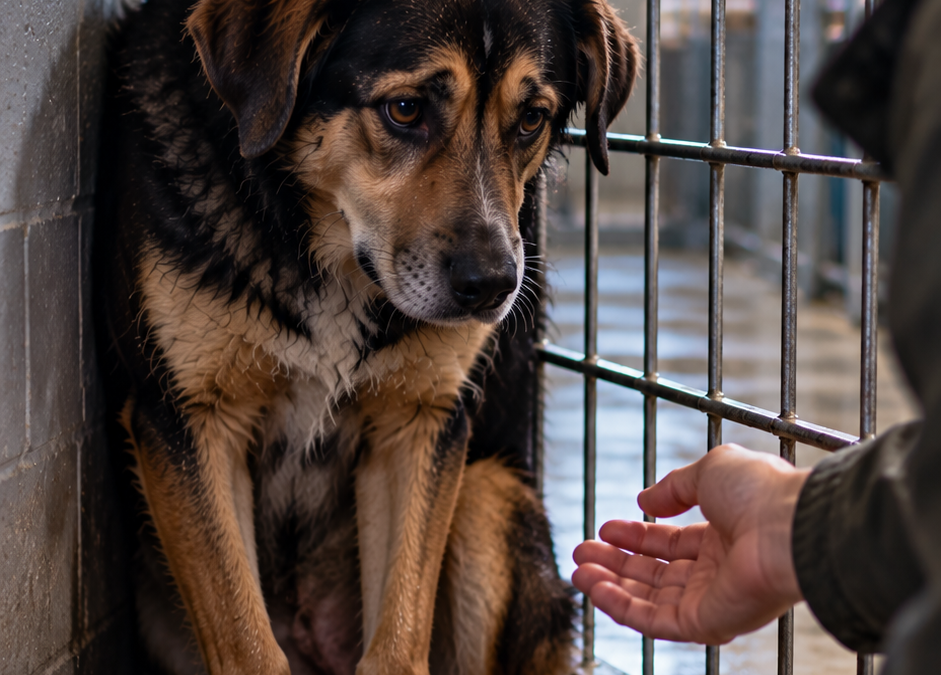
I sat on the floor outside the kennel.
Not directly in front.
Slightly to the side.
For several minutes, nothing happened.
Dogs barked around us.
A volunteer rolled a cart past.
Teddy flinched at the squeak of one wheel.
I wanted to say something.
Instead, I waited.
After perhaps ten minutes, he moved his head.
Just slightly.
Enough to look at me.
I did not smile broadly.
Did not reach.
I remembered what Carla had said.
Slow.
Quiet.
No pressure.
“Hi, Teddy.”
His ear moved.
That was all.
I sat another ten minutes.
He never came closer.
Still, when Carla eventually asked, “Would you like to meet another dog too?” I shook my head.
“No.”
“You’re sure?”
“Yes.”
She looked at Teddy.
Then me.
“Why him?”
I didn’t have a logical answer.
“I don’t know.”
Carla nodded.
“Sometimes people do.”
I returned the next day.
Then the day after.
Each time, I sat.
Teddy never touched me.
On the fourth visit, he sniffed a treat after I placed it on the floor.
On the fifth, he ate it after I moved several feet away.
On the seventh, he took one while I remained nearby.
Carla told me not to interpret progress too quickly.
“Fearful dogs can move forward one day and backward the next.”
“I understand.”
“You say that now.”
“I really do.”
She gave me a look.
I would later understand exactly what she meant.
I brought Teddy home two weeks after our first meeting.
The adoption staff gave me more instructions than I had expected.
Use a quiet room.
Limit visitors.
No forced affection.
Do not drag him from hiding places.
Allow him to approach first.
Avoid standing over him.
Keep routines predictable.
Use a leash outside even in a fenced yard at first.
Watch his body language.
Give him time.
“How much time?” I asked.
Carla smiled.
“That depends on Teddy.”
“Days?”
“Maybe.”
“Weeks?”
“Possibly.”
“Months?”
She hesitated.
“Yes.”
I tried not to react.
She touched my arm.
“Don’t measure the relationship against what you imagined.”
That sentence made little sense to me then.
It would later become one of the most important things anyone said.
The drive home was silent.
Teddy sat in a crate behind the passenger seat.
He did not whine.
Did not bark.
Did not scratch.
He simply remained pressed against the far side.
When we reached the house, I opened the crate.
Teddy did not move.
I waited.
Five minutes.
Ten.
Eventually, he stepped out.
One paw.
Then another.
He crouched low.
His nose moved rapidly.
Every sound made his ears twitch.
A car door across the street.
A bird.
My keys.
When I accidentally dropped them, Teddy jumped backward so hard he struck the side of the car.
“Oh God.”
I froze.
“I’m sorry.”
His entire body trembled.
My first instinct was to reach toward him.
I stopped myself.
“It’s okay.”
He stared.
I lowered my voice.
“No one’s going to hurt you.”
He had no reason to believe that.
Not yet.
Inside, I had prepared the spare bedroom for him.
Dog bed.
Water.
Food.
Blankets.
A crate with the door permanently open.
A stuffed rabbit the shelter sent home because they said he occasionally carried it when no one was watching.
Teddy entered the room cautiously.
He circled.
Sniffed.
Then crawled behind the armchair.
That became his place.
For the first three days, I saw very little of him.
He came out to eat when I left the room.
If I entered, he retreated.
At night, I could hear him moving.
Tap.
Tap.
Tap.
The soft sound of claws on hardwood.
I lay in bed listening.
Sometimes he walked down the hallway.
Sometimes he stood outside my bedroom.
I could tell from the silence.
Then he would turn around and return to the spare room.
The first week, I was optimistic.
I celebrated everything.
“He ate while I was in the kitchen,” I told my sister over the phone.
“That’s good.”
“He drank water before I left the room.”
“Also good.”
“He looked at me for almost two seconds.”
She laughed.
“I’m proud of both of you.”
“So am I.”
I meant it.
Every tiny movement felt like evidence that we were getting somewhere.
The first time Teddy took food from my hand, I nearly cried.
I sat on the kitchen floor.
He stood six feet away.
I held a small piece of chicken between my fingers.
Teddy stared.
“You don’t have to.”
He sniffed.
One step.
Then back.
I kept my arm still.
Another step.
His body remained low.
He stretched his neck.
His lips barely touched my fingers.
Then the chicken disappeared.
Teddy jumped backward.
But he had taken it.
I whispered, “Good boy.”
His ears moved.
I sat there smiling like someone had given me a trophy.
That was week one.
By week two, optimism became harder.
Teddy still did not play.
I bought toys.
Soft toys.
Rope toys.
Balls.
Puzzle feeders.
Squeaky animals.
He ignored all of them.
I tried rolling a ball gently across the floor.
Teddy watched it pass.
I tried placing treats inside the puzzle toy.
He waited until I left before touching it.
The stuffed rabbit from the shelter stayed in his room.
Sometimes I found it moved in the morning.
But Teddy would never touch it in front of me.
More painful was sleep.
He refused to sleep near me.
During the day, if I worked at the dining table, he might eventually lie in the hallway where he could see me from a distance.
If I stood, he stood.
If I approached, he left.
At night, he waited until I went to bed.
Then I heard him moving through the house.
Tap.
Tap.
Tap.
Sometimes I opened my bedroom door wider.
He never entered.
I bought a second dog bed and placed it near the foot of mine.
Nothing.
I moved it into the hallway.
Nothing.
I tried sleeping on the couch.
Teddy remained across the room.
Always watching.
Always ready.
I knew I wasn’t supposed to take it personally.
I had read everything.
Fearful dogs require time.
Trust cannot be forced.
Decompression.
Thresholds.
Triggers.
Consent-based handling.
Positive reinforcement.
I knew the vocabulary.
But knowledge did not stop emotion.
At night, the questions came.
What if I wasn’t good for him?
What if someone else would be better?
What if he disliked me specifically?
What if my house reminded him of something terrible?
What if my voice was wrong?
My movements?
My smell?
What if I was making him miserable by insisting this should become his home?
The rational part of me understood Teddy had been there only two weeks.
The emotional part had expected something.
A tail wag.
A moment of relief.
Some sign that choosing me had made his life better.
That expectation shamed me.
Because adoption was supposed to be about Teddy.
Not about making me feel loved.
Still, feelings are rarely impressed by what they are supposed to do.
On day fourteen, I sat on my kitchen floor after Teddy walked away from me for the third time that evening.
I cried.
Quietly.
Not because he had done anything wrong.
Because I felt helpless.
Teddy stood in the hallway.
He watched me.
I turned my face away.
“I know.”
My voice shook.
“This isn’t your problem.”
He remained still.
“I’m trying not to make this about me.”
I wiped my face.
“You don’t owe me anything.”
Teddy blinked.
I laughed bitterly.
“I know that too.”
He walked away.
I cried harder.
The next morning, I called Carla.
“I think I’m failing him.”
“You’re not.”
“You don’t know that.”
“What happened?”
“Nothing.”
“Exactly.”
I almost became angry.
“That’s the problem.”
“No.”
Her voice remained calm.
“Nothing bad happened?”
“No.”
“Did he eat?”
“Yes.”
“Drink?”
“Yes.”
“Go outside?”
“Yes.”
“Any aggression?”
“No.”
“Any destructive behavior?”
“No.”
“Then what happened?”
I looked toward the hallway.
Teddy was lying near the spare room.
“He still doesn’t want me.”
Carla was silent for a moment.
Then she said, “You’re interpreting distance as rejection.”
“What else am I supposed to think?”
“Think that distance has kept him safe before.”
That stopped me.
She continued.
“Whatever Teddy learned before he came to us, he learned that people required caution.”
I sat down.
“He doesn’t know you’re different yet.”
“It’s been two weeks.”
“To you.”
“What does that mean?”
“You know your intentions.”
“Teddy doesn’t.”
Her voice softened.
“For him, two weeks may be fourteen days of collecting evidence.”
“Evidence?”
“That you don’t yell.”
“That you don’t hit.”
“That food arrives every day.”
“That doors open.”
“That hands stop when he moves away.”
I closed my eyes.
“He is watching you.”
“Yes.”
“All the time.”
“Yes.”
“Then why does it feel like he’s not connecting?”
“Because you’re looking for affection.”
I said nothing.
“And he may be looking for safety first.”
That hurt because it was true.
“What should I do?”
“Exactly what you’re doing.”
“That feels like nothing.”
“Sometimes nothing is the work.”
After we hung up, I sat with that sentence.
Sometimes nothing is the work.
So I stopped chasing milestones.
Or tried to.
I maintained routine.
Breakfast at seven.
Morning walk at seven thirty.
No forced touching.
Work.
Evening walk.
Dinner.
Quiet.
I spoke to Teddy without expecting a response.
“Coffee?”
No reaction.
“Terrible weather.”
Nothing.
“You know, you could at least pretend I’m interesting.”
His ear moved once.
“Thank you.”
Three days later, he let me scratch behind his ear.
Three seconds.
Maybe four.
Then he stepped away.
I let him.
“Okay.”
I did not follow.
That evening, he stood closer while I cooked.
The next morning, when I returned from taking out the trash, he lifted his head.
Just for one second.
But he had noticed my return.
I kept that moment like a secret gift.
By the beginning of week three, Teddy and I had created a strange companionship.
We occupied the same house.
We respected boundaries.
I fed him.
Walked him.
Protected his quiet.
He watched me.
Sometimes from the hallway.
Sometimes from behind furniture.
Occasionally from the doorway of my office.
But he still did not play.
Still did not sleep near me.
Still rarely sought touch.
I thought I had accepted it.
Then the storm came.
It started after midnight.
Not gradually.
One moment the night was quiet.
The next, rain struck the windows hard enough to wake me.
I opened my eyes.
The room flashed white.
Thunder followed several seconds later.
Deep.
Long.
The kind that seems to roll through the foundation of a house.
I pulled the blanket higher.
Then I heard something.
Tap.
Tap.
Tap.
Teddy.
I lay still.
Another flash.
For an instant, the bedroom was illuminated.
I saw nothing.
Darkness returned.
Then thunder.
Closer.
The sound made the windows tremble.
I heard claws scrape the floor.
I sat up slightly.
“Teddy?”
No response.
I waited.
Lightning flashed again.
This time I saw him.
He was standing beside the bed.
I almost gasped.
For three weeks, Teddy had never entered my bedroom while I was awake.
Not once.
Now he stood perhaps two feet from me.
His entire body was shaking.
Not lightly.
Violently.
His ears were pressed flat against his skull.
His tail was tucked so tightly beneath his body that I could barely see it.
His legs were bent.
Every muscle seemed prepared to flee.
“Teddy.”
His eyes met mine.
Really met mine.
That was the first time.
Before then, eye contact had always been brief.
Sideways.
Interrupted.
Now he stared directly at me.
The look broke something inside my chest.
There was no distance in it.
No indifference.
No dislike.
Only fear.
Ancient fear.
I cannot say exactly what happened to Teddy before the shelter.
I do not know.
I will never know.
But in that moment, his body told me enough.
The thunder was not merely loud to him.
It was familiar in some terrible way.
Maybe it reminded him of shouting.
Doors slamming.
Objects falling.
Maybe someone had hurt him during storms.
Maybe noise itself had once predicted pain.
I do not know.
What I know is that Teddy looked at me as though he had reached the edge of everything he understood about survival.
Stay alone.
Or approach a human.
Both choices frightened him.
Lightning filled the room again.
Thunder followed immediately.
Teddy collapsed toward the floor.
Not falling.
Shrinking.
His chest nearly touched the wood.
His head dropped.
His body curved inward.
He was trying to become smaller.
Invisible.
I almost reached for him.
Every instinct screamed to comfort him.
Then I remembered.
Hands could be terrifying too.
I stopped.
“Teddy.”
He looked up.
“It’s okay.”
The words were useless.
A frightened nervous system does not respond to explanations.
I stayed still.
Another thunderclap.
Teddy shuddered.
His claws slid against the floor.
Something inside me changed.
For three weeks, I had wanted Teddy to choose me.
That night, for the first time, I realized how much that choice might cost him.
He was not deciding whether to cuddle.
He was deciding whether getting close to me was safer than facing terror alone.
I slowly moved one arm.
Teddy’s body tightened.
I stopped.
Waited.
His eyes remained fixed on me.
Then, with the smallest motion, I lifted the edge of the blanket beside me.
That was all.
I did not call him.
Did not pat the mattress.
Did not say, “Come here.”
I simply made an opening.
A warm space beside my legs.
Available.
Nothing more.
Teddy stared.
Rain hammered the window.
Wind pushed against the house.
Lightning flashed.
In that blue-white light, I saw him take one step.
Then stop.
My heart pounded so hard I was afraid he could hear it.
Another step.
Stop.
His nose lifted.
He sniffed the air.
I forced myself to breathe slowly.
In.
Out.
No sudden movement.
Teddy came closer.
At the edge of the mattress, he stopped again.
The bed was not high.
Perhaps two feet from the floor.
But the distance between us felt enormous.
He looked at the blanket.
Then me.
Then the door.
Escape route.
Always the door.
Another rumble rolled across the sky.
Teddy flinched.
His front paw lifted.
Touched the mattress.
Then dropped.
I wanted so badly to help.
I did nothing.
Sometimes love is movement.
Sometimes it is refusing to move.
Teddy tried again.
One paw.
Then another.
His front half rose onto the mattress.
His back paws slipped.
He panicked.
For a second, I thought he would run.
Instead, he scrambled.
Claws caught the blanket.
He pulled himself up.
Then froze.
He was on the bed.
My chest tightened so sharply I had to swallow.
Teddy stood near my feet.
Body rigid.
He looked ready to jump down.
I remained still.
Seconds passed.
Then he turned in one tight circle.
Curled into the smallest possible ball.
His face pointed toward the bedroom door.
His back faced me.
Not trust.
Not completely.
But proximity.
He had chosen proximity.
Thunder shook the windows.
Teddy’s whole body trembled.
I could feel it through the mattress.
I did not touch him.
Not yet.
He stayed.
That was enough.
Minutes passed.
Maybe ten.
Maybe twenty.
Time became strange.
The storm filled everything.
Rain.
Thunder.
Wind.
Teddy’s fast breathing.
My own.
His body never relaxed.
He was physically beside me but emotionally still standing at the edge of escape.
I slowly lowered the blanket.
An inch.
Pause.
Another inch.
Pause.
Until the fabric rested lightly across his back.
Teddy stiffened.
I stopped.
His head lifted.
He looked over his shoulder at me.
I held still.
“It’s okay.”
His eyes stayed on me.
Then slowly, very slowly, his head lowered again.
I covered no more than half his body.
Enough warmth.
Enough space to leave.
We stayed like that.
At some point, my leg went numb.
I did not move.
Lightning flashed less often.
Thunder grew more distant.
The rain softened.
But Teddy continued trembling.
I began to understand that the storm outside had probably stopped being the only storm in the room.
His body was still fighting something older.
Something remembered.
I wished I could tell him that.
I wished I could explain that nobody was coming through the door.
Nobody would yell.
Nobody would drag him away.
Nothing in my house required him to shrink.
But all I could offer was evidence.
Quiet.
Stillness.
Time.
Teddy’s breathing slowly changed.
At first, barely.
The gasping spaces between breaths grew longer.
His shoulders lowered.
The trembling came in waves instead of continuously.
Then less often.
I watched.
Waited.
Minutes passed.
Eventually he sighed.
A small sound.
Almost nothing.
But I knew that sound.
Every dog owner knows it eventually.
The full-body exhale that says, for this moment, I am putting my weight down.
Teddy’s head sank onto the blanket.
His eyes remained open.
Then half closed.
Then opened again when thunder sounded far away.
But he did not leave.
I whispered, “You can stay.”
His ear moved.
“I won’t touch you.”
His eyes closed.
“I promise.”
I do not know whether he understood my voice.
Maybe only the tone.
Maybe nothing.
What mattered was what happened next.
Teddy slept.
Not immediately.
Not deeply at first.
His body twitched.
His eyes opened every few minutes.
But sometime near three in the morning, his breathing became slow.
Regular.
Deep.
I stared into the darkness.
Teddy had fallen asleep in my bed.
I began crying.
Silently.
Tears moved down my face and into my hair.
For three weeks, I had imagined this moment as proof that Teddy loved me.
Now it felt like something much more serious.
He had trusted me with sleep.
Sleep is vulnerability.
A frightened animal cannot monitor a room while deeply asleep.
Cannot watch hands.
Doors.
Footsteps.
Cannot run immediately.
Teddy had spent three weeks refusing that vulnerability near me.
Now he was sleeping.
I stayed awake almost the entire night.
Not because I wanted to.
Because I was afraid movement might break the trust forming beside me.
At some point, Teddy changed position.
His body uncurled slightly.
One hind leg stretched.
Then another.
He moved closer.
Only a few inches.
But enough that his back touched my foot.
I smiled into the dark.
“That’s okay.”
He slept.
The storm ended before dawn.
When I finally drifted off, the rain had softened to occasional drops against the window.
I woke because my left hand was numb.
At first, I did not remember why.
Morning light filled the room.
Soft.
Golden.
The air smelled like wet earth through the cracked window.
I tried moving my fingers.
Couldn’t.
Then I looked down.
Teddy was sleeping on my arm.
Not near my feet.
Not at the edge of the mattress.
Beside me.
His head rested across my wrist.
One paw lay over my forearm as though he had placed it there deliberately.
His body was loose.
Completely loose.
His mouth opened slightly with every breath.
One ear twitched in sleep.
He looked younger.
Without tension pulling at every muscle, his face changed.
I could suddenly imagine him as a puppy.
Before whatever happened.
Before fear became habit.
I lay perfectly still.
My shoulder hurt.
My hand was numb.
My bladder was becoming an emergency.
I did not care.
Teddy was asleep beside me.
For the first time in three weeks, he was not listening for danger.
I watched his chest rise.
Fall.
Rise.
Fall.
And suddenly all my questions from the previous weeks seemed embarrassing.
Why doesn’t he love me?
Why won’t he play?
What am I doing wrong?
The answer had never been about affection.
Teddy had not been evaluating whether I was lovable.
He had been evaluating whether I was safe.
Those are not the same test.
A dog can want kindness and still fear the hand offering it.
A dog can want companionship and still choose isolation because isolation once prevented pain.
Teddy had not been cold.
He had been careful.
He had not been rejecting me.
He had been surviving.
And for three weeks, while I thought nothing was happening, he had been watching.
Every bowl of food.
Every door I opened instead of closed.
Every time I stopped reaching when he backed away.
Every time I lowered my voice instead of raising it.
Every night I allowed him to remain across the room.
Every morning I appeared again.
He had been collecting evidence.
Carla had been right.
Fourteen days of evidence.
Then twenty-one.
The storm did not create trust.
It revealed what had been quietly growing.
I finally moved around eight.
Not by choice.
My body demanded it.
I carefully shifted.
Teddy’s eyes opened.
He lifted his head.
For one second, panic flashed across his face.
Then he saw me.
His body remained still.
“Morning.”
His ears moved.
“Did you sleep?”
Teddy blinked.
“I didn’t.”
His tail moved.
Once.
I stopped.
There it was.
A tail wag.
Tiny.
Almost insulting after the night I had endured.
I laughed.
“Seriously?”
Another wag.
I covered my mouth because suddenly I was crying again.
Teddy sat up.
He looked uncertain.
I wiped my face.
“No, no. Good crying.”
That explanation was equally useless.
Teddy leaned forward.
His nose touched my hand.
Then he licked my knuckle.
Once.
I froze.
He did it again.
“Teddy.”
His tail moved.
I lowered my forehead toward him but stopped before touching.
Teddy closed the remaining distance.
His forehead pressed against mine.
That was the first time he chose contact.
I cried into his fur.
Not loudly.
I did not hug him.
Not yet.
I simply let our heads rest together.
“Thank you.”
It was probably a strange thing to tell a dog.
But that was what I felt.
Thank you for trying again.
Thank you for risking me.
Thank you for believing, even temporarily, that I might be different.
The next night, I assumed Teddy would return to his room.
Trauma does not disappear because of one successful night.
I understood that.
I prepared myself.
At ten thirty, I went to bed.
Teddy stood in the hallway.
I lifted the blanket slightly.
No words.
He stared.
Then walked into the bedroom.
No trembling.
No storm.
At the bed, he hesitated only a few seconds.
Then jumped.
This time he curled near my feet.
I smiled.
“Your choice.”
He slept.
Two nights later, he climbed up before I even lifted the blanket.
By the end of the week, he had claimed the bottom right corner.
I considered that progress.
Then one morning I woke to discover his head on my pillow.
“You have boundaries.”
Teddy stared at me.
“This is my pillow.”
His tail moved.
“Unbelievable.”
I bought another pillow.
He took that one too.
Sleep changed first.
Play came later.
A week after the storm, I returned from work and found Teddy standing in the living room.
The gray stuffed rabbit lay beside him.
The one from the shelter.
He had carried it around only when I wasn’t watching.
I set my bag down.
“Hey.”
Teddy looked at the toy.
Then at me.
I crouched.
He picked up the rabbit.
My chest tightened.
Teddy walked forward.
Slowly.
Placed it on the floor several feet from me.
Then backed away.
I stared.
“Do you want me to…”
He looked at the rabbit.
I reached for it.
Teddy’s body tensed.
I stopped.
Then moved slower.
Picked up the toy.
“Okay.”
I rolled it gently across the floor.
Teddy watched.
For one second, nothing happened.
Then he ran.
Not far.
Not fast.
But he ran after it.
I gasped.
Teddy grabbed the rabbit.
His tail started moving.
Not once.
Not twice.
Wagging.
Actually wagging.
He turned toward me.
I laughed.
“Oh my God.”
Teddy froze at the volume of my voice.
I immediately softened.
“Sorry.”
He remained still.
I sat.
Waited.
After a few seconds, he carried the rabbit back.
Closer this time.
Dropped it.
That was the first game we ever played.
It lasted perhaps four minutes.
Then Teddy became overwhelmed and took the rabbit to his room.
I did not follow.
I sat on the floor and cried.
Again.
Apparently adopting Teddy turned me into a person who cried over everything.
Three days later, we played again.
Then again.
Soon the rabbit began appearing everywhere.
Kitchen.
Bedroom.
Bathroom.
Once inside my laundry basket.
Teddy started developing opinions.
That was when I knew he was healing.
At the shelter, he had seemed almost personality-less because fear had consumed all available space.
As safety grew, Teddy emerged.
He was stubborn.
He hated carrots.
Loved chicken.
Distrusted the vacuum cleaner.
Despised rain unless wearing a coat, which was ironic considering the storm that changed us.
He had a particular hatred of the mail carrier’s truck but loved the mail carrier himself.
He stole socks but never chewed them.
He simply collected them beneath my desk.
The first time I found the pile, I stared.
“Teddy.”
He appeared in the doorway.
“Why?”
Tail wag.
“These are mine.”
He sat.
“You cannot create a sock archive.”
Head tilt.
I laughed.
He ran away with another sock.
The emotional changes were slower.
Strangers still frightened him.
Men especially.
If someone moved too quickly, Teddy retreated.
Loud voices caused him to leave the room.
Thunder remained difficult.
The second storm after that first night, Teddy climbed into bed before the rain even began.
I was reading.
He jumped beside me.
Curled against my hip.
I put the book down.
“You heard it coming?”
A distant rumble answered.
Teddy’s body tightened.
This time, I placed my hand on the mattress beside him.
Not on him.
An option.
Teddy looked at it.
Then moved closer until his shoulder touched my palm.
I kept my hand there.
That became our storm ritual.
No restraint.
No forced hugging.
Just proximity.
Sometimes he wanted contact.
Sometimes only the open blanket.
I let him choose.
Months passed.
People who met Teddy later had trouble believing how withdrawn he had once been.
My sister came over one Saturday.
Teddy greeted her cautiously.
Then brought her the rabbit.
She stared.
“This is the dog who wouldn’t come out from behind a chair?”
“The same.”
Teddy dropped the toy.
My sister threw it.
He chased.
She looked at me.
“He seems normal.”
The word bothered me.
Not because she meant harm.
Because Teddy had always been normal.
Fear was not a defect.
It was a response.
A reasonable one, given whatever he had experienced.
“He is normal,” I said.
She looked surprised.
“You know what I mean.”
“I do.”
Teddy returned with the rabbit.
I scratched behind his ear.
“He was always in there.”
My sister smiled.
“Fair.”
That night, I thought about the phrase.
He was always in there.
It changed how I understood rescue.
People like stories where damaged animals transform under love.
Before.
After.
Sad shelter photo.
Happy couch photo.
Fearful dog.
Confident dog.
But Teddy taught me that transformation is rarely that clean.
He did not become a different dog.
Safety allowed more of him to become visible.
The playful Teddy was not created by me.
The affectionate Teddy was not my achievement.
The dog who slept on my pillow had always been capable of attachment.
Fear had simply made attachment too expensive.
I had not fixed him.
I had waited long enough for him to decide he didn’t need to protect himself from me anymore.
That distinction mattered.
It still does.
About six months after the adoption, Carla called.
“How’s Teddy?”
I smiled.
“Stealing socks.”
“That good?”
“Terrible criminal.”
“Sleeping?”
“On my pillow.”
She laughed.
“Playing?”
“Constantly.”
“Good.”
I hesitated.
“Can I ask you something?”
“Sure.”
“Do you know anything more about where he came from?”
Silence.
“A little.”
My stomach tightened.
“What?”
“We didn’t tell you before because nothing was confirmed.”
“I understand.”
“He was found behind a vacant property.”
I closed my eyes.
“Alone?”
“Yes.”
“Condition?”
“Underweight. No major injuries.”
“What about…”
I struggled.
“Abuse?”
Carla was quiet.
“There were signs that made the staff concerned.”
“What signs?”
“His reactions.”
“That’s not proof.”
“No.”
She paused.
“He also had old marks around his neck.”
My hand tightened around the phone.
“From a collar?”
“Possibly.”
“What else?”
“That’s all I know.”
I stared across the room.
Teddy was sleeping in sunlight.
One paw over his nose.
Peaceful.
I realized I did not need details.
Sometimes people think knowing the exact cruelty helps make sense of fear.
It doesn’t.
Pain is not more legitimate when documented.
Teddy’s body already told me he had reasons.
I did not need a story gruesome enough to justify patience.
“Thank you.”
After the call, I sat beside him.
Teddy opened one eye.
“I know a little more about you.”
His tail moved without his head lifting.
“Not much.”
I scratched his chest.
“And that’s okay.”
He closed his eye.
The past belonged to Teddy.
He could not tell it.
I could not rewrite it.
What I could do was make sure the future did not resemble it.
That became enough.
The first anniversary of his adoption arrived on another gray October day.
I had forgotten the date until my phone showed me an old calendar reminder.
TEDDY HOME DAY.
I looked at him.
He was upside down on the couch.
Legs open.
Head hanging over the edge.
Completely undignified.
“You used to be mysterious.”
Teddy sneezed.
“Now look at you.”
His tail hit the cushion.
I made him scrambled eggs for breakfast.
He received a new stuffed toy because the rabbit had finally lost most of one ear.
He refused the new toy and carried the damaged rabbit all day.
Some loyalties cannot be bought.
That evening, rain began.
Not a storm.
Just steady rain.
I went to bed.
Teddy followed.
He jumped onto the mattress.
Turned.
Then settled with his back against my chest.
I rested one hand lightly along his side.
His breathing slowed almost immediately.
I thought about that first night.
How terrified I had been to move.
How small he had made himself.
How his body trembled beneath the blanket.
I whispered, “You came to me.”
Teddy’s ear moved.
“I thought I saved you.”
I smiled in the dark.
“But you were the brave one.”
He sighed.
Maybe that sounds sentimental.
Maybe it is.
But courage is not the absence of fear.
Teddy taught me that more clearly than any person ever had.
He was afraid of me.
And still took chicken from my hand.
Afraid of the hallway.
Still came closer.
Afraid of the bedroom.
Still entered.
Afraid of touch.
Still placed his head on my arm.
Every act of trust happened while fear remained.
That is courage.
Not my waiting.
His trying.
People often ask when Teddy “finally trusted” me.
They expect a date.
I usually mention the storm.
But the truth is more complicated.
Trust was not one moment.
The storm was only the first moment I recognized it.
Trust began when Teddy ate food while I was still in the room.
When he turned his back on me for two seconds.
When he slept in the hallway.
When he accepted touch behind one ear.
When he came into the bedroom.
When he climbed onto the bed.
When he stayed.
When he slept.
When he returned the next night without thunder forcing the choice.
When he brought me the rabbit.
When he wagged at the sound of my key.
When he began sleeping with his stomach exposed.
When he stopped waking every time I stood.
Trust accumulated.
Layer by layer.
Evidence by evidence.
That is the part I wish more people understood about fearful animals.
They are not withholding love to punish us.
They are not ungrateful.
They do not owe instant joy because the new house is objectively better than the old situation.
Safety does not become believable the moment a door closes behind them.
Sometimes their bodies are still living in a place they have already escaped.
Teddy’s body took time to arrive.
I had to wait for it.
There were setbacks.
Of course there were.
One afternoon, I dropped a baking sheet in the kitchen.
The crash was enormous.
Teddy ran.
Not just into the next room.
He hid behind the spare-room chair.
The old place.
I found him crouched there.
Heart racing.
For a moment, I felt devastated.
Months of progress.
Gone.
That was my first thought.
Then I caught myself.
Progress was not gone.
Fear had been triggered.
Those were not the same thing.
I sat outside the room.
Did not approach.
“Teddy.”
No response.
“It’s okay.”
I waited.
After fifteen minutes, he appeared.
He stopped in the doorway.
I held out my hand.
Teddy crossed the room.
Placed his head under it.
My eyes filled.
Recovery is not never being afraid again.
Sometimes it is knowing where to go after fear returns.
That day, Teddy came to me.
That was the progress.
Another time, a man in a baseball cap approached us too quickly during a walk.
“Can I pet him?”
Before I answered, the man reached.
Teddy recoiled.
The man laughed.
“Skittish, huh?”
I stepped between them.
“Please don’t.”
“Oh, I’m good with dogs.”
“Teddy said no.”
The man looked offended.
“He’s just a dog.”
“Yes.”
I shortened the leash and walked away.
My hands shook afterward.
Not from fear.
Anger.
Before Teddy, I might have worried about appearing rude.
Now I understood advocacy differently.
My dog did not have language people respected.
I did.
If he moved away, the answer was no.
Simple.
Teddy looked up at me.
“Did I embarrass you?”
Tail wag.
“Good.”
We kept walking.
The second year was easier.
Not perfect.
Easy enough.
Teddy developed routines.
Morning coffee meant he lay under the table.
Work calls meant he slept beneath my desk.
Five thirty meant dinner.
Six meant walk.
Nine thirty meant he stared at me until I admitted it was bedtime.
“You have a schedule.”
Head tilt.
“I am an adult.”
Stare.
“I can stay up.”
Stare.
“Fine.”
I went to bed.
Teddy followed.
I began dating someone named Mark.
That introduced another challenge.
Teddy was still cautious with men.
The first time Mark came over, Teddy disappeared into the spare room.
Mark looked toward the hallway.
“Should I say hello?”
“No.”
“Really?”
“Let him decide.”
Mark nodded.
That response mattered.
He sat on the couch.
Did not look toward Teddy.
We watched a movie.
Halfway through, Teddy appeared.
He stood in the hallway.
Mark whispered, “He’s there.”
“I know.”
“Do I move?”
“No.”
Teddy watched.
Then walked closer.
Mark kept his hands in his lap.
Teddy sniffed his shoe.
Then retreated.
Mark smiled.
“I’ve been inspected.”
“Don’t get excited.”
The next visit, Teddy stayed in the room.
The third, he accepted a treat.
The fifth, he lay several feet from Mark.
Months later, he placed his head on Mark’s knee.
Mark looked at me with panic.
“What do I do?”
“Nothing.”
“My leg is numb.”
“Congratulations.”
“He’s heavy.”
“Trust is inconvenient.”
Mark endured it.
Teddy slept.
I loved them both a little more after that.
The relationship with Mark eventually ended for ordinary reasons.
No cruelty.
No drama.
Different futures.
But he remained careful with Teddy until the last visit.
When he left, he crouched several feet away.
“Bye, buddy.”
Teddy walked over.
Sniffed his hand.
Mark looked at me.
“That feels bigger than it should.”
“It is.”
Teddy taught people patience simply by requiring it.
Years passed.
His muzzle lightened.
My life changed.
Jobs.
Friends.
A move to a slightly larger house.
Teddy hated the move.
For the first two nights, he slept pressed against me.
Old uncertainty.
New walls.
New sounds.
I did not interpret it as failure.
We returned to what worked.
Routine.
Predictability.
Open blanket.
By the third week, Teddy owned the place.
Especially the patch of sunlight near the back door.
I sometimes thought about the woman I had been during those first weeks.
The woman lying awake asking why her dog would not love her.
I felt tenderness toward her.
And embarrassment.
She did not understand yet.
Love was already happening.
It just did not look like what she expected.
I was feeding him.
He was watching me.
I was giving distance.
He was staying.
I was returning every day.
He was slowly choosing not to hide.
We were building something without realizing it.
One winter, years after the adoption, another severe storm arrived.
Weather alerts sounded all afternoon.
By evening, wind was bending the trees.
Teddy was older then.
Gray around the eyes.
Slower getting onto the bed.
Thunder began around ten.
I was in the living room.
Teddy walked toward me.
He was trembling.
Not as violently as that first storm.
But enough.
I sat on the couch.
Lifted the blanket.
Exactly as I had years before.
No command.
No invitation.
Just space.
Teddy looked.
Then climbed beside me.
This time he did not curl at the far end.
He pressed directly against my side.
I covered him.
My hand rested on his chest.
Thunder sounded.
His heartbeat accelerated.
I whispered, “I’m here.”
He looked up.
Then lowered his head into my lap.
We sat through the storm.
No breakthrough.
No transformation.
Just companionship.
I realized then that trust does not mean fear vanishes.
Trust means fear no longer has to be faced alone.
That may be the most honest definition I know.
Teddy grew old.
Slowly.
Then suddenly.
That is how dogs age.
One year you notice more gray.
Then one morning stairs become harder.
Then walks shorten.
Then the veterinarian uses words like arthritis.
Teddy never stopped sleeping with me.
Eventually, I bought a low bed frame because jumping became difficult.
He still insisted on the pillow.
“You are seventy in dog years.”
Teddy looked at me.
“You should have dignity.”
He stretched across both pillows.
“Apparently not.”
The stuffed rabbit survived everything.
Barely.
By Teddy’s tenth year with me, it was mostly fabric and stitches.
I had repaired it so many times that little of the original toy remained.
One evening, Teddy carried it toward the bed.
Dropped it beside me.
I picked it up.
“You know this thing is disgusting.”
Tail wag.
“It’s older than some marriages.”
Teddy rested his head on my knee.
I looked at the rabbit.
Then him.
That toy had been in the shelter.
It belonged to the Teddy who hid behind an armchair.
The Teddy who played only when nobody watched.
The Teddy who carried comfort secretly.
Eventually he had handed it to me.
Maybe that was what love had been all along.
Not possession.
Sharing what we once protected alone.
Teddy died at home many years after that storm.
Not suddenly.
Not tragically.
Old age.
His body slowed.
His appetite faded.
The veterinarian helped me understand when comfort had begun giving way to exhaustion.
I hated every conversation.
I wanted more time.
Everyone does.
But Teddy had taught me something about not forcing closeness.
That lesson applied at the end too.
Love cannot always mean stay.
Sometimes it means I will not ask you to endure pain because I am afraid of losing you.
His last morning was bright.
No storm.
Sunlight through the window.
Teddy lay on my bed.
His bed, really.
I had stopped pretending otherwise years before.
The rabbit rested near his front paws.
I lay beside him.
My hand beneath his head.
Exactly as he had slept that first morning.
His breathing was shallow.
But calm.
I whispered, “Do you remember?”
Teddy’s eyes opened slightly.
“Of course you don’t.”
I smiled through tears.
“The storm.”
His ear moved.
“You came into my room.”
I stroked his face.
“I thought it meant you finally loved me.”
My voice broke.
“I was so stupid.”
Teddy’s eyes remained on mine.
“It meant you were scared.”
I swallowed.
“And you came anyway.”
His paw shifted.
Touched my wrist.
The same wrist.
I started crying.
“Thank you.”
For everything.
For choosing the bed.
For the rabbit.
For stolen socks.
For every storm.
For every morning he woke beside me.
For teaching me that patience is not passive.
It is something you give repeatedly with no guarantee of return.
For showing me that trust is not earned through grand gestures.
It is earned in ordinary moments when nothing bad happens.
Again.
Again.
Again.
The veterinarian came later that afternoon.
Teddy was peaceful.
I remained beside him.
My hand under his head.
The blanket open around us.
He was no longer trembling.
He had not trembled in years when I touched him.
That fact nearly undid me.
I whispered, “You’re safe.”
The words had been a promise once.
Now they were true.
“Teddy.”
He looked at me.
“I’m here.”
His breathing slowed.
I kept my hand exactly where it was.
He relaxed.
Then he was gone.
For a long time, I did not move.
My arm went numb.
Again.
Just like that first morning.
I almost laughed.
Even grief contained echoes.
Afterward, I kept the rabbit.
Of course I did.
It sits on a shelf now.
Ugly.
Patched.
One ear almost gone.
People sometimes ask why I keep it.
I say, “It belonged to my dog.”
That is true.
But incomplete.
It belonged to the first version of Teddy I knew.
The dog who loved privately.
The dog who played only when no one watched.
The dog who carried comfort into corners.
Then one day, he brought that comfort to me.
That old rabbit represents the distance between hiding and trusting.
Between surviving and resting.
Between watching from the doorway and sleeping with your head in someone’s hand.
Years after Teddy died, I adopted another dog.
Her name was June.
She was nothing like him.
Outgoing.
Noisy.
Ridiculously confident.
She entered my house and claimed the couch within twelve minutes.
The first night, she jumped on my bed without permission and slept across my legs.
I laughed.
“You have no idea how shocking this is.”
June snored.
Her immediate trust did not diminish Teddy’s slower trust.
If anything, it helped me understand how much effort Teddy’s had required.
June assumed kindness.
Teddy had needed proof.
Both were valid.
Both were love.
Sometimes, when storms come, I still wake.
Even now.
Thunder shakes the windows and for one confused second I expect to hear claws.
Tap.
Tap.
Tap.
Then I remember.
No Teddy.
No trembling figure beside the bed.
The room remains quiet.
I usually lift the edge of the blanket anyway.
A habit.
A memory.
A gesture to no one.
Then I think about that first storm.
The moment Teddy stood at the edge of my bed.
The way he stared at that small space between us.
Half a meter.
Maybe less.
To me, nothing.
To him, an ocean.
He crossed it.
That was his gift.
Not unconditional love.
People use that phrase too easily with dogs.
Teddy’s love was deeply conditional at first.
The condition was safety.
Respect.
Time.
Consistency.
He needed evidence that love would not become danger.
And once he had enough evidence, he gave me everything.
Not because dogs are automatically forgiving.
Because Teddy made a choice.
Over and over.
To come closer.
To stay.
To sleep.
To play.
To trust.
I used to think I rescued a dog from a shelter.
Now I think the truth is less heroic and more meaningful.
I provided a place.
Food.
Patience.
Teddy did the difficult work.
He carried his fear into my house.
He studied me.
Tested the silence.
Watched my hands.
Learned my footsteps.
Memorized my voice.
Then one stormy night, when being alone became more frightening than taking a chance on me, he walked into my bedroom.
One step.
Then another.
He stood beside the bed shaking.
I opened the blanket.
And nothing happened for a long time.
That was the important part.
Nothing.
I did not grab him.
Did not call him.
Did not promise things he could not understand.
I simply left space.
Eventually, Teddy entered it.
Years later, I realized that was our entire relationship in miniature.
I did not pull him into my life.
I made room.
He decided when to come.
That is why I no longer believe patience means waiting passively for someone to become what you want.
Real patience is giving another living creature permission to remain exactly where they are while making it safe for them to move when they are ready.
Teddy taught me that.
Not with words.
With twenty-one quiet nights.
With one storm.
With one hesitant jump onto a bed.
With a trembling body under a blanket.
With a sigh in the darkness.
With a head resting on my numb hand when morning came.
That morning, I thought the story was about Teddy finally learning to love me.
I was wrong.
He had already wanted connection.
What he learned was that love did not have to hurt.
And what I learned was even harder.
Sometimes the greatest proof of love is not being chosen quickly.
It is becoming safe enough that someone who has every reason to run finally decides they can stay.
Teddy stayed.
For years.
And long after he was gone, that first night remained with me.
The rain.
The thunder.
The open blanket.
The space beside me.
And the frightened dog who looked into my eyes as if asking one question he could not say aloud.
Will you hurt me too?
I never answered with words.
I answered by staying still.
By leaving the space open.
By waiting.
And eventually, Teddy gave me his answer too.
He climbed into the bed.
He stayed until morning.
And from that night forward, little by little, he stopped living in my house as though he were waiting to disappear.
He began living there as though he had finally understood something I had been trying to tell him all along.
He was home.

