𝗙𝗨𝗟𝗟 𝗦𝗧𝗢𝗥𝗬 For Three Weeks, Lucky Stayed Awake Like He Was Waiting for Me to Disappear
𝗙𝗨𝗟𝗟 𝗦𝗧𝗢𝗥𝗬
I put food down.
He waited until I left the room before eating.
I offered treats.
He ignored them until they were on the floor.
I rolled the blue ball gently toward him.
He watched it pass.
No movement.
I squeaked the duck.
His entire body stiffened.
I stopped immediately.
“Sorry.”
I felt ridiculous apologizing to a dog.
But he looked frightened.
The bed I bought stayed untouched.
Instead, Lucky slept—if what he did could be called sleeping—on the floor near the window.
Except he did not really sleep.
He rested.
He lowered his head.
His body went still.
But his eyes stayed open.
At first, I assumed he was sleeping when I was not watching.
Then I noticed the nights.
The first time I woke at two in the morning and walked into the living room for water, Lucky was sitting upright near the window.
Dark room.
Moonlight across the floor.
His face pointed toward the driveway.
“Lucky?”
He looked at me.
Then back outside.
I returned to bed.
At 3:30, I checked again.
Same position.
The next night, he was awake.
The night after that too.
Sometimes he lay down.
Sometimes his eyes closed for a few seconds.
A sound outside would open them immediately.
A car door somewhere down the street.
Wind.
The refrigerator compressor.
A branch touching the window.
He listened to everything.
His whole body looked exhausted, yet some part of him refused to surrender to sleep.
By the end of the first week, I was worried.
He moved slowly.
His eyes looked tired.
He had faint dark shadows beneath them.
He would stand near his water bowl as if he had forgotten why he came there.
During the day, he stared through the window.
I started wondering who he was waiting for.
His old owners?
The rescue worker?
Someone else?
Maybe no one.
Maybe waiting itself was simply what he knew.
I bought a different bed.
Softer.
Lower.
I moved it beside his corner.
Nothing.
I placed my sweatshirt on it so it smelled like me.
He walked around it.
I tried calming music.
Soft piano.
Lucky stared outside.
I bought a white-noise machine.
He moved farther from it.
I warmed chicken.
He ate when I walked away.
I bought expensive treats.
He inspected them as if they were suspicious evidence.
I started talking to him more.
Not baby talk.
Just normal conversation.
“I’m making coffee.”
No response.
“I have a meeting in twenty minutes and I already hate it.”
One ear moved.
“That counts.”
Nothing.
“I’m going to take that as support.”
He watched the window.
Every small thing became important to me.
If he looked at me for three seconds instead of one, I noticed.
If he drank while I remained in the room, I noticed.
If he did not move away when I passed him, I noticed.
I had never realized how exhausting hope could become when measured in inches.
During the second week, friends started asking how things were going.
At first, I gave easy answers.
“He’s adjusting.”
“He’s shy.”
“He’s had a hard life.”
All true.
Then my friend Melissa came over.
Lucky moved to the far side of the living room the moment she entered.
He remained there the entire visit.
Melissa watched him.
“He doesn’t seem happy.”
The sentence hurt more than it should have.
“I know.”
“Has he always been this quiet?”
“Since I brought him home.”
“Maybe that’s just his personality.”
“Maybe.”
She hesitated.
“I’m not saying you should give up.”
The fact that she needed to say that made my chest tighten.
“What are you saying?”
“Just that sometimes rescue dogs have really deep issues.”
“I know.”
“And sometimes people take on more than they expected.”
I knew she was trying to help.
I still resented every word.
After she left, I sat on the floor.
Lucky was in his corner.
I looked at him.
“Everyone thinks I’m doing this wrong.”
His ears shifted.
“Maybe I am.”
Nothing.
“I don’t know what you need.”
He blinked once.
I laughed quietly.
“Very helpful.”
The nights were worst.
Not because Lucky made noise.
He did not.
Because I started waking just to check whether he had fallen asleep.
That became my own strange habit.
Midnight.
2:00.
4:00.
I would walk down the hallway and see him sitting in the dark.
Sometimes he was facing the door.
Sometimes the window.
Always listening.
I began leaving a small lamp on because the darkness made the whole scene feel too lonely.
One night, around the middle of the second week, I sat several feet from him.
I did not look directly at him.
I had read that staring could feel threatening.
So I faced the other way.
“Lucky.”
His collar moved softly when he turned.
“You’re safe here.”
I knew the words were meaningless to him.
Safe is not something you can explain.
Still, I said it.
“No one is putting you back outside.”
He shifted.
“You don’t have to wait.”
Nothing.
“I’m staying.”
That was the sentence that broke me.
Because even as I said it, I realized how impossible it was for him to believe me.
Why should he?
Someone had probably told him things before.
Maybe they had called his name affectionately.
Maybe they had filled his bowl.
Maybe they had scratched his ears.
Then they disappeared.
Dogs do not understand excuses.
Work.
Travel.
Emergencies.
Busy schedules.
They understand patterns.
Someone is here.
Then they are not.
Someone returns.
Then does not.
Someone walks through the gate.
Then the gate stays closed for hours.
Lucky’s entire history may have taught him that people vanish.
I could not erase that with a new bed.
During the third week, I took him to the veterinarian.
The examination itself was difficult.
Lucky trembled the entire time.
Not dramatically.
His legs simply shook.
The veterinarian, Dr. Harper, sat on the floor instead of lifting him immediately onto the table.
That alone made me trust her.
She watched him for several minutes.
Asked about his food.
Water.
Bathroom habits.
Movement.
Sleep.
When I explained that he barely seemed to sleep, she looked more concerned.
“Does he ever fully relax?”
“Almost never.”
“Dreaming? Leg movement? Deep breathing?”
“I haven’t seen any.”
“How long has this been happening?”
“Since I got him.”
“And you’ve had him three weeks?”
“Almost.”
She looked at Lucky.
He was watching the exam-room door.
“He may be staying hypervigilant.”
“What does that mean exactly?”
“His body may still believe it has to monitor his environment constantly.”
“Because of being left alone?”
“That can contribute.”
I swallowed.
“Is he afraid I’m going to leave?”
Dr. Harper chose her words carefully.
“I can’t tell you exactly what he thinks. But based on what you’re describing, he may not yet believe this environment is stable.”
I looked at him.
“So what do I do?”
“Stop trying to convince him.”
I looked back at her.
“What?”
“Show him.”
She explained that predictability mattered.
Routine.
Low pressure.
No forcing play.
No overwhelming him with attention.
Leave calmly.
Return calmly.
Feed at consistent times.
Walk at consistent times.
Let him choose proximity.
“He needs to discover that nothing bad happens when he relaxes.”
“How long?”
She smiled gently.
“That is the question everyone asks.”
“And?”
“He decides.”
I hated that answer.
Because I could not fix it.
I could only wait.
On the drive home, Lucky lay in the back seat but kept his head raised.
Watching every passing car.
Every turn.
Every stop.
At home, he returned immediately to his window.
I put his leash away.
Then stood in the kitchen.
For the first time since adopting him, I did nothing.
No toy.
No treat.
No cheerful invitation.
No attempt to turn the day into progress.
I made dinner.
Sat on the couch.
Read.
Lucky stayed across the room.
That became my strategy.
Or maybe my strategy became giving up on strategy.
I stopped trying to manufacture moments.
I stopped rolling balls toward him.
Stopped moving treats closer to my chair.
Stopped inviting him onto the couch.
I stopped measuring success by whether he behaved like the dog I had imagined.
I simply existed beside him.
Every morning, breakfast at seven.
Walk at seven-thirty.
Short route.
Same streets.
Then home.
Before leaving the house, I started telling him exactly what I was doing.
At first it felt foolish.
“Lucky, I’m going to the grocery store.”
He watched me put on my shoes.
“I’ll be back in twenty minutes.”
The first time, I came back in seventeen.
Then I sat in my car for three minutes because I had said twenty.
When I opened the door, Lucky was standing in the hallway.
Not wagging.
Not excited.
Just there.
“See?”
I put the grocery bag down.
“Twenty minutes.”
He stepped away.
The next day, I left for ten.
Came back in ten.
Then thirty.
Then fifteen.
No dramatic reunions.
No squealing.
No overexcited affection.
I came home.
Put down my keys.
Spoke quietly.
Every time.
“I’m back.”
I started reading aloud in the evenings.
Not children’s stories.
Whatever I was already reading.
News articles.
A novel.
Once, a painfully boring manual for a new coffee machine.
Lucky did not care about the words.
I think he cared about the sound.
My voice became background noise.
Something that existed without demanding anything from him.
Sometimes I sang while cooking.
Badly.
Lucky’s ears would move.
“I know.”
I looked at him.
“You don’t have to be rude.”
No response.
I started telling him about my day.
“The woman in front of me at the store had nineteen coupons.”
Lucky blinked.
“Nineteen.”
I chopped vegetables.
“She saved eleven dollars. I respect the commitment.”
One evening, he moved from his corner to the rug.
Not close to me.
Just closer than before.
I noticed immediately.
I pretended I had not.
That became another kind of discipline.
Not reaching for every improvement.
Not turning his courage into a demand.
Then came the night I nearly lost hope.
It had been a bad day.
Work problems.
Too many phone calls.
I had slept badly.
Lucky had barely eaten breakfast.
During our evening walk, a truck backfired two streets away.
He froze.
Then pulled hard enough against the leash that I thought he might slip his collar.
I crouched.
Did not touch him.
Waited.
It took almost ten minutes before he moved again.
When we got home, he went to his corner.
I went to the couch.
And suddenly I was tired of being patient.
Not with Lucky.
With myself.
With the feeling that I was constantly being evaluated by an animal who did not even know he was evaluating me.
I lay down on the couch.
Covered my face with one hand.
And cried.
Quietly.
I did not want Lucky frightened by the sound.
That thought made me cry harder.
I remember whispering,
“I don’t know how to help you.”
The room was dark except for the lamp beside the sofa.
I heard Lucky’s nails against the floor.
At first, I assumed he was going to the water bowl.
Then the sound came closer.
I lowered my hand.
Lucky stood beside the couch.
He was close enough that I could see the tiny pale hairs around his muzzle.
I did not move.
He looked at me.
Not at the door.
Not the window.
Me.
“Hi.”
My voice barely came out.
Lucky lowered his head.
For one second, I thought he would turn away.
Instead, he stepped closer.
Then slowly, carefully, as if the decision cost him something, he rested his head in my open hand.
I stopped breathing.
His head was heavier than I expected.
Warm.
His fur soft beneath my fingers.
I did not pet him.
I did not close my hand.
I was terrified that any movement would end the moment.
So I stayed still.
Lucky stood there.
Head in my palm.
For maybe one minute.
Maybe five.
Time felt strange.
Then he lowered himself onto the floor beside the couch without lifting his head from my hand.
I could feel his breathing.
Fast at first.
Then slower.
Slow enough that I started unconsciously matching it.
In.
Out.
In.
Out.
His eyes closed.
Opened.
Closed again.
I felt tears moving down my face.
I did not wipe them away.
That night, I barely moved.
My shoulder hurt.
My hand went numb.
I did not care.
Lucky did not stay asleep for long.
But for the first time, he had chosen contact.
Not because I bribed him.
Not because I called him.
Not because I moved toward him.
He came to me.
The next morning, nothing magical happened.
That mattered.
Lucky did not wake transformed.
He did not jump onto the bed.
He did not suddenly chase toys around the living room.
At breakfast, he still waited until I stepped away from the bowl.
On our walk, he still watched passing cars.
When a neighbor dropped a trash can lid, Lucky flinched.
Healing did not arrive like a switch.
But something had shifted.
Maybe only a fraction.
Still, it was real.
I told Dr. Harper what happened.
She smiled.
“That was a big choice for him.”
“I didn’t even touch him.”
“Exactly.”
I thought about that all day.
Exactly.
For weeks, I had believed love meant doing more.
More toys.
More treats.
More comfort.
More attention.
Lucky seemed to need something else.
Less pressure.
More consistency.
So I continued.
Before every short trip:
“I’m leaving.”
Then a time.
“I’ll be back in thirty minutes.”
And I returned.
If traffic made me late, I found myself becoming irrationally anxious.
Once I told him twenty minutes and returned after twenty-four.
I opened the door and said,
“I’m sorry.”
Lucky stood in the hallway.
His tail did not move.
But he was there.
“I know. Four minutes.”
I held up my hands.
“Unacceptable.”
His ear flicked.
A few days later, something happened at the door.
I had gone to the pharmacy.
Twelve minutes.
When I returned, Lucky stood three feet inside.
I stepped in.
“Hi.”
His tail moved.
Once.
A tiny movement.
So small that I almost thought I imagined it.
Then again.
Not a full wag.
Just the tip.
My heart pounded.
I wanted to drop to my knees.
Call his name.
Hug him.
Instead, I took off my shoes.
Put down my keys.
“I’m back.”
Lucky watched me.
His tail moved one more time.
I went into the kitchen and cried where he could not see me.
After that, the changes came slowly.
One evening, I sat on the floor reading.
Lucky walked past.
Stopped.
I raised my hand slightly.
Nothing more.
He stood there.
Then turned his head enough that my fingers could touch behind one ear.
One scratch.
I stopped.
Lucky did not move away.
Another.
His eyes softened.
Not closed.
But softer.
The next night, he allowed it again.
Then he started standing beside me while I prepared food.
I offered a small piece of chicken.
He looked at my hand.
Normally, I would have put it on the floor.
This time, I waited.
Lucky leaned forward.
Sniffed.
Pulled back.
Tried again.
Then took the chicken from my fingers.
So gently that I barely felt his teeth.
I laughed.
“You have no idea what you just did.”
He chewed.
I offered another piece.
He took that too.
The first time he truly slept happened about a week after the couch.
I woke at 2:17 a.m.
Habit.
For weeks, my body had trained itself to check the living room.
I walked down the hallway.
Stopped.
Lucky was asleep.
Not resting.
Sleeping.
His body had collapsed onto one side.
Legs loose.
Head on the rug.
His front paws twitched.
Then one back leg moved.
A tiny running motion.
A soft sound came from his throat.
A dream.
I stood in the doorway.
I had seen dogs dream hundreds of times before.
Friends’ dogs.
Family dogs.
Videos online.
Nothing about it was extraordinary.
But I had never seen Lucky surrender that completely.
I realized I was holding my breath.
His paws moved again.
For one beautiful moment, whatever place he was running through in his sleep was safe enough for him to stay there.
I went back to bed.
I cried again.
There was a lot of crying that month.
The next morning, I did not celebrate in front of him.
I fed him.
Walked him.
Read aloud.
Kept the routine.
But inside, hope had changed.
Before, hope felt like wanting Lucky to become a different dog.
Now it meant noticing the dog already there.
A month after the adoption, he brought me the blue ball.
The same ball I had rolled toward him during his first week.
I was in the kitchen.
Lucky walked in carrying it.
I froze.
He dropped it at my feet.
Then looked up.
His expression was serious.
Almost concerned.
As though he had made an appointment and needed to know whether I intended to honor it.
I looked down.
Then at him.
“You want this?”
No movement.
I picked up the ball.
His body tensed slightly.
Not fear.
Expectation.
I rolled it gently across the floor.
Lucky watched it.
Did not move.
I laughed.
“Okay.”
Apparently I had misunderstood.
I walked over.
Picked it up.
Returned.
Lucky followed me.
I rolled it again.
This time he took three steps.
Stopped.
Looked back at me.
“Go ahead.”
He moved toward the ball.
Sniffed it.
Left it.
Progress.
The next day, he chased it halfway.
Two days later, all the way.
Then came the moment I still remember most clearly.
I rolled the ball across the living room.
Lucky ran after it.
Picked it up.
Turned.
For one second, I expected him to lie down with it.
Instead, he walked back.
Dropped it at my feet.
Then looked at me.
I picked it up.
“You’re sure?”
His tail moved.
I threw it again.
Lucky ran.
Actually ran.
Not away.
Not toward a door.
After a ball.
He skidded slightly near the rug.
Grabbed it.
Came back.
I laughed so loudly that Lucky stopped.
His ears went up.
“Sorry.”
I covered my mouth.
Then I opened my arms.
I did not call him.
Lucky stood three feet away.
Ball in his mouth.
Then he walked forward.
I put my arms around him.
Carefully.
His body trembled.
I felt it.
For one awful second, I thought I had pushed too far.
I loosened my arms.
Lucky stayed.
So I held him.
Not tightly.
Just enough.
He stayed.
That was when I understood that trust does not always look like fear disappearing.
Sometimes it looks like fear remaining while someone chooses not to leave.
The weeks became months.
Lucky learned the rhythms of the house.
Breakfast.
Walk.
My workday.
The sound of the dishwasher.
The mail truck.
The neighbor’s garage door.
The afternoon patch of sunlight near the window.
He started using the dog bed.
Not the expensive first one.
Of course not.
He preferred the cheaper bed I bought later and nearly returned.
He began sleeping beside my bed at night.
At first, several feet away.
Then closer.
Eventually, his head would rest near my hand if I let my arm hang over the side.
Sometimes I woke and found his fur beneath my fingers.
He still had difficult moments.
Cars remained complicated.
Certain engine sounds made him stand instantly.
If someone slammed a door outside, he watched the window.
Once, a dark SUV stopped in front of the house for several minutes.
Lucky froze.
Did not move until it drove away.
I sat beside him.
Did not touch him.
After a while, he leaned against my leg.
That became enough.
I stopped needing to erase every sign of his past.
He had a past.
It belonged to him.
Love did not require pretending it had never happened.
It required becoming something reliable beside it.
Several months after I brought him home, we started visiting the neighborhood park.
The first trip lasted twelve minutes.
Lucky spent most of it watching.
Children.
Joggers.
Bicycles.
Birds.
Especially birds.
He loved them immediately.
A bird would land in the grass.
Lucky’s ears would rise.
Body leaning forward.
Then the bird would hop.
Lucky would take two steps.
Stop.
Look at me.
The first few times, I assumed he was asking permission.
Later I understood.
He was checking.
Are you still there?
I smiled.
“I’m here.”
He would turn toward the bird again.
Take another few steps.
Then look back.
Still there.
Weeks passed.
He began going farther.
Never very far.
Ten feet.
Fifteen.
The length of the leash.
Every time, he checked.
I always answered.
Sometimes with words.
Sometimes only by looking back.
“Go ahead.”
He started trying to chase birds.
Badly.
Lucky was fast in a straight line but apparently believed birds should respect ground-based pursuit rules.
They did not.
He would sprint three steps.
The bird would fly.
Lucky would stop.
Look offended.
Then check for me.
I laughed.
He began wagging more.
Eventually, the wag became normal enough that I stopped crying every time it happened.
Almost.
One afternoon, a woman at the park stopped me.
“Beautiful dog.”
“Thank you.”
“What breed?”
“Golden mix, probably.”
Lucky stood beside my leg.
The woman reached toward him.
I said gently,
“He’s shy.”
She stopped immediately.
“Sorry.”
“No problem.”
She lowered her hand.
Lucky looked at her.
Then me.
Then back at her.
He stepped forward and sniffed her fingers.
She smiled.
“Hi, sweetheart.”
Lucky moved behind my leg after that.
But he had chosen the first step.
That became the story of his recovery.
Choice.
Again and again.
Not being dragged into affection.
Not being forced into confidence.
Choosing.
The thing I struggled with most was forgiving myself for the first three weeks.
I had meant well.
Everything I did came from love.
But some of it came from fear too.
Fear that Lucky would never attach to me.
Fear that I was failing.
Fear that people would think adopting him had been a mistake.
I wanted visible proof that I was helping.
Tail wag.
Play.
Affection.
Sleep.
Something I could point to and say,
See? He loves me now.
Lucky had no obligation to perform healing on my schedule.
Once I understood that, both of us relaxed.
I stopped asking when he would become normal.
Normal according to what?
He became Lucky.
That was enough.
Nearly a year after his adoption, I found the original stuffed duck beneath a storage box.
The same toy that had frightened him during his first week.
I brought it into the living room.
Did not squeak it.
Just placed it on the floor.
Lucky walked over.
Sniffed it.
Picked it up.
Carried it to his bed.
Then, without warning, squeezed it.
SQUEAK.
Lucky jumped.
Dropped it.
Stared.
I laughed before I could stop myself.
He looked at me.
Then at the duck.
Then picked it up and squeezed again.
SQUEAK.
He shook it violently.
That poor duck survived maybe four minutes.
I sat on the floor laughing while stuffing came out of its side.
Lucky’s tail whipped back and forth.
For the first time, I saw the dog I had imagined on adoption day.
Playful.
Ridiculous.
Joyful.
But by then, I no longer needed him to be that dog all the time.
The quiet version counted too.
The cautious version.
The dog who slept beside my bed.
The dog who checked behind him at the park.
The dog who sometimes heard a car and remembered a life I would never fully understand.
All of him belonged.
Today, Lucky wakes when I wake.
Usually.
Sometimes he stays asleep longer.
That still feels like a gift.
He sleeps deeply now.
Legs twitching.
Soft little sounds.
Occasionally he snores.
Loudly.
The dog who once refused to close his eyes now sleeps through thunderstorms if he is beside my bed.
Not every storm.
Not every noise.
But enough.
When I leave, I still tell him.
“I’m going to the store.”
Or:
“I have a doctor’s appointment.”
Or:
“I’ll be back after lunch.”
I no longer promise exact minutes every time.
Lucky does not need them the way he once did.
But I always say goodbye.
And I always say the same thing when I return.
“I’m back.”
Most days, I hear his feet before I finish opening the door.
Sometimes he is waiting with the blue ball.
Sometimes he brings something else.
A sock.
A rope.
Once, one of my shoes.
I do not ask why.
He has opinions now.
I like that.
He sleeps beside my bed, usually with his head close enough that I can reach down and touch him.
Sometimes in the middle of the night, I wake and rest my hand on his head.
I think about that first night on the couch.
The weight of him in my palm.
How afraid I was to move.
How afraid he had been to stay.
I thought that was the moment I saved him.
I know better now.
Lucky did not need a dramatic rescue after he came home.
He needed proof.
Quiet proof.
Breakfast appearing every morning.
The same voice reading beside him.
The same footsteps returning through the door.
A hand that did not grab.
A leash that did not drag.
A person who could leave and still come back.
Again.
Again.
Again.
People sometimes describe trust as something you earn.
That is true.
But with Lucky, it felt more like something I was invited to witness.
He built it himself.
Tiny piece by tiny piece.
The first night beside the couch.
The first chicken from my hand.
The first tail movement at the door.
The first deep sleep.
The first ball.
The first time he ran toward something joyful without immediately looking afraid.
I did not give those moments to him.
I simply tried to make the world stable enough for him to risk them.
That may be the most important thing Lucky taught me.
Love is not always action.
Sometimes action is easy.
Buy the bed.
Buy the toy.
Give the treat.
Reach out.
Call the name.
The harder kind of love can look like restraint.
Sitting nearby.
Waiting.
Keeping a promise that seems too small to matter.
Leaving for twenty minutes.
Coming back in twenty.
Letting silence stay silent.
Not demanding reassurance from the one you are trying to reassure.
I once thought Lucky’s refusal to sleep meant he did not feel comfortable with me.
Then I thought it meant he might never love me.
Now, when I watch him sleeping, I understand that the question was never whether he loved me.
He was trying to learn whether love stayed.
Those are not the same thing.
Last week, we went to the park just before sunset.
Lucky saw three birds feeding in the grass.
He pulled gently toward them.
I loosened the leash.
“Go ahead.”
He ran.
The birds took off immediately.
Lucky stopped.
Watched them disappear into the trees.
Then he turned.
For years of his life, turning back may have meant checking whether someone had disappeared.
He looked at me.
I was still there.
I smiled.
“There you are.”
His tail moved.
Then he ran back toward me.
Not because he was afraid I would leave.
Because he wanted to come back.
He stopped beside me.
Pressed his shoulder against my leg.
We stood there for a moment as the light changed across the grass.
Then we walked home.
Lucky slept beside my bed that night.
Completely relaxed.
One paw stretched across the floor.
His head resting against my hand.
I thought about the dog I had brought home months earlier.
Wide awake at two in the morning.
Watching the window.
Waiting for someone who might never return.
I wish I could go back and sit beside that version of him.
I would not touch him.
I would not offer a toy.
I would not try to convince him of anything.
I would simply sit on the floor and wait.
Because now I know what he needed me to say.
Not with words.
With time.
I’m still here.
And tomorrow, I’ll still be here too.
𝗧𝗛𝗘 𝗘𝗡𝗗
For Three Weeks, Lucky Stayed Awake Like He Was Waiting for Me to Disappear
For three weeks, my adopted dog barely slept.
He did not play with the toys I bought him, did not run to the door when I came home, and did not look at me the way I had imagined a rescued dog might look at the person who had finally brought him somewhere safe.
Then one night, when I had almost convinced myself he would never trust me, Lucky crossed the room and placed his head in my hand.
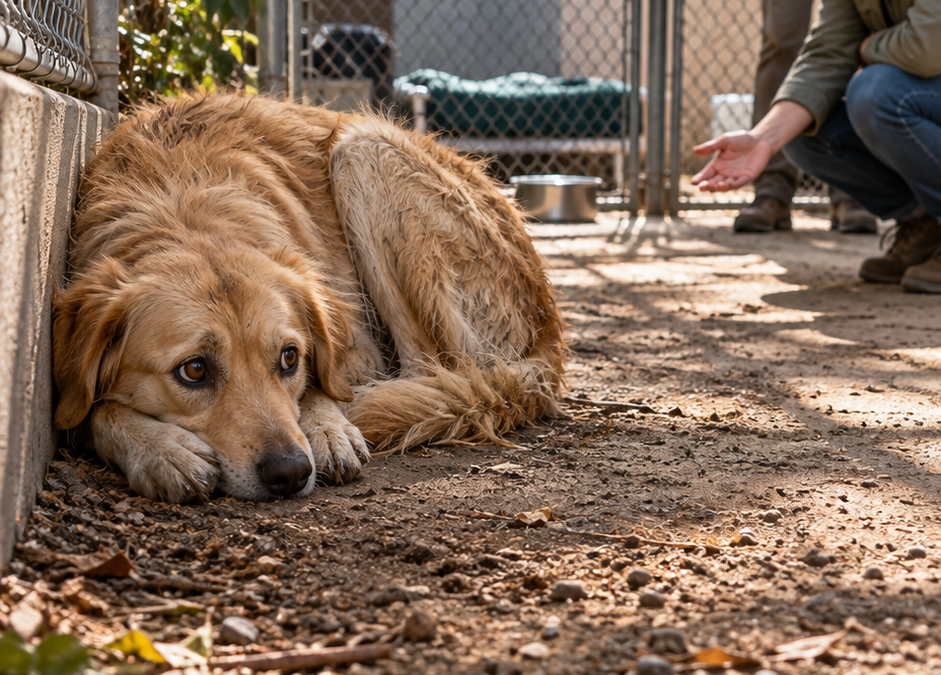
I still remember the first time I saw him.
He was lying in the far corner of a small fenced yard behind a rescue facility, his golden coat dulled by dust and neglect.
He was beautiful.
That was the first thing anyone would have noticed.
Long legs.
Soft ears.
Deep brown eyes.
The kind of dog who might once have looked almost regal standing in sunlight.
But nothing about him felt proud that day.
His body was folded tightly against the ground.
His chin rested between his front paws.
His eyes stayed open.
Not alert in the healthy, curious way dogs watch people.
Alert in the way someone watches a door because they have learned that doors matter.
The volunteer standing beside me spoke quietly.
“He was left alone a lot.”
I looked at Lucky.
“How long?”
“We don’t know exactly.”
“What happened to him?”
She hesitated.
“His previous owners kept him outside most of the time. Small yard. Not much interaction. Sometimes they were gone for long stretches.”
Lucky turned his head slightly when he heard her voice.
Then his eyes went back to the gate.
“Does he bite?”
“No.”
“Growl?”
“Rarely.”
“Play?”
“Not much yet.”
I crouched several feet away.
Lucky did not move.
I had imagined this moment before coming.
I think most people do when they are about to adopt a dog.
You imagine the connection.
The dog walking toward you.
A tail wag.
Maybe that instant recognition people like to describe as if animals are waiting for one exact person to appear.
I got none of that.
I held out my hand.
Lucky looked at it.
Then looked away.
The volunteer said, “Don’t take it personally.”
“I’m not.”
I was.
Not because he owed me affection.
He obviously did not.
But I wanted so badly to help him that his stillness felt like a judgment on everything I had not yet done.
I sat on the ground.
For almost twenty minutes, Lucky remained in the corner.
Then he stood.
Slowly.
Walked toward the water bowl.
Drank.
Paused about six feet from me.
And went back.
That was our first interaction.
I adopted him anyway.
Maybe because of those eyes.
Maybe because I had already decided before I arrived.
Maybe because some part of me understood that the dogs who run toward everyone usually have more options than the ones who have forgotten how.
I signed the paperwork.
Bought a leash.
Loaded the food the rescue gave me.
And brought Lucky home.
My house was quiet.
A small place with two bedrooms, a living room that opened into the kitchen, and a fenced backyard shaded by an old maple tree.
I had prepared everything.
A soft dog bed in the living room.
Another one beside my bed.
Food bowls.
Water bowl.
A basket of toys.
A blue rubber ball.
A rope toy.
A stuffed duck that squeaked loudly enough to annoy me within thirty seconds of testing it.
I had treats in three different flavors because I did not know what he liked.
I even bought a soft blanket that was probably more expensive than any blanket I owned myself.
When I opened the front door, I expected hesitation.
I did not expect Lucky to stop completely.
He stood on the threshold.
One paw inside.
Three outside.
I loosened the leash.
“It’s okay.”
He looked past me into the house.
Nothing was happening.
No voices.
No people.
No other animals.
Still, he would not move.
I stepped farther inside.
“Come on, Lucky.”
His ears shifted.
I sat on the floor.
Five minutes passed.
Then ten.
Eventually, he entered.
Not because I called him.
Because I stopped asking.
He walked around the edge of the room.
Sniffed the walls.
Paused by the hallway.
Checked the kitchen.
Then found the far corner beside the window.
That became his place.
For the first few days, I told myself everything was normal.
He needed time.
Of course he did.
He had been abandoned.
Moved.
Handled by strangers.
Taken into a rescue.
Then taken home by another stranger.
What was I expecting?
Gratitude?
Dogs do not understand adoption paperwork.
Lucky did not know I had chosen him.
As far as he knew, he had been moved again.
So I tried to be patient.
I put food down.
He waited until I left the room before eating.
I offered treats.
He ignored them until they were on the floor.
I rolled the blue ball gently toward him.
He watched it pass.
No movement.
I squeaked the duck.
His entire body stiffened.
I stopped immediately.
“Sorry.”
I felt ridiculous apologizing to a dog.
But he looked frightened.
The bed I bought stayed untouched.
Instead, Lucky slept—if what he did could be called sleeping—on the floor near the window.
Except he did not really sleep.
He rested.
He lowered his head.
His body went still.
But his eyes stayed open.
At first, I assumed he was sleeping when I was not watching.
Then I noticed the nights.
The first time I woke at two in the morning and walked into the living room for water, Lucky was sitting upright near the window.
Dark room.
Moonlight across the floor.
His face pointed toward the driveway.
“Lucky?”
He looked at me.
Then back outside.
I returned to bed.
At 3:30, I checked again.
Same position.
The next night, he was awake.
The night after that too.
Sometimes he lay down.
Sometimes his eyes closed for a few seconds.
A sound outside would open them immediately.
A car door somewhere down the street.
Wind.
The refrigerator compressor.
A branch touching the window.
He listened to everything.
His whole body looked exhausted, yet some part of him refused to surrender to sleep.
By the end of the first week, I was worried.
He moved slowly.
His eyes looked tired.
He had faint dark shadows beneath them.
He would stand near his water bowl as if he had forgotten why he came there.
During the day, he stared through the window.
I started wondering who he was waiting for.
His old owners?
The rescue worker?
Someone else?
Maybe no one.
Maybe waiting itself was simply what he knew.
I bought a different bed.
Softer.
Lower.
I moved it beside his corner.
Nothing.
I placed my sweatshirt on it so it smelled like me.
He walked around it.
I tried calming music.
Soft piano.
Lucky stared outside.
I bought a white-noise machine.
He moved farther from it.
I warmed chicken.
He ate when I walked away.
I bought expensive treats.
He inspected them as if they were suspicious evidence.
I started talking to him more.
Not baby talk.
Just normal conversation.
“I’m making coffee.”
No response.
“I have a meeting in twenty minutes and I already hate it.”
One ear moved.
“That counts.”
Nothing.
“I’m going to take that as support.”
He watched the window.
Every small thing became important to me.
If he looked at me for three seconds instead of one, I noticed.
If he drank while I remained in the room, I noticed.
If he did not move away when I passed him, I noticed.
I had never realized how exhausting hope could become when measured in inches.
During the second week, friends started asking how things were going.
At first, I gave easy answers.
“He’s adjusting.”
“He’s shy.”
“He’s had a hard life.”
All true.
Then my friend Melissa came over.
Lucky moved to the far side of the living room the moment she entered.
He remained there the entire visit.
Melissa watched him.
“He doesn’t seem happy.”
The sentence hurt more than it should have.
“I know.”
“Has he always been this quiet?”
“Since I brought him home.”
“Maybe that’s just his personality.”
“Maybe.”
She hesitated.
“I’m not saying you should give up.”
The fact that she needed to say that made my chest tighten.
“What are you saying?”
“Just that sometimes rescue dogs have really deep issues.”
“I know.”
“And sometimes people take on more than they expected.”
I knew she was trying to help.
I still resented every word.
After she left, I sat on the floor.
Lucky was in his corner.
I looked at him.
“Everyone thinks I’m doing this wrong.”
His ears shifted.
“Maybe I am.”
Nothing.
“I don’t know what you need.”
He blinked once.
I laughed quietly.
“Very helpful.”
The nights were worst.
Not because Lucky made noise.
He did not.
Because I started waking just to check whether he had fallen asleep.
That became my own strange habit.
Midnight.
2:00.
4:00.
I would walk down the hallway and see him sitting in the dark.
Sometimes he was facing the door.
Sometimes the window.
Always listening.
I began leaving a small lamp on because the darkness made the whole scene feel too lonely.
One night, around the middle of the second week, I sat several feet from him.
I did not look directly at him.
I had read that staring could feel threatening.
So I faced the other way.
“Lucky.”
His collar moved softly when he turned.
“You’re safe here.”
I knew the words were meaningless to him.
Safe is not something you can explain.
Still, I said it.
“No one is putting you back outside.”
He shifted.
“You don’t have to wait.”
Nothing.
“I’m staying.”
That was the sentence that broke me.
Because even as I said it, I realized how impossible it was for him to believe me.
Why should he?
Someone had probably told him things before.
Maybe they had called his name affectionately.
Maybe they had filled his bowl.
Maybe they had scratched his ears.
Then they disappeared.
Dogs do not understand excuses.
Work.
Travel.
Emergencies.
Busy schedules.
They understand patterns.
Someone is here.
Then they are not.
Someone returns.
Then does not.
Someone walks through the gate.
Then the gate stays closed for hours.
Lucky’s entire history may have taught him that people vanish.
I could not erase that with a new bed.
During the third week, I took him to the veterinarian.
The examination itself was difficult.
Lucky trembled the entire time.
Not dramatically.
His legs simply shook.
The veterinarian, Dr. Harper, sat on the floor instead of lifting him immediately onto the table.
That alone made me trust her.
She watched him for several minutes.
Asked about his food.
Water.
Bathroom habits.
Movement.
Sleep.
When I explained that he barely seemed to sleep, she looked more concerned.
“Does he ever fully relax?”
“Almost never.”
“Dreaming? Leg movement? Deep breathing?”
“I haven’t seen any.”
“How long has this been happening?”
“Since I got him.”
“And you’ve had him three weeks?”
“Almost.”
She looked at Lucky.
He was watching the exam-room door.
“He may be staying hypervigilant.”
“What does that mean exactly?”
“His body may still believe it has to monitor his environment constantly.”
“Because of being left alone?”
“That can contribute.”
I swallowed.
“Is he afraid I’m going to leave?”
Dr. Harper chose her words carefully.
“I can’t tell you exactly what he thinks. But based on what you’re describing, he may not yet believe this environment is stable.”
I looked at him.
“So what do I do?”
“Stop trying to convince him.”
I looked back at her.
“What?”
“Show him.”
She explained that predictability mattered.
Routine.
Low pressure.
No forcing play.
No overwhelming him with attention.
Leave calmly.
Return calmly.
Feed at consistent times.
Walk at consistent times.
Let him choose proximity.
“He needs to discover that nothing bad happens when he relaxes.”
“How long?”
She smiled gently.
“That is the question everyone asks.”
“And?”
“He decides.”
I hated that answer.
Because I could not fix it.
I could only wait.
On the drive home, Lucky lay in the back seat but kept his head raised.
Watching every passing car.
Every turn.
Every stop.
At home, he returned immediately to his window.
I put his leash away.
Then stood in the kitchen.
For the first time since adopting him, I did nothing.
No toy.
No treat.
No cheerful invitation.
No attempt to turn the day into progress.
I made dinner.
Sat on the couch.
Read.
Lucky stayed across the room.
That became my strategy.
Or maybe my strategy became giving up on strategy.
I stopped trying to manufacture moments.
I stopped rolling balls toward him.
Stopped moving treats closer to my chair.
Stopped inviting him onto the couch.
I stopped measuring success by whether he behaved like the dog I had imagined.
I simply existed beside him.
Every morning, breakfast at seven.
Walk at seven-thirty.
Short route.
Same streets.
Then home.
Before leaving the house, I started telling him exactly what I was doing.
At first it felt foolish.
“Lucky, I’m going to the grocery store.”
He watched me put on my shoes.
“I’ll be back in twenty minutes.”
The first time, I came back in seventeen.
Then I sat in my car for three minutes because I had said twenty.
When I opened the door, Lucky was standing in the hallway.
Not wagging.
Not excited.
Just there.
“See?”
I put the grocery bag down.
“Twenty minutes.”
He stepped away.
The next day, I left for ten.
Came back in ten.
Then thirty.
Then fifteen.
No dramatic reunions.
No squealing.
No overexcited affection.
I came home.
Put down my keys.
Spoke quietly.
Every time.
“I’m back.”
I started reading aloud in the evenings.
Not children’s stories.
Whatever I was already reading.
News articles.
A novel.
Once, a painfully boring manual for a new coffee machine.
Lucky did not care about the words.
I think he cared about the sound.
My voice became background noise.
Something that existed without demanding anything from him.
Sometimes I sang while cooking.
Badly.
Lucky’s ears would move.
“I know.”
I looked at him.
“You don’t have to be rude.”
No response.
I started telling him about my day.
“The woman in front of me at the store had nineteen coupons.”
Lucky blinked.
“Nineteen.”
I chopped vegetables.
“She saved eleven dollars. I respect the commitment.”
One evening, he moved from his corner to the rug.
Not close to me.
Just closer than before.
I noticed immediately.
I pretended I had not.
That became another kind of discipline.
Not reaching for every improvement.
Not turning his courage into a demand.
Then came the night I nearly lost hope.
It had been a bad day.
Work problems.
Too many phone calls.
I had slept badly.
Lucky had barely eaten breakfast.
During our evening walk, a truck backfired two streets away.
He froze.
Then pulled hard enough against the leash that I thought he might slip his collar.
I crouched.
Did not touch him.
Waited.
It took almost ten minutes before he moved again.
When we got home, he went to his corner.
I went to the couch.
And suddenly I was tired of being patient.
Not with Lucky.
With myself.
With the feeling that I was constantly being evaluated by an animal who did not even know he was evaluating me.
I lay down on the couch.
Covered my face with one hand.
And cried.
Quietly.
I did not want Lucky frightened by the sound.
That thought made me cry harder.
I remember whispering,
“I don’t know how to help you.”
The room was dark except for the lamp beside the sofa.
I heard Lucky’s nails against the floor.
At first, I assumed he was going to the water bowl.
Then the sound came closer.
I lowered my hand.
Lucky stood beside the couch.
He was close enough that I could see the tiny pale hairs around his muzzle.
I did not move.
He looked at me.
Not at the door.
Not the window.
Me.
“Hi.”
My voice barely came out.
Lucky lowered his head.
For one second, I thought he would turn away.
Instead, he stepped closer.
Then slowly, carefully, as if the decision cost him something, he rested his head in my open hand.
I stopped breathing.
His head was heavier than I expected.
Warm.
His fur soft beneath my fingers.
I did not pet him.
I did not close my hand.
I was terrified that any movement would end the moment.
So I stayed still.
Lucky stood there.
Head in my palm.
For maybe one minute.
Maybe five.
Time felt strange.
Then he lowered himself onto the floor beside the couch without lifting his head from my hand.
I could feel his breathing.
Fast at first.
Then slower.
Slow enough that I started unconsciously matching it.
In.
Out.
In.
Out.
His eyes closed.
Opened.
Closed again.
I felt tears moving down my face.
I did not wipe them away.
That night, I barely moved.
My shoulder hurt.
My hand went numb.
I did not care.
Lucky did not stay asleep for long.
But for the first time, he had chosen contact.
Not because I bribed him.
Not because I called him.
Not because I moved toward him.
He came to me.
The next morning, nothing magical happened.
That mattered.
Lucky did not wake transformed.
He did not jump onto the bed.
He did not suddenly chase toys around the living room.
At breakfast, he still waited until I stepped away from the bowl.
On our walk, he still watched passing cars.
When a neighbor dropped a trash can lid, Lucky flinched.
Healing did not arrive like a switch.
But something had shifted.
Maybe only a fraction.
Still, it was real.
I told Dr. Harper what happened.
She smiled.
“That was a big choice for him.”
“I didn’t even touch him.”
“Exactly.”
I thought about that all day.
Exactly.
For weeks, I had believed love meant doing more.
More toys.
More treats.
More comfort.
More attention.
Lucky seemed to need something else.
Less pressure.
More consistency.
So I continued.
Before every short trip:
“I’m leaving.”
Then a time.
“I’ll be back in thirty minutes.”
And I returned.
If traffic made me late, I found myself becoming irrationally anxious.
Once I told him twenty minutes and returned after twenty-four.
I opened the door and said,
“I’m sorry.”
Lucky stood in the hallway.
His tail did not move.
But he was there.
“I know. Four minutes.”
I held up my hands.
“Unacceptable.”
His ear flicked.
A few days later, something happened at the door.
I had gone to the pharmacy.
Twelve minutes.
When I returned, Lucky stood three feet inside.
I stepped in.
“Hi.”
His tail moved.
Once.
A tiny movement.
So small that I almost thought I imagined it.
Then again.
Not a full wag.
Just the tip.
My heart pounded.
I wanted to drop to my knees.
Call his name.
Hug him.
Instead, I took off my shoes.
Put down my keys.
“I’m back.”
Lucky watched me.
His tail moved one more time.
I went into the kitchen and cried where he could not see me.
After that, the changes came slowly.
One evening, I sat on the floor reading.
Lucky walked past.
Stopped.
I raised my hand slightly.
Nothing more.
He stood there.
Then turned his head enough that my fingers could touch behind one ear.
One scratch.
I stopped.
Lucky did not move away.
Another.
His eyes softened.
Not closed.
But softer.
The next night, he allowed it again.
Then he started standing beside me while I prepared food.
I offered a small piece of chicken.
He looked at my hand.
Normally, I would have put it on the floor.
This time, I waited.
Lucky leaned forward.
Sniffed.
Pulled back.
Tried again.
Then took the chicken from my fingers.
So gently that I barely felt his teeth.
I laughed.
“You have no idea what you just did.”
He chewed.
I offered another piece.
He took that too.
The first time he truly slept happened about a week after the couch.
I woke at 2:17 a.m.
Habit.
For weeks, my body had trained itself to check the living room.
I walked down the hallway.
Stopped.
Lucky was asleep.
Not resting.
Sleeping.
His body had collapsed onto one side.
Legs loose.
Head on the rug.
His front paws twitched.
Then one back leg moved.
A tiny running motion.
A soft sound came from his throat.
A dream.
I stood in the doorway.
I had seen dogs dream hundreds of times before.
Friends’ dogs.
Family dogs.
Videos online.
Nothing about it was extraordinary.
But I had never seen Lucky surrender that completely.
I realized I was holding my breath.
His paws moved again.
For one beautiful moment, whatever place he was running through in his sleep was safe enough for him to stay there.
I went back to bed.
I cried again.
There was a lot of crying that month.
The next morning, I did not celebrate in front of him.
I fed him.
Walked him.
Read aloud.
Kept the routine.
But inside, hope had changed.
Before, hope felt like wanting Lucky to become a different dog.
Now it meant noticing the dog already there.
A month after the adoption, he brought me the blue ball.
The same ball I had rolled toward him during his first week.
I was in the kitchen.
Lucky walked in carrying it.
I froze.
He dropped it at my feet.
Then looked up.
His expression was serious.
Almost concerned.
As though he had made an appointment and needed to know whether I intended to honor it.
I looked down.
Then at him.
“You want this?”
No movement.
I picked up the ball.
His body tensed slightly.
Not fear.
Expectation.
I rolled it gently across the floor.
Lucky watched it.
Did not move.
I laughed.
“Okay.”
Apparently I had misunderstood.
I walked over.
Picked it up.
Returned.
Lucky followed me.
I rolled it again.
This time he took three steps.
Stopped.
Looked back at me.
“Go ahead.”
He moved toward the ball.
Sniffed it.
Left it.
Progress.
The next day, he chased it halfway.
Two days later, all the way.
Then came the moment I still remember most clearly.
I rolled the ball across the living room.
Lucky ran after it.
Picked it up.
Turned.
For one second, I expected him to lie down with it.
Instead, he walked back.
Dropped it at my feet.
Then looked at me.
I picked it up.
“You’re sure?”
His tail moved.
I threw it again.
Lucky ran.
Actually ran.
Not away.
Not toward a door.
After a ball.
He skidded slightly near the rug.
Grabbed it.
Came back.
I laughed so loudly that Lucky stopped.
His ears went up.
“Sorry.”
I covered my mouth.
Then I opened my arms.
I did not call him.
Lucky stood three feet away.
Ball in his mouth.
Then he walked forward.
I put my arms around him.
Carefully.
His body trembled.
I felt it.
For one awful second, I thought I had pushed too far.
I loosened my arms.
Lucky stayed.
So I held him.
Not tightly.
Just enough.
He stayed.
That was when I understood that trust does not always look like fear disappearing.
Sometimes it looks like fear remaining while someone chooses not to leave.
The weeks became months.
Lucky learned the rhythms of the house.
Breakfast.
Walk.
My workday.
The sound of the dishwasher.
The mail truck.
The neighbor’s garage door.
The afternoon patch of sunlight near the window.
He started using the dog bed.
Not the expensive first one.
Of course not.
He preferred the cheaper bed I bought later and nearly returned.
He began sleeping beside my bed at night.
At first, several feet away.
Then closer.
Eventually, his head would rest near my hand if I let my arm hang over the side.
Sometimes I woke and found his fur beneath my fingers.
He still had difficult moments.
Cars remained complicated.
Certain engine sounds made him stand instantly.
If someone slammed a door outside, he watched the window.
Once, a dark SUV stopped in front of the house for several minutes.
Lucky froze.
Did not move until it drove away.
I sat beside him.
Did not touch him.
After a while, he leaned against my leg.
That became enough.
I stopped needing to erase every sign of his past.
He had a past.
It belonged to him.
Love did not require pretending it had never happened.
It required becoming something reliable beside it.
Several months after I brought him home, we started visiting the neighborhood park.
The first trip lasted twelve minutes.
Lucky spent most of it watching.
Children.
Joggers.
Bicycles.
Birds.
Especially birds.
He loved them immediately.
A bird would land in the grass.
Lucky’s ears would rise.
Body leaning forward.
Then the bird would hop.
Lucky would take two steps.
Stop.
Look at me.
The first few times, I assumed he was asking permission.
Later I understood.
He was checking.
Are you still there?
I smiled.
“I’m here.”
He would turn toward the bird again.
Take another few steps.
Then look back.
Still there.
Weeks passed.
He began going farther.
Never very far.
Ten feet.
Fifteen.
The length of the leash.
Every time, he checked.
I always answered.
Sometimes with words.
Sometimes only by looking back.
“Go ahead.”
He started trying to chase birds.
Badly.
Lucky was fast in a straight line but apparently believed birds should respect ground-based pursuit rules.
They did not.
He would sprint three steps.
The bird would fly.
Lucky would stop.
Look offended.
Then check for me.
I laughed.
He began wagging more.
Eventually, the wag became normal enough that I stopped crying every time it happened.
Almost.
One afternoon, a woman at the park stopped me.
“Beautiful dog.”
“Thank you.”
“What breed?”
“Golden mix, probably.”
Lucky stood beside my leg.
The woman reached toward him.
I said gently,
“He’s shy.”
She stopped immediately.
“Sorry.”
“No problem.”
She lowered her hand.
Lucky looked at her.
Then me.
Then back at her.
He stepped forward and sniffed her fingers.
She smiled.
“Hi, sweetheart.”
Lucky moved behind my leg after that.
But he had chosen the first step.
That became the story of his recovery.
Choice.
Again and again.
Not being dragged into affection.
Not being forced into confidence.
Choosing.
The thing I struggled with most was forgiving myself for the first three weeks.
I had meant well.
Everything I did came from love.
But some of it came from fear too.
Fear that Lucky would never attach to me.
Fear that I was failing.
Fear that people would think adopting him had been a mistake.
I wanted visible proof that I was helping.
Tail wag.
Play.
Affection.
Sleep.
Something I could point to and say,
See? He loves me now.
Lucky had no obligation to perform healing on my schedule.
Once I understood that, both of us relaxed.
I stopped asking when he would become normal.
Normal according to what?
He became Lucky.
That was enough.
Nearly a year after his adoption, I found the original stuffed duck beneath a storage box.
The same toy that had frightened him during his first week.
I brought it into the living room.
Did not squeak it.
Just placed it on the floor.
Lucky walked over.
Sniffed it.
Picked it up.
Carried it to his bed.
Then, without warning, squeezed it.
SQUEAK.
Lucky jumped.
Dropped it.
Stared.
I laughed before I could stop myself.
He looked at me.
Then at the duck.
Then picked it up and squeezed again.
SQUEAK.
He shook it violently.
That poor duck survived maybe four minutes.
I sat on the floor laughing while stuffing came out of its side.
Lucky’s tail whipped back and forth.
For the first time, I saw the dog I had imagined on adoption day.
Playful.
Ridiculous.
Joyful.
But by then, I no longer needed him to be that dog all the time.
The quiet version counted too.
The cautious version.
The dog who slept beside my bed.
The dog who checked behind him at the park.
The dog who sometimes heard a car and remembered a life I would never fully understand.
All of him belonged.
Today, Lucky wakes when I wake.
Usually.
Sometimes he stays asleep longer.
That still feels like a gift.
He sleeps deeply now.
Legs twitching.
Soft little sounds.
Occasionally he snores.
Loudly.
The dog who once refused to close his eyes now sleeps through thunderstorms if he is beside my bed.
Not every storm.
Not every noise.
But enough.
When I leave, I still tell him.
“I’m going to the store.”
Or:
“I have a doctor’s appointment.”
Or:
“I’ll be back after lunch.”
I no longer promise exact minutes every time.
Lucky does not need them the way he once did.
But I always say goodbye.
And I always say the same thing when I return.
“I’m back.”
Most days, I hear his feet before I finish opening the door.
Sometimes he is waiting with the blue ball.
Sometimes he brings something else.
A sock.
A rope.
Once, one of my shoes.
I do not ask why.
He has opinions now.
I like that.
He sleeps beside my bed, usually with his head close enough that I can reach down and touch him.
Sometimes in the middle of the night, I wake and rest my hand on his head.
I think about that first night on the couch.
The weight of him in my palm.
How afraid I was to move.
How afraid he had been to stay.
I thought that was the moment I saved him.
I know better now.
Lucky did not need a dramatic rescue after he came home.
He needed proof.
Quiet proof.
Breakfast appearing every morning.
The same voice reading beside him.
The same footsteps returning through the door.
A hand that did not grab.
A leash that did not drag.
A person who could leave and still come back.
Again.
Again.
Again.
People sometimes describe trust as something you earn.
That is true.
But with Lucky, it felt more like something I was invited to witness.
He built it himself.
Tiny piece by tiny piece.
The first night beside the couch.
The first chicken from my hand.
The first tail movement at the door.
The first deep sleep.
The first ball.
The first time he ran toward something joyful without immediately looking afraid.
I did not give those moments to him.
I simply tried to make the world stable enough for him to risk them.
That may be the most important thing Lucky taught me.
Love is not always action.
Sometimes action is easy.
Buy the bed.
Buy the toy.
Give the treat.
Reach out.
Call the name.
The harder kind of love can look like restraint.
Sitting nearby.
Waiting.
Keeping a promise that seems too small to matter.
Leaving for twenty minutes.
Coming back in twenty.
Letting silence stay silent.
Not demanding reassurance from the one you are trying to reassure.
I once thought Lucky’s refusal to sleep meant he did not feel comfortable with me.
Then I thought it meant he might never love me.
Now, when I watch him sleeping, I understand that the question was never whether he loved me.
He was trying to learn whether love stayed.
Those are not the same thing.
Last week, we went to the park just before sunset.
Lucky saw three birds feeding in the grass.
He pulled gently toward them.
I loosened the leash.
“Go ahead.”
He ran.
The birds took off immediately.
Lucky stopped.
Watched them disappear into the trees.
Then he turned.
For years of his life, turning back may have meant checking whether someone had disappeared.
He looked at me.
I was still there.
I smiled.
“There you are.”
His tail moved.
Then he ran back toward me.
Not because he was afraid I would leave.
Because he wanted to come back.
He stopped beside me.
Pressed his shoulder against my leg.
We stood there for a moment as the light changed across the grass.
Then we walked home.
Lucky slept beside my bed that night.
Completely relaxed.
One paw stretched across the floor.
His head resting against my hand.
I thought about the dog I had brought home months earlier.
Wide awake at two in the morning.
Watching the window.
Waiting for someone who might never return.
I wish I could go back and sit beside that version of him.
I would not touch him.
I would not offer a toy.
I would not try to convince him of anything.
I would simply sit on the floor and wait.
Because now I know what he needed me to say.
Not with words.
With time.
I’m still here.
And tomorrow, I’ll still be here too.

