𝗙𝗨𝗟𝗟 𝗦𝗧𝗢𝗥𝗬 For Three Days, the Old German Shepherd Sat Outside My Neighbor’s Door Without Making a Sound
𝗙𝗨𝗟𝗟 𝗦𝗧𝗢𝗥𝗬
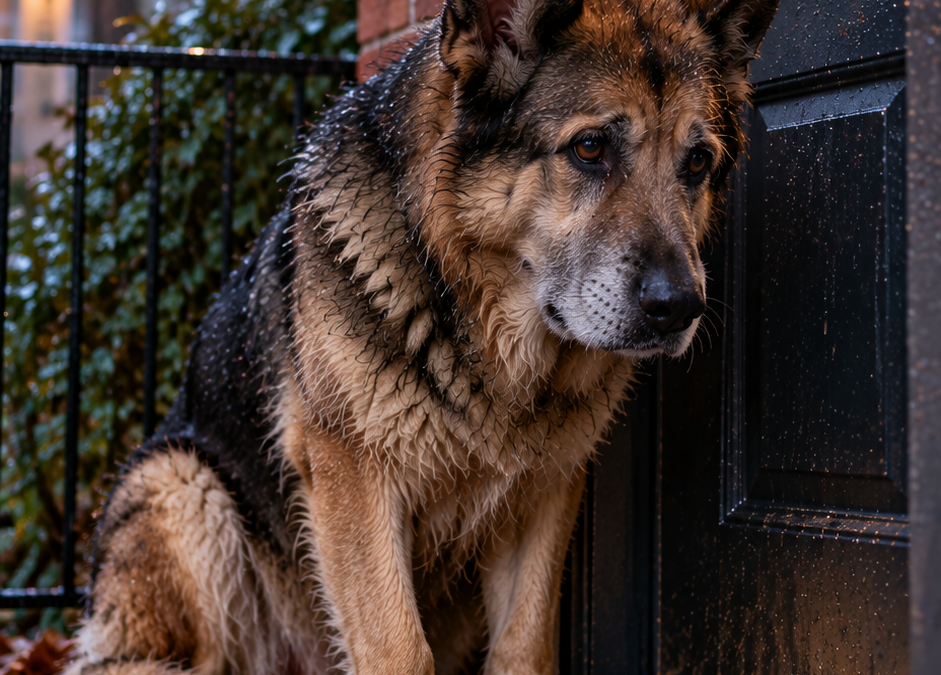
There’s an old German Shepherd sitting outside my neighbor’s house and he hasn’t moved in two days.
She replied:
Call animal control.
I typed:
What if he belongs to the neighbor?
Then knock.
I already did.
Then knock harder.
I stared at her message.
Simple advice always feels simple when it’s somebody else’s door.
Thursday morning, rain had started.
Not heavy.
Cold, thin rain.
The dog had moved beneath the shallow overhang.
He was wet anyway.
That was when I noticed how thin he was.
Not starving.
But lean enough that I could make out the suggestion of ribs beneath his coat.
His paws were filthy.
Mud packed between the toes.
One pad looked cracked.
This dog hadn’t simply walked around the block.
He had traveled.
A long way.
I took my umbrella and crossed the courtyard.
“All right.”
The dog looked at me.
“Three days.”
I stood beside him.
“You’re making this officially strange.”
His eyes returned to the door.
I followed his gaze.
“Okay.”
I knocked.
Firmly this time.
“Mr. Harrison?”
Nothing.
I knocked again.
“Mr. Harrison, it’s Emily from across the courtyard.”
Silence.
My heart began beating faster.
I tried the doorbell.
No sound from inside.
“Mr. Harrison?”
Then I heard something.
Very faint.
A scrape.
Or maybe breathing.
I couldn’t tell.
I leaned closer.
“Sir?”
A long pause.
Then another sound.
Definitely breathing.
Heavy.
Uneven.
My stomach tightened.
I looked at the dog.
For the first time, he looked directly at me.
“Is he in there?”
The dog stood halfway.
Then sat again.
I reached for my phone.
911?
Maybe.
But something stopped me.
Not logic.
Instinct.
Mr. Harrison had spent years protecting his isolation.
Sending police or paramedics through his door unnecessarily could become another violation.
I knocked again, softer.
“Mr. Harrison.”
No response.
“I know you’re in there.”
Nothing.
“I don’t know if you’re okay.”
I swallowed.
“I don’t want to bother you.”
The dog leaned toward the door.
“But this dog has been sitting here for three days.”
Silence.
“He won’t leave.”
Something moved behind the door.
I waited.
No lock.
No footsteps.
Just breathing.
I looked at the dog.
“Guess we’re staying.”
I sat on the porch.
The concrete was damp.
My jeans immediately absorbed the cold.
“Great.”
The dog looked at me.
“This is your fault.”
No response.
I placed one hand on his back.
He tensed.
I froze.
“Okay.”
I waited.
Slowly, the tension eased.
His fur was coarse from dirt.
His body was warmer than I expected.
But beneath my hand, he trembled.
Not from cold.
Or not only from cold.
There was tension inside him.
Three days of waiting compressed into muscle and bone.
“What are you waiting for?”
His ear turned toward me.
“Do you know him?”
The dog looked at the door.
Something about that answer felt unmistakable.
I stayed.
Five minutes.
Ten.
Maybe fifteen.
The neighborhood moved around us.
A car started.
Somebody dragged a trash can.
A child shouted two houses away.
The dog did not move.
Then, finally, a lock clicked.
I stood too quickly.
The dog did not.
He simply lifted his head.
Another lock.
The door opened two inches.
Then five.
Then slowly, almost reluctantly, wider.
Mr. Harrison stood behind it.
I had seen him from a distance many times.
Never this close.
He looked worse than I expected.
Much worse.
His beard had grown long and uneven.
His face was gaunt.
His gray hair fell untidily across his forehead.
He wore an old Army T-shirt beneath an open flannel shirt.
His hands shook.
But what struck me most were his eyes.
They didn’t focus on me at first.
They passed through me.
As if part of him was still standing somewhere far away.
“Mr. Harrison?”
Nothing.
“I’m sorry.”
He stared.
“I heard you inside.”
His mouth moved slightly.
No words.
Then the dog stood.
Mr. Harrison’s eyes dropped.
Everything changed.
His face.
His posture.
His breathing.
For a second, I thought he might collapse.
The dog took one step.
Mr. Harrison whispered something.
I couldn’t hear it.
“What?”
His lips moved again.
“Baron.”
The dog’s ears shot forward.
Mr. Harrison’s knees buckled.
I reached for him, but he dropped before I could catch him.
Not hard.
Almost deliberately.
He fell to his knees on the threshold.
“Baron.”
The dog walked toward him.
Slowly.
Painfully.
As though those three days had finally entered his body.
Mr. Harrison opened both arms.
The dog stepped into them.
And the old man broke.
There is no gentler way to describe it.
He broke.
His arms locked around Baron’s neck.
His face disappeared into the dog’s fur.
No dramatic scream.
No words at first.
Just silent, violent sobs shaking his thin shoulders.
Baron pushed his head against him.
Then licked his cheek.
His ear.
His face.
Mr. Harrison made a sound that seemed pulled from somewhere deeper than speech.
“Twelve years.”
Baron whined.
“Oh, God.”
Mr. Harrison held him tighter.
“Twelve years.”
I stepped back.
I suddenly felt like an intruder.
Whatever this was, it belonged to them.
But I couldn’t leave.
Not yet.
Mr. Harrison looked physically weak.
Baron looked exhausted.
So I stood several feet away beneath the edge of the porch while rain tapped against the roof.
Neither of them seemed aware of me.
“I thought you were dead.”
Mr. Harrison’s words came broken between breaths.
“I thought…”
Baron licked his chin.
“They told me you were gone.”
The dog’s tail moved weakly.
Mr. Harrison laughed through tears.
A terrible, beautiful sound.
“You old bastard.”
Baron whined again.
“I know.”
He pressed his forehead to Baron’s.
“I know, buddy.”
I had no idea what I was watching.
Not fully.
But I knew enough to stay silent.
After several minutes, Mr. Harrison tried to stand.
He couldn’t.
His legs shook.
He reached for the doorframe.
“Mr. Harrison.”
He looked at me as if remembering I existed.
“Let me help.”
“I’m fine.”
His voice was rough from disuse.
He was not fine.
“Sure.”
I moved closer.
“You’re doing great.”
He almost smiled.
Almost.
Then his knee gave out.
I caught his arm.
He was heavier than he looked but weak enough that most of his weight leaned into me.
“Easy.”
“I don’t need—”
“Yes, you do.”
His eyes sharpened.
For one second, I understood why people avoided arguing with him.
Then Baron stepped inside the house.
Mr. Harrison looked at the dog.
Something softened.
“All right.”
I helped him stand.
Baron entered first.
He didn’t hesitate.
That was the second thing that made me realize this dog knew the house.
Or at least knew the man well enough for walls not to matter.
Inside, the air felt stale.
Curtains closed.
Dust on the furniture.
One lamp on though it was daytime.
The room was not filthy.
It was abandoned while still occupied.
A half-finished glass of water sat on a table.
Several unopened envelopes were stacked beside it.
There were no photographs on the walls except one.
A military unit photo.
Baron walked directly toward the couch.
He circled once.
Then lowered himself beside it.
As if he had done so a thousand times.
Mr. Harrison stared.
“How did you know?”
Baron placed his head on his paws.
Mr. Harrison sat on the couch.
His hand immediately found the dog’s head.
I opened the curtains slightly.
Mr. Harrison flinched.
“Sorry.”
I closed them halfway again.
“Water?”
He nodded.
I found the kitchen.
Clean enough.
Sparse.
I filled two glasses.
Then a large bowl for Baron.
The dog drank for almost a full minute.
“Slow.”
Mr. Harrison’s voice carried concern.
“Easy, Baron.”
The dog paused.
Looked at him.
Then resumed more carefully.
That voice.
That response.
There was history there.
Years of it.
I returned to the living room.
“Do you have food for him?”
Mr. Harrison shook his head.
“I’ll get some.”
“No.”
“He’s been outside three days.”
“I have chicken.”
That surprised me.
He pointed weakly toward the refrigerator.
I found cooked chicken in a container.
Probably intended for Mr. Harrison.
Baron ate it.
Not quickly.
Carefully.
Every few bites, he looked toward Mr. Harrison.
“He’s checking you’re still there.”
The words slipped out.
Mr. Harrison’s hand stopped moving.
He looked away.
“He’s always done that.”
Always.
I sat in the chair opposite.
Neither of us spoke.
Baron finished eating and returned to Mr. Harrison.
He lowered himself against the old man’s boots.
Mr. Harrison rested his hand between the dog’s ears.
His fingers trembled.
After several minutes, I asked quietly, “Who is he?”
Mr. Harrison didn’t answer.
I waited.
Then he said, “Baron.”
“I know his name.”
Silence.
“You said twelve years.”
He closed his eyes.
I almost apologized and left.
Then he began speaking.
“We served together.”
His voice was low.
“Military working dog?”
He nodded.
“Afghanistan.”
I stayed still.
Mr. Harrison stared at Baron.
“He wasn’t supposed to be mine.”
“What do you mean?”
“I was infantry.”
He rubbed the dog’s ear.
“Baron belonged to another handler when I first met him.”
He smiled faintly.
“The dog hated me.”
I looked at Baron.
“He doesn’t seem like he hates you.”
“He did.”
A small warmth entered Harrison’s voice.
“First time I tried to touch him, he showed me every tooth he had.”
“What changed?”
“His handler got injured.”
Mr. Harrison paused.
“I started helping.”
He looked somewhere beyond the room.
“We were together after that.”
I didn’t ask for combat details.
Some stories have doors inside them.
You don’t open them unless invited.
“He worked with you?”
“Yeah.”
Mr. Harrison touched the silver fur around Baron’s muzzle.
“He found explosives.”
His voice weakened.
“Found people.”
A pause.
“Found me.”
I wasn’t sure whether he meant physically or something else.
Maybe both.
“He saved your life?”
Mr. Harrison looked at me.
“More than once.”
Baron shifted closer.
“When I got sent home, they wouldn’t let me take him.”
“Why?”
“He was still active.”
“Of course.”
I regretted the words immediately.
Mr. Harrison didn’t react.
“They said he’d be reassigned.”
“Was he?”
“That’s what they told me.”
His jaw tightened.
“I tried to follow where he went.”
“And?”
“Nothing.”
“They wouldn’t tell you?”
“Different unit. Different paperwork. Then years passed.”
His fingers curled into Baron’s fur.
“I got letters returned. Numbers changed. People retired.”
“Did you ever find out what happened?”
“Eventually somebody told me he’d been transferred.”
“Where?”
“Another base.”
“Did you contact them?”
“Yes.”
“And?”
Mr. Harrison laughed once.
Empty.
“By then, Baron was gone from there too.”
I looked at the dog.
“Twelve years.”
He nodded.
“I thought he was dead.”
Baron’s tail touched the floor.
Mr. Harrison’s eyes filled again.
“I hoped he was dead.”
That startled me.
He saw my expression.
“Not because I wanted him dead.”
“I understand.”
“No.”
His voice hardened.
“You don’t.”
I stayed quiet.
He looked at Baron.
“If he was dead, then he wasn’t waiting.”
The room became very still.
“He wasn’t wondering why I didn’t come.”
My throat tightened.
Mr. Harrison continued.
“I couldn’t stand the idea that he was alive somewhere thinking I left him.”
Baron pushed his nose beneath the man’s hand.
Mr. Harrison lowered his head.
“So eventually I told myself he forgot.”
He swallowed.
“That was easier.”
I looked at the old German Shepherd who had spent three days sitting outside a closed door.
“He didn’t.”
Mr. Harrison closed his eyes.
“No.”
“What about you?”
He looked up.
“What?”
“Did you forget him?”
His face answered before his mouth did.
“Never.”
We sat quietly.
The rain continued outside.
Finally, Mr. Harrison said, “I thought forgetting was what you were supposed to do.”
I didn’t understand.
“When?”
“After.”
He gestured vaguely.
“After the Army?”
“After everything.”
His voice dropped.
“You come home and people want you back.”
“Back how?”
“The way you were.”
He looked toward the dark window.
“People say things like, ‘You’re home now.'”
He laughed bitterly.
“Like location fixes something.”
I listened.
“You try grocery stores.”
“Restaurants.”
“Birthdays.”
He rubbed his hands together.
“But you’re listening to doors slam.”
“Watching exits.”
“Counting people.”
“Looking at rooftops.”
His breathing changed slightly.
I realized even talking was costing him something.
“You don’t sleep.”
“You get angry.”
“People stop knowing what to say.”
“And after enough time, they stop asking.”
He looked down.
“I helped them stop.”
“How?”
“Stopped answering.”
“Stopped going.”
“Stopped opening the door.”
There it was.
The closed house.
The curtains.
Years of nighttime trips to the store.
I looked at Baron.
“And he came back.”
Mr. Harrison nodded.
“I don’t know how.”
“Where was he?”
“I have no idea.”
I told him what I’d noticed.
The mud.
The worn paws.
The ribs.
“He traveled a long way.”
Mr. Harrison’s face crumpled again.
“Idiot.”
Baron lifted his head.
“You stupid old dog.”
His voice was full of love.
“You should’ve stayed wherever they were feeding you.”
Baron stood.
Placed his head in Harrison’s lap.
Mr. Harrison gave up pretending.
He bent over him.
I left then.
Not permanently.
Just long enough to give them privacy.
Before going, I put my number on a piece of paper.
“Call me if you need anything.”
Mr. Harrison stared at it.
“I won’t.”
“I know.”
I placed it on the table anyway.
“I’ll come tomorrow morning.”
His head snapped up.
“You don’t have to.”
“I know.”
That seemed to confuse him.
“So why?”
I looked at Baron.
“Because he looks like he’s going to need food.”
Mr. Harrison almost smiled.
“Eight.”
“What?”
“He eats around eight.”
I smiled.
“Good to know.”
The next morning, I brought dog food.
And coffee.
I knocked at eight-oh-three.
Nothing.
I waited.
Then the door opened.
Mr. Harrison looked slightly better.
Not good.
Better.
Baron stood beside him.
Tail moving.
“You’re late.”
I stared.
“Three minutes.”
“Dog’s been starving.”
I looked at Baron.
He appeared unconcerned.
“So this is how it’s going to be?”
Mr. Harrison stepped aside.
It was the first time he’d voluntarily invited me into his house.
Small thing.
Huge thing.
Over the next few days, something unexpected happened.
Baron began forcing Mr. Harrison into the world.
Not dramatically.
Dog logic.
Simple needs.
Food.
Water.
Bathroom.
Walk.
On the second morning, Baron stood by the front door.
Mr. Harrison ignored him.
Baron stared.
Mr. Harrison looked away.
Baron walked over, pushed his nose beneath Harrison’s hand, then returned to the door.
“No.”
Baron waited.
“I’m not going outside.”
Tail movement.
“No.”
Baron whined.
Mr. Harrison glared.
“Don’t start.”
Baron walked to the door again.
I was sitting at the table pretending not to watch.
“He has to go.”
Mr. Harrison looked at me.
“He can use the yard.”
“Then open the door.”
“I’ll open it.”
He did.
Baron stepped onto the porch.
Then turned around.
Mr. Harrison remained inside.
Baron stood there.
“Go.”
Nothing.
“Baron.”
The dog waited.
Mr. Harrison’s jaw tightened.
“You manipulative bastard.”
Baron’s tail moved.
I covered a laugh.
“Don’t encourage him.”
“I’m not.”
“You are.”
Eventually, Mr. Harrison stepped onto the porch.
Baron immediately walked into the yard.
That was how it began.
The first day, Mr. Harrison stood outside for less than five minutes.
The second, ten.
By the fourth, Baron refused to stop at the yard gate.
He walked toward the sidewalk.
Mr. Harrison froze.
“Baron.”
The dog looked back.
“No.”
Baron waited.
Mr. Harrison’s breathing changed.
I was beside them.
“You don’t have to.”
He nodded immediately.
But Baron didn’t move.
Mr. Harrison looked at him.
The dog took one step.
Stopped.
Looked back.
One step.
Wait.
One step.
Wait.
Something passed between them.
Not command.
Not obedience.
Memory.
Mr. Harrison stepped through the gate.
I walked behind them.
At the end of the block, Harrison’s hands were shaking.
But he was outside.
In daylight.
Neighbors stared.
I hated that.
Not their curiosity.
Their obviousness.
Mrs. Palmer nearly dropped her watering can.
Mr. Jenkins stopped pretending to sweep his driveway.
I gave both of them a look.
They returned to their business.
Mostly.
Baron walked beside Harrison.
No leash at first.
I brought one the next day.
Mr. Harrison held it loosely.
They moved together like they’d never been separated.
Old man.
Old dog.
Same pace.
The first week, we went to the corner.
The second, halfway down Maple Street.
Then to the small park.
Mr. Harrison rarely spoke.
But he came.
Some mornings, he refused.
Baron didn’t argue.
He simply waited at the door.
Eventually, Harrison got up.
“He’s worse than a drill sergeant.”
I smiled.
“Maybe he learned from one.”
Mr. Harrison grunted.
Over time, I learned his first name.
Thomas.
I only used it once.
He looked uncomfortable.
So I went back to Mr. Harrison.
Some distances close slowly.
That’s okay.
He told me fragments of his past.
Not enough to construct a clean narrative.
War doesn’t create clean narratives.
A roadside blast.
A lost friend named Miller.
A convoy that didn’t return intact.
Baron finding something beneath loose dirt seconds before men walked over it.
Baron lying across Harrison’s legs one night when he couldn’t stop shaking.
“Was that during deployment?”
Mr. Harrison stared ahead.
“No.”
“After?”
He nodded.
“For a while, I got access to him during transition.”
Then they were separated.
That made Baron’s return even more extraordinary.
“He remembered everything,” I said.
Mr. Harrison looked down at the dog.
“So did I.”
One afternoon, I asked the question I’d avoided.
“Do you know where Baron has been all these years?”
“No.”
“Don’t you want to find out?”
Mr. Harrison thought.
“Part of me.”
“And the rest?”
“He is here.”
He touched Baron’s head.
“For once, that’s enough.”
I understood.
Answers are overrated when compared with presence.
A month after Baron arrived, I walked past the park and saw something that stopped me.
Mr. Harrison sat on a bench.
Baron lay beside him.
A little girl in a pink jacket stood several feet away.
Her mother hovered nearby.
The girl asked, “Can I pet your dog?”
I slowed.
A month earlier, Mr. Harrison might not have answered.
He might have stood and left.
Instead, he looked at Baron.
Then at the girl.
“Slowly.”
She stepped closer.
“He looks old.”
“He is.”
“How old?”
Mr. Harrison considered.
“Old enough to know better.”
The girl’s mother laughed.
The girl didn’t understand.
“Where does he like pets?”
Mr. Harrison touched behind Baron’s ears.
“Here.”
She copied him.
Baron closed his eyes.
The girl smiled.
Then something happened I had never seen.
Mr. Harrison smiled too.
Not much.
Barely a curve at the corner of his mouth.
But real.
I turned away before he noticed me watching.
That evening, he knocked on my door.
For the first time.
When I opened it, Baron sat beside him.
“Everything okay?”
Mr. Harrison held out a container.
“What is that?”
“Stew.”
I stared.
“You made this?”
“I can cook.”
“I didn’t say you couldn’t.”
“You looked surprised.”
“I am.”
“Why?”
“Because you’ve never brought me food.”
“I haven’t brought anyone food.”
“That does not help your argument.”
He grunted.
I took the container.
“Thank you.”
He started to leave.
“Mr. Harrison.”
He turned.
“The girl in the park.”
His face tightened.
“You saw that?”
“Accidentally.”
He looked embarrassed.
“She asked.”
“I know.”
Silence.
“You smiled.”
“I did not.”
“You definitely did.”
“Good night.”
He walked away.
I laughed.
Baron looked back at me.
His tail moved.
Three months passed.
Mr. Harrison opened his curtains.
Not all the way.
Enough.
He began sitting on the porch in the evening.
Baron beside him.
People slowly learned how to approach.
Not everybody.
Not always.
But some.
Mr. Jenkins would raise a hand.
Harrison would nod.
Mrs. Palmer once brought extra tomatoes.
He accepted them.
A teenager from down the street asked whether Baron had been a police dog.
Mr. Harrison actually explained the difference between police and military working dogs.
For ten minutes.
The boy listened.
So did three adults pretending not to.
Baron changed the geometry of the neighborhood.
Before him, Mr. Harrison’s house had been a place everyone walked past.
Now people slowed.
Not to invade.
To acknowledge.
There is a difference between attention and pressure.
We were learning it.
I was learning it.
One evening, Mr. Harrison told me something I hadn’t expected.
“I almost didn’t open the door.”
I looked at him.
“The first day?”
“The third.”
“When I was sitting outside?”
He nodded.
“Why did you?”
He looked at Baron.
“He made a sound.”
“I didn’t hear anything.”
“I did.”
“What?”
Mr. Harrison swallowed.
“A scratch.”
I remembered.
Baron had barely moved.
“He used to do that.”
“When?”
“Outside my quarters.”
His voice softened.
“One scratch.”
“That was all?”
“That was enough.”
I thought about the closed door.
Three days of waiting.
One old dog remembering the exact sound that could reach a man through twelve years of silence.
“Did you know it was him before you opened?”
“No.”
“What did you think?”
Mr. Harrison stared into the yard.
“I thought I was losing my mind.”
“Again?”
He looked at me sharply.
I immediately regretted the word.
But then he surprised me.
“Wouldn’t be the first time.”
He smiled faintly.
Dark humor.
Survival humor.
I relaxed.
“Then you opened it.”
“Yeah.”
“And there he was.”
“Yeah.”
His eyes grew wet.
“You know what I thought first?”
“What?”
“That I’d died.”
I didn’t know what to say.
“Not because I wanted to.”
He continued quickly.
“But because there was no way Baron could be standing there.”
He looked down.
“So I thought maybe I was somewhere else.”
Baron rested his chin on Harrison’s boot.
“What did you think second?”
Mr. Harrison’s hand settled on the dog’s head.
“That maybe I wasn’t dead yet.”
That sentence stayed with me.
Baron didn’t fix Mr. Harrison.
I want to be clear about that.
Love stories often become dishonest when we make healing too simple.
A dog does not erase trauma.
A reunion does not undo war.
Mr. Harrison still had bad nights.
I knew because sometimes his kitchen light remained on until sunrise.
Certain sounds still made him freeze.
Fireworks were terrible.
The first summer after Baron returned, somebody set off illegal fireworks two streets away.
The first explosion sent Harrison to the floor.
I was there.
One second, he was standing near the kitchen.
The next, he had collapsed against the cabinet, breathing too fast.
Baron reacted instantly.
He moved in front of him.
Pressed his entire body against Harrison’s chest.
Mr. Harrison gripped his collar.
“Not there.”
Another explosion.
His eyes weren’t seeing the kitchen anymore.
“Not there.”
I turned off the lights.
Closed the curtains.
Said his name.
He didn’t hear me.
Baron did.
The dog pushed harder against him.
Mr. Harrison buried his hands in the dog’s coat.
“Baron.”
Another firework.
“Baron.”
The dog licked his chin.
“Here.”
I heard Harrison whisper.
“Here.”
Not Afghanistan.
Not twelve years ago.
Here.
The breathing slowly changed.
Minutes passed.
Maybe twenty.
When it ended, Harrison looked ashamed.
“I’m sorry.”
I was furious.
Not at him.
At the apology.
“For what?”
He looked away.
“You don’t apologize for that.”
“I scared you.”
“You didn’t.”
“I scared myself.”
Baron leaned against him.
I sat on the floor nearby.
No speeches.
No advice.
Eventually, Harrison said, “This is why I stayed inside.”
“I figured.”
“People don’t understand.”
“Some don’t.”
“Most don’t want to.”
I considered that.
“Maybe some don’t know how.”
He looked at me.
“Is that better?”
“No.”
I smiled faintly.
“But it leaves room.”
“For what?”
“Learning.”
Baron sighed.
Mr. Harrison scratched his ears.
“He always hated fireworks.”
“Really?”
“No.”
I stared.
Mr. Harrison almost smiled.
“That was a joke.”
I laughed.
It became the first joke he ever intentionally made to me.
There were setbacks.
Days he didn’t leave the house.
Days he didn’t answer.
One week, Baron himself became ill.
He stopped eating breakfast.
Mr. Harrison called me at six in the morning.
Not texted.
Called.
“Something’s wrong.”
I had never heard panic in his voice like that.
We took Baron to the veterinarian.
Arthritis.
Dehydration.
An infection.
Treatable.
Mr. Harrison sat beside the exam table gripping Baron’s paw.
“He’s old,” the vet said gently.
“I know.”
“We can treat this.”
“Okay.”
“But you should understand that at his age—”
“Don’t.”
The vet stopped.
Mr. Harrison looked at Baron.
“Not today.”
The vet nodded.
“Not today.”
On the drive home, Harrison said nothing.
At his house, he helped Baron inside.
I carried the medication.
“He’ll be okay.”
Mr. Harrison looked at me.
“You don’t know that.”
“No.”
I corrected myself.
“He is here today.”
That was something he’d taught me.
His expression softened.
“Today.”
Baron recovered.
Slowly.
His walks became shorter.
Mr. Harrison adjusted.
The park became the mailbox.
Then the end of the street.
Then the park again on good days.
Nobody measured progress anymore.
We measured presence.
Baron grew older.
So did Harrison.
And something strange happened.
As Baron needed more care, Harrison became stronger.
He had a reason to get up.
Medicine at seven.
Food at eight.
Short walk at nine.
Another walk after lunch.
Brushing.
Veterinary appointments.
Purpose entered the house through routine.
I once asked him whether caring for Baron exhausted him.
He looked offended.
“He carried me through a war.”
He poured water into Baron’s bowl.
“I can carry him down three steps.”
That was Harrison.
Not poetic when he meant to be.
Poetic anyway.
About six months after Baron’s return, a small group of local veterans began meeting at a community center near the park.
Mr. Harrison didn’t want to go.
I didn’t ask him to.
Baron did.
At least, that’s how Harrison later told the story.
They were walking past when Baron turned toward the building.
“He smelled coffee,” I said.
“He knew.”
“Knew what?”
“Veterans.”
“That’s not a smell.”
Mr. Harrison stared.
“You haven’t met some of us.”
I laughed.
Whatever the reason, he went inside.
He stayed fifteen minutes.
The next week, twenty.
Eventually, he began attending regularly.
Not every meeting.
Enough.
One evening, he returned and said, “There’s a kid there.”
“Kid?”
“Thirty.”
“At your age, that’s a kid.”
“Exactly.”
“He served in Iraq.”
Mr. Harrison paused.
“Doesn’t talk much.”
I waited.
“Sounds familiar.”
He ignored that.
“Baron sat beside him.”
“And?”
“The kid talked.”
I smiled.
“Maybe Baron’s starting a second career.”
Harrison looked at him.
“Never retired from the first.”
That made sense.
Baron had always been working.
Not because anyone commanded him.
Because staying alert to another creature’s pain had become part of him.
People sometimes romanticize service dogs, military dogs, rescue animals.
They talk about loyalty as if it’s mystical.
Maybe sometimes it is.
But watching Baron, I began to think loyalty is mostly repetition.
I am here.
I am still here.
I will be here tomorrow.
Again.
Again.
Again.
That can look miraculous to someone who has spent years expecting people to disappear.
Mr. Harrison began changing in small ways.
His beard stayed trimmed.
He bought new curtains.
He repaired the porch light.
One afternoon, I caught him painting the front door.
“Blue?”
He looked at the paint can.
“Looks like it.”
“I thought military people liked olive green.”
“I spent enough of my life looking at green.”
Fair.
Baron lay nearby supervising.
Mr. Harrison glanced at him.
“He hates the color.”
“How can you tell?”
“He hasn’t offered one useful opinion.”
“That seems consistent.”
Over time, I learned more about how Baron had returned.
Not the whole story.
Nobody had that.
But enough pieces emerged.
The veterinary office found an old identification tattoo associated with a military working dog registry.
Records confirmed his identity.
After retirement from service, Baron had been placed with a former military contractor who later moved several states away.
That man had died.
From there, the paper trail became messy.
A relative took Baron.
Then apparently another home.
Then nothing clear.
Somehow, months before appearing at Harrison’s door, Baron disappeared from where he’d been staying.
How he traveled so far remained impossible to explain with certainty.
Maybe he was transported part of the distance.
Maybe he followed familiar scents only near the end.
Maybe chance played a larger role than anyone wanted to admit.
But he arrived.
That was the fact.
Mr. Harrison didn’t care about constructing a miracle.
“People keep asking how he found me.”
“What do you tell them?”
“That he’s stubborn.”
I laughed.
“That’s it?”
“That’s enough.”
“You’re no fun.”
“I spent enough years trying to explain things that don’t make sense.”
He scratched Baron’s head.
“I don’t need to explain this.”
Maybe he was right.
A year after Baron appeared, the anniversary of that third day fell on a Thursday.
I remembered.
I wasn’t sure Harrison would.
I brought coffee.
He opened the door before I knocked.
“You’re early.”
“You’re awake.”
“I’m seventy-four. Sleep is theoretical.”
Baron lay near the couch.
Older.
Slower.
Still watching Harrison.
I held up a small bag.
“Chicken.”
“For me?”
“For Baron.”
“Rude.”
I had also brought Harrison breakfast.
We sat on the porch.
The same porch where I’d first found Baron waiting.
The morning was cool.
Mr. Harrison looked at the step.
“He sat right there?”
“For three days.”
“You sure?”
“I watched.”
“I wish I’d known.”
“What would you have done?”
He didn’t answer immediately.
“Opened sooner.”
I looked at him.
“Maybe.”
He shook his head.
“No.”
“What?”
“I might not have.”
His honesty surprised me.
“Even if you knew it was Baron?”
“I’d stopped believing good things knocked.”
I had no response.
He looked at the street.
“When you’ve spent enough years expecting bad news, a closed door feels safer.”
“And now?”
He glanced toward the house.
Baron was slowly getting to his feet.
“Now I leave it unlocked sometimes.”
I smiled.
“That’s irresponsible.”
“I own a German Shepherd.”
“He’s approximately ninety years old.”
“He remains intimidating.”
Baron walked onto the porch and lay beside Harrison.
The old man’s hand automatically settled on his head.
“I wasted a lot of time.”
“Maybe.”
He looked at me.
“You’re not supposed to agree.”
“I’m a bad neighbor.”
“No.”
He smiled faintly.
“You’re annoyingly persistent.”
“I’ll take it.”
“I meant it as criticism.”
“No, you didn’t.”
He looked away.
Baron’s tail moved.
We sat there in silence.
A year earlier, silence around Mr. Harrison felt like a wall.
Now it felt comfortable.
That was another thing Baron changed.
Not every silence meant absence.
Sometimes silence meant two people no longer needed to fill space to prove they were together.
Years have passed since that first morning.
Baron is very old now.
His back legs sometimes need help.
Mr. Harrison built a small ramp for the porch.
It looks terrible.
I told him.
He told me to mind my business.
I reminded him that interfering in his business is how this whole story started.
He conceded the point.
Mr. Harrison still struggles.
Some nights more than others.
But he doesn’t disappear for weeks anymore.
If I don’t see him for two days, I knock.
Now he answers.
Sometimes he tells me to go away.
That counts as answering.
He attends the veterans group.
He occasionally helps younger veterans train service dogs.
The little girl from the park still visits.
She’s older now.
Baron still lets her scratch behind his ears.
The entire neighborhood knows him.
People wave when Harrison walks by.
And Harrison?
Sometimes he waves back.
That still feels miraculous.
One morning, I watched from my balcony as Mr. Harrison and Baron moved slowly down the sidewalk.
They had become nearly the same age in spirit.
Both stiff.
Both stubborn.
Both refusing help unless absolutely necessary.
At the corner, Harrison stopped.
He looked up at the sky.
Then down at Baron.
His hand rested on the dog’s silver head.
He said something.
I couldn’t hear it.
I didn’t need to.
I knew the shape of those words by then.
Thank you.
For remembering.
For finding me.
For waiting.
For making me open the door.
People often describe Baron as the dog who came home after twelve years.
That isn’t how I think of him.
Home wasn’t the house.
Home wasn’t even Mr. Harrison.
Home was the relationship between them.
The piece of each that had never completely stopped recognizing the other.
Baron didn’t arrive and magically cure loneliness.
He didn’t erase trauma.
He didn’t return the years.
What he did was smaller.
And because it was smaller, it was more believable.
He gave Mr. Harrison a reason to open the door once.
Then again the next morning.
Then again the day after that.
Healing often looks like that.
Not transformation.
Repetition.
Open.
Step outside.
Walk to the gate.
Walk to the corner.
Speak to one person.
Smile once.
Try tomorrow.
I used to believe courage was dramatic.
Soldiers.
Firefighters.
People running toward danger.
Mr. Harrison taught me that courage can be an old man standing on his porch while his hands shake.
Baron taught me it can be an old dog sitting outside a closed door for three days without leaving.
And I learned something too.
Respecting someone’s privacy is important.
So is noticing when privacy has become isolation.
There is no perfect rule for knowing when to knock.
You can get it wrong.
You can embarrass somebody.
You can irritate them.
You can be told to mind your own business.
But sometimes a closed door is not saying go away.
Sometimes it is asking whether anyone cares enough to knock twice.
Or three times.
Sometimes there is a person behind it who has spent years believing no one is waiting on the other side.
That Thursday morning, Baron waited.
Then I waited with him.
Eventually, the door opened.
I thought I was witnessing the return of a lost dog.
I understand now that I was watching something much larger.
Mr. Harrison wasn’t just recognizing Baron.
He was recognizing the possibility that something loyal had survived his absence.
That somebody had remembered him.
That he had not become as invisible as he believed.
For a man who had spent years thinking he deserved nobody’s devotion, that mattered.
It still matters.
These days, when I bring coffee, Mr. Harrison usually already has the door open.
Baron lies just inside where he can see the porch.
Sometimes I sit with them.
Sometimes I don’t.
Nobody needs a crisis.
Nobody needs a grand conversation.
We talk about weather.
Dog food.
Bad knees.
Neighborhood gossip Harrison claims not to enjoy but somehow knows everything about.
Normal things.
Those normal things may be the most remarkable part.
Because the man who once left his house only after dark now complains when Mr. Jenkins parks crooked.
The man who wouldn’t meet anyone’s eyes now knows three children on the street by name.
The man who once kept every curtain closed now sits near the front window where people can see him.
And beside him is Baron.
Always Baron.
Silver muzzle resting on his paws.
Eyes half closed.
Still watching.
Still guarding.
Still staying.
One evening recently, I asked Mr. Harrison a question.
“Do you ever wonder why he waited three days instead of making noise?”
He looked at Baron.
“Because he knew me.”
“What does that mean?”
“If he’d barked, I would’ve ignored it.”
I thought about that.
“If he’d scratched constantly, I would’ve gotten angry.”
“So he just sat.”
“He knew eventually I’d look.”
“Did you?”
Mr. Harrison nodded.
“The first day.”
I stared.
“You saw him the first day?”
“Through the curtain.”
“And you didn’t open the door?”
His eyes dropped.
“No.”
“Why?”
He took a long breath.
“Because I was afraid it wasn’t him.”
I understood immediately.
Hope can be terrifying when disappointment has become safer.
“And the second day?”
“I looked again.”
“Still didn’t open.”
“No.”
“And the third?”
He touched Baron’s ear.
“The third day I realized something.”
“What?”
“If I was wrong, I’d survive.”
He swallowed.
“But if I was right and didn’t open the door…”
He couldn’t finish.
He didn’t need to.
I looked at Baron.
Three days.
Not wasted.
Necessary.
Maybe Baron understood patience better than any of us.
Or maybe he was simply too exhausted to leave.
Either way, he stayed long enough.
Mr. Harrison finally looked at me.
“You know what the stupid part is?”
“What?”
“I spent twelve years thinking he forgot me.”
He gave a small laugh.
“And he spent three days proving I was the one who had forgotten what loyalty looks like.”
Baron’s tail moved.
Mr. Harrison smiled.
A real smile.
Not the tiny one from the park.
Not the guarded version.
Warm.
Open.
Alive.
And suddenly I remembered the man I’d seen in that doorway the first morning.
Hollow face.
Unfocused eyes.
Shoulders bent beneath years nobody else could see.
He was still that man.
That part of him hadn’t vanished.
But he was also this man now.
Both could be true.
Trauma and healing.
Fear and love.
Past and present.
Baron had not replaced one with the other.
He had simply made room for more.
That might be the most hopeful thing I learned.
Healing does not always mean becoming the person you were before.
Sometimes that person is gone.
Sometimes you become somebody who carries what happened and still manages to open the door.
Baron eventually lay down at Harrison’s feet.
The sun disappeared behind the houses.
Porch lights came on one by one.
I stood to leave.
“Good night.”
Mr. Harrison nodded.
“Night, Emily.”
He almost never used my name.
I stopped.
Then smiled.
“Good night, Mr. Harrison.”
I walked across the courtyard.
At my door, I looked back.
He was still on the porch.
One hand resting on Baron.
The front door behind them was wide open.
That detail stayed with me.
Not because doors have feelings.
Because people do.
For years, that door had been a boundary.
A shield.
A warning.
Then an old dog sat in front of it for three days.
And one morning, it opened.
It has never stayed closed quite the same way since.
I used to think the remarkable part of the story was that Baron somehow found Mr. Harrison after twelve years.
Maybe it is.
I still don’t know exactly how he did it.
Maybe I never will.
But I no longer think the journey was the miracle.
The miracle was that after twelve years of separation, Baron still wanted to find him.
And after years of believing himself unworthy of being found, Mr. Harrison finally opened the door.
Sometimes that is all a life needs to begin changing.
One creature who refuses to leave.
One person willing to knock.
One door opening a few inches.
Then a little wider.
Today, when I look out my window in the morning, I still see them.
Mr. Harrison walks more slowly now.
So does Baron.
Some days they don’t make it farther than the end of the block.
It doesn’t matter.
They go together.
Harrison usually carries a small bag of treats in his coat.
He denies it.
Baron knows where they are.
At the park, they sit beneath the same tree.
Children occasionally approach.
Veterans occasionally stop.
Sometimes nobody speaks.
That is fine too.
Before Baron came back, silence had imprisoned Mr. Harrison.
Now silence simply means peace.
There is a difference.
And every once in a while, Harrison stops in the middle of the sidewalk.
He looks down.
Baron looks up.
No command.
No leash pulling.
Just recognition.
Then Harrison touches the dog’s head.
I’ve seen his lips move.
I imagine the words.
Thank you for remembering me.
Thank you for coming back.
Thank you for waiting until I could open the door.
I hope someday, when Baron is gone, Harrison remembers something else too.
That Baron did not create the man who stepped outside.
That man was already there.
Baron simply found him.
He reminded him.
And maybe that is what love does at its best.
It doesn’t rescue us by becoming our strength.
It reminds us where our own strength has been hiding.
Mr. Harrison spent years behind a closed door.
Baron spent three days outside it.
I happened to be the neighbor who finally sat down beside him.
None of us knew what would happen when the lock turned.
But I know what happened afterward.
A man began walking again.
Then speaking.
Then smiling.
Then helping other people who understood his silence.
An old dog found his place beside the person he’d never truly forgotten.
And a neighborhood that had spent years politely leaving one man alone finally learned how to be near him without demanding that he become somebody else.
All because one Tuesday morning, a German Shepherd with a silver muzzle sat down in front of a closed door.
And refused to leave.
𝗧𝗛𝗘 𝗘𝗡𝗗
For Three Days, the Old German Shepherd Sat Outside My Neighbor’s Door Without Making a Sound
For three days, the old German Shepherd sat outside my neighbor’s front door without barking, scratching, whining, or moving more than a few feet.
He simply waited.
By the third morning, I could no longer pretend it was none of my business.
My name is Emily, and I live in one of those old neighborhoods where everybody knows everybody else’s schedule without ever admitting they pay attention.
Mrs. Palmer opens her bedroom curtains at exactly six forty-five every morning.
Mr. Jenkins takes his trash cans out a full day too early.
The Wilson twins leave for school at seven twenty, always arguing.
And every afternoon around four, somebody on Maple Street burns something they intended to cook.
We know whose car belongs to whom.
We notice when somebody gets a haircut.
We know when a marriage is in trouble before the couple does.
It is that kind of place.
There was, however, one house we knew almost nothing about.
The narrow brick home at the end of my row belonged to Mr. Harrison.
Nobody called him by his first name.
I didn’t even know it for years.
He was simply Mr. Harrison.
He was somewhere past seventy, though I couldn’t have told you exactly how far past. He had lived in that house longer than almost anyone else on the street, but he existed in the neighborhood like a shadow.
Curtains closed.
Porch empty.
Mailbox checked after dark.
No visitors.
No holiday decorations.
No conversations over fences.
Sometimes, if I happened to be outside late in the evening, I would see him walking quickly toward the corner store.
He always wore the same dark jacket, even when the weather didn’t quite require it.
His shoulders were slightly bent forward.
His eyes stayed on the pavement.
If someone said hello, he usually gave a small nod without stopping.
Then he disappeared into his house again.
People talked, of course.
People always talk when silence leaves them space to invent explanations.
“He was in the Army.”
“My husband says Vietnam, maybe later.”
“No, I heard the Gulf.”
“He has PTSD.”
“He lost somebody.”
“He doesn’t like people.”
That last one bothered me because nobody actually knew whether it was true.
Maybe he didn’t dislike us.
Maybe being around us was simply harder than being alone.
There is a difference.
Still, I respected his distance.
Once, when I first moved in, I carried a plate of cookies to several neighbors, including him.
I knocked.
No answer.
I waited.
I knew someone was inside because I saw the curtain move.
I almost knocked again, then stopped.
I left the plate on the step with a note.
The plate reappeared on my porch three days later.
Washed.
No note.
After that, I left Mr. Harrison alone.
I told myself that was kindness.
Sometimes it was.
Sometimes it was convenience disguised as respect.
I understood that later.
The dog appeared on a Tuesday.
I noticed him while drinking coffee on my upstairs balcony before work.
At first, he looked almost decorative.
A large German Shepherd sitting squarely on the narrow front step of Mr. Harrison’s house.
He was old.
That was obvious even from across the courtyard.
Silver covered much of his muzzle.
His coat was dark along the back and lighter beneath the chest, though dirt dulled the colors.
His ears stood upright, one leaning slightly outward.
He faced the closed front door.
Perfectly still.
I watched for a minute.
Then another.
Maybe he belonged to somebody visiting.
That seemed unlikely.
Mr. Harrison didn’t have visitors.
Maybe he had wandered from another street.
I went inside.
When I left for work forty minutes later, the dog was still there.
“Hey, buddy.”
No reaction.
I slowed.
He didn’t turn his head.
His attention remained fixed on the door.
I looked at Mr. Harrison’s windows.
Curtains closed.
“Do you live here?”
The dog continued waiting.
“Very helpful.”
I drove away.
When I came home, he was still there.
That caught my attention.
The temperature had dropped.
The dog had shifted slightly closer to the wall, but otherwise he remained in almost the same position.
I filled a bowl with water and brought it over.
He watched me place it beside him.
He didn’t growl.
Didn’t retreat.
Didn’t wag.
“Here.”
He looked at the bowl.
Then at the door.
“You can drink it.”
Nothing.
I stepped back.
A few minutes later, from my window, I saw him drink.
That made me feel better.
I went to bed assuming he would be gone by morning.
He wasn’t.
Wednesday.
Same dog.
Same door.
Same posture.
I carried food over.
This time, he turned his head enough to look at me.
His eyes were amber.
Not bright yellow as they seemed from a distance.
Deep, old eyes.
The kind of eyes people like to describe as wise because we don’t have a better word for an animal that looks as though it understands more suffering than it should.
“You’re still here.”
His ears moved.
“Where’s your person?”
Nothing.
I put the food down.
He sniffed it after I left.
He ate very little.
That worried me.
I knocked lightly on Mr. Harrison’s door.
No response.
“Mr. Harrison?”
Silence.
I pressed my ear closer.
Nothing obvious.
Then I remembered every rumor I’d heard.
PTSD.
Isolation.
Didn’t like people.
I stepped back.
Maybe he was asleep.
Maybe he’d gone out through the back.
Maybe the dog belonged to someone else.
I didn’t want to become one of those neighbors who believes proximity grants permission to invade another person’s life.
So I walked home.
But all day, the image followed me.
The dog.
The door.
The stillness.
That evening, he was still there.
I texted my friend Sarah.
There’s an old German Shepherd sitting outside my neighbor’s house and he hasn’t moved in two days.
She replied:
Call animal control.
I typed:
What if he belongs to the neighbor?
Then knock.
I already did.
Then knock harder.
I stared at her message.
Simple advice always feels simple when it’s somebody else’s door.
Thursday morning, rain had started.
Not heavy.
Cold, thin rain.
The dog had moved beneath the shallow overhang.
He was wet anyway.
That was when I noticed how thin he was.
Not starving.
But lean enough that I could make out the suggestion of ribs beneath his coat.
His paws were filthy.
Mud packed between the toes.
One pad looked cracked.
This dog hadn’t simply walked around the block.
He had traveled.
A long way.
I took my umbrella and crossed the courtyard.
“All right.”
The dog looked at me.
“Three days.”
I stood beside him.
“You’re making this officially strange.”
His eyes returned to the door.
I followed his gaze.
“Okay.”
I knocked.
Firmly this time.
“Mr. Harrison?”
Nothing.
I knocked again.
“Mr. Harrison, it’s Emily from across the courtyard.”
Silence.
My heart began beating faster.
I tried the doorbell.
No sound from inside.
“Mr. Harrison?”
Then I heard something.
Very faint.
A scrape.
Or maybe breathing.
I couldn’t tell.
I leaned closer.
“Sir?”
A long pause.
Then another sound.
Definitely breathing.
Heavy.
Uneven.
My stomach tightened.
I looked at the dog.
For the first time, he looked directly at me.
“Is he in there?”
The dog stood halfway.
Then sat again.
I reached for my phone.
911?
Maybe.
But something stopped me.
Not logic.
Instinct.
Mr. Harrison had spent years protecting his isolation.
Sending police or paramedics through his door unnecessarily could become another violation.
I knocked again, softer.
“Mr. Harrison.”
No response.
“I know you’re in there.”
Nothing.
“I don’t know if you’re okay.”
I swallowed.
“I don’t want to bother you.”
The dog leaned toward the door.
“But this dog has been sitting here for three days.”
Silence.
“He won’t leave.”
Something moved behind the door.
I waited.
No lock.
No footsteps.
Just breathing.
I looked at the dog.
“Guess we’re staying.”
I sat on the porch.
The concrete was damp.
My jeans immediately absorbed the cold.
“Great.”
The dog looked at me.
“This is your fault.”
No response.
I placed one hand on his back.
He tensed.
I froze.
“Okay.”
I waited.
Slowly, the tension eased.
His fur was coarse from dirt.
His body was warmer than I expected.
But beneath my hand, he trembled.
Not from cold.
Or not only from cold.
There was tension inside him.
Three days of waiting compressed into muscle and bone.
“What are you waiting for?”
His ear turned toward me.
“Do you know him?”
The dog looked at the door.
Something about that answer felt unmistakable.
I stayed.
Five minutes.
Ten.
Maybe fifteen.
The neighborhood moved around us.
A car started.
Somebody dragged a trash can.
A child shouted two houses away.
The dog did not move.
Then, finally, a lock clicked.
I stood too quickly.
The dog did not.
He simply lifted his head.
Another lock.
The door opened two inches.
Then five.
Then slowly, almost reluctantly, wider.
Mr. Harrison stood behind it.
I had seen him from a distance many times.
Never this close.
He looked worse than I expected.
Much worse.
His beard had grown long and uneven.
His face was gaunt.
His gray hair fell untidily across his forehead.
He wore an old Army T-shirt beneath an open flannel shirt.
His hands shook.
But what struck me most were his eyes.
They didn’t focus on me at first.
They passed through me.
As if part of him was still standing somewhere far away.
“Mr. Harrison?”
Nothing.
“I’m sorry.”
He stared.
“I heard you inside.”
His mouth moved slightly.
No words.
Then the dog stood.
Mr. Harrison’s eyes dropped.
Everything changed.
His face.
His posture.
His breathing.
For a second, I thought he might collapse.
The dog took one step.
Mr. Harrison whispered something.
I couldn’t hear it.
“What?”
His lips moved again.
“Baron.”
The dog’s ears shot forward.
Mr. Harrison’s knees buckled.
I reached for him, but he dropped before I could catch him.
Not hard.
Almost deliberately.
He fell to his knees on the threshold.
“Baron.”
The dog walked toward him.
Slowly.
Painfully.
As though those three days had finally entered his body.
Mr. Harrison opened both arms.
The dog stepped into them.
And the old man broke.
There is no gentler way to describe it.
He broke.
His arms locked around Baron’s neck.
His face disappeared into the dog’s fur.
No dramatic scream.
No words at first.
Just silent, violent sobs shaking his thin shoulders.
Baron pushed his head against him.
Then licked his cheek.
His ear.
His face.
Mr. Harrison made a sound that seemed pulled from somewhere deeper than speech.
“Twelve years.”
Baron whined.
“Oh, God.”
Mr. Harrison held him tighter.
“Twelve years.”
I stepped back.
I suddenly felt like an intruder.
Whatever this was, it belonged to them.
But I couldn’t leave.
Not yet.
Mr. Harrison looked physically weak.
Baron looked exhausted.
So I stood several feet away beneath the edge of the porch while rain tapped against the roof.
Neither of them seemed aware of me.
“I thought you were dead.”
Mr. Harrison’s words came broken between breaths.
“I thought…”
Baron licked his chin.
“They told me you were gone.”
The dog’s tail moved weakly.
Mr. Harrison laughed through tears.
A terrible, beautiful sound.
“You old bastard.”
Baron whined again.
“I know.”
He pressed his forehead to Baron’s.
“I know, buddy.”
I had no idea what I was watching.
Not fully.
But I knew enough to stay silent.
After several minutes, Mr. Harrison tried to stand.
He couldn’t.
His legs shook.
He reached for the doorframe.
“Mr. Harrison.”
He looked at me as if remembering I existed.
“Let me help.”
“I’m fine.”
His voice was rough from disuse.
He was not fine.
“Sure.”
I moved closer.
“You’re doing great.”
He almost smiled.
Almost.
Then his knee gave out.
I caught his arm.
He was heavier than he looked but weak enough that most of his weight leaned into me.
“Easy.”
“I don’t need—”
“Yes, you do.”
His eyes sharpened.
For one second, I understood why people avoided arguing with him.
Then Baron stepped inside the house.
Mr. Harrison looked at the dog.
Something softened.
“All right.”
I helped him stand.
Baron entered first.
He didn’t hesitate.
That was the second thing that made me realize this dog knew the house.
Or at least knew the man well enough for walls not to matter.
Inside, the air felt stale.
Curtains closed.
Dust on the furniture.
One lamp on though it was daytime.
The room was not filthy.
It was abandoned while still occupied.
A half-finished glass of water sat on a table.
Several unopened envelopes were stacked beside it.
There were no photographs on the walls except one.
A military unit photo.
Baron walked directly toward the couch.
He circled once.
Then lowered himself beside it.
As if he had done so a thousand times.
Mr. Harrison stared.
“How did you know?”
Baron placed his head on his paws.
Mr. Harrison sat on the couch.
His hand immediately found the dog’s head.
I opened the curtains slightly.
Mr. Harrison flinched.
“Sorry.”
I closed them halfway again.
“Water?”
He nodded.
I found the kitchen.
Clean enough.
Sparse.
I filled two glasses.
Then a large bowl for Baron.
The dog drank for almost a full minute.
“Slow.”
Mr. Harrison’s voice carried concern.
“Easy, Baron.”
The dog paused.
Looked at him.
Then resumed more carefully.
That voice.
That response.
There was history there.
Years of it.
I returned to the living room.
“Do you have food for him?”
Mr. Harrison shook his head.
“I’ll get some.”
“No.”
“He’s been outside three days.”
“I have chicken.”
That surprised me.
He pointed weakly toward the refrigerator.
I found cooked chicken in a container.
Probably intended for Mr. Harrison.
Baron ate it.
Not quickly.
Carefully.
Every few bites, he looked toward Mr. Harrison.
“He’s checking you’re still there.”
The words slipped out.
Mr. Harrison’s hand stopped moving.
He looked away.
“He’s always done that.”
Always.
I sat in the chair opposite.
Neither of us spoke.
Baron finished eating and returned to Mr. Harrison.
He lowered himself against the old man’s boots.
Mr. Harrison rested his hand between the dog’s ears.
His fingers trembled.
After several minutes, I asked quietly, “Who is he?”
Mr. Harrison didn’t answer.
I waited.
Then he said, “Baron.”
“I know his name.”
Silence.
“You said twelve years.”
He closed his eyes.
I almost apologized and left.
Then he began speaking.
“We served together.”
His voice was low.
“Military working dog?”
He nodded.
“Afghanistan.”
I stayed still.
Mr. Harrison stared at Baron.
“He wasn’t supposed to be mine.”
“What do you mean?”
“I was infantry.”
He rubbed the dog’s ear.
“Baron belonged to another handler when I first met him.”
He smiled faintly.
“The dog hated me.”
I looked at Baron.
“He doesn’t seem like he hates you.”
“He did.”
A small warmth entered Harrison’s voice.
“First time I tried to touch him, he showed me every tooth he had.”
“What changed?”
“His handler got injured.”
Mr. Harrison paused.
“I started helping.”
He looked somewhere beyond the room.
“We were together after that.”
I didn’t ask for combat details.
Some stories have doors inside them.
You don’t open them unless invited.
“He worked with you?”
“Yeah.”
Mr. Harrison touched the silver fur around Baron’s muzzle.
“He found explosives.”
His voice weakened.
“Found people.”
A pause.
“Found me.”
I wasn’t sure whether he meant physically or something else.
Maybe both.
“He saved your life?”
Mr. Harrison looked at me.
“More than once.”
Baron shifted closer.
“When I got sent home, they wouldn’t let me take him.”
“Why?”
“He was still active.”
“Of course.”
I regretted the words immediately.
Mr. Harrison didn’t react.
“They said he’d be reassigned.”
“Was he?”
“That’s what they told me.”
His jaw tightened.
“I tried to follow where he went.”
“And?”
“Nothing.”
“They wouldn’t tell you?”
“Different unit. Different paperwork. Then years passed.”
His fingers curled into Baron’s fur.
“I got letters returned. Numbers changed. People retired.”
“Did you ever find out what happened?”
“Eventually somebody told me he’d been transferred.”
“Where?”
“Another base.”
“Did you contact them?”
“Yes.”
“And?”
Mr. Harrison laughed once.
Empty.
“By then, Baron was gone from there too.”
I looked at the dog.
“Twelve years.”
He nodded.
“I thought he was dead.”
Baron’s tail touched the floor.
Mr. Harrison’s eyes filled again.
“I hoped he was dead.”
That startled me.
He saw my expression.
“Not because I wanted him dead.”
“I understand.”
“No.”
His voice hardened.
“You don’t.”
I stayed quiet.
He looked at Baron.
“If he was dead, then he wasn’t waiting.”
The room became very still.
“He wasn’t wondering why I didn’t come.”
My throat tightened.
Mr. Harrison continued.
“I couldn’t stand the idea that he was alive somewhere thinking I left him.”
Baron pushed his nose beneath the man’s hand.
Mr. Harrison lowered his head.
“So eventually I told myself he forgot.”
He swallowed.
“That was easier.”
I looked at the old German Shepherd who had spent three days sitting outside a closed door.
“He didn’t.”
Mr. Harrison closed his eyes.
“No.”
“What about you?”
He looked up.
“What?”
“Did you forget him?”
His face answered before his mouth did.
“Never.”
We sat quietly.
The rain continued outside.
Finally, Mr. Harrison said, “I thought forgetting was what you were supposed to do.”
I didn’t understand.
“When?”
“After.”
He gestured vaguely.
“After the Army?”
“After everything.”
His voice dropped.
“You come home and people want you back.”
“Back how?”
“The way you were.”
He looked toward the dark window.
“People say things like, ‘You’re home now.'”
He laughed bitterly.
“Like location fixes something.”
I listened.
“You try grocery stores.”
“Restaurants.”
“Birthdays.”
He rubbed his hands together.
“But you’re listening to doors slam.”
“Watching exits.”
“Counting people.”
“Looking at rooftops.”
His breathing changed slightly.
I realized even talking was costing him something.
“You don’t sleep.”
“You get angry.”
“People stop knowing what to say.”
“And after enough time, they stop asking.”
He looked down.
“I helped them stop.”
“How?”
“Stopped answering.”
“Stopped going.”
“Stopped opening the door.”
There it was.
The closed house.
The curtains.
Years of nighttime trips to the store.
I looked at Baron.
“And he came back.”
Mr. Harrison nodded.
“I don’t know how.”
“Where was he?”
“I have no idea.”
I told him what I’d noticed.
The mud.
The worn paws.
The ribs.
“He traveled a long way.”
Mr. Harrison’s face crumpled again.
“Idiot.”
Baron lifted his head.
“You stupid old dog.”
His voice was full of love.
“You should’ve stayed wherever they were feeding you.”
Baron stood.
Placed his head in Harrison’s lap.
Mr. Harrison gave up pretending.
He bent over him.
I left then.
Not permanently.
Just long enough to give them privacy.
Before going, I put my number on a piece of paper.
“Call me if you need anything.”
Mr. Harrison stared at it.
“I won’t.”
“I know.”
I placed it on the table anyway.
“I’ll come tomorrow morning.”
His head snapped up.
“You don’t have to.”
“I know.”
That seemed to confuse him.
“So why?”
I looked at Baron.
“Because he looks like he’s going to need food.”
Mr. Harrison almost smiled.
“Eight.”
“What?”
“He eats around eight.”
I smiled.
“Good to know.”
The next morning, I brought dog food.
And coffee.
I knocked at eight-oh-three.
Nothing.
I waited.
Then the door opened.
Mr. Harrison looked slightly better.
Not good.
Better.
Baron stood beside him.
Tail moving.
“You’re late.”
I stared.
“Three minutes.”
“Dog’s been starving.”
I looked at Baron.
He appeared unconcerned.
“So this is how it’s going to be?”
Mr. Harrison stepped aside.
It was the first time he’d voluntarily invited me into his house.
Small thing.
Huge thing.
Over the next few days, something unexpected happened.
Baron began forcing Mr. Harrison into the world.
Not dramatically.
Dog logic.
Simple needs.
Food.
Water.
Bathroom.
Walk.
On the second morning, Baron stood by the front door.
Mr. Harrison ignored him.
Baron stared.
Mr. Harrison looked away.
Baron walked over, pushed his nose beneath Harrison’s hand, then returned to the door.
“No.”
Baron waited.
“I’m not going outside.”
Tail movement.
“No.”
Baron whined.
Mr. Harrison glared.
“Don’t start.”
Baron walked to the door again.
I was sitting at the table pretending not to watch.
“He has to go.”
Mr. Harrison looked at me.
“He can use the yard.”
“Then open the door.”
“I’ll open it.”
He did.
Baron stepped onto the porch.
Then turned around.
Mr. Harrison remained inside.
Baron stood there.
“Go.”
Nothing.
“Baron.”
The dog waited.
Mr. Harrison’s jaw tightened.
“You manipulative bastard.”
Baron’s tail moved.
I covered a laugh.
“Don’t encourage him.”
“I’m not.”
“You are.”
Eventually, Mr. Harrison stepped onto the porch.
Baron immediately walked into the yard.
That was how it began.
The first day, Mr. Harrison stood outside for less than five minutes.
The second, ten.
By the fourth, Baron refused to stop at the yard gate.
He walked toward the sidewalk.
Mr. Harrison froze.
“Baron.”
The dog looked back.
“No.”
Baron waited.
Mr. Harrison’s breathing changed.
I was beside them.
“You don’t have to.”
He nodded immediately.
But Baron didn’t move.
Mr. Harrison looked at him.
The dog took one step.
Stopped.
Looked back.
One step.
Wait.
One step.
Wait.
Something passed between them.
Not command.
Not obedience.
Memory.
Mr. Harrison stepped through the gate.
I walked behind them.
At the end of the block, Harrison’s hands were shaking.
But he was outside.
In daylight.
Neighbors stared.
I hated that.
Not their curiosity.
Their obviousness.
Mrs. Palmer nearly dropped her watering can.
Mr. Jenkins stopped pretending to sweep his driveway.
I gave both of them a look.
They returned to their business.
Mostly.
Baron walked beside Harrison.
No leash at first.
I brought one the next day.
Mr. Harrison held it loosely.
They moved together like they’d never been separated.
Old man.
Old dog.
Same pace.
The first week, we went to the corner.
The second, halfway down Maple Street.
Then to the small park.
Mr. Harrison rarely spoke.
But he came.
Some mornings, he refused.
Baron didn’t argue.
He simply waited at the door.
Eventually, Harrison got up.
“He’s worse than a drill sergeant.”
I smiled.
“Maybe he learned from one.”
Mr. Harrison grunted.
Over time, I learned his first name.
Thomas.
I only used it once.
He looked uncomfortable.
So I went back to Mr. Harrison.
Some distances close slowly.
That’s okay.
He told me fragments of his past.
Not enough to construct a clean narrative.
War doesn’t create clean narratives.
A roadside blast.
A lost friend named Miller.
A convoy that didn’t return intact.
Baron finding something beneath loose dirt seconds before men walked over it.
Baron lying across Harrison’s legs one night when he couldn’t stop shaking.
“Was that during deployment?”
Mr. Harrison stared ahead.
“No.”
“After?”
He nodded.
“For a while, I got access to him during transition.”
Then they were separated.
That made Baron’s return even more extraordinary.
“He remembered everything,” I said.
Mr. Harrison looked down at the dog.
“So did I.”
One afternoon, I asked the question I’d avoided.
“Do you know where Baron has been all these years?”
“No.”
“Don’t you want to find out?”
Mr. Harrison thought.
“Part of me.”
“And the rest?”
“He is here.”
He touched Baron’s head.
“For once, that’s enough.”
I understood.
Answers are overrated when compared with presence.
A month after Baron arrived, I walked past the park and saw something that stopped me.
Mr. Harrison sat on a bench.
Baron lay beside him.
A little girl in a pink jacket stood several feet away.
Her mother hovered nearby.
The girl asked, “Can I pet your dog?”
I slowed.
A month earlier, Mr. Harrison might not have answered.
He might have stood and left.
Instead, he looked at Baron.
Then at the girl.
“Slowly.”
She stepped closer.
“He looks old.”
“He is.”
“How old?”
Mr. Harrison considered.
“Old enough to know better.”
The girl’s mother laughed.
The girl didn’t understand.
“Where does he like pets?”
Mr. Harrison touched behind Baron’s ears.
“Here.”
She copied him.
Baron closed his eyes.
The girl smiled.
Then something happened I had never seen.
Mr. Harrison smiled too.
Not much.
Barely a curve at the corner of his mouth.
But real.
I turned away before he noticed me watching.
That evening, he knocked on my door.
For the first time.
When I opened it, Baron sat beside him.
“Everything okay?”
Mr. Harrison held out a container.
“What is that?”
“Stew.”
I stared.
“You made this?”
“I can cook.”
“I didn’t say you couldn’t.”
“You looked surprised.”
“I am.”
“Why?”
“Because you’ve never brought me food.”
“I haven’t brought anyone food.”
“That does not help your argument.”
He grunted.
I took the container.
“Thank you.”
He started to leave.
“Mr. Harrison.”
He turned.
“The girl in the park.”
His face tightened.
“You saw that?”
“Accidentally.”
He looked embarrassed.
“She asked.”
“I know.”
Silence.
“You smiled.”
“I did not.”
“You definitely did.”
“Good night.”
He walked away.
I laughed.
Baron looked back at me.
His tail moved.
Three months passed.
Mr. Harrison opened his curtains.
Not all the way.
Enough.
He began sitting on the porch in the evening.
Baron beside him.
People slowly learned how to approach.
Not everybody.
Not always.
But some.
Mr. Jenkins would raise a hand.
Harrison would nod.
Mrs. Palmer once brought extra tomatoes.
He accepted them.
A teenager from down the street asked whether Baron had been a police dog.
Mr. Harrison actually explained the difference between police and military working dogs.
For ten minutes.
The boy listened.
So did three adults pretending not to.
Baron changed the geometry of the neighborhood.
Before him, Mr. Harrison’s house had been a place everyone walked past.
Now people slowed.
Not to invade.
To acknowledge.
There is a difference between attention and pressure.
We were learning it.
I was learning it.
One evening, Mr. Harrison told me something I hadn’t expected.
“I almost didn’t open the door.”
I looked at him.
“The first day?”
“The third.”
“When I was sitting outside?”
He nodded.
“Why did you?”
He looked at Baron.
“He made a sound.”
“I didn’t hear anything.”
“I did.”
“What?”
Mr. Harrison swallowed.
“A scratch.”
I remembered.
Baron had barely moved.
“He used to do that.”
“When?”
“Outside my quarters.”
His voice softened.
“One scratch.”
“That was all?”
“That was enough.”
I thought about the closed door.
Three days of waiting.
One old dog remembering the exact sound that could reach a man through twelve years of silence.
“Did you know it was him before you opened?”
“No.”
“What did you think?”
Mr. Harrison stared into the yard.
“I thought I was losing my mind.”
“Again?”
He looked at me sharply.
I immediately regretted the word.
But then he surprised me.
“Wouldn’t be the first time.”
He smiled faintly.
Dark humor.
Survival humor.
I relaxed.
“Then you opened it.”
“Yeah.”
“And there he was.”
“Yeah.”
His eyes grew wet.
“You know what I thought first?”
“What?”
“That I’d died.”
I didn’t know what to say.
“Not because I wanted to.”
He continued quickly.
“But because there was no way Baron could be standing there.”
He looked down.
“So I thought maybe I was somewhere else.”
Baron rested his chin on Harrison’s boot.
“What did you think second?”
Mr. Harrison’s hand settled on the dog’s head.
“That maybe I wasn’t dead yet.”
That sentence stayed with me.
Baron didn’t fix Mr. Harrison.
I want to be clear about that.
Love stories often become dishonest when we make healing too simple.
A dog does not erase trauma.
A reunion does not undo war.
Mr. Harrison still had bad nights.
I knew because sometimes his kitchen light remained on until sunrise.
Certain sounds still made him freeze.
Fireworks were terrible.
The first summer after Baron returned, somebody set off illegal fireworks two streets away.
The first explosion sent Harrison to the floor.
I was there.
One second, he was standing near the kitchen.
The next, he had collapsed against the cabinet, breathing too fast.
Baron reacted instantly.
He moved in front of him.
Pressed his entire body against Harrison’s chest.
Mr. Harrison gripped his collar.
“Not there.”
Another explosion.
His eyes weren’t seeing the kitchen anymore.
“Not there.”
I turned off the lights.
Closed the curtains.
Said his name.
He didn’t hear me.
Baron did.
The dog pushed harder against him.
Mr. Harrison buried his hands in the dog’s coat.
“Baron.”
Another firework.
“Baron.”
The dog licked his chin.
“Here.”
I heard Harrison whisper.
“Here.”
Not Afghanistan.
Not twelve years ago.
Here.
The breathing slowly changed.
Minutes passed.
Maybe twenty.
When it ended, Harrison looked ashamed.
“I’m sorry.”
I was furious.
Not at him.
At the apology.
“For what?”
He looked away.
“You don’t apologize for that.”
“I scared you.”
“You didn’t.”
“I scared myself.”
Baron leaned against him.
I sat on the floor nearby.
No speeches.
No advice.
Eventually, Harrison said, “This is why I stayed inside.”
“I figured.”
“People don’t understand.”
“Some don’t.”
“Most don’t want to.”
I considered that.
“Maybe some don’t know how.”
He looked at me.
“Is that better?”
“No.”
I smiled faintly.
“But it leaves room.”
“For what?”
“Learning.”
Baron sighed.
Mr. Harrison scratched his ears.
“He always hated fireworks.”
“Really?”
“No.”
I stared.
Mr. Harrison almost smiled.
“That was a joke.”
I laughed.
It became the first joke he ever intentionally made to me.
There were setbacks.
Days he didn’t leave the house.
Days he didn’t answer.
One week, Baron himself became ill.
He stopped eating breakfast.
Mr. Harrison called me at six in the morning.
Not texted.
Called.
“Something’s wrong.”
I had never heard panic in his voice like that.
We took Baron to the veterinarian.
Arthritis.
Dehydration.
An infection.
Treatable.
Mr. Harrison sat beside the exam table gripping Baron’s paw.
“He’s old,” the vet said gently.
“I know.”
“We can treat this.”
“Okay.”
“But you should understand that at his age—”
“Don’t.”
The vet stopped.
Mr. Harrison looked at Baron.
“Not today.”
The vet nodded.
“Not today.”
On the drive home, Harrison said nothing.
At his house, he helped Baron inside.
I carried the medication.
“He’ll be okay.”
Mr. Harrison looked at me.
“You don’t know that.”
“No.”
I corrected myself.
“He is here today.”
That was something he’d taught me.
His expression softened.
“Today.”
Baron recovered.
Slowly.
His walks became shorter.
Mr. Harrison adjusted.
The park became the mailbox.
Then the end of the street.
Then the park again on good days.
Nobody measured progress anymore.
We measured presence.
Baron grew older.
So did Harrison.
And something strange happened.
As Baron needed more care, Harrison became stronger.
He had a reason to get up.
Medicine at seven.
Food at eight.
Short walk at nine.
Another walk after lunch.
Brushing.
Veterinary appointments.
Purpose entered the house through routine.
I once asked him whether caring for Baron exhausted him.
He looked offended.
“He carried me through a war.”
He poured water into Baron’s bowl.
“I can carry him down three steps.”
That was Harrison.
Not poetic when he meant to be.
Poetic anyway.
About six months after Baron’s return, a small group of local veterans began meeting at a community center near the park.
Mr. Harrison didn’t want to go.
I didn’t ask him to.
Baron did.
At least, that’s how Harrison later told the story.
They were walking past when Baron turned toward the building.
“He smelled coffee,” I said.
“He knew.”
“Knew what?”
“Veterans.”
“That’s not a smell.”
Mr. Harrison stared.
“You haven’t met some of us.”
I laughed.
Whatever the reason, he went inside.
He stayed fifteen minutes.
The next week, twenty.
Eventually, he began attending regularly.
Not every meeting.
Enough.
One evening, he returned and said, “There’s a kid there.”
“Kid?”
“Thirty.”
“At your age, that’s a kid.”
“Exactly.”
“He served in Iraq.”
Mr. Harrison paused.
“Doesn’t talk much.”
I waited.
“Sounds familiar.”
He ignored that.
“Baron sat beside him.”
“And?”
“The kid talked.”
I smiled.
“Maybe Baron’s starting a second career.”
Harrison looked at him.
“Never retired from the first.”
That made sense.
Baron had always been working.
Not because anyone commanded him.
Because staying alert to another creature’s pain had become part of him.
People sometimes romanticize service dogs, military dogs, rescue animals.
They talk about loyalty as if it’s mystical.
Maybe sometimes it is.
But watching Baron, I began to think loyalty is mostly repetition.
I am here.
I am still here.
I will be here tomorrow.
Again.
Again.
Again.
That can look miraculous to someone who has spent years expecting people to disappear.
Mr. Harrison began changing in small ways.
His beard stayed trimmed.
He bought new curtains.
He repaired the porch light.
One afternoon, I caught him painting the front door.
“Blue?”
He looked at the paint can.
“Looks like it.”
“I thought military people liked olive green.”
“I spent enough of my life looking at green.”
Fair.
Baron lay nearby supervising.
Mr. Harrison glanced at him.
“He hates the color.”
“How can you tell?”
“He hasn’t offered one useful opinion.”
“That seems consistent.”
Over time, I learned more about how Baron had returned.
Not the whole story.
Nobody had that.
But enough pieces emerged.
The veterinary office found an old identification tattoo associated with a military working dog registry.
Records confirmed his identity.
After retirement from service, Baron had been placed with a former military contractor who later moved several states away.
That man had died.
From there, the paper trail became messy.
A relative took Baron.
Then apparently another home.
Then nothing clear.
Somehow, months before appearing at Harrison’s door, Baron disappeared from where he’d been staying.
How he traveled so far remained impossible to explain with certainty.
Maybe he was transported part of the distance.
Maybe he followed familiar scents only near the end.
Maybe chance played a larger role than anyone wanted to admit.
But he arrived.
That was the fact.
Mr. Harrison didn’t care about constructing a miracle.
“People keep asking how he found me.”
“What do you tell them?”
“That he’s stubborn.”
I laughed.
“That’s it?”
“That’s enough.”
“You’re no fun.”
“I spent enough years trying to explain things that don’t make sense.”
He scratched Baron’s head.
“I don’t need to explain this.”
Maybe he was right.
A year after Baron appeared, the anniversary of that third day fell on a Thursday.
I remembered.
I wasn’t sure Harrison would.
I brought coffee.
He opened the door before I knocked.
“You’re early.”
“You’re awake.”
“I’m seventy-four. Sleep is theoretical.”
Baron lay near the couch.
Older.
Slower.
Still watching Harrison.
I held up a small bag.
“Chicken.”
“For me?”
“For Baron.”
“Rude.”
I had also brought Harrison breakfast.
We sat on the porch.
The same porch where I’d first found Baron waiting.
The morning was cool.
Mr. Harrison looked at the step.
“He sat right there?”
“For three days.”
“You sure?”
“I watched.”
“I wish I’d known.”
“What would you have done?”
He didn’t answer immediately.
“Opened sooner.”
I looked at him.
“Maybe.”
He shook his head.
“No.”
“What?”
“I might not have.”
His honesty surprised me.
“Even if you knew it was Baron?”
“I’d stopped believing good things knocked.”
I had no response.
He looked at the street.
“When you’ve spent enough years expecting bad news, a closed door feels safer.”
“And now?”
He glanced toward the house.
Baron was slowly getting to his feet.
“Now I leave it unlocked sometimes.”
I smiled.
“That’s irresponsible.”
“I own a German Shepherd.”
“He’s approximately ninety years old.”
“He remains intimidating.”
Baron walked onto the porch and lay beside Harrison.
The old man’s hand automatically settled on his head.
“I wasted a lot of time.”
“Maybe.”
He looked at me.
“You’re not supposed to agree.”
“I’m a bad neighbor.”
“No.”
He smiled faintly.
“You’re annoyingly persistent.”
“I’ll take it.”
“I meant it as criticism.”
“No, you didn’t.”
He looked away.
Baron’s tail moved.
We sat there in silence.
A year earlier, silence around Mr. Harrison felt like a wall.
Now it felt comfortable.
That was another thing Baron changed.
Not every silence meant absence.
Sometimes silence meant two people no longer needed to fill space to prove they were together.
Years have passed since that first morning.
Baron is very old now.
His back legs sometimes need help.
Mr. Harrison built a small ramp for the porch.
It looks terrible.
I told him.
He told me to mind my business.
I reminded him that interfering in his business is how this whole story started.
He conceded the point.
Mr. Harrison still struggles.
Some nights more than others.
But he doesn’t disappear for weeks anymore.
If I don’t see him for two days, I knock.
Now he answers.
Sometimes he tells me to go away.
That counts as answering.
He attends the veterans group.
He occasionally helps younger veterans train service dogs.
The little girl from the park still visits.
She’s older now.
Baron still lets her scratch behind his ears.
The entire neighborhood knows him.
People wave when Harrison walks by.
And Harrison?
Sometimes he waves back.
That still feels miraculous.
One morning, I watched from my balcony as Mr. Harrison and Baron moved slowly down the sidewalk.
They had become nearly the same age in spirit.
Both stiff.
Both stubborn.
Both refusing help unless absolutely necessary.
At the corner, Harrison stopped.
He looked up at the sky.
Then down at Baron.
His hand rested on the dog’s silver head.
He said something.
I couldn’t hear it.
I didn’t need to.
I knew the shape of those words by then.
Thank you.
For remembering.
For finding me.
For waiting.
For making me open the door.
People often describe Baron as the dog who came home after twelve years.
That isn’t how I think of him.
Home wasn’t the house.
Home wasn’t even Mr. Harrison.
Home was the relationship between them.
The piece of each that had never completely stopped recognizing the other.
Baron didn’t arrive and magically cure loneliness.
He didn’t erase trauma.
He didn’t return the years.
What he did was smaller.
And because it was smaller, it was more believable.
He gave Mr. Harrison a reason to open the door once.
Then again the next morning.
Then again the day after that.
Healing often looks like that.
Not transformation.
Repetition.
Open.
Step outside.
Walk to the gate.
Walk to the corner.
Speak to one person.
Smile once.
Try tomorrow.
I used to believe courage was dramatic.
Soldiers.
Firefighters.
People running toward danger.
Mr. Harrison taught me that courage can be an old man standing on his porch while his hands shake.
Baron taught me it can be an old dog sitting outside a closed door for three days without leaving.
And I learned something too.
Respecting someone’s privacy is important.
So is noticing when privacy has become isolation.
There is no perfect rule for knowing when to knock.
You can get it wrong.
You can embarrass somebody.
You can irritate them.
You can be told to mind your own business.
But sometimes a closed door is not saying go away.
Sometimes it is asking whether anyone cares enough to knock twice.
Or three times.
Sometimes there is a person behind it who has spent years believing no one is waiting on the other side.
That Thursday morning, Baron waited.
Then I waited with him.
Eventually, the door opened.
I thought I was witnessing the return of a lost dog.
I understand now that I was watching something much larger.
Mr. Harrison wasn’t just recognizing Baron.
He was recognizing the possibility that something loyal had survived his absence.
That somebody had remembered him.
That he had not become as invisible as he believed.
For a man who had spent years thinking he deserved nobody’s devotion, that mattered.
It still matters.
These days, when I bring coffee, Mr. Harrison usually already has the door open.
Baron lies just inside where he can see the porch.
Sometimes I sit with them.
Sometimes I don’t.
Nobody needs a crisis.
Nobody needs a grand conversation.
We talk about weather.
Dog food.
Bad knees.
Neighborhood gossip Harrison claims not to enjoy but somehow knows everything about.
Normal things.
Those normal things may be the most remarkable part.
Because the man who once left his house only after dark now complains when Mr. Jenkins parks crooked.
The man who wouldn’t meet anyone’s eyes now knows three children on the street by name.
The man who once kept every curtain closed now sits near the front window where people can see him.
And beside him is Baron.
Always Baron.
Silver muzzle resting on his paws.
Eyes half closed.
Still watching.
Still guarding.
Still staying.
One evening recently, I asked Mr. Harrison a question.
“Do you ever wonder why he waited three days instead of making noise?”
He looked at Baron.
“Because he knew me.”
“What does that mean?”
“If he’d barked, I would’ve ignored it.”
I thought about that.
“If he’d scratched constantly, I would’ve gotten angry.”
“So he just sat.”
“He knew eventually I’d look.”
“Did you?”
Mr. Harrison nodded.
“The first day.”
I stared.
“You saw him the first day?”
“Through the curtain.”
“And you didn’t open the door?”
His eyes dropped.
“No.”
“Why?”
He took a long breath.
“Because I was afraid it wasn’t him.”
I understood immediately.
Hope can be terrifying when disappointment has become safer.
“And the second day?”
“I looked again.”
“Still didn’t open.”
“No.”
“And the third?”
He touched Baron’s ear.
“The third day I realized something.”
“What?”
“If I was wrong, I’d survive.”
He swallowed.
“But if I was right and didn’t open the door…”
He couldn’t finish.
He didn’t need to.
I looked at Baron.
Three days.
Not wasted.
Necessary.
Maybe Baron understood patience better than any of us.
Or maybe he was simply too exhausted to leave.
Either way, he stayed long enough.
Mr. Harrison finally looked at me.
“You know what the stupid part is?”
“What?”
“I spent twelve years thinking he forgot me.”
He gave a small laugh.
“And he spent three days proving I was the one who had forgotten what loyalty looks like.”
Baron’s tail moved.
Mr. Harrison smiled.
A real smile.
Not the tiny one from the park.
Not the guarded version.
Warm.
Open.
Alive.
And suddenly I remembered the man I’d seen in that doorway the first morning.
Hollow face.
Unfocused eyes.
Shoulders bent beneath years nobody else could see.
He was still that man.
That part of him hadn’t vanished.
But he was also this man now.
Both could be true.
Trauma and healing.
Fear and love.
Past and present.
Baron had not replaced one with the other.
He had simply made room for more.
That might be the most hopeful thing I learned.
Healing does not always mean becoming the person you were before.
Sometimes that person is gone.
Sometimes you become somebody who carries what happened and still manages to open the door.
Baron eventually lay down at Harrison’s feet.
The sun disappeared behind the houses.
Porch lights came on one by one.
I stood to leave.
“Good night.”
Mr. Harrison nodded.
“Night, Emily.”
He almost never used my name.
I stopped.
Then smiled.
“Good night, Mr. Harrison.”
I walked across the courtyard.
At my door, I looked back.
He was still on the porch.
One hand resting on Baron.
The front door behind them was wide open.
That detail stayed with me.
Not because doors have feelings.
Because people do.
For years, that door had been a boundary.
A shield.
A warning.
Then an old dog sat in front of it for three days.
And one morning, it opened.
It has never stayed closed quite the same way since.
I used to think the remarkable part of the story was that Baron somehow found Mr. Harrison after twelve years.
Maybe it is.
I still don’t know exactly how he did it.
Maybe I never will.
But I no longer think the journey was the miracle.
The miracle was that after twelve years of separation, Baron still wanted to find him.
And after years of believing himself unworthy of being found, Mr. Harrison finally opened the door.
Sometimes that is all a life needs to begin changing.
One creature who refuses to leave.
One person willing to knock.
One door opening a few inches.
Then a little wider.
Today, when I look out my window in the morning, I still see them.
Mr. Harrison walks more slowly now.
So does Baron.
Some days they don’t make it farther than the end of the block.
It doesn’t matter.
They go together.
Harrison usually carries a small bag of treats in his coat.
He denies it.
Baron knows where they are.
At the park, they sit beneath the same tree.
Children occasionally approach.
Veterans occasionally stop.
Sometimes nobody speaks.
That is fine too.
Before Baron came back, silence had imprisoned Mr. Harrison.
Now silence simply means peace.
There is a difference.
And every once in a while, Harrison stops in the middle of the sidewalk.
He looks down.
Baron looks up.
No command.
No leash pulling.
Just recognition.
Then Harrison touches the dog’s head.
I’ve seen his lips move.
I imagine the words.
Thank you for remembering me.
Thank you for coming back.
Thank you for waiting until I could open the door.
I hope someday, when Baron is gone, Harrison remembers something else too.
That Baron did not create the man who stepped outside.
That man was already there.
Baron simply found him.
He reminded him.
And maybe that is what love does at its best.
It doesn’t rescue us by becoming our strength.
It reminds us where our own strength has been hiding.
Mr. Harrison spent years behind a closed door.
Baron spent three days outside it.
I happened to be the neighbor who finally sat down beside him.
None of us knew what would happen when the lock turned.
But I know what happened afterward.
A man began walking again.
Then speaking.
Then smiling.
Then helping other people who understood his silence.
An old dog found his place beside the person he’d never truly forgotten.
And a neighborhood that had spent years politely leaving one man alone finally learned how to be near him without demanding that he become somebody else.
All because one Tuesday morning, a German Shepherd with a silver muzzle sat down in front of a closed door.
And refused to leave.

