𝗙𝗨𝗟𝗟 𝗦𝗧𝗢𝗥𝗬 For Thirty-Three Days, the Gray Dog Waited Outside My Office Like He Knew I Was Missing Something
𝗙𝗨𝗟𝗟 𝗦𝗧𝗢𝗥𝗬
Then he walked away.
That surprised me.
I had expected him to follow me back to my car.
Instead, he headed down the block.
I watched him disappear between two buildings.
The next evening, he returned.
That became the pattern.
Some days he waited for me.
Some days I did not see him until I was halfway across the parking lot.
Sometimes he accepted food.
Sometimes he did not.
But he always did the same strange thing.
After spending a few minutes near me, he would walk away in the same direction.
Toward the older industrial blocks east of downtown.
And before disappearing, he would turn around.
Every time.
Look at me.
Wait.
Then continue.
I noticed it.
I just did not understand it.
By day nine, two of my coworkers had noticed him too.
Melissa from accounting stood beside me at the lobby window one evening.
“There’s your dog.”
“He’s not my dog.”
“He thinks he is.”
“He thinks I have sandwiches.”
She smiled.
“You should take him home.”
“No.”
“Why not?”
“Because he belongs to somebody.”
“He doesn’t have a collar.”
“That doesn’t mean anything.”
“He looks thin.”
“He’s not starving.”
“How do you know?”
“I’ve been feeding him.”
Melissa gave me a look.
“What?”
“You realize that sentence contradicts everything you just said.”
I ignored her.
On day eleven, I called animal control.
I still remember feeling relieved when I made the call.
Not because I wanted him taken away.
Because I thought I had finally transferred the problem to someone whose job included stray dogs.
They arrived the next afternoon.
A young officer walked around the area for twenty minutes.
Gray Dog was nowhere to be found.
Of course.
The moment someone came to help him, he vanished.
“He’ll probably return after we leave,” the officer said.
“He’s here every evening.”
“If you can safely contain him next time, call us.”
“Contain him how?”
“Garage, fenced yard, something like that.”
“I work in an office building.”
The officer shrugged apologetically.
“We’ll keep the report open.”
That evening, at 6:47, the dog appeared.
He sat beside the parking entrance and looked at me.
“You did that on purpose.”
Tail tap.
“I know you did.”
For the first time, I laughed.
That was when Gray Dog became Baxter in my mind.
I do not know why.
The name simply fit.
Maybe because he looked like a Baxter.
A little stubborn.
A little serious.
A dog who seemed as though he had been assigned a task and would continue doing it whether anyone else understood the assignment or not.
I started calling him that.
“Evening, Baxter.”
His ears lifted.
That should have told me something.
The first time I said the name, he reacted as if he recognized it.
I assumed coincidence.
Now I know better.
At the time, I simply thought I had found a name he liked.
Our routine settled in.
I left the building.
Baxter appeared.
Sometimes I brought food.
Sometimes just water.
Sometimes I sat on the low concrete wall near the parking lot while he waited beside me.
I never touched him at first.
He did not invite it.
He stayed close enough to watch but far enough that if I moved too quickly, he backed away.
On day fourteen, I finally held out my hand.
He sniffed it.
Then pressed his nose against my fingers.
His fur was wet from rain.
That brief contact affected me more than I expected.
I scratched gently under his chin.
He closed his eyes for half a second.
Then he moved away.
“Okay,” I said. “Boundaries.”
He turned east.
Walked ten steps.
Looked back.
That look again.
I should have followed him then.
Sometimes I think about that.
Fourteen days.
Eighteen days.
Twenty-five.
How many evenings did he give me the same invitation before I was willing to see it?
But human beings are very good at interpreting everything through the story they already believe.
My story was simple.
Stray dog.
Lonely.
Hungry.
Possibly abandoned.
I never considered that he might be trying to communicate something specific.
Dogs followed people.
Dogs begged.
Dogs searched for food.
Dogs did not recruit office workers for rescue missions.
So every evening, I watched him walk away.
Then I drove home.
Day seventeen was the first cold night.
The temperature dropped unexpectedly after sunset.
A wind moved through the streets hard enough to send paper cups rolling along the curb.
When I came outside, Baxter was curled against the side of the building.
He stood when he saw me.
“You’re freezing.”
His fur lifted in the wind.
I crouched.
“You need somewhere warm.”
He approached carefully.
I checked his neck again.
No collar.
No tag.
I opened the back door of my car.
He looked inside.
Then at me.
“Come on.”
He did not move.
“I’m trying to rescue you.”
Nothing.
I tossed a piece of chicken onto the back seat.
Baxter stepped forward.
Sniffed.
Then backed away.
“You’re impossible.”
He looked toward the eastern street.
Walked several steps.
Turned.
Waited.
I pointed at my car.
“This is warmth.”
He stared at me.
Then trotted away.
I stood there holding the open door.
That was the first time I seriously wondered whether he was going somewhere intentionally.
I still did not follow.
The next morning, I mentioned it to Melissa.
“He wouldn’t get in.”
“Maybe he has somewhere to go.”
“That’s what I thought.”
“Then follow him.”
“I’m not following a stray dog through downtown at night.”
“Why?”
“Because that’s how people end up on local news.”
She laughed.
“I’m serious.”
“So is the dog.”
I dismissed it.
But the idea stayed.
On day twenty, Baxter arrived carrying something in his mouth.
A glove.
Brown knit.
Women’s size, probably.
He dropped it near my shoes.
I picked it up.
“Where did you get this?”
He turned toward the same street.
I examined the glove.
Dirty.
Wet.
A small tear near the thumb.
No identifying mark.
I put it on the wall.
“Somebody probably dropped it.”
Baxter whined.
It was the first time I had heard him make that sound.
Not a bark.
Not a growl.
A short, frustrated sound deep in his throat.
“What?”
He walked east.
Looked back.
Whined again.
I followed him half a block.
That was all.
Then my phone rang.
My supervisor.
A client problem.
I answered.
By the time I looked again, Baxter was gone.
That night, I dreamed about the glove.
In the dream, it was sitting on my kitchen table.
Wet.
Dripping water onto the floor.
When I woke, I could not remember why it bothered me.
Day twenty-three, Baxter did not appear.
I waited ten minutes.
Then twenty.
I told myself I was relieved.
Maybe animal control found him.
Maybe his owner had taken him home.
Maybe somebody kinder than me had adopted him.
I drove away.
The next evening, he was back.
His left side was dirty.
Mud streaked his fur.
A small scrape showed above one paw.
I crouched.
“What happened?”
He let me touch the paw.
No serious injury.
“Where are you going every night?”
He looked east.
Of course.
I shook my head.
“You really are going to make me follow you eventually, aren’t you?”
His tail moved.
Day twenty-five, I bought dog food.
Not a sandwich.
Actual dog food.
That felt like an admission.
I kept a small bag in my trunk along with a bowl and two bottles of water.
When I set the bowl down, Baxter ate quickly but not desperately.
Then, as always, he stopped.
Turned east.
Walked.
Looked back.
I remember watching him disappear that night and feeling something almost like guilt.
I could not explain why.
Maybe because by then I had begun to understand that he was not simply wandering.
He had a destination.
And every evening he offered me a choice.
Come.
Or don’t.
I kept choosing don’t.
The twenty-seventh day was Sunday.
I did not work.
Around four in the afternoon, I found myself wondering whether Baxter was sitting outside the empty office building waiting.
I told myself that was ridiculous.
At five, I drove downtown anyway.
He was there.
Sitting beside the locked entrance.
When he saw my car, he stood immediately.
“You’ve got to be kidding me.”
I parked.
He came toward me.
For the first time, he wagged his tail hard enough that his whole rear end moved.
Something in my chest tightened.
“Were you waiting?”
He pressed his head against my knee.
I scratched behind his ears.
Then he turned east.
That evening, I followed farther.
Two blocks.
Then three.
We crossed beneath the railroad bridge.
Passed a closed auto-repair shop.
The neighborhood changed.
Streetlights became farther apart.
Buildings older.
Several storefronts boarded.
Baxter moved with confidence.
He knew exactly where he was going.
Then a car horn startled me as I crossed an intersection.
I stopped.
Baxter kept moving.
“Baxter!”
He turned.
I looked down the dark street ahead.
Then back toward the brighter downtown blocks behind me.
It was getting cold.
My car was three blocks away.
I felt foolish.
“Not tonight.”
Baxter stood there.
I pointed backward.
“I’ll come tomorrow.”
He did not move.
“I promise.”
Eventually, he turned and disappeared.
I broke that promise.
Monday became chaotic.
A vendor problem at work.
Two employees called out.
A client threatened to cancel a contract.
I stayed late.
When I finally left, it was almost nine.
Baxter was nowhere around.
On Tuesday, he appeared again.
I gave him food.
He tried to lead me.
I went home.
Wednesday, same thing.
By Thursday, he had been following me for thirty-two days.
That evening, I was exhausted.
I sat on the concrete wall beside him.
“You know, I think we have a dysfunctional relationship.”
Baxter sat facing me.
“I provide food. You refuse housing. You disappear every night. We never discuss anything.”
He blinked.
“I’m carrying this friendship.”
His tail moved once.
I smiled.
Then his expression changed.
That is difficult to explain if you have never known a dog long enough to recognize differences in the way they look at you.
His eyes became focused.
Almost urgent.
He stood.
Walked east.
Looked back.
Then repeated the movement twice.
“Not tonight.”
He whined.
“I’m tired.”
He came back and nudged my knee.
That was new.
“Baxter.”
He stepped away.
Looked toward the street.
Then at me.
For some reason, I almost followed.
Almost.
Instead, I drove home.
That night, rain began.
Hard rain.
The kind that taps against windows steadily enough to become part of the silence.
I woke around three and looked at the clock.
For reasons I could not explain, I thought about Baxter.
I pictured him under the office awning.
Wet.
Waiting.
Then I pictured him walking east.
I wondered where he slept.
For the first time, it occurred to me that perhaps he was not sleeping alone.
The thought stayed with me until morning.
The thirty-third day started badly and became worse.
A report I had spent hours preparing came back with changes.
A meeting ran long.
Someone sent an email at 4:58 p.m. requesting something they had known about for a week.
I stayed.
One hour became two.
Then three.
By the time I shut down my computer, the office was nearly empty.
The cleaning crew had already passed through.
I looked at the clock.
9:46 p.m.
Rain streaked the windows.
I considered calling a rideshare rather than walking across the lot.
Then I thought about Baxter.
I felt ridiculous.
“He won’t be there.”
I said it out loud to nobody.
I put on my coat.
Opened my umbrella.
Walked outside.
Rain hammered the pavement.
The street was almost empty.
Under the yellow parking lot light, sitting in the middle of a shallow puddle, was Baxter.
He was soaked.
Completely.
His gray fur clung to his body.
Water ran from his ears.
But he sat upright.
Watching me.
Something about him looked different.
Not hopeful.
Not hungry.
Urgent.
I stopped under the awning.
“You’re insane.”
Baxter stood.
Shook himself.
Water sprayed in every direction.
Then he walked left.
Not toward my car.
Toward the alley.
He turned.
Looked at me.
“Baxter.”
He took three more steps.
Looked back.
The rain continued.
I was tired enough to be angry.
“What do you want?”
He whined.
Then barked once.
One sharp sound.
It echoed between the buildings.
I stared at him.
For thirty-three days, Baxter had never barked at me.
Not once.
He walked farther into the alley.
Stopped.
Waited.
Something inside me shifted.
Maybe curiosity.
Maybe guilt.
Maybe the memory of all those evenings when I had watched him disappear.
Maybe simply the fact that no animal spends thirty-three days repeating the same behavior without a reason.
I lowered the umbrella slightly.
“All right.”
His ears lifted.
“I’m following you.”
He turned immediately.
That reaction told me more than anything.
He had understood the problem.
I was finally cooperating.
We went through the alley.
Rainwater rushed along the gutter.
Baxter moved quickly but not so quickly that I could not keep up.
Every half block, he checked behind him.
I followed.
Past the railroad bridge.
Past the auto shop.
Past the intersection where I had turned back days earlier.
The street narrowed.
Buildings became darker.
Several were abandoned.
Windows boarded.
Graffiti covered one brick wall.
A streetlight flickered at the far end.
I stopped once.
“What are you doing to me?”
Baxter waited.
Then continued.
Eventually he turned down a narrow lane between two old apartment buildings.
At the end stood a small house.
Or what used to be one.
The porch leaned.
Two windows were covered with plywood.
Paint peeled from the siding.
The front yard was mostly weeds and mud.
Baxter ran directly to the porch.
He climbed the steps.
Scratched at the door.
Softly.
Not frantically.
Three slow scratches.
Then he looked at me.
I climbed the porch.
“Is this where you live?”
He scratched again.
The door moved slightly.
Not locked.
Every sensible instinct told me not to enter an abandoned house at ten o’clock at night because a dog wanted me to.
I took out my phone.
Turned on the flashlight.
“Hello?”
No answer.
“Anybody inside?”
Nothing.
Baxter pushed the door with his nose.
It opened several inches.
He slipped through.
“Baxter.”
I stood there.
Rain dripped from my coat.
The interior smelled like dust, damp wood, and cold air.
I called again.
“Hello?”
Then I heard something.
A cough.
Weak.
From deeper inside.
Every nerve in my body sharpened.
I stepped through.
The floor creaked.
Broken furniture sat against the walls.
Plaster had fallen in several places.
My phone light moved across empty rooms.
Baxter disappeared around a corner.
Then I heard his nails scratching across the floor.
I followed.
The back room was small.
A broken chair.
Old boxes.
A couch with torn cushions.
And sitting at one end of that couch was a woman.
She was so thin that for one terrible second I thought she might be dead.
Her shoulders disappeared inside a large coat.
Dark hair hung around a pale face.
Both hands held an old photograph.
When my light reached her, she startled.
Her eyes widened.
“Who are you?”
I immediately lowered the phone.
“I’m sorry. I’m sorry. Your dog brought me here.”
Her eyes moved past me.
Baxter stood beside the couch.
Her expression collapsed.
“Baxter?”
The way she said his name answered every question I had failed to ask for thirty-three days.
Baxter crossed the room.
He pressed his head into her lap.
The photograph fell beside her.
She wrapped both arms around his neck.
“Oh, baby.”
Her voice broke.
“Oh, Baxter.”
The dog made a sound I had never heard from him before.
A low whimper.
He pushed closer.
She buried her face against his wet fur.
And cried.
I stood in the doorway feeling like I had walked into something private.
Something sacred.
“I can leave.”
“No.”
She looked up quickly.
“Please.”
I stayed.
She wiped her face with one sleeve.
“I’m sorry.”
“You don’t have anything to apologize for.”
“I probably scared you.”
“I followed a dog into an abandoned house at ten at night. I think I scared myself.”
A small laugh escaped her.
Then she coughed.
“Are you hurt?”
“No.”
“When did you last eat?”
She looked away.
That was answer enough.
I took off my backpack.
There was a protein bar inside from work.
A bottle of water.
I handed both to her.
She hesitated.
“Please.”
She took them.
Her hands shook.
Baxter remained pressed against her leg.
“What’s your name?”
“Rachel.”
“I’m Daniel.”
She nodded.
For several minutes, she ate slowly.
I sat on the floor because every chair looked unsafe.
The concrete beneath me was cold.
Dust clung to my pants.
I did not care.
Baxter watched both of us.
Eventually I asked the question.
“How long has he been yours?”
Rachel looked down.
“Five years.”
I laughed once, but there was no humor in it.
“That explains why he knew his name.”
“You called him Baxter?”
“For about three weeks.”
She smiled faintly.
“He probably thought you were finally learning.”
That sounded exactly like him.
Rachel touched his ear.
“He was with me when everything fell apart.”
Her fingers trembled through his wet fur.
“I lost my job three months ago.”
“What kind of work?”
“Hotel laundry.”
She looked embarrassed.
As if the type of work mattered.
“The hotel changed contractors. Half of us were gone in one week.”
“Were you able to find anything else?”
“I tried.”
She stared at the protein bar wrapper.
“My rent was already late. Then I got sick. Nothing serious. Just enough to miss interviews. I sold some things.”
Her voice became quieter.
“Then the landlord changed the locks.”
“What about family?”
“My mother died six years ago. My brother lives in Arizona. We haven’t spoken in a long time.”
“And Baxter?”
Her hand stopped moving.
“He came with me.”
For the first few weeks, she said, they slept wherever they could.
Bus shelters.
A stairwell behind a warehouse.
A church porch until someone complained.
Sometimes she found temporary shelter beds, but not all allowed dogs.
One place told her Baxter could not stay.
She slept outside instead.
“He kept me warm,” she said.
I looked at him.
Baxter had stretched across her shoes.
“I started thinking I was ruining his life.”
Her voice cracked.
“He was getting thinner. He was always wet. I couldn’t buy enough food.”
She wiped her cheek.
“One day I yelled at him.”
Baxter lifted his head.
She touched his face.
“I told him to go.”
I said nothing.
“I threw his leash.”
Her eyes filled again.
“I told him he deserved somebody better.”
The shame in her expression hurt to watch.
“I thought if I made him believe I didn’t want him, he might leave.”
“But he didn’t.”
“No.”
She laughed through tears.
“He followed me.”
“How long?”
“Everywhere.”
She looked at me.
“Then something changed.”
I already knew.
“He started disappearing.”
Rachel nodded.
“During the day. Sometimes for hours.”
“And coming back?”
“Always.”
She wiped her nose.
“At first I thought he was finding food.”
Sometimes he did.
A piece of bread.
Half a sandwich.
Once an entire hamburger still inside the paper.
But other times, Baxter returned without food.
Instead, someone would appear near the house.
A delivery driver.
A teenager.
A woman walking home.
A man in work clothes.
Baxter would approach them.
Try to lead them.
Most stopped at the end of the lane.
Some watched him disappear toward the abandoned house and walked away.
“One woman followed him almost to the porch,” Rachel said. “Then she saw the building and left.”
“How many?”
“I don’t know.”
She looked at Baxter.
“He kept trying.”
I felt something tighten behind my ribs.
“Thirty-three days.”
Rachel looked at me.
“What?”
“He’s been waiting outside my office for thirty-three days.”
Her hand covered her mouth.
I stared at Baxter.
Every evening.
Every look backward.
Every time he refused to get into my car.
The glove.
The whining.
The Sunday he waited outside an empty office.
The alley.
The invitation.
I had believed he wanted food.
He wanted me to follow.
“I’m sorry.”
Rachel frowned.
“For what?”
I looked down.
“I should have followed him sooner.”
“No.”
“You don’t understand. He tried every day.”
“You fed him.”
“That wasn’t what he needed.”
Rachel looked at me for a long moment.
Then she said quietly, “Maybe he needed you to trust him.”
That sentence stayed with me.
Even now.
Maybe he needed you to trust him.
I sat there on the dusty floor, rain tapping against the boarded windows, and thought about how easily I had misread everything.
I had looked at Baxter and seen inconvenience.
Responsibility.
Potential attachment.
A problem I did not want.
I had spent thirty-three days asking what he wanted from me.
Food?
Shelter?
A home?
He had wanted none of those things for himself.
He had been trying to lead me to Rachel.
He had been searching for someone who would stop seeing him as a stray long enough to realize he was a messenger.
“What happens now?” Rachel asked.
I looked at her.
“Now?”
She nodded toward the door.
“You found me.”
There was something terrifying in the way she said it.
As though discovery might not matter.
As though people could find you and still leave.
I thought about my apartment.
My spare bedroom filled with boxes.
The life I had carefully arranged so no one needed anything from me.
Then I thought about Rachel sitting in that frozen room because every system she had encountered seemed to require one more thing she could not provide.
Identification.
Money.
No dog.
Permanent address.
Proof.
Appointment.
Transportation.
I reached for my phone.
“I know someone.”
She immediately tensed.
“Police?”
“No.”
“Shelter?”
“Maybe. Social services.”
Her face changed.
“They’ll separate us.”
She wrapped one hand around Baxter’s collar even though he wore none.
“I’m not leaving him.”
“I’m not asking you to.”
“Most places won’t take dogs.”
“I’ll make sure we ask first.”
She looked unconvinced.
“My friend’s name is Marcus. We went to college together. He works with a city outreach program.”
“What if he says no?”
“Then we call someone else.”
“And if they all say no?”
“Then we keep calling.”
I realized as I said it that I meant it.
I called Marcus.
He answered after four rings.
“Daniel?”
“Sorry.”
“Do you know what time it is?”
“Yes.”
“Is something wrong?”
I looked at Rachel.
“Yes.”
That got his attention.
I explained enough.
Homeless woman.
Abandoned house.
Dog.
Cold.
Food needed.
Temporary shelter.
Marcus asked for the location.
“I’ll make calls.”
“Dog has to stay with her.”
“That makes it harder.”
“I know.”
“You sound unusually determined.”
“I followed the dog for thirty-three days. I’m not ruining his plan now.”
There was silence.
Then Marcus said, “Give me fifteen minutes.”
While we waited, I found an old blanket in another room.
It smelled dusty, but it was dry.
Rachel wrapped it around her shoulders.
I gave Baxter the dog food I had started keeping in my trunk.
He ate beside the couch.
Rachel watched him.
“You were feeding him?”
“Most days.”
“Thank you.”
“I think he was using me.”
She smiled.
“He does that.”
The smile transformed her.
For a second, I could see the person she had been before exhaustion hollowed out her face.
My phone rang.
Marcus.
“I found one.”
I stood.
“What?”
“Temporary placement through Harbor Outreach. Small transitional facility. They have two rooms that allow animals.”
“Tonight?”
“If we can get her there before midnight.”
I looked at Rachel.
Her eyes were fixed on me.
“What does she need?”
“Basic intake. They can do documentation tomorrow. Outreach worker will meet you there.”
“Address?”
He gave it to me.
I wrote it down.
Then Marcus said, “Daniel.”
“Yeah?”
“You did good calling.”
I looked at Baxter.
“No. Someone else did the hard part.”
Getting Rachel into my car took nearly ten minutes.
Not because she refused.
Because standing made her dizzy.
I supported one arm.
Baxter stayed glued to her side.
When we reached the street, rain was still falling.
I opened the rear door.
Baxter jumped in immediately.
I stopped.
For thirty-three days, he had refused that car.
Rachel noticed my expression.
“What?”
“Nothing.”
I laughed.
“Absolutely nothing.”
She sat beside him.
Baxter curled against her.
I drove.
The shelter was not beautiful.
It was an old converted motel near the edge of town.
But lights were on.
A woman named Denise waited beneath the awning with an umbrella.
She had paperwork in one hand and dog treats in the other.
Baxter liked her immediately.
That seemed like a positive sign.
Denise introduced herself to Rachel.
No judgment.
No surprise.
Just calm questions.
“You’re Rachel?”
“Yes.”
“And this is Baxter?”
Rachel nodded.
“He stays with me.”
“He stays with you.”
Rachel blinked.
“That’s okay?”
“That’s why we put you in Room Seven.”
Rachel started crying again.
Not loudly.
She covered her mouth.
Denise touched her shoulder.
“You’re okay.”
The sentence was simple.
But I watched Rachel absorb it as if no one had said those words to her in months.
You’re okay.
Not you’re a problem.
Not you need to leave.
Not prove something.
Just you’re okay.
We carried her few belongings inside.
One plastic bag.
The photograph.
A jacket.
Nothing else.
Room Seven had two beds, a small table, a bathroom, and one window facing the parking lot.
It was warmer than the abandoned house.
That alone made it feel luxurious.
Denise brought soup.
Rachel sat on the bed.
Baxter immediately climbed onto the floor beside her.
For the first time that night, his body relaxed.
Completely.
No watching the door.
No checking me.
No urgency.
He rested his head on his paws.
I understood.
Mission finished.
I stood near the doorway.
“I should go.”
Rachel looked up.
“Daniel.”
“Yeah?”
“Thank you.”
I felt uncomfortable.
Not because I did not appreciate it.
Because the gratitude belonged somewhere else.
I pointed toward Baxter.
“Thank him.”
She looked down.
“I already owe him everything.”
I stepped into the hallway.
Baxter stood.
Followed me.
Rachel called him.
“Baxter?”
He kept coming.
He stopped beside me.
For one second, I wondered if he wanted to leave with me.
Then he licked my hand.
Once.
Looked directly at my face.
And returned to Rachel.
That was all.
No dramatic goodbye.
No bark.
No tail wagging wildly.
One lick.
One look.
Then back to the person he had refused to abandon.
I stood there longer than I needed to.
Driving home, the city looked different.
Same rain.
Same streets.
Same boarded buildings.
But I kept thinking about how many times I had driven past people like Rachel.
I told myself I was not responsible.
And technically, I wasn’t.
No one person can solve homelessness.
No one can rescue everyone.
You can destroy yourself trying.
But there is a difference between accepting your limits and using them as permission never to notice.
That was what Baxter forced me to understand.
I had built an entire philosophy around not getting involved.
Stay out of trouble.
Mind your business.
Do your job.
Go home.
Do not invite complications.
Then a dog spent thirty-three days patiently dismantling it.
The next morning, I woke exhausted.
For one second, I thought everything might have been a dream.
Then I saw mud on my shoes.
I texted Marcus.
Any update?
He replied twenty minutes later.
Rachel slept. Ate breakfast. Caseworker meeting at 10. Baxter stole half a bagel.
I laughed.
At work, Melissa looked toward the parking lot at five.
“No dog.”
“No.”
“You finally kidnap him?”
“Long story.”
She stared at me.
“You followed him.”
“I followed him.”
Her mouth opened.
“I told you to do that three weeks ago.”
“Yes.”
“I want that officially documented.”
“No.”
“What happened?”
I told her.
Not every detail.
Enough.
By the end, Melissa’s eyes were wet.
“He was trying to rescue her.”
“Yes.”
“And you thought he wanted turkey.”
“In my defense, he accepted the turkey.”
She shook her head.
“You are impossible.”
A week later, I visited Rachel.
She looked different already.
Not healthy yet.
But rested.
Clean clothes.
Hair brushed.
Color beginning to return to her face.
Baxter was asleep beside her chair.
She had met with a benefits coordinator.
Started replacing her identification.
Applied for temporary assistance.
Marcus’s program had connected her with a workforce counselor.
A local hotel needed laundry staff.
The irony was not lost on her.
“I might go back to the same kind of job.”
“Work is work.”
She nodded.
“I miss work.”
That surprised me.
“Really?”
“When you lose it, you miss everything about having somewhere you’re supposed to be.”
I understood more than she knew.
My job had become the place I hid from my life.
Hers had been the structure keeping hers from collapsing.
Same word.
Different relationship.
I visited again two weeks later.
Then again.
Not every day.
I did not become her rescuer.
That would have been its own kind of arrogance.
Rachel did the work.
Filled out forms.
Went to interviews.
Met caseworkers.
Accepted help even when accepting help embarrassed her.
That takes more courage than people admit.
Baxter stayed beside her through all of it.
Eventually, she found a part-time housekeeping job.
Then more hours.
Three months later, she moved from transitional housing into a small subsidized apartment.
The building allowed dogs.
That condition remained non-negotiable.
I helped carry one chair upstairs.
Marcus carried a small table.
Rachel stood in the doorway holding the same photograph she had clutched the first night.
I finally asked about it.
She handed it to me.
A younger Rachel.
Her mother.
Baxter as a puppy.
All three sitting on a porch.
“My mom gave him to me.”
“That explains a lot.”
“What?”
“He comes from a family of stubborn women.”
Rachel laughed.
Baxter barked once.
Apparently offended.
Life did not transform into a perfect story.
Rachel still struggled.
Money remained tight.
There were weeks when transportation became a problem.
Days when she worried about rent.
Baxter needed veterinary care after months of poor nutrition.
Marcus helped connect her with a low-cost clinic.
She had bad days.
So did I.
What changed was not that everything became easy.
It was that neither of us was invisible anymore.
Six months later, I walked through the old neighborhood where Baxter had led me.
The abandoned house had finally been boarded completely.
A city notice was posted on the door.
I stood across the street.
The rain from that night felt very far away.
Baxter had crossed that distance every day.
From Rachel to downtown.
From downtown back to Rachel.
Searching.
Testing strangers.
Trying again.
Thirty-three days with me alone.
I thought about the patience required for that.
People sometimes describe dogs as loyal as though loyalty were passive.
Sit.
Wait.
Stay.
Baxter’s loyalty was active.
He made plans.
He searched.
He recruited.
He refused a warm car because Rachel was still cold.
He took food but returned to share whatever life remained with her.
He did not leave when she tried to drive him away.
He understood something Rachel herself had stopped believing.
She was still worth finding.
A year after that night, I saw them outside a small grocery store.
I was driving home from work.
Baxter sat beside the entrance.
Rachel stood nearby carrying two bags.
I pulled over.
Baxter saw me first.
His tail started.
He did not run toward me.
He simply watched.
Peacefully.
No urgency in his eyes.
No turning toward another street.
No silent request.
I walked over.
“Hey, old man.”
He stood and let me scratch his neck.
Rachel smiled.
“He remembers you.”
“I’d be offended if he didn’t.”
“You know what’s funny?”
“What?”
“He doesn’t follow strangers anymore.”
I looked at him.
“So I really was a project.”
“Definitely.”
We laughed.
Then Rachel grew serious.
“You saved my life.”
I shook my head.
“Baxter did.”
“You followed.”
“Eventually.”
“That matters.”
I thought about arguing.
Then stopped.
Maybe she was right.
Following mattered.
Not because I was special.
Because help often fails in the space between seeing and acting.
I had seen Baxter for thirty-two days.
On the thirty-third, I acted.
That difference was one block.
Then another.
Then one dark street.
Then an abandoned house.
Sometimes the distance between a person’s life collapsing and beginning to recover is not a heroic act.
It is someone deciding to walk ten more minutes in the rain.
My own life changed too.
Quietly.
I started leaving the office earlier.
Not every day.
Enough.
I joined Melissa and some coworkers for dinner once instead of inventing an excuse.
I called my sister more often.
I finally emptied the boxes from the second bedroom.
I volunteered twice a month with Marcus’s outreach program.
Not because Baxter turned me into a saint.
He did not.
I still liked boundaries.
Still liked quiet.
Still occasionally ignored messages until morning.
But I stopped assuming that caring automatically meant being consumed.
That had been one of my excuses.
If I noticed one person’s pain, I would somehow become responsible for everyone.
So better not to notice too much.
Baxter taught me there was another option.
Notice the person in front of you.
Do the next reasonable thing.
Then the next.
You do not have to save the world.
Sometimes you just have to answer the door someone has been scratching at for thirty-three days.
Years have passed since then.
Baxter’s muzzle turned almost white.
Rachel eventually moved into a small apartment closer to work.
She became a shift supervisor.
Marcus still takes credit for finding the shelter.
Melissa still takes credit for telling me to follow the dog.
Everyone apparently played the decisive role except me.
I am comfortable with that.
Sometimes I drive past the parking lot where Baxter first appeared.
I can still see him in my memory.
Gray fur.
Sitting beneath the light.
Watching me.
At the time, I believed his eyes carried need.
I was wrong.
They carried purpose.
That is what I remember most.
Not the abandoned house.
Not the cold room.
Not even Rachel crying into his fur.
I remember all the times he looked back.
The same question each night.
Are you coming?
For thirty-two days, my answer was no.
Too tired.
Too busy.
Too cautious.
Too sensible.
Then one rainy night, I said yes.
That single decision did not make me brave.
It made me available.
Sometimes that is enough.
Baxter had spent thirty-three days trying to show me that someone was still waiting at the other end of the road.
He never needed me to understand everything.
He only needed me to follow.
And once I finally did, I realized the truth that dog had understood long before I did.
Nobody who is still searching for help has completely given up.
Sometimes hope does not look like hope.
Sometimes it looks like a tired woman in an abandoned house holding an old photograph.
Sometimes it looks like a gray dog standing in the rain.
And sometimes it looks like one ordinary person deciding, at last, to take the next step.
𝗧𝗛𝗘 𝗘𝗡𝗗
For Thirty-Three Days, the Gray Dog Waited Outside My Office Like He Knew I Was Missing Something
The first time I saw the gray dog, I thought he wanted food.
By the tenth day, I assumed he wanted shelter.
By the thirtieth, I was mostly irritated that he still appeared every evening outside my office as if my schedule belonged to him.
It took thirty-three days for me to understand that Baxter had never been waiting for me because he needed something.
He was waiting because someone else did.
My name is Daniel Carter.
At the time, I was forty-six years old, divorced, living alone, and working longer hours than anyone had actually asked me to work.
I told myself that meant I was responsible.
Focused.
Reliable.
The truth was less flattering.
Work was easier than going home.
At the office, there were emails to answer, invoices to review, meetings to prepare for, spreadsheets to correct, deadlines to blame for everything I did not want to think about.
At home, there was silence.
A refrigerator humming in the kitchen.
One lamp beside the couch.
A television I often turned on without watching.
A second bedroom I had once planned to turn into something useful and had instead filled with boxes.
I had become very good at living a life that required almost nothing from me emotionally.
Then a wet gray dog started waiting outside my building.
The first evening I noticed him was a Monday.
I left work a little after seven.
The sidewalks were still crowded enough that people passed without paying much attention to one another.
A delivery cyclist nearly clipped me at the curb.
Someone was arguing into a phone near the bus stop.
Cars hissed over damp pavement left from an afternoon shower.
And beside the entrance to the parking lot sat a dog.
He was medium-sized.
Maybe forty pounds.
Gray coat with darker fur along his back.
One white patch under his chin.
No collar that I could see.
His ears stood halfway up, as if he had never decided whether he was supposed to be alert or friendly.
He looked at me.
I looked at him.
Then I kept walking.
He followed.
Not close.
Maybe twenty feet behind.
I stopped.
He stopped.
I turned around.
He sat.
“Go home.”
He tilted his head.
“I’m serious.”
He continued looking at me.
I walked again.
He followed me all the way to my car.
When I opened the driver’s door, he stopped near the rear bumper.
“You’re not getting in.”
His tail moved once.
I drove away.
I expected never to see him again.
The next evening, he was sitting in almost the same place.
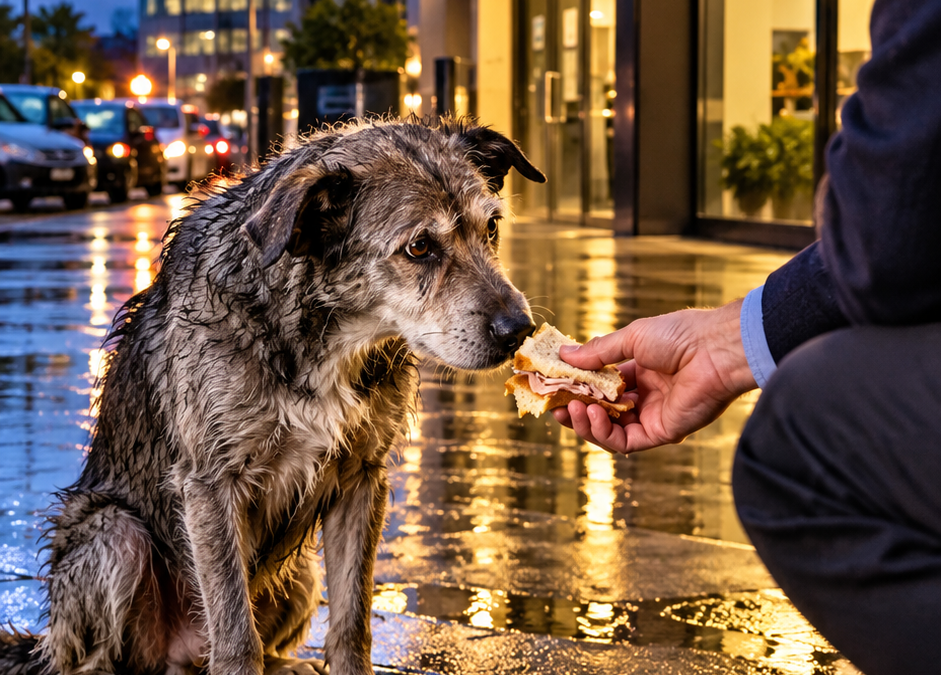
This time, I brought half a turkey sandwich out of my bag.
That was my first mistake.
Or maybe it was the first thing I did right.
I tore off a piece and tossed it toward him.
He sniffed it.
Ate it.
Then looked at me again.
“That’s it.”
His eyes stayed on mine.
“No more.”
I drove home.
On Wednesday, he was back.
Thursday too.
By Friday, I had named him in my head.
Gray Dog.
Not imaginative.
I had no intention of becoming attached.
I had owned a dog once.
Years earlier.
My ex-wife and I had a black Lab named Murphy.
When the marriage ended, Murphy stayed with her because she had the house with the yard, and I moved into an apartment where pets were not allowed.
At first, I visited.
Then less often.
Eventually Murphy got old.
My ex called when he died.
I sat in my car outside a grocery store for almost an hour after that call.
I had not realized how much of my old life that dog still carried for me.
So when the gray dog began appearing outside my office, I told myself I would not repeat that mistake.
Feed him once.
Fine.
Feel sorry for him.
Fine.
But attachment?
No.
Animals made promises without understanding that humans were often the ones who broke them.
I did not want another reminder of that.
On day six, the dog followed me farther.
Instead of stopping at the parking lot, he trotted behind me as I crossed the street to a small convenience store.
I bought a bottle of water and a pack of crackers.
When I came out, he was sitting beside the newspaper box.
“You’re becoming a problem.”
His tail tapped the sidewalk.
I poured some water into the plastic lid from a takeout container and put it near him.
He drank.
Then he walked away.
That surprised me.
I had expected him to follow me back to my car.
Instead, he headed down the block.
I watched him disappear between two buildings.
The next evening, he returned.
That became the pattern.
Some days he waited for me.
Some days I did not see him until I was halfway across the parking lot.
Sometimes he accepted food.
Sometimes he did not.
But he always did the same strange thing.
After spending a few minutes near me, he would walk away in the same direction.
Toward the older industrial blocks east of downtown.
And before disappearing, he would turn around.
Every time.
Look at me.
Wait.
Then continue.
I noticed it.
I just did not understand it.
By day nine, two of my coworkers had noticed him too.
Melissa from accounting stood beside me at the lobby window one evening.
“There’s your dog.”
“He’s not my dog.”
“He thinks he is.”
“He thinks I have sandwiches.”
She smiled.
“You should take him home.”
“No.”
“Why not?”
“Because he belongs to somebody.”
“He doesn’t have a collar.”
“That doesn’t mean anything.”
“He looks thin.”
“He’s not starving.”
“How do you know?”
“I’ve been feeding him.”
Melissa gave me a look.
“What?”
“You realize that sentence contradicts everything you just said.”
I ignored her.
On day eleven, I called animal control.
I still remember feeling relieved when I made the call.
Not because I wanted him taken away.
Because I thought I had finally transferred the problem to someone whose job included stray dogs.
They arrived the next afternoon.
A young officer walked around the area for twenty minutes.
Gray Dog was nowhere to be found.
Of course.
The moment someone came to help him, he vanished.
“He’ll probably return after we leave,” the officer said.
“He’s here every evening.”
“If you can safely contain him next time, call us.”
“Contain him how?”
“Garage, fenced yard, something like that.”
“I work in an office building.”
The officer shrugged apologetically.
“We’ll keep the report open.”
That evening, at 6:47, the dog appeared.
He sat beside the parking entrance and looked at me.
“You did that on purpose.”
Tail tap.
“I know you did.”
For the first time, I laughed.
That was when Gray Dog became Baxter in my mind.
I do not know why.
The name simply fit.
Maybe because he looked like a Baxter.
A little stubborn.
A little serious.
A dog who seemed as though he had been assigned a task and would continue doing it whether anyone else understood the assignment or not.
I started calling him that.
“Evening, Baxter.”
His ears lifted.
That should have told me something.
The first time I said the name, he reacted as if he recognized it.
I assumed coincidence.
Now I know better.
At the time, I simply thought I had found a name he liked.
Our routine settled in.
I left the building.
Baxter appeared.
Sometimes I brought food.
Sometimes just water.
Sometimes I sat on the low concrete wall near the parking lot while he waited beside me.
I never touched him at first.
He did not invite it.
He stayed close enough to watch but far enough that if I moved too quickly, he backed away.
On day fourteen, I finally held out my hand.
He sniffed it.
Then pressed his nose against my fingers.
His fur was wet from rain.
That brief contact affected me more than I expected.
I scratched gently under his chin.
He closed his eyes for half a second.
Then he moved away.
“Okay,” I said. “Boundaries.”
He turned east.
Walked ten steps.
Looked back.
That look again.
I should have followed him then.
Sometimes I think about that.
Fourteen days.
Eighteen days.
Twenty-five.
How many evenings did he give me the same invitation before I was willing to see it?
But human beings are very good at interpreting everything through the story they already believe.
My story was simple.
Stray dog.
Lonely.
Hungry.
Possibly abandoned.
I never considered that he might be trying to communicate something specific.
Dogs followed people.
Dogs begged.
Dogs searched for food.
Dogs did not recruit office workers for rescue missions.
So every evening, I watched him walk away.
Then I drove home.
Day seventeen was the first cold night.
The temperature dropped unexpectedly after sunset.
A wind moved through the streets hard enough to send paper cups rolling along the curb.
When I came outside, Baxter was curled against the side of the building.
He stood when he saw me.
“You’re freezing.”
His fur lifted in the wind.
I crouched.
“You need somewhere warm.”
He approached carefully.
I checked his neck again.
No collar.
No tag.
I opened the back door of my car.
He looked inside.
Then at me.
“Come on.”
He did not move.
“I’m trying to rescue you.”
Nothing.
I tossed a piece of chicken onto the back seat.
Baxter stepped forward.
Sniffed.
Then backed away.
“You’re impossible.”
He looked toward the eastern street.
Walked several steps.
Turned.
Waited.
I pointed at my car.
“This is warmth.”
He stared at me.
Then trotted away.
I stood there holding the open door.
That was the first time I seriously wondered whether he was going somewhere intentionally.
I still did not follow.
The next morning, I mentioned it to Melissa.
“He wouldn’t get in.”
“Maybe he has somewhere to go.”
“That’s what I thought.”
“Then follow him.”
“I’m not following a stray dog through downtown at night.”
“Why?”
“Because that’s how people end up on local news.”
She laughed.
“I’m serious.”
“So is the dog.”
I dismissed it.
But the idea stayed.
On day twenty, Baxter arrived carrying something in his mouth.
A glove.
Brown knit.
Women’s size, probably.
He dropped it near my shoes.
I picked it up.
“Where did you get this?”
He turned toward the same street.
I examined the glove.
Dirty.
Wet.
A small tear near the thumb.
No identifying mark.
I put it on the wall.
“Somebody probably dropped it.”
Baxter whined.
It was the first time I had heard him make that sound.
Not a bark.
Not a growl.
A short, frustrated sound deep in his throat.
“What?”
He walked east.
Looked back.
Whined again.
I followed him half a block.
That was all.
Then my phone rang.
My supervisor.
A client problem.
I answered.
By the time I looked again, Baxter was gone.
That night, I dreamed about the glove.
In the dream, it was sitting on my kitchen table.
Wet.
Dripping water onto the floor.
When I woke, I could not remember why it bothered me.
Day twenty-three, Baxter did not appear.
I waited ten minutes.
Then twenty.
I told myself I was relieved.
Maybe animal control found him.
Maybe his owner had taken him home.
Maybe somebody kinder than me had adopted him.
I drove away.
The next evening, he was back.
His left side was dirty.
Mud streaked his fur.
A small scrape showed above one paw.
I crouched.
“What happened?”
He let me touch the paw.
No serious injury.
“Where are you going every night?”
He looked east.
Of course.
I shook my head.
“You really are going to make me follow you eventually, aren’t you?”
His tail moved.
Day twenty-five, I bought dog food.
Not a sandwich.
Actual dog food.
That felt like an admission.
I kept a small bag in my trunk along with a bowl and two bottles of water.
When I set the bowl down, Baxter ate quickly but not desperately.
Then, as always, he stopped.
Turned east.
Walked.
Looked back.
I remember watching him disappear that night and feeling something almost like guilt.
I could not explain why.
Maybe because by then I had begun to understand that he was not simply wandering.
He had a destination.
And every evening he offered me a choice.
Come.
Or don’t.
I kept choosing don’t.
The twenty-seventh day was Sunday.
I did not work.
Around four in the afternoon, I found myself wondering whether Baxter was sitting outside the empty office building waiting.
I told myself that was ridiculous.
At five, I drove downtown anyway.
He was there.
Sitting beside the locked entrance.
When he saw my car, he stood immediately.
“You’ve got to be kidding me.”
I parked.
He came toward me.
For the first time, he wagged his tail hard enough that his whole rear end moved.
Something in my chest tightened.
“Were you waiting?”
He pressed his head against my knee.
I scratched behind his ears.
Then he turned east.
That evening, I followed farther.
Two blocks.
Then three.
We crossed beneath the railroad bridge.
Passed a closed auto-repair shop.
The neighborhood changed.
Streetlights became farther apart.
Buildings older.
Several storefronts boarded.
Baxter moved with confidence.
He knew exactly where he was going.
Then a car horn startled me as I crossed an intersection.
I stopped.
Baxter kept moving.
“Baxter!”
He turned.
I looked down the dark street ahead.
Then back toward the brighter downtown blocks behind me.
It was getting cold.
My car was three blocks away.
I felt foolish.
“Not tonight.”
Baxter stood there.
I pointed backward.
“I’ll come tomorrow.”
He did not move.
“I promise.”
Eventually, he turned and disappeared.
I broke that promise.
Monday became chaotic.
A vendor problem at work.
Two employees called out.
A client threatened to cancel a contract.
I stayed late.
When I finally left, it was almost nine.
Baxter was nowhere around.
On Tuesday, he appeared again.
I gave him food.
He tried to lead me.
I went home.
Wednesday, same thing.
By Thursday, he had been following me for thirty-two days.
That evening, I was exhausted.
I sat on the concrete wall beside him.
“You know, I think we have a dysfunctional relationship.”
Baxter sat facing me.
“I provide food. You refuse housing. You disappear every night. We never discuss anything.”
He blinked.
“I’m carrying this friendship.”
His tail moved once.
I smiled.
Then his expression changed.
That is difficult to explain if you have never known a dog long enough to recognize differences in the way they look at you.
His eyes became focused.
Almost urgent.
He stood.
Walked east.
Looked back.
Then repeated the movement twice.
“Not tonight.”
He whined.
“I’m tired.”
He came back and nudged my knee.
That was new.
“Baxter.”
He stepped away.
Looked toward the street.
Then at me.
For some reason, I almost followed.
Almost.
Instead, I drove home.
That night, rain began.
Hard rain.
The kind that taps against windows steadily enough to become part of the silence.
I woke around three and looked at the clock.
For reasons I could not explain, I thought about Baxter.
I pictured him under the office awning.
Wet.
Waiting.
Then I pictured him walking east.
I wondered where he slept.
For the first time, it occurred to me that perhaps he was not sleeping alone.
The thought stayed with me until morning.
The thirty-third day started badly and became worse.
A report I had spent hours preparing came back with changes.
A meeting ran long.
Someone sent an email at 4:58 p.m. requesting something they had known about for a week.
I stayed.
One hour became two.
Then three.
By the time I shut down my computer, the office was nearly empty.
The cleaning crew had already passed through.
I looked at the clock.
9:46 p.m.
Rain streaked the windows.
I considered calling a rideshare rather than walking across the lot.
Then I thought about Baxter.
I felt ridiculous.
“He won’t be there.”
I said it out loud to nobody.
I put on my coat.
Opened my umbrella.
Walked outside.
Rain hammered the pavement.
The street was almost empty.
Under the yellow parking lot light, sitting in the middle of a shallow puddle, was Baxter.
He was soaked.
Completely.
His gray fur clung to his body.
Water ran from his ears.
But he sat upright.
Watching me.
Something about him looked different.
Not hopeful.
Not hungry.
Urgent.
I stopped under the awning.
“You’re insane.”
Baxter stood.
Shook himself.
Water sprayed in every direction.
Then he walked left.
Not toward my car.
Toward the alley.
He turned.
Looked at me.
“Baxter.”
He took three more steps.
Looked back.
The rain continued.
I was tired enough to be angry.
“What do you want?”
He whined.
Then barked once.
One sharp sound.
It echoed between the buildings.
I stared at him.
For thirty-three days, Baxter had never barked at me.
Not once.
He walked farther into the alley.
Stopped.
Waited.
Something inside me shifted.
Maybe curiosity.
Maybe guilt.
Maybe the memory of all those evenings when I had watched him disappear.
Maybe simply the fact that no animal spends thirty-three days repeating the same behavior without a reason.
I lowered the umbrella slightly.
“All right.”
His ears lifted.
“I’m following you.”
He turned immediately.
That reaction told me more than anything.
He had understood the problem.
I was finally cooperating.
We went through the alley.
Rainwater rushed along the gutter.
Baxter moved quickly but not so quickly that I could not keep up.
Every half block, he checked behind him.
I followed.
Past the railroad bridge.
Past the auto shop.
Past the intersection where I had turned back days earlier.
The street narrowed.
Buildings became darker.
Several were abandoned.
Windows boarded.
Graffiti covered one brick wall.
A streetlight flickered at the far end.
I stopped once.
“What are you doing to me?”
Baxter waited.
Then continued.
Eventually he turned down a narrow lane between two old apartment buildings.
At the end stood a small house.
Or what used to be one.
The porch leaned.
Two windows were covered with plywood.
Paint peeled from the siding.
The front yard was mostly weeds and mud.
Baxter ran directly to the porch.
He climbed the steps.
Scratched at the door.
Softly.
Not frantically.
Three slow scratches.
Then he looked at me.
I climbed the porch.
“Is this where you live?”
He scratched again.
The door moved slightly.
Not locked.
Every sensible instinct told me not to enter an abandoned house at ten o’clock at night because a dog wanted me to.
I took out my phone.
Turned on the flashlight.
“Hello?”
No answer.
“Anybody inside?”
Nothing.
Baxter pushed the door with his nose.
It opened several inches.
He slipped through.
“Baxter.”
I stood there.
Rain dripped from my coat.
The interior smelled like dust, damp wood, and cold air.
I called again.
“Hello?”
Then I heard something.
A cough.
Weak.
From deeper inside.
Every nerve in my body sharpened.
I stepped through.
The floor creaked.
Broken furniture sat against the walls.
Plaster had fallen in several places.
My phone light moved across empty rooms.
Baxter disappeared around a corner.
Then I heard his nails scratching across the floor.
I followed.
The back room was small.
A broken chair.
Old boxes.
A couch with torn cushions.
And sitting at one end of that couch was a woman.
She was so thin that for one terrible second I thought she might be dead.
Her shoulders disappeared inside a large coat.
Dark hair hung around a pale face.
Both hands held an old photograph.
When my light reached her, she startled.
Her eyes widened.
“Who are you?”
I immediately lowered the phone.
“I’m sorry. I’m sorry. Your dog brought me here.”
Her eyes moved past me.
Baxter stood beside the couch.
Her expression collapsed.
“Baxter?”
The way she said his name answered every question I had failed to ask for thirty-three days.
Baxter crossed the room.
He pressed his head into her lap.
The photograph fell beside her.
She wrapped both arms around his neck.
“Oh, baby.”
Her voice broke.
“Oh, Baxter.”
The dog made a sound I had never heard from him before.
A low whimper.
He pushed closer.
She buried her face against his wet fur.
And cried.
I stood in the doorway feeling like I had walked into something private.
Something sacred.
“I can leave.”
“No.”
She looked up quickly.
“Please.”
I stayed.
She wiped her face with one sleeve.
“I’m sorry.”
“You don’t have anything to apologize for.”
“I probably scared you.”
“I followed a dog into an abandoned house at ten at night. I think I scared myself.”
A small laugh escaped her.
Then she coughed.
“Are you hurt?”
“No.”
“When did you last eat?”
She looked away.
That was answer enough.
I took off my backpack.
There was a protein bar inside from work.
A bottle of water.
I handed both to her.
She hesitated.
“Please.”
She took them.
Her hands shook.
Baxter remained pressed against her leg.
“What’s your name?”
“Rachel.”
“I’m Daniel.”
She nodded.
For several minutes, she ate slowly.
I sat on the floor because every chair looked unsafe.
The concrete beneath me was cold.
Dust clung to my pants.
I did not care.
Baxter watched both of us.
Eventually I asked the question.
“How long has he been yours?”
Rachel looked down.
“Five years.”
I laughed once, but there was no humor in it.
“That explains why he knew his name.”
“You called him Baxter?”
“For about three weeks.”
She smiled faintly.
“He probably thought you were finally learning.”
That sounded exactly like him.
Rachel touched his ear.
“He was with me when everything fell apart.”
Her fingers trembled through his wet fur.
“I lost my job three months ago.”
“What kind of work?”
“Hotel laundry.”
She looked embarrassed.
As if the type of work mattered.
“The hotel changed contractors. Half of us were gone in one week.”
“Were you able to find anything else?”
“I tried.”
She stared at the protein bar wrapper.
“My rent was already late. Then I got sick. Nothing serious. Just enough to miss interviews. I sold some things.”
Her voice became quieter.
“Then the landlord changed the locks.”
“What about family?”
“My mother died six years ago. My brother lives in Arizona. We haven’t spoken in a long time.”
“And Baxter?”
Her hand stopped moving.
“He came with me.”
For the first few weeks, she said, they slept wherever they could.
Bus shelters.
A stairwell behind a warehouse.
A church porch until someone complained.
Sometimes she found temporary shelter beds, but not all allowed dogs.
One place told her Baxter could not stay.
She slept outside instead.
“He kept me warm,” she said.
I looked at him.
Baxter had stretched across her shoes.
“I started thinking I was ruining his life.”
Her voice cracked.
“He was getting thinner. He was always wet. I couldn’t buy enough food.”
She wiped her cheek.
“One day I yelled at him.”
Baxter lifted his head.
She touched his face.
“I told him to go.”
I said nothing.
“I threw his leash.”
Her eyes filled again.
“I told him he deserved somebody better.”
The shame in her expression hurt to watch.
“I thought if I made him believe I didn’t want him, he might leave.”
“But he didn’t.”
“No.”
She laughed through tears.
“He followed me.”
“How long?”
“Everywhere.”
She looked at me.
“Then something changed.”
I already knew.
“He started disappearing.”
Rachel nodded.
“During the day. Sometimes for hours.”
“And coming back?”
“Always.”
She wiped her nose.
“At first I thought he was finding food.”
Sometimes he did.
A piece of bread.
Half a sandwich.
Once an entire hamburger still inside the paper.
But other times, Baxter returned without food.
Instead, someone would appear near the house.
A delivery driver.
A teenager.
A woman walking home.
A man in work clothes.
Baxter would approach them.
Try to lead them.
Most stopped at the end of the lane.
Some watched him disappear toward the abandoned house and walked away.
“One woman followed him almost to the porch,” Rachel said. “Then she saw the building and left.”
“How many?”
“I don’t know.”
She looked at Baxter.
“He kept trying.”
I felt something tighten behind my ribs.
“Thirty-three days.”
Rachel looked at me.
“What?”
“He’s been waiting outside my office for thirty-three days.”
Her hand covered her mouth.
I stared at Baxter.
Every evening.
Every look backward.
Every time he refused to get into my car.
The glove.
The whining.
The Sunday he waited outside an empty office.
The alley.
The invitation.
I had believed he wanted food.
He wanted me to follow.
“I’m sorry.”
Rachel frowned.
“For what?”
I looked down.
“I should have followed him sooner.”
“No.”
“You don’t understand. He tried every day.”
“You fed him.”
“That wasn’t what he needed.”
Rachel looked at me for a long moment.
Then she said quietly, “Maybe he needed you to trust him.”
That sentence stayed with me.
Even now.
Maybe he needed you to trust him.
I sat there on the dusty floor, rain tapping against the boarded windows, and thought about how easily I had misread everything.
I had looked at Baxter and seen inconvenience.
Responsibility.
Potential attachment.
A problem I did not want.
I had spent thirty-three days asking what he wanted from me.
Food?
Shelter?
A home?
He had wanted none of those things for himself.
He had been trying to lead me to Rachel.
He had been searching for someone who would stop seeing him as a stray long enough to realize he was a messenger.
“What happens now?” Rachel asked.
I looked at her.
“Now?”
She nodded toward the door.
“You found me.”
There was something terrifying in the way she said it.
As though discovery might not matter.
As though people could find you and still leave.
I thought about my apartment.
My spare bedroom filled with boxes.
The life I had carefully arranged so no one needed anything from me.
Then I thought about Rachel sitting in that frozen room because every system she had encountered seemed to require one more thing she could not provide.
Identification.
Money.
No dog.
Permanent address.
Proof.
Appointment.
Transportation.
I reached for my phone.
“I know someone.”
She immediately tensed.
“Police?”
“No.”
“Shelter?”
“Maybe. Social services.”
Her face changed.
“They’ll separate us.”
She wrapped one hand around Baxter’s collar even though he wore none.
“I’m not leaving him.”
“I’m not asking you to.”
“Most places won’t take dogs.”
“I’ll make sure we ask first.”
She looked unconvinced.
“My friend’s name is Marcus. We went to college together. He works with a city outreach program.”
“What if he says no?”
“Then we call someone else.”
“And if they all say no?”
“Then we keep calling.”
I realized as I said it that I meant it.
I called Marcus.
He answered after four rings.
“Daniel?”
“Sorry.”
“Do you know what time it is?”
“Yes.”
“Is something wrong?”
I looked at Rachel.
“Yes.”
That got his attention.
I explained enough.
Homeless woman.
Abandoned house.
Dog.
Cold.
Food needed.
Temporary shelter.
Marcus asked for the location.
“I’ll make calls.”
“Dog has to stay with her.”
“That makes it harder.”
“I know.”
“You sound unusually determined.”
“I followed the dog for thirty-three days. I’m not ruining his plan now.”
There was silence.
Then Marcus said, “Give me fifteen minutes.”
While we waited, I found an old blanket in another room.
It smelled dusty, but it was dry.
Rachel wrapped it around her shoulders.
I gave Baxter the dog food I had started keeping in my trunk.
He ate beside the couch.
Rachel watched him.
“You were feeding him?”
“Most days.”
“Thank you.”
“I think he was using me.”
She smiled.
“He does that.”
The smile transformed her.
For a second, I could see the person she had been before exhaustion hollowed out her face.
My phone rang.
Marcus.
“I found one.”
I stood.
“What?”
“Temporary placement through Harbor Outreach. Small transitional facility. They have two rooms that allow animals.”
“Tonight?”
“If we can get her there before midnight.”
I looked at Rachel.
Her eyes were fixed on me.
“What does she need?”
“Basic intake. They can do documentation tomorrow. Outreach worker will meet you there.”
“Address?”
He gave it to me.
I wrote it down.
Then Marcus said, “Daniel.”
“Yeah?”
“You did good calling.”
I looked at Baxter.
“No. Someone else did the hard part.”
Getting Rachel into my car took nearly ten minutes.
Not because she refused.
Because standing made her dizzy.
I supported one arm.
Baxter stayed glued to her side.
When we reached the street, rain was still falling.
I opened the rear door.
Baxter jumped in immediately.
I stopped.
For thirty-three days, he had refused that car.
Rachel noticed my expression.
“What?”
“Nothing.”
I laughed.
“Absolutely nothing.”
She sat beside him.
Baxter curled against her.
I drove.
The shelter was not beautiful.
It was an old converted motel near the edge of town.
But lights were on.
A woman named Denise waited beneath the awning with an umbrella.
She had paperwork in one hand and dog treats in the other.
Baxter liked her immediately.
That seemed like a positive sign.
Denise introduced herself to Rachel.
No judgment.
No surprise.
Just calm questions.
“You’re Rachel?”
“Yes.”
“And this is Baxter?”
Rachel nodded.
“He stays with me.”
“He stays with you.”
Rachel blinked.
“That’s okay?”
“That’s why we put you in Room Seven.”
Rachel started crying again.
Not loudly.
She covered her mouth.
Denise touched her shoulder.
“You’re okay.”
The sentence was simple.
But I watched Rachel absorb it as if no one had said those words to her in months.
You’re okay.
Not you’re a problem.
Not you need to leave.
Not prove something.
Just you’re okay.
We carried her few belongings inside.
One plastic bag.
The photograph.
A jacket.
Nothing else.
Room Seven had two beds, a small table, a bathroom, and one window facing the parking lot.
It was warmer than the abandoned house.
That alone made it feel luxurious.
Denise brought soup.
Rachel sat on the bed.
Baxter immediately climbed onto the floor beside her.
For the first time that night, his body relaxed.
Completely.
No watching the door.
No checking me.
No urgency.
He rested his head on his paws.
I understood.
Mission finished.
I stood near the doorway.
“I should go.”
Rachel looked up.
“Daniel.”
“Yeah?”
“Thank you.”
I felt uncomfortable.
Not because I did not appreciate it.
Because the gratitude belonged somewhere else.
I pointed toward Baxter.
“Thank him.”
She looked down.
“I already owe him everything.”
I stepped into the hallway.
Baxter stood.
Followed me.
Rachel called him.
“Baxter?”
He kept coming.
He stopped beside me.
For one second, I wondered if he wanted to leave with me.
Then he licked my hand.
Once.
Looked directly at my face.
And returned to Rachel.
That was all.
No dramatic goodbye.
No bark.
No tail wagging wildly.
One lick.
One look.
Then back to the person he had refused to abandon.
I stood there longer than I needed to.
Driving home, the city looked different.
Same rain.
Same streets.
Same boarded buildings.
But I kept thinking about how many times I had driven past people like Rachel.
I told myself I was not responsible.
And technically, I wasn’t.
No one person can solve homelessness.
No one can rescue everyone.
You can destroy yourself trying.
But there is a difference between accepting your limits and using them as permission never to notice.
That was what Baxter forced me to understand.
I had built an entire philosophy around not getting involved.
Stay out of trouble.
Mind your business.
Do your job.
Go home.
Do not invite complications.
Then a dog spent thirty-three days patiently dismantling it.
The next morning, I woke exhausted.
For one second, I thought everything might have been a dream.
Then I saw mud on my shoes.
I texted Marcus.
Any update?
He replied twenty minutes later.
Rachel slept. Ate breakfast. Caseworker meeting at 10. Baxter stole half a bagel.
I laughed.
At work, Melissa looked toward the parking lot at five.
“No dog.”
“No.”
“You finally kidnap him?”
“Long story.”
She stared at me.
“You followed him.”
“I followed him.”
Her mouth opened.
“I told you to do that three weeks ago.”
“Yes.”
“I want that officially documented.”
“No.”
“What happened?”
I told her.
Not every detail.
Enough.
By the end, Melissa’s eyes were wet.
“He was trying to rescue her.”
“Yes.”
“And you thought he wanted turkey.”
“In my defense, he accepted the turkey.”
She shook her head.
“You are impossible.”
A week later, I visited Rachel.
She looked different already.
Not healthy yet.
But rested.
Clean clothes.
Hair brushed.
Color beginning to return to her face.
Baxter was asleep beside her chair.
She had met with a benefits coordinator.
Started replacing her identification.
Applied for temporary assistance.
Marcus’s program had connected her with a workforce counselor.
A local hotel needed laundry staff.
The irony was not lost on her.
“I might go back to the same kind of job.”
“Work is work.”
She nodded.
“I miss work.”
That surprised me.
“Really?”
“When you lose it, you miss everything about having somewhere you’re supposed to be.”
I understood more than she knew.
My job had become the place I hid from my life.
Hers had been the structure keeping hers from collapsing.
Same word.
Different relationship.
I visited again two weeks later.
Then again.
Not every day.
I did not become her rescuer.
That would have been its own kind of arrogance.
Rachel did the work.
Filled out forms.
Went to interviews.
Met caseworkers.
Accepted help even when accepting help embarrassed her.
That takes more courage than people admit.
Baxter stayed beside her through all of it.
Eventually, she found a part-time housekeeping job.
Then more hours.
Three months later, she moved from transitional housing into a small subsidized apartment.
The building allowed dogs.
That condition remained non-negotiable.
I helped carry one chair upstairs.
Marcus carried a small table.
Rachel stood in the doorway holding the same photograph she had clutched the first night.
I finally asked about it.
She handed it to me.
A younger Rachel.
Her mother.
Baxter as a puppy.
All three sitting on a porch.
“My mom gave him to me.”
“That explains a lot.”
“What?”
“He comes from a family of stubborn women.”
Rachel laughed.
Baxter barked once.
Apparently offended.
Life did not transform into a perfect story.
Rachel still struggled.
Money remained tight.
There were weeks when transportation became a problem.
Days when she worried about rent.
Baxter needed veterinary care after months of poor nutrition.
Marcus helped connect her with a low-cost clinic.
She had bad days.
So did I.
What changed was not that everything became easy.
It was that neither of us was invisible anymore.
Six months later, I walked through the old neighborhood where Baxter had led me.
The abandoned house had finally been boarded completely.
A city notice was posted on the door.
I stood across the street.
The rain from that night felt very far away.
Baxter had crossed that distance every day.
From Rachel to downtown.
From downtown back to Rachel.
Searching.
Testing strangers.
Trying again.
Thirty-three days with me alone.
I thought about the patience required for that.
People sometimes describe dogs as loyal as though loyalty were passive.
Sit.
Wait.
Stay.
Baxter’s loyalty was active.
He made plans.
He searched.
He recruited.
He refused a warm car because Rachel was still cold.
He took food but returned to share whatever life remained with her.
He did not leave when she tried to drive him away.
He understood something Rachel herself had stopped believing.
She was still worth finding.
A year after that night, I saw them outside a small grocery store.
I was driving home from work.
Baxter sat beside the entrance.
Rachel stood nearby carrying two bags.
I pulled over.
Baxter saw me first.
His tail started.
He did not run toward me.
He simply watched.
Peacefully.
No urgency in his eyes.
No turning toward another street.
No silent request.
I walked over.
“Hey, old man.”
He stood and let me scratch his neck.
Rachel smiled.
“He remembers you.”
“I’d be offended if he didn’t.”
“You know what’s funny?”
“What?”
“He doesn’t follow strangers anymore.”
I looked at him.
“So I really was a project.”
“Definitely.”
We laughed.
Then Rachel grew serious.
“You saved my life.”
I shook my head.
“Baxter did.”
“You followed.”
“Eventually.”
“That matters.”
I thought about arguing.
Then stopped.
Maybe she was right.
Following mattered.
Not because I was special.
Because help often fails in the space between seeing and acting.
I had seen Baxter for thirty-two days.
On the thirty-third, I acted.
That difference was one block.
Then another.
Then one dark street.
Then an abandoned house.
Sometimes the distance between a person’s life collapsing and beginning to recover is not a heroic act.
It is someone deciding to walk ten more minutes in the rain.
My own life changed too.
Quietly.
I started leaving the office earlier.
Not every day.
Enough.
I joined Melissa and some coworkers for dinner once instead of inventing an excuse.
I called my sister more often.
I finally emptied the boxes from the second bedroom.
I volunteered twice a month with Marcus’s outreach program.
Not because Baxter turned me into a saint.
He did not.
I still liked boundaries.
Still liked quiet.
Still occasionally ignored messages until morning.
But I stopped assuming that caring automatically meant being consumed.
That had been one of my excuses.
If I noticed one person’s pain, I would somehow become responsible for everyone.
So better not to notice too much.
Baxter taught me there was another option.
Notice the person in front of you.
Do the next reasonable thing.
Then the next.
You do not have to save the world.
Sometimes you just have to answer the door someone has been scratching at for thirty-three days.
Years have passed since then.
Baxter’s muzzle turned almost white.
Rachel eventually moved into a small apartment closer to work.
She became a shift supervisor.
Marcus still takes credit for finding the shelter.
Melissa still takes credit for telling me to follow the dog.
Everyone apparently played the decisive role except me.
I am comfortable with that.
Sometimes I drive past the parking lot where Baxter first appeared.
I can still see him in my memory.
Gray fur.
Sitting beneath the light.
Watching me.
At the time, I believed his eyes carried need.
I was wrong.
They carried purpose.
That is what I remember most.
Not the abandoned house.
Not the cold room.
Not even Rachel crying into his fur.
I remember all the times he looked back.
The same question each night.
Are you coming?
For thirty-two days, my answer was no.
Too tired.
Too busy.
Too cautious.
Too sensible.
Then one rainy night, I said yes.
That single decision did not make me brave.
It made me available.
Sometimes that is enough.
Baxter had spent thirty-three days trying to show me that someone was still waiting at the other end of the road.
He never needed me to understand everything.
He only needed me to follow.
And once I finally did, I realized the truth that dog had understood long before I did.
Nobody who is still searching for help has completely given up.
Sometimes hope does not look like hope.
Sometimes it looks like a tired woman in an abandoned house holding an old photograph.
Sometimes it looks like a gray dog standing in the rain.
And sometimes it looks like one ordinary person deciding, at last, to take the next step.

