𝗙𝗨𝗟𝗟 𝗦𝗧𝗢𝗥𝗬 For Thirty-Three Days, That Dog Waited for Me to Notice What Everyone Else Had Walked Past
𝗣𝗔𝗥𝗧 𝟮
Everyone laughed.
I smiled because that was easier than explaining that I was beginning to feel genuinely disturbed.
That evening, I took a different route home.
The dog followed.
The next morning, I left twenty minutes earlier.
He was already outside.
Two days later, I left by the rear entrance of the office.
He was waiting across the alley.
I started wondering whether someone was feeding him information about my schedule, which was absurd.
Then I wondered whether he was dangerous.
Rabies crossed my mind.
So did disease.
So did the possibility that he had become territorial or obsessed.
I searched online for information about stray-dog behavior.
None of it seemed to explain him.
Most stray dogs followed people for food, affection, shelter, or protection.
This dog wanted none of those things from me.
At least not directly.
He wouldn’t come inside.
He wouldn’t let me touch him.
He barely ate what I gave him.
He didn’t seem to want me.
He wanted my attention.
There was a difference, though it took me weeks to understand it.
By the tenth day, I had begun talking to him.
Not because I expected an answer.
Mostly because silence made the situation stranger.
“You know people are starting to think I own you.”
He walked several yards behind me.
“I don’t.”
His ears moved.
“Just making that clear.”
Another night I stopped beneath a streetlamp.
“What do you want?”
He stopped too.
“Food?”
Nothing.
“A place to sleep?”
Nothing.
“You want me to call animal control?”
At that, he took a step backward.
I narrowed my eyes.
“Interesting.”
The dog stared at me.
“You understand more than you’re pretending to.”
I laughed at myself.
Then I walked home.
By the second week, his presence had become part of my routine.
Alarm.
Coffee.
Work.
Dog.
Office.
Dog.
Home.
There were nights when I would glance behind me before he appeared because I knew exactly where he would be.
There were mornings when I would open the building door and feel a strange sense of relief when I saw him across the street.
That bothered me more than anything.
I was becoming attached to a dog that wouldn’t let me touch him.
Some mornings, I tried ignoring him completely.
Those were the mornings I felt him most intensely.
I could hear the faint taps of his paws behind me.
If I stopped at a crosswalk, he stopped.
If I crossed, he crossed.
If someone walked too close to me, his posture changed.
But he never became aggressive.
He just watched.
At night, lying in bed, I sometimes wondered where he went after I entered my apartment.
I would get up, walk to the window, and look down.
Sometimes he was gone.
Sometimes he sat across the street for a while.
I began leaving water downstairs.
Once, I left an old towel beneath the building awning because the forecast called for rain.
The next morning, the towel was untouched.
He was sitting beside it.
“You are the most difficult animal I’ve ever met.”
He looked almost offended.
I actually smiled.
That frightened me.
It had been a long time since something outside work had become part of my life without permission.
The dog had done exactly that.
He had entered my routine without entering my home.
He occupied no room, yet somehow took up space.
On the eighteenth day, I almost called a shelter.
I had the phone in my hand.
The dog was sitting outside the office.
One of the women from accounting stood next to me.
“You should do something,” she said.
“I know.”
“He can’t keep living outside.”
“I know.”
“Maybe he’s lost.”
“I’ve checked local notices. Nothing.”
“No microchip?”
“I’d have to catch him first.”
“Doesn’t he come to you?”
“No.”
She looked confused.
“But he follows you everywhere.”
“Exactly.”
“So why won’t he let you touch him?”
“I wish I knew.”
She studied him through the glass.
“Maybe he isn’t following you because he wants you to take him.”
I turned toward her.
“What?”
She shrugged.
“Maybe he wants something else.”
I remember those words.
I didn’t understand them then.
But I remembered them.
That evening, I stood outside and looked at him.
“What else?”
The dog stared back.
“What do you want from me?”
He turned his head briefly toward the east end of the street.
Then looked at me again.
I thought nothing of it.
I wish I had.
Days passed.
Twenty-one.
Twenty-four.
Twenty-seven.
My annoyance faded.
My curiosity deepened.
Then curiosity became concern.
His coat looked wetter most mornings.
He seemed more tired.
Sometimes he disappeared for several hours and returned with mud on his paws.
Once, I noticed a scrape along his shoulder.
I crouched.
“What happened?”
He wouldn’t come close.
“Let me see.”
He backed away.
“Fine.”
I exhaled.
“Fine, don’t trust me.”
But that wasn’t true.
He did trust me.
Just not in the way I understood trust.
He trusted me to follow eventually.
I simply hadn’t earned the truth yet.
On the thirtieth day, I woke from a dream at four in the morning.
In the dream, I had been walking through an unfinished building.
Every room had a door.
Behind every door, I could hear someone knocking.
But whenever I opened one, the room was empty.
At the end of the hallway, the dog stood beneath a light.
I woke with my heart racing.
I went to the window.
The street was nearly empty.
And there he was.
Sitting below.
Looking up.
I froze.
For perhaps ten seconds, neither of us moved.
Then he stood and disappeared around the corner.
I didn’t sleep again.
The next day, I was useless at work.
I made mistakes in drawings I had reviewed three times.
I stared at walls.
I forgot half a conversation with a client.
Around four, Antoine dropped a folder on my desk.
“You look terrible.”
“Thanks.”
“I’m serious. When did you last sleep?”
“I sleep.”
“That’s not what I asked.”
I rubbed my eyes.
He lowered his voice.
“Is this about the dog?”
I almost laughed.
“It sounds insane when you say it out loud.”
“It looks insane too.”
“I don’t understand what he wants.”
“Maybe stop trying to understand.”
“What does that mean?”
“Follow him.”
I looked at him.
Antoine shrugged.
“He’s been following you for a month. Maybe it’s your turn.”
I smiled.
“That’s ridiculous.”
“Probably.”
He walked away.
But the sentence stayed.
Maybe it’s your turn.
Three days later, the rain came.
That was the thirty-third night.
I remember the number because by then I had actually started counting.
Thirty-three days.
Thirty-three mornings.
Thirty-three evenings.
Thirty-three days of those eyes.
It was February, and the rain was bitterly cold.
Not the soft spring rain that makes the city shine.
This rain attacked sideways.
It ran beneath collars and down sleeves.
By ten that night, our office floor was almost empty.
I had stayed late again, partly because of work and partly because I was beginning to question myself.
The dog had not appeared that afternoon.
For the first time in weeks, I felt something that surprised me.
Fear.
Not fear of him.
Fear for him.
I checked the street twice from the window.
Nothing.
At ten-fifteen, I packed my bag.
“You’ve lost your mind,” I muttered to myself.
For thirty-three days, I had complained about being followed.
Now one evening without him made me anxious.
I rode the elevator down.
When the doors opened, the security guard nodded.
“Late again.”
“Unfortunately.”
“Terrible weather.”
“I noticed.”
He smiled.
“Your dog waiting?”
I stopped.
“He’s not my dog.”
The guard laughed.
“Could’ve fooled me.”
I pushed through the lobby doors.
Cold rain hit my face.
For a moment, I saw nothing.
Then a shape moved near the edge of the building.
He stepped into the light.
My chest tightened.
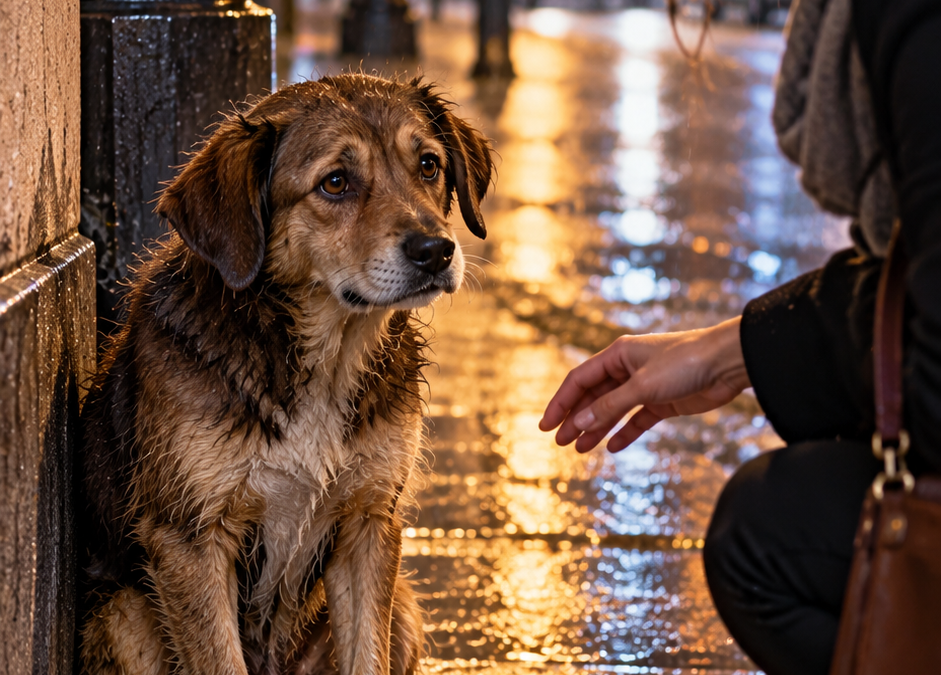
He was soaked.
Completely soaked.
His fur clung to his narrow body.
Water streamed from his ears.
He looked exhausted.
But he was standing.
Waiting.
“There you are.”
I don’t know why I sounded relieved.
Maybe because I was.
I started toward him.
Usually, he would maintain his distance.
That night he didn’t.
He stayed still until I was only a few feet away.
And then I saw his eyes.
They were different.
For thirty-two days, I had seen patience in them.
Expectation.
Persistence.
That night, the patience was gone.
What remained was urgency.
It was the look of someone who had waited as long as waiting was possible.
The dog turned his head toward an alley.
He took several steps.
Stopped.
Looked back.
I didn’t move.
He walked farther.
Stopped again.
Looked at me.
A chill ran through me that had nothing to do with the rain.
“You want me to follow you.”
The dog stood motionless.
“This is insane.”
He turned toward the alley again.
“Do you understand what time it is?”
He looked back.
I laughed once, nervously.
“Of course you don’t care.”
He started walking.
I remained beneath the office awning.
Every reasonable instinct told me to go home.
I was an exhausted thirty-five-year-old architect standing in freezing rain, considering following an unknown stray through a dark section of the city.
No one knew where I was going.
I didn’t know where I was going.
I didn’t even know whether the dog knew.
Then I remembered Antoine.
Maybe it’s your turn.
The dog disappeared around the corner.
I stood alone.
Something in my chest tightened.
I realized that if I walked home that night, I would spend the rest of my life wondering.
So I stepped into the rain.
“Wait.”
The dog reappeared.
He stood beneath the streetlight.
I pointed at him.
“If I get murdered, this is your fault.”
For the first time, I thought I saw his tail move.
Just once.
Then he turned away.
That night, I gave him a name.
Fritz.
I have no logical explanation for why.
Maybe it came from some old German story I had read as a child. Maybe I needed to call him something because following an unnamed animal into darkness felt even more absurd.
“All right, Fritz.”
He looked back.
“Show me.”
He walked slowly.
Not like a dog wandering.
Like a guide.
Every few yards, he checked behind him.
If I fell too far back, he waited.
If I came closer, he continued.
The alley narrowed between old buildings.
Graffiti covered the walls.
Water poured from rusted gutters and struck the pavement in heavy streams.
The stones beneath my shoes were slick.
Once, my foot slid.
I caught myself against the wall.
Fritz immediately turned around.
He came closer than he ever had before.
Not close enough for me to touch him, but close enough that I saw droplets hanging from his whiskers.
“I’m okay.”
He watched me.
“I said I’m okay.”
He turned and continued.
I stared after him.
“You’re more considerate than half the people I work with.”
For some reason, saying it made me laugh.
The sound echoed strangely through the alley.
We crossed another street.
Then another.
The neighborhoods became darker.
Storefronts disappeared.
Several buildings looked abandoned.
One streetlamp flickered above us, turning Fritz’s wet silhouette into something almost ghostlike.
A childhood story returned to me then.
I couldn’t remember its name.
Only an image of wolves leading lost travelers through a forest toward people who needed saving.
I had loved stories like that when I was young.
Then I grew up.
Studied engineering.
Studied architecture.
Learned load calculations, materials, codes, schedules, permits.
I learned to trust structures I could measure.
Somewhere along the way, I stopped believing life could contain mysteries.
Following Fritz through the rain, I felt something old inside me begin to wake up.
Not superstition.
Maybe attention.
There are things we call coincidences simply because admitting they mean something would require us to change.
Fritz stopped.
I almost walked into him.
We had entered a small courtyard trapped between several old buildings.
At the center stood a ruined stone fountain.
The basin had filled with rainwater and brown leaves.
Fritz lowered his head and drank.
I watched him.
“You brought me here for water?”
He raised his head.
Then he turned toward the far side of the courtyard.
That’s when I saw the house.
Calling it a house was generous.
It was more like a forgotten structure squeezed between two abandoned buildings.
The exterior plaster had crumbled away in patches.
Several windows were covered with boards.
The doorway had been partially blocked by old wooden planks.
One plank was missing.
Through that narrow gap, I could see light.
Weak yellow light.
My body went still.
Someone was inside.
Fritz walked toward the door.
“Wait.”
He ignored me.
He reached the threshold and scratched gently at the wood.
Once.
Twice.
Then he stepped back and sat.
His head lowered.
I had seen dogs wait before.
I had seen dogs beg.
But there was something about the way Fritz sat outside that door that broke through every defense I had built.
He wasn’t asking for himself.
I knew it before I knew anything else.
I walked closer.
The smell reached me first.
Wet wood.
Mold.
Smoke.
Something sour.
Something human.
Something sick.
I stared through the gap.
“Hello?”
No answer.
Fritz scratched the door again.
“I’m not supposed to be here,” I whispered.
The dog looked at me.
My hand rested on the old door.
Every sensible thought came at once.
This could be private property.
There could be dangerous people inside.
There could be drugs.
There could be someone armed.
I should call the police.
I should call emergency services.
I should leave.
But beneath all those thoughts was a simpler one.
Thirty-three days.
This was why.
The knowledge settled inside me with astonishing certainty.
For thirty-three days, Fritz had been trying to bring me here.
I pushed the door.
The hinges groaned.
The sound seemed impossibly loud.
“Hello?”
Still nothing.
I stepped inside.
The room was dim.
A single candle burned on an old table.
At first, my eyes could not separate objects from shadows.
Then shapes emerged.
A broken chair.
A blanket.
Plastic bottles.
A small pile of books.
A rusted pan.
And then I saw the man.
He sat on the floor against the far wall.
An old blanket covered his legs.
His beard was long and silver.
His cheeks had collapsed inward with weight loss.
His clothing hung loosely from him.
One hand rested against his chest.
In the other, he held a photograph.
For one terrible second, I thought he was dead.
Then his eyes opened.
They were startlingly clear.
He looked directly at me.
Not frightened.
Not surprised.
Almost relieved.
“I didn’t think you’d come,” he said.
His voice was barely more than a breath.
I stood frozen.
“What?”
The old man’s gaze moved past me.
Fritz entered.
And everything changed.
The dog who had refused to come within arm’s reach of me rushed across the room.
He pressed himself against the old man’s side.
The man lowered one trembling hand onto Fritz’s head.
Fritz closed his eyes.
The familiarity of that gesture told me more than any explanation could have.
They belonged to each other.
The old man looked at me again.
“Every day,” he whispered, “I prayed he would bring someone.”
My mouth went dry.
“What do you mean?”
He stroked Fritz’s wet fur.
“I couldn’t go far anymore.”
His breathing sounded shallow.
“I told him to leave.”
He gave a weak smile.
“He never listened very well.”
I moved closer.
“Are you hurt?”
“Old.”
“That’s not what I asked.”
“Sick, then.”
“How sick?”
He shrugged faintly.
“I stopped keeping track.”
I looked around the room.
“You live here?”
“For now.”
“This isn’t a home.”
“No.”
“How long have you been here?”
He stared toward the candle.
“A while.”
“How long?”
“I don’t know.”
“Days?”
He gave a faint laugh.
“Longer.”
“Weeks?”
His silence answered.
I knelt several feet in front of him.
The floor soaked through my trousers immediately, but I barely noticed.
The photograph in his hand showed a younger version of him standing beside a woman.
She was smiling.
Fritz was there too, younger, his fur darker and fuller.
The old man noticed me looking.
“My wife.”
His thumb touched the edge of the photograph.
“She died.”
“I’m sorry.”
“So am I.”
His voice cracked.
“Every morning.”
He took a slow breath.
“We were married thirty-eight years.”
I didn’t know what to say.
He continued without waiting.
“When she died, the apartment became too quiet. Funny, isn’t it? You spend half your marriage wishing for a little peace, and then one day you get all the peace in the world.”
He stared at the photograph.
“And you would give anything to hear one more cupboard door slam.”
Fritz rested his chin on the man’s leg.
The old man’s fingers moved automatically behind his ear.
“Fritz stayed.”
I looked sharply at the dog.
“Fritz?”
The man nodded.
I stared.
“That’s his name?”
“Yes.”
For a second, I couldn’t speak.
I had chosen the same name hours earlier.
I could have laughed at the coincidence.
Instead, goosebumps rose along my arms.
The man noticed my expression.
“What?”
“Nothing.”
I looked at Fritz.
“Nothing.”
The old man continued.
“My son moved abroad years ago. At first, we called. Then less often. Then life happened.”
He swallowed.
“You know how people say they’ll call tomorrow?”
I nodded.
“Sometimes tomorrow becomes five years.”
His eyes lowered.
“I worked as long as I could. After my wife died, Fritz and work were what I had. Then I got sick.”
“What happened?”
“Doesn’t matter much now.”
“It matters.”
He studied me as though no one had said that to him in a long time.
“I couldn’t work.”
His voice softened.
“Then I couldn’t pay rent. Then the notices came. Then the locks changed.”
I felt my stomach drop.
“So you came here?”
“Not at first.”
He explained in fragments.
A friend’s couch.
A temporary room.
A shelter he couldn’t stay in with Fritz.
Nights outside.
Then this building.
Nobody seemed to care about it, and nobody seemed to care about the old man living inside it.
“So you stayed,” I said.
He nodded.
“Fritz stayed with me.”
The dog opened his eyes at the sound of his name.
“I tried to chase him away.”
The old man smiled sadly.
“Called him names. Threw things near him. Told him to go find someone with food.”
His fingers trembled against Fritz’s head.
“I thought if he hated me enough, maybe he’d leave.”
My throat tightened.
“But he came back.”
“Every time.”
The man looked down.
“He’d disappear during the day.”
His eyes filled.
“At first I thought he was finding food.”
He took another breath.
“Then I realized what he was doing.”
I already knew.
“He was bringing people.”
The man nodded.
“Anyone who would notice him.”
A long silence filled the room.
“How many?” I asked.
“I don’t know.”
He looked toward the doorway.
“Ten, maybe more.”
“What happened?”
“They followed for a little while.”
His eyes returned to mine.
“Then they stopped.”
Something cold settled beneath my ribs.
“They didn’t come here?”
“No.”
“Nobody?”
“Nobody.”
Fritz shifted closer to him.
“Until you.”
I thought of thirty-three days.
Every morning.
Every evening.
The food Fritz refused.
The distance he kept.
Every time he had turned his head toward another street.
Every time I had asked, What do you want?
Suddenly the answer was everywhere.
He had never wanted my food.
He had never wanted my apartment.
He had never wanted me to save him.
He wanted me to save the person he refused to abandon.
I looked at the dog.
“Why me?”
The old man gave a faint smile.
“You’d have to ask him.”
My eyes burned.
I turned away.
For years, I had believed I was observant.
Observation was part of my profession.
I could walk into a room and notice an uneven ceiling line.
I could spot drainage problems in a site plan.
I could tell when a staircase had been designed badly before seeing the measurements.
Yet for thirty-three days, a living creature had stood directly in front of me asking for help, and I hadn’t understood.
Because he hadn’t asked in a language I recognized.
Because there had been no email.
No appointment.
No official request.
No problem placed neatly on my desk.
I covered my face.
“God.”
The old man watched quietly.
“I’m sorry.”
“For what?”
“I don’t know.”
But I did.
I was apologizing for every night I had walked away.
Every morning I had been too busy.
Every time I had called Fritz strange instead of asking whether his strange behavior might have a reason.
The old man shook his head.
“You came.”
“After thirty-three days.”
“You came.”
“He was outside my apartment every morning.”
“I know.”
“You knew?”
“Sometimes he’d return at night.”
The man’s voice broke.
“He’d lie right there by the door. So tired he could barely keep his eyes open.”
I looked at Fritz.
“He followed me all day.”
“I suppose he thought you were the one.”
“Why?”
“I don’t know.”
The man smiled.
“Maybe you looked lonely.”
A laugh escaped me before I could stop it.
It turned into something else.
My vision blurred.
I hadn’t cried when my last relationship ended.
I hadn’t cried when my grandfather died.
I hadn’t cried through years of empty dinners and silent evenings and workweeks that swallowed entire seasons.
But sitting on the filthy floor of that ruined house, soaked from the rain, looking at an old man who had almost disappeared from the world and a dog who refused to let him disappear, something inside me cracked.
I cried.
Quietly at first.
Then without dignity.
The old man said nothing.
Fritz watched me.
Maybe I was crying for him.
Maybe for the old man.
Maybe for myself.
Maybe because I suddenly understood how easy it is for a human being to become invisible.
Not because everyone is cruel.
Most people aren’t.
Sometimes we’re simply busy.
Tired.
Distracted.
Afraid.
We assume someone else will notice.
Someone else will stop.
Someone else will make the call.
And while everyone assumes someone else will do it, a man spends winter in an abandoned house with one candle and one photograph.
Except Fritz hadn’t assumed.
Fritz had done something.
Every day.
Again and again.
Without understanding schedules, social services, money, architecture, bureaucracy, or the thousand excuses adults use to explain why a problem is too complicated.
He simply knew his person was in danger.
So he went looking for help.
And when one human ignored him, he tried another.
When they failed, he tried again.
When I failed to understand, he returned the next morning.
Thirty-three times.
I wiped my face.
“Can you stand?”
The old man frowned.
“Why?”
“Because you’re not staying here tonight.”
His eyes changed.
Fear.
Not relief.
Fear.
“I don’t want trouble.”
“You’re not in trouble.”
“I can’t pay you.”
“I didn’t ask you to.”
“I don’t want charity.”
“This isn’t charity.”
“What is it?”
I looked at Fritz.
“It’s me finally understanding what your dog has been trying to tell me for a month.”
The man stared at me.
Then he lowered his gaze.
“I have nowhere to go.”
“You do tonight.”
“No.”
“Yes.”
“I can’t—”
“You can sleep on my couch.”
He shook his head quickly.
“No.”
“Then take the bed.”
“No.”
“Fine. I’ll take the floor. But we’re leaving.”
He looked almost angry.
“You don’t know me.”
“You’re right.”
“You don’t know what kind of man I am.”
“You’re right.”
“You could regret this.”
“Probably.”
His eyes narrowed.
“Then why?”
I didn’t have a sophisticated answer.
I didn’t have a philosophy.
I had thirty-three days of a wet brown dog refusing to give up.
“Because Fritz came back.”
The old man stared at me.
I continued.
“Every time I ignored him, he came back. Every time I walked away, he came back.”
My voice shook.
“I think the least I can do is show up once.”
The room became very quiet.
The old man pressed his lips together.
Then he nodded.
Barely.
“All right.”
Getting him out was harder than I expected.
His legs were weak from illness and inactivity.
I helped him stand.
The moment his knees buckled, Fritz jumped up, whining for the first time since I had known him.
“It’s okay,” I said.
I wasn’t sure whether I was speaking to the man, the dog, or myself.
We made it to the courtyard.
The rain had softened.
The old man stopped beneath the open sky.
He closed his eyes.
For several seconds, he simply stood there letting rain touch his face.
I thought he was in pain.
“Are you okay?”
He nodded.
“Haven’t stood in the rain for a long time.”
I almost reminded him he could get sick.
Then I realized how ridiculous that sounded.
So I stood beside him.
Fritz stood between us.
Three strangers beneath the rain.
Though, somehow, none of us felt entirely like strangers anymore.
I called a taxi.
The first driver refused when he saw Fritz.
The second looked at the old man’s condition and hesitated.
I must have looked desperate because he eventually unlocked the doors.
“My apartment,” I told him.
During the ride, the old man fell asleep.
His head rested against the window.
Fritz lay curled at his feet.
I watched the city pass outside.
Restaurants.
Bright apartments.
Couples under umbrellas.
People laughing beneath awnings.
For thirty-three days, I had traveled through this same city believing I knew it.
I had known streets.
Buildings.
Routes.
I had not known what existed between them.
At my apartment building, the old man looked embarrassed.
“You live here?”
“Yes.”
“It’s nice.”
“It’s small.”
“It’s a palace.”
I had no answer.
When we entered my apartment, I became painfully aware of everything.
The white walls.
The clean floor.
The orderly kitchen.
The expensive lamp I had bought because I liked its geometric shape.
The guest towels that had almost never been used.
The couch that had never held anyone overnight.
For years, I had created a space designed almost entirely around one person.
Now three breathing creatures stood inside it dripping rainwater onto the floor.
And suddenly, it felt more like a home than it ever had.
“I’ll get you dry clothes.”
The old man looked down at himself.
“I’ll ruin them.”
“Clothes can be washed.”
“I haven’t had a proper bath in…”
He stopped.
“It’s fine.”
“It isn’t.”
“No,” I said. “It isn’t. But it can be.”
I gave him towels.
A clean shirt.
Sweatpants.
Fresh socks.
He held the clothes against his chest as if I had handed him something fragile.
Fritz stood outside the bathroom door while the man washed.
He refused to move.
I crouched beside him.
“So this is what you wanted.”
His eyes shifted toward me.
“You could’ve been clearer.”
He placed his head on his paws.
I laughed softly.
“Thirty-three days. You’re stubborn.”
His tail moved once.
“You know something?”
I leaned against the wall.
“So am I.”
After the old man finished bathing, I made soup.
Nothing elaborate.
Broth.
Vegetables.
Bread.
He ate slowly.
At first, I thought he didn’t like it.
Then I noticed his hands shaking.
“Take your time.”
He nodded.
Fritz sat beside his chair.
The man tore off a tiny piece of bread.
“No.”
I pointed at the dog.
“He has dog food.”
“You bought dog food?”
“Three weeks ago.”
The old man looked at me.
“He wouldn’t eat it?”
“Hardly.”
He smiled.
“He wasn’t hungry enough.”
I stared at him.
“He’s thin.”
“Of course he’s hungry.”
“Then why wouldn’t he eat?”
“Because if he took what you offered, maybe you’d think you’d solved the problem.”
The spoon stopped halfway to my mouth.
The old man looked down at Fritz.
“He needed you curious.”
I felt another chill.
“That’s impossible.”
“Probably.”
He smiled.
“But here we are.”
That night, I made the couch into a bed for him.
He objected again.
Eventually, exhaustion won.
Fritz lay on the rug beside my bed.
I had expected him to stay with the old man.
But sometime after midnight, I opened my eyes and found him there.
Watching me.
“You don’t need to follow me anymore,” I whispered.
He lowered his head.
I couldn’t sleep.
I went to the kitchen and sat in darkness.
Rain tapped against the window.
My apartment had always been quiet.
That night, the quiet felt different.
There was breathing from the living room.
The occasional scratch of Fritz shifting on the rug.
Pipes humming in the walls.
For years, silence had protected me from inconvenience.
Now I understood that silence could also hide things.
People.
Pain.
Need.
At three in the morning, the old man appeared in the doorway.
“Can’t sleep?” I asked.
He shook his head.
“Neither can I.”
He sat across from me.
For a while, we listened to the rain.
Then he said, “Why did you finally follow him?”
I considered lying.
Instead I told the truth.
“I was afraid.”
“Of Fritz?”
“No.”
“Then what?”
“That if I didn’t follow him, I’d never know.”
The old man nodded slowly.
“Sometimes that’s enough.”
“And you?”
“What about me?”
“Were you afraid nobody would ever come?”
He looked toward the hallway where Fritz slept.
“Yes.”
The answer was so quiet it almost disappeared.
“Every night.”
I swallowed.
“Why didn’t you ask someone yourself?”
“I did, in the beginning.”
His face hardened with shame.
“After a while, you get tired of telling strangers the worst parts of your life.”
He rubbed his hands together.
“Every form asks you to prove how badly you’re doing. Every doorway wants a different paper. Every person tells you about another office.”
He looked at me.
“And when you’re sick and tired and ashamed, crossing a city can feel harder than crossing an ocean.”
I said nothing.
“Then Fritz started going out.”
He smiled faintly.
“I thought he was leaving me.”
His eyes became wet.
“I was happy.”
“Happy?”
“I thought he’d finally chosen himself.”
He wiped at one eye.
“Then he came back.”
I looked toward the bedroom.
“He always came back.”
“Always.”
The next morning, I didn’t go to work.
I called my supervisor.
“I’m taking the day.”
There was a pause.
“Are you sick?”
“No.”
“Family emergency?”
I looked at the old man asleep on my couch.
Fritz was curled beside him.
“Something like that.”
I started making calls.
The first organization told me they had no space.
The second transferred me three times.
The third asked questions I couldn’t answer.
Did he have identification?
Medical documents?
Proof of previous address?
A social worker?
Health insurance information?
Family contact?
I became frustrated within an hour.
Then I remembered what the old man had told me.
Every doorway wants a different paper.
For me, the calls were annoying.
For him, they had been walls.
I kept going.
By afternoon, I found a foundation willing to help.
Not permanently.
A few months to begin with.
A bed.
Meals.
Medical assessment.
Assistance with documents.
More importantly, they would allow Fritz.
When I told the old man, he looked suspicious.
“Both of us?”
“Both.”
“You’re sure?”
“I asked three times.”
He looked down at the dog.
Fritz was asleep.
The old man’s shoulders dropped.
It was the first time I saw his body relax.
“Both,” he repeated.
“Yes.”
He covered his mouth.
I looked away to give him privacy.
He cried anyway.
Before we left for the foundation, he stood in my living room holding the clean clothes I had given him.
“I’ll return these.”
“You don’t have to.”
“I will.”
“Fine.”
“And the soup.”
“You don’t return soup.”
For the first time, he laughed.
It was thin and rough from disuse.
But it was laughter.
At the foundation, a woman came out to meet us.
She knelt beside Fritz.
“Hello there.”
Fritz backed away.
The old man touched his head.
“It’s all right.”
Fritz looked at me.
I swear he did.
Not at the woman.
Not at the door.
At me.
“It’s okay,” I told him.
His body relaxed.
That simple trust nearly destroyed me.
The woman took the old man inside.
I remained in the entrance.
I wasn’t family.
I wasn’t his legal guardian.
I was just the man his dog had chosen to annoy for thirty-three days.
Before disappearing down the hallway, the old man turned.
“Martin.”
“Yes?”
“Thank you.”
I shook my head.
“Thank him.”
I pointed at Fritz.
The old man smiled.
“I do.”
That should have been the end.
In another version of my life, maybe it would have been.
I could have returned to work.
Returned to my apartment.
Returned to my clean schedule.
I had done the good deed.
Problem solved.
But something had changed.
The following week, I visited.
I told myself it was to check on Fritz.
That was easier than admitting I wanted to see the old man too.
He looked better.
Still thin.
Still tired.
But clean.
Shaved.
His eyes brighter.
“They’re making me eat vegetables,” he complained.
“Tragic.”
“They say I need strength.”
“They’re probably right.”
“You’re taking their side?”
“I’m an architect. I respect structural reinforcement.”
He stared at me.
Then laughed.
Fritz jumped at the sound.
The old man had medical appointments.
Paperwork.
Assessments.
Slowly, parts of his life began to exist on paper again.
A name.
A history.
An address.
Eligibility.
Documents.
It struck me as strange that a human life could almost disappear simply because the systems designed to recognize it had lost track.
I visited every week.
Sometimes I brought food.
Sometimes books.
Sometimes nothing.
I began sitting beside Fritz while telling the old man about work.
The impossible client.
Antoine’s terrible coffee.
A project delayed because someone had measured a wall incorrectly.
Fritz listened as though each story carried enormous importance.
“You understand any of this?” I once asked him.
His ears moved.
The old man said, “More than you think.”
Over time, I learned more about the man.
I learned about his wife.
How she sang while cooking.
How she hated winter.
How she always burned toast because she became distracted.
I learned about his son abroad.
How pride and distance had slowly hardened into silence.
I never tried to fix that relationship.
Some structures aren’t yours to redesign.
You can only make sure they don’t collapse completely.
The months passed.
Winter softened.
Spring came.
Then summer.
I changed too.
Not dramatically.
I didn’t quit my job.
I didn’t sell everything.
I didn’t become some saint who spent every waking hour helping strangers.
I was still impatient.
Still obsessive about deadlines.
Still annoyed by badly formatted drawings.
But I started noticing things.
A man who slept near the metro entrance.
An elderly neighbor carrying groceries up two flights of stairs.
A woman crying quietly on a bench while hundreds of people passed.
I couldn’t help everyone.
That was another lesson.
Trying to save everyone can become another kind of arrogance.
But I stopped pretending not to see.
Sometimes seeing meant helping.
Sometimes it meant asking.
Sometimes it meant simply acknowledging that another human being existed.
The old man stayed at the foundation for several months.
When his health stabilized, we began looking at longer-term options.
Eventually, we found a small house.
Nothing impressive.
One bedroom.
A modest kitchen.
A narrow garden out back.
The paint was peeling around one window.
The floor needed work.
The bathroom door didn’t close properly.
When I first visited, I immediately started listing repairs.
The old man laughed.
“You’re doing the architect thing.”
“I am an architect.”
“You’ve been staring at that wall for two minutes.”
“It’s not straight.”
“Neither am I.”
I looked at him.
He grinned.
I laughed.
We fixed the house together.
Not alone.
People from the foundation helped.
So did a few volunteers.
Antoine came one Saturday after I finally told him the entire story.
He stood in the garden with a paint roller.
“So I was right.”
“About what?”
“You should’ve followed the dog.”
“Don’t become unbearable.”
“Too late.”
The old man sat beneath a tree while Fritz slept at his feet.
At one point, I stepped outside carrying a box of tools.
Fritz woke.
He saw me.
His tail began beating against the ground.
The old man looked at him.
“He still likes you.”
“He has terrible judgment.”
“No.”
The man’s voice became quiet.
“I think his judgment is better than ours.”
I looked at Fritz.
Maybe he was right.
When the house was ready, the old man moved in.
Fritz moved in with him.
Of course he did.
The first night, I helped unpack boxes.
There weren’t many.
A few books.
Some clothes.
The photograph of his wife.
I watched him place it beside the bed.
Then he stood there for a long time.
“This okay?” I asked.
He nodded.
“She would’ve liked the garden.”
I didn’t say anything.
He touched the photograph.
“She would’ve liked you too.”
That caught me off guard.
“You don’t know that.”
“I do.”
“How?”
“She liked stubborn people.”
I smiled.
“So Fritz?”
“She adored him.”
The dog lifted his head.
The old man sat beside him.
I realized then that I had been wrong about the entire story.
For months, I had thought Fritz’s loyalty belonged to one man.
It didn’t.
It belonged to a family that no longer existed in the form he remembered.
A woman had died.
A son had gone far away.
A home had been lost.
His person had become sick.
Everything familiar had disappeared.
Everything except love.
Fritz had carried that alone.
He couldn’t restore the old apartment.
Couldn’t bring the wife back.
Couldn’t call the son.
Couldn’t fill out applications.
Couldn’t explain homelessness.
Couldn’t diagnose illness.
There was only one thing he could do.
Find someone.
So he did.
Again.
And again.
And again.
Until someone finally followed.
He doesn’t follow me anymore.
That part ended.
I still walk some of the same streets.
I still work at the same firm.
I still wake at seven most mornings.
But now, every so often, I visit that little house.
Sometimes I bring groceries.
Sometimes books.
Sometimes I bring absolutely nothing because I’ve learned that not every visit needs an excuse.
Fritz usually hears me before the old man does.
I’ll barely reach the gate before the door opens and that dark-brown shape comes running toward me.
The first time it happened, I braced myself.
For thirty-three days, he hadn’t allowed me close enough to touch him.
Now he ran straight into my legs.
His tail swung wildly.
He licked my hand.
“Traitor,” the old man shouted from the doorway.
Fritz ignored him.
I bent down.
For the first time, I put both hands around the dog’s face.
His fur had gone slightly gray around the muzzle.
His eyes had not changed.
That same depth.
That same impossible steadiness.
I looked into them.
“You caused a lot of trouble, you know that?”
His tail kept moving.
“Thirty-three days.”
He licked my hand again.
“Thirty-three.”
The old man came outside.
“He’d have followed you thirty-three more.”
I looked at him.
“You think so?”
He smiled.
“Martin, that dog would’ve followed you until one of you died.”
I laughed.
But I knew he meant it.
Sometimes I sit in their garden while the old man drinks coffee.
Fritz lies between us.
We don’t always talk.
I’ve become less afraid of silence.
Real silence is different from emptiness.
I know that now.
One afternoon, I asked the old man something I had avoided for months.
“What would have happened if I hadn’t followed him?”
He looked toward Fritz.
For a long time, he didn’t answer.
Finally, he said, “I don’t know.”
Neither of us needed him to say more.
Maybe someone else would have come.
Maybe Fritz would have found another person.
Maybe the old man would have survived.
Maybe not.
There are questions whose answers don’t make us wiser.
They only remind us how narrow certain moments are.
I thought about the thirty-two nights before that one.
Thirty-two chances to understand.
Thirty-two times I had gone home.
And then the thirty-third.
What changed?
Was Fritz more desperate?
Was I less distracted?
Did exhaustion finally weaken whatever wall I had built between myself and everything outside my routine?
I don’t know.
Perhaps people imagine transformation as something dramatic.
A car crash.
A diagnosis.
A death.
A great confession.
A miracle.
Mine began with a dog sitting beneath a streetlamp.
Nothing exploded.
No voice from the sky spoke.
A small brown animal simply looked at me.
And kept looking.
For thirty-three days.
I used to believe that the important decisions in life arrived clearly labeled.
Career.
Marriage.
Money.
Home.
Big decisions.
Visible decisions.
Now I think some of the most important moments arrive quietly.
They wait on sidewalks.
They walk behind us.
They appear inconvenient.
They interrupt schedules.
They ask us to notice something we would rather not see.
And often, we almost miss them.
I nearly did.
For thirty-three days, I thought a dog was following me.
That was the story I told myself because it placed me at the center.
Why is this dog following me?
What does this dog want from me?
Why has this strange animal chosen me?
Everything was about me.
Only later did I understand.
Fritz wasn’t following me.
He was leading me.
There is a profound difference.
He never needed me to become his owner.
He already had someone he loved.
He never asked me to rescue him.
He was trying to rescue someone else.
He simply needed a human being willing to stop walking in his own direction long enough to go somewhere unexpected.
That is what embarrasses me most when I remember those first weeks.
Not that I was cruel.
I wasn’t.
Not that I hated the dog.
I didn’t.
I fed him.
I left water.
I worried about him.
I did all the small things that allowed me to believe I was a decent person.
But I did them without ever questioning whether the problem I saw was the real problem.
I saw a hungry dog.
Fritz saw a dying man.
I saw a stray.
Fritz saw family.
I saw an inconvenience.
He saw urgency.
And maybe that’s why I still think about those thirty-three days more often than I admit.
They remind me that compassion isn’t always about having a bigger heart.
Sometimes it’s about seeing more accurately.
We can be kind and still misunderstand.
We can mean well and still walk away.
We can offer food to the messenger while never asking what message he’s carrying.
My apartment is still orderly.
Mostly.
There is one difference.
Near the front door, I keep an old towel folded beneath a small wooden bench.
It is the towel I once left outside for Fritz during those first weeks.
The one he refused to use.
I don’t know why I kept it.
Maybe because throwing it away felt wrong.
Maybe because it reminds me of the man I was then.
A man trying to solve the wrong problem with a dry towel.
Sometimes I see it before leaving for work.
And I remember.
Pay attention.
Not everything asking for help knows how to speak.
Not every emergency looks like an emergency.
Not every lost creature is the one that needs to be found.
Years of architecture taught me that a building fails at its weak points.
Water enters through a crack.
Pressure finds the vulnerable joint.
A neglected foundation eventually reveals itself no matter how beautiful the surface appears.
I used to apply that knowledge only to structures.
Now I see people differently too.
We all construct ourselves.
We reinforce certain walls.
Hide certain fractures.
Paint over certain damage.
From the outside, everything can look stable.
Until someone bothers to look closer.
The old man had disappeared behind the architecture of the city.
Behind offices.
Apartments.
Traffic.
Schedules.
Paperwork.
Doors.
He was still there.
We simply weren’t looking.
Fritz was.
Every day.
I have sometimes wondered why animals can remain loyal with a clarity that people struggle to maintain.
Maybe the answer is simpler than we want it to be.
Fritz didn’t care whether the old man had money.
Didn’t care what clothes he wore.
Didn’t care that he smelled bad.
Didn’t care that he had lost his home.
Didn’t care whether his paperwork was current.
Didn’t care whether society considered him useful.
That man was his person.
That was enough.
When the man lost everything, Fritz did not reinterpret their relationship.
He did not calculate whether staying was worth the inconvenience.
He stayed.
And when staying wasn’t enough, he went looking for help.
I used to believe loyalty meant remaining beside someone.
Fritz taught me something harder.
Sometimes loyalty means leaving the person you love because you need to find the one thing that might bring you back together safely.
I still don’t know where he slept during those thirty-three days.
I don’t know exactly how far he traveled.
I don’t know how many people he approached before me.
The old man estimated ten.
Maybe there were more.
People who followed for a block.
People who gave him food.
People who patted their legs and called him over.
People who thought, Poor dog, and continued walking.
People exactly like me.
That thought doesn’t make me angry anymore.
It makes me careful.
Because we like stories where compassion is obvious.
A child in danger.
A wounded animal.
Someone crying openly.
We imagine that if suffering ever stood in front of us, we would recognize it immediately.
But suffering is often quiet.
Embarrassed.
Hidden.
Sometimes it sends a dog instead.
A few months after the old man moved into the house, I arrived one Sunday and found him in the garden.
He had planted flowers.
Badly.
The rows were crooked.
Several were far too close together.
I stood with my hands on my hips.
“This is terrible.”
He looked up.
“What?”
“Spacing.”
“They’re flowers.”
“They still need spacing.”
“Architects.”
He rolled his eyes.
“Always measuring things.”
I knelt beside him.
“Give me that.”
He handed me the small shovel.
Fritz wandered over and immediately stepped on one of the newly planted flowers.
The old man pointed.
“Tell him about spacing.”
“Fritz.”
The dog looked at me.
“You spent thirty-three days manipulating me. Don’t pretend you don’t understand.”
The old man started laughing.
I laughed too.
Fritz sat directly on another flower.
“Unbelievable.”
For a few minutes, there was nothing dramatic about any of it.
An old man.
A dog.
A crooked garden.
Me complaining about flowers.
But I remember looking at them and feeling something settle inside me.
This was the outcome Fritz had been fighting for.
Not some grand miracle.
Not fame.
Not gratitude.
This.
A garden.
A safe place.
A man laughing.
A dog sleeping in sunlight.
Ordinary life.
Sometimes ordinary life is the miracle.
Before I left that afternoon, the old man walked me to the gate.
“Martin.”
“Yeah?”
“You know I never asked why you kept coming.”
I shrugged.
“You make terrible coffee. I feel obligated to monitor you.”
He smiled.
Then his expression changed.
“No, really.”
I looked back at Fritz lying beneath the tree.
“I don’t know.”
That wasn’t completely true.
But the full answer was difficult to explain.
Maybe I kept coming because Fritz had exposed something I could no longer hide.
I had spent years building a life no one needed to enter.
I had mistaken control for peace.
Then a dog led me through a broken door into someone else’s suffering.
Once you have stepped through a door like that, returning to the old version of yourself isn’t as simple as walking back out.
“I think,” I said slowly, “I spent a long time believing being independent meant never needing anyone.”
The old man listened.
“And?”
“And your dog ruined the theory.”
He smiled.
“He does that.”
“I helped you once.”
I looked at him.
“But after that, I think you two started helping me.”
His smile disappeared.
For a moment, he looked almost uncomfortable.
Then he touched my shoulder.
Just once.
“You came through the door,” he said.
I nodded.
“Eventually.”
“Eventually is still better than never.”
I think about that sentence often.
Eventually is still better than never.
We punish ourselves for not seeing sooner.
For not knowing.
For not acting perfectly.
Sometimes guilt becomes another excuse to do nothing.
Fritz never cared that I had ignored him for thirty-two days.
On the thirty-third, when I followed, he didn’t punish me.
He didn’t refuse to lead me because I had taken too long.
He simply turned toward the alley and continued walking.
Animals can be wonderfully practical about redemption.
They care far more about what you do now than what you should have done yesterday.
So when I remember that rainy night, I no longer focus only on my blindness.
I remember the moment I finally saw.
The ruined fountain.
The boarded doorway.
The candle.
The photograph.
The old man’s trembling hand resting on Fritz’s head.
I remember him saying, “I didn’t think you’d come.”
And sometimes, even now, those words make my chest ache.
Because there are probably people everywhere who have stopped believing someone will come.
Maybe no dog is searching for us.
Maybe there is no dramatic clue.
Maybe all we get is a moment when something feels wrong and a choice about whether to keep walking.
I don’t romanticize what happened.
One person cannot repair a broken system.
One act doesn’t cure poverty or loneliness or illness.
Helping one man didn’t suddenly make me good.
I still fail to notice things.
I still get impatient.
I still walk past situations because I don’t know what to do.
But now I know the difference between not being able to solve everything and using that fact as permission to see nothing.
There is always a first step.
Sometimes it is a phone call.
Sometimes a meal.
Sometimes sitting beside someone.
And sometimes it is following a wet dog through the rain.
Today, when I visit, Fritz no longer watches me like he’s waiting for something.
His work is finished.
He runs to me at the gate, demands attention, then goes back to the old man.
Exactly where he belongs.
The old man is stronger now.
Not young.
Not perfectly healthy.
But alive.
Safe.
Known.
He still keeps the photograph of his wife beside his bed.
Fritz sleeps near him.
There are books stacked beside the couch.
The garden is still badly spaced.
I have stopped correcting it.
Mostly.
One evening, I stayed later than usual.
The sun was going down.
The old man had gone inside to make coffee.
Fritz lay beside my chair.
I looked at him.
His eyes were closed.
“You know,” I said quietly, “I thought you were crazy.”
One ear lifted.
“I thought maybe I was crazy too.”
His tail tapped the ground.
“I spent thirty-three days asking what you wanted from me.”
Fritz opened his eyes.
I leaned forward.
“You wanted me to look somewhere else.”
He stared at me.
For a moment, I was back beneath that streetlamp.
Cold pavement.
Dark fur.
Those strange, patient eyes.
Except this time, I understood.
I reached down and scratched behind his ears.
“Good dog.”
His eyes closed again.
The old man appeared in the doorway carrying two cups.
“What are you telling him?”
“Nothing.”
“He looked very serious.”
“He always looks serious.”
“He had a difficult job.”
I took the coffee.
“I know.”
We sat quietly as the sky darkened.
Fritz rested between us.
And it occurred to me that the most important thing that had happened in my life had arrived without introducing itself.
No warning.
No announcement.
Just a small brown dog beneath a streetlamp.
For thirty-three days, I thought he had attached himself to me.
For thirty-three days, I tried to understand why he wouldn’t leave me alone.
For thirty-three days, I kept asking the wrong question.
The truth was simpler.
He had never been lost.
He knew exactly where he needed to go.
I was the one who needed directions.
And when I finally stopped insisting on leading my own life for one night and allowed a dog to choose the road, he took me somewhere I had spent years avoiding without ever knowing it.
Toward another person’s pain.
Toward responsibility.
Toward connection.
Toward a broken doorway I would normally have passed without seeing.
Fritz didn’t save the old man alone.
He couldn’t.
I didn’t save him alone either.
The foundation helped.
Doctors helped.
Volunteers helped.
People with skills and resources I didn’t have stepped in.
But Fritz did something none of us could have done afterward.
He made sure the man was found.
That was his miracle.
Not that he understood homelessness.
Not that he understood medicine.
Not that he somehow knew I was special.
I wasn’t.
He simply refused to accept that the person he loved could disappear without someone noticing.
And maybe that is why I will never forget those thirty-three days.
They taught me that sometimes love isn’t gentle.
Sometimes love is persistent.
Annoying.
Inconvenient.
Standing outside your apartment before sunrise.
Waiting outside your office in freezing rain.
Refusing your food because food isn’t the answer.
Looking at you again and again until you finally understand that the world extends beyond the path you’ve chosen for yourself.
I used to think rescue began with a heroic decision.
Someone sees danger.
Someone knows exactly what to do.
Someone acts.
Now I know it can begin much smaller.
With confusion.
With inconvenience.
With hesitation.
With one uncertain step behind a creature who seems to know something you don’t.
That night, thirty-three days after I first saw him, I thought I was following a stray dog into a dark alley.
I wasn’t.
I was following the first crack in the walls I had built around my own life.
On the other side was an old man everyone had stopped seeing.
A dog who had not.
And a version of myself I might never have met if I had gone home.
Whenever I leave their house now, Fritz walks with me as far as the gate.
Never farther.
He stands there while I head toward the street.
Sometimes I turn around.
He’s still watching.
But the look is different.
There is no urgency.
No command.
No desperate request.
Only recognition.
Then he turns and trots back toward the house.
Back toward his person.
And I keep walking.
The first few times, watching him leave me felt strange.
After thirty-three days of being followed, I had become accustomed to hearing his paws behind me.
Now there was nothing.
Eventually, I understood that this silence was a gift.
Fritz wasn’t following because he didn’t need to anymore.
The man was safe.
The message had been delivered.
I had finally listened.
And every time I watch that little brown dog disappear through the doorway of the home he helped fight for, I remember the simplest lesson anyone has ever taught me.
You do not always get to choose the form in which life asks you to care.
Sometimes the request has no words.
Sometimes it has wet fur, tired eyes, and muddy paws.
Sometimes it waits for you thirty-three days.
And sometimes the only thing standing between someone being forgotten and someone being found is whether, just once, you are willing to stop walking past—
and follow the dog.

