𝗙𝗨𝗟𝗟 𝗦𝗧𝗢𝗥𝗬 For Four Months, the Dog Beside the Suitcase Watched Every Car as If One of Them Owed Him an Answer
𝗙𝗨𝗟𝗟 𝗦𝗧𝗢𝗥𝗬
Then another.
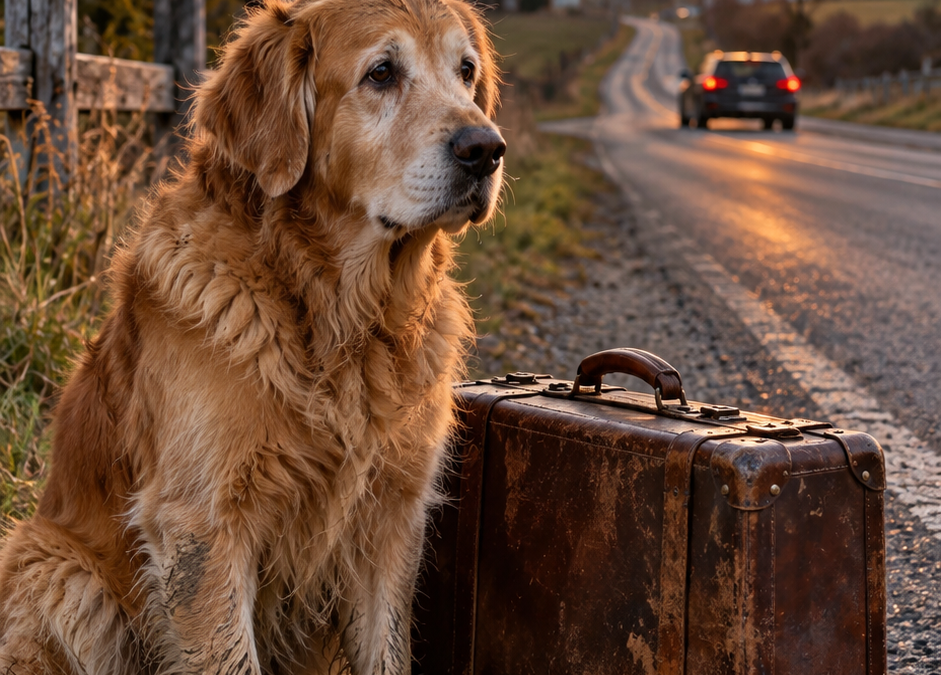
The dog became part of my commute.
That sounds terrible now.
At the time, I didn’t understand how terrible.
I had turned a living creature into scenery.
Tree.
Fence.
Mailbox.
Dog.
Suitcase.
Curve.
Keep driving.
I wasn’t cruel.
At least, that’s what I told myself.
Cruel people hurt animals.
I had never hurt an animal.
I had never kicked a dog, abandoned one, starved one, or deliberately ignored one in obvious distress.
But there are different forms of indifference.
Sometimes you don’t have to cause suffering.
Sometimes you only have to notice it and convince yourself that somebody else will deal with it.
That was me.
Every day.
For months.
Occasionally, I saw evidence that other people had noticed him too.
A paper plate with dry dog food appeared near the suitcase.
Then an old plastic bowl.
Once there was a blanket.
The next morning, the blanket had been dragged partly underneath him.
That made me feel better.
See? I thought.
People are helping.
Which gave me permission not to.
But nobody took him away.
Nobody seemed to know where he belonged.
And the dog kept waiting.
By the third month, I could recognize his moods.
On bright mornings, he watched traffic with more energy, his ears lifting at certain engines.
On cold mornings, he stayed close to the suitcase.
Sometimes an older truck would approach from the opposite direction and he would suddenly stand.
Not slowly.
Instantly.
His whole body would change.
Head high.
Tail lifted.
Hope.
Then the truck would pass.
His tail would fall.
He would sit again.
I saw that happen enough times to understand something that should have been obvious much sooner.
He wasn’t merely living beside the road.
He was waiting for someone.
That realization followed me all the way to work one morning.
At lunch, I searched online for missing dogs in the county.
Nothing.
That evening, I checked local community pages.
Nothing that matched him.
I told myself I would stop the next morning.
Then the next morning, I was running late.
The morning after that, there was heavy traffic.
The morning after that, I had a presentation.
Days are good at helping cowards postpone things.
There’s always another tomorrow available until suddenly there isn’t.
Four months after I first saw him, a storm rolled across the mountains on a Friday afternoon.
The sky had been dark since lunch.
By five, rain hammered the windows of my office so hard that the parking lot disappeared behind sheets of gray water.
I left later than usual.
I was exhausted.
The windshield wipers could barely keep up.
Water streamed across the highway, gathering in shallow rivers near the shoulder. Lightning flickered behind the hills. Thunder followed seconds later.
For the first twenty miles, I thought about nothing except getting home.
Then, without warning, I thought about the dog.
I gripped the steering wheel.
“No.”
I said it out loud.
Not because I didn’t care.
Because I already knew what I was going to see.
The closer I came to that stretch of road, the more uncomfortable I became.
Maybe somebody took him.
Maybe he finally left.
Maybe—
I rounded the curve.
There he was.
The dog stood beside the suitcase in the pouring rain.
He was soaked completely through.
His fur clung to his ribs and legs. Water streamed from his face. He was trembling so badly that even through the windshield I could see it.
Yet he had positioned himself over the suitcase as though he were trying to protect it from the storm.
Something inside me broke.
“God.”
I drove past him.
Maybe fifty yards.
Then I hit the brakes.
My car stopped hard enough for my seat belt to tighten across my chest.
For several seconds, I sat there with both hands locked around the steering wheel.
Rain beat against the roof.
Cars hissed past in the opposite direction.
My heart was pounding.
“Four months,” I whispered.
I’d passed him for four months.
There was no meeting now.
No deadline.
No phone call.
No excuse.
I put the car in reverse, backed carefully along the shoulder, and stopped near him.
The dog watched me.
I killed the engine.
For a few seconds, neither of us moved.
Then I opened the door.
Rain hit me like a wall.
Within seconds, my shirt was stuck to my back and water was running down my face.
The dog didn’t retreat.
“Hey, buddy.”
My voice sounded small beneath the storm.
“I’m Daniel.”
I don’t know why I introduced myself.
Maybe because by then, it felt embarrassing that I knew him and he knew nothing about me.
“I’ve been seeing you out here.”
His ears moved slightly.
“Yeah. I know. That’s not exactly something I should be proud of.”
I moved closer.
He stiffened.
I stopped.
“It’s okay.”
Lightning flashed.
Thunder cracked across the hills.
The dog flinched.
Then he pressed himself harder against the suitcase.
That was when I noticed how carefully he guarded it.
Not like a toy.
Not like food.
Like it mattered.
I crouched several feet away.
“Is that yours?”
The dog stared at me.
“I guess we’re not going to solve this conversationally.”
I held out my hand.
He sniffed the air but didn’t approach.
I moved closer, slowly enough that he could warn me if he wanted.
He never did.
When I finally touched his head, his eyes closed for half a second.
That tiny reaction hurt more than I expected.
How long had it been since someone had touched him?
“You’re freezing.”
I ran my hand down his wet neck.
“You can’t stay here tonight.”
I reached toward the suitcase.
His head snapped up.
A low sound came from his chest.
I froze.
“Okay.”
I pulled my hand back.
“Message received.”
The growl stopped.
He looked at the suitcase.
Then at me.
“Whatever’s in there matters to you.”
Another crack of thunder made him shake.
I took off my jacket, which was already soaked anyway, and draped it across his back.
He didn’t resist.
Then I sat in the mud beside him.
I had no plan.
I simply sat.
Cars passed.
Rain fell.
The dog shivered beside me.
After several minutes, I said, “I’ve been a real jerk, haven’t I?”
His eyes shifted toward me.
“I kept thinking somebody else would stop.”
I laughed once, without humor.
“Maybe everybody thought that.”
The dog lowered his head.
“Okay.”
I rubbed behind his ear.
“Nobody else is coming tonight.”
I looked at the suitcase.
“So I guess it’s you and me.”
I tried touching the handle.
This time, he didn’t growl.
I waited.
Then I lifted it slightly.
Heavy.
The dog watched every movement.
“I’m not taking it away.”
I set it back down.
“I just want to know why you’ve spent four months protecting it.”
The latches were rusty.
One was already partly open.
I looked at him again.
“Can I?”
Obviously, he couldn’t answer.
But something in his posture softened.
Maybe I imagined it.
Maybe I needed permission enough to see it.
I opened the suitcase.
The smell hit me first.
Old leather.
Wool.
Dust.
And something faintly floral.
Inside was a folded wool blanket, carefully packed despite months of damp air.
There were several postcards tied together with a ribbon.
A small metal box.
A framed photograph.
And an envelope yellowed around the edges.
I reached for the photograph.
An elderly woman stood outside a little blue house, smiling at the camera.
In her arms was a golden puppy.
The puppy had the same dark markings around the ears.
The same white patch beneath the chin.
I looked from the picture to the dog sitting beside me.
“No way.”
I held the photograph closer.
“It’s you.”
His ears lifted.
I felt a chill that had nothing to do with the weather.
I put the photograph down and untied the postcards.
Most were old.
Some appeared never to have been mailed.
On several of them, in shaky handwriting, were variations of the same message.
I’m waiting for you.
Come back soon.
Home is still here.
My throat tightened.
I picked up the envelope.
There was no name on the front.
Just three words.
PLEASE READ THIS.
The dog leaned closer.
I unfolded the letter inside.
The handwriting was uneven, each line sloping slightly downward.
The first sentence stopped me.
If someone is reading these words, please take care of my friend.
I looked at the dog.
Rain dripped from the end of his nose.
“Your friend?”
I read on.
My name is Margaret Thompson. I live in the little blue house not far from this road. This dog’s name is Max. He has been my only constant companion for twelve years.
I looked up.
“Max.”
The dog stared at me.
I said it again.
“Max?”
His tail moved once.
That was enough.
“Okay.”
I swallowed.
“Now we know each other.”
I returned to the letter.
Margaret wrote that her health had been failing.
She had been hospitalized more than once.
She was afraid that eventually she would leave home and not come back.
She worried more about Max than herself.
He likes chicken, she had written.
He hates thunder.
At that exact moment, thunder rolled across the valley.
Max pressed closer against my leg.
I almost laughed.
Instead, my eyes burned.
“He hates thunder,” I whispered.
I continued.
His favorite thing in the world is having his belly scratched, especially after dinner. He sleeps near the door whenever he thinks someone is coming home. He may look brave, but he doesn’t understand being left alone.
Then came the line that made me stop breathing for a moment.
Please don’t let him think he was abandoned.
I stared at those words.
Behind them, the rain continued pounding the road.
I looked at Max.
Four months.
Every car.
Every engine.
Every morning and every night.
Waiting.
What had he believed?
That Margaret had left him?
That she was coming back?
That one of those cars would slow down and she would step out?
The thought made my chest hurt.
The final lines were even simpler.
There are a few things in this suitcase and a little money in the metal box for whoever helps him. I know it isn’t much. Max is a good dog. He asks for almost nothing and gives everything he has. If I am gone, please make sure he has a home.
The letter was dated four months earlier.
I lowered it slowly.
“Margaret.”
Max’s ears rose at the name.
“Oh, boy.”
I looked toward the hills.
“She’s the one you’re waiting for.”
His tail tapped the ground once.
That nearly destroyed me.
I folded the letter.
“Is she gone, Max?”
He watched me with those dark, exhausted eyes.
“Or are you just lost?”
Lightning split the sky.
Max jumped.
Without thinking, I wrapped both arms around him.
He froze for a second.
Then something extraordinary happened.
He leaned into me.
Not much.
Just enough.
But after four months of watching him from behind glass, that small movement felt like an accusation and forgiveness at the same time.
“I’m sorry,” I whispered.
I wasn’t even sure what I was apologizing for.
Maybe everything.
“I’m sorry I kept driving.”
He rested his head against my shoulder.
I stayed there in the rain until I realized I was crying.
Then I stood.
“All right.”
I picked up the suitcase.
Max rose immediately.
“You’re coming with me.”
He hesitated.
I opened the passenger door.
Warm air spilled from the car.
“Come on.”
He looked back at the place beside the road.
That small patch of gravel had been his entire world for months.
Then he looked at me.
“Tomorrow,” I said, “we’ll find Margaret.”
His ears lifted.
“I promise.”
I didn’t know whether that promise was possible to keep.
But I meant it.
“Tonight, you don’t stay out here.”
Max stepped toward the car.
He stopped.
Looked once more at the suitcase in my hand.
Then jumped inside.
For the first time in four months, the dog left the roadside.
I put the suitcase in the back seat and climbed behind the wheel.
Max sat rigidly in the passenger seat, dripping water everywhere.
I turned on the heater.
“You’re ruining the upholstery.”
His head turned toward me.
I smiled.
“I’m kidding.”
He continued staring.
“Apparently Margaret forgot to mention you have no sense of humor.”
His tail thumped once.
I pulled back onto the road.
For the next several miles, Max didn’t look out the window.
He watched me.
Every few minutes, his eyes flicked toward the suitcase behind us.
“It’s still there.”
I reached across and touched his neck.
“I’m not taking it from you.”
He lowered his head onto my thigh.
That was how we drove home.
I had imagined, more than once, what it would be like to stop for that dog.
I had never imagined him sleeping against me before we reached my driveway.
My house had never felt particularly empty until Max walked into it.
I lived alone.
I had told myself I liked it that way.
Everything stayed where I put it. Nobody interrupted me. Nobody cared if dinner was eaten at ten at night or consisted of cereal standing over the kitchen sink.
My life was efficient.
Max destroyed that efficiency within twelve minutes.
He shook rainwater across the entryway.
Tracked mud into the kitchen.
Sniffed every room.
Stared suspiciously at the washing machine.
Then, after I dried him with three towels, he followed me everywhere.
If I walked to the refrigerator, Max came with me.
If I went to the bathroom, he waited outside the door.
If I stepped into the garage for thirty seconds, I returned to find him standing exactly where I had left him, watching.
Waiting.
That word had taken on a different meaning.
I found some chicken in the refrigerator.
“Margaret said you like this.”
His entire face changed.
“Oh, so you’re alive after all.”
I shredded the chicken into a bowl with some rice.
He ate quickly but not wildly.
Afterward, he drank nearly an entire bowl of water.
Then I sat on the floor.
“There’s one more thing.”
Max approached cautiously.
“Your official instructions say you like belly scratches.”
He stared.
“Don’t blame me. It’s in writing.”
I rubbed his chest.
Within seconds, he rolled partly onto his side.
“Unbelievable.”
For the first time since I had seen him beside the road, Max looked like somebody’s dog rather than a lonely animal surviving on hope.
Then thunder shook the windows.
His body tightened.
He stood and began pacing.
“Hey.”
Another rumble.
Max pushed himself against my knees.
I remembered the letter.
He hates thunder.
I sat beside him on the kitchen floor until the storm passed.
At some point, his head dropped into my lap.
I stayed there long after my legs went numb.
“Four months,” I whispered.
I couldn’t stop thinking about it.
One hundred and twenty days, more or less.
I had driven past him twice on most weekdays.
Maybe two hundred times.
I wondered how many times he had lifted his head when he saw my car.
How many times I had represented possibility.
How many times I had disappeared around the bend.
It was an uncomfortable thing to realize that you could consider yourself a decent person and still spend months practicing indifference.
Around midnight, I opened the suitcase again.
I wanted to understand.
Inside the metal box were a few folded bills, some coins, Max’s old vaccination tag, and a small brass key.
There was also an address written on the back of an envelope.
Margaret Thompson.
12 Catlett Road.
I searched the address on my phone.
It was less than three miles from the place where Max had been waiting.
The blue house from the photograph appeared in an old street-view image.
My pulse quickened.
“Max.”
He raised his head.
“I found her house.”
At Margaret’s name, he came fully awake.
I showed him the phone like an idiot.
“See?”
Max sniffed the screen.
“Right. You have no idea what that is.”
I looked at the time.
Nearly one in the morning.
“We’re not knocking on an old woman’s door now.”
Max stared at me.
“Tomorrow.”
I heard myself say the word and hated it.
For months, tomorrow had been my excuse.
So I corrected myself.
“At sunrise.”
I slept badly.
Max refused the dog bed I made from blankets and slept beside my bedroom door instead.
Every time I woke, he was there.
Watching.
At 5:42 a.m., I gave up trying to sleep.
I made coffee.
Max ate more chicken.
At six fifteen, I texted my supervisor.
Family emergency. I’ll be late.
I stared at the message after sending it.
Technically, Max wasn’t family.
But the word didn’t feel entirely dishonest anymore.
The morning after the storm was washed clean.
Mist hung above the fields.
Water dripped from the trees.
Max sat in the passenger seat, more alert than he’d been the night before.
The suitcase was on the back seat.
As soon as we turned onto Catlett Road, his entire body changed.
He stood.
His nose lifted.
“Do you know this road?”
His breathing quickened.
Then we rounded a bend.
The little blue house appeared.
Max made a sound deep in his throat.
Not a bark.
Almost a cry.
My hands tightened around the steering wheel.
The house was smaller than it had looked in the photograph.
Its blue paint was faded. The porch leaned slightly. Wind chimes hung from the eaves, barely moving in the still morning air.
There were flowerpots along the steps.
Most were empty.
I parked.
Max pushed his nose toward the window.
“Easy.”
His whole body trembled.
I wasn’t sure whether it was excitement or fear.
I got out first.
Then I opened his door.
Max jumped down.
He started toward the house.
Stopped.
Looked at me.
Maybe he needed permission.
Maybe I did.
“Go ahead.”
He walked to the porch.
Not running.
Not yet.
I carried the suitcase behind him.
At the front door, Max sniffed the bottom edge.
Then he sat.
Exactly as he had sat beside the road.
That almost stopped my heart.
I knocked.
Nothing.
I waited.
Knocked again.
The house remained silent.
Max looked up at me.
My stomach sank.
“Margaret?”
I called through the door.
“My name is Daniel. I found your dog.”
Silence.
I tried again.
“Margaret?”
Behind me, Max whined.
Then I heard something inside.
A scrape.
Slow footsteps.
The click of a lock.
The door opened three inches.
An elderly woman peered through the gap.
White hair.
Thin face.
A cane in one hand.
For one second, I couldn’t speak.
I knew that face.
Older.
More tired.
But unmistakable.
The woman from the photograph.
“Margaret Thompson?”
Her eyes narrowed.
“Yes.”
Her voice was weak but steady.
“Who are you?”
“My name is Daniel.”
I looked down.
Max stood partly behind the porch rail, just outside her view.
“I found something that belongs to you.”
Her expression changed when she saw the suitcase.
Her hand tightened around the cane.
“Where did you get that?”
“Beside the highway.”
All the color seemed to leave her face.
“No.”
I heard the word more than saw her lips move.
“I found it with a dog.”
Margaret’s hand flew to her chest.
“What dog?”
I couldn’t understand the question at first.
Then I realized she was afraid to hope.
“His name is Max.”
The cane slipped.
I caught it before it hit the floor.
Margaret grabbed the doorframe.
“Max?”
Behind me, his nails clicked against the wooden porch.
Margaret looked past my shoulder.
I stepped aside.
For a heartbeat, neither of them moved.
Max stared at her.
Margaret stared at him.
Everything became still.
No wind.
No traffic.
No birds.
Nothing.
“Max?”
Her voice broke on his name.
His ears shot forward.
Margaret covered her mouth.
“Oh, my God.”
Max took one step.
Then another.
He stopped.
Maybe four feet from her.
His nose worked frantically, drawing in a scent he had probably searched for in every passing car for four months.
Margaret lowered herself as far as her weak legs allowed.
“My baby.”
Max made a sound I will never forget.
It began as a whine and rose into something between a bark and a cry.
His entire body started shaking.
His tail moved once.
Twice.
Then violently.
“Max.”
Margaret opened her arms.
That was all it took.
He ran.
Not recklessly.
Even in that explosion of joy, he seemed to remember she was fragile.
He stopped short of knocking her over and pushed his head against her chest.
Margaret wrapped both arms around him.
“Oh, Max.”
She buried her face in his wet-gold fur.
“I’m sorry.”
Max licked her cheek.
“I’m so sorry.”
She was crying openly now.
“I didn’t leave you. I didn’t leave you, sweetheart.”
My throat closed.
Those words.
Please don’t let him think he was abandoned.
The letter.
The roadside.
The hundreds of passing cars.
Margaret held his face between her hands.
“I tried to find you.”
Max licked her fingers.
“I tried.”
She pressed her forehead to his.
“I thought you were dead.”
I looked away.
Some moments feel too private even when you’re standing in the middle of them.
I stared across the yard until Margaret said my name.
“Daniel?”
I turned.
She was sitting on the threshold now.
Max had folded himself against her legs.
“Would you come inside?”
I carried the suitcase into the house.
The living room looked exactly like the sort of room Max would remember.
An old couch.
A knitted blanket.
A clock ticking above the fireplace.
Photographs everywhere.
Margaret with a younger man I assumed was her husband.
Margaret with two children.
Margaret standing beside a Christmas tree.
And Max.
Max as a puppy.
Max in snow.
Max wearing a ridiculous birthday hat.
Max asleep on the couch.
Max beside Margaret in the garden.
His entire life covered those walls.
He went straight to the right side of the couch and jumped onto a faded blanket.
Margaret laughed through her tears.
“That’s his place.”
“I guessed.”
“He always hated the other side.”
Max circled once and lay down.
Then he immediately stood again and went back to Margaret.
She touched his head.
“I still can’t believe this.”
I set the suitcase near the coffee table.
“I have about a thousand questions.”
“So do I.”
She looked at the suitcase.
“Where exactly did you find him?”
I told her.
Her eyes filled again.
“That close.”
“What happened?”
Margaret took a slow breath.
“Four months ago, I got sick.”
She looked down at her hands.
“My heart. I’ve had trouble for years, but that morning was worse. I called an ambulance.”
Max pushed his nose beneath her palm.
She stroked him automatically.
“I didn’t know how long I’d be gone. I didn’t even know if I was coming home.”
She looked at the suitcase.
“So I packed that.”
“You packed it?”
She nodded.
“I’d prepared the letter earlier. A foolish old woman’s insurance policy, I suppose.”
“It wasn’t foolish.”
“I had nobody nearby I could rely on permanently. My children live in different states. They have families, jobs… lives.”
There was no bitterness in her voice.
That somehow made it sadder.
“My neighbor, Harold, agreed to care for Max while I was in the hospital. I gave him the suitcase. I told him that if anything happened to me, everything important was inside.”
“What happened after that?”
Margaret’s fingers tightened in Max’s fur.
“Harold called me two days later. Max was gone.”
She closed her eyes.
“He had slipped through the gate.”
“Did your neighbor look for him?”
“For days. So did his son. They put up notices. They called the shelter. I was still in the hospital and could barely stand.”
Her voice cracked.
“When I finally came home, I searched as much as I could.”
She lifted her cane slightly.
“Which wasn’t much.”
“And the suitcase?”
“Harold couldn’t explain that either. It disappeared the same day Max did. He thought perhaps his son had loaded it into the truck while they were searching. His son insisted he hadn’t. We never found it.”
She looked at me.
“I thought Max had wandered miles away.”
“He didn’t.”
“No.”
She touched his face.
“He stayed less than three miles from home.”
The answer came to both of us at once.
“The road,” I said.
Margaret nodded slowly.
“That’s the road the ambulance took.”
The room went quiet.
I saw it in my mind.
Margaret being carried from the blue house.
The ambulance turning toward the highway.
Max watching her disappear.
Then somehow escaping.
Finding his way to the route she had taken.
Waiting beside the one object that still smelled like home.
Margaret covered her mouth.
“He was waiting where he last knew I had gone.”
I felt a pressure behind my eyes.
“Every car.”
She looked at me.
“What?”
“Every time certain cars passed, he stood up.”
My voice sounded rough.
“I watched him do it for months.”
Margaret closed her eyes.
A tear slid down her cheek.
“He thought I was coming back that way.”
Neither of us spoke for a long time.
Then she asked quietly, “How long did you say you saw him there?”
I hated the answer.
“Four months.”
Her face crumpled.
“No.”
“I’m sorry.”
“He was there the whole time?”
“I think so.”
“In the rain?”
“Yes.”
“The cold?”
“Yes.”
Margaret began crying again.
I wanted to comfort her, but guilt had already lodged too deeply in my chest.
“I should have stopped sooner.”
She looked up.
“What?”
“I saw him almost every day.”
I rubbed my palms together.
“I drove past him.”
Margaret said nothing.
“At first I thought he belonged to somebody nearby. Then I thought somebody else would help. Then I saw people leaving food, so I used that as an excuse.”
I shook my head.
“I kept telling myself I’d stop tomorrow.”
Max came over and rested his chin on my knee.
I almost couldn’t continue.
“I passed him for four months.”
Margaret watched me.
“I could have brought him back to you months ago.”
“Daniel.”
“I should have.”
“Look at me.”
I did.
Her eyes were tired but clear.
“Did you know where he belonged?”
“No.”
“Did you know I was here?”
“No.”
“Did you know what was in that suitcase?”
“No.”
“But you stopped.”
“Eventually.”
“You stopped.”
Her voice became firmer.
“Do you know how many people will spend their entire lives seeing things they should stop for and never do?”
I looked away.
“That doesn’t make four months disappear.”
“No.”
She didn’t try to absolve me.
I respected her for that.
“It doesn’t.”
Her hand moved through Max’s fur.
“But Max isn’t keeping count.”
I looked down.
His tail moved against the floor.
Margaret smiled faintly.
“Animals are better at forgiveness than we are.”
“I’m not sure I deserve his.”
“That’s not your decision.”
For some reason, that sentence stayed with me.
Margaret made coffee.
I tried to stop her, but she insisted.
“You brought my family home,” she said. “I can make you coffee.”
Max followed her into the kitchen.
Then followed me.
Then seemed confused about which of us he was supposed to watch.
Margaret laughed.
“Now you’ve done it.”
“What?”
“He’s adopted you.”
“I think that’s backwards.”
“Not with Max.”
We sat at the small kitchen table.
Morning sunlight came through lace curtains and fell across the suitcase.
I asked about the postcards.
Margaret picked one up.
“My husband wrote some of those.”
“Your husband?”
“Thomas.”
Her expression softened.
“He died nine years ago.”
“I’m sorry.”
“He was Max’s favorite person.”
She smiled.
“I pretended to be offended.”
She turned the postcard over.
“Thomas traveled for work. Whenever he was gone, I wrote little notes and left them around the house as a joke. ‘We’re waiting.’ ‘Come home.’ That sort of thing.”
Her thumb moved across the handwriting.
“After he died, I couldn’t throw them away.”
“And you put them in Max’s suitcase.”
“They belonged to both of them.”
I understood then why the suitcase felt heavier than its contents.
It wasn’t luggage.
It was a small archive of a life.
Margaret’s marriage.
Her memories.
Her fear.
Her love for the one creature still sharing her house.
“What about the money?”
She waved one hand.
“Almost nothing.”
“I don’t want it.”
“I know.”
“I mean it.”
“So do I.”
“I didn’t stop for money.”
“I know that too.”
She looked at me for several seconds.
“People who stop for money usually ask about it before the dog.”
That made me smile.
Max settled between us.
After a while, Margaret asked about me.
I gave her the usual answer.
Thirty-eight.
Project manager.
Long commute.
No wife.
No children.
Parents living several states away.
Small house.
Busy schedule.
The kind of facts people use to describe a life without really describing it.
Margaret listened.
Then she asked, “Are you happy?”
I almost laughed.
Nobody asked adults questions like that.
Not seriously.
“I don’t know.”
“That’s usually a no.”
“You’re very direct.”
“I’m old. It saves time.”
I looked into my coffee.
“I have a good job.”
“I didn’t ask about your job.”
“I have a house.”
“Didn’t ask about your house either.”
I smiled despite myself.
“Are you always like this?”
“Thomas said I was worse when I was young.”
Max sighed beneath the table.
Margaret’s expression softened.
“You drove one hundred and twenty kilometers every day?”
“About seventy-five miles each way.”
“And all that time, what were you rushing toward?”
“Work, mostly.”
“And what were you rushing home to?”
That question landed harder.
I looked through the window.
“My house.”
“That’s a location.”
I didn’t answer.
Margaret didn’t push.
She didn’t need to.
Max placed one paw on my shoe.
I stared at it.
For months, he had possessed almost nothing except a suitcase, a memory, and the expectation that somebody he loved would return.
And somehow his life had seemed fuller than mine.
I had a house, a salary, a reliable car, retirement accounts, health insurance.
I had optimized everything.
Except belonging.
Around nine, I realized I had missed two calls from work.
“I need to go.”
The words felt strangely wrong.
Margaret nodded.
“Of course.”
Max stood immediately.
When I reached the front door, he followed.
Then he looked back at Margaret.
Then at me.
“You stay.”
His ears lowered.
“You’re home.”
Max didn’t move.
Margaret smiled.
“I told you.”
“Told me what?”
“He adopted you.”
I crouched.
“Listen, buddy.”
Max stared at me.
“I spent four months driving past you. You don’t have to follow me.”
He stepped closer.
I rubbed behind his ears.
“I’m coming back.”
The moment I said it, something tightened in my chest.
Coming back.
Maybe those words should never be spoken casually to a dog who had spent four months waiting.
So I added, “Tomorrow morning.”
Margaret raised an eyebrow.
“Tomorrow?”
“My route passes right by here.”
“You don’t have to do that.”
“I know.”
I looked at Max.
“I want to.”
I kept my promise.
The next morning, I left home twenty minutes early.
Max was already at Margaret’s window when I pulled into the driveway.
By the time I reached the porch, he was barking.
Not the desperate bark I’d heard during their reunion.
This one was ridiculous and happy.
Margaret opened the door.
“You created this problem.”
“I see that.”
“He heard your car before I did.”
I scratched Max’s ears.
“Morning, buddy.”
Margaret handed me coffee.
I stayed ten minutes.
The next day, I stayed fifteen.
By the end of the week, stopping at Margaret’s house had become part of my commute.
Not an obligation.
A correction.
For five years, I’d measured the value of my mornings by how efficiently I reached work.
Now I measured them differently.
Did Max meet me at the porch?
Was Margaret having a good day?
Had she eaten?
Did she need anything from town?
Sometimes I brought chicken for Max.
Sometimes I brought groceries for Margaret.
Sometimes I brought nothing.
I learned that Margaret had been a school librarian for thirty-one years.
That Thomas had been an electrician.
That her daughter lived in Oregon and her son in North Carolina.
That she spoke to both regularly but hated asking them for help.
“They’d come if I asked,” she told me once.
“Then ask.”
“And become a project?”
“You’re stubborn.”
“So are you.”
She had me there.
I started walking Max on mornings when Margaret’s knees bothered her.
At first, he never let the house out of sight.
We’d reach the end of the driveway and he would look back.
Then we’d walk another fifty yards.
He’d look back again.
I understood.
“She’s still there.”
His ears would relax.
After several weeks, we made it to a small park half a mile away.
Max trotted ahead.
Every few yards, he turned around to make sure I was following.
The habit made me smile.
“Still here.”
He’d continue.
“Still here.”
Again.
“Still here, Max.”
I began to wonder how often people needed to hear those words too.
One Saturday, Margaret asked me to take her to the place where I had found him.
I didn’t want to.
“Why?”
“I need to see it.”
“I’m not sure that’s a good idea.”
“I’m eighty-one, Daniel. Good ideas are becoming less important.”
I sighed.
“Fine.”
We put Max in the back seat and drove there.
When I stopped beside the gravel shoulder, Max became very still.
His body lowered.
Margaret noticed.
“Oh, sweetheart.”
She opened her door.
Max followed.
The sky was clear that day.
Nothing about the place looked dramatic.
Just asphalt.
Grass.
A ditch.
A few distant houses.
It disturbed me how ordinary suffering could look from a distance.
Margaret stood where the suitcase had been.
“So this is it.”
“Yes.”
She looked toward the road.
“Four months.”
I nodded.
Max pressed against her leg.
She bent carefully and touched him.
“I’m sorry I took so long.”
I looked away.
Then Margaret said something unexpected.
“Put the suitcase here.”
I had brought it because she’d asked me to.
I placed it on the gravel.
Max immediately stood beside it.
My stomach turned.
The image was too familiar.
Margaret saw my face.
“Wait.”
She walked several steps away.
“Max.”
His ears lifted.
“Come here.”
He looked at the suitcase.
Then at Margaret.
For a terrible second, he stayed frozen.
“Max.”
She opened her arms.
He left the suitcase.
He went to her.
Margaret buried her fingers in his fur.
“Good boy.”
She looked at me.
“Now you.”
“What?”
“Call him.”
“Margaret—”
“Daniel.”
I knew that tone.
I crouched.
“Max.”
He looked at me.
“Come on, buddy.”
He hesitated.
Then ran to me.
I caught him against my chest.
Margaret smiled.
“There.”
“What was that supposed to prove?”
“That he isn’t waiting anymore.”
I looked at the suitcase.
For the first time since I’d known him, Max was standing yards away from it without anxiety.
Margaret was right.
Something had changed.
Not just for him.
For all of us.
“Take the suitcase,” she said.
“What?”
“Keep it.”
“No.”
“I want you to.”
“It’s yours.”
“It was meant for the person who took care of Max if I couldn’t.”
“But you’re here.”
“And you’re taking care of both of us anyway.”
I shook my head.
“I can’t.”
“You can.”
“Margaret.”
“Daniel.”
Again, that tone.
I laughed.
“You’re impossible.”
“So I’ve been told.”
She rested one hand on the old leather.
“That suitcase spent four months reminding Max where he’d come from.”
She looked at me.
“Maybe now it can remind you where you decided to stop.”
I didn’t have an answer.
So I took it home.
I placed it on a shelf in my study.
I left everything inside exactly as I’d found it.
The photograph.
The blanket.
The postcards.
The metal box.
The letter.
Especially the letter.
Sometimes, after a difficult day, I opened it.
Please don’t let him think he was abandoned.
That sentence began to mean more than it had on the roadside.
Abandonment isn’t always dramatic.
Sometimes it’s a hundred small decisions not to stop.
Not to call.
Not to visit.
Not to notice.
I started calling my parents more often.
I visited them that Thanksgiving instead of claiming work was too busy.
I stopped eating every meal over the sink.
I met my neighbors.
I learned the name of the man who worked the overnight shift at the gas station I’d passed for five years.
Frank.
He had three daughters.
One was studying nursing.
I learned that the church whose steeple marked twenty minutes from my office ran a food pantry on Thursdays.
I began volunteering once a month.
Not because I had become some extraordinary person.
I hadn’t.
I was still impatient.
Still busy.
Still capable of driving too fast when late.
But I had started seeing things again.
There is a difference between looking and seeing.
Max taught me that.
Margaret helped.
Months passed.
Her health remained fragile but stable.
Her children visited more often after she finally told them how difficult the hospitalization had been.
Her daughter cried when she heard about Max.
Her son shook my hand for a long time and said, “Thank you for stopping.”
Every time someone said that, I still felt the shadow of those four months.
Eventually, I learned not to run from it.
Guilt can be useless if all you do is punish yourself.
It becomes useful when it changes what you do next.
One evening, nearly a year after the storm, I sat with Margaret on her porch.
Max lay between us.
The sun was dropping behind the hills.
Traffic moved faintly in the distance.
“You know what I think?” Margaret asked.
“That I’m drinking too much coffee?”
“You are.”
“I knew it.”
She smiled.
“I think Max knew.”
“Knew what?”
“That somebody would stop.”
I shook my head.
“You give me too much credit.”
“I didn’t say he knew you’d stop.”
“That’s comforting.”
“I said he knew somebody would.”
I looked at Max.
He was asleep.
“You really believe that?”
Margaret considered the question.
“I think animals understand loyalty without needing to explain it.”
She watched the sunset.
“People make loyalty complicated. We ask whether someone deserves it. Whether it’s convenient. Whether enough time has passed.”
She scratched Max’s neck.
“He just waited.”
“For four months.”
“Yes.”
“That’s not exactly healthy behavior.”
Margaret laughed.
“You’re a project manager. Of course you’d try to turn devotion into a scheduling issue.”
I laughed too.
Then she grew quiet.
“Daniel?”
“Yeah?”
“When I really do go someday…”
I immediately understood.
“No.”
“You don’t even know what I was going to say.”
“Yes, I do.”
She looked at Max.
I did too.
My throat tightened.
“You don’t need to ask.”
“I need to hear you say it.”
I took a breath.
“When that day comes, Max comes with me.”
Margaret nodded.
“No shelter.”
“No shelter.”
“No strangers.”
“No strangers.”
“He likes—”
“Chicken. Thunder scares him. Belly scratches after dinner.”
Her eyes filled.
“You remembered.”
“Every word.”
She looked down.
“Thank you.”
I reached across and touched her hand.
“But not anytime soon.”
“I’m eighty-two now.”
“I don’t care.”
“That’s not how aging works.”
“It is in my version.”
She smiled.
“Then I like your version.”
Max woke and looked between us.
Margaret whispered, “We’re talking about you.”
His tail moved once.
The same small movement he had made in the rain the night I finally stopped.
Sometimes I still think about the man I was before that storm.
He wasn’t evil.
That’s what makes the memory uncomfortable.
He was ordinary.
Busy.
Distracted.
Certain that someone else would handle whatever wasn’t directly his responsibility.
I think there are a lot of people like that.
I still recognize him in myself sometimes.
When my phone is ringing.
When I’m late.
When someone wants more time than I planned to give.
When inconvenience starts pretending to be a legitimate reason not to care.
Then I remember wet golden fur.
A leather suitcase.
A dog trembling in a thunderstorm who still refused to leave the last piece of his world.
And I slow down.
A few months ago, I added something to the suitcase.
A new photograph.
Margaret sits on her porch in it.
She’s laughing.
Max is standing beside her with one paw on her shoe.
I’m behind them, leaning against the railing.
We used the timer on my phone, and it took seven attempts because Max kept walking toward the camera.
It isn’t a beautiful photograph.
My eyes are half closed.
Margaret’s hair is blowing across her face.
Max isn’t even looking in the right direction.
It’s perfect.
Behind it, I placed a letter of my own.
Not because I expect a stranger to find it.
Because some things deserve to be written down.
It says:
I saw Max for four months before I stopped.
I wish I could write that I recognized immediately that he needed help.
I didn’t.
I wish I could say compassion made the decision easy.
It didn’t.
I was busy. I was tired. I assumed someone else would do what I kept postponing.
Then one rainy night, I stopped.
I thought I was rescuing a dog.
I was wrong.
Max already knew how to love, how to wait, how to trust, and how to forgive.
Margaret already knew what mattered.
I was the one who had forgotten.
Sometimes the longest journey in a person’s life begins when he finally stops moving.
I keep that letter beneath Margaret’s.
Two pieces of paper.
Two different kinds of fear.
Hers was the fear of leaving someone she loved behind.
Mine was the fear of discovering how easily I’d learned to pass suffering without letting it interrupt me.
Both letters remain in the same old suitcase.
And the suitcase stays closed most of the time.
It doesn’t need to be opened often anymore.
I know what’s inside.
This morning, I drove the same road I’ve driven for years.
The old barn was still there.
The broken mailbox had finally been replaced.
Fog sat low between the hills.
I reached the place where Max once waited.
There was nothing on the shoulder.
No dog.
No suitcase.
No bowl.
Just sunlight spreading across wet gravel.
I slowed down anyway.
I probably always will.
Then I continued another three miles and turned onto Catlett Road.
Max was already waiting behind the window.
The moment my car entered the driveway, he disappeared from view.
Three seconds later, the front door opened and he came charging onto the porch.
“Daniel!”
Margaret shouted from inside.
“Don’t let him knock you down!”
“No promises.”
Max hit me at knee level.
I laughed and grabbed his shoulders.
“Morning, buddy.”
His tail slammed against the porch rail.
Margaret appeared in the doorway with her cane.
“Coffee?”
“Obviously.”
“You’re late.”
“By two minutes.”
“Max noticed.”
“Max needs a watch.”
“He has one. It’s called loyalty.”
I followed her inside.
Max stayed beside me.
The kitchen smelled like coffee and toast.
Morning light came through the curtains.
Nothing extraordinary happened.
And maybe that’s why the moment mattered so much.
For years, I believed life-changing moments announced themselves.
I expected them to be dramatic.
A promotion.
A wedding.
A death.
A phone call in the middle of the night.
I didn’t understand that sometimes a life changes quietly on the side of a road.
Sometimes the moment arrives disguised as an inconvenience.
Something that will make you late.
Something that will get mud in your car.
Something you can easily convince yourself isn’t your responsibility.
The difference between who you are and who you might become can be as small as putting your foot on the brake.
As I write this, I’m sitting at Margaret’s kitchen table.
She’s asleep in the living room.
The television is playing quietly.
Rain has started tapping against the windows.
Not a storm.
Just autumn rain.
Max is lying at my feet.
His muzzle has gone grayer over the past year.
Every few minutes, one ear moves when a car passes outside.
But he doesn’t get up.
He doesn’t rush to the door.
He doesn’t search every engine for someone who might finally be coming back.
He knows where Margaret is.
He knows where I am.
When thunder comes now, he still hates it.
He wedges himself between my legs or presses against Margaret’s chair until one of us touches him.
When dinner comes, he still believes chicken is the only food worth eating.
And after dinner, he still rolls onto his back with absolutely no dignity and waits for the belly scratch Margaret promised in her letter.
Some things haven’t changed.
But the most important thing has.
Max no longer waits beside a suitcase.
He no longer has to protect the remains of a life he thinks he has lost.
He is home.
Sometimes he sleeps so deeply that his paws twitch as though he’s running through a dream.
I like to imagine there are no roads in those dreams.
No passing cars.
No cold mornings.
No rain.
No waiting.
Only familiar voices calling his name.
Only doors that open.
Only people who come back.
I spent four months believing that dog was simply part of the landscape.
He was never part of the landscape.
He was a story asking someone to stop long enough to hear it.
It took me far too long.
But eventually, on one Friday night beneath a sky split by lightning, I pulled onto the shoulder.
I opened an old leather suitcase.
And somewhere between Margaret’s trembling handwriting and Max leaning against me in the rain, I understood something I should have understood much earlier.
There are moments when another life quietly enters your hands.
You may not feel ready.
You may be late.
You may have a hundred reasons to keep moving.
But sometimes you stop anyway.
And if you’re lucky, years later, you realize that the life you interrupted your journey to save was never the only one being rescued.
Max waited four months for someone he loved to come back.
I drove past him more times than I can bear to count.
But the night I finally stopped, he left that roadside behind.
And little by little, so did I.
Max is sleeping against my feet now.
Margaret is resting in the next room.
The rain continues outside.
And for the first time in more years than I care to admit, there is nowhere else I feel I should be.
What do you think of this story? Please leave a like and share your thoughts in the comments. Your support means a lot to us and inspires us to keep writing more meaningful and powerful stories. Thank you! 👍

