𝗙𝗨𝗟𝗟 𝗦𝗧𝗢𝗥𝗬 For Four Days, Bailey Wouldn’t Come Out From Under My Kitchen Table, and Then I Finally Heard What Had Been Keeping Him There
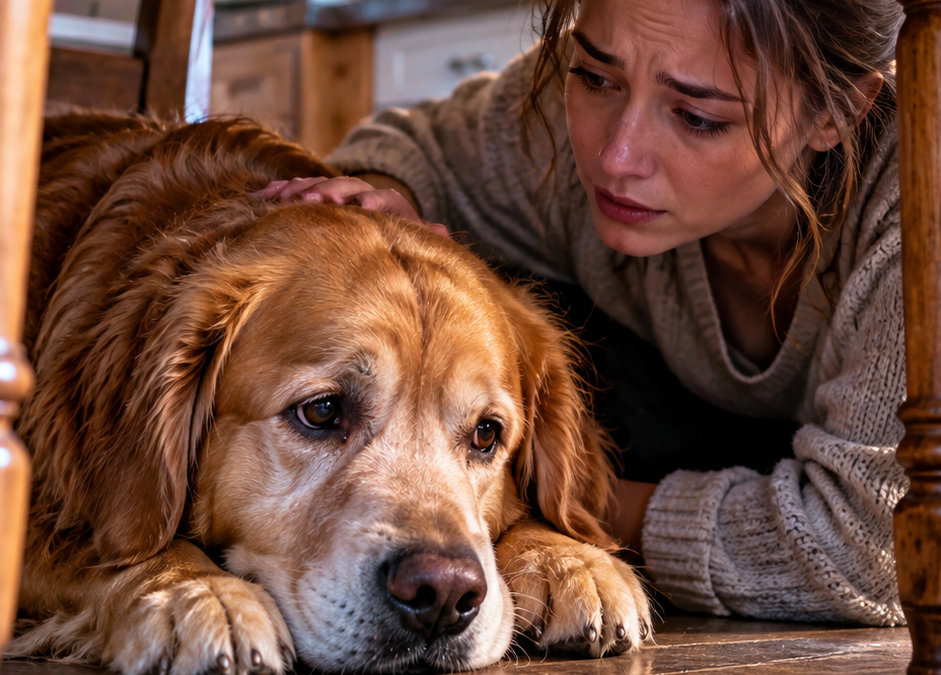
𝗙𝗨𝗟𝗟 𝗦𝗧𝗢𝗥𝗬
His tail moved once.
Not the usual joyful sweep.
Just one nervous tap against the floor.
I reached toward him.
“Come on.”
Bailey lowered his head.
That stopped me.
Dogs communicate constantly if you pay attention.
Bailey lowering his head like that meant he did not want to move.
“Okay.”
I sat back.
“You’re being weird.”
His eyes shifted away from me.
Toward the wall.
The kitchen shared that wall with the house next door.
The Harper house.
At least, that was what I still called it.
Margaret and Thomas Harper had lived there for almost thirty years.
They were already retired when I bought my house.
Thomas grew tomatoes every summer and distributed them to half the street.
Margaret baked too much around Christmas and treated that problem as everyone else’s responsibility.
They had been the kind of neighbors you do not appreciate fully until they are gone.
Six months earlier, Thomas’s health had declined.
Their daughter convinced them to move closer to her.
I helped Thomas load several boxes into the moving truck.
Margaret hugged me twice and cried both times.
The house had been listed for sale ever since.
A realtor came occasionally.
Someone cut the grass.
Otherwise, it remained empty.
I looked at Bailey.
He was staring at that wall.
“What?”
His ears lifted.
I heard nothing.
“Mouse?”
Bailey did not move.
I opened one of the grocery bags.
“Chicken?”
Normally the word chicken could wake him from another dimension.
Nothing.
I pulled out a package.
“Actual chicken.”
His nose twitched.
Still, he remained under the table.
That was the first moment I became concerned.
I checked him for injuries.
No swelling.
No obvious pain.
His gums looked normal.
His breathing was steady.
He drank when I placed water near him.
He ate a few pieces of chicken from my hand.
But he refused to leave the space beneath the table.
At ten that night, I carried his bed into the kitchen.
“You win.”
Bailey looked at me.
“This is ridiculous.”
His tail tapped once.
I placed the bed beside the table and went upstairs.
At midnight, I woke automatically.
Something felt wrong.
For years, I had slept with the faint sound of Bailey breathing nearby.
Without it, the bedroom seemed too quiet.
I went downstairs.
He was exactly where I had left him.
Under the table.
Facing the wall.
I knelt beside him.
“What is it, buddy?”
Bailey’s ears moved.
I listened.
The refrigerator hummed.
Rain tapped gently against the window.
Pipes clicked somewhere inside the wall.
Nothing else.
I stroked his neck.
He leaned against my hand but would not come out.
“Fine.”
I pulled a blanket from the couch and slept on the kitchen floor.
That was night one.
The next morning, Bailey still refused his walk.
I held up the leash.
Normally, the metal clasp alone made him spin in circles.
“Walk?”
He watched me.
“Bailey. Walk.”
Nothing.
I clipped the leash to his collar and gave the gentlest pull.
He planted his paws.
I stopped immediately.
“Okay.”
Now I was worried enough to call our veterinarian.
Dr. Lee had treated Bailey since I adopted him.
I described the behavior.
“Is he eating?”
“A little.”
“Drinking?”
“Yes.”
“Vomiting?”
“No.”
“Diarrhea?”
“No.”
“Any chance he hurt himself?”
“I checked his legs. He lets me touch everything.”
“Bring him in.”
Getting Bailey into the car required me to lift him.
That had never happened before.
He did not resist exactly.
He simply kept turning his head back toward the kitchen wall as I carried him outside.
At the clinic, he behaved almost normally.
That was somehow more confusing.
He greeted the receptionist.
He sniffed another dog.
He accepted three treats from Dr. Lee.
She examined him from nose to tail.
Heart.
Lungs.
Joints.
Abdomen.
Temperature.
Eyes.
Ears.
Nothing.
“He seems healthy,” she said.
“Then why is he hiding?”
Dr. Lee looked at Bailey.
“Could be environmental.”
“What does that mean?”
“Something changed at home.”
“Nothing changed.”
“Construction nearby?”
“No.”
“New appliance?”
“No.”
“Pest control?”
“No.”
“Smoke detector chirping?”
I shook my head.
“Anything high-pitched that you might not notice?”
“Not that I know of.”
She crouched beside Bailey.
“Dogs hear frequencies we don’t.”
“So he could be hearing something?”
“Absolutely.”
“Like what?”
“Rodents in a wall. A leaking pipe. Electrical noise. An alarm in another house. Machinery. Lots of possibilities.”
Bailey licked her hand.
Dr. Lee smiled.
“Physically, I’m not seeing anything concerning. But if he stops eating or drinking, call me immediately.”
I brought him home.
The second we entered the kitchen, Bailey pulled free of me and went directly beneath the table.
Straight toward the wall.
I stood there holding the leash.
“Are you kidding me?”
His ears lifted.
Then his head tilted.
As if listening.
That afternoon, I inspected everything.
I pulled the refrigerator away from the wall.
Nothing.
Checked beneath the sink.
Nothing.
Opened cabinets.
Nothing.
Looked for droppings.
Chewed wires.
Leaks.
Cracks.
I even turned off every electrical appliance in the kitchen.
Bailey remained beneath the table.
At one point, I pressed my ear against the wall.
Silence.
I went outside and walked around the Harper house.
Every window was dark.
The FOR SALE sign leaned slightly toward the sidewalk.
A few dead leaves had collected on the porch.
Nothing appeared disturbed.
I called the realtor whose number was printed on the sign.
A woman answered.
“Harper property.”
“Yes. I live next door. Has anyone been inside recently?”
There was a pause.
“Are you interested in the house?”
“No.”
Another pause.
“Then may I ask why?”
I felt ridiculous.
“My dog has been behaving strangely.”
Silence.
“I’m sorry?”
“I know how that sounds.”
She laughed politely.
“I’m afraid I don’t understand.”
“Has anyone been inside the house?”
“We had a showing last weekend.”
“Anyone since?”
“Not according to our schedule.”
“Workers?”
“Not this week.”
“Could an alarm be going off?”
“The security system is inactive.”
I thanked her and hung up.
That evening, Bailey ate half his dinner under the table.
Then, at 9:17, he did something that made the hair rise along my arms.
He whimpered.
Bailey was not a dog who whimpered often.
He barked.
Groaned dramatically when ignored.
Made strange sighing noises if dinner was late.
But he almost never whimpered.
I knelt.
“What is it?”
His eyes stayed fixed on the wall.
Then he made a low sound in his throat.
Not a growl.
More like a question.
I pressed my ear against the drywall again.
Nothing.
“Bailey.”
He looked at me.
For several seconds, I had the absurd sensation that he was frustrated with me.
As if he could not understand why I was not hearing what was obvious to him.
“I’m trying.”
He turned back toward the wall.
That was night two.
I slept on the couch.
Bailey stayed in the kitchen.
Around three in the morning, I woke to barking.
Not loud.
Three short barks.
Pause.
Two more.
I hurried into the kitchen.
Bailey was standing now.
Halfway out from beneath the table.
His body tense.
His ears forward.
“Bailey?”
He barked once at the wall.
Then waited.
I waited too.
Nothing.
Eventually, he crawled back under the table.
By Saturday morning, I was exhausted.
I had begun searching online for explanations I would normally have mocked.
Can dogs sense earthquakes?
Can dogs detect electrical problems?
Can dogs hear animals inside walls?
Can dogs detect illness in neighbors?
Then, around noon, the searches became stranger.
Why does my dog stare at an empty house?
Can dogs see things humans can’t?
I closed the laptop.
“This is ridiculous.”
Bailey watched me from beneath the table.
“You are making me crazy.”
His tail moved.
I sat on the floor.
“All right. Tell me.”
Bailey blinked.
“What is in that wall?”
He placed his chin against his paws.
“You’re very helpful.”
I leaned back against a cabinet.
The truth was that I was beginning to feel afraid.
Not because I believed in ghosts.
I did not.
But because unexplained things become frightening when they continue long enough.
One strange night is strange.
Four strange days become a pattern.
And Bailey was so consistent.
He was not wandering around the house listening randomly.
He did not stare at the ceiling.
He did not bark at windows.
He stayed beneath the same section of the same table, facing the same wall.
Waiting.
Saturday afternoon, I went into the backyard.
Our properties were separated by a six-foot wooden fence.
The Harper house sat only about fifteen feet from mine.
Our kitchens nearly faced each other across the narrow side yards.
I stood quietly.
Birds.
Distant traffic.
Wind in the branches.
Nothing.
Then Bailey barked from inside my house.
One bark.
A pause.
Another.
I walked closer to the fence.
For a second, I thought I heard something.
I held my breath.
Nothing.
“Hello?”
No answer.
I felt foolish.
I returned inside.
Bailey looked at me as if disappointed.
Sunday was worse.
He barely ate.
I called Dr. Lee again.
She told me if he refused food entirely by morning, I should bring him back.
I tried everything.
Turkey.
Cheese.
Peanut butter.
His favorite treats.
He ate a little but kept returning to his position.
That evening, my sister Rachel called.
“You sound terrible.”
“I haven’t slept.”
“Why?”
“My dog thinks my wall is haunted.”
There was silence.
Then she laughed.
“I’m serious.”
That made her laugh harder.
“Claire.”
“I know how it sounds.”
“What is Bailey actually doing?”
I explained.
When I finished, she became quieter.
“That is weird.”
“Thank you.”
“Did you check the neighbor’s house?”
“It’s empty.”
“That’s not what I asked.”
“I walked around it.”
“Maybe something got inside.”
“Like what?”
“A raccoon.”
“Bailey likes raccoons.”
“Your dog has never actually met a raccoon.”
“He wants to.”
“Which is why his judgment cannot be trusted.”
Despite myself, I laughed.
Rachel said, “Call the realtor again.”
“I already did.”
“Then call the police nonemergency line.”
“And tell them my dog is staring at drywall?”
“Tell them you think someone may be inside the vacant house.”
“I have no reason to think that.”
“You have a reason. You just don’t know whether it’s a good one.”
I looked at Bailey.
He was staring at the wall.
“I’ll think about it.”
“Claire.”
“What?”
“Don’t go into the house alone.”
“I’m not going into the house.”
“Promise.”
“I promise.”
That promise lasted less than twenty-four hours.
Monday evening marked day four.
I got home early.
Bailey did not greet me.
I sat beside the table.
He looked tired.
Dark circles seemed to exist beneath his eyes, though I knew that was probably my imagination.
“You can’t keep doing this.”
I pushed his food toward him.
He sniffed it.
Did not eat.
That frightened me more than anything else.
I called Dr. Lee.
Her office had already closed.
I left a message.
Then I sat on the kitchen floor.
“Come on, Bailey.”
Nothing.
“Please.”
He stared at the wall.
I lowered myself onto my stomach and crawled fully beneath the table beside him.
The space was ridiculous for an adult woman.
My shoulder pressed against one table leg.
My hair caught on something beneath the chair.
Bailey turned his head toward me.
“Yes. This is what you’ve reduced me to.”
I rested my cheek against the floor.
For a while, nothing happened.
Then Bailey’s ears rose.
His breathing changed.
He looked at the wall.
I listened.
Refrigerator.
Heating vent.
A car outside.
Then—
Something.
I stopped breathing.
It was so faint I could not identify it.
A vibration.
A whisper.
Then silence.
I lifted my head.
“Bailey?”
His eyes widened.
He heard it.
I pressed closer to the wall.
There.
Again.
A sound from the other side.
Not pipes.
Not scratching.
A voice.
I crawled out from beneath the table so quickly I struck my head.
“Damn it.”
Bailey stood.
For the first time in four days, he came completely out.
I froze.
He walked to the wall.
Pressed his nose against it.
Then the sound came again.
I heard words this time.
Not clear words.
A melody.
Someone was singing.
Very softly.
A child.
Every hair on my body stood up.
“Hello?”
The singing stopped.
I pressed my hand to the wall.
“Can you hear me?”
Nothing.
Bailey whined.
Then the voice returned.
Weak.
Broken.
Like someone singing the same line repeatedly because they could not remember what came next.
I recognized the melody after a moment.
A lullaby.
My heart began pounding.
The house next door was supposed to be empty.
I grabbed my phone.
My first instinct was to call 911 immediately.
Then I thought about Rachel’s warning.
Do not go inside.
I dialed.
Before I pressed call, Bailey ran toward the back door.
He scratched once.
“Bailey.”
He looked back.
Then scratched again.
I should have called right then.
I know that.
I should have waited for police.
But something about that voice changed every calculation in my head.
It was too weak.
Too small.
Too close.
What if someone was hurt?
What if every minute mattered?
I called 911 while pulling on my coat.
The dispatcher answered.
“911, what’s your emergency?”
“I think there’s someone inside the vacant house next door.”
“What makes you think that?”
“I can hear a child.”
The dispatcher’s tone changed.
“A child?”
“Yes. Through the wall. Very faint.”
“Do you know who should be in the residence?”
“No one. It has been empty for six months.”
“Do not enter the property.”
I looked at Bailey.
He was waiting at the door.
“I’m outside my house.”
“Stay there. Officers are being sent.”
Then Bailey barked.
The dispatcher heard.
“Is that your dog?”
“Yes.”
“Keep him with you.”
I opened the back door.
Bailey shot into the yard.
“Bailey!”
He ran along the fence toward the gate.
I followed.
“Bailey, stop!”
He stopped long enough to look back.
Then continued.
I told the dispatcher where I was going.
“Ma’am, officers are on the way.”
“I know.”
“Please do not enter the residence.”
“I’m just checking the outside.”
That part was true when I said it.
We went around to the neighboring driveway.
The night was cool.
Clouds moved slowly across a half-full moon.
The Harper house looked different in the dark.
Not haunted.
Just abandoned.
Empty houses develop a kind of stillness occupied houses never have.
No television glow.
No movement behind curtains.
No porch light.
No shadow passing across a window.
But halfway down the side of the house, I saw something.
A faint orange glow.
One window.
Living room.
My heart kicked harder.
“There’s a light.”
The dispatcher said, “Do not approach.”
Bailey barked softly.
Not his normal deep bark.
A short, urgent sound.
The porch door stood slightly open.
That was when I knew someone was inside.
I stopped at the bottom step.
“Hello?”
Nothing.
“Police are coming.”
Still nothing.
Bailey pulled forward.
I caught his collar.
“Stay.”
He trembled beneath my hand.
Not fear.
Excitement.
Urgency.
He knew.
He had known for four days.
I looked through the doorway.
“Hello?”
A sound came from inside.
Not singing now.
Crying.
So soft I might have missed it if Bailey had not gone completely still.
The dispatcher was speaking.
I barely heard her.
“Ma’am, remain outside.”
Then a child coughed.
That decided it.
“I’m sorry.”
I pushed open the door.
The house smelled closed.
Dust.
Old wood.
Stale air.
The furniture Margaret and Thomas had left for staging sat beneath white sheets.
Moonlight crossed the hallway.
The orange glow came from the living room.
A battery lantern.
Not a candle.
Bailey moved ahead of me.
“Slow.”
He ignored me.
He rounded the corner.
Then stopped.
I saw the child.
For several seconds, my mind could not make sense of how small she was.
She sat on the floor beside the fireplace.
Five.
Maybe six years old.
Blond hair tangled around her face.
Bare feet.
An oversized button-down shirt hung almost to her knees.
Beside her sat a tiny backpack.
She clutched an old stuffed bear so tightly its faded brown face disappeared beneath her arm.
Her lips were pale.
Her eyes were enormous.
Bailey walked toward her.
I almost called him back.
Then the girl lifted one hand.
Bailey stopped directly in front of her.
She touched his forehead.
And smiled.
It was the smallest smile I had ever seen.
But after four days of watching Bailey hide beneath my kitchen table, that smile broke something open inside me.
I knelt several feet away.
“Hi.”
The girl stared.
“My name is Claire.”
No response.
“This is Bailey.”
Her fingers moved into his fur.
Bailey sat beside her.
Then, carefully, he lowered his head onto her knees.
The child’s face changed.
Her chin trembled.
Tears spilled down her cheeks.
But she made almost no sound.
I wanted to grab her.
Wrap her in my arms.
Carry her out.
Instead, I forced myself to move slowly.
“What’s your name?”
Her mouth opened.
Nothing came out.
I took off my coat.
“Can I put this around you?”
She looked at Bailey.
Then nodded.
I moved closer.
Her feet were ice cold.
I wrapped the coat around her shoulders and legs.
Bailey remained pressed against her.
The dispatcher was still connected.
I lifted the phone.
“I found her.”
“Is she conscious?”
“Yes.”
“Breathing normally?”
“I think so.”
“How old?”
“Maybe five or six.”
“Is she injured?”
“I don’t see anything.”
“Officers and EMS are almost there.”
I looked at the girl.
“Do you know your name?”
She swallowed.
“Lily.”
Barely a whisper.
“Lily?”
She nodded.
“That’s a beautiful name.”
Her eyes closed for a second.
“Are you hurt?”
She shook her head.
“Hungry?”
A tiny nod.
“Thirsty?”
Another nod.
I remembered the dispatcher.
“Can I give her water?”
“Small sips if she is awake and able to swallow.”
I found a glass in the kitchen.
The water still worked.
When I returned, Bailey had not moved.
Lily drank carefully.
Then faster.
“Slow,” I said.
She obeyed.
When she finished, she whispered, “He heard me.”
I looked at Bailey.
“What?”
She touched his ear.
“The dog.”
“You heard Bailey?”
“He barked.”
My throat tightened.
“How long have you been here?”
Lily looked confused.
“Three sleeps.”
Three nights.
My stomach turned.
“Were you alone?”
She nodded.
“Where are your parents?”
Her face crumpled.
“Mommy.”
She began crying.
This time there was sound.
Weak but terrible.
I moved closer.
“Okay. Okay.”
I opened my arms but did not touch her.
“Can I hold you?”
She looked at Bailey again.
Then leaned toward me.
I pulled her carefully against my chest.
She weighed almost nothing.
That was the first thought that entered my mind.
Too light.
Far too light.
Her body shook.
“I want Mommy.”
“I know.”
“She can’t find me.”
“She will.”
“You don’t know.”
Her words were so quiet.
But the despair inside them was enormous.
I held her tighter.
“Listen to me, Lily.”
She looked up.
“I called the police. They’re coming. We’re going to find your mom and dad.”
Her lower lip trembled.
“I was calling.”
“I know.”
“Nobody came.”
Bailey lifted his head.
Lily touched him.
“He came.”
I looked at my dog.
For four days, Bailey had refused to leave the kitchen.
For four days, I had treated his behavior as a problem.
Something to solve.
Something wrong with him.
But Bailey had been listening.
Lily whispered, “I sang.”
“The song?”
She nodded.
“My mommy sings it when I’m scared.”
I had to look away.
Red-and-blue light suddenly flashed through the front windows.
Lily flinched.
“It’s okay.”
Doors slammed outside.
Voices.
“Police!”
“In here!” I shouted.
Two officers entered first.
Then paramedics.
The room changed instantly.
Questions.
Medical equipment.
Flashlights.
Radios.
One paramedic knelt beside Lily.
“Hi, sweetheart. My name’s Jenna.”
Lily tightened her arms around me.
“It’s okay,” I said.
Jenna smiled.
“I’m not taking you anywhere without explaining everything first.”
That helped.
They checked Lily’s temperature.
Pulse.
Blood pressure.
Blood sugar.
Dehydrated.
Cold.
Weak.
But conscious and stable.
A police officer asked me what happened.
I explained.
He looked at Bailey.
“Your dog heard her through the wall?”
“For four days.”
The officer stared at the shared side of the houses.
“That’s incredible.”
I shook my head.
“No.”
“What?”
“It’s terrible.”
He looked confused.
“She was here four days.”
“Claire.”
The paramedic’s voice was gentle.
“You found her.”
“Bailey found her.”
The officer asked Lily where she came from.
At first, she could not answer.
Then, slowly, pieces emerged.
A road trip.
A gas station.
Her mother going inside.
Her father near the car.
A butterfly.
Trees.
Walking.
Calling.
Darkness.
Fear.
She had wandered much farther than anyone realized.
Eventually, she found our street.
The side porch door of the vacant house had apparently failed to latch completely.
Lily pushed it open.
Inside, she found a few crackers in her backpack.
A sink.
An old shirt left behind in a laundry closet.
And shelter.
But after days of walking and almost no food, she had become too weak to do much more than sit near the fireplace.
At night, she whispered.
Cried.
Sang the lullaby her mother used to sing.
My walls were insulated well enough that I had heard nothing.
Bailey had heard everything.
One officer stepped outside to make a call.
A few minutes later, he returned quickly.
“We have a match.”
My heart jumped.
“What?”
“A missing child report from three days ago. Lily Morgan. Six years old.”
Lily looked up.
“Mommy?”
The officer crouched.
“Your mom and dad have been looking for you everywhere.”
Her face collapsed.
“They didn’t leave?”
“No.”
She started sobbing.
“They didn’t leave you.”
The officer’s voice softened.
“They have not stopped looking.”
The search had been massive.
Police.
Volunteers.
Search dogs.
Flyers.
News alerts.
Her parents had been staying near the area where she disappeared, believing she could not have traveled as far as she had.
No one had considered our neighborhood.
No one knew Lily had followed drainage paths, woods, and side roads until she reached a house nearly six miles away.
The paramedics wanted to take her to the hospital.
Lily refused to let go of Bailey.
Jenna looked at me.
“Can he ride?”
I did not hesitate.
“Yes.”
So Bailey climbed into the ambulance.
I followed in my car.
At the hospital, they brought Lily into a pediatric treatment room.
I expected Bailey and me to wait outside.
Instead, Lily began crying the moment he moved toward the door.
“Bailey.”
I stopped.
Her voice was stronger now.
“He stays.”
The nurse looked at me.
Then at Bailey.
Technically, rules existed.
But sometimes human beings remember why rules exist in the first place.
“Keep him away from the equipment,” she said.
Bailey lay beside Lily’s bed.
His chin rested on the mattress.
She kept one hand buried in his fur.
I sat near the door.
Two hours passed.
Fluids.
Bloodwork.
Food in tiny portions.
Warm blankets.
Police questions kept minimal.
Then, shortly after midnight, the hallway erupted.
Running footsteps.
A woman crying.
A man’s voice demanding, “Where is she?”
Lily sat straight up.
“Mommy.”
The door opened.
A woman entered.
Early thirties.
Brown hair pulled into a messy ponytail.
Face pale from exhaustion.
For a fraction of a second, she stood frozen.
Then she made a sound I will never forget.
Not a word.
Not exactly a cry.
Something deeper.
The sound of three days of terror leaving a mother’s body all at once.
“Lily.”
The girl threw herself forward.
“Mommy!”
Emily Morgan crossed the room in two steps.
She wrapped her arms around her daughter.
Lily disappeared against her chest.
Emily kissed her face.
Hair.
Hands.
Forehead.
Again and again.
“I’m sorry.”
Lily cried.
“I’m sorry, Mommy.”
“No.”
Emily pulled back and held Lily’s face.
“No, no, no. You have nothing to be sorry for.”
“I followed the butterfly.”
“I know.”
“I couldn’t find you.”
“We looked everywhere.”
“I called.”
Emily broke down.
“I know, baby.”
“I thought you left.”
“Oh God.”
Emily pressed her forehead against Lily’s.
“We would never leave you.”
Lily sobbed.
Behind them, a man entered.
James.
Her father.
He tried to speak.
Could not.
He stood beside the bed with both hands covering his mouth.
Then he fell to his knees.
Lily reached for him.
“Daddy.”
James buried his face against her shoulder.
All three of them cried.
I looked away.
Some moments do not belong to witnesses.
Bailey stood.
He approached carefully.
Lily noticed.
Even while held between both parents, she reached toward him.
“Bailey.”
Emily looked at the dog.
Then at me.
“Is this—”
I nodded.
“This is Bailey.”
Lily touched his head.
“He heard me.”
James looked confused.
“What?”
“I called.”
She stroked Bailey’s fur.
“He heard me through the wall.”
Emily stared at me.
I told them everything.
Bailey hiding.
The wall.
Four days.
The singing.
The empty house.
When I finished, James sat silently.
Then he looked at Bailey.
His face folded again.
He knelt beside him.
“Come here.”
Bailey walked over.
James wrapped both arms around his neck.
Bailey, who greeted almost everyone enthusiastically, became strangely still.
James pressed his face into Bailey’s fur.
“Thank you.”
His voice broke.
“Thank you for hearing my little girl.”
Emily came toward me.
I did not know what she intended until she hugged me.
Hard.
I felt her shaking.
“You found her.”
“Bailey did.”
“You went inside.”
“I heard her.”
“You brought her out.”
“I just—”
She pulled away.
Her eyes were swollen and red.
“You have no idea what the last three days have been.”
I believed her.
“We thought…”
She stopped.
James closed his eyes.
Emily continued.
“Every hour, people told us to stay hopeful.”
Her mouth twisted painfully.
“But hope starts changing after a while.”
I said nothing.
“It becomes something you’re afraid to feel.”
I understood that more than I wanted to.
She looked toward Lily.
“She’s here.”
“Yes.”
“She’s actually here.”
Lily had fallen back against the pillows.
Exhaustion was winning.
One hand remained on Bailey’s head.
Before falling asleep, she whispered something.
I leaned closer.
“What was that?”
Her eyes barely opened.
“Don’t let Bailey go.”
“I won’t.”
That night, I sat in a hospital chair while my dog slept beside a child he had heard before any of us did.
Around three in the morning, James came into the hallway.
I was getting coffee.
He stood beside me in silence.
Then he said, “There was a butterfly.”
I looked at him.
“At the gas station.”
He rubbed both hands over his face.
“We stopped because the car was overheating. Emily went inside with our older son. I was looking under the hood.”
He swallowed.
“Lily was standing ten feet away.”
I waited.
“I looked down for maybe thirty seconds.”
His eyes filled.
“When I looked up, she was gone.”
“James.”
“I should have watched her.”
“You were watching her.”
“Not enough.”
“Children move fast.”
“She’s six.”
His voice hardened.
“I’m her father.”
I understood what he was doing.
Guilt gives terrified people the illusion of control.
If something was your fault, then perhaps the world is not random.
Perhaps tragedy can be prevented if you punish yourself enough.
But I had seen Lily.
A small child following something beautiful for a few moments.
A father handling an unexpected car problem.
A mistake measured in seconds.
Not neglect.
Not abandonment.
Just one of those terrible openings life sometimes creates.
“You found her,” I said.
He shook his head.
“Your dog found her.”
“Yes.”
“But you listened to him.”
“Eventually.”
James looked at me.
“Eventually was enough.”
That sentence stayed with me.
Eventually was enough.
For three days, search teams had been looking.
For four days, Bailey had been listening.
For hours, I had dismissed what I could not understand.
And still, eventually was enough.
Lily stayed in the hospital until the following afternoon.
Doctors said she was fortunate.
Dehydrated.
Exhausted.
Underfed.
A few cuts and bruises.
But no serious injuries.
The police later reconstructed much of her route.
She had traveled farther than anyone expected because she kept moving in roughly one direction.
She slept beneath trees the first night.
Near an abandoned shed the second.
By the third day, she reached our neighborhood.
The porch door of the Harper house was partially open.
She entered.
She found running water.
An old battery lantern.
The oversized shirt.
Then she simply ran out of strength.
That night, Bailey had begun hiding beneath my table.
The distance between the spot where Lily sat and the place Bailey chose was separated by two walls and less than twenty feet.
What I thought was hiding had actually been listening.
That realization changed the way I remembered every moment.
Bailey refusing his walk.
Bailey ignoring chicken.
Bailey barking at three in the morning.
Bailey looking at me with those wide brown eyes.
I had thought he wanted protection.
He had been asking me to pay attention.
The morning after Lily went home, I woke late.
For the first time in several days, Bailey was beside my bed.
His paw rested on my arm.
I opened my eyes.
“Hey.”
His tail thumped.
“You’re back.”
He stood.
Turned toward the bedroom door.
Then looked at me.
“What?”
He wagged harder.
I followed him downstairs.
The kitchen table was empty.
No dog beneath it.
I stood there for a moment.
Four days earlier, the sight would have felt normal.
Now it made my throat tighten.
Someone knocked.
Bailey exploded with joy.
That was the Bailey I knew.
He ran toward the door barking as though our closest friend had returned from war.
I opened it.
Emily.
James.
Lily.
Lily looked different.
Clean clothes.
Hair brushed.
Pink sneakers.
Color back in her face.
She held a large sheet of paper against her chest.
Bailey nearly knocked her over.
“Bailey!”
She dropped to her knees.
He covered her face with kisses.
She laughed.
It was the first time I had heard her laugh.
The sound filled the entire entryway.
Emily covered her mouth.
James looked away.
I understood.
After hearing your child cry from fear, laughter becomes something sacred.
Lily stood and handed me the picture.
Three figures.
A woman.
A little girl.
A large golden dog between them.
The houses were drawn behind us.
Above everything was an enormous yellow sun.
“You drew this?”
She nodded.
“That’s you.”
She pointed.
“That’s me.”
Then Bailey.
“And that’s the hero.”
I laughed.
“Accurate.”
Lily reached into her pocket.
A red ribbon.
“Can I give him this?”
“Absolutely.”
She tied it loosely around Bailey’s collar.
He sat perfectly still as if he understood the ceremony.
“There.”
She smiled.
“Now everyone knows.”
“Knows what?”
“That he saved me.”
Emily put one hand on her daughter’s shoulder.
“We wanted to thank you.”
“You already did.”
“No.”
James shook his head.
“We wanted to ask something.”
I looked between them.
“What?”
“Would it be okay if Lily visited Bailey sometimes?”
Lily’s face became serious.
“A lot.”
I smiled.
“As much as Bailey can tolerate.”
His tail began hitting the wall.
James laughed.
“I think he’ll manage.”
They stayed for two hours.
Lily showed us how she had followed the butterfly.
She described the woods.
The dark.
The sounds that scared her.
She told us she had carried her stuffed bear, Mr. Buttons, inside her backpack until the second night because she was afraid he would get wet.
Children remember survival differently from adults.
Adults create timelines.
Distances.
Search grids.
Probabilities.
Children remember the color of a butterfly.
The shape of a tree.
The sound of a truck far away.
A stuffed bear staying dry.
Lily remembered reaching the empty house and thinking someone might come home.
She waited.
No one did.
She tried yelling.
Her throat hurt.
She drank water.
Ate the last crackers.
Then she heard Bailey bark through the wall.
“I knew there was a dog.”
She sat on my floor with both hands around Bailey’s neck.
“Were you scared of him?”
“No.”
“Why not?”
She looked genuinely confused.
“He was talking to me.”
I smiled.
“What did he say?”
She thought.
“He said I wasn’t alone.”
No adult in the room spoke for several seconds.
After that, Lily visited often.
At first, usually with both parents.
Then sometimes with Emily alone.
Bailey learned the sound of their car.
He would race to the front window before they reached the porch.
Lily always brought him something.
A drawing.
A tennis ball.
A biscuit.
Once, half a peanut butter sandwich she had wrapped in a napkin without informing her mother.
Bailey adored her.
The feeling was mutual.
But Lily had nightmares.
Emily told me quietly one afternoon.
“She wakes up crying.”
“That seems understandable.”
“She doesn’t like closed doors.”
“Also understandable.”
“She asks if Bailey can hear her.”
I looked toward the backyard.
Lily was throwing a ball.
Bailey returned it badly, as always.
“What do you tell her?”
“That he probably can.”
I smiled.
Emily did not.
“Sometimes she asks if I’ll lose her again.”
There was no good answer.
So I gave the only honest one.
“Tell her you’ll always look.”
Emily looked at me.
“Always?”
“Always.”
She nodded slowly.
“I can promise that.”
The Harper house sold two months later.
A young couple moved in.
Before they did, the realtor let me walk through once with Lily’s family.
I had not wanted to return.
Neither had James.
But Lily did.
“I want to see it in daytime.”
So we went.
The living room looked completely ordinary.
That shocked me.
I had remembered it as enormous.
Dark.
Terrible.
In daylight, it was just a room.
Dusty fireplace.
Beige walls.
Old carpet.
The battery lantern still sat on the mantel.
Lily stood in the place where I had found her.
Bailey sat beside her.
Emily watched from the doorway.
“You okay?”
Lily nodded.
She pointed toward the wall.
“Your house is there?”
“Yes.”
“And Bailey was there?”
“Right on the other side.”
She walked toward the wall.
Placed her hand against it.
Then smiled.
“Hi, Bailey.”
He barked.
She laughed.
The sound echoed through the empty room.
James cried quietly.
He did that more easily now.
He told me later that before losing Lily, he had rarely cried.
Afterward, tears seemed to arrive whenever his body remembered what his mind tried to control.
I told him that seemed reasonable.
Before leaving, Lily placed something on the fireplace mantel.
The red ribbon.
I looked at her.
“I thought that belonged to Bailey.”
“He doesn’t need it anymore.”
“Why?”
“Everyone already knows.”
She was right.
People in the neighborhood knew.
Police officers knew.
Our veterinarian knew.
Someone at the hospital had told a local reporter, and eventually Bailey’s story appeared in the community paper.
I hated the headline.
HERO DOG SAVES MISSING GIRL.
It was too simple.
Bailey did not drag Lily from a burning building.
He did not lead searchers through a forest.
He listened.
That was all.
But perhaps that was why the story stayed with people.
Listening sounds small.
Until someone desperately needs to be heard.
Months passed.
Lily became stronger.
The nightmares became less frequent.
She returned to school.
Her family moved eventually, though not far.
Emily said staying near the gas station where Lily disappeared had become too difficult.
But they remained close enough that Lily could visit.
Every year on the date she was found, she brought Bailey something.
First year: a red collar.
Second year: a dog bed he refused to use because he preferred my couch.
Third year: a ridiculous golden retriever birthday hat even though it was not his birthday.
Bailey tolerated everything.
As he aged, Lily grew.
The six-year-old girl who once disappeared beneath my coat became a tall teenager who still sat on the kitchen floor whenever she visited.
Bailey’s muzzle turned white.
His movements slowed.
He developed arthritis.
Then heart problems.
Lily was sixteen when Dr. Lee finally gave me the conversation every dog owner dreads.
“We’re getting close.”
I stared at Bailey lying between us.
“Close to what?”
Dr. Lee did not answer immediately.
She did not need to.
I looked away.
“He still eats.”
“Yes.”
“He still wants walks.”
“Short ones.”
“He still gets excited when Lily comes.”
Dr. Lee smiled sadly.
“I know.”
“So we’re not there.”
“No.”
She touched my arm.
“Not today.”
Those two words became precious.
Not today.
For almost a year, Bailey gave us many not todays.
Then one winter morning, he could not stand.
I called Lily before I called anyone else.
She was away at college.
Two hours away.
“I’m coming.”
“Lily—”
“I’m coming.”
She arrived before noon.
Bailey was lying beside my kitchen table.
Not beneath it.
Beside it.
The same table.
The same wall.
Lily walked in.
Bailey lifted his head.
His tail moved once.
That was enough.
She dropped beside him.
“Hey, hero.”
Bailey sighed.
Lily buried her face against his neck.
I sat opposite her.
For a while, neither of us spoke.
Then she whispered, “Do you think he remembers?”
I knew exactly what she meant.
“Yes.”
“How do you know?”
“Because I do.”
She looked at the wall.
“I remember singing.”
“I know.”
“I thought nobody could hear me.”
I reached across Bailey and took her hand.
“Somebody did.”
She smiled through tears.
Bailey’s breathing slowed that afternoon.
Dr. Lee came to the house.
She offered us time.
We took it.
There is never enough.
But we took what we had.
Lily placed one hand on Bailey’s head.
I held his paw.
I told him the same thing I had told him years earlier.
“You’re okay.”
His eyes opened.
I leaned closer.
“You can stay exactly where you are.”
His tail moved.
Once.
Then he was gone.
For months afterward, I could not move the kitchen table.
It was just furniture.
Wood.
Four legs.
Scratches from years of use.
But whenever I looked beneath it, I saw Bailey.
Listening.
Waiting.
Refusing to move because somewhere beyond a wall, a frightened child needed someone to know she existed.
Lily came home from college the following spring.
She stood in the kitchen.
“Still haven’t moved it?”
“No.”
“Good.”
She sat on the floor.
Exactly where Bailey used to lie.
I sat beside her.
For a while, we said nothing.
Then Lily reached into her backpack.
She pulled out the original drawing she had made after being rescued.
The woman.
The little girl.
The golden dog.
The huge yellow sun.
The paper had faded.
The corners were bent.
“You kept it?”
“Of course.”
She pointed toward Bailey.
“I used to think this picture was about him saving me.”
“What do you think now?”
She considered the question.
“I think it’s about being heard.”
I nodded.
Lily looked at the wall.
“When I was little, I thought Bailey understood every word I said.”
“He probably did.”
She laughed.
“No. I mean really understood.”
“Maybe he did.”
She turned toward me.
“You still believe dogs hear things we don’t?”
I thought about that question.
I thought about frequency ranges.
Smell.
Instinct.
Attention.
All the scientific explanations that were probably true.
Then I thought about a six-year-old child singing a broken lullaby inside an empty house.
A dog who stopped eating because he would not leave the closest place to her voice.
A frightened little girl saying, He didn’t abandon me.
“Yes,” I said.
“But not in the way I used to.”
“What way?”
“I used to think it meant they had some mysterious sense we don’t.”
“And now?”
I looked beneath the table.
“Now I think Bailey was simply better at paying attention.”
Lily smiled.
“That sounds like him.”
It did.
Human beings are remarkably good at ignoring quiet things.
We respond to alarms.
Sirens.
Phones.
Deadlines.
People who speak loudly.
Problems that demand immediate attention.
But not every important thing is loud.
Sometimes the person who needs us cannot shout.
Sometimes fear speaks in whispers.
Sometimes pain looks like silence.
Sometimes someone is only a few feet away, separated by a wall we have convinced ourselves is empty.
Bailey taught me that.
Not because he was supernatural.
Not because he saw ghosts.
Not because he possessed some magical understanding of the world.
He simply heard something vulnerable.
And once he heard it, he refused to stop listening.
Four days.
That was how long he stayed beneath that table.
Four days of missing walks.
Ignoring treats.
Sleeping away from me.
Watching the wall.
Waiting for his slow human to finally understand.
Years later, Lily still tells people Bailey saved her life.
I never correct her.
But privately, I think the truth is even more beautiful.
Bailey did not know her name.
He did not know why she was trapped.
He did not know whether anyone else was searching.
He did not know there would be police or paramedics or grateful parents.
There was no reward in his mind.
No heroic decision.
There was only a weak voice beyond a wall.
And Bailey decided that voice mattered.
The last photograph I have of him sits beside my bed.
Bailey is old.
White around the face.
Lily is kneeling beside him.
I am behind them.
All three of us are looking toward the camera.
But Bailey’s ears are turned slightly to one side.
Listening.
I love that detail.
Because that is how I remember him best.
Not running.
Not barking.
Not wearing the red ribbon Lily once tied to his collar.
Listening.
Whenever I think of those four days, I remember how badly I misunderstood him.
I thought he was frightened.
He was focused.
I thought he was hiding.
He was waiting.
I thought something invisible had scared my dog beneath the table.
In reality, Bailey had found something the rest of us had missed.
A child.
A voice.
A life.
The night after he died, I lay awake for hours.
The bedroom felt painfully empty.
Eventually, sometime after midnight, I whispered into the darkness.
“You were a hero, Bailey.”
For the first time in years, there was no tail tapping the floor.
No heavy sigh.
No warm body beside the bed.
Just silence.
But I smiled anyway.
Because somewhere in that silence was the memory of a little girl singing behind a wall and a golden dog who refused to walk away.
He had heard her when no one else could.
And because he kept listening, eventually I did too.
𝗧𝗛𝗘 𝗘𝗡𝗗
For Four Days, Bailey Wouldn’t Come Out From Under My Kitchen Table, and Then I Finally Heard What Had Been Keeping Him There
For four days, my dog refused to come out from under the kitchen table.
Bailey would not sleep beside my bed.
He would not wait at the front door when I picked up his leash.
He barely touched his food unless I pushed the bowl beneath the table toward him.
And every few hours, he would suddenly lift his head, stare at the wall separating my kitchen from the empty house next door, and listen.
By the fourth night, I had started wondering whether my dog could hear something I couldn’t.
Then I crawled under the table beside him.
And through the wall, so faintly that I almost convinced myself I had imagined it, I heard a child trying to sing.
My name is Claire Bennett.
Before those four days, I would have described Bailey as the least mysterious dog in America.
He was a six-year-old golden retriever with a weakness for peanut butter, mail carriers, muddy puddles, and anything that fell off a kitchen counter.
He greeted strangers as if he had been expecting them personally.
He slept upside down.
He carried socks from one room to another for reasons known only to him.
If someone knocked on the door, Bailey did not protect the house.
He celebrated the possibility of a visitor.
I had adopted him when he was eight months old.
The rescue organization had described him as “highly social.”
That was a polite way of saying Bailey believed solitude was a design flaw.
For nearly six years, he followed me everywhere.
Bathroom.
Laundry room.
Backyard.
Garage.
If I sat on the couch, he put his head on my knee.
If I worked at the dining room table, he slept on my feet.
At night, he had a bed beside mine, though more than once I had woken with his eighty-pound body somehow occupying half my mattress.
Bailey liked being close.
Which was why his behavior frightened me almost immediately.
It started on a Thursday evening.
I came home from work around six carrying groceries in one hand and my laptop bag in the other.
Normally Bailey heard my car before I even reached the driveway.
By the time I unlocked the front door, he would be standing behind it, tail striking the wall hard enough to sound like someone beating a drum.
That evening, the house was silent.
“Bailey?”
Nothing.
I stepped inside.
The living room was empty.
His bed was empty.
His water bowl sat untouched near the kitchen island.
I set down the groceries.
“Bailey?”
Still nothing.
My first thought was that I had somehow left the back door open.
My stomach dropped.
Then I heard a soft movement beneath the kitchen table.
I crouched.
Two large brown eyes looked back at me from the shadows.
“There you are.”
Bailey stayed where he was.
I smiled.
“What are you doing under there?”
His tail moved once.
Not the usual joyful sweep.
Just one nervous tap against the floor.
I reached toward him.
“Come on.”
Bailey lowered his head.
That stopped me.
Dogs communicate constantly if you pay attention.
Bailey lowering his head like that meant he did not want to move.
“Okay.”
I sat back.
“You’re being weird.”
His eyes shifted away from me.
Toward the wall.
The kitchen shared that wall with the house next door.
The Harper house.
At least, that was what I still called it.
Margaret and Thomas Harper had lived there for almost thirty years.
They were already retired when I bought my house.
Thomas grew tomatoes every summer and distributed them to half the street.
Margaret baked too much around Christmas and treated that problem as everyone else’s responsibility.
They had been the kind of neighbors you do not appreciate fully until they are gone.
Six months earlier, Thomas’s health had declined.
Their daughter convinced them to move closer to her.
I helped Thomas load several boxes into the moving truck.
Margaret hugged me twice and cried both times.
The house had been listed for sale ever since.
A realtor came occasionally.
Someone cut the grass.
Otherwise, it remained empty.
I looked at Bailey.
He was staring at that wall.
“What?”
His ears lifted.
I heard nothing.
“Mouse?”
Bailey did not move.
I opened one of the grocery bags.
“Chicken?”
Normally the word chicken could wake him from another dimension.
Nothing.
I pulled out a package.
“Actual chicken.”
His nose twitched.
Still, he remained under the table.
That was the first moment I became concerned.
I checked him for injuries.
No swelling.
No obvious pain.
His gums looked normal.
His breathing was steady.
He drank when I placed water near him.
He ate a few pieces of chicken from my hand.
But he refused to leave the space beneath the table.
At ten that night, I carried his bed into the kitchen.
“You win.”
Bailey looked at me.
“This is ridiculous.”
His tail tapped once.
I placed the bed beside the table and went upstairs.
At midnight, I woke automatically.
Something felt wrong.
For years, I had slept with the faint sound of Bailey breathing nearby.
Without it, the bedroom seemed too quiet.
I went downstairs.
He was exactly where I had left him.
Under the table.
Facing the wall.
I knelt beside him.
“What is it, buddy?”
Bailey’s ears moved.
I listened.
The refrigerator hummed.
Rain tapped gently against the window.
Pipes clicked somewhere inside the wall.
Nothing else.
I stroked his neck.
He leaned against my hand but would not come out.
“Fine.”
I pulled a blanket from the couch and slept on the kitchen floor.
That was night one.
The next morning, Bailey still refused his walk.
I held up the leash.
Normally, the metal clasp alone made him spin in circles.
“Walk?”
He watched me.
“Bailey. Walk.”
Nothing.
I clipped the leash to his collar and gave the gentlest pull.
He planted his paws.
I stopped immediately.
“Okay.”
Now I was worried enough to call our veterinarian.
Dr. Lee had treated Bailey since I adopted him.
I described the behavior.
“Is he eating?”
“A little.”
“Drinking?”
“Yes.”
“Vomiting?”
“No.”
“Diarrhea?”
“No.”
“Any chance he hurt himself?”
“I checked his legs. He lets me touch everything.”
“Bring him in.”
Getting Bailey into the car required me to lift him.
That had never happened before.
He did not resist exactly.
He simply kept turning his head back toward the kitchen wall as I carried him outside.
At the clinic, he behaved almost normally.
That was somehow more confusing.
He greeted the receptionist.
He sniffed another dog.
He accepted three treats from Dr. Lee.
She examined him from nose to tail.
Heart.
Lungs.
Joints.
Abdomen.
Temperature.
Eyes.
Ears.
Nothing.
“He seems healthy,” she said.
“Then why is he hiding?”
Dr. Lee looked at Bailey.
“Could be environmental.”
“What does that mean?”
“Something changed at home.”
“Nothing changed.”
“Construction nearby?”
“No.”
“New appliance?”
“No.”
“Pest control?”
“No.”
“Smoke detector chirping?”
I shook my head.
“Anything high-pitched that you might not notice?”
“Not that I know of.”
She crouched beside Bailey.
“Dogs hear frequencies we don’t.”
“So he could be hearing something?”
“Absolutely.”
“Like what?”
“Rodents in a wall. A leaking pipe. Electrical noise. An alarm in another house. Machinery. Lots of possibilities.”
Bailey licked her hand.
Dr. Lee smiled.
“Physically, I’m not seeing anything concerning. But if he stops eating or drinking, call me immediately.”
I brought him home.
The second we entered the kitchen, Bailey pulled free of me and went directly beneath the table.
Straight toward the wall.
I stood there holding the leash.
“Are you kidding me?”
His ears lifted.
Then his head tilted.
As if listening.
That afternoon, I inspected everything.
I pulled the refrigerator away from the wall.
Nothing.
Checked beneath the sink.
Nothing.
Opened cabinets.
Nothing.
Looked for droppings.
Chewed wires.
Leaks.
Cracks.
I even turned off every electrical appliance in the kitchen.
Bailey remained beneath the table.
At one point, I pressed my ear against the wall.
Silence.
I went outside and walked around the Harper house.
Every window was dark.
The FOR SALE sign leaned slightly toward the sidewalk.
A few dead leaves had collected on the porch.
Nothing appeared disturbed.
I called the realtor whose number was printed on the sign.
A woman answered.
“Harper property.”
“Yes. I live next door. Has anyone been inside recently?”
There was a pause.
“Are you interested in the house?”
“No.”
Another pause.
“Then may I ask why?”
I felt ridiculous.
“My dog has been behaving strangely.”
Silence.
“I’m sorry?”
“I know how that sounds.”
She laughed politely.
“I’m afraid I don’t understand.”
“Has anyone been inside the house?”
“We had a showing last weekend.”
“Anyone since?”
“Not according to our schedule.”
“Workers?”
“Not this week.”
“Could an alarm be going off?”
“The security system is inactive.”
I thanked her and hung up.
That evening, Bailey ate half his dinner under the table.
Then, at 9:17, he did something that made the hair rise along my arms.
He whimpered.
Bailey was not a dog who whimpered often.
He barked.
Groaned dramatically when ignored.
Made strange sighing noises if dinner was late.
But he almost never whimpered.
I knelt.
“What is it?”
His eyes stayed fixed on the wall.
Then he made a low sound in his throat.
Not a growl.
More like a question.
I pressed my ear against the drywall again.
Nothing.
“Bailey.”
He looked at me.
For several seconds, I had the absurd sensation that he was frustrated with me.
As if he could not understand why I was not hearing what was obvious to him.
“I’m trying.”
He turned back toward the wall.
That was night two.
I slept on the couch.
Bailey stayed in the kitchen.
Around three in the morning, I woke to barking.
Not loud.
Three short barks.
Pause.
Two more.
I hurried into the kitchen.
Bailey was standing now.
Halfway out from beneath the table.
His body tense.
His ears forward.
“Bailey?”
He barked once at the wall.
Then waited.
I waited too.
Nothing.
Eventually, he crawled back under the table.
By Saturday morning, I was exhausted.
I had begun searching online for explanations I would normally have mocked.
Can dogs sense earthquakes?
Can dogs detect electrical problems?
Can dogs hear animals inside walls?
Can dogs detect illness in neighbors?
Then, around noon, the searches became stranger.
Why does my dog stare at an empty house?
Can dogs see things humans can’t?
I closed the laptop.
“This is ridiculous.”
Bailey watched me from beneath the table.
“You are making me crazy.”
His tail moved.
I sat on the floor.
“All right. Tell me.”
Bailey blinked.
“What is in that wall?”
He placed his chin against his paws.
“You’re very helpful.”
I leaned back against a cabinet.
The truth was that I was beginning to feel afraid.
Not because I believed in ghosts.
I did not.
But because unexplained things become frightening when they continue long enough.
One strange night is strange.
Four strange days become a pattern.
And Bailey was so consistent.
He was not wandering around the house listening randomly.
He did not stare at the ceiling.
He did not bark at windows.
He stayed beneath the same section of the same table, facing the same wall.
Waiting.
Saturday afternoon, I went into the backyard.
Our properties were separated by a six-foot wooden fence.
The Harper house sat only about fifteen feet from mine.
Our kitchens nearly faced each other across the narrow side yards.
I stood quietly.
Birds.
Distant traffic.
Wind in the branches.
Nothing.
Then Bailey barked from inside my house.
One bark.
A pause.
Another.
I walked closer to the fence.
For a second, I thought I heard something.
I held my breath.
Nothing.
“Hello?”
No answer.
I felt foolish.
I returned inside.
Bailey looked at me as if disappointed.
Sunday was worse.
He barely ate.
I called Dr. Lee again.
She told me if he refused food entirely by morning, I should bring him back.
I tried everything.
Turkey.
Cheese.
Peanut butter.
His favorite treats.
He ate a little but kept returning to his position.
That evening, my sister Rachel called.
“You sound terrible.”
“I haven’t slept.”
“Why?”
“My dog thinks my wall is haunted.”
There was silence.
Then she laughed.
“I’m serious.”
That made her laugh harder.
“Claire.”
“I know how it sounds.”
“What is Bailey actually doing?”
I explained.
When I finished, she became quieter.
“That is weird.”
“Thank you.”
“Did you check the neighbor’s house?”
“It’s empty.”
“That’s not what I asked.”
“I walked around it.”
“Maybe something got inside.”
“Like what?”
“A raccoon.”
“Bailey likes raccoons.”
“Your dog has never actually met a raccoon.”
“He wants to.”
“Which is why his judgment cannot be trusted.”
Despite myself, I laughed.
Rachel said, “Call the realtor again.”
“I already did.”
“Then call the police nonemergency line.”
“And tell them my dog is staring at drywall?”
“Tell them you think someone may be inside the vacant house.”
“I have no reason to think that.”
“You have a reason. You just don’t know whether it’s a good one.”
I looked at Bailey.
He was staring at the wall.
“I’ll think about it.”
“Claire.”
“What?”
“Don’t go into the house alone.”
“I’m not going into the house.”
“Promise.”
“I promise.”
That promise lasted less than twenty-four hours.
Monday evening marked day four.
I got home early.
Bailey did not greet me.
I sat beside the table.
He looked tired.
Dark circles seemed to exist beneath his eyes, though I knew that was probably my imagination.
“You can’t keep doing this.”
I pushed his food toward him.
He sniffed it.
Did not eat.
That frightened me more than anything else.
I called Dr. Lee.
Her office had already closed.
I left a message.
Then I sat on the kitchen floor.
“Come on, Bailey.”
Nothing.
“Please.”
He stared at the wall.
I lowered myself onto my stomach and crawled fully beneath the table beside him.
The space was ridiculous for an adult woman.
My shoulder pressed against one table leg.
My hair caught on something beneath the chair.
Bailey turned his head toward me.
“Yes. This is what you’ve reduced me to.”
I rested my cheek against the floor.
For a while, nothing happened.
Then Bailey’s ears rose.
His breathing changed.
He looked at the wall.
I listened.
Refrigerator.
Heating vent.
A car outside.
Then—
Something.
I stopped breathing.
It was so faint I could not identify it.
A vibration.
A whisper.
Then silence.
I lifted my head.
“Bailey?”
His eyes widened.
He heard it.
I pressed closer to the wall.
There.
Again.
A sound from the other side.
Not pipes.
Not scratching.
A voice.
I crawled out from beneath the table so quickly I struck my head.
“Damn it.”
Bailey stood.
For the first time in four days, he came completely out.
I froze.
He walked to the wall.
Pressed his nose against it.
Then the sound came again.
I heard words this time.
Not clear words.
A melody.
Someone was singing.
Very softly.
A child.
Every hair on my body stood up.
“Hello?”
The singing stopped.
I pressed my hand to the wall.
“Can you hear me?”
Nothing.
Bailey whined.
Then the voice returned.
Weak.
Broken.
Like someone singing the same line repeatedly because they could not remember what came next.
I recognized the melody after a moment.
A lullaby.
My heart began pounding.
The house next door was supposed to be empty.
I grabbed my phone.
My first instinct was to call 911 immediately.
Then I thought about Rachel’s warning.
Do not go inside.
I dialed.
Before I pressed call, Bailey ran toward the back door.
He scratched once.
“Bailey.”
He looked back.
Then scratched again.
I should have called right then.
I know that.
I should have waited for police.
But something about that voice changed every calculation in my head.
It was too weak.
Too small.
Too close.
What if someone was hurt?
What if every minute mattered?
I called 911 while pulling on my coat.
The dispatcher answered.
“911, what’s your emergency?”
“I think there’s someone inside the vacant house next door.”
“What makes you think that?”
“I can hear a child.”
The dispatcher’s tone changed.
“A child?”
“Yes. Through the wall. Very faint.”
“Do you know who should be in the residence?”
“No one. It has been empty for six months.”
“Do not enter the property.”
I looked at Bailey.
He was waiting at the door.
“I’m outside my house.”
“Stay there. Officers are being sent.”
Then Bailey barked.
The dispatcher heard.
“Is that your dog?”
“Yes.”
“Keep him with you.”
I opened the back door.
Bailey shot into the yard.
“Bailey!”
He ran along the fence toward the gate.
I followed.
“Bailey, stop!”
He stopped long enough to look back.
Then continued.
I told the dispatcher where I was going.
“Ma’am, officers are on the way.”
“I know.”
“Please do not enter the residence.”
“I’m just checking the outside.”
That part was true when I said it.
We went around to the neighboring driveway.
The night was cool.
Clouds moved slowly across a half-full moon.
The Harper house looked different in the dark.
Not haunted.
Just abandoned.
Empty houses develop a kind of stillness occupied houses never have.
No television glow.
No movement behind curtains.
No porch light.
No shadow passing across a window.
But halfway down the side of the house, I saw something.
A faint orange glow.
One window.
Living room.
My heart kicked harder.
“There’s a light.”
The dispatcher said, “Do not approach.”
Bailey barked softly.
Not his normal deep bark.
A short, urgent sound.
The porch door stood slightly open.
That was when I knew someone was inside.
I stopped at the bottom step.
“Hello?”
Nothing.
“Police are coming.”
Still nothing.
Bailey pulled forward.
I caught his collar.
“Stay.”
He trembled beneath my hand.
Not fear.
Excitement.
Urgency.
He knew.
He had known for four days.
I looked through the doorway.
“Hello?”
A sound came from inside.
Not singing now.
Crying.
So soft I might have missed it if Bailey had not gone completely still.
The dispatcher was speaking.
I barely heard her.
“Ma’am, remain outside.”
Then a child coughed.
That decided it.
“I’m sorry.”
I pushed open the door.
The house smelled closed.
Dust.
Old wood.
Stale air.
The furniture Margaret and Thomas had left for staging sat beneath white sheets.
Moonlight crossed the hallway.
The orange glow came from the living room.
A battery lantern.
Not a candle.
Bailey moved ahead of me.
“Slow.”
He ignored me.
He rounded the corner.
Then stopped.
I saw the child.
For several seconds, my mind could not make sense of how small she was.
She sat on the floor beside the fireplace.
Five.
Maybe six years old.
Blond hair tangled around her face.
Bare feet.
An oversized button-down shirt hung almost to her knees.
Beside her sat a tiny backpack.
She clutched an old stuffed bear so tightly its faded brown face disappeared beneath her arm.
Her lips were pale.
Her eyes were enormous.
Bailey walked toward her.
I almost called him back.
Then the girl lifted one hand.
Bailey stopped directly in front of her.
She touched his forehead.
And smiled.
It was the smallest smile I had ever seen.
But after four days of watching Bailey hide beneath my kitchen table, that smile broke something open inside me.
I knelt several feet away.
“Hi.”
The girl stared.
“My name is Claire.”
No response.
“This is Bailey.”
Her fingers moved into his fur.
Bailey sat beside her.
Then, carefully, he lowered his head onto her knees.
The child’s face changed.
Her chin trembled.
Tears spilled down her cheeks.
But she made almost no sound.
I wanted to grab her.
Wrap her in my arms.
Carry her out.
Instead, I forced myself to move slowly.
“What’s your name?”
Her mouth opened.
Nothing came out.
I took off my coat.
“Can I put this around you?”
She looked at Bailey.
Then nodded.
I moved closer.
Her feet were ice cold.
I wrapped the coat around her shoulders and legs.
Bailey remained pressed against her.
The dispatcher was still connected.
I lifted the phone.
“I found her.”
“Is she conscious?”
“Yes.”
“Breathing normally?”
“I think so.”
“How old?”
“Maybe five or six.”
“Is she injured?”
“I don’t see anything.”
“Officers and EMS are almost there.”
I looked at the girl.
“Do you know your name?”
She swallowed.
“Lily.”
Barely a whisper.
“Lily?”
She nodded.
“That’s a beautiful name.”
Her eyes closed for a second.
“Are you hurt?”
She shook her head.
“Hungry?”
A tiny nod.
“Thirsty?”
Another nod.
I remembered the dispatcher.
“Can I give her water?”
“Small sips if she is awake and able to swallow.”
I found a glass in the kitchen.
The water still worked.
When I returned, Bailey had not moved.
Lily drank carefully.
Then faster.
“Slow,” I said.
She obeyed.
When she finished, she whispered, “He heard me.”
I looked at Bailey.
“What?”
She touched his ear.
“The dog.”
“You heard Bailey?”
“He barked.”
My throat tightened.
“How long have you been here?”
Lily looked confused.
“Three sleeps.”
Three nights.
My stomach turned.
“Were you alone?”
She nodded.
“Where are your parents?”
Her face crumpled.
“Mommy.”
She began crying.
This time there was sound.
Weak but terrible.
I moved closer.
“Okay. Okay.”
I opened my arms but did not touch her.
“Can I hold you?”
She looked at Bailey again.
Then leaned toward me.
I pulled her carefully against my chest.
She weighed almost nothing.
That was the first thought that entered my mind.
Too light.
Far too light.
Her body shook.
“I want Mommy.”
“I know.”
“She can’t find me.”
“She will.”
“You don’t know.”
Her words were so quiet.
But the despair inside them was enormous.
I held her tighter.
“Listen to me, Lily.”
She looked up.
“I called the police. They’re coming. We’re going to find your mom and dad.”
Her lower lip trembled.
“I was calling.”
“I know.”
“Nobody came.”
Bailey lifted his head.
Lily touched him.
“He came.”
I looked at my dog.
For four days, Bailey had refused to leave the kitchen.
For four days, I had treated his behavior as a problem.
Something to solve.
Something wrong with him.
But Bailey had been listening.
Lily whispered, “I sang.”
“The song?”
She nodded.
“My mommy sings it when I’m scared.”
I had to look away.
Red-and-blue light suddenly flashed through the front windows.
Lily flinched.
“It’s okay.”
Doors slammed outside.
Voices.
“Police!”
“In here!” I shouted.
Two officers entered first.
Then paramedics.
The room changed instantly.
Questions.
Medical equipment.
Flashlights.
Radios.
One paramedic knelt beside Lily.
“Hi, sweetheart. My name’s Jenna.”
Lily tightened her arms around me.
“It’s okay,” I said.
Jenna smiled.
“I’m not taking you anywhere without explaining everything first.”
That helped.
They checked Lily’s temperature.
Pulse.
Blood pressure.
Blood sugar.
Dehydrated.
Cold.
Weak.
But conscious and stable.
A police officer asked me what happened.
I explained.
He looked at Bailey.
“Your dog heard her through the wall?”
“For four days.”
The officer stared at the shared side of the houses.
“That’s incredible.”
I shook my head.
“No.”
“What?”
“It’s terrible.”
He looked confused.
“She was here four days.”
“Claire.”
The paramedic’s voice was gentle.
“You found her.”
“Bailey found her.”
The officer asked Lily where she came from.
At first, she could not answer.
Then, slowly, pieces emerged.
A road trip.
A gas station.
Her mother going inside.
Her father near the car.
A butterfly.
Trees.
Walking.
Calling.
Darkness.
Fear.
She had wandered much farther than anyone realized.
Eventually, she found our street.
The side porch door of the vacant house had apparently failed to latch completely.
Lily pushed it open.
Inside, she found a few crackers in her backpack.
A sink.
An old shirt left behind in a laundry closet.
And shelter.
But after days of walking and almost no food, she had become too weak to do much more than sit near the fireplace.
At night, she whispered.
Cried.
Sang the lullaby her mother used to sing.
My walls were insulated well enough that I had heard nothing.
Bailey had heard everything.
One officer stepped outside to make a call.
A few minutes later, he returned quickly.
“We have a match.”
My heart jumped.
“What?”
“A missing child report from three days ago. Lily Morgan. Six years old.”
Lily looked up.
“Mommy?”
The officer crouched.
“Your mom and dad have been looking for you everywhere.”
Her face collapsed.
“They didn’t leave?”
“No.”
She started sobbing.
“They didn’t leave you.”
The officer’s voice softened.
“They have not stopped looking.”
The search had been massive.
Police.
Volunteers.
Search dogs.
Flyers.
News alerts.
Her parents had been staying near the area where she disappeared, believing she could not have traveled as far as she had.
No one had considered our neighborhood.
No one knew Lily had followed drainage paths, woods, and side roads until she reached a house nearly six miles away.
The paramedics wanted to take her to the hospital.
Lily refused to let go of Bailey.
Jenna looked at me.
“Can he ride?”
I did not hesitate.
“Yes.”
So Bailey climbed into the ambulance.
I followed in my car.
At the hospital, they brought Lily into a pediatric treatment room.
I expected Bailey and me to wait outside.
Instead, Lily began crying the moment he moved toward the door.
“Bailey.”
I stopped.
Her voice was stronger now.
“He stays.”
The nurse looked at me.
Then at Bailey.
Technically, rules existed.
But sometimes human beings remember why rules exist in the first place.
“Keep him away from the equipment,” she said.
Bailey lay beside Lily’s bed.
His chin rested on the mattress.
She kept one hand buried in his fur.
I sat near the door.
Two hours passed.
Fluids.
Bloodwork.
Food in tiny portions.
Warm blankets.
Police questions kept minimal.
Then, shortly after midnight, the hallway erupted.
Running footsteps.
A woman crying.
A man’s voice demanding, “Where is she?”
Lily sat straight up.
“Mommy.”
The door opened.
A woman entered.
Early thirties.
Brown hair pulled into a messy ponytail.
Face pale from exhaustion.
For a fraction of a second, she stood frozen.
Then she made a sound I will never forget.
Not a word.
Not exactly a cry.
Something deeper.
The sound of three days of terror leaving a mother’s body all at once.
“Lily.”
The girl threw herself forward.
“Mommy!”
Emily Morgan crossed the room in two steps.
She wrapped her arms around her daughter.
Lily disappeared against her chest.
Emily kissed her face.
Hair.
Hands.
Forehead.
Again and again.
“I’m sorry.”
Lily cried.
“I’m sorry, Mommy.”
“No.”
Emily pulled back and held Lily’s face.
“No, no, no. You have nothing to be sorry for.”
“I followed the butterfly.”
“I know.”
“I couldn’t find you.”
“We looked everywhere.”
“I called.”
Emily broke down.
“I know, baby.”
“I thought you left.”
“Oh God.”
Emily pressed her forehead against Lily’s.
“We would never leave you.”
Lily sobbed.
Behind them, a man entered.
James.
Her father.
He tried to speak.
Could not.
He stood beside the bed with both hands covering his mouth.
Then he fell to his knees.
Lily reached for him.
“Daddy.”
James buried his face against her shoulder.
All three of them cried.
I looked away.
Some moments do not belong to witnesses.
Bailey stood.
He approached carefully.
Lily noticed.
Even while held between both parents, she reached toward him.
“Bailey.”
Emily looked at the dog.
Then at me.
“Is this—”
I nodded.
“This is Bailey.”
Lily touched his head.
“He heard me.”
James looked confused.
“What?”
“I called.”
She stroked Bailey’s fur.
“He heard me through the wall.”
Emily stared at me.
I told them everything.
Bailey hiding.
The wall.
Four days.
The singing.
The empty house.
When I finished, James sat silently.
Then he looked at Bailey.
His face folded again.
He knelt beside him.
“Come here.”
Bailey walked over.
James wrapped both arms around his neck.
Bailey, who greeted almost everyone enthusiastically, became strangely still.
James pressed his face into Bailey’s fur.
“Thank you.”
His voice broke.
“Thank you for hearing my little girl.”
Emily came toward me.
I did not know what she intended until she hugged me.
Hard.
I felt her shaking.
“You found her.”
“Bailey did.”
“You went inside.”
“I heard her.”
“You brought her out.”
“I just—”
She pulled away.
Her eyes were swollen and red.
“You have no idea what the last three days have been.”
I believed her.
“We thought…”
She stopped.
James closed his eyes.
Emily continued.
“Every hour, people told us to stay hopeful.”
Her mouth twisted painfully.
“But hope starts changing after a while.”
I said nothing.
“It becomes something you’re afraid to feel.”
I understood that more than I wanted to.
She looked toward Lily.
“She’s here.”
“Yes.”
“She’s actually here.”
Lily had fallen back against the pillows.
Exhaustion was winning.
One hand remained on Bailey’s head.
Before falling asleep, she whispered something.
I leaned closer.
“What was that?”
Her eyes barely opened.
“Don’t let Bailey go.”
“I won’t.”
That night, I sat in a hospital chair while my dog slept beside a child he had heard before any of us did.
Around three in the morning, James came into the hallway.
I was getting coffee.
He stood beside me in silence.
Then he said, “There was a butterfly.”
I looked at him.
“At the gas station.”
He rubbed both hands over his face.
“We stopped because the car was overheating. Emily went inside with our older son. I was looking under the hood.”
He swallowed.
“Lily was standing ten feet away.”
I waited.
“I looked down for maybe thirty seconds.”
His eyes filled.
“When I looked up, she was gone.”
“James.”
“I should have watched her.”
“You were watching her.”
“Not enough.”
“Children move fast.”
“She’s six.”
His voice hardened.
“I’m her father.”
I understood what he was doing.
Guilt gives terrified people the illusion of control.
If something was your fault, then perhaps the world is not random.
Perhaps tragedy can be prevented if you punish yourself enough.
But I had seen Lily.
A small child following something beautiful for a few moments.
A father handling an unexpected car problem.
A mistake measured in seconds.
Not neglect.
Not abandonment.
Just one of those terrible openings life sometimes creates.
“You found her,” I said.
He shook his head.
“Your dog found her.”
“Yes.”
“But you listened to him.”
“Eventually.”
James looked at me.
“Eventually was enough.”
That sentence stayed with me.
Eventually was enough.
For three days, search teams had been looking.
For four days, Bailey had been listening.
For hours, I had dismissed what I could not understand.
And still, eventually was enough.
Lily stayed in the hospital until the following afternoon.
Doctors said she was fortunate.
Dehydrated.
Exhausted.
Underfed.
A few cuts and bruises.
But no serious injuries.
The police later reconstructed much of her route.
She had traveled farther than anyone expected because she kept moving in roughly one direction.
She slept beneath trees the first night.
Near an abandoned shed the second.
By the third day, she reached our neighborhood.
The porch door of the Harper house was partially open.
She entered.
She found running water.
An old battery lantern.
The oversized shirt.
Then she simply ran out of strength.
That night, Bailey had begun hiding beneath my table.
The distance between the spot where Lily sat and the place Bailey chose was separated by two walls and less than twenty feet.
What I thought was hiding had actually been listening.
That realization changed the way I remembered every moment.
Bailey refusing his walk.
Bailey ignoring chicken.
Bailey barking at three in the morning.
Bailey looking at me with those wide brown eyes.
I had thought he wanted protection.
He had been asking me to pay attention.
The morning after Lily went home, I woke late.
For the first time in several days, Bailey was beside my bed.
His paw rested on my arm.
I opened my eyes.
“Hey.”
His tail thumped.
“You’re back.”
He stood.
Turned toward the bedroom door.
Then looked at me.
“What?”
He wagged harder.
I followed him downstairs.
The kitchen table was empty.
No dog beneath it.
I stood there for a moment.
Four days earlier, the sight would have felt normal.
Now it made my throat tighten.
Someone knocked.
Bailey exploded with joy.
That was the Bailey I knew.
He ran toward the door barking as though our closest friend had returned from war.
I opened it.
Emily.
James.
Lily.
Lily looked different.
Clean clothes.
Hair brushed.
Pink sneakers.
Color back in her face.
She held a large sheet of paper against her chest.
Bailey nearly knocked her over.
“Bailey!”
She dropped to her knees.
He covered her face with kisses.
She laughed.
It was the first time I had heard her laugh.
The sound filled the entire entryway.
Emily covered her mouth.
James looked away.
I understood.
After hearing your child cry from fear, laughter becomes something sacred.
Lily stood and handed me the picture.
Three figures.
A woman.
A little girl.
A large golden dog between them.
The houses were drawn behind us.
Above everything was an enormous yellow sun.
“You drew this?”
She nodded.
“That’s you.”
She pointed.
“That’s me.”
Then Bailey.
“And that’s the hero.”
I laughed.
“Accurate.”
Lily reached into her pocket.
A red ribbon.
“Can I give him this?”
“Absolutely.”
She tied it loosely around Bailey’s collar.
He sat perfectly still as if he understood the ceremony.
“There.”
She smiled.
“Now everyone knows.”
“Knows what?”
“That he saved me.”
Emily put one hand on her daughter’s shoulder.
“We wanted to thank you.”
“You already did.”
“No.”
James shook his head.
“We wanted to ask something.”
I looked between them.
“What?”
“Would it be okay if Lily visited Bailey sometimes?”
Lily’s face became serious.
“A lot.”
I smiled.
“As much as Bailey can tolerate.”
His tail began hitting the wall.
James laughed.
“I think he’ll manage.”
They stayed for two hours.
Lily showed us how she had followed the butterfly.
She described the woods.
The dark.
The sounds that scared her.
She told us she had carried her stuffed bear, Mr. Buttons, inside her backpack until the second night because she was afraid he would get wet.
Children remember survival differently from adults.
Adults create timelines.
Distances.
Search grids.
Probabilities.
Children remember the color of a butterfly.
The shape of a tree.
The sound of a truck far away.
A stuffed bear staying dry.
Lily remembered reaching the empty house and thinking someone might come home.
She waited.
No one did.
She tried yelling.
Her throat hurt.
She drank water.
Ate the last crackers.
Then she heard Bailey bark through the wall.
“I knew there was a dog.”
She sat on my floor with both hands around Bailey’s neck.
“Were you scared of him?”
“No.”
“Why not?”
She looked genuinely confused.
“He was talking to me.”
I smiled.
“What did he say?”
She thought.
“He said I wasn’t alone.”
No adult in the room spoke for several seconds.
After that, Lily visited often.
At first, usually with both parents.
Then sometimes with Emily alone.
Bailey learned the sound of their car.
He would race to the front window before they reached the porch.
Lily always brought him something.
A drawing.
A tennis ball.
A biscuit.
Once, half a peanut butter sandwich she had wrapped in a napkin without informing her mother.
Bailey adored her.
The feeling was mutual.
But Lily had nightmares.
Emily told me quietly one afternoon.
“She wakes up crying.”
“That seems understandable.”
“She doesn’t like closed doors.”
“Also understandable.”
“She asks if Bailey can hear her.”
I looked toward the backyard.
Lily was throwing a ball.
Bailey returned it badly, as always.
“What do you tell her?”
“That he probably can.”
I smiled.
Emily did not.
“Sometimes she asks if I’ll lose her again.”
There was no good answer.
So I gave the only honest one.
“Tell her you’ll always look.”
Emily looked at me.
“Always?”
“Always.”
She nodded slowly.
“I can promise that.”
The Harper house sold two months later.
A young couple moved in.
Before they did, the realtor let me walk through once with Lily’s family.
I had not wanted to return.
Neither had James.
But Lily did.
“I want to see it in daytime.”
So we went.
The living room looked completely ordinary.
That shocked me.
I had remembered it as enormous.
Dark.
Terrible.
In daylight, it was just a room.
Dusty fireplace.
Beige walls.
Old carpet.
The battery lantern still sat on the mantel.
Lily stood in the place where I had found her.
Bailey sat beside her.
Emily watched from the doorway.
“You okay?”
Lily nodded.
She pointed toward the wall.
“Your house is there?”
“Yes.”
“And Bailey was there?”
“Right on the other side.”
She walked toward the wall.
Placed her hand against it.
Then smiled.
“Hi, Bailey.”
He barked.
She laughed.
The sound echoed through the empty room.
James cried quietly.
He did that more easily now.
He told me later that before losing Lily, he had rarely cried.
Afterward, tears seemed to arrive whenever his body remembered what his mind tried to control.
I told him that seemed reasonable.
Before leaving, Lily placed something on the fireplace mantel.
The red ribbon.
I looked at her.
“I thought that belonged to Bailey.”
“He doesn’t need it anymore.”
“Why?”
“Everyone already knows.”
She was right.
People in the neighborhood knew.
Police officers knew.
Our veterinarian knew.
Someone at the hospital had told a local reporter, and eventually Bailey’s story appeared in the community paper.
I hated the headline.
HERO DOG SAVES MISSING GIRL.
It was too simple.
Bailey did not drag Lily from a burning building.
He did not lead searchers through a forest.
He listened.
That was all.
But perhaps that was why the story stayed with people.
Listening sounds small.
Until someone desperately needs to be heard.
Months passed.
Lily became stronger.
The nightmares became less frequent.
She returned to school.
Her family moved eventually, though not far.
Emily said staying near the gas station where Lily disappeared had become too difficult.
But they remained close enough that Lily could visit.
Every year on the date she was found, she brought Bailey something.
First year: a red collar.
Second year: a dog bed he refused to use because he preferred my couch.
Third year: a ridiculous golden retriever birthday hat even though it was not his birthday.
Bailey tolerated everything.
As he aged, Lily grew.
The six-year-old girl who once disappeared beneath my coat became a tall teenager who still sat on the kitchen floor whenever she visited.
Bailey’s muzzle turned white.
His movements slowed.
He developed arthritis.
Then heart problems.
Lily was sixteen when Dr. Lee finally gave me the conversation every dog owner dreads.
“We’re getting close.”
I stared at Bailey lying between us.
“Close to what?”
Dr. Lee did not answer immediately.
She did not need to.
I looked away.
“He still eats.”
“Yes.”
“He still wants walks.”
“Short ones.”
“He still gets excited when Lily comes.”
Dr. Lee smiled sadly.
“I know.”
“So we’re not there.”
“No.”
She touched my arm.
“Not today.”
Those two words became precious.
Not today.
For almost a year, Bailey gave us many not todays.
Then one winter morning, he could not stand.
I called Lily before I called anyone else.
She was away at college.
Two hours away.
“I’m coming.”
“Lily—”
“I’m coming.”
She arrived before noon.
Bailey was lying beside my kitchen table.
Not beneath it.
Beside it.
The same table.
The same wall.
Lily walked in.
Bailey lifted his head.
His tail moved once.
That was enough.
She dropped beside him.
“Hey, hero.”
Bailey sighed.
Lily buried her face against his neck.
I sat opposite her.
For a while, neither of us spoke.
Then she whispered, “Do you think he remembers?”
I knew exactly what she meant.
“Yes.”
“How do you know?”
“Because I do.”
She looked at the wall.
“I remember singing.”
“I know.”
“I thought nobody could hear me.”
I reached across Bailey and took her hand.
“Somebody did.”
She smiled through tears.
Bailey’s breathing slowed that afternoon.
Dr. Lee came to the house.
She offered us time.
We took it.
There is never enough.
But we took what we had.
Lily placed one hand on Bailey’s head.
I held his paw.
I told him the same thing I had told him years earlier.
“You’re okay.”
His eyes opened.
I leaned closer.
“You can stay exactly where you are.”
His tail moved.
Once.
Then he was gone.
For months afterward, I could not move the kitchen table.
It was just furniture.
Wood.
Four legs.
Scratches from years of use.
But whenever I looked beneath it, I saw Bailey.
Listening.
Waiting.
Refusing to move because somewhere beyond a wall, a frightened child needed someone to know she existed.
Lily came home from college the following spring.
She stood in the kitchen.
“Still haven’t moved it?”
“No.”
“Good.”
She sat on the floor.
Exactly where Bailey used to lie.
I sat beside her.
For a while, we said nothing.
Then Lily reached into her backpack.
She pulled out the original drawing she had made after being rescued.
The woman.
The little girl.
The golden dog.
The huge yellow sun.
The paper had faded.
The corners were bent.
“You kept it?”
“Of course.”
She pointed toward Bailey.
“I used to think this picture was about him saving me.”
“What do you think now?”
She considered the question.
“I think it’s about being heard.”
I nodded.
Lily looked at the wall.
“When I was little, I thought Bailey understood every word I said.”
“He probably did.”
She laughed.
“No. I mean really understood.”
“Maybe he did.”
She turned toward me.
“You still believe dogs hear things we don’t?”
I thought about that question.
I thought about frequency ranges.
Smell.
Instinct.
Attention.
All the scientific explanations that were probably true.
Then I thought about a six-year-old child singing a broken lullaby inside an empty house.
A dog who stopped eating because he would not leave the closest place to her voice.
A frightened little girl saying, He didn’t abandon me.
“Yes,” I said.
“But not in the way I used to.”
“What way?”
“I used to think it meant they had some mysterious sense we don’t.”
“And now?”
I looked beneath the table.
“Now I think Bailey was simply better at paying attention.”
Lily smiled.
“That sounds like him.”
It did.
Human beings are remarkably good at ignoring quiet things.
We respond to alarms.
Sirens.
Phones.
Deadlines.
People who speak loudly.
Problems that demand immediate attention.
But not every important thing is loud.
Sometimes the person who needs us cannot shout.
Sometimes fear speaks in whispers.
Sometimes pain looks like silence.
Sometimes someone is only a few feet away, separated by a wall we have convinced ourselves is empty.
Bailey taught me that.
Not because he was supernatural.
Not because he saw ghosts.
Not because he possessed some magical understanding of the world.
He simply heard something vulnerable.
And once he heard it, he refused to stop listening.
Four days.
That was how long he stayed beneath that table.
Four days of missing walks.
Ignoring treats.
Sleeping away from me.
Watching the wall.
Waiting for his slow human to finally understand.
Years later, Lily still tells people Bailey saved her life.
I never correct her.
But privately, I think the truth is even more beautiful.
Bailey did not know her name.
He did not know why she was trapped.
He did not know whether anyone else was searching.
He did not know there would be police or paramedics or grateful parents.
There was no reward in his mind.
No heroic decision.
There was only a weak voice beyond a wall.
And Bailey decided that voice mattered.
The last photograph I have of him sits beside my bed.
Bailey is old.
White around the face.
Lily is kneeling beside him.
I am behind them.
All three of us are looking toward the camera.
But Bailey’s ears are turned slightly to one side.
Listening.
I love that detail.
Because that is how I remember him best.
Not running.
Not barking.
Not wearing the red ribbon Lily once tied to his collar.
Listening.
Whenever I think of those four days, I remember how badly I misunderstood him.
I thought he was frightened.
He was focused.
I thought he was hiding.
He was waiting.
I thought something invisible had scared my dog beneath the table.
In reality, Bailey had found something the rest of us had missed.
A child.
A voice.
A life.
The night after he died, I lay awake for hours.
The bedroom felt painfully empty.
Eventually, sometime after midnight, I whispered into the darkness.
“You were a hero, Bailey.”
For the first time in years, there was no tail tapping the floor.
No heavy sigh.
No warm body beside the bed.
Just silence.
But I smiled anyway.
Because somewhere in that silence was the memory of a little girl singing behind a wall and a golden dog who refused to walk away.
He had heard her when no one else could.
And because he kept listening, eventually I did too.

