𝗙𝗨𝗟𝗟 𝗦𝗧𝗢𝗥𝗬 For Eight Hours, the Golden Dog Never Took His Eyes Off the Station Door
𝗙𝗨𝗟𝗟 𝗦𝗧𝗢𝗥𝗬
That sentence hit me harder than it should have.
I walked toward a station employee standing near a pillar.
“Excuse me.”
He turned.
“That dog.”
He followed my gaze.
“Oh. Yeah.”
“How long has he been there?”
The employee frowned.
“Since before my shift.”
“When did you start?”
“Six.”
“I saw him at seven.”
He nodded.
“Cleaner said he was here around four.”
“Four in the morning?”
“Apparently.”
I looked at the dog.
More than eight hours.
“Has anyone checked his collar?”
“Transport police had a look earlier. No obvious contact tag.”
“Has anyone tried moving him?”
The employee gave a small laugh without humor.
“Twice.”
“What happened?”
“He won’t go.”
“Aggressive?”
“No. That’s the strange part.”
He looked toward the dog.
“Gentle as anything. You can touch him. He’ll stand if you encourage him. But the second you try to lead him away from that suitcase, he plants himself.”
“What about the suitcase?”
“Not ours to open unless there’s a security reason.”
“Has it been checked?”
“They scanned it. Nothing suspicious.”
“So everyone is just waiting?”
He shrugged.
“Animal services have been called. They’re busy.”
I looked at the clock.
Eight hours.
Maybe more.
The dog had been waiting longer than some people stayed awake between shifts.
I walked over and sat on a bench about twenty feet away.
I did not know why.
My train home was due in thirty minutes.
I could have left.
Probably should have.
Instead, I watched.
Every time the main entrance opened, the dog lifted his head slightly.
A man in a gray coat entered.
The dog’s ears rose.
Then settled.
A woman pulling a red suitcase came through.
Same thing.
A delivery worker.
Two teenagers.
An elderly couple.
A police officer.
Each time, hope moved visibly through the dog’s body.
Each time, the person passed.
Each time, he returned to stillness.
The girl with the pastry eventually left.
Someone else put down a paper cup filled with water.
That, he drank.
But he never moved more than a few feet from the suitcase.
I began wondering what could be inside.
Not valuables.
The suitcase was too ordinary for that thought to last long.
Clothes, maybe.
Documents.
Medication.
Something belonging to whoever had left the dog there.
The longer I watched him, the more I felt that the suitcase and the dog were connected.
Not just because they had been abandoned together.
Because he guarded it.
Whenever anyone walked too close, he stood.
He did not growl.
He simply positioned himself between the stranger and the case.
Then, once they passed, he sat again.
I checked the time.
My train would leave in eighteen minutes.
I told myself to go.
Instead, I stood and approached the dog.
Slowly.
He watched me.
“Hey, buddy.”
His ears moved.
No growl.
No bark.
I crouched several feet away.
“You’ve been here all day, haven’t you?”
He stared at me.
I extended my hand.
He leaned forward enough to smell my fingers.
Then looked back toward the entrance.
I smiled sadly.
“Right. I’m not who you’re waiting for.”
His collar had a small metal plate.
BAILEY.
No phone number.
No address.
Just Bailey.
“Bailey.”
His ears moved again.
At least I had the name.
I looked at the suitcase.
Then at him.
“You know what’s in there?”
He stood.
Not threatening.
Alert.
I reached toward the latch.
Bailey moved closer.
For a moment, I stopped.
His eyes were fixed on my hand.
There was something almost human in the way he looked at me.
Not fear.
Not anger.
Something closer to urgency.
“Do you want me to leave it alone?”
He stepped closer.
Then touched his nose to the suitcase.
I wish I could explain why that felt like permission.
Maybe I simply wanted it to.
Maybe after eight hours, I had already decided I was not leaving until I understood what was happening.
The suitcase was old enough that the metal latches had patches of rust around the hinges.
I pulled one.
It opened easily.
The second needed more force.
Bailey stood beside my shoulder.
I lifted the lid.
The first thing I noticed was how carefully everything had been packed.
Two folded blouses.
A cardigan.
A pair of trousers.
Toiletries in a small cloth bag.
A pair of children’s shoes, old and carefully wrapped in tissue.
That did not make sense.
I touched them.
Tiny leather shoes.
Probably decades old.
Beneath them was a photograph.
An elderly woman with white hair sitting in a garden chair.
Bailey beside her.
Same golden coat.
Same dark eyes.
The woman had both arms wrapped around him.
On the back, written in blue ink:
Margaret and Bailey — eleven years together.
My throat tightened.
Under the photograph was an envelope.
Cream paper.
A little bent at one corner.
Across the front, written by hand:
To whoever finds my Bailey.
I stopped breathing for a second.
Bailey stood so close that his shoulder touched my arm.
I looked at him.
Then at the envelope.
“Is this what you’ve been waiting for?”
His tail moved once.
I opened it.
The handwriting was steady but clearly elderly.
My name is Margaret Thompson.
I am eighty-four years old.
The dog beside you is Bailey.
He has been my only companion for eleven years.
I looked at the photograph again.
Then continued.
If you are reading this, then I was not brave enough to do what I should have done.
My health has failed quickly.
The doctors have told me that I must be admitted to the hospital and that I may not return home.
I have no children nearby.
No husband.
No one I trust to take Bailey permanently.
I tried shelters.
I tried neighbors.
I tried everyone I could think of.
I began to feel angry.
Not at her.
At whatever chain of circumstances had left an eighty-four-year-old woman believing a railway station was her best hope for the creature she loved most.
Then came the line that changed everything.
So I brought Bailey here.
I left his suitcase beside him.
I kissed him on the forehead.
And I walked away.
My hands tightened around the paper.
Bailey did not understand.
That is the part I cannot forgive myself for.
He thought I was coming back.
I watched from outside the station window, and he would not follow me.
He stayed beside the suitcase.
Waiting.
I had to leave because the hospital car was waiting.
I cried the entire way.
If you are reading this, then perhaps you are the person I prayed would stop.
Please do not leave him there.
Please do not let him believe forever that I forgot him.
Bailey is gentle.
He sleeps near the bed.
He dislikes thunderstorms.
He will not eat carrots.
He loves cheese more than is good for him.
He knows the word “garden.”
If you are able to give him a home, I will die with one less fear.
If you cannot, please find someone who can.
Just do not abandon him twice.
Margaret Thompson.
I read the final line three times.
Just do not abandon him twice.
The noise of Victoria Station continued around me.
Announcements.
Footsteps.
Conversations.
Luggage.
But for a few seconds, I heard nothing.
Bailey sat at my feet.
He was trembling.
Not violently.
Just enough that I could feel it when I placed my hand against his neck.
“You’ve been waiting all this time.”
He leaned into my palm.
I had spent most of my adult life believing I was not suited for attachments.
That is the polite way to say it.
The less polite version is that I had become very good at leaving before anything could matter too much.
My parents had divorced when I was young.
My father disappeared from my life in gradual stages.
First fewer calls.
Then missed birthdays.
Then silence.
My mother died when I was thirty-four.
Two years later, the woman I planned to marry ended our relationship because, as she put it, living with me felt like living beside a locked room.
She was right.
I worked.
Came home.
Ate alone.
Watched television.
Went back to work.
Weekends disappeared without leaving memories.
I had convinced myself I preferred it.
No one depending on me.
No one waiting.
No one I could disappoint.
Then Bailey looked up at me.
And for reasons I could not explain, I thought of Margaret sitting in a hospital room somewhere, wondering whether the dog she loved was still sitting beside a suitcase.
I folded the letter.
“Okay.”
Bailey tilted his head.
“I don’t know what I’m doing.”
His tail moved.
“But we’re not staying here.”
I stood.
Picked up the suitcase.
Took the blue leash in my other hand.
Bailey did not resist.
That was the first time all day he willingly moved away from the corner.
The station employee saw us.
“You taking him?”
“I’m taking him to find his owner.”
“You know where she is?”
“I know her name.”
“That’s something.”
It was.
Outside, Bailey stopped on the pavement.
He looked back through the station doors.
For several seconds, he refused to move.
I crouched beside him.
“She isn’t coming back there.”
His ears lowered.
“But maybe we can go to her.”
That word did it.
Her.
Maybe it was my tone.
Maybe nothing more.
Bailey stepped toward me.
I had driven that morning because I needed to visit a site before taking the train, so my car was parked nearby.
I put the suitcase in the trunk.
Bailey jumped into the rear seat without hesitation.
Then immediately stood with his paws against the window and looked back toward the station.
I called hospitals.
The first two had no Margaret Thompson matching the age.
The third transferred me twice.
Then an admissions clerk said:
“Yes, we have a Margaret Thompson, eighty-four.”
My heart jumped.
“Is she conscious?”
“I can’t provide medical information over the phone.”
“I understand.”
“Are you family?”
I looked at Bailey.
“No.”
“Then I’m afraid—”
“I found her dog.”
Silence.
“What?”
“Bailey.”
Another silence.
Then:
“Oh.”
“You know him?”
“I know about him.”
That was enough.
“Can I bring him?”
“You’ll need approval.”
“Who do I ask?”
“Come to the main desk.”
We drove.
Bailey spent most of the trip standing behind my seat, head close to my shoulder.
Every time we stopped at a light, he whined softly.
“I know.”
I did not know why I kept talking to him.
Maybe because silence had begun to feel cruel.
“We’re going.”
Whine.
“I don’t know what we’ll find.”
He pressed his nose against my shoulder.
“I know.”
When we reached the hospital, I suddenly worried that bringing a dog inside would be impossible.
It almost was.
The receptionist frowned.
Hospital policy.
Infection control.
Visitor restrictions.
I showed her Margaret’s letter.
She read the first paragraph.
Then the second.
Her expression changed.
“Wait here.”
A nurse came down ten minutes later.
Her name was Helen.
She read the letter too.
“You found him at Victoria?”
“This morning.”
“How long had he been there?”
“At least eight hours.”
She looked at Bailey.
“Oh, sweetheart.”
Bailey stared past her toward the elevators.
Helen noticed.
“I think he knows.”
“Is Margaret alive?”
She looked at me.
“Yes.”
I exhaled.
“But she’s very weak.”
“Can he see her?”
Helen hesitated.
Then nodded.
“We’ll make it happen.”
We took a service elevator.
Bailey stood pressed against my leg.
The moment the doors opened on the top floor, everything about him changed.
His head came up.
His nose moved rapidly.
Then he pulled.
Not wildly.
But with purpose.
“Bailey.”
He did not look at me.
He knew.
Helen led us down a bright hallway.
Room 614.
The door was partly open.
Bailey stopped outside it.
For one second, he froze completely.
Then a weak voice came from inside.
“Bailey?”
The leash nearly tore from my hand.
He rushed into the room.
I followed.
Margaret Thompson was smaller than I expected.
White hair.
Thin face.
Oxygen tubing beneath her nose.
Hands that looked almost weightless against the sheets.
The moment Bailey reached the bed, he rose on his back legs and placed his front paws carefully against the mattress.
Margaret opened her eyes fully.
“Bailey.”
She began crying.
Not the quiet kind.
Her whole face collapsed.
Bailey made a sound I had never heard from a dog before.
Half whine.
Half cry.
Helen turned away.
I stood near the door holding the suitcase, suddenly feeling like an intruder inside something sacred.
Margaret reached down.
Her fingers found Bailey’s head.
“You came.”
He pushed his face into her hand.
“I’m sorry.”
She kissed the top of his head.
“I’m so sorry.”
Bailey kept trying to climb onto the bed.
Helen looked at me.
Then at Margaret.
“Oh, go on.”
We helped him up.
Bailey curled beside Margaret as though he had done it every night for eleven years.
She wrapped one arm around him.
Then looked toward me.
“You found him.”
“Yes.”
Her voice trembled.
“How long?”
I did not want to tell her.
She knew immediately.
“How long did he wait?”
“At least eight hours.”
Margaret closed her eyes.
A tear moved toward her ear.
“I knew he would.”
I stepped closer.
“You wrote the letter.”
“Yes.”
“I found it in the suitcase.”
“I didn’t know what else to do.”
Her voice carried shame.
That bothered me.
“You were trying to save him.”
“I abandoned him.”
“No.”
She looked at me.
“I left.”
“You were dying.”
“I still left.”
I thought about the letter.
Just do not abandon him twice.
“What were you supposed to do?”
“I should have found someone first.”
“You tried.”
“Not enough.”
Bailey lifted his head at the sound of her voice.
Margaret stroked his ear.
“I kept thinking I had another week.”
Her fingers moved slowly through his fur.
“Then another.”
She looked at me.
“You know how people do that?”
“Yes.”
“Pretend time is negotiable?”
I nodded.
“Then suddenly the doctor said hospital.”
She swallowed.
“My neighbor has three cats. My sister died years ago. No children. No one.”
“You could have called a rescue.”
“I did.”
“Then?”
“Waiting lists.”
She laughed weakly.
“Everyone says plan ahead.”
Her eyes returned to Bailey.
“I thought I had.”
I pulled a chair beside the bed.
“My name is Daniel.”
“Margaret.”
“I know.”
That made her smile slightly.
“You read everything.”
“Yes.”
She studied my face.
“You brought him back.”
“I did.”
“Why?”
The question caught me off guard.
“Because he was waiting.”
Margaret looked at Bailey.
“He always waits.”
She told me about him.
How she found him as a young dog after her husband died.
How Bailey refused to sleep anywhere except beside her bed.
How he learned which cupboard contained cheese.
How he sat outside the bathroom when she showered.
How he followed her into the garden.
How he once spent three hours lying beside the back door when an ambulance took her away for tests.
“He doesn’t understand leaving,” she said.
I looked at him.
“Maybe he understands it too well.”
Margaret studied me.
“You sound like someone who does.”
I almost laughed.
“Maybe.”
She reached toward me.
Her hand barely reached halfway.
I took it.
“You are a good man.”
“No.”
She frowned.
“That wasn’t a question.”
“You don’t know me.”
“I know you stopped.”
I looked at her.
“Hundreds of people passed him.”
“Someone else would have eventually.”
“But you did.”
I did not know what to say.
Margaret squeezed my fingers with surprising strength.
“Will you make me a promise?”
I already knew what she would ask.
I looked at Bailey.
Then back at her.
“He won’t be alone.”
Her face changed.
A kind of relief I had never seen in another person.
Not happiness.
Something deeper.
The easing of fear.
“You’ll take him?”
“Yes.”
The word came out before I had fully understood it.
Margaret stared at me.
“You have a family?”
“No.”
“Other dogs?”
“No.”
“Garden?”
I smiled.
“Small one.”
“Good.”
She glanced at Bailey.
“He likes gardens.”
“I read that.”
“And cheese.”
“I read that too.”
“Too much.”
“I’ll try to be responsible.”
She smiled.
Then I added:
“And I’ll bring him here.”
“What?”
“Every day you want him.”
Her mouth opened.
“Daniel, you don’t have to—”
“I know.”
I looked at Bailey lying against her side.
“But he waited eight hours because he thought you were coming back.”
My throat tightened.
“I don’t think either of you should have to wait again.”
Margaret started crying.
So did I.
I had not cried in years.
That was the beginning.
The next morning, Bailey woke me at 5:47 by breathing directly into my face.
I opened my eyes.
Golden head.
Dark eyes.
“Absolutely not.”
His tail struck the mattress.
“You don’t live here yet.”
He sneezed.
“All right.”
I had spent the previous night learning that Bailey did not understand personal space.
He slept beside the bed for approximately eleven minutes.
Then climbed onto it.
I woke at two with his back against mine.
At four, one paw across my ankle.
At 5:47, apparently, the day had begun.
I walked him.
Fed him.
Went to work late.
Then drove him to the hospital.
Margaret looked half asleep when we entered.
Bailey’s nails clicked against the floor.
Her eyes opened immediately.
“There he is.”
Bailey went straight to the bed.
Every morning after that, we repeated it.
Some days before work.
Some days during lunch.
Sometimes after.
My manager complained twice.
Then I told him enough of the story that he stopped.
Margaret became part of my life almost as quickly as Bailey did.
I learned she had been a school librarian.
That she had married a man named Arthur at twenty-two.
That Arthur died twelve years earlier.
That the children’s shoes in the suitcase had belonged to a daughter who lived only three days.
Margaret had kept them for sixty years.
When I asked why she packed them, she looked embarrassed.
“I didn’t want strangers clearing the flat to throw them away.”
I understood then why the suitcase mattered.
It had not only carried Bailey’s things.
It carried the last objects Margaret could not bear to leave behind.
The photograph.
The shoes.
Clothes.
Her past.
She had placed everything she loved beside the one living creature she loved most.
And hoped a stranger would understand.
Over six weeks, Margaret became weaker.
The nurses adjusted medication.
Her appetite disappeared.
Some days she spoke for an hour.
Other days barely at all.
Bailey never cared.
He lay beside her.
Head in the hollow of her hand.
Sometimes neither moved.
At first, I felt awkward sitting there during those silences.
Eventually, I understood.
They did not need conversation.
People often think love is proven through action.
Sometimes it is.
But sometimes the deepest form of love is simply refusing to leave the room.
Bailey had mastered that.
He stayed.
One afternoon, Margaret looked at me while Bailey slept.
“You’ve changed.”
I laughed.
“You’ve known me five weeks.”
“Long enough.”
“How?”
“You used to sit near the door.”
I looked toward the chair.
I was closer to her bed now.
“So?”
“People who expect to leave sit near doors.”
I did not answer.
She smiled.
“Now you put your coat down.”
I looked at the coat hanging over the other chair.
“You notice too much.”
“Librarian.”
“Of course.”
She turned serious.
“Why are you alone, Daniel?”
I could have changed the subject.
Instead, I told her.
Not everything.
Enough.
My father leaving.
My mother dying.
The engagement ending.
The way I had turned independence into a fortress.
Margaret listened.
When I finished, she said:
“That sounds exhausting.”
“What?”
“Making sure nobody can leave you.”
I frowned.
“I don’t do that.”
“You do.”
“How?”
“By never letting anyone close enough.”
I looked at Bailey.
He was sleeping with one ear folded beneath his head.
Margaret followed my eyes.
“Too late now.”
“What?”
“He loves you.”
I almost laughed.
“He loves cheese.”
“Both can be true.”
The sixth week was harder.
Margaret slept more.
Her breathing changed.
The nurses started speaking softly outside the room.
I knew what that meant.
Bailey seemed to know too.
He stopped pulling toward the elevator.
He walked slowly.
Inside the room, he no longer tried to climb onto the bed until I lifted him.
One Thursday morning, Margaret was awake when we arrived.
She looked clearer than she had in days.
“Daniel.”
“Morning.”
“Close the door.”
I did.
She pointed toward the bedside drawer.
“There’s something in there.”
I opened it.
A small envelope.
My name.
“You and your letters.”
She smiled.
“Take it.”
“Now?”
“Later.”
I put it in my coat.
Margaret stroked Bailey’s head.
“I’m tired.”
“I know.”
“I’m not afraid.”
I sat beside her.
“Good.”
“That’s because of you.”
“No.”
She looked at Bailey.
“Partly him.”
“Mostly him.”
Bailey lifted his head.
Margaret smiled.
“Definitely him.”
She reached for my hand.
“Promise again.”
“He stays with me.”
“And?”
“I bring him home.”
She shook her head.
“He is home.”
That sentence hit me.
I looked at Bailey.
Margaret continued.
“You understand?”
“Yes.”
“Home is not where I am anymore.”
Her eyes filled but she did not cry.
“It’s where he is loved.”
I squeezed her hand.
“He’s loved.”
“Good.”
We stayed two hours.
When I finally left, Margaret was sleeping.
Bailey stood at the doorway and refused to move.
“Come on.”
He looked back.
“Bailey.”
Nothing.
I crouched.
“We’ll come back tomorrow.”
He stared at the bed.
I touched his collar.
“I promise.”
Eventually, he followed me.
That night, I opened Margaret’s envelope.
One line.
Thank you for waiting with him.
I read it again.
Not rescuing him.
Not taking him.
Not saving him.
Waiting with him.
I folded the note and placed it beside the photograph from the suitcase.
At 5:12 the next morning, my phone rang.
Hospital.
I knew before answering.
Margaret had died peacefully during the night.
The nurse said she was comfortable.
Said she had not been alone.
A staff nurse had been present.
But I knew that was not entirely true.
Part of her had left six weeks earlier when she walked away from Victoria Station and looked back through the glass at Bailey sitting beside the suitcase.
The fear she carried that day had already been resolved.
Bailey had a home.
I sat on the edge of my bed.
He stood in front of me.
“How do I tell you?”
He wagged his tail because I was awake.
That nearly destroyed me.
We went to the hospital anyway.
Helen met us downstairs.
When she saw Bailey, she knelt.
“Oh, sweetheart.”
He licked her hand.
Then pulled toward the elevator.
I could not stop him.
We went upstairs.
Margaret’s room had already been cleaned.
The bed was empty.
Fresh sheets.
No flowers.
No cardigan on the chair.
Nothing.
Bailey entered.
Stopped.
Looked toward the bed.
Then toward me.
He sniffed the floor.
The chair.
The corner.
He waited.
Five minutes.
Ten.
Eventually, he sat.
The same way he had sat at Victoria.
Facing the place where someone should have been.
I sat on the floor beside him.
This time, I knew better.
I did not tell him to move.
I did not pull the leash.
I waited with him.
Helen stood outside the room.
At some point, Bailey leaned against me.
Then lowered his head onto my thigh.
I whispered:
“She loved you.”
His ears moved.
“She didn’t leave because she wanted to.”
I do not know how much dogs understand.
Maybe everything.
Maybe only tone.
But after a while, he stood.
Walked to the door.
Looked back once.
Then followed me home.
The first few weeks after Margaret died, Bailey watched the front door constantly.
Every hallway sound made his head rise.
Every elevator-like mechanical noise from the building next door made him stand.
Sometimes, during walks, he would stop beside older women with white hair.
Not approach.
Just look.
Then continue.
I did not correct him.
Grief deserves time whether it belongs to a person or a dog.
I kept Margaret’s suitcase.
At first because I did not know what else to do.
Then because throwing it away felt wrong.
The children’s shoes went into a small shadow box.
The photograph of Margaret and Bailey sits on my bookshelf.
Her original letter is framed behind UV glass.
The final note stays in my desk.
Thank you for waiting with him.
Bailey changed my routine completely.
Six in the morning became normal.
Then 5:45.
He had strong opinions about breakfast.
Even stronger opinions about walks.
He did, in fact, hate carrots.
Margaret had not exaggerated.
The first time I dropped one near his bowl, he sniffed it, looked at me with genuine disappointment, and walked away.
Cheese was different.
One sound from the refrigerator drawer and he appeared.
“Margaret warned me about you.”
Tail wag.
“She specifically said too much cheese.”
Faster wag.
“You’re manipulating me.”
Head tilt.
I lost that argument often.
The garden behind my flat was barely large enough for a chair, three planters, and a patch of grass.
Bailey treated it like an estate.
The first time I said “garden,” he ran to the back door so fast he slid across the floor.
I laughed.
A real laugh.
Not the polite kind I used at work.
That surprised me.
So did many things.
I started coming home earlier.
Taking fewer unnecessary overtime assignments.
Walking in the park before work.
Talking to people I had passed for years without knowing their names.
When you have a dog, strangers talk to you.
Children ask permission to pet him.
Older people tell you about dogs they once owned.
Other dog owners know details about your schedule you never told them.
Within months, I knew half the people around the park.
Bailey remembered everyone.
Especially anyone carrying food.
My flat changed.
Dog bed beside the sofa.
Leash by the door.
Water bowl in the kitchen.
Toys under furniture.
Golden hair on clothes.
I stopped caring.
My mother had once told me that a home should look like someone lived there.
For years, mine looked like someone was staying temporarily.
Bailey fixed that.
I also started volunteering once a month with a senior-dog rescue.
I wish I could say it was a noble decision.
It began because I wanted to donate Margaret’s remaining dog supplies.
Instead, I stayed three hours.
Then came back.
There were so many older dogs.
Gray muzzles.
Clouded eyes.
Stiff hips.
Animals whose owners had died.
Moved into care.
Become ill.
Lost housing.
Every one of them had a story that began with somebody leaving.
Not always cruelly.
Sometimes life simply separated people.
Bailey had taught me the difference between being left and being unloved.
Those two things are not always the same.
A year after Margaret died, I returned to Victoria Station with Bailey.
I had avoided it.
Maybe unconsciously.
Then one Tuesday morning, almost exactly twelve months later, I put the blue leash on him.
“We’re going somewhere.”
He wagged his tail.
We took the train.
The station was exactly as I remembered.
Crowded.
Noisy.
Impatient.
People moving past each other without looking.
I led Bailey toward the corner.
The bench had been replaced.
The pillar repainted.
But I knew the place.
Bailey stopped.
His entire body became still.
I felt the leash tighten.
He looked toward the entrance.
My chest hurt.
He remembered.
We stood there together.
People passed.
A child dropped a napkin.
Someone argued into a phone.
An announcement echoed overhead.
Bailey kept watching the door.
I crouched beside him.
“I know.”
His ears moved.
“She isn’t coming.”
He looked at me.
“But you’re not waiting alone this time.”
I sat on the bench.
Bailey sat beside me.
We stayed fifteen minutes.
Then twenty.
I did not rush him.
At some point, he leaned against my leg.
Then looked away from the entrance.
That felt important.
“Ready?”
He stood.
We walked out together.
After that, he stopped staring at my front door so much.
Maybe coincidence.
Maybe not.
Years passed.
Bailey slowed.
His muzzle whitened.
Walks became shorter.
He stopped jumping onto my bed and waited for me to lift him.
The vet said arthritis.
Then heart problems.
Medication helped.
For a while.
I dreaded the day Margaret’s story would repeat itself from the other direction.
This time, I would be the one watching him weaken.
But there was one difference.
He would never wonder whether I was coming back.
I stayed.
When the final day came, it was quiet.
Bailey had stopped eating.
Even cheese.
That was how I knew.
The vet came to the flat.
I spread his favorite blanket beside the back door where sunlight reached the floor.
Garden.
His favorite word.
I lay beside him.
Held his head.
The blue leash rested nearby.
The same one he had worn at Victoria.
I told him about Margaret.
Not because I thought he had forgotten.
Because I needed to say her name.
“She waited for you too.”
His breathing was slow.
“She was afraid you’d be alone.”
I stroked his ear.
“She was wrong.”
His eyes opened.
“You found me.”
My voice broke.
“And I think I needed finding more than you did.”
His tail moved once.
Barely.
I laughed and cried at the same time.
“Still arguing.”
When he died, my hand was on his head.
He was home.
No suitcase.
No station.
No door he had to watch.
Just home.
Afterward, I buried his ashes beneath a small tree in the garden.
Not because the garden was large enough.
Because Margaret had written that he loved gardens.
I had a small brass marker made.
Not his whole story.
Just:
BAILEY
HE WAITED.
HE WAS FOUND.
HE WAS LOVED.
For weeks, the flat felt too quiet.
I still woke at six.
Still looked toward the leash.
Still expected to hear his nails on the floor.
Grief has habits.
Eventually, I returned to the rescue.
There was an old spaniel there named Rosie.
Twelve years old.
Owner deceased.
Nobody wanted her because she needed medication twice a day.
I sat beside her kennel.
She looked at me.
Then looked away.
One volunteer said:
“She’s been here three months.”
I felt something in my chest tighten.
Three months.
Waiting.
I opened the kennel door.
Rosie did not move.
I sat on the floor.
Did not call her.
Did not reach.
I simply waited.
Twenty minutes later, she came over.
Rested her chin on my knee.
I thought about Victoria.
Margaret.
The suitcase.
Bailey.
The letter.
Everything that had begun because, for once in my life, I stopped moving long enough to notice someone waiting.
I adopted Rosie that afternoon.
She never replaced Bailey.
Nothing replaces anything worth loving.
That is not how it works.
Love does not erase previous love.
It makes room beside it.
Today, the old suitcase still sits in my hallway cabinet.
The brass is duller now.
The handle is still wrapped in tape.
Inside are Margaret’s photograph, copies of her letters, Bailey’s blue leash, and the tiny children’s shoes she carried all those years.
Sometimes people ask why I keep a stranger’s suitcase.
I tell them she stopped being a stranger the moment she trusted me with what she loved most.
The truth is that I think about those eight hours often.
Eight hours Bailey sat beside that suitcase.
Hundreds, maybe thousands of people passed.
Most probably saw him.
Some did not.
A few offered food.
Someone offered water.
Station employees called for help.
Nobody was cruel.
But everyone was going somewhere.
That is the thing about stations.
People are always leaving.
Always arriving.
Always looking at clocks.
Everyone has a platform.
A meeting.
A destination.
A reason they cannot stop.
I had one too.
Twice.
The first time, I walked past him.
The second time, I stopped.
My life divided there.
Before Bailey, I believed kindness was mostly about good intentions.
After Bailey, I understood that kindness often looks like inconvenience.
Missing a train.
Changing your plans.
Carrying someone else’s suitcase.
Driving across town.
Walking into a hospital.
Taking responsibility you did not wake up expecting.
Showing up again the next morning.
And the next.
Waiting in an empty room with a grieving dog because leaving quickly would be easier for you.
Margaret thought she was praying for someone to save Bailey.
Maybe she was.
But I think Bailey saved me too.
He gave me mornings.
People.
Routine.
Responsibility.
A reason to come home.
A reason to open a door instead of keeping it locked.
He taught me that attachment is not weakness simply because it eventually hurts.
The hurt is proof that something mattered.
For years, I had protected myself so carefully from loss that I had also protected myself from belonging.
Bailey had no interest in that philosophy.
He loved without insurance.
Without guarantees.
Without asking how long someone would stay.
He simply stayed first.
That was what Margaret understood when she wrote her final note.
Thank you for waiting with him.
Not saving him.
Waiting.
Because waiting is what love had always meant to Bailey.
He waited beside Margaret’s bed.
He waited outside doors.
He waited at Victoria Station for more than eight hours because he could not imagine that the person he loved would disappear forever.
And when he finally understood she was gone, he learned to wait differently.
Beside me.
At home.
Not for someone to return.
Just because staying near the people we love is sometimes enough.
I still pass through Victoria occasionally.
Every time I do, I glance toward that corner.
There is usually nothing there.
A traveler checking a phone.
A suitcase.
Someone drinking coffee.
Ordinary things.
But I always slow down.
Because once, in that exact place, a golden dog sat beside an old suitcase and believed with his whole heart that someone would come back for him.
For eight hours, the world hurried past.
Then I stopped.
I thought I was opening a suitcase.
In truth, I was opening a door I had spent years keeping closed.
And on the other side of it were Margaret, Bailey, six weeks of impossible tenderness, years of companionship, a garden, grief, and a life that finally felt inhabited.
Sometimes the most important decision you make does not look important when it happens.
Sometimes it is simply bending down beside a dog you do not know.
Putting your hand on an old latch.
Reading a stranger’s letter.
And deciding that this time, someone will not be left waiting alone.
𝗧𝗛𝗘 𝗘𝗡𝗗
For Eight Hours, the Golden Dog Never Took His Eyes Off the Station Door
The first time I saw the dog, I was running late.
That detail has always bothered me.
If my train had been on time, if I had slept ten minutes longer, if I had stopped for coffee, if I had entered Victoria Station through another door, I might never have noticed him.
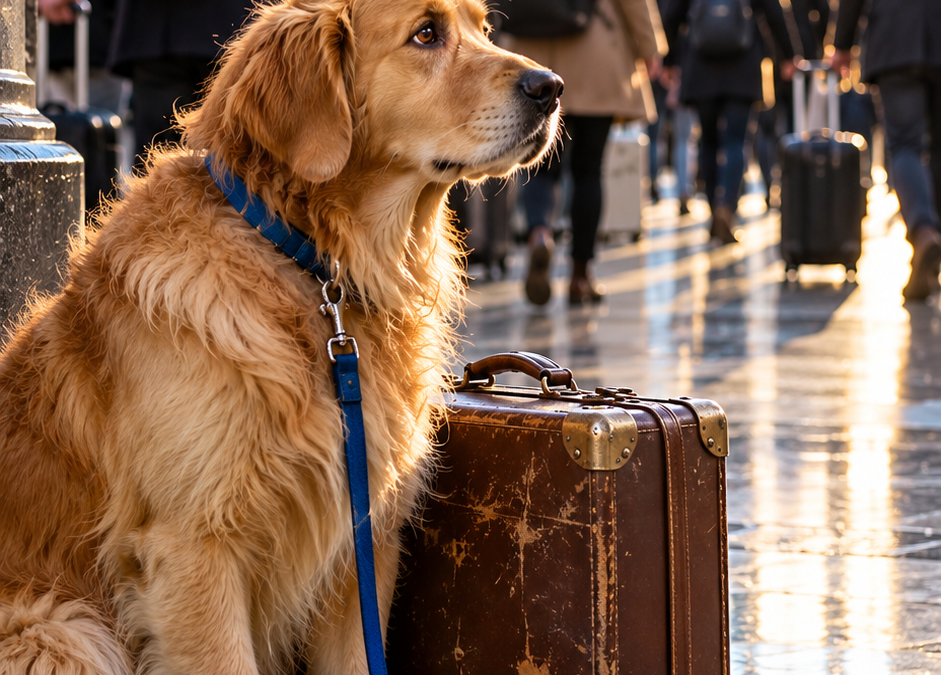
He was sitting beside an old brown suitcase near the edge of the main concourse.
Golden coat.
Medium-sized.
Blue leather leash looped loosely around his neck.
He was not barking.
Not wandering.
Not begging strangers for food.
He was simply staring at the opposite entrance with such absolute concentration that I slowed down without meaning to.
It was seven in the morning, and London Victoria was already alive.
Shoes striking tile.
Announcements echoing from the ceiling.
Suitcase wheels rattling over seams in the floor.
People carrying coffee with one hand and phones with the other.
Families arguing quietly about platforms.
Commuters moving with the hard, practiced urgency of people who believe every second has already been assigned a purpose.
And in the middle of all that motion, the dog did not move at all.
He sat beside the suitcase and watched the door.
I remember thinking that someone had probably gone to buy a ticket.
Or use the restroom.
Or get coffee.
The suitcase looked old but not abandoned.
Scratched leather.
Brass corners dulled with age.
One handle wrapped in dark tape.
The dog looked cared for.
No visible wounds.
No matted coat.
No ribs showing.
He wore a collar beneath the blue leash.
Someone loved that dog.
That was what I assumed.
And because I was late, I kept walking.
I glanced back once.
He was still staring at the entrance.
Then I disappeared into the crowd.
My name is Daniel Mercer.
At the time, I was forty-two years old, lived alone in a small flat in Battersea, and worked as an insurance claims investigator.
It was not a glamorous job.
Most days were paperwork, phone calls, train rides, damaged roofs, broken pipes, car accidents, and people trying to explain why something worth five thousand pounds yesterday was suddenly worth twenty thousand after it disappeared.
I had become good at noticing details.
Scuff marks.
Dates.
Receipts.
Contradictions.
The things people overlooked because they were too emotional or too hurried to see them.
Yet that morning, the most important detail in the entire station was sitting ten yards from me, and I walked right past him.
For the next five hours, I attended a meeting across town.
I took notes.
Asked questions.
Reviewed photographs.
Discussed numbers.
Did everything I was supposed to do.
But every once in a while, without warning, I thought about the dog.
I pictured the way he had been sitting.
Not lost.
Waiting.
There is a difference.
A lost dog moves.
Sniffs.
Circles.
Searches.
That dog had already chosen a place.
He believed someone would return to it.
By the time my meeting finished, I had almost convinced myself I was being ridiculous.
Surely his owner had come back.
Surely some station employee had handled it.
Surely the dog was already home.
When I returned to Victoria a little after noon, I came through the same concourse.
And there he was.
Same corner.
Same suitcase.
Same blue leash.
Same eyes fixed on the opposite door.
I stopped completely.
People moved around me.
Someone muttered because I was blocking the walkway.
I barely heard him.
Five hours had passed since I first saw the dog.
He had not left.
A young girl, maybe seven or eight, crouched nearby holding a piece of pastry.
Her mother stood behind her.
The girl extended the food carefully.
The dog looked at it.
For one second, I thought he might take it.
Instead, he turned his head toward the entrance again.
The girl looked disappointed.
“He doesn’t want it.”
Her mother touched her shoulder.
“Leave him, sweetheart.”
“Is he waiting for someone?”
“I think so.”
That sentence hit me harder than it should have.
I walked toward a station employee standing near a pillar.
“Excuse me.”
He turned.
“That dog.”
He followed my gaze.
“Oh. Yeah.”
“How long has he been there?”
The employee frowned.
“Since before my shift.”
“When did you start?”
“Six.”
“I saw him at seven.”
He nodded.
“Cleaner said he was here around four.”
“Four in the morning?”
“Apparently.”
I looked at the dog.
More than eight hours.
“Has anyone checked his collar?”
“Transport police had a look earlier. No obvious contact tag.”
“Has anyone tried moving him?”
The employee gave a small laugh without humor.
“Twice.”
“What happened?”
“He won’t go.”
“Aggressive?”
“No. That’s the strange part.”
He looked toward the dog.
“Gentle as anything. You can touch him. He’ll stand if you encourage him. But the second you try to lead him away from that suitcase, he plants himself.”
“What about the suitcase?”
“Not ours to open unless there’s a security reason.”
“Has it been checked?”
“They scanned it. Nothing suspicious.”
“So everyone is just waiting?”
He shrugged.
“Animal services have been called. They’re busy.”
I looked at the clock.
Eight hours.
Maybe more.
The dog had been waiting longer than some people stayed awake between shifts.
I walked over and sat on a bench about twenty feet away.
I did not know why.
My train home was due in thirty minutes.
I could have left.
Probably should have.
Instead, I watched.
Every time the main entrance opened, the dog lifted his head slightly.
A man in a gray coat entered.
The dog’s ears rose.
Then settled.
A woman pulling a red suitcase came through.
Same thing.
A delivery worker.
Two teenagers.
An elderly couple.
A police officer.
Each time, hope moved visibly through the dog’s body.
Each time, the person passed.
Each time, he returned to stillness.
The girl with the pastry eventually left.
Someone else put down a paper cup filled with water.
That, he drank.
But he never moved more than a few feet from the suitcase.
I began wondering what could be inside.
Not valuables.
The suitcase was too ordinary for that thought to last long.
Clothes, maybe.
Documents.
Medication.
Something belonging to whoever had left the dog there.
The longer I watched him, the more I felt that the suitcase and the dog were connected.
Not just because they had been abandoned together.
Because he guarded it.
Whenever anyone walked too close, he stood.
He did not growl.
He simply positioned himself between the stranger and the case.
Then, once they passed, he sat again.
I checked the time.
My train would leave in eighteen minutes.
I told myself to go.
Instead, I stood and approached the dog.
Slowly.
He watched me.
“Hey, buddy.”
His ears moved.
No growl.
No bark.
I crouched several feet away.
“You’ve been here all day, haven’t you?”
He stared at me.
I extended my hand.
He leaned forward enough to smell my fingers.
Then looked back toward the entrance.
I smiled sadly.
“Right. I’m not who you’re waiting for.”
His collar had a small metal plate.
BAILEY.
No phone number.
No address.
Just Bailey.
“Bailey.”
His ears moved again.
At least I had the name.
I looked at the suitcase.
Then at him.
“You know what’s in there?”
He stood.
Not threatening.
Alert.
I reached toward the latch.
Bailey moved closer.
For a moment, I stopped.
His eyes were fixed on my hand.
There was something almost human in the way he looked at me.
Not fear.
Not anger.
Something closer to urgency.
“Do you want me to leave it alone?”
He stepped closer.
Then touched his nose to the suitcase.
I wish I could explain why that felt like permission.
Maybe I simply wanted it to.
Maybe after eight hours, I had already decided I was not leaving until I understood what was happening.
The suitcase was old enough that the metal latches had patches of rust around the hinges.
I pulled one.
It opened easily.
The second needed more force.
Bailey stood beside my shoulder.
I lifted the lid.
The first thing I noticed was how carefully everything had been packed.
Two folded blouses.
A cardigan.
A pair of trousers.
Toiletries in a small cloth bag.
A pair of children’s shoes, old and carefully wrapped in tissue.
That did not make sense.
I touched them.
Tiny leather shoes.
Probably decades old.
Beneath them was a photograph.
An elderly woman with white hair sitting in a garden chair.
Bailey beside her.
Same golden coat.
Same dark eyes.
The woman had both arms wrapped around him.
On the back, written in blue ink:
Margaret and Bailey — eleven years together.
My throat tightened.
Under the photograph was an envelope.
Cream paper.
A little bent at one corner.
Across the front, written by hand:
To whoever finds my Bailey.
I stopped breathing for a second.
Bailey stood so close that his shoulder touched my arm.
I looked at him.
Then at the envelope.
“Is this what you’ve been waiting for?”
His tail moved once.
I opened it.
The handwriting was steady but clearly elderly.
My name is Margaret Thompson.
I am eighty-four years old.
The dog beside you is Bailey.
He has been my only companion for eleven years.
I looked at the photograph again.
Then continued.
If you are reading this, then I was not brave enough to do what I should have done.
My health has failed quickly.
The doctors have told me that I must be admitted to the hospital and that I may not return home.
I have no children nearby.
No husband.
No one I trust to take Bailey permanently.
I tried shelters.
I tried neighbors.
I tried everyone I could think of.
I began to feel angry.
Not at her.
At whatever chain of circumstances had left an eighty-four-year-old woman believing a railway station was her best hope for the creature she loved most.
Then came the line that changed everything.
So I brought Bailey here.
I left his suitcase beside him.
I kissed him on the forehead.
And I walked away.
My hands tightened around the paper.
Bailey did not understand.
That is the part I cannot forgive myself for.
He thought I was coming back.
I watched from outside the station window, and he would not follow me.
He stayed beside the suitcase.
Waiting.
I had to leave because the hospital car was waiting.
I cried the entire way.
If you are reading this, then perhaps you are the person I prayed would stop.
Please do not leave him there.
Please do not let him believe forever that I forgot him.
Bailey is gentle.
He sleeps near the bed.
He dislikes thunderstorms.
He will not eat carrots.
He loves cheese more than is good for him.
He knows the word “garden.”
If you are able to give him a home, I will die with one less fear.
If you cannot, please find someone who can.
Just do not abandon him twice.
Margaret Thompson.
I read the final line three times.
Just do not abandon him twice.
The noise of Victoria Station continued around me.
Announcements.
Footsteps.
Conversations.
Luggage.
But for a few seconds, I heard nothing.
Bailey sat at my feet.
He was trembling.
Not violently.
Just enough that I could feel it when I placed my hand against his neck.
“You’ve been waiting all this time.”
He leaned into my palm.
I had spent most of my adult life believing I was not suited for attachments.
That is the polite way to say it.
The less polite version is that I had become very good at leaving before anything could matter too much.
My parents had divorced when I was young.
My father disappeared from my life in gradual stages.
First fewer calls.
Then missed birthdays.
Then silence.
My mother died when I was thirty-four.
Two years later, the woman I planned to marry ended our relationship because, as she put it, living with me felt like living beside a locked room.
She was right.
I worked.
Came home.
Ate alone.
Watched television.
Went back to work.
Weekends disappeared without leaving memories.
I had convinced myself I preferred it.
No one depending on me.
No one waiting.
No one I could disappoint.
Then Bailey looked up at me.
And for reasons I could not explain, I thought of Margaret sitting in a hospital room somewhere, wondering whether the dog she loved was still sitting beside a suitcase.
I folded the letter.
“Okay.”
Bailey tilted his head.
“I don’t know what I’m doing.”
His tail moved.
“But we’re not staying here.”
I stood.
Picked up the suitcase.
Took the blue leash in my other hand.
Bailey did not resist.
That was the first time all day he willingly moved away from the corner.
The station employee saw us.
“You taking him?”
“I’m taking him to find his owner.”
“You know where she is?”
“I know her name.”
“That’s something.”
It was.
Outside, Bailey stopped on the pavement.
He looked back through the station doors.
For several seconds, he refused to move.
I crouched beside him.
“She isn’t coming back there.”
His ears lowered.
“But maybe we can go to her.”
That word did it.
Her.
Maybe it was my tone.
Maybe nothing more.
Bailey stepped toward me.
I had driven that morning because I needed to visit a site before taking the train, so my car was parked nearby.
I put the suitcase in the trunk.
Bailey jumped into the rear seat without hesitation.
Then immediately stood with his paws against the window and looked back toward the station.
I called hospitals.
The first two had no Margaret Thompson matching the age.
The third transferred me twice.
Then an admissions clerk said:
“Yes, we have a Margaret Thompson, eighty-four.”
My heart jumped.
“Is she conscious?”
“I can’t provide medical information over the phone.”
“I understand.”
“Are you family?”
I looked at Bailey.
“No.”
“Then I’m afraid—”
“I found her dog.”
Silence.
“What?”
“Bailey.”
Another silence.
Then:
“Oh.”
“You know him?”
“I know about him.”
That was enough.
“Can I bring him?”
“You’ll need approval.”
“Who do I ask?”
“Come to the main desk.”
We drove.
Bailey spent most of the trip standing behind my seat, head close to my shoulder.
Every time we stopped at a light, he whined softly.
“I know.”
I did not know why I kept talking to him.
Maybe because silence had begun to feel cruel.
“We’re going.”
Whine.
“I don’t know what we’ll find.”
He pressed his nose against my shoulder.
“I know.”
When we reached the hospital, I suddenly worried that bringing a dog inside would be impossible.
It almost was.
The receptionist frowned.
Hospital policy.
Infection control.
Visitor restrictions.
I showed her Margaret’s letter.
She read the first paragraph.
Then the second.
Her expression changed.
“Wait here.”
A nurse came down ten minutes later.
Her name was Helen.
She read the letter too.
“You found him at Victoria?”
“This morning.”
“How long had he been there?”
“At least eight hours.”
She looked at Bailey.
“Oh, sweetheart.”
Bailey stared past her toward the elevators.
Helen noticed.
“I think he knows.”
“Is Margaret alive?”
She looked at me.
“Yes.”
I exhaled.
“But she’s very weak.”
“Can he see her?”
Helen hesitated.
Then nodded.
“We’ll make it happen.”
We took a service elevator.
Bailey stood pressed against my leg.
The moment the doors opened on the top floor, everything about him changed.
His head came up.
His nose moved rapidly.
Then he pulled.
Not wildly.
But with purpose.
“Bailey.”
He did not look at me.
He knew.
Helen led us down a bright hallway.
Room 614.
The door was partly open.
Bailey stopped outside it.
For one second, he froze completely.
Then a weak voice came from inside.
“Bailey?”
The leash nearly tore from my hand.
He rushed into the room.
I followed.
Margaret Thompson was smaller than I expected.
White hair.
Thin face.
Oxygen tubing beneath her nose.
Hands that looked almost weightless against the sheets.
The moment Bailey reached the bed, he rose on his back legs and placed his front paws carefully against the mattress.
Margaret opened her eyes fully.
“Bailey.”
She began crying.
Not the quiet kind.
Her whole face collapsed.
Bailey made a sound I had never heard from a dog before.
Half whine.
Half cry.
Helen turned away.
I stood near the door holding the suitcase, suddenly feeling like an intruder inside something sacred.
Margaret reached down.
Her fingers found Bailey’s head.
“You came.”
He pushed his face into her hand.
“I’m sorry.”
She kissed the top of his head.
“I’m so sorry.”
Bailey kept trying to climb onto the bed.
Helen looked at me.
Then at Margaret.
“Oh, go on.”
We helped him up.
Bailey curled beside Margaret as though he had done it every night for eleven years.
She wrapped one arm around him.
Then looked toward me.
“You found him.”
“Yes.”
Her voice trembled.
“How long?”
I did not want to tell her.
She knew immediately.
“How long did he wait?”
“At least eight hours.”
Margaret closed her eyes.
A tear moved toward her ear.
“I knew he would.”
I stepped closer.
“You wrote the letter.”
“Yes.”
“I found it in the suitcase.”
“I didn’t know what else to do.”
Her voice carried shame.
That bothered me.
“You were trying to save him.”
“I abandoned him.”
“No.”
She looked at me.
“I left.”
“You were dying.”
“I still left.”
I thought about the letter.
Just do not abandon him twice.
“What were you supposed to do?”
“I should have found someone first.”
“You tried.”
“Not enough.”
Bailey lifted his head at the sound of her voice.
Margaret stroked his ear.
“I kept thinking I had another week.”
Her fingers moved slowly through his fur.
“Then another.”
She looked at me.
“You know how people do that?”
“Yes.”
“Pretend time is negotiable?”
I nodded.
“Then suddenly the doctor said hospital.”
She swallowed.
“My neighbor has three cats. My sister died years ago. No children. No one.”
“You could have called a rescue.”
“I did.”
“Then?”
“Waiting lists.”
She laughed weakly.
“Everyone says plan ahead.”
Her eyes returned to Bailey.
“I thought I had.”
I pulled a chair beside the bed.
“My name is Daniel.”
“Margaret.”
“I know.”
That made her smile slightly.
“You read everything.”
“Yes.”
She studied my face.
“You brought him back.”
“I did.”
“Why?”
The question caught me off guard.
“Because he was waiting.”
Margaret looked at Bailey.
“He always waits.”
She told me about him.
How she found him as a young dog after her husband died.
How Bailey refused to sleep anywhere except beside her bed.
How he learned which cupboard contained cheese.
How he sat outside the bathroom when she showered.
How he followed her into the garden.
How he once spent three hours lying beside the back door when an ambulance took her away for tests.
“He doesn’t understand leaving,” she said.
I looked at him.
“Maybe he understands it too well.”
Margaret studied me.
“You sound like someone who does.”
I almost laughed.
“Maybe.”
She reached toward me.
Her hand barely reached halfway.
I took it.
“You are a good man.”
“No.”
She frowned.
“That wasn’t a question.”
“You don’t know me.”
“I know you stopped.”
I looked at her.
“Hundreds of people passed him.”
“Someone else would have eventually.”
“But you did.”
I did not know what to say.
Margaret squeezed my fingers with surprising strength.
“Will you make me a promise?”
I already knew what she would ask.
I looked at Bailey.
Then back at her.
“He won’t be alone.”
Her face changed.
A kind of relief I had never seen in another person.
Not happiness.
Something deeper.
The easing of fear.
“You’ll take him?”
“Yes.”
The word came out before I had fully understood it.
Margaret stared at me.
“You have a family?”
“No.”
“Other dogs?”
“No.”
“Garden?”
I smiled.
“Small one.”
“Good.”
She glanced at Bailey.
“He likes gardens.”
“I read that.”
“And cheese.”
“I read that too.”
“Too much.”
“I’ll try to be responsible.”
She smiled.
Then I added:
“And I’ll bring him here.”
“What?”
“Every day you want him.”
Her mouth opened.
“Daniel, you don’t have to—”
“I know.”
I looked at Bailey lying against her side.
“But he waited eight hours because he thought you were coming back.”
My throat tightened.
“I don’t think either of you should have to wait again.”
Margaret started crying.
So did I.
I had not cried in years.
That was the beginning.
The next morning, Bailey woke me at 5:47 by breathing directly into my face.
I opened my eyes.
Golden head.
Dark eyes.
“Absolutely not.”
His tail struck the mattress.
“You don’t live here yet.”
He sneezed.
“All right.”
I had spent the previous night learning that Bailey did not understand personal space.
He slept beside the bed for approximately eleven minutes.
Then climbed onto it.
I woke at two with his back against mine.
At four, one paw across my ankle.
At 5:47, apparently, the day had begun.
I walked him.
Fed him.
Went to work late.
Then drove him to the hospital.
Margaret looked half asleep when we entered.
Bailey’s nails clicked against the floor.
Her eyes opened immediately.
“There he is.”
Bailey went straight to the bed.
Every morning after that, we repeated it.
Some days before work.
Some days during lunch.
Sometimes after.
My manager complained twice.
Then I told him enough of the story that he stopped.
Margaret became part of my life almost as quickly as Bailey did.
I learned she had been a school librarian.
That she had married a man named Arthur at twenty-two.
That Arthur died twelve years earlier.
That the children’s shoes in the suitcase had belonged to a daughter who lived only three days.
Margaret had kept them for sixty years.
When I asked why she packed them, she looked embarrassed.
“I didn’t want strangers clearing the flat to throw them away.”
I understood then why the suitcase mattered.
It had not only carried Bailey’s things.
It carried the last objects Margaret could not bear to leave behind.
The photograph.
The shoes.
Clothes.
Her past.
She had placed everything she loved beside the one living creature she loved most.
And hoped a stranger would understand.
Over six weeks, Margaret became weaker.
The nurses adjusted medication.
Her appetite disappeared.
Some days she spoke for an hour.
Other days barely at all.
Bailey never cared.
He lay beside her.
Head in the hollow of her hand.
Sometimes neither moved.
At first, I felt awkward sitting there during those silences.
Eventually, I understood.
They did not need conversation.
People often think love is proven through action.
Sometimes it is.
But sometimes the deepest form of love is simply refusing to leave the room.
Bailey had mastered that.
He stayed.
One afternoon, Margaret looked at me while Bailey slept.
“You’ve changed.”
I laughed.
“You’ve known me five weeks.”
“Long enough.”
“How?”
“You used to sit near the door.”
I looked toward the chair.
I was closer to her bed now.
“So?”
“People who expect to leave sit near doors.”
I did not answer.
She smiled.
“Now you put your coat down.”
I looked at the coat hanging over the other chair.
“You notice too much.”
“Librarian.”
“Of course.”
She turned serious.
“Why are you alone, Daniel?”
I could have changed the subject.
Instead, I told her.
Not everything.
Enough.
My father leaving.
My mother dying.
The engagement ending.
The way I had turned independence into a fortress.
Margaret listened.
When I finished, she said:
“That sounds exhausting.”
“What?”
“Making sure nobody can leave you.”
I frowned.
“I don’t do that.”
“You do.”
“How?”
“By never letting anyone close enough.”
I looked at Bailey.
He was sleeping with one ear folded beneath his head.
Margaret followed my eyes.
“Too late now.”
“What?”
“He loves you.”
I almost laughed.
“He loves cheese.”
“Both can be true.”
The sixth week was harder.
Margaret slept more.
Her breathing changed.
The nurses started speaking softly outside the room.
I knew what that meant.
Bailey seemed to know too.
He stopped pulling toward the elevator.
He walked slowly.
Inside the room, he no longer tried to climb onto the bed until I lifted him.
One Thursday morning, Margaret was awake when we arrived.
She looked clearer than she had in days.
“Daniel.”
“Morning.”
“Close the door.”
I did.
She pointed toward the bedside drawer.
“There’s something in there.”
I opened it.
A small envelope.
My name.
“You and your letters.”
She smiled.
“Take it.”
“Now?”
“Later.”
I put it in my coat.
Margaret stroked Bailey’s head.
“I’m tired.”
“I know.”
“I’m not afraid.”
I sat beside her.
“Good.”
“That’s because of you.”
“No.”
She looked at Bailey.
“Partly him.”
“Mostly him.”
Bailey lifted his head.
Margaret smiled.
“Definitely him.”
She reached for my hand.
“Promise again.”
“He stays with me.”
“And?”
“I bring him home.”
She shook her head.
“He is home.”
That sentence hit me.
I looked at Bailey.
Margaret continued.
“You understand?”
“Yes.”
“Home is not where I am anymore.”
Her eyes filled but she did not cry.
“It’s where he is loved.”
I squeezed her hand.
“He’s loved.”
“Good.”
We stayed two hours.
When I finally left, Margaret was sleeping.
Bailey stood at the doorway and refused to move.
“Come on.”
He looked back.
“Bailey.”
Nothing.
I crouched.
“We’ll come back tomorrow.”
He stared at the bed.
I touched his collar.
“I promise.”
Eventually, he followed me.
That night, I opened Margaret’s envelope.
One line.
Thank you for waiting with him.
I read it again.
Not rescuing him.
Not taking him.
Not saving him.
Waiting with him.
I folded the note and placed it beside the photograph from the suitcase.
At 5:12 the next morning, my phone rang.
Hospital.
I knew before answering.
Margaret had died peacefully during the night.
The nurse said she was comfortable.
Said she had not been alone.
A staff nurse had been present.
But I knew that was not entirely true.
Part of her had left six weeks earlier when she walked away from Victoria Station and looked back through the glass at Bailey sitting beside the suitcase.
The fear she carried that day had already been resolved.
Bailey had a home.
I sat on the edge of my bed.
He stood in front of me.
“How do I tell you?”
He wagged his tail because I was awake.
That nearly destroyed me.
We went to the hospital anyway.
Helen met us downstairs.
When she saw Bailey, she knelt.
“Oh, sweetheart.”
He licked her hand.
Then pulled toward the elevator.
I could not stop him.
We went upstairs.
Margaret’s room had already been cleaned.
The bed was empty.
Fresh sheets.
No flowers.
No cardigan on the chair.
Nothing.
Bailey entered.
Stopped.
Looked toward the bed.
Then toward me.
He sniffed the floor.
The chair.
The corner.
He waited.
Five minutes.
Ten.
Eventually, he sat.
The same way he had sat at Victoria.
Facing the place where someone should have been.
I sat on the floor beside him.
This time, I knew better.
I did not tell him to move.
I did not pull the leash.
I waited with him.
Helen stood outside the room.
At some point, Bailey leaned against me.
Then lowered his head onto my thigh.
I whispered:
“She loved you.”
His ears moved.
“She didn’t leave because she wanted to.”
I do not know how much dogs understand.
Maybe everything.
Maybe only tone.
But after a while, he stood.
Walked to the door.
Looked back once.
Then followed me home.
The first few weeks after Margaret died, Bailey watched the front door constantly.
Every hallway sound made his head rise.
Every elevator-like mechanical noise from the building next door made him stand.
Sometimes, during walks, he would stop beside older women with white hair.
Not approach.
Just look.
Then continue.
I did not correct him.
Grief deserves time whether it belongs to a person or a dog.
I kept Margaret’s suitcase.
At first because I did not know what else to do.
Then because throwing it away felt wrong.
The children’s shoes went into a small shadow box.
The photograph of Margaret and Bailey sits on my bookshelf.
Her original letter is framed behind UV glass.
The final note stays in my desk.
Thank you for waiting with him.
Bailey changed my routine completely.
Six in the morning became normal.
Then 5:45.
He had strong opinions about breakfast.
Even stronger opinions about walks.
He did, in fact, hate carrots.
Margaret had not exaggerated.
The first time I dropped one near his bowl, he sniffed it, looked at me with genuine disappointment, and walked away.
Cheese was different.
One sound from the refrigerator drawer and he appeared.
“Margaret warned me about you.”
Tail wag.
“She specifically said too much cheese.”
Faster wag.
“You’re manipulating me.”
Head tilt.
I lost that argument often.
The garden behind my flat was barely large enough for a chair, three planters, and a patch of grass.
Bailey treated it like an estate.
The first time I said “garden,” he ran to the back door so fast he slid across the floor.
I laughed.
A real laugh.
Not the polite kind I used at work.
That surprised me.
So did many things.
I started coming home earlier.
Taking fewer unnecessary overtime assignments.
Walking in the park before work.
Talking to people I had passed for years without knowing their names.
When you have a dog, strangers talk to you.
Children ask permission to pet him.
Older people tell you about dogs they once owned.
Other dog owners know details about your schedule you never told them.
Within months, I knew half the people around the park.
Bailey remembered everyone.
Especially anyone carrying food.
My flat changed.
Dog bed beside the sofa.
Leash by the door.
Water bowl in the kitchen.
Toys under furniture.
Golden hair on clothes.
I stopped caring.
My mother had once told me that a home should look like someone lived there.
For years, mine looked like someone was staying temporarily.
Bailey fixed that.
I also started volunteering once a month with a senior-dog rescue.
I wish I could say it was a noble decision.
It began because I wanted to donate Margaret’s remaining dog supplies.
Instead, I stayed three hours.
Then came back.
There were so many older dogs.
Gray muzzles.
Clouded eyes.
Stiff hips.
Animals whose owners had died.
Moved into care.
Become ill.
Lost housing.
Every one of them had a story that began with somebody leaving.
Not always cruelly.
Sometimes life simply separated people.
Bailey had taught me the difference between being left and being unloved.
Those two things are not always the same.
A year after Margaret died, I returned to Victoria Station with Bailey.
I had avoided it.
Maybe unconsciously.
Then one Tuesday morning, almost exactly twelve months later, I put the blue leash on him.
“We’re going somewhere.”
He wagged his tail.
We took the train.
The station was exactly as I remembered.
Crowded.
Noisy.
Impatient.
People moving past each other without looking.
I led Bailey toward the corner.
The bench had been replaced.
The pillar repainted.
But I knew the place.
Bailey stopped.
His entire body became still.
I felt the leash tighten.
He looked toward the entrance.
My chest hurt.
He remembered.
We stood there together.
People passed.
A child dropped a napkin.
Someone argued into a phone.
An announcement echoed overhead.
Bailey kept watching the door.
I crouched beside him.
“I know.”
His ears moved.
“She isn’t coming.”
He looked at me.
“But you’re not waiting alone this time.”
I sat on the bench.
Bailey sat beside me.
We stayed fifteen minutes.
Then twenty.
I did not rush him.
At some point, he leaned against my leg.
Then looked away from the entrance.
That felt important.
“Ready?”
He stood.
We walked out together.
After that, he stopped staring at my front door so much.
Maybe coincidence.
Maybe not.
Years passed.
Bailey slowed.
His muzzle whitened.
Walks became shorter.
He stopped jumping onto my bed and waited for me to lift him.
The vet said arthritis.
Then heart problems.
Medication helped.
For a while.
I dreaded the day Margaret’s story would repeat itself from the other direction.
This time, I would be the one watching him weaken.
But there was one difference.
He would never wonder whether I was coming back.
I stayed.
When the final day came, it was quiet.
Bailey had stopped eating.
Even cheese.
That was how I knew.
The vet came to the flat.
I spread his favorite blanket beside the back door where sunlight reached the floor.
Garden.
His favorite word.
I lay beside him.
Held his head.
The blue leash rested nearby.
The same one he had worn at Victoria.
I told him about Margaret.
Not because I thought he had forgotten.
Because I needed to say her name.
“She waited for you too.”
His breathing was slow.
“She was afraid you’d be alone.”
I stroked his ear.
“She was wrong.”
His eyes opened.
“You found me.”
My voice broke.
“And I think I needed finding more than you did.”
His tail moved once.
Barely.
I laughed and cried at the same time.
“Still arguing.”
When he died, my hand was on his head.
He was home.
No suitcase.
No station.
No door he had to watch.
Just home.
Afterward, I buried his ashes beneath a small tree in the garden.
Not because the garden was large enough.
Because Margaret had written that he loved gardens.
I had a small brass marker made.
Not his whole story.
Just:
BAILEY
HE WAITED.
HE WAS FOUND.
HE WAS LOVED.
For weeks, the flat felt too quiet.
I still woke at six.
Still looked toward the leash.
Still expected to hear his nails on the floor.
Grief has habits.
Eventually, I returned to the rescue.
There was an old spaniel there named Rosie.
Twelve years old.
Owner deceased.
Nobody wanted her because she needed medication twice a day.
I sat beside her kennel.
She looked at me.
Then looked away.
One volunteer said:
“She’s been here three months.”
I felt something in my chest tighten.
Three months.
Waiting.
I opened the kennel door.
Rosie did not move.
I sat on the floor.
Did not call her.
Did not reach.
I simply waited.
Twenty minutes later, she came over.
Rested her chin on my knee.
I thought about Victoria.
Margaret.
The suitcase.
Bailey.
The letter.
Everything that had begun because, for once in my life, I stopped moving long enough to notice someone waiting.
I adopted Rosie that afternoon.
She never replaced Bailey.
Nothing replaces anything worth loving.
That is not how it works.
Love does not erase previous love.
It makes room beside it.
Today, the old suitcase still sits in my hallway cabinet.
The brass is duller now.
The handle is still wrapped in tape.
Inside are Margaret’s photograph, copies of her letters, Bailey’s blue leash, and the tiny children’s shoes she carried all those years.
Sometimes people ask why I keep a stranger’s suitcase.
I tell them she stopped being a stranger the moment she trusted me with what she loved most.
The truth is that I think about those eight hours often.
Eight hours Bailey sat beside that suitcase.
Hundreds, maybe thousands of people passed.
Most probably saw him.
Some did not.
A few offered food.
Someone offered water.
Station employees called for help.
Nobody was cruel.
But everyone was going somewhere.
That is the thing about stations.
People are always leaving.
Always arriving.
Always looking at clocks.
Everyone has a platform.
A meeting.
A destination.
A reason they cannot stop.
I had one too.
Twice.
The first time, I walked past him.
The second time, I stopped.
My life divided there.
Before Bailey, I believed kindness was mostly about good intentions.
After Bailey, I understood that kindness often looks like inconvenience.
Missing a train.
Changing your plans.
Carrying someone else’s suitcase.
Driving across town.
Walking into a hospital.
Taking responsibility you did not wake up expecting.
Showing up again the next morning.
And the next.
Waiting in an empty room with a grieving dog because leaving quickly would be easier for you.
Margaret thought she was praying for someone to save Bailey.
Maybe she was.
But I think Bailey saved me too.
He gave me mornings.
People.
Routine.
Responsibility.
A reason to come home.
A reason to open a door instead of keeping it locked.
He taught me that attachment is not weakness simply because it eventually hurts.
The hurt is proof that something mattered.
For years, I had protected myself so carefully from loss that I had also protected myself from belonging.
Bailey had no interest in that philosophy.
He loved without insurance.
Without guarantees.
Without asking how long someone would stay.
He simply stayed first.
That was what Margaret understood when she wrote her final note.
Thank you for waiting with him.
Not saving him.
Waiting.
Because waiting is what love had always meant to Bailey.
He waited beside Margaret’s bed.
He waited outside doors.
He waited at Victoria Station for more than eight hours because he could not imagine that the person he loved would disappear forever.
And when he finally understood she was gone, he learned to wait differently.
Beside me.
At home.
Not for someone to return.
Just because staying near the people we love is sometimes enough.
I still pass through Victoria occasionally.
Every time I do, I glance toward that corner.
There is usually nothing there.
A traveler checking a phone.
A suitcase.
Someone drinking coffee.
Ordinary things.
But I always slow down.
Because once, in that exact place, a golden dog sat beside an old suitcase and believed with his whole heart that someone would come back for him.
For eight hours, the world hurried past.
Then I stopped.
I thought I was opening a suitcase.
In truth, I was opening a door I had spent years keeping closed.
And on the other side of it were Margaret, Bailey, six weeks of impossible tenderness, years of companionship, a garden, grief, and a life that finally felt inhabited.
Sometimes the most important decision you make does not look important when it happens.
Sometimes it is simply bending down beside a dog you do not know.
Putting your hand on an old latch.
Reading a stranger’s letter.
And deciding that this time, someone will not be left waiting alone.

