𝗙𝗨𝗟𝗟 𝗦𝗧𝗢𝗥𝗬 Every Wednesday, the Same Skinny Yellow Dog Stepped in Front of My Car and Refused to Let Me Pass
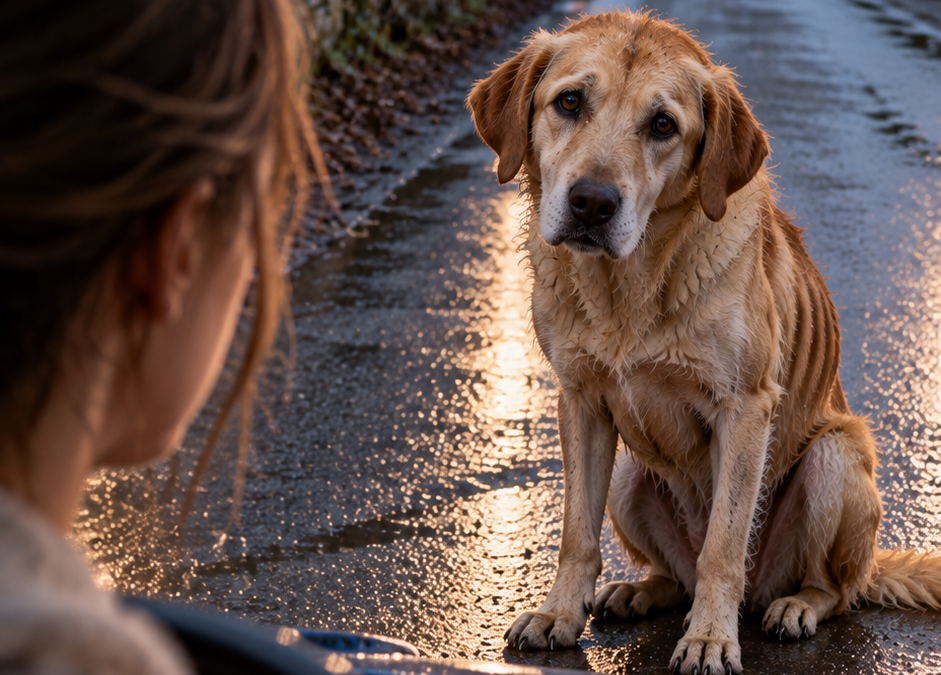
𝗙𝗨𝗟𝗟 𝗦𝗧𝗢𝗥𝗬
He stepped into the lane.
I stopped.
He sat.
“You.”
Tail movement.
I didn’t get out at first.
A small hatchback approached from the opposite direction.
I expected the dog to block them too.
Instead, he stood, moved neatly to the edge of the road, let the car pass, then immediately returned to his position in front of me.
I stared through the windshield.
“Excuse me?”
The dog looked at my car.
Not at me.
My car.
I opened the door.
“Do you have a personal issue with Ford?”
He walked toward me.
Again, he sniffed the driver’s door.
Then looked up at the window.
I crouched.
“Do you know this car?”
His tail moved once.
Then he walked back into the lane.
That became our ritual.
Every Wednesday.
Same time, give or take twenty minutes.
Same narrow road.
Same yellow dog.
The rest of the week, when I occasionally used Heatherfield at different times, I often didn’t see him.
Wednesday evenings were different.
He was there.
Waiting.
Sometimes beneath the oak tree.
Sometimes near the stone wall.
But as soon as my Ford appeared, he stepped out.
The third Wednesday, I brought him a biscuit.
“Bribery.”
I held it out.
“Let’s make a deal.”
He came close enough to take the food.
A good sign.
He chewed.
Then sat back down in front of the car.
I stared.
“That was absolutely a bribe.”
His ears lifted.
“You are violating the terms.”
I gave him another biscuit.
Same result.
Eventually I started arriving with food intentionally.
That was my first mistake.
Not feeding him.
Assuming food was what he wanted.
The dog was hungry.
Obviously.
But hunger wasn’t why he stopped me.
I learned that slowly.
After about a month, I started asking around.
There was a small grocery shop near the village center.
The owner, Mr. Bell, seemed to know everything about everyone.
I showed him a photograph I’d taken from my car.
“Do you know this dog?”
He leaned closer.
“Oh.”
“You do?”
“Sort of.”
“What does that mean?”
“He’s been around for years.”
“Whose is he?”
Mr. Bell shrugged.
“Nobody’s, far as I know.”
“He’s a stray?”
“Seems that way.”
“How long?”
“Three years, maybe.”
“Three years?”
“People feed him.”
“Nobody took him in?”
“They tried.”
He returned a loaf of bread to the shelf.
“He won’t stay.”
“What do you mean?”
“Mrs. Carter got him into her garden once.”
“And?”
“Next morning he was gone.”
“How?”
“Dug under the fence.”
“Why?”
Mr. Bell shrugged.
“Maybe he likes being free.”
That explanation didn’t feel right.
I showed him the photo again.
“Does he have a name?”
“People call him Daisy.”
I blinked.
“Daisy?”
“Don’t ask me.”
“He is male, isn’t he?”
“As far as anyone knows.”
“Why Daisy?”
“A little girl named him.”
That was apparently enough.
“Does Daisy stop cars?”
Mr. Bell shook his head.
“Not that I’ve seen.”
“He stops mine.”
That got his attention.
“What kind of car?”
“Blue Ford Focus.”
Mr. Bell looked thoughtful.
“Every time?”
“Every Wednesday.”
“Huh.”
“What does ‘huh’ mean?”
“It means huh.”
Extremely helpful.
I asked other residents.
A woman walking two spaniels.
A gardener.
The man at the petrol station.
Everybody knew Daisy.
Nobody owned him.
He slept wherever he could.
Sheds.
Barns.
Under hedges in summer.
People left food.
He avoided hands.
He didn’t bite.
Didn’t bark much.
Didn’t trust anyone enough to stay.
One elderly woman said, “He’s waiting.”
“For what?”
She looked toward Heatherfield Lane.
“If I knew, I’d tell you.”
That word followed me.
Waiting.
The more I watched Daisy, the more obvious it became.
He wasn’t wandering.
He wasn’t merely surviving.
There was purpose to him.
Wednesday after Wednesday, he appeared.
If another car came, he moved aside.
If mine came, he stopped me.
He would sniff the same parts.
Driver’s door.
Wheel arch.
Mirror.
Sometimes the rear quarter panel.
Then he would sit nearby and look toward me as though expecting the next part of something.
I just didn’t know what.
Once, frustrated, I deliberately took a different route.
Heatherfield added almost nothing to my commute, but I wanted to prove something to myself.
I drove the longer road.
No dog.
No delay.
No mystery.
I arrived home twenty minutes earlier than usual.
And felt guilty.
Ridiculous.
Guilty about avoiding a stray dog.
The next Wednesday, I returned to Heatherfield.
Daisy was waiting beneath the tree.
When he saw the Ford, he stood so quickly that my chest tightened.
“There you are.”
I stopped.
He came immediately to the driver’s side.
I opened the door.
“Did you miss me?”
His tail moved.
I stepped out.
He sniffed the inside of the car.
Then looked past me.
Not at my face.
Behind me.
Toward the driver’s seat.
It was almost as if he expected someone else to emerge.
I felt a chill.
“What are you looking for?”
Daisy turned his head.
I followed his gaze.
Empty seat.
Steering wheel.
My handbag.
Nothing.
“There’s nobody.”
His ears lowered.
Then he returned to the road.
I began thinking about him more than was reasonable.
At work.
At home.
On weekends.
Why only Wednesday?
Why my car?
Why would a dog who avoided people allow me within arm’s reach?
I mentioned it to my sister during a phone call.
“Maybe your car smells like another dog.”
“I’ve never owned a dog in this car.”
“Maybe the previous owner did.”
That stopped me.
Previous owner.
I’d bought the Focus used four years earlier from a dealership outside Reading.
I knew almost nothing about its history.
“Could be.”
“Or he likes blue.”
“Thanks.”
“I’m trying.”
I looked at the car through my kitchen window.
Same model.
Same color.
Ordinary.
Hundreds of them on British roads.
Still, the thought stayed.
Then came the rainy Wednesday.
The day everything changed.
I had had an awful week.
A project deadline had moved forward without warning.
My phone battery was dying.
Traffic leaving Richmond had been terrible.
I’d spilled coffee on my blouse.
By the time I reached Heatherfield, rain was falling hard enough to make the road shine black beneath my headlights.
I was exhausted.
I turned the bend.
Daisy stepped out.
I slammed the brakes.
“Not tonight.”
He sat in the road.
Rain plastered his yellow fur against his body.
He looked thinner wet.
Smaller.
More vulnerable.
But I was too irritated to feel sympathy immediately.
I opened the door and stepped into the rain.
“Daisy!”
He watched me.
“Come on!”
Nothing.
I marched toward him.
“What do you want from me?”
He stood.
I expected him to retreat.
Instead, he walked straight toward me.
The anger disappeared almost instantly.
Up close, I could see him shaking.
I crouched.
“I’m sorry.”
He let me touch his shoulder.
That surprised me.
Usually he tolerated proximity, not contact.
I moved my fingers toward his neck.
His fur was thick there.
Matted in places.
My hand found something hard.
“What is that?”
I pushed aside the wet fur.
Metal.
A small rusted ring buried beneath the coat.
Part of an old collar.
Not a decorative tag.
Not random debris.
A broken metal fitting where something had once been attached.
I looked at Daisy.
“You had someone.”
His ears moved.
Of course he’d had someone.
Vaccinated dogs become strays.
Loved dogs become abandoned.
Families disappear.
But touching that rusted piece of collar made his past suddenly physical.
Someone had bought that collar.
Fastened it around him.
Maybe called his name.
Maybe walked him down this road.
Maybe once opened a car door and said, Come on, boy.
Daisy looked toward my Ford.
Then toward the driver’s door.
For the first time, the idea came fully formed.
He knows the car.
I barely slept that night.
The rain struck my bedroom window.
Every time I closed my eyes, I saw Daisy sitting in the road.
Not blocking me.
Waiting for a door to open.
The next morning, I called the veterinary clinic in Heatherfield.
A woman answered.
“Heatherfield Veterinary Practice. Eleanor speaking.”
“Hi. This is going to sound strange.”
“Most interesting calls do.”
I smiled despite myself.
“Do you know a yellow stray dog people call Daisy?”
Silence.
“Yes.”
“You know him?”
“Everyone knows Daisy.”
“Has he been treated there?”
“We’ve tried.”
“What does that mean?”
“He doesn’t cooperate.”
“I heard people have tried catching him.”
“For years.”
“Has anyone managed?”
“Not properly.”
“What about food?”
“He’ll take food if you put it down and leave.”
“Touching?”
“No.”
I hesitated.
“He lets me.”
Another silence.
“Sorry?”
“I can touch him.”
“You’re sure we’re talking about the same dog?”
“Skinny. Yellow coat. One ear leans outward. Old piece of metal around his neck.”
Eleanor’s voice changed.
“Where did you see the metal?”
“Under his fur.”
“You got close enough to move the fur?”
“Yes.”
“Did he react?”
“No.”
“That’s very unusual.”
“Why?”
“Because Daisy won’t let us within arm’s reach once he realizes we’re trying to handle him.”
My mind began racing.
“He stops my car.”
“What?”
“Every Wednesday.”
I explained.
The lane.
The waiting.
Other cars passing.
Mine blocked.
Eleanor didn’t interrupt.
When I finished, she said, “What kind of car?”
“A blue Ford Focus.”
She went quiet again.
Longer this time.
“Eleanor?”
“I’m thinking.”
“About what?”
“I don’t know yet.”
She sighed.
“Could you bring him in?”
“If he’ll come.”
“If you can get him here, I’ll stay late.”
That Friday, I left work early.
I stopped at a pet shop and bought the most expensive food the employee recommended for convincing a difficult dog to trust you.
“Trying to catch a stray?”
“Something like that.”
I also bought a blanket.
A lead.
A water bowl.
I don’t know why.
Maybe some part of me already knew Daisy wasn’t going back to the road that evening.
When I entered Heatherfield Lane, he wasn’t in the road.
My heart sank.
Then I saw him beneath the oak.
Watching.
I stopped.
Turned off the engine.
Daisy stood.
He approached the car.
I didn’t get out immediately.
I waited until he had sniffed the door.
Then I opened it slowly.
“Hi.”
Tail movement.
“No work today.”
He looked into the car.
Again, that searching.
That expectation.
I stepped away.
This time, instead of walking toward him, I sat on the wet grass several yards from the road.
I opened the food.
The smell was terrible.
“Apparently this is gourmet.”
Daisy watched.
I placed some on a paper plate.
Then pushed it away from me.
“Your choice.”
He didn’t move.
I waited.
Five minutes.
Ten.
A delivery van passed.
Daisy didn’t care.
A cyclist went by.
Nothing.
He was watching me.
Not the food.
Me.
“Okay.”
I folded my arms around my knees.
“I’m not trying to catch you.”
His ears shifted.
“I’m not very good at catching anything anyway.”
Nothing.
“I’ve been thinking about you.”
His tail gave the smallest movement.
“This is ridiculous, by the way.”
I looked toward the lane.
“I have a job. A mortgage. Laundry I haven’t done.”
Daisy sat.
“And somehow I’m sitting in wet grass talking to a dog named Daisy who is definitely male.”
His mouth opened slightly.
I almost imagined a smile.
“Do you know why?”
No response.
“Because I think you’re trying to tell me something.”
I picked at the grass.
“When I was a kid, we had a dog.”
Daisy watched.
“His name was Charlie.”
His ear moved.
“He wasn’t clever.”
That wasn’t fair.
Charlie had been smart in the ways that mattered.
“He used to sleep outside my bedroom door.”
I smiled.
“My mother hated it because she’d trip over him in the morning.”
I hadn’t talked about Charlie in years.
“He died when I was nineteen.”
Daisy took one step closer.
“I was away at university.”
Another.
“I didn’t get home in time.”
My throat tightened unexpectedly.
“I told myself I was fine.”
Another step.
“That was ten years ago.”
Daisy was close enough now that I could hear him breathe.
“I still miss him.”
He stopped.
I held out my hand.
Not reaching.
Just offering.
“You know something about waiting, don’t you?”
Daisy’s nose touched my fingers.
I stayed perfectly still.
He sniffed.
Then moved closer.
His shoulder brushed my knee.
“Hi.”
My voice broke.
Slowly, carefully, I placed my hand on his chest.
His entire body trembled.
He didn’t leave.
I stroked once.
Then again.
Daisy lowered his head.
A minute later, he did something no one in Heatherfield seemed able to make him do for three years.
He lay down beside me.
Then, after another long hesitation, placed his head in my lap.
I stopped breathing.
“Oh.”
His eyes closed.
I rested one hand against his neck.
Beneath the yellow fur, I felt the rusted metal ring.
“You really were waiting.”
I don’t know how long I sat there.
Maybe an hour.
Long enough for my legs to go numb.
Long enough for the road to become quiet.
Long enough for Daisy to eat from my hand.
When I finally stood, he stood too.
I opened the rear door of the Ford.
“Want to come?”
He looked inside.
Then at me.
I expected hesitation.
Instead, he climbed in.
Just like that.
As though he had done it a hundred times.
My heart pounded.
“Daisy?”
He sat on the rear seat.
Turned once.
Then faced forward.
His eyes were fixed on the driver’s seat.
I climbed behind the wheel.
In the mirror, I saw him watching me.
Not disappointed.
Not exactly.
But searching.
The veterinary clinic was twelve minutes away.
Eleanor was waiting.
When I walked through the door with Daisy beside me, she stared.
“You brought him.”
“He came.”
“No sedation?”
“No.”
“No trap?”
“No.”
She crouched several feet away.
“Daisy?”
He looked at her.
Then leaned against my leg.
Eleanor laughed softly.
“Well.”
“What?”
“He has very clearly made a decision.”
The examination took time.
Daisy was nervous.
Every unfamiliar touch tightened his body.
So I stayed beside him.
One hand on his shoulder.
“You’re okay.”
Eleanor checked his heart.
Teeth.
Paws.
Skin.
Weight.
“About five years old.”
“That’s younger than I expected.”
“Hard living ages them.”
That hurt.
“Anything serious?”
“Underweight. Some old scarring. Dental issues. Parasites are possible. Nothing obvious that we can’t manage.”
Then Eleanor brought out the microchip scanner.
“I thought people already checked.”
“They couldn’t get close enough.”
The scanner passed along Daisy’s shoulder.
Nothing.
Again.
Then:
Beep.
Eleanor froze.
I did too.
“He has one.”
“Yes.”
She scanned again.
Beep.
“Can you identify the owner?”
“If the registration is current.”
She went to the computer.
I sat with Daisy on the floor.
His head rested against my thigh.
“Now we find out.”
My stomach twisted.
What if the owner was alive?
What if Daisy had been stolen?
What if someone had spent three years searching?
Would I return him?
Of course.
Would I want to?
The answer came too quickly.
No.
That frightened me.
I’d known this dog three months.
Touched him properly once.
Yet the idea of him leaving already hurt.
Eleanor returned.
Her face had changed.
“What?”
She pulled a chair closer.
“His registered name isn’t Daisy.”
“Of course it isn’t.”
“What is it?”
“Sunny.”
I looked down.
“Sunny?”
The dog lifted his head slightly.
Eleanor smiled.
“He knows it.”
I swallowed.
“Owner?”
“James Harrison.”
“Does he live nearby?”
“He did.”
Past tense.
My chest tightened.
“Did?”
Eleanor looked at me carefully.
“Claire, James Harrison died three years ago.”
The room went silent.
Exactly three years.
Daisy—Sunny—had appeared in Heatherfield three years earlier.
“Where did he live?”
Eleanor turned the monitor slightly.
The address was on Heatherfield Lane.
Not near it.
On it.
I stared.
“Which house?”
She told me.
I knew the property.
An old stone cottage set back from the road, partly hidden by trees.
I’d driven past it every Wednesday.
“That’s where he’s been.”
“Likely.”
“Waiting?”
Eleanor’s expression softened.
“Possibly.”
I looked at Sunny.
But something still didn’t fit.
“Why my car?”
Eleanor returned to the computer.
“The chip record has an old phone number.”
She made a few calls.
The process took nearly forty minutes.
Eventually, we learned that James had a nephew.
He answered.
His name was Peter.
Eleanor explained.
I could hear only her side of the conversation.
“Yes.”
“No, the dog is alive.”
Pause.
“Yes.”
“Three years.”
Another pause.
She looked at me.
Then at my Ford through the clinic window.
“What kind of car did your uncle drive?”
My skin prickled.
Eleanor listened.
Then slowly lowered the phone.
“What?”
She covered the receiver.
“Blue Ford Focus.”
My chest went cold.
“Same generation?”
She asked Peter.
Then turned back.
“Same model year.”
I stared through the window at my car.
“No.”
Sunny lifted his head at the direction of my gaze.
“That’s why.”
The driver’s door.
The wheel.
The mirror.
The car.
Not me.
At least, not at first.
Eleanor continued speaking with Peter.
The story came together slowly.
James Harrison had been elderly and lived alone at the cottage.
Sunny had been his dog from puppyhood.
They went everywhere together.
Village.
Shop.
Veterinary clinic.
Walks.
And apparently, every Wednesday afternoon, James drove the same route.
Why Wednesday?
Peter wasn’t certain.
Possibly errands.
Possibly a regular appointment.
Possibly shopping.
The details didn’t matter.
The routine did.
Then James died suddenly.
His nephew came to settle the estate.
Sunny disappeared before the family could make arrangements.
They searched.
Days.
Weeks.
Nothing.
Peter assumed someone had taken the dog.
The cottage was eventually sold.
James’s car was sold to a dealer.
I asked Eleanor to ask which dealer.
She did.
Peter named it.
My stomach dropped.
Same dealership where I had bought my Focus.
“But there must’ve been lots of cars.”
“Yes.”
Eleanor was already thinking.
“Do you have the registration records from purchase?”
“Probably.”
“VIN?”
“I can find it.”
I found the old paperwork electronically that night.
The next day, the dealership confirmed what felt impossible.
My blue Ford Focus had once belonged to James Harrison.
I had been driving Sunny’s owner’s car for four years.
I sat in my kitchen holding the phone after the dealership representative finished talking.
Sunny was lying near the back door.
He looked up when I said James’s name.
That confirmed something deeper than paperwork ever could.
“Oh, Sunny.”
His ears lifted.
I sat on the floor.
He approached.
For three years, he had lived within miles of the road where he’d last known his owner.
Three winters.
Three summers.
Fed by strangers.
Sleeping under hedges and sheds.
Refusing permanent homes.
Then one day, James’s blue Ford returned.
Except James wasn’t driving.
I was.
Sunny must have heard the engine.
Seen the color.
Recognized the shape.
Maybe even smelled something embedded deep in fabric or plastic that no human nose could detect.
And every Wednesday, when the car appeared at roughly the same time, the old pattern came alive.
His person is back.
So Sunny stepped into the road.
Stopped the car.
Waited for the driver’s door to open.
And every time, I got out.
Not James.
A stranger.
No wonder he wouldn’t move.
No wonder he stared.
No wonder he sniffed the car over and over.
It was the right car.
The wrong person.
I covered my face.
Sunny nudged my hands.
“I’m sorry.”
He pressed closer.
“For what?” I whispered to myself.
I hadn’t done anything.
Still, guilt came.
All those Wednesdays I’d been impatient.
All those times I’d said, Move.
Go away.
What is wrong with you?
Nothing was wrong with him.
He was trying to make sense of a world that had broken its routine without explaining why.
I touched the rusted remains of his collar.
“I wish I could tell you.”
Sunny looked toward the window where the Ford sat outside.
How do you explain death to a dog?
How do you tell an animal that loyalty can outlive the person it’s loyal to?
You don’t.
You show them what remains.
The next day, Eleanor helped remove the corroded hardware from Sunny’s neck.
The collar remnant had become partly hidden by hair and irritation.
“We’ll leave the neck bare for a while.”
“Then what?”
“New collar.”
I looked at Sunny.
“Maybe when he’s ready.”
Eleanor smiled.
“That’s probably more about you.”
“Likely.”
I completed the adoption paperwork formally after Peter confirmed the family had no claim and was relieved Sunny was safe.
Peter asked to visit.
I agreed.
Two weeks later, an older man stood in my kitchen looking at Sunny with tears in his eyes.
“That’s him.”
Sunny watched cautiously.
Peter crouched.
“Hey, boy.”
Sunny sniffed.
No sudden recognition.
No dramatic reunion.
Peter smiled sadly.
“He didn’t know me well.”
“You helped search?”
“Every day.”
He looked at me.
“My uncle adored him.”
I swallowed.
“What was James like?”
Peter laughed softly.
“Stubborn.”
Sunny’s tail moved at the sound of James’s name.
Peter saw.
“Oh.”
His face broke slightly.
“He still knows.”
“Yes.”
We talked for over an hour.
Peter showed me photographs.
James and Sunny by the cottage.
James sitting in the driver’s seat of the Ford with Sunny in the passenger seat.
That photograph destroyed me.
Same dashboard.
Same steering wheel.
Same blue door frame.
Sunny looked young.
Healthy.
His head stuck proudly through the open window.
I touched the image.
“This is my car.”
“Was his.”
Peter smiled.
“Seems like it still belongs to the dog.”
For the first time in days, I laughed.
Peter gave me something before leaving.
A small old tag.
Sunny’s original name and James’s phone number were engraved on it.
“We found this at the cottage after Sunny disappeared.”
I held it carefully.
“I think it belongs with him.”
That night, I placed the tag in a small wooden box.
Not on his new collar.
Not yet.
It felt too much like replacing James.
I was learning that loving Sunny didn’t require erasing what came before me.
That was important.
The first night Sunny slept in my house, he lay directly in front of the front door.
I had bought him an expensive orthopedic dog bed.
He ignored it.
I moved it closer.
Nothing.
“Fine.”
At midnight, I found him awake.
Still facing the door.
I lay down beside him.
The floor was cold.
“This is uncomfortable.”
Sunny looked at me.
“I bought you a bed.”
Nothing.
“You could at least pretend to appreciate it.”
His tail moved.
I rested my hand on his head.
After a while, I whispered, “He isn’t coming.”
Sunny’s ears moved.
I regretted saying it immediately.
Not because he understood the words.
Because I did.
I swallowed.
“I know that’s not fair.”
His eyes stayed on the door.
“I know you’ve waited.”
I stroked his ear.
“You don’t have to stop loving him.”
My eyes burned.
“But you don’t have to wait alone anymore.”
Sunny turned his head.
Looked at me.
There was something different in his expression.
Not understanding.
I’m careful about giving dogs human thoughts they can’t tell us they have.
But there was softness.
A release of tension.
I moved closer.
“I’m here.”
Sunny lowered his head onto my arm.
We slept on the floor.
At six in the morning, I woke with a numb shoulder and dog hair in my mouth.
Sunny was still beside me.
For the first time, he wasn’t facing the door.
He was facing me.
The next few weeks were not magically easy.
Sunny had spent three years living by his own rules.
He didn’t understand indoor life anymore.
The washing machine terrified him.
He stole bread.
He refused to eat if I stood too close.
He woke at small sounds.
And every time I started the Ford, his behavior changed.
At first, he rushed toward it.
Circling.
Sniffing.
Searching.
The first time I took him for a drive, he immediately climbed into the front passenger seat.
I stared.
“That’s apparently your seat.”
He sat upright.
I fastened a harness safely in the back instead.
He looked deeply offended.
“Modern safety standards.”
No forgiveness.
But gradually, we built new routines.
Morning breakfast.
Short walk.
My work days.
Evening walk.
Fireplace.
He discovered the sofa after six days and never respected furniture rules again.
He gained weight.
Slowly.
His ribs disappeared beneath healthier muscle.
His coat changed.
The dull yellow became almost gold in sunlight.
People in Heatherfield barely recognized him.
Mr. Bell from the grocery shop came outside when he saw us.
“Daisy?”
“Sunny.”
“What?”
“His real name.”
Mr. Bell looked at him.
“Sunny.”
Tail movement.
“Well, I’ll be.”
He looked at me.
“You kept him?”
“He kept me.”
Mr. Bell laughed.
“That sounds about right.”
Three months after Sunny came home with me, I drove Heatherfield Lane again.
This time, intentionally.
Sunny was in the back seat.
I had avoided the lane for weeks.
I told myself there was no reason.
The truth was, I was afraid.
Afraid of what Sunny would do.
Would he try to get out?
Would he return to waiting?
Would the old road mean more than our new home?
Eventually, I realized avoiding the place gave it more power.
So one Saturday morning, I drove there.
Slowly.
Sunny stood when we turned onto the narrow lane.
His nose moved rapidly.
I watched him in the mirror.
“You know.”
He stared out the window.
Trees passed.
Stone walls.
The oak.
Then we reached the place where he used to block me.
I slowed.
Sunny moved closer to the window.
I stopped the car.
My heart raced.
For several seconds, he simply stared.
Then he sighed.
A deep, long exhale.
He turned away from the window.
Walked across the back seat.
And rested his head against my shoulder.
I started crying.
“Oh, Sunny.”
He licked the side of my hand.
I parked safely.
Got out.
Opened the rear door.
Sunny stepped onto the road.
He sniffed.
Walked toward the old oak.
I followed.
He moved through the grass.
Then stopped.
The cottage was visible farther down, partly through the trees.
Sunny stared.
I said nothing.
This moment belonged to him.
Eventually, he looked back at me.
“Ready?”
He walked toward the car.
Not the cottage.
The car.
I smiled through tears.
“Okay.”
He climbed in.
That was the last time I saw him wait there.
Life changed in other ways too.
For years, I had considered my house a place I lived.
Not home.
There is a difference.
I worked.
Came back.
Ate.
Slept.
Repeated.
Sunny changed the rhythm.
I had to return because someone expected dinner.
I had to walk because someone needed the outside world.
I stopped working absurd hours.
I learned which neighbors had children because Sunny loved them.
He especially loved a little boy named Oliver who lived two houses down.
Oliver threw tennis balls terribly.
Sunny didn’t care.
The boy would throw three feet.
Sunny would retrieve.
“Good boy!”
Again.
Three feet.
Again.
I sometimes watched from my porch and thought about James.
Had he stood like this?
Had he watched Sunny play?
Did he know how completely this dog could rearrange somebody’s life?
I hoped so.
One evening, Peter called me.
“There’s something else.”
“What?”
“We’re clearing the last storage unit from my uncle’s estate.”
“After three years?”
“Family moves slowly when nobody wants the responsibility.”
Fair.
“We found Sunny’s old things.”
My chest tightened.
“What kind of things?”
“Bed. Lead. Toys.”
I looked at Sunny sleeping near my feet.
“And a notebook.”
“What notebook?”
“My uncle used to write everything down.”
Peter laughed.
“Every vet appointment. Feeding changes. Training.”
He hesitated.
“There’s a lot about the dog.”
A week later, he brought the box.
Inside was a faded red lead.
A blanket.
A rubber ball hardened with age.
A photograph album.
And James’s notebook.
I almost didn’t read it.
It felt private.
Peter had given permission.
Still, I hesitated.
Then I found a page marked:
SUNNY.
James’s handwriting was small and careful.
Sunny hates thunderstorms.
Loves boiled chicken.
Will pretend not to hear “come” if chasing rabbits.
I smiled.
Accurate.
Another page.
Sunny knows Wednesday means drive day. Waits by car after lunch.
My breath caught.
Wednesday.
There it was.
The pattern.
James and Sunny had driven Heatherfield every Wednesday.
Regularly enough that Sunny had built the day into his body.
I kept reading.
One entry was dated several months before James died.
Getting harder to walk far. Sunny slows down for me now. Funny. I used to slow down for him when he was a pup.
I touched the page.
Another.
He waits by the Ford whenever I take too long. Thinks I might leave without him. Never have. Never will.
I closed the notebook.
Couldn’t breathe.
Never will.
Except James had.
Not by choice.
That’s the cruelty animals can’t understand.
Human promises collide with mortality.
Sunny had no concept of heart failure.
No knowledge of funerals.
Estate sales.
Dealerships.
Death certificates.
He knew only that James had driven away from some point in his life and never returned.
Then years later, the Ford returned.
No wonder he stood in front of me.
He wasn’t blocking my journey.
He thought his own journey was finally ending.
I cried that night.
Not dramatically.
Quietly.
Sunny came to me.
I sat on the floor with James’s notebook.
“You were loved.”
Sunny rested his head against my knee.
“Very much.”
I showed him the page as if he could read.
“He didn’t leave you.”
Sunny’s eyes closed while I scratched behind his ears.
“He just couldn’t come back.”
That mattered to me even if it meant nothing to him.
Maybe because humans carry explanations animals don’t.
And sometimes we need to say them anyway.
Months passed.
Sunny learned that when my Ford left in the morning, it returned.
At first, he waited by the window.
Every sound made his head rise.
My neighbor told me.
“He sits there until your car comes around the corner.”
That frightened me.
I didn’t want him replacing one wait with another.
Then something slowly changed.
He stopped sitting there all day.
He slept.
Played with Oliver.
Lay by the fireplace.
He still recognized my engine.
I could tell by the way he was already at the door when I entered.
But it was different.
Confidence instead of desperation.
Expectation without fear.
That’s what trust became for Sunny.
Not believing nobody would ever leave.
Believing some departures end in return.
One Wednesday afternoon, I worked from home.
At the usual time, Sunny became restless.
He walked to the front door.
Then to the window.
Then looked at me.
I checked the clock.
Almost exactly the time I normally drove Heatherfield.
My heart tightened.
“Wednesday.”
Tail.
“You remember.”
I picked up my keys.
Sunny became alert.
“All right.”
We drove.
Not because he needed to wait.
Because I wanted to give the old routine a different ending.
We followed the lane.
Passed the oak.
Passed the cottage.
Then continued.
Sunny watched the world through the window.
No stopping.
No roadblock.
No confusion.
We drove all the way home.
When I parked, Sunny waited for me to open his door.
Then jumped out and walked straight toward our house.
Our house.
I realized I had started calling it that.
Not my house.
Ours.
That evening, I placed James’s old tag beside a photograph Peter had given me.
James sitting beside Sunny.
Blue Ford behind them.
Then I added a new photograph.
Sunny in my garden.
Healthy.
Golden.
Tongue hanging out.
Oliver beside him.
Two chapters.
One dog.
Neither erased the other.
People sometimes say Sunny chose me because I had James’s car.
That’s partly true.
The Ford brought us together.
But I don’t think a car is why he stayed.
At first, I was a mistake.
A familiar shape.
An old memory traveling down a country lane.
Sunny stopped me because he expected James.
He approached because my car carried something recognizable.
But eventually, he learned me.
My voice.
My footsteps.
My routines.
The way I scratched beneath his collar.
The sound of my front door.
My tendency to burn toast.
My habit of saying “five more minutes” before getting out of bed.
He learned that I was not James.
And he stayed anyway.
That matters more to me than being mistaken for someone he once loved.
One year after I first saw Sunny in the road, I drove Heatherfield Lane on a rainy Wednesday.
Almost exactly like the night I’d found the rusted collar ring.
Sunny sat safely in the back.
His coat was bright.
His body healthy.
We reached the bend.
I remembered the first time I saw him.
Skinny dog.
Middle of the road.
My irritation.
My horn.
I laughed softly.
“What a nightmare you were.”
Sunny lifted his head.
“You heard me.”
Tail.
“I used to think you were trying to ruin my commute.”
He sneezed.
“I know better.”
I stopped near the oak.
Rain tapped the windows.
For a while, neither of us moved.
I thought about James.
A man I’d never met.
A man whose car I had unknowingly bought.
A man whose dog had spent three years searching an ordinary road for something that looked like home.
I wished I could tell him.
Sunny is okay.
He’s warm.
He’s fed.
He still hates thunderstorms.
He still loves chicken.
He still ignores “come” when distracted.
He isn’t alone.
I don’t know whether such messages go anywhere.
Maybe saying them was enough.
I turned toward Sunny.
“You ready to go home?”
His ears lifted.
I drove on.
He didn’t look back.
Years later, people in Heatherfield still remember the stray yellow dog.
Some still call him Daisy.
Mr. Bell refuses to change.
“Daisy sounds better.”
“His name is Sunny.”
“He ignored Daisy too.”
“That’s not the point.”
Sunny has grown older.
A little gray around the face.
He moves slower after long walks.
But he is no longer the frightened, thin dog who slept beneath hedges.
He has a bed in every room because I became ridiculous.
He owns more toys than some children.
He believes the sofa exists solely for him.
And every Wednesday, if the weather is good, we take a drive.
Sometimes Heatherfield.
Sometimes somewhere else.
The destination doesn’t matter anymore.
He loves the car.
Maybe he always did.
When I open the rear door, Sunny climbs in and settles down.
He no longer searches the driver’s seat for another man.
He knows who is driving.
That took time.
So did everything worth having.
I once thought loyalty meant refusing to let go.
Sunny taught me something more complicated.
Loyalty doesn’t mean you can never love again.
He loved James.
He probably always will, in whatever way dogs carry the people who shaped them.
I don’t compete with that.
I don’t want to.
James deserves his place in Sunny’s life.
Without James, there would be no Wednesday routine.
No blue Ford memory.
No strange dog standing in front of my car.
And maybe no Sunny sleeping beside my fireplace tonight.
Love doesn’t always replace.
Sometimes it continues.
Changes hands.
Changes homes.
Changes shape.
But continues.
There is one part of the story that still bothers me.
Those three years.
Where exactly did Sunny sleep?
How cold were the winters?
How many cars did he watch?
How often did he hear an engine and run toward the road?
How many times did hope rise and fail?
I’ll never know.
Some missing years stay missing.
I’ve learned not to fill them with the worst possibilities.
Sunny survived.
People fed him.
Some tried to help.
And eventually, the right car returned.
With the wrong person inside.
Until I became the right person too.
That is the part I hold onto.
I had spent years believing chance was meaningless.
Wrong turn.
Used car.
Wednesday commute.
A dog in the road.
But when enough ordinary accidents line up and alter a life, it’s difficult not to wonder about them.
I still don’t believe everything happens for a reason.
I’ve seen too many painful things for that sentence to satisfy me.
But I do believe we sometimes get opportunities we don’t recognize immediately.
Mine sat in the middle of a narrow country road and refused to move.
For three months.
He had to stop me again and again before I finally understood that the inconvenience was the invitation.
Stop.
Get out.
Look closer.
There is something here you are missing.
Sunny wasn’t asking me to save him.
Not at first.
He was asking the blue Ford to return what it had once carried away.
I couldn’t do that.
I couldn’t give James back.
I couldn’t explain death.
Couldn’t restore those lost years.
But I could offer something else.
A door that opened.
Food waiting in a bowl.
A warm floor.
A new collar.
A place beside the fire.
A person who came home.
Sometimes that is what healing looks like.
Not receiving what you lost.
Learning that life can still give you something worth staying for.
Sunny learned that.
So did I.
Before him, my workdays blurred into one another.
Richmond.
Traffic.
Heatherfield.
Home.
Dinner.
Sleep.
Repeat.
I didn’t think I was lonely.
I was simply efficient.
Independent.
Busy.
Then Sunny entered my life and suddenly I had someone to talk to while making dinner.
Someone to drag me outside when it rained.
Someone who stared at me until I stopped working.
Someone who considered every return home a major event.
I thought I rescued a stray.
It embarrasses me how often that sentence appears in stories like this.
Because the truth is more balanced.
Sunny changed my life as much as I changed his.
Maybe more.
One winter evening, years after the first roadblock, snow started falling over Oxfordshire.
Sunny hates snow now.
Too old.
Too cold.
He stood at the back door, considered the garden, and immediately turned around.
“Absolutely not?”
He looked at me.
“Fair.”
I made tea.
Sunny lay beside the fireplace.
Outside, the blue Ford sat under a thin layer of snow.
I looked from the car to the dog.
For a moment, I saw the entire path between them.
James.
The Wednesday drives.
The loss.
Three years on Heatherfield Lane.
Me getting angry in the rain.
The rusted metal beneath Sunny’s fur.
Eleanor finding the microchip.
Peter saying, That’s him.
James’s notebook.
Sunny finally walking away from the old road.
I sat on the floor.
Sunny raised his head.
“You know what?”
Tail tap.
“I nearly took another route forever.”
His ear moved.
“You were extremely annoying.”
Tail.
“But persistent.”
I scratched his neck.
The new collar was soft leather.
His tag read:
SUNNY
CLAIRE
HOME
I had hesitated before engraving that last word.
It wasn’t necessary.
A phone number would have been more practical.
I put that on the reverse.
But I wanted home on the front.
Not because Sunny needed to read it.
Because I did.
Home.
A word that had once been attached to James.
Then Heatherfield.
Then a car.
Then waiting.
Now it meant here.
Not exclusively.
Love isn’t a property line.
Sunny’s first home still mattered.
James still mattered.
But home could expand.
That was another lesson.
I sometimes imagine what James might say if he could see us.
Maybe he’d laugh at how spoiled Sunny became.
Maybe he’d tell me I’m feeding him too much.
Maybe he’d be relieved.
I hope so.
I hope, wherever human love goes after a person dies, some part of James would understand that Sunny did not betray him by loving me.
He survived him.
There is a difference.
And I hope he’d know I never tried to take his place.
There was no need.
Sunny’s heart had room.
So did mine.
Last Wednesday, we drove Heatherfield again.
Sunny is too old now to stand comfortably for long, so he lay across the back seat.
I slowed near the old oak.
He lifted his head.
The stone cottage was visible through the trees.
For a moment, he watched it.
Then his eyes met mine in the rearview mirror.
His tail moved once.
I smiled.
“Yeah.”
We continued.
No stop.
No waiting.
No dog in the road.
Just the blue Ford moving through the trees toward home.
Sometimes the most important journeys don’t begin when you start driving.
They begin when something makes you stop.
For me, it was a skinny yellow dog who had spent three years believing the past might still come around the bend.
Every Wednesday, he stood in front of my car and refused to let me continue.
I thought he was blocking my road.
He wasn’t.
He was standing at the exact place where two lives were about to change direction.
It simply took me three months to notice.
Sunny doesn’t wait on Heatherfield Lane anymore.
He doesn’t sleep beneath hedges.
He doesn’t chase blue cars.
He doesn’t stare into the driver’s seat searching for a man who cannot return.
He sleeps beside my fireplace.
He knows where dinner comes from.
He knows Oliver keeps biscuits in his coat pocket.
He knows the sound of my footsteps.
And when my car pulls into the drive after work, he doesn’t look confused.
He doesn’t search behind me.
He comes to the door.
He knows I’m the one getting out.
And he knows I’ll come inside.
That certainty took years from him.
Now he has it.
So do I.
I used to think home was the place at the end of my commute.
Now I know better.
Home is the place where someone recognizes the sound of you returning.
And every Wednesday evening, when I turn off the engine and see Sunny waiting behind the window, I understand exactly why he once refused to let that blue Ford pass.
He wasn’t trying to stop me.
He was asking someone to come home.
Eventually, I did.
𝗧𝗛𝗘 𝗘𝗡𝗗
Every Wednesday, the Same Skinny Yellow Dog Stepped in Front of My Car and Refused to Let Me Pass
Every Wednesday for three months, the same skinny yellow dog stepped into the middle of Heatherfield Lane and stopped my car.
Not other cars.
Mine.
He would let vans, trucks, motorcycles, delivery vehicles, and every other commuter pass without so much as lifting his head.
But the moment my blue Ford Focus appeared around the bend, he would walk into the road, sit down directly in front of me, and refuse to move.
At first, I thought it was coincidence.
Then I thought he was strange.
Then I thought I was losing my mind.
By the time I finally understood what he had been waiting for, I wished I had stopped much sooner.
My name is Claire, and for several years I worked three days a week in Richmond while living in a small house outside Oxfordshire.
The commute wasn’t pleasant, but I had grown used to it.
Wednesday evenings were usually the worst.
By then, I was tired enough to resent every traffic light, every tractor, every driver who traveled five miles below the speed limit.
Heatherfield Lane was my shortcut home.
Calling it a road was generous.
It was an old strip of pavement barely wide enough for two cars to pass comfortably, bordered by hedges, ancient oak trees, and stone walls that seemed to have existed longer than anyone living nearby.
I liked it because hardly anyone used it.
Or at least, hardly anyone had until the dog appeared.
The first time happened in early February.
The sky was already darkening when I turned onto Heatherfield.
I’d spent nine hours at work arguing with a client over a project revision he had approved the week before and was now pretending he had never seen.
I wanted nothing except my sofa, dinner, and silence.
Then I came around the bend and saw something in the road.
I hit the brakes.
A dog.
“Seriously?”
He sat maybe thirty feet ahead of me.
Medium-sized.
Yellowish coat.
Thin.
Very thin.
Not skeletal, but close enough that I could see the outline of his ribs when he turned sideways.
He wasn’t wearing an obvious collar.
His ears were slightly uneven.
One stood straighter than the other.
I waited.
He waited.
I tapped the horn once.
Nothing.
“Come on.”
I rolled the car forward perhaps a foot.
The dog didn’t move.
I stopped again.
“You’re going to get yourself killed.”
I put the car in park and stepped outside.
The cold surprised me.
I had forgotten my coat in the office.
“Hey.”
The dog looked at me.
No barking.
No growling.
No retreat.
Just a long, steady stare.
“You need to move.”
His tail touched the ground once.
I took a few steps toward him.
He stayed exactly where he was.
“Whose dog are you?”
Nothing.
I reached within about six feet.
He stood.
For a moment I thought he would approach.
Instead, he walked around me.
Not away.
Around.
Then stopped beside the driver’s door of my car.
I stared.
“What are you doing?”
He sniffed the door.
Then the front wheel.
Then the air near the side mirror.
His entire posture changed.
Not excitement exactly.
Recognition.
I didn’t understand that then.
I assumed there was food in the car.
“There’s nothing in there for you.”
The dog looked at me again.
Then returned to the middle of the road.
I laughed in disbelief.
“You can’t be serious.”
For twelve minutes, according to the clock on my dashboard, we performed the world’s most pointless standoff.
I walked toward him.
He moved slightly.
I returned to the car.
He sat down again.
Eventually, as suddenly as he’d appeared, he stood and walked toward the hedge.
I drove past.
In my rearview mirror, I saw him return to the road after I was gone.
I told myself it was bizarre.
Then forgot about it.
Until the next Wednesday.
Same bend.
Same dog.
Same place.
This time, I recognized him immediately.
“Oh, no.”
He stepped into the lane.
I stopped.
He sat.
“You.”
Tail movement.
I didn’t get out at first.
A small hatchback approached from the opposite direction.
I expected the dog to block them too.
Instead, he stood, moved neatly to the edge of the road, let the car pass, then immediately returned to his position in front of me.
I stared through the windshield.
“Excuse me?”
The dog looked at my car.
Not at me.
My car.
I opened the door.
“Do you have a personal issue with Ford?”
He walked toward me.
Again, he sniffed the driver’s door.
Then looked up at the window.
I crouched.
“Do you know this car?”
His tail moved once.
Then he walked back into the lane.
That became our ritual.
Every Wednesday.
Same time, give or take twenty minutes.
Same narrow road.
Same yellow dog.
The rest of the week, when I occasionally used Heatherfield at different times, I often didn’t see him.
Wednesday evenings were different.
He was there.
Waiting.
Sometimes beneath the oak tree.
Sometimes near the stone wall.
But as soon as my Ford appeared, he stepped out.
The third Wednesday, I brought him a biscuit.
“Bribery.”
I held it out.
“Let’s make a deal.”
He came close enough to take the food.
A good sign.
He chewed.
Then sat back down in front of the car.
I stared.
“That was absolutely a bribe.”
His ears lifted.
“You are violating the terms.”
I gave him another biscuit.
Same result.
Eventually I started arriving with food intentionally.
That was my first mistake.
Not feeding him.
Assuming food was what he wanted.
The dog was hungry.
Obviously.
But hunger wasn’t why he stopped me.
I learned that slowly.
After about a month, I started asking around.
There was a small grocery shop near the village center.
The owner, Mr. Bell, seemed to know everything about everyone.
I showed him a photograph I’d taken from my car.
“Do you know this dog?”
He leaned closer.
“Oh.”
“You do?”
“Sort of.”
“What does that mean?”
“He’s been around for years.”
“Whose is he?”
Mr. Bell shrugged.
“Nobody’s, far as I know.”
“He’s a stray?”
“Seems that way.”
“How long?”
“Three years, maybe.”
“Three years?”
“People feed him.”
“Nobody took him in?”
“They tried.”
He returned a loaf of bread to the shelf.
“He won’t stay.”
“What do you mean?”
“Mrs. Carter got him into her garden once.”
“And?”
“Next morning he was gone.”
“How?”
“Dug under the fence.”
“Why?”
Mr. Bell shrugged.
“Maybe he likes being free.”
That explanation didn’t feel right.
I showed him the photo again.
“Does he have a name?”
“People call him Daisy.”
I blinked.
“Daisy?”
“Don’t ask me.”
“He is male, isn’t he?”
“As far as anyone knows.”
“Why Daisy?”
“A little girl named him.”
That was apparently enough.
“Does Daisy stop cars?”
Mr. Bell shook his head.
“Not that I’ve seen.”
“He stops mine.”
That got his attention.
“What kind of car?”
“Blue Ford Focus.”
Mr. Bell looked thoughtful.
“Every time?”
“Every Wednesday.”
“Huh.”
“What does ‘huh’ mean?”
“It means huh.”
Extremely helpful.
I asked other residents.
A woman walking two spaniels.
A gardener.
The man at the petrol station.
Everybody knew Daisy.
Nobody owned him.
He slept wherever he could.
Sheds.
Barns.
Under hedges in summer.
People left food.
He avoided hands.
He didn’t bite.
Didn’t bark much.
Didn’t trust anyone enough to stay.
One elderly woman said, “He’s waiting.”
“For what?”
She looked toward Heatherfield Lane.
“If I knew, I’d tell you.”
That word followed me.
Waiting.
The more I watched Daisy, the more obvious it became.
He wasn’t wandering.
He wasn’t merely surviving.
There was purpose to him.
Wednesday after Wednesday, he appeared.
If another car came, he moved aside.
If mine came, he stopped me.
He would sniff the same parts.
Driver’s door.
Wheel arch.
Mirror.
Sometimes the rear quarter panel.
Then he would sit nearby and look toward me as though expecting the next part of something.
I just didn’t know what.
Once, frustrated, I deliberately took a different route.
Heatherfield added almost nothing to my commute, but I wanted to prove something to myself.
I drove the longer road.
No dog.
No delay.
No mystery.
I arrived home twenty minutes earlier than usual.
And felt guilty.
Ridiculous.
Guilty about avoiding a stray dog.
The next Wednesday, I returned to Heatherfield.
Daisy was waiting beneath the tree.
When he saw the Ford, he stood so quickly that my chest tightened.
“There you are.”
I stopped.
He came immediately to the driver’s side.
I opened the door.
“Did you miss me?”
His tail moved.
I stepped out.
He sniffed the inside of the car.
Then looked past me.
Not at my face.
Behind me.
Toward the driver’s seat.
It was almost as if he expected someone else to emerge.
I felt a chill.
“What are you looking for?”
Daisy turned his head.
I followed his gaze.
Empty seat.
Steering wheel.
My handbag.
Nothing.
“There’s nobody.”
His ears lowered.
Then he returned to the road.
I began thinking about him more than was reasonable.
At work.
At home.
On weekends.
Why only Wednesday?
Why my car?
Why would a dog who avoided people allow me within arm’s reach?
I mentioned it to my sister during a phone call.
“Maybe your car smells like another dog.”
“I’ve never owned a dog in this car.”
“Maybe the previous owner did.”
That stopped me.
Previous owner.
I’d bought the Focus used four years earlier from a dealership outside Reading.
I knew almost nothing about its history.
“Could be.”
“Or he likes blue.”
“Thanks.”
“I’m trying.”
I looked at the car through my kitchen window.
Same model.
Same color.
Ordinary.
Hundreds of them on British roads.
Still, the thought stayed.
Then came the rainy Wednesday.
The day everything changed.
I had had an awful week.
A project deadline had moved forward without warning.
My phone battery was dying.
Traffic leaving Richmond had been terrible.
I’d spilled coffee on my blouse.
By the time I reached Heatherfield, rain was falling hard enough to make the road shine black beneath my headlights.
I was exhausted.
I turned the bend.
Daisy stepped out.
I slammed the brakes.
“Not tonight.”
He sat in the road.
Rain plastered his yellow fur against his body.
He looked thinner wet.
Smaller.
More vulnerable.
But I was too irritated to feel sympathy immediately.
I opened the door and stepped into the rain.
“Daisy!”
He watched me.
“Come on!”
Nothing.
I marched toward him.
“What do you want from me?”
He stood.
I expected him to retreat.
Instead, he walked straight toward me.
The anger disappeared almost instantly.
Up close, I could see him shaking.
I crouched.
“I’m sorry.”
He let me touch his shoulder.
That surprised me.
Usually he tolerated proximity, not contact.
I moved my fingers toward his neck.
His fur was thick there.
Matted in places.
My hand found something hard.
“What is that?”
I pushed aside the wet fur.
Metal.
A small rusted ring buried beneath the coat.
Part of an old collar.
Not a decorative tag.
Not random debris.
A broken metal fitting where something had once been attached.
I looked at Daisy.
“You had someone.”
His ears moved.
Of course he’d had someone.
Vaccinated dogs become strays.
Loved dogs become abandoned.
Families disappear.
But touching that rusted piece of collar made his past suddenly physical.
Someone had bought that collar.
Fastened it around him.
Maybe called his name.
Maybe walked him down this road.
Maybe once opened a car door and said, Come on, boy.
Daisy looked toward my Ford.
Then toward the driver’s door.
For the first time, the idea came fully formed.
He knows the car.
I barely slept that night.
The rain struck my bedroom window.
Every time I closed my eyes, I saw Daisy sitting in the road.
Not blocking me.
Waiting for a door to open.
The next morning, I called the veterinary clinic in Heatherfield.
A woman answered.
“Heatherfield Veterinary Practice. Eleanor speaking.”
“Hi. This is going to sound strange.”
“Most interesting calls do.”
I smiled despite myself.
“Do you know a yellow stray dog people call Daisy?”
Silence.
“Yes.”
“You know him?”
“Everyone knows Daisy.”
“Has he been treated there?”
“We’ve tried.”
“What does that mean?”
“He doesn’t cooperate.”
“I heard people have tried catching him.”
“For years.”
“Has anyone managed?”
“Not properly.”
“What about food?”
“He’ll take food if you put it down and leave.”
“Touching?”
“No.”
I hesitated.
“He lets me.”
Another silence.
“Sorry?”
“I can touch him.”
“You’re sure we’re talking about the same dog?”
“Skinny. Yellow coat. One ear leans outward. Old piece of metal around his neck.”
Eleanor’s voice changed.
“Where did you see the metal?”
“Under his fur.”
“You got close enough to move the fur?”
“Yes.”
“Did he react?”
“No.”
“That’s very unusual.”
“Why?”
“Because Daisy won’t let us within arm’s reach once he realizes we’re trying to handle him.”
My mind began racing.
“He stops my car.”
“What?”
“Every Wednesday.”
I explained.
The lane.
The waiting.
Other cars passing.
Mine blocked.
Eleanor didn’t interrupt.
When I finished, she said, “What kind of car?”
“A blue Ford Focus.”
She went quiet again.
Longer this time.
“Eleanor?”
“I’m thinking.”
“About what?”
“I don’t know yet.”
She sighed.
“Could you bring him in?”
“If he’ll come.”
“If you can get him here, I’ll stay late.”
That Friday, I left work early.
I stopped at a pet shop and bought the most expensive food the employee recommended for convincing a difficult dog to trust you.
“Trying to catch a stray?”
“Something like that.”
I also bought a blanket.
A lead.
A water bowl.
I don’t know why.
Maybe some part of me already knew Daisy wasn’t going back to the road that evening.
When I entered Heatherfield Lane, he wasn’t in the road.
My heart sank.
Then I saw him beneath the oak.
Watching.
I stopped.
Turned off the engine.
Daisy stood.
He approached the car.
I didn’t get out immediately.
I waited until he had sniffed the door.
Then I opened it slowly.
“Hi.”
Tail movement.
“No work today.”
He looked into the car.
Again, that searching.
That expectation.
I stepped away.
This time, instead of walking toward him, I sat on the wet grass several yards from the road.
I opened the food.
The smell was terrible.
“Apparently this is gourmet.”
Daisy watched.
I placed some on a paper plate.
Then pushed it away from me.
“Your choice.”
He didn’t move.
I waited.
Five minutes.
Ten.
A delivery van passed.
Daisy didn’t care.
A cyclist went by.
Nothing.
He was watching me.
Not the food.
Me.
“Okay.”
I folded my arms around my knees.
“I’m not trying to catch you.”
His ears shifted.
“I’m not very good at catching anything anyway.”
Nothing.
“I’ve been thinking about you.”
His tail gave the smallest movement.
“This is ridiculous, by the way.”
I looked toward the lane.
“I have a job. A mortgage. Laundry I haven’t done.”
Daisy sat.
“And somehow I’m sitting in wet grass talking to a dog named Daisy who is definitely male.”
His mouth opened slightly.
I almost imagined a smile.
“Do you know why?”
No response.
“Because I think you’re trying to tell me something.”
I picked at the grass.
“When I was a kid, we had a dog.”
Daisy watched.
“His name was Charlie.”
His ear moved.
“He wasn’t clever.”
That wasn’t fair.
Charlie had been smart in the ways that mattered.
“He used to sleep outside my bedroom door.”
I smiled.
“My mother hated it because she’d trip over him in the morning.”
I hadn’t talked about Charlie in years.
“He died when I was nineteen.”
Daisy took one step closer.
“I was away at university.”
Another.
“I didn’t get home in time.”
My throat tightened unexpectedly.
“I told myself I was fine.”
Another step.
“That was ten years ago.”
Daisy was close enough now that I could hear him breathe.
“I still miss him.”
He stopped.
I held out my hand.
Not reaching.
Just offering.
“You know something about waiting, don’t you?”
Daisy’s nose touched my fingers.
I stayed perfectly still.
He sniffed.
Then moved closer.
His shoulder brushed my knee.
“Hi.”
My voice broke.
Slowly, carefully, I placed my hand on his chest.
His entire body trembled.
He didn’t leave.
I stroked once.
Then again.
Daisy lowered his head.
A minute later, he did something no one in Heatherfield seemed able to make him do for three years.
He lay down beside me.
Then, after another long hesitation, placed his head in my lap.
I stopped breathing.
“Oh.”
His eyes closed.
I rested one hand against his neck.
Beneath the yellow fur, I felt the rusted metal ring.
“You really were waiting.”
I don’t know how long I sat there.
Maybe an hour.
Long enough for my legs to go numb.
Long enough for the road to become quiet.
Long enough for Daisy to eat from my hand.
When I finally stood, he stood too.
I opened the rear door of the Ford.
“Want to come?”
He looked inside.
Then at me.
I expected hesitation.
Instead, he climbed in.
Just like that.
As though he had done it a hundred times.
My heart pounded.
“Daisy?”
He sat on the rear seat.
Turned once.
Then faced forward.
His eyes were fixed on the driver’s seat.
I climbed behind the wheel.
In the mirror, I saw him watching me.
Not disappointed.
Not exactly.
But searching.
The veterinary clinic was twelve minutes away.
Eleanor was waiting.
When I walked through the door with Daisy beside me, she stared.
“You brought him.”
“He came.”
“No sedation?”
“No.”
“No trap?”
“No.”
She crouched several feet away.
“Daisy?”
He looked at her.
Then leaned against my leg.
Eleanor laughed softly.
“Well.”
“What?”
“He has very clearly made a decision.”
The examination took time.
Daisy was nervous.
Every unfamiliar touch tightened his body.
So I stayed beside him.
One hand on his shoulder.
“You’re okay.”
Eleanor checked his heart.
Teeth.
Paws.
Skin.
Weight.
“About five years old.”
“That’s younger than I expected.”
“Hard living ages them.”
That hurt.
“Anything serious?”
“Underweight. Some old scarring. Dental issues. Parasites are possible. Nothing obvious that we can’t manage.”
Then Eleanor brought out the microchip scanner.
“I thought people already checked.”
“They couldn’t get close enough.”
The scanner passed along Daisy’s shoulder.
Nothing.
Again.
Then:
Beep.
Eleanor froze.
I did too.
“He has one.”
“Yes.”
She scanned again.
Beep.
“Can you identify the owner?”
“If the registration is current.”
She went to the computer.
I sat with Daisy on the floor.
His head rested against my thigh.
“Now we find out.”
My stomach twisted.
What if the owner was alive?
What if Daisy had been stolen?
What if someone had spent three years searching?
Would I return him?
Of course.
Would I want to?
The answer came too quickly.
No.
That frightened me.
I’d known this dog three months.
Touched him properly once.
Yet the idea of him leaving already hurt.
Eleanor returned.
Her face had changed.
“What?”
She pulled a chair closer.
“His registered name isn’t Daisy.”
“Of course it isn’t.”
“What is it?”
“Sunny.”
I looked down.
“Sunny?”
The dog lifted his head slightly.
Eleanor smiled.
“He knows it.”
I swallowed.
“Owner?”
“James Harrison.”
“Does he live nearby?”
“He did.”
Past tense.
My chest tightened.
“Did?”
Eleanor looked at me carefully.
“Claire, James Harrison died three years ago.”
The room went silent.
Exactly three years.
Daisy—Sunny—had appeared in Heatherfield three years earlier.
“Where did he live?”
Eleanor turned the monitor slightly.
The address was on Heatherfield Lane.
Not near it.
On it.
I stared.
“Which house?”
She told me.
I knew the property.
An old stone cottage set back from the road, partly hidden by trees.
I’d driven past it every Wednesday.
“That’s where he’s been.”
“Likely.”
“Waiting?”
Eleanor’s expression softened.
“Possibly.”
I looked at Sunny.
But something still didn’t fit.
“Why my car?”
Eleanor returned to the computer.
“The chip record has an old phone number.”
She made a few calls.
The process took nearly forty minutes.
Eventually, we learned that James had a nephew.
He answered.
His name was Peter.
Eleanor explained.
I could hear only her side of the conversation.
“Yes.”
“No, the dog is alive.”
Pause.
“Yes.”
“Three years.”
Another pause.
She looked at me.
Then at my Ford through the clinic window.
“What kind of car did your uncle drive?”
My skin prickled.
Eleanor listened.
Then slowly lowered the phone.
“What?”
She covered the receiver.
“Blue Ford Focus.”
My chest went cold.
“Same generation?”
She asked Peter.
Then turned back.
“Same model year.”
I stared through the window at my car.
“No.”
Sunny lifted his head at the direction of my gaze.
“That’s why.”
The driver’s door.
The wheel.
The mirror.
The car.
Not me.
At least, not at first.
Eleanor continued speaking with Peter.
The story came together slowly.
James Harrison had been elderly and lived alone at the cottage.
Sunny had been his dog from puppyhood.
They went everywhere together.
Village.
Shop.
Veterinary clinic.
Walks.
And apparently, every Wednesday afternoon, James drove the same route.
Why Wednesday?
Peter wasn’t certain.
Possibly errands.
Possibly a regular appointment.
Possibly shopping.
The details didn’t matter.
The routine did.
Then James died suddenly.
His nephew came to settle the estate.
Sunny disappeared before the family could make arrangements.
They searched.
Days.
Weeks.
Nothing.
Peter assumed someone had taken the dog.
The cottage was eventually sold.
James’s car was sold to a dealer.
I asked Eleanor to ask which dealer.
She did.
Peter named it.
My stomach dropped.
Same dealership where I had bought my Focus.
“But there must’ve been lots of cars.”
“Yes.”
Eleanor was already thinking.
“Do you have the registration records from purchase?”
“Probably.”
“VIN?”
“I can find it.”
I found the old paperwork electronically that night.
The next day, the dealership confirmed what felt impossible.
My blue Ford Focus had once belonged to James Harrison.
I had been driving Sunny’s owner’s car for four years.
I sat in my kitchen holding the phone after the dealership representative finished talking.
Sunny was lying near the back door.
He looked up when I said James’s name.
That confirmed something deeper than paperwork ever could.
“Oh, Sunny.”
His ears lifted.
I sat on the floor.
He approached.
For three years, he had lived within miles of the road where he’d last known his owner.
Three winters.
Three summers.
Fed by strangers.
Sleeping under hedges and sheds.
Refusing permanent homes.
Then one day, James’s blue Ford returned.
Except James wasn’t driving.
I was.
Sunny must have heard the engine.
Seen the color.
Recognized the shape.
Maybe even smelled something embedded deep in fabric or plastic that no human nose could detect.
And every Wednesday, when the car appeared at roughly the same time, the old pattern came alive.
His person is back.
So Sunny stepped into the road.
Stopped the car.
Waited for the driver’s door to open.
And every time, I got out.
Not James.
A stranger.
No wonder he wouldn’t move.
No wonder he stared.
No wonder he sniffed the car over and over.
It was the right car.
The wrong person.
I covered my face.
Sunny nudged my hands.
“I’m sorry.”
He pressed closer.
“For what?” I whispered to myself.
I hadn’t done anything.
Still, guilt came.
All those Wednesdays I’d been impatient.
All those times I’d said, Move.
Go away.
What is wrong with you?
Nothing was wrong with him.
He was trying to make sense of a world that had broken its routine without explaining why.
I touched the rusted remains of his collar.
“I wish I could tell you.”
Sunny looked toward the window where the Ford sat outside.
How do you explain death to a dog?
How do you tell an animal that loyalty can outlive the person it’s loyal to?
You don’t.
You show them what remains.
The next day, Eleanor helped remove the corroded hardware from Sunny’s neck.
The collar remnant had become partly hidden by hair and irritation.
“We’ll leave the neck bare for a while.”
“Then what?”
“New collar.”
I looked at Sunny.
“Maybe when he’s ready.”
Eleanor smiled.
“That’s probably more about you.”
“Likely.”
I completed the adoption paperwork formally after Peter confirmed the family had no claim and was relieved Sunny was safe.
Peter asked to visit.
I agreed.
Two weeks later, an older man stood in my kitchen looking at Sunny with tears in his eyes.
“That’s him.”
Sunny watched cautiously.
Peter crouched.
“Hey, boy.”
Sunny sniffed.
No sudden recognition.
No dramatic reunion.
Peter smiled sadly.
“He didn’t know me well.”
“You helped search?”
“Every day.”
He looked at me.
“My uncle adored him.”
I swallowed.
“What was James like?”
Peter laughed softly.
“Stubborn.”
Sunny’s tail moved at the sound of James’s name.
Peter saw.
“Oh.”
His face broke slightly.
“He still knows.”
“Yes.”
We talked for over an hour.
Peter showed me photographs.
James and Sunny by the cottage.
James sitting in the driver’s seat of the Ford with Sunny in the passenger seat.
That photograph destroyed me.
Same dashboard.
Same steering wheel.
Same blue door frame.
Sunny looked young.
Healthy.
His head stuck proudly through the open window.
I touched the image.
“This is my car.”
“Was his.”
Peter smiled.
“Seems like it still belongs to the dog.”
For the first time in days, I laughed.
Peter gave me something before leaving.
A small old tag.
Sunny’s original name and James’s phone number were engraved on it.
“We found this at the cottage after Sunny disappeared.”
I held it carefully.
“I think it belongs with him.”
That night, I placed the tag in a small wooden box.
Not on his new collar.
Not yet.
It felt too much like replacing James.
I was learning that loving Sunny didn’t require erasing what came before me.
That was important.
The first night Sunny slept in my house, he lay directly in front of the front door.
I had bought him an expensive orthopedic dog bed.
He ignored it.
I moved it closer.
Nothing.
“Fine.”
At midnight, I found him awake.
Still facing the door.
I lay down beside him.
The floor was cold.
“This is uncomfortable.”
Sunny looked at me.
“I bought you a bed.”
Nothing.
“You could at least pretend to appreciate it.”
His tail moved.
I rested my hand on his head.
After a while, I whispered, “He isn’t coming.”
Sunny’s ears moved.
I regretted saying it immediately.
Not because he understood the words.
Because I did.
I swallowed.
“I know that’s not fair.”
His eyes stayed on the door.
“I know you’ve waited.”
I stroked his ear.
“You don’t have to stop loving him.”
My eyes burned.
“But you don’t have to wait alone anymore.”
Sunny turned his head.
Looked at me.
There was something different in his expression.
Not understanding.
I’m careful about giving dogs human thoughts they can’t tell us they have.
But there was softness.
A release of tension.
I moved closer.
“I’m here.”
Sunny lowered his head onto my arm.
We slept on the floor.
At six in the morning, I woke with a numb shoulder and dog hair in my mouth.
Sunny was still beside me.
For the first time, he wasn’t facing the door.
He was facing me.
The next few weeks were not magically easy.
Sunny had spent three years living by his own rules.
He didn’t understand indoor life anymore.
The washing machine terrified him.
He stole bread.
He refused to eat if I stood too close.
He woke at small sounds.
And every time I started the Ford, his behavior changed.
At first, he rushed toward it.
Circling.
Sniffing.
Searching.
The first time I took him for a drive, he immediately climbed into the front passenger seat.
I stared.
“That’s apparently your seat.”
He sat upright.
I fastened a harness safely in the back instead.
He looked deeply offended.
“Modern safety standards.”
No forgiveness.
But gradually, we built new routines.
Morning breakfast.
Short walk.
My work days.
Evening walk.
Fireplace.
He discovered the sofa after six days and never respected furniture rules again.
He gained weight.
Slowly.
His ribs disappeared beneath healthier muscle.
His coat changed.
The dull yellow became almost gold in sunlight.
People in Heatherfield barely recognized him.
Mr. Bell from the grocery shop came outside when he saw us.
“Daisy?”
“Sunny.”
“What?”
“His real name.”
Mr. Bell looked at him.
“Sunny.”
Tail movement.
“Well, I’ll be.”
He looked at me.
“You kept him?”
“He kept me.”
Mr. Bell laughed.
“That sounds about right.”
Three months after Sunny came home with me, I drove Heatherfield Lane again.
This time, intentionally.
Sunny was in the back seat.
I had avoided the lane for weeks.
I told myself there was no reason.
The truth was, I was afraid.
Afraid of what Sunny would do.
Would he try to get out?
Would he return to waiting?
Would the old road mean more than our new home?
Eventually, I realized avoiding the place gave it more power.
So one Saturday morning, I drove there.
Slowly.
Sunny stood when we turned onto the narrow lane.
His nose moved rapidly.
I watched him in the mirror.
“You know.”
He stared out the window.
Trees passed.
Stone walls.
The oak.
Then we reached the place where he used to block me.
I slowed.
Sunny moved closer to the window.
I stopped the car.
My heart raced.
For several seconds, he simply stared.
Then he sighed.
A deep, long exhale.
He turned away from the window.
Walked across the back seat.
And rested his head against my shoulder.
I started crying.
“Oh, Sunny.”
He licked the side of my hand.
I parked safely.
Got out.
Opened the rear door.
Sunny stepped onto the road.
He sniffed.
Walked toward the old oak.
I followed.
He moved through the grass.
Then stopped.
The cottage was visible farther down, partly through the trees.
Sunny stared.
I said nothing.
This moment belonged to him.
Eventually, he looked back at me.
“Ready?”
He walked toward the car.
Not the cottage.
The car.
I smiled through tears.
“Okay.”
He climbed in.
That was the last time I saw him wait there.
Life changed in other ways too.
For years, I had considered my house a place I lived.
Not home.
There is a difference.
I worked.
Came back.
Ate.
Slept.
Repeated.
Sunny changed the rhythm.
I had to return because someone expected dinner.
I had to walk because someone needed the outside world.
I stopped working absurd hours.
I learned which neighbors had children because Sunny loved them.
He especially loved a little boy named Oliver who lived two houses down.
Oliver threw tennis balls terribly.
Sunny didn’t care.
The boy would throw three feet.
Sunny would retrieve.
“Good boy!”
Again.
Three feet.
Again.
I sometimes watched from my porch and thought about James.
Had he stood like this?
Had he watched Sunny play?
Did he know how completely this dog could rearrange somebody’s life?
I hoped so.
One evening, Peter called me.
“There’s something else.”
“What?”
“We’re clearing the last storage unit from my uncle’s estate.”
“After three years?”
“Family moves slowly when nobody wants the responsibility.”
Fair.
“We found Sunny’s old things.”
My chest tightened.
“What kind of things?”
“Bed. Lead. Toys.”
I looked at Sunny sleeping near my feet.
“And a notebook.”
“What notebook?”
“My uncle used to write everything down.”
Peter laughed.
“Every vet appointment. Feeding changes. Training.”
He hesitated.
“There’s a lot about the dog.”
A week later, he brought the box.
Inside was a faded red lead.
A blanket.
A rubber ball hardened with age.
A photograph album.
And James’s notebook.
I almost didn’t read it.
It felt private.
Peter had given permission.
Still, I hesitated.
Then I found a page marked:
SUNNY.
James’s handwriting was small and careful.
Sunny hates thunderstorms.
Loves boiled chicken.
Will pretend not to hear “come” if chasing rabbits.
I smiled.
Accurate.
Another page.
Sunny knows Wednesday means drive day. Waits by car after lunch.
My breath caught.
Wednesday.
There it was.
The pattern.
James and Sunny had driven Heatherfield every Wednesday.
Regularly enough that Sunny had built the day into his body.
I kept reading.
One entry was dated several months before James died.
Getting harder to walk far. Sunny slows down for me now. Funny. I used to slow down for him when he was a pup.
I touched the page.
Another.
He waits by the Ford whenever I take too long. Thinks I might leave without him. Never have. Never will.
I closed the notebook.
Couldn’t breathe.
Never will.
Except James had.
Not by choice.
That’s the cruelty animals can’t understand.
Human promises collide with mortality.
Sunny had no concept of heart failure.
No knowledge of funerals.
Estate sales.
Dealerships.
Death certificates.
He knew only that James had driven away from some point in his life and never returned.
Then years later, the Ford returned.
No wonder he stood in front of me.
He wasn’t blocking my journey.
He thought his own journey was finally ending.
I cried that night.
Not dramatically.
Quietly.
Sunny came to me.
I sat on the floor with James’s notebook.
“You were loved.”
Sunny rested his head against my knee.
“Very much.”
I showed him the page as if he could read.
“He didn’t leave you.”
Sunny’s eyes closed while I scratched behind his ears.
“He just couldn’t come back.”
That mattered to me even if it meant nothing to him.
Maybe because humans carry explanations animals don’t.
And sometimes we need to say them anyway.
Months passed.
Sunny learned that when my Ford left in the morning, it returned.
At first, he waited by the window.
Every sound made his head rise.
My neighbor told me.
“He sits there until your car comes around the corner.”
That frightened me.
I didn’t want him replacing one wait with another.
Then something slowly changed.
He stopped sitting there all day.
He slept.
Played with Oliver.
Lay by the fireplace.
He still recognized my engine.
I could tell by the way he was already at the door when I entered.
But it was different.
Confidence instead of desperation.
Expectation without fear.
That’s what trust became for Sunny.
Not believing nobody would ever leave.
Believing some departures end in return.
One Wednesday afternoon, I worked from home.
At the usual time, Sunny became restless.
He walked to the front door.
Then to the window.
Then looked at me.
I checked the clock.
Almost exactly the time I normally drove Heatherfield.
My heart tightened.
“Wednesday.”
Tail.
“You remember.”
I picked up my keys.
Sunny became alert.
“All right.”
We drove.
Not because he needed to wait.
Because I wanted to give the old routine a different ending.
We followed the lane.
Passed the oak.
Passed the cottage.
Then continued.
Sunny watched the world through the window.
No stopping.
No roadblock.
No confusion.
We drove all the way home.
When I parked, Sunny waited for me to open his door.
Then jumped out and walked straight toward our house.
Our house.
I realized I had started calling it that.
Not my house.
Ours.
That evening, I placed James’s old tag beside a photograph Peter had given me.
James sitting beside Sunny.
Blue Ford behind them.
Then I added a new photograph.
Sunny in my garden.
Healthy.
Golden.
Tongue hanging out.
Oliver beside him.
Two chapters.
One dog.
Neither erased the other.
People sometimes say Sunny chose me because I had James’s car.
That’s partly true.
The Ford brought us together.
But I don’t think a car is why he stayed.
At first, I was a mistake.
A familiar shape.
An old memory traveling down a country lane.
Sunny stopped me because he expected James.
He approached because my car carried something recognizable.
But eventually, he learned me.
My voice.
My footsteps.
My routines.
The way I scratched beneath his collar.
The sound of my front door.
My tendency to burn toast.
My habit of saying “five more minutes” before getting out of bed.
He learned that I was not James.
And he stayed anyway.
That matters more to me than being mistaken for someone he once loved.
One year after I first saw Sunny in the road, I drove Heatherfield Lane on a rainy Wednesday.
Almost exactly like the night I’d found the rusted collar ring.
Sunny sat safely in the back.
His coat was bright.
His body healthy.
We reached the bend.
I remembered the first time I saw him.
Skinny dog.
Middle of the road.
My irritation.
My horn.
I laughed softly.
“What a nightmare you were.”
Sunny lifted his head.
“You heard me.”
Tail.
“I used to think you were trying to ruin my commute.”
He sneezed.
“I know better.”
I stopped near the oak.
Rain tapped the windows.
For a while, neither of us moved.
I thought about James.
A man I’d never met.
A man whose car I had unknowingly bought.
A man whose dog had spent three years searching an ordinary road for something that looked like home.
I wished I could tell him.
Sunny is okay.
He’s warm.
He’s fed.
He still hates thunderstorms.
He still loves chicken.
He still ignores “come” when distracted.
He isn’t alone.
I don’t know whether such messages go anywhere.
Maybe saying them was enough.
I turned toward Sunny.
“You ready to go home?”
His ears lifted.
I drove on.
He didn’t look back.
Years later, people in Heatherfield still remember the stray yellow dog.
Some still call him Daisy.
Mr. Bell refuses to change.
“Daisy sounds better.”
“His name is Sunny.”
“He ignored Daisy too.”
“That’s not the point.”
Sunny has grown older.
A little gray around the face.
He moves slower after long walks.
But he is no longer the frightened, thin dog who slept beneath hedges.
He has a bed in every room because I became ridiculous.
He owns more toys than some children.
He believes the sofa exists solely for him.
And every Wednesday, if the weather is good, we take a drive.
Sometimes Heatherfield.
Sometimes somewhere else.
The destination doesn’t matter anymore.
He loves the car.
Maybe he always did.
When I open the rear door, Sunny climbs in and settles down.
He no longer searches the driver’s seat for another man.
He knows who is driving.
That took time.
So did everything worth having.
I once thought loyalty meant refusing to let go.
Sunny taught me something more complicated.
Loyalty doesn’t mean you can never love again.
He loved James.
He probably always will, in whatever way dogs carry the people who shaped them.
I don’t compete with that.
I don’t want to.
James deserves his place in Sunny’s life.
Without James, there would be no Wednesday routine.
No blue Ford memory.
No strange dog standing in front of my car.
And maybe no Sunny sleeping beside my fireplace tonight.
Love doesn’t always replace.
Sometimes it continues.
Changes hands.
Changes homes.
Changes shape.
But continues.
There is one part of the story that still bothers me.
Those three years.
Where exactly did Sunny sleep?
How cold were the winters?
How many cars did he watch?
How often did he hear an engine and run toward the road?
How many times did hope rise and fail?
I’ll never know.
Some missing years stay missing.
I’ve learned not to fill them with the worst possibilities.
Sunny survived.
People fed him.
Some tried to help.
And eventually, the right car returned.
With the wrong person inside.
Until I became the right person too.
That is the part I hold onto.
I had spent years believing chance was meaningless.
Wrong turn.
Used car.
Wednesday commute.
A dog in the road.
But when enough ordinary accidents line up and alter a life, it’s difficult not to wonder about them.
I still don’t believe everything happens for a reason.
I’ve seen too many painful things for that sentence to satisfy me.
But I do believe we sometimes get opportunities we don’t recognize immediately.
Mine sat in the middle of a narrow country road and refused to move.
For three months.
He had to stop me again and again before I finally understood that the inconvenience was the invitation.
Stop.
Get out.
Look closer.
There is something here you are missing.
Sunny wasn’t asking me to save him.
Not at first.
He was asking the blue Ford to return what it had once carried away.
I couldn’t do that.
I couldn’t give James back.
I couldn’t explain death.
Couldn’t restore those lost years.
But I could offer something else.
A door that opened.
Food waiting in a bowl.
A warm floor.
A new collar.
A place beside the fire.
A person who came home.
Sometimes that is what healing looks like.
Not receiving what you lost.
Learning that life can still give you something worth staying for.
Sunny learned that.
So did I.
Before him, my workdays blurred into one another.
Richmond.
Traffic.
Heatherfield.
Home.
Dinner.
Sleep.
Repeat.
I didn’t think I was lonely.
I was simply efficient.
Independent.
Busy.
Then Sunny entered my life and suddenly I had someone to talk to while making dinner.
Someone to drag me outside when it rained.
Someone who stared at me until I stopped working.
Someone who considered every return home a major event.
I thought I rescued a stray.
It embarrasses me how often that sentence appears in stories like this.
Because the truth is more balanced.
Sunny changed my life as much as I changed his.
Maybe more.
One winter evening, years after the first roadblock, snow started falling over Oxfordshire.
Sunny hates snow now.
Too old.
Too cold.
He stood at the back door, considered the garden, and immediately turned around.
“Absolutely not?”
He looked at me.
“Fair.”
I made tea.
Sunny lay beside the fireplace.
Outside, the blue Ford sat under a thin layer of snow.
I looked from the car to the dog.
For a moment, I saw the entire path between them.
James.
The Wednesday drives.
The loss.
Three years on Heatherfield Lane.
Me getting angry in the rain.
The rusted metal beneath Sunny’s fur.
Eleanor finding the microchip.
Peter saying, That’s him.
James’s notebook.
Sunny finally walking away from the old road.
I sat on the floor.
Sunny raised his head.
“You know what?”
Tail tap.
“I nearly took another route forever.”
His ear moved.
“You were extremely annoying.”
Tail.
“But persistent.”
I scratched his neck.
The new collar was soft leather.
His tag read:
SUNNY
CLAIRE
HOME
I had hesitated before engraving that last word.
It wasn’t necessary.
A phone number would have been more practical.
I put that on the reverse.
But I wanted home on the front.
Not because Sunny needed to read it.
Because I did.
Home.
A word that had once been attached to James.
Then Heatherfield.
Then a car.
Then waiting.
Now it meant here.
Not exclusively.
Love isn’t a property line.
Sunny’s first home still mattered.
James still mattered.
But home could expand.
That was another lesson.
I sometimes imagine what James might say if he could see us.
Maybe he’d laugh at how spoiled Sunny became.
Maybe he’d tell me I’m feeding him too much.
Maybe he’d be relieved.
I hope so.
I hope, wherever human love goes after a person dies, some part of James would understand that Sunny did not betray him by loving me.
He survived him.
There is a difference.
And I hope he’d know I never tried to take his place.
There was no need.
Sunny’s heart had room.
So did mine.
Last Wednesday, we drove Heatherfield again.
Sunny is too old now to stand comfortably for long, so he lay across the back seat.
I slowed near the old oak.
He lifted his head.
The stone cottage was visible through the trees.
For a moment, he watched it.
Then his eyes met mine in the rearview mirror.
His tail moved once.
I smiled.
“Yeah.”
We continued.
No stop.
No waiting.
No dog in the road.
Just the blue Ford moving through the trees toward home.
Sometimes the most important journeys don’t begin when you start driving.
They begin when something makes you stop.
For me, it was a skinny yellow dog who had spent three years believing the past might still come around the bend.
Every Wednesday, he stood in front of my car and refused to let me continue.
I thought he was blocking my road.
He wasn’t.
He was standing at the exact place where two lives were about to change direction.
It simply took me three months to notice.
Sunny doesn’t wait on Heatherfield Lane anymore.
He doesn’t sleep beneath hedges.
He doesn’t chase blue cars.
He doesn’t stare into the driver’s seat searching for a man who cannot return.
He sleeps beside my fireplace.
He knows where dinner comes from.
He knows Oliver keeps biscuits in his coat pocket.
He knows the sound of my footsteps.
And when my car pulls into the drive after work, he doesn’t look confused.
He doesn’t search behind me.
He comes to the door.
He knows I’m the one getting out.
And he knows I’ll come inside.
That certainty took years from him.
Now he has it.
So do I.
I used to think home was the place at the end of my commute.
Now I know better.
Home is the place where someone recognizes the sound of you returning.
And every Wednesday evening, when I turn off the engine and see Sunny waiting behind the window, I understand exactly why he once refused to let that blue Ford pass.
He wasn’t trying to stop me.
He was asking someone to come home.
Eventually, I did.

