𝗙𝗨𝗟𝗟 𝗦𝗧𝗢𝗥𝗬 Every Time the Rain Started, My Dog Vanished Through the Fence, and One Stormy Afternoon I Finally Followed Him
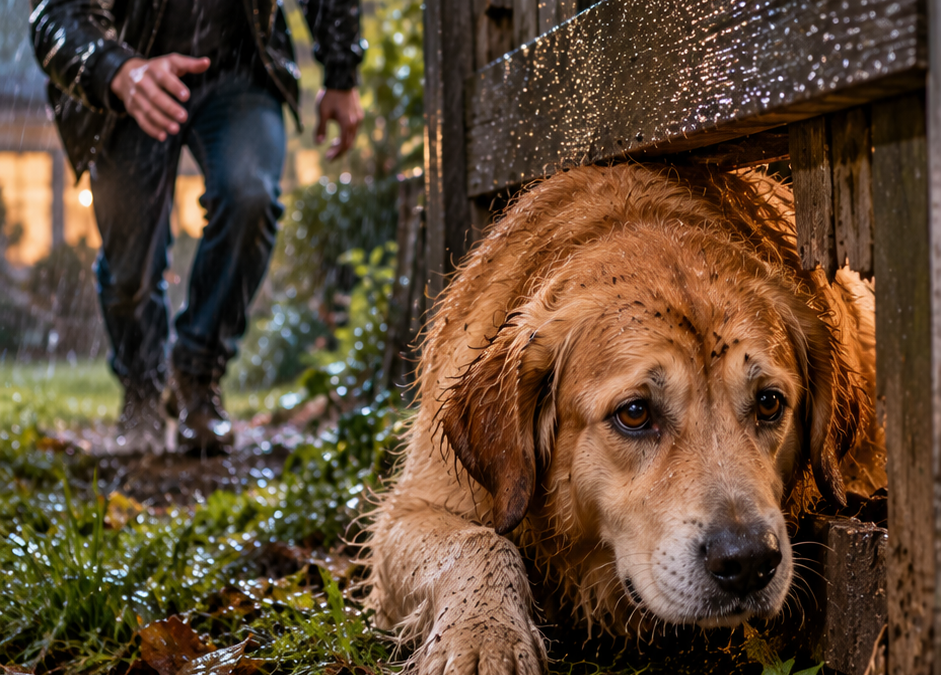
𝗙𝗨𝗟𝗟 𝗦𝗧𝗢𝗥𝗬
He whined.
I assumed he needed the bathroom.
I put on his leash.
The moment we stepped outside, he pulled harder than he ever had before.
Not toward the grass.
Toward the fence.
“Max.”
He strained against the leash.
“What is wrong with you?”
He looked toward the far end of the yard and whined.
I pulled him back inside.
For the next fifteen minutes he paced.
Window.
Door.
Window.
Door.
He wouldn’t settle.
Finally, frustrated, I let him outside while I stood near the fence.
“Five minutes.”
He didn’t even look at me.
He squeezed beneath the fence again.
I swore.
By the time I climbed through the gate and reached the alley, he was gone.
This time, he returned ninety minutes later.
Again, mostly dry.
Again, calm.
Again, impossible to interrogate.
That became the pattern.
Heavy rain.
Max restless.
Max disappears.
Rain stops.
Max returns.
Sometimes after forty minutes.
Sometimes after two hours.
Always safe.
Always peaceful.
Always with mud around his paws but surprisingly little water on his back.
At first, I thought he had found a shed somewhere.
Then I wondered if someone was feeding him.
That bothered me more than I wanted to admit.
I imagined an unknown family saying, “Oh, look, our rainy-day golden retriever is back.”
One evening, I checked his collar to make sure my number was readable.
“You have a house.”
Max stared at me.
“And food.”
He blinked.
“And an expensive orthopedic bed you refuse to sleep on.”
He yawned.
“If you’re maintaining a second family, I’d like to know.”
He rested his head on my knee.
I rubbed his ears.
“You are terrible at communication.”
The truth was, I began worrying for a different reason.
Oakleigh wasn’t dangerous, but it wasn’t free of danger either.
Cars drove too fast on wet roads.
The creek could rise after storms.
Branches came down.
And Max was getting older.
He was ten now.
Strong, but not young.
I repaired the gap beneath the fence.
The next rainstorm came two days later.
Max stood at the back door.
He scratched.
“No.”
He scratched again.
“I fixed your escape route.”
He stared at me.
“Game over.”
Five minutes later, I heard something in the yard.
I looked through the window.
Max was digging.
“You’ve got to be kidding.”
By the time I reached him, he had opened enough space beneath the fence to shove his head through.
“What are you doing?”
He turned toward me.
Rain ran across his face.
There was something almost desperate in his expression.
Not fear.
Urgency.
“Max.”
He whined.
I stopped.
“You need to go somewhere.”
His tail didn’t move.
He looked beyond the fence.
Then back at me.
The thought entered my mind for the first time.
Maybe this wasn’t about Max.
Maybe he was going to someone.
I stood in the rain thinking about that.
Then I pulled him away from the fence and took him inside.
“Next time.”
He paced the house for the rest of the storm.
I felt guilty without knowing why.
The next week brought clear weather.
Max returned to normal.
Morning walks.
Afternoon naps.
Demanding part of my dinner as though taxation laws applied to chicken.
I almost forgot about it.
Then the forecast called for heavy rain on Friday.
I made a plan.
I took the afternoon off.
Bought a proper raincoat.
Put waterproof boots near the door.
And moved my car around the corner so Max wouldn’t associate my standing nearby with anything unusual.
At three in the afternoon, clouds moved over the mountains.
By three-thirty, the first drops hit the kitchen windows.
Max lifted his head from the living-room rug.
Immediately.
Not when thunder came.
Not when rain intensified.
At the first sound.
Tap.
Tap.
Tap.
His ears rose.
He stood.
Walked to the back door.
Scratch.
I was already wearing my boots.
“All right.”
Scratch.
“Show me.”
I opened the door.
Max ran.
I let him get through the gap he’d reopened, then waited ten seconds.
I followed.
By the time I reached the alley, he was twenty yards ahead.
He moved with purpose.
No sniffing mailboxes.
No stopping at trees.
No chasing squirrels.
He turned onto Maple Street.
Crossed behind the church.
Then followed a narrow path between two rows of old houses.
I stayed far enough back that he wouldn’t notice me.
Or at least I tried.
Once, he turned and looked directly at me.
I froze.
He stared.
Then continued.
“Of course you know,” I muttered.
The rain strengthened.
Max passed the grocery store.
Crossed near the old train depot.
Then headed toward Oakleigh’s oldest public park.
That surprised me.
The park was almost empty even in good weather.
It had once been beautiful.
There was a playground near the entrance, a small pond, several walking paths, and dozens of old oak trees planted before anyone in town could remember.
But the town had built newer parks closer to the suburbs.
The old one became quiet.
Some benches were broken.
The pavilion roof leaked.
One corner had become a place people mostly avoided after dark.
Max entered through a gap in the iron fence.
I followed.
Wet leaves stuck to my boots.
Water ran along the path.
“Max,” I whispered.
He didn’t slow down.
We moved deeper into the park.
Past the pond.
Past the abandoned tennis courts.
Past a stone fountain that hadn’t worked in years.
Then he left the main trail.
He followed a smaller path toward the oldest part of the park.
I almost called him.
Then I saw the tree.
A massive oak stood near the edge of a shallow hill.
Its trunk was wide enough that three adults probably couldn’t have wrapped their arms around it.
Its branches spread so far outward that even in heavy rain, the ground beneath remained relatively sheltered.
Max disappeared beneath those branches.
I stopped about thirty feet away.
For a moment, I saw only him.
Then I noticed the man.
He was sitting against the trunk.
Maybe fifty.
Maybe sixty.
It was difficult to tell.
His beard had grown unevenly.
His coat was worn at both elbows.
His pants were dirty.
A weathered backpack rested beside him.
He was asleep.
And Max was lying against his legs.
My dog rested his head on the man’s lap.
One of the man’s hands lay gently across Max’s back.
I didn’t move.
Rain struck the leaves above them, filling the park with a steady whisper.
Max’s eyes were closed.
He looked exactly as he did on my living-room rug after dinner.
Safe.
Content.
Home.
Except he wasn’t home.
He was beneath an old oak tree with a stranger.
I stood there trying to understand.
This was where he came.
Every storm.
Not to hide.
Not because he was frightened.
For him.
The man.
I moved closer.
Max opened one eye.
He saw me.
His tail tapped the wet ground once.
That was all.
No guilt.
No surprise.
As though he’d been waiting for me to finally figure it out.
I crouched several feet away.
“Who is he?”
Max closed his eye again.
The man shifted.
His fingers moved automatically through Max’s fur.
Even asleep, he seemed to know exactly where the dog was.
Something tightened in my chest.
I looked around.
Beneath the oak were signs someone spent time there.
A folded piece of cardboard.
An old blanket.
Two empty water bottles.
A plastic shopping bag containing what looked like clothes.
No tent.
No real shelter.
Just the tree.
I sat on a nearby rock.
For nearly twenty minutes, I watched them.
I don’t know why I didn’t wake the man immediately.
Maybe because the scene felt private.
Maybe because I was ashamed.
Max had discovered something in my town I hadn’t seen.
I drove through Oakleigh every day.
Walked through this park occasionally.
Bought coffee three blocks away.
And somehow an entire human life had existed beneath this tree without ever entering mine.
Max had noticed.
Not once.
Repeatedly.
The rain began to soften.
Max lifted his head.
The man stirred.
His eyes opened slowly.
For a second, he looked confused.
Then he saw me.
Fear moved across his face.
He sat upright.
“Sorry.”
I immediately raised both hands.
“I’m not here to cause trouble.”
He looked toward Max.
My dog put one paw on his thigh.
The man relaxed slightly.
I pointed toward him.
“He’s mine.”
The man’s eyebrows rose.
“Your dog?”
“Yeah.”
He looked at Max.
Then at me.
“I wondered.”
I stepped closer.
“My name’s Daniel.”
He hesitated.
“Thomas.”
“Nice to meet you.”
He almost smiled.
“Under unusual circumstances.”
“You could say that.”
I nodded toward Max.
“I’ve been following him.”
“Following him?”
“For weeks he disappears whenever it rains.”
Thomas looked down at the dog.
“Oh.”
That one word carried something I couldn’t read.
“You knew?”
“Not that he was disappearing.”
He scratched beneath Max’s chin.
“He just comes.”
“When?”
“When it rains.”
“Every time?”
“Almost.”
I stared at him.
“For how long?”
Thomas thought.
“Three months, maybe.”
That matched exactly.
I sat on another rock.
“How did this start?”
Thomas rubbed his hands together.
“The first time?”
“Yeah.”
He looked toward the path.
“It was raining harder than this.”
His voice was quiet.
“I’d been walking all morning.”
“Where?”
“Anywhere.”
He gave a small shrug.
“When you don’t have somewhere to go, walking gives people the impression you’re going somewhere.”
I didn’t know what to say to that.
“I came here because the branches keep most of the rain off.”
He touched the oak beside him.
“Not all. But enough.”
Max rested his chin on Thomas’s knee again.
“And then?”
“He came down the path.”
“Alone?”
“Yes.”
Thomas smiled faintly.
“I assumed someone was walking him off-leash.”
“He doesn’t usually leave the yard.”
“Well, he did that day.”
“What did he do?”
“Came over.”
“That’s it?”
Thomas nodded.
“He looked at me.”
Then he laughed softly.
“You know that look he has.”
I did.
“He looked like he was evaluating me.”
“That sounds like Max.”
“I told him to go home.”
“What did he do?”
“Laid down.”
I smiled despite myself.
“Also sounds like Max.”
Thomas continued stroking his fur.
“I hadn’t spoken to anyone that day.”
His smile faded.
“Not really.”
I heard the qualification.
“Someone at a gas station told me to move along. A woman asked if I wanted a receipt from something she bought me. That’s about it.”
He looked down at Max.
“He stayed maybe an hour.”
“And then left?”
“When the rain stopped.”
The pieces clicked together.
“Every time the storm ended.”
Thomas nodded.
“He’d stand, lick my hand, and walk away.”
My eyes burned unexpectedly.
Max’s behavior suddenly made terrible sense.
At home, he wasn’t returning because the rain had ended.
He was returning because his work was finished.
I looked at him.
“You knew.”
Max’s tail moved.
Thomas watched me.
“He knows when people are alone.”
I looked at Thomas.
The statement wasn’t dramatic.
He said it as though describing the weather.
“Are you alone?”
He glanced away.
“Mostly.”
I let silence sit between us.
Rainwater dripped from the lower branches.
Somewhere across the park, a car splashed through a puddle.
Eventually I asked, “Do you live here?”
Thomas’s face tightened.
“Not exactly.”
“Sorry. That’s none of my business.”
“No.”
He shook his head.
“It’s fair.”
He looked toward the backpack.
“I sleep wherever I can.”
“How long?”
“About seven months.”
“What happened?”
His expression changed.
I regretted asking immediately.
“You don’t have to tell me.”
“It’s not secret.”
He rubbed his hands together.
“Lost my job.”
“What did you do?”
“Warehouse supervisor.”
“Here in Oakleigh?”
“North side industrial park.”
I knew the place.
One large distribution center had closed the previous winter.
“You worked at Carlton Logistics?”
“For twelve years.”
I remembered newspaper stories about the closure.
More than a hundred jobs gone.
“After that?”
“I thought I’d find something else fast.”
His mouth twisted.
“That’s what everybody tells themselves.”
“Did you?”
“Temporary things.”
He looked down.
“Nothing enough.”
“Family?”
The question seemed to hurt.
“My wife died five years ago.”
“I’m sorry.”
He nodded.
“No children.”
He paused.
“My younger brother lives two states away. We haven’t spoken much.”
“Why?”
“Because I’m proud.”
He gave a tired laugh.
“Or stupid. Depends who you ask.”
I didn’t ask more.
Thomas stared toward the rain.
“I fell behind on rent.”
He continued.
“Sold things.”
“Car?”
“First.”
“Then?”
“Everything that was worth anything.”
There was no self-pity in his voice.
That made it harder to hear.
“I stayed with a friend for a while. Then his landlord found out.”
“So you ended up outside.”
“Eventually.”
“Have you gone to the shelter?”
“Which one?”
“The municipal place near the highway.”
Thomas’s expression told me I’d said something naive.
“They fill up.”
“I didn’t know.”
“They’re full most nights.”
“What about services?”
“I’ve talked to people.”
“And?”
He shrugged.
“There are forms. Waiting lists. Appointments.”
His tone remained gentle.
“I don’t want to sound ungrateful. People have tried.”
“But you’re still here.”
“Yes.”
Max shifted closer to him.
I looked at my dog.
Warm house.
Full food bowl.
Dry bed.
Then this man under a tree.
Every time rain fell, Max chose to leave comfort and sit with him.
I felt embarrassed.
Not because I had a house.
Not because I hadn’t magically solved homelessness.
Because I’d spent weeks worried Max might be visiting someone who was feeding him better treats.
I had made his disappearances about me.
Meanwhile, he was doing something I wasn’t.
Showing up.
“Why rain?” I asked.
Thomas looked confused.
“What?”
“Max comes only when it rains.”
“Oh.”
He smiled.
“I wondered about that too.”
He looked toward the tree canopy.
“I think because this is where he first found me.”
That answer didn’t satisfy me.
Thomas seemed to understand.
“Rain changes this place.”
“How?”
“When it’s dry, people come through.”
“Walkers?”
“Kids. Runners. People with dogs.”
He nodded toward the empty path.
“When it rains, nobody comes.”
I understood.
“You’re more alone.”
He nodded.
“Rain makes an empty place emptier.”
Max looked at him.
Thomas scratched his ear.
“He figured that out somehow.”
I swallowed.
“My dog is making me look bad.”
Thomas laughed.
For the first time, I saw what his face probably looked like before life wore it down.
“He doesn’t judge.”
“No.”
“That’s why I like him.”
We sat beneath the oak after the rain stopped.
I should have gone home.
I didn’t.
Thomas and I talked.
Not dramatically.
Not like strangers in a movie who reveal every wound in one conversation.
We talked about Max.
Oakleigh.
Weather.
Books.
He told me he used to read crime novels constantly.
I told him I hated them because I always guessed the wrong person.
He said that meant I was exactly the reader the author wanted.
Eventually I asked whether he was hungry.
He hesitated.
“Yes.”
“What do you want?”
“Anything.”
“That’s not an answer.”
“Something hot.”
We walked to a diner near the park.
Thomas initially refused to enter.
“My clothes—”
“Are wet. Mine too.”
“It’s different.”
The waitress looked at us when we entered.
Then at Max.
“Dog can’t be inside unless he’s service.”
“No problem.”
I nodded toward the covered patio.
“We’ll sit outside.”
She looked at Thomas again.
Something passed across her face.
Not disgust exactly.
Caution.
I noticed because Thomas noticed.
We sat on the patio.
The rain had stopped, but cold wind moved through the street.
I ordered coffee.
Thomas ordered soup and bread.
Then, after I encouraged him, meatloaf.
Max lay beneath the table.
Thomas ate slowly.
Too slowly.
Like someone trying not to reveal how hungry he was.
“You can eat.”
He looked at me.
“I am.”
“You don’t have to make it last.”
His fork paused.
“I know.”
But I could tell he didn’t.
Halfway through the meal, he wrapped a piece of bread in a napkin.
“For later?” I asked.
He looked embarrassed.
“Yeah.”
“Order another meal.”
“No.”
“Thomas.”
“No.”
It was firm.
I backed off.
That moment taught me something important.
Helping someone wasn’t the same as taking control of them.
Thomas had already lost enough control over his life.
He didn’t need me making decisions because I had money in my wallet.
When we finished, I asked one question.
“Can I drive you somewhere?”
He looked toward the park.
“No.”
“Back there?”
“Tonight.”
I glanced at the sky.
Temperature was dropping.
“There has to be somewhere warmer.”
“Sometimes there is.”
He stood.
“But tonight, the tree is fine.”
I wanted to argue.
Instead, I wrote my phone number on a receipt.
“If you ever want a ride, food, help with something—whatever.”
He looked at the paper.
“You don’t have to.”
“I know.”
“Because of him?”
He nodded at Max.
“Partly.”
“And the rest?”
I looked at him.
“Because I should’ve noticed you before my dog did.”
Thomas’s expression hardened slightly.
“Don’t feel guilty.”
“I do.”
“That doesn’t help me.”
He wasn’t rude.
Just direct.
I nodded.
“Fair.”
He put the number into his coat pocket.
“Thank you.”
I drove home with Max in the passenger seat.
For several miles, neither of us made a sound.
Then I glanced at him.
“You could have told me.”
He looked out the window.
“I know. Limited vocabulary.”
His tail moved.
I reached over and touched his neck.
“I’m proud of you.”
He turned toward me.
“I’m also angry you dug under my fence.”
Tail.
“Both things can be true.”
That night I couldn’t sleep.
Rain began again after midnight.
Not heavy.
Just steady.
Max was asleep near my bedroom door.
For the first time, he didn’t try to leave.
Maybe because he’d seen Thomas before we came home.
Maybe because he considered the visit complete.
I lay awake thinking about the oak tree.
The cardboard.
The backpack.
Thomas wrapping bread for later.
And what he had said.
Rain makes an empty place emptier.
The next morning, I called the town shelter.
Full.
I called a nonprofit in the next county.
Waiting list.
I called the church near my house.
A woman named Ruth answered.
“Are you calling for yourself?”
“No. Someone I met.”
“Does he want help?”
That question stopped me.
“I think so.”
“You think so?”
“I haven’t asked exactly.”
“Ask.”
Again, direct.
She explained their church worked with a transitional housing program.
Limited spaces.
No guarantees.
They helped with identification documents, job applications, transportation, and temporary beds when available.
“But Daniel,” she said, “he needs to choose this.”
“I understand.”
“Do you?”
I thought about the diner.
“I think I’m learning.”
Two days later, clear skies.
I returned to the oak.
Thomas was there.
Max ran ahead.
Thomas smiled when he saw him.
“You came without rain.”
“Breaking tradition.”
I told him about Ruth.
He listened.
Said nothing.
When I finished, he asked, “Why?”
“Why what?”
“Why are you doing this?”
I thought about giving him something noble.
Instead, I gave him the truth.
“Because my dog made it difficult to pretend you weren’t here.”
Thomas stared at me.
Then laughed quietly.
“That’s probably the best answer.”
“Will you call?”
“Maybe.”
“That’s not yes.”
“It’s not no.”
I handed him Ruth’s number.
He took it.
For a week, nothing happened.
I visited twice.
Brought coffee once.
A clean pair of gloves another time.
Thomas accepted the coffee.
Refused the gloves.
“I have gloves.”
He held up a pair with two fingers missing.
“Those barely qualify.”
“They work.”
I didn’t push.
Then one afternoon, he called.
“Daniel?”
“Thomas?”
A pause.
“I called the church.”
I sat up at my desk.
“And?”
“They have a bed available tonight.”
“That’s good.”
“Maybe.”
There was fear in his voice.
I hadn’t expected that.
“What’s wrong?”
“Nothing.”
“Thomas.”
Another silence.
“I’ve been outside seven months.”
“I know.”
“Being around people again feels…”
He couldn’t find the word.
“Hard?”
“Yeah.”
I looked at my computer screen.
An email marked urgent waited.
I closed the laptop.
“Want me to drive you?”
“I can walk.”
“I know.”
Pause.
“Yes.”
I picked him up forty minutes later.
He had his backpack.
The old blanket.
A plastic bag.
Everything he owned fit in less space than the groceries in my trunk.
Max sat in the backseat.
Thomas climbed in.
Max immediately put his head between the front seats.
“You coming too?”
Of course he was.
At the church, Ruth met us.
She was in her sixties, short, gray-haired, energetic.
She shook Thomas’s hand.
“I’m Ruth.”
“Thomas.”
“We spoke.”
“Yes.”
“You nervous?”
Thomas looked surprised.
“A little.”
“Good.”
“Good?”
“Means you’re paying attention.”
She smiled.
“We’ll go one step at a time.”
Thomas looked at me.
I nodded.
Then Max whined.
Thomas crouched beside him.
“I’ll see you.”
Max licked his face.
Thomas laughed.
“I mean it.”
His eyes became wet.
“I’ll see you.”
The first week was difficult.
I knew because Thomas told me later.
The shelter had rules.
Schedules.
Shared bathrooms.
Noise.
People coughing at night.
Someone snoring.
Someone arguing.
Someone stealing his shampoo.
He almost left twice.
Ruth talked him out of it once.
Max did the second time.
We visited on a rainy Wednesday.
The moment Thomas saw him, his entire body softened.
“There he is.”
Max pulled me across the lobby.
Technically he wasn’t supposed to be inside.
Ruth looked the other way.
Thomas knelt.
Max pressed his chest against him.
I watched them.
For all the assistance programs, forms, and plans, I understood something.
Max wasn’t replacing practical help.
He was making it emotionally possible for Thomas to accept it.
Sometimes people need resources.
Sometimes they also need a reason to believe they’re still connected to the world outside their crisis.
For Thomas, that reason had four legs and golden fur.
Over the next month, things moved slowly.
He replaced a lost identification card.
Got a mailing address.
Started applying for work.
Ruth helped him contact his brother.
That call went badly.
Then better.
Then badly again.
Relationships don’t repair on schedule.
Neither do people.
Thomas told me about it one evening while we walked Max.
“My brother said I should have called before things got bad.”
“He isn’t wrong.”
“No.”
“You don’t sound angry.”
“I was.”
Thomas shoved his hands into his coat pockets.
“Then I realized I’d been angry at him for not finding me when I had spent months making myself hard to find.”
I looked at him.
“That’s a brutal realization.”
“Most useful ones are.”
He had dark humor.
I came to like that about him.
He also hated being treated as a project.
The first time I offered to buy him a new coat, he became angry.
“I can get one.”
“I know.”
“Then why are you doing this?”
“Because it’s freezing.”
“I’m not your charity case.”
I immediately backed off.
“You’re right.”
He looked surprised.
“I am?”
“Yes.”
We walked several yards.
Then I said, “For what it’s worth, I buy my friends coffee and stupid things all the time.”
He glanced at me.
“Are we friends?”
“I thought so.”
Thomas looked toward Max.
“He decided first.”
“That’s becoming a theme.”
Two days later, Thomas called.
“What size coat do you wear?”
I asked.
He laughed.
“Large.”
“Good.”
“Daniel?”
“Yeah?”
“Thank you.”
I bought the coat.
He accepted it.
No speech.
No tears.
Just a coat between friends.
By late November, Thomas had interviews.
The first went badly.
The second seemed promising.
The third was at a small independent bookstore downtown.
The owner, Mrs. Avery, was a woman in her seventies who believed books should be organized “sensibly,” which apparently meant according to a system only she understood.
Thomas had worked retail when he was younger.
More importantly, he loved books.
After the interview, he called me.
“I think she hated me.”
“What happened?”
“I told her the mystery section is too close to romance.”
“Why would you say that during an interview?”
“It is.”
“Thomas.”
“People looking for murder shouldn’t have to walk through decorative weddings.”
I laughed.
“You’re unemployed and criticizing her shelving.”
“I have principles.”
Mrs. Avery hired him the next day.
“She said anyone willing to insult her shelves during an interview was probably honest,” Thomas told me.
“That’s a very bookstore thing to say.”
He started part-time.
Then full-time.
The first paycheck wasn’t enough for an apartment.
The third was.
Not a nice apartment.
A small room above an old hardware store on the far side of town.
One window.
Tiny kitchen.
Radiator that clanked like machinery.
Thomas loved it.
The first evening after he moved in, Max and I visited.
There was almost no furniture.
A mattress.
One chair.
Secondhand table.
Stack of books.
Thomas stood in the center of the room.
“What do you think?”
I looked around.
“Needs a dog.”
Max immediately jumped onto the mattress.
Thomas laughed.
“Apparently he agrees.”
We ordered pizza.
Sat on the floor.
Rain began against the window.
All three of us heard it.
Max’s ears rose.
Thomas looked at him.
I looked at Thomas.
For a few seconds, none of us spoke.
Then Max stood.
Walked toward the door.
Thomas smiled.
“He thinks it’s time.”
“For what?”
“To go to the tree.”
Max scratched the door.
I laughed.
“Absolutely not.”
Thomas put on his coat.
“What are you doing?”
“Let’s go.”
“You’re serious?”
“One last time.”
So we did.
The three of us walked through Oakleigh in the rain.
Past the old depot.
Past the fountain.
Into the park.
The oak looked exactly the same.
Thomas stood beneath it.
He touched the trunk.
Max lay down in the same place.
I stayed a few feet away.
Thomas stared toward the cardboard spot where he’d once slept.
No cardboard now.
No backpack.
Nothing.
“How does it feel?” I asked.
He thought for a long time.
“Smaller.”
“The tree?”
“The life.”
I understood.
“When you’re trapped inside something, it feels like the whole world.”
He looked around.
“Now it just looks like a place.”
Max rolled onto his back.
Thomas scratched his belly.
“I hated this tree.”
“Really?”
“Some nights.”
He smiled.
“Other nights, it was the only roof I had.”
He looked at Max.
“And then this idiot started showing up.”
Max thumped his tail.
Thomas’s voice softened.
“Do you know what was worst about being homeless?”
I expected hunger.
Cold.
Fear.
He said, “Becoming invisible.”
I stayed quiet.
“People look around you.”
He continued.
“They don’t always mean to. Some are uncomfortable. Some are afraid. Some don’t know what to say.”
He shrugged.
“Eventually you start feeling like maybe you’ve disappeared.”
He knelt beside Max.
“Then he came over.”
His hand rested on Max’s head.
“He looked straight at me.”
Rain moved through the leaves.
“He didn’t know I had no job.”
Thomas smiled.
“No address.”
“No clean clothes.”
“No plan.”
“He just knew I was there.”
My throat tightened.
“Sometimes that’s enough to begin.”
Thomas nodded.
“Yeah.”
We left the park together.
After that, Max stopped escaping during storms.
At first, I thought the habit had simply ended.
Then came the first heavy rain of December.
I was in the kitchen.
Rain struck the windows.
Max lifted his head.
He ran toward the front door.
Not the back.
The front.
He sat there.
Waiting.
Three minutes later, someone knocked.
I opened it.
Thomas stood on the porch.
He held two coffees.
Max nearly knocked him over.
“Whoa.”
Thomas laughed.
“I missed you too.”
I stared.
“How did Max know?”
Thomas looked at him.
“Maybe he heard me.”
Through the rain?
From across the street?
Maybe.
Or maybe dogs know more about patterns than we give them credit for.
Thomas came inside.
Max stayed glued to him for an hour.
That became our new tradition.
When it rained, Thomas came over.
Sometimes after work.
Sometimes on weekends.
He’d bring coffee.
Or soup.
Or a book he thought I’d like.
He was almost always wrong about the books.
“You keep giving me depressing things.”
“It’s literature.”
“It’s misery with a hardcover.”
“You have no culture.”
“I have television.”
“Exactly.”
Max sat between us.
No longer racing through the fence.
No longer disappearing.
Because the person he’d been searching for no longer waited beneath the oak.
Thomas could come to him.
The transformation wasn’t dramatic from day to day.
That’s the strange thing about recovery.
From a distance, people say, “He turned his life around.”
Up close, it looks like smaller things.
Getting out of bed.
Showing up to work.
Buying groceries.
Paying rent.
Answering calls.
Learning to believe one bad month doesn’t mean every month will be bad.
Thomas struggled.
There were days he looked exhausted.
Days when crowds made him anxious.
Days he walked by the park and felt the urge to disappear there again.
Once, after a difficult shift, he didn’t show up for our usual dinner.
I called.
No answer.
I went to his apartment.
Empty.
I panicked.
Then Max began pulling me toward the park.
We found Thomas beneath the oak.
Not sleeping.
Just sitting.
Max ran to him.
I stopped several feet away.
“You okay?”
Thomas wiped his face.
“Not really.”
“Want company?”
He nodded.
I sat.
No lecture.
No advice.
I had finally learned from Max.
Sometimes you just stay.
After ten minutes, Thomas said, “I almost quit today.”
“Why?”
“Customer accused me of stealing his wallet.”
“Did you?”
He looked at me.
“That wasn’t funny.”
“Sorry.”
His mouth twitched.
“Security camera showed he put it in his own bag.”
“Idiot.”
“Yeah.”
“But?”
Thomas stared at the ground.
“For twenty minutes, everyone looked at me like…”
He stopped.
“Like you were who you used to be?”
“Like I was nothing.”
I understood why the tree had called him back.
“Are you quitting?”
“I don’t know.”
Max rested his head on Thomas’s thigh.
Thomas looked at him.
“You have an opinion?”
Tail.
Thomas sighed.
“No.”
He looked at me.
“I’m going back tomorrow.”
“Good.”
“Don’t sound proud.”
“I’m not.”
“You are.”
“A little.”
He returned.
Two weeks later, the same customer came back and apologized.
Thomas said the apology didn’t erase the humiliation.
But it mattered.
People don’t heal because nothing bad happens again.
They heal partly by discovering that bad moments no longer control the entire direction of their lives.
By January, Thomas had been promoted to assistant manager.
Mrs. Avery claimed this was because he was competent.
I suspected it was because she wanted someone else to carry boxes.
“You still hate her shelving?” I asked.
“More than ever.”
“Planning a revolution?”
“Slowly.”
Winter in Oakleigh became brutal that year.
Snow came.
Rain froze overnight.
The old park closed twice because tree branches fell.
Every time weather turned bad, Thomas checked on the shelter.
Sometimes he volunteered there.
That surprised me.
“Doesn’t it bring things back?”
“Yes.”
“Then why go?”
He looked at me as though the answer was obvious.
“Because I know what it’s like when everyone goes home and you don’t have one.”
Ruth eventually convinced him to speak to new residents.
Not motivational speeches.
Thomas hated those.
He simply sat with people.
Explained the system.
Told them which forms mattered.
Which bus routes ran late.
Where they could wash clothes cheaply.
Who at the church answered the phone.
Practical things.
One night, I watched him talk with a man who had arrived hours earlier.
The man barely spoke.
Thomas didn’t push.
He placed a cup of coffee beside him.
Then sat.
Max would have approved.
In February, Thomas’s brother came to Oakleigh.
His name was Matthew.
He was younger by four years and looked enough like Thomas that I recognized him immediately.
Their reunion wasn’t dramatic.
No running embrace.
No music.
Just two men standing outside the bookstore.
Matthew said, “You look old.”
Thomas answered, “You look worse.”
Then they hugged.
Afterward, Thomas cried in my car for fifteen minutes.
“Don’t tell him.”
“I won’t.”
“Don’t tell Ruth.”
“I won’t.”
“Don’t—”
“Thomas.”
“Yeah?”
“I won’t tell anyone.”
Max licked the side of his face.
“Except him.”
Thomas laughed through tears.
“He’s terrible with secrets.”
By March, the first signs of spring appeared.
Snow disappeared from the shaded streets.
Rain replaced it.
One Saturday morning, I woke to the familiar sound against my windows.
I looked toward the bedroom doorway.
Max wasn’t there.
For one terrible second, the old panic returned.
Then I heard voices in the kitchen.
I walked downstairs.
Thomas was standing beside the counter.
Max sat in front of him.
“What are you doing in my house?”
Thomas lifted my spare key.
“You gave me this.”
“For emergencies.”
“Coffee shortage is an emergency.”
He had brought a small box.
“What is that?”
“Nothing for you.”
Max became intensely interested.
Thomas opened it.
Homemade dog biscuits.
I stared.
“You baked?”
“Don’t make a big deal out of it.”
“You baked for my dog.”
“He deserves things.”
“He’s already spoiled.”
“Not enough.”
Max barked once.
“See?”
Thomas knelt.
“These are for you.”
Max inhaled the first biscuit without chewing.
“Great manners,” I said.
Thomas gave him another.
“Slow.”
Max ignored him.
We laughed.
For a moment, rain became the loudest thing in the room.
It drummed against the windows.
Ran through gutters.
Darkened the pavement outside.
The same sound that once sent Max running through a hole beneath my fence.
I looked at him.
He didn’t move toward the door.
He stayed beside Thomas.
That was when the meaning of everything finally settled inside me.
Max had never been running away.
He had been going back.
Back to someone who had no one waiting.
Back to a man who had become almost invisible to everyone except a dog.
And somehow, without planning any of it, Max had built a bridge between two lives that might otherwise never have touched.
Mine.
Thomas’s.
I used to wonder what Max saw in him.
Now I think that was the wrong question.
Max didn’t see something special hidden beneath the dirt.
He saw Thomas.
That was special enough.
People like me often say we don’t notice suffering because we are busy.
Sometimes that’s true.
Sometimes we notice and don’t know what to do.
Sometimes we are afraid helping will become complicated.
Sometimes we tell ourselves someone else is more qualified.
Sometimes we fear doing the wrong thing so much that we do nothing.
Max had none of those excuses.
He didn’t need to solve homelessness.
He didn’t need a program.
He didn’t need money.
He had no idea why Thomas was beneath that tree.
He simply understood that every time the rain came, one man became colder and more alone.
So Max went.
He lay beside him.
Again.
And again.
And again.
People tend to dismiss small acts because they don’t solve everything.
But small acts sometimes keep someone alive long enough for the next thing to happen.
Thomas once told me there had been a night, before Max first found him, when he wasn’t sure he cared whether he woke up the next morning.
He didn’t tell me details.
I didn’t ask.
He simply said, “Then the next week that dog started showing up.”
I looked at Max after he said it.
“Did you know that?”
Max slept through the question.
Thomas smiled.
“He didn’t have to.”
That’s the thing about kindness.
It rarely knows its own size.
The person giving it may think they’re offering an hour.
A meal.
A ride.
A warm coat.
A place to sit.
The person receiving it may experience proof that the world hasn’t completely forgotten them.
Those are not the same gift.
Months after Thomas moved into his room, we returned to the oak again.
This time the weather was sunny.
Families were in the park.
Children ran near the pond.
A couple walked a dog along the main path.
The old tree looked less lonely beneath blue sky.
Thomas stood beneath it.
“You know what I hate?” he asked.
“What?”
“People would walk through here on sunny days.”
I waited.
“Sometimes they’d say hello.”
He looked toward the branches.
“But when rain came, nobody did.”
“Except Max.”
“Except Max.”
He crouched beside him.
“That’s why I think he understood.”
“Understood what?”
“That loneliness isn’t always needing someone every day.”
Thomas looked at me.
“Sometimes it’s needing someone during the hour everyone else disappears.”
I never forgot that.
Spring became summer.
Thomas saved money.
Bought a used bicycle.
Then a secondhand car that made disturbing noises.
“You bought this voluntarily?”
“It was cheap.”
“There’s a reason.”
“It runs.”
“Technically.”
He began visiting his brother.
Matthew visited him.
Their relationship remained imperfect.
That seemed healthy.
Perfect reunions belong to fiction.
Real families interrupt one another.
Get offended.
Say the wrong thing.
Try again.
Thomas learned that stability didn’t mean never struggling.
It meant having somewhere to return when he did.
The bookstore gave him that.
The shelter gave him that.
His brother eventually gave him that.
And somehow, so did my kitchen.
One rainy evening, nearly a year after I followed Max into the park, Thomas and I sat on my porch.
Max was between us.
“You realize this is your fault,” I told him.
Thomas looked confused.
“What?”
“I used to have peaceful rainy evenings.”
“You followed your dog.”
“Because you were under a tree.”
“I didn’t invite either of you.”
“Exactly.”
He smiled.
Rain fell beyond the porch.
“You ever wonder what would have happened if you hadn’t followed him?”
“All the time.”
“Maybe I’d still have gotten help.”
“Maybe.”
“Maybe not.”
“Maybe.”
Thomas looked at Max.
“But he would’ve kept coming.”
“Absolutely.”
“Even if you never knew?”
“Yes.”
We both believed that.
Max wasn’t performing kindness for an audience.
He didn’t need me to know.
That’s probably part of why it mattered so much.
I looked down at him.
His muzzle had become whiter.
He was eleven now.
I noticed age in smaller ways.
He took longer getting up.
Slept more deeply.
Didn’t chase squirrels as far.
I hated it.
Thomas noticed me watching him.
“He’s getting older.”
“Don’t.”
“Daniel.”
“I know.”
Thomas rested a hand on Max’s back.
“He changed everything.”
“Yeah.”
“He probably has no idea.”
“Definitely.”
Max rolled onto his side.
Thomas laughed.
“Or he knows exactly.”
That autumn, on the anniversary of the day I followed him, heavy rain hit Oakleigh.
I took the afternoon off.
Not intentionally at first.
Then I realized the date.
I called Thomas.
“Park?”
He was silent for a second.
“Yeah.”
We met near the old fountain.
Max walked between us.
Slowly.
He no longer hurried.
We followed the same path.
Wet leaves.
Empty benches.
Gray sky.
The giant oak.
Thomas stopped beneath it.
“So this is the day.”
“One year.”
He touched the trunk.
Max immediately went to the familiar spot and lay down.
Thomas sat beside him.
I sat on the rock where I’d watched them for the first time.
For a while, none of us spoke.
Rain filled the silence.
Finally Thomas said, “I used to think this tree was the lowest point of my life.”
“And now?”
He looked around.
“Now I’m not sure.”
“Why?”
“Because this is where something started too.”
He scratched Max’s chest.
“That’s annoying.”
“What is?”
“The same place can be both.”
“Both what?”
“The worst place and the place that saved you.”
I understood.
“Life is inefficient.”
Thomas laughed.
“Very.”
He pulled something from his coat pocket.
A small metal tag.
“What is that?”
He handed it to me.
It was engraved.
MAX
RAINY DAY DEPARTMENT
I laughed.
“You made him an employee badge?”
“Honorary.”
I attached it beside Max’s regular tag.
Max shook his collar.
The metal clicked.
“Ridiculous.”
Thomas smiled.
“He earned it.”
When the rain eased, we walked home together.
Not back to the tree.
Home.
That distinction mattered.
Thomas still visited the shelter.
Eventually, Mrs. Avery helped him organize a small book donation program.
Customers brought used books.
The store donated them to shelters and transitional housing facilities.
Thomas called it Second Chapter.
I told him that was unbearably sentimental.
He said, “You own a golden retriever. You have no authority on sentimentality.”
He was right.
Over the next few years, his life became ordinary.
That’s the best thing I can say about it.
Not extraordinary.
Ordinary.
Rent.
Work.
Groceries.
Taxes.
Car repairs.
A dentist appointment he complained about for two weeks.
Dinner with his brother.
Arguments with Mrs. Avery over shelving.
Coffee at my house.
Walking Max when I worked late.
Ordinary.
After living outside, ordinary was a luxury.
Once, I asked whether he ever feared losing everything again.
“Yes.”
“Often?”
“Less than before.”
“What helps?”
He thought.
“Knowing I wouldn’t hide this time.”
I waited.
“If things got bad, I’d call.”
“Me?”
“You.”
“Matthew.”
“Ruth.”
He smiled.
“Probably Max first.”
“Obviously.”
He looked toward my living room, where Max slept.
“That’s the difference.”
“What?”
“I had people before.”
His face became serious.
“But I didn’t know how to need them.”
That may have been one of the hardest things Thomas learned.
Receiving help takes its own kind of courage.
So does asking before you’re drowning.
For me, the lesson was different.
I had always thought kindness was an instinct some people possessed more strongly than others.
After Max, I stopped believing that.
Kindness is often attention followed by inconvenience.
You notice.
Then you allow what you noticed to disrupt your plans.
Max noticed Thomas.
Then left a warm house during storms.
I noticed Thomas only because Max forced me to.
Then I had to decide whether seeing him changed anything.
I’m glad it did.
But I’m careful when I tell the story.
I did not “save” Thomas.
He hated that language.
And he was right to.
I gave rides.
Made calls.
Sat beside him.
Introduced him to Ruth.
Bought a coat.
Brought Max.
Thomas did the harder work.
He walked into the shelter.
Stayed when he wanted to leave.
Filled out forms.
Went to interviews.
Returned to work after humiliation.
Called his brother.
Paid rent.
Built a life.
Max didn’t save him by magic either.
But Max reminded him he was worth visiting.
Sometimes that is where saving begins.
Not with rescue.
With recognition.
Years passed.
Max slowed.
One autumn morning, rain began.
He was sleeping by the fireplace.
Thomas was sitting at the table drinking coffee.
The first drops hit the window.
Max’s ears lifted.
For a second, both of us waited.
The old instinct was still there.
Max tried to stand.
His back legs struggled.
I moved toward him.
Thomas reached him first.
“Easy.”
Max stood.
Slowly.
He looked toward the door.
Thomas’s face changed.
“Oh, buddy.”
Max took one step.
Then looked at Thomas.
Thomas knelt.
“You don’t have to come find me anymore.”
Max wagged his tail.
“I’m right here.”
He put both hands around Max’s face.
“I’m here.”
Max leaned into him.
I turned away because my eyes filled.
Thomas pressed his forehead against Max’s.
“You can stay dry.”
Max licked his chin.
Thomas laughed through tears.
“Finally.”
That evening, we didn’t go to the park.
We stayed inside.
Rain fell.
Max slept between us.
Thomas had brought homemade biscuits again.
Max ate three.
Probably too many.
I didn’t care.
We talked about the first storm.
“I thought he was cheating on me with another family,” I admitted.
Thomas stared.
“What?”
“I thought someone else was feeding him.”
“That’s your first theory?”
“I was insecure.”
“Your dog had a homeless best friend and you thought he had a second household.”
“It made sense at the time.”
Thomas laughed so hard he had to wipe his eyes.
Max opened one eye, annoyed by the noise.
“Sorry,” Thomas told him.
Then he looked at me.
“Thank you for following him.”
I shook my head.
“No.”
“Daniel.”
“Thank him.”
We both looked at Max.
He was asleep again.
Thomas smiled.
“I do.”
The following spring, sunlight came through the windows on a March morning.
The rain had ended during the night.
Thomas arrived carrying coffee.
Max was already at the door before the knock.
Not running.
Not escaping.
Waiting.
I opened it.
Thomas stepped inside.
Max pressed himself against his legs.
“Morning, old man.”
Max wagged.
Thomas scratched behind his ears.
I watched them.
Years earlier, the sound of rain had meant Max disappeared from my yard.
Now rain usually meant Thomas appeared at my door.
The direction had reversed.
No one had to run through the storm anymore.
The person Max once searched for knew where to come.
Sometimes I still visit the oak.
Thomas does too.
There is no plaque.
No memorial.
Nothing telling anyone what happened there.
To everyone else, it’s only a tree.
Maybe that’s fitting.
Not every important place needs to announce its importance.
Some places hold their meaning quietly.
A tree.
A park.
A front porch.
A kitchen table.
The spaces where people stop being alone.
Whenever I stand beneath those branches, I remember the first time I saw Thomas.
Thin.
Wet.
Sleeping with his hand on Max’s back.
I remember wondering why my dog would leave everything comfortable to come there.
Now I understand.
Comfort wasn’t what Max valued most.
Connection was.
He had a warm home.
But he knew someone else didn’t.
So he shared the only thing he could offer.
Himself.
No speeches.
No judgment.
No questions.
Just presence.
I’ve spent years thinking about that.
Human beings make kindness complicated.
Dogs rarely do.
If someone needs warmth, move closer.
If someone is alone, stay.
If someone is afraid, don’t leave.
If someone is lost, help them find a way back.
Maybe that simplicity is why Max saw Thomas before I did.
I was looking at weather.
Schedules.
Fences.
Mud.
Max was looking at a person.
One afternoon, Thomas and I sat under the oak while Max slept between us.
The sky threatened rain.
Thomas looked toward the town.
“You know what I think now?”
“What?”
“I don’t think he came because he knew I was homeless.”
“No?”
“No.”
He rubbed Max’s head.
“I don’t think dogs care about categories.”
I waited.
“He didn’t see a homeless man.”
Thomas looked at me.
“He saw a man sitting alone in the rain.”
That sentence stayed with me.
Maybe because so much changes depending on which description you choose.
A homeless man.
A stranger.
A problem.
A risk.
A statistic.
Or simply a man sitting alone in the rain.
Max chose the last one.
I’m glad he did.
Because Thomas became my friend.
Not my responsibility.
Not my good deed.
My friend.
He came to Thanksgiving.
Helped repair my fence.
Borrowed tools and forgot to return them.
Made fun of my cooking.
Walked Max when my knee surgery kept me home.
Sat beside me when my sister got sick.
He gave back more than I ever gave him.
Not because kindness needs repayment.
Because relationships move both ways once you stop defining one person only by the moment they needed help.
Years after the first storm, someone at the bookstore heard part of Thomas’s story and said to me, “That must feel amazing, knowing you saved him.”
Thomas overheard.
He smiled.
Then said, “Daniel didn’t save me.”
The person looked embarrassed.
Thomas continued.
“He followed the dog.”
Then he laughed.
“After that, we all just kept showing up.”
That’s the version I like best.
No hero.
No miracle worker.
A dog notices.
A man follows.
Another man accepts a little help.
Then everyone keeps showing up.
Maybe most lives are changed that way.
Not by one enormous event.
By repeated presence.
Rain after rain.
Visit after visit.
Choice after choice.
Max taught me that.
Thomas proved it.
And Oakleigh, with its long wet autumns and sudden storms, gave us plenty of chances to practice.
Today, when rain begins against my windows, I still think about that first day.
The fence.
The path.
The old park.
The giant oak.
A golden retriever lying with his head in a stranger’s lap.
At the time, I thought I had uncovered Max’s secret.
I know better now.
The real secret was simpler.
Max understood something about loneliness that I had missed.
Loneliness isn’t always loud.
Sometimes it doesn’t ask for help.
Sometimes it sits beneath a tree and tells everyone it’s fine.
Sometimes the only creature willing to challenge that answer is a dog.
Thomas once told me, “Max didn’t care whether I had fixed my life.”
“He cared that you were there.”
“Exactly.”
That was what saved something in him.
Being seen before he became successful again.
Before the job.
Before the room.
Before the clean coat and regular haircut.
Before anyone could call his story inspiring.
Max valued him while nothing about his situation looked impressive.
That’s rare.
People often celebrate recovery more easily than they accompany struggle.
Max did the opposite.
He showed up during the worst part.
The rainiest part.
The part with no guarantee of a happy ending.
Then stayed long enough for the story to change.
And whenever Thomas comes through my door now, Max still acts as though the most important person in Oakleigh has arrived.
Maybe to him, Thomas always was.
One rainy March morning, the three of us sat by my front window.
Thomas had brought a box of biscuits.
Max lay between our chairs.
Sunlight began pushing through the clouds.
Thomas looked outside.
“Storm’s ending.”
Max lifted his head.
Years ago, that would have been the moment he stood and came home.
I smiled.
“Yeah.”
Thomas rested his hand on Max’s back.
“But nobody has to leave.”
Max sighed and closed his eyes.
That was the moment I finally understood what happiness looked like.
Not perfection.
Not a dramatic rescue.
Not some grand reward after suffering.
It looked like an old dog sleeping between two men while rain faded outside.
It looked like knowing everyone had somewhere to be when the storm ended.
Thomas had a home.
Max didn’t have to search for him anymore.
And I no longer wondered why my dog used to disappear every time the rain came.
He had never been running away from home.
He had been carrying a little piece of home to someone who didn’t have one.
Until one day, that man found his own way back.
And after that, whenever the sky over Oakleigh darkened and rain began tapping against the windows, Max stopped scratching at the back door.
Instead, he waited by the front.
Because sooner or later, there would be a knock.
Thomas would be standing on the porch.
Max would wag his tail.
I would open the door.
And the storm would stay outside.

