𝗙𝗨𝗟𝗟 𝗦𝗧𝗢𝗥𝗬 Every Time I Opened His Kennel, He Looked Past Me as If He Were Waiting for Someone the World Had Already Given Up On
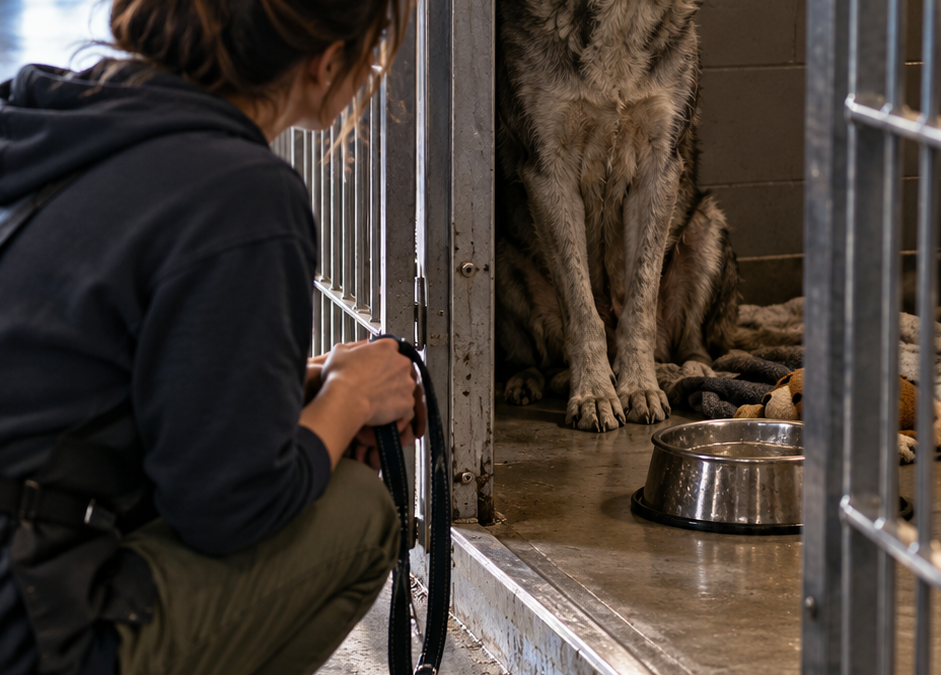
𝗙𝗨𝗟𝗟 𝗦𝗧𝗢𝗥𝗬
I had worked with animals before. I knew not to romanticize every frightened dog’s behavior. Silence could mean fear. Withdrawal could mean trauma. A dog staring toward a doorway could simply be monitoring movement.
Still, something about Max stayed with me.
It was the way he watched.
He wasn’t scanning the shelter nervously.
He was waiting.
There was a difference.
The next morning, I went to kennel seventeen before I did anything else.
Max was in the same place.
“Morning.”
His eyes moved toward me.
Progress, I thought.
Ridiculous progress, perhaps, but progress nonetheless.
That afternoon, while the other dogs were being walked, I opened his kennel and stepped inside.
I didn’t bring a leash.
I didn’t bring treats.
I simply sat on the concrete floor several feet away.
Max watched me.
“I’m not asking you for anything,” I said.
His ears twitched.
“I’m just going to sit here.”
So I did.
For ten minutes, neither of us moved.
Then fifteen.
Eventually my leg went numb.
Max turned his head toward the hallway.
I followed his gaze.
Staff members walked past. Volunteers came and went. A man pushing a cart stopped to refill a water bowl two kennels down.
Every time someone entered the corridor, Max’s posture changed almost imperceptibly.
His head lifted.
His breathing paused.
His eyes sharpened.
Then the person passed.
And Max relaxed again.
Not peacefully.
Disappointedly.
That was the first time the thought occurred to me.
He’s waiting for someone.
I began visiting him every day.
At first, I told myself it was part of my job.
It wasn’t.
There were plenty of animals who needed attention. Plenty who needed training, exercise, medication, socialization.
But whenever I had twenty spare minutes, I found myself walking toward kennel seventeen.
I stopped trying to make Max respond.
Instead, I brought a book.
I sat against the wall and read aloud.
It felt foolish the first time.
“All right,” I told him. “You don’t have to like me, but you’re going to hear chapter one whether you want to or not.”
Max stared at the hallway.
I began reading.
My voice sounded strange against the metal walls, too soft for such a loud place.
After twenty minutes, I left.
The next day, I returned.
Then again.
Days became a week.
A week became two.
Max slowly began acknowledging my existence.
First, he started watching me enter.
Then he stopped shifting away when I sat near him.
One rainy afternoon, I was halfway through a paragraph when he stood.
I stopped reading.
Max took one step toward me.
Then another.
I lowered the book.
He froze.
“Okay,” I whispered. “I won’t move.”
For several seconds, he stared at my face.
Then he walked past me.
I almost laughed.
So much for the breakthrough.
But instead of returning to his corner, he turned once, circled slowly, and lay down beside me.
His shoulder touched my leg.
I forgot how to breathe.
It was the smallest contact imaginable.
He wasn’t asking to be petted.
He wasn’t looking at me.
He simply leaned a fraction of his weight against my thigh.
I kept my hands still.
“That’s okay,” I whispered. “You can stay.”
For the next fifteen minutes, I continued reading while Max remained beside me.
When I finally stood to leave, he looked up.
For the first time, I felt certain that he was actually seeing me.
I walked out of the kennel with tears burning behind my eyes.
Denise noticed.
“What happened?”
“He leaned on me.”
She smiled.
“That’s good.”
“It’s more than good.”
“Careful.”
“With what?”
“With thinking you can fix every broken heart in this building.”
I looked back toward kennel seventeen.
“He’s not broken.”
Denise followed my gaze.
“No?”
“No.”
I wasn’t sure why I felt so strongly about it.
“He’s grieving.”
Over the following weeks, Max and I developed a routine.
I came in every morning and greeted him.
Sometimes I sat with him before the shelter opened.
Sometimes during lunch.
Sometimes after my shift ended.
He slowly began allowing me to touch him.
First his shoulder.
Then the side of his neck.
Eventually, he rested his chin on my knee while I read.
But there was always a boundary between us.
The moment footsteps came down the corridor, Max lifted his head.
Every single time.
No matter how relaxed he seemed.
No matter whether he was sleeping.
No matter how familiar he became with me.
A door opened somewhere in the building, and he listened.
A male voice drifted from the lobby, and he stood.
Heavy boots crossed the tile, and he stared through the bars.
Someone laughed, and Max’s ears rose.
Then the stranger appeared.
Max watched.
And waited.
And when the person moved on, something in his face dimmed again.
One afternoon, I crouched beside him while replacing his worn collar.
The leather was old, softened by years of use.
“Someone loved this thing,” I murmured.
Max stood patiently while I loosened the buckle.
As I pulled the collar free, I noticed markings on the inside.
At first I thought they were scratches.
I tilted the leather toward the light.
There were letters.
Faded.
Nearly rubbed away.
But still readable.
JAMES REYNOLDS.
I ran my thumb across the name.
Max immediately lifted his head.
His eyes fixed on the collar.
Then on me.
“James?”
His entire body changed.
It was subtle, but undeniable.
His ears came forward.
His tail moved once against the floor.
I stared at him.
“James.”
Max stood.
For the first time since I had met him, he moved toward the kennel door without being asked.
A chill moved down my arms.
I repeated the name.
“James?”
Max looked toward the corridor.
I sat back slowly.
“Oh, Max.”
That evening, I found our shelter director, Linda, in her office.
She was working through a stack of adoption forms when I placed the collar on her desk.
“Do you remember who brought Max in?”
Linda glanced at the collar.
“Max?”
“Seventeen.”
Her expression changed.
“Yes.”
“Who was it?”
She leaned back.
“A young woman.”
“Do you remember her name?”
“Not without checking the intake paperwork.”
“What happened?”
Linda looked at me carefully.
“Why?”
“There’s a name inside his collar.”
I turned it so she could see.
She read it.
“James Reynolds.”
“Does that sound familiar?”
Linda was silent for a moment.
Then she slowly nodded.
“I remember the woman now.”
“What did she say?”
“Not much.”
Linda folded her hands.
“She came in late one afternoon. She looked exhausted. I thought she might change her mind before we finished the surrender forms.”
“Why?”
“She kept hugging him.”
My chest tightened.
Linda continued.
“She cried into his fur almost the entire time. Max kept trying to follow her whenever she moved away.”
“What reason did she give?”
“She said she couldn’t keep him anymore.”
“That’s it?”
“That’s it.”
“Did she seem cruel?”
Linda shook her head immediately.
“No. Quite the opposite.”
She looked toward the office door as though she could still see the scene.
“She looked devastated.”
“What happened when she left?”
Linda exhaled slowly.
“Max tried to go with her.”
My throat tightened.
“He pulled?”
“No. That was the strange part.”
She paused.
“He just followed her to the lobby. When a staff member took his leash, he sat down by the front door and watched her leave.”
“Did she look back?”
“No.”
Linda’s voice softened.
“I remember that because I was angry with her for it.”
“Maybe she couldn’t.”
“That occurred to me later.”
“And she never came back?”
“Never.”
I picked up the collar.
“Do we have her information?”
“Emily.”
“Please.”
“There are privacy rules.”
“I know.”
“What are you thinking?”
“I don’t know yet.”
That wasn’t entirely true.
I knew exactly what I was thinking.
I wanted to know who James Reynolds was.
That night, I sat at my kitchen table with my laptop open.
I typed the name into a search engine.
James Reynolds.
Thousands of results.
I added our city.
Then I added military.
The first article appeared almost immediately.
LOCAL SOLDIER MISSING AFTER OVERSEAS MISSION.
I stopped breathing.
I clicked.
A photograph loaded.
The man in the picture looked no older than thirty.
He wore a military uniform and stood in front of an American flag. His hair was cut short. His smile was wide but slightly crooked, as though someone had caught him laughing before he was ready for the photograph.
His eyes were gentle.
I looked down at the collar beside my laptop.
James Reynolds.
Same name.
I kept reading.
James had been reported missing during an overseas operation months earlier. Search efforts had continued for a period of time before official operations were scaled back.
There were quotes from family members.
A sister named Sarah.
A photograph of James in civilian clothes.
Another photograph.
This one stopped me.
James was kneeling on a lawn.
Beside him stood a younger version of Max.
Same silver-gray coat.
Same narrow white patch beneath the chin.
Same eyes.
James had one arm wrapped around Max’s chest.
Max was looking up at him.
Not at the camera.
At James.
I covered my mouth with my hand.
“Oh, God.”
The article described them as inseparable.
Neighbors remembered James running with Max every morning.
Friends mentioned that James had raised the dog from a puppy.
Before deployment, he had left Max with his sister.
I leaned away from the screen.
Suddenly every moment I had spent inside kennel seventeen rearranged itself in my mind.
Max staring toward the hallway.
Max lifting his head at male voices.
Max reacting to boots.
Max’s body changing when I said the name James.
He wasn’t simply afraid.
He wasn’t merely withdrawn.
He was waiting for the man in the photograph.
And James had disappeared.
I stayed awake most of that night.
At two in the morning, I found myself thinking about all the times I had entered Max’s kennel.
How he had watched the door open.
How his eyes had risen toward my face.
How, for just a fraction of a second, something hopeful had appeared there.
Then disappeared.
I had believed I was teaching him to trust again.
But what if he had never stopped trusting?
That thought broke something in me.
Max wasn’t refusing to form a new attachment because he was damaged.
He was holding on to an old one.
I had been trying to convince him that the world had changed.
Max had decided it hadn’t.
James had left.
Therefore James would return.
Dogs don’t understand military reports.
They don’t understand missing-person designations.
They don’t understand search operations being suspended.
They don’t understand phrases like presumed dead.
They understand doors.
Footsteps.
Voices.
Promises.
And James had apparently told Max he was coming back.
The next morning, I went directly to kennel seventeen.
Max was awake.
I opened the door.
He looked past me.
I sat beside him.
For several minutes, I couldn’t speak.
Finally, I took his old collar from my pocket.
He sniffed it.
“James.”
His ears rose.
I swallowed.
“You’re waiting for him.”
Max looked toward the corridor.
My eyes filled.
“All this time.”
I placed my hand over his paw.
“I’m sorry.”
Max lowered his head again.
“I thought you were waiting for someone to choose you.”
My voice cracked.
“But you’ve already chosen.”
That afternoon, I asked Linda if she would contact Sarah Reynolds on my behalf.
She hesitated.
“Why?”
“Because I need to understand what happened.”
“Emily, grief makes people do things they regret.”
“I’m not trying to judge her.”
“What are you trying to do?”
I looked through the office window toward the kennel wing.
“I don’t know yet.”
Linda studied me.
“That worries me.”
“It worries me too.”
She eventually agreed to call.
Two days later, Sarah gave permission for me to have her number.
I stared at it for nearly an hour before dialing.
She answered on the fourth ring.
“Hello?”
“Is this Sarah Reynolds?”
“Yes.”
“My name is Emily Carter. I work at the animal shelter.”
Silence.
Not ordinary silence.
The kind that changes the air.
Finally she whispered, “Max.”
“Yes.”
Another pause.
“How is he?”
The question came out so quietly I almost didn’t hear it.
“He’s healthy.”
Sarah exhaled.
I heard something between a laugh and a sob.
“Does he hate me?”
My throat tightened.
“No.”
“You don’t know that.”
“I know him pretty well.”
“I left him.”
“I know.”
“I promised James I would take care of him.”
Her voice broke on her brother’s name.
“I promised him.”
I waited.
Sometimes silence gives people permission to keep talking.
Sarah did.
“When James left, he crouched in our driveway with Max for almost twenty minutes.”
Her breathing became uneven.
“Max kept trying to climb into the truck.”
I closed my eyes.
“James laughed. He told him, ‘Not this time, buddy.’ Then he looked at me and said, ‘Keep him safe for me.’”
Sarah stopped speaking.
I could hear her crying.
“I did,” she whispered. “I swear I did.”
“I believe you.”
“For months.”
“What happened?”
“Nothing happened.”
She sounded almost angry at herself.
“That was the problem.”
I waited.
“Every morning, Max sat by the front door.”
She sniffed.
“At first I thought it was sweet. Then James went missing.”
My hand tightened around the phone.
“Max didn’t understand.”
“No.”
“Every car that slowed down outside, he ran to the window. Every time a man walked up the sidewalk, Max stood at the door.”
Her voice cracked.
“And every night, he slept in James’s room.”
I pictured him curled beside an empty bed.
“Sarah…”
“I couldn’t move anything.”
She was crying openly now.
“His clothes were there. His pictures. His stupid coffee mug. Max would lie beside the bed and stare at the doorway.”
She inhaled shakily.
“And I kept seeing James everywhere.”
I said nothing.
“My parents stopped talking about him because it hurt too much. Friends stopped calling because they didn’t know what to say. The military kept giving us careful answers that didn’t mean anything.”
She swallowed.
“But Max…”
Her voice disappeared for a moment.
“Max never adjusted.”
I understood before she said it.
“He kept waiting.”
“Every day.”
There was no bitterness in her voice now.
Only exhaustion.
“I started dreading going home because he would meet me at the door, look behind me, and realize James wasn’t there.”
I covered my eyes.
“I know that look.”
Sarah went quiet.
“You’ve seen it?”
“Every day.”
That seemed to hurt her more than anything else.
“I thought if I put him somewhere new…”
She struggled to continue.
“I thought maybe he would stop.”
“Stop waiting?”
“Yes.”
“Did you believe that?”
“No.”
Her answer was immediate.
“I just needed to believe something.”
I stared at Max’s collar on the table in front of me.
“I’m not calling because I’m angry with you.”
“Why are you calling?”
“Because I’m trying to understand him.”
“You can’t.”
“Maybe not.”
“No one can.”
Sarah’s voice softened.
“James was his whole world.”
“Tell me about them.”
She laughed through her tears.
“What do you want to know?”
“Everything.”
So she did.
James had found Max nearly five years earlier through a local rescue organization.
Max had been a skinny, long-legged puppy with ears too large for his head.
James had chosen him immediately.
“He said Max looked like he was waiting for instructions,” Sarah told me.
I smiled.
“That sounds like him.”
“James trained him himself.”
“What kind of training?”
“Everything. Sit. Stay. Come. Heel. Hand signals. He could leave food on the floor and tell Max not to touch it, then walk out of the room.”
“That takes patience.”
“James had endless patience with him.”
She paused.
“With dogs, anyway.”
I laughed softly.
Sarah did too.
It was the first time the conversation didn’t feel like it was made entirely of grief.
She told me how Max hated thunderstorms as a puppy, and James would sleep downstairs beside him when storms rolled through.
How they went hiking together.
How Max knew the sound of James’s truck before anyone else did.
How James once canceled a weekend trip because Max had been sick and refused to leave him.
“They were ridiculous,” Sarah said.
Her voice was warmer now.
“Everyone teased him.”
“What would James say?”
“He’d say, ‘At least someone around here listens to me.’”
I smiled.
Then Sarah became quiet again.
“The night before he deployed, he slept on the floor with Max.”
My eyes burned.
“He told me he didn’t want Max getting used to having him in the bed because he wouldn’t be there for a while.”
There was a pause.
“Did he say goodbye?”
“No.”
The word came sharply.
“He hated goodbyes.”
“What did he say?”
Sarah took a long breath.
“He held Max’s face in both hands and said, ‘I’ll be back, buddy. You stay with Sarah. I’ll come get you.’”
My chest tightened painfully.
There it was.
The promise.
Simple.
Absolute.
Impossible for a dog to misunderstand.
James had said he would come back.
So Max waited.
After I hung up, I sat in my car outside the shelter for almost half an hour.
I didn’t cry loudly.
I simply let the tears fall.
Then I went inside.
Max was lying in his usual place.
I entered the kennel and sat beside him.
This time I didn’t bring my book.
“I talked to Sarah.”
His eyes moved toward me.
“She loves you.”
Max rested his chin on his paws.
“She’s hurting too.”
I hesitated.
“And James told you he’d come back.”
At his name, Max lifted his head.
I nodded.
“I know.”
I placed my palm against the concrete between us.
“I finally understand.”
That evening, I made a decision.
It was not a sensible decision.
At least that was what Linda told me when I explained it the following morning.
“You’re going to do what?”
“Look for him.”
“Emily.”
“I know.”
“No, I don’t think you do.”
She leaned both hands on her desk.
“Military authorities looked for James Reynolds.”
“I’m aware.”
“People with resources. Training. Access.”
“I know.”
“And you think you’re going to find something they didn’t?”
“I think official searches end.”
She stared at me.
“That doesn’t mean answers stop existing.”
Linda sighed.
“This is about the dog.”
“Yes.”
“It’s also about you.”
I stiffened.
“What does that mean?”
“You need this to have an ending.”
“Max needs an ending.”
“Maybe.”
She softened.
“But sometimes there isn’t one.”
I hated her for saying it.
Not because she was cruel.
Because she might have been right.
“I’m not promising I’ll find him.”
“Then what are you promising?”
I looked toward the kennel hall.
“That I’ll look.”
Linda rubbed her forehead.
“You’re going to get hurt.”
“Probably.”
“And if you find nothing?”
“Then at least Max won’t be the only one waiting anymore.”
That was how it began.
At first, I searched online.
I read every public article about James.
I copied dates.
Names.
Units.
Locations.
I found veteran forums and posted carefully worded messages.
I contacted nonprofit organizations that helped locate missing service members.
I emailed hospitals.
Rehabilitation centers.
Veterans’ organizations.
I wrote letters when emails went unanswered.
I made spreadsheets.
I recorded every name, phone number, response, dead end.
Most people were kind.
Few could help.
Some messages were never answered.
Others contained information I already knew.
James Reynolds.
Missing during an overseas operation.
Search conducted.
No confirmed remains.
No confirmed location.
Family notified.
Case unresolved.
The language was clinical.
Max’s grief was not.
Weeks passed.
Every morning, I went to work.
Every afternoon, I sat with Max.
Every evening, I searched.
Sarah and I began speaking regularly.
At first, our conversations revolved around information.
“Have you heard from anyone?”
“No.”
“Did the veterans’ organization respond?”
“They said they’re checking.”
“Anything from the hospital network?”
“Nothing yet.”
Eventually, we started talking about James.
Not the missing soldier.
James.
The man.
The brother.
The dog owner.
“He hated raisins,” Sarah told me one night.
“Raisins?”
“Absolutely hated them.”
“That seems specific.”
“He once ate half a cinnamon roll and discovered there were raisins inside. You would have thought someone poisoned him.”
I laughed.
Sarah laughed too.
Then she became quiet.
“I haven’t talked about him like this in a long time.”
“Why?”
“Because everyone gets uncomfortable.”
“I won’t.”
“You might.”
“I spend my days cleaning kennel floors.”
That made her laugh again.
“Your standards are low.”
“Extremely.”
Our friendship formed in the strange space between hope and grief.
Sarah still wouldn’t visit Max.
I asked once.
“Do you want to come see him?”
Silence.
Then: “I can’t.”
“Okay.”
“I want to.”
“You don’t have to explain.”
“I’m afraid he’ll think I’m taking him home.”
That answer stayed with me.
She wasn’t afraid Max would hate her.
She was afraid he would forgive her immediately.
And perhaps that was harder.
Meanwhile, Max changed.
Not dramatically.
He still waited.
But he began participating in life again.
He would walk outside with me.
At first, he stayed close to the shelter entrance.
Then one afternoon, he followed me all the way to the field behind the building.
He sniffed the grass.
A bird landed near the fence.
Max watched it.
His tail moved.
I nearly cried.
“You know you’re allowed to be a dog, right?”
He glanced at me.
“You can wait for James and still sniff things.”
Max lowered his nose back to the grass.
“Exactly.”
Sometimes I talked to him during our walks.
I told him about my day.
About Sarah.
About the messages I had sent.
About the people I had contacted.
Maybe it was ridiculous.
But it helped me.
“We got another no today,” I told him one evening.
Max walked beside me.
“That’s thirty-seven.”
He sniffed a tree.
“I appreciate your concern.”
We reached a bench, and I sat.
Max settled beside my feet.
“I don’t know what I’m doing.”
He looked at me.
“I thought you should know.”
His ears twitched.
“I’m not some investigator.”
He rested his head against my knee.
“I’m a woman who thought reading novels to you was a treatment plan.”
His tail tapped once.
I smiled.
“But I’m still trying.”
I placed my hand on his head.
“And you are too.”
There were days when hope felt stupid.
Those were the hardest.
An email would arrive from an organization I had spent weeks trying to contact.
No record.
Unable to assist.
Outside jurisdiction.
Insufficient information.
I would stare at the screen and feel the entire search shrinking around me.
Then I would go to the shelter the next morning.
Max would hear the front door open.
He would lift his head.
And I would understand that he had done this for months.
Not because he had evidence.
Because he had love.
I stopped trying to teach Max how to move on.
Instead, I learned how to sit beside him.
Sometimes that is the only thing you can do with grief.
You cannot solve it.
You cannot talk it into becoming reasonable.
You cannot replace what has been lost.
You can only refuse to leave someone alone inside it.
One afternoon, I sat on the kennel floor with my back against the wall.
Max lay beside me.
I placed my hand over his paw.
“I’m waiting too now.”
He looked up.
“We’re waiting together.”
Something in my voice must have reached him.
He leaned his shoulder into me.
That became our promise.
Not that James would come back.
I couldn’t promise that.
Only that Max would not wait alone.
Two months into my search, I nearly stopped.
It happened after I received an email from a contact who had spent several weeks reviewing information.
He wrote that, based on available records, there was no reason to believe James had survived.
I read that sentence five times.
No reason to believe.
I closed my laptop.
For the first time since starting the search, I felt foolish.
Not hopeful.
Foolish.
I thought about Linda’s warning.
I thought about Sarah.
I thought about Max.
Maybe I had transformed one dog’s grief into an obsession because I couldn’t accept that some stories simply ended badly.
I didn’t search that night.
Or the next.
On the third evening, Sarah called.
“You haven’t sent me anything.”
“There’s nothing to send.”
“What happened?”
I hesitated.
Then I told her.
She was quiet.
“I’m sorry.”
“So am I.”
“Emily…”
“I think I made this worse.”
“For who?”
“For you. For me. Maybe even Max.”
“No.”
“You don’t know that.”
“I do.”
“How?”
“Because before you called, I was trying not to think about James.”
Her words stopped me.
Sarah continued.
“I thought surviving meant shutting every door that reminded me of him.”
I said nothing.
“I gave Max away because I thought I couldn’t survive seeing hope in his face.”
Her voice trembled.
“But maybe I was wrong.”
“Sarah.”
“You gave me permission to talk about my brother again.”
I covered my eyes.
“That matters.”
For a long moment, neither of us spoke.
Then she said, “You don’t have to keep searching.”
“I know.”
“But don’t stop because you think it hurt me.”
After we hung up, I sat in the dark.
The next morning, I went to Max’s kennel.
He stood when he saw me.
Not because he thought I was James anymore.
I knew that now.
He stood because he knew me.
That distinction mattered.
I opened the door.
“I got discouraged.”
Max stepped closer.
“I think you’re better at this than I am.”
I crouched.
He pressed his head against my chest.
I wrapped one arm around him.
It was the first time he had allowed me to hug him.
I buried my face against his neck.
“Okay,” I whispered.
“I’ll keep looking.”
Three weeks later, on a cold morning just before sunrise, my phone rang.
I was unlocking the shelter’s front door.
I nearly ignored it.
The number was unfamiliar.
I answered while juggling my keys.
“Hello?”
A man’s voice responded.
“Is this Emily Carter?”
“Yes.”
“My name is Colonel Daniel Hayes.”
I stopped moving.
“I was James Reynolds’s commanding officer.”
Everything around me seemed to disappear.
The keys slipped from my hand and hit the concrete.
“What?”
“I was told you’ve been trying to locate Sergeant Reynolds.”
“Yes.”
My heart was pounding so violently I could hear it.
“I have.”
There was a pause.
Then he said the words I had stopped allowing myself to imagine.
“James is alive.”
My knees nearly gave out.
I grabbed the doorframe.
“Say that again.”
“James Reynolds is alive.”
I closed my eyes.
The hallway blurred.
“How?”
“He was recovered some time ago under circumstances I’m not authorized to discuss in detail.”
My mind raced.
“Some time ago?”
“He was severely injured.”
“Where has he been?”
“In a medical facility outside the country initially. He was later transferred.”
“Why didn’t his family know?”
“There were identification complications. His condition was unstable. He suffered significant trauma and memory loss.”
I pressed my hand against my mouth.
“Memory loss.”
“Yes.”
“Does Sarah know?”
“She is being contacted.”
I could barely breathe.
“Why are you calling me?”
Another pause.
“Because something changed.”
“What?”
“His memory.”
I gripped the phone.
The man’s voice softened.
“For months, Reynolds could not provide reliable information about his identity.”
I leaned against the wall.
“He remembered fragments. Faces without names. Places he couldn’t identify.”
I closed my eyes.
“This past week, he began remembering more.”
I knew what was coming before he said it.
Still, nothing could have prepared me.
“The first clear name he repeatedly asked for was Max.”
I slid down the wall until I was sitting on the floor.
For a moment I couldn’t speak.
“Max?”
“Yes.”
A laugh escaped me, followed immediately by a sob.
Colonel Hayes waited.
“He remembered his dog?”
“Yes.”
I covered my face.
Of everything James’s damaged mind could have reached for first, it had reached for the one creature who had never stopped reaching back.
“Does he know where Max is?”
“No.”
My eyes moved toward the kennel hallway.
“Can he travel?”
“Soon.”
“How soon?”
“We’re working on that.”
I stood.
“Colonel, please…”
My voice broke.
“Please tell him Max is here.”
“I will.”
“Tell him he waited.”
The words came faster now.
“Tell him every day. Tell him Max never stopped.”
“I’ll tell him.”
“And tell him…”
I stopped.
“What?”
I wiped my eyes.
“Tell him he kept his promise.”
When I ended the call, I stood alone in the lobby.
The shelter was still quiet.
No volunteers.
No visitors.
Only the soft hum of fluorescent lights and the distant sound of dogs shifting in their kennels.
I walked toward seventeen.
Max was sitting in his corner.
When he saw me, he stood.
I opened the gate.
My hands were trembling.
Max approached cautiously.
I knelt.
For a few seconds, I couldn’t say anything.
Then I placed both hands against his face.
“Max.”
He stared at me.
“James is alive.”
Of course he didn’t understand the sentence.
But he understood the name.
His ears lifted.
“James.”
Max looked toward the hallway.
I started laughing through my tears.
“Yes.”
His tail moved.
“James.”
This time his tail moved again.
I wrapped my arms around him.
“He’s alive.”
Max pressed himself against me while I cried into his fur.
Everyone at the shelter knew within an hour.
Linda cried.
Denise cried.
One of the maintenance workers pretended he had something in his eye.
Sarah called me before noon.
She couldn’t speak.
I answered and heard only breathing.
“Sarah?”
“Is it true?”
“Yes.”
She sobbed.
Not politely.
Not quietly.
It sounded like months of grief breaking open all at once.
“He’s alive?”
“Yes.”
“My brother is alive?”
“Yes.”
She repeated it several times.
Not because she doubted me.
Because she needed to hear herself say it.
James is alive.
James is alive.
James is alive.
Then suddenly she said, “Max.”
“He’s here.”
“Does he know?”
I smiled through tears.
“I told him.”
Sarah laughed.
“Of course you did.”
“He reacted to James’s name.”
“He always did.”
There was silence.
Then she asked the question I had been waiting for.
“Can I come see him?”
That afternoon, Sarah entered the shelter for the first time since surrendering Max.
I met her in the lobby.
I recognized her immediately from photographs.
She looked thinner than she had in the older pictures. Tired.
Terrified.
“I don’t know if I can do this,” she said.
“You don’t have to.”
“Yes.”
She took a breath.
“I do.”
We walked toward kennel seventeen.
Max heard us before he saw her.
His head lifted.
Then Sarah stepped into view.
Max froze.
She stopped.
Neither moved.
“Hi, Max.”
Her voice broke on his name.
Max stared.
Sarah began crying.
“I’m sorry.”
Max walked toward the gate.
She covered her mouth.
“I’m so sorry, buddy.”
I unlocked the kennel.
Sarah entered.
She sank to her knees.
Max approached slowly.
For one terrible second, I wondered if he would turn away.
Instead, he pressed his forehead against her chest.
Sarah collapsed around him.
“Oh, God.”
She buried her face in his coat.
“I’m sorry.”
Max licked her cheek.
Sarah laughed through her tears.
“You shouldn’t forgive me that fast.”
He licked her again.
“I don’t deserve you.”
I stood outside the kennel.
I understood then what Sarah had feared.
Max did not punish her.
He did not demand an explanation.
He did not make her earn back his love.
He simply recognized her.
And loved her.
Sometimes forgiveness is most devastating when it arrives without conditions.
The next days moved slowly.
James needed medical clearance.
Travel arrangements had to be made.
He was still recovering physically.
His memory continued returning in fragments.
We learned that he remembered Sarah.
He remembered his childhood home.
He remembered Max.
Other pieces remained uncertain.
Sarah spoke with him by phone before he traveled.
She called me afterward.
“What did he say?”
I asked.
She laughed softly.
“He asked if Max still sleeps upside down.”
I smiled.
“Does he?”
“Apparently he used to.”
“I’ll investigate.”
Then Sarah became quiet.
“He asked if I kept him safe.”
My heart sank.
“What did you say?”
“The truth.”
I closed my eyes.
“How did he react?”
“He was quiet.”
“Sarah…”
“Then he told me he was sorry.”
I frowned.
“For what?”
“For leaving me with everything.”
I heard her begin crying again.
“He said he knew I must have been scared.”
“What did you say?”
“I told him I gave Max away.”
“And?”
“He said, ‘You found him again.’”
I sat silently.
Sarah whispered, “I think that’s the first time I’ve forgiven myself.”
The day James came to the shelter began like any other.
That almost offended me.
I wanted thunder.
Sunlight.
Some sign that the universe understood what was about to happen.
Instead, it was an ordinary morning.
Cloudy.
Cool.
A little windy.
I arrived early.
Max was already awake.
I sat beside him.
“You have no idea what today is.”
He looked at me.
I smiled.
“I wish I could explain it.”
Max rested his head against my leg.
I ran my fingers through his coat.
For months, I had sat beside him while he waited.
Now the waiting had only hours left.
That frightened me more than I expected.
What if Max didn’t recognize him?
James had been injured.
He had lost weight.
His appearance had changed.
His scent might be different after months of hospitals and medications.
What if James remembered Max more clearly than Max remembered James?
I hated myself for thinking it.
But hope becomes fragile when you finally get close enough to touch it.
Around noon, Sarah arrived.
She paced the lobby.
“I’m going to throw up.”
“You’re not.”
“I might.”
“Please don’t. I just cleaned.”
She glared at me.
Then laughed.
We needed that laugh.
At 12:47, a car pulled into the parking lot.
Sarah stopped moving.
I looked through the front window.
A man sat in the passenger seat.
Even from a distance, I recognized him.
Older than the photograph.
Thinner.
A scar ran near his temple.
He moved carefully when he stepped from the car, favoring one leg.
For a moment he stood beside the vehicle.
He looked at the shelter.
His face tightened.
Sarah made a sound beside me.
“James.”
She ran outside.
I stayed inside.
Through the glass, I watched brother and sister meet.
James opened his arms.
Sarah collided with him so hard that the man standing nearby reached forward as if worried they might fall.
They held each other.
Neither let go.
Then James looked toward the building.
Even through the glass, I saw the question on his face.
Sarah nodded.
He came inside.
When the door opened, Max heard it.
He was still in kennel seventeen.
But suddenly every muscle in his body became alert.
I had seen him react to hundreds of doors.
Thousands of footsteps.
Dozens of male voices.
This was different.
Max stood.
His ears rose.
His head tilted.
James stepped into the hallway.
His boots struck the floor.
Once.
Twice.
Max began trembling.
I had never seen him tremble like that.
Not from fear.
His entire body seemed overwhelmed by something he could not yet confirm.
James stopped several yards from the kennel.
For a second, neither moved.
Then James whispered one word.
“Max.”
The sound that came from kennel seventeen did not resemble anything I had ever heard from him.
A sharp, startled cry.
Then a bark.
His first.
One enormous bark that echoed through the entire shelter.
Everyone froze.
Max barked again.
Then again.
His tail began moving so violently that his whole body twisted with it.
“Max.”
James was crying now.
The dog lunged toward the gate.
I reached for the latch.
I barely had time.
The moment the gate opened, Max exploded through it.
He ran.
Not cautiously.
Not uncertainly.
He ran as if every day of waiting had gathered inside his body and suddenly been released.
James dropped to his knees.
Max hit him in the chest.
James nearly fell backward.
He wrapped both arms around the dog.
Max climbed against him, whining, barking, licking his face, his hands, his neck.
James laughed and sobbed at the same time.
“I’m here.”
Max cried against him.
“I’m here, buddy.”
James buried his face in the silver fur.
“I’m sorry.”
Max’s tail slammed against the floor.
“I’m sorry it took me so long.”
The shelter went silent.
Dogs who normally barked at every disturbance seemed strangely still.
No one spoke.
No one wanted to interrupt.
James held Max’s face between both hands.
“Look at you.”
Max licked his chin.
“You waited?”
My vision blurred.
James laughed through tears.
“You actually waited for me.”
Sarah stood several feet away, crying into both hands.
James looked up.
He saw her.
“Sarah.”
She shook her head.
This time, the shame returned.
“I’m sorry.”
James extended one arm.
“Come here.”
“I gave him away.”
“I know.”
“I broke my promise.”
“Sarah.”
“I’m sorry.”
James looked at Max.
Then at his sister.
“You kept him alive.”
She cried harder.
“You found him again.”
“No. Emily—”
James looked toward me for the first time.
I suddenly wished I could disappear.
He studied my face.
Then Max.
Then me again.
“How?”
His voice was hoarse.
I shook my head.
“He did most of it.”
James frowned.
I crouched near them.
“He never stopped waiting.”
My throat tightened.
“I just decided he shouldn’t have to do it alone.”
James looked down at Max.
The dog had pressed himself against James’s chest as though afraid even an inch of distance might make him disappear again.
“I don’t know how to thank you.”
“You don’t need to.”
“Yes.”
He looked at me.
“I do.”
I smiled through tears.
“He never stopped believing you were coming back.”
James stroked Max’s head.
“I’m not sure I believed it.”
“That’s okay.”
He looked up.
“Why?”
“Because he believed enough for both of you.”
James closed his eyes.
Sarah finally knelt beside them.
James pulled her closer.
For the first time, the three of them were together again.
Brother.
Sister.
Dog.
There was nothing graceful about it.
They cried.
Max climbed across both of them.
Sarah kept apologizing.
James kept telling her to stop.
At one point Max sneezed directly into James’s face, and everyone started laughing.
That somehow made the moment more real.
Not a miracle frozen in perfect light.
A family.
Bruised.
Changed.
Alive.
I stepped away.
Linda stood behind me.
She wiped her face.
“Don’t say anything.”
“I wasn’t going to.”
“You were.”
“I was going to say you told me I couldn’t fix every broken heart.”
She looked at me.
“I hate you.”
I smiled.
“I know.”
Then Linda looked toward James and Max.
“You didn’t fix that.”
“No.”
She was right.
I hadn’t.
Max was never mine to repair.
James wasn’t a prize I had recovered for good behavior.
Sarah’s grief had not vanished.
James still had injuries to heal.
Memories were still missing.
There would be difficult days after that reunion.
Real life does not become painless simply because one beautiful thing finally happens.
But something had been restored.
Not perfectly.
Not completely.
Enough.
James sat with Max for hours that afternoon.
He seemed almost afraid to leave.
Max followed him everywhere.
When James stood, Max stood.
When James went to the restroom, Max waited outside the door.
When James sat, Max pressed against his leg.
At one point, James looked at me and said, “He used to do this.”
“What?”
“Lean against me.”
I smiled.
“He started doing that with me too.”
James looked down at Max.
The expression on his face changed.
Not jealousy.
Recognition.
“He trusted you.”
“I think eventually.”
“No.”
James scratched behind Max’s ears.
“If he leaned on you, he trusted you.”
I looked at the dog.
“That means more than you know.”
James smiled faintly.
“I think I know.”
Before they left, I brought out Max’s old collar.
The one with James’s name inside.
“I thought you might want this.”
James took it.
His fingers traced the faded letters.
“I made this.”
“You did?”
“With a cheap engraving kit.”
He laughed softly.
“I thought it looked terrible.”
“It helped me find you.”
His hand stopped.
He stared at the collar.
“That stupid thing?”
“That stupid thing.”
He looked down at Max.
Then back at me.
“Guess I did one thing right.”
“You did several.”
James crouched and fastened the collar around Max’s neck.
The leather was worn.
Old.
Far from perfect.
But when it clicked into place, something inside me finally settled.
James stood.
“You ready to go home?”
Max froze.
Home.
He may not have understood the word exactly as we did.
But he understood James walking toward the door.
For months, Max had watched people leave that shelter without him.
That day, James took three steps toward the exit.
Max followed instantly.
At the door, he stopped.
He looked back.
At me.
I know people like to imagine that animals understand everything we say.
I don’t believe that.
But I believe they understand more than we sometimes deserve.
Max looked at me for several seconds.
Then he walked back.
He pressed his head against my hand.
I crouched.
“Well,” I whispered, “I guess this is it.”
He leaned against me one last time.
My eyes filled.
“You were right.”
Max looked up.
“He came back.”
I kissed the top of his head.
“Go home.”
Max turned.
James was waiting by the door.
Of course he was.
Max ran to him.
And together they left.
I stood at the window until their car disappeared.
The kennel felt enormous afterward.
Empty bowls.
Folded blanket.
Water dish.
The corner where Max had spent months watching the door.
I stepped inside and sat down.
For the first time since I had met him, there was no dog beside me.
I cried harder than I expected.
Not because I wanted him back.
Because I didn’t.
That was the strange beauty of loving an animal in a shelter.
Success sometimes looked exactly like loss.
You gave them food.
Medicine.
Patience.
Pieces of your heart.
And if everything went right, one day they left you.
A week later, James sent me a photograph.
Max was asleep on a couch, upside down, legs in the air.
The caption said:
You asked Sarah to investigate. Confirmed.
I laughed so loudly that Denise came over.
“What?”
I showed her.
She smiled.
“He looks different.”
He did.
Not physically.
His coat was the same.
His face was the same.
But the tension had left his eyes.
For months, Max had always looked as though part of him was listening for a distant sound.
Now he was sleeping.
Really sleeping.
A few weeks later, James and Max came by the shelter.
James was walking more steadily.
Max bounded through the front door.
I braced myself for some dramatic reunion.
Instead, he sniffed me, leaned against my leg for approximately three seconds, then walked directly toward the cabinet where we kept treats.
I stared at him.
“Seriously?”
James laughed.
“I think you’ve been replaced.”
“I searched half the planet for you.”
Max sat in front of the treat cabinet.
James shrugged.
“He’s practical.”
I gave Max a treat.
Then another.
We sat outside for almost an hour.
James told me pieces of what he remembered.
Not everything.
Some things he wasn’t ready to discuss.
Some memories might never return.
I didn’t ask for details.
At one point he said, “There were days I didn’t know my own name.”
I looked at him.
“But you remembered Max.”
“Not exactly.”
“What do you mean?”
He stared across the yard where Max was sniffing the fence.
“At first, I remembered a feeling.”
“What feeling?”
“That someone was waiting.”
My skin prickled.
“I didn’t know who.”
James swallowed.
“I would wake up with this certainty that I had somewhere I was supposed to go.”
He looked toward Max.
“Then I remembered gray fur.”
I said nothing.
“After that, his name came back.”
James smiled.
“Max.”
The dog looked toward us immediately.
James laughed.
“See?”
“Yes.”
“He always did that.”
Max trotted over.
James rested a hand on his neck.
“Once I remembered him, other things started coming back.”
“Sarah?”
“Eventually.”
I smiled.
“Don’t tell her Max was first.”
“She knows.”
“Oh.”
“She’s offended.”
“I would be too.”
James laughed.
Then his expression became serious.
“I keep thinking about him waiting.”
“So do I.”
“What if you hadn’t found the name?”
I looked at Max’s collar.
“I did.”
“I know, but…”
James stopped.
Some questions are dangerous because they ask us to imagine the version of life where the miracle never happens.
I shook my head.
“I don’t know.”
James nodded.
We both let the question go.
Months passed.
James continued recovering.
Sarah moved closer to him.
Max resumed morning walks with James as soon as doctors approved longer distances.
At first they only walked one block.
Then two.
Eventually they began going to a nearby park.
Sometimes James sent me photographs.
Max beside a lake.
Max asleep across James’s feet.
Max staring through a kitchen window.
Max carrying a stick far too large for him.
Ordinary pictures.
That was what made them extraordinary.
For so long, their story had been about disappearance.
Now it became about breakfast.
Walks.
Medication schedules.
Physical therapy.
Dog hair on the couch.
The small, unremarkable details that make a life.
I remained at the shelter.
Kennel seventeen did not stay empty for long.
They never do.
A frightened hound arrived next.
Then an elderly shepherd.
Then a young dog who barked at absolutely everything, perhaps determined to compensate for Max’s months of silence.
I continued sitting inside kennels.
I still read sometimes.
I still waited for frightened animals to approach me on their own terms.
But Max changed the way I understood them.
Before him, I believed the purpose of rescue was to persuade an animal to begin again.
Now I knew better.
Sometimes an animal does not need you to erase the past.
Sometimes love for the past is the very thing keeping them alive.
The goal is not always to make them forget.
Sometimes your job is simply to sit beside them until the thing they are waiting for becomes bearable.
Or until the door finally opens.
One evening, nearly a year after James came home, I visited them.
Sarah was there too.
James grilled hamburgers in the backyard while Max stationed himself directly beneath the table.
“You know he’s manipulating you,” I told James.
“He survived an international crisis.”
“That does not entitle him to half a hamburger.”
James looked at Max.
“What do you think?”
Max stared at the meat.
James nodded solemnly.
“He disagrees.”
Sarah rolled her eyes.
“You created this.”
“He waited for me.”
“You use that excuse for everything.”
James tore off a tiny piece of meat.
Sarah pointed at him.
“James.”
“What?”
“The vet said he needs to lose four pounds.”
James looked at Max.
Max looked at James.
I watched their silent negotiation.
“No hamburger,” James said firmly.
Max continued staring.
Five seconds passed.
James handed him the meat.
Sarah threw her hands up.
“I give up.”
We laughed.
Later, as the sun lowered behind the fence, James sat on the porch steps.
Max lay beside him.
I watched the dog glance up at his owner.
The expression was familiar.
I had seen it hundreds of times.
But something had changed.
There was no question in his eyes anymore.
No searching.
No listening for footsteps.
No expectation aimed at an empty doorway.
James was there.
That was enough.
He scratched Max’s neck.
“You know,” he said quietly, “Sarah told me what you used to say to him.”
I frowned.
“What did I say?”
“That you were waiting with him.”
I felt embarrassed.
“I talked to him a lot.”
“I heard.”
“He was a good listener.”
James smiled.
Then he became serious.
“Thank you.”
“You already thanked me.”
“Not for finding me.”
I looked at him.
“For staying with him.”
My throat tightened.
James looked down at Max.
“I hate thinking about him in that kennel.”
“He was safe.”
“I know.”
“He was loved.”
“I know.”
“And he never gave up on you.”
James nodded.
“That’s what scares me.”
“Why?”
“Because I don’t know if I deserved that.”
I looked at him for a moment.
Then at Max.
“I don’t think dogs ask that question.”
James smiled faintly.
“What do they ask?”
“Are you here?”
Max lifted his head at the sound of James’s voice.
I continued.
“That’s probably enough for him.”
James placed a hand over Max’s paw.
“I’m here.”
Max relaxed again.
I looked away because suddenly I needed to.
There are moments so intimate that witnessing them feels almost intrusive.
That was one of them.
When I returned to the shelter the following morning, a newly surrendered dog was curled against the back wall of a kennel.
Small.
Brown.
Terrified.
The intake sheet said her name was Daisy.
I opened the gate.
She flinched.
I didn’t reach for her.
Instead, I sat on the concrete.
“Hi, Daisy.”
She stared at me.
I pulled a book from my pocket.
“Don’t worry. I’m not going to ask you for anything.”
Her eyes stayed fixed on the doorway.
Once, that would have made me think I needed to become important to her.
Now I understood.
Maybe someone already was.
Maybe she was afraid.
Maybe she was grieving.
Maybe she simply needed time.
I opened the book.
“You can miss whoever you miss.”
Daisy’s ears moved.
“I’ll sit here anyway.”
So I did.
That became the lesson Max left me with.
Not every lonely creature is asking you to replace what they lost.
Not every closed heart needs to be forced open.
Sometimes loyalty looks like stubbornness to people who do not understand it.
Sometimes grief looks like rejection.
Sometimes the most compassionate thing you can do is stop demanding that someone move on according to your timetable.
Just sit.
Stay.
Wait.
Let them remember.
Let them hope.
And if there is a road leading them home, help them find it.
I still see Max occasionally.
He is older now.
There is more white around his muzzle.
James walks with a slight limp that becomes worse in cold weather.
Neither of them seems bothered by those things.
They move at the same pace.
On good mornings, they walk through the park before most people are awake.
James once told me Max still watches him constantly.
Not anxiously.
Just attentively.
If James stops, Max stops.
If James sits, Max lies beside him.
If James leaves a room, Max follows.
People sometimes notice them.
They see a large silver dog looking up at a man as though nothing else in the world matters.
They don’t know the story.
They don’t know about kennel seventeen.
They don’t know about the old leather collar.
They don’t know about Sarah crying into Max’s fur as she surrendered him because grief had become too heavy to carry.
They don’t know about the months James spent far away, injured and unable to remember his own life.
They don’t know about the hundreds of times Max lifted his head when a door opened.
They don’t know how many strangers he watched walk past.
They don’t know about the night I discovered a faded name inside his collar.
They only see a man and his dog.
And perhaps that is the best ending.
Because after everything they endured, they no longer need to be symbols of grief, loyalty, survival, or hope.
They can simply belong to each other again.
I used to think I gained Max’s trust by entering his kennel every day.
I know now that I misunderstood what was happening.
Max was never waiting for me to prove that I could replace James.
He was teaching me that real loyalty does not always disappear when the world says it should.
I didn’t teach him how to trust again.
He taught me what trust looks like when it survives disappointment.
I didn’t convince him to stop waiting.
I learned to wait beside him.
And in the end, when the door finally opened and the footsteps he had been listening for came down that hallway, Max did what he had always believed he would do.
He went home.

