𝗙𝗨𝗟𝗟 𝗦𝗧𝗢𝗥𝗬 Every Day He Watched My Car Pass, Guarding the Same Battered Suitcase as If His Whole Life Were Still Inside It.
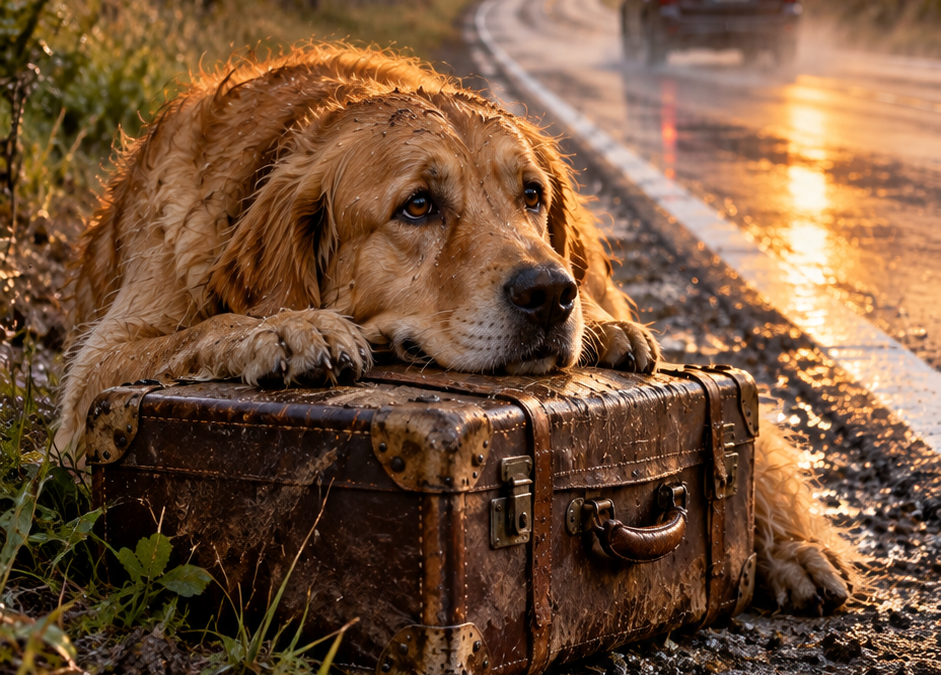
𝗙𝗨𝗟𝗟 𝗦𝗧𝗢𝗥𝗬
There was no one else in the car.
“Come on, Daniel. Five minutes.”
I glanced at the clock.
8:06.
There was a meeting at nine.
I had promised my manager I’d arrive early.
The dog watched me.
I pressed the accelerator.
“Tomorrow,” I muttered.
Tomorrow became another week.
Then another.
I started inventing explanations that made it easier to keep driving.
Someone nearby probably owned him.
Maybe he belonged to a farmhouse hidden behind the trees.
Maybe somebody fed him every night.
Maybe the suitcase belonged to a homeless traveler.
Maybe the dog only spent part of the day there.
Maybe someone else would stop.
That last excuse was the easiest.
Thousands of cars used that road.
Surely somebody more qualified would handle it.
A police officer.
An animal-control worker.
A local resident.
Somebody with more time.
Somebody who knew what to do.
Somebody who wasn’t me.
But each time I drove past, the dog remained.
The weather changed.
Warm afternoons became colder.
Rain came.
The fields turned darker.
Leaves along the mountain road began curling brown around their edges.
And still he stayed beside that suitcase.
There were mornings when I found myself angry at him.
I know how ridiculous that sounds.
He was a dog.
But his presence forced me to see something about myself I didn’t want to examine.
Every time I passed him, I made a choice.
And every time, I disguised that choice as necessity.
I was too busy.
Too late.
Too tired.
Too unsure.
I told myself that caring and acting were basically the same thing.
They aren’t.
You can feel sorry for something at sixty miles an hour.
It costs nothing.
Stopping costs something.
Time.
Comfort.
Inconvenience.
Responsibility.
So I kept caring from inside a moving car.
Then came that Friday night.
I had had one of those days that seems determined to drain every decent thing out of you.
A project had gone wrong.
Two people had blamed each other.
My manager had kept me late.
I had skipped lunch and lived on coffee.
By the time I left the office, darkness had already settled over the road.
Rain began twenty minutes into the drive.
Not a gentle rain.
A hard autumn downpour that erased the lane markings and turned every oncoming pair of headlights into a white blur across the windshield.
The wipers struggled at full speed.
Thunder rolled somewhere beyond the mountains.
I turned the radio off because I needed to concentrate.
For most of the drive, all I heard was rain pounding the roof and tires spraying water across the pavement.
Then I remembered the dog.
The thought hit me so suddenly that I sat straighter.
“No,” I whispered.
Surely he wouldn’t still be there.
Not tonight.
Somebody had taken him somewhere.
He had finally left.
He had found shelter.
I almost convinced myself.
Then I rounded the bend.
My headlights reached the shoulder.
And there he was.
He was sitting beside the suitcase.
Soaked.
His golden fur was plastered against his body. Water ran from his ears and muzzle. His shoulders trembled.
But he had not moved.
The suitcase gleamed under the rain.
Something inside me finally broke.
“Damn it.”
I hit the brakes harder than I intended.
The tires hissed against the wet pavement.
I drove another fifty yards before finding enough shoulder to pull over safely.
For several seconds, I just sat there.
The engine idled.
The wipers moved left, right, left, right.
In the rearview mirror, I could barely make out the dog through the rain.
Four months.
I had passed him for four months.
How many times had I said tomorrow?
I shut off the engine.
“Today,” I said.
My voice sounded strange in the quiet car.
“Today is the day.”
I opened the door.
Rain hit me immediately.
Within seconds, my jacket was soaked through.
I jogged back along the shoulder, shielding my eyes against the water.
The dog saw me coming.
He stood.
I stopped several feet away.
“Hey.”
He didn’t bark.
“It’s okay.”
His body was tense, but he didn’t run.
Up close, he looked older than I had imagined.
There was gray around his muzzle. His fur was tangled in places. He was thinner than he should have been, though not skeletal.
His eyes were what stopped me.
They weren’t wild.
They weren’t empty.
They were tired.
Deeply, terribly tired.
But beneath that exhaustion was something else.
Hope.
He looked past me toward the road.
A car approached.
His ears rose.
The vehicle rushed by.
His ears lowered.
I felt a pressure in my chest.
“You’re waiting for somebody, aren’t you?”
He looked at me.
Thunder cracked.
The dog flinched so hard his entire body folded toward the suitcase.
He pressed himself against it.
“Hey. Easy.”
I crouched slowly.
“It’s okay. I’m not going to hurt you.”
The suitcase was secured with two metal latches.
Old-fashioned ones.
The dog watched my hand as I reached toward them.
I hesitated.
“This yours?”
His ears moved slightly.
“Yeah. Stupid question.”
I put my fingers on the first latch.
The dog made a low sound.
I froze.
It wasn’t exactly a growl.
More like a warning wrapped in uncertainty.
“Okay.”
I pulled my hand back.
“You’ve been guarding this thing for months. I understand.”
I stayed crouched beside him while rain streamed down my face.
“I’m Daniel.”
He blinked.
“I’ve been driving past you twice a day.”
Saying it aloud made me ashamed.
“I should’ve stopped sooner.”
The dog lowered his head.
“I know.”
For another minute, neither of us moved.
Then, very slowly, he stepped closer.
He sniffed my hand.
I let him.
His nose was cold.
After a few seconds, he touched my fingers with his muzzle.
I gently rubbed the side of his face.
His eyes closed.
That tiny gesture of trust nearly destroyed me.
“All right,” I whispered. “Let’s figure this out.”
I reached for the latch again.
This time, he didn’t object.
The first latch opened with a metallic click.
The second resisted.
I pulled harder.
It snapped free.
The suitcase opened with a tired creak.
I expected clothes.
Maybe food.
Maybe nothing.
Instead, the first thing I saw was a photograph.
It was inside an old glass frame.
Despite the dampness around the edges of the suitcase, the picture itself had survived.
An elderly woman smiled at the camera while holding a golden puppy against her chest.
Even through the faded colors, I recognized him.
The same eyes.
The same pale patch of fur under the chin.
I looked from the photograph to the dog.
“That’s you.”
He sniffed the frame.
His tail moved once.
Just once.
Under the photograph was a folded wool blanket.
A few postcards were tied together with string.
I lifted the first one.
The writing was faded, but still readable.
I miss you.
Another said:
I’m waiting for you. Come home soon.
There was also a small wooden box.
And beneath it, folded carefully despite the age of the paper, was a letter.
My hands began shaking before I even opened it.
Maybe because by then I understood that whatever had kept this dog on that roadside wasn’t going to have a simple explanation.
I unfolded the page.
The handwriting was uneven.
Old.
Trembling.
The first sentence made me stop breathing.
If someone is reading this, please take care of my friend.
Rain dripped from my hair onto the paper.
I shifted my body over the letter to protect it.
Then I read.
My name is Margaret Thompson.
I live in the little blue house not far from this road.
This dog’s name is Max.
He has been my best friend for twelve years.
I can no longer care for him the way he deserves. My health is failing, and I don’t know how much time I have left.
One day I may have to leave him, and Max will not understand why.
If that day has come and you are reading this, please do not abandon him.
He loves chicken.
He is afraid of thunderstorms.
He will pretend he doesn’t want affection when he meets someone new, but scratch his belly and he’ll forgive you for almost anything.
He sleeps near the bedroom door.
He likes old blankets more than new ones.
And if he waits by the front window, let him.
Waiting is something he has always done.
There are a few coins in the small box. They aren’t much. Take them if you need them for his food.
Please understand that Max is a good dog.
He asks for very little.
He gives everything.
Please don’t let him end his life believing he was forgotten.
Margaret.
I stared at the final line.
Then I saw the date.
Four months earlier.
Exactly around the time I had first noticed him beside the road.
“Oh, God.”
My knees sank into the wet gravel.
I looked at him.
“Max?”
His ears lifted.
So that was his name.
I touched his neck.
“Max.”
His tail moved again.
Thunder rolled across the sky.
He flinched and pressed against me.
The letter had said he was afraid of storms.
For four months, I had watched him sit beside that suitcase.
Four months.
Sun.
Cold.
Wind.
Rain.
Cars.
Darkness.
And now a thunderstorm.
He had endured all of it.
For someone.
I looked toward the road.
“Margaret isn’t coming, is she?”
Max stared at me.
I knew dogs couldn’t answer questions like that.
But sometimes silence feels like an answer anyway.
I looked down at the photograph again.
An elderly woman holding a puppy.
Twelve years together.
Twelve years of mornings and nights, meals and walks, sickness and ordinary days no one photographs because they don’t seem important until they’re gone.
What had happened four months ago?
Had Margaret died?
Had someone abandoned Max?
Had he escaped while looking for her?
Why was the suitcase here?
And why had nobody come back for him?
I carefully returned the letter to the suitcase.
Then I closed it.
“All right, Max.”
He watched me.
“I don’t know what happened.”
I stood and lifted the suitcase.
It was heavier than I expected.
Not physically.
Emotionally.
It felt as though I was lifting twelve years of somebody else’s life.
“But you’re not staying here tonight.”
Max didn’t move.
I started toward the car.
After five steps, I turned around.
He was still beside the place where the suitcase had been.
“Come on.”
Nothing.
I lowered the suitcase.
“Max.”
His eyes shifted from me to the road.
My throat tightened.
“You think she’s coming.”
He stared into the rain.
“Don’t you?”
I walked back to him.
I put one hand against his wet head.
“I can’t promise you that.”
His body trembled.
“But I can promise you this.”
I swallowed.
“You won’t wait out here alone tonight.”
For a moment, he remained perfectly still.
Then he took one step.
Then another.
For the first time in four months, I watched that dog leave the spot beside the road.
He followed me.
At the car, I opened the passenger door.
Max hesitated.
“It’s dry.”
He sniffed the seat.
“And warm.”
Thunder sounded again.
That decided it.
He jumped inside.
I put the suitcase in the back.
When I climbed into the driver’s seat, Max was sitting stiffly beside me, dripping water onto the upholstery.
I didn’t care.
I turned on the heat.
For the first few miles, he remained upright.
Then slowly, almost carefully, he lowered his head onto my thigh.
I looked down at him.
“Really?”
His eyes closed.
I put one hand on his neck.
“Okay.”
We drove through the storm like that.
Every few minutes, he opened his eyes and looked at me.
Not through me.
At me.
As though making sure I was still there.
“I’m not going anywhere,” I said.
I don’t know whether I meant it for him or myself.
When we reached my house, Max refused to come inside at first.
He stood in the driveway staring down the street.
Waiting.
Always waiting.
I left the front door open and carried the suitcase inside.
“Your choice.”
I went to the kitchen.
A few minutes later, I heard claws clicking against the floor.
Max stood in the doorway.
“Good decision.”
I found some leftover chicken in the refrigerator.
The letter hadn’t lied.
The moment he smelled it, something changed in his face.
“Well, Margaret definitely knew you.”
I cut the chicken into small pieces and put them in a bowl.
He ate slowly at first, then faster.
I filled another bowl with water.
Afterward, I found an old blanket and placed it near the couch.
Max sniffed it.
Then he walked away and lay down beside my bedroom door.
I stared at him.
The letter had said that too.
For the first time all evening, I laughed.
It came out half broken.
“Of course.”
I knelt beside him.
“You really do have rules.”
His eyes followed me.
I reached down cautiously and rubbed his chest.
Then his belly.
One rear leg kicked.
“There it is.”
His tail thumped once against the floor.
I smiled.
Then, without warning, I started crying.
I hadn’t cried in years.
Not when relationships ended.
Not when work became unbearable.
Not even when my father died, at least not where anybody could see me.
But there I was, kneeling on the floor beside an old dog I had ignored for four months, crying like something inside me had finally cracked open.
“I’m sorry.”
Max licked my wrist.
“I’m sorry I didn’t stop.”
He had no idea what I was apologizing for.
Or maybe he did.
That night, I barely slept.
Max woke whenever a car passed outside.
Each time, he lifted his head.
Listened.
Waited.
Then lowered it again.
Around three in the morning, I sat on the floor beside him.
“You still think she’s coming.”
His head rested against my knee.
“I hope you’re right.”
The next morning, I opened the suitcase again.
In daylight, I examined everything carefully.
The photograph.
The blanket.
The postcards.
The letter.
The little box.
Inside were a few coins and folded bills.
Not much.
Exactly as Margaret had written.
Then, tucked into an inner pocket, I found an old envelope.
On it was an address.
Margaret Thompson
12 Catlett Road.
My heart kicked hard.
“Max.”
He came over immediately.
“I’ve got an address.”
The little blue house wasn’t far from the highway.
Maybe fifteen minutes from where I’d found him.
I called my manager.
“I’m going to be late.”
There was a pause.
“Everything okay?”
I looked at Max.
“Family emergency.”
The words came out before I could think about them.
When I hung up, I realized I didn’t regret saying them.
“Come on, buddy.”
At the word come, Max went directly to the car.
The drive to Catlett Road was quiet.
As we got closer, Max became restless.
He stood on the passenger seat.
Then sat.
Then stood again.
His nose moved rapidly.
“You know where we are?”
His ears rose.
I turned onto Catlett Road.
Max began whining.
Not loudly.
Just a thin, desperate sound from deep in his throat.
The houses were scattered far apart.
Number eight.
Number ten.
Then I saw it.
Number twelve.
A small blue house set back from the road.
The paint had faded.
One shutter hung slightly crooked.
A narrow porch stretched across the front.
There were flowerpots near the steps, though most of the plants had died.
I parked.
Max immediately tried to climb across me.
“Whoa. Easy.”
His whole body shook.
I opened the passenger door.
He jumped out.
Then stopped.
Instead of running to the house, he froze beside the car.
His eyes fixed on the front door.
“Go ahead.”
He didn’t.
For four months, he had waited.
Now that he was finally here, he seemed afraid.
I understood.
Hope is easier when the answer is still far away.
Standing in front of that house meant we were about to know.
I walked toward the porch.
Max stayed near the car.
The doorbell didn’t work.
I pressed it twice.
Nothing.
I knocked.
“Hello?”
No answer.
I knocked again.
“Margaret Thompson?”
Silence.
My stomach sank.
Of course.
I had known what the letter probably meant.
I had simply refused to accept it.
I stepped back.
Then I heard something inside.
A slow scrape.
A pause.
Another scrape.
The lock turned.
The door opened several inches.
An elderly woman stood behind it.
White hair.
Thin shoulders.
One hand gripping a cane.
Her face was lined deeply with age and exhaustion.
But I recognized her immediately.
The woman in the photograph.
My mouth went dry.
“Margaret?”
She narrowed her eyes.
“Yes.”
For a second, I couldn’t speak.
She was alive.
She studied me cautiously.
“Can I help you?”
“My name is Daniel.”
“All right.”
“I…”
I turned toward the driveway.
Max was partly hidden behind my car.
“I found your dog.”
Everything in Margaret’s face changed.
Her hand tightened around the cane.
“What?”
“Max.”
Her lips parted.
“Did you say Max?”
“Yes.”
The cane slipped slightly.
I moved forward.
“Are you okay?”
“Where is he?”
Her voice was suddenly stronger.
“Where is Max?”
“He’s right there.”
She stepped onto the porch.
“Max?”
The dog heard her.
His head snapped up.
For one second, neither of them moved.
Margaret put a hand over her mouth.
“Oh, my God.”
Max took a step.
Then stopped.
“Max.”
Her voice broke.
“It’s me.”
He stared at her.
I watched recognition happen.
Not gradually.
Instantly.
His entire body changed.
His ears lifted.
His tail rose.
He made a sound I had never heard from a dog before—a mixture of bark, cry, and something almost human.
Then he ran.
“Max!”
Margaret dropped her cane.
She tried to crouch, but her legs couldn’t manage it.
I reached for her, afraid she would fall.
Max reached her first.
He didn’t jump.
That was the remarkable part.
After four months of waiting, he somehow remembered she was fragile.
He stopped directly against her legs and pressed his head into her.
Margaret bent over him.
“My baby.”
Her hands moved through his fur.
“My Max.”
He whined.
She cried openly.
“I thought you were gone.”
Max pushed harder against her.
“I thought I’d lost you.”
She kissed his head again and again.
“I’m sorry.”
Her shoulders shook.
“I’m so sorry.”
I stepped back.
There are moments when being present feels almost intrusive.
This was one of them.
Max kept looking up at her as though he needed to confirm her face from every angle.
He sniffed her hands.
Her dress.
Her shoes.
Then he buried his muzzle against her again.
Four months of waiting collapsed into that doorway.
No speeches.
No grand gestures.
Just an old woman and an old dog holding on to each other.
Eventually Margaret looked at me.
Tears ran freely down her face.
“Where did you find him?”
“Beside the highway.”
Her expression changed.
“Where?”
I described the place.
Her hand flew to her mouth again.
“The turnout.”
“You know it?”
She nodded.
“That’s where my husband used to stop when we brought Max home as a puppy.”
I looked at the dog.
Margaret kept stroking him.
“Why was he there?”
“I don’t know.”
I hesitated.
“He had a suitcase with him.”
Margaret went still.
“What suitcase?”
“The brown leather one.”
Her eyes widened.
“You found that too?”
“It’s in my car.”
For several seconds, she simply stared at me.
Then she whispered, “My neighbor.”
“What happened?”
She looked down at Max.
“Please.”
She opened the door wider.
“Come inside.”
The house smelled faintly of coffee, old wood, and something floral.
There were photographs everywhere.
On shelves.
On tables.
Along the walls.
Margaret as a young woman.
Margaret beside a tall man I assumed was her husband.
A wedding photograph.
A Christmas dinner.
And dozens of pictures of Max.
Max as a puppy asleep inside a laundry basket.
Max wearing a red bandanna.
Max beside Margaret in the garden.
Max stretched across the couch.
Max with gray beginning around his muzzle.
He walked through the house as though he had never left.
Straight to the living room.
Straight to the corner of the couch.
There was an old blanket folded there.
Max climbed up, turned once, and lay down.
Margaret covered her face.
“He remembered.”
“Of course he remembered.”
“No.”
She shook her head.
“You don’t understand. After four months… I thought…”
She couldn’t finish.
I waited.
Eventually she sat in a chair.
I placed her cane beside her.
“What happened, Margaret?”
She took a breath.
“Four months ago, I got sick.”
Her eyes remained on Max.
“I’d been having trouble for a while. My doctor kept telling me I needed tests. I kept putting them off.”
A sad smile crossed her face.
“I’m stubborn.”
“I’ve heard that can happen.”
She almost laughed.
“One morning I collapsed in the kitchen.”
She pointed toward the doorway.
“Right there.”
Max lifted his head at the sound of her voice.
“The ambulance took me to the hospital. I thought I’d be gone for a day or two.”
She looked at her hands.
“I was gone much longer.”
“What about Max?”
“My neighbor, Richard, agreed to take care of him.”
Her expression tightened.
“At least, that’s what I believed.”
I remained quiet.
“Before I went to the hospital, I already knew my health was getting worse. That’s why I wrote the letter you found.”
“So you wrote it before you disappeared.”
“Yes.”
She looked embarrassed.
“I was afraid I might die suddenly. My children live far away. My husband has been gone for years. I needed some plan for Max.”
“And the suitcase?”
“I packed it months earlier.”
Her eyes filled.
“I know it sounds foolish.”
“It doesn’t.”
“I put the things in there that mattered. His blanket. The photograph. A little money. Instructions.”
She looked toward Max.
“I thought if something happened to me, someone could use it to help him understand he hadn’t simply been thrown away.”
My chest tightened.
“How did the suitcase end up beside the road?”
“I don’t know exactly.”
She rubbed her forehead.
“When I finally came home from the hospital, Max was gone.”
Her voice trembled.
“Richard said Max slipped out. He said he’d been restless ever since I left. One day, he got through the gate.”
“And the suitcase?”
“Richard had taken some of my things to his house while I was hospitalized. I think he may have moved the suitcase too. He said when Max escaped, several things had been dragged or knocked over.”
She looked at me.
“I suspect Max followed the suitcase, or Richard tried to use it to lure him back. I don’t know.”
She swallowed.
“By the time I came home, I could barely walk. I called shelters. I called the county. I asked neighbors.”
She glanced toward the window.
“I wanted to search myself.”
“Why didn’t anyone find him?”
“I don’t know.”
Her eyes lowered.
“Maybe they looked in the wrong places. Maybe they didn’t look very hard.”
There was no bitterness in her voice.
That somehow made it worse.
“My children begged me not to go out searching alone. I was weak. I kept telling myself someone would recognize him.”
“And he was fifteen minutes away.”
She closed her eyes.
“Fifteen minutes.”
“He was there every day.”
Her eyes opened.
“Every day?”
I nodded.
“For four months.”
The room became completely silent.
Margaret looked at Max.
“He waited there?”
“Yes.”
“For me?”
“I think so.”
Her face folded.
She tried to speak, but no words came.
Max climbed down from the couch.
Slowly, he walked to her.
He rested his head on her knee.
Margaret put both hands around his face.
“You waited for me?”
Max gazed up at her.
“Oh, sweetheart.”
She bent over him.
“I didn’t leave you.”
Her voice broke.
“I need you to know that.”
Max licked her hand.
“I didn’t leave you.”
I turned toward the window because I felt tears coming again.
Maybe some people would say I was projecting human emotion onto an animal.
Maybe.
But I had watched Max stand every time a car approached.
I had watched his ears rise.
I had watched hope appear and disappear over and over again.
Whatever word we choose for it, that dog had believed someone was coming back.
And now she had.
After a while, Margaret looked at me.
“How long did you know he was there?”
The question landed exactly where it needed to.
I could have softened the truth.
I didn’t.
“Almost four months.”
She looked surprised.
“I drove past him every morning and every evening.”
“You saw him all that time?”
“Yes.”
The shame returned.
“I kept telling myself someone else would help.”
Margaret said nothing.
“I thought he belonged nearby. Then I thought somebody must be feeding him. Then I told myself animal control would notice.”
I rubbed my hands together.
“There was always some explanation that allowed me to keep going.”
Max looked between us.
“The night I stopped, it was pouring rain.”
I looked at Margaret.
“He was soaked. Shivering. But he was still sitting beside that suitcase.”
My voice tightened.
“I realized I’d run out of excuses.”
Margaret studied me for a long moment.
“I’m sorry.”
“For what?”
“For waiting so long.”
She shook her head.
“You stopped.”
“Eventually.”
“You stopped.”
“I passed him maybe a hundred times.”
“And then you stopped.”
Her voice was gentle, but firm.
“You brought him somewhere warm. You found the letter. You brought him home.”
I looked down.
“Someone should’ve done it sooner.”
“Yes.”
The answer surprised me.
She didn’t rush to comfort me.
“Someone should have.”
Then she reached across and touched my hand.
“But Daniel, people spend too much time wishing they had been good yesterday. That doesn’t help anyone today.”
I looked at her.
“You cannot change the ninety-nine times you kept driving.”
Her eyes moved to Max.
“But apparently you could change what happened on the hundredth.”
I didn’t answer.
She smiled faintly.
“That matters.”
We sat there for a while.
Then Margaret said, “Would you like coffee?”
I almost laughed.
After everything, coffee sounded absurdly ordinary.
Maybe that was exactly what we needed.
“Sure.”
She tried to stand.
I immediately rose.
“I’ll get it.”
“You don’t know where anything is.”
“Then you’ll tell me.”
She pointed toward the kitchen.
Max followed me.
Of course he did.
“Traitor,” Margaret called after him.
For the first time, I heard her laugh.
It was quiet.
Fragile.
But real.
In the kitchen, Max sat beside me while I searched cabinets.
“Coffee?”
Margaret called, “Above the sink.”
“Mugs?”
“Second shelf.”
“Filters?”
A pause.
“Oh, goodness.”
I heard her stand.
“No, no. Stay there.”
“They’re beside the refrigerator.”
I found them.
When I returned with the coffee, Margaret was examining the photograph I had taken from the suitcase.
“I remember that day.”
She touched the glass.
“He was ten weeks old.”
Max lay between our chairs.
“My husband, Harold, said we were too old for a puppy.”
She smiled at the picture.
“He said puppies chewed furniture, ruined carpets, woke people at night.”
“Was he right?”
“Completely.”
I laughed.
“Max destroyed two shoes, a lamp cord, and part of the kitchen baseboard during his first month.”
She looked down at him.
“Harold adored him by the second.”
Her smile faded slightly.
“After Harold died, this house became very quiet.”
Max lifted his head.
Margaret rubbed his ear.
“People say animals are company. That’s true, but it doesn’t really explain it.”
She looked at me.
“When you lose someone after forty-three years of marriage, silence changes. It has weight.”
I didn’t interrupt.
“You wake up and expect to hear another person breathing.”
Her fingers moved slowly through Max’s fur.
“You make too much coffee. You turn toward an empty chair to say something. You hear a floorboard creak and for half a second you forget.”
She swallowed.
“Max gave the silence somewhere to go.”
That sentence stayed with me.
“He needed meals, walks, medicine. He needed the door opened. He needed me.”
She smiled.
“And sometimes being needed is the thing that keeps you alive.”
I looked around the little house.
For years, I had thought of loneliness as the absence of people.
Sitting there, I realized it could exist in rooms filled with photographs.
“Do your children visit?”
“When they can.”
The answer came quickly, protectively.
“They have families. Jobs. Lives.”
She didn’t criticize them.
That told me more than criticism would have.
“They call.”
“But they’re far away.”
“Very.”
Max shifted his head onto her foot.
“When he disappeared,” Margaret said, “I thought perhaps that was it.”
“What was it?”
“My reason.”
She looked down.
“To get up.”
I felt something tighten behind my ribs.
“And now?”
Max rolled onto his side.
Margaret stared at him.
“Now he needs breakfast tomorrow.”
She smiled through tears.
“And apparently chicken.”
“Definitely chicken.”
She laughed again.
Before I left, I carried the suitcase inside.
Margaret ran her fingers over the worn leather.
“I haven’t seen this since before the hospital.”
“Do you want me to leave it?”
She hesitated.
Then shook her head.
“No.”
I was surprised.
“You keep it.”
“Margaret, it’s yours.”
“It was for Max.”
She looked at me.
“And somehow it found you.”
“I can’t take this.”
“There’s nothing valuable in it.”
“That’s not what I mean.”
“I know.”
Her voice softened.
“Keep it anyway.”
I looked at the suitcase.
“It seems wrong.”
“Then don’t think of it as a gift.”
“What should I think of it as?”
She considered that.
“A reminder.”
“Of what?”
Her gaze moved toward Max.
“Of what can happen when someone finally stops.”
I didn’t know what to say.
So I nodded.
At the door, I crouched beside Max.
“Well, buddy.”
His tail started moving.
“You made it.”
I scratched behind his ears.
“You’re home.”
He pressed his forehead against mine.
For several seconds, neither of us moved.
Then I stood.
Margaret was watching.
“Thank you, Daniel.”
“You don’t owe me anything.”
“I know.”
Her eyes were wet again.
“That’s why thank you matters.”
I walked toward my car.
Halfway there, I heard claws behind me.
I turned.
Max had followed me onto the porch.
“Hey.”
He stood watching me.
Margaret laughed softly behind him.
“Apparently you’ve made an impression.”
I walked back and scratched his chest.
“I’m going to work.”
He tilted his head.
“Some of us still have jobs.”
His tail moved.
“I’ll see you around.”
I had no idea when I said it that I was making a promise.
But I was.
The next morning, I took the same route to work.
For the first time in four months, the roadside was empty.
No dog.
No suitcase.
Just gravel darkened by rain.
I slowed anyway.
Then I pulled over.
I sat there looking at the spot.
Cars passed behind me.
This was where Max had spent four months of his life.
Waiting.
Watching.
Believing.
I tried to imagine what it had been like during the nights.
Every pair of headlights.
Every familiar engine sound.
Every stranger who slowed but didn’t stop.
Every storm.
Every morning that arrived without Margaret.
And every day he chose to remain.
I rested my hands on the steering wheel.
“Never again,” I said.
I wasn’t entirely sure what I meant.
Maybe I meant I would never ignore an animal like that again.
Maybe I meant I would stop postponing everything that mattered.
Maybe I meant I was tired of being a man who moved through life so quickly that he only noticed suffering through a windshield.
Whatever I meant, the words felt true.
Instead of continuing directly to work, I drove to Catlett Road.
Margaret opened the door wearing a robe.
She looked surprised.
“Daniel?”
“Sorry. I know it’s early.”
Max appeared behind her.
The moment he saw me, his tail began striking the wall.
Thump.
Thump.
Thump.
I smiled.
“I just wanted to make sure everything was okay.”
Margaret opened the door wider.
“Coffee?”
I checked the clock.
I was already going to be late.
For five years, that would have been enough to make me decline.
Instead, I said, “Sure.”
That was how it started.
At first, I stopped once or twice a week.
Then more often.
Sometimes only for five minutes.
Sometimes twenty.
Margaret made terrible coffee.
I never told her.
She told long stories.
I never minded.
I learned that Harold had been a mechanic.
That Margaret had worked at a school cafeteria for thirty-one years.
That she hated television news but watched the weather every night.
That she had once driven across three states with Harold because he insisted a particular lake had “the best fishing in America,” only to discover neither of them knew how to fish.
I learned Max hated vacuum cleaners.
He loved chicken.
He was afraid of thunder.
And yes, belly scratches could repair almost any offense.
Some mornings I brought breakfast.
Sometimes I carried groceries inside.
On weekends, when Margaret felt strong enough, we took Max to a nearby park.
She moved slowly with her cane.
Max moved slowly with her.
That fascinated me.
When I walked him alone, he still had energy.
He sniffed everything.
Pulled at the leash.
Investigated squirrels as though each one represented a national security threat.
But beside Margaret, he matched her pace.
One step at a time.
If she stopped, he stopped.
If she stumbled, he immediately turned around.
He never pulled.
He simply stayed beside her.
One Saturday afternoon, we reached a bench under a large tree.
Margaret sat down.
Max wandered a few yards ahead, then turned to check on us.
“You see that?” she asked.
“What?”
“He always looks back.”
Max sniffed the grass.
Then turned again.
“He’s making sure we’re following.”
Margaret nodded.
“He has done that his whole life.”
We watched him for a while.
“You know,” she said, “I used to think loyalty meant never leaving.”
I glanced at her.
“What do you think now?”
“Maybe it means looking back.”
I didn’t understand immediately.
She smiled.
“People have to leave sometimes. Children grow up. Husbands die. Bodies fail.”
She looked toward Max.
“You cannot stop people from going.”
Her eyes returned to me.
“But you can look back. You can make sure the people you love haven’t disappeared behind you.”
For some reason, that made me think of my mother.
I hadn’t called her in almost three weeks.
Always tomorrow.
I called her that evening.
She answered on the second ring.
“Daniel?”
“Hi, Mom.”
“Is something wrong?”
“No.”
“Are you sure?”
“Yes.”
She laughed.
“You never call on Saturday evening.”
I sat at my kitchen table, looking at the old suitcase.
“I know.”
“So?”
“I just wanted to hear your voice.”
There was silence on the line.
Then she said softly, “Well. That’s a nice surprise.”
We talked for nearly an hour.
About nothing important.
Which meant, I later realized, we talked about everything important.
The months that followed changed my routines in ways I never planned.
I still drove seventy-five miles to work.
I still had deadlines.
My manager still sent emails marked URGENT about things that somehow stopped being urgent two days later.
Bills still arrived.
The lawn still needed mowing.
Life did not suddenly become simple because I rescued a dog from a roadside.
But something in the order of things changed.
I stopped worshiping urgency.
That may sound dramatic.
It wasn’t.
It happened quietly.
I began asking myself a question whenever I felt too busy to notice someone.
Will this actually matter tomorrow?
Sometimes the answer was yes.
Often it wasn’t.
A meeting could wait five minutes.
A spreadsheet could survive until afternoon.
An email could remain unanswered during dinner.
A phone call to my mother mattered more.
Coffee with Margaret mattered more.
Watching Max run through fallen leaves mattered more.
One morning, I arrived at Margaret’s house and found her sitting on the porch.
Max lay at her feet.
“You all right?”
“Fine.”
“You sure?”
“Daniel, I’m old, not made of glass.”
“I didn’t say you were.”
“You were thinking it.”
I smiled.
“I brought muffins.”
“Then you’re forgiven.”
I sat beside her.
The morning was cold enough that our breath showed.
Max moved between us.
Margaret looked toward the road.
“Do you ever think about the first day you saw him?”
“All the time.”
“Do you still feel guilty?”
I didn’t answer immediately.
“Yes.”
She nodded.
“Good.”
That surprised me.
“Good?”
“A little guilt can be useful.”
She took a bite of muffin.
“It tells you where you failed.”
“That’s encouraging.”
“I’m not finished.”
She pointed the muffin at me.
“The mistake is building a house there.”
I looked at her.
“If you spend the rest of your life punishing yourself for driving past Max, then you haven’t learned anything. You’re just finding a different way to make the story about you.”
I stared at her.
“You’ve been saving that speech, haven’t you?”
“About two weeks.”
I laughed.
She smiled.
“Max doesn’t care how many times you passed him.”
The dog lifted his head at his name.
“He cares that you’re here now.”
That sentence stayed with me too.
As Margaret regained some strength, she became more independent.
I stopped hovering.
Mostly.
But I kept visiting.
Because somewhere along the way, I realized I wasn’t visiting only for her.
Or Max.
I was visiting because I needed that house.
Not literally.
I needed what happened to time inside it.
Nothing moved quickly there.
Coffee took longer.
Conversations wandered.
Max could spend ten minutes deciding whether one patch of grass deserved closer inspection.
Margaret never looked at her phone while someone spoke.
She listened completely.
That was rare.
One afternoon, she asked me why I worked so much.
“Because I have a job.”
“That’s not what I asked.”
I sighed.
“Because work matters.”
“Does it?”
“Margaret.”
“I’m serious.”
“I’ve built a career.”
“All right.”
“I have responsibilities.”
“Fine.”
“I can’t just ignore them.”
“I didn’t say you should.”
She leaned back.
“I’m asking why you’re always racing.”
I had no answer ready.
So I gave her the first truthful one.
“I don’t know how to stop.”
She studied me.
“Then perhaps that’s why Max sat where you could see him.”
I laughed.
“You think he planned it?”
“No.”
She smiled.
“But I think life is sometimes less subtle than we’d like.”
Max was asleep under the table.
I looked at him.
Four months.
A dog sitting beside a road.
A man passing twice a day.
Maybe life had been shouting at me and I had mistaken it for scenery.
Near the beginning of winter, another storm came through.
Thunder woke me just after midnight.
My first thought was Max.
I called Margaret.
She answered sleepily.
“Daniel?”
“Everything okay?”
A pause.
Then she laughed.
“You’re calling because of the thunder.”
“Maybe.”
“Hold on.”
I heard her moving.
Then her voice became softer.
“He’s beside my bed.”
“Scared?”
“A little.”
I heard something through the phone.
Margaret scratching his fur.
“He’s all right.”
“Okay.”
“Daniel?”
“Yeah?”
“Go to sleep.”
“Yes, ma’am.”
Before hanging up, I heard her whisper to Max.
“You’re home. You’re safe.”
I sat in the darkness for a long time after that.
You’re home.
You’re safe.
Such simple words.
Maybe everyone spends part of life waiting to hear them.
Months earlier, Max had been sitting beside a road, terrified of thunder, guarding the last physical pieces of the person he loved.
Now he was beside her bed.
The storm was the same.
His life wasn’t.
Neither was mine.
Eventually, Margaret asked about the suitcase.
“You still have it?”
“Yes.”
“Where?”
“In my living room.”
“What do you keep in it?”
“Nothing.”
She frowned.
“That’s a waste of a perfectly good suitcase.”
“It’s older than I am.”
“Rude.”
I laughed.
Then I thought about it.
That evening, I opened the suitcase.
The photograph was still inside.
So was Margaret’s original letter.
The postcards.
The blanket had gone back to Max.
The little wooden box remained.
I found a clean sheet of paper.
I sat at my kitchen table for nearly an hour before I knew what to write.
Finally, I wrote:
Sometimes the longest journey begins with a single stop.
I stared at the sentence.
Then continued.
For four months, I believed I was too busy to stop.
The truth was simpler.
I was waiting for someone else to care first.
Max taught me that compassion without action is only a feeling.
He waited when I would have given up.
He trusted when I hadn’t earned it.
And when I finally stopped, I thought I was rescuing him.
I was wrong.
I folded the page and placed it beside Margaret’s letter.
For a long time, I sat looking at both.
Her letter had been written because she feared what would happen to Max when she was gone.
Mine existed because of what happened when I finally arrived.
A beginning and an ending.
Or maybe two beginnings.
I closed the suitcase.
Years from now, someone might find those letters and think the story was about a dog.
They wouldn’t be entirely wrong.
But it was also about an old woman who believed she had been forgotten.
And a middle-aged man who thought being busy was the same as being alive.
And the strange way three lonely lives crossed because one stubborn dog refused to leave a battered suitcase beside a country road.
I still drive that road.
Every morning.
Every evening.
The mountains haven’t changed.
The red barn is still falling apart.
The little church still stands beside the cemetery.
The diner still keeps its neon sign glowing before sunrise.
But the road doesn’t feel the same anymore.
Maybe roads never change.
Maybe the people traveling them do.
I no longer pass the turnout without looking.
Sometimes I even stop.
Not because Max is there.
He isn’t.
The gravel is empty now.
But I remember the shape of him sitting beside that suitcase.
I remember rain dripping from his fur.
I remember his eyes following cars.
I remember how close I came to driving past one more time.
Then I continue toward the blue house.
Most mornings, Max hears my car before Margaret does.
By the time I reach the porch, he’s waiting at the door.
But it’s different now.
His tail moves.
His body is relaxed.
He doesn’t stare past me at the road.
He isn’t waiting for someone who might never come.
He’s simply happy to see someone who did.
One morning, not long ago, I sat at Margaret’s kitchen table while she poured coffee.
Max lay across my feet.
“You’ve spoiled him,” she said.
“Me?”
“He expects chicken every time you visit.”
“That’s because someone put it in writing.”
Margaret laughed.
“That letter may have been a tactical error.”
Max looked up at us.
His muzzle was grayer now.
His movements slower.
But his eyes were peaceful.
Margaret followed my gaze.
“We don’t get forever,” she said quietly.
I knew what she meant.
“No.”
She placed her hand on Max’s back.
“But sometimes we get enough.”
I looked at her.
She smiled.
“Enough time to find each other again.”
Max sighed and closed his eyes.
I thought about the hundreds of miles I had traveled during those four months.
Hundreds of hours.
Thousands of thoughts.
All while a story sat ten feet from the edge of my route waiting for me to notice it.
I had spent years believing important moments announced themselves.
That they arrived with phone calls, promotions, weddings, funerals, emergencies.
But some of the most important moments look ordinary.
A dog beside a road.
An old suitcase.
A stranger opening a door.
A cup of bad coffee.
A five-minute stop on the way to work.
You don’t always know you’re standing at the edge of a different life.
Sometimes you think you’re only pulling over.
I once believed Max had spent four months doing nothing.
Just waiting.
Now I understand how wrong I was.
Waiting was the most courageous thing he knew how to do.
Every morning, cars passed.
He stayed.
Every evening, darkness came.
He stayed.
Rain came.
He stayed.
Thunder came.
He stayed.
Whatever had happened to him, whatever confusion or fear had brought him to that roadside, he held onto the only thing he understood.
Someone he loved existed.
Somewhere.
And he refused to believe love had simply disappeared.
I don’t romanticize those four months.
He should never have had to endure them.
Someone should have stopped earlier.
I should have stopped earlier.
That truth doesn’t become beautiful simply because the ending was kind.
But there is something I carry from it.
We often imagine indifference as cruelty.
Sometimes it isn’t.
Sometimes indifference looks like decent people who are tired.
Busy people.
People with meetings.
People who assume another car will stop.
People who feel concern and then continue driving.
People exactly like me.
That’s what frightens me most.
I wasn’t heartless.
I wasn’t cruel.
I was simply practiced at postponing compassion.
Tomorrow.
Tomorrow.
Tomorrow.
Until a storm made tomorrow impossible.
If that rain hadn’t come, I still wonder how many more times I would have passed Max.
One day?
One week?
A month?
I don’t know.
That’s the part of the story I will never be proud of.
But Margaret was right.
I can’t build a house inside that guilt.
I can only let it change what I do next.
So now, when something makes me slow down, I pay attention.
When someone I love calls, I try to answer.
When my mother says, “You don’t have to stay on the phone,” I stay a little longer.
When Margaret begins telling me a story I’ve already heard three times, I listen again.
When Max stops on our walks because a smell in the grass deserves his full attention, I stop too.
The world survives.
The clock keeps moving.
And surprisingly, almost nothing important collapses because I arrived ten minutes late.
A few weeks ago, Margaret and I took Max to the park.
It was one of those clear autumn afternoons when the sunlight makes everything look briefly younger.
Margaret sat on our usual bench.
I walked Max toward the trees.
He moved slowly.
Age had caught up with him.
After a few minutes, he stopped.
I thought he was tired.
Then he turned around.
Margaret was still on the bench.
Max stared at her.
“She’s there,” I told him.
He remained still.
Then Margaret raised one hand.
“Max!”
His tail moved.
He looked at me.
Then back at her.
I laughed.
“Go on.”
We walked back together.
Halfway there, Max began moving faster.
Not running exactly.
More like remembering how.
Margaret opened her arms.
“There you are.”
He reached her and rested his head against her knee.
The same way he had the morning I brought him home.
I stood a few feet away.
And suddenly I was back in the rain.
Back on that gravel shoulder.
Back beside an old suitcase.
I could see everything.
The letter trembling in my hands.
The headlights passing.
Max watching the road.
My own voice telling him he wouldn’t spend another night alone.
I thought I had made that promise to him.
I understand now that I made it to myself too.
I would not keep moving simply because moving was easier.
I would notice.
I would stop.
I would look back.
Margaret glanced up at me.
“What are you thinking about?”
“The suitcase.”
She smiled.
“Still?”
“Probably always.”
She nodded.
“Good.”
Max lay down between us.
I sat beside Margaret.
We watched the trees move in the wind.
No one spoke for several minutes.
There was nothing that needed saying.
That is another thing I learned from Max.
Silence doesn’t always mean something is missing.
Sometimes silence means everything that matters is already there.
Today, the old suitcase remains in my house.
The leather is cracked.
The hinges complain when I open it.
Inside are Margaret’s photograph, her postcards, her letter, the wooden box, and my own note.
I’ve added one more photograph.
Margaret sits on the porch of the blue house.
Max is beside her.
I’m standing behind them with one hand resting on his back.
None of us looks particularly impressive.
Margaret is laughing.
I’m squinting into the sun.
Max isn’t even looking at the camera.
He’s looking at Margaret.
I think that’s why it’s my favorite photograph.
Because after all that waiting, he finally knows exactly where to look.
Sometimes, when work has been especially difficult, I come home and open that suitcase.
I read Margaret’s first line.
If someone is reading this, please take care of my friend.
And I remember how close I came to never reading it at all.
Four months.
I drove past Max more times than I can count.
Each time I had an excuse.
Each time he watched another car disappear.
Until one Friday night, in pouring rain, I finally stopped.
For a long time, I thought that was the moment I saved him.
Then I thought perhaps I had saved Margaret too, because I returned the companion she believed she had lost forever.
Now I don’t think of it that way.
The truth is more complicated.
Max didn’t need a hero.
Margaret didn’t need a hero.
They needed one person to stop long enough to notice what had happened.
And I needed them far more than I understood.
Before Max, I moved through my days as if speed were proof that my life mattered.
I filled every empty space.
I measured days by how much I accomplished.
I thought being needed at work meant I wasn’t lonely.
I thought having somewhere to go meant I knew where I was going.
Then an old dog sitting beside a suitcase forced me to confront a truth I had spent years avoiding.
I had become very efficient at passing things by.
People.
Moments.
Grief.
Love.
My own life.
Max waited four months for Margaret.
I sometimes wonder how long I had been waiting too.
Waiting for life to slow down on its own.
Waiting for the perfect weekend.
Waiting to call people I missed.
Waiting to become the sort of person who would stop.
Life never slowed down.
I did.
That was the difference.
This morning, I drove to Margaret’s before work.
The sky was pale.
There was mist over the fields.
I pulled into her driveway and saw the curtain move.
A moment later, the front door opened.
Max appeared first.
He stepped onto the porch.
Old now.
Gray-faced.
A little stiff.
But when he saw me, his tail began to move.
Behind him stood Margaret.
She lifted her mug.
“You’re late.”
I checked my watch.
“For work?”
“For coffee.”
I laughed.
“That’s serious.”
“Extremely.”
I climbed the steps.
Max pressed against my leg.
I bent down and scratched his belly.
His back foot kicked weakly.
“Still works.”
Margaret smiled.
“I told you.”
We went inside.
I stayed fourteen minutes.
Fourteen minutes I technically didn’t have.
Fourteen minutes that once would have made me anxious.
When I finally left, Margaret stood in the doorway with Max beside her.
I walked toward the car.
Before getting in, I turned around.
Max was watching me.
But this time, there was no desperate expectation in his eyes.
No question.
No fear.
He knew I would come back.
And he knew Margaret was standing beside him.
He was home.
Loved.
Safe.
For twelve years, Margaret had been his world.
For four months, he had sat beside a highway waiting for that world to return.
And somehow, against every reasonable expectation, it did.
I raised my hand.
“See you tomorrow.”
Margaret waved.
Max’s tail moved.
I got into the car and drove toward work.
When I passed the old turnout, sunlight was beginning to break through the clouds.
For a second, I could almost see him there again.
The golden dog.
The battered suitcase.
Those tired, hopeful eyes following traffic.
Then the image was gone.
The shoulder was empty.
I kept driving.
But I did not forget.
Max waited four months.
I passed him again and again.
Then, one night, I stopped.
That stop brought Max home to Margaret.
It brought Margaret back something she thought life had taken from her.
And it gave me something I hadn’t even known I’d lost.
The ability to notice my own life while I was still living it.
So when I look at that old suitcase now, I don’t think first about sadness.
I think about a rainy highway.
A trembling dog.
An unopened letter.
And the distance between seeing something and truly noticing it.
Sometimes that distance is only a few feet.
Sometimes it takes four months to cross.
I know because I crossed it.
And on the other side, waiting for me, were an old woman, a faithful dog, a cup of terrible coffee, and a life I had been driving past without ever realizing it.
Max is no longer waiting beside the road.
He doesn’t have to.
He knows where home is.
And, finally, so do I.
What do you think of this story? Please leave a like and share your thoughts in the comments. Your support means a lot to us and inspires us to keep writing more meaningful and powerful stories. Thank you! 👍

