𝗙𝗨𝗟𝗟 𝗦𝗧𝗢𝗥𝗬 Every Afternoon at 3:55, William Rolled to the Same Fence and Waited for Someone No One Else Could See
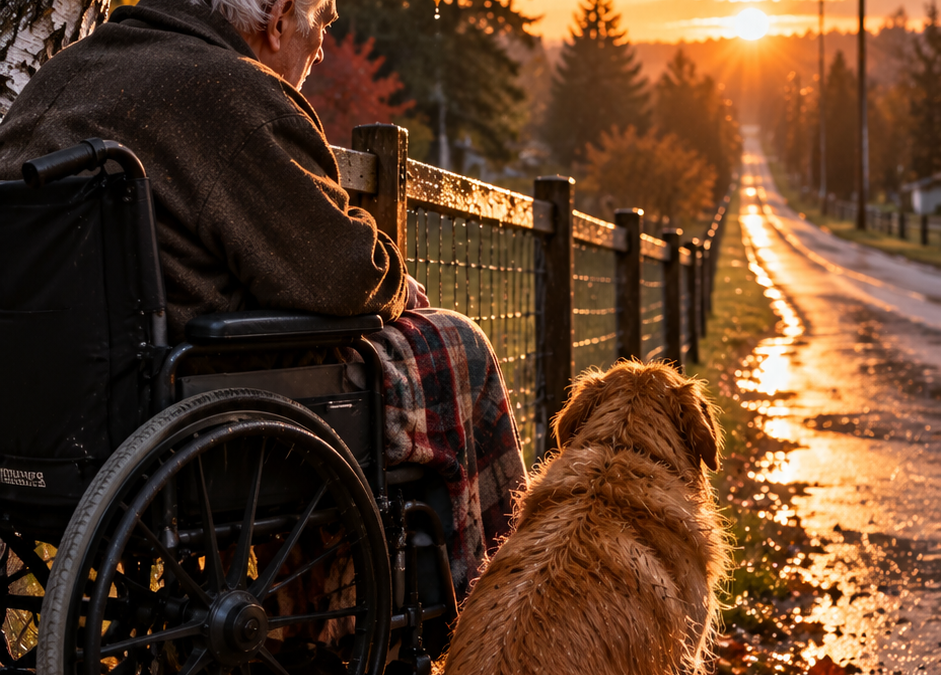
𝗙𝗨𝗟𝗟 𝗦𝗧𝗢𝗥𝗬
I kept returning because I liked sitting with him.
Even when he did not speak.
Especially then.
Nurse Margaret eventually told me some of his history.
“Don’t push him,” she said one afternoon while we folded towels in the laundry room.
“I’m not.”
“You think you’re not.”
I looked at her.
Margaret had worked at Pearl Dawn for nearly fifteen years.
She could deliver criticism so gently you thanked her afterward.
“What am I doing?”
“You ask too many questions.”
I laughed.
“I have a psychology degree.”
“Exactly.”
“That doesn’t make sense.”
“It makes perfect sense.”
She folded another towel.
“William doesn’t need to become your success story.”
I stopped smiling.
“I don’t think that.”
“Good.”
She stacked the towel.
“Then sit with him because you want to sit with him.”
I looked toward the hallway.
“What happened to him?”
Margaret hesitated.
“You didn’t hear this from me.”
“Of course.”
“He was a veterinarian.”
That surprised me.
“Large animals?”
“Everything. Small town practice. Dogs, cats, horses, livestock.”
“Was he good?”
“Apparently.”
She smiled.
“Old residents from the area still recognize him.”
“What happened to his family?”
Margaret stopped folding.
“His wife, Eleanor, died fifteen years ago.”
My expression changed.
“Cancer.”
I nodded.
“They were married forty-two years.”
“And children?”
“One son.”
“What happened to him?”
“That depends what you mean by happened.”
She lowered her voice.
“Robert moved to Australia thirty years ago.”
“Thirty?”
“Yes.”
“They still talk?”
Margaret looked at me.
That look answered before she did.
“At first.”
She continued folding.
“Robert called monthly for a while. Then birthdays. Then Christmas.”
“And then?”
“Last call was in 2005.”
I did the math.
“That long?”
“Yes.”
“What happened?”
“William turned seventy-two.”
Margaret paused.
“Robert called on his birthday.”
“What did he say?”
“I only know because William told another nurse years ago.”
She looked at me.
“Robert said, ‘Forgive me, Dad. I have another life now.’”
I felt something tighten inside me.
“And that was it?”
“That was it.”
“No letters?”
“None that we know of.”
“No email?”
“No.”
“Why didn’t William contact him?”
“He tried.”
“How long?”
“For years.”
Margaret sighed.
“Numbers changed. Addresses changed. Messages unanswered.”
I looked down at the towel in my hands.
“What did William do?”
“He stopped celebrating his birthday.”
That detail hurt more than I expected.
Margaret continued.
“He kept his hair cut the way Eleanor liked it.”
“He still does.”
“Yes.”
“And eventually arthritis got worse. Walking became difficult. His house became too much.”
“So he came here.”
“Voluntarily.”
She smiled sadly.
“On intake day, somebody asked whether he was sure about leaving his house.”
“What did he say?”
“‘What good is a house if nobody is waiting inside?’”
That evening, I sat beside William in the sunroom.
I did not mention Eleanor.
Or Robert.
Or birthdays.
I read.
He listened.
At 3:50, something changed.
I noticed it because William, who normally moved slowly, became alert.
He checked the wall clock.
3:51.
His hands moved to the wheels of his chair.
At 3:52, he began rolling toward the hallway.
“Where are you going?”
“Out.”
“Do you want help?”
“No.”
He made it six feet.
Then his left hand slipped slightly.
His arthritis was bad that day.
I stood.
“You can either let me push you, or I can walk beside you and pretend not to notice how long this takes.”
He looked up.
“You’re irritating.”
“So I’ve been told.”
“Fine.”
I took the handles.
“Where?”
“North fence.”
We traveled through the corridor.
Past the common room.
Through a side door.
Across the courtyard.
The air was cool.
Early spring.
Bare branches overhead.
William directed me past the flower beds toward the northern edge of the property.
A tall metal fence separated the retirement home grounds from a narrow service road.
Beyond it was a strip of grass, then an old line of oak trees.
Near the fence grew a large birch.
Its white bark was scarred and peeling.
“Here,” William said.
I stopped beneath it.
He adjusted the chair until he faced the road.
Then he waited.
I waited too.
Five minutes.
Ten.
Cars passed occasionally.
A delivery van.
A cyclist.
A woman walking with groceries.
William watched each one.
But not exactly.
He seemed to be looking beyond them.
At 4:05, I asked, “Are we meeting someone?”
“No.”
Five more minutes.
“Are you expecting something?”
No response.
4:15.
A light wind moved the birch branches.
William remained perfectly still.
At 4:20, he looked down.
“Let’s go.”
That was all.
The next day at 3:52, he moved toward the door again.
“Fence?”
“Yes.”
I took him.
Again, he waited.
Again, nothing happened.
Again, at 4:20:
“Let’s go.”
On the third day, I asked Margaret.
“Why does William go to the north fence every afternoon?”
She frowned.
“He does?”
“Same time.”
“How long?”
“I don’t know. I only noticed three days ago.”
Margaret asked another nurse.
Then another.
Everyone knew William sometimes went outside.
Nobody knew he had a schedule.
Pearl Dawn was busy.
A quiet old man sitting beside a fence was not an emergency.
So people had simply accepted it.
I began paying attention.
3:55.
Every day.
Same place.
Same road.
Same waiting.
At first, I kept asking questions.
“Who are you looking for?”
“No one.”
“Then why come?”
“Because I want to.”
“What happens at four?”
“Time passes.”
“You’re very difficult.”
“I’m eighty-seven. I’ve earned it.”
After a week, I stopped asking.
I started carrying a book instead.
William watched the road.
I read.
Sometimes aloud.
Sometimes silently.
At 4:20, we left.
One afternoon, it rained.
Not heavily.
Enough that I assumed William would stay indoors.
At 3:53, I found him waiting beside the exit.
“You cannot be serious.”
“I usually am.”
“It’s raining.”
“I noticed.”
“You’ll get sick.”
“That is not how colds work, Miss Psychology.”
“You know what I mean.”
“I do.”
I fetched an umbrella.
At the fence, rain tapped against the fabric above us.
William watched the road.
A drop of water rolled from the edge of the umbrella onto his coat.
I moved it.
“Thank you,” he said.
I almost dropped the umbrella.
“What?”
“I said thank you.”
“I heard you.”
“Then why ask?”
I smiled.
“Nothing.”
At 4:20, we went inside.
That night, I bought a notebook.
It was not part of any professional plan.
I simply did not want to forget.
On the first page, I wrote:
William — North Fence.
Day 1: 3:55 to 4:20. Clear weather. Said nothing.
A few weeks later:
Day 47: Rain. Brought umbrella. He thanked me.
Day 63: Windy. William seemed tired. Still went.
Day 89: Very warm. Asked if he wanted water. Said, “I want fewer questions.”
Day 112: First snow. I assumed he would cancel. He didn’t.
By then, the ritual had become part of my life.
I arranged my volunteer schedule around 3:55.
If another volunteer needed me, I explained.
If staff asked where I was, they knew.
“William’s fence.”
People began calling it that.
Not because he owned it.
Because no one else spent as much time there.
Winter came.
The birch lost its leaves.
Snow covered the road.
William wore a heavy navy coat and a wool hat he hated.
I tucked a blanket over his knees.
“I look ridiculous.”
“You’re warm.”
“I’d rather freeze with dignity.”
“You can freeze after I leave.”
He gave me a look.
I smiled.
We waited.
The mystery should have frustrated me.
Instead, it became intimate.
I began to understand that William’s silence was not emptiness.
It was crowded.
There were names inside it.
Memories.
Regrets.
People he had loved so completely that even decades later they still occupied physical space around him.
Eleanor appeared in small ways.
If someone served apple pie, William always removed the crust.
“She ate the crust?” I asked once.
He looked at me.
“How do you know?”
“You never eat it.”
He was silent.
Then said, “She liked it.”
“You gave her yours?”
“For forty-two years.”
That was all.
Robert appeared differently.
Harder.
A young male orderly from Sydney started working at Pearl Dawn for several weeks.
The first time William heard the accent, his face changed.
He asked the young man which part of Australia he was from.
“Melbourne.”
William nodded.
Robert had lived near Brisbane.
William never mentioned why he asked.
But that afternoon at the fence, he sighed more than usual.
I learned his moods that way.
When he sat completely still, I suspected Eleanor.
When he rubbed his left thumb against the wheel of his chair, Robert.
When he looked almost amused, animals.
Those memories were easier.
One afternoon, I asked him what kind of veterinarian he had been.
“A competent one.”
“That modest?”
“I was excellent.”
I laughed.
“Favorite animal?”
“None.”
“Dogs?”
“No.”
“Horses?”
“No.”
“Cats?”
“Certainly not.”
“What did cats do?”
“Everything intentionally.”
I laughed again.
Then his expression softened.
“But there was one dog.”
I closed my book.
“What dog?”
“Ben.”
That was the first time I heard the name.
William looked toward the road.
“I was thirty-two.”
“What happened?”
“Winter storm.”
His voice changed.
Less guarded.
“I had been called to a farm outside town. Cow in labor.”
“Romantic.”
“Nothing about cattle is romantic.”
“Fair.”
“On the way home, I saw something beside the road.”
“Ben?”
“He was lying in snow.”
William stared into the distance as though the old road existed beyond the fence.
“Gray dog. Large. Maybe shepherd mix.”
“Injured?”
“Half frozen.”
“What did you do?”
“What do you think?”
“You took him.”
“He bit me.”
I smiled.
“I already like him.”
“Twenty stitches.”
“I really like him.”
William almost smiled.
“I brought him to the clinic.”
“Owner?”
“None.”
“Chip?”
“Not back then.”
“What happened?”
“He survived.”
“And stayed with you?”
“For fourteen years.”
Fourteen.
I looked at William.
“Eleanor liked him?”
“More than she liked me.”
“Understandable.”
William gave me a sideways glance.
“Ben slept beside her when she had migraines.”
He paused.
“Later, when she became sick…”
His voice disappeared.
I did not finish the sentence.
We sat quietly.
After a while, he said, “Animals know when words are useless.”
That sentence stayed with me.
“When did Ben die?”
“Long before Eleanor.”
“How long?”
“Twenty years ago.”
I nodded.
William’s hand rested on the wheelchair wheel.
“He saved me once.”
“How?”
No response.
“William?”
He looked at me.
“Not every story needs an audience.”
I accepted that.
Weeks passed.
Then one day I asked Ruth, one of Pearl Dawn’s oldest nurses, whether she remembered anything unusual about the north road.
Ruth was seventy herself and had worked there for nearly twenty years.
She frowned.
“North road?”
“William goes there every day.”
“Oh, that.”
My heart jumped.
“You know?”
“Not why.”
“What do you know?”
She thought.
“Years ago, there was a gray dog.”
“What?”
“Big thing. Came from the farms beyond the oak grove.”
My notebook suddenly felt heavy in my pocket.
“When?”
“Maybe ten years ago. Maybe more.”
“Did William know it?”
“I don’t know.”
“Did the dog come here?”
“Sometimes.”
Ruth shrugged.
“Staff fed strays occasionally until management stopped us.”
“Was it like Ben?”
“Who?”
I almost told her.
Then stopped.
“Never mind.”
“Dog disappeared eventually.”
“Do you know where it came from?”
“One of the farms, I suppose.”
“Which one?”
Ruth shook her head.
I spent several nights thinking about it.
A gray dog.
Ben.
The fence.
Was William waiting for an animal?
Impossible.
Ben had been dead twenty years.
Perhaps another stray reminded him of Ben.
Perhaps the ritual had started because of a dog he saw once.
But every day for a year?
I still did not know how long he had been going when I started.
So one afternoon, I finally asked.
“How long have you been doing this?”
William knew exactly what I meant.
“Almost a year.”
I stopped pushing the chair.
“A year?”
“Yes.”
“You’ve been coming to this fence every afternoon for almost a year?”
“Yes.”
“Why?”
He looked back.
“That question again.”
“Because that answer changes things.”
“How?”
“I thought maybe this started recently.”
“It didn’t.”
“Then what happened a year ago?”
William’s face closed.
“Nothing.”
“Something happened.”
“Emilie.”
“What?”
“Do not turn me into a case.”
The words hurt.
I stepped away from the chair.
“I’m not.”
“Yes, you are.”
“No.”
“You write in that notebook.”
My face warmed.
He had noticed.
“William—”
“You watch me.”
“I sit with you.”
“You count.”
I said nothing.
His voice sharpened.
“You studied people, didn’t you?”
“Psychology.”
“And now you think if you observe an old man long enough, eventually he becomes understandable.”
“That’s not fair.”
“No.”
His eyes met mine.
“Life is rarely fair.”
I took a breath.
“I write things down because…”
I stopped.
Why?
At first curiosity.
Then habit.
Then fear that one day William would not be there and I would forget all the small things.
How he hated wool hats.
How he took tea without sugar.
How he touched his wedding ring when people mentioned cancer.
How he waited.
“I don’t want to forget,” I said.
Something changed in his face.
Only slightly.
“Forget what?”
“You.”
He looked away.
For a long moment, the only sound was wind moving through bare branches.
Then William said, “Push.”
I took the handles.
We continued to the fence.
At 4:20:
“Let’s go.”
He never asked me to stop writing.
A few days later, he spoke without being prompted.
“I saw a dog.”
I closed the notebook.
“When?”
“Last October.”
My heartbeat changed.
“Here?”
“Yes.”
“Gray?”
William looked at me.
“You spoke to Ruth.”
“Yes.”
“She talks too much.”
“So do I.”
“True.”
“What happened?”
He stared beyond the fence.
“I came outside.”
“Why?”
“Air.”
“And?”
“He was standing near the oak grove.”
“Who?”
“The dog.”
“What did he look like?”
William’s jaw tightened.
“Ben.”
I stayed quiet.
“Not Ben,” he corrected. “Of course.”
“Similar?”
“Almost identical.”
“Same breed?”
“Same eyes.”
His voice softened.
“Same way of carrying his left shoulder.”
I frowned.
“You could see that from here?”
“He came closer.”
“How close?”
“To the fence.”
“Did you touch him?”
“No.”
“Why not?”
“He ran.”
“What happened after?”
“I came back the next day.”
I finally understood.
“And he didn’t.”
“No.”
“Then the next?”
“No.”
“And you’ve been waiting ever since.”
William turned toward me.
“Yes.”
I struggled to choose my words.
“You think he’s related to Ben.”
“I know what I think.”
“What evidence?”
William snorted.
“You really are a psychologist.”
“I’m serious.”
“So am I.”
“Ben died twenty years ago.”
“Yes.”
“Did he have puppies?”
William’s expression changed.
“Before I found him.”
“How do you know?”
“He’d been used for breeding.”
I frowned.
“How?”
“Scar patterns. Condition. Later I learned where he came from.”
My skin prickled.
“Where?”
“A farm past the oak grove.”
I looked down the road.
“The farms are still there.”
“Some.”
“So this dog could…”
“Be nothing.”
William finished for me.
Then he looked at the road.
“Or something.”
I sat beside him.
“Why would he come back?”
William’s answer was immediate.
“Dogs remember.”
“Places?”
“Smells. Routes. People. Other dogs.”
“But generations?”
He looked at me.
“Maybe I’m wrong.”
It was the first time he allowed that possibility.
“Then why wait every day?”
His hands tightened over the blanket covering his knees.
“Because I saw him.”
“That’s not enough.”
“For you.”
I said nothing.
William’s eyes remained on the road.
“When you reach my age, Emilie, enough disappears that you stop asking whether hope is rational.”
His voice became quieter.
“You take it where you find it.”
That was the moment I stopped trying to solve the fence.
I simply went with him.
Spring came.
The birch produced small green leaves.
William turned eighty-seven.
Pearl Dawn always celebrated birthdays.
Cake.
Balloons.
A paper crown somebody had bought in bulk.
William refused.
Margaret tried.
I tried.
Helen threatened to sing outside his room until he surrendered.
He still refused.
That afternoon at 3:55, we went to the fence.
I had hidden a cupcake in my coat.
At 4:10, I put it in his lap.
He stared.
“No singing.”
“I wasn’t going to.”
“No candles.”
“I forgot them.”
“You’re lying.”
“Yes.”
He looked at the cupcake.
“Chocolate?”
“Yes.”
“Eleanor hated chocolate cake.”
“What did she like?”
“Lemon.”
“I’ll remember next year.”
William looked at me.
Something passed over his face.
Next year.
At eighty-seven, those words carry weight.
Finally he took one bite.
“Too sweet.”
“You’re welcome.”
At 4:20, we returned inside.
Summer came.
William grew weaker.
There were days his hands hurt too much to move the chair.
I pushed him.
Days when his breathing was shallow.
Days when Margaret quietly asked whether I thought he should skip the fence.
He never did.
One afternoon in August, the heat was brutal.
I stood under the birch holding a bottle of water.
William had been quieter than usual.
At 4:05, I asked, “Do you regret anything?”
He looked at me as though I had insulted him.
“What kind of question is that?”
“A bad one.”
“Yes.”
“I’m curious.”
“You’re always curious.”
“Do you?”
He watched a car disappear beyond the oaks.
“Yes.”
“Robert?”
His face hardened.
I almost apologized.
Then he said, “Partly.”
“What else?”
“Eleanor.”
“You were married forty-two years.”
“That doesn’t mean I did everything right.”
“No one does.”
“I worked too much.”
“You were a vet.”
“I chose to work too much.”
He rubbed his wedding ring.
“There’s a difference.”
I waited.
“She asked me to retire earlier.”
“You didn’t.”
“No.”
“Why?”
“I thought there would be more time.”
He smiled without humor.
“Everyone believes in more time until time develops other plans.”
I looked toward the road.
“And Robert?”
William’s jaw tightened.
“I wanted him to stay.”
“He wanted Australia.”
“He wanted a life that wasn’t mine.”
“That isn’t wrong.”
“No.”
William’s voice became softer.
“But I treated it as if it were.”
I looked at him.
“I told him leaving meant he didn’t care about family.”
“Did he?”
“No.”
“What did he say?”
“That I had built my whole identity around one town and expected him to do the same.”
William closed his eyes.
“He was right.”
“Then why didn’t you fix it?”
“I thought he would come back first.”
“And he thought?”
“Probably the same.”
Thirty years.
Two men waiting for the other to move first.
I looked at William beneath the birch.
Maybe the fence was not only about a dog.
Maybe waiting had become his native language.
Eleanor.
Robert.
Ben.
His old life.
The body that used to stand.
William had outlived too many goodbyes.
And yet every day at 3:55, he still went outside.
That was the contradiction I loved most about him.
He acted like someone who expected nothing.
But he kept showing up for hope.
September arrived.
Then October.
Leaves turned gold.
The one-year mark approached.
I knew the date because of my notebook.
October 23.
The day William had first seen the gray dog.
That morning, rain began before sunrise.
Heavy.
Cold.
Relentless.
By lunch, water ran in streams along the windows.
I assumed for the first time in months that we would miss the fence.
At 3:45, I went to William’s room.
Empty.
I checked the dining hall.
Nothing.
Then the main corridor.
At 3:50, I found him near the side exit already wearing his coat.
His wool blanket covered his legs.
His hat was on.
The terrible one.
“You’re going?”
“Yes.”
“William, it’s pouring.”
“I noticed.”
“We can see the road from the window.”
“No.”
“Why not?”
“Because today is not a window day.”
I frowned.
“What does that mean?”
His hands trembled slightly against the wheelchair.
Then he said it.
“Today he’ll come.”
I stared.
“How do you know?”
“I don’t.”
“But you just said—”
“I know.”
It made no sense.
His voice carried a certainty that frightened me.
I crouched.
“Are you feeling okay?”
“No.”
My concern sharpened.
“Chest pain?”
“No.”
“Dizzy?”
“Emilie.”
“What?”
“Take me outside.”
I hesitated.
Then got the large umbrella.
We crossed the courtyard.
Rain blew sideways.
By the time we reached the birch, my coat was already wet.
William’s blanket darkened around the edges.
“Twenty minutes,” I said.
“No.”
“What?”
“We stay.”
“Until when?”
He looked toward the road.
“Until.”
I almost argued.
Instead, I stood beside him.
3:55.
Nothing.
4:00.
Rain.
4:05.
A truck passed.
4:10.
The road remained empty.
William’s hands shook.
Cold.
Age.
Hope.
I could not tell.
“Let’s go inside.”
“No.”
“You’re soaked.”
“No.”
“William.”
“He’s coming.”
4:12.
Nothing.
4:15.
I began to worry seriously.
His lips looked pale.
“I’m getting Margaret.”
“You leave, you’ll miss him.”
“I care more about you than your mystery dog.”
William turned.
His eyes were brighter than I had seen them in months.
“Then stay.”
Something in his expression stopped me.
I tightened the blanket.
4:16.
Rain hammered the umbrella.
Then William inhaled.
Sharp.
I followed his gaze.
At first, I saw nothing.
Then movement appeared near the oak grove.
Small.
Gray.
A shape emerging from rain.
My pulse quickened.
“William…”
He did not answer.
The shape moved closer.
A dog.
Medium-sized.
Gray coat plastered against a thin body.
Head low.
Walking slowly.
But directly toward us.
William’s hand slid off the wheelchair armrest.
“Oh.”
It was almost a sob.
The dog stopped twenty yards from the fence.
I could hear my own heart.
William did not move.
Neither did the animal.
They stared at each other.
The dog’s ears lifted.
William whispered, “Come on.”
Nothing.
He lowered his hand through a wider gap near the bottom of the fence.
“Come here.”
The dog took one step.
Then stopped.
William’s fingers trembled.
“Come on, boy.”
Another step.
Then another.
Rain ran down William’s face.
I could not tell what was rain and what was tears.
The dog reached the fence.
Sniffed.
William’s hand remained open.
The animal leaned forward.
Its nose touched his palm.
William broke.
Not loudly.
His shoulders simply collapsed.
His mouth opened.
And for the first time in two years, I watched an eighty-seven-year-old man cry like a child.
“Ben.”
The dog moved closer.
Pressed his face against the fence.
William stroked the wet fur through the bars.
“Ben.”
I crouched beside him.
“William.”
He shook his head.
“I know.”
His voice cracked.
“I know it’s not him.”
The dog licked his hand.
William laughed through tears.
“Look at those eyes.”
Amber.
Warm.
Alert.
“Same eyes,” he whispered.
The dog sat.
William put both hands around its face through the fence.
“I waited.”
The dog leaned into him.
“God, I waited.”
I was crying now too.
I did not know whether the dog was Ben’s grandson.
Great-grandson.
Or simply a gray stray with the right eyes who had wandered down the right road on the right afternoon.
At that moment, it did not matter.
But William turned to me.
“You want evidence?”
I laughed through tears.
“What?”
“You always want evidence.”
Even then.
Still William.
“Yes.”
I wiped my face.
“Where’s your evidence?”
He pointed weakly toward the dog’s left shoulder.
“Watch when he walks.”
The dog shifted.
One step.
Then another.
A slight roll through the left shoulder.
William closed his eyes.
“Same.”
“That could mean anything.”
“I know.”
He smiled.
“And I don’t care.”
The dog suddenly pushed its nose under the bottom edge of the fence.
There was a small gap where rain had eroded the soil.
William reached down.
“Easy.”
The animal scratched once.
Then again.
“Don’t try to crawl through.”
Of course, the dog tried.
I laughed.
“Apparently he inherited stubbornness too.”
William looked at me.
“Ben was smarter.”
“Then maybe this one got your side.”
He actually laughed.
A full laugh.
I had never heard it.
I stared.
The sound seemed impossible coming from him.
Warm.
Deep.
Alive.
I called Margaret.
“Come outside.”
“In this weather?”
“Now.”
“What happened?”
“Just come.”
Five minutes later, three staff members were standing beneath umbrellas watching William and the dog.
Ruth came too.
The moment she saw the animal, she stopped.
“Oh my God.”
I looked at her.
“You recognize him?”
“Not this one.”
She stepped closer.
“But I know that face.”
William turned.
“You remember?”
“The old gray dog.”
Ruth pointed.
“Years ago.”
William’s hand remained on the animal.
“That was one of Ben’s line.”
Ruth frowned.
“How would you know?”
“Because I knew the farmer.”
That was new.
I looked sharply at him.
“You knew?”
William sighed.
“Of course.”
“You let me spend a year wondering?”
“You ask too many questions.”
“William!”
He smiled.
The old impossible man was enjoying himself.
“The farmer was named Harold Mercer,” he said.
“I treated his livestock.”
“And Ben?”
“Came from his father’s property.”
I stared.
“You actually knew Ben’s descendants were in that area?”
“Possibly.”
“Possibly?”
“Farm dogs breed.”
I covered my face.
“You are unbelievable.”
Margaret laughed.
The gray dog sneezed.
William stroked him.
“Harold told me years ago there were still dogs in the line.”
“Why didn’t you say that?”
William looked at the road.
“Because knowing a dog exists somewhere is not the same as knowing he’ll come.”
That silenced me.
Margaret called local animal control and the nearby farms.
The dog had no collar.
No tag.
No obvious owner.
We brought him through the main gate rather than letting him dig under the fence.
The moment he entered the courtyard, he ran directly to William.
Not to me.
Not Margaret.
William.
He pressed against the wheelchair.
William placed one hand over his back.
“Hungry.”
The dog was thin.
We brought food.
He ate cautiously.
Water.
Then more food.
By evening, Pearl Dawn’s manager had reluctantly agreed to let him remain temporarily while we searched for an owner.
Temporary lasted one night before William started calling him Ben.
“That’s confusing,” I said.
“No.”
“There was already a Ben.”
“Yes.”
“So call him something else.”
William looked at the dog sleeping beside his wheelchair.
“Ben Hope.”
“That is terrible.”
“Hope for short.”
I stared.
“You’re eighty-seven and naming dogs like a greeting card.”
“You’re twenty-six and still single.”
My mouth fell open.
Margaret laughed so hard she had to leave the room.
“Fine,” I said. “Hope.”
The dog’s ears moved.
William smiled.
“He likes it.”
“He moved an ear.”
“Agreement.”
The investigation into Hope’s past took several weeks.
We learned that an elderly farmer named Samuel Mercer had died nearly a year earlier.
He lived several miles beyond the oak grove.
His property had housed working dogs for generations.
One old photograph showed Samuel’s father standing beside a large gray shepherd mix.
On the back, someone had written:
Ben’s son, Grey.
William held the photograph for a long time.
“So?”
I asked gently.
He traced one finger across the image.
“Ben.”
“You think…”
“I think family is complicated.”
That was all.
Hope had lived on Samuel’s farm.
After Samuel died, relatives sold most of the property.
The dog disappeared before anyone could rehome him.
Neighbors occasionally saw him moving between abandoned barns and nearby fields.
For almost a year, he survived outside.
Then on October 23, he walked toward Pearl Dawn.
Could he have inherited a memory of the place?
No.
Not in the magical way people wanted to believe afterward.
Could he have traveled old routes used by related dogs?
Possibly.
Could familiar scent patterns, geography, feeding locations, or simple chance have brought him there?
Of course.
William never cared about proving the mechanism.
Neither did I by then.
He had waited.
The dog had arrived.
That was enough.
The more remarkable thing was what happened afterward.
William started eating.
Not dramatically.
He did not suddenly become a different man.
But breakfast stopped returning untouched.
He asked for eggs.
Then complained about the eggs.
Which Margaret considered excellent progress.
He began sitting in the common room.
Hope followed.
Pearl Dawn officially adopted him as a resident therapy animal after veterinary checks and permission from management.
In reality, he belonged to William.
Everyone knew.
At 3:55 each afternoon, William still went to the north fence.
But now Hope walked beside his chair.
The first time, I asked, “What are we waiting for now?”
William looked at me.
“Nothing.”
“Then why come?”
He scratched Hope’s head.
“To remember what waiting felt like.”
We sat beneath the birch.
Hope lay beside him.
At 4:20, William did not immediately ask to leave.
Instead, he watched the road.
Then said, “I wasted thirty years.”
I knew exactly what he meant.
“Robert.”
“Yes.”
I waited.
William’s hand rested on Hope.
“I kept thinking he should call.”
“Maybe he thought you should.”
“Probably.”
“You could try again.”
“Too late.”
“Maybe.”
He looked at me.
“You’re supposed to disagree.”
“I don’t know if it’s too late.”
“That’s better.”
A week later, I asked Pearl Dawn’s administrator whether we could try locating Robert.
William refused.
Then agreed.
Then refused again.
Finally Hope solved the argument by putting his head on William’s lap while we were discussing it.
William stared at him.
“Traitor.”
I smiled.
We found Robert.
Not quickly.
Not easily.
He was still in Australia.
Seventy himself now.
Married.
Two adult daughters.
Three grandchildren William had never met.
When I first called, Robert thought I was selling something.
Then I said his father’s name.
Silence.
“Is he dead?”
Those were his first words.
“No.”
Another long silence.
“Then why are you calling?”
“Because he’s eighty-seven.”
“I know how old he is.”
“Do you?”
That was rude.
I do not regret it.
Robert exhaled.
“What does he want?”
I looked through the glass toward the common room.
William sat with Hope.
“He won’t tell me.”
“Then why are you involved?”
“Because someone has to move first.”
Robert said nothing.
I told him about Eleanor.
He already knew.
I told him about William’s arthritis.
Pearl Dawn.
The fence.
The dog.
At that part, Robert laughed once.
“Dad waited a year for a dog?”
“Yes.”
“That sounds like him.”
“Why?”
“He would wait twenty years for the wrong thing rather than admit he wanted it.”
That sentence told me William and his son were more alike than either would ever admit.
“Robert.”
“Yes?”
“Call him.”
Silence.
“He hates me.”
“No.”
“You don’t know.”
“I know him.”
“You’ve known him two years.”
“And you haven’t spoken to him in decades.”
The words came out harsher than intended.
Robert did not hang up.
Finally he said, “I don’t know what to say.”
“Neither does he.”
A week passed.
No call.
Then two.
William never asked.
Neither did I.
One afternoon, Hope and I were with him at the fence.
The autumn light had faded into early winter.
William seemed tired.
At 4:18, my phone rang.
International number.
My heart stopped.
I answered.
“Hello?”
“Emilie?”
Robert.
I looked at William.
He was watching the road.
“Yes.”
“Is he there?”
I swallowed.
“Yes.”
“Can I…”
His voice broke.
“Can I speak to my father?”
I walked around the wheelchair.
“William.”
“What?”
“Phone.”
“I don’t want it.”
“It’s Robert.”
Everything stopped.
Hope stood.
William’s face became completely still.
For one terrible moment, I thought he might refuse.
Then he lifted one hand.
I placed the phone in it.
He held it near his ear.
Neither man spoke.
Finally William said, “Hello.”
I heard Robert’s voice faintly.
“Dad.”
William closed his eyes.
That one word seemed to pass through thirty years.
He did not cry.
Not then.
He simply said, “You took your time.”
A sound came through the phone.
Half laugh.
Half sob.
Robert replied, “So did you.”
I walked away.
Some moments do not belong to witnesses.
Hope stayed.
Of course.
He sat beside William’s chair while father and son spoke for forty-three minutes.
Later, William refused to tell me what they discussed.
“You’re impossible.”
“Yes.”
“Is he calling again?”
“Sunday.”
I smiled.
William looked toward the road.
“Don’t make a thing of it.”
“I’m not.”
“You’re making a face.”
“What face?”
“That psychology face.”
“I don’t have one.”
“You do.”
Hope rested his chin on William’s knee.
William scratched behind his ear.
Then said quietly, “Thank you.”
I did not ask whether he meant me.
Or Hope.
Or life.
Maybe all three.
Months passed.
Robert began calling weekly.
Then video calls.
The first time William saw his granddaughters on a tablet screen, he stared at them without speaking.
One had Eleanor’s eyes.
William later told me that privately.
Robert eventually planned a visit.
But that came later.
The story people at Pearl Dawn preferred to tell was still the one about the fence.
The old man who waited a year.
The gray dog who appeared in the rain.
The moment Hope placed his head in William’s lap.
They liked calling it a miracle.
William hated that.
“Miracles are lazy explanations,” he said.
“What would you call it?”
He considered.
“Persistence.”
“Yours?”
“His.”
Hope was sleeping beneath his chair.
“He walked farther.”
I smiled.
The change in William was not dramatic enough for a movie.
That is why I trusted it.
He still had bad mornings.
Still refused birthdays.
Still missed Eleanor.
Still sometimes became silent after calls with Robert.
Regret does not disappear because reconciliation begins.
But light returned to his eyes.
A little.
Some days more than others.
He began helping other residents.
Not officially.
A new woman named Dorothy arrived after a stroke.
She cried every afternoon.
William rolled into her room once with Hope.
He did not offer advice.
He simply parked beside her.
Hope rested his head on her foot.
After twenty minutes Dorothy stopped crying.
“You’re good at this,” I told William.
“I did nothing.”
“Exactly.”
He looked at me.
“You finally learned something.”
“Apparently.”
One year after Hope arrived, October 23 came again.
Rain.
Of course.
Not as heavy.
At 3:50, William was waiting by the door.
I smiled.
“Fence?”
“Fence.”
Hope stood beside him.
We went out.
Same birch.
Same road.
Same time.
3:55.
William was eighty-eight now.
Smaller.
More fragile.
Hope’s gray coat had thickened.
He sat close enough that his side touched the wheelchair.
At 4:17—the exact minute Hope had appeared the year before—William looked down.
“You remember?”
Hope’s tail moved.
William smiled.
“I do.”
I stood beneath the umbrella.
“Do you still think he’s Ben’s great-grandson?”
William scratched Hope’s neck.
“Probably.”
“Scientific answer.”
“I was a veterinarian, not a geneticist.”
I laughed.
“Would it matter if he wasn’t?”
William took his time.
“No.”
That surprised me.
“No?”
“He came.”
He looked toward the road.
“That is what matters.”
We waited until 4:20.
Then William said, “Let’s stay.”
So we did.
Five more minutes.
Then ten.
No reason.
No one expected.
Just because we could.
Years earlier, William had asked what good a house was if nobody waited inside.
Hope changed that question.
Pearl Dawn was not William’s house.
Not really.
But somebody waited for him there.
A gray dog lifted his head whenever William returned from appointments.
He slept beside his bed.
Followed his wheelchair down hallways.
Waited outside the bathroom door.
And every afternoon, walked with him to the fence where their story had begun.
Sometimes Robert called while we sat there.
Sometimes William answered.
Sometimes he didn’t.
Relationships do not become simple just because people reconnect.
But they became possible.
That was enough.
One afternoon, I finally asked William about something he had refused to explain for almost three years.
“You said Ben saved you.”
He glanced at me.
“You remembered.”
“I write things down.”
“Unfortunately.”
“How?”
William looked at Hope.
Then toward the road.
“Eleanor lost a baby.”
I stopped breathing.
“Before Robert?”
“Yes.”
“I’m sorry.”
“Long time ago.”
He swallowed.
“I didn’t handle it well.”
“What did you do?”
“Worked.”
Of course.
“Eleanor grieved openly.”
“And you?”
“Pretended.”
His fingers tightened around the wheelchair.
“One night I drove out to the clinic.”
“Why?”
“To be alone.”
He looked down.
“I had thoughts I’m not proud of.”
I understood without asking him to say more.
“Ben had only been with us a few months.”
William’s voice became softer.
“He followed the truck somehow.”
“All the way?”
“Three miles.”
I smiled despite the weight of the story.
“He was furious when he found me.”
“Dogs get furious?”
“That one did.”
“What happened?”
“I sat behind the clinic until sunrise.”
“And Ben?”
“Sat on my feet.”
William looked at me.
“I couldn’t leave without moving him.”
A faint smile.
“So I stayed.”
My eyes filled.
“And then?”
“Morning came.”
That was all.
But it was enough.
Ben had not solved William’s grief.
He had gotten him through one night.
Sometimes saving a life looks exactly like that.
Hope did something similar decades later.
He did not restore Eleanor.
He did not erase Robert’s absence.
He did not make William young or healthy.
He arrived.
And William, who had spent years surviving loss by expecting less from life, suddenly had something living beside him that expected breakfast.
Walks.
Touch.
Presence.
Tomorrow.
Hope forced tomorrow back into William’s schedule.
That may be the greatest gift an animal can give someone who has begun treating the future like an administrative inconvenience.
One winter morning, I found William asleep in his chair by the window.
Hope lay beneath him.
The newspaper rested unread in William’s lap.
Sunlight touched one side of his face.
For a moment, fear stopped me.
He was very still.
“William?”
His eyes opened.
“What?”
I exhaled.
“You scared me.”
“Good.”
“You’re terrible.”
“I’m alive.”
“I noticed.”
Hope raised his head.
William touched his ear.
Then looked out the window.
“Life is short.”
I smiled.
“That’s cheerful.”
He ignored me.
“But love is long.”
I froze.
He continued looking outside.
“Longer than sense.”
“Longer than distance?”
“Yes.”
“Longer than thirty years?”
He looked at me.
“Apparently.”
“Longer than death?”
His hand rested on Hope.
“For the person who stays behind, yes.”
I sat near him.
“Is that why you waited?”
“No.”
“Why, then?”
He thought.
“Because waiting was something I could still do.”
That answer has stayed with me longer than almost anything else William ever said.
People talk about waiting as weakness.
As passivity.
Sometimes it is.
But not always.
William’s waiting required effort.
Every day, his hands hurt.
His legs did not work well.
Some afternoons he felt sick.
Some days were too hot.
Some too cold.
Still, he showed up.
Not because he knew Hope would come.
He didn’t.
He showed up because somewhere inside him, after burying Eleanor, losing Robert, losing Ben, losing strength, losing his home, a small stubborn part of him had refused to accept that every important arrival was behind him.
I think that was what he protected at the fence.
Not the possibility of one gray dog.
The possibility of one more good thing.
And eventually, one came walking through the rain.
Not Ben.
Not a replacement.
Hope.
That name turned out to be better than either of us knew.
When I first met William, I believed he was an old man waiting for life to end.
I could not have been more wrong.
He was still waiting for life to surprise him.
There is an enormous difference.
Today, as I write this, William is sitting near the large window in Pearl Dawn’s common room.
Hope is beside him.
William is older now.
His hands shake more.
His voice has weakened.
Some days he forgets whether lunch has happened.
But he never forgets 3:55.
If I am late, he notices.
“You forgot.”
“I didn’t.”
“You’re three minutes late.”
“You’re impossible.”
“Yes.”
We go to the fence.
Always.
Hope walks beside us.
Sometimes William tells me about Eleanor.
Sometimes Robert.
Sometimes Ben.
Sometimes nobody speaks.
The birch has changed too.
Storms took one large branch last winter.
The bark has darkened near the roots.
Everything ages.
Everything changes.
But at 3:55, when the afternoon light begins stretching across the road, William still turns his wheelchair toward the oak grove.
Not because he expects another miracle.
He says one was enough.
He goes because this is the place where waiting stopped feeling foolish.
The place where something he believed might happen actually happened.
The place where a lonely old veterinarian and a homeless gray dog recognized something in each other that neither could explain.
Sometimes people passing Pearl Dawn see us and ask about William.
“Why does he sit there?”
I used to give long answers.
Now I say, “He’s remembering.”
That is true.
He remembers Eleanor.
Robert.
Ben.
The year of empty afternoons.
October 23.
4:17.
Rain on his face.
A wet gray dog walking down the road.
His head settling onto William’s lap.
He remembers what it felt like when expectation returned.
And when 4:20 arrives, I still wait for the familiar words.
“Let’s go.”
But William does not always say them anymore.
Sometimes he stays longer.
Sometimes he looks down at Hope and smiles.
And sometimes he says the sentence that has come to mean more to me than anything I learned in three years of psychology lectures.
“Another five minutes.”
So we stay.
Because William taught me that five more minutes can contain an entire life.
Five minutes for somebody to call.
Five minutes for forgiveness to become possible.
Five minutes for a dog to appear at the end of a rainy road.
Five minutes for an old man who thought every great love of his life belonged to the past to discover that love could still arrive in another form.
I once thought my work at Pearl Dawn was about helping people accept the endings of their lives.
William changed that too.
It is not my job to teach anyone how to end.
Sometimes the most useful thing I can do is help someone keep the door open.
Or the window.
Or, in William’s case, a place beside a northern fence beneath an old birch tree.
A place where he can wait.
Not forever.
None of us have forever.
But long enough.
Long enough for one more voice.
One more chance.
One more friend.
One more reason to wake tomorrow.
William waited almost a year for a dog who had no idea an old man was waiting for him.
Maybe that should make the story sad.
To me, it doesn’t.
It makes it beautiful.
Because hope does not require both sides to know the plan.
Sometimes one heart holds the place until the other arrives.
Sometimes the one who comes has gray fur, tired amber eyes, and no understanding of why the man on the other side of the fence is crying.
And sometimes that is enough.
William once told me animals know when words are useless.
He was right.
The afternoon Hope arrived, William did not need an explanation.
Neither did the dog.
One old hand reached through a fence.
One wet nose touched it.
Twenty years of memory met one year of waiting.
And for the first time since I had known him, William’s eyes no longer looked faded.
They were simply blue.
Warm blue.
Alive.
I remember standing in the rain and realizing that I had spent months trying to understand why an eighty-seven-year-old man would sit beside an empty road every afternoon.
I wanted a reason.
A diagnosis.
A neat psychological explanation.
Grief.
Projection.
Ritual.
Attachment.
Loneliness.
Maybe all of those words were relevant.
None were enough.
The truth was simpler.
William went because once, for a few seconds, he had seen something that reminded him of love.
Then he decided that was worth waiting for.
And one year later, love found the road back.
𝗧𝗛𝗘 𝗘𝗡𝗗
Every Afternoon at 3:55, William Rolled to the Same Fence and Waited for Someone No One Else Could See
For an entire year, William went to the same fence at exactly 3:55 every afternoon.
Rain.
Snow.
Cold.
Heat.
It did not matter.
He would position his wheelchair beneath an old birch tree, turn toward the narrow road beyond the property, and wait.
He never explained who he was waiting for.
Most days, he barely spoke at all.
At 4:20, he would turn to me and say the same two words.
“Let’s go.”
Then one rainy afternoon in October, he looked down the empty road and said something I had never heard from him before.
“Today.”
I leaned closer.
“What?”
His faded blue eyes never left the road.
“Today he’ll come.”
My name is Emilie, and I was twenty-six years old when William taught me that waiting is not always the same thing as giving up.
Three years earlier, I had graduated with a degree in psychology.
At graduation, I believed I understood people.
That is one of the great embarrassments of being twenty-three.
You study theories.
Attachment.
Grief.
Trauma.
Depression.
Human development.
You memorize terminology until complicated emotions begin fitting neatly into categories.
Then you step into a room with a real person who has lived eighty-seven years, buried a wife, lost a son without a funeral, watched his body weaken, and somehow continued waking up every morning.
Suddenly textbooks feel very small.
I started volunteering at a retirement home called Pearl Dawn two years before that October.
The building was old but beautiful.
Three stories of pale brick surrounded by gardens, maples, oaks, and one enormous birch tree near the northern fence.
There was a sunroom where residents drank tea in winter.
A small library nobody used enough.
A dining hall that smelled permanently of soup and coffee.
And long hallways where photographs of Christmas parties, birthdays, weddings, and dead residents hung in cheerful frames.
My first six months were difficult.
Not because anyone was unkind.
Because I did not know how to be useful.
I arrived with the energy of a young volunteer who had been trained to believe every silence needed filling.
I organized games.
I brought books.
I suggested group activities.
I asked questions.
So many questions.
“What did you do for work?”
“Where did you grow up?”
“How are you feeling today?”
“What would make you happy?”
I cringe when I remember some of them.
There was eighty-four-year-old Helen, who taught me that not everyone wanted to discuss her childhood with a stranger holding a clipboard.
There was Mr. Owens, who answered every emotional question with the weather forecast.
There was Clara, who participated in every activity because she did not want me to feel bad.
And there was William.
The first time I saw him, he was sitting alone in the far corner of the dining room.
Breakfast was almost over.
His oatmeal was untouched.
Coffee cold.
His wheelchair faced slightly away from the other tables.
He had thinning white hair cut short around his ears and a narrow face with high cheekbones.
His hands were large despite his age.
Veterinarian’s hands, I later learned.
Strong fingers.
Old scars.
Knuckles made large by arthritis.
But what I noticed first were his eyes.
Blue.
Not bright blue.
Not the kind of blue poets write about.
They looked faded.
As though somewhere along the way, somebody had turned down the light behind them.
I walked over.
“Good morning.”
Nothing.
“My name is Emilie.”
He looked at me.
Then at his oatmeal.
“I’m one of the volunteers.”
Still nothing.
I pulled out the chair across from him.
“Would you mind if I sat?”
William looked toward the empty dining room around us.
“Plenty of chairs.”
It was the first thing he ever said to me.
I smiled.
“I’ll take that as permission.”
“You’ll take anything as permission if you want it badly enough.”
I sat.
He returned to staring at his oatmeal.
“What are you reading?” he asked eventually.
I glanced at the paperback in my hand.
“The Sea-Wolf.”
“Jack London?”
“Yes.”
“You’re too young.”
“For Jack London?”
“For thinking Jack London is about the sea.”
I stared at him.
He took one sip of cold coffee.
Then wheeled himself away.
That was William.
For weeks, he gave me sentences instead of conversations.
Short ones.
Dry.
Precise.
Sometimes cruel enough to be funny.
Sometimes simply cruel.
I kept coming back.
Not because I believed I could “reach” him.
I hate that phrase now.
People are not locked doors waiting for the right volunteer to discover the key.
I kept returning because I liked sitting with him.
Even when he did not speak.
Especially then.
Nurse Margaret eventually told me some of his history.
“Don’t push him,” she said one afternoon while we folded towels in the laundry room.
“I’m not.”
“You think you’re not.”
I looked at her.
Margaret had worked at Pearl Dawn for nearly fifteen years.
She could deliver criticism so gently you thanked her afterward.
“What am I doing?”
“You ask too many questions.”
I laughed.
“I have a psychology degree.”
“Exactly.”
“That doesn’t make sense.”
“It makes perfect sense.”
She folded another towel.
“William doesn’t need to become your success story.”
I stopped smiling.
“I don’t think that.”
“Good.”
She stacked the towel.
“Then sit with him because you want to sit with him.”
I looked toward the hallway.
“What happened to him?”
Margaret hesitated.
“You didn’t hear this from me.”
“Of course.”
“He was a veterinarian.”
That surprised me.
“Large animals?”
“Everything. Small town practice. Dogs, cats, horses, livestock.”
“Was he good?”
“Apparently.”
She smiled.
“Old residents from the area still recognize him.”
“What happened to his family?”
Margaret stopped folding.
“His wife, Eleanor, died fifteen years ago.”
My expression changed.
“Cancer.”
I nodded.
“They were married forty-two years.”
“And children?”
“One son.”
“What happened to him?”
“That depends what you mean by happened.”
She lowered her voice.
“Robert moved to Australia thirty years ago.”
“Thirty?”
“Yes.”
“They still talk?”
Margaret looked at me.
That look answered before she did.
“At first.”
She continued folding.
“Robert called monthly for a while. Then birthdays. Then Christmas.”
“And then?”
“Last call was in 2005.”
I did the math.
“That long?”
“Yes.”
“What happened?”
“William turned seventy-two.”
Margaret paused.
“Robert called on his birthday.”
“What did he say?”
“I only know because William told another nurse years ago.”
She looked at me.
“Robert said, ‘Forgive me, Dad. I have another life now.’”
I felt something tighten inside me.
“And that was it?”
“That was it.”
“No letters?”
“None that we know of.”
“No email?”
“No.”
“Why didn’t William contact him?”
“He tried.”
“How long?”
“For years.”
Margaret sighed.
“Numbers changed. Addresses changed. Messages unanswered.”
I looked down at the towel in my hands.
“What did William do?”
“He stopped celebrating his birthday.”
That detail hurt more than I expected.
Margaret continued.
“He kept his hair cut the way Eleanor liked it.”
“He still does.”
“Yes.”
“And eventually arthritis got worse. Walking became difficult. His house became too much.”
“So he came here.”
“Voluntarily.”
She smiled sadly.
“On intake day, somebody asked whether he was sure about leaving his house.”
“What did he say?”
“‘What good is a house if nobody is waiting inside?’”
That evening, I sat beside William in the sunroom.
I did not mention Eleanor.
Or Robert.
Or birthdays.
I read.
He listened.
At 3:50, something changed.
I noticed it because William, who normally moved slowly, became alert.
He checked the wall clock.
3:51.
His hands moved to the wheels of his chair.
At 3:52, he began rolling toward the hallway.
“Where are you going?”
“Out.”
“Do you want help?”
“No.”
He made it six feet.
Then his left hand slipped slightly.
His arthritis was bad that day.
I stood.
“You can either let me push you, or I can walk beside you and pretend not to notice how long this takes.”
He looked up.
“You’re irritating.”
“So I’ve been told.”
“Fine.”
I took the handles.
“Where?”
“North fence.”
We traveled through the corridor.
Past the common room.
Through a side door.
Across the courtyard.
The air was cool.
Early spring.
Bare branches overhead.
William directed me past the flower beds toward the northern edge of the property.
A tall metal fence separated the retirement home grounds from a narrow service road.
Beyond it was a strip of grass, then an old line of oak trees.
Near the fence grew a large birch.
Its white bark was scarred and peeling.
“Here,” William said.
I stopped beneath it.
He adjusted the chair until he faced the road.
Then he waited.
I waited too.
Five minutes.
Ten.
Cars passed occasionally.
A delivery van.
A cyclist.
A woman walking with groceries.
William watched each one.
But not exactly.
He seemed to be looking beyond them.
At 4:05, I asked, “Are we meeting someone?”
“No.”
Five more minutes.
“Are you expecting something?”
No response.
4:15.
A light wind moved the birch branches.
William remained perfectly still.
At 4:20, he looked down.
“Let’s go.”
That was all.
The next day at 3:52, he moved toward the door again.
“Fence?”
“Yes.”
I took him.
Again, he waited.
Again, nothing happened.
Again, at 4:20:
“Let’s go.”
On the third day, I asked Margaret.
“Why does William go to the north fence every afternoon?”
She frowned.
“He does?”
“Same time.”
“How long?”
“I don’t know. I only noticed three days ago.”
Margaret asked another nurse.
Then another.
Everyone knew William sometimes went outside.
Nobody knew he had a schedule.
Pearl Dawn was busy.
A quiet old man sitting beside a fence was not an emergency.
So people had simply accepted it.
I began paying attention.
3:55.
Every day.
Same place.
Same road.
Same waiting.
At first, I kept asking questions.
“Who are you looking for?”
“No one.”
“Then why come?”
“Because I want to.”
“What happens at four?”
“Time passes.”
“You’re very difficult.”
“I’m eighty-seven. I’ve earned it.”
After a week, I stopped asking.
I started carrying a book instead.
William watched the road.
I read.
Sometimes aloud.
Sometimes silently.
At 4:20, we left.
One afternoon, it rained.
Not heavily.
Enough that I assumed William would stay indoors.
At 3:53, I found him waiting beside the exit.
“You cannot be serious.”
“I usually am.”
“It’s raining.”
“I noticed.”
“You’ll get sick.”
“That is not how colds work, Miss Psychology.”
“You know what I mean.”
“I do.”
I fetched an umbrella.
At the fence, rain tapped against the fabric above us.
William watched the road.
A drop of water rolled from the edge of the umbrella onto his coat.
I moved it.
“Thank you,” he said.
I almost dropped the umbrella.
“What?”
“I said thank you.”
“I heard you.”
“Then why ask?”
I smiled.
“Nothing.”
At 4:20, we went inside.
That night, I bought a notebook.
It was not part of any professional plan.
I simply did not want to forget.
On the first page, I wrote:
William — North Fence.
Day 1: 3:55 to 4:20. Clear weather. Said nothing.
A few weeks later:
Day 47: Rain. Brought umbrella. He thanked me.
Day 63: Windy. William seemed tired. Still went.
Day 89: Very warm. Asked if he wanted water. Said, “I want fewer questions.”
Day 112: First snow. I assumed he would cancel. He didn’t.
By then, the ritual had become part of my life.
I arranged my volunteer schedule around 3:55.
If another volunteer needed me, I explained.
If staff asked where I was, they knew.
“William’s fence.”
People began calling it that.
Not because he owned it.
Because no one else spent as much time there.
Winter came.
The birch lost its leaves.
Snow covered the road.
William wore a heavy navy coat and a wool hat he hated.
I tucked a blanket over his knees.
“I look ridiculous.”
“You’re warm.”
“I’d rather freeze with dignity.”
“You can freeze after I leave.”
He gave me a look.
I smiled.
We waited.
The mystery should have frustrated me.
Instead, it became intimate.
I began to understand that William’s silence was not emptiness.
It was crowded.
There were names inside it.
Memories.
Regrets.
People he had loved so completely that even decades later they still occupied physical space around him.
Eleanor appeared in small ways.
If someone served apple pie, William always removed the crust.
“She ate the crust?” I asked once.
He looked at me.
“How do you know?”
“You never eat it.”
He was silent.
Then said, “She liked it.”
“You gave her yours?”
“For forty-two years.”
That was all.
Robert appeared differently.
Harder.
A young male orderly from Sydney started working at Pearl Dawn for several weeks.
The first time William heard the accent, his face changed.
He asked the young man which part of Australia he was from.
“Melbourne.”
William nodded.
Robert had lived near Brisbane.
William never mentioned why he asked.
But that afternoon at the fence, he sighed more than usual.
I learned his moods that way.
When he sat completely still, I suspected Eleanor.
When he rubbed his left thumb against the wheel of his chair, Robert.
When he looked almost amused, animals.
Those memories were easier.
One afternoon, I asked him what kind of veterinarian he had been.
“A competent one.”
“That modest?”
“I was excellent.”
I laughed.
“Favorite animal?”
“None.”
“Dogs?”
“No.”
“Horses?”
“No.”
“Cats?”
“Certainly not.”
“What did cats do?”
“Everything intentionally.”
I laughed again.
Then his expression softened.
“But there was one dog.”
I closed my book.
“What dog?”
“Ben.”
That was the first time I heard the name.
William looked toward the road.
“I was thirty-two.”
“What happened?”
“Winter storm.”
His voice changed.
Less guarded.
“I had been called to a farm outside town. Cow in labor.”
“Romantic.”
“Nothing about cattle is romantic.”
“Fair.”
“On the way home, I saw something beside the road.”
“Ben?”
“He was lying in snow.”
William stared into the distance as though the old road existed beyond the fence.
“Gray dog. Large. Maybe shepherd mix.”
“Injured?”
“Half frozen.”
“What did you do?”
“What do you think?”
“You took him.”
“He bit me.”
I smiled.
“I already like him.”
“Twenty stitches.”
“I really like him.”
William almost smiled.
“I brought him to the clinic.”
“Owner?”
“None.”
“Chip?”
“Not back then.”
“What happened?”
“He survived.”
“And stayed with you?”
“For fourteen years.”
Fourteen.
I looked at William.
“Eleanor liked him?”
“More than she liked me.”
“Understandable.”
William gave me a sideways glance.
“Ben slept beside her when she had migraines.”
He paused.
“Later, when she became sick…”
His voice disappeared.
I did not finish the sentence.
We sat quietly.
After a while, he said, “Animals know when words are useless.”
That sentence stayed with me.
“When did Ben die?”
“Long before Eleanor.”
“How long?”
“Twenty years ago.”
I nodded.
William’s hand rested on the wheelchair wheel.
“He saved me once.”
“How?”
No response.
“William?”
He looked at me.
“Not every story needs an audience.”
I accepted that.
Weeks passed.
Then one day I asked Ruth, one of Pearl Dawn’s oldest nurses, whether she remembered anything unusual about the north road.
Ruth was seventy herself and had worked there for nearly twenty years.
She frowned.
“North road?”
“William goes there every day.”
“Oh, that.”
My heart jumped.
“You know?”
“Not why.”
“What do you know?”
She thought.
“Years ago, there was a gray dog.”
“What?”
“Big thing. Came from the farms beyond the oak grove.”
My notebook suddenly felt heavy in my pocket.
“When?”
“Maybe ten years ago. Maybe more.”
“Did William know it?”
“I don’t know.”
“Did the dog come here?”
“Sometimes.”
Ruth shrugged.
“Staff fed strays occasionally until management stopped us.”
“Was it like Ben?”
“Who?”
I almost told her.
Then stopped.
“Never mind.”
“Dog disappeared eventually.”
“Do you know where it came from?”
“One of the farms, I suppose.”
“Which one?”
Ruth shook her head.
I spent several nights thinking about it.
A gray dog.
Ben.
The fence.
Was William waiting for an animal?
Impossible.
Ben had been dead twenty years.
Perhaps another stray reminded him of Ben.
Perhaps the ritual had started because of a dog he saw once.
But every day for a year?
I still did not know how long he had been going when I started.
So one afternoon, I finally asked.
“How long have you been doing this?”
William knew exactly what I meant.
“Almost a year.”
I stopped pushing the chair.
“A year?”
“Yes.”
“You’ve been coming to this fence every afternoon for almost a year?”
“Yes.”
“Why?”
He looked back.
“That question again.”
“Because that answer changes things.”
“How?”
“I thought maybe this started recently.”
“It didn’t.”
“Then what happened a year ago?”
William’s face closed.
“Nothing.”
“Something happened.”
“Emilie.”
“What?”
“Do not turn me into a case.”
The words hurt.
I stepped away from the chair.
“I’m not.”
“Yes, you are.”
“No.”
“You write in that notebook.”
My face warmed.
He had noticed.
“William—”
“You watch me.”
“I sit with you.”
“You count.”
I said nothing.
His voice sharpened.
“You studied people, didn’t you?”
“Psychology.”
“And now you think if you observe an old man long enough, eventually he becomes understandable.”
“That’s not fair.”
“No.”
His eyes met mine.
“Life is rarely fair.”
I took a breath.
“I write things down because…”
I stopped.
Why?
At first curiosity.
Then habit.
Then fear that one day William would not be there and I would forget all the small things.
How he hated wool hats.
How he took tea without sugar.
How he touched his wedding ring when people mentioned cancer.
How he waited.
“I don’t want to forget,” I said.
Something changed in his face.
Only slightly.
“Forget what?”
“You.”
He looked away.
For a long moment, the only sound was wind moving through bare branches.
Then William said, “Push.”
I took the handles.
We continued to the fence.
At 4:20:
“Let’s go.”
He never asked me to stop writing.
A few days later, he spoke without being prompted.
“I saw a dog.”
I closed the notebook.
“When?”
“Last October.”
My heartbeat changed.
“Here?”
“Yes.”
“Gray?”
William looked at me.
“You spoke to Ruth.”
“Yes.”
“She talks too much.”
“So do I.”
“True.”
“What happened?”
He stared beyond the fence.
“I came outside.”
“Why?”
“Air.”
“And?”
“He was standing near the oak grove.”
“Who?”
“The dog.”
“What did he look like?”
William’s jaw tightened.
“Ben.”
I stayed quiet.
“Not Ben,” he corrected. “Of course.”
“Similar?”
“Almost identical.”
“Same breed?”
“Same eyes.”
His voice softened.
“Same way of carrying his left shoulder.”
I frowned.
“You could see that from here?”
“He came closer.”
“How close?”
“To the fence.”
“Did you touch him?”
“No.”
“Why not?”
“He ran.”
“What happened after?”
“I came back the next day.”
I finally understood.
“And he didn’t.”
“No.”
“Then the next?”
“No.”
“And you’ve been waiting ever since.”
William turned toward me.
“Yes.”
I struggled to choose my words.
“You think he’s related to Ben.”
“I know what I think.”
“What evidence?”
William snorted.
“You really are a psychologist.”
“I’m serious.”
“So am I.”
“Ben died twenty years ago.”
“Yes.”
“Did he have puppies?”
William’s expression changed.
“Before I found him.”
“How do you know?”
“He’d been used for breeding.”
I frowned.
“How?”
“Scar patterns. Condition. Later I learned where he came from.”
My skin prickled.
“Where?”
“A farm past the oak grove.”
I looked down the road.
“The farms are still there.”
“Some.”
“So this dog could…”
“Be nothing.”
William finished for me.
Then he looked at the road.
“Or something.”
I sat beside him.
“Why would he come back?”
William’s answer was immediate.
“Dogs remember.”
“Places?”
“Smells. Routes. People. Other dogs.”
“But generations?”
He looked at me.
“Maybe I’m wrong.”
It was the first time he allowed that possibility.
“Then why wait every day?”
His hands tightened over the blanket covering his knees.
“Because I saw him.”
“That’s not enough.”
“For you.”
I said nothing.
William’s eyes remained on the road.
“When you reach my age, Emilie, enough disappears that you stop asking whether hope is rational.”
His voice became quieter.
“You take it where you find it.”
That was the moment I stopped trying to solve the fence.
I simply went with him.
Spring came.
The birch produced small green leaves.
William turned eighty-seven.
Pearl Dawn always celebrated birthdays.
Cake.
Balloons.
A paper crown somebody had bought in bulk.
William refused.
Margaret tried.
I tried.
Helen threatened to sing outside his room until he surrendered.
He still refused.
That afternoon at 3:55, we went to the fence.
I had hidden a cupcake in my coat.
At 4:10, I put it in his lap.
He stared.
“No singing.”
“I wasn’t going to.”
“No candles.”
“I forgot them.”
“You’re lying.”
“Yes.”
He looked at the cupcake.
“Chocolate?”
“Yes.”
“Eleanor hated chocolate cake.”
“What did she like?”
“Lemon.”
“I’ll remember next year.”
William looked at me.
Something passed over his face.
Next year.
At eighty-seven, those words carry weight.
Finally he took one bite.
“Too sweet.”
“You’re welcome.”
At 4:20, we returned inside.
Summer came.
William grew weaker.
There were days his hands hurt too much to move the chair.
I pushed him.
Days when his breathing was shallow.
Days when Margaret quietly asked whether I thought he should skip the fence.
He never did.
One afternoon in August, the heat was brutal.
I stood under the birch holding a bottle of water.
William had been quieter than usual.
At 4:05, I asked, “Do you regret anything?”
He looked at me as though I had insulted him.
“What kind of question is that?”
“A bad one.”
“Yes.”
“I’m curious.”
“You’re always curious.”
“Do you?”
He watched a car disappear beyond the oaks.
“Yes.”
“Robert?”
His face hardened.
I almost apologized.
Then he said, “Partly.”
“What else?”
“Eleanor.”
“You were married forty-two years.”
“That doesn’t mean I did everything right.”
“No one does.”
“I worked too much.”
“You were a vet.”
“I chose to work too much.”
He rubbed his wedding ring.
“There’s a difference.”
I waited.
“She asked me to retire earlier.”
“You didn’t.”
“No.”
“Why?”
“I thought there would be more time.”
He smiled without humor.
“Everyone believes in more time until time develops other plans.”
I looked toward the road.
“And Robert?”
William’s jaw tightened.
“I wanted him to stay.”
“He wanted Australia.”
“He wanted a life that wasn’t mine.”
“That isn’t wrong.”
“No.”
William’s voice became softer.
“But I treated it as if it were.”
I looked at him.
“I told him leaving meant he didn’t care about family.”
“Did he?”
“No.”
“What did he say?”
“That I had built my whole identity around one town and expected him to do the same.”
William closed his eyes.
“He was right.”
“Then why didn’t you fix it?”
“I thought he would come back first.”
“And he thought?”
“Probably the same.”
Thirty years.
Two men waiting for the other to move first.
I looked at William beneath the birch.
Maybe the fence was not only about a dog.
Maybe waiting had become his native language.
Eleanor.
Robert.
Ben.
His old life.
The body that used to stand.
William had outlived too many goodbyes.
And yet every day at 3:55, he still went outside.
That was the contradiction I loved most about him.
He acted like someone who expected nothing.
But he kept showing up for hope.
September arrived.
Then October.
Leaves turned gold.
The one-year mark approached.
I knew the date because of my notebook.
October 23.
The day William had first seen the gray dog.
That morning, rain began before sunrise.
Heavy.
Cold.
Relentless.
By lunch, water ran in streams along the windows.
I assumed for the first time in months that we would miss the fence.
At 3:45, I went to William’s room.
Empty.
I checked the dining hall.
Nothing.
Then the main corridor.
At 3:50, I found him near the side exit already wearing his coat.
His wool blanket covered his legs.
His hat was on.
The terrible one.
“You’re going?”
“Yes.”
“William, it’s pouring.”
“I noticed.”
“We can see the road from the window.”
“No.”
“Why not?”
“Because today is not a window day.”
I frowned.
“What does that mean?”
His hands trembled slightly against the wheelchair.
Then he said it.
“Today he’ll come.”
I stared.
“How do you know?”
“I don’t.”
“But you just said—”
“I know.”
It made no sense.
His voice carried a certainty that frightened me.
I crouched.
“Are you feeling okay?”
“No.”
My concern sharpened.
“Chest pain?”
“No.”
“Dizzy?”
“Emilie.”
“What?”
“Take me outside.”
I hesitated.
Then got the large umbrella.
We crossed the courtyard.
Rain blew sideways.
By the time we reached the birch, my coat was already wet.
William’s blanket darkened around the edges.
“Twenty minutes,” I said.
“No.”
“What?”
“We stay.”
“Until when?”
He looked toward the road.
“Until.”
I almost argued.
Instead, I stood beside him.
3:55.
Nothing.
4:00.
Rain.
4:05.
A truck passed.
4:10.
The road remained empty.
William’s hands shook.
Cold.
Age.
Hope.
I could not tell.
“Let’s go inside.”
“No.”
“You’re soaked.”
“No.”
“William.”
“He’s coming.”
4:12.
Nothing.
4:15.
I began to worry seriously.
His lips looked pale.
“I’m getting Margaret.”
“You leave, you’ll miss him.”
“I care more about you than your mystery dog.”
William turned.
His eyes were brighter than I had seen them in months.
“Then stay.”
Something in his expression stopped me.
I tightened the blanket.
4:16.
Rain hammered the umbrella.
Then William inhaled.
Sharp.
I followed his gaze.
At first, I saw nothing.
Then movement appeared near the oak grove.
Small.
Gray.
A shape emerging from rain.
My pulse quickened.
“William…”
He did not answer.
The shape moved closer.
A dog.
Medium-sized.
Gray coat plastered against a thin body.
Head low.
Walking slowly.
But directly toward us.
William’s hand slid off the wheelchair armrest.
“Oh.”
It was almost a sob.
The dog stopped twenty yards from the fence.
I could hear my own heart.
William did not move.
Neither did the animal.
They stared at each other.
The dog’s ears lifted.
William whispered, “Come on.”
Nothing.
He lowered his hand through a wider gap near the bottom of the fence.
“Come here.”
The dog took one step.
Then stopped.
William’s fingers trembled.
“Come on, boy.”
Another step.
Then another.
Rain ran down William’s face.
I could not tell what was rain and what was tears.
The dog reached the fence.
Sniffed.
William’s hand remained open.
The animal leaned forward.
Its nose touched his palm.
William broke.
Not loudly.
His shoulders simply collapsed.
His mouth opened.
And for the first time in two years, I watched an eighty-seven-year-old man cry like a child.
“Ben.”
The dog moved closer.
Pressed his face against the fence.
William stroked the wet fur through the bars.
“Ben.”
I crouched beside him.
“William.”
He shook his head.
“I know.”
His voice cracked.
“I know it’s not him.”
The dog licked his hand.
William laughed through tears.
“Look at those eyes.”
Amber.
Warm.
Alert.
“Same eyes,” he whispered.
The dog sat.
William put both hands around its face through the fence.
“I waited.”
The dog leaned into him.
“God, I waited.”
I was crying now too.
I did not know whether the dog was Ben’s grandson.
Great-grandson.
Or simply a gray stray with the right eyes who had wandered down the right road on the right afternoon.
At that moment, it did not matter.
But William turned to me.
“You want evidence?”
I laughed through tears.
“What?”
“You always want evidence.”
Even then.
Still William.
“Yes.”
I wiped my face.
“Where’s your evidence?”
He pointed weakly toward the dog’s left shoulder.
“Watch when he walks.”
The dog shifted.
One step.
Then another.
A slight roll through the left shoulder.
William closed his eyes.
“Same.”
“That could mean anything.”
“I know.”
He smiled.
“And I don’t care.”
The dog suddenly pushed its nose under the bottom edge of the fence.
There was a small gap where rain had eroded the soil.
William reached down.
“Easy.”
The animal scratched once.
Then again.
“Don’t try to crawl through.”
Of course, the dog tried.
I laughed.
“Apparently he inherited stubbornness too.”
William looked at me.
“Ben was smarter.”
“Then maybe this one got your side.”
He actually laughed.
A full laugh.
I had never heard it.
I stared.
The sound seemed impossible coming from him.
Warm.
Deep.
Alive.
I called Margaret.
“Come outside.”
“In this weather?”
“Now.”
“What happened?”
“Just come.”
Five minutes later, three staff members were standing beneath umbrellas watching William and the dog.
Ruth came too.
The moment she saw the animal, she stopped.
“Oh my God.”
I looked at her.
“You recognize him?”
“Not this one.”
She stepped closer.
“But I know that face.”
William turned.
“You remember?”
“The old gray dog.”
Ruth pointed.
“Years ago.”
William’s hand remained on the animal.
“That was one of Ben’s line.”
Ruth frowned.
“How would you know?”
“Because I knew the farmer.”
That was new.
I looked sharply at him.
“You knew?”
William sighed.
“Of course.”
“You let me spend a year wondering?”
“You ask too many questions.”
“William!”
He smiled.
The old impossible man was enjoying himself.
“The farmer was named Harold Mercer,” he said.
“I treated his livestock.”
“And Ben?”
“Came from his father’s property.”
I stared.
“You actually knew Ben’s descendants were in that area?”
“Possibly.”
“Possibly?”
“Farm dogs breed.”
I covered my face.
“You are unbelievable.”
Margaret laughed.
The gray dog sneezed.
William stroked him.
“Harold told me years ago there were still dogs in the line.”
“Why didn’t you say that?”
William looked at the road.
“Because knowing a dog exists somewhere is not the same as knowing he’ll come.”
That silenced me.
Margaret called local animal control and the nearby farms.
The dog had no collar.
No tag.
No obvious owner.
We brought him through the main gate rather than letting him dig under the fence.
The moment he entered the courtyard, he ran directly to William.
Not to me.
Not Margaret.
William.
He pressed against the wheelchair.
William placed one hand over his back.
“Hungry.”
The dog was thin.
We brought food.
He ate cautiously.
Water.
Then more food.
By evening, Pearl Dawn’s manager had reluctantly agreed to let him remain temporarily while we searched for an owner.
Temporary lasted one night before William started calling him Ben.
“That’s confusing,” I said.
“No.”
“There was already a Ben.”
“Yes.”
“So call him something else.”
William looked at the dog sleeping beside his wheelchair.
“Ben Hope.”
“That is terrible.”
“Hope for short.”
I stared.
“You’re eighty-seven and naming dogs like a greeting card.”
“You’re twenty-six and still single.”
My mouth fell open.
Margaret laughed so hard she had to leave the room.
“Fine,” I said. “Hope.”
The dog’s ears moved.
William smiled.
“He likes it.”
“He moved an ear.”
“Agreement.”
The investigation into Hope’s past took several weeks.
We learned that an elderly farmer named Samuel Mercer had died nearly a year earlier.
He lived several miles beyond the oak grove.
His property had housed working dogs for generations.
One old photograph showed Samuel’s father standing beside a large gray shepherd mix.
On the back, someone had written:
Ben’s son, Grey.
William held the photograph for a long time.
“So?”
I asked gently.
He traced one finger across the image.
“Ben.”
“You think…”
“I think family is complicated.”
That was all.
Hope had lived on Samuel’s farm.
After Samuel died, relatives sold most of the property.
The dog disappeared before anyone could rehome him.
Neighbors occasionally saw him moving between abandoned barns and nearby fields.
For almost a year, he survived outside.
Then on October 23, he walked toward Pearl Dawn.
Could he have inherited a memory of the place?
No.
Not in the magical way people wanted to believe afterward.
Could he have traveled old routes used by related dogs?
Possibly.
Could familiar scent patterns, geography, feeding locations, or simple chance have brought him there?
Of course.
William never cared about proving the mechanism.
Neither did I by then.
He had waited.
The dog had arrived.
That was enough.
The more remarkable thing was what happened afterward.
William started eating.
Not dramatically.
He did not suddenly become a different man.
But breakfast stopped returning untouched.
He asked for eggs.
Then complained about the eggs.
Which Margaret considered excellent progress.
He began sitting in the common room.
Hope followed.
Pearl Dawn officially adopted him as a resident therapy animal after veterinary checks and permission from management.
In reality, he belonged to William.
Everyone knew.
At 3:55 each afternoon, William still went to the north fence.
But now Hope walked beside his chair.
The first time, I asked, “What are we waiting for now?”
William looked at me.
“Nothing.”
“Then why come?”
He scratched Hope’s head.
“To remember what waiting felt like.”
We sat beneath the birch.
Hope lay beside him.
At 4:20, William did not immediately ask to leave.
Instead, he watched the road.
Then said, “I wasted thirty years.”
I knew exactly what he meant.
“Robert.”
“Yes.”
I waited.
William’s hand rested on Hope.
“I kept thinking he should call.”
“Maybe he thought you should.”
“Probably.”
“You could try again.”
“Too late.”
“Maybe.”
He looked at me.
“You’re supposed to disagree.”
“I don’t know if it’s too late.”
“That’s better.”
A week later, I asked Pearl Dawn’s administrator whether we could try locating Robert.
William refused.
Then agreed.
Then refused again.
Finally Hope solved the argument by putting his head on William’s lap while we were discussing it.
William stared at him.
“Traitor.”
I smiled.
We found Robert.
Not quickly.
Not easily.
He was still in Australia.
Seventy himself now.
Married.
Two adult daughters.
Three grandchildren William had never met.
When I first called, Robert thought I was selling something.
Then I said his father’s name.
Silence.
“Is he dead?”
Those were his first words.
“No.”
Another long silence.
“Then why are you calling?”
“Because he’s eighty-seven.”
“I know how old he is.”
“Do you?”
That was rude.
I do not regret it.
Robert exhaled.
“What does he want?”
I looked through the glass toward the common room.
William sat with Hope.
“He won’t tell me.”
“Then why are you involved?”
“Because someone has to move first.”
Robert said nothing.
I told him about Eleanor.
He already knew.
I told him about William’s arthritis.
Pearl Dawn.
The fence.
The dog.
At that part, Robert laughed once.
“Dad waited a year for a dog?”
“Yes.”
“That sounds like him.”
“Why?”
“He would wait twenty years for the wrong thing rather than admit he wanted it.”
That sentence told me William and his son were more alike than either would ever admit.
“Robert.”
“Yes?”
“Call him.”
Silence.
“He hates me.”
“No.”
“You don’t know.”
“I know him.”
“You’ve known him two years.”
“And you haven’t spoken to him in decades.”
The words came out harsher than intended.
Robert did not hang up.
Finally he said, “I don’t know what to say.”
“Neither does he.”
A week passed.
No call.
Then two.
William never asked.
Neither did I.
One afternoon, Hope and I were with him at the fence.
The autumn light had faded into early winter.
William seemed tired.
At 4:18, my phone rang.
International number.
My heart stopped.
I answered.
“Hello?”
“Emilie?”
Robert.
I looked at William.
He was watching the road.
“Yes.”
“Is he there?”
I swallowed.
“Yes.”
“Can I…”
His voice broke.
“Can I speak to my father?”
I walked around the wheelchair.
“William.”
“What?”
“Phone.”
“I don’t want it.”
“It’s Robert.”
Everything stopped.
Hope stood.
William’s face became completely still.
For one terrible moment, I thought he might refuse.
Then he lifted one hand.
I placed the phone in it.
He held it near his ear.
Neither man spoke.
Finally William said, “Hello.”
I heard Robert’s voice faintly.
“Dad.”
William closed his eyes.
That one word seemed to pass through thirty years.
He did not cry.
Not then.
He simply said, “You took your time.”
A sound came through the phone.
Half laugh.
Half sob.
Robert replied, “So did you.”
I walked away.
Some moments do not belong to witnesses.
Hope stayed.
Of course.
He sat beside William’s chair while father and son spoke for forty-three minutes.
Later, William refused to tell me what they discussed.
“You’re impossible.”
“Yes.”
“Is he calling again?”
“Sunday.”
I smiled.
William looked toward the road.
“Don’t make a thing of it.”
“I’m not.”
“You’re making a face.”
“What face?”
“That psychology face.”
“I don’t have one.”
“You do.”
Hope rested his chin on William’s knee.
William scratched behind his ear.
Then said quietly, “Thank you.”
I did not ask whether he meant me.
Or Hope.
Or life.
Maybe all three.
Months passed.
Robert began calling weekly.
Then video calls.
The first time William saw his granddaughters on a tablet screen, he stared at them without speaking.
One had Eleanor’s eyes.
William later told me that privately.
Robert eventually planned a visit.
But that came later.
The story people at Pearl Dawn preferred to tell was still the one about the fence.
The old man who waited a year.
The gray dog who appeared in the rain.
The moment Hope placed his head in William’s lap.
They liked calling it a miracle.
William hated that.
“Miracles are lazy explanations,” he said.
“What would you call it?”
He considered.
“Persistence.”
“Yours?”
“His.”
Hope was sleeping beneath his chair.
“He walked farther.”
I smiled.
The change in William was not dramatic enough for a movie.
That is why I trusted it.
He still had bad mornings.
Still refused birthdays.
Still missed Eleanor.
Still sometimes became silent after calls with Robert.
Regret does not disappear because reconciliation begins.
But light returned to his eyes.
A little.
Some days more than others.
He began helping other residents.
Not officially.
A new woman named Dorothy arrived after a stroke.
She cried every afternoon.
William rolled into her room once with Hope.
He did not offer advice.
He simply parked beside her.
Hope rested his head on her foot.
After twenty minutes Dorothy stopped crying.
“You’re good at this,” I told William.
“I did nothing.”
“Exactly.”
He looked at me.
“You finally learned something.”
“Apparently.”
One year after Hope arrived, October 23 came again.
Rain.
Of course.
Not as heavy.
At 3:50, William was waiting by the door.
I smiled.
“Fence?”
“Fence.”
Hope stood beside him.
We went out.
Same birch.
Same road.
Same time.
3:55.
William was eighty-eight now.
Smaller.
More fragile.
Hope’s gray coat had thickened.
He sat close enough that his side touched the wheelchair.
At 4:17—the exact minute Hope had appeared the year before—William looked down.
“You remember?”
Hope’s tail moved.
William smiled.
“I do.”
I stood beneath the umbrella.
“Do you still think he’s Ben’s great-grandson?”
William scratched Hope’s neck.
“Probably.”
“Scientific answer.”
“I was a veterinarian, not a geneticist.”
I laughed.
“Would it matter if he wasn’t?”
William took his time.
“No.”
That surprised me.
“No?”
“He came.”
He looked toward the road.
“That is what matters.”
We waited until 4:20.
Then William said, “Let’s stay.”
So we did.
Five more minutes.
Then ten.
No reason.
No one expected.
Just because we could.
Years earlier, William had asked what good a house was if nobody waited inside.
Hope changed that question.
Pearl Dawn was not William’s house.
Not really.
But somebody waited for him there.
A gray dog lifted his head whenever William returned from appointments.
He slept beside his bed.
Followed his wheelchair down hallways.
Waited outside the bathroom door.
And every afternoon, walked with him to the fence where their story had begun.
Sometimes Robert called while we sat there.
Sometimes William answered.
Sometimes he didn’t.
Relationships do not become simple just because people reconnect.
But they became possible.
That was enough.
One afternoon, I finally asked William about something he had refused to explain for almost three years.
“You said Ben saved you.”
He glanced at me.
“You remembered.”
“I write things down.”
“Unfortunately.”
“How?”
William looked at Hope.
Then toward the road.
“Eleanor lost a baby.”
I stopped breathing.
“Before Robert?”
“Yes.”
“I’m sorry.”
“Long time ago.”
He swallowed.
“I didn’t handle it well.”
“What did you do?”
“Worked.”
Of course.
“Eleanor grieved openly.”
“And you?”
“Pretended.”
His fingers tightened around the wheelchair.
“One night I drove out to the clinic.”
“Why?”
“To be alone.”
He looked down.
“I had thoughts I’m not proud of.”
I understood without asking him to say more.
“Ben had only been with us a few months.”
William’s voice became softer.
“He followed the truck somehow.”
“All the way?”
“Three miles.”
I smiled despite the weight of the story.
“He was furious when he found me.”
“Dogs get furious?”
“That one did.”
“What happened?”
“I sat behind the clinic until sunrise.”
“And Ben?”
“Sat on my feet.”
William looked at me.
“I couldn’t leave without moving him.”
A faint smile.
“So I stayed.”
My eyes filled.
“And then?”
“Morning came.”
That was all.
But it was enough.
Ben had not solved William’s grief.
He had gotten him through one night.
Sometimes saving a life looks exactly like that.
Hope did something similar decades later.
He did not restore Eleanor.
He did not erase Robert’s absence.
He did not make William young or healthy.
He arrived.
And William, who had spent years surviving loss by expecting less from life, suddenly had something living beside him that expected breakfast.
Walks.
Touch.
Presence.
Tomorrow.
Hope forced tomorrow back into William’s schedule.
That may be the greatest gift an animal can give someone who has begun treating the future like an administrative inconvenience.
One winter morning, I found William asleep in his chair by the window.
Hope lay beneath him.
The newspaper rested unread in William’s lap.
Sunlight touched one side of his face.
For a moment, fear stopped me.
He was very still.
“William?”
His eyes opened.
“What?”
I exhaled.
“You scared me.”
“Good.”
“You’re terrible.”
“I’m alive.”
“I noticed.”
Hope raised his head.
William touched his ear.
Then looked out the window.
“Life is short.”
I smiled.
“That’s cheerful.”
He ignored me.
“But love is long.”
I froze.
He continued looking outside.
“Longer than sense.”
“Longer than distance?”
“Yes.”
“Longer than thirty years?”
He looked at me.
“Apparently.”
“Longer than death?”
His hand rested on Hope.
“For the person who stays behind, yes.”
I sat near him.
“Is that why you waited?”
“No.”
“Why, then?”
He thought.
“Because waiting was something I could still do.”
That answer has stayed with me longer than almost anything else William ever said.
People talk about waiting as weakness.
As passivity.
Sometimes it is.
But not always.
William’s waiting required effort.
Every day, his hands hurt.
His legs did not work well.
Some afternoons he felt sick.
Some days were too hot.
Some too cold.
Still, he showed up.
Not because he knew Hope would come.
He didn’t.
He showed up because somewhere inside him, after burying Eleanor, losing Robert, losing Ben, losing strength, losing his home, a small stubborn part of him had refused to accept that every important arrival was behind him.
I think that was what he protected at the fence.
Not the possibility of one gray dog.
The possibility of one more good thing.
And eventually, one came walking through the rain.
Not Ben.
Not a replacement.
Hope.
That name turned out to be better than either of us knew.
When I first met William, I believed he was an old man waiting for life to end.
I could not have been more wrong.
He was still waiting for life to surprise him.
There is an enormous difference.
Today, as I write this, William is sitting near the large window in Pearl Dawn’s common room.
Hope is beside him.
William is older now.
His hands shake more.
His voice has weakened.
Some days he forgets whether lunch has happened.
But he never forgets 3:55.
If I am late, he notices.
“You forgot.”
“I didn’t.”
“You’re three minutes late.”
“You’re impossible.”
“Yes.”
We go to the fence.
Always.
Hope walks beside us.
Sometimes William tells me about Eleanor.
Sometimes Robert.
Sometimes Ben.
Sometimes nobody speaks.
The birch has changed too.
Storms took one large branch last winter.
The bark has darkened near the roots.
Everything ages.
Everything changes.
But at 3:55, when the afternoon light begins stretching across the road, William still turns his wheelchair toward the oak grove.
Not because he expects another miracle.
He says one was enough.
He goes because this is the place where waiting stopped feeling foolish.
The place where something he believed might happen actually happened.
The place where a lonely old veterinarian and a homeless gray dog recognized something in each other that neither could explain.
Sometimes people passing Pearl Dawn see us and ask about William.
“Why does he sit there?”
I used to give long answers.
Now I say, “He’s remembering.”
That is true.
He remembers Eleanor.
Robert.
Ben.
The year of empty afternoons.
October 23.
4:17.
Rain on his face.
A wet gray dog walking down the road.
His head settling onto William’s lap.
He remembers what it felt like when expectation returned.
And when 4:20 arrives, I still wait for the familiar words.
“Let’s go.”
But William does not always say them anymore.
Sometimes he stays longer.
Sometimes he looks down at Hope and smiles.
And sometimes he says the sentence that has come to mean more to me than anything I learned in three years of psychology lectures.
“Another five minutes.”
So we stay.
Because William taught me that five more minutes can contain an entire life.
Five minutes for somebody to call.
Five minutes for forgiveness to become possible.
Five minutes for a dog to appear at the end of a rainy road.
Five minutes for an old man who thought every great love of his life belonged to the past to discover that love could still arrive in another form.
I once thought my work at Pearl Dawn was about helping people accept the endings of their lives.
William changed that too.
It is not my job to teach anyone how to end.
Sometimes the most useful thing I can do is help someone keep the door open.
Or the window.
Or, in William’s case, a place beside a northern fence beneath an old birch tree.
A place where he can wait.
Not forever.
None of us have forever.
But long enough.
Long enough for one more voice.
One more chance.
One more friend.
One more reason to wake tomorrow.
William waited almost a year for a dog who had no idea an old man was waiting for him.
Maybe that should make the story sad.
To me, it doesn’t.
It makes it beautiful.
Because hope does not require both sides to know the plan.
Sometimes one heart holds the place until the other arrives.
Sometimes the one who comes has gray fur, tired amber eyes, and no understanding of why the man on the other side of the fence is crying.
And sometimes that is enough.
William once told me animals know when words are useless.
He was right.
The afternoon Hope arrived, William did not need an explanation.
Neither did the dog.
One old hand reached through a fence.
One wet nose touched it.
Twenty years of memory met one year of waiting.
And for the first time since I had known him, William’s eyes no longer looked faded.
They were simply blue.
Warm blue.
Alive.
I remember standing in the rain and realizing that I had spent months trying to understand why an eighty-seven-year-old man would sit beside an empty road every afternoon.
I wanted a reason.
A diagnosis.
A neat psychological explanation.
Grief.
Projection.
Ritual.
Attachment.
Loneliness.
Maybe all of those words were relevant.
None were enough.
The truth was simpler.
William went because once, for a few seconds, he had seen something that reminded him of love.
Then he decided that was worth waiting for.
And one year later, love found the road back.

