𝗙𝗨𝗟𝗟 𝗦𝗧𝗢𝗥𝗬 At Three in the Morning, a Mud-Covered Stray Walked Into My Police Station Carrying the One Thing None of Us Had Thought to Look For
𝗙𝗨𝗟𝗟 𝗦𝗧𝗢𝗥𝗬
The lake access.
Roads.
Nearby structures.
Drainage channels.
Any place a frightened child might wander toward.
We checked vehicles leaving the area.
Spoke with campers.
Reviewed the campsite entrance.
Called additional personnel.
Dogs were requested, but availability and travel time worked against us.
Rain earlier that evening had complicated scent and tracks.
By ten-thirty, volunteers had formed organized lines.
By eleven, we had lights moving across the forest like a second constellation.
At midnight, nothing.
One o’clock, nothing.
Two o’clock—
still nothing.
I moved between the campsite and the small station several miles away, coordinating information, fielding calls, checking reports.
Every time the radio cracked, my chest tightened.
Possible sighting.
Negative.
Footprint.
Adult-sized.
Pink fabric.
Trash.
Child heard crying.
Fox.
Each false lead stole a little more time and a little more hope.
Around two-thirty, one of the rescue coordinators came over.
“Temperature’s dropping faster than forecast.”
“I know.”
“She’s not dressed for this.”
“I know.”
He didn’t need to say the rest.
At four years old, in a thin nightshirt, possibly wet, possibly injured—
the cold was becoming as dangerous as whatever had made her disappear.
I radioed another team.
“Expand south.”
Static.
“South toward what?”
“The old farm tracks.”
“We’ve got most personnel north and east.”
“I know. Send two.”
The search leader hesitated.
“Why south?”
I looked at the map.
“No reason.”
That wasn’t entirely true.
The campsite terrain naturally drew searchers toward the forest and lake.
South was rougher.
Rocky ground.
Abandoned agricultural land.
Less obvious.
But a child doesn’t navigate by what adults consider logical.
Still, I had nothing to justify shifting major resources.
So I didn’t.
That decision would bother me later.
Around three in the morning, I returned to the station to make calls and check incoming reports.
The building was nearly empty.
One civilian dispatcher.
One constable processing paperwork.
Me.
My body felt heavy.
I hadn’t eaten since late afternoon.
Coffee had replaced blood in my veins hours earlier.
I ended a call with the search coordinator and stood at the small kitchenette counter.
The coffee pot contained something that had technically once been coffee.
I poured it anyway.
That was when I heard scratching.
Scratch.
Pause.
Scratch.
I looked toward the front door.
Nothing.
Wind, probably.
The weather had become rough.
I lifted the cup.
Scratch.
Longer this time.
I glanced toward the surveillance monitor above the desk.
The camera showed the front entrance.
Something dark stood on the mat.
I squinted.
“A dog?”
The constable looked up.
“What?”
“There’s a dog outside.”
“At three in the morning?”
“Apparently he didn’t check office hours.”
I walked toward the door.
I had no patience for a stray dog.
That sounds cruel now.
It wasn’t cruelty.
We had a missing child.
Dozens of people outside in the cold.
Radios going constantly.
A dog at the station door was, at best, another problem for morning shift.
I opened the door just enough to step out and move him away.
“Go on.”
The dog didn’t move.
He was medium to large.
Some kind of shepherd mix, maybe.
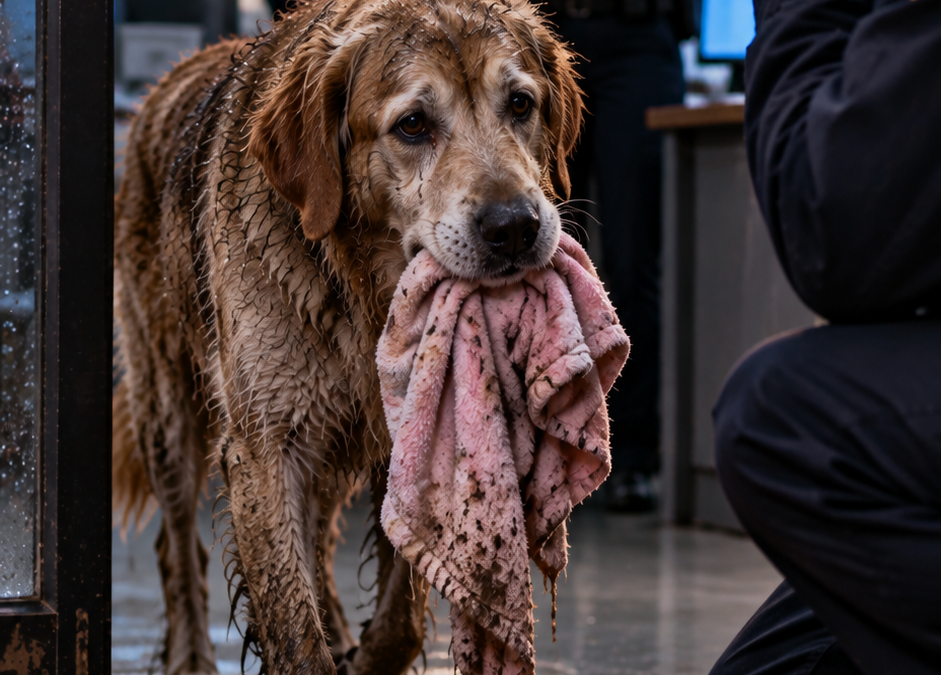
Dark coat under layers of mud.
Rainwater dripped from his fur.
His body was painfully thin.
Even in the poor light, I could see ribs.
One back leg didn’t sit quite right.
Old injury, I thought.
His ears carried scars.
One had a small piece missing from the edge.
No collar.
No tag.
Definitely not somebody’s well-cared-for pet out for a midnight stroll.
“Come on.”
I motioned away from the entrance.
“Off you go.”
The dog looked directly at me.
There was something uncomfortable about the stare.
Not aggression.
Not fear.
Purpose.
I stepped forward.
He stepped past me.
Straight into the station.
“Hey.”
I turned.
The constable stood.
The dog ignored both of us.
He walked across the floor with a strange, controlled determination.
Then I saw something hanging from his mouth.
Small.
White.
For some reason, my entire body went cold before I understood why.
The dog stopped at my boots.
Lowered his head.
And carefully placed the object on the tile.
A sock.
A child’s sock.
White.
Mud-stained.
Soaked.
And near the top—
a small pink strawberry.
I stopped breathing.
The constable whispered, “Sergeant?”
I crouched.
For a second, I couldn’t touch it.
My brain was already replaying Sarah Parker.
White socks.
Strawberries.
I picked it up carefully.
Mud.
Water.
Grass.
Tiny.
Four-year-old tiny.
“Call the search coordinator.”
The constable moved instantly.
I looked at the dog.
“Where did you get this?”
His ears rose.
I felt foolish and desperate at the same time.
“You found a girl?”
He stared.
“A little girl?”
The dog turned toward the door.
Walked several steps.
Stopped.
Looked back.
My heart began hammering.
“No way.”
The dog looked toward the door again.
The constable was already on the radio.
“Possible evidence located at station.”
I stood.
“Tell them I’m moving.”
“Moving where?”
I looked at the dog.
“I don’t know yet.”
“Sergeant—”
I grabbed my jacket.
“The dog does.”
I understand how that sounds.
Twenty-two years in police work.
Training.
Procedure.
Evidence.
Command structures.
And at three in the morning, I was preparing to follow a stray dog because he had brought me a sock.
But the sock changed everything.
He had found it somewhere.
Maybe discarded.
Maybe near a trash bin.
Maybe miles from Hollis.
Or maybe directly beside her.
I did not have enough information to treat his behavior as proof.
I had more than enough to investigate.
I opened the station door.
The dog went out.
Then stopped beside my patrol car.
He sat near the passenger side.
I stared.
“You want in?”
Nothing.
I opened the passenger door.
He jumped inside immediately.
Not clumsily.
Not fearfully.
He climbed onto the seat, turned once, and sat facing forward.
Like he’d done it before.
I stood there for half a second.
“Who are you?”
His head turned toward me.
I got behind the wheel.
The constable came outside.
“Search teams are asking where you’re going.”
“Tell them south from the station.”
“That’s a big area.”
“I’ll update.”
He looked at the dog.
“You’re following him?”
“I’m following the sock.”
That sounded slightly better.
I put the car in gear.
We pulled away.
The dog stood.
At the first intersection, I slowed.
I had no idea which direction to take.
He barked.
One short, sharp bark.
Toward the left.
I turned left.
“This better mean something.”
He remained standing.
We drove another mile.
Second intersection.
I slowed again.
The dog shifted.
Bark.
Left.
I turned.
Now I radioed.
“Unit 12 moving south on Mill Road.”
Dispatch responded.
“Destination?”
“Unknown.”
Pause.
“Repeat?”
“Unknown.”
Another pause.
“Following potential evidence trail.”
I looked at the dog.
That was true enough.
At the next junction, he gave another bark.
Right this time.
I followed.
Twenty-two years of policing had taught me to distrust certainty.
But the dog did not hesitate.
Not once.
At every turn, he reacted before I chose.
His body would tense.
His nose lifted.
Sometimes he scratched once at the window.
Sometimes one precise bark.
Always a direction.
We moved farther from the campsite.
That bothered me.
Search teams had focused mostly around the forest and lake.
The dog was leading toward old farmland and rocky slopes south of the normal camping area.
I radioed coordinates.
“Have teams begin moving toward my position.”
“Reason?”
I looked at the sock on the console inside an evidence bag.
“Possible trail connected to missing child.”
That got movement.
No more questions.
The roads narrowed.
Pavement became broken.
Then gravel.
The dog grew more restless.
I drove faster than I should have on those roads.
Branches scraped the sides of the patrol car.
Mud kicked against the wheel wells.
My headlights swept across stone walls and empty fields.
I tried to imagine Hollis traveling this far.
Could a four-year-old walk it?
Maybe.
But why?
Had she followed something?
Become frightened?
Taken a wrong path?
Been moved?
That last possibility darkened everything.
I glanced at the dog.
“Did you find her alone?”
He panted.
“Great talk.”
Another turn.
We passed an abandoned barn.
Then another structure I recognized.
An old stable complex.
Closed for years.
The road ended near it.
The dog began whining.
First sound I’d heard from him other than those directional barks.
I stopped.
Before the engine was fully off, he jumped from the passenger seat.
“Wait.”
He didn’t.
He ran around the back of the old stable.
I grabbed my flashlight.
Radio.
Jacket.
“Dispatch, Unit 12 on foot.”
“Location confirmed.”
“Send medical and nearest search team.”
“Have you located the child?”
“Negative.”
I looked at the disappearing dog.
“But I think I’m close.”
I ran.
The terrain behind the stable was terrible.
Wet grass.
Rock.
Old fencing half buried in weeds.
The dog moved despite his bad leg with astonishing speed.
“Slow down.”
He glanced back.
Then kept going.
My flashlight beam bounced wildly.
I slipped once and caught myself against a tree.
The dog stopped twenty yards ahead.
Looked back.
Waited.
“I’m coming.”
He moved again.
There was something surreal about the whole thing.
A veteran police sergeant running through darkness behind a half-starved stray.
No map.
No visible trail.
Trusting an animal I had met fifteen minutes earlier.
But every instinct I had developed in twenty-two years told me not to stop.
We crossed a narrow field.
Then a rocky incline.
The dog disappeared behind tall grass.
I followed.
He had found a path I could barely see.
Maybe animals had used it.
Maybe children.
Maybe nobody for years.
The farther we went, the more I understood why searchers had missed it.
From the campsite, the natural routes pulled you elsewhere.
This area looked inaccessible.
Uninviting.
Nothing obvious to attract a child.
Yet somewhere ahead, the dog knew exactly where he was going.
I radioed again.
“Trail south of abandoned Hawthorne stables.”
“Teams eight minutes out.”
“Medical?”
“Approximately fifteen.”
Too long if Hollis was critically cold.
I kept moving.
The dog stopped.
Not gradually.
Instantly.
His whole body froze.
We had reached an old drainage ditch.
Wide.
Dry.
Overgrown.
Something metallic lay across part of it.
A rusted sheet of corrugated metal, perhaps from a roof.
The dog walked to the edge.
Looked down.
Then looked at me.
His body trembled.
He barked.
Not the sharp command-like sound from the car.
This bark was soft.
Almost a whine.
I approached.
My flashlight swept across the ditch.
Mud.
Rocks.
Metal.
Then—
pink.
A piece of fabric beneath the sheet.
My heart stopped.
“Hollis?”
Nothing.
I scrambled down.
“Hollis!”
Still nothing.
I dropped to one knee and angled the light underneath the rusted metal.
There she was.
Curled so tightly she barely looked human.
Pink nightshirt.
Mud across her legs.
One bare foot.
One white sock with little strawberries.
The other sock was in my car.
Her face was dirty.
Hair stuck to her forehead.
One leg lay strangely.
A dark line ran from a small cut near her hairline down her cheek.
Her eyes were closed.
For half a second, my training vanished.
I thought:
Too late.
Then I saw her lips move.
Barely.
A tremor.
“Hollis.”
I crawled closer.
“Hollis, can you hear me?”
No response.
I touched her neck.
Pulse.
Weak, but there.
“Dispatch.”
My voice came out harder than intended.
“Child located.”
The dispatcher immediately answered.
“Condition?”
“Unconscious or minimally responsive.”
“Breathing.”
“Severe cold exposure.”
“Possible leg injury.”
“Speed medical.”
The words were professional.
My hands were not.
They shook as I moved the metal.
“Hollis.”
Her eyelids fluttered.
I heard the faintest sound.
Not a word.
Just breath.
“I’m Sergeant Michaels.”
“You’re safe.”
I don’t know whether she heard me.
I removed my jacket.
Wrapped it around her.
She was frighteningly cold.
Children are small when you see them playing.
They become impossibly small when you lift them injured from the ground.
I picked her up.
She weighed almost nothing in my arms.
Her head rested against my chest.
One leg shifted and she whimpered.
“Okay.”
“Okay.”
“I know.”
“We’re not moving that leg more than we need.”
The dog stood above us.
Watching.
Not approaching.
Not barking.
He simply watched.
I looked up.
“You found her.”
His tail moved.
One small sweep.
Then another.
No celebration.
No demand.
He sat.
As if this was the moment he had been trying to reach and now that I was there, his work was finished.
Search personnel arrived first.
Then medical.
The woods filled with light and voices.
One volunteer stopped when he saw Hollis in my arms.
“Oh God.”
“Blankets.”
I said.
“Now.”
A medic took her.
Assessment began.
Airway.
Breathing.
Temperature.
Pulse.
Leg.
Possible ankle fracture.
Dehydration.
Hypothermia.
I stood beside them, suddenly aware of how hard I was breathing.
“How bad?”
The medic looked at me.
“She’s cold.”
“I can see that.”
“We’re moving.”
“Will she make it?”
He gave me the answer medical professionals give when they refuse to promise.
“We got her.”
That wasn’t what I asked.
But it was enough.
As they carried her toward the ambulance, I looked for the dog.
He stood near the edge of the lights.
Mud-caked.
Thin.
Scarred.
Almost invisible again.
I walked over.
He lowered his head slightly.
“Come here.”
He hesitated.
I crouched.
“You did good.”
No movement.
I put out one hand.
“Come on.”
He approached.
Slowly.
Sniffed my fingers.
Then pressed his head against my palm.
I closed my eyes.
For the first time that night, I felt something crack inside me.
I’d been running on training.
Procedure.
Pressure.
Get the child.
Get medical.
Get coordinates.
Keep moving.
Now there was simply a dog leaning into my hand.
A dog nobody knew.
A dog with old wounds and no collar.
A dog who had found what dozens of trained humans hadn’t.
“Who the hell are you?”
His tail moved.
An officer behind me said, “Sergeant?”
I stood quickly.
“Take him with us.”
“The dog?”
“Yes.”
“Animal control?”
“No.”
I looked at him.
“Not yet.”
At the campsite, Sarah Parker saw the ambulance before she saw me.
She ran.
James followed.
The medic tried to slow her.
“My daughter.”
“We have her.”
Sarah stopped.
“What?”
I had never seen a human face change so quickly.
“We found her.”
Her knees buckled.
James caught her.
“She’s alive?”
“Yes.”
“Oh God.”
Sarah made a sound I still hear sometimes.
Not quite a scream.
Not quite crying.
Something deeper.
A body releasing terror all at once.
She pushed toward the ambulance.
“Hollis!”
The doors were still open.
The medic allowed her close.
“She’s very cold.”
“Possible ankle fracture.”
“We’re taking her now.”
Sarah touched Hollis’s hair.
“My baby.”
James stood behind her crying openly.
No shame.
No restraint.
Then Sarah turned toward me.
“You found her.”
I looked past her.
The dog had jumped from another patrol vehicle.
He stood near the edge of the lights.
“No.”
I said.
“He did.”
Sarah followed my gaze.
The dog stared back.
“Whose dog is that?”
“I don’t know.”
“What do you mean?”
I took the evidence bag from my coat.
Inside was the sock.
Sarah saw it.
Her hand flew to her mouth.
“He brought this to the station.”
She stared.
“What?”
“At three in the morning.”
“He walked into the station carrying it.”
“And then he led me to her.”
Sarah looked from the sock to the dog.
“No.”
Her voice was barely there.
James stepped closer.
“You’re saying that dog found Hollis?”
“I’m saying I followed him straight to where she was.”
Sarah began crying again.
She walked toward the dog.
Slowly.
He did not run.
When she reached him, she crouched.
“You stayed with her?”
The dog watched her.
“You found my baby?”
His head lowered.
Sarah wrapped both arms around him.
For a second, his body became rigid.
Then he softened.
James covered his face.
I looked away.
Some moments belong to families even when the person in the middle of them has four legs.
Hollis spent the next days in the hospital.
Her ankle was fractured.
She was dehydrated.
Her body temperature had fallen to a dangerous level.
The doctors told the Parkers what we already understood.
Another few hours in that cold could have changed everything.
No one used the word death around Sarah.
No one needed to.
We all knew.
The dog went to a local veterinarian.
I insisted.
He needed treatment.
The vet called me later that morning.
“Male.”
“About six or seven, best guess.”
“Underweight.”
“Dehydrated.”
“Old injury in the rear leg.”
“Scarring on both ears.”
“Any chip?”
“No.”
“Collar mark?”
“Not recently.”
“How long stray?”
“Impossible to know.”
“Months?”
“Could be.”
“Years?”
“Could be.”
No chip.
No registration.
No one claiming him.
We released photographs through local media.
DOG WHO HELPED FIND MISSING CHILD — OWNER SOUGHT
People shared the image.
Calls came.
Most useless.
“I saw a dog like that six months ago.”
“My cousin had one.”
“Looks like my neighbor’s old dog.”
Nothing matched.
No owner.
No history.
No explanation.
Meanwhile, a different mystery began to emerge.
Hollis started talking.
Not much.
At first, almost nothing.
Her parents were told not to push.
Trauma in children doesn’t always come out as words.
Sometimes it becomes silence.
Sleep problems.
Clinging.
Fear.
Hollis stared through hospital windows.
Held Sarah’s hand.
Asked for water.
That was about it.
The dog visited after the veterinarian cleared him.
Hospital staff resisted initially.
Understandably.
Then the story got around.
Policies became flexible.
The first time they brought him into Hollis’s room, he stopped in the doorway.
She was sitting upright in bed.
Ankle immobilized.
Small bandage on her forehead.
Sarah beside her.
Hollis looked at the dog.
The dog looked at Hollis.
Then his tail began moving.
Slowly.
He walked to the bed.
Placed his chin on the mattress.
Hollis reached toward him.
Her fingers touched his ear.
The scarred one.
She said nothing.
The dog stayed.
For twenty minutes.
Then thirty.
When staff tried to take him out, Hollis grabbed his fur.
Not hard.
Just enough.
“Stay.”
It was one of the first clear words she had said all morning.
They let him stay longer.
That was when the Parkers started calling him Scout.
James told me later.
“Because he found her.”
Simple enough.
Scout.
The name stuck immediately.
Two days after Hollis came home, I stopped by their house.
Officially, I was checking on details from the case.
Unofficially, I wanted to see the dog.
Scout was lying at the foot of Hollis’s bed.
He lifted his head when I entered.
Tail moved.
“Well, hello to you too.”
Hollis watched me.
She was quieter than the child described in the missing-person notes.
Those reports called her energetic.
Talkative.
Curious.
The girl in bed looked cautious.
Like the world had become less reliable overnight.
I crouched beside Scout.
“Taking over the house?”
Hollis looked at him.
Then at me.
“He’s mine.”
Sarah, standing by the door, covered her mouth.
James looked away.
It may have been the first time Hollis had claimed anything with confidence since coming home.
I nodded.
“I figured.”
Scout lifted his head toward her.
She touched the scar on his ear.
Then she touched the healing cut on her forehead.
“Same.”
I looked.
The scars weren’t actually identical.
Not medically.
But to a four-year-old, shape and meaning matter differently.
“Same.”
I agreed.
Hollis stared at Scout.
Then she said something that made every adult in the room go silent.
“You came to get me.”
Sarah sat down hard in the nearby chair.
James’s eyes filled.
Scout simply looked at Hollis.
She repeated it.
“You came to get me.”
We learned more slowly.
In fragments.
Children remember trauma like broken glass.
Pieces.
Not always chronology.
Hollis remembered walking away from the campsite.
Why?
She wasn’t sure.
Maybe she followed lights.
Maybe a sound.
Maybe she was looking for something.
At some point, she slipped.
Her ankle twisted badly.
She crawled.
She remembered rain.
Cold.
Darkness.
Then the old drainage ditch.
The metal sheet provided some shelter.
She curled underneath.
She lost one sock.
Or maybe Scout pulled it free later.
No one knew.
What she remembered clearly was the dog.
“It was dark.”
She told Sarah.
“Then he came.”
“What did he do?”
“He smelled me.”
“Did you touch him?”
Hollis nodded.
“He was wet.”
“Was he scary?”
“No.”
“He was warm.”
That detail mattered.
Sarah looked at me later.
“You think he lay with her?”
“Probably.”
Hollis said he did.
Scout curled against her.
Licked the cut on her forehead.
Stayed.
Then left.
Then came back.
Then left again.
At four years old, she couldn’t explain why.
I could.
He had found her.
Then he went looking for help.
Maybe he explored nearby roads.
Maybe he recognized human buildings.
Maybe the police station lights drew him.
Maybe he had once belonged to someone connected with law enforcement.
People invented explanations.
Newspapers loved that part.
STRAY DOG LEADS POLICE TO LOST GIRL
MYSTERY HERO DOG SAVES FOUR-YEAR-OLD
HOW DID SCOUT KNOW WHERE TO GO?
Everyone asked me the same question.
How?
My answer never changed.
“I don’t know.”
People dislike that.
They want mystery resolved.
Especially reporters.
“Could he have followed scent to the station?”
“Maybe.”
“Had he been there before?”
“Possibly.”
“Was he trained?”
“No evidence.”
“Could he understand that the sock belonged to the child?”
“I have no idea.”
“Did he intentionally bring it as evidence?”
I laughed at that.
“Evidence is a human word.”
“What do you think happened?”
That question was harder.
What did I think?
I thought Scout knew the small human he had found needed help.
I thought he understood the sock smelled like her.
I thought he took something connected to Hollis and carried it until he found another human willing to follow.
Whether that was conscious reasoning or instinct didn’t matter much to me.
He did it.
That was enough.
There were stranger details.
Scout had chosen the police station.
Not a house.
Not a gas station.
Not the nearest occupied building.
The station.
Why?
No answer.
He knew how to ride in a vehicle.
Why?
No answer.
He understood intersections.
Waited.
Barked directions.
Had he traveled the route before?
Probably.
Maybe he had followed roads while searching for help.
Maybe the station had been one stop among several.
Maybe other people had ignored him.
That possibility stayed with me.
Had he carried the sock to another door first?
Had someone told him to go away?
Had he scratched elsewhere?
No one ever came forward.
The town adopted the mystery along with the dog.
And eventually, the Parkers adopted Scout legally.
No hesitation.
Sarah told me:
“I don’t care if someone appears tomorrow claiming he belonged to them years ago.”
“That’s a legal problem for tomorrow.”
“Today he’s coming home.”
Luckily, nobody appeared.
Scout moved into the Parker house.
At first, he seemed unsure what to do with walls.
He ate too quickly.
Slept near doors.
Startled when someone raised their voice.
Hid food.
The first week, Sarah found half a bread roll buried beneath a blanket.
He disliked men wearing baseball caps.
He froze at the sound of chains.
Those things told a story none of us could document.
Old fear.
Old survival.
Possibly old cruelty.
But he also adapted.
Fast.
Especially to Hollis.
He slept at the foot of her bed.
Every night.
No exceptions.
If Hollis woke from nightmares, Scout was there before her parents.
Sarah told me she would hear Hollis crying through the baby monitor.
Then Scout moving.
His tags making a small sound.
By the time Sarah entered the room, Hollis would often have one hand buried in Scout’s fur.
Breathing slower.
Sometimes asleep again.
“He knows.”
Sarah told me.
“Knows what?”
“When she’s afraid.”
I looked at the dog.
“I believe that.”
Hollis began talking more.
Then laughing.
The first full laugh Sarah heard after the disappearance came because Scout tried to carry three tennis balls at once.
He managed two.
The third kept falling.
Hollis laughed so hard she slid off the couch.
Sarah cried in the kitchen afterward.
Not because she was sad.
Because she had been waiting to hear that sound.
Scout helped bring it back.
I visited more than was professionally necessary.
I’ll admit that.
Part of it was Hollis.
Part of it was the case.
Mostly, it was Scout.
I had spent twenty-two years encountering people at their worst.
Police work teaches you to be suspicious for good reasons.
You see lies.
Violence.
Neglect.
Cowardice.
People harming those they claim to love.
People abandoning responsibility.
Then a dog with scars on his ears appears carrying a child’s sock and reminds you loyalty exists without paperwork.
I needed that.
More than I realized.
One afternoon, several months later, Hollis was playing in the yard.
Her ankle had healed.
Scout followed her everywhere.
Not close enough to interfere.
Never far enough to lose sight of her.
I sat with James on the back steps.
“Does he ever stop watching her?”
“No.”
“He follows her to the bathroom.”
“That seems excessive.”
“Hollis agrees.”
Scout sat thirty feet away while Hollis drew with sidewalk chalk.
James became quiet.
Then said, “I still dream about that night.”
I looked at him.
“Me too.”
“In mine, you don’t find her.”
I said nothing.
He rubbed his hands together.
“Sometimes I wake up and I have to go check.”
“She’ll be asleep.”
“Scout too.”
“Then I stand there like an idiot.”
“You’re not an idiot.”
“I left her alone for five minutes.”
There it was.
Months later.
Still guilt.
“James.”
“I know what you’re going to say.”
“Do you?”
“That it could happen to anyone.”
“No.”
He looked at me.
“I was going to say you can’t keep punishing yourself and still be fully present for the child who came home.”
He stared.
“That’s different.”
“It’s also harder.”
James looked toward Hollis.
Scout had moved closer because she had walked toward the gate.
The dog positioned himself between her and the road.
James saw it too.
“He’s better at this than I am.”
“No.”
“He’s just not wasting energy on guilt.”
James smiled faintly.
“That’s annoyingly profound for a police sergeant.”
“Don’t tell anyone.”
The strawberry sock became famous locally.
That bothered me more than the dog becoming famous.
It was evidence.
It represented one of the worst nights of a family’s life.
But Sarah eventually decided to keep it after the case documentation no longer required it.
She washed it.
Framed it.
Alongside the sentence Hollis had said:
YOU CAME TO GET ME.
The frame hung in their kitchen.
Visitors always asked.
Hollis would point toward Scout.
“He brought it.”
By the time she was six, the story had become part memory, part family legend.
By seven, she corrected people who called Scout a police dog.
“He’s not.”
She would say.
“He’s my dog.”
That distinction mattered to her.
Scout had become older too.
Gray around the muzzle.
His damaged back leg became stiffer in winter.
The Parkers paid for treatment.
Better food.
A warm orthopedic bed he rarely used because he preferred Hollis’s room.
I once joked that Scout had gone from sleeping in ditches to rejecting expensive bedding.
Sarah said:
“That’s success.”
I agreed.
Years after the rescue, I was asked to speak to a class of new recruits.
Training room.
Young officers.
Most of them looked painfully young to me by then.
Someone asked the standard question.
“Sergeant, what’s the strangest case you’ve ever worked?”
I had plenty of options.
Drunk man reporting his own stolen car while sitting in it.
Burglary suspect hiding inside a children’s inflatable pool.
Woman who called because a goose wouldn’t let her leave her car.
Twenty-two years offers material.
But I thought of the sock.
“The dog.”
Several recruits smiled.
“What dog?”
So I told them.
Missing girl.
Cold night.
Three in the morning.
Scratch at the station door.
Stray.
Sock.
Strawberry.
Car.
Intersections.
Drainage ditch.
Child alive.
By the time I finished, no one was smiling.
One young officer asked:
“You really followed a stray dog without backup?”
“Backup was moving.”
“But you went first.”
“Yes.”
“Wasn’t that against procedure?”
There are always recruits who love procedure before experience teaches them what procedure is for.
I said, “Procedure helps you make good decisions.”
“It does not remove the need to make them.”
He nodded.
Another asked:
“How did the dog know?”
I smiled.
“That’s the part you’re supposed to explain to me.”
They laughed.
I became serious.
“I don’t know.”
“And be careful around anyone who pretends they know everything about a moment like that.”
“Maybe scent.”
“Maybe memory.”
“Maybe prior training.”
“Maybe instinct.”
“What matters operationally is that he brought a physical item matching the missing child’s clothing.”
“Then repeatedly demonstrated directional behavior.”
“That’s information.”
I looked across the room.
“You don’t have to believe in miracles to follow evidence.”
That line eventually became something people repeated back to me.
I never meant it as wisdom.
Just police work.
But privately, I admitted there was a part of Scout’s story evidence couldn’t completely satisfy.
Facts explained what happened.
They didn’t fully explain why this particular abandoned dog chose to help this particular child on this particular night.
Maybe coincidence.
Maybe biology.
Maybe the human mind is too hungry for meaning.
All possible.
But I had been there.
I saw the dog sit at the edge of the ditch after Hollis was in my arms.
Saw the tail move twice.
Saw him stop.
He knew something had changed.
Mission accomplished is too human a phrase.
But that’s what it looked like.
Scout never asked for anything in return.
That part stays with me.
He didn’t find Hollis because someone fed him.
Didn’t guide me because he expected a home.
Didn’t know newspapers would print his photograph.
He acted before reward existed.
Maybe that is why people respond so strongly to stories about animals.
We distrust human motives because we’ve seen how complicated they become.
Animals can be complicated too.
But loyalty often looks cleaner.
Scout saw someone vulnerable.
Stayed.
Then went for help.
That’s the whole moral if you need one.
Years later, Sarah sent me a photograph at Christmas.
Hollis was seven.
Scout lay beside her.
She wore white socks with strawberries.
Not the original pair.
New ones.
Apparently she had decided strawberry socks were lucky.
I called Sarah.
“You’re really letting her wear those?”
Sarah laughed.
“She insists.”
“That seems psychologically complicated.”
“Thomas, she’s seven.”
“Fair.”
“She says Scout found her because of the sock.”
“Technically, Scout found me because of the sock.”
“Don’t correct her story.”
“I wouldn’t dare.”
Hollis took the phone.
“Sergeant Michaels?”
“Hello, troublemaker.”
“I’m not a troublemaker.”
“You started the largest search operation that county saw all year.”
“I was four.”
“Convenient defense.”
She giggled.
Then asked:
“Do you still have the picture of Scout at the police station?”
“Yes.”
“Mom says he was ugly.”
Sarah shouted from the background, “I said filthy!”
Hollis laughed.
I said, “He was very muddy.”
“He looks handsome now.”
“I’ve seen.”
“Do you know why he found me?”
There it was again.
The question adults had asked for years.
I gave Hollis a different answer.
“Because he was looking.”
She became quiet.
“What does that mean?”
“It means a lot of people wanted to find you.”
“But Scout did.”
“Yes.”
“Because he was closer?”
“Maybe.”
She thought.
Then said:
“I think he knew I was scared.”
I looked at the photograph on my desk.
Scout at the station.
Wet.
Thin.
Sock in his mouth.
“Maybe he did.”
Hollis sounded satisfied.
Children don’t always need explanations.
Sometimes recognition is enough.
The case changed how I treated animals at calls.
Not dramatically.
I did not become the officer who assumed every barking dog was Lassie delivering coordinates.
But I paid attention differently.
Behavior is information.
Not proof.
Information.
A dog refusing to leave one area.
A horse reacting to something unseen.
An animal repeatedly returning to a location.
Most of the time, there’s a mundane explanation.
Sometimes there’s not.
That principle applies to people too.
The world talks constantly.
Most of us aren’t trained to listen unless language arrives in expected forms.
Scout didn’t have language.
He had persistence.
That was enough.
I retired years later.
Twenty-eight years total.
At my retirement gathering, someone displayed old photographs from notable cases.
Some were funny.
Some serious.
Then Scout appeared on the screen.
Standing beside my patrol car.
Mud all over him.
I had forgotten the picture existed.
People applauded.
I shook my head.
“Wrong officer.”
A younger detective said, “What?”
“You’re applauding the wrong guy.”
Everyone laughed.
I pointed at Scout.
“He did the work.”
Later that night, Sarah and James arrived.
Hollis came with them.
She was older now.
Tall enough that I had to stare for a second before recognizing the four-year-old face inside the teenager.
And Scout—
Scout came too.
Very old.
Gray.
Slow.
But he walked into the room under his own power.
The moment he saw me, his ears lifted.
I crouched.
“Don’t you dare make me emotional in front of these people.”
He walked over.
Slowly.
Placed his head against my knee.
The room went blurry.
Hollis smiled.
“He remembers you.”
“Apparently.”
I scratched behind the scarred ear.
“Still causing trouble?”
His tail moved.
Once.
Twice.
Exactly like the ditch.
I had to look away.
Hollis sat beside us.
“Mom told me you almost sent him away.”
I groaned.
“She still tells that?”
“All the time.”
“I opened the door to send him outside.”
“That’s basically sending him away.”
“Police records will reflect a more nuanced version.”
She laughed.
Then became quiet.
“I remember him.”
I looked at her.
“From that night?”
“Parts.”
“What parts?”
“The cold.”
“The metal thing over me.”
“The dirt.”
She touched the small scar on her forehead.
“This.”
Then Scout.
“I remember him breathing near my face.”
Her voice softened.
“I remember holding his fur.”
“Anything else?”
“He left.”
I nodded.
“I thought he wasn’t coming back.”
I felt that sentence in my chest.
“But I wasn’t angry.”
“Why?”
“I think I knew he was doing something.”
She looked at him.
“Then people came.”
We sat quietly.
Hollis said, “I used to think he came back with you.”
“He did, in a way.”
“Yeah.”
She smiled.
“Mom still has the sock.”
“Of course she does.”
“She’d save a grocery receipt if it had emotional significance.”
“Also true.”
Scout lowered himself carefully onto the floor.
Hollis immediately adjusted a blanket beneath him.
Automatic care.
The child he had warmed in a ditch now protecting his old joints from a hard floor.
That felt like a circle closing.
I asked:
“What do you want to do when you’re older?”
She shrugged.
“Maybe veterinary medicine.”
I smiled.
“Scout’s influence?”
“Probably.”
“Your parents know?”
“Mom cries every time I mention it.”
“That sounds like Sarah.”
Hollis looked at me.
“Do you think things happen for a reason?”
That question is dangerous.
Especially from a child connected to a story everyone else calls miraculous.
I took my time.
“I think things happen.”
“Then people decide what they mean.”
She considered.
“So you don’t believe Scout was meant to find me?”
“I believe he found you.”
“That’s already remarkable.”
She smiled.
“That’s a police answer.”
“Occupational damage.”
“But…”
I looked at the old dog.
“I’m grateful the world put him close enough to hear you.”
Hollis rested one hand on Scout’s head.
“Me too.”
Scout died the following winter.
Sarah called me.
I knew from her voice.
“He went this morning.”
I sat down.
“I’m sorry.”
“Hollis was with him.”
“James too.”
“At home?”
“Yes.”
“Good.”
Sarah cried.
“He slept in her room last night.”
“Of course.”
“Hollis lay on the floor beside him.”
For a moment, I couldn’t speak.
Then Sarah said:
“She told him, ‘You came to get me. I stayed to let you go.'”
That sentence ended me.
Twenty-eight years in law enforcement.
Deaths.
Accidents.
Funerals.
Families.
And I sat in my kitchen crying over a stray dog I had met because he carried a dirty sock into a police station.
My wife found me.
“What happened?”
“Scout.”
She understood.
Everyone in my family knew Scout’s story.
She sat beside me.
For a while, neither of us spoke.
Then she said:
“He had a good life after.”
“Yes.”
“That’s because of them.”
“Partly.”
“And because of him.”
“Mostly.”
Scout was buried on the Parker property beneath a tree near Hollis’s bedroom window.
They placed a small stone.
No dramatic inscription.
Just:
SCOUT
HE CAME TO FIND ME
When Sarah sent me the photo, I kept it.
I keep a lot of things from that case.
A copy of the missing-child bulletin.
Photograph of Scout at the station.
A newspaper clipping I pretend I don’t care about.
And one picture of Hollis at seven in strawberry socks with Scout beside her.
Not the actual sock.
That belongs to the Parkers.
Good.
Evidence eventually becomes memory.
Memory belongs where it matters.
Young officers still ask me about the strangest case I ever handled.
Even after retirement.
Someone always knows someone who knows the story.
“You’re the officer with the dog, right?”
I correct them.
“No.”
“The dog was the one with the officer.”
That usually gets a laugh.
Then I tell the story.
I tell them about a four-year-old girl in a pink nightshirt.
Her parents.
The falling temperature.
The useless leads.
The mud-covered dog.
The sock.
The strawberry.
The passenger seat.
The turns.
The abandoned stable.
The ditch.
The tiny movement of Hollis’s lips when I thought for one horrible second we were too late.
And the dog sitting at the edge after I lifted her.
I always slow down there.
Even now.
There are moments your body stores more faithfully than your mind.
I remember the cold weight of Hollis in my arms.
The wet sleeve of my uniform.
Scout’s eyes.
The two movements of his tail.
People ask how he knew.
I still don’t know.
Maybe no one ever will.
And I have become comfortable with that.
Twenty-two-year-old me would have hated an unanswered question.
Forty-year-old me would have investigated until every possibility had been exhausted.
Older me understands something different.
Not every mystery needs to be solved to be respected.
We know enough.
A child was lost.
A stray found her.
The stray stayed long enough to help keep her warm.
He took a sock.
He carried it to a place with people.
He guided one of those people back.
The child lived.
The dog gained a family.
Those are facts.
Maybe they are enough.
There is one part I think about more as I get older.
Scout was unwanted before that night.
At least, that’s what his condition suggested.
No collar.
No chip.
Old scars.
Thin.
Injured.
Living outside human care.
Somewhere in his past, a person had failed him.
Maybe several people.
We never knew.
Yet when Scout encountered a helpless human being, he did not return the world’s cruelty.
He helped.
I don’t romanticize animals as morally perfect.
They’re animals.
But there is something powerful in that.
A creature with every reason to avoid humans chose to trust us enough to seek help.
Then a human family chose to trust him enough to bring him home.
Rescue went both ways.
Scout saved Hollis.
The Parkers saved Scout.
And if you ask Sarah, she’ll tell you Hollis and Scout saved something in all of them after that night.
James stopped assuming time with family was guaranteed.
Sarah stopped treating ordinary mornings as background noise.
Hollis grew up knowing that safety could have fur and scars.
Maybe that’s what extraordinary events do.
They rearrange the value of ordinary ones.
Breakfast.
Bedtime.
A dog asleep near a child.
Doors locked.
Voices in the next room.
The small evidence that everyone came home.
For years after the disappearance, James checked Hollis’s bedroom every night before sleeping.
Even when she was ten.
Even when she was thirteen.
He tried to stop.
Couldn’t.
Scout always looked up when he entered.
James told me once:
“He’d look at me like, I’ve got her.”
That made it easier for him to close the door.
That’s trust.
Not absence of fear.
Enough confidence to leave the room anyway.
I think about the station door too.
That scratch.
If the television monitor hadn’t caught my eye.
If I had poured coffee first.
If I had opened the door and scared Scout away.
If he had dropped the sock outside.
If I hadn’t remembered the strawberries.
If.
Police officers learn not to live in if.
Too many cases generate them.
If the driver had left two minutes later.
If the victim had answered one call.
If the weather had changed.
If.
The only useful version is the real one.
Scout scratched.
I looked.
He entered.
I followed.
Hollis lived.
That is enough.
But there is still a lesson in the first impulse I had.
Send the dog away.
Not because I was heartless.
Because I thought I already knew what mattered.
Missing child mattered.
Stray dog didn’t.
The strange part is that the stray dog was the missing-child case.
I had separated the important thing from the apparent distraction.
Life does that to us constantly.
We decide in advance what information should look like.
What a witness should look like.
What help should look like.
That night, help looked like mud, ribs, scars, and a child’s sock held carefully between teeth.
If I had waited for help to look official, Hollis might not have made it.
That stays with me.
Not as superstition.
As humility.
Pay attention to what doesn’t fit.
Not everything unusual matters.
But sometimes the thing that seems out of place is the thing carrying the answer.
Hollis is grown now.
She still wears strawberry socks sometimes.
Not every day.
Not because she genuinely thinks they alter probability.
She says they remind her.
I asked what they remind her of.
She said:
“That being lost isn’t the same as being forgotten.”
I had to write that one down.
She became a veterinarian.
No surprise.
She works often with rescue animals.
Especially older ones.
Especially the ones people overlook.
When I visited her clinic after it opened, there was a photograph behind the reception desk.
Scout.
Older.
Gray-faced.
Lying in sunlight.
Underneath:
YOU CAME TO GET ME.
I stood there longer than I intended.
Hollis came out wearing scrubs.
“You’re staring.”
“I noticed.”
“You okay?”
“Yes.”
She smiled.
“You still tell the story?”
“Sometimes.”
“Do you exaggerate?”
“I’m a retired police sergeant.”
“So yes.”
“I improve pacing.”
She laughed.
Then hugged me.
I was not prepared for that.
“What’s that for?”
“For following him.”
I pulled back.
“He brought evidence.”
“You still could’ve ignored him.”
I thought about the station.
The coffee.
The scratching.
My first instinct.
Go on.
Off you go.
“Yeah.”
I said.
“I suppose I could have.”
Hollis looked at Scout’s photograph.
“He didn’t ignore me.”
“No.”
“He didn’t.”
That’s the part of the story that matters most to her.
Not that Scout became famous.
Not that a police sergeant followed him.
Not the newspapers.
Not even the sock.
A living creature found her when she was cold, hurt, and alone.
And stayed.
Then left only to bring someone back.
Children understand that kind of loyalty immediately.
Adults complicate it with questions.
How?
Why?
Training?
Instinct?
Chance?
Hollis never needed those answers.
Scout came.
That was enough.
As for me, whenever I think of the strangest night of my career, I no longer begin with the missing-child bulletin.
I begin with the station door.
Scratch.
Pause.
Scratch.
I see a shadow on the surveillance monitor.
A muddy animal I almost dismissed.
Then that small white object touching the floor.
The strawberry.
Everything after that happened because I looked twice.
Maybe that is the lesson I carried longest.
Look twice.
At people.
At evidence.
At strange behavior.
At what seems inconvenient.
At what doesn’t fit.
Sometimes a child disappears in one direction while everyone searches another.
Sometimes the only witness can’t speak.
Sometimes the creature nobody claimed becomes the one who refuses to leave someone else behind.
Scout never wore a badge.
Never had training we could prove.
Never understood search grids or hypothermia protocols.
He had four damaged paws, scarred ears, a stubborn heart, and information nobody else had.
That night, it was enough.
More than enough.
He walked out of darkness carrying a child’s sock.
Years later, he left the world surrounded by the family that sock led him to.
I don’t need a better ending than that.
And if somewhere beyond everything we understand there is a place where old dogs run without pain, I like to imagine Scout the way I first saw him after Hollis was safe.
Sitting quietly.
Watching.
Tail moving once.
Then twice.
Knowing someone had finally followed him all the way to where he needed us to go.

