𝗙𝗨𝗟𝗟 𝗦𝗧𝗢𝗥𝗬 At 4 A.M., a Stray-Looking Dog Walked Into My Police Station Carrying One Man’s Shoe
𝗙𝗨𝗟𝗟 𝗦𝗧𝗢𝗥𝗬
The laces hung loosely from one side.
The toe was badly scuffed.
The dog walked across the lobby.
Stopped three feet in front of me.
Looked directly into my eyes.
Then lowered his head.
And placed the shoe on the floor.
Not dropped.
Placed.
Carefully.
Thomas slowly put down his pen.
“What the hell is this?”
Martinez stood.
Zhao appeared from the break area with her mug.
Nobody moved for several seconds.
The dog sat.
And waited.
I crouched.
“Hey, buddy.”
His ears twitched.
“You lose your owner?”
No reaction.
I held out one hand.
He sniffed it.
Then leaned his head very slightly against my fingers.
His body was cold.
“He’s been outside a while,” I said.
Martinez came closer.
“Collar?”
I checked.
No identification tag.
Just an old blue fabric collar with no writing left on it.
Thomas pointed toward the shoe.
“Maybe he stole it off somebody’s porch.”
“At four in the morning?”
Thomas shrugged.
“Dog crime is unpredictable.”
Zhao crouched on the other side.
The dog looked at her.
Then back at me.
His expression was unusually serious.
I know how that sounds.
People project emotions onto dogs constantly.
But I had been around enough working dogs and enough frightened animals to recognize agitation.
This dog wasn’t wandering.
He wasn’t confused.
He was waiting for us to do something.
I picked up the shoe.
The leather was damp.
Cold.
Mud marked one side of the sole.
It looked well worn, the kind of shoe somebody might use every day for years.
Near the heel, something caught my eye.
Blue thread.
“Hold on.”
I turned the shoe.
Inside the heel lining was a tiny hand-stitched flower.
Five pale blue petals.
Small enough that I might never have noticed it under normal circumstances.
Martinez leaned closer.
“That’s unusual.”
“Homemade repair?”
“Maybe.”
The dog stood.
For one second, I thought he was going to take the shoe back.
Instead, he walked toward the door.
Stopped.
Looked back at us.
Then returned to me.
Thomas pointed.
“He wants something.”
“Obviously,” Zhao said.
“Thank you, detective.”
Martinez ignored them.
She was studying the dog.
Then she said something that changed the direction of the entire night.
“Thomas, didn’t you mention seeing a dog like this during patrol?”
He frowned.
“When?”
“Earlier.”
Thomas looked closer.
“Maybe.”
He stood and came around the desk.
Then his expression shifted.
“Actually, yeah.”
“Where?”
“Old Oak Street.”
The dog immediately turned his head when Thomas said the name.
We all noticed.
Thomas continued.
“Yesterday evening. I was driving through around nine. There was a dog standing in front of one of the houses.”
“This dog?”
“I think so.”
“What was he doing?”
Thomas thought.
“Howling.”
“At the house?”
“Yeah.”
He looked at Bailey.
“But it wasn’t loud. That’s why I remember it.”
“What do you mean?”
“It sounded…”
Thomas searched for the word.
“Sad.”
The dog walked toward the door again.
Stopped.
Looked back.
Sergeant Martinez folded her arms.
“We’re following him.”
Thomas blinked.
“Seriously?”
She looked at him.
“An animal walks into a police station before dawn carrying a man’s shoe, refuses to leave, and keeps trying to get us outside.”
Thomas nodded slowly.
“When you put it like that.”
Martinez pointed at Zhao.
“You go with him.”
Then at me.
“You too.”
“Thomas?”
“Stays here with me.”
Thomas looked offended.
“I discovered the Old Oak Street connection.”
“And now you get to answer the phones.”
Cruel but fair.
Zhao grabbed her jacket.
I took mine.
The dog was already at the door.
“Okay, buddy,” I said. “Show us.”
He stepped outside.
We followed.
The streets were almost completely empty.
Millford looked different before dawn.
Storefronts dark.
Traffic lights changing for no one.
Mist hovering over the pavement.
The dog walked without hesitation.
No leash.
No commands.
He stayed several yards ahead, but every so often he looked back to make sure we were following.
Zhao walked beside me.
“You ever done this before?”
“Followed a dog carrying evidence through town at four in the morning?”
“Yes.”
“No.”
“Good.”
“Why?”
“I’d feel underqualified if you had.”
We crossed Main Street.
The dog turned left.
Then right.
He led us through a quiet residential block.
Across a small bridge over Miller Creek.
Through a park.
At one point he stopped near a drinking fountain and looked toward us.
I expected him to drink from a puddle.
He didn’t.
He kept moving.
That concerned me.
“He’s tired,” Zhao said.
“I know.”
“He hasn’t stopped once.”
The dog was limping slightly now.
Not badly.
Probably from distance.
I checked my phone.
We had already covered more than a mile.
Then Bailey left the residential area and headed toward the county road.
Zhao’s expression changed.
“Where is he going?”
“Apparently out of town.”
“This road gets dangerous farther up.”
“I know.”
There was a curve several miles ahead where the road narrowed near the wooded hills.
Too many drivers approached it faster than they should.
Two accidents had occurred there the previous month.
One minor.
One that required a helicopter.
Zhao looked at me.
“Think that’s where he’s taking us?”
I didn’t answer.
Because the dog suddenly began moving faster.
His entire posture changed.
His head lowered.
His pace became direct.
Urgent.
“Yeah,” I said. “I do.”
We picked up speed.
The road was damp.
Our boots crunched along the gravel shoulder.
The dog stayed ahead.
Five minutes.
Ten.
Maybe longer.
Time feels strange when you know you’re moving toward something but don’t know what.
Then we passed an abandoned roadside service station.
The pumps had been removed years earlier.
Only the cracked concrete pad and an old building remained.
The dog veered toward the grass.
And started barking.
Not wildly.
Short.
Sharp.
Urgent.
Zhao moved first.
“There!”
I saw silver through the weeds.
A car.
Small sedan.
Off the road.
Front end against a tree.
My stomach dropped.
We ran.
The driver’s side door was partly open.
One headlight still flickered weakly.
The hood had crumpled.
The windshield was cracked.
The dog reached the open door and pushed his head inside.
Then he whined.
A man was behind the wheel.
Older.
Maybe early sixties.
His upper body leaned partly toward the open doorway.
His face was pale.
Blood had dried near his hairline.
One foot was still wearing a shoe.
The other was bare.
I looked down at the shoe in my hand.
Same size.
Same color.
Same worn leather.
“Call it in,” I said.
Zhao already had her radio out.
“Dispatch, this is Zhao. We have a single-vehicle collision off County Route Nine near the old service station. One adult male, unconscious but breathing. Start EMS.”
I moved closer.
“Sir?”
No response.
I checked for a pulse.
Weak.
But there.
“He’s alive.”
The dog immediately pressed against the man’s leg.
“Easy.”
He licked the man’s hand.
His entire body trembled.
I looked at the bare foot.
Then at the shoe.
And understood.
The dog had taken it.
Somehow.
Maybe it had come loose in the crash.
Maybe he’d pulled it off.
I didn’t know.
But he had carried it all the way to us.
Not a wallet.
Not keys.
Not something we would immediately identify.
A shoe.
The only object he could manage.
The only piece of his person he knew how to bring.
“Zhao.”
She looked at me.
“You know what he did?”
Her face changed.
“Oh.”
We both looked at the dog.
“He went for help.”
She whispered it.
I nodded.
“He went all the way into town.”
The dog kept licking the man’s hand.
I touched his shoulder.
“Buddy.”
He glanced at me.
“We understand now.”
I don’t know whether he understood the words.
But his body seemed to relax slightly.
We carefully adjusted the driver’s position as much as we safely could without moving him unnecessarily.
The man’s lips were dry.
His skin felt cool.
The damage to the car didn’t look catastrophic, but he’d clearly been there for hours.
Dehydration.
Exposure.
Concussion.
Maybe other injuries we couldn’t see.
Zhao checked the area with her flashlight.
“No passenger.”
“Any phone?”
She searched what she could without disturbing the scene.
“Not seeing one.”
The dog sat so close to the man that his shoulder touched the open doorway.
I looked at him.
Mud.
Wet fur.
Small cuts on his paws.
How far had he walked?
The direct route to town was several miles.
And he’d done it in darkness.
Possibly after spending hours trying to wake the man first.
The ambulance arrived about fifteen minutes later.
Two paramedics approached.
The dog stood immediately.
His body tightened.
“He’s protective,” I warned.
One of the paramedics slowed.
“Can you hold him?”
I crouched beside Bailey.
“It’s okay.”
His eyes stayed on the stretcher.
“They’re helping him.”
The dog looked at me.
Then at the paramedic.
Then back at the man.
Finally, he stepped aside.
That decision moved me more than it should have.
He didn’t know those people.
Didn’t know what an ambulance was.
Everything in him probably wanted to stay between his injured owner and strangers.
But he had brought strangers for exactly this reason.
So he let them work.
The medics stabilized the man’s neck.
Checked his vitals.
Started an IV.
One looked up.
“He’s severely dehydrated.”
“Head injury?”
“Likely mild concussion. We’ll know more at the hospital.”
“Life-threatening?”
“Doesn’t look like it right now.”
The dog sat beside me.
I put my hand on his back.
“Good job.”
He leaned against my leg.
It was the first time I’d felt how exhausted he really was.
The ambulance crew loaded the man.
Then we had another problem.
The dog tried to jump in after him.
“Whoa.”
One paramedic stopped.
The dog stood with his front paws against the rear step.
I expected them to refuse.
Instead, the medic looked at us.
“Is he safe?”
“As far as we can tell.”
The medic looked at Bailey.
Then at the unconscious man.
“Fine.”
They made room.
The dog climbed into the ambulance.
No hesitation.
No fear.
He went straight to his person.
The doors closed.
And they left.
Zhao and I stood beside the road.
Neither of us spoke for a moment.
Then she looked at the shoe still in my hand.
“You should probably bring that.”
I stared at it.
“Evidence?”
“Technically property.”
I looked toward the road where the ambulance had disappeared.
“Message.”
She nodded.
“That too.”
We returned to the station shortly before sunrise.
Thomas immediately looked up.
“Well?”
“We found a car.”
His joking expression vanished.
“Driver?”
“Alive.”
Martinez stepped out of her office.
“And the dog?”
“Found his owner.”
I placed the shoe on the desk.
For some reason, everyone looked at it differently now.
Thomas sat back.
“You’re telling me the dog carried that from the crash?”
“Looks that way.”
“How far?”
“Several miles.”
Nobody said anything.
Then Martinez looked at the little blue flower inside the heel.
“I told you.”
“What?”
“Animals don’t walk into police stations for no reason.”
Thomas stared at the shoe.
“Okay. You get this one.”
The following afternoon, I went to Millford Regional Hospital.
Officially, I wanted to get a statement.
Unofficially, I wanted to see the dog.
The man had regained consciousness.
His name was Walter Ellis.
Sixty-three years old.
He lived alone on a small farm roughly twenty-five miles outside town.
When I entered his room, Bailey was lying in the corner.
The instant he saw me, his head came up.
His tail moved.
Once.
Then faster.
“You remember me,” I said.
Walter looked toward the dog.
“He doesn’t forget people who help me.”
His voice was rough.
He had a bandage near his temple.
Bruising along one side of his face.
But he was awake.
Alert.
And very much alive.
I introduced myself.
Walter extended his hand.
“You’re the officer he found.”
“One of them.”
I pulled a chair closer.
“How are you feeling?”
“Like I picked a fight with a tree.”
“Tree looks better.”
He laughed.
Then winced.
“Don’t make me laugh.”
“Sorry.”
I placed the shoe in a plastic property bag on the bedside table.
Walter stared at it.
His expression changed instantly.
“Where did you get that?”
“Your dog brought it to us.”
His eyes moved toward Bailey.
Then back to me.
“What?”
“He walked into the police station around four yesterday morning.”
Walter didn’t speak.
“Had that in his mouth.”
I continued.
“He put it on the floor in front of my desk. Then led us to you.”
Walter’s eyes filled.
For several seconds, he could only stare at Bailey.
The dog stood.
Walked toward the bed.
Placed his chin against the mattress.
Walter reached down.
His hand trembled against Bailey’s head.
“You did that?”
The dog closed his eyes.
Walter looked at me.
“How far?”
“Several miles.”
He swallowed.
“By himself?”
“Yes.”
Walter turned away.
One tear moved down his cheek.
He didn’t wipe it.
“That fool.”
Bailey’s tail moved.
Walter laughed softly.
“He’s always been stubborn.”
“Probably saved your life.”
“I know.”
Walter stared at him.
“He saved it long before yesterday.”
That caught my attention.
“What do you mean?”
Walter rubbed Bailey’s ear.
“I found him seven years ago.”
“Where?”
“Storm.”
He looked toward the window.
“Bad one.”
Thunderstorms had always rolled hard through the rural areas around Millford.
Walter said he’d been driving home when he spotted a soaked cardboard box near a drainage ditch.
He almost passed it.
Then he saw movement.
Inside was a puppy.
Tiny.
Shivering.
Water gathering around the box.
“I told myself I wasn’t keeping him.”
Walter smiled.
“That lasted about six hours.”
Bailey looked up at him.
“I wasn’t doing well then.”
Walter paused.
“My wife had died the year before.”
He lived alone.
Farm too quiet.
Meals for one.
No reason to speak once he came inside at night.
“I didn’t think I needed anybody.”
He scratched Bailey under the chin.
“Apparently he disagreed.”
The puppy followed Walter everywhere.
Slept near the bedroom door.
Waited beside the tractor.
Sat outside while Walter repaired fences.
“He never learned tricks.”
Walter smiled.
“Never cared about fetching.”
“Seems like he learned one useful skill.”
Walter’s face softened.
“Yeah.”
He looked at Bailey.
“Finding people.”
Then he told me what he remembered about the crash.
He had been returning home after visiting someone in another county.
Long drive.
Not enough water.
He’d been tired.
Near the curve outside Millford, dizziness hit him suddenly.
He remembered trying to slow down.
Then the tree.
He woke sometime during the night.
Dark.
Cold.
Bailey beside him.
Walter tried to move.
Couldn’t.
He remembered saying the dog’s name.
Then blackness.
“Next thing I knew, I was here.”
He looked at the shoe.
“I don’t remember losing that.”
“We think Bailey took it after he couldn’t wake you.”
Walter shook his head slowly.
“He knew.”
“Knew what?”
“That he needed somebody.”
I nodded.
“Apparently.”
Walter looked at me.
“You know, I used to say dogs were just animals.”
I smiled.
“That’s a dangerous thing to say in front of Bailey.”
Walter laughed carefully.
“I’ve changed my position.”
Later that day, Sergeant Martinez found something else.
There had actually been a report about an abandoned or damaged vehicle near the county road during the night.
But the location information had been unclear.
The report had been routed incorrectly.
By the time anyone clarified it, we were already with Walter.
That bothered me.
Systems fail.
Calls get confused.
Locations get entered badly.
People assume someone else is checking.
If Bailey hadn’t reached us, Walter might have remained in that car until daylight.
Maybe longer.
Dehydrated.
Injured.
Unconscious.
Cold.
I don’t like finishing that thought.
Two weeks later, Walter walked into our station.
On his own.
Slowly.
But upright.
He carried a cardboard box.
Bailey walked beside him.
This time, the dog wasn’t wet.
His coat was brushed.
His blue collar had been replaced with a new one.
Thomas saw them first.
“Uh-oh.”
I looked up.
Walter smiled.
“I brought a peace offering.”
He placed the box on the counter.
Cookies.
Homemade.
Zhao appeared instantly.
“Are those chocolate chip?”
Walter nodded.
“Some.”
Martinez walked out of her office.
“You’re bribing law enforcement now?”
Walter looked serious.
“Is it working?”
Martinez opened the box.
“Continue.”
We laughed.
Bailey walked over to my desk.
He looked at the floor.
Then at me.
I pointed.
“No more shoes.”
His tail wagged.
Walter shook his head.
“He’s not nearly as clever as you’re all making him sound.”
I looked at him.
“Walter, he found a police station.”
“Pure luck.”
“Carried identifying property.”
“Coincidence.”
“Then led us back to you.”
Walter considered.
“Stubbornness.”
“Right.”
Bailey leaned against Walter’s leg.
Walter looked down.
His expression softened.
Then he said,
“Truth is, he can’t do much.”
Thomas raised an eyebrow.
“High standards.”
Walter continued.
“He won’t fetch the newspaper.”
Bailey sat.
“He won’t catch a Frisbee.”
Tail wag.
“He knows exactly three commands and ignores two of them whenever he feels like it.”
I laughed.
“But when I needed him…”
Walter stopped.
His voice tightened.
Bailey leaned harder against him.
Walter rested one hand on the dog’s head.
“When I needed him, he figured out what mattered.”
The room became quiet.
Then Walter looked at us.
“And you people understood him.”
Martinez closed the cookie box.
“Eventually.”
Walter smiled.
“That’s enough.”
Before he left, I asked him about the little blue flower in the shoe.
He laughed.
“My wife.”
“She embroidered it?”
“Years ago.”
“Why?”
“Because I used to leave my shoes everywhere.”
I waited.
“How did the flower help?”
“It didn’t.”
He smiled.
“She said if I was going to wear ugly shoes, at least she’d make one part of them pretty.”
That small detail stayed with me.
The shoe had already carried one person’s love long before Bailey carried it into our station.
Walter’s wife.
Then Walter.
Then Bailey.
A ridiculous old shoe.
And somehow it connected all of them.
Walter still has it.
Last time I visited his farm, it was sitting on the windowsill in his kitchen.
Not being worn.
Just kept.
He bought new shoes after the accident.
“Safer,” he said.
“For driving?”
“No. Bailey apparently steals the old ones.”
The dog was asleep nearby.
I scratched his head.
“Evidence collection.”
Walter pointed at me.
“Don’t encourage him.”
Bailey opened one eye.
Then went back to sleep.
Months have passed since that night.
Walter recovered.
He still lives on the farm.
Bailey is still with him.
Most mornings, if I’m driving through town after shift change, I see them walking along Main Street.
Walter moves slower than he used to.
Bailey does too.
They stop often.
Neither seems bothered by that.
Sometimes Walter raises one hand when he sees the cruiser.
Bailey looks at the car as though checking whether I’m inside.
I’ve thought about that morning more than I expected.
Maybe because after twelve years in police work, you become accustomed to people asking for help in obvious ways.
911 calls.
Screaming.
Knocking on doors.
Running toward you.
Sometimes people don’t know how to explain what happened, but they still have language.
Bailey didn’t.
He couldn’t tell us where Walter was.
Couldn’t describe the crash.
Couldn’t give us an address.
Couldn’t say,
My person is hurt.
So he found something that belonged to Walter.
Carried it.
Walked through the darkness.
Found a building where people in uniform kept entering and leaving.
And gambled everything on the possibility that we would understand.
I don’t know exactly how Bailey decided on the police station.
Maybe he had seen patrol cars there.
Maybe Walter had walked past the building with him before.
Maybe the lights were on and he simply tried the first place containing people.
There are details we will never know.
That doesn’t make what he did less remarkable.
The part I remember most isn’t finding the car.
It isn’t even seeing Walter alive in the hospital.
It’s Bailey sitting on the station floor after placing that shoe in front of me.
Waiting.
He had done everything he could do.
The rest belonged to us.
There is a lesson in that, though I try not to turn real moments into slogans.
Sometimes help arrives cleanly.
A clear call.
An address.
A name.
Sometimes it arrives at four in the morning covered in mud, exhausted, carrying an old shoe between its teeth.
You still have to recognize it.
A few weeks ago, I stopped by Walter’s farm after my shift.
He was sitting on the porch.
Bailey lay beside him.
The old shoe was visible through the kitchen window.
Walter handed me coffee.
“Still working nights?”
“Apparently forever.”
“Bad for you.”
“So everyone keeps telling me.”
Bailey got up.
Walked over.
Leaned against my leg.
I scratched behind his ears.
Walter smiled.
“He likes you.”
“He has questionable judgment.”
“Runs in the family.”
We sat there until the sun came up.
Bailey eventually returned to Walter and lay across his feet.
Neither of them spoke.
Neither needed to.
Before leaving, I looked once more through the kitchen window at that battered shoe with the faded blue flower stitched inside the heel.
Walter noticed.
“Funny thing to keep, isn’t it?”
“No.”
He looked at me.
“No?”
I shook my head.
“Some things stop being what they were after they save your life.”
Walter stared at the shoe.
Then nodded.
“Yeah.”
Bailey lifted his head.
Walter rested a hand on him.
“I guess that’s true of dogs too.”
I drove back toward town as the first sunlight broke across the road.
I passed the curve where Walter had crashed.
Passed the abandoned service station.
Crossed the little bridge.
Then Main Street.
The same route Bailey had traveled in darkness.
Several miles on four tired paws.
Carrying one man’s shoe.
Refusing to quit until somebody understood.
After twelve years of night shifts, I thought I knew what an emergency looked like.
Bailey taught me otherwise.
Sometimes an emergency doesn’t make a sound.
Sometimes it walks through the door, sets down the only clue it knows how to carry, and looks you straight in the eyes.
Then waits for you to listen.
𝗧𝗛𝗘 𝗘𝗡𝗗
At 4 A.M., a Stray-Looking Dog Walked Into My Police Station Carrying One Man’s Shoe
At four in the morning, a dog pushed open the door of my police station, walked straight toward my desk, and carefully placed a worn man’s shoe at my feet.
He didn’t bark, beg, or wander around like a lost animal—he simply stared at me as though the shoe was a message and I was taking far too long to understand it.
When we finally followed him into the darkness outside Millford, I realized he hadn’t come looking for shelter at all.
I had worked the night shift at the Millford Police Department for twelve years by the time Bailey walked through our front door.
Twelve years is long enough to stop expecting surprises.
Millford is the kind of town where most nights are measured by noise complaints, arguments between neighbors, suspicious cars that turn out to belong to somebody’s cousin, and the occasional teenager who thinks midnight is the perfect time to test how loud an old pickup can be.
We had serious calls, of course.
Every town does.
But most nights, especially between two and five in the morning, nothing happened.
The town slept.
And we waited for sunrise.
That particular morning felt even quieter than usual.
A light mist had settled over the streets.
The parking lot outside reflected the yellow security lights in long, wet streaks.
Inside, the building smelled like old paper, burnt coffee, and whatever herbal tea Officer Zhao had decided would finally convince her body that working nights was a reasonable life choice.
Thomas Reed sat across the room filling out paperwork from a traffic stop.
Sergeant Elena Martinez had just finished a phone call with an elderly man convinced someone was moving his garbage cans at night.
Zhao was making her fourth cup of tea.
I was on my third coffee.
“That stuff is going to kill you,” Zhao said.
I looked at her mug.
“What exactly are you drinking?”
“Chamomile.”
“At four in the morning?”
“It promotes calm.”
“You’re armed.”
She looked at me.
“So are you.”
Thomas didn’t raise his head from the report.
“I’d trust the coffee drinker first.”
“Nobody asked you,” Zhao said.
It was that kind of night.
Nothing happening.
Four tired cops making bad jokes to stay awake.
Then I heard the scratching.
Very faint.
Near the front door.
I looked up.
“You hear that?”
Thomas paused.
“Hear what?”
Another soft scrape.
Martinez turned toward the lobby.
“Probably a branch.”
There weren’t any branches close enough to touch the door.
I stood.
Before I reached it, the door moved.
Slowly.
The outer door hadn’t latched completely after someone left earlier, and something pushed against it from outside.
A nose appeared through the gap.
Then a head.
Then a dog walked in.
For a second, nobody said anything.
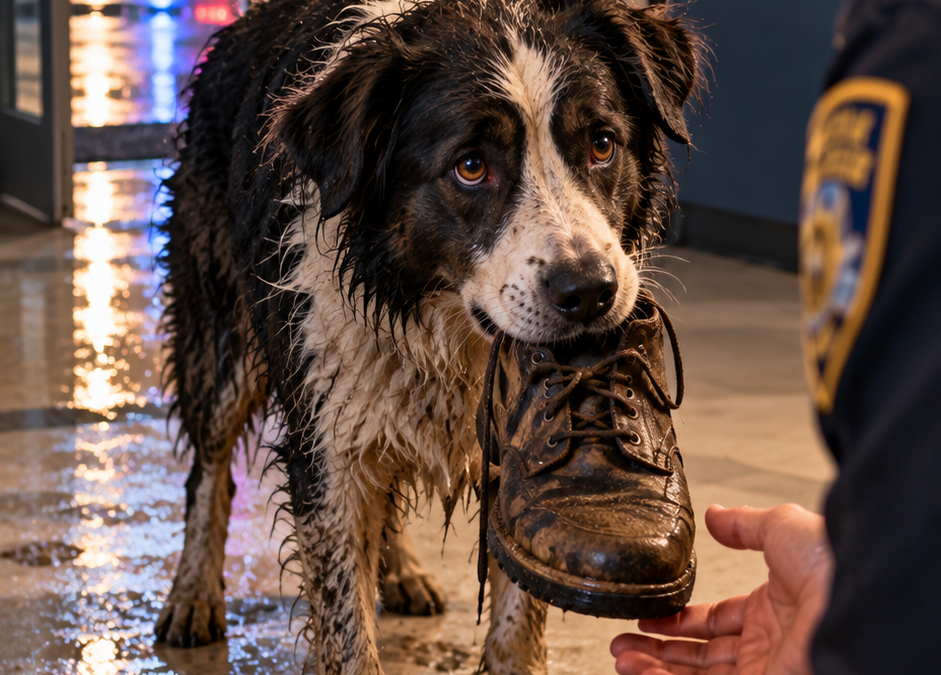
He was medium-sized.
Maybe forty pounds.
Border Collie mix, if I had to guess.
Black and white fur, though most of the white areas were gray with dirt.
His coat was messy.
His legs were wet almost to the shoulders.
Burrs clung to the fur around his chest.
But he didn’t look like an ordinary stray.
He moved with purpose.
In his mouth was a shoe.
A man’s shoe.
Brown leather.
Old.
The laces hung loosely from one side.
The toe was badly scuffed.
The dog walked across the lobby.
Stopped three feet in front of me.
Looked directly into my eyes.
Then lowered his head.
And placed the shoe on the floor.
Not dropped.
Placed.
Carefully.
Thomas slowly put down his pen.
“What the hell is this?”
Martinez stood.
Zhao appeared from the break area with her mug.
Nobody moved for several seconds.
The dog sat.
And waited.
I crouched.
“Hey, buddy.”
His ears twitched.
“You lose your owner?”
No reaction.
I held out one hand.
He sniffed it.
Then leaned his head very slightly against my fingers.
His body was cold.
“He’s been outside a while,” I said.
Martinez came closer.
“Collar?”
I checked.
No identification tag.
Just an old blue fabric collar with no writing left on it.
Thomas pointed toward the shoe.
“Maybe he stole it off somebody’s porch.”
“At four in the morning?”
Thomas shrugged.
“Dog crime is unpredictable.”
Zhao crouched on the other side.
The dog looked at her.
Then back at me.
His expression was unusually serious.
I know how that sounds.
People project emotions onto dogs constantly.
But I had been around enough working dogs and enough frightened animals to recognize agitation.
This dog wasn’t wandering.
He wasn’t confused.
He was waiting for us to do something.
I picked up the shoe.
The leather was damp.
Cold.
Mud marked one side of the sole.
It looked well worn, the kind of shoe somebody might use every day for years.
Near the heel, something caught my eye.
Blue thread.
“Hold on.”
I turned the shoe.
Inside the heel lining was a tiny hand-stitched flower.
Five pale blue petals.
Small enough that I might never have noticed it under normal circumstances.
Martinez leaned closer.
“That’s unusual.”
“Homemade repair?”
“Maybe.”
The dog stood.
For one second, I thought he was going to take the shoe back.
Instead, he walked toward the door.
Stopped.
Looked back at us.
Then returned to me.
Thomas pointed.
“He wants something.”
“Obviously,” Zhao said.
“Thank you, detective.”
Martinez ignored them.
She was studying the dog.
Then she said something that changed the direction of the entire night.
“Thomas, didn’t you mention seeing a dog like this during patrol?”
He frowned.
“When?”
“Earlier.”
Thomas looked closer.
“Maybe.”
He stood and came around the desk.
Then his expression shifted.
“Actually, yeah.”
“Where?”
“Old Oak Street.”
The dog immediately turned his head when Thomas said the name.
We all noticed.
Thomas continued.
“Yesterday evening. I was driving through around nine. There was a dog standing in front of one of the houses.”
“This dog?”
“I think so.”
“What was he doing?”
Thomas thought.
“Howling.”
“At the house?”
“Yeah.”
He looked at Bailey.
“But it wasn’t loud. That’s why I remember it.”
“What do you mean?”
“It sounded…”
Thomas searched for the word.
“Sad.”
The dog walked toward the door again.
Stopped.
Looked back.
Sergeant Martinez folded her arms.
“We’re following him.”
Thomas blinked.
“Seriously?”
She looked at him.
“An animal walks into a police station before dawn carrying a man’s shoe, refuses to leave, and keeps trying to get us outside.”
Thomas nodded slowly.
“When you put it like that.”
Martinez pointed at Zhao.
“You go with him.”
Then at me.
“You too.”
“Thomas?”
“Stays here with me.”
Thomas looked offended.
“I discovered the Old Oak Street connection.”
“And now you get to answer the phones.”
Cruel but fair.
Zhao grabbed her jacket.
I took mine.
The dog was already at the door.
“Okay, buddy,” I said. “Show us.”
He stepped outside.
We followed.
The streets were almost completely empty.
Millford looked different before dawn.
Storefronts dark.
Traffic lights changing for no one.
Mist hovering over the pavement.
The dog walked without hesitation.
No leash.
No commands.
He stayed several yards ahead, but every so often he looked back to make sure we were following.
Zhao walked beside me.
“You ever done this before?”
“Followed a dog carrying evidence through town at four in the morning?”
“Yes.”
“No.”
“Good.”
“Why?”
“I’d feel underqualified if you had.”
We crossed Main Street.
The dog turned left.
Then right.
He led us through a quiet residential block.
Across a small bridge over Miller Creek.
Through a park.
At one point he stopped near a drinking fountain and looked toward us.
I expected him to drink from a puddle.
He didn’t.
He kept moving.
That concerned me.
“He’s tired,” Zhao said.
“I know.”
“He hasn’t stopped once.”
The dog was limping slightly now.
Not badly.
Probably from distance.
I checked my phone.
We had already covered more than a mile.
Then Bailey left the residential area and headed toward the county road.
Zhao’s expression changed.
“Where is he going?”
“Apparently out of town.”
“This road gets dangerous farther up.”
“I know.”
There was a curve several miles ahead where the road narrowed near the wooded hills.
Too many drivers approached it faster than they should.
Two accidents had occurred there the previous month.
One minor.
One that required a helicopter.
Zhao looked at me.
“Think that’s where he’s taking us?”
I didn’t answer.
Because the dog suddenly began moving faster.
His entire posture changed.
His head lowered.
His pace became direct.
Urgent.
“Yeah,” I said. “I do.”
We picked up speed.
The road was damp.
Our boots crunched along the gravel shoulder.
The dog stayed ahead.
Five minutes.
Ten.
Maybe longer.
Time feels strange when you know you’re moving toward something but don’t know what.
Then we passed an abandoned roadside service station.
The pumps had been removed years earlier.
Only the cracked concrete pad and an old building remained.
The dog veered toward the grass.
And started barking.
Not wildly.
Short.
Sharp.
Urgent.
Zhao moved first.
“There!”
I saw silver through the weeds.
A car.
Small sedan.
Off the road.
Front end against a tree.
My stomach dropped.
We ran.
The driver’s side door was partly open.
One headlight still flickered weakly.
The hood had crumpled.
The windshield was cracked.
The dog reached the open door and pushed his head inside.
Then he whined.
A man was behind the wheel.
Older.
Maybe early sixties.
His upper body leaned partly toward the open doorway.
His face was pale.
Blood had dried near his hairline.
One foot was still wearing a shoe.
The other was bare.
I looked down at the shoe in my hand.
Same size.
Same color.
Same worn leather.
“Call it in,” I said.
Zhao already had her radio out.
“Dispatch, this is Zhao. We have a single-vehicle collision off County Route Nine near the old service station. One adult male, unconscious but breathing. Start EMS.”
I moved closer.
“Sir?”
No response.
I checked for a pulse.
Weak.
But there.
“He’s alive.”
The dog immediately pressed against the man’s leg.
“Easy.”
He licked the man’s hand.
His entire body trembled.
I looked at the bare foot.
Then at the shoe.
And understood.
The dog had taken it.
Somehow.
Maybe it had come loose in the crash.
Maybe he’d pulled it off.
I didn’t know.
But he had carried it all the way to us.
Not a wallet.
Not keys.
Not something we would immediately identify.
A shoe.
The only object he could manage.
The only piece of his person he knew how to bring.
“Zhao.”
She looked at me.
“You know what he did?”
Her face changed.
“Oh.”
We both looked at the dog.
“He went for help.”
She whispered it.
I nodded.
“He went all the way into town.”
The dog kept licking the man’s hand.
I touched his shoulder.
“Buddy.”
He glanced at me.
“We understand now.”
I don’t know whether he understood the words.
But his body seemed to relax slightly.
We carefully adjusted the driver’s position as much as we safely could without moving him unnecessarily.
The man’s lips were dry.
His skin felt cool.
The damage to the car didn’t look catastrophic, but he’d clearly been there for hours.
Dehydration.
Exposure.
Concussion.
Maybe other injuries we couldn’t see.
Zhao checked the area with her flashlight.
“No passenger.”
“Any phone?”
She searched what she could without disturbing the scene.
“Not seeing one.”
The dog sat so close to the man that his shoulder touched the open doorway.
I looked at him.
Mud.
Wet fur.
Small cuts on his paws.
How far had he walked?
The direct route to town was several miles.
And he’d done it in darkness.
Possibly after spending hours trying to wake the man first.
The ambulance arrived about fifteen minutes later.
Two paramedics approached.
The dog stood immediately.
His body tightened.
“He’s protective,” I warned.
One of the paramedics slowed.
“Can you hold him?”
I crouched beside Bailey.
“It’s okay.”
His eyes stayed on the stretcher.
“They’re helping him.”
The dog looked at me.
Then at the paramedic.
Then back at the man.
Finally, he stepped aside.
That decision moved me more than it should have.
He didn’t know those people.
Didn’t know what an ambulance was.
Everything in him probably wanted to stay between his injured owner and strangers.
But he had brought strangers for exactly this reason.
So he let them work.
The medics stabilized the man’s neck.
Checked his vitals.
Started an IV.
One looked up.
“He’s severely dehydrated.”
“Head injury?”
“Likely mild concussion. We’ll know more at the hospital.”
“Life-threatening?”
“Doesn’t look like it right now.”
The dog sat beside me.
I put my hand on his back.
“Good job.”
He leaned against my leg.
It was the first time I’d felt how exhausted he really was.
The ambulance crew loaded the man.
Then we had another problem.
The dog tried to jump in after him.
“Whoa.”
One paramedic stopped.
The dog stood with his front paws against the rear step.
I expected them to refuse.
Instead, the medic looked at us.
“Is he safe?”
“As far as we can tell.”
The medic looked at Bailey.
Then at the unconscious man.
“Fine.”
They made room.
The dog climbed into the ambulance.
No hesitation.
No fear.
He went straight to his person.
The doors closed.
And they left.
Zhao and I stood beside the road.
Neither of us spoke for a moment.
Then she looked at the shoe still in my hand.
“You should probably bring that.”
I stared at it.
“Evidence?”
“Technically property.”
I looked toward the road where the ambulance had disappeared.
“Message.”
She nodded.
“That too.”
We returned to the station shortly before sunrise.
Thomas immediately looked up.
“Well?”
“We found a car.”
His joking expression vanished.
“Driver?”
“Alive.”
Martinez stepped out of her office.
“And the dog?”
“Found his owner.”
I placed the shoe on the desk.
For some reason, everyone looked at it differently now.
Thomas sat back.
“You’re telling me the dog carried that from the crash?”
“Looks that way.”
“How far?”
“Several miles.”
Nobody said anything.
Then Martinez looked at the little blue flower inside the heel.
“I told you.”
“What?”
“Animals don’t walk into police stations for no reason.”
Thomas stared at the shoe.
“Okay. You get this one.”
The following afternoon, I went to Millford Regional Hospital.
Officially, I wanted to get a statement.
Unofficially, I wanted to see the dog.
The man had regained consciousness.
His name was Walter Ellis.
Sixty-three years old.
He lived alone on a small farm roughly twenty-five miles outside town.
When I entered his room, Bailey was lying in the corner.
The instant he saw me, his head came up.
His tail moved.
Once.
Then faster.
“You remember me,” I said.
Walter looked toward the dog.
“He doesn’t forget people who help me.”
His voice was rough.
He had a bandage near his temple.
Bruising along one side of his face.
But he was awake.
Alert.
And very much alive.
I introduced myself.
Walter extended his hand.
“You’re the officer he found.”
“One of them.”
I pulled a chair closer.
“How are you feeling?”
“Like I picked a fight with a tree.”
“Tree looks better.”
He laughed.
Then winced.
“Don’t make me laugh.”
“Sorry.”
I placed the shoe in a plastic property bag on the bedside table.
Walter stared at it.
His expression changed instantly.
“Where did you get that?”
“Your dog brought it to us.”
His eyes moved toward Bailey.
Then back to me.
“What?”
“He walked into the police station around four yesterday morning.”
Walter didn’t speak.
“Had that in his mouth.”
I continued.
“He put it on the floor in front of my desk. Then led us to you.”
Walter’s eyes filled.
For several seconds, he could only stare at Bailey.
The dog stood.
Walked toward the bed.
Placed his chin against the mattress.
Walter reached down.
His hand trembled against Bailey’s head.
“You did that?”
The dog closed his eyes.
Walter looked at me.
“How far?”
“Several miles.”
He swallowed.
“By himself?”
“Yes.”
Walter turned away.
One tear moved down his cheek.
He didn’t wipe it.
“That fool.”
Bailey’s tail moved.
Walter laughed softly.
“He’s always been stubborn.”
“Probably saved your life.”
“I know.”
Walter stared at him.
“He saved it long before yesterday.”
That caught my attention.
“What do you mean?”
Walter rubbed Bailey’s ear.
“I found him seven years ago.”
“Where?”
“Storm.”
He looked toward the window.
“Bad one.”
Thunderstorms had always rolled hard through the rural areas around Millford.
Walter said he’d been driving home when he spotted a soaked cardboard box near a drainage ditch.
He almost passed it.
Then he saw movement.
Inside was a puppy.
Tiny.
Shivering.
Water gathering around the box.
“I told myself I wasn’t keeping him.”
Walter smiled.
“That lasted about six hours.”
Bailey looked up at him.
“I wasn’t doing well then.”
Walter paused.
“My wife had died the year before.”
He lived alone.
Farm too quiet.
Meals for one.
No reason to speak once he came inside at night.
“I didn’t think I needed anybody.”
He scratched Bailey under the chin.
“Apparently he disagreed.”
The puppy followed Walter everywhere.
Slept near the bedroom door.
Waited beside the tractor.
Sat outside while Walter repaired fences.
“He never learned tricks.”
Walter smiled.
“Never cared about fetching.”
“Seems like he learned one useful skill.”
Walter’s face softened.
“Yeah.”
He looked at Bailey.
“Finding people.”
Then he told me what he remembered about the crash.
He had been returning home after visiting someone in another county.
Long drive.
Not enough water.
He’d been tired.
Near the curve outside Millford, dizziness hit him suddenly.
He remembered trying to slow down.
Then the tree.
He woke sometime during the night.
Dark.
Cold.
Bailey beside him.
Walter tried to move.
Couldn’t.
He remembered saying the dog’s name.
Then blackness.
“Next thing I knew, I was here.”
He looked at the shoe.
“I don’t remember losing that.”
“We think Bailey took it after he couldn’t wake you.”
Walter shook his head slowly.
“He knew.”
“Knew what?”
“That he needed somebody.”
I nodded.
“Apparently.”
Walter looked at me.
“You know, I used to say dogs were just animals.”
I smiled.
“That’s a dangerous thing to say in front of Bailey.”
Walter laughed carefully.
“I’ve changed my position.”
Later that day, Sergeant Martinez found something else.
There had actually been a report about an abandoned or damaged vehicle near the county road during the night.
But the location information had been unclear.
The report had been routed incorrectly.
By the time anyone clarified it, we were already with Walter.
That bothered me.
Systems fail.
Calls get confused.
Locations get entered badly.
People assume someone else is checking.
If Bailey hadn’t reached us, Walter might have remained in that car until daylight.
Maybe longer.
Dehydrated.
Injured.
Unconscious.
Cold.
I don’t like finishing that thought.
Two weeks later, Walter walked into our station.
On his own.
Slowly.
But upright.
He carried a cardboard box.
Bailey walked beside him.
This time, the dog wasn’t wet.
His coat was brushed.
His blue collar had been replaced with a new one.
Thomas saw them first.
“Uh-oh.”
I looked up.
Walter smiled.
“I brought a peace offering.”
He placed the box on the counter.
Cookies.
Homemade.
Zhao appeared instantly.
“Are those chocolate chip?”
Walter nodded.
“Some.”
Martinez walked out of her office.
“You’re bribing law enforcement now?”
Walter looked serious.
“Is it working?”
Martinez opened the box.
“Continue.”
We laughed.
Bailey walked over to my desk.
He looked at the floor.
Then at me.
I pointed.
“No more shoes.”
His tail wagged.
Walter shook his head.
“He’s not nearly as clever as you’re all making him sound.”
I looked at him.
“Walter, he found a police station.”
“Pure luck.”
“Carried identifying property.”
“Coincidence.”
“Then led us back to you.”
Walter considered.
“Stubbornness.”
“Right.”
Bailey leaned against Walter’s leg.
Walter looked down.
His expression softened.
Then he said,
“Truth is, he can’t do much.”
Thomas raised an eyebrow.
“High standards.”
Walter continued.
“He won’t fetch the newspaper.”
Bailey sat.
“He won’t catch a Frisbee.”
Tail wag.
“He knows exactly three commands and ignores two of them whenever he feels like it.”
I laughed.
“But when I needed him…”
Walter stopped.
His voice tightened.
Bailey leaned harder against him.
Walter rested one hand on the dog’s head.
“When I needed him, he figured out what mattered.”
The room became quiet.
Then Walter looked at us.
“And you people understood him.”
Martinez closed the cookie box.
“Eventually.”
Walter smiled.
“That’s enough.”
Before he left, I asked him about the little blue flower in the shoe.
He laughed.
“My wife.”
“She embroidered it?”
“Years ago.”
“Why?”
“Because I used to leave my shoes everywhere.”
I waited.
“How did the flower help?”
“It didn’t.”
He smiled.
“She said if I was going to wear ugly shoes, at least she’d make one part of them pretty.”
That small detail stayed with me.
The shoe had already carried one person’s love long before Bailey carried it into our station.
Walter’s wife.
Then Walter.
Then Bailey.
A ridiculous old shoe.
And somehow it connected all of them.
Walter still has it.
Last time I visited his farm, it was sitting on the windowsill in his kitchen.
Not being worn.
Just kept.
He bought new shoes after the accident.
“Safer,” he said.
“For driving?”
“No. Bailey apparently steals the old ones.”
The dog was asleep nearby.
I scratched his head.
“Evidence collection.”
Walter pointed at me.
“Don’t encourage him.”
Bailey opened one eye.
Then went back to sleep.
Months have passed since that night.
Walter recovered.
He still lives on the farm.
Bailey is still with him.
Most mornings, if I’m driving through town after shift change, I see them walking along Main Street.
Walter moves slower than he used to.
Bailey does too.
They stop often.
Neither seems bothered by that.
Sometimes Walter raises one hand when he sees the cruiser.
Bailey looks at the car as though checking whether I’m inside.
I’ve thought about that morning more than I expected.
Maybe because after twelve years in police work, you become accustomed to people asking for help in obvious ways.
911 calls.
Screaming.
Knocking on doors.
Running toward you.
Sometimes people don’t know how to explain what happened, but they still have language.
Bailey didn’t.
He couldn’t tell us where Walter was.
Couldn’t describe the crash.
Couldn’t give us an address.
Couldn’t say,
My person is hurt.
So he found something that belonged to Walter.
Carried it.
Walked through the darkness.
Found a building where people in uniform kept entering and leaving.
And gambled everything on the possibility that we would understand.
I don’t know exactly how Bailey decided on the police station.
Maybe he had seen patrol cars there.
Maybe Walter had walked past the building with him before.
Maybe the lights were on and he simply tried the first place containing people.
There are details we will never know.
That doesn’t make what he did less remarkable.
The part I remember most isn’t finding the car.
It isn’t even seeing Walter alive in the hospital.
It’s Bailey sitting on the station floor after placing that shoe in front of me.
Waiting.
He had done everything he could do.
The rest belonged to us.
There is a lesson in that, though I try not to turn real moments into slogans.
Sometimes help arrives cleanly.
A clear call.
An address.
A name.
Sometimes it arrives at four in the morning covered in mud, exhausted, carrying an old shoe between its teeth.
You still have to recognize it.
A few weeks ago, I stopped by Walter’s farm after my shift.
He was sitting on the porch.
Bailey lay beside him.
The old shoe was visible through the kitchen window.
Walter handed me coffee.
“Still working nights?”
“Apparently forever.”
“Bad for you.”
“So everyone keeps telling me.”
Bailey got up.
Walked over.
Leaned against my leg.
I scratched behind his ears.
Walter smiled.
“He likes you.”
“He has questionable judgment.”
“Runs in the family.”
We sat there until the sun came up.
Bailey eventually returned to Walter and lay across his feet.
Neither of them spoke.
Neither needed to.
Before leaving, I looked once more through the kitchen window at that battered shoe with the faded blue flower stitched inside the heel.
Walter noticed.
“Funny thing to keep, isn’t it?”
“No.”
He looked at me.
“No?”
I shook my head.
“Some things stop being what they were after they save your life.”
Walter stared at the shoe.
Then nodded.
“Yeah.”
Bailey lifted his head.
Walter rested a hand on him.
“I guess that’s true of dogs too.”
I drove back toward town as the first sunlight broke across the road.
I passed the curve where Walter had crashed.
Passed the abandoned service station.
Crossed the little bridge.
Then Main Street.
The same route Bailey had traveled in darkness.
Several miles on four tired paws.
Carrying one man’s shoe.
Refusing to quit until somebody understood.
After twelve years of night shifts, I thought I knew what an emergency looked like.
Bailey taught me otherwise.
Sometimes an emergency doesn’t make a sound.
Sometimes it walks through the door, sets down the only clue it knows how to carry, and looks you straight in the eyes.
Then waits for you to listen.

