𝗙𝗨𝗟𝗟 𝗦𝗧𝗢𝗥𝗬 At 11:30 That Night, the Shelter Lights Went Out and the Old Dog Finally Made a Sound None of Us Could Forget
𝗙𝗨𝗟𝗟 𝗦𝗧𝗢𝗥𝗬
I brought out the intake form.
Mr. Harrison sat.
Rex sat beside him.
For several minutes, I heard only the scratch of pen across paper.
Then it stopped.
Mr. Harrison stared at the line labeled Reason for Surrender.
His hand tightened around the pen.
I waited.
Finally, he wrote:
Medical inability to provide care.
He pushed the paper toward me.
“You mentioned yesterday that you’ve been ill.”
“Yes.”
“Is there anything we can do to make this easier?”
He looked at me sharply.
For one hopeful second, I wondered if he might change his mind.
Instead he said, “No.”
Then quieter:
“No. This is what I have to do.”
Rex looked between us.
I crouched beside him.
He sniffed my hand.
Then allowed me to scratch under his chin.
“He’s beautiful.”
“He was six months old when my wife brought him home.”
I glanced up.
Mr. Harrison was staring somewhere beyond me.
“She said the house had gotten too quiet.”
His mouth curved weakly.
“I told her a puppy was a ridiculous solution to quiet.”
“What did she say?”
“She said that was the point.”
I smiled.
“She sounds smart.”
“She was.”
Was.
I didn’t ask.
Mr. Harrison continued anyway.
“Elaine died seven years ago.”
“I’m sorry.”
He nodded.
“After that, Rex…”
His voice disappeared.
Rex turned toward him.
Mr. Harrison placed both hands on the dog’s face.
“After that, it was the two of us.”
That was when I understood this was not a man surrendering a pet.
He was giving away the last living piece of a life he’d already lost once.
“Mr. Harrison—”
“I can’t walk him anymore.”
The words came quickly now, as if he had rehearsed them.
“I can barely make it to the end of my driveway.”
He rubbed one hand across his chest.
“I’ve been in and out of the hospital. Stairs are difficult. Some mornings I can’t even stand long enough to prepare breakfast.”
Rex licked his wrist.
Mr. Harrison closed his eyes.
“He deserves more.”
“Does anyone help you at home?”
“No.”
“Family?”
“A niece in another state.”
“Neighbors?”
“I don’t want to bother people.”
That sentence told me a lot.
“I understand.”
“No.”
He looked at me.
“I don’t think you do.”
There was no anger in it.
Only exhaustion.
“Rex waits for me to get up.”
His voice cracked.
“He stands by the door with his leash.”
He touched the dog’s collar.
“And I have to tell him no.”
Rex leaned closer.
“Again and again.”
Mr. Harrison’s eyes filled.
“He has spent twelve years giving me everything he has. I won’t make his last years smaller because my body stopped cooperating.”
I didn’t know what to say.
So I didn’t say anything.
Sometimes people don’t need you to correct their pain.
They just need you not to interrupt it.
Mr. Harrison took a slow breath.
“He deserves walks.”
“Yes.”
“People.”
“Yes.”
“Someone who can get down on the floor with him.”
Rex sat pressed against his knee.
Mr. Harrison looked at me.
“He deserves a life better than what I can give him now.”
I wish I could tell you I immediately knew what to do.
I didn’t.
We had community support programs, foster networks, volunteer groups.
But resources changed.
Programs had eligibility rules.
Availability came and went.
And during busy intake days, staff sometimes saw a surrender form before we saw the crisis underneath it.
That sentence still bothers me.
Because that afternoon, I let Mr. Harrison believe the shelter was his only choice.
I took the leash.
Mr. Harrison didn’t release it.
Not at first.
His fingers stayed closed around the handle.
Rex looked at him.
“Sir?”
“I know.”
His hand trembled.
“I know.”
He slowly let go.
Rex remained seated.
Mr. Harrison stood.
So did Rex.
“Stay.”
Rex stared at him.
It wasn’t a command Rex intended to obey.
Mr. Harrison took one step toward the door.
Rex followed.
I held the leash gently.
He stopped when it tightened.
“Rex.”
Mr. Harrison turned.
I still remember his face.
He crouched despite how difficult it clearly was.
Rex moved toward him immediately.
Mr. Harrison buried both hands in the dog’s fur.
“Listen to me.”
Rex’s tail moved.
“You be good.”
Tail.
“You hear me?”
Rex licked his chin.
Mr. Harrison laughed once, and it sounded like something breaking.
“Of course you don’t.”
He pressed his forehead against Rex’s.
“You’ve always been better than me.”
I looked away.
I’ve learned that goodbyes deserve privacy even when they happen in public.
Mr. Harrison whispered something I couldn’t hear.
Then he stood.
His hand remained on Rex’s head for several seconds.
Finally, he pulled it away.
Rex took a step.
Mr. Harrison took another toward the exit.
Rex followed.
The leash tightened again.
Mr. Harrison opened the door.
Rex’s ears lifted.
I thought he would bark.
He didn’t.
He sat.
And watched.
Mr. Harrison stepped outside.
The door closed.
Rex remained perfectly still.
Through the glass, we could see Mr. Harrison cross the parking lot.
Halfway to his car, he stopped.
He placed one elbow on the roof.
Lowered his head.
For maybe thirty seconds, he didn’t move.
Rex stood.
His nose touched the glass.
Mr. Harrison opened the car door.
Rex’s tail began moving.
He believed the man was coming back.
The engine started.
The car reversed.
Rex watched until it disappeared.
Then he sat beside the door.
“Come on, buddy.”
Nothing.
“Let’s get you settled.”
Rex remained there.
I crouched.
“Rex.”
His eyes moved to me.
Then immediately back to the parking lot.
I knew that look.
Wait.
He wasn’t refusing me.
He was waiting for someone else.
Eventually, with gentle pressure on the leash, I got him down the hallway.
We gave him one of our larger kennels because of his age.
I placed a thick orthopedic bed in the corner.
His old blanket went on top.
Mr. Harrison had packed it.
Blue fleece.
Worn almost smooth.
Rex sniffed it.
Then turned toward the kennel door.
I brought water.
He drank.
Food.
He ignored it.
“You’re going to be okay.”
His ears lifted when I said okay.
Maybe Mr. Harrison used the word.
Maybe I imagined that.
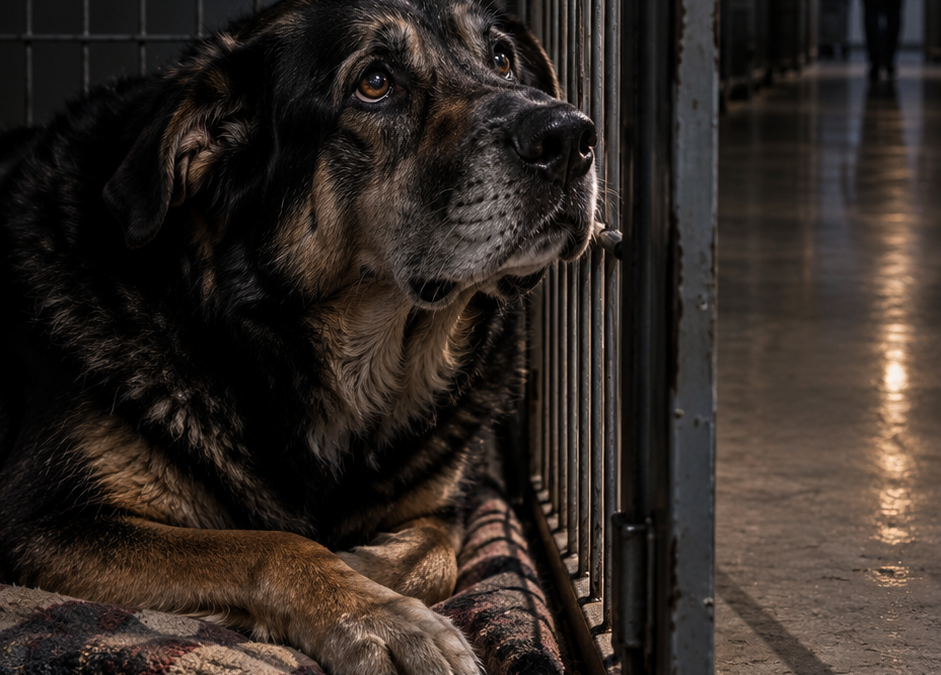
That first night, Rex didn’t sleep.
I know because I was on closing shift.
At ten, he sat facing the hallway.
At ten-thirty, same position.
At eleven, same.
Whenever someone walked near the kennel, his tail moved.
Not a happy wag.
One small sweep.
Hope reduced to muscle memory.
A volunteer passed carrying laundry.
Rex stood.
Not him.
A cleaner pushed a cart.
Rex stood.
Not him.
I returned with medication hidden inside chicken.
Rex took it reluctantly.
Then looked behind me.
“He isn’t there.”
The words left my mouth before I considered them.
Rex stared at the empty hallway.
“I’m sorry.”
At 11:30, we turned off the main lights.
Rex remained sitting.
I left the overnight lights on.
When I came in the next morning, one of the early volunteers said, “That old shepherd has been sitting there since I got here.”
“I know.”
“He waiting for somebody?”
“Yes.”
“Are they coming?”
I looked toward Rex.
“I don’t think so.”
The volunteer’s expression changed.
“Oh.”
That was the first day.
Rex barely ate.
I mixed chicken into rice.
Mr. Harrison had told us that was his favorite.
Rex sniffed it.
For one second, I thought hunger had won.
Then he stepped away.
He drank water.
That was something.
We took him into the exercise yard.
He walked to the gate.
Stood there.
Waited.
I tried toys.
Nothing.
A tennis ball rolled across the grass.
Rex watched it pass.
Another dog barked from the next yard.
No reaction.
“Come on, old man.”
I walked slowly.
After a few seconds, Rex followed.
But every twenty feet, he turned toward the building.
Toward the entrance.
Toward the road.
He wasn’t exploring.
He was making sure he hadn’t missed the return.
By afternoon, I began telling myself he’d adjust.
Dogs do.
Not all quickly.
But routines help.
Food helps.
Gentle handling.
Smells.
Walks.
Consistency.
We know the methods.
What we don’t always know is how to compete with memory.
That evening, I was updating charts when I heard metal tapping.
Tap.
Pause.
Tap.
Tap.
I walked toward the sound.
Rex stood inside his kennel.
He was hitting the door handle with one paw.
Tap.
“Rex.”
Tap.
He looked at me.
Then at the handle.
“I can’t open it.”
Tap.
“He’s not outside.”
Rex hit it again.
Harder.
A piece of me wanted to open the door anyway.
To let him run through the hallway.
To let him check the lobby.
The parking lot.
Every room.
Maybe if he saw for himself, he would understand.
But dogs don’t understand absence that way.
Sometimes they simply search farther.
I entered the kennel.
Rex moved immediately toward the open door.
I blocked it gently.
“No.”
He looked past me.
I sat on the floor.
“Come here.”
Nothing.
I had brought a book with me.
Not because I expected to read.
Because shelter animals sometimes trust you more when you stop staring at them.
So I sat.
Turned a page.
Waited.
Ten minutes.
Twenty.
Eventually, Rex lay down near the door.
Not beside me.
Near the door.
His head rested on his paws.
His eyes remained open.
I reached across and placed my hand on the floor between us.
After a while, one of his paws shifted.
Barely.
It touched two of my fingers.
That was all.
The second night passed.
The next morning, his food bowl was almost untouched.
That worried me.
Older dogs can decline quickly when stress suppresses appetite.
I asked our veterinary technician to check him.
Heart sounded stable.
Temperature normal.
Hydration acceptable but worth watching.
Arthritis obvious.
Nothing explained the emptiness in his expression except grief.
The third day, Rex stopped standing every time someone walked by.
That was worse.
Hope had exhausted itself.
When I said his name, his ears moved slightly.
No tail.
When I opened the kennel, he didn’t try to get out.
He simply lay there.
Eyes toward the corridor.
I crouched.
“Come on.”
Nothing.
“We’ll go outside.”
He looked at me.
“No?”
I sat beside him.
“I know.”
Of course I didn’t know.
Not really.
But I had seen grief in dogs before.
A bonded dog whose companion died.
A dog left after an elderly owner entered long-term care.
Animals rescued from burned homes who spent weeks searching each doorway.
People like to debate whether animals understand loss.
After twelve years in shelter work, I don’t find the debate particularly useful.
They understand that someone who belonged in their world is no longer there.
Sometimes that’s enough.
At noon, I called the number Mr. Harrison had left.
No answer.
I told myself it was routine.
We weren’t supposed to pressure someone who had voluntarily surrendered an animal.
Sometimes surrender is the right decision.
Sometimes contacting an owner repeatedly causes more pain.
But I wanted to ask one question.
Was there truly no other way?
The phone rang seven times.
Voicemail.
I didn’t leave a message.
Not yet.
That evening, I stayed late.
Officially, I was finishing records.
Unofficially, I was watching Rex.
At ten-thirty, I brought fresh chicken.
He ate two pieces from my hand.
“Good.”
A third.
He turned away.
“Two is better than none.”
His eyes remained fixed toward the hall.
At eleven, the shelter quieted.
The young dogs finally exhausted themselves.
The dryers in the laundry room stopped.
Phones went silent.
One by one, overhead lights were switched off.
Rex lifted his head at every click.
11:10.
11:15.
11:20.
I was supposed to leave at eleven-thirty.
I put on my coat.
Checked the kennels one final time.
Rex was sitting again.
Something about his posture stopped me.
Not hopeful.
Not exactly.
More like he was forcing himself to wait until the absolute last possible second.
I stood at the end of the corridor.
“Good night, Rex.”
His ears lifted.
At 11:30, I reached for the last bank of switches.
Click.
The main lights went out.
Only the soft blue overnight lamps remained.
The shelter changed immediately.
Day was over.
For every dog there, that ritual meant sleep.
No more visitors.
No more volunteers.
No more footsteps arriving from the lobby.
No more possibility that a familiar voice would appear before morning.
Rex raised his head.
He looked toward the ceiling.
Then the hall.
Then the closed door at the far end.
I watched his face.
I don’t know what happened inside him.
I cannot prove he understood three days had passed.
I cannot tell you a dog calculated the meaning of the lights going out.
Maybe it was coincidence.
Maybe accumulated stress.
Maybe exhaustion.
But standing there, I felt certain something changed.
Rex lowered his head.
Then he made a sound.
At first, it was so low I thought he’d groaned.
Then it grew.
A long, trembling howl rose from his chest.
Not loud in the way excited dogs are loud.
Deep.
Raw.
It seemed to come from someplace beneath breath.
He howled once.
Stopped.
Took another breath.
Then again.
I had heard dogs howl.
At sirens.
At music.
At other dogs.
This was different.
I know how sentimental that sounds.
I don’t care.
There are sounds you hear with your ears.
And there are sounds your body understands before your mind has language for them.
Rex’s cry was one of those.
The other dogs woke.
A beagle stood at the front of his kennel.
A pit bull across the corridor began whining.
Farther down, a young husky paced.
None joined in.
They listened.
So did I.
Rex howled again.
My keys slipped from my hand.
They hit the floor.
I didn’t pick them up.
Tears were already running down my face.
“Rex.”
He didn’t look at me.
His face remained pointed toward the dark hallway.
Another howl.
Longer.
Breaking near the end.
I walked toward him.
My hands shook while I opened the kennel.
Rex stayed on the floor.
I sat beside him.
“It’s okay.”
The lie tasted terrible.
Nothing felt okay.
I touched his shoulder.
He cried again.
I pulled out my phone.
Our director, Mrs. Martin, had told all of us we could call her at any hour for a genuine emergency.
I stared at her name.
Was this an emergency?
No blood.
No seizure.
No escaped animal.
No fire.
Just a twelve-year-old dog with a broken heart.
I almost put the phone away.
Then Rex’s howl filled the corridor again.
I pressed call.
Mrs. Martin answered on the second ring.
“Sarah?”
Her voice was thick with sleep.
Then instantly alert.
“What happened?”
For several seconds, I couldn’t speak.
Rex did it for me.
His howl traveled through the phone.
Mrs. Martin became silent.
“Sarah?”
“I’m here.”
“Is that Rex?”
“Yes.”
“What is happening?”
“I think…”
My voice failed.
I wiped my face.
“I think he realized Mr. Harrison isn’t coming.”
There was silence.
Then she said, “I’m coming.”
“You don’t have to—”
“I said I’m coming.”
She hung up.
Twenty minutes later, Mrs. Martin entered wearing jeans under a long coat, hair pulled into a crooked ponytail.
She was sixty-two and had spent almost three decades running shelters.
Very little surprised her.
Rex did.
She heard him before she reached the corridor.
Her expression changed.
“Oh, sweetheart.”
She walked to the kennel.
I had remained on the floor beside him.
Mrs. Martin sat on the bench opposite us.
She didn’t immediately come closer.
“Hi, Rex.”
His howl faded into a low whine.
“That’s it.”
Her voice became softer.
“We’re here.”
Rex looked at her.
Then back toward the door.
Mrs. Martin’s eyes met mine.
“Has Harrison called?”
“No.”
“Have we called him?”
“I tried this afternoon.”
“No answer?”
“No.”
She leaned back.
“Do you remember exactly what he said during surrender?”
I told her.
Illness.
Hospital.
No strength.
Could not walk Rex.
No family nearby.
Believed surrender was his only responsible choice.
Mrs. Martin frowned.
“Did anyone discuss Stay Together?”
I stared at her.
The program.
Of course.
Stay Together was one of our smaller community programs.
Volunteer-supported.
Designed for owners temporarily unable to meet all of their pets’ needs because of illness, disability, hospitalization, or financial crisis.
Dog walking.
Food delivery.
Medication assistance.
Occasional housekeeping partnerships through local agencies.
Temporary foster care when necessary.
The program wasn’t large.
Resources were limited.
And because intake had been chaotic that week, no one had connected Mr. Harrison’s situation with it.
My stomach dropped.
“I didn’t.”
Mrs. Martin’s face showed no anger.
That somehow made me feel worse.
“Neither did intake coordination.”
“He could have kept Rex.”
“Maybe.”
I looked at the dog.
“God.”
“Sarah.”
“I took his leash.”
“Sarah.”
“He told me he was sick.”
“You did your job with the information and process you had.”
“That’s not good enough.”
“No.”
She said it calmly.
“It isn’t.”
I looked at her.
She continued.
“So we fix what we can.”
Rex began whining again.
Mrs. Martin stood.
“Give me Harrison’s file.”
We spent the next hour making calls.
The emergency contact number went unanswered.
The hospital Mr. Harrison had mentioned initially wouldn’t confirm anything for privacy reasons.
We tried another.
Then another.
Finally, through information Mr. Harrison himself had provided on his intake paperwork, Mrs. Martin reached the medical center where he had recently been treated.
After several conversations, we learned only one thing:
He had been discharged two days earlier.
“He went home,” Mrs. Martin said.
“Then why isn’t he answering?”
“I don’t know.”
We called again.
Nothing.
My imagination went somewhere dark.
“What if something happened?”
“We don’t know that.”
“He lives alone.”
“We still don’t know.”
Rex had exhausted himself.
His cries had become small, broken sounds.
Mrs. Martin entered the kennel and sat beside us.
For nearly an hour, three beings remained together under blue shelter lights.
Rex.
Mrs. Martin.
Me.
Eventually, Rex’s head lowered.
His eyes closed.
Even asleep, his legs moved.
Small running motions.
Paws twitching against the blanket.
I wondered where he was going in his dream.
Home, probably.
At two in the morning, Mrs. Martin ordered me to lie down in the staff room.
I refused.
She stopped arguing.
At six, the first employee arrived and found both of us still there.
At seven-thirty, Mrs. Martin made coffee.
At eight, she called Mr. Harrison again.
This time, someone answered.
“Hello?”
The voice through the speaker was weak.
Mrs. Martin sat straighter.
“Mr. Harrison?”
“Yes.”
“This is Linda Martin from Oakridge Animal Shelter.”
A pause.
“Is Rex all right?”
There it was.
Immediate.
Not How can I help you?
Not Why are you calling?
Rex.
Mrs. Martin looked at me.
“He’s physically stable.”
Silence.
“But he’s having a very difficult time.”
Mr. Harrison’s breathing changed.
“What do you mean?”
“He isn’t eating well.”
Another silence.
“And last night…”
Mrs. Martin hesitated.
I could hear him breathe.
“What happened?”
“He cried for most of the night.”
Mr. Harrison made a sound I will never forget.
Not quite a sob.
More like pain escaping before he could stop it.
“Oh, God.”
“Mr. Harrison—”
“I knew.”
His voice broke.
“I knew he would wait.”
I covered my mouth.
“I made a mistake.”
Mrs. Martin leaned closer to the phone.
“Tell me what you mean.”
“I thought I was helping him.”
He began crying openly.
“I thought if I let him go while he was still healthy enough, someone better would take him.”
“Sir—”
“He watched me leave.”
“I know.”
“I couldn’t turn around.”
His breathing became uneven.
“If I turned around, I knew I’d take him home.”
Mrs. Martin let him speak.
“I came back from the hospital and the house was empty.”
His words slowed.
“I kept hearing him.”
My eyes filled again.
“His nails on the floor.”
He laughed weakly through tears.
“Can you imagine? I knew he wasn’t here, but every time the house settled, I thought it was Rex.”
Mrs. Martin closed her eyes briefly.
“I haven’t slept.”
He continued.
“I don’t eat much.”
“Mr. Harrison.”
“I thought this was supposed to make his life better.”
His voice collapsed.
“I think I broke him.”
“No.”
Mrs. Martin’s tone changed.
Firm.
Professional.
Compassionate.
“You made a decision because you believed you had no other option.”
“I didn’t.”
“Actually, you may have.”
Silence.
“What?”
“We have a program called Stay Together.”
I watched hope enter the conversation before Mr. Harrison even spoke.
“What is that?”
“We help people who want to keep their animals but need practical support.”
“I don’t understand.”
“Volunteers.”
Mrs. Martin began listing services.
“Dog walking. Food deliveries. Medication assistance. Help with vet visits. Depending on availability, partnerships for housekeeping and transportation.”
Mr. Harrison said nothing.
“Your medical limitations may qualify you.”
Still silence.
Then:
“Why didn’t anyone tell me?”
The question hurt.
Mrs. Martin did not defend us.
“We should have.”
She looked at me.
“We missed it.”
A long pause.
Then Mr. Harrison whispered, “I would never have left him.”
“I know.”
“If I’d known…”
“I know.”
His voice trembled.
“Can I have him back?”
Mrs. Martin smiled.
Not broadly.
Not yet.
“If you’re asking whether Rex can come home while we put support in place—yes.”
A sob came through the phone.
“Please.”
“We need to confirm a few things about your current health and home setup.”
“Anything.”
“We’ll move quickly.”
“Please bring him home.”
Mrs. Martin looked at me.
I was already crying.
“I thought he deserved better than me.”
Mr. Harrison’s voice became almost inaudible.
Mrs. Martin answered:
“Maybe what he wants isn’t better.”
She looked toward the kennel.
“Maybe he wants you with enough help to make it work.”
Two hours later, we loaded Rex into the shelter van.
He seemed confused.
He had hardly slept.
His eyes were dull.
When I opened the van door, he hesitated.
“It’s okay.”
I patted the seat.
“Come on.”
Thomas, one of our senior staff members, helped lift his back end because of the arthritis.
Rex settled onto a blanket.
I sat beside him.
Mrs. Martin had arranged the first week of support before we even left.
A volunteer walker.
Meal delivery.
A home health contact Mr. Harrison already qualified for but had not fully used.
A check-in schedule.
Food for Rex.
Medication refills.
It wasn’t a perfect system.
It was enough to begin.
The van started.
Rex lifted his head.
At the first turn, one ear rose.
At the second, both.
He moved toward the window.
Thomas cracked it open several inches.
Cold air entered.
Rex’s nose began working.
Sniff.
Sniff.
His entire posture changed.
“Do you know?” I whispered.
Rex stood.
His legs were stiff.
But he stood.
We turned onto Maple Avenue.
His tail moved.
Once.
Then again.
Thomas looked in the mirror.
“He recognizes it.”
I smiled.
“He knows.”
The closer we got, the more restless Rex became.
He moved from window to window.
Whined.
Sniffed.
At one point he looked directly at me.
His eyes were alive again.
Not fully.
But something had returned.
“Yes.”
I scratched his neck.
“We’re going home.”
At the beginning of Mr. Harrison’s street, Rex began trembling.
Not fear.
His whole body vibrated with recognition.
His tail struck the side of the van.
Thomas laughed.
“Easy, old man.”
We passed a white mailbox.
Rex barked once.
The first bark I’d heard from him since he arrived.
Then we turned into the driveway.
The house was small.
White siding.
Green shutters.
Neat flowerbeds gone slightly wild.
One window stood open despite the cold.
Before Thomas shut off the engine, the front door opened.
Mr. Harrison appeared.
He was thinner than I remembered.
Paler.
A cane in one hand.
The other hand gripping the doorframe.
For a second, neither moved.
Rex stood inside the van.
Mr. Harrison stood in the doorway.
I stopped breathing.
“Rex.”
The voice was barely audible.
Rex’s ears shot forward.
Mr. Harrison said it again.
“Rex.”
The dog exploded.
There is no other word.
Twelve years old.
Arthritic.
Exhausted after three days of barely eating.
He moved like a puppy.
I opened the van door just in time.
Rex jumped down.
“Slow!”
He ignored me.
He ran.
Mr. Harrison stepped forward.
I saw the danger immediately.
If Rex hit him full force, the man would fall.
Rex seemed to understand at the last possible moment.
He slowed.
His run became a fast walk.
Then smaller steps.
He reached Mr. Harrison and stopped with his chest inches from the man’s knees.
For half a second, they stared at each other.
Then Rex pressed his head into Mr. Harrison’s hand.
A tiny sound came from him.
The same dog who had filled an entire shelter with grief the night before now produced one soft whine.
Mr. Harrison dropped his cane.
Thomas moved to catch him.
“Sir.”
“I’m fine.”
He wasn’t.
But he lowered himself carefully anyway.
One knee.
Then both.
His hands wrapped around Rex’s neck.
“Oh, my boy.”
Rex pushed against him.
“I’m sorry.”
Mr. Harrison buried his face in the dog’s fur.
“I’m sorry.”
Rex licked his cheek.
His ear.
His chin.
Mr. Harrison laughed and cried simultaneously.
“I thought I was helping you.”
Rex’s tail hit the porch.
“Can you forgive an old fool?”
Rex licked his face again.
I turned away.
Thomas pretended to inspect the van.
Neither of us was fooling anyone.
Mr. Harrison stayed on the ground for several minutes.
Rex eventually lay beside him.
Head across his thigh.
Exactly where he belonged.
When Mr. Harrison finally looked at me, his eyes were red.
“Sarah.”
“Hi.”
“Thank you.”
I shook my head.
“We should have told you about the program before you left.”
His expression softened.
“You brought him back.”
“We almost didn’t.”
“But you did.”
That mattered.
It didn’t erase the mistake.
But it mattered.
Thomas helped Mr. Harrison stand.
I carried Rex’s things inside.
His bed.
Bowls.
Blanket.
Medication.
Two toys.
A rubber ball.
A stuffed rabbit missing one ear.
The moment Rex crossed the doorway, something changed again.
He moved slowly through the living room.
Sniffing.
Checking.
Confirming.
His water bowl had been removed, but the mat remained.
He sniffed it.
Then the couch.
Then the hallway.
Then a bedroom doorway.
Finally, he returned to Mr. Harrison.
As if completing an inspection.
Everything familiar.
Everyone accounted for.
The house told their story.
Photographs covered the walls.
Mr. Harrison with a woman I assumed was Elaine.
Young.
Laughing.
Standing beside a lake.
Another of them holding Rex as a puppy.
One of Rex wearing a ridiculous red sweater.
One on a beach.
One asleep beside Elaine’s chair.
Another of Mr. Harrison and Rex sitting on the porch.
This wasn’t a home containing a dog.
This was a home built around a relationship.
There were dishes in the sink.
Laundry piled on a chair.
A stack of unopened mail.
Medication bottles on the counter.
Nothing catastrophic.
But enough to show that Mr. Harrison had been struggling.
“I used to keep it better.”
He sounded embarrassed.
“You’ve been sick.”
“Elaine would be horrified.”
I looked at the photograph.
“She sounds like someone who would have helped rather than judged.”
He smiled.
“She would have cleaned while criticizing me.”
“Then we’ll honor her method.”
That got a real laugh.
Rex followed the sound.
His tail moved.
We spent almost three hours there.
Thomas fixed a loose handrail on the porch.
I organized Rex’s medication.
Mrs. Martin called twice.
The first volunteer, Emily, came by that afternoon to meet everyone.
She was twenty-four, studying veterinary medicine, energetic enough for three people.
“Seven a.m. walk okay?”
Mr. Harrison looked startled.
“You don’t have to come every morning.”
“Actually, I signed up for mornings.”
“But seven?”
“I’ve met veterinary school. Seven is sleeping in.”
Mr. Harrison laughed.
Rex immediately liked her.
Of course he did.
Emily crouched.
“Want to go for a short one?”
Rex looked at Mr. Harrison.
That detail almost broke me.
Permission.
Always him.
Mr. Harrison touched Rex’s head.
“Go.”
Rex followed Emily out.
Mr. Harrison watched through the window.
His eyes filled.
“He hasn’t had a proper walk in weeks.”
“Now he will.”
He nodded.
“He looked back.”
“What?”
“When they left.”
He smiled through tears.
“He checked that I was still here.”
The first week required adjustment.
Mr. Harrison hated receiving help.
Not because he disliked anyone.
Because independence had become part of his identity.
Emily walked Rex every morning.
Michael, another volunteer, came twice a week for groceries and basic household tasks.
I stopped by several evenings.
The first time I carried dinner in, Mr. Harrison frowned.
“You people are going to make me useless.”
“No.”
“We’re bringing food.”
“I can cook.”
“Then tomorrow you can cook.”
He considered that.
“Fair.”
Help worked better when it didn’t treat him like a child.
We learned that quickly.
Mr. Harrison could make decisions.
Choose his meals.
Manage his medications with reminders.
Brush Rex.
Feed him.
Sit outside with him.
What he couldn’t do consistently was walk long distances, lift heavy objects, shop alone, clean the entire house, or manage stairs safely.
So we helped with those things.
Not everything.
Just what illness had temporarily made difficult.
Rex changed almost immediately.
The first night home, he ate an entire bowl of chicken and rice.
Mr. Harrison called the shelter at 8:17.
I answered.
“Sarah.”
“Mr. Harrison?”
“He ate.”
I smiled.
“All of it?”
“Every bite.”
“That’s great.”
Then he whispered, “He’s asleep beside my bed.”
I leaned back in my chair.
“Where he belongs.”
“Yes.”
His voice broke.
“Where he belongs.”
Three days later, I visited.
Rex met me at the door.
Tail wagging.
Eyes bright.
Same dog.
Not exactly.
But close.
“Look at you.”
He pressed against me.
“Last time I saw you, you almost destroyed me.”
Mr. Harrison stood behind him with his cane.
“He has that effect.”
Rex looked back.
Checking.
Mr. Harrison smiled.
“See?”
“I see.”
For the next month, improvement came in small pieces.
Mr. Harrison began eating more.
His physician adjusted medication.
Physical therapy increased.
His strength returned slowly.
Not dramatically.
Real recovery rarely looks dramatic.
It looks like getting out of bed without assistance.
Walking ten more feet.
Finishing breakfast.
Showering without feeling exhausted afterward.
Laughing at something stupid.
Opening curtains.
Answering the phone.
Allowing people into your house.
Rex became part watchdog, part therapist, part nurse.
If Mr. Harrison coughed, Rex approached.
If he stood too quickly, Rex followed.
If the cane fell, Rex stared at it until someone picked it up.
At night, he slept beside the bed.
Always.
One afternoon, I arrived and found Mr. Harrison on the porch.
No coat.
Morning sunlight across his face.
Rex at his feet.
“You’ll catch cold.”
He looked at me.
“My wife used to say exactly that.”
“She was right.”
“That was her favorite condition.”
Rex opened one eye.
Mr. Harrison’s hand rested on his head.
“Look.”
He pointed toward the driveway.
“What?”
“I walked from the kitchen to here without stopping.”
“That’s excellent.”
“And only used the cane outside.”
“Even better.”
He smiled.
“Rex supervised.”
“Naturally.”
We sat.
For a few minutes, neither of us spoke.
Then Mr. Harrison said, “I thought giving him up was the last loving thing I could do.”
I looked at him.
“I know.”
“Do you?”
“Yes.”
He watched Rex breathe.
“I’d spent weeks becoming less useful.”
“Less able isn’t the same as less useful.”
“You sound like Linda.”
“She’s usually right.”
“Don’t tell her I said that.”
I smiled.
Mr. Harrison continued.
“I couldn’t walk him.”
His fingers moved through Rex’s fur.
“Couldn’t bend down some days.”
“I know.”
“One night, he stood by the door holding his leash.”
His voice softened.
“I sat there pretending I didn’t see him.”
Rex’s tail moved in his sleep.
“I felt ashamed.”
“That doesn’t mean you didn’t love him.”
“That was exactly the problem.”
He looked at me.
“I loved him enough to notice what I couldn’t give.”
He paused.
“But I wasn’t wise enough to ask whether someone could help me give it.”
That sentence stayed with me.
Because surrender sometimes happens long before someone enters a shelter.
It begins when people believe needing help makes them a burden.
Mr. Harrison had been surrounded by possible resources.
Neighbors.
Community programs.
Shelter volunteers.
Medical support.
But pride and fear convinced him the responsible thing was to disappear from Rex’s life.
I wondered how many people make the same mistake.
Not only with animals.
With everything.
They withdraw before asking whether anyone would stay.
“I’m glad you answered the phone.”
I said it quietly.
Mr. Harrison smiled.
“I’m glad you called.”
By winter, Rex and Mr. Harrison had established a routine.
Emily arrived at seven.
Rex walked forty minutes on good days.
Twenty on cold ones.
Breakfast after.
Medication hidden in chicken.
Mr. Harrison did physical therapy at ten.
Michael visited on Tuesdays and Fridays.
I usually came Thursday evening with dinner.
On Sundays, something unexpected began.
Mr. Harrison brought Rex back to the shelter.
Not as a surrender.
As visitors.
The first time, Rex froze in the parking lot.
I saw it.
His body stiffened.
Mr. Harrison did too.
“Oh.”
He touched Rex’s shoulder.
“It’s okay.”
Rex looked toward the entrance.
His tail dropped.
For one moment, I wondered if bringing him back had been a terrible idea.
Mr. Harrison crouched as far as his body allowed.
“You’re not staying.”
Rex stared at him.
“I’m staying too.”
He touched Rex’s face.
“We go in together.”
Then he stood.
Rex took one step.
Another.
They entered side by side.
Inside, everyone made a fuss.
Rex remembered us.
Tail everywhere.
Emily cried.
Michael brought treats.
Mrs. Martin knelt and let Rex lick her entire face despite normally pretending she had dignity.
But the most interesting part happened when a newly surrendered dog started crying.
Young hound.
Maybe two.
Pacing.
Whining.
Pressed near the kennel door.
Rex heard him.
He walked over.
Sat outside the kennel.
The hound stopped pacing.
They looked at each other.
Mr. Harrison stood beside me.
“He’s doing for him what you did for Rex.”
I shook my head.
“No.”
“What?”
“Rex is doing what Rex does.”
We started using Sunday visits intentionally.
Not formally at first.
Mr. Harrison would sit near nervous dogs.
Rex would lie nearby.
Some animals relaxed.
Some didn’t.
But Mr. Harrison understood waiting in a way most volunteers didn’t.
He never said things like, “Cheer up.”
Never rushed an animal toward affection.
He simply sat.
“I know,” he would whisper.
“I know.”
One Sunday, I heard him speaking to a frightened older dog named Daisy.
“Sometimes people leave because they’re afraid.”
Daisy watched him from the back of her kennel.
“Doesn’t mean you weren’t loved.”
Rex lay beside the door.
Mr. Harrison rested one hand on his back.
“Sometimes love gets confused.”
I walked away before they noticed me crying.
By early spring, Mr. Harrison could walk short distances without his cane.
The first time I saw it, I nearly shouted.
He had come into the shelter lobby with Rex.
No cane.
“Where is it?”
“In the car.”
“Shouldn’t it be with you?”
“Probably.”
“Then why isn’t it?”
He smiled like a mischievous teenager.
“Because I walked from the car.”
“That is twenty yards.”
“Twenty-two.”
“You’re counting?”
“Every step.”
Rex stood beside him.
Proud, somehow.
“You two are impossible.”
Mrs. Martin appeared from the office.
“Where is your cane?”
Mr. Harrison immediately looked guilty.
I laughed.
“See? I told you.”
Mrs. Martin put her hands on her hips.
“James Harrison.”
I learned his first name that day.
“You are not allowed to become reckless simply because physical therapy is working.”
“I’m not reckless.”
“You left your cane in the car.”
“It was a controlled experiment.”
She glared.
He smiled.
Rex wagged.
And suddenly the shelter lobby, the same place where he had handed me that leash months earlier, was full of laughter.
Sometimes places of grief get new memories.
That’s how they stop belonging entirely to what hurt there.
Summer came.
Mr. Harrison grew stronger.
Not young.
Not cured.
His illness remained part of his life.
Some weeks were better than others.
But support allowed bad days to remain bad days instead of becoming disasters.
If he couldn’t walk Rex, Emily could.
If he was admitted for tests, we arranged temporary care.
If he felt overwhelmed, he called.
That last part was the hardest for him.
Asking.
One evening he phoned me.
“Sarah?”
“Everything okay?”
A pause.
“Not exactly.”
My heart tightened.
“What happened?”
“I have another procedure next Tuesday.”
“Okay.”
“I may be in the hospital two nights.”
“We can arrange Rex’s care.”
“I know.”
Another pause.
“I just needed to hear someone say it.”
I smiled.
“We’ll take care of him.”
“And bring him back.”
“Of course.”
“Promise?”
The question wasn’t practical.
I understood.
“I promise.”
Rex stayed with Emily for three nights.
Mr. Harrison returned home Thursday afternoon.
Rex was waiting.
This time, there was no kennel.
No glass door.
No misunderstanding.
When Mr. Harrison stepped from the car, Rex ran to him.
And Mr. Harrison laughed.
No apology.
No grief.
Just reunion.
They had learned the difference between leaving and abandoning.
That difference matters.
The following fall marked almost one year since the night Rex howled.
I was closing again.
11:30.
Same corridor.
Same switches.
Different dog waiting near the office because Mr. Harrison and Rex had visited earlier and were still finishing coffee with Mrs. Martin.
“Ready?” I called.
Mr. Harrison appeared.
Rex beside him.
I looked at the clock.
“You know what time it is?”
“Late.”
“Eleven-thirty.”
Mr. Harrison became quiet.
He knew immediately.
I turned off the lights.
Click.
The corridor went dim.
Rex looked around.
For a second, my chest tightened.
Then he looked at Mr. Harrison.
His tail moved.
Mr. Harrison smiled.
“I’m here.”
Rex leaned against his leg.
That was all.
No howl.
No waiting.
No fear.
The dark meant only night again.
Nothing more.
I swallowed hard.
Mr. Harrison noticed.
“You remember.”
“Every second.”
He looked down at Rex.
“So do I.”
We walked toward the lobby.
At the door, Mr. Harrison stopped.
“Sarah.”
“Yeah?”
“If you hadn’t called Linda that night…”
I interrupted.
“Don’t.”
“But—”
“We can play that game forever.”
He looked at me.
“If you hadn’t answered.”
“If Linda hadn’t come.”
“If Rex hadn’t cried.”
“If the program didn’t exist.”
“If you hadn’t loved him enough to regret leaving.”
I opened the door.
“Too many ifs.”
Mr. Harrison considered that.
“What should I think about instead?”
I looked at Rex.
“What happened.”
He smiled.
“What happened?”
“We didn’t give up.”
He nodded.
“No.”
“We didn’t.”
Today, Rex is thirteen.
His muzzle is almost completely gray.
He sleeps more.
Walks slower.
Takes longer to climb into the car.
He still hates thunder.
He still expects chicken around every pill.
Some things never change.
Mr. Harrison walks without his cane around the house and for short distances outside.
He still uses it when he’s tired.
Emily still walks Rex several mornings a week, though now the walks are slower.
Michael still helps with groceries.
I still bring dinner sometimes.
Mostly because Mr. Harrison is a terrible cook.
He denies this.
Rex supports my position.
They still come to the shelter on Sundays.
Mr. Harrison drinks coffee with volunteers.
Rex greets everyone.
Sometimes they sit with new surrender cases.
People going through what Mr. Harrison once went through.
Illness.
Money.
Fear.
Guilt.
When appropriate, Mr. Harrison tells them about Stay Together.
Not everyone qualifies.
Not every situation can be solved.
Some animals truly need new homes.
But now we ask more questions.
Can transportation solve this?
Can food assistance help?
Temporary foster care?
Dog walking?
Medical support?
Is surrender really the only choice?
We learned from Rex.
Shelters talk constantly about saving animals.
Sometimes saving an animal means taking them in.
Sometimes it means helping them never need to come through the door at all.
I know that now in a way I didn’t before.
One Sunday afternoon, a woman in her sixties brought in a little terrier.
Her husband had died.
She was undergoing chemotherapy.
She could no longer manage daily walks.
She stood at the same desk where Mr. Harrison had once stood.
Same trembling hands.
Same shame.
“I think he’d be better with someone else.”
I looked at the terrier.
He was pressed against her leg.
Then I looked across the lobby.
Mr. Harrison sat beside Rex.
I asked the woman one question.
“If we could help you keep him safely, would you want to?”
Her face changed.
“What?”
I explained the program.
She started crying before I finished.
Across the room, Mr. Harrison looked at me.
He understood.
Later he said, “You asked her.”
“Yes.”
“You didn’t ask me.”
“No.”
I waited for guilt.
He smiled.
“But you’re asking now.”
That was forgiveness, I think.
Not pretending the mistake never happened.
Letting it teach us something useful.
Sometimes, late at night, I still hear Rex’s howl in my memory.
The shelter dark.
My keys hitting the floor.
His face toward the hallway.
It would be easier to remember the reunion instead.
Rex running from the van.
Mr. Harrison kneeling.
The dog pressed against him.
Those images are kinder.
But I don’t want to forget the painful one.
Because that howl changed us.
It forced us to stop treating heartbreak as if it were outside our job description.
It made us ask whether surrender had really been necessary.
It made one phone call happen.
That phone call led to another.
Then a van ride.
Then a front door opening.
Then volunteers showing up morning after morning.
People like dramatic rescues.
A dog pulled from a river.
A cat rescued from fire.
A puppy found on a highway.
Those stories matter.
But many lives are saved by quieter things.
A phone call made instead of postponed.
A volunteer who shows up at seven in the morning.
A ride to the veterinarian.
A bag of dog food.
Someone cleaning a kitchen.
Someone saying, “I can walk him today.”
Someone else saying, “You don’t have to lose everything just because you need help.”
No cameras.
No applause.
Just enough people deciding not to walk away.
Mr. Harrison once asked me whether Rex understood why he had been surrendered.
I told him the truth.
“I don’t know.”
He looked sad.
Then I added, “But I think he understands what happened afterward.”
“What do you mean?”
“He knows you came back.”
Mr. Harrison looked at Rex sleeping beside his chair.
“Do you think that’s enough?”
“For him?”
“Yes.”
I watched the old dog’s chest rise and fall.
“I think dogs are better at living in the answer they have than humans are.”
Mr. Harrison laughed.
“That’s annoyingly wise.”
“I spend a lot of time with dogs.”
He nodded.
“Rex doesn’t punish me.”
“No.”
“I punished myself.”
“I know.”
“For months.”
“I know.”
He looked at me.
“One day I realized he had already forgiven something I was still using to hurt myself.”
I didn’t answer.
There wasn’t anything to add.
Another year passed.
Rex slowed more.
His walks became shorter.
Instead of reaching the end of the block, some mornings he went only to the mailbox.
Mr. Harrison never complained.
Neither did Emily.
A good walk isn’t measured only by distance.
Sometimes Rex spent five minutes smelling the same patch of grass.
Emily let him.
“He earned the right to waste time,” she said.
I agreed.
On one cool Sunday morning, Rex entered the shelter and went directly to the bench where Mrs. Martin had sat on that third night.
He circled once.
Lay down.
Mr. Harrison sat beside him.
I joined them.
For a while, we didn’t talk.
The shelter was unusually quiet.
“Do you ever think dogs remember places because of what happened there?” Mr. Harrison asked.
“Probably.”
“Then why does he keep wanting to come back?”
I smiled.
“Maybe this place doesn’t mean only one thing anymore.”
Mr. Harrison looked down.
Rex’s head rested on his shoe.
“First it was where I left him.”
“Yes.”
“Then where you brought him back from.”
“Yes.”
“Then where all these people came from.”
Emily was across the room.
Michael near the front desk.
Mrs. Martin talking to a foster family.
Mr. Harrison nodded.
“So maybe it’s part of home now.”
“Maybe.”
He scratched Rex’s ear.
“Strange.”
“What?”
“How a place can hurt you and still become good.”
I thought about shelters.
Hospitals.
Empty houses.
People.
“Most places probably hold more than one story.”
He smiled.
“Rex certainly does.”
That afternoon, before leaving, Mr. Harrison stopped near the entrance.
Exactly where he’d surrendered the leash years earlier.
He looked down at his hand.
“What?”
He smiled.
“I remember how it felt.”
“The leash?”
“Letting go.”
His fingers closed as though holding the handle again.
“I thought love meant knowing when to release someone.”
He looked at Rex.
“Maybe sometimes it does.”
“Sometimes.”
“But not that day.”
“No.”
He nodded.
“That day, love should have meant asking for help.”
We left it there.
No dramatic lesson.
Just truth.
When people hear this story, they sometimes become angry at Mr. Harrison.
How could he surrender Rex?
Why didn’t he ask for help?
Why didn’t he know about the program?
I understand the reaction.
I also know how easy it is to judge decisions made from outside someone else’s fear.
Mr. Harrison was sick.
Grieving.
Alone.
Ashamed of his limitations.
He didn’t leave Rex because he stopped loving him.
He left because he loved him and believed love required sacrifice.
He was wrong.
Being wrong and being cruel are not the same thing.
The important question is what happens when we realize the difference.
He came back.
Not physically at first.
He answered the phone.
Admitted the mistake.
Accepted help.
Let people into his home.
Let Rex stay.
Sometimes returning begins before anyone moves.
It begins the moment pride loosens enough to say:
I was wrong.
Help me fix it.
Rex did his part too.
He waited.
I wish he hadn’t suffered.
I wish we’d recognized the solution on the first afternoon.
Nothing about those three days was necessary or beautiful.
Pain doesn’t become good simply because it eventually teaches us something.
But since it happened, we owed Rex the dignity of learning from it.
Now every employee at our shelter receives additional training on owner-support options.
When someone says, “I can’t care for my animal anymore,” we ask why.
Not accusingly.
Curiously.
What changed?
What would make keeping them possible?
Is the problem temporary?
Is there help?
Sometimes the answer remains surrender.
And when it does, we help without shame.
But sometimes the answer is a dog walker.
A bag of food.
A ride.
A temporary foster.
A volunteer.
One phone call.
Rex taught us to ask.
A few months ago, I stopped by Mr. Harrison’s house after work.
The sun was setting.
His porch light had come on.
I found him outside.
Rex lay beside his chair.
“How’s he doing?”
Mr. Harrison looked down.
“Old.”
“That’s not a diagnosis.”
“It is when you’re thirteen.”
I sat.
Rex lifted his head.
His tail tapped twice.
“Hi, handsome.”
I rubbed his ears.
His eyes closed.
Mr. Harrison smiled.
“He always liked you.”
“After emotionally destroying me for three nights.”
“He has dramatic instincts.”
“Clearly.”
We watched the sky change.
Orange.
Then pink.
Then gray.
Eventually Mr. Harrison said, “I’m afraid.”
I didn’t need to ask of what.
Rex was thirteen.
We both knew.
“I’ve already lost him once.”
Mr. Harrison’s voice shook.
“I don’t know how I’ll do it for real.”
I looked at Rex.
There are no good answers to that.
So I didn’t insult him with one.
“You won’t do it today.”
Mr. Harrison looked at me.
“Today he’s here.”
He nodded.
Rex sighed.
“Today he’s here,” he repeated.
That’s how they live now.
Not denying the future.
Not surrendering to it early.
Mr. Harrison once tried to give Rex away because he was so afraid of failing him tomorrow that he forgot what Rex wanted today.
Now they take days one at a time.
Breakfast.
Medicine.
Short walk.
Nap.
Porch.
Dinner.
Bed.
There is a profound dignity in ordinary routines when you know they are finite.
Today, as I write this, Rex is asleep beside Mr. Harrison’s bed.
I know because Mr. Harrison sent me a photograph this morning.
The room is flooded with pale sunlight.
Rex is curled on his blue blanket.
Mr. Harrison’s hand hangs from the edge of the mattress, fingers touching the dog’s back.
Nothing dramatic.
No reunion.
No tears.
No rescue van.
Just two old friends sleeping in the same room.
That photograph means more to me than the reunion picture ever could.
Because reunion is a moment.
Staying is a life.
At the shelter, the lights still go out every night at 11:30.
Click.
Click.
Click.
Dogs settle.
Volunteers leave.
Hallways become quiet.
Sometimes, when I’m the one closing, I pause at the final switch.
For a fraction of a second, I hear Rex.
Not really.
Memory.
That long cry moving through the building.
The sound of a dog who believed darkness meant the person he loved had finally stopped coming.
Then I think of another night.
Mr. Harrison’s house.
The porch light glowing.
Rex asleep beside the bed.
And I remind myself that darkness doesn’t always mean the story is over.
Sometimes it only means someone needs to make a call before morning.
The night Rex cried, I almost went home.
I almost told myself there was nothing more we could do.
Mrs. Martin could have ignored the phone.
Mr. Harrison could have let it ring.
Any one of us could have decided the situation was already settled.
Instead, one person called.
One person came.
One person answered.
One old man admitted he had made a mistake.
And one old dog got to go home.
People sometimes ask me why I have stayed in shelter work for so long.
There are easier jobs.
Cleaner jobs.
Jobs where grief does not arrive on a leash.
I never know how to answer briefly.
Maybe it is because sometimes, hidden inside the worst night, there is still one decision left to make.
Call.
Go.
Ask.
Stay.
Try once more.
You cannot save every animal.
You cannot repair every family.
You cannot guarantee happy endings.
But occasionally, you discover that the ending everyone accepted was never the only one available.
Rex taught me that.
Mr. Harrison taught me too.
Love is not proven by suffering alone.
Sometimes love means sacrifice.
Sometimes it means letting go.
But sometimes the bravest form of love is much less dramatic.
Sometimes it is admitting:
I cannot do this by myself.
And allowing someone to help you stay.
That is what Mr. Harrison finally did.
That is why Rex is home.
And whenever I see them together now—Mr. Harrison’s hand resting on that gray old head, Rex sleeping with complete trust beside his chair—I remember the night the shelter lights went dark.
I remember the howl.
I remember believing I was listening to the sound of an ending.
I was wrong.
It was the sound that made us look for another way.
And because we did, Rex never again had to sit beside that shelter door waiting for footsteps that wouldn’t come.
Now, when night falls, he lies beside Mr. Harrison’s bed.
The house becomes quiet.
The lights go out.
And if Rex lifts his head in the darkness, the person he loves is still there.
Close enough to hear breathing.
Close enough to touch.
Exactly where both of them belong.

