𝗙𝗨𝗟𝗟 𝗦𝗧𝗢𝗥𝗬 After Eight Hours Beneath the Rubble, Something Warm Moved Under My Hand
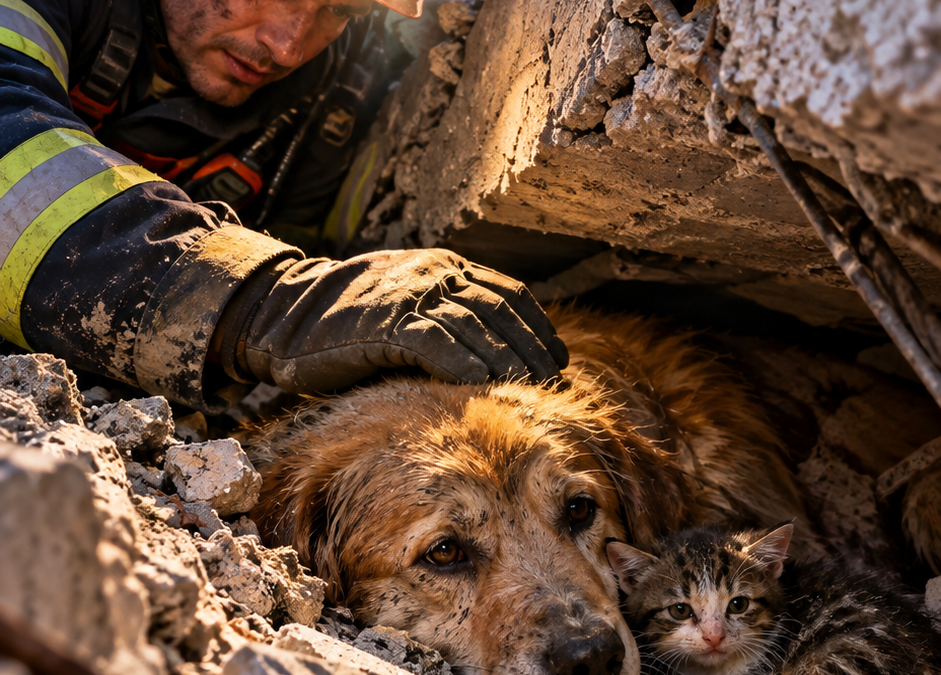
𝗙𝗨𝗟𝗟 𝗦𝗧𝗢𝗥𝗬
All tools went silent.
We listened.
Sometimes you heard water.
Sometimes metal settling.
Sometimes nothing.
And sometimes, if you’re lucky, you hear the faintest sound in the world.
A tap.
A cry.
Breathing.
We followed heat readings deeper into the southwest section.
At one point, Jacob pointed toward a narrow opening beneath a collapsed stairwell.
“Possible cavity.”
I shined my light.
Darkness.
We placed additional supports before entering.
Wood braces.
Hydraulic shoring.
Everything calculated to keep several tons of building from becoming our ceiling.
Hours passed.
Outside, daylight disappeared.
Inside, it never mattered.
There was only the beam from my flashlight and the next few feet of space.
By then, my back ached from crawling.
My gloves were torn.
Sweat had mixed with concrete dust until my skin felt coated in paste.
Michael handed me water.
“Drink.”
“I’m good.”
“That wasn’t a question.”
I drank.
“How long?”
Jacob checked his watch.
“Seven hours, nineteen minutes in this sector.”
It felt like forty minutes and three days at the same time.
We kept going.
We had thermal evidence.
Weak.
Intermittent.
But enough.
Someone might still be alive.
That’s all rescuers need.
Might.
Hope lives inside that word.
Around the eighth hour, I squeezed through a gap beneath two slabs.
My shoulders barely fit.
“Clear behind you?” Jacob called.
“Clear.”
“Movement?”
“None.”
I shifted forward.
My left hand searched the floor ahead.
Broken plaster.
Glass.
Wood.
Insulation.
Then something touched my glove.
Warm.
I froze.
Something moved.
Not much.
A tremor.
A living tremor.
“Hold.”
Everyone stopped.
“What?” Jacob asked.
“I’ve got something.”
“What kind of something?”
“I don’t know.”
I moved my hand again.
Warm fur.
My heart jumped.
“It’s an animal.”
Michael’s voice came from behind me.
“Alive?”
“Yeah.”
I angled my flashlight.
At first, all I saw was dust.
Then two eyes reflected the beam.
A dog.
Medium-sized.
Mixed breed.
Brown and black beneath layers of gray concrete powder.
His body was curled tightly inside a triangular void created by a fallen wooden beam and part of a concrete slab.
He was staring at me.
Not panicking.
Not barking.
Just staring.
“Hey.”
His ears moved.
“Easy.”
I brought the light lower.
That’s when I saw what he was lying beside.
A small shoe.
Pink.
Then a hand.
My pulse surged.
“Child.”
Everything changed.
“Michael!”
“Coming.”
“There’s a kid in here.”
“Status?”
“Can’t tell yet.”
I shifted farther into the space.
The dog moved immediately.
He stood.
Low growl.
Not aggressive.
Warning.
Protective.
“Okay.”
I stopped.
“You’re right.”
His body placed itself between me and the child.
“You don’t know me.”
The growl deepened.
“But I’m here to help.”
Of course he couldn’t understand the words.
But tone matters.
Especially to frightened animals.
I lowered myself as much as the space allowed.
“Easy, buddy.”
The dog glanced toward the child.
Then at me.
I followed his eyes.
A little girl was wedged under what had once been a heavy dining table.
The table had partially collapsed, but its frame had created a survivable pocket.
Her body was curled beneath it.
Her face was dusty.
Eyes closed.
For one terrible second, I thought she was dead.
Then I saw her chest move.
“She’s breathing.”
Michael exhaled behind me.
“Thank God.”
“Maybe six years old.”
The dog stood over her legs.
“Possible fractures?”
“Can’t see.”
“Bleeding?”
“Nothing major visible.”
I reached toward her.
The dog growled again.
“Buddy.”
He looked at me.
“I need to check her.”
I extended my hand slowly.
The dog sniffed my glove.
Then something unexpected happened.
He moved half a step aside.
Not enough to leave her.
Enough to let me touch her wrist.
Pulse.
Weak but steady.
“Pulse present.”
Michael relayed it to command.
I touched the girl’s shoulder.
“Hey.”
Nothing.
“Sweetheart, can you hear me?”
Her eyelids moved.
The dog immediately lowered his head toward her.
He licked her cheek.
Her eyes opened.
She looked confused.
Then frightened.
“Mom?”
“I’m Ethan.”
Her breathing quickened.
“Where’s my mom?”
“Your mom is outside.”
That was partly an assumption.
But if this was the missing girl we’d heard about, I knew exactly which mother was waiting.
“She’s waiting for you.”
The girl’s eyes filled.
“I want my mom.”
“I know.”
The dog pressed closer to her.
She grabbed his fur.
“Don’t take him.”
“I’m not taking anybody.”
“You promise?”
“I promise.”
The dog watched me.
That promise seemed intended for him too.
“What is your name?”
“Emily.”
There it was.
The girl from outside.
Six years old.
“Okay, Emily.”
I swallowed.
“Your mom has been waiting for you.”
“Is she mad?”
The question caught me off guard.
“No.”
“Because I went outside.”
“No, sweetheart.”
“She told me not to.”
“She is not mad.”
Emily looked at the dog.
“He saved me.”
I thought I had misheard.
“What?”
“He pulled me.”
“Where?”
“Under here.”
I looked at the broken table.
“You were somewhere else?”
She nodded weakly.
“When it got loud.”
The building.
“He grabbed me.”
“By your clothes?”
She pointed toward her sweater.
Part of the sleeve was torn.
“He pulled me.”
The dog lowered his head against her.
Emily touched his ear.
“He knew.”
A chill went through me.
“What did he know?”
“That we had to hide.”
I looked around the cavity.
If Emily had remained in the open area of the room, she would almost certainly have been crushed.
The table had created a pocket.
A tiny one.
Barely enough.
“Is he your dog?”
She shook her head.
“No.”
“What do you mean?”
“He lives outside.”
A stray.
“You know him?”
“I gave him bread.”
“When?”
“Sunday.”
Three days earlier.
That was all.
This dog had known this child for three days.
Maybe less.
Yet when the building began collapsing, he’d pulled her into a survivable void and stayed.
I looked at him differently after that.
Not like an animal trapped in rubble.
Like another rescuer.
“What’s his name?”
Emily shook her head.
“He doesn’t have one.”
The dog stared at me.
“Well.”
I adjusted my helmet.
“We’re going to have to fix that.”
Then the structure groaned above us.
Everyone froze.
Concrete shifted somewhere deep inside the building.
“Nobody move,” Jacob said.
We waited.
Five seconds.
Ten.
Twenty.
Silence returned.
Captain Ruiz’s voice came through my radio.
“Status?”
“Live child located. Female, approximately six. Conscious. Dog with her.”
“Can you extract?”
I looked at the slab pinning part of the table.
“Not without cutting.”
Jacob examined the load path.
“We remove that piece, this beam could shift.”
“So brace first.”
“Yeah.”
The next hours became some of the most careful work of my career.
Emily was close enough to touch.
That was almost worse.
When someone is deep in rubble, your brain accepts distance.
But she was right there.
A few feet away.
And we couldn’t simply pull her out.
One careless movement could collapse the pocket keeping her alive.
We installed supports.
One.
Then another.
Jacob cut sections of twisted metal.
Michael kept talking to Emily.
“What’s your favorite color?”
“Purple.”
“Good choice.”
“It’s not a choice. It’s the best one.”
Even in rubble, children will correct you.
“What about pizza toppings?”
“Cheese.”
“Only cheese?”
“Pepperoni is too spicy.”
I smiled.
The dog never left her.
He changed position occasionally.
But always touching Emily.
Sometimes she became frightened.
“I want out.”
“I know.”
“Why is it taking so long?”
“Because we’re making sure the building stays exactly where it is.”
“I hate this building.”
“Honestly?”
I looked around.
“Me too.”
She smiled weakly.
Then another sound came from above and her face collapsed into fear.
The dog licked her hand.
Emily held him.
“He does that when I cry.”
“He sounds pretty smart.”
“He is.”
The dog looked at me.
“Smarter than Jacob.”
Behind me, Jacob said, “I heard that.”
Emily laughed.
That laugh gave all of us energy.
During one pause, I asked, “How long has he been with you?”
“Since everything fell.”
“Did he leave at all?”
“No.”
“You sure?”
“He wouldn’t let me go.”
“What do you mean?”
“I tried.”
Her face tightened.
“I heard people.”
“When?”
“I don’t know.”
“You tried to crawl out?”
She nodded.
“He stood in front of me.”
The dog had kept her inside the safe pocket.
If she had crawled toward unstable rubble, she could have triggered another collapse.
“What did he do?”
“Growled.”
Emily stroked his head.
“But he’s nice.”
“I know.”
“He was scared.”
“So were you.”
She nodded.
“He licked me.”
“When?”
“When I cried.”
I looked at the dog.
He met my eyes again.
That stare.
There was no pleading in it.
No helplessness.
It felt almost like a demand.
Get her out.
That became our mission.
Not them.
Her.
As if he had appointed us.
We worked through pain.
Through thirst.
Through fatigue.
At one point, my hands cramped so badly I had to stop and stretch my fingers.
Jacob leaned against a brace.
“You good?”
“Yeah.”
“That’s your lying voice.”
“So is yours.”
“Fair.”
Michael checked Emily again.
“She’s dehydrated.”
“We need another hour.”
“Try for less.”
“I’m trying for alive.”
He nodded.
That’s the cruelty of rescue.
You can see someone suffering and still have to move slowly.
Emily asked for water.
Michael managed to give her small amounts through a tube.
The dog watched.
“You too.”
I squeezed water into my palm.
At first, he refused.
He looked toward Emily.
“She’s drinking.”
Nothing.
“Come on.”
Finally, he drank.
Barely enough.
Then returned to her.
“He didn’t eat either,” Emily whispered.
“For how long?”
“I had crackers.”
“You gave him some?”
“He wouldn’t take them.”
The dog was exhausted.
His paws were bleeding.
Dust coated his nose.
A shallow cut ran along his side.
And somehow he’d spent hour after hour refusing to leave the child he’d barely known.
The final obstacle was a fractured concrete section resting partly on the table frame.
We couldn’t lift it directly.
We had to stabilize.
Cut.
Raise.
Support.
Millimeters at a time.
Captain Ruiz warned us twice that the building was shifting.
We could hear additional crews working elsewhere.
But inside that void, the world narrowed to Emily, the dog, and the slab.
Finally, Jacob looked at me.
“We have enough clearance.”
“You’re sure?”
“As sure as anybody gets in this business.”
Michael moved forward.
“Emily.”
She looked at him.
“We’re taking you out now.”
Her eyes widened.
“Really?”
“Really.”
She grabbed the dog’s neck.
“He comes.”
“Absolutely.”
“No.”
The word was sudden.
“He’s first.”
I stared at her.
“You first.”
“No.”
“Emily—”
“He saved me.”
Her chin trembled.
“He goes first.”
The dog looked between us.
I understood.
“Okay.”
I reached toward him.
This time, there was no growl.
He let me slide my arms beneath his body.
The moment I lifted him, I realized how weak he was.
He had looked strong because he had decided to be strong.
That’s different.
His body trembled.
“Easy.”
I pulled him through the opening.
As soon as we reached the safer corridor, he twisted in my arms.
“Hey.”
He tried to turn back.
“Emily’s coming.”
He struggled harder.
“She’s coming.”
His eyes locked on the cavity.
Michael began moving Emily out.
The dog froze.
He watched.
The instant Emily appeared, his body relaxed.
She reached toward him.
“See?”
I held the dog closer.
“Your girl’s okay.”
Our radios exploded with activity.
“Live child coming out.”
“Medical ready.”
“Clear route.”
We passed Emily carefully through the corridor.
The dog refused to be separated.
Eventually, I stopped fighting it and carried him just behind her stretcher.
When we emerged from the building, the night air hit my face.
Lights blinded us.
People began shouting.
Medics rushed forward.
Then a scream cut through everything.
“Emily!”
The mother from the barricade.
She ran.
Police tried to slow her, then gave up.
Emily lifted her head from the stretcher.
“Mom!”
That sound changed the entire street.
Her mother reached her.
She bent over the stretcher and wrapped both arms around her daughter.
I turned away.
Not because I didn’t want to see.
Because scenes like that belonged to families.
We were just the people who carried them back to one another.
The dog struggled in my arms.
“Okay.”
I lowered him.
He ran toward Emily.
A medic tried to block him.
“Wait—”
“Let him through.”
The dog reached the stretcher.
Emily put both hands around his neck.
“He saved me!”
Her mother looked confused.
“What?”
“He saved me, Mom.”
The dog licked Emily’s face.
The mother covered her mouth.
“That’s the dog from outside.”
Emily nodded.
“I gave him bread.”
Her mother stared at him.
Then at me.
“He was with her?”
“The whole time.”
The mother began crying again.
She knelt and touched the dog’s head.
“Thank you.”
The dog barely reacted.
He was looking at Emily.
Only Emily.
That’s when I understood something.
He hadn’t protected her because he expected gratitude.
He hadn’t known there would be cameras.
Or medics.
Or people calling him a hero.
He had simply decided she mattered.
The medics needed to move Emily.
The dog tried to follow.
I caught him gently.
“Easy.”
He whined.
Emily reached toward him.
“Can he come?”
“We need to get you checked first.”
Her eyes filled.
“You promised.”
I had.
I crouched beside the stretcher.
“Hey.”
She looked at me.
“I’ll stay with him.”
“Really?”
“Really.”
“You won’t leave him?”
“No.”
The dog looked at me.
That same stare.
But something in it had changed.
I wasn’t sure whether I had earned trust.
Maybe only temporary permission.
Still, he stopped fighting.
The ambulance doors closed with Emily inside.
The dog stood watching until the vehicle disappeared.
Then he sat.
Just sat.
In the middle of the chaos.
Dusty.
Bleeding.
Exhausted.
Alone.
I knelt beside him.
“Now what do we do with you?”
He looked at me.
A reporter nearby called out.
“Is that the dog that saved the girl?”
I ignored him.
The dog leaned slightly against my leg.
That was the first time he touched me voluntarily.
I placed my hand on his head.
“Okay.”
The name came almost immediately.
“Hope.”
His ear moved.
I smiled.
“Yeah.”
Something about it felt right.
Not because I was trying to be poetic.
Not because he’d survived.
Not even because Emily had survived.
I called him Hope because after hours beneath concrete, surrounded by crushed homes and broken families, that dog had reminded me that living things still choose to protect each other.
Even when no one is watching.
“Hope.”
His tail touched the ground once.
“Looks like that’s you.”
After my shift ended, I took him to an emergency veterinary clinic.
The waiting room was nearly empty.
I looked ridiculous.
Rescue uniform.
Dust from head to boots.
Blood on one sleeve that wasn’t mine.
And a filthy stray dog asleep against my leg.
The vet, Dr. Patel, examined him.
“No chip.”
“Nothing?”
“Nothing.”
“Collar?”
“None.”
“Age?”
“Three, maybe four.”
“Breed?”
She smiled.
“A committee made that decision.”
“Meaning?”
“Shepherd. Maybe Lab. Maybe something else.”
“Healthy?”
“Mostly.”
She pointed out damaged paw pads, dehydration, a minor cut, bruising.
“No fractures.”
“That’s incredible.”
“He’s tough.”
I looked at Hope.
“Yeah.”
“Where did you find him?”
“Collapsed apartment building.”
Dr. Patel stopped writing.
“That’s the dog?”
“You heard?”
“The entire city has heard.”
I groaned.
“Great.”
“Apparently he protected a little girl.”
“He did more than protect her.”
I looked at Hope.
“I think he kept her alive.”
Dr. Patel crouched.
“Then somebody owes you a steak.”
Hope licked her hand.
When the examination ended, she asked the obvious question.
“Where is he going?”
I hadn’t thought that far.
“Shelter, I guess.”
Hope looked at me.
I hated that.
“I mean eventually.”
Dr. Patel raised an eyebrow.
“You can foster him overnight.”
“One night?”
“Sure.”
Her smile suggested she knew something I didn’t.
“I work.”
“So do millions of dog owners.”
“I live in an apartment.”
“So?”
“I’ve never had a dog.”
“That seems like a solvable problem.”
I looked at Hope.
He had fallen asleep against the exam table.
“One night.”
Dr. Patel nodded.
“Of course.”
Hope came home with me at 2:17 in the morning.
My apartment was small.
One bedroom.
A living room with an old couch.
A kitchen that was mostly decorative because I rarely cooked.
No yard.
No dog bed.
No toys.
Nothing.
“Welcome to luxury.”
Hope walked inside.
He didn’t explore.
That surprised me.
Most dogs would sniff everything.
He simply crossed the living room, climbed onto my old couch, turned once, and lay down.
“Seriously?”
He put his head on his paws.
“That’s my couch.”
Eyes closed.
“Fine.”
I took a shower.
Concrete dust ran gray down the drain.
When I came back into the living room, Hope was still awake.
Watching me.
I sat in the chair opposite him.
For several minutes, neither of us moved.
Then I said something I’d never said to anyone.
“I hate coming home.”
Hope’s ears moved.
I laughed softly.
“Don’t know why I’m telling you.”
He watched.
“I’ve been doing rescue work eight years.”
Nothing.
“I thought I’d get used to this part.”
The apartment was silent.
“People think the hard part is going in.”
Hope blinked.
“It’s not.”
I leaned back.
“The hard part is coming out.”
I thought about Emily’s mother.
The way she wrapped herself around her daughter.
“There is always someone waiting for them.”
My throat tightened unexpectedly.
“Wife. Husband. Mother. Brother.”
I looked around the apartment.
“And I come here.”
Hope raised his head.
“Don’t look at me like that.”
He continued.
“I’m not lonely.”
That sounded false even to me.
Hope lowered his head again.
“Okay.”
I sighed.
“Maybe a little.”
I woke the next morning because something was touching the mattress.
I opened my eyes.
Hope’s head rested on the side of the bed.
He was staring at me.
“What time is it?”
His tail moved.
“You don’t know.”
He sneezed.
“Helpful.”
For a dog I’d intended to keep for one night, he adjusted quickly.
Too quickly.
Within three days, he learned where I kept food.
Within four, he understood the elevator.
Within five, he recognized the sound of my truck.
I contacted two rescue organizations.
One returned my call.
A woman named Sarah asked for photos and veterinary records.
“We can probably place him quickly,” she said.
“Okay.”
“He has a great story.”
Something about that bothered me.
“He’s not a story.”
She paused.
“Of course.”
“I mean…”
I rubbed my face.
“Sorry.”
“It’s fine.”
“When?”
“Maybe next week.”
I looked across the room.
Hope was sleeping near my boots.
“Next week.”
“Is that a problem?”
“No.”
I ended the call.
Then sat there.
Hope opened one eye.
“You’re leaving next week.”
His eye closed.
“Apparently.”
I told myself that was right.
My schedule was unpredictable.
Twenty-four-hour shifts.
Emergency deployments.
Training.
I wasn’t dog material.
Hope deserved a family.
A yard.
Children.
Someone home regularly.
Not a rescuer who ate cereal for dinner at midnight.
So I prepared to let him go.
Then one evening, everything changed.
I had worked an eight-hour shift.
Nothing dramatic.
Vehicle extraction.
Medical assist.
Paperwork.
I unlocked my apartment door.
Before it opened completely, Hope appeared.
He had one of my socks in his mouth.
Not a pair.
One old gray sock.
His tail was moving so hard that his entire back end swung with it.
“What are you doing?”
Hope ran in a circle.
The sock stayed in his mouth.
“Give me that.”
He backed away.
“Hope.”
Tail.
“That’s mine.”
He dropped it.
Then immediately picked it up again.
I laughed.
A real laugh.
Louder than I intended.
Hope rushed forward and pressed against my legs.
“Eight hours.”
I crouched.
“I was gone eight hours.”
He licked my face.
“You’d think I came back from war.”
His paws landed on my shoulders.
I nearly fell.
“Okay.”
I wrapped both arms around him.
“Okay.”
Hope pressed his head against my neck.
Something inside me gave way.
Not dramatically.
No revelation.
Just a quiet collapse.
I sat on the floor.
Hope sat with me.
The old sock between us.
I called Sarah.
“I can’t give him up.”
She laughed.
“I was waiting.”
“You knew?”
“Everybody knew except you.”
“That’s irritating.”
“Congratulations.”
“On what?”
“Your dog.”
I looked at Hope.
My dog.
The words felt strange.
Then right.
Three weeks later, I received orders for a two-week rescue training course in another city.
Normally, I would have packed and gone.
Now I had a problem.
Hope.
The training facility didn’t allow personal animals.
My coworkers had schedules of their own.
My sister lived three hours away and had two cats who considered dogs a hostile species.
I called boarding facilities.
Booked.
Booked.
Booked.
Finally, Jacob gave me a number.
“Margaret.”
“Who is Margaret?”
“Neighbor of my aunt.”
“That’s not reassuring.”
“She’s seventy-four and has had dogs since dinosaurs.”
“Very reassuring.”
I called.
A woman answered.
“Margaret?”
“Depends who’s asking.”
“Ethan Cole.”
“Don’t know you.”
“Jacob Morales gave me your number.”
Silence.
“That idiot?”
“That’s him.”
“What do you need?”
I explained.
She interrupted halfway through.
“Bring the dog.”
“Don’t you want to meet him first?”
“No.”
“He was a stray.”
“So?”
“He can be cautious.”
“Young man, I raised German Shepherds before you learned how to tie your shoes.”
I smiled.
“You don’t know when I learned.”
“Bring the dog.”
So I did.
Margaret lived in a small house with a fenced yard and flower beds everywhere.
Hope liked her immediately.
That should have made leaving easier.
It didn’t.
I set his food by the kitchen.
“Two cups morning and evening.”
Margaret nodded impatiently.
“Medication?”
“None.”
“Good.”
“He likes—”
“I know how dogs work.”
“This dog specifically—”
“Ethan.”
“What?”
“Leave.”
Hope followed me toward the door.
My chest tightened.
Margaret touched his collar.
“Stay.”
Hope looked at me.
“I’m coming back.”
His ears lowered.
“Two weeks.”
I stepped outside.
Hope moved toward me.
Margaret held him gently.
“I’m coming back.”
Then Hope made a sound.
A long, low whine.
Not barking.
Not panic.
Something worse.
A question.
Why are you leaving?
I almost went back inside.
Margaret saw it.
“Go.”
“I can cancel.”
“You cannot.”
“Technically—”
“If you turn around now, he’ll learn that whining controls your life.”
Hope whined again.
“It might.”
Margaret closed the door.
I stood outside feeling like the worst person alive.
That night at the hotel, I reached toward the side of the bed.
Nothing.
No dog.
I laughed at myself.
Then didn’t.
The second night, I dreamed about the collapse.
Not unusual.
Rescuers dream.
Usually, mine were distorted versions of calls.
Stairwells leading nowhere.
Voices behind walls.
Doors I couldn’t open.
That night, I dreamed I found Hope beneath the rubble again.
Only when I reached for him, he backed away.
Then disappeared.
I woke at 3:14 a.m.
I called Margaret the next morning.
“How is he?”
“Alive.”
“Margaret.”
“You’re dramatic.”
“Is he eating?”
Silence.
My stomach tightened.
“Margaret.”
“Not much.”
“How much?”
“Enough water. Almost no food.”
“Why didn’t you call?”
“Because then you’d come home.”
“Maybe I should.”
“No.”
“What is he doing?”
“Sitting by my front door.”
I closed my eyes.
“All day?”
“Mostly.”
“Margaret—”
“He’ll adjust.”
“I shouldn’t have left him.”
“You told him you’d come back.”
“He doesn’t understand English.”
Margaret’s voice softened.
“Then show him.”
“How?”
“Come back when you said you would.”
That sentence stayed with me through the remaining days.
Come back when you said you would.
By the fourth day, Hope started eating.
Margaret sent me a photo.
His food bowl sat on the threshold.
Hope lay beside it.
Another photo showed him in the yard.
Another showed him sleeping near the front door.
I hated every one.
Training became harder.
For the first time in my career, I wanted to leave early.
Not because I was tired.
Because someone was waiting.
That realization scared me more than I expected.
For eight years, I had constructed a life that minimized attachment.
It wasn’t intentional.
At least, I hadn’t thought so.
My parents lived far away.
My sister had her family.
Relationships rarely survived my schedule.
Women got tired of canceled dinners.
Emergency calls.
Weekends interrupted.
I understood.
Eventually, I stopped trying.
Work became enough.
Or I called it enough.
Hope changed the equation.
Somewhere, for the first time in years, a living creature noticed I was gone.
And I noticed too.
On day fourteen, I drove back without stopping except for gas.
Margaret had told me not to arrive before noon.
I arrived at eleven twenty-three.
I parked outside.
Before I reached the porch, the door opened.
Margaret stood there smiling.
Hope sat beside her.
He saw me.
For half a second, he froze.
Then he ran.
“Holy—”
He hit me square in the chest.
I fell backward onto the grass.
Hope climbed onto me.
Paws.
Tongue.
Tail.
Everything at once.
“Hope!”
I was laughing.
“Okay!”
He licked my face.
“I came back.”
Hope whined.
“I told you.”
I held his head.
“I’m here.”
My vision blurred.
I hadn’t cried in years.
Not at funerals.
Not after difficult rescues.
Not after losing people we couldn’t reach.
I had learned to lock everything down.
Hope didn’t care about locks.
He pushed through all of them.
Margaret stood on the porch.
“Well.”
I wiped my face.
“Don’t say anything.”
“I’m going to.”
“Please don’t.”
“That dog is yours.”
“I know.”
“No.”
She came down the steps.
“You don’t.”
Hope pressed against me.
Margaret looked at him.
“The first three days, he barely ate.”
“I heard.”
“He sat by that door.”
My throat tightened.
“I know.”
“Every car made him stand.”
I looked down.
Margaret continued.
“Day four, I put his bowl right beside the threshold.”
“He ate?”
“Finally.”
“Why there?”
“Because he wouldn’t leave the door.”
I touched Hope’s neck.
Margaret smiled.
“I’ve seen dogs miss owners before.”
“Yeah?”
“This isn’t that.”
“What is it?”
She considered.
“A soul friend.”
I laughed.
“That’s not a thing.”
“It is when you’re seventy-four.”
“Convenient.”
“You rescue people, don’t you?”
“Yes.”
“You think everything worth understanding has to fit into a report?”
I didn’t answer.
Margaret pointed at Hope.
“That dog decided you are his person.”
Hope looked at me.
Margaret continued.
“And from what I can see, you’ve made the same decision.”
I sat in her old armchair while Hope somehow managed to climb half onto my lap.
“He’s too big for that,” I said.
Margaret brought coffee.
“He disagrees.”
Hope settled his head against my chest.
I ran a hand over his back.
“Why does this scare me?”
Margaret sat opposite.
“What?”
“This.”
“Being loved?”
I looked at her.
She shrugged.
“I’m old. I don’t waste time.”
“I’m not scared of being loved.”
“Then why did you ask?”
I stared at my coffee.
“I don’t know.”
Margaret did.
“Because being loved gives you something to lose.”
The sentence landed hard.
Hope’s breathing was slow against me.
“For years, I’ve watched people lose everything.”
Margaret waited.
“I’ve seen parents lose children.”
“Husbands lose wives.”
“People lose homes.”
“I’ve seen rescuers die.”
I swallowed.
“You start thinking distance is safer.”
“Is it?”
“I thought so.”
Margaret nodded toward Hope.
“Until him.”
“Yeah.”
She smiled.
“That’s life.”
“What?”
“The price of belonging is that losing matters.”
“That’s depressing.”
“It’s also the reason having matters.”
I didn’t respond.
Hope sighed against me.
Margaret leaned back.
“You’ve spent your career entering ruins.”
“Pretty dramatic phrasing.”
“Am I wrong?”
“No.”
“Maybe you’re good at wreckage because you’ve made a home there.”
I stared at her.
She took a sip of coffee.
“Too much?”
“A little.”
“Still true.”
That night, Hope and I sat on my apartment balcony.
Millbrook glowed below us.
Traffic moved along distant streets.
The skyline looked peaceful from that height.
Cities are good at hiding what happens inside them.
I scratched Hope’s head.
“She thinks you’re my soul friend.”
His tail moved.
“Don’t encourage her.”
I thought about the first time he’d looked at me beneath the rubble.
The strange authority in his eyes.
He hadn’t begged me to save him.
He’d demanded that I save Emily.
Now I understood something else about that moment.
Trust.
He had been surrounded by noise, danger, dust, strangers.
Yet eventually, he had allowed me into the only safe space he had.
He had trusted me with the child he had chosen to protect.
I had spent years earning people’s trust professionally.
Victims had to trust my rope.
My hands.
My instructions.
But those relationships lasted minutes.
Hours.
Then they went home.
Hope stayed.
That was different.
Months passed.
Hope became part of every routine.
Morning walks.
Coffee.
Work.
Dinner.
Late-night television.
If I worked long shifts, Jacob sometimes walked him.
Hope tolerated Jacob.
Barely.
“He hates me,” Jacob complained.
“He has good instincts.”
“You’re hilarious.”
“He likes Michael.”
“Everybody likes Michael.”
Hope loved riding in my truck.
Whenever I put on my rescue boots, he watched carefully.
At first, he tried following me every time.
“I’m coming back.”
I always said it.
Even though he didn’t understand the sentence.
Or maybe he understood the pattern.
Boots.
Door.
Absence.
Return.
Over time, he stopped panicking when I left.
He still waited.
But waiting became trust instead of fear.
There is a difference.
One evening, we had a difficult call.
A car had gone through a guardrail.
Two teenagers inside.
We got one out.
We couldn’t save the other.
Those are the calls that don’t leave when your shift ends.
I returned home after midnight.
Hope met me at the door with his usual excitement.
“Not tonight.”
He stopped.
I immediately felt guilty.
“Sorry.”
I walked past him.
Sat on the couch.
The room was dark except for streetlight coming through the blinds.
Hope approached.
I didn’t touch him.
For several minutes, he stood there.
Then he disappeared into the bedroom.
“Good.”
The word came out bitter.
“Smart dog.”
A minute later, he returned.
Something was in his mouth.
His favorite toy.
A battered rubber bone.
He carried it everywhere.
Slept beside it.
Protected it from Jacob like state secrets.
Hope came to me.
Placed the toy in my lap.
Then sat.
I stared at it.
“What?”
He looked at me.
I pushed it toward him.
“Take it.”
Nothing.
“Hope.”
He placed one paw on my knee.
Something inside me cracked.
Maybe it was coincidence.
Maybe dogs don’t think symbolically the way humans do.
Maybe he simply wanted to play.
I don’t care.
In that moment, it felt as if he had brought me the most valuable thing he possessed because he knew I was hurting.
I lowered my head.
And for the first time since I was a teenager, I cried without trying to stop.
Not one tear.
Not silence.
Everything.
The teenager we couldn’t save.
The people I had carried.
The ones I couldn’t.
The empty apartment.
Years of coming home and pretending that being alone was the same thing as being strong.
Hope climbed onto the couch.
He pressed his body beside mine.
Then rested his head against my chest.
We stayed that way until nearly dawn.
I talked.
About calls.
About fear.
About guilt.
About the people rescuers remember even when nobody knows we remember them.
Hope listened.
No advice.
No attempt to fix anything.
No sentence beginning with, You should.
He was simply there.
That became our pattern.
I talked to him more than I talked to people.
Ridiculous things.
Serious things.
“Jacob stole my coffee again.”
Tail.
“I’m considering murder.”
Tail.
“Professionally inappropriate.”
Tail.
Or:
“We lost somebody today.”
Stillness.
“I don’t know if we could’ve done more.”
Hope’s paw on my leg.
“Maybe we could’ve.”
He never answered.
That was the point.
Sometimes grief doesn’t need an answer.
It needs company.
Hope gave me that.
About six months after the collapse, I saw Emily again.
Her mother contacted the department and asked whether they could visit.
I wasn’t sure.
Hope solved it.
The moment Emily walked into the station, Hope went wild.
He recognized her immediately.
She dropped to her knees.
“Hope!”
He ran into her arms.
Emily had grown a little.
Children do that quickly.
She wore a purple jacket.
Of course.
I stood nearby.
Her mother came to me.
“I’ve wanted to thank you.”
“You did already.”
“Not enough.”
“You don’t owe me anything.”
She looked at Hope.
“She still talks about him.”
“So do I.”
Emily was whispering into Hope’s ear.
Her mother smiled.
“She told everyone the dog saved her.”
“He did.”
“You really believe that?”
“Absolutely.”
I told her what we’d reconstructed.
The torn sleeve.
The table.
How Hope kept Emily from leaving the cavity.
Her mother’s eyes filled.
“I used to chase him away from the courtyard.”
I looked at her.
“What?”
“Before the collapse.”
She swallowed.
“He was a stray.”
“You didn’t know.”
“I thought he might be dangerous.”
“Reasonable.”
“Emily fed him anyway.”
“Also reasonable if you’re six.”
She laughed through tears.
Then looked at Hope.
“Three days.”
“What?”
“She knew him three days.”
I nodded.
“And he stayed.”
“Yes.”
Her voice broke.
“Twelve hours.”
“At least.”
Emily came over.
“Can I still visit him?”
I crouched.
“You’ll have to ask Hope.”
She looked at him seriously.
“Can I?”
Hope licked her face.
Emily giggled.
“I think that’s yes.”
They visited several times after that.
Hope loved Emily.
But when she left, he always came back to me.
That mattered more than I wanted to admit.
Not because I needed him to choose.
Because somewhere inside me, the man who had spent years avoiding attachment was finally learning what staying felt like.
One year after the collapse, the city held a small remembrance ceremony.
Several people had died that day.
You don’t celebrate a disaster because some survived.
You honor both truths.
Loss.
Survival.
Emily stood beside her mother.
Hope sat with me.
Reporters wanted photographs.
Hope hated cameras.
Every time someone crouched in front of him, he turned away.
“You’re terrible at publicity.”
He yawned.
“Agreed.”
Afterward, Emily gave me something.
A drawing.
Crayon.
A collapsed building.
A little girl.
A dog.
And a rescuer.
Above us she’d drawn a huge yellow sun.
At the bottom, in uneven handwriting:
HOPE SAVED ME AND ETHAN SAVED HOPE AND HOPE SAVED ETHAN.
I stared at it for a long time.
Emily’s mother smiled.
“She insisted.”
“She’s not wrong.”
That night, I framed the drawing.
It hangs in my living room now.
People who visit usually laugh at the proportions.
Hope is enormous.
I am tiny.
Emily says that’s accurate.
Years have passed since that Tuesday.
I’m still a rescuer.
I still go into buildings other people are leaving.
I still hear things I wish I couldn’t.
I still come home some nights carrying names nobody else knows.
The job hasn’t become easier.
I’ve become different inside it.
Before Hope, I believed strength meant carrying everything alone.
No attachments.
No dependence.
No softness you couldn’t control.
Rescue culture can encourage that if you let it.
Be useful.
Be calm.
Be the one who doesn’t break.
Hope taught me that not breaking isn’t the same thing as being whole.
Sometimes being whole means knowing where to fall apart.
For me, that’s home.
Not my apartment.
Hope.
When I open the door after a sixteen-hour shift and hear his nails on the floor, I’m home.
When he brings me some ridiculous stolen sock, I’m home.
When he lies beside me while I talk about people I couldn’t save, I’m home.
When he sleeps with one paw touching my boot because apparently six inches of separation is unacceptable, I’m home.
Margaret still watches him occasionally.
Hope no longer refuses food when I leave.
But she says he sleeps by the door the night before I return.
“How does he know?”
I asked.
Margaret shrugged.
“Soul friend.”
“You’re never letting that go.”
“Never.”
Hope’s muzzle is beginning to gray now.
Not much.
Just around the chin.
I hate it.
Age feels unfair after everything he’s survived.
Sometimes, when he sleeps, I watch his chest rise and fall.
I remember the rubble.
Dust.
Two eyes in the dark.
That impossible little cavity.
Emily curled beneath a table.
Hope standing over her.
I used to think the most important part of that story was the extraction.
Eight hours of work.
Technical skill.
Careful cutting.
Shoring.
Medicine.
Getting them out alive.
I was wrong.
The rescue didn’t end when we emerged from the building.
Maybe rescue rarely ends where we think it does.
Emily was rescued from concrete.
Hope was rescued from the street.
And I was rescued from a life I’d convinced myself was enough.
Nobody used hydraulic tools for that one.
Nobody applauded.
There were no cameras.
It happened slowly.
A dog sleeping beside my bed.
A sock in his mouth.
A two-week separation.
A woman named Margaret telling me I was afraid of being loved.
A rubber bone placed in my lap on the worst night I’d had in years.
Small things.
That’s how Hope saved me.
Not by pulling me from a collapsed building.
By teaching me I didn’t have to live under the rubble I’d built inside myself.
There’s a difference between solitude and emptiness.
I know that now.
There’s also a difference between rescuing someone and staying after they’re safe.
That one took me longer.
My career had trained me for arrival.
Alarm.
Response.
Action.
Extraction.
Transfer.
Leave.
Hope taught me what comes afterward.
Feeding.
Walking.
Waiting.
Returning.
Staying.
There is no applause for staying.
That’s probably why it’s harder.
Nobody gives medals for getting up every morning and choosing the same person, the same animal, the same family.
Nobody interviews you for coming home when you said you would.
But maybe those are the rescues that matter most.
Hope is sleeping beside my chair as I write this.
His paws twitch occasionally.
Maybe he’s dreaming.
Sometimes I wonder what he remembers from the collapse.
Do dogs replay fear?
Does he remember concrete falling?
Emily crying?
The darkness?
My flashlight?
Or does memory work differently for him?
Maybe all he remembers is smell.
Dust.
Fear.
A child’s hand.
Then my voice.
I hope if he remembers anything, he remembers the ending.
Light.
Fresh air.
Emily’s arms.
Safety.
Home.
Earlier tonight, I came back from a call.
Nothing dramatic.
A warehouse fire.
Everyone evacuated safely.
When I opened the apartment door, Hope came running.
Slower than he used to.
But still running.
He had one of my socks.
Of course.
“Seriously?”
Tail wag.
“You’re getting predictable.”
Hope dropped the sock.
Then pushed his head against my legs.
I knelt.
For a few seconds, I smelled smoke on my uniform and dog shampoo in his fur.
Two parts of my life.
The person I was before him.
The person I became after.
“I came back.”
His tail moved.
I say that every time now.
Maybe for him.
Maybe for me.
I’m back.
I’m here.
I stayed.
Those are simple words.
But for animals who have lived on streets, children who have waited beneath rubble, and people who have spent years pretending they need nobody, simple words can become everything.
Sometimes people ask me why I named him Hope.
I usually give them the easy answer.
Because we found him in a disaster.
Because he saved a child.
Because everybody needed hope that day.
All true.
But not complete.
I called him Hope because of the way he looked at me beneath the wreckage.
He trusted me before I understood what trust would demand from me.
He looked at me as if saying:
I did my part.
Now you do yours.
At first, I thought he meant Emily.
Get her out.
Protect her.
Don’t fail.
Years later, I think maybe that look meant more.
Don’t walk away once the emergency is over.
Don’t confuse saving with leaving.
Don’t spend your whole life bringing everyone else home while pretending you don’t need one yourself.
I didn’t understand any of that beneath the rubble.
I understand it now.
Emily survived.
She’s older now.
Still loves purple.
Still visits.
Margaret still calls me “young man” even though I stopped qualifying years ago.
Jacob still steals my coffee.
Michael still claims Hope likes him better.
And Hope?
Hope still waits at the door.
Not anxiously anymore.
Confidently.
He knows something I once didn’t.
People can leave and come back.
A door closing doesn’t always mean abandonment.
A quiet apartment doesn’t have to stay empty.
A man can spend years believing his only purpose is saving others and still discover that he deserves to be saved too.
That Tuesday, after eight hours beneath a collapsed building, I reached through broken concrete and felt something warm move under my glove.
I thought I had found another victim.
Instead, I found a dog standing guard over a little girl.
I carried him out.
I gave him a name.
I brought him home.
For a long time, I told myself that meant I had rescued Hope.
I don’t say that anymore.
Because I know what happened after the rubble.
Hope stayed when I came home carrying silence.
He waited when I left.
He forgave me for leaving.
He celebrated every return.
He sat beside me when I finally let grief have a voice.
He taught me that strength isn’t refusing to need anyone.
Sometimes strength is admitting that you do.
And sometimes the greatest rescue of your life doesn’t happen beneath concrete.
Sometimes it happens afterward, quietly, when someone decides to stay beside you until you remember that you’re worth coming home to.
After eight hours of rescue work, I carried Hope into the light.
Then he spent the rest of our life doing the same for me.
𝗧𝗛𝗘 𝗘𝗡𝗗
After Eight Hours Beneath the Rubble, Something Warm Moved Under My Hand
I thought the worst thing beneath that collapsed apartment building would be what we couldn’t save.
Then something warm moved under my hand.
When my flashlight caught two pairs of eyes in the darkness, I realized the hardest part of that rescue hadn’t even begun.
My name is Ethan Cole, and for eight years, I had made a living going into places everyone else was desperate to escape.
Burned buildings.
Flooded basements.
Collapsed bridges.
Crushed cars.
Mountain ravines.
Places where concrete, steel, fire, water, gravity, and bad luck had decided to remind human beings how fragile we really were.
I was good at the work.
At least, that’s what people told me.
I knew how to stay calm when everyone around me was screaming.
I knew how to crawl into spaces so narrow that my helmet scraped both sides.
I knew how to listen to the difference between harmless settling and the kind of structural groan that meant you had seconds to move.
I knew how to hold pressure on a wound while telling someone a lie they needed to hear.
You’re going to be okay.
We’re almost there.
Stay with me.
I had said those sentences hundreds of times.
What I didn’t know was how to say them to myself.
The call came on a Tuesday afternoon in Millbrook.
A five-story residential building in one of the city’s older neighborhoods had collapsed.
Not burned.
Not partially failed.
Collapsed.
One moment, it had been standing.
The next, several floors had pancaked into one another, throwing concrete dust over the entire block.
By the time my unit was sent in, the street had already become a scene from a nightmare.
Fire engines.
Police cruisers.
Ambulances.
Search dogs.
Families behind barricades shouting names.
Paramedics carrying stretchers.
Concrete dust hanging in the air like gray fog.
The building had been constructed in the 1970s.
Old reinforced concrete.
Brick exterior.
Wood framing in some renovated sections.
A terrible combination once the structure began folding in on itself.
I stepped out of the truck and immediately heard a woman screaming.
“My daughter is in there!”
Two officers were holding her back.
“Please!”
Her voice cut through everything.
“Her name is Emily! She’s six! Please, somebody find my baby!”
I looked toward the building.
Half the front facade was gone.
Rooms had been torn open like dollhouses.
A refrigerator hung at an angle from what used to be a kitchen.
Curtains moved in a window that no longer had a wall beneath it.
I had seen collapses before.
That didn’t make them easier to understand.
Homes aren’t supposed to look like that.
A home is supposed to be where danger stops.
When one collapses, something inside your mind rejects the image.
Our team leader, Captain Ruiz, gathered us near the command tent.
“Thermal imaging still shows possible signatures in the southwest section.”
He pointed at a structural map.
“Void space here, here, and possibly here.”
My partner Jacob leaned closer.
“How stable?”
Ruiz gave him the look experienced rescuers understand immediately.
Not stable enough.
“Engineers say the eastern wall may shift.”
“Meaning?”
“Meaning you don’t touch anything you don’t have to.”
Michael, our medic, adjusted his pack.
“So a normal Tuesday.”
Nobody laughed.
Ruiz looked at all of us.
“We already have two live recoveries from the upper debris layer. We also have fatalities.”
Silence.
“You’re going after possible live signals. Slow is fast. Nobody becomes another victim. Understood?”
We nodded.
Then we went in.
There is something people misunderstand about rescue work after a collapse.
They imagine digging.
You don’t just dig.
Digging carelessly kills people.
Every piece of debris is touching something else.
A concrete slab may be holding up a beam.
That beam may be supporting a pocket of air.
That pocket may contain someone alive.
Move the wrong thing and everything comes down.
So you crawl.
Listen.
Brace.
Cut.
Wait.
Measure.
Move inches at a time.
Then repeat.
The first hour disappeared.
Then the second.
We crawled through a void barely wide enough for our shoulders.
Concrete scraped my elbows.
Dust coated my tongue.
Even through the respirator, I could taste it.
Every few minutes, we stopped.
“Quiet!”
All tools went silent.
We listened.
Sometimes you heard water.
Sometimes metal settling.
Sometimes nothing.
And sometimes, if you’re lucky, you hear the faintest sound in the world.
A tap.
A cry.
Breathing.
We followed heat readings deeper into the southwest section.
At one point, Jacob pointed toward a narrow opening beneath a collapsed stairwell.
“Possible cavity.”
I shined my light.
Darkness.
We placed additional supports before entering.
Wood braces.
Hydraulic shoring.
Everything calculated to keep several tons of building from becoming our ceiling.
Hours passed.
Outside, daylight disappeared.
Inside, it never mattered.
There was only the beam from my flashlight and the next few feet of space.
By then, my back ached from crawling.
My gloves were torn.
Sweat had mixed with concrete dust until my skin felt coated in paste.
Michael handed me water.
“Drink.”
“I’m good.”
“That wasn’t a question.”
I drank.
“How long?”
Jacob checked his watch.
“Seven hours, nineteen minutes in this sector.”
It felt like forty minutes and three days at the same time.
We kept going.
We had thermal evidence.
Weak.
Intermittent.
But enough.
Someone might still be alive.
That’s all rescuers need.
Might.
Hope lives inside that word.
Around the eighth hour, I squeezed through a gap beneath two slabs.
My shoulders barely fit.
“Clear behind you?” Jacob called.
“Clear.”
“Movement?”
“None.”
I shifted forward.
My left hand searched the floor ahead.
Broken plaster.
Glass.
Wood.
Insulation.
Then something touched my glove.
Warm.
I froze.
Something moved.
Not much.
A tremor.
A living tremor.
“Hold.”
Everyone stopped.
“What?” Jacob asked.
“I’ve got something.”
“What kind of something?”
“I don’t know.”
I moved my hand again.
Warm fur.
My heart jumped.
“It’s an animal.”
Michael’s voice came from behind me.
“Alive?”
“Yeah.”
I angled my flashlight.
At first, all I saw was dust.
Then two eyes reflected the beam.
A dog.
Medium-sized.
Mixed breed.
Brown and black beneath layers of gray concrete powder.
His body was curled tightly inside a triangular void created by a fallen wooden beam and part of a concrete slab.
He was staring at me.
Not panicking.
Not barking.
Just staring.
“Hey.”
His ears moved.
“Easy.”
I brought the light lower.
That’s when I saw what he was lying beside.
A small shoe.
Pink.
Then a hand.
My pulse surged.
“Child.”
Everything changed.
“Michael!”
“Coming.”
“There’s a kid in here.”
“Status?”
“Can’t tell yet.”
I shifted farther into the space.
The dog moved immediately.
He stood.
Low growl.
Not aggressive.
Warning.
Protective.
“Okay.”
I stopped.
“You’re right.”
His body placed itself between me and the child.
“You don’t know me.”
The growl deepened.
“But I’m here to help.”
Of course he couldn’t understand the words.
But tone matters.
Especially to frightened animals.
I lowered myself as much as the space allowed.
“Easy, buddy.”
The dog glanced toward the child.
Then at me.
I followed his eyes.
A little girl was wedged under what had once been a heavy dining table.
The table had partially collapsed, but its frame had created a survivable pocket.
Her body was curled beneath it.
Her face was dusty.
Eyes closed.
For one terrible second, I thought she was dead.
Then I saw her chest move.
“She’s breathing.”
Michael exhaled behind me.
“Thank God.”
“Maybe six years old.”
The dog stood over her legs.
“Possible fractures?”
“Can’t see.”
“Bleeding?”
“Nothing major visible.”
I reached toward her.
The dog growled again.
“Buddy.”
He looked at me.
“I need to check her.”
I extended my hand slowly.
The dog sniffed my glove.
Then something unexpected happened.
He moved half a step aside.
Not enough to leave her.
Enough to let me touch her wrist.
Pulse.
Weak but steady.
“Pulse present.”
Michael relayed it to command.
I touched the girl’s shoulder.
“Hey.”
Nothing.
“Sweetheart, can you hear me?”
Her eyelids moved.
The dog immediately lowered his head toward her.
He licked her cheek.
Her eyes opened.
She looked confused.
Then frightened.
“Mom?”
“I’m Ethan.”
Her breathing quickened.
“Where’s my mom?”
“Your mom is outside.”
That was partly an assumption.
But if this was the missing girl we’d heard about, I knew exactly which mother was waiting.
“She’s waiting for you.”
The girl’s eyes filled.
“I want my mom.”
“I know.”
The dog pressed closer to her.
She grabbed his fur.
“Don’t take him.”
“I’m not taking anybody.”
“You promise?”
“I promise.”
The dog watched me.
That promise seemed intended for him too.
“What is your name?”
“Emily.”
There it was.
The girl from outside.
Six years old.
“Okay, Emily.”
I swallowed.
“Your mom has been waiting for you.”
“Is she mad?”
The question caught me off guard.
“No.”
“Because I went outside.”
“No, sweetheart.”
“She told me not to.”
“She is not mad.”
Emily looked at the dog.
“He saved me.”
I thought I had misheard.
“What?”
“He pulled me.”
“Where?”
“Under here.”
I looked at the broken table.
“You were somewhere else?”
She nodded weakly.
“When it got loud.”
The building.
“He grabbed me.”
“By your clothes?”
She pointed toward her sweater.
Part of the sleeve was torn.
“He pulled me.”
The dog lowered his head against her.
Emily touched his ear.
“He knew.”
A chill went through me.
“What did he know?”
“That we had to hide.”
I looked around the cavity.
If Emily had remained in the open area of the room, she would almost certainly have been crushed.
The table had created a pocket.
A tiny one.
Barely enough.
“Is he your dog?”
She shook her head.
“No.”
“What do you mean?”
“He lives outside.”
A stray.
“You know him?”
“I gave him bread.”
“When?”
“Sunday.”
Three days earlier.
That was all.
This dog had known this child for three days.
Maybe less.
Yet when the building began collapsing, he’d pulled her into a survivable void and stayed.
I looked at him differently after that.
Not like an animal trapped in rubble.
Like another rescuer.
“What’s his name?”
Emily shook her head.
“He doesn’t have one.”
The dog stared at me.
“Well.”
I adjusted my helmet.
“We’re going to have to fix that.”
Then the structure groaned above us.
Everyone froze.
Concrete shifted somewhere deep inside the building.
“Nobody move,” Jacob said.
We waited.
Five seconds.
Ten.
Twenty.
Silence returned.
Captain Ruiz’s voice came through my radio.
“Status?”
“Live child located. Female, approximately six. Conscious. Dog with her.”
“Can you extract?”
I looked at the slab pinning part of the table.
“Not without cutting.”
Jacob examined the load path.
“We remove that piece, this beam could shift.”
“So brace first.”
“Yeah.”
The next hours became some of the most careful work of my career.
Emily was close enough to touch.
That was almost worse.
When someone is deep in rubble, your brain accepts distance.
But she was right there.
A few feet away.
And we couldn’t simply pull her out.
One careless movement could collapse the pocket keeping her alive.
We installed supports.
One.
Then another.
Jacob cut sections of twisted metal.
Michael kept talking to Emily.
“What’s your favorite color?”
“Purple.”
“Good choice.”
“It’s not a choice. It’s the best one.”
Even in rubble, children will correct you.
“What about pizza toppings?”
“Cheese.”
“Only cheese?”
“Pepperoni is too spicy.”
I smiled.
The dog never left her.
He changed position occasionally.
But always touching Emily.
Sometimes she became frightened.
“I want out.”
“I know.”
“Why is it taking so long?”
“Because we’re making sure the building stays exactly where it is.”
“I hate this building.”
“Honestly?”
I looked around.
“Me too.”
She smiled weakly.
Then another sound came from above and her face collapsed into fear.
The dog licked her hand.
Emily held him.
“He does that when I cry.”
“He sounds pretty smart.”
“He is.”
The dog looked at me.
“Smarter than Jacob.”
Behind me, Jacob said, “I heard that.”
Emily laughed.
That laugh gave all of us energy.
During one pause, I asked, “How long has he been with you?”
“Since everything fell.”
“Did he leave at all?”
“No.”
“You sure?”
“He wouldn’t let me go.”
“What do you mean?”
“I tried.”
Her face tightened.
“I heard people.”
“When?”
“I don’t know.”
“You tried to crawl out?”
She nodded.
“He stood in front of me.”
The dog had kept her inside the safe pocket.
If she had crawled toward unstable rubble, she could have triggered another collapse.
“What did he do?”
“Growled.”
Emily stroked his head.
“But he’s nice.”
“I know.”
“He was scared.”
“So were you.”
She nodded.
“He licked me.”
“When?”
“When I cried.”
I looked at the dog.
He met my eyes again.
That stare.
There was no pleading in it.
No helplessness.
It felt almost like a demand.
Get her out.
That became our mission.
Not them.
Her.
As if he had appointed us.
We worked through pain.
Through thirst.
Through fatigue.
At one point, my hands cramped so badly I had to stop and stretch my fingers.
Jacob leaned against a brace.
“You good?”
“Yeah.”
“That’s your lying voice.”
“So is yours.”
“Fair.”
Michael checked Emily again.
“She’s dehydrated.”
“We need another hour.”
“Try for less.”
“I’m trying for alive.”
He nodded.
That’s the cruelty of rescue.
You can see someone suffering and still have to move slowly.
Emily asked for water.
Michael managed to give her small amounts through a tube.
The dog watched.
“You too.”
I squeezed water into my palm.
At first, he refused.
He looked toward Emily.
“She’s drinking.”
Nothing.
“Come on.”
Finally, he drank.
Barely enough.
Then returned to her.
“He didn’t eat either,” Emily whispered.
“For how long?”
“I had crackers.”
“You gave him some?”
“He wouldn’t take them.”
The dog was exhausted.
His paws were bleeding.
Dust coated his nose.
A shallow cut ran along his side.
And somehow he’d spent hour after hour refusing to leave the child he’d barely known.
The final obstacle was a fractured concrete section resting partly on the table frame.
We couldn’t lift it directly.
We had to stabilize.
Cut.
Raise.
Support.
Millimeters at a time.
Captain Ruiz warned us twice that the building was shifting.
We could hear additional crews working elsewhere.
But inside that void, the world narrowed to Emily, the dog, and the slab.
Finally, Jacob looked at me.
“We have enough clearance.”
“You’re sure?”
“As sure as anybody gets in this business.”
Michael moved forward.
“Emily.”
She looked at him.
“We’re taking you out now.”
Her eyes widened.
“Really?”
“Really.”
She grabbed the dog’s neck.
“He comes.”
“Absolutely.”
“No.”
The word was sudden.
“He’s first.”
I stared at her.
“You first.”
“No.”
“Emily—”
“He saved me.”
Her chin trembled.
“He goes first.”
The dog looked between us.
I understood.
“Okay.”
I reached toward him.
This time, there was no growl.
He let me slide my arms beneath his body.
The moment I lifted him, I realized how weak he was.
He had looked strong because he had decided to be strong.
That’s different.
His body trembled.
“Easy.”
I pulled him through the opening.
As soon as we reached the safer corridor, he twisted in my arms.
“Hey.”
He tried to turn back.
“Emily’s coming.”
He struggled harder.
“She’s coming.”
His eyes locked on the cavity.
Michael began moving Emily out.
The dog froze.
He watched.
The instant Emily appeared, his body relaxed.
She reached toward him.
“See?”
I held the dog closer.
“Your girl’s okay.”
Our radios exploded with activity.
“Live child coming out.”
“Medical ready.”
“Clear route.”
We passed Emily carefully through the corridor.
The dog refused to be separated.
Eventually, I stopped fighting it and carried him just behind her stretcher.
When we emerged from the building, the night air hit my face.
Lights blinded us.
People began shouting.
Medics rushed forward.
Then a scream cut through everything.
“Emily!”
The mother from the barricade.
She ran.
Police tried to slow her, then gave up.
Emily lifted her head from the stretcher.
“Mom!”
That sound changed the entire street.
Her mother reached her.
She bent over the stretcher and wrapped both arms around her daughter.
I turned away.
Not because I didn’t want to see.
Because scenes like that belonged to families.
We were just the people who carried them back to one another.
The dog struggled in my arms.
“Okay.”
I lowered him.
He ran toward Emily.
A medic tried to block him.
“Wait—”
“Let him through.”
The dog reached the stretcher.
Emily put both hands around his neck.
“He saved me!”
Her mother looked confused.
“What?”
“He saved me, Mom.”
The dog licked Emily’s face.
The mother covered her mouth.
“That’s the dog from outside.”
Emily nodded.
“I gave him bread.”
Her mother stared at him.
Then at me.
“He was with her?”
“The whole time.”
The mother began crying again.
She knelt and touched the dog’s head.
“Thank you.”
The dog barely reacted.
He was looking at Emily.
Only Emily.
That’s when I understood something.
He hadn’t protected her because he expected gratitude.
He hadn’t known there would be cameras.
Or medics.
Or people calling him a hero.
He had simply decided she mattered.
The medics needed to move Emily.
The dog tried to follow.
I caught him gently.
“Easy.”
He whined.
Emily reached toward him.
“Can he come?”
“We need to get you checked first.”
Her eyes filled.
“You promised.”
I had.
I crouched beside the stretcher.
“Hey.”
She looked at me.
“I’ll stay with him.”
“Really?”
“Really.”
“You won’t leave him?”
“No.”
The dog looked at me.
That same stare.
But something in it had changed.
I wasn’t sure whether I had earned trust.
Maybe only temporary permission.
Still, he stopped fighting.
The ambulance doors closed with Emily inside.
The dog stood watching until the vehicle disappeared.
Then he sat.
Just sat.
In the middle of the chaos.
Dusty.
Bleeding.
Exhausted.
Alone.
I knelt beside him.
“Now what do we do with you?”
He looked at me.
A reporter nearby called out.
“Is that the dog that saved the girl?”
I ignored him.
The dog leaned slightly against my leg.
That was the first time he touched me voluntarily.
I placed my hand on his head.
“Okay.”
The name came almost immediately.
“Hope.”
His ear moved.
I smiled.
“Yeah.”
Something about it felt right.
Not because I was trying to be poetic.
Not because he’d survived.
Not even because Emily had survived.
I called him Hope because after hours beneath concrete, surrounded by crushed homes and broken families, that dog had reminded me that living things still choose to protect each other.
Even when no one is watching.
“Hope.”
His tail touched the ground once.
“Looks like that’s you.”
After my shift ended, I took him to an emergency veterinary clinic.
The waiting room was nearly empty.
I looked ridiculous.
Rescue uniform.
Dust from head to boots.
Blood on one sleeve that wasn’t mine.
And a filthy stray dog asleep against my leg.
The vet, Dr. Patel, examined him.
“No chip.”
“Nothing?”
“Nothing.”
“Collar?”
“None.”
“Age?”
“Three, maybe four.”
“Breed?”
She smiled.
“A committee made that decision.”
“Meaning?”
“Shepherd. Maybe Lab. Maybe something else.”
“Healthy?”
“Mostly.”
She pointed out damaged paw pads, dehydration, a minor cut, bruising.
“No fractures.”
“That’s incredible.”
“He’s tough.”
I looked at Hope.
“Yeah.”
“Where did you find him?”
“Collapsed apartment building.”
Dr. Patel stopped writing.
“That’s the dog?”
“You heard?”
“The entire city has heard.”
I groaned.
“Great.”
“Apparently he protected a little girl.”
“He did more than protect her.”
I looked at Hope.
“I think he kept her alive.”
Dr. Patel crouched.
“Then somebody owes you a steak.”
Hope licked her hand.
When the examination ended, she asked the obvious question.
“Where is he going?”
I hadn’t thought that far.
“Shelter, I guess.”
Hope looked at me.
I hated that.
“I mean eventually.”
Dr. Patel raised an eyebrow.
“You can foster him overnight.”
“One night?”
“Sure.”
Her smile suggested she knew something I didn’t.
“I work.”
“So do millions of dog owners.”
“I live in an apartment.”
“So?”
“I’ve never had a dog.”
“That seems like a solvable problem.”
I looked at Hope.
He had fallen asleep against the exam table.
“One night.”
Dr. Patel nodded.
“Of course.”
Hope came home with me at 2:17 in the morning.
My apartment was small.
One bedroom.
A living room with an old couch.
A kitchen that was mostly decorative because I rarely cooked.
No yard.
No dog bed.
No toys.
Nothing.
“Welcome to luxury.”
Hope walked inside.
He didn’t explore.
That surprised me.
Most dogs would sniff everything.
He simply crossed the living room, climbed onto my old couch, turned once, and lay down.
“Seriously?”
He put his head on his paws.
“That’s my couch.”
Eyes closed.
“Fine.”
I took a shower.
Concrete dust ran gray down the drain.
When I came back into the living room, Hope was still awake.
Watching me.
I sat in the chair opposite him.
For several minutes, neither of us moved.
Then I said something I’d never said to anyone.
“I hate coming home.”
Hope’s ears moved.
I laughed softly.
“Don’t know why I’m telling you.”
He watched.
“I’ve been doing rescue work eight years.”
Nothing.
“I thought I’d get used to this part.”
The apartment was silent.
“People think the hard part is going in.”
Hope blinked.
“It’s not.”
I leaned back.
“The hard part is coming out.”
I thought about Emily’s mother.
The way she wrapped herself around her daughter.
“There is always someone waiting for them.”
My throat tightened unexpectedly.
“Wife. Husband. Mother. Brother.”
I looked around the apartment.
“And I come here.”
Hope raised his head.
“Don’t look at me like that.”
He continued.
“I’m not lonely.”
That sounded false even to me.
Hope lowered his head again.
“Okay.”
I sighed.
“Maybe a little.”
I woke the next morning because something was touching the mattress.
I opened my eyes.
Hope’s head rested on the side of the bed.
He was staring at me.
“What time is it?”
His tail moved.
“You don’t know.”
He sneezed.
“Helpful.”
For a dog I’d intended to keep for one night, he adjusted quickly.
Too quickly.
Within three days, he learned where I kept food.
Within four, he understood the elevator.
Within five, he recognized the sound of my truck.
I contacted two rescue organizations.
One returned my call.
A woman named Sarah asked for photos and veterinary records.
“We can probably place him quickly,” she said.
“Okay.”
“He has a great story.”
Something about that bothered me.
“He’s not a story.”
She paused.
“Of course.”
“I mean…”
I rubbed my face.
“Sorry.”
“It’s fine.”
“When?”
“Maybe next week.”
I looked across the room.
Hope was sleeping near my boots.
“Next week.”
“Is that a problem?”
“No.”
I ended the call.
Then sat there.
Hope opened one eye.
“You’re leaving next week.”
His eye closed.
“Apparently.”
I told myself that was right.
My schedule was unpredictable.
Twenty-four-hour shifts.
Emergency deployments.
Training.
I wasn’t dog material.
Hope deserved a family.
A yard.
Children.
Someone home regularly.
Not a rescuer who ate cereal for dinner at midnight.
So I prepared to let him go.
Then one evening, everything changed.
I had worked an eight-hour shift.
Nothing dramatic.
Vehicle extraction.
Medical assist.
Paperwork.
I unlocked my apartment door.
Before it opened completely, Hope appeared.
He had one of my socks in his mouth.
Not a pair.
One old gray sock.
His tail was moving so hard that his entire back end swung with it.
“What are you doing?”
Hope ran in a circle.
The sock stayed in his mouth.
“Give me that.”
He backed away.
“Hope.”
Tail.
“That’s mine.”
He dropped it.
Then immediately picked it up again.
I laughed.
A real laugh.
Louder than I intended.
Hope rushed forward and pressed against my legs.
“Eight hours.”
I crouched.
“I was gone eight hours.”
He licked my face.
“You’d think I came back from war.”
His paws landed on my shoulders.
I nearly fell.
“Okay.”
I wrapped both arms around him.
“Okay.”
Hope pressed his head against my neck.
Something inside me gave way.
Not dramatically.
No revelation.
Just a quiet collapse.
I sat on the floor.
Hope sat with me.
The old sock between us.
I called Sarah.
“I can’t give him up.”
She laughed.
“I was waiting.”
“You knew?”
“Everybody knew except you.”
“That’s irritating.”
“Congratulations.”
“On what?”
“Your dog.”
I looked at Hope.
My dog.
The words felt strange.
Then right.
Three weeks later, I received orders for a two-week rescue training course in another city.
Normally, I would have packed and gone.
Now I had a problem.
Hope.
The training facility didn’t allow personal animals.
My coworkers had schedules of their own.
My sister lived three hours away and had two cats who considered dogs a hostile species.
I called boarding facilities.
Booked.
Booked.
Booked.
Finally, Jacob gave me a number.
“Margaret.”
“Who is Margaret?”
“Neighbor of my aunt.”
“That’s not reassuring.”
“She’s seventy-four and has had dogs since dinosaurs.”
“Very reassuring.”
I called.
A woman answered.
“Margaret?”
“Depends who’s asking.”
“Ethan Cole.”
“Don’t know you.”
“Jacob Morales gave me your number.”
Silence.
“That idiot?”
“That’s him.”
“What do you need?”
I explained.
She interrupted halfway through.
“Bring the dog.”
“Don’t you want to meet him first?”
“No.”
“He was a stray.”
“So?”
“He can be cautious.”
“Young man, I raised German Shepherds before you learned how to tie your shoes.”
I smiled.
“You don’t know when I learned.”
“Bring the dog.”
So I did.
Margaret lived in a small house with a fenced yard and flower beds everywhere.
Hope liked her immediately.
That should have made leaving easier.
It didn’t.
I set his food by the kitchen.
“Two cups morning and evening.”
Margaret nodded impatiently.
“Medication?”
“None.”
“Good.”
“He likes—”
“I know how dogs work.”
“This dog specifically—”
“Ethan.”
“What?”
“Leave.”
Hope followed me toward the door.
My chest tightened.
Margaret touched his collar.
“Stay.”
Hope looked at me.
“I’m coming back.”
His ears lowered.
“Two weeks.”
I stepped outside.
Hope moved toward me.
Margaret held him gently.
“I’m coming back.”
Then Hope made a sound.
A long, low whine.
Not barking.
Not panic.
Something worse.
A question.
Why are you leaving?
I almost went back inside.
Margaret saw it.
“Go.”
“I can cancel.”
“You cannot.”
“Technically—”
“If you turn around now, he’ll learn that whining controls your life.”
Hope whined again.
“It might.”
Margaret closed the door.
I stood outside feeling like the worst person alive.
That night at the hotel, I reached toward the side of the bed.
Nothing.
No dog.
I laughed at myself.
Then didn’t.
The second night, I dreamed about the collapse.
Not unusual.
Rescuers dream.
Usually, mine were distorted versions of calls.
Stairwells leading nowhere.
Voices behind walls.
Doors I couldn’t open.
That night, I dreamed I found Hope beneath the rubble again.
Only when I reached for him, he backed away.
Then disappeared.
I woke at 3:14 a.m.
I called Margaret the next morning.
“How is he?”
“Alive.”
“Margaret.”
“You’re dramatic.”
“Is he eating?”
Silence.
My stomach tightened.
“Margaret.”
“Not much.”
“How much?”
“Enough water. Almost no food.”
“Why didn’t you call?”
“Because then you’d come home.”
“Maybe I should.”
“No.”
“What is he doing?”
“Sitting by my front door.”
I closed my eyes.
“All day?”
“Mostly.”
“Margaret—”
“He’ll adjust.”
“I shouldn’t have left him.”
“You told him you’d come back.”
“He doesn’t understand English.”
Margaret’s voice softened.
“Then show him.”
“How?”
“Come back when you said you would.”
That sentence stayed with me through the remaining days.
Come back when you said you would.
By the fourth day, Hope started eating.
Margaret sent me a photo.
His food bowl sat on the threshold.
Hope lay beside it.
Another photo showed him in the yard.
Another showed him sleeping near the front door.
I hated every one.
Training became harder.
For the first time in my career, I wanted to leave early.
Not because I was tired.
Because someone was waiting.
That realization scared me more than I expected.
For eight years, I had constructed a life that minimized attachment.
It wasn’t intentional.
At least, I hadn’t thought so.
My parents lived far away.
My sister had her family.
Relationships rarely survived my schedule.
Women got tired of canceled dinners.
Emergency calls.
Weekends interrupted.
I understood.
Eventually, I stopped trying.
Work became enough.
Or I called it enough.
Hope changed the equation.
Somewhere, for the first time in years, a living creature noticed I was gone.
And I noticed too.
On day fourteen, I drove back without stopping except for gas.
Margaret had told me not to arrive before noon.
I arrived at eleven twenty-three.
I parked outside.
Before I reached the porch, the door opened.
Margaret stood there smiling.
Hope sat beside her.
He saw me.
For half a second, he froze.
Then he ran.
“Holy—”
He hit me square in the chest.
I fell backward onto the grass.
Hope climbed onto me.
Paws.
Tongue.
Tail.
Everything at once.
“Hope!”
I was laughing.
“Okay!”
He licked my face.
“I came back.”
Hope whined.
“I told you.”
I held his head.
“I’m here.”
My vision blurred.
I hadn’t cried in years.
Not at funerals.
Not after difficult rescues.
Not after losing people we couldn’t reach.
I had learned to lock everything down.
Hope didn’t care about locks.
He pushed through all of them.
Margaret stood on the porch.
“Well.”
I wiped my face.
“Don’t say anything.”
“I’m going to.”
“Please don’t.”
“That dog is yours.”
“I know.”
“No.”
She came down the steps.
“You don’t.”
Hope pressed against me.
Margaret looked at him.
“The first three days, he barely ate.”
“I heard.”
“He sat by that door.”
My throat tightened.
“I know.”
“Every car made him stand.”
I looked down.
Margaret continued.
“Day four, I put his bowl right beside the threshold.”
“He ate?”
“Finally.”
“Why there?”
“Because he wouldn’t leave the door.”
I touched Hope’s neck.
Margaret smiled.
“I’ve seen dogs miss owners before.”
“Yeah?”
“This isn’t that.”
“What is it?”
She considered.
“A soul friend.”
I laughed.
“That’s not a thing.”
“It is when you’re seventy-four.”
“Convenient.”
“You rescue people, don’t you?”
“Yes.”
“You think everything worth understanding has to fit into a report?”
I didn’t answer.
Margaret pointed at Hope.
“That dog decided you are his person.”
Hope looked at me.
Margaret continued.
“And from what I can see, you’ve made the same decision.”
I sat in her old armchair while Hope somehow managed to climb half onto my lap.
“He’s too big for that,” I said.
Margaret brought coffee.
“He disagrees.”
Hope settled his head against my chest.
I ran a hand over his back.
“Why does this scare me?”
Margaret sat opposite.
“What?”
“This.”
“Being loved?”
I looked at her.
She shrugged.
“I’m old. I don’t waste time.”
“I’m not scared of being loved.”
“Then why did you ask?”
I stared at my coffee.
“I don’t know.”
Margaret did.
“Because being loved gives you something to lose.”
The sentence landed hard.
Hope’s breathing was slow against me.
“For years, I’ve watched people lose everything.”
Margaret waited.
“I’ve seen parents lose children.”
“Husbands lose wives.”
“People lose homes.”
“I’ve seen rescuers die.”
I swallowed.
“You start thinking distance is safer.”
“Is it?”
“I thought so.”
Margaret nodded toward Hope.
“Until him.”
“Yeah.”
She smiled.
“That’s life.”
“What?”
“The price of belonging is that losing matters.”
“That’s depressing.”
“It’s also the reason having matters.”
I didn’t respond.
Hope sighed against me.
Margaret leaned back.
“You’ve spent your career entering ruins.”
“Pretty dramatic phrasing.”
“Am I wrong?”
“No.”
“Maybe you’re good at wreckage because you’ve made a home there.”
I stared at her.
She took a sip of coffee.
“Too much?”
“A little.”
“Still true.”
That night, Hope and I sat on my apartment balcony.
Millbrook glowed below us.
Traffic moved along distant streets.
The skyline looked peaceful from that height.
Cities are good at hiding what happens inside them.
I scratched Hope’s head.
“She thinks you’re my soul friend.”
His tail moved.
“Don’t encourage her.”
I thought about the first time he’d looked at me beneath the rubble.
The strange authority in his eyes.
He hadn’t begged me to save him.
He’d demanded that I save Emily.
Now I understood something else about that moment.
Trust.
He had been surrounded by noise, danger, dust, strangers.
Yet eventually, he had allowed me into the only safe space he had.
He had trusted me with the child he had chosen to protect.
I had spent years earning people’s trust professionally.
Victims had to trust my rope.
My hands.
My instructions.
But those relationships lasted minutes.
Hours.
Then they went home.
Hope stayed.
That was different.
Months passed.
Hope became part of every routine.
Morning walks.
Coffee.
Work.
Dinner.
Late-night television.
If I worked long shifts, Jacob sometimes walked him.
Hope tolerated Jacob.
Barely.
“He hates me,” Jacob complained.
“He has good instincts.”
“You’re hilarious.”
“He likes Michael.”
“Everybody likes Michael.”
Hope loved riding in my truck.
Whenever I put on my rescue boots, he watched carefully.
At first, he tried following me every time.
“I’m coming back.”
I always said it.
Even though he didn’t understand the sentence.
Or maybe he understood the pattern.
Boots.
Door.
Absence.
Return.
Over time, he stopped panicking when I left.
He still waited.
But waiting became trust instead of fear.
There is a difference.
One evening, we had a difficult call.
A car had gone through a guardrail.
Two teenagers inside.
We got one out.
We couldn’t save the other.
Those are the calls that don’t leave when your shift ends.
I returned home after midnight.
Hope met me at the door with his usual excitement.
“Not tonight.”
He stopped.
I immediately felt guilty.
“Sorry.”
I walked past him.
Sat on the couch.
The room was dark except for streetlight coming through the blinds.
Hope approached.
I didn’t touch him.
For several minutes, he stood there.
Then he disappeared into the bedroom.
“Good.”
The word came out bitter.
“Smart dog.”
A minute later, he returned.
Something was in his mouth.
His favorite toy.
A battered rubber bone.
He carried it everywhere.
Slept beside it.
Protected it from Jacob like state secrets.
Hope came to me.
Placed the toy in my lap.
Then sat.
I stared at it.
“What?”
He looked at me.
I pushed it toward him.
“Take it.”
Nothing.
“Hope.”
He placed one paw on my knee.
Something inside me cracked.
Maybe it was coincidence.
Maybe dogs don’t think symbolically the way humans do.
Maybe he simply wanted to play.
I don’t care.
In that moment, it felt as if he had brought me the most valuable thing he possessed because he knew I was hurting.
I lowered my head.
And for the first time since I was a teenager, I cried without trying to stop.
Not one tear.
Not silence.
Everything.
The teenager we couldn’t save.
The people I had carried.
The ones I couldn’t.
The empty apartment.
Years of coming home and pretending that being alone was the same thing as being strong.
Hope climbed onto the couch.
He pressed his body beside mine.
Then rested his head against my chest.
We stayed that way until nearly dawn.
I talked.
About calls.
About fear.
About guilt.
About the people rescuers remember even when nobody knows we remember them.
Hope listened.
No advice.
No attempt to fix anything.
No sentence beginning with, You should.
He was simply there.
That became our pattern.
I talked to him more than I talked to people.
Ridiculous things.
Serious things.
“Jacob stole my coffee again.”
Tail.
“I’m considering murder.”
Tail.
“Professionally inappropriate.”
Tail.
Or:
“We lost somebody today.”
Stillness.
“I don’t know if we could’ve done more.”
Hope’s paw on my leg.
“Maybe we could’ve.”
He never answered.
That was the point.
Sometimes grief doesn’t need an answer.
It needs company.
Hope gave me that.
About six months after the collapse, I saw Emily again.
Her mother contacted the department and asked whether they could visit.
I wasn’t sure.
Hope solved it.
The moment Emily walked into the station, Hope went wild.
He recognized her immediately.
She dropped to her knees.
“Hope!”
He ran into her arms.
Emily had grown a little.
Children do that quickly.
She wore a purple jacket.
Of course.
I stood nearby.
Her mother came to me.
“I’ve wanted to thank you.”
“You did already.”
“Not enough.”
“You don’t owe me anything.”
She looked at Hope.
“She still talks about him.”
“So do I.”
Emily was whispering into Hope’s ear.
Her mother smiled.
“She told everyone the dog saved her.”
“He did.”
“You really believe that?”
“Absolutely.”
I told her what we’d reconstructed.
The torn sleeve.
The table.
How Hope kept Emily from leaving the cavity.
Her mother’s eyes filled.
“I used to chase him away from the courtyard.”
I looked at her.
“What?”
“Before the collapse.”
She swallowed.
“He was a stray.”
“You didn’t know.”
“I thought he might be dangerous.”
“Reasonable.”
“Emily fed him anyway.”
“Also reasonable if you’re six.”
She laughed through tears.
Then looked at Hope.
“Three days.”
“What?”
“She knew him three days.”
I nodded.
“And he stayed.”
“Yes.”
Her voice broke.
“Twelve hours.”
“At least.”
Emily came over.
“Can I still visit him?”
I crouched.
“You’ll have to ask Hope.”
She looked at him seriously.
“Can I?”
Hope licked her face.
Emily giggled.
“I think that’s yes.”
They visited several times after that.
Hope loved Emily.
But when she left, he always came back to me.
That mattered more than I wanted to admit.
Not because I needed him to choose.
Because somewhere inside me, the man who had spent years avoiding attachment was finally learning what staying felt like.
One year after the collapse, the city held a small remembrance ceremony.
Several people had died that day.
You don’t celebrate a disaster because some survived.
You honor both truths.
Loss.
Survival.
Emily stood beside her mother.
Hope sat with me.
Reporters wanted photographs.
Hope hated cameras.
Every time someone crouched in front of him, he turned away.
“You’re terrible at publicity.”
He yawned.
“Agreed.”
Afterward, Emily gave me something.
A drawing.
Crayon.
A collapsed building.
A little girl.
A dog.
And a rescuer.
Above us she’d drawn a huge yellow sun.
At the bottom, in uneven handwriting:
HOPE SAVED ME AND ETHAN SAVED HOPE AND HOPE SAVED ETHAN.
I stared at it for a long time.
Emily’s mother smiled.
“She insisted.”
“She’s not wrong.”
That night, I framed the drawing.
It hangs in my living room now.
People who visit usually laugh at the proportions.
Hope is enormous.
I am tiny.
Emily says that’s accurate.
Years have passed since that Tuesday.
I’m still a rescuer.
I still go into buildings other people are leaving.
I still hear things I wish I couldn’t.
I still come home some nights carrying names nobody else knows.
The job hasn’t become easier.
I’ve become different inside it.
Before Hope, I believed strength meant carrying everything alone.
No attachments.
No dependence.
No softness you couldn’t control.
Rescue culture can encourage that if you let it.
Be useful.
Be calm.
Be the one who doesn’t break.
Hope taught me that not breaking isn’t the same thing as being whole.
Sometimes being whole means knowing where to fall apart.
For me, that’s home.
Not my apartment.
Hope.
When I open the door after a sixteen-hour shift and hear his nails on the floor, I’m home.
When he brings me some ridiculous stolen sock, I’m home.
When he lies beside me while I talk about people I couldn’t save, I’m home.
When he sleeps with one paw touching my boot because apparently six inches of separation is unacceptable, I’m home.
Margaret still watches him occasionally.
Hope no longer refuses food when I leave.
But she says he sleeps by the door the night before I return.
“How does he know?”
I asked.
Margaret shrugged.
“Soul friend.”
“You’re never letting that go.”
“Never.”
Hope’s muzzle is beginning to gray now.
Not much.
Just around the chin.
I hate it.
Age feels unfair after everything he’s survived.
Sometimes, when he sleeps, I watch his chest rise and fall.
I remember the rubble.
Dust.
Two eyes in the dark.
That impossible little cavity.
Emily curled beneath a table.
Hope standing over her.
I used to think the most important part of that story was the extraction.
Eight hours of work.
Technical skill.
Careful cutting.
Shoring.
Medicine.
Getting them out alive.
I was wrong.
The rescue didn’t end when we emerged from the building.
Maybe rescue rarely ends where we think it does.
Emily was rescued from concrete.
Hope was rescued from the street.
And I was rescued from a life I’d convinced myself was enough.
Nobody used hydraulic tools for that one.
Nobody applauded.
There were no cameras.
It happened slowly.
A dog sleeping beside my bed.
A sock in his mouth.
A two-week separation.
A woman named Margaret telling me I was afraid of being loved.
A rubber bone placed in my lap on the worst night I’d had in years.
Small things.
That’s how Hope saved me.
Not by pulling me from a collapsed building.
By teaching me I didn’t have to live under the rubble I’d built inside myself.
There’s a difference between solitude and emptiness.
I know that now.
There’s also a difference between rescuing someone and staying after they’re safe.
That one took me longer.
My career had trained me for arrival.
Alarm.
Response.
Action.
Extraction.
Transfer.
Leave.
Hope taught me what comes afterward.
Feeding.
Walking.
Waiting.
Returning.
Staying.
There is no applause for staying.
That’s probably why it’s harder.
Nobody gives medals for getting up every morning and choosing the same person, the same animal, the same family.
Nobody interviews you for coming home when you said you would.
But maybe those are the rescues that matter most.
Hope is sleeping beside my chair as I write this.
His paws twitch occasionally.
Maybe he’s dreaming.
Sometimes I wonder what he remembers from the collapse.
Do dogs replay fear?
Does he remember concrete falling?
Emily crying?
The darkness?
My flashlight?
Or does memory work differently for him?
Maybe all he remembers is smell.
Dust.
Fear.
A child’s hand.
Then my voice.
I hope if he remembers anything, he remembers the ending.
Light.
Fresh air.
Emily’s arms.
Safety.
Home.
Earlier tonight, I came back from a call.
Nothing dramatic.
A warehouse fire.
Everyone evacuated safely.
When I opened the apartment door, Hope came running.
Slower than he used to.
But still running.
He had one of my socks.
Of course.
“Seriously?”
Tail wag.
“You’re getting predictable.”
Hope dropped the sock.
Then pushed his head against my legs.
I knelt.
For a few seconds, I smelled smoke on my uniform and dog shampoo in his fur.
Two parts of my life.
The person I was before him.
The person I became after.
“I came back.”
His tail moved.
I say that every time now.
Maybe for him.
Maybe for me.
I’m back.
I’m here.
I stayed.
Those are simple words.
But for animals who have lived on streets, children who have waited beneath rubble, and people who have spent years pretending they need nobody, simple words can become everything.
Sometimes people ask me why I named him Hope.
I usually give them the easy answer.
Because we found him in a disaster.
Because he saved a child.
Because everybody needed hope that day.
All true.
But not complete.
I called him Hope because of the way he looked at me beneath the wreckage.
He trusted me before I understood what trust would demand from me.
He looked at me as if saying:
I did my part.
Now you do yours.
At first, I thought he meant Emily.
Get her out.
Protect her.
Don’t fail.
Years later, I think maybe that look meant more.
Don’t walk away once the emergency is over.
Don’t confuse saving with leaving.
Don’t spend your whole life bringing everyone else home while pretending you don’t need one yourself.
I didn’t understand any of that beneath the rubble.
I understand it now.
Emily survived.
She’s older now.
Still loves purple.
Still visits.
Margaret still calls me “young man” even though I stopped qualifying years ago.
Jacob still steals my coffee.
Michael still claims Hope likes him better.
And Hope?
Hope still waits at the door.
Not anxiously anymore.
Confidently.
He knows something I once didn’t.
People can leave and come back.
A door closing doesn’t always mean abandonment.
A quiet apartment doesn’t have to stay empty.
A man can spend years believing his only purpose is saving others and still discover that he deserves to be saved too.
That Tuesday, after eight hours beneath a collapsed building, I reached through broken concrete and felt something warm move under my glove.
I thought I had found another victim.
Instead, I found a dog standing guard over a little girl.
I carried him out.
I gave him a name.
I brought him home.
For a long time, I told myself that meant I had rescued Hope.
I don’t say that anymore.
Because I know what happened after the rubble.
Hope stayed when I came home carrying silence.
He waited when I left.
He forgave me for leaving.
He celebrated every return.
He sat beside me when I finally let grief have a voice.
He taught me that strength isn’t refusing to need anyone.
Sometimes strength is admitting that you do.
And sometimes the greatest rescue of your life doesn’t happen beneath concrete.
Sometimes it happens afterward, quietly, when someone decides to stay beside you until you remember that you’re worth coming home to.
After eight hours of rescue work, I carried Hope into the light.
Then he spent the rest of our life doing the same for me.

