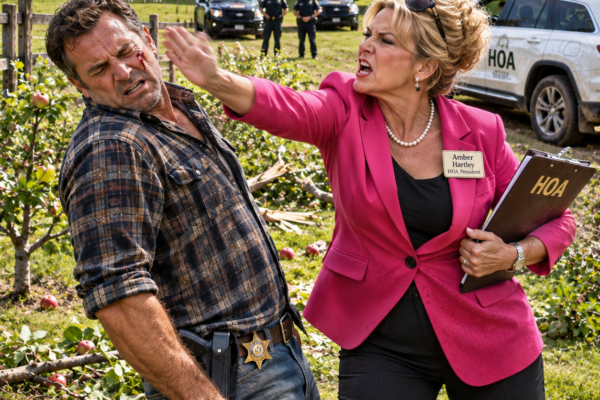
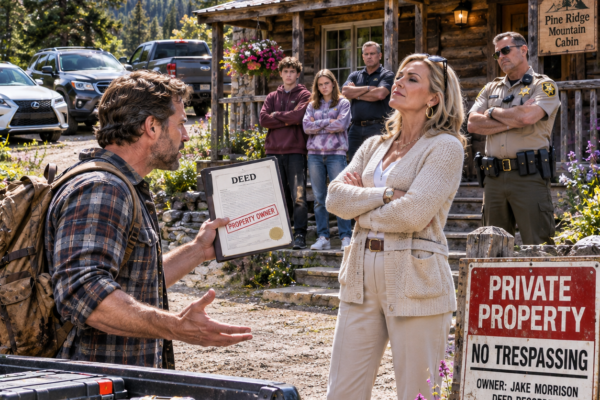
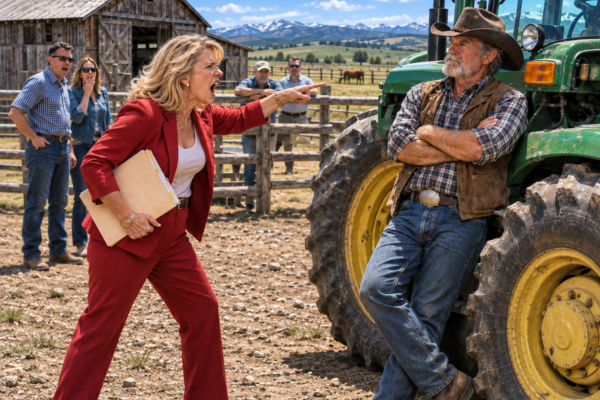
PART 2: HOA Karen Cut My Farm Gate and Sent Her Patrol Inside—Then the Barn Door Opened
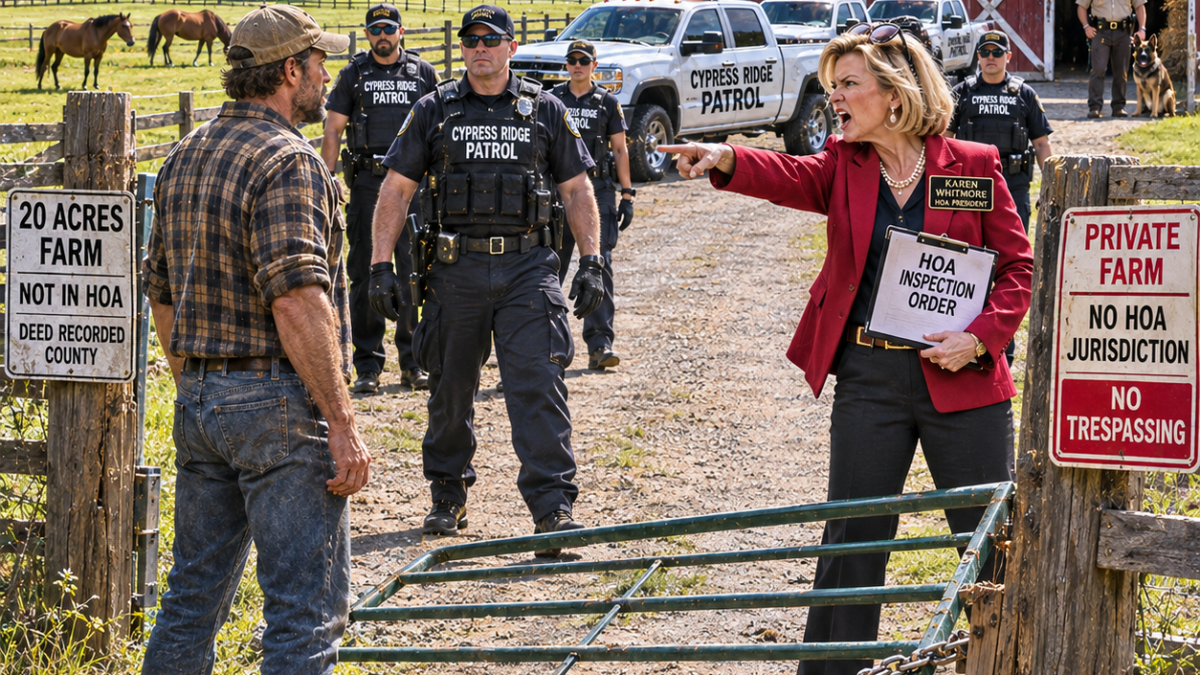
The first sound I heard that Sunday afternoon was the snap of my steel gate lock hitting the dirt, followed by Karen Whitmore shouting, “Move in—this property is under HOA inspection,” while three white pickup trucks marked CYPRESS RIDGE PATROL blocked my driveway and half a dozen strangers marched onto my twenty-acre farm with cameras, radios, and bolt cutters.
I had warned Karen for months that my farmhouse, barn, horses, fields, and every fence post she kept trying to regulate sat completely outside her HOA, but she had finally decided that if county records would not give her authority over me, she would simply bring an audience and pretend she already had it.
What Karen did not know was that someone else was already on my farm that afternoon, and the closer her little patrol team got to my locked barn, the more certain I became that I should stop arguing and let them keep walking.
My name is Mike Thompson, and I bought those twenty acres fifteen years before Karen Whitmore ever became president of Cypress Ridge Estates.
The land had been agricultural for decades.
I built my farmhouse myself, put up a red barn, planted corn, kept a few horses, and spent most mornings drinking coffee on the porch before the rest of the county had fully woken up.
Cypress Ridge was built beside me later.
Big houses.
Perfect lawns.
Stone entrances.
Matching mailboxes.
None of that bothered me.
Their property, their rules.
My property, mine.
Karen apparently struggled with that arrangement.
The first time she came to my fence, she complained that my horses created an “offensive agricultural odor affecting community enjoyment.”
I looked at the pasture.
Then at her.
“Ma’am, that’s a horse.”
Her mouth tightened.
“We have standards here.”
“You do.”
“You need to address this.”
“No, I don’t.”
That should have ended it.
Instead, it started everything.
Soon I received letters accusing me of unauthorized livestock, improper landscaping, unapproved fencing, visible equipment, and a barn color that supposedly violated Cypress Ridge’s architectural palette.
One notice actually demanded that I repaint my working red barn beige.
I called the county clerk.
The woman who answered looked up my parcel and laughed.
“Mr. Thompson, you are not in Cypress Ridge.”
“I know.”
“Your land is agricultural.”
“I know.”
“The HOA has no enforcement authority over you.”
“That is what I thought.”
“Then why are they sending fines?”
“That is what I am trying to figure out.”
The fines kept coming anyway.
Then Karen started sending “HOA patrol” members to photograph my property from the road.
One morning two of them crossed the fence line.
That was when I called Sheriff Tom Brown.
Tom and I had known each other since high school. He became a lawman. I went into construction and eventually built the farm.
When he arrived, Karen marched toward him waving one of her violation packets.
“This property is creating multiple community hazards.”
Tom read the first page.
Then the second.
He handed the packet back.
“Ma’am, Mr. Thompson’s property isn’t in your HOA.”
Karen stiffened.
“These issues affect our residents.”
“That doesn’t change the property line.”
“We have a duty to investigate.”
“You have a duty to stay off land you don’t own.”
Karen looked at me like I had personally arranged the Constitution to embarrass her.
From then on, the letters became rumors.
I was supposedly storing hazardous waste.
Running an illegal salvage yard.
Hiding unregistered vehicles.
Growing something suspicious behind my barn.
Most neighbors ignored her.
Some believed her.
Then, on Friday morning, Tom called me.
“I need a favor.”
“What kind?”
“A quiet place for a few days.”
He was working a county investigation involving stolen construction equipment and suspicious contractor activity. He couldn’t tell me much more.
I offered him the small guest quarters beside my barn.
That afternoon, Karen drove slowly past my gate.
She spotted Tom’s unmarked SUV.
Stopped.
Raised her phone.
Took three photographs.
The next morning I found a notice taped to my gate:
**EMERGENCY HOA SAFETY INSPECTION — IMMEDIATE ACCESS REQUIRED.**
Tom read it over coffee.
He shook his head.
“She isn’t really going to do this.”
I looked toward Cypress Ridge.
“You’ve met Karen.”
Sunday arrived hot and still.
Just after noon, engines growled down the road.
Three white trucks appeared through the dust.
Neighbors started gathering along the fence.
Karen stepped from the lead truck wearing a white blazer, sunglasses, and the expression of a woman arriving to accept a surrender.
Behind her came Stan, Don, Marv, and the rest of her homemade patrol.
Stan carried bolt cutters.
Karen pointed at my locked gate.
“Cut it.”
Stan hesitated.
“Karen—”
“I said cut it.”
The blades closed.
My lock snapped.
Then Karen looked directly at me.
“Now we’ll see what you’ve been hiding.”
Behind them, fifty feet away, the barn door moved.
PART 2
The barn door opened about six inches.
Karen didn’t notice.
She was too busy enjoying herself.
That was one thing I had learned about her over the previous four years: Karen didn’t simply want compliance. She wanted witnesses to compliance.
She wanted the moment.
She wanted neighbors watching from behind the fence while she demonstrated that the farmer next door—the stubborn man who ignored her fines, laughed at her letters, and kept refusing to paint his barn beige—could finally be made to obey.
Stan dropped the broken padlock beside the gate.
It bounced once in the dust.
I looked down at it.
Then at him.
“Stan.”
He avoided my eyes.
“We have orders.”
“From who?”
He glanced toward his wife.
Karen answered.
“The Cypress Ridge board.”
“Your board doesn’t own my gate.”
“This access point affects community safety.”
“What community?”
“Our community.”
I gestured around us.
“You’re standing on my farm.”
Her jaw tightened.
“Record that.”
Marv immediately raised his phone.
Karen pointed at me.
“Mr. Thompson is refusing lawful cooperation with an authorized safety inspection.”
I looked at the camera.
“For your video, my name is Mike Thompson. I own this property. Cypress Ridge Estates ends at that fence. I have told these people to leave.”
Karen smiled.
“Thank you.”
“For what?”
“For documenting your refusal.”
I almost admired the confidence.
Almost.
Behind her, the barn door opened another few inches.
Tom stood just inside the shadow.
Plain clothes.
Jeans.
Gray shirt.
No hat.
From where Karen stood, she couldn’t see enough to recognize him.
He could certainly hear her.
I knew because I saw his head tilt slightly when she shouted:
“Patrol team, proceed.”
Don stepped through the broken gate.
Marv followed.
Two other residents I barely knew came behind them carrying clipboards.
They had laminated badges clipped to fluorescent vests.
**CYPRESS RIDGE COMMUNITY ENFORCEMENT.**
Those badges fascinated me.
Not because they were convincing.
Because somebody had gone through the trouble of designing them.
I stepped off my porch.
“Last warning.”
Karen turned.
“That sounds threatening.”
“No. It sounds like notice. You are trespassing.”
“We are exercising emergency access.”
“Show me the county authority.”
“Our bylaws—”
“County authority.”
“You don’t dictate procedure.”
“On my land, I dictate whether you get to walk through my gate.”
She lowered her sunglasses.
“You’ve had months to cooperate.”
“With what?”
“Livestock sanitation.”
“My horses are legal.”
“Improper structures.”
“My barn was permitted.”
“Vehicle storage.”
“My tractor?”
“You know exactly what I’m talking about.”
“No, Karen. That’s the problem. I don’t think even you know what you’re talking about anymore.”
A few neighbors laughed.
Karen heard them.
Her cheeks reddened.
“Stan.”
He straightened.
“Yes?”
“Inspect the barn.”
Stan looked toward the big double doors.
I watched the blood leave his face slightly.
He wasn’t stupid.
He had already cut one lock.
Now he was being ordered to cut another.
“Maybe we should wait.”
Karen stared at him.
“For what?”
“A county officer.”
She laughed.
“Why?”
“To make sure we’re covered.”
“We are covered.”
“Karen—”
“We voted.”
Stan’s shoulders sagged.
That sentence told me something.
He wasn’t comfortable.
He was participating anyway.
I filed that away.
He walked toward the barn.
I didn’t stop him.
Tom had moved closer to the door.
I could see the outline of his shoulder now.
Karen followed Stan through my yard.
Her little group spread out.
Don pointed his camera toward my tractor.
“Unregistered heavy equipment.”
I couldn’t help myself.
“It’s a tractor, Don.”
He ignored me.
Another patrol member photographed a water tank.
“What violation is that?”
He looked at his clipboard.
“Potential hazardous storage.”
“It’s rainwater.”
He frowned as if rainwater had become suspicious.
Karen shouted from near the barn:
“Mike, if you had complied from the beginning, none of this would be necessary.”
I walked slowly after them.
“You sent me fines for having horses on agricultural land.”
“The smell impacts property values.”
“You demanded I repaint a barn.”
“Visual continuity matters.”
“To you.”
“To everyone.”
“Then everybody can buy my land.”
That stopped her.
“What?”
“If you want to control it, buy it.”
“We shouldn’t have to purchase property just to protect our neighborhood from irresponsible use.”
“And there we are.”
“What?”
“The part where you think living near something means owning it.”
She stepped toward me.
“I have spent four years improving Cypress Ridge.”
“Good for you.”
“Property values are up thirty percent.”
“Congratulations.”
“Residents trust me.”
“Some do.”
“They elected me.”
“I didn’t.”
Her voice dropped.
“You’ve made a point of embarrassing me.”
I almost laughed.
“You came to my farm and demanded I repaint my barn.”
“You laughed in front of people.”
“I laughed because you asked me to paint a barn beige.”
“This isn’t about the barn.”
“I know.”
That caught her off guard.
For a second the performance vanished.
I saw anger underneath.
Personal anger.
Not about horse smell.
Not safety.
Control.
Then she covered it again.
“Stan.”
He had reached the barn latch.
“It’s locked.”
Karen didn’t even look.
“Cut it.”
Stan held up the bolt cutters.
He hesitated.
“Karen, I really think—”
“Cut it.”
I spoke.
“You should listen to him.”
Karen spun toward me.
“Stay back.”
“That’s my barn.”
“Which is under inspection.”
“I am telling you not to open it.”
“You’ve refused lawful access.”
“No. I’ve refused you.”
She pointed at Marv.
“Get this.”
Marv zoomed in.
Karen faced the camera.
“Owner has repeatedly refused inspection of a structure suspected of containing prohibited equipment and potentially hazardous materials.”
I called toward Marv:
“Be sure you get the part where I tell you all to leave.”
He lowered the phone slightly.
Karen snapped:
“Keep recording.”
Stan positioned the bolt cutters around the latch.
Then the barn door moved.
Not six inches this time.
All the way.
The hinges groaned.
Every person near the barn stopped.
Sheriff Tom Brown stepped into the sunlight.
He had put on his duty shirt.
Badge.
Radio.
Service belt.
Hat.
The whole thing.
I had no idea when he’d changed.
Later he told me he’d heard Karen order the first lock cut and decided plain clothes were going to create too many arguments.
For five full seconds, nobody spoke.
Marv’s camera remained pointed directly at Tom.
Stan still held the bolt cutters.
Karen stared.
Her mouth opened.
Closed.
Opened again.
“Who are you?”
Tom looked at her.
Then at the broken gate.
Then at the bolt cutters around my barn latch.
“Tom Brown.”
He stepped outside.
“County sheriff.”
Stan slowly lowered the cutters.
Karen blinked.
“Sheriff?”
“Yes, ma’am.”
“What are you doing here?”
Tom’s expression barely changed.
“Right now? Watching several people trespass on private property after cutting a lock.”
Karen immediately switched tones.
“Oh. There’s been a misunderstanding.”
I actually coughed to hide a laugh.
Thirty seconds earlier, I was a dangerous outlaw hiding contraband.
Now we had a misunderstanding.
Tom pointed toward the gate.
“Did your group cut that lock?”
Karen lifted her chin.
“We exercised emergency access under community authority.”
“What community authority?”
“Cypress Ridge HOA.”
Tom looked around my field.
“This isn’t Cypress Ridge.”
“The property impacts Cypress Ridge.”
“I didn’t ask what it impacts.”
Karen’s smile disappeared.
“Our bylaws authorize safety inspections of adjacent nuisance properties.”
Tom stared at her.
“Forced entry?”
“When necessary.”
“Show me.”
Karen pulled open her thick binder.
She flipped pages.
Tom waited.
The silence became uncomfortable.
Neighbors along the fence moved closer.
Phones remained raised.
Finally Karen held up a page.
“Section twelve.”
Tom took it.
Read.
Then looked at her.
“This applies to association-owned common areas.”
“It grants emergency inspection power.”
“Over common property.”
“Not exclusively.”
Tom handed it back.
“Yes, exclusively.”
She tried again.
“We have reports of unlawful activity.”
“Then you call my office.”
“We did.”
“When?”
Karen hesitated.
“We contacted county departments.”
“That wasn’t my question.”
She didn’t answer.
Tom pointed toward Stan.
“Sir, put the bolt cutters on the ground.”
Stan did it immediately.
Karen snapped:
“Stanley.”
He looked at her.
“I’m not arguing with the sheriff.”
Smartest thing he’d done all day.
Tom looked toward the others.
“Everyone stay where you are.”
Karen stiffened.
“You cannot detain us.”
“I absolutely can determine who you are and what happened before anybody leaves.”
“This is HOA business.”
“When you cut a private lock and enter land after the owner tells you not to, it becomes county business.”
“You’re biased.”
That one surprised me.
Tom raised an eyebrow.
“Excuse me?”
“You know him.”
“Yes.”
“You’re friends.”
“Yes.”
“This entire thing is obviously coordinated.”
Tom nodded slowly.
“That’s an interesting accusation.”
“It is.”
“You want another deputy handling it?”
“Yes.”
“Perfect.”
He raised his radio.
“Dispatch, send two units to the Thompson property. Criminal trespass complaint, property damage, multiple involved parties.”
Karen’s confidence cracked.
“Criminal?”
Tom looked at her.
“You broke a lock.”
“It’s a twenty-dollar padlock.”
“The price isn’t what makes entry authorized.”
“We were protecting residents.”
“From what?”
Karen pointed at my barn.
“Whatever he’s hiding.”
Tom looked behind himself.
Then at her.
“You mean the barn I’ve been sitting in?”
That silenced even the neighbors.
Karen stared.
Tom continued.
“I’ve been here since Friday.”
Her eyes flicked toward the unmarked SUV behind the guest house.
That was when I saw it happen.
The connection.
She had noticed that vehicle.
Photographed it.
Constructed an entire theory around it.
Karen pointed.
“That vehicle.”
Tom nodded.
“What about it?”
“That’s yours?”
“Yes.”
She looked at me.
Then back at him.
Her whole “illegal operation” narrative had just collapsed.
I said:
“You thought it was evidence, didn’t you?”
Karen ignored me.
Tom said:
“Evidence of what?”
She opened her mouth.
Nothing.
Sirens appeared in the distance.
Stan whispered:
“Jesus.”
Karen turned on him.
“Stop acting guilty.”
“Karen, we cut his gate.”
“Under orders.”
“Your orders.”
That landed.
Don removed his laminated badge.
Marv quietly lowered his camera.
Karen saw him.
“Keep filming.”
He looked at her.
“Why?”
Her eyes widened.
“What do you mean why?”
“I think we’ve got enough.”
The first county cruiser arrived.
Then the second.
Deputies Ramirez and Cole stepped out.
Tom briefed them.
Professional.
No jokes.
No dramatic arrest.
He pointed out the broken lock, the second attempted lock, the vehicles blocking the driveway, the video cameras, and the witnesses.
Ramirez photographed everything.
Cole took my statement separately.
“What did you tell them when they arrived?”
“That they were trespassing.”
“Did you give permission to enter?”
“No.”
“Did anyone threaten you?”
“Karen said they’d escalate to authorities.”
Cole glanced toward Tom.
“That part aged well.”
I smiled.
Across the yard, Karen talked rapidly to Ramirez.
I could hear fragments.
“Community safety.”
“Emergency authority.”
“Repeated noncompliance.”
“Hazard concern.”
Stan stood twenty feet away giving his own statement.
Karen noticed.
“Stanley, come here.”
Ramirez held up a hand.
“Ma’am, he’s giving a statement. Please don’t interfere.”
“He’s my husband.”
“He’s also a witness.”
That shut her up for approximately eight seconds.
Then she started demanding an attorney.
Ramirez said:
“You’re free to contact one.”
“Am I under arrest?”
“At this moment we’re investigating what occurred.”
“Then I’m leaving.”
“No, you’re going to remain while we complete identification and determine the appropriate action.”
“This is unlawful detention.”
Ramirez looked at Tom.
Tom said:
“If you’d prefer, I can explain probable cause for trespass and property damage again.”
Karen stayed.
Neighbors filmed the entire thing.
She had wanted an audience.
She got one.
Just not the one she had imagined.
After statements were taken, Stan and several patrol members were released from the scene with instructions that reports would be forwarded for review.
Karen received a formal notice barring her from my property.
Tom made it explicit.
“You personally, your patrol, anyone acting on behalf of Cypress Ridge. Do not cross this property line without Mr. Thompson’s permission or lawful government authority.”
Karen glared.
“You don’t have the authority to restrict HOA operations.”
Tom almost smiled.
“Ma’am, there are no lawful HOA operations on his land.”
She pointed toward me.
“He has been antagonizing this community for years.”
I finally stepped closer.
“Karen.”
“What?”
“I plant corn.”
“That isn’t the point.”
“I own horses.”
“You know what you’ve done.”
“No. I genuinely don’t.”
“You refuse every attempt at cooperation.”
“Because you keep calling control cooperation.”
Her face went red.
“You think you’re better than everybody.”
“No.”
“You sit over here on your twenty acres laughing at people who actually care about standards.”
“I care about standards.”
“Clearly not.”
“My standard is simple.”
I pointed at the broken gate.
“Don’t cut my lock.”
A neighbor laughed.
Then another.
Karen looked toward them.
That humiliation hurt her more than the sheriff.
I could see it.
She turned toward the trucks.
“This isn’t over.”
Tom said immediately:
“It needs to be over here.”
Karen stopped.
He continued.
“If you return, you may be arrested. Do you understand?”
Her voice came out thin.
“Yes.”
“Say it clearly.”
“I understand.”
She climbed into her SUV.
Stan did not get in with her.
That caught my attention.
He walked toward one of the patrol trucks instead.
Karen leaned across the passenger seat and shouted:
“Stan!”
He kept walking.
She drove off alone.
The rest followed.
When the road finally emptied, I picked up the broken padlock.
Tom came beside me.
“You keeping that?”
“Absolutely.”
“Evidence first.”
“You’re ruining the souvenir.”
He smiled.
“After the case review.”
I handed it over.
We walked back toward the porch.
Tom took off his hat.
“Coffee?”
“I thought law enforcement didn’t drink on duty.”
“Coffee, Mike.”
“I know.”
“You’re irritating.”
“That is what Karen says.”
He laughed.
Then his expression became serious.
“This may actually help me.”
I looked at him.
“The trespass case?”
“No.”
“Your equipment case?”
“Sort of.”
I waited.
Tom leaned against the railing.
“When I told you I was looking into stolen construction equipment, that was true.”
“Okay.”
“But the equipment trail connects to contractors.”
“Also true.”
“Some of those contractors have business with homeowners associations.”
My eyes narrowed.
“Cypress Ridge.”
He didn’t answer immediately.
That was answer enough.
“Karen?”
“I’m not saying that.”
“Tom.”
“I’m not saying that because I don’t know yet.”
I crossed my arms.
“What do you know?”
“A treasurer connected to Cypress Ridge appears in financial records we’re reviewing.”
I thought about Karen’s constant “community improvements.”
New landscaping contracts.
Security patrol vehicles.
Decorative signs.
Special projects.
“What kind of records?”
“I can’t discuss details.”
“Then why mention it?”
“Because today may become relevant.”
“How?”
“She brought vehicles, people, equipment, radios, and badges onto private land claiming organizational authority.”
“Fake authority.”
“That’s the relevant part.”
He glanced toward the road.
“If those patrol operations are being funded through accounts we’re already examining, today’s stunt may give investigators another reason to look closely at how that money is being spent.”
I sat.
“So Karen might have just walked into your investigation.”
Tom smiled faintly.
“She may have kicked the door open.”
That should have been satisfying.
Instead, I felt uneasy.
Karen had always annoyed me.
I had never considered her dangerous in the financial-crime sense.
Controlling?
Yes.
Petty?
Absolutely.
But stealing?
Laundering money?
Something bigger?
I looked toward Cypress Ridge.
Rows of polished roofs beyond my fields.
Hundreds of people living under an HOA that trusted the same woman who had ordered my gate cut.
“What happens now?”
Tom put his hat back on.
“You do nothing.”
“My specialty.”
“I’m serious.”
“So am I.”
“Don’t confront her about finances.”
“I won’t.”
“Don’t post online.”
“I barely know how.”
“You’re an IT guy’s worst nightmare.”
“I was in construction.”
“Exactly.”
He started toward the guest house.
Then stopped.
“And keep your cameras running.”
That night I sat on the porch alone.
The broken gate hung slightly crooked where Stan had forced it.
I could fix it in twenty minutes.
I didn’t.
Not yet.
It felt like a crime scene.
Technically, it was.
Around nine, Linda from Cypress Ridge called.
“You okay?”
“Fine.”
“I saw everything.”
“Half the county saw everything.”
“That may be literal.”
“What?”
“Marv’s video is online.”
I closed my eyes.
“Of course it is.”
“He posted it before Karen told everybody not to.”
“How bad?”
“For her?”
“Yes.”
“Very.”
I went inside.
Linda sent the link.
The video began with Karen standing at my gate.
**Cut it.**
Then Stan cutting the lock.
Then Karen marching inside.
Then me repeatedly saying the property was private.
Then the barn door opening.
Tom stepping out in uniform looked like something a director would have rejected as too convenient.
The comments multiplied faster than I could read.
**IS THIS A REAL HOA OR A COMMUNITY THEATER GROUP?**
**THE SHERIFF WAS IN THE BARN. I’M DONE.**
**Imagine breaking into someone’s farm while filming yourself.**
Someone had already clipped the exact moment Karen saw Tom.
I turned off my phone.
This wasn’t how I wanted my farm becoming famous.
The next morning it was worse.
Thirty thousand views.
Then fifty.
A local television station called.
I declined.
Another called.
Declined.
Tom walked over carrying coffee.
“You’re famous.”
“I hate you.”
“You’re welcome.”
“You planned this.”
“I was doing paperwork.”
“Suspiciously cinematic paperwork.”
He sat.
“Karen called my office.”
“What did she want?”
“An internal investigation into me.”
I stared.
“For what?”
“Political retaliation.”
“What politics?”
“Apparently enforcing property boundaries is political now.”
“She’ll file.”
“She already did.”
“What happens?”
“My office documents it. County counsel reviews. Somebody wastes several hours.”
“Sorry.”
“Don’t be. Complaints are part of the job.”
He took a drink.
“But she also made a public statement.”
I groaned.
“What now?”
He showed me his phone.
Karen had written:
**Yesterday’s unfortunate incident resulted from misinformation, hostility from an adjacent landowner, and inappropriate interference by county law enforcement. Cypress Ridge acted solely to protect the safety and property values of our residents. We stand behind our community patrol and will continue all lawful enforcement activity.**
I stared.
“She still thinks she has enforcement activity.”
Tom nodded.
“That part interested the prosecutor too.”
“Why?”
“She isn’t backing away from the authority claim.”
“So?”
“If the financial records show those patrol operations are funded through fraudulent contracts or misrepresented expenses, her own statement becomes useful.”
My coffee suddenly tasted bitter.
“How bad is the financial investigation?”
Tom looked toward the fields.
“Bad enough that I’m not staying at your place for fun.”
That was the first time he said it that plainly.
Later that afternoon, I repaired the gate.
I was tightening the new hinge when a truck stopped.
Stan.
Alone.
He climbed out holding a brown paper bag.
I kept the wrench in my hand.
Not as a weapon.
Just because I was using it.
“Afternoon.”
“Stan.”
He raised the bag.
“Peace offering.”
“What is it?”
“Biscuits.”
I stared.
“Is that code for something?”
He smiled weakly.
“No.”
I took the bag.
They smelled incredible.
“You made these?”
“Yeah.”
“Karen know you’re here?”
His smile disappeared.
“No.”
I set the bag on the fence post.
“What do you want?”
He looked toward the repaired gate.
“First, I’m sorry.”
“For cutting my lock?”
“Yes.”
“Why did you?”
He rubbed the back of his neck.
“Because I’m an idiot.”
“Accurate, but incomplete.”
He gave a tired laugh.
“Because she told me to.”
“You’re a grown man.”
“I know.”
“Then that’s not much of an explanation.”
He nodded.
“You ever live with somebody who can make refusing one stupid request more exhausting than doing it?”
I didn’t answer.
Stan continued.
“At first Karen wasn’t like this.”
“Everybody says that about people after they become impossible.”
“I know.”
He looked toward Cypress Ridge.
“When she became president, people praised her. Property values rose. She got things fixed. Landscaping. Security. Events.”
“Power.”
“Yeah.”
“Then?”
“She started believing every disagreement was disloyalty.”
That sounded right.
“She’d stay up until midnight writing notices.”
“I’ve received some.”
“She made spreadsheets of violations.”
“I believe you.”
“She started talking about the HOA like it was a government.”
“She told the sheriff to stay out of HOA business.”
Stan covered his face briefly.
“I heard.”
“What about the money?”
His hands stopped.
That told me more than words.
“Mike.”
“What about it?”
“I don’t know.”
“Tom’s investigating.”
“I figured.”
“What do you know?”
Stan looked toward the road.
Then lowered his voice.
“Karen has been authorizing contractors I’ve never seen.”
“For what?”
“Landscaping. Security consulting. Community improvement.”
“Do the improvements exist?”
“Some.”
“And the others?”
He shrugged.
“I asked once.”
“What did she say?”
“That I didn’t understand association finance.”
I waited.
Stan kicked dirt with his boot.
“Then I asked the treasurer.”
“Who?”
“Robert Gaines.”
I recognized the name.
“What did he say?”
“He told me not to worry about it.”
“That reassure you?”
“No.”
“What happened after?”
“Robert resigned.”
“When?”
“Last week.”
Tom had mentioned a treasurer in the investigation.
I felt the pieces shift.
“Why?”
“Karen told everyone burnout.”
“And you?”
“I called him the day before.”
Stan met my eyes.
“He sounded scared.”
“Of Karen?”
“Of something.”
I set down my wrench.
“You came here with more than biscuits.”
He nodded.
“I’ve copied things.”
“What things?”
“Emails Karen keeps on a flash drive. Bank statements she prints. Contractor invoices.”
My stomach tightened.
“Do not give them to me.”
He looked surprised.
“Why?”
“Because if this is a real investigation, I’m not becoming the middleman.”
“Then who?”
“Tom.”
I called him.
He arrived twenty minutes later in an unmarked county vehicle.
When Stan saw him, he almost left.
Tom stopped several yards away.
“Mr. Whitmore.”
“Sheriff.”
“You asked to speak?”
Stan looked at me.
I nodded.
He reached into his pocket.
Flash drive.
Tom did not immediately take it.
“Where did this come from?”
“My house.”
“Whose files?”
“My wife’s.”
“Did you have lawful access?”
Stan swallowed.
“We share the computer.”
“Did you copy password-protected files you were not authorized to access?”
“No.”
“Did you steal this device?”
“No. It’s mine. The copies are mine.”
Tom glanced toward me.
Then back.
“I need you to come to the office and give a full statement before anybody treats this as evidence.”
Stan nodded.
“I’ll do whatever.”
“Don’t delete anything.”
“I won’t.”
“Don’t confront Karen.”
Stan laughed bitterly.
“That won’t be difficult.”
“Why?”
“I’m leaving.”
Tom’s expression changed.
“The house?”
“Yes.”
“Today?”
“Tonight.”
“Does she know?”
“No.”
Stan looked toward Cypress Ridge.
“She thinks I’m just embarrassed about yesterday.”
“Aren’t you?”
“Sheriff, half the internet watched me cut my neighbor’s lock because my wife told me the HOA had emergency powers.”
Tom nodded.
“Fair.”
Stan left with him.
I stayed at the gate.
The biscuits were still on the fence post.
I ate one.
It was excellent.
That irritated me for some reason.
The next morning, at 7:18, Karen’s black SUV screeched to a stop outside my new lock.
She jumped out wearing yoga pants, a hoodie, and no makeup.
I had never seen her without the polished HOA-president uniform.
She looked exhausted.
Angry.
Scared.
“Mike!”
I stayed on the porch.
She walked to the gate but did not cross it.
At least she’d learned one thing.
“Where is Stan?”
I said nothing.
“Did he come here?”
“Yesterday.”
Her eyes narrowed.
“What did he tell you?”
“You should ask him.”
“He won’t answer.”
“Then I guess you have your answer.”
Her hands clenched around the gate.
“You poisoned him against me.”
“No.”
“You humiliated him.”
“You told him to cut my lock.”
“You made him look like a criminal.”
“He cut my lock.”
“Because you refused a lawful inspection!”
There it was again.
Even now.
After the sheriff.
After the video.
After the warning.
She needed her version to remain true.
“Karen.”
“What?”
“You were told by the county that my land isn’t in your HOA.”
“You manipulate everyone.”
“The county map?”
“You have friends.”
“The clerk?”
“You complain.”
“The zoning records?”
“You’ve been here longer.”
I stared at her.
She heard herself.
Somewhere underneath all that anger, she had to know how absurd it sounded.
She continued anyway.
“Everybody protects you.”
“From what?”
“Consequences.”
“For owning a farm?”
“For undermining me.”
There.
Finally.
Not community.
Not safety.
Her.
“You think this is about you.”
“It became about me when you decided to make me look incompetent.”
“No, Karen. You decided that every person who told you no was attacking you.”
Her face tightened.
“You don’t know me.”
“Thankfully.”
She took a step closer to the gate.
“Stan took things.”
I stayed still.
“Did he give them to you?”
“No.”
That was technically true.
“Where?”
“I don’t know where Stan went.”
Also true.
“Did he talk to Brown?”
I didn’t answer.
Karen’s face changed.
That was enough.
“You.”
Her voice went quiet.
“You set this up.”
“No.”
“You had the sheriff inside your barn.”
“He was staying here.”
“Why?”
“County business.”
“What business?”
“Ask him.”
“You’ve been trying to destroy me.”
I almost laughed.
“Karen, until yesterday I thought your biggest crime was being annoying.”
She stared.
Then engines approached behind her.
An unmarked county sedan.
Two cruisers.
Karen turned slowly.
Tom stepped out of the sedan.
He was not smiling.
Two deputies came behind him.
One carried paperwork.
Karen backed away from the gate.
“No.”
Tom walked toward her.
“Karen Whitmore?”
“You know who I am.”
“Yes.”
“What is this?”
“We have a warrant.”
Her face went white.
“For what?”
Tom remained calm.
“Financial offenses under investigation involving association funds, fraudulent transactions, and possible obstruction. You’ll receive the exact allegations and paperwork.”
“This is because of him.”
“No.”
She pointed at me.
“He did this.”
Tom shook his head.
“Mike didn’t create your bank records.”
“I haven’t done anything.”
“Then the process will establish that.”
“You’re arresting an HOA president based on my husband’s lies?”
“The warrant wasn’t issued by your husband.”
Karen looked around.
Neighbors had begun appearing again.
Curtains.
Porches.
Phones.
She saw them.
Her panic turned to rage.
“You people love this.”
Nobody answered.
“You’ve all been waiting for me to fail.”
Still nothing.
Tom said:
“Karen, turn around.”
“No.”
“Don’t make this harder.”
“You have no idea what I’ve done for this community.”
“Turn around.”
“I raised property values.”
“Karen.”
“I fixed everything!”
“Hands behind your back.”
“They begged me to lead!”
One deputy stepped closer.
Karen finally turned.
The cuffs clicked.
No screaming.
Not at first.
She stood completely still.
Then looked toward me.
“This is your fault.”
I said:
“No.”
“You couldn’t just leave us alone.”
“My farm is twenty acres.”
“What?”
“I stayed on it.”
She stared.
“You’re the one who kept coming here.”
Tom guided her toward the cruiser.
Then she started shouting.
Not at me.
At the neighbors.
“Call the board!”
Nobody moved.
“Call Robert!”
The former treasurer.
Still nobody.
“Someone call my attorney!”
One woman finally said:
“Karen, stop.”
Karen froze.
It was Linda.
The same neighbor who had warned me.
“You’ve done enough.”
Karen looked genuinely wounded.
Not angry.
Wounded.
“You too?”
Linda didn’t answer.
The cruiser door closed.
Karen disappeared behind tinted glass.
I watched it pull away.
Tom remained.
“So?”
I asked.
“So what?”
“How bad?”
He looked tired.
“Bad.”
“Stan’s files?”
“Helpful. Not sufficient by themselves.”
“What else?”
“Bank records. Contractor accounts. Treasurer cooperation.”
“Robert?”
Tom nodded.
“Looks like he didn’t resign because he was burned out.”
“Why?”
“He was trying to get out.”
“Of what?”
“That’s what the state is determining.”
I looked toward Cypress Ridge.
“What happens to residents’ money?”
“Too early.”
“Tom.”
“I don’t know.”
That answer bothered me more than Karen’s arrest.
HOA dues belonged to people.
Retirees.
Families.
Young couples.
People who believed they were paying for roads and landscaping and pool maintenance.
Not whatever this was.
Tom put a hand on my shoulder.
“This is going bigger.”
“How big?”
“I can’t say yet.”
Three days later, I found out.
A black sedan pulled onto the farm.
Tom got out.
Beside him was a woman in a dark suit carrying a hard-sided case.
She introduced herself as Special Agent Leah Parker with the State Financial Crimes Division.
We sat at my kitchen table.
The same table where Tom had drunk coffee before Karen’s patrol raid.
Parker opened her file.
“Mr. Thompson, your property appears in several records connected to our investigation.”
I sat straighter.
“My property?”
“You’re not a suspect.”
“Good opening.”
She almost smiled.
“Cypress Ridge records contain payments marked ‘adjacent property compliance acquisition’ and ‘maintenance easement reimbursement.’”
“I never received money.”
“We know.”
“Then who did?”
“We’re tracing that.”
She showed me a document.
My farm address.
Parcel number.
A supposed “maintenance access agreement.”
My name typed underneath.
Signature.
Not mine.
I looked at Tom.
“This is why she thought she had authority.”
Parker nodded.
“Potentially.”
The document claimed Cypress Ridge held partial maintenance rights over a strip of my property.
It referenced “health and safety inspections.”
“Who filed this?”
“It wasn’t properly recorded with the county.”
“Then where was it used?”
“Internal justification for payments.”
“How much?”
Parker didn’t give a number.
She didn’t need to.
I understood.
My farm wasn’t only Karen’s personal obsession.
Someone had used it on paper.
Maybe to justify money leaving HOA accounts.
Parker continued.
“We’re looking at similar arrangements elsewhere.”
“Other farms?”
“Other communities.”
“How many?”
“Several.”
Tom leaned forward.
“Cypress Ridge may be a hub.”
I stared.
“For what?”
“Fake service contracts. Maintenance agreements. Consulting. Property-acquisition reimbursements.”
“Money laundering.”
Parker chose her words carefully.
“Potential laundering and misappropriation.”
“Karen?”
“Her signature appears on authorizations.”
“The treasurer?”
“Also.”
“Stan?”
“No evidence at this time that he participated financially.”
That mattered.
He had been foolish.
Weak.
Complicit in harassment.
But maybe not a thief.
I looked at the fake agreement again.
“Who created this?”
“We’re investigating.”
“Can I keep a copy?”
“No.”
“Worth asking.”
Parker closed the folder.
“Your video from the patrol incident is useful.”
“Why?”
“Because it documents Ms. Whitmore publicly asserting an authority that appears tied to these internal records.”
“So her invasion helps prove intent.”
“It may help establish knowledge and pattern.”
Tom looked at me.
“Her ego built part of the case.”
Parker gave him a look.
Tom shrugged.
“Accurate.”
Over the next week, Cypress Ridge collapsed in slow motion.
Not physically.
Socially.
The board announced an emergency financial review.
Two members resigned.
The management company froze discretionary spending.
The HOA attorney sent residents a bland email saying the association was “cooperating fully with governmental inquiries.”
People hated that phrase.
Cooperating fully.
It sounds calm.
It means somebody important has started asking questions.
Linda called me one evening.
“There’s a meeting.”
“Not my HOA.”
“You should come.”
“Why?”
“Because half the meeting is about you.”
I sighed.
Town hall was packed.
I stayed in the back.
No one challenged me.
Without Karen, the room felt strangely leaderless.
Robert Gaines, the former treasurer, wasn’t there.
Stan wasn’t either.
A vice president named Helen Moore stood at the front.
She looked like she hadn’t slept.
“We’ve received preliminary information from outside auditors.”
Someone shouted:
“How much is missing?”
Helen raised a hand.
“We don’t have a final number.”
“How much?”
“We don’t know.”
“You’ve had a week!”
Another voice:
“Where’s Karen?”
“In custody pending proceedings.”
“Where is our money?”
“I don’t know.”
That answer changed the room.
Karen would never have said it.
She would have invented certainty.
Helen simply looked terrified and told the truth.
An elderly man stood.
“We paid special dues for security.”
“Yes.”
“Was that fake?”
“We’re reviewing.”
“Landscaping?”
“Reviewing.”
“Consulting fees?”
“Reviewing.”
A woman near me said:
“My assessment went up twelve percent.”
Helen closed her eyes.
“I know.”
Then Linda stood.
“Why were patrol vehicles paid from community safety funds?”
Helen looked toward her.
“I don’t know.”
Linda pointed toward me.
“They used those patrol vehicles to break into his farm.”
The room turned.
Every face looked at me.
I hated it.
Someone asked:
“Mike, did Karen really say she had maintenance rights?”
“Yes.”
“Did she?”
“No.”
“Was the farm ever part of Cypress Ridge?”
“No.”
“Did she know?”
“Yes.”
“How?”
“The sheriff told her months before the raid.”
Murmurs.
I continued.
“County records told her. Zoning told her. The property line is not ambiguous.”
A man in front asked:
“Then why did she keep going?”
That question stayed in the room.
I could have insulted her.
Called her crazy.
Power hungry.
Corrupt.
Instead I said:
“I think she got used to nobody saying no.”
Nobody laughed.
Because many of them knew exactly what I meant.
After the meeting, a younger couple stopped me.
The husband said:
“We voted for her.”
“That doesn’t make you responsible for everything she did.”
His wife looked ashamed.
“We liked the rules.”
“Some rules are useful.”
“We liked the patrol.”
“Probably felt safer.”
She nodded.
“Until yesterday.”
I knew what she meant.
Until the patrol crossed somebody else’s fence.
Authority always looks different depending on which direction it’s walking.
The state investigation expanded.
News reports described questionable contractor payments across multiple communities.
Fake landscaping companies.
“Consulting services” that appeared to exist only on invoices.
Developers receiving money through associations.
A county employee suspended pending review.
Cypress Ridge was not the only HOA involved.
But according to prosecutors, it was one of the central accounts.
Karen had not designed the entire network.
That mattered.
The story online simplified everything into:
**HOA KAREN RUNS MULTI-COUNTY FRAUD EMPIRE.**
Reality was less neat.
Karen signed authorizations.
Approved fake or inflated expenses.
Helped justify payments through aggressive “compliance” operations.
Used authority she did not possess.
Other people handled shell companies.
Transfers.
Contractor kickbacks.
Robert Gaines knew more than he’d initially admitted.
He eventually cooperated.
Stan moved into a motel.
Then a small apartment.
He came to my farm once more.
No biscuits this time.
He looked ten years older.
“How’s Karen?”
I asked.
He stared toward the pasture.
“Angry.”
“At you?”
“Everyone.”
“Kids?”
“We don’t have kids.”
I had never asked.
That somehow made the whole marriage feel even quieter.
“Are you divorcing?”
He nodded.
“You okay?”
“No.”
I appreciated the answer.
He sat on my porch.
For a while we watched one of my horses rub against the fence.
Then Stan said:
“You know the stupid part?”
“There are several candidates.”
He smiled faintly.
“I loved how strong she was.”
“Karen?”
“When we met.”
He looked down.
“She walked into a room and knew what she wanted. She’d fight anybody.”
“That can be useful.”
“It was.”
“Until?”
“Until everything became a fight.”
He rubbed his hands together.
“She couldn’t just disagree. Somebody had to win.”
I thought about all the violation letters.
“That sounds familiar.”
“I enabled it.”
I didn’t answer.
“I cut your gate.”
“Yes.”
“I knew it was wrong.”
“Yes.”
“Why didn’t you stop me?”
I looked at him.
“What?”
“That day.”
“You’re asking why I didn’t physically stop you?”
“I guess.”
“Because you were filming yourselves.”
He laughed unexpectedly.
Actually laughed.
“That was unbelievably stupid.”
“Top five.”
He grew serious again.
“I thought maybe if I did what she wanted, she’d calm down.”
“Did she?”
“You know the answer.”
I did.
Stan stood to leave.
At the bottom of the steps, he turned.
“I am sorry, Mike.”
This time there was nothing defensive in it.
I nodded.
“I believe you.”
Not forgiveness.
Not yet.
But belief.
Karen’s case moved slowly.
The viral video moved fast.
People recognized me in town.
“Are you the farm guy?”
I hated that question.
One cashier asked:
“Where’s your sheriff friend?”
“At work.”
A teenager at the hardware store requested a selfie.
I said no.
Then his father apologized.
I laughed.
“It’s fine.”
The broken lock came back from evidence.
Tom delivered it personally.
“You still want it?”
I held it.
The shackle was cleanly cut.
“Definitely.”
“For what?”
“Reminder.”
“Of Karen?”
“No.”
“Then what?”
“That fences only work if people respect them.”
He nodded.
“Deep.”
“Don’t get used to it.”
I hung the lock above my workbench.
Not framed.
Just on a nail.
Weeks later, prosecutors announced plea negotiations.
Karen faced fraud-related charges, falsifying documents, obstruction-related counts, and financial offenses tied to HOA transactions.
Other participants faced their own cases.
Some cooperated.
Some fought.
The county’s review uncovered that Cypress Ridge had paid for projects that did not exist.
Benches.
Landscaping.
Traffic calming.
Security consulting.
Maintenance work.
Residents remembered paying for all of it.
Some had even wondered where the improvements were.
Karen always had an explanation.
Contract delays.
Supply shortages.
Permitting.
Weather.
When a person controls information, excuses can look like facts for a surprisingly long time.
Then the final audit came out.
At the community meeting, Helen read numbers with a shaking voice.
People gasped.
Some cried.
One retired teacher asked:
“How did none of us catch this?”
Helen said:
“We trusted signatures.”
That was the whole tragedy.
Trust itself wasn’t stupid.
Unquestioned trust was.
Cypress Ridge voted to dissolve the existing HOA structure after legal and financial review determined it could not continue in its current form.
There were lawyers involved.
Insurance claims.
Debt.
Restitution efforts.
The clean story would be that everyone got every dollar back.
They didn’t.
Real financial fraud leaves scars.
Some money was recovered.
Some claims were paid.
Some losses remained.
But the association that Karen had treated like her private government was finished.
Three months after the raid, an envelope arrived from the county.
Official notice.
Cypress Ridge Estates Homeowners Association had completed dissolution under the applicable process.
I read it twice.
Then a third time.
I didn’t cheer.
Didn’t call anybody.
I sat on my porch.
My land had never been inside the HOA.
Technically, its dissolution changed nothing for me.
Emotionally?
Everything.
No more patrol truck.
No more fake fines.
No more enforcement letters.
No more woman at my fence insisting that proximity was authority.
That afternoon Tom came by with two coffees.
“One for you.”
“Bribery?”
“Community relations.”
We sat.
He looked older too.
The investigation had taken months.
“How’d it end?”
“Karen entered a plea.”
“To what?”
He explained that she had pleaded guilty to several charges involving fraud, falsified documents, and obstruction, while cooperating against other participants in the broader scheme.
“What sentence?”
“Court imposed a custodial term. Minimum around two years before she’s eligible under the structure of the sentence, depending on credits and conditions.”
I nodded.
“And Robert?”
“Awaiting sentencing.”
“Other board members?”
“Two cooperated.”
“The bigger network?”
“Still cases moving.”
“So it wasn’t all Karen.”
“No.”
That mattered to me.
“People online think she masterminded everything.”
Tom shrugged.
“People online like one villain.”
“She wasn’t?”
“She was responsible for what she did.”
“But not everything.”
“Exactly.”
We sat quietly.
Then he said:
“You almost feel sorry for her.”
I looked at him.
“Almost.”
He smiled.
“Thought so.”
“She lost her position.”
“Yes.”
“Marriage.”
“Yes.”
“Reputation.”
“Yes.”
“Freedom.”
“For a while.”
I watched wind move through the corn.
“All because nobody could tell her no.”
Tom took a drink.
“Not exactly.”
I looked over.
“Then what?”
“Because eventually she stopped treating ‘no’ as information.”
That was better than anything I had been thinking.
He continued.
“Everybody gets told no. Good people. Bad people. Powerful people. Children. Sheriffs.”
“HOA presidents.”
“Especially HOA presidents.”
I smiled.
“Problem is when you decide no means somebody is attacking you.”
I thought about Karen.
The fence.
The patrol.
Stan cutting the lock.
“You think she believed she was right?”
Tom didn’t hesitate.
“Absolutely.”
“That makes it worse.”
“Yes.”
He stood after finishing his coffee.
Before leaving he pointed toward the barn.
“You know people call you the farmer who beat the HOA.”
“I know.”
“You hate it.”
“Yes.”
“Could be worse.”
“How?”
“They could call you Beige Barn Mike.”
I stared at him.
He laughed all the way to his cruiser.
A month later, Linda invited me to a neighborhood meeting.
Not an HOA meeting.
She emphasized that.
“Voluntary committee.”
“That sounds suspiciously like an HOA with better marketing.”
“No dues.”
“Continue.”
“No fines.”
“Interesting.”
“No patrol.”
“Sold.”
The town-hall room held maybe forty people.
Some I recognized from the fence during the raid.
Others I knew only by sight.
When I walked in, conversations stopped.
That made me want to leave immediately.
Linda blocked the door.
“No.”
“What?”
“I know that look.”
“What look?”
“The Mike-is-about-to-escape-social-interaction look.”
“I have animals.”
“They’ll survive.”
A man named Daniel stood.
He had filmed part of the raid.
“Mike.”
“Yeah?”
“We wanted to thank you.”
I shook my head.
“No.”
People laughed.
“I mean it. I didn’t do anything heroic.”
“You held your ground.”
“I stood on my own farm.”
“Exactly.”
A woman near the front said:
“We stopped questioning Karen because arguing with her was exhausting.”
Several people nodded.
Daniel continued.
“You reminded us that convenience isn’t the same as consent.”
I didn’t know what to do with that.
So I said:
“Can we talk about the park instead?”
That broke the tension.
The new committee had actual problems.
Broken swing.
An elderly couple needed help repainting a fence.
A drainage ditch clogged every spring.
Residents wanted monthly potlucks.
Nobody discussed mailbox colors.
Nobody proposed a patrol team.
At the end, Linda handed me a framed photograph.
I stared.
It was a still from Marv’s video.
Karen at my gate, finger raised.
Tom stepping from the barn behind her.
Below it were two words:
**RESPECT BOUNDARIES**
I laughed so hard I had to sit down.
“You people are awful.”
Linda smiled.
“You’re hanging it in the house.”
“Absolutely not.”
“The barn?”
“Maybe.”
It went above my workbench.
Right beside the cut padlock.
For months afterward, every time I picked up a wrench or sorted tools, I saw those two objects.
One represented the moment somebody decided my boundary didn’t matter.
The other showed what happened when reality finally walked into the frame.
But the farm itself mattered more.
Corn came in strong that year.
One mare foaled in early spring.
I repaired the old creek fence.
The guest quarters where Tom had stayed went back to being empty most weekends.
No unmarked SUV.
No evidence boxes.
No radios.
Just a cot and an old desk.
Sometimes I sat there and remembered how close Karen’s patrol had come to cutting that barn lock.
If Tom had not been inside, what would I have done?
Called deputies.
Probably.
Confronted them.
Maybe.
Gotten angrier.
Definitely.
The sheriff’s presence made the scene unforgettable.
But it wasn’t actually what saved me.
The county map did.
The cameras did.
The repeated written warnings did.
The fact that I had never joined Cypress Ridge did.
The fact that Karen recorded herself ignoring all of it did.
Tom was simply there when her lie finally became impossible to maintain.
One summer evening, I saw a familiar car stop at the end of my drive.
Stan.
He stayed outside the gate.
That detail wasn’t lost on me.
I walked down.
“Evening.”
“Mike.”
“You planning another inspection?”
He smiled.
“No bolt cutters.”
“Good start.”
He held an envelope.
“What is it?”
“Karen wrote you.”
I didn’t take it immediately.
“From prison?”
“Yes.”
“Why didn’t she mail it?”
“She didn’t know if you’d read it.”
“And you?”
“I told her I would ask.”
I looked at the envelope.
My name.
Her handwriting.
“What does she want?”
“I don’t know. I didn’t open it.”
I took it.
Stan started to leave.
“Stan.”
He stopped.
“How are you?”
“Better.”
“Divorce final?”
“Yes.”
“Sorry.”
“Don’t be.”
Then:
“I wish it had ended differently.”
I understood.
“Me too.”
He left.
I carried Karen’s letter to the porch.
For an hour I didn’t open it.
Then I did.
It was only two pages.
No dramatic confession.
No begging.
No claims that everybody framed her.
That surprised me.
She wrote that she had spent the first months furious.
At Tom.
At Stan.
At Robert.
At the board.
At the county.
At me.
Then she wrote:
**The hardest part has been admitting that every person I blamed had told me to stop before things became what they became.**
I read that line twice.
She admitted the patrol raid had been her idea.
Admitted she knew my farm wasn’t officially inside the HOA.
She had convinced herself that “community impact” gave her moral authority even if she lacked legal authority.
Then came the sentence I had not expected.
**I thought leadership meant being the person nobody could overrule.**
I looked toward my fields.
That explained almost everything.
She apologized for the gate.
The harassment.
The fake notices.
Not elegantly.
Not perfectly.
But without excuses.
She did not ask forgiveness.
At the bottom:
**You once told me that if I wanted to control your land, I should buy it. I hated you for saying that because I knew you were right.**
I laughed once.
Then folded the letter.
I never wrote back.
Not because I wanted to punish her.
Because nothing I said would improve the truth she had finally reached herself.
I put the letter in a drawer.
Not beside the framed photograph.
Not beside the lock.
Some things don’t need display.
Years later, Cypress Ridge looked different.
The stone entrance remained.
The houses remained.
People still cared about lawns.
They still had neighborhood meetings.
But the voluntary committee lasted.
No mandatory patrol.
No fake enforcement.
No “community jurisdiction” over anybody beyond actual property agreements.
Linda eventually moved.
Before leaving, she stopped at my farm.
“You’re going to miss me.”
“No.”
“Liar.”
“Maybe.”
She looked toward the barn.
“Still have the picture?”
“Yes.”
“Lock?”
“Yes.”
“Karen’s letters?”
“One.”
Linda raised an eyebrow.
“She wrote?”
“Yes.”
“What’d she say?”
“That she was wrong.”
Linda stood silent.
Then:
“Wow.”
“Yeah.”
“You forgive her?”
I thought about it.
“I don’t know.”
“That’s fair.”
“I’m not angry anymore.”
“That might be enough.”
Maybe it was.
After Linda left, I walked the property line.
Twenty acres.
Same as before.
The HOA never took an inch.
The fence posts leaned in places.
The creek still flooded after heavy rain.
Horses still smelled like horses.
My barn remained red.
Very red.
I repainted it the following spring.
Tom helped.
When we finished one side, he stepped back.
“You know what color would look good?”
I narrowed my eyes.
“Don’t.”
“Beige.”
I threw a paint rag at him.
He ducked.
We laughed until my ribs hurt.
Later we sat on the porch.
Same place we’d sat before the raid.
Tom had more gray in his hair.
So did I.
He had eventually retired as sheriff.
I asked:
“Ever miss it?”
“Some days.”
“Which days?”
“None involving HOAs.”
I laughed.
He pointed toward the barn.
“You realize the internet still circulates that video.”
“I know.”
“My niece sent it to me last month.”
“What’d she say?”
“Is this really you?”
“Was it?”
“No. AI.”
“Coward.”
We watched the sun drop.
After a while Tom said:
“You know what I remember most?”
“The raid?”
“No.”
“What?”
“Right before I opened the barn.”
I looked at him.
“You were standing outside holding coffee.”
“So?”
“They had cut your lock. Six people were on your property. Karen was yelling.”
“Accurate.”
“And you looked bored.”
“I wasn’t bored.”
“What were you?”
“Trying not to do something stupid.”
He nodded.
“That is basically adulthood.”
I smiled.
Maybe that was the real story.
People later made it sound like I had planned some brilliant trap.
I hadn’t.
I didn’t lure Karen onto the farm.
I didn’t know she would cut the lock.
I didn’t arrange for Tom to make a dramatic entrance.
He happened to be there because of another investigation.
What I did was simpler.
I documented.
I told her no.
I called the county when necessary.
I refused to accept her fake paperwork as law.
And when she finally crossed the line physically, I didn’t cross one with her.
That mattered.
One Sunday morning years after everything, I walked into the barn to get a socket wrench.
The framed photograph caught my eye.
Karen frozen mid-command.
Tom behind her.
The old cut lock hung beside it.
I smiled.
Then noticed dust on the frame.
I wiped it clean with my sleeve.
Outside, one of my horses whinnied.
Wind moved through the corn.
No radios.
No HOA truck.
No clipboard.
Just farm noise.
I carried my tools outside and stopped at the gate.
The replacement lock was newer now.
Stronger.
Not because I expected Karen.
Not because I expected patrols.
Because gates on farms need locks.
Sometimes the simplest explanation is the right one.
I closed it behind me.
The latch clicked.
Across the road, the Cypress Ridge entrance sign stood in the distance.
Their neighborhood.
Their voluntary committee.
Their lives.
This side of the fence was mine.
No one needed to lose a marriage, a career, money, or freedom for that boundary to exist.
It had always existed.
Karen’s mistake was believing that enough confidence could erase it.
Mine might have been underestimating how far somebody would go before admitting they couldn’t.
But that Sunday afternoon settled the question forever.
She arrived with three trucks, a patrol team, radios, cameras, fake authority, and bolt cutters.
I had a deed, a fence, a few security cameras, and an old friend finishing paperwork inside my barn.
Karen had told Stan to cut the lock because she wanted everyone to see how powerful she was.
Instead, the entire county ended up seeing exactly where her power stopped.
Right at my gate.
[END OF STORY]