PART 2: HOA President Demanded a Key to My Inherited House—So I Installed Biometrics and Told Her, “Bring Your Finger.”
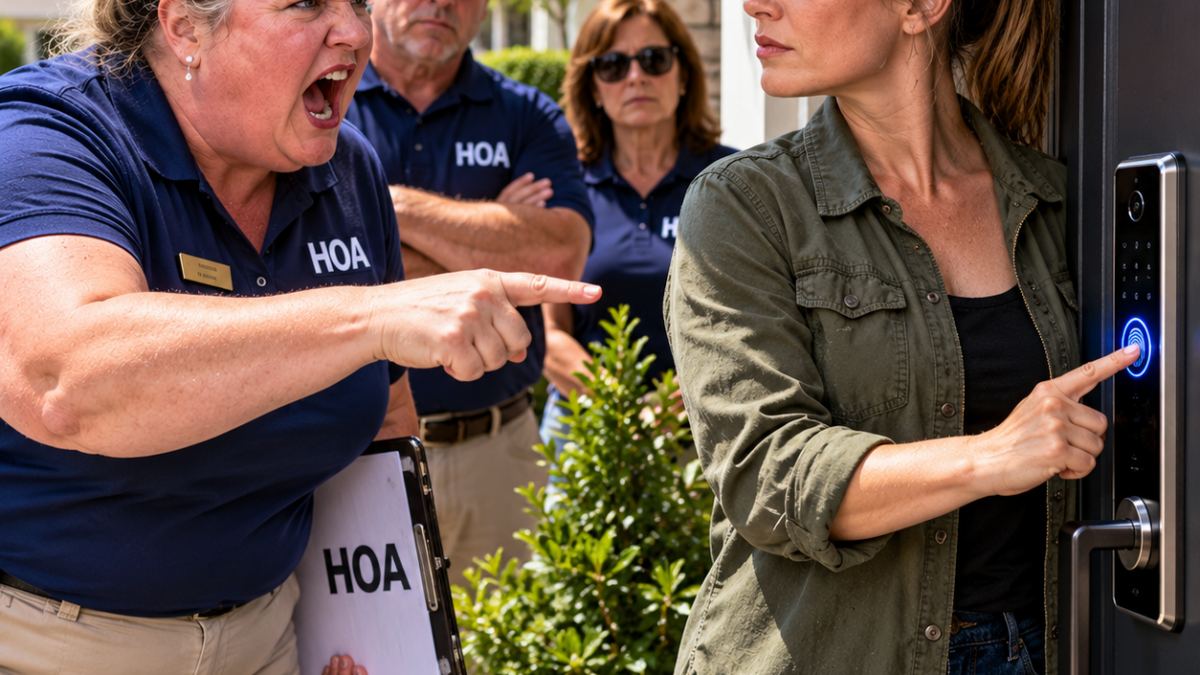
PART 2
I spent the next twenty minutes examining the cables.
Whoever had cut them knew exactly what they were doing.
The cuts were neat.
No torn insulation.
No damage to the nearby electrical wiring.
Only the video feeds had been disabled.
Arthur had installed those cameras himself.
He had once told me, “A system doesn’t need to be expensive, Elias. It needs to be understood.”
At the time, we had been talking about alarm sensors.
Now his words felt different.
I pulled the recorder’s storage drive.
The local footage ended exactly when the system log said it did.
Three days before his death.
I checked for cloud backups.
Nothing obvious.
That surprised me.
Arthur believed in redundancy.
A man who kept paper copies of digital receipts would never trust a single video recorder.
Which meant either the backup had been removed—
or I hadn’t found it yet.
I called the medical examiner’s office that afternoon.
Arthur’s death had been ruled natural.
Cardiac event.
He had a documented heart condition.
A neighbor had eventually found him after noticing that his porch lights had remained on through the morning.
Nothing in the official record suggested foul play.
I told myself not to turn coincidence into conspiracy.
An older man with heart problems had passed away.
The cameras might have failed for unrelated reasons.
Beverly might simply be an overbearing HOA president with no respect for boundaries.
All of those things were possible.
But possible wasn’t the same as convincing.
At six that evening, I opened my professional equipment case.
Inside was a biometric access unit my company had been testing for high-security residential applications.
It didn’t rely on a normal key.
It didn’t even rely exclusively on a fingerprint.
The scanner measured multiple characteristics of a live finger before granting access.
The important part wasn’t the technology itself.
The important part was control.
Every attempt would be logged.
Every successful entry would be tied to an authorized user.
Every failed attempt would create a timestamped record.
No hidden master key.
No untracked copies.
No one getting inside simply because they knew somebody on the HOA board.
By eight thirty, Arthur’s brass deadbolt was sitting on the kitchen counter.
In its place was a matte-black biometric lock.
I added a temporary access profile for myself and set up an emergency enrollment mode.
If Beverly truly wanted a documented emergency-access method, I was happy to provide one.
She would simply have to attach her identity to every time she used it.
Something told me that would make the rule suddenly less attractive.
I was right.
The orange notice appeared the next morning.
Someone had pushed it between my storm door and frame.
NOTICE OF NONCOMPLIANCE.
Fine: $250.
Violation: Failure to provide required emergency access.
Below that was something more serious.
MANDATORY SAFETY INSPECTION.
Thursday.
9:00 a.m.
The notice stated that if I failed to provide entry, the association might hire a locksmith and charge me for the service.
I read the document twice.
Then I made coffee.
If Beverly wanted to play through the bylaws, I could do that.
I spent most of Wednesday reading the governing documents.
All of them.
Almost three hundred pages.
Declarations.
Amendments.
Architectural standards.
Emergency procedures.
Meeting rules.
Financial disclosure policies.
The language was dense enough to discourage anyone who didn’t enjoy administrative puzzles.
Unfortunately for Beverly, administrative puzzles were basically my natural habitat.
The emergency-access rule was poorly written.
It said homeowners had to maintain a reliable means of emergency entry available to the association under authorized circumstances.
It did not say physical key.
It did not say duplicate deadbolt key.
It did not say the board president had to possess unrestricted access twenty-four hours a day.
So I drafted a written response.
I confirmed that my property now maintained a reliable emergency access method.
I explained that authorized HOA representatives could be enrolled in the biometric system.
Their use would be logged.
Access could be revoked when they left office.
And the system could provide temporary emergency credentials when necessary.
Then I emailed the document to the board and printed three copies.
Thursday morning, Beverly arrived at 8:59.
Of course she did.
Her black SUV pulled into my driveway.
A white commercial van followed.
Three people got out.
Beverly.
Two board members.
And a locksmith carrying a large tool case.
I was already standing on the porch.
Tablet in hand.
Coffee beside me.
Beverly climbed the steps.
“You received the inspection notice.”
“I did.”
“Then step aside.”
“Paperwork first.”
She blinked.
“What?”
“Written purpose of inspection. Names of authorized representatives. Scope of access. Expected duration.”
Her lips tightened.
“This is a routine emergency inspection.”
“If it’s routine, it’s not an emergency.”
One of the board members looked at the other.
Beverly ignored them.
“This is Mr. Henderson.”
She gestured toward the locksmith.
“He will replace your lock with an HOA-compliant cylinder.”
Mr. Henderson raised one hand in a hesitant greeting.
I looked at him.
“Did anyone tell you I already provided a compliant emergency-access method?”
He looked at Beverly.
She answered before he could.
“He refused to provide a key.”
“That isn’t what I asked.”
I held up my tablet.
A live view of the biometric panel appeared.
“I’m ready to enroll the HOA’s authorized representative right now.”
Beverly stared at the screen.
I continued.
“Put your finger on the scanner. The system creates your profile. If there’s a legitimate emergency, your identity is logged when you enter.”
Her face changed.
“What?”
“You wanted access.”
“I want a key.”
“The bylaw requires access.”
“A physical key.”
“Show me the sentence.”
She opened the folder.
Flipped several pages.
Stopped.
Then flipped backward.
I waited.
The two board members watched her.
Mr. Henderson watched me.
Finally Beverly snapped the folder shut.
“This is ridiculous.”
“I agree. But you came here with a locksmith, so apparently we’re committed.”
Her cheeks reddened.
“I am not giving you my biometric information.”
I shrugged.
“Then you’re refusing the emergency-access method I provided.”
“You will give this association a key.”
“There is no key.”
“Then we’ll remove the lock.”
I turned toward Mr. Henderson.
“If you alter my door without authorization, please understand that the entire interaction is being recorded and I will dispute the work.”
He glanced up.
Two small cameras were visible beneath the porch roof.
Another sat beside the doorbell.
Mr. Henderson slowly set his tool case down.
“Ma’am,” he said to Beverly, “this isn’t what you described on the phone.”
Her head snapped toward him.
“He is violating the association rules.”
“I’m a locksmith, not a judge.”
“Do your job.”
“My job doesn’t include forcing entry into an occupied house when the owner is standing here telling me no.”
Beverly’s eyes widened.
“You have a contract with Willow Creek.”
“And I’d like to keep my license.”
He picked up his tool case.
“I’m out.”
Beverly stepped in front of him.
“You leave and you won’t get another dollar of HOA business.”
Mr. Henderson stopped.
For a second I thought the threat might work.
Then he shook his head.
“Fine.”
He walked back to his van.
The engine started.
Thirty seconds later, he was gone.
I looked at Beverly.
She looked at me.
Neither of us spoke.
Finally I lifted the tablet slightly.
“Offer still stands.”
She stared at the biometric scanner.
Then at me.
“You think you’re clever.”
“No.”
I gestured toward the door.
“I think my house is mine.”
She stepped closer and lowered her voice.
“People have tried fighting this board before.”
“I’m not fighting the board.”
“You are now.”
She turned and walked toward her SUV.
Before leaving, she opened the rear door and pulled out a portable printer.
I almost admired the preparation.
Almost.
A minute later, she slapped another notice against my mailbox.
Seven hundred fifty dollars.
Obstruction of scheduled inspection.
Contractor cancellation.
Administrative costs.
The two board members looked embarrassed.
Beverly didn’t.
She climbed into the SUV.
Before closing the door, she called toward me.
“You’ll learn.”
Then they drove away.
Ten minutes later, an email arrived.
My account had been suspended from community facilities.
Pool.
Clubhouse.
Architectural approvals.
Then another notification.
A lien-related filing had been initiated against the property.
I stood in Arthur’s kitchen reading the message.
The amount wasn’t enormous.
That wasn’t the point.
The speed was.
Most bureaucracies move slowly even when everyone is trying to cooperate.
This had moved almost instantly.
Someone had been prepared for my refusal.
I printed everything.
Then I started searching the house.
Not casually.
Systematically.
Arthur had spent thirty years auditing organizations that didn’t want to be audited.
If he had discovered something important enough to make him suspicious of the HOA, he wouldn’t have stored it in a desk drawer labeled EVIDENCE.
He would have hidden it.
The basement was the obvious place to start.
Arthur’s basement was half workshop, half archive.
Metal shelves lined the walls.
Old tools hung in perfect rows.
Boxes were labeled by year.
The wine storage area sat behind a thick wooden door.
I checked drawers.
Shelves.
Cabinet bottoms.
Air vents.
Nothing.
Then I noticed one limestone block near the floor.
Every other block had a thin layer of dust along the top edge.
This one didn’t.
I knelt beside it.
The mortar looked real from a distance.
Up close, it was cosmetic.
I pulled.
The stone shifted.
Behind it was a small fire-resistant safe bolted into the concrete.
I sat back.
“Arthur…”
Of course.
The lock was mechanical.
Old.
Reliable.
I knew my uncle’s habits well enough to make an educated guess at the combination.
The year he joined federal service.
Wrong.
The year he retired.
Wrong.
My aunt’s birthday.
Wrong.
Then I remembered something he had told me after she died.
“The most important date in my life isn’t when I met Margaret. It’s when she said yes.”
Their engagement date.
Click.
The handle turned.
Inside was one envelope.
PROJECT WILLOW.
My pulse accelerated.
I carried it to the workbench.
Inside were spreadsheets.
Bank records.
Photographs.
Copies of invoices.
Property maps.
Emails.
Handwritten notes.
Arthur had been auditing the HOA.
Not officially.
Personally.
At first, the problem looked simple.
Money was missing from the capital improvement fund.
A lot of money.
Payments had been made to companies for repairs that appeared never to have happened.
Roof projects.
Drainage work.
Irrigation upgrades.
Emergency maintenance.
One company appeared repeatedly.
Sinclair Environmental Services.
I searched the state corporate registry.
The company was connected to a relative of Beverly Sinclair.
I went back to Arthur’s papers.
He had highlighted half a dozen payments.
Then beside them, in his handwriting:
NO CREW OBSERVED.
NO PERMIT FOUND.
NO MATERIAL DELIVERY.
DUPLICATE INVOICE NUMBERS.
Another sheet estimated the discrepancy at nearly half a million dollars over several years.
I sat very still.
That was when everything changed.
Beverly hadn’t been desperate for a key because the HOA cared about water leaks.
She had been desperate because she believed Arthur had something.
And now I had it.
One document caught my attention.
An irrigation contract.
Original signatures.
Original site plans.
Arthur had written across the top:
THIS IS WHY SHE NEEDS THE OLD RECORDS DESTROYED.
The contract showed utility routing through land tied to a private development proposal.
Arthur’s notes suggested the project depended on approvals that might never have been properly obtained.
I was still reading when I heard a sound upstairs.
Metal against wood.
I froze.
Then another sound.
A window.
I closed the envelope.
Turned off the workbench lamp.
And listened.
Footsteps.
Inside the house.
Someone had entered through the guest room.
My phone was in my pocket.
I quietly activated the emergency function on my security system.
The new cameras began uploading live video offsite.
I moved behind the furnace-room wall.
A flashlight beam appeared at the basement stairs.
Someone was coming down.
A man.
Tall.
Heavy jacket.
Gloves.
He wasn’t carrying anything I could identify clearly, and I had no intention of moving close enough to find out.
He reached the bottom of the stairs.
Looked around.
His light landed on the loose limestone block.
Then the open safe.
He knew where to look.
That told me more than his face ever could.
He took two steps toward the workbench.
His phone vibrated.
He answered in a whisper.
I couldn’t hear the other person.
Then his posture changed.
“What?”
Pause.
“Now?”
Another pause.
He turned immediately.
Went back upstairs.
Seconds later, the house became silent.
Then I heard a vehicle accelerate away.
I waited.
One minute.
Two.
Three.
Then sirens approached.
Someone had called the police.
I hadn’t.
Two patrol officers arrived.
I showed them the window.
The camera footage.
The open safe.
I did not show them every Project Willow document.
Not yet.
But I made a formal report.
One officer asked whether I had enemies.
I almost laughed.
“I’ve lived here six days.”
That night I barely slept.
At sunrise, I had made three decisions.
First, the Project Willow records would no longer remain inside the house.
Second, I would stop treating Beverly as a difficult neighbor.
Third, I would not confront her with what I knew until copies were somewhere she could never reach.
By seven thirty, encrypted backups existed in three separate locations.
At eight, a courier arrived.
Three legal notices.
The HOA had escalated again.
Daily fines.
An attempt to compel removal of my biometric lock.
And a formal warning that unpaid assessments and enforcement costs could ultimately threaten my property rights.
That one made me angry.
Not because I believed Beverly would succeed.
Because this had been Arthur’s home.
He had left it to me.
She was trying to use the machinery of the association to turn his legacy into leverage.
I made another pot of coffee.
Then I started my counterattack.
Not dramatic.
Not illegal.
Paperwork.
The most underrated weapon in America.
I filed a formal records request for the HOA’s financial documents.
Five years.
Capital improvement expenditures.
Vendor contracts.
Board approvals.
Invoices.
Payment ledgers.
Minutes authorizing emergency spending.
Conflict-of-interest disclosures.
Everything.
Then I formally challenged the lien-related filing and disputed every fine.
Dates.
Sections.
Attachments.
Delivery confirmations.
I created a spreadsheet for Beverly.
Column A: action.
Column B: claimed authority.
Column C: governing language.
Column D: procedural defect.
Column E: evidence.
By lunchtime, the sheet had forty-three rows.
At two in the afternoon, someone taped another violation to my garage.
Curtains.
Apparently the gray curtains Arthur had owned for years suddenly violated community appearance standards.
Fine: one hundred dollars.
I actually laughed.
Then came a complaint about my exterior security lighting.
Then a complaint about a temporary camera.
Then an accusation that I had modified my front entrance without architectural approval.
They were searching for pressure points.
So I documented every one.
The next knock came from a city inspector.
His name was Miller.
He looked exhausted before I even opened the door.
“Mr. Thorne?”
“Yes.”
“We received a complaint about an unpermitted basement modification.”
“From the HOA?”
He gave me the expression of a man who wasn’t allowed to say yes.
I stepped aside.
“Come in.”
He looked surprised.
“You don’t want to see a warrant or inspection notice?”
“You have the complaint paperwork?”
He showed me.
“Good enough. I’ll walk with you.”
I activated my body camera.
Not secretly.
I told him.
He appreciated that.
We went downstairs.
I showed him the basement.
Workshop.
Utility room.
Wine storage.
No illegal construction.
No hidden occupied space.
No wiring hazards.
He examined the biometric system.
Checked the permit documentation I had already submitted.
Then he sighed.
“This is cleaner than half the houses I inspect.”
“Can I get that in writing?”
That made him laugh.
“You security guys are all the same.”
“Documentation keeps everyone honest.”
He wrote his report.
No violations found.
When we walked outside, Beverly’s black SUV was parked across the street.
She was sitting behind the wheel.
Watching.
Inspector Miller saw her.
Then looked at me.
Then back at her.
He understood.
He didn’t wave.
He simply got in his city vehicle and drove away.
That evening, an email appeared in my encrypted account.
No sender name.
One attachment.
A bank statement.
The Willow Creek HOA had transferred fifty thousand dollars earlier that day.
Destination: an overseas account.
Description: emergency legal defense retainer.
I stared at it.
Someone inside the association was helping me.
The email contained only one sentence.
ARTHUR WAS RIGHT. CHECK THE SERVER BACKUPS.
At midnight, another message arrived.
This one wasn’t digital.
A black envelope appeared beneath my front door.
Handwritten.
If you want the rest of what Arthur found, come to the pool house at 2:00 a.m.
Alone.
I read it twice.
Every instinct said trap.
So I did exactly what a security engineer does when asked to enter an unknown environment alone.
I made sure I wasn’t actually alone.
I sent my location to my attorney.
I activated a remote check-in protocol.
I placed multiple people on automatic alert if I failed to confirm my safety.
Then I went.
At 1:58 a.m., the pool house was dark.
The smell of chlorine hung in the air.
I entered through the side gate.
A figure stepped from behind the equipment room.
Eleanor Price.
The HOA recording secretary.
I knew her face from board emails.
In person, she looked terrified.
“You came.”
“You asked me to.”
She looked around.
Then held out a rugged USB drive.
“Arthur made this.”
I didn’t take it immediately.
“What is it?”
“Everything Beverly couldn’t find.”
“Why are you giving it to me?”
Her eyes filled with tears.
“Because I should have helped him.”
That answer felt real.
I took the drive.
Eleanor continued.
“Your uncle knew money was disappearing. At first, that was all he thought it was.”
“What changed?”
“He found the development records.”
“The irrigation contract?”
She nodded.
“He realized Beverly had been using HOA-funded utility work to benefit property connected to her family.”
“And the cameras?”
Eleanor looked down.
“I don’t know who cut them.”
“But?”
“But Beverly knew Arthur kept records in the house. She became obsessed with getting access.”
The phrase sent a chill through me.
“Did my uncle give her a key?”
Eleanor hesitated.
“I think the old board had one.”
Of course.
That explained everything.
Arthur had tolerated the system.
Maybe he had believed the key was only for emergencies.
Then he discovered something.
And suddenly the person who already had access to his house had a reason to use it.
“What’s on the drive?”
“Encrypted archives from the HOA server.”
“How did you get them?”
“Arthur created backups before he died.”
She stepped away.
“I have to go.”
“Eleanor.”
She stopped.
“Why now?”
She looked at me.
“Because when Beverly sent someone into your house, I realized she wasn’t going to stop.”
Then she disappeared into the darkness.
I went home.
The USB drive was heavily encrypted.
Arthur had known what he was doing.
Or he had known someone who did.
It took hours to reconstruct the access path.
At sunrise, I finally opened the first archive.
Financial records.
Deleted emails.
Board communications.
Vendor invoices.
Enough to support most of Arthur’s conclusions.
But one folder was different.
EMERGENCY RESPONSE LOGS.
Inside were timestamps from Willow Creek’s resident alert system.
Arthur had used a medical emergency button connected to the community service network.
The night he died, the system registered an alert.
Then something strange happened.
The alert remained unresolved for several minutes before the outside emergency call was transmitted.
I stared at the logs.
Someone with administrative access had interacted with the system during that delay.
That was serious.
But it was not proof of why.
I refused to make the mistake Beverly would have made.
I didn’t jump from suspicious data to a dramatic accusation.
I preserved the records.
Then I called the attorney I had retained that morning.
By noon, copies were with appropriate investigators.
That decision mattered.
Because from that point forward, this wasn’t my private investigation.
It was evidence.
And evidence needs rules.
Chain of custody.
Authentication.
Context.
Experts.
That wasn’t as exciting as storming into an HOA meeting and shouting accusations.
It was much more dangerous to Beverly.
At four that afternoon, my attorney called.
“Do not access their live systems.”
“I’m not.”
“Good.”
“Everything I have came from Arthur’s drive or documents voluntarily provided to me.”
“Keep it that way.”
“I plan to.”
He paused.
“Elias, there’s enough here that state financial investigators may become interested.”
“May?”
“They move slowly.”
“Beverly doesn’t.”
“No. Which is why you stop giving her opportunities to claim you’re the problem.”
That advice became important the next morning.
At 4:12 a.m., motion alerts woke me.
Several vehicles had stopped outside.
A private security contractor.
Not police.
Three men approached the house carrying equipment.
Beverly stood near the sidewalk.
I watched through the cameras.
The lead contractor knocked.
I opened the intercom.
“Yes?”
“Mr. Thorne, we’ve been retained to secure the property pursuant to HOA enforcement action.”
“Do you have a court order?”
Pause.
“We have documentation from the association.”
“Is it signed by a judge?”
Another pause.
“No.”
“Then do not enter.”
Beverly moved into view.
“Elias, you’ve had every opportunity.”
I spoke through the intercom.
“So have you.”
The lead contractor turned toward her.
She pointed at my door.
“Proceed.”
He didn’t.
Instead, he looked at the cameras.
Then at the biometric lock.
“Ma’am, you said the house was vacant.”
I smiled inside.
Beverly had apparently forgotten to tell them I lived there.
“It is subject to emergency securing authority.”
“That’s not what our work order says.”
He pulled out his phone.
Beverly’s composure cracked.
“Your company was paid.”
“I’m calling dispatch.”
She stepped closer.
“You have a contract.”
He ignored her.
Two minutes later, the team began packing up.
Beverly looked at my camera.
Her face was pale with fury.
I opened the front door.
Not wide.
Just enough.
“Still want emergency access?”
She stared at me.
I pointed toward the scanner.
“Bring your finger.”
One of the contractors tried to hide a smile.
Beverly turned and walked away.
That should have been satisfying.
It wasn’t.
Because by then I understood something.
Every time she failed, she became more reckless.
By nine that morning, the HOA sent a mass email to the neighborhood.
It described me as a hostile resident using “advanced surveillance technology” to interfere with lawful community operations.
It implied I had manipulated records.
It called my biometric system an emergency hazard.
It accused me of harassing board officers.
The strategy was obvious.
If Beverly couldn’t control my property, she would control the story.
So I did the opposite of what she expected.
I didn’t write an angry response.
I didn’t insult her.
I didn’t post accusations.
I built a public evidence page.
Only documents I could lawfully disclose.
HOA budgets.
Public corporate registrations.
Approved minutes.
My violation notices.
My written responses.
The inspector’s clean report.
Vendor information.
Arthur’s financial comparisons without the sensitive investigative material.
Then I created a simple table.
Capital improvement spending.
Reported project.
Vendor.
Publicly verifiable work.
Conflict indicators.
No adjectives.
No accusations.
Numbers.
I sent the link to residents with one sentence:
These records speak for themselves. Please review them and ask your own questions.
Traffic exploded.
Within two hours, I had dozens of messages.
Some angry at me.
Some confused.
Some frightened.
And some relieved.
One message said:
I THOUGHT I WAS THE ONLY ONE.
Another:
SHE FINED US $3,200 AFTER WE QUESTIONED THE POOL CONTRACT.
Another:
MY MOTHER SOLD BECAUSE SHE COULDN’T KEEP UP WITH THE FEES.
Then Mr. Henderson returned.
The locksmith.
He stood on my porch holding an envelope.
“I owe you an apology.”
“You walked away. Nothing to apologize for.”
“No.”
He shook his head.
“There is.”
He explained that Beverly had called him the night before the inspection.
She wanted a written statement saying my lock created a fire-safety problem.
He refused.
She threatened to terminate his maintenance contract with Willow Creek.
“I’ve worked here nine years,” he said. “I knew she pushed people. I told myself it wasn’t my business.”
He handed me the envelope.
Copies of emails.
“She sent those?”
“Yes.”
I scanned them.
One message was especially useful.
IF THORNE REFUSES ENTRY, DOCUMENT HIS LOCK AS UNSAFE. WE NEED THE RECORD.
I looked up.
“Are you willing to confirm these are authentic?”
Mr. Henderson swallowed.
“Yes.”
“Even if the association cancels your contract?”
He looked back toward the street.
Then at me.
“I think that contract is already gone.”
I shook his hand.
The public meeting was called that afternoon.
Emergency Safety Town Hall.
Beverly chose the community park.
Probably because she wanted a stage.
She had always understood theater.
When I arrived, nearly a hundred residents were already there.
Beverly stood behind a portable lectern.
Two board members flanked her.
Eleanor sat off to the side.
Beverly began with the biometric lock.
Of course.
She described it as dangerous.
Unnecessary.
Hostile.
Then she called me a resident who believed technology placed him above community rules.
I stood near the back.
Silent.
Someone raised a hand.
Beverly ignored it.
Then another resident shouted:
“Where’s the reserve fund?”
Everything stopped.
The woman who asked was in her sixties.
I later learned her name was Linda Perez.
She held up her phone.
“We paid a twelve-hundred-dollar special assessment last year.”
Murmurs spread.
Linda continued.
“Your budget says the capital reserve should have more than three hundred thousand dollars. Elias’s documents show almost nothing left.”
Beverly tightened her grip on the lectern.
“That information is misleading.”
“How?”
“Capital funds are allocated across long-term infrastructure obligations.”
“Which obligations?”
“The details are complex.”
“Then explain them.”
People started talking.
Beverly raised her voice.
“This meeting is about security.”
“No,” someone else shouted. “You made it about security.”
Another resident stepped forward.
“You fined me over a shed after I asked about drainage spending.”
Another voice.
“You threatened my mother with a lien.”
Then another.
“And why does Sinclair Environmental have your family’s address?”
Beverly’s face changed.
For years, she had dealt with residents one at a time.
Isolated.
Embarrassed.
Afraid.
Now they were talking to each other.
That was the one contingency she hadn’t planned for.
I stepped forward.
Not to the microphone.
To a folding table.
I placed copies of the bylaws and state HOA procedures on it.
Then a petition.
A petition requesting a special membership meeting and board recall vote.
Linda signed first.
Mr. Henderson signed as a witness, though he wasn’t a resident.
Then twenty people lined up.
Then forty.
Then sixty.
Beverly came off the stage.
“This is improper.”
I looked at her.
“The petition follows the association’s own process.”
“You’re manipulating these people.”
“I gave them documents.”
“You’re destroying this community.”
“No.”
I looked at the line of residents.
“They’re finally talking to each other.”
Then something happened I didn’t expect.
Thomas Greene, Willow Creek’s longtime treasurer, stood up from his chair beside the stage.
He was a quiet man in his late sixties.
He had served on the board for eleven years.
Beverly turned toward him.
“Thomas, sit down.”
He didn’t.
He removed a leather folder from beneath his chair.
Then walked toward me.
Beverly’s voice sharpened.
“Thomas.”
He stopped.
Looked at her.
And said:
“No.”
One word.
It hit her harder than any speech.
He handed me the folder.
“I’m resigning.”
The park went silent.
Beverly stared at him.
“You don’t know what you’re doing.”
“Yes, I do.”
His voice trembled.
“That’s the problem. I’ve known for years.”
Gasps moved through the crowd.
He looked at the residents.
“I signed things I shouldn’t have signed because she told me the vendors were legitimate. Later, I realized some weren’t. By then my name was already on the approvals.”
Beverly stepped toward him.
“Stop talking.”
Thomas continued.
“I was afraid if I exposed it, I’d go down with her.”
“You will.”
He looked at Beverly.
“Maybe.”
Then at me.
“But Arthur was right.”
Hearing my uncle’s name changed the air.
Thomas opened the leather folder.
Original bank statements.
Vendor approvals.
Board signatures.
Documents Arthur had apparently been trying to obtain.
“I gave him copies,” Thomas said. “Not all of them. I was too scared.”
“What happened after that?” I asked.
Thomas looked at Beverly.
“He started asking questions she couldn’t answer.”
Beverly turned toward the crowd.
“This man is confused.”
Thomas shook his head.
“No, Beverly.”
Then he said something that ended her control of Willow Creek before any investigator ever arrived.
“I’m done being afraid of you.”
People applauded.
Not loudly at first.
Then louder.
Beverly left the park alone.
That evening, her attorney called mine.
The offer was simple.
All fines removed.
Lien withdrawn.
Written acknowledgement that my biometric lock met HOA rules.
In exchange, I would shut down the public records page and surrender the Project Willow documents.
My attorney barely finished explaining before I answered.
“No.”
“I assumed.”
“There’s no settlement involving evidence.”
“I already told them that.”
“Good.”
The next evening, Willow Creek held the formal special meeting.
Two hundred folding chairs filled the community center.
Almost every one was occupied.
Beverly was still technically president.
So she sat in the center chair.
Navy blazer.
Perfect hair.
Stack of papers.
The uniform of power.
But the room had changed.
People no longer avoided her eyes.
They stared.
Beverly opened the meeting.
“This association is under attack.”
Nobody reacted.
She continued.
“A private resident has obtained confidential records and distributed distorted financial information in an effort to destabilize Willow Creek.”
I stood at the back.
Tablet beneath my arm.
She spoke for fifteen minutes.
Cybersecurity.
Privacy.
Property values.
Community unity.
She even suggested some of Arthur’s financial documents might have been digitally altered.
That part made me smile.
Because investigators had spent the previous day authenticating them.
When Beverly finished, residents were permitted to speak.
Linda went first.
She asked about the reserve fund.
No answer.
A father named Mark Dalton asked why his family had received six violations immediately after challenging a special assessment.
No answer.
An elderly woman asked why her late husband’s estate had been charged thousands in administrative costs.
No answer.
Then Thomas Greene walked to the microphone.
He confirmed the bank records.
Beverly’s attorney objected from the front row.
This wasn’t a court.
Nobody cared.
Thomas described shell vendors.
Duplicate invoices.
Emergency approvals.
Payments that had never matched completed work.
Then Eleanor stood.
Beverly’s face went white.
Eleanor walked toward the microphone.
For years, she had looked like the quietest person in Willow Creek.
That evening, her hands still trembled.
But her voice did not.
“I kept the minutes.”
She looked around.
“Not only the versions residents received.”
Beverly stood.
“Eleanor, I advise you to stop.”
Eleanor continued.
“I kept drafts.”
She held up a USB drive.
“Original drafts.”
Beverly’s attorney leaned toward her.
Whispered something.
She ignored him.
Eleanor continued.
“Several votes were changed after meetings ended.”
The room erupted.
Beverly struck the gavel.
“Order!”
No one listened.
“Order!”
I watched her.
The same woman who had stood on my porch demanding my key now couldn’t make her own meeting room obey.
That was when two investigators entered.
They didn’t make a dramatic announcement.
They simply walked to the side wall and observed.
Beverly saw them.
She knew immediately they weren’t residents.
Her confidence disappeared.
I went to the microphone.
She pointed at me.
“You do not have the floor.”
The crowd answered for me.
“Let him speak.”
“Let Elias talk.”
“Let him speak.”
Beverly looked around.
Then sat down.
I placed my tablet on the podium.
“When I moved into my uncle’s house, Beverly asked for a key.”
The room quieted.
“I refused because I didn’t believe any HOA should possess uncontrolled access to a private residence.”
I looked toward her.
“So I installed a biometric lock.”
A few people smiled.
“I thought this dispute was about a key.”
I paused.
“It wasn’t.”
The projector activated.
The screen displayed a timeline.
Arthur’s questions about HOA finances.
The dates he requested records.
The date his cameras stopped recording.
The date of his medical emergency.
The dates of several questionable payments.
I was careful.
No accusation beyond what the evidence supported.
“These events require independent investigation.”
Then I showed Arthur’s financial analysis.
Vendor records.
Payments.
Corporate relationships.
Thomas’s authenticated bank documents.
Finally, the emergency alert logs.
“This is the part I want to be absolutely clear about.”
I looked at the room.
“My uncle died from a documented medical condition. I am not standing here claiming I know exactly what happened during his final hours.”
Beverly stared at me.
“But his emergency system generated an alert.”
The screen changed.
“The alert did not proceed normally.”
Timestamp.
Administrative interaction.
Delay.
“Someone with authorized access interacted with the system before outside help was contacted.”
A woman in the second row covered her mouth.
I continued.
“That does not belong in HOA gossip.”
I looked toward the two investigators.
“It belongs with professionals who can determine what happened.”
Beverly suddenly stood.
“He hacked it!”
Her attorney grabbed her arm.
She pulled away.
“He broke into our servers!”
I kept my voice calm.
“These records came from archived material created before Arthur died and were voluntarily provided to investigators.”
“You liar!”
Her voice cracked.
The room went silent.
She looked at the projector.
At Eleanor.
At Thomas.
At me.
Then words started spilling out.
“Arthur didn’t understand what he was doing.”
Her attorney stood.
“Beverly.”
“He was going to ruin everything.”
“Stop talking.”
She ignored him.
“The development would have increased property values.”
Nobody moved.
She pointed toward me.
“Your uncle thought every accounting discrepancy was some great conspiracy.”
My pulse pounded.
But I remained silent.
Her lawyer moved closer.
“Mrs. Sinclair, stop.”
She looked at him.
Then realized what she had done.
Too late.
One investigator stepped forward.
“Mrs. Sinclair, we’d like to speak with you privately.”
Her mouth opened.
No words came.
He continued.
“You are not required to answer questions here.”
That sentence, more than anything, seemed to break the spell.
Because everyone in the room understood what it meant.
This had moved beyond HOA politics.
Beverly gathered her papers.
Her hands were shaking.
As she walked toward the side door, she passed me.
For a moment, we stood less than three feet apart.
She looked at me with exhausted hatred.
“This was your uncle’s fault.”
I answered quietly.
“No.”
I looked toward the residents.
“This happened because you thought nobody would check.”
She left with her attorney and the investigators.
The room stayed silent.
Then Linda Perez walked to the podium.
“We still have a vote.”
And that was how Beverly Sinclair lost the presidency of Willow Creek.
Not with shouting.
Not with some dramatic act of revenge.
A membership vote.
One hundred eighty-seven votes cast.
One hundred seventy-nine supported removal.
Six opposed.
Two abstained.
The remaining board members resigned within forty-eight hours.
The association hired temporary outside management.
My fines were suspended pending review.
Three days later, they were voided.
The lien filing was withdrawn.
Every violation issued against me since my arrival disappeared.
But I didn’t celebrate.
Not yet.
Arthur’s questions remained.
Over the following weeks, investigators worked through Project Willow.
Forensic accountants reviewed years of HOA spending.
They confirmed that substantial amounts had been diverted through vendors linked directly or indirectly to Beverly’s family and associates.
Some invoices represented exaggerated work.
Some represented duplicate billing.
Some had little evidence of legitimate services.
The total eventually approached Arthur’s estimate.
Nearly half a million dollars.
That alone was enough to destroy Beverly’s reputation.
But the investigation didn’t stop there.
The development project Arthur had flagged involved zoning irregularities.
Two local officials had received benefits connected to parties involved in the plan.
The microSD card Eleanor eventually surrendered contained deleted emails linking those relationships.
Again, I did not investigate them myself.
I handed the material over.
That decision became increasingly important to me.
For the first two weeks, I had felt like I was in a war.
Security systems.
Cameras.
Encrypted backups.
Countermeasures.
Documentation.
By the third week, I realized the healthiest thing I could do was stop trying to personally control the outcome.
My job was to preserve what Arthur had found.
Tell the truth.
Protect the house.
Then let the system do what it was supposed to do.
The most difficult question concerned Arthur’s final night.
Experts reviewed the emergency system.
The evidence showed that his alert had been delayed after an administrative interaction.
The reason was investigated.
I will not pretend I received every answer I wanted.
Real life rarely gives you that.
There was enough concern for authorities to expand their inquiry.
There were communications suggesting Beverly knew Arthur had suffered a medical crisis before outside responders arrived.
There were questions about why she had been near his property.
There were also limits to what could be proven with certainty.
Arthur was gone.
No investigation could change that.
At first, this frustrated me.
I wanted a perfect answer.
A clear timeline.
A single person to blame.
Something that could fit neatly into one final line.
Instead, I learned that justice sometimes arrives in pieces.
Financial accountability.
Public truth.
Restitution.
Reform.
The protection of the people who remain.
Beverly eventually faced serious criminal charges related to the financial misconduct, false records, and the effort to conceal evidence.
Her attorney fought aggressively.
There were hearings.
Delays.
Motions.
Arguments about admissibility.
Nothing happened as quickly as people on social media later claimed.
But slowly, the facts became impossible to avoid.
Sinclair Environmental Services had received money for work that could not be substantiated.
Board records had been altered.
Conflict disclosures were missing.
Reserve money had been misused.
Residents had been pressured after asking questions.
And Beverly had repeatedly tried to use the association’s enforcement mechanisms against people who threatened her control.
My uncle had been one of them.
So had I.
Months after I first opened Arthur’s safe, Beverly entered a negotiated resolution that included years of incarceration, restitution obligations, and the surrender of assets tied to the scheme.
Other people involved faced separate consequences.
Some criminal.
Some civil.
Some professional.
Two local officials resigned while their conduct was investigated.
Thomas Greene cooperated fully.
His role was complicated.
He had signed documents.
He had stayed silent.
He had helped Beverly maintain the appearance of legitimacy.
But he had also preserved records and eventually told the truth.
When I saw him after one hearing, he looked twenty years older than the man I had first seen beside Beverly.
“I’m sorry about Arthur,” he said.
I believed him.
That didn’t erase what he had done.
Forgiveness and accountability aren’t opposites.
Sometimes they have to occupy the same room.
Eleanor became one of the most important witnesses.
For years she had recorded meetings while pretending not to notice the things happening around her.
The guilt had nearly consumed her.
One afternoon, she came to my house.
She stopped at the bottom of the porch steps.
Didn’t approach the door.
That detail mattered.
“Can I come up?”
I smiled.
“Of course.”
She looked at the biometric scanner.
“So that’s the famous lock.”
“Apparently.”
She laughed.
It was the first time I had heard her laugh.
“I thought Beverly was going to explode when you told her to use her finger.”
“She almost did.”
Eleanor sat on the porch chair.
For a while we talked about Arthur.
She told me he had always believed the neighborhood could be better than its board.
“He didn’t hate Willow Creek,” she said.
“That surprised me.”
“He hated what fear was turning it into.”
That sounded like him.
Eleanor reached into her bag.
She handed me a small notebook.
Arthur’s.
“I found it in the records room.”
Inside were handwritten notes.
Numbers.
Dates.
Questions.
Near the back was a page with my name.
Elias understands systems.
If anything happens to me, he will know that systems fail where people stop asking who benefits.
I read the sentence three times.
My vision blurred.
Eleanor pretended not to notice.
“Why didn’t he tell me?” I asked.
“Maybe he wanted to.”
“He had my number.”
“He also had pride.”
That made me laugh through the ache in my chest.
“Yes.”
She smiled.
“That too.”
The new Willow Creek board was elected four months after Beverly’s removal.
For the first time in more than a decade, there were more candidates than available seats.
Linda Perez ran.
So did Mark Dalton.
A retired principal named Marcus Reed became treasurer.
One of the first things they did was ask me to join.
I refused.
Not because I didn’t care.
Because I had spent enough of my life thinking about the HOA.
“I’ll help with security and financial transparency,” I told Marcus. “But I don’t want a title.”
He nodded.
“Fair.”
We redesigned the association’s accounting controls.
Nothing magical.
No science-fiction system.
Just good governance.
Multiple approvals for large payments.
Digital audit trails.
Regular independent reviews.
Resident access to non-confidential financial records.
Clear conflict-of-interest rules.
No single officer could approve a vendor connected to themselves or a family member.
Meetings were recorded.
Draft minutes were retained.
And the emergency-access rule that had started everything was rewritten.
No homeowner would ever again be required to surrender an uncontrolled physical key to the HOA.
Emergency entry had to be based on consent, lawful authority, documented circumstances, or properly managed technology.
The vote passed almost unanimously.
When Marcus announced the result, he looked toward me.
“Any comments?”
I shook my head.
Linda laughed.
“Oh, come on.”
People turned.
I stood.
Looked around the room.
Then said:
“Keep your keys.”
The room erupted in laughter.
It felt good.
Not victory.
Relief.
The reserve fund took longer to repair.
Some money was eventually recovered through restitution and asset sales.
Some probably never would be.
Residents approved a recovery plan.
Nobody liked paying more.
But for the first time, people understood exactly where the money was going.
That changed everything.
Transparency didn’t make disagreements disappear.
It made disagreement survivable.
The neighborhood still argued.
About landscaping.
Parking.
Budgets.
Pool hours.
Dogs.
Holiday decorations.
Ordinary things.
Beautifully ordinary things.
A year earlier, every disagreement had carried the unspoken question:
What will Beverly do to me if I push back?
Now residents argued, voted, complained, and went home.
That was what democracy looked like at the smallest possible scale.
Messy.
Loud.
Sometimes irritating.
But shared.
I spent the following months restoring Arthur’s house.
Not because it was broken.
Because it had stopped feeling like a home.
Every room carried the memory of the investigation.
Documents.
Cameras.
Backup drives.
Boxes of evidence.
I wanted those things gone.
The temporary security equipment came down first.
Extra perimeter cameras.
Portable sensors.
Emergency speakers.
I kept normal residential coverage.
Nothing more.
One afternoon, I removed the last hidden camera from a bookshelf.
I held it in my hand.
Then placed it in a storage box.
That moment felt larger than it should have.
For months, security had meant watching everything.
Now security meant not needing to.
I kept the biometric lock.
Of course I did.
It had become something more than technology.
It was the physical boundary Beverly had never managed to cross.
One Sunday afternoon, I removed the lock housing.
Carried it to Arthur’s old workbench.
Then used a precision engraver to mark two words into the side.
ARTHUR THORNE.
Small letters.
Nothing dramatic.
I reassembled the lock.
Returned it to the door.
Pressed my thumb against the scanner.
Green light.
Click.
The bolt retracted.
Simple.
Reliable.
Mine.
As I stood there, I realized something had changed.
When I first arrived, I thought inheriting Arthur’s house meant receiving property.
Square footage.
Land.
Furniture.
Equity.
I was wrong.
Arthur had left me responsibility.
Not to avenge him.
Not to become some permanent watchdog.
He had left me the responsibility to finish asking the question he had started.
Where did the money go?
Why were the records wrong?
Why did powerful people become nervous when someone asked for documentation?
And most importantly:
Who benefits when everyone else stays silent?
Once those questions were answered, my responsibility ended.
That mattered.
Because revenge can become another kind of prison.
For months, I had imagined Beverly losing everything.
Her office.
Her authority.
Her reputation.
Her freedom.
When those consequences began arriving, I discovered they didn’t bring Arthur back.
They didn’t make his empty chair less empty.
They didn’t erase the final unanswered questions surrounding his death.
What helped was something quieter.
Linda knocking on my door because she wanted advice on a security camera.
Thomas sending a handwritten apology to Arthur’s estate.
Eleanor laughing on my porch.
Residents showing up at meetings because they finally believed their votes mattered.
Marcus walking past my house without a folder, violation notice, or hidden agenda.
That was the part Beverly had never understood.
Power wasn’t having access to everyone’s house.
It wasn’t controlling the budget.
It wasn’t knowing which rule could be twisted against which resident.
Real power was being trusted.
And trust was the one resource she had spent years destroying.
One Saturday in October, Willow Creek held a neighborhood barbecue.
Marcus had invited me months earlier.
This time I went.
I brought drinks.
Linda brought enough food for twice the neighborhood.
Kids ran through the park.
Someone set up speakers.
Mr. Henderson—the locksmith—showed up with his wife.
He found me near the grill.
“You ever going back to a normal deadbolt?”
“Absolutely not.”
He laughed.
“I figured.”
“I’m emotionally attached now.”
“To a lock?”
“You weren’t here for the whole relationship.”
He raised his drink.
“Fair enough.”
Later, Eleanor joined us.
Thomas came too.
There was an awkward moment when he saw her.
Then she walked over.
They spoke quietly.
I couldn’t hear the conversation.
I didn’t need to.
Eventually, they shook hands.
Maybe forgiveness.
Maybe simply acknowledgment.
Sometimes that’s enough.
As the sun went down, I looked toward Arthur’s house.
My house.
For the first time, I didn’t see the porch where Beverly had demanded my key.
I didn’t see the window someone had entered.
I didn’t see evidence bags or orange violation notices.
I saw warm light through the living-room window.
A home waiting for me.
I walked back alone after dark.
The streets were quiet.
Not the suffocating quiet I had noticed when I first arrived.
This was different.
Peace had returned without requiring silence.
As I reached my driveway, Marcus was walking his dog.
He waved.
“Good barbecue.”
“Yeah.”
“You surviving Willow Creek?”
“Barely.”
He laughed.
Then he glanced at my front door.
“That thing really only opens for you?”
“And a few people I authorize.”
“No HOA master profile?”
“Absolutely not.”
He raised both hands.
“I wasn’t asking.”
“I know.”
He smiled.
“That might be the nicest thing anyone in this neighborhood has ever said to you.”
“What?”
“I wasn’t asking.”
I laughed.
He continued down the sidewalk.
I stood there for a moment.
He was right.
That simple sentence represented everything that had changed.
No demand.
No presumed authority.
No expectation that because he held a board position he was entitled to cross my boundary.
Just respect.
I climbed the porch steps.
Arthur’s name was visible on the side of the biometric housing.
I touched the scanner.
Green.
Click.
Before opening the door, I looked down the street.
Somewhere in all the legal files and news stories, people had reduced what happened in Willow Creek to a catchy summary.
HOA president demands key.
Homeowner installs biometric lock.
Corruption exposed.
President falls.
It made a good headline.
But it wasn’t the real story.
The real story began years earlier when Arthur noticed numbers that didn’t make sense.
It continued every time someone received an unfair notice and decided it was easier to pay than argue.
Every time a board member saw something wrong and stayed quiet.
Every time Beverly discovered that fear worked.
By the time I arrived, the system wasn’t powerful because Beverly was brilliant.
It was powerful because everyone had been separated.
Each resident thought their problem belonged only to them.
The moment they compared stories, her control began to disappear.
My biometric lock didn’t bring Beverly down.
The lock simply forced her to reveal how badly she needed access without accountability.
The documents did the rest.
Arthur’s records.
Thomas’s bank statements.
Eleanor’s drafts.
Mr. Henderson’s emails.
The residents’ stories.
One piece of evidence meant little.
Together, they created a pattern no amount of authority could hide.
I opened the door.
The entryway smelled faintly of cedar.
Arthur’s old coat rack still stood beside the stairs.
I had considered replacing it.
I never did.
I walked into the kitchen.
On the refrigerator was a photograph of Arthur and me from ten years earlier.
We were standing beside an old pickup truck.
He had one hand on my shoulder.
Neither of us was smiling properly because Arthur hated photographs.
I picked up the frame.
“You could’ve just called me, you know.”
The house, naturally, did not answer.
I smiled.
“Would’ve saved me a lot of paperwork.”
I put the photograph back.
Then I noticed something beside it.
Arthur’s notebook.
The page Eleanor had shown me was still marked.
Elias understands systems.
If anything happens to me, he will know that systems fail where people stop asking who benefits.
I read it one more time.
Then closed the notebook.
Arthur had spent his career auditing institutions.
I spent mine securing systems.
Different disciplines.
Same principle.
Trust is never supposed to mean the absence of verification.
A healthy system doesn’t fear questions.
It survives them.
That was what Beverly had gotten wrong.
She believed anyone asking questions was disloyal.
Arthur knew the opposite.
People who care enough to ask hard questions are often the only reason a system remains worth trusting.
Months later, I received one final letter regarding Beverly’s case.
Her remaining claims against my property had been formally dismissed.
Restitution proceedings were continuing.
The letter was dry.
Technical.
Two pages of language no normal person would ever frame.
I framed it.
Not because of Beverly.
Because at the bottom was my property address.
Arthur’s address.
And beside it was a simple statement confirming that no valid HOA lien remained against the home.
For all the drama, that was my ending.
No speech.
No courtroom applause.
No triumphant confrontation.
A clean title.
A locked door.
A quiet house.
One evening, nearly a year after I moved in, someone knocked.
Three sharp knocks.
For half a second, memory pulled me backward.
Beverly on the porch.
The folder.
The open palm.
Hand over the key.
I checked the camera.
A young couple stood outside.
New neighbors.
I opened the door.
“Hi,” the woman said. “Sorry to bother you. We just moved in two houses down.”
Her husband held a plate covered with foil.
“We made too much food.”
I looked at the plate.
Then at them.
For some reason, I almost laughed.
“Come in.”
The woman glanced at the biometric scanner.
“That lock is amazing.”
“It has a history.”
Her husband grinned.
“You’re the finger guy, aren’t you?”
I closed my eyes.
“Please tell me people don’t call me that.”
He laughed.
“Only Marcus.”
“That explains it.”
They stayed for coffee.
We talked about work.
Moving boxes.
Restaurants.
The best grocery store nearby.
Not HOA corruption.
Not missing money.
Not Arthur’s death.
Normal things.
When they left, the woman stopped beside the door.
“So if there’s an emergency, does the HOA have access?”
I looked at the scanner.
Then at her.
“They have a procedure.”
“No master key?”
“No.”
“Good.”
She smiled.
“I hate giving people spare keys.”
I watched them walk home.
Then I shut the door.
The lock engaged with a solid click.
It was strange how much meaning one small sound could hold.
A year earlier, that sound had meant defense.
Now it meant privacy.
That was the real victory.
Not that Beverly lost.
Not that I won.
That eventually, the fight stopped defining the house.
The house became a home again.
On the anniversary of Arthur’s death, I visited his grave.
I brought no flowers.
Arthur had disliked flowers.
I brought coffee.
Black.
Exactly how he used to drink it.
I sat beside the headstone and told him what had happened.
The investigations.
The board election.
The recovered money.
Eleanor.
Thomas.
The rewritten access rule.
The new neighbors.
I even told him about being called “the finger guy.”
I could imagine his reaction.
He would have pretended not to find it funny.
Then repeated it to everyone for the next five years.
I stayed there until the coffee went cold.
Before leaving, I placed my hand against the stone.
“You were right.”
The wind moved through the trees.
“You were also incredibly annoying.”
That made me laugh.
Then my voice caught.
“I miss you.”
There are victories you celebrate.
And there are victories you carry quietly because the person you most wanted to show them to is no longer there.
Arthur should have been sitting on that porch.
He should have seen Beverly finally lose control.
He should have watched residents fill a meeting room demanding records.
He should have been there when Willow Creek rewrote the rule that had given the board access to his home.
He wasn’t.
So I did the next best thing.
I made sure everyone remembered who had started asking questions.
The following month, the new board dedicated its financial transparency policy to Arthur.
Not the clubhouse.
Not a bench.
Arthur would have hated anything sentimental.
A policy.
That suited him perfectly.
The plaque in the meeting room read:
ARTHUR THORNE TRANSPARENCY STANDARD
Every resident has the right to understand how community funds are collected, approved, and spent.
I stared at it longer than I expected.
Marcus stood beside me.
“He’d like that?”
“He’d complain about the font.”
Marcus laughed.
“Seriously?”
“Absolutely.”
“What font would he want?”
“Something boring.”
“This is Times New Roman.”
“Too flashy for Arthur.”
Marcus shook his head.
“You Thornes are strange people.”
“Correct.”
That evening, I returned home.
The sky was turning orange behind the trees.
No black SUV waited at the curb.
No violation notice hung from the mailbox.
No stranger was inspecting my house.
Only a package on the porch.
New coffee filters.
I had ordered them myself.
I stood in front of the biometric reader.
Arthur’s engraved name caught the last light of the day.
For one second, I remembered Beverly standing on the same porch.
Her hand open.
Her voice certain.
Hand it over.
She had believed the key represented obedience.
If I gave it to her, I accepted that she had authority beyond the boundary of my front door.
When I refused, she thought she needed to punish me.
So she pushed.
And pushed.
And pushed.
Until she exposed the very thing she had spent years trying to protect.
That was the irony I appreciated most.
If Beverly had accepted my first answer, she might have remained HOA president for years.
If she had shrugged and walked away, I might never have inspected Arthur’s cameras.
If she hadn’t threatened the locksmith, he might never have come back with her emails.
If she hadn’t buried me in fines, I might never have demanded the financial records.
If she hadn’t tried to control the community narrative, residents might never have compared their experiences.
If she hadn’t been so determined to get into Arthur’s house—
I might never have discovered what Arthur had hidden inside it.
Beverly wasn’t defeated because I was smarter than everyone.
She was defeated because she couldn’t tolerate a boundary.
One homeowner said no.
And instead of walking away, she revealed exactly how much she had to lose.
I pressed my thumb to the scanner.
Green light.
The lock opened.
I stepped inside.
Behind me, the bolt slid back into place.
Solid.
Simple.
Final.
I didn’t need Beverly’s permission to live there.
I didn’t need the board’s approval to protect it.
And I certainly didn’t need to give anyone a key.
Arthur had left me a house.
Beverly had tried to turn that house into leverage.
In the end, she accomplished the opposite.
She taught an entire neighborhood where the boundary was.
The association belonged to the residents.
The money belonged to the community.
And my front door belonged to me.
So if anyone ever asks what happened when the president of Willow Creek demanded the key to my inherited house, the answer is simple.
I didn’t yell.
I didn’t threaten her.
I didn’t surrender.
I replaced the lock.
I documented everything.
And when she came back demanding access, I pointed at the scanner and gave her the only answer she had earned.
“Want in?”
I smiled.
“Bring your finger.”




