PART 2: HOA “Cops” Forced Me to Scrap My Dad’s Classic Mustang—Then I Revealed I Owned the Land Under Their Clubhouse
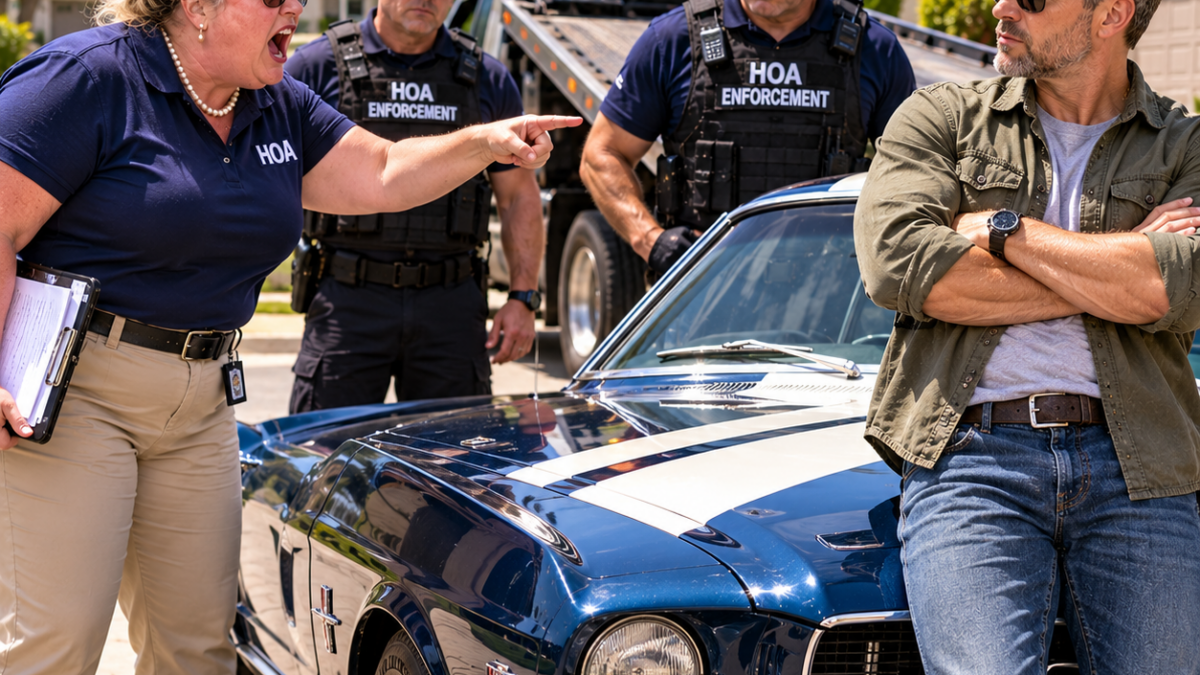
PART 2
The next morning, I called Robert Castellano.
Robert had handled Dad’s estate.
He was a real-estate attorney with thirty years of experience and the permanent expression of a man who had already seen every possible way human beings could make property disputes unnecessarily complicated.
I brought him the notice.
He read it once.
Then again.
Then looked at me.
“Destroy?”
“That’s what it says.”
“I can read, Daniel. I’m trying to understand whether they can.”
He turned the page over like maybe the actual legal justification was printed on the back.
It wasn’t.
Robert spent almost two hours reading Meadowbrook’s governing documents.
Section 12.7 concerned inoperable vehicles, abandoned vehicles, visible restoration projects, and conditions affecting common aesthetics.
My Mustang was none of those things.
It was registered.
Insured.
Operational.
Stored indoors.
Maintained better than Gerald’s own SUV, if I was being honest.
“There is nothing here authorizing destruction,” Robert finally said.
“So we’re done?”
“No.”
“Why not?”
“Because having the law on your side and stopping someone from making your life miserable are two different things.”
He drafted an appeal anyway.
The letter was methodical.
Registration records.
Inspection records.
Photographs of the garage.
Relevant covenant language.
Property-rights arguments.
He sent it by certified mail.
For approximately twenty-three hours, I felt relieved.
Then Gerald responded.
Appeal denied.
Emergency presidential authority.
He claimed the Mustang represented a fire hazard because of its age and a potential environmental hazard because of “suspected leaking fluids.”
Both claims were ridiculous.
The car had no leaks.
I could have eaten breakfast off the garage floor.
Robert called me.
“We can take this to court.”
“Good.”
“Daniel, listen to the second half.”
I sat down.
“HOA litigation moves slowly. Very slowly. They can keep issuing fines while we fight over procedure.”
“How slowly?”
“Twelve months. Eighteen. Maybe more.”
“And the fines?”
“We challenge them.”
“But they still appear on the account.”
“Yes.”
That was Gerald’s strategy.
He didn’t need to be right.
He needed resistance to cost more than surrender.
By Monday, the HOA patrol sedan began circling my house.
Eight times the first day.
I counted.
White car.
Meadowbrook logo.
Same two men who had stood in my driveway.
They slowed each time they passed.
Sometimes they photographed the house.
Sometimes the yard.
Sometimes me.
Tuesday brought a grass-height violation.
Apparently one patch beside the mailbox was half an inch too tall.
Wednesday brought a trash-container violation.
I had brought my bins in two hours and fourteen minutes after collection.
The rules allegedly allowed two hours.
Thursday brought a notice claiming a water spot near my garage looked like an automotive chemical leak.
Fifty dollars.
Fifty dollars.
Another fifty.
Then warnings about escalating penalties.
It was almost impressive.
Petty, but organized.
Dad had lived there twenty-five years.
Nobody had measured his grass with that enthusiasm.
Nobody had photographed his garbage cans.
Nobody had treated a splash of hose water like an environmental incident.
The rules hadn’t changed.
The target had.
That realization altered the way I approached everything.
My profession is forensic accounting.
For eight years, I had made a living reconstructing what happened when companies insisted nothing unusual had happened.
Money disappears.
Invoices appear.
Records contradict each other.
Someone always says it was a misunderstanding.
My job begins when explanations stop making mathematical sense.
So I stopped arguing.
I documented.
Every patrol-car pass went into a spreadsheet.
Date.
Time.
Direction.
Driver.
Photographs.
Every violation notice was scanned.
Every envelope preserved.
Every conversation summarized immediately afterward.
I installed cameras around the house and backed the footage up remotely.
When I cut the grass, I photographed the measuring tape.
When I moved the garbage bins, I timestamped it.
When I washed the driveway, I photographed it before and after.
It felt ridiculous.
That was exactly what Gerald counted on.
He wanted resisting him to feel so absurd and exhausting that eventually I would stop.
Friday evening, someone forwarded me a neighborhood email.
I didn’t recognize the sender.
The message from Gerald had the subject line:
PROTECTING OUR PROPERTY VALUES.
Inside was a picture of my Mustang.
The angle was misleading enough to make it appear the car might be sitting partly outside the garage.
Gerald never mentioned my name.
He didn’t need to.
He described an unnamed homeowner who refused to respect Meadowbrook’s standards.
He called the vehicle an eyesore.
He suggested it could negatively affect the value of neighboring properties.
He asked residents to “stand together.”
That phrase bothered me.
Not because it was convincing.
Because I understood what he was doing.
Gerald wasn’t simply punishing me.
He was creating permission for everyone else to dislike me before they ever spoke to me.
By Saturday morning, people who had waved during my first week stopped.
A man walking his Labrador crossed to the opposite sidewalk when he saw me checking the mail.
Then Mrs. Patterson came down the street.
She was eighty-one.
Small woman.
Gardening gloves tucked into one pocket.
Dad had mentioned her dozens of times.
She had lived three houses away longer than almost anyone else in Meadowbrook.
“You’re David’s boy.”
I smiled.
“Depends how old I’m allowed to be before people stop calling me that.”
She didn’t smile.
Instead, she looked toward the street.
Then toward Gerald’s house.
“Your father fought him too.”
My amusement disappeared.
“Gerald?”
She nodded.
“Years ago.”
“About what?”
“Land.”
I stared at her.
“What land?”
Mrs. Patterson shook her head.
“I don’t know all of it.”
“What did Dad say?”
“That Gerald forgot something.”
Those words sounded familiar.
Something they forgot.
The box.
Mrs. Patterson touched my arm.
“Look through David’s papers.”
Then she walked home.
I stood beside the mailbox for a long time.
That night, I went into the garage.
The cardboard box remained on the workbench.
I put my hand on it.
Then pulled it away.
Grief does strange things to ordinary objects.
That box wasn’t cardboard to me.
It was six months of avoiding my father’s handwriting because every time I saw it, I heard his voice.
Opening the box meant admitting there would never be another note.
No new birthday card.
No scribbled list of parts.
No reminder telling me to change the furnace filter.
So I left it closed.
Again.
The next morning, Gerald gave me fourteen days.
FINAL COMPLIANCE DEADLINE.
The fines were increasing.
The notice threatened a lien.
Then possible forced-sale proceedings if the account became seriously delinquent.
That was when I understood he was no longer threatening the Mustang.
He was threatening Dad’s house.
The garage where we had rebuilt the car.
The kitchen where he taught me to cook eggs without burning them.
The back porch where we sat after Mom died and pretended we weren’t both terrified of life changing.
Gerald was turning all of it into leverage.
Day thirteen brought a knock at my front door.
This time Gerald wasn’t accompanied by his costume security officers.
He had a real sheriff’s deputy.
The deputy introduced himself politely.
He handed me a folder.
Inside was an emergency order connected to Gerald’s safety allegations.
Robert got on the phone immediately.
I watched Gerald through the glass while Robert explained.
The order had been issued without a full hearing.
Temporary.
Challengeable.
But effective.
Gerald had framed the Mustang as an imminent community hazard.
The system had accepted his filing long enough to create exactly the pressure he wanted.
“We can appeal,” Robert said.
“How fast?”
“Not today.”
I closed my eyes.
“What happens today?”
There was a pause.
“You need to comply with the order unless we can get emergency relief.”
“Can we?”
“Not before this afternoon.”
Gerald knocked gently on the glass.
Almost friendly.
When I opened the door, he produced two forms.
“Option one,” he said. “Voluntary compliance.”
He pointed.
“You surrender the vehicle to an approved facility, pay the compliance costs, and this ends.”
“And option two?”
“Continue fighting.”
His voice softened.
“Then the financial consequences continue.”
The deputy shifted uncomfortably.
Gerald added, “I’ve watched families with more money than you lose a great deal trying to prove a point.”
I looked at him.
For the first time, I realized Gerald enjoyed this.
Not the car.
Not even winning.
Submission.
That was what mattered.
I called Robert again.
There was no miracle.
No judge suddenly available.
No procedural loophole.
I looked toward the garage.
The Mustang sat beneath the fluorescent lights.
Cherry red.
Perfect.
Dad and I had spent an entire month choosing that color.
He wanted something darker.
I wanted red.
Eventually he told me, “Fine. If we’re going to make a terrible decision, let’s commit to it.”
I had laughed for ten minutes.
Now I could hear him saying it again.
Gerald held out a pen.
My hand shook when I took it.
I hated myself for signing.
Even now, I can admit that.
For months afterward, I replayed that moment.
Maybe I should have refused.
Maybe Robert could have stopped it hours later.
Maybe Gerald was bluffing.
Maybe the deputy would have intervened.
Maybe.
Grief feeds on that word.
I signed because I believed Dad would rather lose the car than risk losing the house.
The towing service arrived forty-five minutes later.
The driver looked at the Mustang.
Then at the paperwork.
Then back at me.
“You’re serious?”
“I wish I weren’t.”
I followed them forty minutes outside the city to an industrial vehicle-processing yard.
Rows of wrecked cars stood behind fencing.
Most were burned out.
Damaged.
Stripped.
Dad’s Mustang looked almost unreal among them.
Polished chrome.
Clean glass.
Red paint bright beneath the California sun.
The yard manager read the order.
“You sure there’s no salvage option?”
I shook my head.
“Document specifies destruction.”
He looked embarrassed.
“I’m sorry.”
I nodded.
“Me too.”
They offered to let me wait in the office.
I refused.
I owed Dad more than turning away.
The Mustang was moved into position.
I put one hand on the roof before they started.
The metal was warm from the sun.
For one second, I wasn’t forty years old anymore.
I was sitting on a stool beside Dad.
He was showing me how to label bolts before removing an engine part.
“Organization,” he said, “is what separates restoration from a pile of expensive mistakes.”
I could smell oil.
Coffee.
His old aftershave.
Then I stepped back.
The machine started.
I won’t describe every second.
I don’t need to.
Metal folded.
Glass broke.
The roof disappeared.
The hood we had polished together bent inward.
In less than two minutes, the Mustang stopped looking like a car.
I stood there after the machinery went quiet.
The operator said something to me.
I didn’t hear it.
I drove home with the radio off.
When I entered the garage, the empty space hurt more than the destruction itself.
There was the oil mark beneath where the engine had sat.
A tiny chip in the wall where Dad once slipped with a wrench.
The electrical outlet he installed because we were tired of running extension cords.
Everything remained.
Except the thing those memories had lived inside.
I sat on the workbench.
Then I saw the cardboard box.
IMPORTANT DOCUMENTS.
Something in me changed.
Maybe I had spent six months avoiding Dad’s death.
Gerald had just made avoidance impossible.
I pulled the box toward me.
Opened it.
Tax returns.
Old photographs.
Insurance papers.
Receipts.
Folders.
Then, at the bottom, an envelope with my name on it.
DANIEL.
Dad’s handwriting.
I opened it.
Three things were inside.
A deed.
A lease agreement.
And a yellow sheet from a legal pad.
The note was short.
Son,
If they ever cross the line, you’ll know what to do.
This land remembers who owns it.
They just forgot.
—Dad
I read it twice.
Then unfolded the deed.
Chen Family Holdings.
Dad had placed several properties into an old family trust years earlier.
I knew the trust existed.
I did not know what it owned.
The parcel description covered 2.3 acres inside Meadowbrook Estates.
I opened the county map.
My breath stopped.
The HOA clubhouse.
Community pool.
Board offices.
Parking lot.
All of it.
The association did not own the property where Gerald held his meetings.
They leased it.
From my father.
Now from me.
I opened the lease.
Original date: 1999.
Twenty-five-year term with renewal provisions.
Monthly rent:
$800.
I stared at the number.
Eight hundred dollars.
For more than two acres of prime suburban land, a clubhouse, pool area, and parking.
The lease had less than six months remaining.
Then I found Clause 12.
Rental rate may be adjusted upon renewal with proper notice.
I kept reading.
Clause 14.
No structural alteration without written permission from the property owner.
I drove past the clubhouse the next morning.
New windows.
Expanded patio.
Second-story addition.
None of that existed in older photographs I had found online.
At the county planning office, I pulled permits.
The renovation had cost more than two hundred thousand dollars.
Completed three years earlier.
I searched Dad’s papers.
No authorization.
No landlord approval.
Nothing.
Gerald Hoffman had spent weeks telling me rules were rules.
He had altered a building on land he did not own without following the lease governing his own headquarters.
For the first time since losing the Mustang, I smiled.
Then I stopped myself.
This couldn’t become revenge for revenge’s sake.
Gerald had destroyed something because he could.
I would not become Gerald.
But consequences?
Consequences were different.
I spent the next seventy-two hours doing what I was trained to do.
I audited.
Current comparable rent for the property exceeded eight thousand dollars per month.
The HOA paid eight hundred.
A tenfold difference.
Dad had subsidized Meadowbrook for decades.
Quietly.
No recognition.
No annual announcement.
No plaque.
Nothing.
He had simply believed the neighborhood deserved affordable community facilities.
Gerald had mistaken kindness for weakness.
Then I looked at HOA finances.
California law gave homeowners rights to certain association records.
I submitted formal requests.
Budgets.
Assessments.
Vendor spending.
Maintenance reports.
Five years.
When the documents arrived, I built a model.
Three hundred twelve homes.
Special assessment:
Two hundred dollars per household annually.
That was $62,400 per year.
Over five years:
$312,000.
Reported spending for the stated projects totaled roughly $130,000.
Difference:
About $182,000.
Money collected.
Money apparently spent.
But not on documented community work.
Several vendor names appeared repeatedly.
Exposed Services LLC.
Meadowbrook Maintenance Solutions.
Premier Community Partners.
The names sounded legitimate.
The registrations didn’t.
Some barely existed.
Some had no meaningful public footprint.
And every suspicious payment carried the same approval.
Gerald Hoffman.
I called Robert.
“This is beyond an estate dispute.”
“Yes.”
“I need someone else.”
“I know exactly who.”
That was how I met Lisa Yamamoto.
Lisa specialized in complex property disputes and HOA governance.
She was forty-something, calm, precise, and impossible to impress.
I spread everything across her conference table.
The deed.
Lease.
Permits.
Financial statements.
My harassment log.
The Mustang order.
She read for almost an hour.
Then she leaned back.
“You understand you’re holding three separate problems.”
“Only three?”
“First, landlord-tenant and lease issues.”
She tapped the renovation permit.
“Second, potential HOA governance violations.”
Then the financial analysis.
“Third, possible financial misconduct, which belongs with professionals if the evidence continues to support it.”
“What would you do?”
“I wouldn’t lead with accusations.”
“Why?”
“Because Gerald expects anger.”
She looked at me.
“Men who operate through intimidation usually understand angry opponents. They know how to portray them as unstable, unreasonable, vindictive.”
“So?”
“We give him documents.”
She tapped the deed.
“Boring, undeniable documents.”
I liked her immediately.
The strategy was simple.
Inform the entire board that Chen Family Holdings owned the land.
Not Gerald alone.
Every board member.
Copies of the deed.
Lease.
County assessor record.
Notice that the lease was approaching renewal.
Notice that unauthorized improvements appeared to violate Clause 14.
And a request for an emergency meeting.
Lisa sent it Thursday morning.
Five board members.
Certified mail.
Return receipt.
Gerald called me at 11:40 that night.
I watched his name appear on my phone.
Let it ring four times.
Then answered.
“What game are you playing?”
No hello.
No president voice.
No polished confidence.
“What do you mean?”
“This property claim.”
“It isn’t a claim.”
“Your father never told us he owned the clubhouse.”
“Your association signed a lease.”
“That lease is ancient.”
“It’s valid.”
“Gerald, check the county record.”
Silence.
Then:
“You’re trying to extort Meadowbrook because of the car.”
“No.”
“You want revenge.”
“I wanted my father’s Mustang.”
His breathing changed.
“But you made sure that became impossible.”
“Daniel—”
“So now we’re discussing the lease.”
I paused.
“You have a calendar?”
“What?”
“Use it.”
I ended the call.
The emergency board meeting took place Tuesday.
Inside the clubhouse.
On my land.
That irony would never stop being satisfying.
Gerald sat in the center seat.
Four board members surrounded him.
Alice Cook, treasurer.
Richardson, vice president.
Maria Delgado, secretary.
And another member named Paul Mercer.
Lisa and I sat opposite them.
She connected her laptop to the projector.
Gerald folded his arms.
“This entire meeting is based on a fraudulent premise.”
Lisa clicked.
County deed.
Parcel map.
Ownership chain.
The room became quiet.
She showed the 1999 lease.
Eight hundred dollars monthly.
Alice stared at the screen.
“We pay rent?”
Gerald looked at her.
“It’s an administrative arrangement.”
Alice turned.
“You told me Meadowbrook owned this building.”
“No, I said—”
“You said our facilities were community assets.”
“They are.”
Lisa spoke calmly.
“The association owns certain improvements. The land is owned by Chen Family Holdings.”
Alice looked at me.
“Your father?”
“Yes.”
Lisa continued.
She displayed comparable commercial rent.
Current market:
Approximately $8,000 to $9,000 monthly.
Richardson leaned forward.
“We pay eight hundred?”
“Yes.”
“For all of this?”
“Yes.”
Nobody looked at Gerald.
That was almost worse.
Then Lisa displayed Clause 14.
Structural modifications require landlord approval.
Next slide.
County permits.
New patio.
Window expansion.
Second story.
Total renovation cost north of two hundred thousand.
“Can the association provide written landlord approval?”
Gerald answered immediately.
“David Thompson was unavailable.”
I stared at him.
“My father lived three blocks away.”
Gerald ignored me.
“The renovations were necessary.”
“Necessary doesn’t waive the lease,” Lisa said.
“The board approved them.”
“Can you provide minutes documenting that approval?”
Gerald hesitated.
“They’re archived.”
Alice began writing.
Lisa waited.
The silence did the work.
Then she nodded to me.
I hadn’t planned to speak emotionally.
But sitting inside a building my father had subsidized for twenty-five years while Gerald pretended Dad was some unreachable landlord broke something loose.
“My father charged this association eight hundred dollars a month.”
Gerald shifted.
“I didn’t know that until last week.”
I looked at the board.
“He could have charged ten times that and still been within market range.”
Alice looked down.
“He didn’t.”
I continued.
“He never used ownership of this land to control residents. He didn’t threaten anyone with eviction. He didn’t use the lease to force compliance.”
Then I looked directly at Gerald.
“Two weeks ago, your president forced me into a situation where my father’s Mustang was destroyed.”
Gerald’s face hardened.
“That was a legitimate compliance action.”
“No.”
My voice stayed calm.
“It was pressure.”
I told them about the patrol cars.
The grass.
The trash containers.
The notices.
The misleading neighborhood email.
Then the Mustang.
Three years rebuilding it.
Dad getting sick.
The last Saturday we worked together.
The crusher.
Alice stopped writing.
Richardson looked toward Gerald.
Lisa placed a document on the table.
“Our proposed resolution.”
Gerald laughed.
Too quickly.
Lisa listed the terms.
Formal apology.
Compensation based on the professionally appraised value of the Mustang.
Independent financial audit.
Immediate suspension of the aggressive vehicle enforcement policy pending review.
And Gerald’s resignation.
“No.”
He didn’t even pretend to consider it.
Lisa nodded.
“Then Chen Family Holdings will exercise its contractual rights.”
She moved to the next page.
“At renewal, the landlord is legally positioned to issue notice adjusting monthly rent from $800 toward market rate, currently approximately $8,000.”
Alice’s head snapped up.
“That’s ten times what we pay.”
“Approximately.”
Lisa continued.
“We also reserve all rights arising from the unauthorized structural modifications.”
Then she placed my financial analysis on the table.
“Separately, Mr. Thompson has identified approximately $182,000 in special-assessment spending requiring explanation.”
The room changed.
Gerald’s face went pale.
Alice looked at him.
“What is she talking about?”
“Nothing.”
“Gerald.”
“It’s accounting noise.”
I spoke.
“I’m a forensic accountant.”
Gerald glared at me.
“I know what accounting noise looks like.”
Alice reached for the spreadsheet.
Gerald tried to stop her.
She pulled it away.
Five minutes later, she requested executive session without Gerald controlling the agenda.
Richardson seconded.
Vote:
Four to one.
Gerald was the one.
Lisa and I waited outside.
Forty-five minutes later, Alice came out.
She looked tired.
“Gerald says you’re bluffing.”
Lisa smiled slightly.
“Does he?”
Alice looked at me.
“I don’t think you are.”
“No.”
She held the door.
“I need to look at the books.”
“Then look.”
Gerald’s empire didn’t collapse that night.
But the first crack appeared.
And once people begin looking through cracks, they start noticing what the wall has been hiding.
Alice called me three days later.
Personal phone.
Coffee shop two towns away.
She sat facing the entrance.
“I feel ridiculous doing this.”
“You probably should.”
She almost smiled.
Then slid a folder across the table.
“I’ve been treasurer four years.”
“I know.”
“I haven’t been treasurer.”
That got my attention.
“What does that mean?”
“Gerald approves everything.”
“Then what do you do?”
“Sign.”
She stared into her coffee.
“He brings invoices. Says they were approved. Says the vendors are long-standing. I sign.”
“How many?”
“I don’t know.”
She looked sick.
“Too many.”
Inside the folder was her own analysis.
$183,000.
Almost exactly my number.
Payments to vendors that appeared unverifiable.
Some dormant.
Some tied to addresses that made no sense for operating businesses.
Every payment authorized through Gerald.
“Why are you giving this to me?”
“Because after your meeting, Gerald called us back.”
She folded her hands.
“He said your deed was forged.”
“It isn’t.”
“I know.”
“He said you’re trying to take the clubhouse and sell it to developers.”
“I’m not.”
“I know that too.”
She looked at me.
“He told us anyone who broke ranks would be removed from the board.”
“You’re afraid of him.”
“Yes.”
Her honesty surprised me.
“Then why do this?”
“Because I signed some of those checks.”
There it was.
Guilt.
People imagine whistleblowers as fearless heroes.
Most aren’t.
Most are frightened people who finally reach a point where remaining silent hurts more than speaking.
Alice said she knew residents who had questioned the special assessments.
She could gather signatures requesting an audit and emergency meeting under the governing procedures.
I told her to do it carefully.
Gerald retaliated within forty-eight hours.
URGENT COMMUNITY ALERT.
He described an unnamed “predatory landlord.”
He claimed I intended to evict Meadowbrook from its community facilities.
He suggested I would sell the land to commercial developers.
Then he used the Mustang photograph again.
According to Gerald, my refusal to comply with vehicle standards had been the “beginning of an organized attack on Meadowbrook.”
It was almost brilliant.
Except he made one mistake.
He told the residents there was a landlord.
Most of them had no idea.
Neighborhood message boards exploded.
Who owns the clubhouse?
Why are we paying rent?
How much?
Since when?
Why wasn’t this disclosed?
Residents searched county records.
They found my deed themselves.
That mattered.
Gerald couldn’t call evidence propaganda when two hundred homeowners could type the parcel number into a government database.
Then Mrs. Patterson invited neighbors to her house.
She called it a “community conversation.”
Forty-one people attended.
I did not.
That was deliberate.
I didn’t want Gerald claiming I had orchestrated a mob.
Mrs. Patterson told Dad’s story.
The original Meadowbrook developer had gone bankrupt twenty-five years earlier.
The clubhouse parcel risked being sold outside the community.
Dad purchased the property through his trust.
Then leased it back to the HOA at a rate so low it barely covered taxes and administrative costs.
He never increased it.
He never threatened them with the land.
He believed a neighborhood needed shared spaces.
That was all.
Then Mrs. Patterson told them about the Mustang.
According to Alice, the room changed after that.
People started comparing stories.
One man had questioned pool spending.
Two weeks later, he received three landscaping violations.
Another woman challenged a special assessment.
Suddenly her fence became a problem after nine years.
A retired couple received repeated parking notices after asking for vendor invoices.
Individually, each story looked petty.
Together, they looked like a system.
Twenty-three homeowners signed the audit petition that night.
Within days, the number reached sixty-three.
Meanwhile, Lisa’s team reviewed my security footage.
Three incidents mattered.
One HOA compliance officer approached my mailbox at approximately two in the morning and damaged the paint with something in his hand.
Another recording showed him photographing through a garage window.
Then there was audio.
A radio transmission.
Gerald’s voice was distorted.
But recognizable.
Make his life miserable until he sells.
Not enough on its own to prove every allegation.
Enough to show intent.
Gerald called me after midnight.
For once, he didn’t sound powerful.
He sounded exhausted.
“What do you want?”
“You know.”
“I can compensate you.”
Silence.
“One hundred thousand.”
I almost laughed.
“For what?”
“The car. Inconvenience. Legal expenses. Whatever you want to call it.”
“And the audit?”
“Cancelled.”
“No.”
“The meeting?”
“Still happening.”
“Daniel, be reasonable.”
I looked through the office doorway toward the empty garage.
“You destroyed something money can’t replace.”
“I didn’t personally—”
“You signed the order.”
“It was HOA procedure.”
“You were the procedure.”
Silence.
I continued.
“I don’t want your private deal.”
“What do you want?”
“I want you to explain the money.”
“Nothing is missing.”
“Then the audit should be easy.”
He hung up.
Saturday arrived.
The clubhouse had never been that full.
More than two hundred residents.
Chairs along the walls.
People standing outside the open side doors.
Local news had heard about the meeting.
One reporter set up near the back.
Lisa sat beside me.
Gerald sat at the board table with his attorney.
He looked smaller.
Not physically.
Institutionally.
Power has an appearance.
For years Gerald had entered rooms already expecting obedience.
That afternoon, nobody gave it to him automatically.
Alice called the meeting to order.
Sixty-three homeowner signatures had triggered formal review procedures.
First:
Independent audit.
A CPA named Margaret Chen presented.
Five years of bank records.
Special assessments.
Vendor payments.
Business registration checks.
The tone was dry.
Professional.
Perfect.
Total special assessments:
Approximately $314,000.
Documented spending connected to the stated purposes:
Approximately $131,000.
Difference:
Approximately $183,000.
Gerald shifted.
Margaret explained that multiple recipients could not be verified as normal operating businesses.
Some shared addresses with private residences.
One had financial links requiring further investigation.
Gerald’s lawyer stood.
“This is preliminary.”
Margaret nodded.
“Yes.”
“Then you cannot claim theft.”
“I did not.”
That answer shut him down.
“What I said is that the patterns require further investigation.”
A man in the back shouted:
“Where did our money go?”
Another resident joined.
Then another.
Gerald slammed his palm against the table.
“Order.”
Nobody listened.
For twelve years, that command had probably been enough.
Not anymore.
Margaret recommended referring the findings to appropriate authorities for professional review.
Then Lisa stood.
The property deed appeared on the projector.
Residents already knew.
But seeing it on a twenty-foot screen made it real.
Dad owned the land.
The trust leased it.
Meadowbrook paid $800 per month.
Market value:
More than $8,000.
A tenfold gap.
The room buzzed.
Lisa explained that legal notice of a market-rate adjustment had been prepared for the upcoming lease renewal if the existing board refused to resolve the serious compliance issues.
That was the moment Gerald finally understood the title had turned.
For weeks, he had been threatening my property.
Now the institution he ruled occupied property my family controlled.
Not through intimidation.
Not through an obscure HOA penalty.
Through an ordinary lease with his association’s signature on it.
Then Lisa showed the renovation.
Permit.
Cost.
Clause 14.
No landlord authorization.
Gerald’s lawyer leaned over and whispered to him.
Gerald’s face remained gray.
Then came the security footage.
The mailbox.
The garage window.
Finally the radio audio.
Make his life miserable until he sells.
The room became completely silent.
Gerald stood.
“Fabricated.”
Lisa paused the video.
“You’re alleging the recording was fabricated?”
“Yes.”
“Then we’ll preserve that statement along with the original digital files for independent analysis.”
His lawyer grabbed his sleeve.
“Sit down.”
Gerald pulled away.
“This entire thing is an attack.”
Mrs. Patterson stood.
She didn’t need a microphone.
At eighty-one, she possessed the kind of authority no uniform could imitate.
“Gerald.”
He looked at her.
“I knew David before you ever moved into this neighborhood.”
The room quieted.
She told them about Dad.
How he bought the land when Meadowbrook was struggling.
How he charged almost nothing.
How he never asked to be praised.
Then she talked about the Mustang.
Her voice cracked.
“David spent his last healthy years building that car with his son.”
I looked down.
“You knew that.”
Gerald said nothing.
“You still made Daniel destroy it.”
Someone near the back started crying.
I wish I could say I remained completely composed.
I didn’t.
When Alice asked if I wanted to speak, I walked to the front with three pages of prepared remarks.
I looked at them.
Then folded them.
“I can’t get the car back.”
My voice sounded different through the microphone.
“Even if Meadowbrook wrote me a check tomorrow, I can’t buy those three years.”
I looked around.
“I can buy another 1967 Mustang.”
Pause.
“I can’t buy the Saturday morning when Dad taught me how to adjust a carburetor.”
Someone wiped her eyes.
“I can buy identical chrome.”
My throat tightened.
“I can’t buy another argument with him over whether cherry red was too flashy.”
A few people laughed softly.
“That car was valuable because my father was gone.”
I looked toward Gerald.
“And Gerald knew that before the final deadline.”
His expression didn’t move.
“I thought this meeting was going to feel like revenge.”
I took a breath.
“It doesn’t.”
That surprised even me.
“I’m angry.”
I looked toward the residents.
“But my father loved Meadowbrook. He bought this land so the community wouldn’t lose its shared spaces.”
I pointed toward the floor.
“You are sitting on proof of that.”
Then I looked at Alice.
“So I’m asking you to fix what Gerald turned this place into.”
I stepped away.
Gerald stood so abruptly his chair fell backward.
“You people have no idea what I’ve done for this community.”
His attorney closed his eyes.
Gerald continued.
“Before me, this place was disorganized.”
His voice rose.
“I established standards.”
Nobody responded.
“I protected property values.”
A man shouted:
“With our money?”
Gerald pointed toward him.
“This is exactly what happens when leadership weakens.”
The room erupted.
Gerald shouted over them.
“I decide what belongs here because somebody has to.”
There it was.
Twelve years reduced to one sentence.
Not representation.
Not service.
Control.
Alice called for the vote.
Removal of Gerald Hoffman from the HOA board, effective immediately under applicable procedures.
Hands rose.
Front row.
Middle.
Back.
Almost everyone.
Ninety-four percent supported removal.
The financial referral passed unanimously.
The motion to issue a public apology to my family passed unanimously.
The board table suddenly looked enormous around Gerald.
His lawyer packed his briefcase.
Richardson moved his chair away.
Gerald stared at the residents.
Then at me.
For weeks, I had imagined that moment.
I thought I would feel triumphant.
Instead, I saw an old man whose power had depended entirely on everyone else believing he had more of it than he actually did.
At the doorway, Gerald turned.
Our eyes met.
No threat.
No arrogant smile.
Fear.
Then he left.
Lisa leaned toward me.
“Lease.”
I looked at the screen.
Market rate:
$8,000.
Current rate:
$800.
“Send the ten-times notice.”
She raised an eyebrow.
“You’re sure?”
“For now.”
The room quieted when Lisa announced that Chen Family Holdings would issue formal notice of a market-rate renewal amount unless a new board reached a good-faith resolution before renewal.
That mattered.
I wanted the residents to understand the difference between Dad’s generosity and Gerald’s entitlement.
For twenty-five years, Meadowbrook had enjoyed an extraordinary benefit.
Gerald had treated it like his birthright.
A week later, the new temporary board met with me.
Alice sat at the center now.
No fake compliance officers.
No raised voices.
She slid a folder toward me.
“We’re asking for time.”
“For the lease?”
“Yes.”
“The association can’t absorb eight thousand a month without increasing dues.”
“I know.”
She looked tired.
“We also know you’re legally within your rights.”
“I know that too.”
Silence.
Then she said:
“Your father could have raised it years ago.”
“Yes.”
“Why didn’t he?”
“Because he didn’t need to.”
Alice looked down.
That answer stayed in the room.
The audit continued.
The district attorney’s office reviewed the financial findings.
More records were subpoenaed through appropriate legal process.
The story expanded beyond anything I had initially discovered.
Multiple shell vendors.
Invoices for work that could not be verified.
Payments connected to Gerald and a relative.
A pattern stretching years.
I stayed out of the criminal investigation as much as possible.
My role was evidence preservation and financial analysis when requested.
I had spent years working fraud cases.
One rule mattered more than nearly any other:
Do not fall in love with your theory.
Let records prove what records prove.
Four months after the emergency meeting, Gerald was arrested on financial charges related to the HOA investigation.
The local paper ran his photograph.
I stared at it for a long time.
Then closed the website.
People expected me to celebrate.
I didn’t.
Gerald had a wife.
Adult children.
A career outside Meadowbrook.
Consequences radiate beyond the person who caused them.
That does not mean accountability is wrong.
It means accountability and joy are not the same thing.
The new board filed civil claims seeking recovery of community funds.
Assets tied to the disputed money were pursued through the courts.
Gerald’s employment ended.
His family asked the public for privacy.
I gave it to them.
None of them had crushed my Mustang.
None of them had driven past my house photographing the garage.
None of them had written the compliance order.
They were not my enemy.
That distinction mattered.
Meanwhile, Meadowbrook changed.
Slowly.
Then faster.
Alice became board president.
Her first proposal required dual authorization for significant expenditures.
Approved unanimously.
Term limits.
Approved.
Annual independent audits.
Approved.
Financial reports available to homeowners.
Approved.
The HOA Compliance Division—the two men playing neighborhood police—was dissolved.
Actual emergencies went to actual emergency services.
Ordinary rule disputes went through written notice, mediation, and hearings with defined procedures.
The rewritten vehicle policy specifically prohibited forced destruction of legally registered private vehicles except where required by legitimate public authority.
Section 12.7 disappeared.
When Alice showed me the revision, she smiled.
“Thought you’d like this one.”
“I do.”
Then came the lease.
By then, the association had new leadership.
The financial controls were being rebuilt.
Residents had voted.
The audit was public.
Gerald was gone.
My tenfold renewal notice was sitting on Lisa’s desk waiting for final execution.
Eight thousand dollars a month.
Ninety-six thousand a year.
I had every legal reason to impose it.
Lisa called me.
“Decision time.”
I stood in the garage.
The empty space where the Mustang used to sit remained untouched.
I had never parked another vehicle there.
“What would you do?” I asked.
“That’s irrelevant.”
“Humor me.”
“As your attorney?”
“As Lisa.”
She sighed.
“Market rent is justified.”
“I know.”
“You could use part of the income to build another car.”
That sentence hurt more than she intended.
“There isn’t another car.”
Silence.
“I’m sorry.”
“It’s okay.”
I looked at Dad’s note framed on the wall.
This land remembers who owns it.
They just forgot.
For weeks, I had interpreted it as a weapon.
Maybe Dad hadn’t meant it that way.
Ownership wasn’t only power.
It was responsibility.
Gerald believed having authority meant asking:
What can I force people to do?
Dad had always asked:
What can I preserve?
“Renew at eight hundred.”
Lisa went silent.
“Daniel.”
“You heard me.”
“You threatened ten times market leverage, exposed a serious lease breach, and now you’re keeping the original rate?”
“Yes.”
“Why?”
“Because Gerald is gone.”
“That doesn’t mean the land is worth less.”
“No.”
I looked through the garage door toward the clubhouse roof in the distance.
“But the people living here didn’t crush my car.”
Another silence.
“Your father would approve.”
“I hope so.”
I did add conditions.
Not financial punishment.
Governance protections.
The low rent would continue while Meadowbrook maintained independent annual audits, transparent budgeting, and compliant management of the facilities.
If future boards returned to the same kind of abuse, the favorable arrangement could be reconsidered.
Alice signed.
Then I did.
For twenty-five more years, subject to the agreed terms, Meadowbrook would retain its clubhouse land at a rate far below market.
Residents were stunned.
A few asked why.
I gave them the same answer.
“Because my father believed in this place.”
The memorial garden was Alice’s idea.
I almost rejected it.
Dad hated attention.
He would have found the entire concept embarrassing.
Then Mrs. Patterson convinced me.
“David didn’t need the memorial,” she said.
“We do.”
That settled it.
They built the garden beside the clubhouse entrance.
Native flowers.
Two benches.
A modest stone.
No giant statue.
Dad would have hated a statue.
The dedication happened in April.
More than a hundred residents attended.
Mrs. Patterson spoke first.
She talked about Dad’s generosity.
Not the land.
Not the money.
The smaller things.
Fixing a neighbor’s sprinkler.
Driving someone to a doctor’s appointment.
Helping a teenager rebuild his first engine.
Alice talked about accountability.
Then they asked me to speak.
I stood beside the stone.
My notes remained in my pocket.
“I spent months thinking about what Gerald destroyed.”
The crowd quieted.
“I thought the Mustang was the last thing Dad and I built together.”
I looked at the garden.
“I was wrong.”
A breeze moved through the trees.
“He built something else.”
I looked toward the clubhouse.
“This.”
Residents turned.
“Not the building.”
I shook my head.
“The idea that a community is worth helping even when nobody gives you credit.”
My voice tightened.
“Gerald took advantage of that.”
I paused.
“But that doesn’t make Dad wrong.”
Then I placed a framed photograph beside the memorial stone.
The Mustang.
Cherry red.
Sunlight on the hood.
The last picture I had taken before the destruction order.
The inscription on the memorial read:
IN MEMORY OF DAVID THOMPSON
WHO BELIEVED BROKEN THINGS COULD BECOME BEAUTIFUL AGAIN,
AND GAVE HIS COMMUNITY THE CHANCE TO PROVE IT.
I couldn’t speak afterward.
Mrs. Patterson hugged me.
That was enough.
I still live in Dad’s house.
The garage is still mostly empty.
Some evenings, I stand in the doorway with a cup of coffee.
If I close my eyes, I can hear him.
“Half turn.”
“Too much.”
“Try again.”
“No, Daniel, the other wrench.”
I can still hear myself arguing.
“I know what I’m doing.”
And Dad laughing.
“That’s usually when people make the expensive mistakes.”
For a long time, those memories hurt.
Then something changed.
I stopped remembering the crusher first.
I started remembering the restoration.
That felt like winning.
Not Gerald’s arrest.
Not the audit.
Not owning the land.
Not the tenfold rent notice that made his board finally understand the leverage they had ignored for decades.
The real victory was Gerald failing to become the final chapter of my father’s Mustang.
Gerald believed destruction erased history.
It doesn’t.
The physical car was gone.
What Dad taught me remained.
Patience.
Documentation.
Doing difficult work correctly.
Knowing when a machine needs force and when it needs precision.
Those lessons saved me more effectively than the car ever could.
One afternoon, months after the memorial dedication, Alice stopped by.
No clipboard.
No compliance officers.
She carried cookies.
I laughed when I opened the door.
“Is this an official HOA inspection?”
“Absolutely.”
She held up the container.
“We’ve had complaints your kitchen may not contain sufficient baked goods.”
“That sounds serious.”
“Potentially catastrophic.”
I let her in.
We had coffee.
She showed me the latest financial report.
Not because I requested it.
Because she wanted another pair of eyes.
“No missing one hundred eighty-three thousand?” I asked.
“Very funny.”
“Any mystery shell companies?”
“None.”
“Fake security force?”
“Definitely none.”
“Then what am I supposed to complain about?”
She smiled.
“Pool hours?”
“Give me a week.”
That was Meadowbrook now.
Still imperfect.
People argued over landscaping.
Parking.
Budgets.
Dogs.
Holiday decorations.
But the disagreements were boring.
I had learned to love boring governance.
Boring meant nobody was circling your house eight times a day.
Boring meant a disagreement didn’t suddenly become five unrelated violations.
Boring meant the HOA president could lose a vote and still sleep that night without deciding someone needed punishment.
The uniformed “officers” disappeared completely.
One of them eventually mailed me a written apology.
He admitted Gerald had encouraged them to behave as if their authority extended beyond what the association actually allowed.
He said the paycheck and the uniform had made him feel important.
That line stayed with me.
Power doesn’t always corrupt people because it makes them rich.
Sometimes it corrupts them because it makes them feel seen.
Gerald had understood that.
He gave ordinary men uniforms.
Titles.
Radios.
Then told them they were protecting Meadowbrook.
In return, they helped make his pressure campaigns feel official.
I kept that apology with the other records.
Not because I planned to use it.
Because it reminded me how easily theater can look like authority if nobody asks for credentials.
A year after Dad’s death, I finally cleaned the garage.
The empty Mustang space had become almost sacred.
I decided Dad would have hated that.
Garages were for work.
Not shrines.
So I brought in a rolling toolbox.
Organized the old sockets.
Replaced the workbench light.
Then Mrs. Patterson’s grandson, Ethan, showed up with a 1978 pickup that refused to start reliably.
He was seventeen.
Nervous.
“Grandma said you know engines.”
“She exaggerates.”
“She said your dad taught you.”
“That part’s true.”
We opened the hood.
Ethan immediately reached for the wrong tool.
I almost said it without thinking.
“The other wrench.”
He froze.
I froze.
For half a second, Dad’s voice had come out of my mouth.
I started laughing.
Ethan looked terrified.
“What?”
“Nothing.”
I handed him the correct wrench.
“Again.”
We spent three hours working.
He asked too many questions.
Exactly like I had.
At one point he said:
“I know what I’m doing.”
I had to step outside because I was laughing too hard.
Dad would have loved him.
That became another part of healing.
The garage didn’t need another Mustang to become alive again.
It needed someone learning.
Someone making mistakes.
Someone getting grease on clean clothes.
By summer, Ethan’s truck ran beautifully.
He offered to pay me.
I refused.
Instead, I told him:
“Help the next person.”
He rolled his eyes.
“That’s such an old-guy thing to say.”
“Get off my property.”
He laughed.
I watched him drive away.
Maybe that was Dad’s real inheritance.
Not the house.
Not the land.
Not the lease.
Not even the car.
Continuation.
The willingness to repair something and then teach another person how.
Gerald’s case moved through the courts.
I attended only when necessary.
Eventually, there were guilty findings and negotiated resolutions related to the financial misconduct.
Restitution orders followed.
The HOA recovered a significant portion of the money through legal proceedings and insurance.
Not everything.
Money rarely returns as neatly as it disappears.
But enough came back to stabilize the reserve fund without destroying homeowners with new assessments.
Gerald’s attorney once approached Lisa about a civil settlement related to the Mustang.
Gerald wanted to avoid additional litigation.
The offer was substantial.
Lisa called.
“You have options.”
I listened.
I could sue for the car’s value.
Potential additional damages.
Costs.
Emotional loss was more complicated.
I thought about it overnight.
Then I asked for one thing.
Not another giant payment.
A formal written admission from the HOA that the destruction directive had exceeded proper authority.
Gerald would not personally sign it.
I didn’t care.
The new board did.
They issued a public statement.
My father’s Mustang should never have been ordered destroyed.
The association apologized.
They reimbursed the appraised monetary value.
Forty-five thousand dollars.
The check sat on my desk for three weeks.
I couldn’t deposit it.
It felt like pricing Dad.
Finally, Mrs. Patterson said:
“Then don’t spend it on yourself.”
That gave me an idea.
I created a small vocational scholarship through the local high school.
For students interested in automotive restoration, machining, welding, or skilled trades.
The David Thompson Restoration Scholarship.
The first recipient was not Ethan.
He complained extensively.
“You know me personally.”
“Exactly why you’re disqualified.”
“That’s corruption.”
“Report me to the HOA.”
He laughed.
The first student was a young woman named Marisol whose father owned a small repair shop.
She wanted to study automotive technology and eventually modernize his business.
At the scholarship ceremony, she asked why the fund existed.
I told her:
“Because my father believed broken things could become beautiful.”
She looked confused.
I smiled.
“You’ll understand eventually.”
The tenfold-rent story followed me longer than I expected.
Local reporters loved that part.
HOA forces man to destroy classic Mustang.
Man reveals he owns HOA clubhouse land.
Rent jumps from $800 to $8,000.
Technically, that headline was incomplete.
The notice was real.
The legal leverage was real.
But I eventually preserved Dad’s original rate after reforms.
Nobody liked that detail as much.
Mercy is rarely as clickable as revenge.
I understood why people wanted the harsher version.
There is something deeply satisfying about imagining Gerald receiving exactly what he gave others.
He threatened my house.
So I threaten his clubhouse.
He destroyed my property.
So I financially crush his institution.
Clean symmetry.
Real life gave me something different.
The opportunity to become him.
And the choice not to.
That was more difficult than raising the rent.
Anybody can use leverage once they have it.
The harder question is knowing why you’re using it.
If I had charged eight thousand simply because I could, Meadowbrook residents would have paid Gerald’s punishment.
Mrs. Patterson.
Alice.
Ethan’s family.
People who had signed the audit petition.
People Gerald had intimidated too.
Dad would never have wanted that.
So Gerald got consequences.
The community got another chance.
That distinction became the ending I needed.
One autumn evening, I walked through the memorial garden.
A couple sat on one bench.
Kids rode bicycles near the pool.
Someone had left flowers beside Dad’s stone.
No card.
I sat down.
The clubhouse lights came on automatically as evening settled.
The same building Gerald had ruled from.
It looked different now.
Not physically.
Symbolically.
For years, Gerald treated that building like a throne.
Dad treated the land beneath it like a responsibility.
That contrast explained both men perfectly.
I placed my hand on the stone.
“Eight hundred,” I said.
If Dad could hear me, he was probably laughing.
“You’re welcome.”
I sat there until the sky darkened.
Then walked home.
The garage light was on.
Ethan had left a ratchet on the workbench again.
I texted him.
YOU LEFT TOOLS OUT.
His reply arrived instantly.
SORRY.
Then another.
YOUR DAD PROBABLY DID TOO.
I stared at the phone.
Then laughed.
“No,” I said aloud. “He absolutely did not.”
Dad’s organization bordered on psychological warfare.
I put the ratchet away.
Before turning off the light, I looked at the photograph of the Mustang.
For months, I had wished I could reverse ninety seconds.
Stop the crusher.
Refuse Gerald’s order.
Save the car.
Now I understood something painful.
If the Mustang had survived, Gerald might have remained HOA president.
Alice might never have looked at the books.
The missing money might never have surfaced.
The compliance patrol might still be circling residents’ homes.
The lease might have expired quietly while Gerald continued assuming the community owned the land.
That did not make losing the car worth it.
I would never say that.
Some losses don’t become good because something good follows.
But loss can reveal things.
Gerald took one piece of my father’s legacy.
In doing so, he forced me to discover the rest.
Dad had left the Mustang.
He had also left the house.
The land.
The lease.
The note.
His reputation.
His habits.
The neighbors who remembered him.
The principles Gerald could never understand.
That was the mistake Gerald made from the beginning.
He believed inheritance meant objects.
A car.
A house.
Property.
He thought if he could threaten or destroy the objects, he could control the person who inherited them.
Dad had taught me that inheritance is also knowledge.
Character.
Memory.
What you choose to do when nobody is standing beside you telling you what the right thing is.
Gerald could crush steel.
He couldn’t crush that.
Years later, when people ask about the Mustang, I still feel the loss.
I tell them the truth.
Yes, it was beautiful.
Yes, Dad and I built it together.
Yes, I wish it were still here.
Then they ask whether I enjoyed raising the HOA’s rent tenfold.
I usually smile.
“I enjoyed watching Gerald learn that the HOA didn’t own the ground under his office.”
That is true.
“What about the rent?”
“I had the right to raise it.”
“Did you?”
“For long enough to make them understand.”
Then I tell them the part internet headlines usually skip.
“I kept Dad’s rate after the community changed.”
People sometimes look disappointed.
They wanted revenge.
I understand.
But Dad spent three years teaching me how to restore a car.
Restoration is slow.
Destruction is fast.
Gerald proved that in ninety seconds.
Dad proved the opposite every Saturday for three years.
That became the lesson I chose to keep.
Any person with enough power can destroy something.
A car.
A reputation.
A community.
A relationship.
Building something better requires patience.
Precision.
Accountability.
And the humility to understand that just because you can tighten a bolt farther doesn’t mean you should.
Dad used to say:
“Stop when it’s right, not when you’ve used all your strength.”
For years I thought he was talking about engines.
Maybe he wasn’t.
One final thing changed at Meadowbrook.
The community entrance used to have a large sign:
MEADOWBROOK ESTATES
A COMMUNITY OF EXCELLENCE
The new board replaced it.
Same name.
Different line beneath.
A COMMUNITY BUILT ON TRUST AND ACCOUNTABILITY.
Alice asked if I approved.
“I don’t own the sign.”
“You own half the dirt around it.”
“Unfortunately.”
She laughed.
“You’re impossible.”
“I inherited that.”
We stood beside the new sign.
Mrs. Patterson joined us.
She stared at it.
“David would say the lettering is crooked.”
“It is,” I said.
Alice looked horrified.
“It is not.”
“Quarter inch.”
Mrs. Patterson nodded solemnly.
“Maybe half.”
Alice walked away muttering something about never inviting us to another sign installation.
Mrs. Patterson watched her go.
Then said:
“Your father would be proud.”
I looked at the clubhouse.
The garden.
The pool.
The land Dad had protected for twenty-five years.
“I hope so.”
“Not because Gerald lost.”
“I know.”
“Because you knew when to stop.”
That hit me.
I looked at her.
“You knew him too well.”
“Yes.”
She smiled.
“So do you.”
That night, I returned to the garage.
I opened Dad’s old cardboard box one more time.
Most of the documents were now properly archived.
The deed.
Lease.
Copies of the audit.
Legal correspondence.
Dad’s note remained in the frame.
Son, if they ever cross the line, you’ll know what to do.
This land remembers who owns it.
They just forgot.
Underneath, months earlier, I had written:
And now it remembers who you were.
I added one more line.
I remembered too.
Then I shut off the garage light.
The house was quiet.
Not empty.
Quiet.
There’s a difference.
For a long time after Dad died, I thought silence meant absence.
Now it meant something else.
A finished job.
A settled account.
A place no longer waiting for the next patrol car.
No red notices.
No fake officers.
No man in a golf shirt telling me cooperation was cheaper than resistance.
Just Dad’s house.
My home.
Across the neighborhood, the clubhouse lights glowed on land my family still owned.
The rent remained eight hundred dollars.
Gerald probably would have called that weakness.
Dad would have called it stewardship.
I know which man I wanted to resemble.
I closed the garage door.
As it lowered, the photograph of the Mustang disappeared behind it.
Cherry red.
Perfect.
Forever preserved in the last image taken before Gerald touched it.
The physical car was gone.
The lessons were not.
Gerald Hoffman thought he had won when he ordered me to destroy my father’s Mustang.
For ninety seconds in that junkyard, I believed him.
Then I opened Dad’s box.
I found the deed.
I found the lease.
I followed the money.
And Gerald discovered that while he had spent twelve years pretending Meadowbrook belonged to him, my father had quietly owned the ground beneath the very clubhouse where Gerald exercised his power.
I put a tenfold rent increase on the table.
I exposed the lease violations.
An independent audit exposed the missing money.
The residents removed him.
The financial case finished what his arrogance had started.
But the most important thing I did came afterward.
I didn’t become him.
I didn’t punish three hundred families because one man had hurt mine.
I preserved Dad’s generous lease after Meadowbrook rebuilt its board.
I used the Mustang settlement to help young people learn the kind of work Dad had taught me.
And I watched a neighborhood built around fear slowly become the community my father had always believed it could be.
Gerald thought power was the ability to destroy whatever stood in his way.
Dad knew better.
Real power is having the ability to destroy something—
and choosing instead to rebuild it.




