PART 2: Fake HOA’s cops Kept Driving Through My Ranch After I Refused to Sell—So I Installed Steel Bollards
PART 2
I didn’t sleep much that night.
Every time I closed my eyes, I saw those lights sweeping across the walls of my bedroom.
Blue.
Red.
Blue.
Red.
Before Helen died, she used to complain that I could sleep through anything. Thunderstorms. Coyotes near the chicken coop. Cattle breaking through a section of fence. Once, when a branch fell onto the roof during a windstorm, she had to shake me awake because I had apparently decided the crashing sound above our bedroom wasn’t worth interrupting my rest.
After she was gone, silence became louder.
That night it was unbearable.
At five in the morning, I gave up trying to sleep. I made coffee, pulled on my boots, and walked toward the eastern hill.
The grass was wet.
The sky had barely begun turning gray.
Helen’s headstone appeared slowly through the early light, simple granite with her name, her dates, and two words beneath them.
BELOVED WIFE.
I sat on the bench beside her and wrapped both hands around the coffee mug.
“You were right about people,” I said.
The wind moved through the live oak.
Helen had always been better at reading people than I was.
I believed what someone told me until they proved they were lying.
Helen believed what people did.
She had met Victor Harmon once.
Only once.
It had been years before she got sick, when his development was still nothing more than survey stakes and heavy equipment beyond our southern fence.
He had stopped us near the feed store and introduced himself.
Helen smiled politely.
Victor talked for five straight minutes about investment, expansion, property values, and his vision for “responsible growth.”
When we got back into my truck, Helen fastened her seat belt and said, “That man looks at land the way a butcher looks at cattle.”
I laughed.
She didn’t.
“What does that mean?”
“He doesn’t see what it is. He sees what he can turn it into.”
I remembered that sentence while sitting beside her grave.
For years, Victor had looked across my fence and seen eighty acres of expansion.
He didn’t see the cedar trees my father planted.
He didn’t see the old barn my grandfather built.
He didn’t see the creek where Helen and I used to take our kids when they were little.
And he certainly didn’t see a grave under a live oak.
He saw numbers.
And I was standing between him and those numbers.
By seven, I was back in the house.
I downloaded every video my cameras had recorded.
The first intrusion.
The second.
The late-night drives.
The flashing lights.
The moment one of the men stared directly into the camera and waved.
I paused that frame.
There was something about his grin that made my stomach turn.
He knew the camera was there.
He wasn’t worried about being recorded.
That meant he believed nobody would do anything with the recording.
I called Sheriff Ray Caldwell.
Ray and I had known each other since high school. He had been faster than me, stronger than me, and terrible at algebra. We played football together until he injured his knee junior year.
Life took us in different directions.
He became a sheriff’s deputy, then chief deputy, then sheriff.
I stayed on the ranch.
But in a county like ours, people never completely disappear from one another’s lives.
Ray answered on the fourth ring.
“Caldwell.”
“It’s Earl.”
A pause.
“That voice means trouble.”
“I need you to look at something.”
“How bad?”
“I don’t know yet.”
He came after his shift.
Still in uniform.
He sat at my kitchen table while I played the footage.
He didn’t interrupt.
The first video made him lean closer.
The second made his forehead tighten.
When the men stepped from the car in the sixth recording, Ray froze the frame himself.
He zoomed in on one badge.
Then the other.
“Those aren’t ours.”
“I know.”
“They’re not state police either.”
“I know that too.”
“Any department markings on the car?”
“No.”
I showed him the frame with the Ridgewood Security sticker.
Ray leaned back.
For several seconds he said nothing.
Then he asked, “Did either of them specifically say they were deputies?”
“No.”
“Police?”
“No.”
“What exactly did they say?”
“Official business. They said they had authority. Told me to step aside.”
“Anything else?”
“They knew my name.”
That got his attention.
Ray folded his arms.
“Have you had trouble with Harmon?”
I laughed once.
“If refusing to sell him my ranch counts.”
“How many offers?”
“Three.”
“How recently?”
“Last one a few weeks before this started.”
Ray rubbed his jaw.
“You keep all the letters?”
“Every one.”
“Good.”
I expected him to say he would drive over and arrest somebody.
Instead, he reached for a yellow legal pad I kept near the phone.
“Start a timeline.”
I frowned.
“A timeline?”
“Every incident. Date. Time. Vehicle. What was said. Which camera caught it. Whether anybody else witnessed it. Everything.”
“Ray, they’re trespassing right now.”
“I know.”
“They’re dressing like cops.”
“I know.”
“So arrest them.”
His face changed.
Not anger.
Frustration.
“Earl, I need evidence that gives us something clean. Not something Harmon’s lawyers can muddy.”
“They’re on video.”
“That helps. A lot. But I want more than helpful. I want undeniable.”
I stood and walked toward the sink.
“So I just let them keep driving across my ranch?”
“No.”
He followed me with his eyes.
“This is your property. Secure it.”
“How?”
“Gate it. Fence it. Block the access. Whatever you choose, make it visible, lawful, and documented.”
“Then what?”
“Then we see whether they respect a boundary when they can’t pretend they didn’t know it existed.”
He rose.
At the front door, he stopped.
“Earl.”
“Yeah?”
“Do not give Harmon what he wants.”
“What does he want?”
“You angry.”
I stared at him.
“He wants you yelling. Threatening people. Waving a shotgun around. Doing something that lets him call you unstable.”
“I’m not stupid.”
“No. But grief and anger can make smart people temporary idiots.”
He glanced toward the dark silhouette of the hill.
“I know what this place means to you.”
I didn’t answer.
He opened the door.
“Document. Don’t chase them. Don’t threaten them. Don’t touch them. Make the line clear and let them decide whether they’re stupid enough to cross it.”
After he left, I stood on the porch until his taillights disappeared.
I thought about that word.
Line.
I had spent my entire life maintaining lines.
Fence lines.
Property lines.
Tree lines.
Creek boundaries.
Lines weren’t hostile.
They simply told you where one thing ended and another began.
Respecting them was part of living beside other people.
Victor Harmon had decided mine didn’t matter.
The next morning, I drove to the county clerk’s office.
I wasn’t looking for revenge.
Not yet.
I wanted to understand exactly what Ridgewood Security Services was.
The clerk, a woman named Patricia who had worked there longer than I could remember, helped me search business registrations.
“Ridgewood Security Services LLC,” she read.
She turned the screen slightly toward me.
“Registered eighteen months ago.”
“Owner?”
Her eyes moved down the page.
Then she looked at me.
“Victor Harmon.”
I leaned closer.
There it was.
His name.
His clubhouse address.
His company.
Not some contractor.
Not some independent security firm that had gotten confused.
Victor owned it.
A cold feeling moved through my chest.
He had offered to buy my ranch.
I had refused.
Then his security company began driving through my property in uniforms designed to look enough like law enforcement that an ordinary person would hesitate before challenging them.
Coincidence had officially left the building.
I printed everything I legally could.
That afternoon, I drove straight to Ridgewood Estates.
The clubhouse sat behind a stone entrance sign and two rows of decorative oaks. It looked more like a country club than the administrative center of a neighborhood.
Inside, the air smelled like lemon polish and expensive coffee.
The receptionist looked up.
“Can I help you?”
“I’m here to see Victor Harmon.”
“Do you have an appointment?”
“No.”
“Mr. Harmon is extremely busy.”
“So am I.”
Her smile stiffened.
“I’m afraid—”
“Tell him Earl Dawson is here.”
That worked.
Thirty seconds later, Victor appeared from a hallway.
Golf shirt.
Pressed pants.
Watch that probably cost more than my first pickup.
“Earl.”
“Mr. Dawson.”
He gave a little laugh.
“Still formal.”
“Especially today.”
He gestured toward his office.
“Come in.”
I followed him.
He closed the door.
I remained standing.
He sat behind a wide walnut desk and folded his hands.
“So what can I do for you?”
“Ridgewood Security Services belongs to you.”
Not a question.
His eyes flickered.
Barely.
Then the smile returned.
“It’s a subsidiary operation.”
“Your men are trespassing on my ranch.”
“We discussed that.”
“No. You called it a misunderstanding.”
“I still believe that’s what it is.”
“They’ve crossed my land repeatedly.”
“Our community borders your property, Earl. Sometimes patrol routes overlap.”
“They told me they had authority.”
“They do.”
“No, Victor. They have uniforms.”
For the first time, the smile disappeared completely.
He leaned back.
“You came here to argue semantics?”
“I came here to tell you the patrols stop.”
“They’re performing their jobs.”
“Not on my ranch.”
“Your ranch creates an access problem.”
“Your development created an access problem.”
His jaw shifted.
There it was.
A crack.
Finally.
“Phase two will improve property values throughout this area.”
“Not interested.”
“It will create jobs.”
“Not interested.”
“It will bring infrastructure improvements.”
“Still not interested.”
He rose slowly.
“You know what your problem is?”
“I walked into this office, so apparently I’m about to find out.”
“You think history gives you ownership over the future.”
I stared at him.
“No. My deed gives me ownership over eighty acres.”
His nostrils flared.
“You’re one man.”
“So are you.”
“I represent hundreds of families.”
“No. You represent yourself.”
That hit him.
He walked around the desk.
“Take the offer.”
“No.”
“Four and a half million dollars.”
“No.”
“You’re sixty-two years old.”
“And?”
“What are you protecting?”
I don’t know whether he intended the question to hurt.
Maybe he did.
Maybe it was just another sales tactic.
But suddenly I saw Helen lying in our bedroom near the end, thinner than she had ever been, looking through the window toward the hill.
I heard her voice.
I want that hill.
I looked at Victor.
“You wouldn’t understand.”
He gave me a small smile.
“Try me.”
“No.”
His expression hardened.
“You’re going to regret making this difficult.”
I stepped closer.
“Is that a threat?”
He didn’t blink.
“Advice.”
“Then here’s mine.”
I pointed toward the clubhouse door.
“Keep your company off my ranch.”
I left before anger could make me say anything else.
That night, at 11:43, their car came through again.
They didn’t just cross.
They accelerated.
The light bar painted my bedroom ceiling blue and red while the engine roared through the darkness.
Thirty seconds later, they were gone.
I lay in bed listening to my own breathing.
Victor’s answer could not have been clearer.
The following week, the pressure expanded beyond the ranch.
Larry at the feed store barely spoke to me.
People at the diner stopped conversations when I walked by.
A man I had known since elementary school asked whether I was “having trouble lately.”
I didn’t understand until Linda Morales pulled up beside my gate.
Linda lived in Ridgewood Estates.
Mid-fifties.
Gray threaded through dark hair.
The kind of woman who always waved when she passed my place.
That afternoon, she rolled down her window but kept the engine running.
“Mr. Dawson?”
“What’s wrong?”
She glanced back toward the subdivision.
“I thought you should know Victor’s been talking about you at HOA meetings.”
“What’s he saying?”
“That you’re blocking community development.”
“That part’s true.”
She didn’t smile.
“He says you’re unstable.”
I felt my face go still.
“What?”
“He says you’ve become aggressive. That residents should be cautious around you.”
“Has he given an example?”
“No.”
“Because he doesn’t have one.”
“I know.”
She gripped the steering wheel.
“He’s also encouraging residents to document livestock smells, equipment noise, drainage issues. Anything that could become a complaint.”
I looked past her car toward the rooftops.
Victor wasn’t merely trying to scare me.
He was building a story about me.
One complaint at a time.
Old rancher.
Angry.
Unstable.
Dangerous.
A problem that needed to be solved.
“Why are you telling me?”
Linda hesitated.
“My husband used to say bullies survive because everyone assumes somebody else will be the first person to say something.”
“Where is he?”
Her eyes dropped.
“Gone three years.”
I understood immediately.
“I’m sorry.”
“So am I.”
She looked at me again.
“Be careful.”
Then she drove away.
That evening I reviewed every camera recording.
One clip stopped me cold.
The white sedan slowed near a fence post.
The passenger door opened.
One of the men stepped out.
Later I learned his name was Derek Sloan.
He looked toward my camera.
He knew exactly where it was.
Then he deliberately humiliated me on my own property and smiled into the lens before getting back in the vehicle.
I watched the clip twice.
Then a third time.
My hands began shaking.
Not because I was afraid.
Because I wanted to drive straight to Victor Harmon’s house.
I wanted him to know exactly what I thought.
Instead, I heard Ray Caldwell’s voice.
He wants you angry.
I closed the laptop.
Walked outside.
And climbed the eastern hill.
I sat beside Helen until my hands stopped shaking.
“You’d tell me I’m being stupid,” I said.
Silence.
“You’d probably use stronger language.”
I could almost hear her.
I went home.
The next morning, I called Marcus Morgan.
Marcus had handled my father’s estate and represented me years earlier during a boundary dispute.
He was the kind of attorney who could make five words do the work of fifty.
His office looked exactly as it always had.
Stacks of paper.
Old coffee.
Legal books nobody had opened since the Internet was invented.
I placed my folder on his desk.
“This bad?”
He looked at its thickness.
“Depends. You planning to confess to something?”
“I’m planning to stop something.”
I told him everything.
The purchase offers.
The fake patrols.
The uniforms.
The threats disguised as advice.
The gossip campaign.
The video.
The business registration tying Ridgewood Security directly to Victor.
Marcus listened.
When I finished, he removed his glasses.
“You have a serious problem.”
“Thank you for the professional insight.”
“I’m expensive because of insights like that.”
I almost laughed.
Almost.
“What are my options?”
“Legal action.”
“How long?”
“Potentially years.”
“I’m not spending years watching them drive through my ranch.”
“I didn’t think you would.”
He opened a drawer, pulled out a photograph from an old case file, and pushed it toward me.
Steel vehicle barriers.
Bollards.
Brightly painted.
Impossible to miss.
I looked at him.
“You suggesting I build a fortress?”
“I’m suggesting you secure a private access point.”
“What happens if they hit them?”
Marcus leaned forward.
“Then the critical question is whether the barriers were visible, properly placed on your property, and clearly warned.”
“So we make them impossible to miss.”
“Exactly.”
“No hidden cables. No tricks.”
“Absolutely not.”
“No trap.”
“No trap.”
“Just a boundary.”
“Now you’re speaking my language.”
I studied the photograph.
For months Victor’s men had treated the road through my pasture as though it belonged to them.
A sign had not stopped them.
A conversation had not stopped them.
The sheriff’s office could not sit at my gate every night.
But steel didn’t care how expensive your lawyer was.
Still, I hesitated.
“Marcus.”
“Yeah?”
“What if somebody gets hurt?”
“Then your job is to make sure nobody can truthfully say they didn’t see the barrier.”
That mattered to me.
This wasn’t revenge.
Not then.
I didn’t want Derek dead.
I didn’t want Tommy injured.
I wanted them gone.
We planned it carefully.
Written notice to Victor.
Proof of delivery.
Large warning signs.
Photographs.
A survey confirming placement entirely inside my property.
Professional installation.
No hidden obstruction.
No ambiguity.
I ordered six heavy steel bollards.
When I hung up the phone, my kitchen felt unnaturally quiet.
I stared at Helen’s empty chair.
“This is crazy,” I said.
Of course, she didn’t answer.
The night before installation, I barely slept.
At some point after midnight, I got up and found an old photograph in the hall cabinet.
Helen and me.
Twenty-nine years old.
Standing beside a section of fence we had spent an entire weekend rebuilding.
Her hair was tied back in a red bandanna.
Mud on her jeans.
She was laughing at whoever held the camera.
Probably my father.
On the back, in Helen’s handwriting, were four words.
WE BUILT THIS TOGETHER.
I sat on the floor holding that photograph until nearly two in the morning.
Then I understood something.
Victor thought I was protecting dirt.
I wasn’t.
I was protecting memory.
Not the sentimental kind you put in a box.
The physical kind.
The porch Helen painted twice because she hated the first shade.
The kitchen window where she grew basil.
The cedar chest my father built.
The hill where I had promised she would remain.
Money could replace a house.
It could buy another ranch.
It could not replace a life.
Tuesday morning, the installation crew arrived just after sunrise.
The foreman studied the tire ruts.
“Somebody using this as a road?”
“Somebody thinks they are.”
He looked toward my warning signs.
“Not much for reading?”
“Apparently not.”
The crew worked most of the morning.
I stayed nearby.
Not supervising.
Watching.
Each post changed the entrance.
By noon, the route that Victor’s men had treated like their personal shortcut had become unmistakably closed.
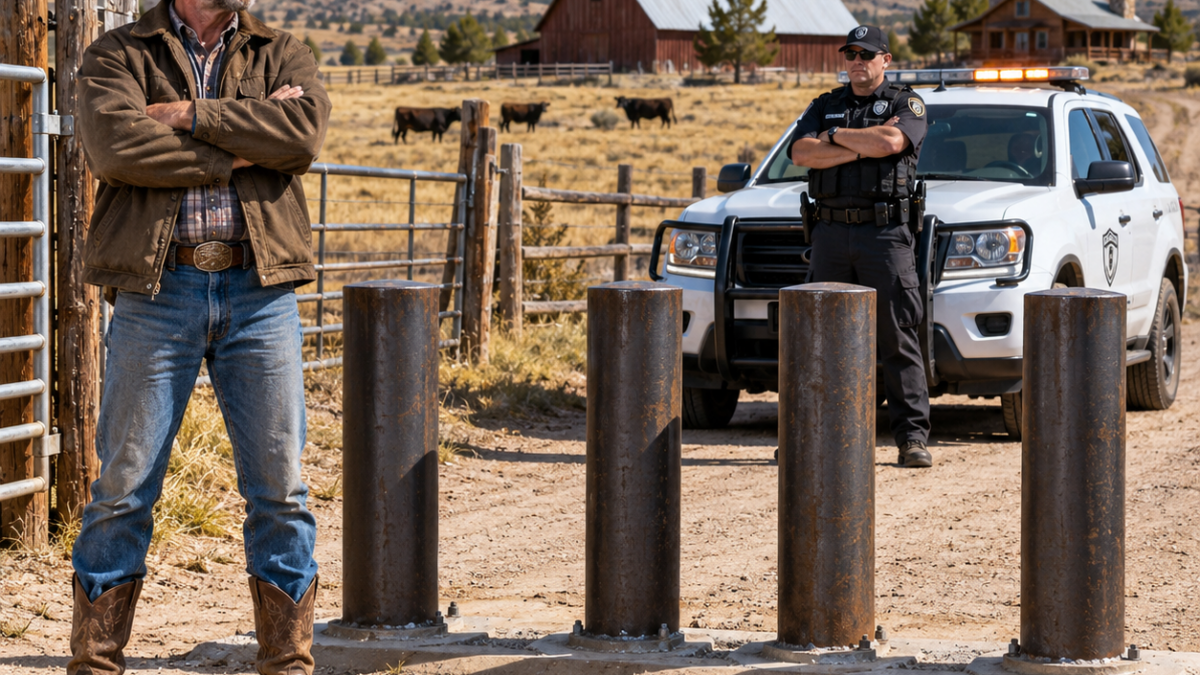
Six yellow steel bollards stood in a line across it.
Behind them, I installed two large signs.
PRIVATE PROPERTY.
NO TRESPASSING.
VEHICLE BARRIER AHEAD.
NO UNAUTHORIZED ENTRY.
Then I photographed everything.
Wide shots.
Close shots.
The relationship between the signs and the barriers.
The property line.
The existing cameras.
Marcus insisted on documentation so thorough that even a hostile lawyer would get bored before reaching the end.
I sent Victor another notice by certified mail.
One paragraph.
No anger.
No threats.
No accusations.
Just the facts.
Unauthorized vehicle access was prohibited.
Physical barriers had been installed.
His employees had no permission to enter.
Three days later, the delivery receipt came back.
Signed.
I placed it in the folder.
That evening, I walked up to Helen.
“Now we wait.”
The first night, nothing happened.
Second night, nothing.
Third.
Fourth.
A week passed.
Silence.
The silence should have felt good.
Instead, it made me nervous.
I had lived with the harassment long enough that my body expected headlights.
Every engine on County Road 12 made me look up.
Every motion alert made my pulse jump.
Usually it was a deer.
Once it was a raccoon that spent several minutes investigating one of the bollards like he was considering filing a complaint.
I laughed harder than the situation deserved.
It was the first real laugh I’d had in weeks.
Then, on the eighth night, I found something in the old camera audio.
I was replaying footage from one of the earlier trespasses.
Derek turned toward Tommy.
His words were muffled by wind.
I put on headphones.
Raised the volume.
Played it again.
“Old man’s got cameras now.”
Tommy answered.
“Who cares?”
A laugh.
“What’s he gonna do?”
I sat absolutely still.
Who cares?
What’s he going to do?
That sentence explained everything.
They hadn’t been afraid of my cameras because they believed evidence only mattered when the person collecting it had power.
They believed I didn’t.
I closed the laptop.
The following afternoon Linda returned.
This time she parked inside my gate and walked to the porch.
“You look worried,” I said.
“I am.”
“What happened?”
“Board meeting.”
I waited.
“Victor spent almost half of it talking about you.”
“Still unstable?”
“Worse.”
She glanced toward the road.
“He says those barriers are illegal.”
“They’re not.”
“I know.”
“He says they’re dangerous.”
“They’re visible from halfway down the road.”
“I know.”
“What exactly are you trying to tell me, Linda?”
She swallowed.
“He said he was done waiting.”
Something tightened in my chest.
“For what?”
“He didn’t say. He told the board the access issue would be resolved this weekend.”
“What does that mean?”
“I don’t know.”
“Did anyone ask?”
“Yes.”
“And?”
“He said we should let professionals handle it.”
That phrase bothered me.
Professionals.
Not lawyers.
Not surveyors.
Professionals.
“Will you write down what you heard?”
Fear flashed across her face.
“I can’t.”
I nodded.
“I understand.”
“I’m sorry.”
“You already did more than most people would.”
She looked at the yellow bollards.
“Are those really enough?”
“They’re not meant to fight anybody.”
“What are they meant to do?”
I looked toward Victor’s development.
“Make people choose.”
Saturday morning arrived gray and cool.
I woke before sunrise.
Checked the cameras.
Made coffee.
Fed the cattle.
Repaired part of a hinge on the barn door.
Tried to act like it was any other Saturday.
It wasn’t.
At 2:17 that afternoon, my phone chimed.
Motion alert.
I opened the camera app.
White sedan.
My heart kicked hard once.
Behind it was a black SUV.
Victor’s.
I set down my coffee.
Then I called Ray.
“They’re coming.”
“Stay back.”
“I am.”
“Earl, listen to me.”
“I’m listening.”
“Do not approach the vehicles.”
“I won’t.”
“Do not argue.”
“I won’t.”
“Call 911 if they enter.”
“Already planning on it.”
“Good.”
I ended the call.
Then I stepped outside.
The wind had picked up.
I could hear the engines before I could clearly see them.
The white sedan turned from County Road 12.
The light bar came alive.
Blue.
Red.
Blue.
Red.
For a second I was back in my bedroom weeks earlier, watching those colors move across the ceiling.
Except I wasn’t in bed anymore.
I wasn’t confused.
I wasn’t stepping aside.
I stopped well back from the entrance and raised my phone.
Recording.
The sedan came closer.
I could see Derek behind the wheel.
Tommy in the passenger seat.
Derek stared toward the barrier.
There was no possibility he missed it.
Six bright posts.
Two warning signs.
Daylight.
He slowed.
For half a second, relief moved through me.
Turn around.
That was all he had to do.
Turn around.
Drive away.
End it.
Then Tommy pointed toward me.
Derek looked.
Even from that distance, I could see recognition.
He leaned toward the windshield.
The car rolled forward again.
Slowly at first.
Then faster.
I felt cold all over.
“No,” I whispered.
Maybe he thought the posts were removable.
Maybe Victor told him they were decorative.
Maybe he believed I would move.
Maybe pride simply took over.
Whatever the reason, the engine rose.
The sedan crossed the final stretch.
Then metal met steel.
The sound punched across the pasture.
The front of the car collapsed violently around the barrier.
Airbags exploded inside the cabin.
The white hood buckled upward.
The vehicle stopped.
The black SUV behind it slammed its brakes and struck the sedan at low speed before coming to rest.
For one second there was silence.
Then shouting.
I was already calling 911.
Derek forced his door open.
Blood ran from a small cut near his hairline.
Tommy stumbled out the passenger side, dazed but standing.
“Ambulance too,” I told the dispatcher. “They hit the barrier. Two men are walking.”
Derek saw me.
His face transformed.
“You!”
He started toward me.
I stayed where I was.
“You set us up!”
I kept the phone raised.
“You drove onto private property.”
“You tried to kill us!”
“The barrier is marked.”
“You knew we were coming!”
“No.”
“You—”
The black SUV door opened.
Victor stepped out.
He stared at the wreck.
Then the signs.
Then me.
For the first time since I had met him, Victor Harmon looked ordinary.
Not powerful.
Not polished.
Not in control.
Just a man standing beside the consequences of a decision.
Derek kept shouting.
Victor snapped, “Shut up.”
Derek turned.
“What?”
“I said shut up.”
“You told us—”
Victor’s face changed.
That was the moment everything shifted.
“You told us” hung in the air between them.
Derek heard it too.
So did Tommy.
So did my phone.
And so did Linda Morales, who had arrived among several neighbors gathering along County Road 12.
Victor stepped toward Derek.
“Do not say another word.”
Derek stared at him.
Something broke behind his eyes.
Loyalty, maybe.
Or fear.
“You said he wouldn’t do anything.”
Victor glanced toward me.
I didn’t move.
“You said the road was ours.”
“Derek.”
“You said keep driving it until he gives in.”
Victor went pale.
“Stop talking.”
But Derek had just realized who would be blamed.
He pointed at Victor with a shaking hand.
“You told us to make him uncomfortable.”
The people near the road went silent.
Victor saw the phones.
Three.
Four.
Maybe five people recording.
He understood instantly.
“Derek, you’re hurt. Sit down.”
“You told us to scare him!”
Sirens rose in the distance.
Real ones.
Derek turned toward the sound.
Something strange happened to his face.
Months earlier, he had worn a badge and told me he had authority.
Now, for the first time, actual authority was coming toward him.
Sheriff Caldwell arrived first.
Two deputies followed.
An ambulance came behind them.
Ray stepped out.
He didn’t come to me.
He went directly to Derek and Tommy.
“Everybody stay where you are.”
Derek pointed toward the bollards.
“He set a trap.”
Ray looked.
Six yellow posts.
Large warning signs.
Cameras.
Then he looked at the smashed car.
“How long have those barriers been here?”
I answered from where I stood.
“Eleven days.”
“Were they notified?”
“Certified mail.”
“Receipt?”
“In the house.”
Victor spoke.
“This is outrageous.”
Ray turned.
“Mr. Harmon, I’ll get to you.”
“I demand these men be arrested.”
“You don’t get to demand anything at my scene.”
Victor stopped.
Ray faced Derek.
“Identification.”
Derek reached toward his belt.
Ray’s deputy moved instantly.
“Slow.”
Derek froze.
Then carefully removed his wallet.
Ray looked at the badge clipped beside it.
“Take that off.”
Derek did.
Ray examined it.
Turned it over.
“No agency identification.”
Derek’s confidence was draining by the second.
“We’re security.”
“Then why the emergency-style lights?”
“For visibility.”
“Why were you telling a landowner you had authority over his property?”
Derek looked toward Victor.
That single glance said more than an hour of testimony.
Ray saw it.
“Mr. Harmon, stay where you are.”
The ambulance crew checked both guards.
Minor injuries.
Nothing life-threatening.
Once they were cleared, Ray separated them.
One deputy spoke with Tommy.
Ray took Derek.
Another approached Victor.
I remained near the porch until Ray waved me over.
“Show me the documentation.”
I went inside.
When I returned carrying the thick folder, Victor stared at it.
I will remember that look until I die.
He had spent months believing I was an old rancher reacting emotionally.
He hadn’t realized I had been building a record.
I opened the folder on the hood of Ray’s cruiser.
Purchase offers.
Business registration.
Property survey.
Trespass timeline.
Screenshots.
Certified notices.
Delivery receipts.
Camera stills.
Photographs of the barriers.
Sheriff complaint number.
Ray turned the pages slowly.
Victor stopped talking.
“You kept all this?” Ray asked.
“Everything.”
“You have backup copies?”
“Three.”
I heard one of the deputies mutter, “Good Lord.”
Ray looked at me.
Then at Victor.
Then back at the file.
“Earl, go wait by your porch.”
I knew that tone.
Investigation.
Not friendship.
So I obeyed.
From the porch, I watched a scene I could barely believe.
Real deputies photographed the fake badges.
Real deputies documented the imitation emergency equipment.
Real deputies measured tire marks.
Real deputies stood beside the men who had spent months borrowing the appearance of law enforcement to intimidate me.
Derek and Tommy were eventually placed in separate patrol vehicles.
Not because of the crash alone.
Not because I demanded it.
Because what I had documented had turned a private conflict into something investigators could no longer dismiss as a neighbor dispute.
Victor was not arrested that afternoon.
That disappointed me.
I’d be lying if I claimed otherwise.
But Ray approached him before he left.
“Mr. Harmon, you need to be available for questioning.”
Victor’s face had turned gray.
“My attorney will contact you.”
“I’m sure he will.”
Victor stepped toward his SUV.
Ray added, “And until this is resolved, nobody associated with Ridgewood Security enters Mr. Dawson’s property.”
Victor turned toward me.
For months, he had smiled whenever our eyes met.
Not then.
There was hate in his face.
Pure and quiet.
I expected to enjoy it.
I didn’t.
Mostly I felt tired.
The tow truck came near sunset.
As the wrecked sedan was pulled away, I saw a streak of white paint on one bollard.
That was the only visible damage.
Linda approached after most people had left.
She stopped several feet away.
“Are you okay?”
“Ask me tomorrow.”
She nodded.
“I recorded Derek.”
“I know.”
“Everything he said.”
“Keep a copy somewhere safe.”
“I already sent it to my sister.”
That made me smile.
“You learn fast.”
Her eyes filled.
“I should’ve spoken sooner.”
“You spoke when you were ready.”
“I watched Victor do this to other people.”
“What people?”
She looked toward the subdivision.
That answer opened an entirely new door.
“What do you mean, other people?”
She lowered her voice.
“Not like this. But contractors. Homeowners. People who challenged assessments. He’d make things difficult until they gave in.”
“Do you have proof?”
“No.”
“Does anybody?”
“Maybe.”
That one word changed the case.
Within a week, Ray’s investigation expanded.
So did Marcus’s.
Residents began calling.
At first, two.
Then five.
Then twelve.
One retired couple had been threatened with escalating penalties after refusing to give the HOA an easement across the back of their lot.
A contractor claimed Victor withheld payment until he agreed to perform private work at Victor’s house.
A former Ridgewood employee said security staff were repeatedly told to “look official” because residents complied faster when they thought guards had government authority.
The most important witness was Tommy.
I didn’t learn the details immediately.
Ray wouldn’t discuss an active case.
But Marcus heard enough through court filings to tell me Tommy had started cooperating.
Derek followed soon after.
Neither man wanted to carry Victor’s entire operation on his back.
The story they told investigators was ugly.
Victor had recruited them after they left ordinary security jobs.
He paid well.
He liked uniforms darker than most private security companies used.
He wanted reflective insignia.
Professional belts.
Vehicles that looked official from a distance.
According to the allegations eventually described in court, the purpose was always psychological.
Victor rarely gave explicit instructions.
He used phrases.
“Establish presence.”
“Encourage cooperation.”
“Remind people who controls access.”
“Create urgency.”
With me, the instruction had been even simpler.
“Make the ranch inconvenient.”
That phrase made me angrier than the crash.
Make the ranch inconvenient.
As though my life were an obstacle in a spreadsheet.
As though grief could be priced.
As though Helen’s grave were simply a drainage issue between Phase One and Phase Two.
Two weeks after the crash, Victor’s attorney sent me a letter.
Marcus called before I even opened it.
“Don’t respond.”
“I wasn’t planning to send him a Christmas card.”
“They’re threatening civil action.”
“For what?”
“Unsafe barrier. Intentional property damage. Emotional distress.”
I laughed.
Marcus didn’t.
“They’re serious.”
“They drove into it.”
“I know.”
“They had notice.”
“I know.”
“They ignored signs.”
“I know.”
“So what are they suing me for?”
“Pressure.”
There was that word again.
Marcus continued.
“They want you to worry about legal bills. Maybe settle. Maybe agree to an access easement. Maybe sell.”
“They still think I’m selling?”
“Victor does.”
I looked through the kitchen window toward the eastern hill.
“He really doesn’t understand.”
“No,” Marcus said. “I don’t think he does.”
I decided Victor needed to understand one thing.
Not through threats.
Not through anger.
Through truth.
At a preliminary civil hearing several weeks later, Victor and I sat on opposite sides of a courtroom.
It was the first time we had been in the same room since the collision.
His legal team filled one table.
Three attorneys.
Laptops.
Binders.
A consultant.
Marcus sat beside me with one worn briefcase and a yellow legal pad.
Victor’s attorney described me as an “agitated neighboring landowner.”
Marcus wrote something on his pad.
I looked over.
He had written:
HERE WE GO.
I nearly laughed.
The attorney argued that I had created an unreasonable hazard knowing Ridgewood personnel used the route.
Then Marcus stood.
“Your Honor, the route was private property.”
He entered my deed.
Survey.
Warning signs.
Certified notice.
Delivery receipt.
Sheriff complaints.
Video of repeated trespassing.
Then footage from the day of the crash.
The judge watched silently.
The sedan appeared.
The barrier was visible.
The vehicle continued.
Impact.
Marcus paused the video just before contact.
Six bright bollards dominated the frame.
Two signs stood beside them.
“This,” Marcus said, “is not a hidden obstruction.”
Victor’s attorney objected.
The judge overruled him.
Marcus continued.
“My client did not lure anyone onto his property. He repeatedly told them not to enter. He placed visible barriers on land he owns. He provided written notice to the company owner. The people complaining about the barrier are the same people who ignored every warning.”
Then Victor’s lawyer made the mistake that ultimately exposed the heart of the matter.
He asked why I refused reasonable development negotiations in the first place.
Marcus started to object.
I touched his sleeve.
“Let me answer.”
The judge allowed it.
Victor’s attorney approached.
“Mr. Dawson, Mr. Harmon offered you several million dollars for your property, correct?”
“Yes.”
“More than its agricultural value.”
“Yes.”
“Enough to purchase another ranch.”
“Probably.”
“So your refusal was emotional.”
“Yes.”
He looked surprised.
He had expected an argument.
I continued.
“My wife is buried there.”
The courtroom changed.
No movement.
No whispering.
Just quiet.
The attorney glanced toward Victor.
I looked at the judge.
“She died four years ago. Before she died, I promised she could remain on that hill. I promised I’d be buried beside her.”
The attorney cleared his throat.
“I’m sorry for your loss, but—”
“So am I.”
He stopped.
I continued.
“Mr. Harmon believes every obstacle has a price. I don’t. That’s the disagreement.”
I turned toward Victor.
For once, he didn’t look back.
The civil claim went nowhere.
The criminal investigation did.
Months passed.
Ridgewood Security lost contracts.
State regulators began examining its licensing and operations.
The HOA board hired outside counsel.
Then an independent audit uncovered financial relationships between Victor’s development company, Ridgewood Security, and HOA expenditures that residents said had never been properly explained to them.
The anger inside the subdivision exploded.
I attended one HOA meeting.
Only one.
Linda asked me to come.
The clubhouse was packed.
People stood along the walls.
Victor sat at the front table beside two attorneys.
I stayed in the back.
I didn’t belong to the association.
I couldn’t vote.
I didn’t need to.
One homeowner stood.
Then another.
Then another.
Questions came faster than Victor could answer.
Why had HOA dues funded security patrols outside HOA property?
Who authorized those patrols?
Why were Ridgewood guards using equipment that made them appear to be public officers?
Why had Victor continued operations after receiving my written notice?
Why had expansion negotiations been discussed as though my ranch were already available?
Victor tried the same strategy he had always used.
Control the room.
Speak slowly.
Use polished language.
Call mistakes misunderstandings.
Call intimidation enforcement.
Call pressure negotiation.
But the room had changed.
People no longer accepted his vocabulary.
A man near the front stood.
“You told us Earl Dawson was unstable.”
Victor raised his hands.
“I said residents had expressed concerns.”
“Which residents?”
“I don’t have that information in front of me.”
“You said there were complaints.”
“There were concerns.”
“That’s not what I asked.”
Murmurs spread through the room.
Linda rose.
Her hands were shaking.
I could see it from the back.
Victor saw it too.
“Linda,” he said gently, “please sit. You’re upset.”
She didn’t.
That sentence may have been the last mistake he ever made as head of Ridgewood Estates.
“Don’t tell me how I feel.”
The room went silent.
Victor’s smile vanished.
Linda held up her phone.
“You told this board Mr. Dawson built a trap.”
“Linda—”
“You told us he was dangerous.”
“I said—”
“I was there when your men crashed.”
She turned toward the homeowners.
“I recorded what they said.”
Victor’s attorney whispered something.
Victor ignored him.
“Anything said at an accident scene by injured employees is unreliable.”
Linda looked directly at him.
“Derek said you told them to scare Earl.”
A woman near the front gasped.
Victor stood.
“This meeting is adjourned.”
Nobody moved.
“I said this meeting is adjourned.”
A board member beside him spoke.
“No.”
Victor slowly turned.
The board member was a retired school principal named Martin Avery.
He had rarely challenged Victor publicly.
That night he did.
“You don’t get to adjourn it.”
“I’m chairman.”
“Not if the board removes you.”
The room erupted.
Victor stared at Martin.
Martin placed a printed motion on the table.
“I move that Victor Harmon be suspended from all HOA authority pending completion of the financial and criminal investigations.”
A second came immediately.
Then a vote.
Victor didn’t lose narrowly.
He lost overwhelmingly.
I watched the man who had spent years controlling Ridgewood sit perfectly still while people around him raised their hands.
He had wanted my eighty acres because he believed expansion proved strength.
Instead, he lost control of the community he already had.
I left before the meeting ended.
Linda followed me into the parking lot.
“You should’ve stayed.”
“No.”
“Why?”
“That was your fight.”
She smiled.
“And yours wasn’t?”
“Mine ended at my fence.”
I thought it had.
I was wrong.
Three nights later, at 1:08 in the morning, my motion alarm sounded.
I sat up instantly.
No headlights.
No sedan.
A person.
One camera showed a figure near the eastern side of my property.
Dark clothes.
Baseball cap.
Moving on foot.
My stomach tightened.
The figure wasn’t near the house.
He was near the hill.
Helen.
I was out of bed before I had fully formed the thought.
Then Ray’s warning hit me.
Do not confront.
I called 911.
I stayed inside.
Every part of me wanted to run up that hill.
Instead, I watched through the camera.
The figure moved closer to Helen’s grave.
Then stopped.
He held something.
A can.
Spray paint.
My vision narrowed.
He raised his hand toward the headstone.
A pair of headlights suddenly swept across the eastern access.
The figure froze.
A sheriff’s cruiser.
Ray had quietly increased patrols after Victor’s suspension.
The person ran.
He made it thirty yards.
A deputy caught him near the fence.
I reached the hill only after Ray told me it was safe.
The man was young.
Early twenties.
I didn’t recognize him.
A can of red spray paint lay in the grass.
He had not managed to touch the stone.
Not one mark.
Ray pulled me aside.
“Do you know him?”
“No.”
“He says he was paid.”
My blood went cold.
“By who?”
“Doesn’t want to say.”
“Victor?”
“I didn’t say that.”
“You didn’t have to.”
Ray gripped my shoulder.
“Go sit with Helen.”
“What?”
“I’ve got this.”
I looked at the young man in handcuffs.
He looked terrified.
Not arrogant.
Not like Derek.
Just scared.
“How much?”
Ray frowned.
“What?”
“How much did somebody pay him?”
The deputy answered.
“Five hundred dollars.”
Five hundred dollars.
Someone had valued desecrating my wife’s grave at five hundred dollars.
I walked away because if I stayed, I didn’t trust myself to remain the man Helen had married.
I reached her grave.
Kneeled.
Ran my hand over the clean stone.
“I’m sorry,” I whispered.
That was the lowest moment.
Not the cars.
Not the fake badges.
Not the crash.
That.
Because intimidation against me was one thing.
Helen couldn’t defend herself.
For several minutes, revenge became something physical inside me.
Hot.
Immediate.
I imagined Victor’s house.
His car.
His reputation.
Everything I could destroy.
Then I remembered another conversation with Helen.
Years earlier, a neighboring rancher cheated my father during a cattle sale.
I wanted to confront the man.
Helen stopped me.
“Don’t become ugly just because somebody handed you a reason.”
That sentence came back to me beside her grave.
Don’t become ugly.
I breathed until the rage became something I could carry without letting it drive.
The young man eventually told investigators he had been approached through an intermediary.
The trail did not lead cleanly enough to Victor for an immediate additional charge, but it increased scrutiny around everyone associated with his operation.
And, strangely, it changed me.
Until then, I had wanted Victor punished.
After that night, I wanted the truth finished.
All of it.
No shortcuts.
No private revenge.
No damaged property.
No threats.
If he had built his power on records, money, intimidation, and lies, then records, witnesses, and truth would dismantle it.
Derek formally cooperated.
Tommy did too.
Former employees provided emails.
Residents produced meeting notes.
Accountants followed money.
The case that had begun with two men driving across a ranch became an examination of an entire private enforcement system Victor had created around himself.
Nearly nine months after the first sedan crossed my pasture, charges were announced.
Derek and Tommy faced criminal counts related to their conduct, including repeated trespass and unlawful impersonation allegations.
Both eventually entered plea agreements.
Neither became a heroic whistleblower.
They had participated willingly for months.
They had scared people.
Mocked me.
Ignored every boundary I set.
But when consequences arrived, they finally told the truth.
Victor fought longer.
Of course he did.
He hired different lawyers.
Issued statements.
Claimed rogue employees had acted outside his instructions.
Said angry residents misunderstood normal security practices.
Said the entire controversy was driven by a personal feud with “an unreasonable neighboring rancher.”
Then prosecutors introduced the internal messages.
One was from Victor to a Ridgewood Security supervisor.
Regarding my ranch.
The language was short.
KEEP PRESSURE ON D.
He never wrote my full name.
He didn’t need to.
Another message discussed access.
One employee had warned that I had expressly refused permission.
Victor replied:
HE’LL CHANGE HIS MIND.
Another:
DON’T LET HIM GET COMFORTABLE.
I read those words in Marcus’s office.
For months, I had wondered whether I was imagining the scale of it.
Whether grief had made me oversensitive.
Whether Victor simply wanted land and his employees had gone too far.
Three messages erased that doubt.
He wanted discomfort.
He wanted pressure.
He wanted me exhausted.
He wanted a widower sitting alone in his house while flashing lights crossed the walls at midnight, wondering whether surrender might finally buy peace.
Marcus watched me carefully.
“You all right?”
“No.”
He waited.
“But I will be.”
Victor eventually entered a plea that kept the case from becoming the long public trial many residents expected.
The penalties mattered.
Fines.
Probation.
Restrictions that effectively ended his ability to run Ridgewood or its security operation.
But punishment on paper wasn’t the part that stayed with me.
Power was.
Victor had spent years accumulating it.
Money.
Titles.
Companies.
A board that rarely questioned him.
Employees trained to look authoritative.
Residents conditioned to assume resistance was pointless.
Then slowly, piece by piece, that power disappeared.
The HOA removed him permanently.
Ridgewood Security shut down.
Investors backed away from Phase Two.
The development company sold several holdings.
Victor listed his oversized house.
The sign appeared on his lawn one Thursday morning.
FOR SALE.
Linda sent me a photograph.
I didn’t celebrate.
Well.
Not much.
A month later, Victor came to my ranch alone.
No guards.
No SUV convoy.
No attorneys.
He parked outside the bollards and waited.
I saw him on the camera.
For nearly a minute, he stood beside his car looking at the barriers.
Then he called me.
I answered.
“What do you want?”
“To talk.”
“We’ve done enough of that.”
“Five minutes.”
I considered hanging up.
Then I looked toward Helen’s hill.
“Stay outside the barrier.”
I walked down.
Victor looked older.
Not dramatically.
But enough.
His shoulders had lost some of their certainty.
“You kept them,” he said.
“The bollards?”
“Yes.”
“They work.”
His mouth moved like he almost smiled.
Then didn’t.
“I’m leaving.”
“I heard.”
“My house is sold.”
I said nothing.
He looked beyond me toward the ranch.
“I never understood why you wouldn’t take the money.”
“I told you.”
“No.”
“You heard me. That’s different.”
He lowered his eyes.
For a moment, I thought he might apologize.
He didn’t.
People like Victor sometimes come close to understanding what they did without ever stepping across the final distance required to say the words.
Instead, he asked, “Was it worth it?”
I looked around.
The barn.
Pasture.
House.
Eastern ridge.
Helen.
“Yes.”
“Four and a half million dollars.”
“Yes.”
“You could have started anywhere.”
“No.”
He looked at me.
“Why not?”
I answered with the simplest truth I had.
“Because my life already happened here.”
Victor stared toward the hill.
“Your wife.”
“Yes.”
He nodded slowly.
Then he surprised me.
“I was angry when you said no.”
“I noticed.”
“I had investors.”
“Not my problem.”
“I had commitments.”
“Still not my problem.”
“I thought if you understood how inevitable the project was, you’d stop resisting.”
“That was your mistake.”
“What?”
“You thought inevitable meant right.”
He absorbed that.
Maybe.
Then he glanced at the bollards.
“I could have died.”
The statement was quiet.
No accusation.
Just fact.
“You weren’t in the sedan.”
“My employees could have.”
“Yes.”
“You knew they might hit them.”
“I hoped they’d stop.”
Victor looked at the warning signs.
Even months later, they remained impossible to miss.
“I told Derek they wouldn’t.”
That caught me off guard.
“What?”
“I told him you were bluffing.”
He swallowed.
“I told them old men put up signs because they’re afraid to do anything else.”
There it was.
More honest than an apology.
The belief beneath everything.
“You thought I was weak.”
“Yes.”
“Because I didn’t shout.”
“Yes.”
“Because I went through legal channels.”
He looked away.
“Yes.”
“Because I asked nicely first.”
“Yes.”
I nodded.
“Then you learned the wrong lesson from kindness.”
He looked back.
“What lesson?”
“That it was fear.”
Neither of us spoke for several seconds.
Finally Victor said, “I am sorry about your wife’s grave.”
My whole body stiffened.
“What do you know about that?”
“Only what I heard after.”
“Did you send that kid?”
“No.”
I studied his face.
For once, I couldn’t tell whether he was lying.
Investigators had never proven it.
I had promised myself I would accept what could be established, not what I wanted to believe.
So I didn’t accuse him.
“I hope that’s true.”
“It is.”
Another silence.
Then he held out his hand.
I looked at it.
I didn’t take it.
“I’m not there yet.”
He lowered it.
“I understand.”
“No. I don’t think you do.”
His face tightened.
But he didn’t argue.
He returned to his car.
Before opening the door, he looked toward the ranch one last time.
“For what it’s worth, Earl, I hope you get to keep it exactly the way it is.”
“That was always the plan.”
Victor drove away.
I never saw him again.
Spring arrived.
The grass came back bright green after a wet March.
New calves appeared in the pasture.
I repaired the eastern fence.
Painted the barn.
Replaced part of the porch railing.
Ordinary work.
Good work.
One morning, I carried a bucket of yellow paint down to the entrance.
The bollards had scratches.
One still wore a streak of white from the sedan.
I sanded them.
Repainted each one.
When the yellow dried, I brought out a small brush and dark blue paint.
On each post, I painted a single letter.
H.
Six bollards.
Six H’s.
Nobody asked at first.
Then Linda noticed.
“What does the H stand for?”
“Helen.”
She smiled.
“Of course it does.”
“They’re ugly monuments.”
“I’ve seen worse.”
I stepped back.
The posts no longer looked angry to me.
They looked permanent.
Not monuments to the crash.
Not to Victor.
Not even to victory.
To a promise.
Months later, the new Ridgewood board invited me to a barbecue.
I almost didn’t go.
Then Linda called.
“You spent a year fighting with us. The least you can do is eat our brisket.”
“I wasn’t fighting with you.”
“Exactly.”
So I went.
The clubhouse felt different.
Same walls.
Same pool.
Same polished floors.
Different atmosphere.
No security guards standing near the entrance.
No Victor.
No whispered conversations when I walked into a room.
Martin Avery, the new board president, shook my hand.
“We owe you an apology.”
“You personally don’t.”
“The association does.”
I didn’t know what to say to that.
He continued.
“We should have asked questions sooner.”
“Probably.”
“We should have stopped him.”
“Probably.”
“You’re not making this easier.”
“I’m sixty-three now. I’ve stopped making things easy.”
He laughed.
Then grew serious.
“We approved something tonight.”
“What?”
“The board formally abandoned all plans related to Phase Two adjoining your ranch.”
I stared at him.
“No future acquisition strategy. No access proposal. No expansion easement.”
“Put it in writing.”
He laughed again.
“Marcus told you to say that?”
“No. Experience did.”
A week later, the document arrived.
I filed it beside the others.
Then I took my coffee up to Helen.
The sunrise that morning was spectacular.
Orange across the eastern horizon.
Low mist above the creek.
Cattle moving like dark shapes in the pasture.
I sat beside her.
“They’re done.”
The wind rustled through the oak.
“Actually done this time.”
I drank my coffee.
“I wish you could’ve seen it.”
I stopped.
Then laughed quietly.
“You would’ve hated every minute.”
Helen hated confrontation.
But she hated bullies more.
I rested my hand on the edge of her headstone.
“I kept my promise.”
Those four words broke something inside me.
Not painfully.
More like a knot finally loosening.
For years after Helen died, I had thought grief meant missing her.
It did.
But grief also meant carrying unfinished promises.
Places she expected to remain.
Things she trusted me to protect.
A future she would never see but had asked me to continue living.
Victor had almost turned that promise into a war.
I had almost let anger turn me into someone she wouldn’t recognize.
That mattered more to me than whether he went to jail.
More than whether Derek lost his security license.
More than Ridgewood’s embarrassment.
The real victory was that after everything they had done, I still knew who I was.
I had defended my boundary without becoming the kind of man who enjoyed hurting people.
I had waited when waiting was harder than fighting.
Documented when shouting would have felt better.
Trusted evidence when revenge would have been quicker.
And when the moment finally came, I didn’t have to chase anybody.
They drove themselves into the consequences.
Two years have passed.
The ruts their sedan carved through my pasture are gone.
Grass covered them.
The eastern route is no longer a road.
It’s pasture again.
The bollards remain.
People in Ridgewood know the story.
Some versions get exaggerated.
I heard one where I supposedly built the barriers overnight with my bare hands.
Another where fifteen fake police cars arrived.
One kid at the feed store told me his father said I “took down an entire corrupt empire.”
I told him I installed a gate.
He looked disappointed.
Truth usually has less special effects.
Linda still stops by.
Sometimes she brings pie.
Sometimes she just talks.
She once asked whether I regretted not taking the $4.5 million.
I answered immediately.
“No.”
“Not even once?”
“No.”
“What if they offered ten?”
“No.”
“Twenty?”
I looked toward Helen’s hill.
“Linda.”
“Right. Stupid question.”
“No. Normal question.”
She smiled.
“What happens to this place when you’re gone?”
That one was harder.
My children live elsewhere.
Neither wants to ranch full-time.
For years I avoided thinking about it.
Then I realized protecting something doesn’t mean freezing it forever.
It means choosing what happens to it instead of surrendering that choice to somebody else.
I worked with Marcus to create a family land trust.
The house and agricultural acreage will remain protected.
Helen’s hill will never be developed.
Neither will the grove surrounding it.
If my children eventually sell portions of the ranch, they can.
Life changes.
I finally learned that defending history does not mean denying the future.
It means refusing to let somebody else erase the past just because it interferes with their plans.
On the second anniversary of the collision, I woke before sunrise.
Made coffee.
Walked to the entrance.
The six yellow bollards stood exactly where they had for two years.
I touched the first blue H.
Cold steel.
Then I climbed toward the hill.
I sat beside Helen as sunlight came over the ridge.
“You know something?” I said.
“You were right.”
I smiled.
“You were always irritatingly right.”
A hawk crossed the sky.
The cattle shifted below me.
Somewhere beyond the southern fence, sprinklers clicked on in Ridgewood Estates.
Normal sounds.
Peaceful sounds.
For months, I had thought victory would feel loud.
Sirens.
Handcuffs.
Courtrooms.
Votes.
Headlines.
It didn’t.
Victory sounded like this.
Wind.
Cattle.
Birds.
Nothing roaring through my property at midnight.
Nothing flashing blue and red against my bedroom ceiling.
Nothing forcing me to wonder whether the place I loved still belonged to me.
A few weeks ago, an unfamiliar pickup stopped near the entrance.
Out-of-state plates.
The driver rolled down his window.
Middle-aged man.
Baseball cap.
“Excuse me,” he called.
I walked closer but stayed inside the barrier.
“Can I help you?”
“GPS says I can cut through here to County Road 12.”
I looked at the bollards.
Then the signs.
Then him.
He followed my eyes.
“Guess GPS is wrong.”
“Been known to happen.”
He laughed.
“Nice posts.”
“They’ve got a history.”
“I bet.”
He reversed carefully.
Before leaving, he leaned out the window.
“Sorry to bother you.”
“No bother.”
He drove away.
I stood there for another moment.
Years earlier, Victor’s men would have driven straight through without asking.
That stranger had stopped.
Read the signs.
Respected the line.
Such a small thing.
Most people will never understand how beautiful it can feel when somebody simply respects a boundary.
I walked back toward the house.
Halfway there, I turned around.
Six yellow posts stood against the Texas sky.
Six small blue H’s.
Helen.
Home.
History.
Maybe all three.
Victor Harmon once believed my ranch was valuable because of what he could build after destroying everything already here.
I learned its true value through what I refused to let him destroy.
The barn is still standing.
The cattle still cross the lower field every morning.
The creek still floods after hard rain.
Helen still rests under the live oak where she asked me to leave her.
And someday, when my work is finished, there will be another stone beside hers.
Until then, I’ll keep making coffee before sunrise.
I’ll keep fixing fence.
I’ll keep tending the land my grandfather bought almost eighty years ago.
And every time I pass those six steel bollards, I remember the lesson Victor never understood until it was too late.
A boundary doesn’t need to shout.
It doesn’t need a uniform.
It doesn’t need flashing lights, an expensive title, a boardroom, or a badge designed to fool people.
It only needs to be clear.
And sometimes the strongest thing a person can say is simply:
This far.
No farther.




