PART 2: Fake HOA Cops Tried to Seize My 1,000-Acre Inheritance—Then Froze When I Showed My FBI Badge
PART 2
Ten days later, I returned.
This time I came with everything.
Certified probate order.
Recorded deed.
County survey.
Original Carter family trust documents.
Ground lease.
Tax history.
Copies of correspondence from Aunt Michelle’s attorney.
Every page had been duplicated.
Scanned.
Stored securely.
I wore a light-blue button-down shirt and gray slacks.
Nothing tactical.
Nothing that suggested federal law enforcement.
My badge stayed locked in my apartment safe.
Before leaving, I activated a recording app on my phone and synced it with my smartwatch.
Redundancy had saved more investigations than heroics ever did.
If somebody took the phone, the watch would continue.
Then I called Supervisory Special Agent Elena Morales.
Elena and I had worked together for nearly a decade.
She was one of the few people who could hear trouble in my voice before I admitted it existed.
“I’m going back to Willow Creek.”
“How official is this?”
“Not official yet.”
“Arthur.”
“I’m going as the landowner.”
“You were already physically confronted.”
“Correct.”
“You saw residents being detained.”
“Correct.”
“And you still think returning alone is a good idea?”
“No.”
“Yet you’re doing it.”
“Yes.”
She sighed.
“How long?”
“Four hours.”
“And if you don’t call?”
“Start the protocol.”
“You’re recording?”
“Yes.”
“Backups?”
“Yes.”
“Location sharing?”
“Yes.”
Another sigh.
“Sometimes I wonder why I keep asking.”
“Because procedure matters.”
“Procedure matters more when you actually follow it.”
“I’ll call.”
The Willow Creek gate looked exactly the same.
Iron.
Stone.
Cameras.
Rules.
But this time Brown was already waiting.
Three officers stood behind him.
Arms crossed.
Black uniforms.
Matching belts.
A little theater company awaiting the returning villain.
Brown stepped into the road.
I stopped.
Rolled down my window.
“Well,” he said. “The trespasser came back.”
“I brought certified documents.”
“I told you what would happen.”
“I’d like to speak with Christopher Allen.”
I held up the folder.
“Court-certified inheritance certificate. Recorded title. Original ground lease.”
Brown took it from my hand.
He opened the folder.
Read the first page.
Then tore it in half.
The sound of paper ripping seemed strangely loud.
The pieces fluttered to the pavement.
“Forgery.”
I looked at him.
“That was a certified probate copy.”
“Then print another.”
Behind him, one of the younger officers shifted uncomfortably.
I recognized him from my first visit.
“Get Mr. Allen.”
Brown smiled.
“Mr. Allen doesn’t meet with trespassers.”
“I’m the landowner.”
“You’re whatever the board recognizes you as.”
“That isn’t how property law works.”
His hand moved toward his belt.
Not cuffs.
A black device with two metal contacts at the tip.
He never pointed it at me.
But he made sure I saw it.
“Step out of the car.”
“Why?”
“Criminal trespass.”
“On land I own?”
“Last warning.”
I turned off the engine.
Opened the door.
The moment my shoes touched asphalt, two security officers seized my arms.
A third opened the passenger door and started searching my car.
“You don’t have permission.”
Brown stepped in front of me.
“I don’t need permission.”
“You’re private security.”
“I’m the authority at this gate.”
The smartwatch continued recording.
Brown reached into my pocket and took my phone.
The recording app was open.
He smiled.
“Trying to collect evidence?”
“I’m documenting an interaction.”
“Recording security personnel without authorization.”
“That isn’t a crime.”
“Here it is.”
He turned the phone off.
Slid it into his pocket.
Then the cuffs closed around my wrists.
Too tight.
Deliberately.
I looked at Brown.
“Are you claiming I’m under arrest?”
“You’re being detained.”
“By what legal authority?”
“Willow Creek security charter.”
“Are you a sworn law-enforcement officer?”
His expression hardened.
“You talk too much.”
He turned me toward the security SUV.
Before they placed me inside, he leaned near my ear.
“You need to understand something.”
“What?”
“This isn’t the outside world.”
He nodded toward the gate.
“We handle our own problems here.”
That sentence stayed with me.
Not because it frightened me.
Because it sounded rehearsed.
Which meant I probably wasn’t the first person who had heard it.
They drove me into Willow Creek.
Perfect lawns passed outside the tinted windows.
Stone houses.
Expensive landscaping.
Golf carts.
People walking dogs.
Several residents watched the security SUV.
Most looked away when they saw me inside.
Learned behavior.
That was my first thought.
The community management center stood near the middle of the development.
Brick building.
Flagpole.
Landscaped walkway.
We entered through a side door.
I was taken down a windowless hallway.
Then into a small room.
Metal table.
Two chairs.
Ceiling camera.
The door locked behind me.
Three hours.
No police.
No formal charges.
No phone call.
No attorney.
No explanation beyond “management review.”
I wasn’t idle.
Observation is work.
The ceiling camera had a blinking red indicator.
Recorded video.
Potential evidence.
Through the narrow reinforced window in the door, I could see a desk across the hallway.
A thick binder sat on top.
DETENTION LOG.
I counted hundreds of handwritten entries from where I sat.
Names.
Dates.
Times.
On the wall behind the desk was a map of Willow Creek.
Red pushpins marked specific houses.
Some had three pins.
Some had five.
One had at least eight.
A violation tracking board hung beside it.
Several addresses appeared repeatedly.
This wasn’t random enforcement.
It looked like targeting.
An hour passed.
The door opened.
A young officer entered carrying water.
Maybe twenty-five.
Thin.
Brown hair.
His nameplate said TYLER MORGAN.
He placed the cup in front of me.
“Sorry about the wait.”
“You mean the detention.”
His eyes flicked toward the camera.
“I don’t make the rules.”
“That isn’t what I asked.”
He looked uncomfortable.
“How long have you worked here?”
“Eight months.”
“You think the HOA can lock residents in this room?”
He didn’t answer.
“Tyler.”
His eyes finally met mine.
“Drink the water.”
Then he left.
That interaction mattered.
Not because he helped me.
Because he was afraid.
An hour later, Christopher Allen entered.
Same gray suit.
Different tie.
He closed the door and sat across from me.
“Arthur Reed.”
He folded his hands.
“I looked you up.”
I waited.
“No criminal history.”
Silence.
“No lawsuits.”
Still silence.
“No obvious financial problems.”
I smiled slightly.
“That’s flattering.”
His smile didn’t return.
“You’re an intelligent man.”
“So people tell me.”
“Then stop wasting everybody’s time.”
“How?”
“You’ll sign a statement recognizing that your claim to Willow Creek property is disputed.”
“No.”
“You’ll stop contacting our residents.”
“I haven’t contacted anyone.”
“You will stop returning here.”
“No.”
His eyes hardened.
“You think the courts are going to protect you?”
“I think deeds matter.”
“Deeds are paper.”
“That’s usually what deeds are.”
He didn’t appreciate that.
“I have lawyers.”
“So do I.”
“I know judges.”
That sentence came out naturally.
Too naturally.
I made a mental note.
Christopher leaned forward.
“People have challenged Willow Creek before.”
“What happened?”
“They learned.”
“What?”
“That being technically right doesn’t matter if proving it costs everything.”
There it was.
The philosophy behind the machine.
He wasn’t defending rules.
He was defending exhaustion.
Make resistance expensive enough and truth becomes irrelevant.
He stood.
“Release him.”
Then opened the door.
Before leaving, he looked at Brown in the hallway.
“If he comes back again, keep him overnight.”
The handcuffs came off twenty minutes later.
My wrists were red.
Brown gave me my phone.
“You should learn when to stop.”
I looked at him.
“You first.”
He smiled as if I had made a joke.
I drove away.
Two miles outside Willow Creek, I pulled into a supermarket parking lot.
The smartwatch recorded three hours and seventeen minutes.
Everything.
The gate.
The torn paperwork.
Brown’s statements.
Christopher’s conversation.
The overnight detention threat.
I called Elena.
“I’m out.”
Her voice changed immediately.
“Are you hurt?”
“No.”
“Arthur.”
“Bruising.”
“What happened?”
“Private detention. Three hours.”
“No police?”
“None.”
“Did they search you?”
“Yes.”
“Take the phone?”
“Yes.”
“You still have recording?”
“Watch.”
She exhaled slowly.
“Original?”
“Yes.”
“Do not edit it.”
“I know.”
“Don’t send it through normal email.”
“I know.”
“Stop saying you know.”
I almost laughed.
Then she asked the question that mattered.
“Do you have enough to justify federal review?”
I looked at the red marks around my wrists.
“Yes.”
“How much?”
“More than I expected.”
“Then come in tomorrow.”
My apartment became a case room.
Three monitors.
Whiteboard.
Printed property filings.
State corporate records.
Public lawsuits.
Campaign contributions.
HOA budgets.
Security-company registrations.
Complaint records.
Christopher Allen’s name went in the center.
A red line connected him to Willow Creek HOA.
Another connected him to Willow Security Services.
That company was registered twenty-six months earlier.
Owner:
Christopher Allen.
He controlled the HOA.
The HOA hired his company.
His company enforced HOA rules.
The same enforcement created fines.
The fines funded security.
The structure rewarded more enforcement.
That alone didn’t prove criminal conduct.
But it explained incentives.
Three days after my detention, an anonymous email arrived.
YOU’RE NOT THE FIRST.
I replied cautiously.
The sender agreed to meet at a coffee shop in the next town.
Nancy Adams arrived ten minutes early.
Sixty-eight.
Retired elementary-school teacher.
Silver hair.
Reading glasses hanging from a chain.
She wrapped both hands around a cup of tea.
“They detained me six months ago.”
“For what?”
“My granddaughter’s birthday party.”
I waited.
“Eight children.”
She tried to smile.
“Cake. Balloons. A bounce house.”
“What was the violation?”
“Unauthorized gathering.”
“How long did they hold you?”
“Four hours.”
“Actual police?”
“No.”
“Did they search you?”
“Yes.”
Her hand moved to her neck.
“My necklace disappeared.”
“What necklace?”
“My mother’s gold chain.”
Her voice softened.
“She gave it to me before she died. I wore it every day for thirty years.”
“Did you report it?”
“I asked Brown.”
“What did he say?”
“He said I must have lost it during processing.”
Processing.
She looked ashamed.
That bothered me.
“You didn’t do anything wrong.”
“I know that now.”
Nancy connected me with four more people.
Then six.
Then twelve.
A man named Robert Gaines had been detained three times over parking violations.
The last one?
His truck was allegedly angled incorrectly in his own driveway.
A woman named Carla Jennings received weekly citations because some flowers in her yard weren’t on the approved landscaping palette.
A family paid more than twelve thousand dollars in penalties after their teenage son repeatedly played basketball in the street after an evening recreation cutoff.
Bernard Thompson—the elderly man I had seen on my first visit—had lived in Willow Creek for thirty-one years.
His offense was walking after eight.
“Why did you stop going out?” I asked him.
He looked down.
“Because everyone watched.”
“Watched what?”
“Them put me in the security car.”
His voice lowered.
“I’m seventy-six, Arthur. I didn’t want my neighbors looking at me like I’d done something terrible.”
Each story followed the same architecture.
Minor issue.
Security visit.
Escalating citations.
Detention or threat.
Payment demand.
More problems if the homeowner pushed back.
Sometimes people surrendered.
Sometimes they sold.
Sometimes they stopped speaking.
That last group mattered most.
Fear doesn’t need to punish everybody.
It only needs enough examples.
Then Abigail Jones called.
Seventy-one.
Former bank auditor.
Former Willow Creek finance committee member.
Unlike Nancy, she didn’t bring stories.
She brought spreadsheets.
“I joined the finance committee two years ago.”
“How long did you last?”
“Two months.”
“What happened?”
“I asked where the money was going.”
She slid a manila folder across the table.
Financial statements.
Committee notes.
Copies of bank summaries.
“I noticed the fine revenue didn’t reconcile.”
“How far off?”
“Depends on the quarter.”
She pointed.
“Here. HOA reports approximately eighty-seven thousand in collections.”
I followed the line.
“Deposit records?”
“Sixty-one.”
“Twenty-six thousand difference.”
“Exactly.”
Next quarter.
Another gap.
Then vendor expenses.
Willow Security Services.
Equipment.
Patrol.
“Expected,” I said.
Abigail nodded.
“Now look at the other vendors.”
North Ridge Community Maintenance.
Premier Residential Solutions.
Civic Enhancement Group.
Professional names.
Thin public records.
Some had no websites.
No employees.
No physical business addresses.
One led to a mailbox.
Another to a residential house.
“When I asked Christopher, he told me financial details were above my clearance.”
I looked at her.
“Finance committee members had clearance levels?”
“That was my question.”
“A week later?”
“Removed.”
“Reason?”
“Performance concerns.”
She laughed once.
“I was a bank auditor for thirty-eight years.”
That night, I dug into the security company.
Christopher owned it outright.
Brown was a salaried employee.
Willow Creek HOA paid the company more than $180,000 annually.
I found a second payment channel.
Community Enhancement Fund.
Discretionary.
Minimal board reporting.
Eventually, an accounting clerk confirmed Brown received recurring additional payments from that fund.
Nearly forty thousand annually.
No clear additional work description.
The structure was becoming visible.
I called Elena.
“I need an official case file.”
“How strong?”
“Victim interviews. Financial inconsistencies. Detention recordings. Corporate conflicts.”
“Potential charges?”
“Conspiracy. Fraud. Extortion depending on the payment evidence. Rights violations depending on jurisdiction and actors.”
She corrected me immediately.
“Careful with the legal theories until counsel reviews them.”
“I know.”
“Arthur.”
“Sorry.”
“Send the evidence matrix.”
“It’s ready.”
“Of course it is.”
She was quiet a moment.
“Personal involvement?”
“Yes.”
“That complicates things.”
“I know.”
“You won’t run the parts directly involving your own detention.”
“I know.”
“You’ll disclose everything.”
“I know.”
“Stop saying that.”
I smiled.
“Understood.”
The investigation became official.
Quietly.
That mattered.
Christopher still thought he was fighting a land dispute.
Two weeks later, he escalated publicly.
A former academy colleague called me.
“Arthur, why is your face on a neighborhood warning page?”
“What?”
“You’re apparently scamming old people.”
I opened my laptop.
There I was.
Grainy photo from the gate.
Bold red text.
WARNING.
THIS INDIVIDUAL IS APPROACHING WILLOW CREEK RESIDENTS CLAIMING LAND OWNERSHIP.
SUSPECTED PROPERTY FRAUD.
DO NOT ENGAGE.
REPORT SIGHTINGS TO SECURITY.
The comment section filled with nearly identical messages.
THANK GOD OUR HOA PROTECTS US.
KEEP OUTSIDERS OUT.
OUR SECURITY TEAM KEEPS FAMILIES SAFE.
Many accounts were brand-new.
Coordinated messaging.
Maybe residents.
Maybe fake accounts.
Maybe both.
I documented everything.
Screenshots.
Timestamps.
URLs.
Account creation dates.
Then came the lawyer’s envelope.
Cease and desist.
Stop contacting residents.
Withdraw my property claim.
Stay away from Willow Creek.
And pay fifty thousand dollars within thirty days.
In exchange, the HOA would supposedly refrain from pursuing criminal allegations.
I read that section twice.
Then forwarded it to counsel.
Elena called an hour later.
“They demanded money?”
“Yes.”
“To avoid criminal complaints?”
“That’s how it’s written.”
“Preserve the envelope.”
“Already bagged.”
“You bagged your own mail?”
“Evidence habits.”
“You need hobbies.”
Attached to the letter was a court filing.
Temporary restraining order request.
Christopher wanted me barred from coming within five hundred feet of Willow Creek properties or residents.
The argument described me as a stalker and con artist.
My property attorney, Sarah Kim, reviewed it.
Then laughed.
“You own the ground.”
“That was my reaction.”
“They are asking a court to prohibit a landowner from approaching the land while the HOA simultaneously benefits from a ground lease tied to that ownership.”
“Can it work?”
“Anything can create temporary inconvenience.”
She looked at me.
“But their paperwork is inconsistent.”
One name on the motion bothered me.
The assigned county judge.
I recognized it.
I searched public campaign finance records.
Christopher had made a lawful campaign contribution three years earlier.
Fifteen thousand dollars.
Two other Willow Creek board members contributed another eight thousand.
Political contributions weren’t evidence of wrongdoing.
But Christopher’s comment about knowing judges made the relationship relevant enough to flag.
I added it to the referral.
No accusations.
Just records.
Follow the money.
Nancy called the same night.
“Someone wants to talk.”
“Who?”
“Former accounting employee.”
The woman refused to meet me directly.
She spoke first through counsel.
Eventually, investigators interviewed her.
She described two streams of payments to Brown.
She also said some fines collected by security never appeared in official association ledgers.
That changed everything.
Because it suggested the security operation might not simply be aggressive.
It might be financially self-serving.
The Willow Creek annual meeting was scheduled two weeks later.
I requested speaking time under the ground lease.
Certified mail.
No response.
Second request.
No response.
Sarah sent one through counsel.
That got acknowledged.
Christopher believed I was coming to argue about ownership.
He had no idea how much of the investigation had matured.
The night of the meeting, the parking lot was already crowded when I arrived.
Minivans.
SUVs.
Golf carts.
Luxury sedans.
Two Willow Security patrol vehicles sat near the entrance.
I parked far away.
My briefcase contained property documents and a deliberately limited presentation.
My badge was in my jacket.
Before getting out, I texted Elena.
Going in.
Her reply came immediately.
Team positioned.
That was all.
Inside, roughly 120 residents filled folding chairs.
Christopher sat at the center of the board table.
Brown stood beside him.
Four other board members sat nearby.
Nancy was near the back.
Abigail sat along the aisle.
Bernard sat beside a woman I assumed was his wife.
We didn’t acknowledge each other.
Christopher opened with the budget.
Maintenance.
Landscaping.
Pool upgrades.
Then security.
He praised the patrol division.
Called it essential.
Claimed outside threats justified additional investment.
Then announced a twenty-percent annual fee increase.
Nobody voted.
Nobody asked questions.
He simply moved on.
That told me almost as much as the financial records.
Then:
“Public comment.”
Christopher looked directly at me.
“We have a request from an individual who is not a member of this community.”
I stood.
“Your bylaws allow persons with legitimate legal interests to address matters affecting Willow Creek.”
Christopher raised his hand.
“You are not recognized.”
“My name is Arthur Reed.”
Whispers.
“My aunt Michelle Carter died three months ago.”
I walked into the center aisle.
“Her estate included approximately one thousand acres of land connected to Willow Creek.”
More whispers.
I held up the certified inheritance document.
“This probate order was issued by the county court.”
Christopher’s jaw tightened.
“The underlying ground lease confirms the Carter estate’s ownership.”
I looked around the room.
“I am not a trespasser.”
Pause.
“I am the landowner.”
The hall erupted.
People turned to each other.
A woman asked loudly:
“What does he mean?”
Someone else:
“We own our houses.”
“Yes,” I said. “You do.”
Christopher slammed a gavel.
“Mr. Brown.”
Brown stepped forward.
“Remove him.”
He walked down the aisle.
Residents shifted automatically.
That practiced fear again.
Brown stopped three feet away.
“Mr. Reed, you are under arrest for trespassing, disruption, and fraudulent misrepresentation.”
I kept my voice steady.
“Are you a sworn police officer?”
“I have full enforcement authority inside Willow Creek.”
“From a government agency?”
“Turn around.”
“You’re not answering.”
His hand closed around my shoulder.
That was the moment.
I stepped backward.
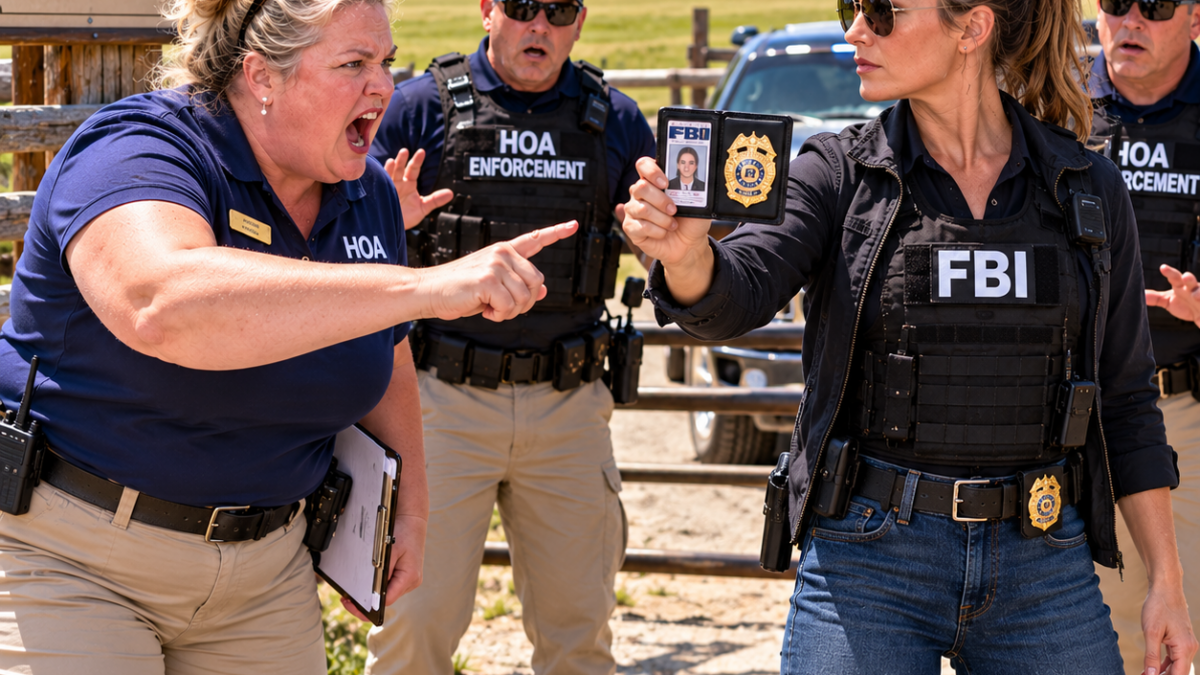
Reached inside my jacket.
Opened the credential wallet.
The gold shield caught the fluorescent lighting.
Brown froze.
His hand stayed in the air.
His face went blank.
I held the credentials where he could read them.
“Special Agent Arthur Reed.”
Silence.
“Federal Bureau of Investigation.”
Someone gasped.
A chair scraped across the floor.
Brown’s eyes moved from the badge to my face.
Then back.
Christopher stood abruptly.
“Fake.”
I turned slightly so the residents could see.
“For the past several weeks, federal investigators have been reviewing allegations involving Willow Creek Security.”
Christopher pushed around the table.
“This is absurd.”
“Resident detentions.”
Brown lowered his hand.
“Financial coercion.”
Murmurs spread.
“Missing personal property.”
Nancy’s hand went to her neck.
“Questionable movement of association funds.”
Christopher shouted:
“Call the real police.”
The main doors opened.
Elena entered.
Two federal investigators behind her.
Two state officers.
Her credentials were visible.
She looked at me.
Small nod.
Brown’s handcuffs slipped from his fingers and hit the tile floor.
Christopher’s face changed.
“Private property,” he said.
Nobody responded.
“This is private property. You need authorization.”
I looked directly at him.
“You’re standing on land I legally own.”
His mouth opened.
Nothing came.
Elena approached the board table.
“Christopher Allen?”
He straightened.
“I want counsel.”
“You may contact counsel.”
She handed him paperwork.
“Federal search warrants have been authorized for several locations and accounts connected to this investigation.”
Christopher stared at the pages.
Brown moved half a step toward the side aisle.
An investigator noticed.
“Mr. Brown, stay where you are.”
He stopped.
The bravado vanished.
“I was following HOA policy.”
No one answered.
Then Tyler Morgan stood.
The young security officer.
The one who brought me water.
He slowly removed his radio.
Placed it on a chair.
“I want to cooperate.”
Elena turned.
“What’s your name?”
“Tyler Morgan.”
“Position?”
“Security officer.”
“How long?”
“Eight months.”
His voice trembled.
“I’ll tell you everything.”
Christopher looked at him.
“Tyler.”
The boy flinched.
Elena stepped between them.
“Mr. Morgan, do not discuss this further in the room.”
Tyler nodded.
“I understand.”
“An agent will speak with you privately.”
For the first time, Christopher looked genuinely afraid.
Not angry.
Afraid.
Because control depends on people keeping secrets.
And one of his own had just volunteered to talk.
The next forty-eight hours transformed Willow Creek.
The management center was secured.
Financial systems preserved.
Security records collected.
Surveillance archives copied.
The detention log contained more than two hundred entries across three years.
Residents held for alleged curfew violations.
Landscaping disputes.
Gatherings.
Parking.
Noise.
Repeated “noncompliance.”
Some were held for less than an hour.
Others for several.
A few entries extended overnight.
There were no matching police records for most of them.
That mattered.
Then investigators opened Brown’s office safe.
The first agent called me over.
Inside were small bags.
Jewelry.
Watches.
Cash.
Credit cards.
Miscellaneous personal items.
Some tagged with resident names.
Nancy Adams.
Her gold chain was there.
Bagged.
Dated.
Her address written on a label.
I stared at it.
Fifteen years in the Bureau teaches you to separate evidence from emotion.
Sometimes you fail.
I remembered Nancy touching her empty neck.
I called her that evening after prosecutors approved the communication.
“We found something.”
Silence.
“Arthur?”
“Your mother’s necklace.”
A breath.
Then nothing.
“Nancy?”
“I’m here.”
Her voice broke.
“I thought maybe I was crazy.”
“You weren’t.”
“I thought maybe I dropped it.”
“You didn’t.”
She started crying.
I waited.
Finally she said:
“Thank you for believing me.”
That sentence hurt more than it should have.
Because she had spent six months believing the theft mattered less because the people who took it wore uniforms.
Financial evidence took longer.
Bank subpoenas.
Vendor records.
Tax documents.
Transaction histories.
Account ownership.
The money didn’t tell a clean story at first.
Money rarely does.
Some security payments were legitimate.
Some vendors performed real work.
Some fees were properly recorded.
But patterns emerged.
Hundreds of thousands collected.
Large transfers into security-related entities.
Questionable vendor payments.
Additional money to Brown.
Accounts tied to Christopher and his associates.
Eventually forensic accountants identified enough to support a broader prosecution theory.
Residents had financed the system used against them.
Tyler’s testimony filled gaps.
Christopher maintained lists of “problem residents.”
People who challenged fees.
Asked for records.
Complained about patrols.
Questioned the budget.
Those addresses received increased enforcement.
Brown directed officers to document anything they could.
Trash cans.
Parking.
Noise.
Guests.
Exterior colors.
Tyler admitted participating.
Elena asked him:
“Why?”
“I needed the job.”
“That explains why you stayed employed.”
He looked down.
“I know.”
“Why did you follow orders you believed were wrong?”
His eyes filled.
“Because everybody did.”
There it was.
The oldest excuse in the world.
He swallowed.
“I kept telling myself it wasn’t real police work, so it wasn’t serious.”
“And now?”
“I locked people in a room.”
His voice cracked.
“I know exactly how serious it was.”
Cooperation did not erase responsibility.
But it mattered.
The surveillance archive became devastating.
Christopher installed cameras thinking they would protect the HOA from complaints.
Instead, they documented the operation.
Residents brought into the room.
Personal belongings taken.
Documents presented.
Payment agreements.
Threats of additional fines.
Brown pacing.
Christopher entering occasionally.
One file showed Nancy.
Another showed Bernard.
One video showed Harold Winters.
Eighty-two.
He had been taken into the management center during an enforcement encounter.
He stumbled.
Went down near the doorway.
Security staff hesitated before calling for medical help.
Harold later died after complications.
That event required far more investigation than any online story could summarize.
Medical evidence mattered.
Timelines mattered.
Causation mattered.
We did not announce conclusions we couldn’t prove.
But investigators confirmed Willow Creek’s internal reporting had failed badly.
Harold’s family had never been given an honest account of what happened.
That alone was serious.
His daughter, Emily, came to the office.
She carried a photograph.
Harold wearing a Navy cap.
Smiling beside a lake.
“My father survived everything,” she said.
I didn’t interrupt.
“He raised three children.”
She pressed the photo flat against the table.
“He lost my mother after fifty-four years.”
Her eyes filled.
“He should not have spent his last months being afraid of walking outside.”
I had no professional answer for that.
Sometimes there isn’t one.
The investigation also uncovered Christopher’s political relationships.
Campaign donations.
Charity events.
Photographs with county officials.
Most were perfectly legal.
Knowing politicians wasn’t a crime.
Supporting campaigns wasn’t a crime.
But some contributions appeared to move through entities already under financial scrutiny.
Those transactions were referred to a separate public-integrity team.
I intentionally stepped back.
The case was too personal.
Elena reminded me of that regularly.
“You’re not touching the campaign contribution side.”
“I know.”
“You’re not interviewing officials.”
“I know.”
“You’re not conducting searches.”
“I know.”
She stared at me.
“You enjoy annoying me.”
“Professionally.”
“Leave.”
Willow Creek’s old board began collapsing.
Two members resigned.
Another claimed Christopher controlled financial information and they had never understood the security operation’s full scope.
Residents demanded meetings.
The land issue became a second crisis.
Homeowners discovered their homes were built on land governed partly through long-standing ground arrangements.
Some panicked.
I received angry letters.
You’re going to evict us.
You’re going to raise rents.
You’re stealing our houses.
I understood the fear.
Christopher’s final gift to the community was confusion.
So I held a meeting.
No security.
No stage.
No lawyers sitting beside me.
Just residents.
I stood at the front of the community center.
“My ownership does not mean I own your homes.”
A man raised his hand.
“Then what do you own?”
“Underlying parcels subject to existing legal agreements.”
“Can you throw us out?”
“Not because I feel like it.”
Another resident shouted:
“Are you going to sell to developers?”
“No.”
“How do we know?”
“You don’t.”
That answer surprised them.
I continued.
“You don’t know me.”
The room quieted.
“That’s why I’m not asking you to trust me personally.”
I held up a draft proposal.
“I’m asking you to build protections that don’t depend on trusting one person.”
That became the foundation of the new ground agreement.
Clear renewal terms.
Independent legal review.
Resident protections.
Transparency.
No unilateral control by the landowner.
No unilateral control by the HOA president.
The same principle applied both ways.
Power should have limits even when you like the person holding it.
Especially then.
Eight months after the arrests, trial began.
News cameras waited outside the federal courthouse.
The badge reveal had become the headline.
FAKE HOA POLICE TRY TO ARREST FBI AGENT.
It made good television.
The actual trial was mostly paperwork.
That’s real justice.
Bank records.
Recorded conversations.
Video authentication.
Corporate documents.
Victim testimony.
Accounting schedules.
Policies.
Logs.
Thousands of pages.
I testified on the third day.
The prosecutor asked about my first visit.
“Did you identify yourself as an FBI agent?”
“No.”
“Why?”
“I was there concerning inherited property.”
“Were you conducting an undercover investigation?”
“No.”
“Did you induce Willow Creek Security to detain you?”
“No.”
“What did you do?”
“I presented property documents and requested access.”
The defense attorney stood.
“Agent Reed, you could have displayed your badge on the first visit.”
“Yes.”
“And on the second.”
“Yes.”
“You deliberately concealed your profession.”
“I did not announce it.”
“Because you wanted my clients to make mistakes.”
“No.”
“Then why?”
I looked at the jury.
“Because private security officers should not need to know someone is an FBI agent before respecting that person’s legal rights.”
The attorney paused.
“Isn’t it true that if you had displayed your badge, none of this would have happened to you?”
“Possibly.”
“So your decision contributed to your detention.”
The prosecutor objected.
The judge sustained.
But I answered the larger point when questioning resumed.
“My profession shouldn’t determine whether someone gets treated lawfully.”
That was the entire case in one sentence.
Nancy testified the next day.
She wore a simple navy dress.
Her mother’s necklace had been temporarily released for court identification and then returned under evidence procedures.
The prosecutor showed the jury photographs of the chain in Brown’s safe.
Nancy looked down.
“What did that necklace mean to you?”
“My mother wore it.”
Her voice shook.
“She gave it to me before she died.”
“Did you give it to Willow Creek Security?”
“No.”
“Did you authorize anyone to keep it?”
“No.”
“Did Mr. Brown return it when you asked?”
“No.”
“What did he say?”
Nancy swallowed.
“That I probably lost it during processing.”
The word sounded ugly in the courtroom.
Processing.
Like Nancy was inventory.
Abigail testified about finances.
That was devastating in a different way.
Numbers don’t cry.
They don’t become confused.
They don’t exaggerate.
She showed the jury gaps.
Vendor payments.
Security transfers.
Enhancement Fund disbursements.
Brown’s additional compensation.
Shell entities.
Then the government’s forensic accountant traced several transactions into accounts connected to Christopher.
The defense challenged everything.
Maybe it was administrative error.
Maybe expenses were misclassified.
Maybe Christopher relied on accountants.
Some explanations made sense individually.
Together, the pattern was harder to ignore.
Bernard testified.
He wore a dark suit that looked uncomfortable on him.
The prosecutor asked:
“How long did you live in Willow Creek?”
“Thirty-one years.”
“Did you have a walking routine?”
“Every evening.”
“What changed?”
“They created curfew rules.”
“For residents?”
“Yes.”
“What happened when you violated them?”
“I was taken to the management center.”
“How many times?”
“Three.”
“What happened after the third?”
Bernard looked at the jury.
“I stopped walking.”
“Why?”
He was quiet.
Then:
“Because I was embarrassed.”
No anger.
No dramatic speech.
Just embarrassment.
“I didn’t like my neighbors seeing me put into a security car.”
That sentence changed the room.
Christopher stared forward.
Brown looked down.
Emily Winters testified about her father Harold.
The prosecution carefully limited the questions to what evidence supported.
She described the phone call.
The hospital.
The lack of a clear incident report.
Learning later that cameras existed.
Learning that important details had never been disclosed.
“My father deserved honesty.”
She wiped her eyes.
“That’s all.”
Tyler testified under a cooperation agreement.
The defense attacked him hardest.
“You’re testifying to save yourself.”
“Yes.”
That answer surprised the lawyer.
“You expect leniency.”
“Yes.”
“So you benefit from blaming Mr. Allen.”
Tyler shook his head.
“I blame myself too.”
Silence.
“I followed orders I knew were wrong.”
His voice broke.
“I’m not asking anyone to pretend I didn’t.”
The attorney tried again.
“Who created the detention procedures?”
“Christopher Allen.”
“Who enforced them?”
“Jose Brown.”
“And you?”
“I helped.”
“Why should this jury believe you?”
Tyler looked toward the jury.
“They shouldn’t believe me because I’m sorry.”
Pause.
“They should believe the records.”
That was exactly right.
After nearly two weeks, the jury deliberated.
Hours passed.
Victims waited in hallways.
Reporters refreshed phones.
I sat beside Elena in a conference room.
“You nervous?” she asked.
“I don’t get nervous.”
“You reorganized those papers four times.”
“They were misaligned.”
“Five times.”
“Fine.”
The call came.
Verdict.
We returned.
Christopher stood.
Brown stood.
The jury entered.
Guilty on the major conspiracy and financial counts.
Additional guilty verdicts on several detention-related charges.
Brown convicted on the principal charges tied to his role in the operation and stolen property.
Not every count.
That matters.
Real trials aren’t movies.
Prosecutors prove what they can prove beyond a reasonable doubt.
Some allegations remain allegations.
Some evidence supports civil rather than criminal consequences.
Justice is stronger when it respects that distinction.
Nancy cried quietly.
Bernard closed his eyes.
Emily held a photograph of her father.
Christopher barely reacted.
Brown looked like the floor had disappeared beneath him.
Sentencing came weeks later.
Victims submitted statements.
Nancy wrote about the humiliation of being treated like a criminal at her granddaughter’s birthday.
Bernard wrote about fear changing his daily routine.
Emily wrote about truth arriving too late for her father.
I almost didn’t submit anything.
Then Elena said:
“You were detained too.”
“I know.”
“You’re allowed to be a victim and an agent.”
“I hate that sentence.”
“Still true.”
My statement was short.
I wrote that the case mattered because uniforms and titles can make people obey before they ask whether authority is legitimate.
I wrote that private organizations cannot create their own justice system simply because residents are afraid to object.
And I wrote one sentence about Christopher.
He told me land was dirt and power was what mattered.
The judge referenced that line at sentencing.
Then imposed substantial federal prison terms based on the proven offenses, along with restitution and asset-forfeiture orders.
I won’t repeat the exact numbers as if years in a cell were trophies.
They weren’t.
The important part was simpler.
Christopher Allen would no longer run Willow Creek.
Jose Brown would no longer wear a uniform there.
Victims would receive restitution through the lawful process.
And the system they built was finished.
The other security employees faced outcomes based on their individual conduct.
Some received shorter custodial sentences.
Others probation.
Tyler received significant leniency because of early cooperation, but still faced court-imposed consequences and community service.
When the hearing ended, marshals escorted Christopher through a side door.
He passed within twenty feet of me.
Our eyes met.
The first day we met, he had told me I had nothing.
That he had power.
Now I felt no urge to remind him.
He already knew.
Power built on fear disappears fast when people stop performing fear for you.
Eighteen months after the trial, I drove back to Willow Creek.
For the first time, the gate opened without a uniformed man demanding papers.
The guard booth remained.
Empty.
The HOA security SUVs were gone.
No flashing blue-red lights.
No compliance division.
Just a normal residential entrance.
Kids rode bicycles down the sidewalk.
A teenager bounced a basketball near the curb.
It was after eight.
Nobody stopped him.
Bernard walked toward me.
Same cardigan.
Same walking shoes.
He checked his watch theatrically.
“Dangerous hour.”
I laughed.
“You should get home.”
“Going to arrest me?”
“Absolutely.”
He held out both wrists.
I shook my head.
“Go away, Bernard.”
“That’s what I thought.”
He smiled.
Then continued walking.
No one followed him.
That might have been my favorite moment of the entire case.
Inside the community center, a ceremony was underway.
Nancy stood near the front.
Her mother’s necklace rested around her neck.
She touched it occasionally as though confirming it was really there.
Abigail had joined the newly created financial oversight committee.
She had designed reporting requirements so detailed that even I thought they were excessive.
I told her that.
She said:
“Good.”
The old HOA had been dissolved and reorganized.
The new Willow Creek Community Association had rotating leadership.
Term limits.
Published budgets.
Independent audits.
Resident review periods.
No secret discretionary enforcement fund.
No private detention authority.
No security company owned by the person approving its invoices.
Actual emergencies went to actual emergency services.
Violations were handled through ordinary notice procedures.
Disputes through hearings and mediation.
Boring governance.
Wonderful governance.
Bernard used part of his civil settlement to install a park bench.
The plaque contained four words.
FREEDOM HAS NO CURFEW.
I stared at it.
“That’s dramatic.”
Bernard appeared behind me.
“I learned from you.”
“I’m not dramatic.”
He laughed so hard he started coughing.
“FBI agent inherits thousand-acre neighborhood and exposes fake cops.”
“That wasn’t my choice.”
“Sure.”
Harold Winters’s family created an emergency-response fund.
It paid for real medical-alert devices.
Training.
Voluntary wellness checks requested by families.
Emily insisted on one rule.
Nobody entered a resident’s home or restricted their movement because a board member simply said so.
That should have been obvious.
After Willow Creek, nobody wanted to rely on obvious things remaining obvious.
Then came the land.
Aunt Michelle’s thousand acres.
People had spent months afraid I would use it the way Christopher used his presidency.
Threaten.
Control.
Raise costs until residents surrendered.
I understood why.
Power teaches people to expect more power.
I had Sarah prepare a new long-term ground agreement.
Transparent.
Predictable.
Resident protections.
Defined rent formulas.
Independent review.
Restrictions on unilateral termination.
Oversight.
No hidden clauses.
No handshake deals.
No ability for one association president to manipulate everything.
At the signing, Nancy looked at the paperwork.
“You could charge more.”
“I could.”
“A lot more.”
“Yes.”
“Why don’t you?”
I thought about Aunt Michelle.
She never lived extravagantly.
Old house.
Old car.
Same kitchen for thirty years.
She had apparently controlled property worth more money than I wanted to calculate.
Yet almost nobody knew.
“Because Michelle didn’t leave me a weapon.”
Nancy smiled.
“What did she leave?”
“Responsibility.”
I used part of the land income to create the Michelle Carter Community Rights Fund.
The name was slightly grander than I wanted.
Nancy insisted.
The fund provided legal consultations and document review for homeowners dealing with serious association disputes.
Not every HOA disagreement is abuse.
Sometimes a fence really violates a valid rule.
Sometimes someone genuinely owes dues.
Sometimes neighbors are simply angry.
The fund’s purpose wasn’t to attack associations.
It was to help people understand the difference between legitimate governance and intimidation.
The first family we assisted was an elderly couple in another county.
They had received frightening letters threatening major penalties over an accessibility modification installed for the husband’s mobility needs.
They didn’t need federal agents.
They needed an attorney to read six pages of rules and make two phone calls.
Problem resolved.
No raid.
No courtroom.
No viral badge reveal.
That made me happier than the Willow Creek case ever did.
Prevention is less dramatic than justice.
It is also better.
Months later, Tyler wrote me.
I debated opening the letter.
Eventually I did.
Agent Reed,
I used to think if someone above me gave the order, the moral responsibility belonged to them.
I understand now that following an order is still a decision.
I am not asking forgiveness.
I wanted you to know I understand that.
I read the letter twice.
Then stored it with the case records.
Not because he was absolved.
Because change matters.
Accountability is supposed to protect people.
If it can also teach someone, that’s worth acknowledging.
One evening, I walked Willow Creek alone.
No badge.
No suit.
No weapon.
Just jeans and an old jacket.
Porch lights glowed.
Two families were having dinner outside.
Someone had left a bicycle in the middle of a driveway.
Christopher would probably have found three regulations for it.
Nobody cared.
I reached Bernard’s bench.
Sat.
The sky had turned dark blue.
Nancy walked past with her granddaughter.
The little girl carried a balloon.
Nancy saw me.
“Birthday party.”
I smiled.
“Authorized?”
She stared at me.
Then laughed.
“Don’t start.”
Her granddaughter looked confused.
“What?”
“Long story,” Nancy said.
They continued toward the house.
I sat alone.
For years, I had measured successful cases in convictions.
Recovered money.
Seized assets.
Sentences.
Those things matter.
Willow Creek changed the measurement.
Success was Bernard walking after dark.
Nancy hosting a birthday party without fear.
Children playing basketball without a security vehicle appearing.
Residents attending meetings and disagreeing openly.
Nobody checking the street before criticizing the board.
That was freedom in its smallest form.
Ordinary life without permission.
People often ask about the moment I showed Brown my badge.
They want details.
Was his face really pale?
Yes.
Did he freeze?
Yes.
Did Christopher panic?
Eventually.
Did it feel satisfying?
For approximately three seconds.
Then the work started.
A badge can interrupt a bad moment.
It cannot rebuild a community.
Evidence did that.
Nancy did that.
Abigail did that.
Tyler did that.
Bernard did that.
Emily did that.
Agents and prosecutors and auditors did that.
Residents did that.
Christopher had survived for years because everybody thought their problem was private.
Nancy thought she had lost a necklace.
Bernard thought he was embarrassed about walking.
Abigail thought she had been removed from a committee.
Another resident thought their parking fines were unusually high.
Someone else thought they were just unlucky with landscaping citations.
Separately, each story was easy to dismiss.
Together, they described a system.
That is how abusive power survives.
Isolation.
One person believes they are the only one.
Then another.
Then another.
Christopher didn’t need every resident to love him.
He needed them not to talk.
The first day I entered Willow Creek, he told me:
“Land is dirt. Power is what matters.”
For a while, I thought the best answer would be proving how much power the land gave me.
A thousand acres.
Leases.
Property rights.
The ability to complicate his entire community.
I was wrong.
Land was not my revenge.
Neither was the FBI badge.
The badge represented authority entrusted to me by something larger than myself.
The land was property entrusted to me by my aunt.
Both came with the same warning.
Having power does not mean every use of it is justified.
Christopher never learned that.
He treated every tool as permission.
Board presidency.
Security officers.
Fines.
Community rules.
Residents’ fear.
Even the word safety.
He turned all of them into leverage.
And because he got away with it long enough, he eventually stopped recognizing the difference between authority and desire.
He wanted something.
Therefore he believed he had the right to take it.
Money.
Silence.
Compliance.
Control.
That was the real crime beneath everything else.
The final time I visited Aunt Michelle’s old house, I found an envelope in her desk.
My name was written on the front.
ARTHUR.
Her handwriting.
I opened it at the kitchen table.
The note was only a page.
Arthur,
If you are reading this, then I was too stubborn to explain everything while I was alive.
That sounds like Michelle.
I laughed.
She continued.
The Carter land has survived because nobody in this family treated ownership as permission to dominate the people who live on it.
Property is temporary.
Reputation lasts longer.
Do not confuse what is legally yours with what is morally yours to control.
I stopped reading.
There it was.
The lesson I had spent eighteen months learning.
Written before any of it happened.
The letter continued.
Willow Creek has changed. I do not know whether it changed for the better.
If you inherit the responsibility, remember that the families there are not assets on a ledger.
They are people.
Use lawyers.
Use accountants.
Ask questions.
And if someone tells you not to ask questions, ask twice.
Love,
Michelle.
I sat in her kitchen until the sunlight shifted across the floor.
Then I folded the letter carefully.
Aunt Michelle had spent years protecting one thousand acres without letting the land turn her into Christopher Allen.
That became the standard.
Not winning.
Not revenge.
Stewardship.
A year after the new association formed, Willow Creek held its first open community picnic.
No permits.
No special security.
Just food tables.
Music.
Kids running everywhere.
Elena came.
I didn’t invite her.
Nancy did.
Elena found me beside the grill.
“This is weird.”
“What?”
“Seeing you around civilians voluntarily.”
“I’m friendly.”
“You interrogated the grill operator about internal temperature.”
“Food safety.”
She shook her head.
Bernard walked up.
“Is she FBI too?”
Elena looked at me.
“You told him?”
“He knows everything.”
Bernard pointed at her.
“Past curfew later.”
Elena stared at me.
I said:
“Don’t ask.”
The three of us laughed.
That afternoon, I watched Willow Creek residents argue about where to put a new playground.
One group wanted it near the pool.
Another wanted it near the west field.
Voices rose.
People interrupted each other.
Nobody was detained.
Nobody got fined.
Nobody received a surprise visit from security.
Eventually they voted.
West field won.
The pool group complained.
Then everyone ate pie.
I remember standing there thinking:
This is what Christopher feared.
Not chaos.
Participation.
People discovering disagreement doesn’t require domination.
That night, I drove toward the gate.
The old forty-seven-rule sign had been removed.
The replacement was simple.
WILLOW CREEK
PLEASE RESPECT OUR NEIGHBORS.
That was it.
No threat.
No curfew warning.
No enforcement language.
No giant list.
I stopped and took a photograph.
Then continued.
No security SUV appeared behind me.
No blue and red lights.
Nobody demanded identification.
Before leaving the property, I pulled over near Bernard’s bench.
The park was empty.
The inscription caught the light.
FREEDOM HAS NO CURFEW.
I sat there for a few minutes.
Then reached into my jacket.
My credential wallet.
The same one I had kept hidden during my first two visits.
I opened it.
Gold shield.
My name.
Federal Bureau of Investigation.
For fifteen years, that badge had opened doors.
Closed conversations.
Changed people’s posture.
Sometimes it protected me.
Sometimes it made people afraid.
It was powerful.
But it was still only metal.
Christopher’s officers wore metal too.
They had patches.
Radios.
Vehicles.
Cuffs.
Everything looked convincing.
That was the danger.
People often obey symbols before confirming what those symbols mean.
The difference between Brown’s badge and mine wasn’t that mine looked better.
The difference was accountability.
My authority came with laws.
Policies.
Supervisors.
Courts.
Inspector generals.
Defense attorneys.
Judges.
Rules limiting what I could do.
That is what Christopher never understood.
Real authority is defined as much by its limits as by its powers.
His system had no meaningful limits.
That was why it failed.
I closed the wallet.
Put it away.
Then looked across the dark park.
No patrols.
No fear.
Just sprinklers clicking softly in the distance.
The first day I came to Willow Creek, silence had felt wrong.
Too controlled.
Too perfect.
Now the neighborhood was quiet again.
But the quiet felt different.
Because silence and peace are not the same thing.
Silence is what happens when people are afraid to speak.
Peace is what happens when they no longer need to be afraid.
Willow Creek had finally learned the difference.
So had I.
Christopher Allen believed the story ended the moment I opened my FBI credentials in that crowded community hall.
In his mind, the badge destroyed him.
It didn’t.
The badge only stopped one fake arrest.
What destroyed his system was the record he created himself.
The detention logs.
The financial transfers.
The private security contracts.
The surveillance footage.
Nancy’s necklace.
Abigail’s spreadsheets.
Tyler’s testimony.
Bernard’s story.
Emily’s demand for truth.
Hundreds of small pieces that became impossible to explain away once people were willing to look at them together.
That is the part I remember whenever someone calls me the FBI agent who “took down” Willow Creek.
I didn’t.
Willow Creek took itself back.
I just happened to be there when the people who had been frightened into silence finally realized they were not alone.
And the thousand acres Christopher tried to control?
They’re still there.
Under houses.
Roads.
Gardens.
Playgrounds.
Ordinary families.
No kingdom.
No private empire.
Just land.
Aunt Michelle was right.
Property is temporary.
Responsibility lasts longer.
And Christopher Allen?
He told me dirt didn’t matter.
Power did.
Maybe he was right about one thing.
Power mattered.
He just never understood where real power came from.
It wasn’t in his fake police cars.
It wasn’t in his uniforms.
It wasn’t in his board title.
It wasn’t even in the federal badge inside my pocket.
Real power arrived the moment people like Nancy, Bernard, Abigail, Tyler, and Emily stopped believing they had to face him alone.
Once that happened, Christopher’s entire kingdom was already finished.
The rest was paperwork.




