HOA “Cop” Smashed Through My Gate and Attacked My Wife—Then One Decision Brought Down Their Entire Scheme
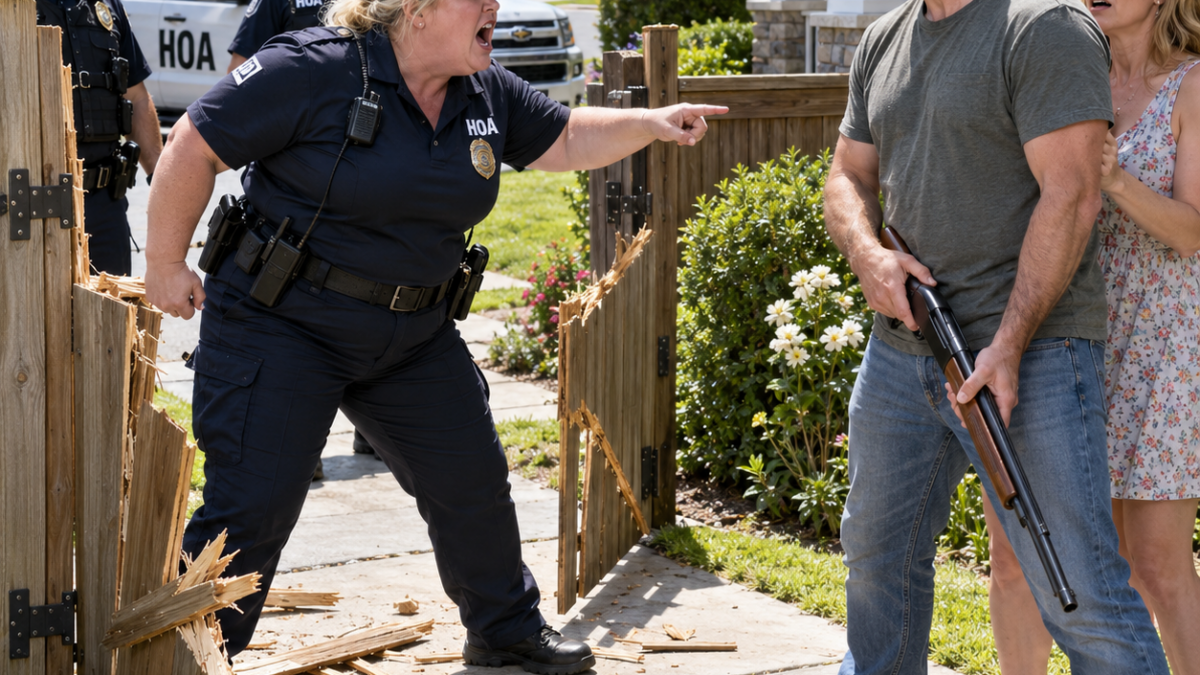
PART 2
The first violation notice claimed my truck had been parked in a manner inconsistent with “community aesthetic standards.”
There was a $150 fine attached.
I read the email twice because I assumed I had missed something. My truck had been parked squarely inside my own driveway, facing the street, without blocking a sidewalk, fire lane, mailbox, or anything else a reasonable person could object to.
At the bottom of the notice was a digital signature.
**Garrett Wade
Security Enforcement Officer**
I searched the HOA governing documents.
Nothing prohibited my truck from being parked exactly where it had been.
I replied politely.
**Please identify the specific bylaw allegedly violated and provide documentation establishing Mr. Wade’s enforcement authority.**
No response.
Two days later, a second violation arrived.
Trash cans placed at the curb “outside approved collection hours.”
Fine: $100.
The difference between the time shown on Garrett’s notice and the time I had rolled the cans out was two minutes.
Then came the grass.
Apparently one section of our lawn exceeded the approved height by roughly a quarter inch.
$150.
Then the garden gnome.
That one stopped Elena cold.
Her grandmother had given her the little ceramic figure years earlier. It was maybe ten inches tall, slightly faded, with a chipped red hat. Elena had unpacked it on a Saturday afternoon and placed it beside the flowers near our porch.
The violation notice arrived that evening.
**Unauthorized exterior decorative object.**
Fine: $50.
Elena stared at the email.
“He saw it today.”
“Yes.”
“I put it there three hours ago.”
“I know.”
She slowly looked toward the front window.
The curtain was open.
I crossed the room and closed it.
That was the first moment the situation stopped feeling ridiculous.
Someone was watching closely.
Very closely.
By the end of the week, we had accumulated $450 in fines.
Every notice carried Garrett’s name.
I didn’t pay.
Instead, I created a folder.
**CYPRESS GROVE — WADE**
Inside went every email, every camera clip, every screenshot from the licensing database, and a written timeline of each interaction.
My years in the Army had taught me something that later became even more useful in civilian security work: memory becomes unreliable when stress rises. Documentation doesn’t.
The first direct confrontation happened the following Saturday.
I was trimming the hedges when Garrett’s black SUV rolled slowly down the street and stopped in front of the house.
The door opened.
Garrett stepped out.
Elena’s description had been accurate.
Tall.
Heavyset.
Broad shoulders.
Dark uniform.
A metallic badge.
Utility belt.
He moved slowly, deliberately, like someone who believed the space around him belonged to him before he entered it.
I shut off the hedge trimmer.
He didn’t introduce himself.
“Mr. Callahan.”
Not a question.
“Yes.”
“You need to come with me.”
I almost smiled.
“Where?”
“HOA office.”
“For what?”
“Your outstanding violations.”
“Then email me.”
His jaw shifted.
“This needs to be handled in person.”
“Why?”
“Because I’m telling you it does.”
I set the hedge trimmer down.
“Garrett, are you a police officer?”
His eyes narrowed.
“I’m HOA enforcement.”
“That wasn’t my question.”
He stepped off the sidewalk and onto my driveway.
I held up my hand.
“Stop.”
He kept coming.
“This property is within Cypress Grove.”
“That doesn’t give you permission to walk onto it.”
“I have inspection authority.”
“Show me.”
He stopped maybe ten feet away.
“What?”
“The authority.”
“I don’t need to show you anything.”
“Then get off my property.”
For a moment, neither of us spoke.
The smile that appeared on Garrett’s face wasn’t friendly.
It was the smile of someone deciding whether a boundary mattered.
“I can make things very difficult for you here.”
I pointed toward the camera above the garage.
“You’re already being recorded.”
His smile vanished.
“You threatening me?”
“No.”
I gestured toward the sidewalk.
“I’m telling you to leave.”
He stared at the camera.
Then at me.
Then slowly stepped backward.
“This isn’t over.”
“I assumed not.”
He got into his SUV.
As he pulled away, I noticed his eyes watching me through the side mirror.
I went inside immediately.
Backed up the camera footage.
Twice.
That evening, Elena sat at the kitchen table holding a mug with both hands.
“His car came by four times today.”
I looked up.
“When?”
“After you left for the store.”
My stomach tightened.
“What did he do?”
“First time, nothing. Second time he slowed down. Third time he stopped across the street.”
“And the fourth?”
She stared at the coffee.
“He looked through the kitchen window.”
“What do you mean?”
“He was sitting in the SUV. I came in here for water, turned around, and he was looking directly at me.”
I tried to keep my voice calm.
“How long?”
“I don’t know. Ten seconds. Twenty.”
“Why didn’t you call me?”
“Because I didn’t want this to become bigger than it already was.”
I sat across from her.
“Elena, it already is.”
She looked at me.
For the first time since this started, she looked scared.
Not nervous.
Scared.
I reached across the table.
“We document everything.”
She nodded.
“No opening the door for him.”
“I know.”
“If he comes back, talk through the camera.”
“I know.”
“And if you feel threatened—”
“I call 911.”
“Yes.”
She squeezed my hand.
“I’m not helpless.”
“I didn’t say you were.”
“I know.”
Then she looked toward the dark window.
“But I hate that he makes me feel like I am.”
That sentence changed my priorities.
Monday morning, I filed a public-records request regarding Garrett Wade’s former employment with Houston police.
Then I wrote formally to the HOA board.
The board president, Margaret Sinclair, responded the next day.
Three short paragraphs.
Garrett was a “licensed security professional.”
His credentials had been “properly verified.”
All complaints should be routed through the HOA.
I read the line twice.
Licensed.
The state database showed nothing.
Either Margaret had failed to verify him—
or she was lying.
That evening, I walked over to Marcus Taylor’s house.
He invited me onto the porch.
When I showed him Margaret’s email, he laughed.
“She told me the same thing.”
“When?”
“Last year.”
“What happened?”
“I complained about Garrett following my wife home after she questioned a parking notice.”
My expression changed.
Marcus noticed.
“Yeah.”
“How many violations did you get after that?”
“Seven.”
“Seven?”
“In about six weeks.”
“For what?”
“Trash cans. Grass. My basketball hoop. A wreath. One claimed my car was leaking oil.”
“Was it?”
“No.”
“What did Margaret say?”
“That I was becoming paranoid.”
Marcus looked toward his driveway.
Three long scratches ran across the side of his car.
“Week after I complained, that happened.”
“You have proof Garrett did it?”
“No.”
“But?”
“I don’t believe in that many coincidences.”
Then Marcus gave me the first piece of information that explained why Margaret might be protecting Garrett.
“The security company belongs to her son.”
I looked at him.
“What?”
“Brian Sinclair.”
“You’re sure?”
“Look it up.”
I did.
That night.
Cypress Grove Security Services had been created shortly after Margaret became HOA president.
Brian Sinclair owned it.
One employee was listed in internal HOA records.
Garrett Wade.
The HOA contract paid roughly $15,000 every month.
One hundred eighty thousand dollars a year.
For a neighborhood that already received regular county patrols.
I sat at my desk staring at the number.
Elena came in.
“What?”
“Margaret’s son owns the security company.”
She stopped.
“That feels illegal.”
“Not necessarily.”
“But?”
“It’s one hell of a conflict.”
I pulled up footage from our cameras.
Garrett’s SUV appeared again.
And again.
Eleven passes in one day.
Morning.
Midday.
Late afternoon.
After dark.
At one point he parked at the corner for nearly ten minutes.
Headlights off.
I leaned back.
“This isn’t enforcement.”
“What is it?”
I looked at Elena.
“I think he’s watching us.”
The next week, I met attorney Victoria Reyes.
Victoria specialized in property disputes and civil-rights cases. She was sharp, methodical, and unimpressed by dramatic storytelling.
I liked her immediately.
I gave her everything.
Violation notices.
Camera clips.
License searches.
Margaret’s email.
Marcus’s account.
Company records.
Victoria read silently for almost forty minutes.
Then she looked at me.
“You’ve done the most important thing.”
“What?”
“You didn’t escalate.”
“I’ve argued with him.”
“That’s not what I mean.”
She tapped the file.
“You documented.”
She reviewed Garrett’s repeated appearances.
“This may support a harassment pattern. Potential stalking concerns become stronger if his focus on your wife continues.”
“So what do we do?”
“Formal cease-and-desist.”
“To Garrett?”
“To everyone.”
She drafted three copies.
Garrett Wade.
Cypress Grove Security Services.
Cypress Grove HOA.
The letter required that Garrett cease direct contact with Elena and me. Future communication concerning alleged violations had to go through counsel.
Victoria looked at me before I left.
“Understand something.”
“What?”
“This letter may not stop him.”
“That’s encouraging.”
“It creates clarity.”
“Meaning?”
“If he continues after receiving formal notice, no one gets to claim later that he didn’t understand the boundary.”
The letters were delivered Thursday.
Friday morning, Elena called me at work.
“He’s outside.”
I closed my eyes.
“Where?”
“Across the street.”
“Doing what?”
“Nothing.”
That answer frightened me more.
“Stay inside.”
“I am.”
“I’m calling the sheriff.”
Deputy James Hartley responded.
He spoke briefly with Garrett through the SUV window.
Garrett drove away.
Later, Hartley called me.
“You want the unofficial version?”
“Yes.”
“Garrett Wade is known to us.”
“How well?”
“Multiple calls over two years.”
“Why hasn’t anything happened?”
“Because he’s careful.”
I sat back.
“He likes getting close to the line.”
“Exactly.”
“Is he licensed security?”
Hartley paused.
“I’d verify that through the state.”
“I did.”
“And?”
“Nothing.”
Another pause.
“That’s interesting.”
I explained the cease-and-desist.
Hartley sighed.
“He acts like he still has a badge.”
“Still?”
“You haven’t gotten the employment record yet?”
“No.”
“When you do, read it carefully.”
Before we ended the call, I asked a question that I hated needing to ask.
“What if he enters my home?”
Hartley’s answer was cautious.
“If anyone unlawfully enters your residence and presents an immediate threat, protect yourself and your family, call 911, and stop the moment the threat stops. Everything around that incident will matter.”
That phrase stayed with me.
**Stop the moment the threat stops.**
I hoped I would never need it.
Victoria’s investigator delivered Garrett’s employment history Monday.
Former Houston police.
Terminated after an excessive-force incident during a traffic stop.
The complainant had been a woman.
The internal findings were ugly enough that Garrett left law enforcement completely.
Margaret’s claim that he had been “properly verified” became even harder to understand.
Then the investigator found three previous written complaints against Garrett inside Cypress Grove.
Margaret had personally dismissed all three.
One of those complainants was Helen Kelly.
Helen lived on Ridgewood Lane.
When I knocked on her door, she studied me through the opening for a long time before letting me inside.
“What do you want?”
“I’m dealing with Garrett Wade.”
Her face changed.
“That isn’t my problem anymore.”
“I understand.”
“Do you?”
“No.”
I held up the folder.
“But I’m trying to.”
She let me sit.
Her story was worse than Marcus’s.
Six months earlier, Garrett had confronted her because her elderly mother’s car was parked on the street.
Helen challenged the violation.
After that, Garrett began appearing.
At her mailbox.
Near her workplace.
Once in a grocery-store parking lot.
Once at a restaurant.
“He told me community safety required knowing residents’ routines.”
I stared at her.
“What did you say?”
“I told him that sounded like stalking.”
“And?”
Helen’s mouth tightened.
“He said, ‘I pay attention to people who interest me.’”
She showed me text messages.
Nothing explicitly violent.
That almost made them worse.
**Home late tonight. Everything okay?**
**Living room light was on pretty late. Couldn’t sleep?**
**Different grocery store today. Smart.**
My skin went cold.
“You filed a complaint?”
“Yes.”
“What did Margaret say?”
Helen laughed bitterly.
“She said I was being dramatic.”
“Will you give this to my attorney?”
Helen looked toward the window.
For months, she had changed her schedule.
Changed parking spaces.
Changed grocery stores.
Changed restaurants.
Garrett had taught her to reorganize her life around avoiding him.
Finally, she nodded.
“Yes.”
That night, Elena and I talked honestly.
Not about cameras.
Not about lawyers.
Fear.
“I’m afraid,” she said.
I reached for her hand.
She stopped me.
“Let me finish.”
I did.
“I’m afraid when I’m here alone. I’m afraid when a black SUV drives past. I’m afraid when someone knocks harder than normal.”
Her eyes filled.
“But I don’t want you deciding that means I’m fragile.”
“I don’t.”
“Then don’t treat me like I’m waiting to be rescued.”
I nodded.
“What do you want me to do?”
“Believe me when I say something feels wrong.”
“I do.”
“And trust that I can follow the plan.”
I looked at her.
She had grown up around hunting.
She knew firearm safety.
She knew emergency procedures.
More importantly, she knew herself.
“I trust you.”
“Good.”
We added another camera inside the living room facing the front entrance.
Redundancy.
Documentation.
Preparation.
Three days later, my phone vibrated during a meeting.
Two words from Elena.
**He’s here.**
I stood immediately.
Called her.
She answered in a whisper.
“He’s at the front door.”
“What does he want?”
“He says there’s a gas leak.”
I was already moving toward the elevator.
“Do you smell gas?”
“No.”
“Any utility trucks outside?”
“No.”
“Stay away from the door.”
“I am.”
“Call 911 if he tries to enter.”
“He says this is an emergency.”
“Do not open it.”
I reached my truck.
The drive home was normally forty-five minutes.
That afternoon, every red light felt personal.
Seven minutes later, Elena called again.
Her breathing was faster.
“He moved to the backyard.”
“Where exactly?”
“Gate.”
I heard metal shaking through the phone.
“Elena?”
“He’s trying the latch.”
“Call 911 now.”
A heavy impact came through the speaker.
Then another.
I heard wood crack.
“Elena!”
“I’m moving.”
Another crash.
Glass.
Elena shouting.
Then the phone went silent except for background noise.
Not disconnected.
Just no voice.
There are moments when time stops behaving normally.
The next stretch of highway lasted forever and disappeared instantly.
I remember gripping the wheel.
I remember calling 911 from another device.
I remember saying my address.
I remember repeating that my wife was alone.
I remember almost nothing else.
When I reached our street, the front gate was down.
Not open.
Down.
One hinge torn free.
I parked.
The back door had been damaged badly enough that daylight cut through the frame.
I entered the house.
“Elena!”
Movement.
Then I saw her.
She was beside the couch trying to stand.
One side of her face was reddened and swelling.
Her wrist was held close against her body.
And ten feet away stood Garrett Wade.
He turned toward me.
Everything inside me narrowed.
The sound in the room disappeared.
I moved to the secured backup firearm I kept for emergencies and brought it up as I ordered Garrett not to move.
For the first time since I had met him, Garrett looked uncertain.
“Put that down,” he said.
“No.”
“I’m law enforcement.”
“You are not.”
“I’m conducting a welfare check.”
“You broke into my house.”
“Elena attacked me.”
My eyes stayed on him.
Behind him, Elena shook her head.
“He hit me.”
Garrett looked toward her.
“Don’t look at her.”
His hands rose slightly.
I could feel every violent possibility sitting inside that room.
Every fear.
Every sleepless night.
Every violation notice.
Every time he had watched my wife through a window.
Every warning ignored.
Every lie.
And underneath it all was anger.
Pure anger.
The kind that can make a person believe revenge and protection are the same thing.
They aren’t.
Garrett was no longer moving toward Elena.
He wasn’t reaching for anything.
The immediate danger had stopped.
That mattered.
“Get down,” I told him.
He hesitated.
“Now.”
He lowered himself onto the floor.
I kept distance.
Kept control.
Elena had reached another phone.
911 was already connected.
Sirens approached.
When deputies entered, I immediately followed their instructions, set the weapon aside, stepped away, and told them Elena needed medical attention.
Garrett tried talking.
The deputies separated everyone.
Paramedics came in.
Elena had a concussion.
Facial bruising.
A small fracture in her wrist from the fall.
Painful.
Frightening.
But she would recover.
I repeated that to myself while sitting in the hospital.
She would recover.
Deputy Hartley arrived.
He had already seen preliminary footage.
“Your cameras caught everything.”
I looked at him.
“Everything?”
“Gate. Rear entry. Interior.”
“What about the gas leak?”
“There wasn’t one.”
Of course there wasn’t.
Garrett had invented the emergency.
When Elena refused entry, he created his own.
Hartley sat beside me.
“You did something important today.”
“What?”
“You stopped.”
I looked at him.
“The threat stopped. So did you.”
I didn’t feel heroic.
I felt exhausted.
“I wanted to hurt him.”
“I know.”
“I wanted him to understand what he’d done.”
Hartley nodded.
“But you didn’t turn the worst day of your wife’s life into the worst decision of yours.”
That sentence stayed with me.
Garrett was arrested.
The charges were serious.
Burglary of a habitation.
Assault causing bodily injury.
Criminal trespass.
The video destroyed his story.
There was no welfare check.
No gas emergency.
No official authority.
Just a private individual using a uniform and an invented pretext.
Elena came home two days later.
We covered the damaged back entrance until it could be repaired.
A temporary fence replaced the gate.
Neither of us slept properly.
Sometimes Elena woke suddenly.
Sometimes I heard a noise and checked cameras before realizing it was a delivery truck.
We didn’t call it trauma.
Not yet.
We called it being careful.
That was easier.
Victoria Reyes called the night of Garrett’s arrest.
“This is not finished.”
“I know.”
“No. I mean Garrett isn’t the whole case.”
“What are you thinking?”
“Who kept him employed?”
“Margaret.”
“Who dismissed complaints?”
“Margaret.”
“Who profited from the contract?”
“Brian.”
I looked at Elena sleeping on the hospital bed.
Victoria continued.
“The man in custody is the visible part. The structure that protected him is still there.”
She was right.
Within seventy-two hours, prosecutors formally accepted the case.
Garrett’s bail was set high.
Then something happened that even Victoria found remarkable.
Cypress Grove Security Services posted it.
Brian Sinclair’s company paid to get Garrett released while his case proceeded.
Victoria stared at the record.
“They’re financing his defense after he attacked a homeowner while performing work connected to their company.”
“What does that mean?”
“It means Brian just made explaining distance between himself and Garrett significantly harder.”
Media coverage began.
We refused interviews.
I didn’t want Elena’s injuries turned into entertainment.
But the story spread anyway.
And once it did, other people called.
Helen first.
She was ready to speak publicly.
Then David Henderson.
His seventeen-year-old daughter had once been cornered by Garrett while parking.
She came home shaken and stopped driving alone for months.
Then Sarah and Gwen Nguyen.
After a vacation, they returned to find their backyard gate open, patio furniture moved, and cigarette butts near their back door.
A neighbor had seen Garrett’s SUV nearby.
They complained.
Margaret dismissed it.
Then Marcus.
Then another family.
Then another.
Victoria built a timeline.
Twelve complaints.
Eighteen months.
Every one involving Garrett.
Every one dismissed or minimized by Margaret Sinclair.
The financial discovery was worse.
Cypress Grove Security Services had one primary client.
Our HOA.
The contract:
$15,000 per month.
Then investigators found recurring transfers.
$5,000 monthly.
From Brian’s company.
To Margaret’s personal account.
Label:
**CONSULTING**
Sixty thousand dollars a year.
For years.
Margaret had approved a contract with her son’s company, then personally received money connected to that arrangement while dismissing complaints against the company’s only enforcement officer.
The numbers did not look like coincidence.
Victoria filed our civil lawsuit.
Garrett Wade.
Cypress Grove Security Services.
Brian Sinclair.
Margaret Sinclair.
The HOA.
We alleged assault-related damages, negligent hiring, negligent supervision, harassment, financial misconduct and other claims supported by the evidence.
The demand was large.
But money was not what made Margaret panic.
Discovery did.
Because discovery meant documents.
Emails.
Contracts.
Bank records.
Employment files.
Complaint records.
Everything.
Garrett began talking almost immediately.
His attorney clearly wished he wouldn’t.
Garrett claimed he had only been following instructions.
According to information later produced through the case, he said Margaret had repeatedly told him the Callahans were “creating problems.”
We had questioned his authority.
Questioned his license.
Hired an attorney.
Contacted law enforcement.
Asked about the security contract.
In Margaret’s world, those weren’t normal homeowner actions.
They were threats.
Discovery produced Garrett’s personnel file.
Inside was the document that changed everything.
His former police employment history.
The excessive-force termination.
The prior female complainant.
And a signed acknowledgment showing Margaret had reviewed the background information before approving Garrett’s work in Cypress Grove.
I sat across from Victoria.
“She knew?”
Victoria tapped the page.
“Her signature says she reviewed it.”
“She told me his credentials had been verified.”
“Yes.”
“She knew he had that history.”
“Yes.”
“And still hired him.”
“Yes.”
I looked away.
For the first time, I thought about Elena the day Garrett first knocked on our door.
Alone.
He had already shown a pattern involving women.
Margaret knew.
And she put him in uniform anyway.
Victoria leaned forward.
“Annual HOA meeting is next week.”
“What does that have to do with us?”
“Everything.”
More than two hundred homeowners were expected.
Margaret would have to face them.
This time, we were bringing documents.
Elena insisted on attending.
“No.”
She stared at me.
“I wasn’t asking.”
“You’re still recovering.”
“My wrist is recovering.”
“You don’t need this.”
“Neither did Helen.”
I stopped.
“Neither did Marcus. Neither did that teenage girl. Neither did I.”
Her voice remained calm.
“But if I stay home because Margaret’s system made me afraid, then Garrett still controls where I go.”
I looked at her.
There was no argument that didn’t sound like fear disguised as protection.
“All right.”
She smiled faintly.
“Good answer.”
The meeting happened on a Saturday night.
By seven, the community center was packed.
Residents stood along walls.
Extra chairs were brought in.
A local reporter waited near the back.
Deputy Hartley attended in an official community-safety capacity.
Margaret sat behind the board table.
Navy blazer.
Pearls.
Perfect posture.
Brian beside her.
For the first twenty minutes, Margaret rushed through routine business.
Landscaping.
Holiday decorations.
Budget items.
Then she tried to adjourn.
I stood.
“Homeowner comment period.”
Her face tightened.
“We’re out of time.”
Victoria stood beside me.
“The bylaws guarantee a comment period.”
Margaret stared at her.
“You have five minutes.”
I walked to the projector.
Connected my laptop.
The room became silent.
I looked toward Elena.
She nodded.
I began.
“Three weeks ago, a man employed through this HOA forced his way into my home and attacked my wife.”
No one moved.
“He is facing serious criminal charges.”
The first slide appeared.
Twelve complaint summaries.
Different names.
Different dates.
Same man.
“All of these complaints were filed before the incident at my house.”
Murmurs spread.
“Every one was dismissed or closed under Margaret Sinclair’s leadership.”
Margaret spoke from the table.
“These are unverified allegations.”
I clicked.
Garrett’s personnel file.
His former police termination.
Then the acknowledgment page.
Margaret’s signature.
“Mrs. Sinclair signed paperwork acknowledging his employment history before he was allowed to work inside Cypress Grove.”
The murmurs became voices.
Margaret stood.
“That document is being mischaracterized.”
I clicked again.
Security contract.
$15,000 monthly.
Brian’s company.
Then the transfers.
$5,000 per month.
To Margaret.
The room changed.
People began shouting.
“What is that?”
“Consulting for what?”
“You were paying yourself?”
Margaret grabbed the microphone.
“Order!”
Nobody listened.
Helen Kelly stood.
Her hands shook.
Her voice didn’t.
“For six months, Garrett Wade followed me.”
The room quieted.
“He knew when I got home. Where I shopped. When my lights were on.”
She looked at Margaret.
“I told you.”
Margaret’s face went rigid.
“You called me dramatic.”
Marcus stood next.
“I filed one complaint.”
He held up copies of seven violations.
“I got these afterward.”
Then David Henderson.
“My daughter was seventeen when Garrett cornered her.”
He didn’t need another sentence.
Sarah Nguyen.
“Our backyard was entered while we were away.”
Another resident.
“He threatened to tow my car from my own driveway.”
Another.
“He told my wife he could enter our garage for inspection.”
One voice became many.
The room filled with things people had apparently been carrying alone.
Margaret stood suddenly.
“This is a coordinated attack on the board.”
I looked at her.
“No.”
I pointed toward the documents.
“This is coordination.”
I clicked the transfer record again.
“Explain the $5,000 monthly payments.”
She opened her mouth.
Nothing came.
Brian stared at the table.
Margaret looked at him.
“Brian?”
He didn’t move.
Somebody in the crowd shouted:
“Remove them.”
Another voice:
“Vote.”
Another:
“Vote them out.”
Margaret tried to invoke procedure.
Victoria already had the bylaws open.
An emergency removal motion was permitted under the circumstances and attendance threshold present.
A homeowner formally moved.
Another seconded.
The vote happened.
Margaret.
Brian.
Two allied board members.
Removed.
The entire power structure collapsed in less than five minutes.
Margaret stared at the raised hands.
For years, she had controlled that room.
Now nearly every hand was against her.
Deputy Hartley approached afterward.
He didn’t arrest anyone.
He didn’t need theatrics.
He simply told Margaret and Brian that investigators would be contacting them concerning the financial records now circulating.
Outside, residents gathered in clusters.
Elena took my hand.
“Is it over?”
“No.”
She looked exhausted.
“But?”
“The part where nobody believes us is over.”
That mattered.
Six weeks later, a grand jury reviewed the broader case.
Brian cooperated.
The records he provided were devastating.
Emails.
Payments.
Instructions.
He had saved everything, probably as protection for himself.
One email from Margaret concerning us was especially hard to read.
She wanted Garrett to “handle the Callahan problem.”
She wanted pressure increased.
She wanted us uncomfortable.
Brian later admitted there had been discussion of extra compensation if we moved.
Garrett’s testimony aligned with enough of Brian’s account to make Margaret’s denial increasingly impossible.
He tried to minimize the day he entered our home.
Said he only intended to intimidate Elena.
The prosecutor reportedly asked how forcing entry into a residence fit that description.
Garrett had no good answer.
He eventually entered guilty pleas to serious charges.
Margaret’s attorneys tried to separate her from his conduct.
But every layer led back to her.
Her signatures.
Her payments.
Her dismissals.
Her emails.
Her approval.
The sentencing hearing came in February.
Elena’s wrist had healed.
Mostly.
Cold weather still made it ache.
She prepared a statement.
I expected her to describe the break-in.
The injuries.
The fear.
She didn’t.
When she stood at the podium, she spoke about mornings.
“I stopped running.”
The courtroom was silent.
“Before this happened, I ran before work three days a week. Afterward, I couldn’t walk past our gate without thinking someone was watching.”
She looked toward the judge.
“For months, I thought recovery meant becoming the woman I was before.”
Her voice trembled once.
Then steadied.
“I don’t believe that anymore.”
I watched her.
“I’m not the woman I was before.”
She glanced toward me.
“I’m the woman who came after.”
I felt something tighten in my chest.
“I run again.”
She smiled slightly.
“Not as far.”
A few people in the courtroom smiled too.
“I still check behind me sometimes. I still wake up some nights.”
Then:
“But fear no longer decides whether I leave my house.”
Helen spoke next.
She had stopped changing grocery stores.
Marcus said his family had considered moving but decided Cypress Grove was theirs too.
David thanked investigators for listening to his daughter when the HOA had not.
The judge imposed prison time on Garrett.
Margaret received a separate sentence tied to the fraud, conspiracy and misconduct proven in her case, along with substantial restitution obligations.
Brian avoided incarceration under his cooperation agreement but faced restitution, probation and long-term professional consequences.
The civil case settled soon afterward.
Insurance funds and assets produced a substantial settlement shared among affected families.
Our portion covered Elena’s medical bills.
Legal costs.
Repairs.
Security improvements.
We put most of what remained away.
Money didn’t erase anything.
But accountability mattered.
Cypress Grove changed.
Helen Kelly became HOA president.
One of her first actions was terminating the security contract completely.
The company collapsed not long afterward.
Then she hired an independent auditor.
The audit uncovered more.
Questionable maintenance vendors.
Reimbursements for meetings that apparently never happened.
Payments that lacked normal supporting documents.
Years of small irregularities hidden inside larger budgets.
The amount lost was significant.
Some would never be recovered.
But for the first time, residents could see the records.
Board meetings that once attracted five or six homeowners started drawing forty.
People asked questions.
Uncomfortable questions.
Useful questions.
Marcus organized a small community event in the spring.
He planted a magnolia tree near the playground.
His wife helped.
His son carried the sapling.
Maybe fifty residents came.
Marcus hated speeches.
He gave one anyway.
“This tree isn’t about what happened.”
He looked toward Elena.
“It’s about what happened afterward.”
He rested one hand on the shovel.
“We spent years thinking silence kept the peace.”
Then:
“It didn’t.”
That was the whole speech.
He didn’t need more.
Elena returned to Texas Children’s Hospital full-time.
The first weeks were difficult.
Crowded hallways sometimes made her anxious.
Unexpected knocks on doors made her shoulders tighten.
But she kept going.
Eventually, she started a small support group for women dealing with intimidation and trauma.
Nothing formal at first.
Coffee.
A room.
Eight chairs.
People talking.
One evening she came home late.
“How was it?”
“Hard.”
“Good hard or bad hard?”
She dropped her bag.
“Both.”
I made tea.
She sat at the kitchen table.
“One woman said she thought she was weak because she still checks her locks three times.”
“What did you tell her?”
Elena looked at me.
“That checking a lock isn’t weakness.”
I smiled.
“Sounds smart.”
“She also said she’s afraid she’ll never feel normal.”
I sat across from her.
“What did you tell her?”
Elena looked toward the backyard.
“That normal changes.”
The backyard had changed too.
The spot near the gate where everything happened became her garden.
Tomatoes.
Basil.
Rosemary.
Flowers.
She didn’t plan the symbolism.
Neither did I.
But every spring morning, something living grew where our worst memory began.
I still kept the shotgun secured.
I hoped never to touch it for an emergency again.
Deputy Hartley visited one afternoon.
Off duty.
Iced tea on the porch.
He looked toward the repaired gate.
“Looks better.”
“Stronger.”
“You sleeping?”
“Mostly.”
“Elena?”
“Better.”
Hartley nodded.
Then he said:
“I’ve been doing this twenty-two years.”
“Doing what?”
“Watching people make decisions in bad seconds.”
I knew what he meant.
“I wanted to pull the trigger.”
“I know.”
“I still think about that.”
“Good.”
I looked at him.
“Good?”
“If you didn’t think about it, I’d worry.”
He leaned back.
“Restraint isn’t pretending anger wasn’t there.”
The neighborhood was quiet around us.
“It’s knowing the anger doesn’t get to decide.”
I looked toward Elena’s garden.
“You rehearsed that?”
“No.”
“You should.”
“Terrible bedside manner.”
“Law-enforcement problem.”
He laughed.
The settlement money gave Elena and me choices.
One choice came up repeatedly.
Move.
Sell the house.
Start over somewhere else.
A home without a broken-gate memory.
A kitchen window Garrett had never watched through.
A living room where Elena had never been hurt.
For weeks, leaving sounded attractive.
One night, we sat at the table with listings open on a laptop.
Elena closed it.
“I don’t want to go.”
I looked at her.
“You sure?”
“No.”
“That’s reassuring.”
She smiled.
“I’m sure I don’t want Garrett to be the reason.”
I understood.
“If we leave because we want another house someday, fine.”
She nodded.
“But not because he made this one feel stolen.”
We stayed.
We repaired.
We changed things.
Not because the house needed all of them.
Because we did.
New gate.
New back door.
Fresh paint.
Garden beds.
A larger patio light.
We replaced the couch.
Elena never said why.
She didn’t need to.
By late May, we were sitting outside drinking coffee again.
Same patio.
Same fence line.
Same Texas sky.
Eight months after that first peaceful morning.
Elena rested her head against my shoulder.
“Do you regret moving here?”
I thought about Garrett.
Margaret.
The courtroom.
The hospital.
Then Marcus.
Helen.
The Henderson family.
The Nguyens.
People who had finally spoken because someone else spoke first.
“No.”
She lifted her head.
“Really?”
“Ask me again on a bad day.”
She laughed.
Then:
“Are we staying?”
I looked at the house.
The rebuilt gate.
Her garden.
The community park beyond the street.
“Yes.”
“Why?”
“Because this is ours.”
The words felt different now.
Not possessive.
Earned.
That summer, Cypress Grove held its first properly audited annual meeting.
Helen stood at the front.
No pearls.
No security officer beside her.
No family business receiving giant contracts.
A projector showed every line of the budget.
Residents asked about landscaping.
Insurance.
Lighting.
Reserve funds.
One man complained the meeting was boring.
Helen smiled.
“Good.”
Everyone laughed.
She continued.
“Community governance should be boring enough that nobody ends up on the evening news.”
Even Victoria laughed at that when I told her.
The cameras stayed on our house.
But I stopped checking them constantly.
At first, I watched every notification.
Car.
Dog walker.
Delivery driver.
Wind moving a tree.
Eventually, the cameras became what they were supposed to be.
Tools.
Not windows into fear.
Elena’s nightmares became less frequent.
Not gone.
Less.
Sometimes she woke and reached for my arm.
I never asked what she saw.
I just stayed there.
Some things don’t need interrogation.
Healing doesn’t happen because a judge says a case is closed.
It happens quietly.
A night slept through.
A run completed.
A door opened without fear.
A morning when a black SUV passes and you don’t notice until it is already gone.
One afternoon, Elena called me outside.
“What?”
She pointed toward the gate.
A delivery driver had leaned a large package against it.
“What am I looking at?”
“The gate.”
“Yes.”
“I haven’t thought about Garrett all day.”
I smiled.
“That seems healthy.”
She looked annoyed.
“I’m serious.”
“I know.”
She stood there.
Then started crying.
I hugged her.
Not because she was sad.
Because sometimes progress arrives disguised as an ordinary afternoon.
The magnolia Marcus planted grew slowly.
The first year, it looked fragile.
Second year, stronger.
At a neighborhood barbecue, Marcus pointed at it.
“See?”
“What?”
“Still here.”
“You’re emotionally attached to a tree.”
“Retirement does things to a man.”
His wife called from across the park.
“He talks to it.”
Marcus glared.
“That is private.”
Elena laughed harder than I had heard her laugh in months.
That sound mattered more than every settlement number.
Over time, people stopped calling us “the family Garrett attacked.”
We became Ethan and Elena again.
Neighbors.
The couple with the garden.
The guy who complained about sprinklers.
The nurse who brought cookies to new parents.
That was another kind of victory.
Trauma can turn you into a headline even inside your own mind.
Recovery is reclaiming the parts of your identity that existed before the worst thing happened.
Years later, I still think about the moment I came through the house.
Garrett turning.
Elena hurt.
The weapon in my hands.
I have replayed those seconds more times than I can count.
Sometimes I imagine a different ending.
One decision changed everything.
Not because Garrett deserved mercy from me.
That wasn’t what it was.
I chose not to turn protection into punishment.
Once he stopped being an immediate threat, I stopped escalating.
That choice meant the cameras told the entire story.
Garrett broke in.
Garrett attacked Elena.
Garrett lied about authority.
I controlled the scene.
Then I stopped.
There was no ambiguity.
No competing tragedy.
No question about whether rage had taken over.
The evidence stayed clean.
Later, when lawyers and reporters wanted to turn that moment into something dramatic, I resisted.
It wasn’t dramatic while I was living it.
It was terrifying.
And restraint did not feel noble.
It felt hard.
People sometimes think self-control means you aren’t angry enough.
They’re wrong.
Sometimes self-control is what anger looks like when it has discipline.
Garrett eventually disappeared from the daily conversation in Cypress Grove.
His name became something older residents knew and newer residents didn’t.
Margaret’s old house sold.
Brian moved away.
The security SUV vanished.
One day I drove past the community entrance and realized I could no longer remember exactly where it used to park.
That surprised me.
Fear had once made that SUV seem permanently carved into the landscape.
It wasn’t.
Nothing is.
Helen served two terms as HOA president and refused a third.
“Why?”
I asked.
“Power should have an expiration date.”
“That sounds like something you learned recently.”
“Painfully.”
Under her leadership, the HOA adopted conflict-of-interest rules.
Vendor contracts required independent review.
Security services, if ever considered again, required licensing verification and community approval.
Complaint records could not be erased by a single officer.
There were term limits.
Regular audits.
Resident access to financials.
Nothing revolutionary.
Just controls.
The kind Margaret had removed or bypassed because controls annoyed people who wanted permanent discretion.
At Helen’s final meeting as president, she gave Elena a small box.
Inside was the old garden gnome.
I stared.
“Where did you get that?”
Helen smiled.
“Your violation hearing file.”
Elena picked it up.
The red hat was still chipped.
“You kept evidence?”
“Margaret’s office kept everything.”
Elena laughed.
“The fifty-dollar gnome.”
Helen shook her head.
“The beginning of the end.”
We took it home.
Elena put it back in the flower bed.
Exactly where it had been.
I looked at it.
“You know, technically, it’s still unauthorized.”
She stared at me.
I raised both hands.
“Sorry.”
She pointed toward the gate.
“Leave.”
The gnome stayed.
So did we.
That night, we sat on the patio.
The sun dropped.
Orange across the fence.
Children laughing somewhere nearby.
A dog barking.
Ordinary sounds.
Elena took my hand.
“Remember our first morning here?”
“Yes.”
“You said the kitchen needed another shelf.”
“It did.”
“It still doesn’t.”
“We’ve survived corruption, stalking, a break-in and a criminal case, and you remain wrong about that shelf.”
She laughed.
Then rested her head against my shoulder.
The world had not returned to what it was before.
That was impossible.
We had changed.
The neighborhood had changed.
But different wasn’t automatically worse.
We were more careful.
More skeptical.
More aware of how easily authority can be performed by someone wearing the right uniform and speaking with enough certainty.
We also understood something we hadn’t before.
Communities become vulnerable when everyone suffers alone.
Marcus thought his complaints were his problem.
Helen thought Garrett’s attention was happening only to her.
David’s daughter thought she had overreacted.
Sarah and Gwen wondered whether they had imagined someone entering their yard.
We believed our violations were personal retaliation.
Every story stayed isolated.
That was the system’s strength.
The moment those stories touched, the system collapsed.
That became the lesson I carried forward.
Not that every uniform is fake.
Not that every HOA is corrupt.
Not that every authority figure is dangerous.
Something simpler.
Ask questions.
Save records.
Listen when someone tells you they are afraid.
Do not confuse confidence with legitimacy.
And when people who have nothing to gain tell similar stories, stop treating each one as an isolated inconvenience.
Sometimes a pattern only becomes visible after somebody places every piece on the same table.
That is what happened in Cypress Grove.
Garrett Wade thought his badge protected him.
It didn’t.
Margaret Sinclair thought her title protected her.
It didn’t.
Brian thought corporate paperwork would separate him from the consequences.
It didn’t.
What mattered in the end were the things they had underestimated.
Camera footage.
Complaints.
Signatures.
Bank transfers.
Witnesses.
People who finally talked to each other.
And one moment inside my house when anger could have changed the story forever—
but didn’t.
I used to think the most satisfying ending would be watching the people responsible lose everything.
It wasn’t.
The most satisfying ending was much quieter.
Elena running in the morning again.
Helen going to the grocery store without changing routes.
Marcus keeping his house.
David’s daughter driving herself to college.
Sarah and Gwen sleeping with their backyard gate unlocked while they sat outside.
Residents attending HOA meetings because they wanted to, not because they were afraid.
The magnolia growing near the playground.
Our garden.
The stupid gnome.
Home.
That was what Garrett and Margaret had nearly taken.
Not our property.
Our sense that ordinary life belonged to us.
We took that back.
Slowly.
Not with revenge.
With evidence.
With voices.
With patience.
With consequences.
And with the decision not to let the worst thing someone did to us become the thing that defined everything after.
Years later, if you drove through Cypress Grove, you wouldn’t know any of this happened.
You would see trimmed lawns.
Kids on bicycles.
Dogs pulling owners down sidewalks.
A magnolia tree near the playground.
A house with a strong gate and a chipped garden gnome sitting beside the flowers.
You might see Elena and me drinking coffee on the back patio.
You might think we were lucky.
You’d be right.
Just not for the reasons we thought on that first Tuesday morning.
Back then, I thought being lucky meant buying the house.
Finishing the renovation.
Finding a quiet neighborhood.
Now I know luck is different.
Luck was Elena surviving.
Luck was the cameras working.
Luck was Marcus speaking.
Helen speaking.
Every other family speaking.
But what happened afterward wasn’t luck.
That part was choice.
We chose to document instead of explode.
To ask questions instead of accept titles.
To stay when fear told us to leave.
To rebuild instead of let the damage become permanent.
And, in the hardest moment of my life, I chose not to let anger make the final decision.
That choice gave the truth room to finish the story.
The gate is repaired now.
The glass is replaced.
The scars faded.
The court files are closed.
The HOA is different.
Elena’s garden grows every spring.
And sometimes, late in the evening, I stand near the spot where Garrett came through and realize I can remember the event without feeling like I’m still inside it.
That is how I know we won.
Not because he went to prison.
Not because Margaret lost her position.
Not because the settlement was large.
We won because the house became home again.
And nobody—not a fake badge, not a corrupt board, not a man who mistook intimidation for authority—was able to take that from us.
The gate was lying crooked across the walkway when I pulled into the driveway, one hinge ripped free and the metal frame twisted enough that I knew immediately Garrett had not simply opened it. He had forced his way through. The back entrance was worse. Glass covered the floor near the door, one section of the frame was splintered, and somewhere inside the house I could hear movement I could not identify.
“Elena!”
No answer.
I moved through the house and found her near the couch, trying to get to her feet with one hand pressed against the furniture for balance. Her face was already swelling along one cheek, and she held her left wrist close to her body. Ten feet away, Garrett Wade turned toward me.
For weeks he had worn that dark uniform as if the patches and metal badge transformed him into something official. He had ordered residents around, issued invented violations, appeared outside homes at strange hours, and acted as though the neighborhood belonged to him.
Inside my house, with my wife hurt behind him, the costume suddenly looked exactly like what it was.
A costume.
I brought up the secured firearm I had retrieved for the emergency and ordered him not to move.
Garrett froze.
“Put that down,” he said.
His voice still carried that same command he had used from the beginning, but there was something different underneath it now. The confidence had become calculation.
“I’m conducting a welfare check.”
“You forced your way into my house.”
“There was a safety complaint.”
“There was no safety complaint.”
“Elena became aggressive.”
My eyes moved briefly toward my wife.
She shook her head.
“He hit me.”
Something inside me went cold.
For three weeks I had documented every violation notice, every pass of Garrett’s SUV, every threat, every complaint the HOA ignored. I had spent nights watching camera footage and listening to Elena tell me how uncomfortable she felt in her own kitchen. I had spoken with neighbors who had stories of their own.
Now the man responsible was standing in my living room.
Every instinct in me wanted to make him understand exactly how far he had gone.
But there is a line between protecting someone and punishing someone.
I knew that line.
The immediate threat had stopped.
Garrett was no longer moving toward Elena.
His hands were visible.
So I held my position.
“Get down.”
He stared at me.
“Now.”
Slowly, he lowered himself onto the floor.
Elena reached for the phone that had been knocked near the couch. The emergency call had already connected, and the dispatcher had apparently heard enough that sirens were approaching before I had even entered the house.
When deputies arrived, I followed every instruction immediately.
I set the firearm down where they told me.
Raised my hands.
Identified myself.
Then pointed toward Elena.
“My wife needs medical attention.”
Everything after that blurred together.
Paramedics.
Questions.
Photographs.
Deputies separating everyone.
Garrett trying to explain himself.
Elena sitting on the edge of a stretcher while a medic examined her wrist.
The final diagnosis was frightening but manageable: a concussion, bruising, and a small fracture from the fall.
I repeated that to myself while I sat beside her hospital bed.
She would heal.
She was safe.
She was alive.
Deputy James Hartley arrived that evening.
He had already been familiar with Garrett from earlier complaints and from the day I called after Garrett ignored our cease-and-desist order.
Hartley pulled a chair closer.
“We have the footage.”
“All of it?”
“Enough.”
The camera over the backyard had captured Garrett testing the gate, then forcing entry after Elena refused to open it.
Another camera had captured him approaching the rear door.
The interior camera captured the confrontation inside.
There had been no gas leak.
No emergency.
No legitimate welfare check.
Garrett had created a false reason to demand entry, then escalated when Elena refused.
Hartley looked at me.
“You did the right thing when you stopped.”
I knew what he meant.
I looked toward Elena.
“I didn’t feel calm.”
“You didn’t need to feel calm.”
“I wanted to hurt him.”
Hartley nodded.
“You stopped when he stopped being an immediate threat. That distinction matters.”
I sat with that for a while.
People like to imagine restraint as something peaceful.
It isn’t always.
Sometimes restraint is standing inside anger and refusing to let anger make the next decision.
Garrett was arrested that evening.
The criminal charges were serious enough that the story quickly reached local news.
Elena and I declined interviews.
Neither of us wanted the worst afternoon of our lives turned into entertainment.
But public attention changed something important.
People started calling.
The first was Helen Kelly.
I had met her only days before the break-in after discovering she had filed one of several complaints against Garrett.
She had told me how he began appearing at places outside the neighborhood after she challenged one of his parking notices.
The grocery store.
A restaurant.
Near her mailbox.
Once she confronted him, he told her that community safety required him to understand residents’ routines.
When Helen complained to HOA president Margaret Sinclair, Margaret dismissed her concerns.
After Garrett’s arrest, Helen called my attorney, Victoria Reyes.
“I’m ready,” she said.
“Ready for what?” Victoria asked.
“To stop being quiet.”
Marcus Taylor was next.
Marcus was the retired firefighter who first warned me about Garrett.
He provided all seven violation notices he had received after challenging Garrett’s conduct.
Then came David Henderson.
His seventeen-year-old daughter had been confronted by Garrett while parking near her home. Garrett stood too close, questioned her aggressively, and left her so shaken that for months she refused to drive alone at night.
Sarah and Gwen Nguyen came forward with another story.
After returning from vacation, they found their backyard gate open and furniture moved.
A neighbor had seen Garrett’s black SUV in their driveway while they were away.
They complained.
Margaret told them they were overreacting.
By the end of the week, Victoria had assembled twelve formal complaints involving Garrett across eighteen months.
Different residents.
Different incidents.
Same pattern.
And nearly every complaint had been dismissed or minimized by Margaret Sinclair.
That alone was troubling.
Then Victoria’s investigator uncovered the money.
Cypress Grove Security Services was owned by Margaret’s son, Brian Sinclair.
The company had been created shortly after Margaret became HOA president.
It had essentially one major client.
Our HOA.
The contract paid Brian’s company approximately $15,000 every month.
One hundred eighty thousand dollars a year.
For a neighborhood that already received ordinary county law-enforcement services.
Then investigators found recurring transfers from Brian’s company to Margaret’s personal account.
Five thousand dollars each month.
The payments were labeled consulting fees.
Sixty thousand dollars a year flowed back to the very person who had helped approve the security contract.
I sat in Victoria’s office looking at the bank records.
“So every time someone complained about Garrett…”
“Margaret had a financial reason not to disturb the contract,” Victoria said.
“And Brian?”
“His company depended on it.”
I looked at the transfers again.
This had never been just about one man with a badge.
Garrett had been protected by a structure that benefited from keeping him in place.
Victoria filed our civil action shortly afterward.
Garrett.
Cypress Grove Security Services.
Brian Sinclair.
Margaret Sinclair.
And the HOA itself.
The claims covered the attack on Elena, negligent hiring and supervision, harassment, and the financial conduct uncovered during the investigation.
The dollar amount was large.
But Victoria told me the most important part was not the number.
“Discovery,” she said.
“What about it?”
“They now have to produce documents.”
Emails.
Contracts.
Bank statements.
Personnel records.
Complaint files.
Everything that Margaret had spent years controlling privately was moving into a formal legal process.
The first major discovery was Garrett’s employment history.
I already knew he had been removed from law enforcement after an excessive-force complaint.
What I had not known was that Margaret had seen the same information.
The security-company personnel file contained a signed acknowledgment showing she had reviewed Garrett’s background before approving his work in Cypress Grove.
The earlier incident involved a woman.
Margaret knew.
She had still authorized Garrett to patrol a community full of families.
I remember staring at her signature.
For days after the attack, I had wondered whether Margaret simply had been incompetent.
Whether she had trusted her son.
Whether she had believed Garrett’s side of every complaint.
That signature removed much of the ambiguity.
She knew there had been warning signs.
Then came the annual HOA meeting.
More than two hundred homeowners packed the community center.
Normally those meetings drew a fraction of that.
But Garrett’s arrest had changed everything.
People wanted answers.
Margaret sat at the front table beside Brian.
Navy blazer.
Pearls.
Papers arranged perfectly.
The same composed image she had always projected.
Elena came with me.
I had tried to convince her to stay home.
She refused.
“I’m not hiding because of him.”
So she sat beside me, wrist still healing.
Victoria brought a box of documents and a flash drive.
Deputy Hartley attended in an official capacity.
A local reporter stood near the back.
Margaret rushed through routine agenda items and attempted to adjourn before the homeowner-comment period.
I stood.
She looked directly at me.
“We’re out of time.”
Victoria opened the bylaws.
“No, you’re not.”
Margaret gave me five minutes.
I connected my laptop to the projector.
The first slide showed twelve complaints.
I faced the residents.
“Three weeks ago, a man working under this HOA’s security contract forced his way into my home and injured my wife.”
The room went silent.
“He is facing criminal charges. But the incident at our house did not begin that afternoon.”
I clicked.
Twelve names.
Twelve dates.
Twelve complaints.
“All of these came first.”
Murmurs began.
Margaret interrupted.
“Unverified complaints.”
I clicked again.
Garrett’s employment file.
His previous termination.
Then Margaret’s signed acknowledgment.
“She had this information before he was approved to work here.”
The murmurs grew.
Margaret’s face tightened.
“That document does not prove—”
Another slide.
The security contract.
$15,000 monthly.
Brian’s company.
Then the recurring payments to Margaret.
Five thousand dollars.
Every month.
The room changed completely.
People stopped murmuring.
They started shouting.
“Consulting for what?”
“You were paying yourself?”
“That’s our dues!”
Margaret grabbed the microphone.
“Order.”
Nobody cared.
Helen stood.
For six months, she told the room, she had changed her routine because Garrett seemed to know where she was.
She had stopped shopping at the same places.
Stopped coming home at predictable times.
She told Margaret.
Margaret had called her dramatic.
Marcus stood next.
Seven violation notices after one complaint.
David talked about his daughter.
Sarah and Gwen described their backyard.
Another resident talked about being threatened with towing.
Another about being ordered to allow a garage inspection.
One story became ten.
Then twenty.
It was the first time many residents realized their experience had not been unique.
Margaret tried to call the accusations defamatory.
I put the payment record back on the screen.
“Then explain the money.”
She had no answer.
Someone called for a removal vote.
Another homeowner seconded the motion.
Margaret objected.
Victoria pointed to the emergency-removal provision in the bylaws.
The vote passed overwhelmingly.
Margaret.
Brian.
Two board allies.
Removed.
Years of authority disappeared in less than a minute.
As people filed outside afterward, Elena took my hand.
“Is it over?”
“No.”
She looked at me.
“But people know now.”
“Yes.”
That mattered more than I can explain.
For weeks, Elena had felt as though Garrett’s behavior was something happening only to us.
Helen thought the same thing.
Marcus.
David’s daughter.
Sarah and Gwen.
Everyone had been isolated.
The moment the stories touched, the power structure began collapsing.
Six weeks later, a grand jury reviewed the broader investigation.
Brian cooperated.
He had kept emails and financial records, probably because he understood that someday he might need protection from his own mother.
Those records became devastating for Margaret.
One email described us as a growing problem.
Another discussed increasing pressure after we hired Victoria.
The most damaging message told Brian to make sure Garrett “handled” the Callahan situation.
Garrett also began talking.
His version tried to minimize his actions.
He claimed he intended only to intimidate Elena.
The prosecutor reportedly asked how forcing entry into a residence fit that explanation.
There was no useful answer.
Garrett ultimately entered guilty pleas to serious charges.
Margaret’s legal team attempted to distance her from him.
But the records kept leading back to her.
Her signature on his background file.
Her personal financial payments.
Her dismissals of complaints.
Her emails.
Her instructions.
At sentencing, Elena chose to speak.
I expected her to describe the attack.
She barely mentioned it.
Instead, she talked about running.
Before Garrett, she ran three mornings a week.
Afterward, she stopped.
She could not walk past our gate without thinking someone might be watching.
“I thought recovery meant becoming exactly who I was before,” she told the judge.
Then she shook her head.
“I don’t think that anymore.”
The courtroom stayed quiet.
“I’m not the woman I was before.”
She looked toward me.
“I’m the woman who came after.”
She said she had started running again.
Shorter distances.
Sometimes checking behind her.
Sometimes stopping when anxiety became too strong.
But she was running.
Fear was no longer deciding whether she left the house.
Helen spoke too.
She had stopped changing grocery stores.
Marcus said his family had considered selling but decided they would not let Margaret push them away.
David thanked investigators for believing his daughter when the HOA had not.
The judge imposed a lengthy prison sentence on Garrett.
Margaret received a separate sentence tied to the broader misconduct and substantial restitution requirements.
Brian avoided incarceration because of his cooperation but faced probation, restitution, and permanent damage to his professional reputation.
The civil matter resolved afterward.
The settlement covered Elena’s medical bills, our legal expenses, the repairs to the house, additional security improvements, and compensation for the harm that had been done.
Other affected families received portions too.
Money did not repair trust.
But acknowledgment mattered.
Cypress Grove changed after that.
Helen Kelly became the new HOA president.
Her first major act was terminating the security contract.
Her second was hiring an independent auditor.
The audit uncovered additional questionable spending.
Maintenance companies that barely existed.
Reimbursements for meetings no one remembered.
Poor documentation.
Conflicts of interest.
Some money was recovered.
Some was not.
But every report was released to the homeowners.
Board meetings that once attracted six people began drawing thirty or forty.
Residents started asking questions.
People exchanged phone numbers.
Neighbors who had lived three houses apart for years finally learned each other’s names.
Marcus organized a gathering in the community park that spring.
He planted a young magnolia tree near the playground.
Around fifty residents came.
Marcus hated public speaking, so his speech lasted less than a minute.
“We spent years thinking silence kept the peace.”
He looked around.
“It didn’t.”
Then he planted the tree.
That was enough.
Elena returned to work full-time at Texas Children’s Hospital.
The transition was difficult.
Crowded hallways sometimes brought back the feeling of being trapped.
Sudden loud noises bothered her.
But she kept going.
Eventually, she helped organize a small support group for women recovering from intimidation and traumatic experiences.
Eight women attended regularly.
One evening she came home later than usual.
“How was it?”
“Hard.”
“Bad?”
“No.”
She sat at the kitchen table.
“One woman said she still checks every lock three times.”
“What did you tell her?”
“That sometimes safety habits are just safety habits.”
She looked toward the back door.
“And sometimes they become fear.”
“How do you know the difference?”
“I’m still figuring that out.”
That answer made me proud of her.
Not because it sounded strong.
Because it was honest.
We repaired the gate.
Replaced the damaged door.
Changed the patio.
Elena planted a garden beside the fence.
Tomatoes.
Basil.
Rosemary.
Flowers.
Life grew where our worst memory had happened.
For a while, we considered selling.
Starting somewhere new.
A house where Garrett had never stood.
One night we had real-estate listings open on the laptop.
Elena closed the computer.
“I don’t want to leave.”
“You sure?”
“I don’t want to leave because of him.”
That was enough.
We stayed.
Months passed.
The cameras remained.
But I stopped checking them every time they sent an alert.
Eventually, they became like smoke detectors.
Tools.
Not obsessions.
One afternoon, Elena called me outside.
She pointed toward the repaired gate.
“What?”
“I haven’t thought about Garrett all day.”
I smiled.
“That’s good.”
Then she started crying.
I hugged her.
Sometimes healing doesn’t announce itself.
Sometimes it is simply realizing an ordinary day stayed ordinary.
Years later, the chipped garden gnome still sits beside the flowers.
Helen found it in an old violation file after the previous board records were reorganized.
She gave it back to Elena.
I looked at the gnome.
“Technically, I think it’s still unauthorized.”
Elena pointed toward the gate.
“Get out.”
I laughed.
The gnome stayed.
So did we.
I still think about the afternoon I came home.
The broken gate.
Elena hurt.
Garrett turning toward me.
And the decision I made when every emotion in me wanted a different ending.
People sometimes assume restraint means weakness.
They are wrong.
Restraint was the hardest thing I did that day.
Because once Garrett stopped being an immediate threat, continuing would not have protected Elena.
It would only have satisfied my anger.
Stopping preserved everything.
The evidence.
The truth.
The case.
My future.
Our future.
Garrett faced consequences for what he did.
Margaret faced consequences for what she enabled.
Brian faced consequences for what he profited from.
But the ending I care about most happened long after every courtroom closed.
It happened on a warm evening when Elena and I sat on the back patio.
The sun dropped behind the same fence line we had watched the morning this all began.
Somewhere down the street, children were laughing.
A dog barked.
Someone called a kid inside for dinner.
Ordinary sounds.
Elena leaned against me.
“Are we staying here forever?”
“I don’t know.”
She smiled.
“Good answer.”
Then she looked toward the garden.
“But this is home now.”
“Yes.”
Not because nothing terrible had happened there.
Because terrible things had happened, and they had not been allowed to own everything that came afterward.
The gate was rebuilt.
The glass was replaced.
Her wrist healed.
The neighborhood found its voice.
The corrupt security program disappeared.
The fear became smaller.
And the house became ours again.
That was the part Garrett never understood.
He thought power meant making people afraid.
Margaret thought power meant controlling the board.
Brian thought power meant controlling the money.
They were all wrong.
Real power was Helen speaking after six months of silence.
Marcus refusing to move.
David believing his daughter.
Elena running again.
Neighbors asking questions.
And me standing in the living room on the worst afternoon of my life and refusing to let rage decide what kind of man walked out of that house afterward.
That was how everything changed.
Not with one violent moment.
With the decision to stop one.




