Why This Retired K9 Risked Everything for a Stranger in the Park—Then His Handler Learned the Dog Had Been Protecting a Secret for 11 Years
PART3:
But he never completely slept in public.
Working dogs don’t always learn how.
Neither do cops.
People in town knew us.
Some by name.
Most by sight.
“The old K9 guy.”
“The retired cop.”
“The shepherd on the third bench.”
Kids would ask:
“Can I pet him?”
I’d say:
“Ask him.”
They’d look confused.
Then I’d show them how to hold a hand out and wait.
Duke decided.
Most children got permission.
Adults had a worse success rate.
Duke had judgment.
That Tuesday started gray.
Low clouds.
Sprinklers ticking across the baseball field.
Temperature maybe sixty-eight.
Perfect July morning before the heat settled in.
I sat down at 7:14.
Duke circled once.
Dropped beside me.
I had the sports page.
Coffee.
Nothing urgent.
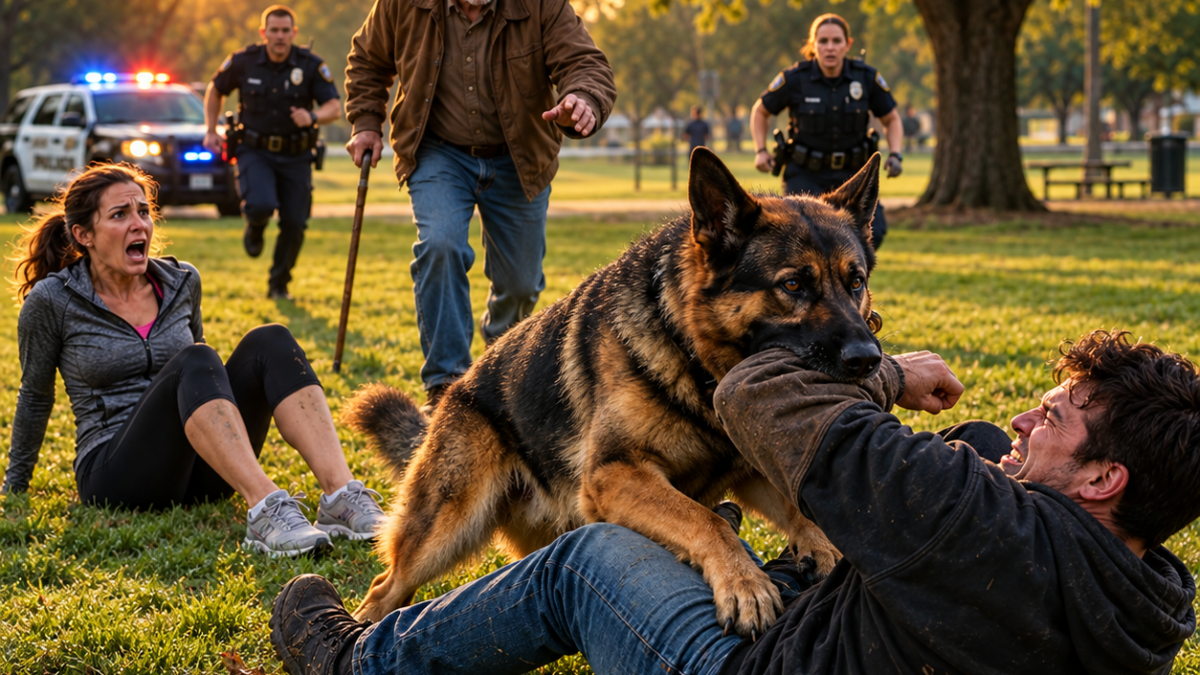
At 7:42, a woman came jogging along the tree line.
Thirty-five maybe.
Dark running clothes.
Ponytail.
Earbuds.
I noticed her because Duke noticed her.
His head lifted.
Not unusual.
Then he looked past her.
That was unusual.
A man was following.
At first, nothing about it looked wrong.
Jogger behind jogger.
Twenty yards apart.
Then the woman looked over her shoulder.
Once.
Twice.
She sped up.
The man sped up.
Duke stood.
I lowered the newspaper.
The woman left the paved path.
Cut across the grass toward the fountain.
The man followed.
I was already reaching for Duke’s leash when her shoe caught a raised root.
She went down hard.
Rolled.
Hit one knee.
Lost an earbud.
The fall knocked the wind out of her.
For half a second she made no sound.
Then she looked behind her.
The man was closing fast.
She screamed.
Once.
That was all.
Duke left.
I never gave a command.
Didn’t drop the leash deliberately.
One second he was beside me.
The next my hand closed on empty air.
Coffee hit pavement.
“Duke!”
He crossed forty yards like he was six years old again.
Head low.
Ears flat.
No wasted motion.
No bark.
I hadn’t seen him move that way in years.
The man saw him at maybe ten yards.
Changed direction.
Too late.
Duke hit him from the side.
Not reckless.
Controlled.
Exactly the way he’d been trained.
The man went down.
Duke secured the forearm.
Held.
No thrashing.
No repeated bite.
No loss of control.
Just pressure.
The man screamed.
I got my cane under me and moved as fast as an old knee and an older back allowed.
“Duke!”
No response.
“OUT!”
His jaw released instantly.
He backed.
Turned.
Looked at me.
For one second, he didn’t look old.
He looked like K14.
Working.
Waiting.
The man rolled onto his back holding his arm.
“You psycho!”
I ignored him.
“Duke, heel.”
Duke returned to my left side.
Sat.
His breathing was hard.
Mine worse.
Two other joggers had called 911.
The woman remained on the grass, one hand on her ankle, the other pressed against her chest.
“You okay?” I asked.
She nodded too quickly.
“No.”
Fair answer.
The man tried to stand.
I pointed my cane at him.
“I wouldn’t.”
He looked at Duke.
Sat back down.
A patrol car arrived four minutes later.
Officer Liam Parker.
Twenty-six.
Had been a rookie during my last year.
He saw me.
Saw Duke.
Saw the man.
His expression became complicated.
“Walter?”
“Morning.”
“What happened?”
The woman answered.
“He followed me.”
The man shouted:
“I was running!”
She shook her head.
“He followed me from Oak Street.”
Liam separated them.
Second unit arrived.
Statements.
EMTs.
Then Liam ran the man’s identification.
Radio response came back.
His face changed.
He looked toward his partner.
Then at me.
The man was wanted in two counties.
Assault.
Stalking complaint.
Failure to appear.
Another warrant involving an attempted abduction investigation.
Liam cuffed him.
Suddenly everyone looked at Duke differently.
That bothered me.
Five minutes earlier he had been an old dog who acted.
Now he was a hero because the man had warrants.
As if the paperwork changed what the woman experienced.
She sat on the edge of the ambulance bumper while EMTs wrapped her ankle.
Duke had returned to my side.
I checked his legs.
Shoulders.
Mouth.
No visible injury.
“Don’t ever do that again,” I muttered.
Duke licked his nose.
Unrepentant.
Then the woman said:
“Wait.”
I looked up.
She was staring at him.
Not casually.
Recognition.
“That’s him.”
“What?”
“The dog.”
I frowned.
“What dog?”
She pointed.
“That scar.”
Duke’s left flank had a thin white crescent hidden beneath fur.
Maybe four inches.
I’d seen it thousands of times.
His file said prior injury.
No details.
I had assumed kennel accident.
Training fence.
Something before he came to Fairview.
The woman stood despite the EMT telling her not to.
“I know that scar.”
“Ma’am.”
She shook her head.
“No, I know him.”
Duke watched her.
“That dog was in a news story years ago.”
I stared.
“What story?”
“The lake.”
“What lake?”
She searched my face.
“You don’t know?”
“Know what?”
“A little boy went into the water.”
She looked back at Duke.
“There was a police dog.”
“My mother showed me the article because my brother had a shepherd.”
She pointed.
“Same scar.”
I almost laughed from confusion.
“Duke never worked a lake rescue.”
Her eyes narrowed.
“Duke?”
“Yes.”
She went pale.
“No.”
“What?”
“The dog in the story wasn’t called Duke.”
The park seemed to get quieter.
I asked:
“What was he called?”
She stared at the old shepherd.
“Bishop.”
Duke’s ears moved.
One small movement.
Forward.
I felt it in my chest.
“Say that again.”
“Bishop.”
Duke stood.
Not fully.
Half rise.
Then settled again.
The woman noticed.
So did I.
My hand went to his collar.
“Where did you hear that name?”
“The article.”
“When?”
“Years ago.”
“What department?”
“I don’t remember.”
“State?”
She squeezed her eyes closed.
“Arizona maybe.”
Then:
“Camp Verde.”
That name meant nothing to me.
Duke’s records said he had entered Fairview’s police program as a two-year-old shelter transfer from a regional working-dog initiative.
No prior service.
No prior handler.
I knew because I’d read those records.
I had signed them.
The ambulance took the woman away.
Her name was Claire Donnelly.
Before leaving she wrote her number on the back of an EMT card.
“If I can find the article, I’ll call.”
I thanked her.
Then watched the patrol cars leave with the wanted man.
Fairview Park returned to normal.
Sprinklers.
Joggers.
Children.
But I didn’t.
I sat on the bench.
Duke beside me.
“Bishop.”
His left ear twitched.
“Duke.”
He looked up.
That was normal.
“Bishop.”
His eyes stayed on mine.
I felt ridiculous.
Dogs respond to tones.
Sounds.
Maybe it was coincidence.
Then I said:
“Who the hell were you before me?”
Duke lowered his head onto my boot.
We went home.
I didn’t sleep that night.
Duke’s service folder lived in the bottom drawer of my desk.
Blue cover.
FAIRVIEW POLICE DEPARTMENT
K9 UNIT
K14 — DUKE
I had looked at it hundreds of times.
Vet dates.
Certification scores.
Training notes.
Incident records.
Deployment logs.
Eight years.
Nothing before Fairview except three pages.
Estimated age: 2.
Shelter transfer.
Breed: German Shepherd.
Temperament evaluation.
Working aptitude.
No known prior handler.
No known prior police service.
But that night I read every line.
Then every blank space.
At the back of the folder was an envelope.
Brown.
Thin.
I had seen it before.
Never opened it.
PRIOR ARRANGEMENT.
I had assumed administrative correspondence.
Kennel donation.
Transport.
Something unimportant.
At sixty-eight, you should know better than to assume an unopened envelope is unimportant.
Inside was one photograph.
Glossy.
Faded.
Young German Shepherd.
Duke.
No doubt.
Same eyes.
Same narrow black stripe along the bridge of his nose.
Same white scar beginning on the left flank.
He sat beside a woman in police uniform.
Latina.
Early thirties.
Dark hair pulled back.
Hand resting on his chest.
Behind them:
Lake.
Patrol SUV.
On the vehicle door:
CAMP VERDE REGIONAL POLICE K9.
I turned the photograph.
Pencil.
Officer M. Reyes & K9 Bishop
Lake Verde
April 2011
My hands started shaking.
Duke had come to Fairview as a “two-year-old shelter transfer” in 2017.
The photograph was six years earlier.
That was impossible.
Unless the age was wrong.
Unless the records were wrong.
Unless everything before Fairview had been deliberately rewritten.
Duke walked over.
Rested his chin on my knee.
I stared down.
“Bishop.”
He didn’t move.
“Did you have another person?”
Tail hit the floor.
Once.
I almost stopped there.
Part of me didn’t want the answer.
That’s something retirement teaches you.
Truth is not automatically comforting just because it’s true.
But I had been a cop thirty-one years.
Retired cops are terrible at leaving unanswered questions alone.
Next morning, I started making calls.
Camp Verde Regional Police no longer existed under that exact name.
Merged.
Reorganized.
Transferred jurisdiction.
First officer I reached had never heard of Maria Reyes.
Second didn’t have access to old canine records.
Third sent me to archives.
Fourth call reached Donna Kellerman.
Records clerk.
Thirty-three years with the department.
I said:
“I’m looking for an Officer M. Reyes.”
Silence.
“Maria?”
“I don’t know.”
“K9 handler?”
Longer silence.
“Why?”
“I think I have her dog.”
Nothing.
Then:
“Who is this?”
“Walter Briggs. Retired Fairview PD.”
“What dog’s name?”
“Mine is Duke.”
“No.”
She said it too quickly.
I looked at Duke lying near kitchen doorway.
“The photograph says Bishop.”
Donna inhaled.
“Where did you get that name?”
“An old photo.”
“Describe the dog.”
“German Shepherd.”
“Scar?”
“Yes.”
“Left flank?”
“Yes.”
I heard her chair creak.
“Mr. Briggs.”
“Yes?”
“Maria Reyes died seven years ago.”
Everything in my kitchen seemed to stop.
“How?”
“Line of duty.”
I held the table edge.
“What happened to the dog?”
Donna didn’t answer.
“Donna.”
“Officially?”
“Yes.”
“Transferred out.”
“To where?”
“That’s complicated.”
“Try me.”
She lowered her voice.
“Domestic disturbance.”
“Maria responded first.”
“Situation deteriorated.”
“Suspect was armed.”
“Maria was killed inside the residence.”
I looked at Duke.
“Bishop?”
“Survived.”
“Injured?”
“Yes.”
“The scar?”
“Probably from that night.”
My throat tightened.
“What happened after?”
“Bishop stopped working.”
“What does that mean?”
“Wouldn’t engage a new handler.”
“Wouldn’t enter buildings.”
“Became reactive around certain calls.”
“Department classified him unsuitable.”
“And erased his history?”
“That’s not how they described it.”
“How did they describe it?”
“Placement simplification.”
I laughed once.
Ugly sound.
Donna continued.
“The department had liability concerns.”
“There had already been criticism over Maria’s death.”
“Response delays.”
“Supervision.”
“Communications failure.”
“Having her traumatized K9 sitting in the kennel became part of the story nobody wanted revisited.”
“So they transferred him.”
“Through a rescue intermediary.”
“New name.”
“Clean history.”
“Then Fairview trained him again.”
Donna was quiet.
“I guess.”
I looked at Duke.
Six good years beside me.
Arrests.
Searches.
Missing children.
Narcotics.
Tracking.
School demonstrations.
He had worked.
Beautifully.
They hadn’t erased a broken dog.
They had erased a dog who needed time.
“Why didn’t anyone tell me?”
“I don’t know.”
“Yes, you do.”
Donna sighed.
“Because if Fairview knew he had prior K9 service tied to a handler death, they might not have accepted him.”
There it was.
Administrative convenience.
A living history edited to fit a form.
I sat down.
“Was there a lake rescue?”
Donna went silent again.
“Yes.”
“Tell me.”
“Before Maria died.”
“Bishop was about two.”
“Boy wandered off during a family picnic near Lake Verde.”
“Went into the water.”
“Maria was searching shoreline with Bishop.”
“Dog entered water before anyone found the child.”
“He pulled the boy’s jacket close enough for Maria to reach him.”
“Local paper ran it.”
Claire had remembered.
The scar in the photograph.
The name.
Then I asked:
“Why did Duke—Bishop—run toward that woman yesterday?”
“How would I know?”
But I did.
Not completely.
Enough.
Woman falls.
Man closes distance.
A scream.
Duke had watched his first handler die after a call where danger moved faster than backup.
Somewhere beneath all the new commands and new years, that pattern had remained.
Person down.
Threat approaching.
Move.
I couldn’t prove a dog’s internal memory.
Nobody could.
But the resemblance was hard to ignore.
That night, I sat on the porch.
Duke at my feet.
“You watched her die.”
His ears lifted.
“And they changed your name.”
He pressed closer.
“They sent you away.”
I put my hand on his head.
“And somehow you still trusted me.”
That broke something in me.
I had spent years thinking I rescued him from a shelter pipeline.
Maybe Duke had rescued me from something else.
My wife Helen died four years into my partnership with Duke.
Breast cancer.
Fast at the end.
After the funeral, I returned to work too early.
Everyone told me.
I ignored them.
Duke did not.
For months he followed me differently.
Closer.
At night, if I fell asleep in the recliner, he’d place himself between me and the front door.
I thought it was training.
Maybe it was grief recognizing grief.
Maybe that old dog knew exactly what it was to wake up and discover your person was gone.
I called Donna again.
“Maria have family?”
“Sister.”
“Name?”
“Elena Reyes.”
“Where?”
“Last address is old.”
“Can you contact her?”
Donna paused.
“She used to call.”
“How often?”
“Every year.”
“About Bishop?”
“Yes.”
My chest hurt.
“What did you tell her?”
“That we didn’t have current placement information.”
“You did.”
“Not by the time she called.”
“Someone did.”
“Yes.”
“Did she think he was dead?”
“She didn’t know.”
I closed my eyes.
“Find her.”
It took eleven days.
Donna found an old emergency contact.
That led to a former landlord.
That led to a school district.
Elena Reyes worked cafeteria service in a town two hours away.
I called.
I had spent a career telling families things they did not want to hear.
Death notifications.
Accidents.
Arrests.
I had never been as nervous making a phone call as I was dialing Elena.
She answered.
“Hello?”
“Ms. Reyes?”
“Yes.”
“My name is Walter Briggs.”
Pause.
“I’m a retired police officer.”
Longer pause.
“I need to ask you about your sister Maria.”
No answer.
“And her K9.”
I heard breath.
“What K9?”
“Bishop.”
Silence.
Then:
“Who are you?”
“I think Bishop has been living with me for eleven years.”
I heard something hit a counter.
“That’s not funny.”
“I know.”
“He disappeared.”
“I know.”
“They told us he was transferred.”
“He was.”
“No one would tell me where.”
“I know.”
Her breathing became uneven.
I said:
“He’s alive.”
Elena cried.
Not loud.
That made it worse.
She asked only one question.
“Does he have a scar on his left side?”
“Crescent-shaped?”
“Yes.”
“Yes, ma’am.”
She tried to speak.
Couldn’t.
Finally:
“I’ll come Saturday.”
Fairview Park.
Third bench.
Gray morning.
I got there early.
Duke beside me.
I had told myself the meeting might mean nothing to him.
Dogs don’t understand family relationships.
Seven years had passed since Maria died.
Eleven since the photograph.
Memory in dogs works differently.
Scent matters.
Routine.
Association.
Elena wasn’t Maria.
I prepared myself for Duke to treat her like any stranger.
9:07.
Ride-share car stopped.
Woman stepped out.
Late forties.
Gray coat.
Dark hair.
Canvas bag clutched against chest.
She walked twenty feet.
Stopped.
Duke raised his head.
I felt his leash shift.
His ears came forward.
Not alarm.
Focus.
Elena whispered:
“Oh my God.”
Duke stood.
I loosened my grip.
He walked.
Slow.
Then quicker.
Elena dropped the canvas bag.
“Bishop.”
The name carried across the grass.
Duke stopped.
Five feet away.
Head tilted.
“Bishop.”
Elena sank to her knees.
She held one hand out.
Duke approached.
Sniffed.
Then pressed his head against her legs.
Not excitement.
No jumping.
No barking.
Just pressure.
The same grounding gesture he’d used on me hundreds of times.
Elena made a sound I will never forget.
Half sob.
Half laugh.
She wrapped her arms around his neck.
“Bishop.”
Her face disappeared into gray fur.
“I found you.”
Duke stood motionless.
Then gave one low, trembling exhale.
I looked away.
Some moments are not improved by witnesses.
Elena stayed on the grass a long time.
When she finally stood, her knees were wet.
She didn’t care.
We sat.
Duke between us.
She opened the canvas bag.
Inside:
photographs.
Maria with Bishop as a puppy.
Maria sleeping beside a kennel.
Maria in uniform.
Bishop wearing a ridiculous red bandanna.
Maria by Lake Verde.
The rescue article.
Headline:
K9 BISHOP HELPS SAVE MISSING BOY FROM LAKE
There it was.
Claire’s memory.
Elena touched the newspaper clipping.
“Maria trained him from eight weeks.”
I stared.
“Department records said he entered a police program later.”
“No.”
“She picked him herself.”
“Why wasn’t any of this transferred?”
Elena laughed bitterly.
“Because the department wanted Maria’s case to disappear.”
She told me the full story.
Maria Reyes was thirty-two.
Patrol officer.
K9 handler.
Believed dogs were better police partners because they didn’t care about department politics.
Bishop was her life.
Her sister said Maria slept in the kennel room during his first week because he cried when left alone.
Trained him every day.
Swimming.
Tracking.
Article searches.
Suspect apprehension.
Community demonstrations.
The lake rescue made local news.
But what defined them was the domestic call.
Maria responded to a house where neighbors reported screaming.
Backup delayed.
Communications confusion.
She entered because a child was believed inside.
Bishop with her.
Suspect ambushed from interior hallway.
Maria was hit.
Bishop engaged.
He was cut and struck during the fight.
Scar.
The child escaped through a rear room.
More officers arrived.
Suspect arrested.
Maria died before reaching hospital.
Bishop survived.
Then refused to accept another handler.
Wouldn’t enter similar houses.
Would stand outside and shake.
He had become inconvenient evidence of what happened.
A lawsuit followed.
Questions about why Maria entered without backup.
Radio delays.
Supervisory failures.
The department quietly moved Bishop.
Elena called every year.
No answer.
“I thought maybe they euthanized him.”
She stroked his head.
“I thought he spent his last day waiting for Maria.”
“No.”
My voice broke.
“No, he didn’t.”
She looked at me.
“He had you.”
“I had him.”
Elena smiled.
“Same thing.”
We sat nearly two hours.
At one point Duke put his head in my lap.
Elena watched.
“He does that with you.”
“Every night.”
“Maria said he always knew when something was wrong before she did.”
I looked toward the place where Claire had fallen.
“Maybe he remembered.”
Elena followed my gaze.
“What?”
I explained.
Woman running.
Falling.
Man approaching.
Scream.
Duke’s reaction.
Elena closed her eyes.
“Maria was on the floor when Bishop got between her and the shooter.”
I didn’t speak.
She opened her eyes.
“Maybe he saw it again.”
“Dogs don’t think in stories.”
“No.”
She touched Duke.
“But they remember feelings.”
That was the best explanation I ever heard.
Elena did not ask to take him.
I had been afraid she might.
Ashamed of the fear.
But there.
She looked at Duke settled beside my boot.
“This is his home.”
“You’re sure?”
“Yes.”
“He loved Maria.”
“I know.”
“And he loves you.”
My eyes burned.
Elena smiled.
“Dogs get to have more than one person.”
That sentence freed something in me too.
I had been feeling like a thief.
As though eleven years with Duke somehow belonged to a dead woman.
Elena understood before I did.
Love does not become false because something came before it.
She asked for one thing.
“Can I visit?”
“Anytime.”
She did.
Every few weeks.
Two-hour drive.
Fairview Park.
Third bench.
Sometimes she brought coffee.
Better coffee than mine.
Duke learned her car.
Would stand before she reached us.
Then greet her with that same quiet press.
We pieced together his two lives.
Bishop.
Duke.
Maria.
Walter.
Camp Verde.
Fairview.
Not contradiction.
Continuity.
Donna eventually released more old records after public-records review.
Internal memos.
Transfer documents.
One sentence made me furious.
Reassignment recommended under neutral identity to improve future working placement.
Neutral identity.
They had turned history into a liability and solved it with an eraser.
Elena pushed for correction.
So did I.
At first, the old department resisted.
Administrative complications.
Records retention.
Liability.
Then Claire’s park incident became local news.
Reporter found Duke’s prior identity.
Suddenly hiding looked worse than correcting.
Fairview PD supported us.
Chief Liam—no longer the young officer from the park by then, but now a lieutenant—said:
“He earned both records.”
That helped.
Six months later, Camp Verde Regional held a ceremony.
Small.
No media circus.
Maria’s family.
Former officers.
Fairview representatives.
Elena.
Me.
Duke.
They restored Bishop’s K9 service record.
Recognized Maria’s line-of-duty death publicly in connection with her canine partner.
Acknowledged the Lake Verde rescue.
Acknowledged Bishop’s transfer.
No dramatic confession.
Institutions rarely confess dramatically.
Language was careful.
But his name returned.
Bishop.
K9 27.
Maria Reyes’s partner.
At the ceremony, a framed photograph of Maria stood on an easel.
Same one from the old envelope.
After speeches, people moved toward refreshments.
Duke stayed with me.
Then he pulled slightly.
Not hard.
I looked down.
He walked toward the photograph.
Sat.
Right in front of it.
Head high.
Still.
Elena covered her mouth.
Nobody called him.
Nobody touched him.
He remained there nearly three minutes.
Maybe he recognized Maria.
Maybe scent on an old photograph is impossible after that long.
Maybe he recognized Elena’s emotion.
Maybe he simply liked the spot.
I stopped trying to explain everything Duke did.
Some things can matter without becoming proof.
When he finally stood, he returned to me.
I scratched his neck.
“Ready?”
He looked toward Elena.
Then me.
Two lives.
One dog.
We left together.
Duke lived three more years.
Good years.
Slower each season.
Hip medication.
Shorter walks.
No more apprehension demonstrations.
No stairs if I could avoid them.
Fairview Park remained our morning place.
Third bench.
Elena still visited.
Claire visited once too.
The woman whose scream had started everything.
She brought flowers.
Felt silly and admitted it.
Duke sniffed them.
Sneezed.
Claire laughed.
The man who followed her eventually received prison time on older charges and the case connected to that morning.
Claire moved away.
Before leaving she told me:
“I don’t know what would’ve happened if Duke wasn’t there.”
I said:
“Neither do I.”
She crouched.
“Thank you.”
I expected Duke’s head.
Instead she looked at me.
“For letting him keep being who he was.”
That stayed with me.
Retirement is strange for working dogs.
And working men.
You spend decades being necessary.
Then someone hands you paper saying you’re finished.
Badge turned in.
Radio silent.
No calls.
No one needs your response time.
At first I thought Duke’s peaceful retirement meant he had forgotten work.
I had hoped that for him.
Then the park showed me something different.
He hadn’t forgotten.
He had simply learned not every morning required it.
There is dignity in that.
Capacity without constant deployment.
Strength at rest.
I learned from him.
Helen had been dead eight years by then.
For years after her death, I behaved like grief was a case I could solve by staying busy.
I retired because my body told me.
Not because I knew how to stop.
Duke knew before I did.
He made stopping look possible.
Sit beneath tree.
Watch.
Breathe.
Go home.
Eat.
Sleep.
Repeat.
Elena told me Maria had been the same.
Always working.
Always volunteering.
Always taking extra shifts.
Bishop forced her outside.
Walks.
Training.
Lake.
“He made her have a life,” Elena said.
I understood.
Dogs do that.
They tether us to ordinary things.
Water bowl.
Morning walk.
Food.
Weather.
The present.
Duke’s final morning came in October.
Fourteen years old.
Cold sunrise.
He did not get out of bed.
He looked at me.
Tail moved once.
I knew.
Vet came to the house.
Elena drove two hours.
Made it in time.
We lay on the living room floor.
Duke’s head across my thigh.
Elena held one paw.
She whispered:
“Bishop.”
I said:
“Duke.”
His ears barely moved at both.
The vet gave him medication.
His breathing slowed.
I put my hand on the scar along his flank.
The scar that had opened his hidden history.
“You did enough, partner.”
Elena was crying.
So was I.
He went quietly.
No uniform.
No badge.
No command.
Just two people who knew him by different names.
Afterward, Elena asked:
“What do we put on the marker?”
I didn’t know.
Bishop felt important.
Duke felt true.
Neither cancelled the other.
We buried him near Fairview Park’s tree line with permission from the town.
Near the stretch of grass he’d crossed that morning.
Small stone.
Nothing elaborate.
It reads:
BISHOP
ALSO KNOWN AS DUKE
K9 PARTNER
LOYAL IN EVERY LIFE HE WAS GIVEN
Elena added one more line.
HE NEVER STOPPED WATCHING OVER THE PEOPLE HE LOVED.
I couldn’t improve it.
For a while, I stopped going to Fairview Park.
The third bench felt wrong without him.
Then one morning Elena came to my house.
“You’re going.”
“No.”
“Yes.”
“I don’t need supervision.”
“Apparently you do.”
She drove.
We sat on the third bench.
No dog.
That hurt.
A young officer walked past with a working shepherd.
The dog glanced toward us.
My chest tightened.
Elena touched my arm.
“Different dog.”
“I know.”
“Different story.”
“I know.”
We kept sitting.
Eventually the park became a park again.
Not only where Duke saved Claire.
Not only where Elena found Bishop.
Just grass.
Sprinklers.
Children.
Morning.
That mattered.
Fairview Police later created a better retired-K9 records policy.
Full prior history where legally available.
Handler transitions documented.
Trauma and prior service not erased simply to make placement easier.
One captain asked me to help write it.
I did.
The old Camp Verde department also corrected archival files.
Maria’s personnel record now references Bishop properly.
The Lake Verde rescue returned to the public archive.
A photograph of Maria and Bishop hangs in their training room.
Elena sent me a picture.
Under it:
Officer Maria Reyes & K9 Bishop
Partners in Service
I stared at that photo a long time.
Then I placed my own beside it.
Me and Duke.
Fairview PD.
Partners too.
That is the thing people kept asking after the story got around.
“Whose dog was he really?”
Maria’s?
Mine?
The department’s?
Elena’s connection?
Wrong question.
Dogs aren’t stories you own.
Bishop belonged to Maria in one chapter.
Duke belonged with me in another.
Both relationships were real.
Neither stole from the other.
He had two names because people gave him two lives.
Maybe more.
The years between Maria’s death and Fairview remain incomplete.
There are gaps.
A foster kennel.
A shelter placement.
Training evaluation.
People whose names I never found.
At first those missing pages bothered me.
Old cop instinct.
Incomplete file.
Need closure.
Eventually I stopped.
Duke wasn’t paperwork.
The file could never contain him.
No file recorded how he leaned his whole body against my leg when Helen died.
No incident report captured the way he waited outside the bathroom every morning.
No certification score recorded how gently he approached Elena the first time she whispered Bishop.
Records matter.
But records are not memory.
They only point toward it.
Claire once asked me:
“Do you think he saved me because I reminded him of Maria?”
I answered carefully.
“I don’t know.”
She looked disappointed.
People want certainty around miracles.
I said:
“He knew you were in trouble.”
“Yes.”
“He knew someone was moving toward you.”
“Yes.”
“And he decided to act.”
“Without you telling him.”
“Yes.”
“Why?”
I looked toward Duke’s marker.
“Maybe because once in his life he wasn’t fast enough to save the person he loved.”
Claire swallowed.
“That’s sad.”
“Yes.”
“Or maybe he was just trained.”
“Yes.”
“Which do you believe?”
“Both.”
Training becomes instinct.
Experience shapes instinct.
Grief shapes behavior.
Love shapes behavior.
You don’t have to choose one explanation.
Duke was trained to protect.
He had also lost Maria.
Both can be true.
That’s what Elena meant when she said loyal things learn to hold two truths at once.
Duke and Bishop.
Walter and Maria.
Past and present.
Retired and ready.
Old and still capable.
The town installed a plaque near the third bench two years after his death.
I argued against anything sentimental.
Lost.
Elena won.
Of course.
It says:
K9 BISHOP “DUKE”
Served Camp Verde and Fairview
His final public apprehension began without a command and ended with a life protected.
I told the mayor that was too dramatic.
Mayor said:
“You’re too grumpy.”
Also true.
Kids read it.
Some ask me if I knew him.
I say:
“Yeah.”
“What was he like?”
“Hungry.”
They laugh.
“Was he brave?”
“Yes.”
“Was he smart?”
“Smarter than some officers.”
Adults laugh harder.
Then sometimes a child asks:
“Did he remember his first owner?”
That question still gets me.
I look toward the tree line.
“I think he remembered something.”
“What?”
“Love.”
Sounds sentimental.
Maybe it is.
At sixty-eight, I would’ve rolled my eyes at myself.
At seventy-three, I care less.
Duke’s story changed how I thought about memory.
We imagine memory as pictures.
Names.
Dates.
But bodies remember too.
A shoulder tightens.
A heart speeds up.
A dog hears a scream.
A man smells hospital disinfectant.
A woman sees a crescent-shaped scar and remembers an old newspaper article.
Not all memory speaks in sentences.
Duke carried Maria without being able to tell me.
And I carried Helen in ways I couldn’t explain either.
Maybe that’s why we worked.
Two old creatures with histories neither fully understood.
Watching doors.
Sitting quietly.
Learning that safety can be ordinary.
The stranger in the park was named Claire.
People ask why Duke risked himself for someone he didn’t know.
I used to answer:
Training.
Now I think the better answer is simpler.
Because she needed him.
Dogs rarely complicate morality the way humans do.
They don’t ask whether you’re family.
Whether you deserve help.
Whether somebody will post it online.
Duke saw danger.
Moved.
That was enough.
And somehow that one decision returned his own past to him.
If Claire hadn’t screamed, I might never have opened the envelope.
If Duke hadn’t crossed the grass, Claire might never have noticed the scar.
If she hadn’t recognized the old lake story, I might never have called Donna.
If Donna hadn’t remembered Maria, Elena might have died never knowing what became of Bishop.
One moment.
Then another.
Eleven years of hidden history unraveling because an old dog refused to stay on a bench.
That’s what stays with me.
Not the takedown.
Not the wanted man.
Not the news story.
The chain.
Duke saved a stranger.
The stranger gave Duke his first name back.
That name led us to Maria.
Maria led us to Elena.
Elena gave Duke the missing half of his own story.
And in return, Duke gave her something nobody else had been able to give.
Proof that Maria’s partner had survived.
Had been loved.
Had continued serving.
Had not died forgotten in a kennel after the worst night of his life.
Elena told me once:
“For seven years, I imagined Bishop alone.”
She looked at me.
“Now when I think of those years, I see him with you.”
That may be the kindest thing anyone ever said to me.
Because for a while I feared I had unknowingly benefited from Maria’s loss.
Elena taught me that life isn’t divided that way.
Someone can lose.
Someone else can love what remains.
That love does not steal from the first.
It honors survival.
I keep the original photograph now.
Maria and Bishop.
Lake behind them.
In the same frame, I put a photograph of me and Duke outside Fairview Police Department on our retirement day.
Two handlers.
Same dog.
Different names.
Different years.
Same eyes.
On the back I wrote:
He found his way through both lives.
Then underneath:
So did we.
I don’t know who will read that after I’m gone.
Maybe nobody.
That’s all right.
Some truths don’t need audiences.
They just need to be written down.
Duke taught me that too.
Or Bishop did.
Depends which part of the story you’re telling.
I still call him Duke when I talk to him in my head.
Elena still calls him Bishop.
Neither of us corrects the other.
We stopped needing one name to defeat the other.
Every few weeks, Elena still drives to Fairview.
We sit on the third bench.
Sometimes talk about Maria.
Sometimes Helen.
Sometimes nothing.
Old grief doesn’t always need discussion.
Sometimes it needs company.
Sprinklers tick.
Joggers pass.
Children shout near the baseball diamond.
And every once in a while, some dog tears across the grass chasing a ball and for half a second both of us turn our heads too quickly.
Then we smile.
Not yet.
Wrong dog.
But the memory is warm now.
Mostly.
Duke spent the last years of his life with the truth restored.
His first handler remembered publicly.
His original name returned.
His second handler beside him.
Elena in his life.
No secret file.
No erased history.
No missing chapter.
People like to say he risked everything for a stranger that morning.
Maybe.
He was old.
A younger suspect could have hurt him.
He didn’t know.
He simply went.
But I sometimes think the bigger risk happened years earlier.
After Maria died.
After people moved him.
Renamed him.
Put him in another program.
At some point, Duke had to trust another handler.
Me.
That’s risk too.
To lose your person and still attach again.
To know, in whatever way a dog knows, that love can disappear and choose it anyway.
Humans struggle with that.
Duke didn’t.
Or he struggled and did it anyway.
That’s courage.
Not fearlessness.
Choosing connection after loss.
When I think about him now, that’s the part I remember most.
Not teeth around a suspect’s arm.
Not the badge.
Not the lake rescue.
Not even the scar.
I remember an old shepherd walking across wet grass toward Elena Reyes after eleven years.
Slow.
Gray.
Stiff in one hip.
Hearing a name he had not heard in almost a decade.
Bishop.
Stopping.
Looking.
Then continuing.
Until his head rested against her knees.
That was the moment the whole story came home.
A woman found the last living piece of her sister’s partnership.
An old cop discovered his dog had trusted him with a second life.
And Duke learned, if dogs can learn such things, that the people from his first one had never stopped looking.
All because a stranger screamed once in a park.
And an old K9 decided the badge on his collar still meant something.

