When I Was 11, I Gave Half My Perfectly Cut Lunch to a Stranded Biker Everyone Else Feared—Four Days Later, the Sound Coming Down Our Dirt Road Stopped My Mom’s Farm Auction Cold.
PART3:
For three months after Dad died, I could not sit at the kitchen table because his chair was empty.
Mom did not make me.
She moved my place to the counter.
That was how Claire Walker loved people.
Not perfectly.
Practically.
Mom was thirty-nine then.
Brown hair she kept tied back.
Strong hands.
Always moving.
Before Dad died, she handled calves, bookkeeping entries he gave her, meals, my school meetings, and everything nobody calls farm labor because there is no tractor involved.
After Dad died, she inherited all the things he had hidden inside his own brain.
Loan dates.
Milk contracts.
Feed terms.
Water allocations.
Equipment notes.
Insurance.
Property taxes.
Which neighbor could repair a hydraulic line after six.
Which salesman lied about delivery dates.
Which cow kicked left.
Dad knew everything.
Then suddenly Mom had to.
She tried.
I did not understand how badly things were going.
Children know more than adults believe and less than adults fear.
I knew Mom stopped buying coffee from the drive-through.
I knew she canceled satellite television.
I knew she started cutting toothpaste tubes open to scrape what remained.
I knew she cried in the barn sometimes.
I knew a man named Martin Vale from Central Valley Agricultural Bank visited twice.
He wore clean boots.
That detail bothered me.
Anyone walking around our farm should have dirty boots.
Vale never did.
He stood at our kitchen table with a leather folder and spoke slowly to Mom.
I heard words.
Delinquency.
Acceleration.
Secondary note.
Collateral.
Foreclosure.
I searched some of them later on Dad’s old laptop.
That was when I understood the farm could stop belonging to us.
I asked Mom.
“Are they taking the house?”
She froze.
“No one is taking anything today.”
That was not my question.
“Later?”
She closed her eyes.
“We’re working on it.”
“Does that mean yes?”
“It means I don’t know.”
I appreciated that.
Adults often lie because they think uncertainty is harmful to children.
For me, false certainty was worse.
That summer was dry even by Bakersfield standards.
The hay fields produced less than half what Dad had expected.
Feed prices climbed.
Our tractor transmission began slipping.
The dairy cooperative delayed a payment because of a pricing dispute.
Then an irrigation pump failed.
Mom used credit to repair it.
Then credit to buy feed.
Then she discovered Dad had refinanced a portion of the farm three years earlier to cover improvements and medical bills from my early childhood.
There were two loans.
One manageable.
One not.
The second note belonged to a smaller agricultural lending subsidiary tied to Central Valley Agricultural Bank.
Balance outstanding was far higher than the number needed to stop foreclosure.
That distinction became important later.
At eleven, I only knew Friday was coming.
Friday meant auction.
Tuesday came first.
At 12:27, I walked toward my tree.
My noise-canceling headphones rested around my neck.
It was hot enough that the air above the road seemed to move.
My lunchbox felt cool against my palm.
Then I heard an engine.
Motorcycles had patterns.
Dad taught me the four-stroke cycle when I was eight.
Intake.
Compression.
Power.
Exhaust.
Engines communicate through repetition.
This motorcycle sounded wrong.
The rhythm broke.
Caught.
Recovered.
Broke again.
I stopped walking.
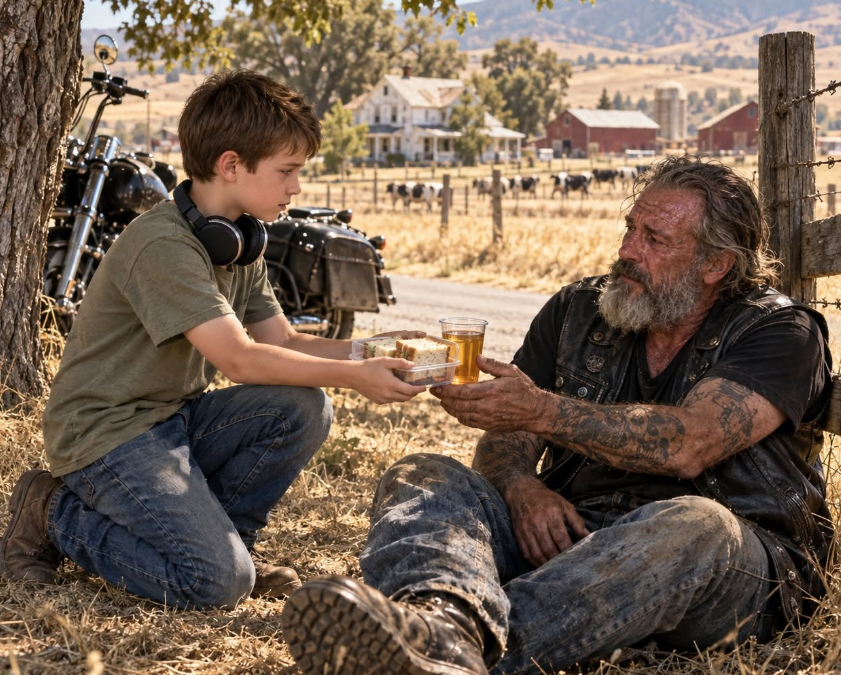
The motorcycle appeared on County Road 14.
Large touring bike.
Black.
The rider slowed.
Engine coughed.
Then stopped beside our fence.
He put one boot down.
For about three seconds he remained upright.
Then he climbed off, took three steps, and sat hard in the dust.
I knew something was wrong.
Not because he was a biker.
Not because he was enormous.
Because his body was giving me data.
Face red.
Skin wet.
Hands trembling.
Breathing too fast.
Poor balance.
He wore a black leather vest even though the temperature was over one hundred degrees.
Gray beard.
Scar from his left cheek toward his jaw.
Tattoos.
If I had been a different child, I might have been frightened.
I was more interested in the symptoms.
“You are overheating.”
His eyes opened.
“What?”
“You are sweating excessively, your balance is unstable, and your skin is flushed.”
He stared at me.
“Kid, where’s your mom?”
“At the house.”
“Go there.”
“You need fluids.”
“I said go home.”
I did not move.
Adults sometimes interpreted that as defiance.
Often I was processing.
The man wiped sweat from his face.
“Seriously.”
“You should lie in shade.”
“I’m fine.”
“That statement conflicts with observable evidence.”
He stared.
Then laughed once.
It hurt him.
He grabbed his side.
I noticed.
“Are you injured?”
“Old rib problem.”
“What happened?”
“Motorcycle crash a long time ago.”
“How long?”
He squinted.
“Why?”
“You said old.”
“About twelve years.”
“That qualifies.”
He laughed again.
“You always talk like this?”
“Yes.”
His motorcycle ticked as the engine cooled.
I looked at my watch.
12:29.
Lunch.
I sat beneath the cottonwood.
The man remained near the fence.
I opened my lunchbox.
Four squares.
Perfect.
12:30.
I picked up the first.
Then looked at him.
He had placed both hands against the ground.
His shoulders sagged.
Dad had rules.
Never stand behind a horse.
Close gates.
Disconnect battery ground before working on electrical systems.
Do not touch hydraulic fluid with bare hands.
But Dad had one rule that outranked convenience.
If something is hurt, help first.
I looked at my sandwich.
Four squares.
My stomach tightened.
Routine had already been disrupted by the motorcycle.
Giving away food would make it worse.
I pressed my fingers together.
Once.
Twice.
Four times.
Then I carried the container to the fence.
“Eat.”
The man opened one eye.
“Is that your lunch?”
“Yes.”
“No.”
“You need calories and fluid.”
“I’m not stealing lunch from a kid.”
“I am giving it to you. That is not stealing.”
“I’ll manage.”
“You are bigger than me and currently in worse condition.”
His eyebrows rose.
“That’s cold.”
“It is accurate.”
I held out the container.
He looked at my hand.
Then the sandwich.
Then me.
“Half.”
I considered.
Four divided evenly.
Two and two.
That was manageable.
I handed him two squares.
He ate slowly.
I poured apple juice into the thermos cup.
“You need this.”
“Kid—”
“Apple juice contains water and sugar.”
“I know what juice is.”
I waited.
He took it.
After drinking, his hands stopped shaking as much.
His color changed.
Not normal.
Better.
He leaned back against the fence post.
“You got a name?”
“Ethan Walker.”
“They call me Bear.”
“That is biologically inaccurate.”
For several seconds he stared.
Then laughed hard enough to cough.
“Daniel Cross.”
“Daniel is more plausible.”
“Good to know.”
He handed back the thermos.
I looked at my remaining sandwich.
Two squares.
Then at him.
His breathing was still too fast.
I gave him another.
“No.”
“Eat.”
“You need food too.”
“I will have one remaining square.”
“That isn’t lunch.”
“It is twenty-five percent of lunch.”
He stared.
“Kid.”
I waited.
He ate it.
Then eventually the fourth.
That was harder.
I remember watching him chew while everything inside me insisted something had gone wrong.
At 12:34 I should have had no sandwich.
At 12:34 normally I would have finished two squares.
The sequence was broken.
I pressed my fingers together rapidly.
Daniel noticed.
“You okay?”
“Yes.”
“You sure?”
“I dislike changes.”
He looked at the empty container.
“Because you gave me the sandwich?”
“Yes.”
His face changed.
“I didn’t know.”
“You required it more.”
He looked down.
For some reason, that seemed to hurt him.
“You hungry?”
“Yes.”
“I’m sorry.”
“You did not force me.”
He reached into a pocket.
Pulled out a red bandanna.
White geometric shapes repeated across it.
Paisley, I learned later.
He folded it.
Held it toward me.
“You take this.”
“Why?”
“Because where I come from, someone feeds you when you’ve got nothing, you remember them.”
“I don’t need compensation.”
“It isn’t payment.”
I examined the pattern.
Repeated curves.
Symmetry.
Predictable.
I liked it.
“Okay.”
He smiled.
Then I said:
“It doesn’t matter because we will not be here next Tuesday.”
His smile disappeared.
“What?”
“The farm is being sold Friday.”
He sat straighter.
“What do you mean sold?”
“Foreclosure auction.”
“How old are you?”
“Eleven.”
“How do you know that phrase?”
“I can read.”
He almost smiled.
“What happened?”
I told him.
Not emotionally.
Facts.
Dad died February 3.
Drought.
Feed.
Tractor.
Loan.
Martin Vale.
Auction.
Corporate buyer.
Cattle probably sold separately.
“Mom says we might move to my aunt’s apartment.”
“Where?”
“Fresno.”
“You don’t want to?”
“There is no cottonwood tree.”
He watched me.
“My room will be gone.”
I could feel my fingers begin moving again.
“The milking shed will be gone.”
“Ethan—”
“Tuesday lunch happens here.”
He did not say, “Everything will be okay.”
That mattered.
Adults often offered guarantees they did not own.
Instead Daniel asked:
“How much does your mother owe?”
“I do not know.”
“You know the bank?”
“Central Valley Agricultural.”
His eyes narrowed.
“Who’s handling it?”
“Martin Vale.”
Something changed in his expression.
“You know him?”
“No.”
But Daniel looked toward the farmhouse differently now.
A pickup stopped twenty minutes later.
Driver named Frank.
He had tools and water.
Daniel’s motorcycle problem was a fuel-line issue combined with a charging problem.
They patched it enough for him to ride.
Before leaving, Daniel looked at the red bandanna in my hands.
“Keep that.”
“You already said that.”
“Making sure.”
“For how long?”
He smiled.
“No expiration.”
He started the motorcycle.
I covered my ears until the engine settled.
He noticed.
Immediately lowered the throttle.
Then he rode away.
Mom came running from the house less than a minute later.
“Ethan!”
She had binoculars because she used them to check cows in the far pasture.
“I saw motorcycles.”
“One.”
“Who was that?”
“Daniel.”
“Daniel who?”
“Cross.”
Her face was pale.
“What was he doing?”
“Overheating.”
“Did you go near him?”
“Yes.”
“Ethan.”
“He required food.”
She looked at my empty lunchbox.
“You gave him your lunch?”
“Yes.”
“All of it?”
“He needed four squares.”
For one second Mom looked as though she might laugh or cry.
Instead she hugged me.
Too quickly.
Too tight.
My shoulders stiffened.
She immediately loosened her arms.
“Sorry.”
I stayed.
After several seconds, I leaned toward her.
That was my version of giving permission.
She held me again.
Friday arrived.
I did not sleep much Thursday night.
Mom packed boxes until after midnight.
Not everything.
Only things she considered irreplaceable.
Dad’s photographs.
Marriage certificate.
My school records.
Grandpa’s pocketknife.
Grandma’s recipe book.
I organized my objects by probability of loss.
Highest priority:
Dad’s metal ruler.
My engine manuals.
Red bandanna.
Headphones.
Family photograph.
At 7:15 Friday morning, vehicles began arriving.
Pickups.
SUVs.
Two expensive black trucks belonging to people from San Joaquin Land & Produce.
That was the company everyone expected to buy us.
They had purchased three nearby farms in five years.
Then removed houses, consolidated fields, leased water rights, and converted some acreage into almond operations.
Dad disliked them.
“Nothing wrong with big farms,” he once told Mom. “Problem starts when money thinks people are obstacles.”
I had memorized that.
Martin Vale arrived at 8:05.
Clean boots.
Again.
He spoke privately with Mom near the barn.
I sat close enough to hear.
“You still have the option to vacate voluntarily by Monday.”
Mom folded her arms.
“I understand.”
“Ms. Walker, I want to emphasize that fighting possession after confirmation will increase your costs.”
“I said I understand.”
Vale looked toward me.
His expression changed into something adults thought children preferred.
Soft.
Fake.
“Big day, huh, buddy?”
I stared at his clean boots.
He stopped smiling.
At 8:40 the auctioneer set equipment on our porch.
Portable speaker.
Clipboard.
Digital tablet.
A folding podium.
I sat on the bottom step.
Headphones on.
Bandanna folded into a rectangle.
9:00.
Auction began.
Opening bid.
Two hundred sixty thousand dollars.
The San Joaquin representative raised his paddle.
Only one other buyer bid at first.
Two sixty-five.
Two seventy.
Two eighty.
My mother stood beside the kitchen door holding the cardboard box.
I watched her instead of the numbers.
She had both arms wrapped around Dad’s photographs.
Like a person carrying ashes.
At 9:11 I felt something beneath my feet.
Vibration.
Low.
Regular.
I removed my headphones.
Mom saw.
“Ethan?”
“Something is coming.”
The auctioneer kept talking.
Two ninety.
Three hundred.
Vibration grew.
Not one engine.
Many overlapping.
I stood.
Everyone looked toward County Road 14.
One headlight appeared over the rise.
Then three.
Five.
Ten.
Twenty.
A line of motorcycles.
Long.
Organized.
Dust rose behind them.
The auctioneer stopped midsentence.
The San Joaquin buyer turned.
Vale frowned.
Motorcycles kept coming.
Thirty.
Forty.
Fifty.
I stopped counting at sixty because simultaneous motion became difficult.
They turned onto our road.
Slowly.
No unnecessary revving.
That detail registered first.
The front rider wore a red bandanna tied around his neck.
Daniel.
Bear.
He parked.
Sixty-two others parked behind him.
The engines shut off one by one.
Silence afterward seemed enormous.
Bear removed his helmet.
His eyes found me immediately.
Then the bandanna in my hand.
“You kept it.”
I nodded.
“You instructed me to.”
“That I did.”
Mom stepped forward.
“Mr. Cross?”
“Daniel.”
She looked behind him.
“What is this?”
He removed gloves.
“Sorry about the noise.”
“You brought sixty motorcycles to my foreclosure auction.”
“Sixty-three.”
I liked the correction.
Mom did not.
“What are you doing?”
Bear looked toward Martin Vale.
“I heard there was a public sale.”
Vale stepped forward.
“This proceeding is lawful and scheduled.”
Bear nodded.
“Good.”
Vale seemed surprised.
Bear continued:
“Because we brought a lawyer.”
A thin man climbed off a touring motorcycle.
No beard.
Glasses.
Gray riding jacket.
He carried a leather folder.
“Marcus Hill.”
He extended a hand to Mom.
“I’m an attorney.”
Mom stared.
“Why?”
Marcus looked toward Bear.
Bear pointed at me.
“Sandwich.”
That explained nothing and everything.
Marcus opened his folder.
“Mrs. Walker, we obtained the public notice Wednesday.”
Mom looked sharply at our neighbor Frank, who had stopped to help Bear Tuesday.
Frank lifted both hands.
“I gave them your number.”
Marcus continued.
“We also spoke with the regional loss-mitigation department after you authorized release of the loan information yesterday.”
Mom blinked.
“I talked to a woman named Carla.”
“Carla Nguyen.”
“Yes.”
“She sent us the reinstatement figure.”
Vale stepped closer.
“Any such discussion would be confidential.”
Marcus smiled.
“Mrs. Walker is the borrower. She authorized it.”
Vale’s jaw tightened.
Marcus removed a page.
“Current reinstatement amount including delinquent principal, interest, late fees, attorney fees, trustee costs, and taxes advanced is forty-seven thousand two hundred eighty dollars and sixteen cents.”
Mom went pale.
I had never heard the exact number.
The total mortgage was far larger.
But that was the amount needed to cure the default.
Marcus continued:
“Your regional office confirmed the borrower retains the contractual right to reinstate until the trustee’s sale is completed, provided certified funds are received.”
Vale said:
“That is not how this branch has handled—”
Marcus handed him a printed email.
“Then your branch may wish to speak with your regional counsel.”
The San Joaquin buyer approached.
“Can we continue?”
The auctioneer looked uncomfortable.
Vale nodded.
“Until certified funds are tendered and confirmed, the sale proceeds.”
Bear shrugged.
“Proceed.”
I expected the motorcycles to become threatening.
They did not.
No yelling.
No circling buyers.
No intimidation.
Some riders stood near the fence.
Others drank water.
One woman handed Mom a business card.
One man crouched far from me and waved but did not approach.
The auction restarted.
San Joaquin bid three hundred twenty thousand.
Another buyer offered three twenty-five.
Then a Red Valley Rider raised a bidder card.
Three thirty.
San Joaquin went three forty.
Another rider:
Three forty-five.
Mom whispered:
“What are they doing?”
Bear answered:
“Buying time.”
Marcus was on his phone.
The bids continued.
Not recklessly.
The Riders had pooled bidder deposits because if necessary they were prepared to bid on the farm through an LLC and lease it back temporarily.
That was plan B.
Plan A arrived at 9:24.
A red pickup flew down the road.
It stopped hard.
A woman got out.
Maybe forty-five.
Short silver-streaked hair.
Leather vest over a white blouse.
She carried an envelope.
Bear smiled.
“That’s Nora.”
Nora Vega.
CPA.
Treasurer of the Red Valley Riders.
She had spent most of Thursday collecting pledges.
Not just from bikers.
Veterans groups.
Motorcycle shops.
Construction companies.
A retired rancher who knew Bear.
A machinists union chapter.
Three people gave five hundred dollars.
One gave ten thousand.
Many gave fifty.
The club itself emptied a charity reserve account that its board legally approved for emergency community assistance.
Total:
$47,500.
Enough.
Barely.
Nora handed Marcus a cashier’s check.
Mom stared at it.
“No.”
Bear turned.
“No?”
“I cannot take forty-seven thousand dollars from strangers.”
“Technically sixty-eight strangers.”
“That does not help.”
Bear looked toward me.
“Your son already paid.”
“With a sandwich.”
“He gave me the only food he had.”
“You were overheated.”
“I was still a stranger.”
Mom’s mouth trembled.
“That was worth forty-seven thousand dollars?”
“No.”
Bear shook his head.
“Worth more.”
Mom started crying.
Bear looked horrified.
Large men often are when women cry.
Nora rescued him.
“Claire, this isn’t charity in the way you think.”
Mom wiped her face.
“What way do I think?”
“That you owe us shame.”
Nora handed her a document.
“This is structured as an interest-free community rescue note.”
Mom stared.
“A loan?”
“A very strange one.”
Bear said:
“Payment starts only after your farm is cash-flow positive.”
Mom kept reading.
“No prepayment penalty.”
“No collateral lien on the house.”
“Correct.”
“What if I never recover?”
Nora answered:
“Then after five years the unpaid balance converts into a grant from the Riders Foundation.”
Mom looked up.
“Why?”
Nora nodded toward me.
“Because Bear would have simply handed you the money and then gotten sued by his own accountant.”
Bear grunted.
“I hate paperwork.”
“That’s why adults supervise you.”
I liked Nora immediately.
Vale refused to take the check.
“This branch cannot accept tender during an active auction without authorization.”
Marcus held up the email.
“Your regional office says otherwise.”
“I need confirmation.”
“Get it.”
Vale looked offended.
Marcus remained calm.
“I’ll wait.”
The auction continued while Vale called.
That became the longest twenty-three minutes of my childhood.
I watched the digital clock.
9:25.
9:31.
9:36.
9:42.
The bidding reached four hundred thousand.
San Joaquin remained highest.
The Red Valley Riders stopped bidding because Marcus told them not to create unnecessary financial exposure.
9:46.
Vale’s phone rang.
He listened.
His expression changed.
9:47.
He walked toward the auctioneer.
“Hold.”
The auctioneer stopped.
Everyone waited.
Vale looked at Mom.
“The reinstatement has been approved.”
She did not move.
“The cashier’s check will be accepted.”
Still nothing.
Vale inhaled.
“The foreclosure sale is canceled.”
The words did not make sense immediately.
Mom stared at him.
Marcus said quietly:
“Claire.”
She looked at him.
“The farm is not being sold today.”
Her knees buckled.
Bear caught one arm.
Nora the other.
The Riders erupted.
Cheering.
Clapping.
Someone whooped.
The sound hit me physically.
I covered my ears.
My body locked.
Bear saw me before Mom did.
Both his arms shot upward.
“Quiet!”
The cheering died almost immediately.
Not gradually.
Immediately.
Sixty-three people.
Silent.
Bear looked at me.
“Better?”
I nodded.
That was the moment I trusted him.
Not when he returned.
Not when he brought money.
When everybody around him was celebrating and he noticed I was hurting.
He changed the whole group’s behavior without making me explain myself.
Mom sat beside me.
Her shoulder touched mine.
Usually unexpected touch bothered me.
I leaned against her.
“The farm stays?”
“Yes.”
“My room?”
“Yes.”
“The cottonwood?”
She laughed through tears.
“Yes.”
“The cattle?”
“Yes.”
I looked toward the barn.
“Dad’s workshop?”
Mom’s face broke.
“Yes.”
Only then could I breathe normally.
I thought the story ended there.
At eleven, I believed saving a farm meant stopping the auction.
Adults knew better.
A stopped auction does not repair a broken business.
We still owed money.
The tractor still did not work.
Hay remained expensive.
Milk prices remained low.
Dad remained dead.
The forty-seven-thousand-dollar rescue bought time.
Time can be worth more than money.
Bear understood.
So did Nora.
The riders stayed.
Friday became Saturday.
Saturday became Sunday.
Bear announced rules.
He stood near the porch with his helmet beneath one arm.
“Listen up.”
Sixty adults turned.
“Rule one. No unnecessary engine revving within two hundred yards of the house.”
Several riders looked confused.
Bear pointed at me.
“Ethan hears everything.”
A few nodded.
“Rule two. Ask before touching his belongings.”
He looked toward me.
“Anything else?”
I thought.
“Tell me before using impact tools.”
A mechanic shouted:
“What about grinders?”
“Yes.”
“Air compressor?”
“Yes.”
“Welding?”
“Light is also a problem sometimes.”
Bear nodded seriously.
“You heard him.”
No one laughed.
That surprised me.
Adults often laughed when my requests sounded unusually specific.
The Red Valley Riders treated specificity as useful information.
That weekend, our farm became a repair project.
Mike Reynolds opened the tractor transmission.
He was built larger than Bear.
Tattoos covered his forearms.
He spoke almost in whispers.
“You want to watch?”
“Yes.”
“You know what you’re looking at?”
“Partially.”
He pointed.
“Clutch pack.”
“Valve body.”
“Pump assembly.”
I watched for six hours.
Machines calmed me.
Every component had purpose.
When Mike removed something, he placed bolts in labeled trays.
I liked him immediately.
Carpenters fixed barn doors.
A fencing crew replaced seventy-one posts.
An electrician named Sandra repaired wiring Dad had meant to replace for years.
Two riders rebuilt the irrigation pump housing.
A feed-store owner delivered enough hay for three weeks.
A retired veterinarian examined our herd at no charge and identified two cows costing more to maintain than they could produce.
That upset Mom.
But she needed truth more than comfort.
Nora sat at the kitchen table with every farm record.
By Saturday afternoon, papers covered the room.
She discovered things Mom had missed.
Dad had life insurance.
Small.
Most of it had paid medical and funeral bills.
But he had also carried a farm debt-protection policy attached to the primary loan.
The bank had applied it only to one note.
Correctly.
No miracle there.
Then Nora found an unfinished application for drought assistance.
Dad had begun it weeks before his death.
Never submitted.
She completed a new application with Mom.
A dairy cooperative emergency fund existed.
Mom qualified.
There were USDA programs.
County relief.
A state water-efficiency grant.
Not all approved.
Some did.
“What did the bank tell you about alternatives?” Marcus asked Mom.
She looked toward Martin Vale’s business card on the table.
“He said the branch had exhausted options.”
Marcus’s expression tightened.
“Did he give you a written loss-mitigation denial?”
“A what?”
That answer started something.
Marcus reviewed the loan file more closely.
The Riders had saved the farm legally.
No conspiracy was required for that.
But Marcus did not like several details.
Central Valley Agricultural Bank’s regional office had multiple restructuring programs.
Mom had never been offered most.
Her requests had been handled by Martin Vale.
San Joaquin Land & Produce had made an unsolicited cash offer months earlier.
Far below market.
Vale had encouraged Mom to consider it.
He called selling “the responsible choice.”
Then late fees accelerated.
A payment was posted eleven days late even though Mom’s bank statement showed the transfer left her account on time.
One insurance escrow charge appeared twice.
None of that alone proved anything sinister.
Marcus said so.
“Could be sloppy servicing.”
Bear asked:
“Could be something else?”
“Yes.”
That was enough to look.
Bear hated Vale.
Marcus loved evidence.
“Feelings are not admissible exhibits,” he told him.
Bear responded:
“That’s why nobody likes lawyers.”
They investigated through lawful channels.
Loan records.
Emails.
Appraisals.
Public filings.
What they found did not become a giant criminal conspiracy.
Real life was less theatrical.
But it was ugly.
Martin Vale’s brother-in-law, Stephen Cole, worked as acquisition manager for San Joaquin Land & Produce.
Mom had never known.
Neither had the auction attendees.
Vale had referred at least seven distressed agricultural borrowers to San Joaquin before foreclosure.
In four cases, owners sold voluntarily at prices well below later appraised value.
Was that illegal?
Not automatically.
But bank policy required employees to disclose personal relationships that could create conflicts.
Vale had not.
More troubling, internal correspondence later obtained during litigation showed Vale writing to his brother-in-law:
“Walker is nearly done. Widow doesn’t know the business. If the cure fails, Friday should be clean.”
Widow doesn’t know the business.
Mom read that email months later.
She stared a long time.
Then said:
“He was right about one thing.”
Bear frowned.
“What?”
“I didn’t know the business.”
I expected her to cry.
She didn’t.
She straightened the paper.
“But I learned.”
That was my mother.
The bank fired Vale after an internal investigation.
Regulators reviewed the branch’s foreclosure practices.
Central Valley Agricultural Bank settled Mom’s servicing complaint without admitting intentional wrongdoing.
Several fees were refunded.
Our loan was transferred to another department.
Vale was not imprisoned.
There was no dramatic arrest.
He had violated conflict rules and engaged in conduct the bank determined was improper.
That was enough to end his career there.
San Joaquin still operated.
Still bought farms.
Still made money.
Not every villain collapses.
Sometimes justice means removing one thumb from the scale.
The real fight was keeping the farm alive.
Mom changed everything.
She sold seven low-producing cows.
Painful.
Necessary.
She negotiated a direct milk agreement with a restaurant in Bakersfield.
Then a bakery.
Then an ice-cream shop.
Walker Family Dairy began bottling small quantities of cream locally.
I designed labels on the computer because I liked alignment.
Bear hated the first one.
“Looks like tax paperwork.”
“That is not constructive.”
“It has no cow.”
“Why must dairy packaging contain cows?”
“People like cows.”
“The product already indicates dairy.”
Bear stared at me.
“Kid, you have much to learn about marketing.”
We added a cow.
Sales improved.
I disliked that result.
The Red Valley Riders visited often.
Not sixty-three at a time.
Usually two or three.
Bear came every couple of months.
He parked near the machine shed because the sound was less intense there.
He always texted Mom before starting the bike if I was nearby.
That meant more to me than he knew.
People sometimes describe accommodation as kindness.
For me, it was respect.
Bear did not act like reducing unnecessary noise was a favor I needed to repay with gratitude.
He treated it as information.
Ethan dislikes sudden engine noise.
Okay.
Change engine noise.
Simple.
When I was twelve, he brought me a torque wrench.
Mom objected.
“He is twelve.”
Bear looked confused.
“Exactly.”
“What twelve-year-old needs a torque wrench?”
I raised my hand.
Bear pointed.
“That one.”
When I was thirteen, I learned his full story.
Daniel Cross had grown up in Fresno.
Joined the Army at nineteen.
Served six years.
Worked heavy-equipment repair.
Married young.
Had one son.
Jacob.
Jacob died at seventeen when a drunk driver crossed the center line.
Bear’s marriage collapsed afterward.
For two years he drank too much.
Then stopped.
Motorcycles gave him a place to belong when home no longer felt like home.
The Red Valley Riders were not an outlaw club.
They were a riding association with veterans, tradespeople, small-business owners, teachers, mechanics, nurses, and plenty of people who simply liked engines.
Bear had become president almost accidentally.
“Everybody else was smarter,” he told me.
“That does not explain why you were selected.”
“Exactly.”
He rarely spoke about Jacob.
One Sunday under the cottonwood tree, I asked:
“Did he have routines?”
Bear looked surprised.
“Jacob?”
“Yes.”
“Sure.”
“What were they?”
Bear thought.
“He had to eat cereal out of the same blue bowl.”
“Was he autistic?”
“No.”
“Then why?”
“People can have routines without being autistic.”
“I know.”
I had asked because I wanted to understand grief.
Bear looked at the fields.
“Every Sunday we washed motorcycles.”
“Together?”
“Yeah.”
“What happened after he died?”
He rubbed his beard.
“I stopped washing mine.”
“For how long?”
“Almost a year.”
“Why?”
“Felt wrong without him.”
That made sense.
“Then?”
“One Sunday I washed it.”
“Did you feel better?”
“No.”
I appreciated that answer.
“Did you feel worse?”
“Different.”
I thought.
“That is vague.”
“Grief is vague.”
I disliked that because it was true.
Bear turned toward me.
“What did your dad do on Tuesdays?”
I knew immediately.
“Checked irrigation after my lunch.”
“You still think about that?”
“Yes.”
He nodded.
“I think that’s what grief does.”
“What?”
“Leaves appointments nobody comes to.”
I memorized that sentence.
At fourteen, I changed my sandwich.
Not completely.
Turkey.
Cheddar.
Four squares.
But I left the crust on one piece.
Mom noticed from the kitchen window.
She did not cheer.
Did not praise me for “trying something new.”
Did not turn it into progress.
She understood what most people did not.
Change was not automatically better.
Routine was not automatically bad.
I had chosen.
That was what mattered.
By fifteen, I worked regularly with Mike in the equipment shed.
He taught me transmissions.
Hydraulics.
Welding.
Bearing tolerances.
I taught myself CAD.
Dad’s old computer struggled with the software.
Bear and the Riders bought me a refurbished workstation.
I was furious.
“It is too expensive.”
Bear shrugged.
“You need it.”
“That is not financial justification.”
“Nora approved it.”
I called Nora.
She said:
“Education budget.”
“What education budget?”
“The one Bear invented and I reluctantly made legitimate.”
I accepted the computer.
But I made them let me repair three members’ farm trailers in exchange.
Bear called me stubborn.
Mom laughed for nearly a minute.
At sixteen, San Joaquin Land & Produce approached Mom again.
Different representative.
Professional.
Fairer offer.
Nearly three times what they had offered during Dad’s final year.
Mom brought the proposal to me.
I read every page.
“You want to sell?”
She did not answer immediately.
“Sometimes.”
My chest tightened.
Not panic yet.
“Why?”
“Because farms are hard.”
I stared at the table.
“Would we move?”
“If we sold, yes.”
My hands started rubbing.
Mom noticed.
She did not retract the idea.
That was important too.
She said:
“Ethan, the farm cannot become a prison because change is hard for you.”
I hated her for about twelve minutes.
Then realized she was right.
Not entirely.
Enough.
We talked for three weeks.
Schedules.
Alternatives.
What I feared.
What she wanted.
In the end, she refused the offer.
Not because of me.
Because the farm had become profitable and she wanted to stay.
I needed to know that distinction.
Love is dangerous when people secretly turn sacrifices into debts.
Mom never said:
I kept the farm for you.
She said:
I chose the farm too.
At seventeen, I designed my first real machine.
A feed-cart modification that reduced waste in narrow dairy alleys.
It was ugly.
Worked.
Mike helped build it.
Bear watched the first test.
Feed dropped evenly.
No clogging.
He slapped my shoulder without warning.
I recoiled.
He immediately stepped back.
“Sorry.”
“Fine.”
“No, forgot.”
I appreciated that too.
Adults sometimes expected accommodation rules to disappear when I became familiar with them.
Bear forgot occasionally.
Then apologized.
No excuses.
The machine saved us about six percent on feed waste over the next year.
That number mattered more to Mom than sentimental praise.
At my high-school graduation, the Red Valley Riders came.
Only twelve.
Mom had negotiated the number.
Bear sat behind her.
When my name was called, he stood.
Did not yell.
He knew better.
He held up the red bandanna.
I smiled.
People later told me that photographs showed my smile clearly.
I rarely smiled for pictures.
That one was real.
I entered Cal Poly for mechanical engineering with an agricultural systems focus.
Leaving the farm nearly broke me.
Dorm.
New sounds.
New food.
Roommate.
Schedules changing weekly.
Lighting.
Laundry.
People.
I considered quitting in the first month.
Mom did not tell me to stay.
Bear did not tell me to be tough.
He drove down.
Parked.
Found me sitting outside the engineering building.
“Bad?”
“Yes.”
“Want to go home?”
“Yes.”
He nodded.
“Okay.”
I stared.
“You think I should quit?”
“Didn’t say that.”
“You said okay.”
“You want to go home. That’s true.”
I hated how literally accurate he had become around me.
“Then what?”
Bear sat beside me.
“Give it one more week.”
“Why?”
“Because quitting today and quitting next Friday both remain available.”
I processed that.
He continued.
“Staying today only asks for today.”
That worked.
I stayed that day.
Then another.
Then another.
I created routines.
Monday grocery store.
Tuesday call Mom.
Wednesday laundry at 7:10.
Earplugs during cafeteria hours.
Same seat in thermodynamics whenever possible.
I graduated.
Not because autism disappeared.
Because I built a life that fit my nervous system better.
Bear mailed twenty dollars inside my graduation card.
DON’T SPEND IT ALL ON SANDWICHES.
I kept the card.
My first job was with an agricultural-equipment manufacturer near Modesto.
I lasted eleven months.
Open office.
Fluorescent lights.
Constant meetings.
Managers who used phrases like “quick pivot” when they meant three weeks of work had just changed.
I became exhausted.
Stopped eating.
Slept badly.
My performance fell.
For years people had praised me as gifted.
Then suddenly I could not do something other engineers considered ordinary.
I thought I had failed.
Mom disagreed.
Bear said:
“Wrong shop.”
“What?”
“You can be a good wrench in the wrong toolbox.”
“That metaphor is structurally poor.”
“Still true.”
I changed jobs.
Smaller engineering firm.
Agricultural irrigation and dairy automation.
Private workspace.
Written schedules.
Clear deliverables.
My work improved immediately.
That experience shaped the company I later created.
Walker Agricultural Systems.
We designed equipment for small and medium farms that could not afford custom solutions from major manufacturers.
Feed systems.
Low-cost sensors.
Wash-water recovery.
Mechanical modifications.
Repairable equipment.
That last part was important.
Dad hated machines designed so farmers could not fix them.
“If it requires a software license to replace a bolt, somebody got greedy.”
I built around that philosophy.
Walker Family Dairy survived too.
Not dramatically.
Some years were good.
Some poor.
We lost money during another drought.
Then recovered.
Mom hired a herd manager.
Reduced cattle numbers.
Expanded direct sales.
The cottonwood grew.
Bear kept visiting.
As he aged, his beard turned almost entirely white.
He developed arthritis.
Complained about electric motorcycles.
Refused to call navigation systems anything except “that screen.”
At twenty-five, I met a woman named Maya.
She was an industrial designer.
She understood that silence was not rejection.
I understood that when she said “I need space,” it was not a coded request for me to chase her.
We were good at explicit language.
I told Bear I planned to propose.
He stared.
“You’re asking me?”
“No.”
“Good.”
“I am informing you.”
“Even better.”
Then he gave me advice anyway.
“Don’t do it in a restaurant.”
“Why?”
“Too many people.”
“I know that.”
“Don’t hide the ring in food.”
“That is unsanitary.”
“See? You’re ready.”
Maya said yes beneath the cottonwood tree.
At exactly 12:30.
Tuesday.
The sandwich that day was cut into four squares.
Two for me.
Two for her.
Bear came to the wedding wearing a suit.
The red bandanna folded into his breast pocket.
Mom cried.
Bear cried.
Mike denied crying despite photographic evidence.
Three years later, Bear called me.
His voice sounded wrong.
Not engine wrong.
Human wrong.
“Got a minute?”
“Yes.”
“Cancer.”
One word.
Lung.
Advanced.
Treatment.
He was sixty-eight.
The man who had once appeared indestructible became smaller over the next year.
Chemotherapy thinned his beard.
Motorcycle rides stopped.
The Red Valley Riders adapted.
They came to him.
Quietly.
No engines near the house after his headaches worsened.
That amused me.
“Your rule came back.”
“What rule?”
“No unnecessary revving.”
He smiled.
“Good rule.”
I visited one Tuesday carrying a lunchbox.
Bear sat on his porch beneath a blanket.
“What’s that?”
“Lunch.”
“It’s Tuesday.”
“Yes.”
“12:30?”
I showed him my watch.
12:29.
He laughed.
I opened the container.
Turkey.
Cheddar.
Four equal squares.
Bear looked at me.
“You serious?”
“Yes.”
I handed him two.
He took one.
“No.”
“What?”
“Half.”
“You ate four last time.”
“I was younger.”
“That is medically irrelevant.”
“Cancer patients get authority.”
“Not over arithmetic.”
He ate two.
I ate two.
We sat quietly.
Then he said:
“You know what I remember about that day?”
“My lunch.”
“Your face.”
“What about it?”
“You looked angry.”
“I was dysregulated.”
“You looked like you wanted to kill me over a sandwich.”
“That is exaggerated.”
“Barely.”
He smiled.
Then became serious.
“I almost didn’t come back Friday.”
My hand stopped.
“Why?”
“Didn’t think it was my business.”
I stared.
“What changed?”
“You.”
“That answer is vague.”
He laughed weakly.
“Of course.”
He looked toward his yard.
“I kept thinking about you saying your Tuesday tree would be gone.”
I said nothing.
“I knew what it sounded like to other people.”
He tapped his temple.
“Kid upset about a tree.”
My chest tightened.
“But it wasn’t a tree.”
“No.”
“It was your dad.”
I looked at him.
Bear continued.
“The farm was every routine that still connected your life before and after he died.”
I had never explained that.
He had figured it out.
“Yes.”
“So I made calls.”
“You raised forty-seven thousand dollars.”
“Sixty-eight people did.”
“You organized them.”
“Nora organized.”
“You returned.”
He looked at me.
“You fed me.”
“No scorekeeping.”
Bear smiled.
“Finally learned.”
He died four months later.
Cancer.
Hospice.
His daughter-in-law and grandchildren beside him.
Red Valley Riders rotating visits.
I saw him three days before.
He gave me the original bandanna.
I had returned it years earlier after the auction because I thought it belonged to him.
He had kept it folded in his dresser.
“Take it.”
“I already have many bandannas.”
“Not this one.”
I accepted it.
“What should I do with it?”
“Keep it.”
“For how long?”
His eyes brightened.
“No expiration.”
Those had been almost the same words as our first meeting.
I cried.
Bear pretended not to notice until I said:
“I am crying.”
“I can see that.”
“You usually make jokes.”
“Running low.”
“That is concerning.”
He laughed.
That was the last time.
At his memorial, hundreds came.
Motorcycles filled three blocks.
I wore headphones during the arrival.
Nobody commented.
The service organizers had reserved me a quiet room because Bear had apparently written instructions before his death.
ETHAN GETS THE BACK OFFICE IF ENGINES GET TOO MUCH.
Typical Bear.
When I spoke, I held the red bandanna.
People expected me to say he saved our farm.
I said:
“That is not completely accurate.”
Some laughed because they knew me.
“Bear and the Red Valley Riders stopped one foreclosure sale.”
I looked at Nora.
“Marcus used law.”
“Nora used arithmetic.”
“Mike used tools.”
“Sixty-eight people used money.”
“My mother used the time they purchased to rebuild a business.”
“Neighbors bought our products.”
“Employees worked.”
“Customers returned.”
“My father had built decades of knowledge before he died.”
I paused.
“A life is rarely saved by one person.”
Bear’s wife nodded.
“A farm is not either.”
I looked at the bandanna.
“But sometimes one person changes the direction of the next hour.”
“That matters.”
I told them about 12:30.
Four squares.
The empty lunchbox.
Bear understanding the cheering hurt me.
How he stopped sixty-three people with two raised hands.
“That was the moment I trusted him.”
The room became quiet.
“Not because he brought money.”
“Because he noticed what I needed after everyone else thought the emergency was over.”
That was Bear.
People loved the auction story.
The motorcycles.
The cashier’s check.
The corporate buyer lowering his paddle.
Those details are cinematic.
But Bear’s real gift was attention.
He noticed the sandwich mattered.
He noticed the tree mattered.
He noticed noise mattered.
He never demanded that I become easier to prove I was grateful.
That shaped me more than the forty-seven thousand dollars.
Today I am thirty-two.
Mom still lives at Walker Family Dairy.
She owns fewer cattle now.
Better margins.
Less debt.
More gray hair.
She claims retirement is coming.
Nobody believes her.
Maya and I live forty minutes away.
Walker Agricultural Systems employs twenty-seven people.
Several are autistic.
Not because I intentionally created an autistic engineering company.
Though my wife says I accidentally did.
We write meeting agendas.
We use quiet work areas.
Nobody is punished for wearing headphones.
Important changes are communicated in writing whenever possible.
Those things help many people, not only autistic people.
One of our engineers told me once:
“This is the first job where I don’t spend half my energy pretending the environment doesn’t hurt.”
I understood exactly.
The tractor Mike rebuilt still runs.
Technically.
I have replaced nearly everything except part of the frame and one housing.
Mom says calling it the same tractor is philosophical fraud.
I disagree.
Continuity does not require original parts.
That may also be true of people.
I still eat beneath the cottonwood when I visit on Tuesdays.
12:30.
My sandwich often has crust now.
Usually four squares.
Sometimes two rectangles if Maya cuts it.
I can tolerate that.
Most days.
The old red bandanna stays in a sealed frame inside our farmhouse.
Not as sacred memorabilia.
Fabric decays.
I know that.
Beneath the cottonwood is a bench.
I designed it.
Mike built the first version.
We replaced it after termites.
No motorcycle emblem.
No photograph.
Four words carved into the wood:
WE FEED THE HURT ONES.
Dad’s rule.
Bear understood it immediately.
For years I thought it referred to food.
Then I learned hurt creates many forms of hunger.
Hunger for time.
Hunger for dignity.
Hunger for predictability.
Hunger for money when one bad season threatens everything.
Hunger for someone who knows the rules well enough to stop a system from crushing you.
Hunger for somebody to look at a frightening-looking stranger and see dehydration before tattoos.
Or look at an autistic child and see a person making a difficult moral choice instead of a quirky story about sandwiches.
People sometimes retell what happened as if giving up my lunch cured something in me.
I dislike that version.
I was not cured by generosity.
I remained autistic Friday.
I remain autistic now.
Routine still structures my life.
Noise still overwhelms me.
Unexpected touch can still make my body react before my mind catches up.
I still notice mechanical patterns faster than social ones.
I still prefer people to say exactly what they mean.
Bear never taught me to abandon routine.
He taught me something much more useful.
A routine can be important without being absolute.
I can choose when another value outranks it.
That Tuesday, helping an overheated man outranked four sandwich squares.
Friday, sixty-three people rearranged their routines because keeping our home mattered to them.
That is not a lesson about becoming flexible enough for everyone else’s comfort.
It is a lesson about choice.
There is a difference.
Mom understands too.
Years after Bear died, Martin Vale wrote her.
I did not know until recently.
He apologized.
Not dramatically.
He admitted he had viewed distressed farmers as numbers and acquisition opportunities.
He admitted the connection to his brother-in-law had influenced his judgment.
Mom never answered.
I asked why.
She said:
“He lost his job. He apologized. I don’t need anything else from him.”
“Do you forgive him?”
She thought.
“I stopped arranging my life around being angry with him.”
I liked that definition better than most.
San Joaquin eventually bought the farm across the highway.
The family chose to sell.
Fair price.
No scandal.
They built large almond blocks.
Some people expected Mom to hate seeing them.
She did not.
“The company wasn’t the only problem,” she said. “People make choices inside companies.”
Again, complexity.
Life kept refusing simple categories.
Biker.
Banker.
Corporate buyer.
Autistic child.
Widow.
Hero.
Villain.
Labels are efficient.
Efficiency is not always accuracy.
The red bandanna taught me that too.
To people driving past County Road 14, Daniel Cross looked dangerous.
Leather.
Scars.
Tattoos.
Large body.
Motorcycle.
To me, he looked overheated.
At our auction, sixty-three riders looked threatening.
To Martin Vale, probably.
To me, they were a collection of occupations.
CPA.
Attorney.
Mechanic.
Teacher.
Veteran.
Electrician.
Business owner.
People carrying different tools toward the same problem.
Bear once told me:
“Most folks don’t know what to do when bikers show up calm.”
I asked:
“Why?”
“They expect trouble.”
“Then calm violates the prediction.”
He stared.
“Exactly.”
I said:
“That is why it works.”
He laughed.
The day of the auction taught me something else I did not understand until adulthood.
Help that preserves dignity feels different from rescue that demands ownership.
Bear could have arrived with forty-seven thousand dollars and expected us to become a story about his goodness.
He did not.
The Riders created paperwork.
A legal structure.
Terms Mom could read.
An exit.
No secret lien.
No demand that she pose for photographs.
No viral fundraising campaign using my diagnosis.
No sign saying BIKERS SAVE AUTISTIC BOY’S FARM.
Several reporters came afterward.
Bear turned most away.
One asked to photograph me holding the bandanna.
Mom asked me.
I said no.
That was the end of it.
Imagine that.
A child said no.
Adults listened.
Years later I understood how rare that could be.
The community rescue note was repaid.
Mom insisted.
It took seven years.
The Riders Foundation wanted to forgive the final balance after year five.
Mom refused.
Nora negotiated a compromise.
Mom repaid principal.
The foundation waived inflation and administrative costs.
On the day the final check cleared, Bear came to the farm.
Just him.
He brought a sandwich.
Turkey.
Cheddar.
Crust removed.
Four squares.
The squares were not equal.
Not even close.
I stared.
He watched anxiously.
“I tried.”
“One is approximately thirty percent larger.”
“I don’t own a ruler.”
“Everyone owns a ruler.”
“That cannot be true.”
I went inside.
Got Dad’s metal ruler.
Measured.
Bear groaned.
Mom laughed until she cried.
Then I ate the sandwich anyway.
All four uneven pieces.
Bear noticed.
Did not comment.
He was learning too.
That is one of my favorite memories.
Not because I tolerated unequal sandwich squares.
Because nobody turned it into a milestone.
No applause.
No “look how far you’ve come.”
I ate lunch with a friend.
That was enough.
After Bear’s memorial, the Red Valley Riders started a small program in his name.
The Cross Road Fund.
I objected to the pun.
Everyone ignored me.
It provides emergency bridge loans for family farms and small rural businesses facing temporary crises.
Not free money automatically.
An accountant reviews books.
A lawyer reviews liens.
Industry experts determine whether the business can realistically survive.
Sometimes the answer is no.
That matters.
Helping does not mean pretending every failing business can be saved.
Sometimes the fund helps families sell under fair conditions instead of being forced into crisis sales.
Sometimes it pays an urgent repair.
Sometimes three months of feed.
Sometimes legal fees when servicing errors occur.
The fund’s first rule is printed on every application:
TIME CAN BE A FORM OF RESCUE.
Nora wrote that.
Bear would have claimed it.
The second rule came from me:
NO ONE OWES PUBLIC GRATITUDE AS A CONDITION OF HELP.
That one came from watching the world turn pain into content.
I understand why people share stories.
I am sharing mine.
Stories move people.
Bear found our farm because I told him the truth.
The Riders raised money because he told them.
But there is a line between telling a story and owning the person inside it.
Bear always knew the line.
He returned because he remembered a sandwich.
He stayed because he understood a farm needed more than spectacle.
And then he left us enough room to become ourselves again.
That is what I remember most.
Not the roar.
The room afterward.
Room to breathe.
Room to plan.
Room to learn.
Room for Mom to make mistakes without one late payment ending everything.
Room for me to remain a child a little longer.
People sometimes ask what I would have done if Bear had never returned.
I dislike hypothetical questions with unbounded variables.
But the likely answer is straightforward.
The farm would have sold.
Mom and I would have moved to my aunt’s apartment in Fresno.
She would have found work.
I would have changed schools.
I would have been distressed.
Eventually I would have built new routines.
We would have survived.
That matters too.
I do not tell this story to suggest losing the farm would have destroyed us permanently.
People survive enormous change.
Autistic people too.
But survival is not an argument for unnecessary harm.
If someone has the ability to prevent a loss fairly, legally, and without creating a worse problem, survival should not be the only standard.
Dad used to say:
“Just because a cow can walk on a bad hoof doesn’t mean you make her.”
Practical man.
Same principle.
The farm was worth saving because it could still function.
Mom was capable.
The debt could be restructured.
The auction did not represent an inevitable end.
It represented a deadline.
Bear and sixty-eight strangers moved the deadline.
Mom did the rest.
When she turned sixty-five, we held a small dinner beneath the cottonwood.
No motorcycles.
Mostly because many Riders had become too old to ride comfortably.
Mike arrived in a truck.
Nora drove an electric car that Bear would have mocked.
Marcus brought wine.
Mom looked around at everyone.
Then at me.
“You know, when your dad died, I thought I had failed him.”
I said:
“Why?”
“Because I couldn’t run the farm the way he did.”
“You are not Dad.”
She smiled.
“I know that now.”
She touched the table.
“I kept trying to preserve everything exactly.”
That sounded familiar.
“Then Bear’s people came and repaired half the place differently.”
I smiled.
“The transmission redesign was better.”
“I know.”
She looked toward the fields.
“Sometimes keeping something doesn’t mean keeping it unchanged.”
I thought about Dad’s tractor.
Original frame.
Mostly replacement parts.
Same tractor.
Maybe.
Same farm.
Different operation.
Same Ethan.
Different routines.
Continuity without sameness.
That became important to me.
At thirty-two, I no longer need lunch at exactly 12:30 every day.
I often prefer it.
There is a difference between need and preference.
On difficult days, I return to stronger routine.
Same breakfast.
Same route.
Same clothing.
That is not regression.
It is regulation.
Maya understands.
My employees understand.
Mom understands.
Bear learned.
And because Bear learned, dozens of adults around him learned too.
Once, at a Cross Road Fund meeting, a new volunteer asked:
“Why do we always send applicants exact meeting agendas in advance?”
Nora pointed at me.
“Ethan.”
The volunteer looked confused.
I explained.
“Uncertainty consumes cognitive resources.”
He nodded.
“Okay.”
That was it.
No lecture.
No inspiration.
An accommodation created for one person made the process clearer for everyone.
Systems can work that way.
Kindness can become infrastructure.
That may be Bear’s largest legacy.
He did not merely help once.
He influenced rules.
The Red Valley Riders still have ride protocols for sensory needs at public charity events.
The Cross Road Fund allows applicants to request written communication instead of phone calls.
Our company uses predictable change notices because I built the practice there.
Mom’s farm keeps a quiet corner during open-house days for children overwhelmed by crowds.
Small things.
None makes headlines.
All make someone’s day more survivable.
I think Bear would approve.
Though he would complain there were not enough motorcycles involved.
I still have Dad’s metal ruler.
I keep it in my office.
Beside it is Bear’s red bandanna.
One taught me precision.
The other taught me priorities.
Dad’s lesson:
Make the cut carefully.
Bear’s lesson:
Know when the sandwich matters less than the person beside you.
Those lessons do not contradict.
That took me years to understand.
Rules matter.
Then sometimes a higher rule appears.
At eleven, mine appeared at 12:30 beside County Road 14.
A man was hurt.
Help first.
Four days later, Bear faced a different kind of hurt.
A widow about to lose her farm.
An autistic child watching his world become unpredictable.
A business with enough value to survive but not enough cash to reach the next season.
Bear could not solve it alone.
So he did not pretend he could.
He called a lawyer.
An accountant.
Mechanics.
Veterans.
Business owners.
Friends.
That may be the most important thing he taught me about strength.
Strong people are not the ones who can fix everything.
Strong people know what they cannot fix and know who to call.
Bear knew engines.
People.
Loyalty.
He did not know foreclosure law.
So he called Marcus.
He did not know farm finance.
So he called Nora.
He did not know tractor transmissions as well as Mike.
So Mike came.
Sixty-three motorcycles looked dramatic coming over the rise.
The real power was sixty-three different skill sets arriving together.
Community is specialization with loyalty.
That is how I define it now.
I sometimes imagine Dad watching that Friday morning.
He would have hated the noise.
Loved the legal maneuver.
Argued with Mike about the tractor repair.
Distrusted Bear for approximately fifteen minutes.
Then offered him coffee.
By Sunday they would have been friends.
I wish they had met.
Grief still leaves appointments nobody comes to.
But sometimes new people arrive for different ones.
That does not replace anyone.
Bear never replaced Dad.
Mike did not.
Marcus.
Nora.
Nobody.
Replacement is the wrong model.
People add.
That is another thing I learned.
Today, when somebody visits Walker Family Dairy and notices the bench beneath the cottonwood, they sometimes ask about the carved words.
WE FEED THE HURT ONES.
I explain.
My father taught me that rule about animals and people.
A stranded biker tested whether I meant it.
Then that biker returned and expanded my definition of feeding.
Food, yes.
But also money.
Expertise.
Time.
Noise reduction.
A second chance.
Legal knowledge.
Patience.
Truth.
Sometimes the hurt thing is a body overheating beside a road.
Sometimes it is a farm three minutes from a gavel.
Sometimes it is a widow who has been spoken to like she is already defeated.
Sometimes it is a child whose world is changing too quickly.
People need different things.
You cannot help well if you decide what they need before looking.
That was Bear’s gift.
He looked.
He listened.
Then he came back prepared.
Every Tuesday when I visit Mom, I still walk sixty-seven steps to the tree.
Usually sixty-seven.
The root has changed.
So has my stride.
Sometimes sixty-six.
I no longer correct it.
At 12:30 I open lunch.
Often turkey and cheese.
Four squares.
Not always equal.
Usually an extra sandwich beside mine.
Maya once asked:
“Do you really think another stranded biker is going to appear?”
Probability is low.
But probability is not zero.
So I bring an extra.
For farmhands.
Visitors.
Delivery drivers.
Once, a teenage boy from a neighboring ranch forgot lunch.
I gave it to him.
He said:
“Thanks, Mr. Walker.”
I almost corrected the formality.
Then didn’t.
The sandwich disappeared quickly.
I sat beneath the cottonwood holding the empty container.
For a moment, I was eleven again.
Heat.
Broken motorcycle.
Gray beard.
A stranger telling me not to help.
I remembered the discomfort of watching my four perfect squares disappear.
I remembered choosing anyway.
Four days later, I remembered the road vibrating.
The headlights.
Dust.
Sixty-three motorcycles.
Mom holding Dad’s photographs.
Bear removing his helmet.
People like to say that was the day he repaid me.
They are wrong.
He did not owe me.
I did not owe him.
The sandwich was not an investment.
The forty-seven thousand dollars was not payment.
Kindness that keeps accounts becomes trade.
What happened between us was simpler.
I saw someone who needed something I had.
Then he saw us needing something he could help gather.
That is all.
That is enough.
My father used to tell me:
“Ethan, a farm is just a thousand small jobs people keep doing because tomorrow depends on them.”
I think a community is the same.
One person brings lunch.
One brings water.
One calls a lawyer.
One repairs a transmission.
One writes a check.
One lowers the noise.
One tells the truth about a conflict of interest.
One learns how to run the farm after her husband dies.
No single act becomes the whole rescue.
But enough small acts in the right direction can hold something together until it becomes strong again.
Bear did not save our farm alone.
Neither did I.
But four sandwich squares started a chain neither of us could see.
That is why the red bandanna remains framed beside Dad’s ruler.
Not because Bear was a hero.
He would have hated that word.
Because he remembered.
Because he returned.
And because on the worst Friday of my childhood, when an auctioneer was seconds away from selling the only home I understood, the ground began to tremble beneath my feet and I learned that sometimes help does not arrive quietly.
Sometimes it comes down a dirt road in sixty-three columns of dust and chrome.
Sometimes it carries a cashier’s check.
Sometimes it knows foreclosure law.
Sometimes it repairs your tractor afterward.
And sometimes the reason all those people came is almost embarrassingly small.
A hungry man.
An eleven-year-old boy.
Four perfectly cut squares.
And a rule my father left behind:
When something is hurt, help first.

