We Were Warned Our Rescue Cat Might Hide for Weeks—Ten Minutes After Coming Home, He Stole My Pillow and Made My Grieving Daughter Laugh for the First Time in a Year.
PART3:
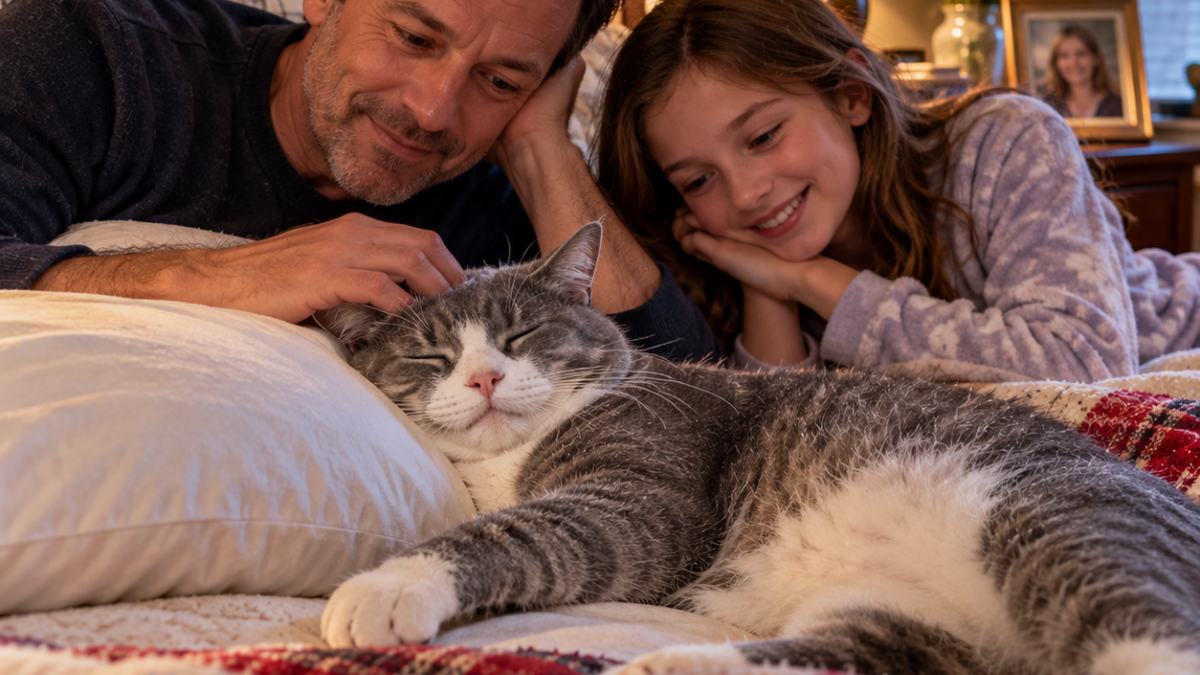
And I stood beside the bed staring at a cat I had not wanted, listening to my daughter laugh in a house that had forgotten how.
That was how Rio entered our family.
Not cautiously.
Not gratefully.
Like a landlord returning after a long trip.
Eleven months earlier, my wife Lisa had died after eighteen months of treatment.
Cancer is a word people understand until they have to live inside it.
From far away, cancer is appointments.
Pink ribbons.
Hospital bracelets.
Fundraisers.
Brave photographs.
Inside a house, it is different.
It is medication alarms at two in the morning.
Insurance letters.
Hair in the shower drain.
Arguments about food because the person you love cannot eat and you keep trying to feed them anyway.
It is learning the parking structure at the hospital better than your own neighborhood.
It is saying:
“This treatment might work.”
Then:
“The next treatment might work.”
Then:
“We still have options.”
Then finally sitting beside a bed while a doctor uses words like comfort and time.
Lisa was forty-one.
Emily was eleven.
I was forty-four.
We had been married sixteen years.
The morning Lisa died, I promised her I would take care of Emily.
It sounded like the kind of promise a husband should make.
I had no idea what it meant.
Food?
School?
Health insurance?
Keeping the lights on?
Remembering permission slips?
Or did it mean somehow preventing our daughter from becoming a person whose mother died when she was eleven?
Because I could not do that.
I discovered this slowly.
Painfully.
I could make breakfast.
I could drive her to school.
I could sit outside the counselor’s office.
I could stand in Target holding two brands of shampoo because I did not know which one Lisa had always bought.
But I could not stop Emily from looking toward the front door whenever a car pulled into the driveway.
I could not stop her from sleeping in one of her mother’s sweatshirts.
I could not stop her from reaching for her phone some afternoons before remembering there was nobody to text.
Our house became quiet.
Not peaceful.
Quiet.
There is a difference.
Peace has room in it.
Our quiet felt packed solid.
Emily went to school.
Came home.
Put on headphones.
Closed her bedroom door.
I went to work.
Came home.
Made dinner.
Cleaned things that were already clean.
I stopped using half the bed.
Lisa’s pillow remained untouched.
Her shoes stayed in a box at the back of the closet because moving them felt like making a decision I was not ready to make.
We talked every night.
Technically.
“How was school?”
“Fine.”
“How was work?”
“Fine.”
“What do you want for dinner?”
“Anything.”
Nothing was fine.
Then Emily’s school counselor, Ms. Franklin, called me.
“I’m not saying a pet fixes grief.”
“Good.”
“Because if you say that, I’m hanging up.”
She laughed.
“I’m saying Emily is isolated.”
“I know.”
“She needs something that invites connection without demanding conversation.”
I stared through the window of my maintenance office.
“What does that mean?”
“It could mean volunteering.”
“She won’t.”
“Art.”
“She used to draw with Lisa.”
“Then maybe not yet.”
She paused.
“Have you considered an animal?”
“No.”
“Why?”
“Because I am currently keeping one teenager and one house alive.”
“She’s twelve.”
“She has teenager energy.”
Ms. Franklin laughed again.
“I’m serious, Daniel.”
“So am I.”
“A dog would be too much.”
“I agree.”
“A cat?”
“No.”
“Why?”
“I don’t like litter boxes.”
“Compelling.”
“And furniture damage.”
“Strong case.”
“And I don’t need another living thing depending on me.”
There was a silence.
Then she said softly:
“Maybe that is exactly why.”
I disliked that answer enough to think about it all week.
Saturday morning, Emily and I drove to Cedar County Animal Rescue.
I told her we were only looking.
She did not believe me.
Neither did the volunteer.
Her name was Karen.
She showed us kittens first.
Tiny.
Friendly.
Ridiculous.
One orange kitten climbed onto Emily’s shoe.
She smiled.
Then carefully handed him back.
We moved farther into the cat room.
That was where we found Rio.
He sat at the back of an enclosure.
Seven years old.
Gray and white.
Broken whisker.
Serious face.
Tail wrapped around his feet.
He did not approach.
Did not meow.
Did not press against the bars.
He looked like a judge listening to weak testimony.
Karen lowered her voice.
“He’s had a hard year.”
“What happened?”
“His owner died.”
Emily’s expression changed.
Karen continued.
“Older gentleman.”
“Rio lived with him most of his life.”
“Afterward, family couldn’t take him.”
“He was adopted twice.”
“And returned twice.”
“Why?”
“First family said he was too independent.”
I looked at Rio.
“That sounds like an accusation from someone who bought the wrong species.”
Karen smiled.
“The second family had young children.”
“Rio doesn’t like being carried.”
“He scratched when they ignored his signals.”
“Nothing severe.”
“But they decided it wasn’t a fit.”
Emily sat on the floor.
“Can I open it?”
Karen unlocked the enclosure.
“Let him decide.”
I expected Rio to retreat.
For several minutes, he did nothing.
Emily did nothing too.
That surprised me.
Before Lisa got sick, Emily had been impatient.
Talkative.
Always touching things.
Always asking questions.
Grief had slowed her.
She sat cross-legged.
Hands in her lap.
Rio stared.
Then stood.
Walked toward her.
Stopped.
Placed one front paw on her knee.
Three seconds.
Maybe four.
Then he turned around and walked away.
Emily looked at me.
Her eyes were wet.
“He picked us.”
“I’m not sure that’s how adoption works.”
“It is today.”
We brought him home.
I had prepared a cat bed.
Soft.
Gray.
Twenty-eight dollars.
Rio sniffed it once.
He never used it.
He drank from my water glass.
Pushed the television remote off the couch and sat in its place.
Stole Emily’s chair at dinner.
Then marched upstairs and claimed Lisa’s pillow.
Within an hour, the homeless cat had become head of household.
Rio was not affectionate in ways people expect rescue animals to be.
He did not behave grateful.
He hated being carried.
He rarely sat in laps.
He accepted petting according to a private schedule nobody received.
But he always knew where to be.
When Emily ate breakfast alone, Rio sat in the chair beside her.
When she did homework, he slept under the table with one paw on her shoe.
When she cried in her room, he did not scratch at the door.
He waited.
Sometimes for an hour.
Until she opened it.
Then he entered like it had been his decision all along.
At night, Rio slept on my pillow.
Not beside it.
On it.
That forced me toward the center of the bed.
Toward Lisa’s side.
For months after she died, I had slept so close to my edge that I nearly fell out twice.
The first week Rio lived with us, I woke at 3:00 a.m. and found myself lying diagonally across the mattress because he had stretched behind my head.
I was furious.
Then I realized I had slept six uninterrupted hours.
The next night I let him stay.
Little things changed.
Emily began leaving her bedroom door open.
She came downstairs to see what Rio had destroyed.
Usually nothing expensive.
Usually.
He stole turkey.
Climbed into clean laundry.
Knocked one framed family photograph from the shelf.
It did not break.
Emily picked it up.
The picture was from a beach trip three years earlier.
Lisa standing between us.
Wind blowing her hair across her face.
All three of us laughing.
Emily stared.
I braced for tears.
Instead she said:
“Mom hated that picture.”
“She said her hair looked terrible.”
“It did.”
We both laughed.
Rio sat beside the fallen frame like he had arranged the conversation.
That evening Emily told me a girl at school had stopped sitting with her at lunch because she “never knew what to say” around someone whose mom had died.
“I hate that.”
Emily said.
“What?”
“When people act like I’m dangerous.”
“They’re uncomfortable.”
“That’s not my job.”
“No.”
“She said she didn’t want to say the wrong thing.”
“What did you say?”
“I told her saying nothing for three months was also a thing.”
I almost corrected her tone.
Then stopped.
“You’re right.”
Emily looked surprised.
“What?”
“You’re right.”
“That’s it?”
“What do you want, a certificate?”
Rio pushed a pencil off the table.
Emily laughed.
The house began breathing again.
Not healing in the clean way people like to describe.
Grief stayed.
Lisa stayed.
Her photographs stayed.
The empty place at Thanksgiving stayed.
But grief stopped entering every room before we did.
Then one cold November evening, I came home and could not find Rio.
Back door partly open.
The latch had failed.
Emily saw it.
Her face turned white.
We searched the house.
Closets.
Basement.
Garage.
Then yard.
Street.
Neighbors.
Rain came harder.
Emily stood in the driveway without a coat.
“Rio!”
I checked beneath cars.
Bushes.
Drainage ditch.
Nothing.
“He left.”
Emily whispered.
“He wouldn’t just leave.”
“Everybody leaves.”
The words stopped me.
She was not talking about Rio.
I walked to her.
She tried to step away.
I pulled her against me.
“I’m still here.”
She shook against my chest.
“So am I.”
she whispered.
That nearly broke me.
When we returned to porch, I heard scratching.
Outdoor storage closet.
I opened it.
Rio stepped out.
Wet.
Offended.
Perfectly fine.
Wind must have shut the door behind him.
Emily fell to her knees.
Wrapped both arms around him.
Rio tolerated the hug for approximately five seconds.
Then walked inside.
Went upstairs.
Got on my pillow.
That night Emily and I sat beside him.
She put one hand on his back.
I placed mine next to hers.
And for the first time since Lisa died, we talked about her death without pretending we were protecting each other.
Emily admitted she still expected her mother to walk through the door.
I admitted I did too.
She admitted she was angry at Lisa for dying.
I told her I had been angry too.
She said moving forward felt like betrayal.
I told her I understood.
Rio lay between us.
Did nothing.
That was what mattered.
He stayed.
Eight months after we adopted him, the rescue called.
I was at work.
A packaging plant outside Dayton.
I supervised building maintenance.
Air handling.
Loading docks.
Electrical contractors.
Plumbing.
Fire systems.
Things people notice only when they stop working.
Karen sounded careful.
“Rio’s doing okay?”
“He’s become management.”
She laughed.
Then paused.
That pause changed everything.
A woman named Marissa had contacted the rescue after seeing an old photograph online.
Marissa was the daughter of Rio’s first owner.
Harold.
The elderly man who died.
“She thought Rio went directly to a permanent home.”
Karen explained.
“She didn’t know about both returns.”
“What does she want?”
“She asked where he was.”
“What did you tell her?”
“Only that he was adopted and safe.”
“Good.”
“She has photographs.”
“Some old belongings.”
“She wants to know whether you’d speak with her.”
“Does she want Rio back?”
Another pause.
“She says she wants to meet him.”
“That is not what I asked.”
“No.”
“It isn’t.”
I spent the rest of the afternoon pretending to work normally.
I replaced a hinge.
Checked a leak.
Signed a delivery form without reading it.
Had to ask for it back.
Rio’s past had always been words on paperwork.
Owner deceased.
Returned twice.
Now it had a name.
Marissa.
That evening I found Emily doing homework.
Rio sat beside her and repeatedly slapped her pencil off the table.
I should have told her immediately.
Instead I waited through dinner.
Mistake.
After dishes, I said:
“This is probably nothing.”
Every parent should know those words make everything worse.
Emily froze.
“What?”
“The rescue called.”
“Is Rio sick?”
“No.”
I explained Marissa.
First owner.
Photographs.
Old things.
Meeting.
Emily dried her hands.
“She wants him back.”
“She didn’t say that.”
“She wants to meet him.”
“Yes.”
“So she wants him back.”
“We don’t know.”
Emily picked up Rio.
He twisted until she put him down.
She started upstairs.
“I think meeting her might be kind.”
Emily stopped.
“Kind to who?”
“To her.”
“What about him?”
“She was part of his life.”
“She gave him away.”
“She may not have had a choice.”
“People always have choices.”
The sharpness shocked me.
“She lived somewhere that didn’t allow pets.”
“Then move.”
“Her son had allergies.”
“Then figure something out.”
“Emily.”
“She left him.”
“And he got returned twice.”
“That was not her.”
“She still didn’t come.”
“She may not have known.”
“She should have known.”
Her voice cracked.
There it was.
This was not about Marissa.
Not entirely.
She held Rio against her chest.
“We are not giving him back.”
“No one said we were.”
“You thought about it.”
“I thought about what to say.”
“You waited all day.”
“Because I wanted to understand.”
“That’s what adults say when they already decided something.”
Then she carried Rio into my bedroom.
Locked the door.
“Emily.”
“No.”
“You cannot lock yourself in my room.”
“I’m not alone.”
“Open the door.”
“No.”
I sat in the hallway.
I could have ordered her.
Taken the lock apart.
Used authority.
Instead I sat.
Ten minutes.
Then scratching started from inside.
Rio hated closed doors regardless of which side he occupied.
Emily opened it.
Rio walked past both of us downstairs.
I stayed sitting.
She sat on my bed.
“I am not giving him away.”
I said.
“Promise.”
I wanted to.
But promises had become dangerous after Lisa.
I once promised Emily her mother’s treatment would work because I confused hope with certainty.
“I promise nobody takes him without us agreeing.”
Emily’s face hardened.
“That’s not what I asked.”
“I know.”
“That means you might agree.”
“I do not plan to.”
“But you might.”
“We don’t even know what she wants.”
“I do.”
“You’re guessing.”
“So are you.”
She was right.
I called Karen next morning.
Said we were not ready.
The photographs could wait.
I thought that ended it.
Two weeks later, my company called an all-staff meeting.
Thirty people.
Forty chairs.
Nobody sat in the first row.
Bad sign.
Regional consolidation.
Positions moved.
Positions eliminated.
My job was not eliminated.
Technically.
It was transferred.
A larger facility nearly two hours away.
Higher salary.
More responsibility.
Better long-term stability.
And company housing for one year.
I read the page.
Managed apartment complex near the new plant.
No pets.
I read it twice.
Then the alternatives.
Commute.
Almost four hours a day.
Or refuse the reassignment.
Eight weeks severance.
No guarantee of another position.
Money had been tight since Lisa’s illness.
Hospital bills.
Roof repair.
Braces Emily would need.
A car making a noise every time I turned left.
I had savings.
Months, not years.
The promotion should have felt like rescue.
Instead it looked like another person holding out a contract and saying:
Choose.
I hid the papers in my dresser.
Another mistake.
My sister-in-law Rachel called.
Lisa’s older sister.
She had been one of the few people who kept showing up after the funeral.
Food.
School clothes.
Anniversaries.
She loved Emily.
She loved me too, in the complicated way families assembled through marriage sometimes continue after death.
I told her.
“You have to take it.”
“I do not have to.”
“You know what I mean.”
“The housing bans pets.”
Silence.
Then:
“Is that really the main issue?”
“Emily’s school.”
“She can transfer.”
“She finally has friends.”
“She can make new ones.”
“Lisa is buried here.”
Rachel exhaled.
“Daniel, maybe being surrounded by every reminder is part of why both of you are stuck.”
“We are not stuck.”
“You still had Lisa’s shoes in the hall closet six months ago.”
“They’re boxed now.”
“You know what I mean.”
I hated that phrase.
“What about Rio?”
She sighed.
Small.
But I heard it.
“You find him a good home.”
I said nothing.
“I love animals.”
Rachel began.
“No sentence starting that way ends well for an animal.”
She almost laughed.
Then:
“This is your career.”
“This is Emily’s future.”
“You can’t make a financial decision based on a cat.”
“He helped your niece survive losing her mother.”
“I know.”
“He helped me too.”
“And that matters.”
“But there’s a difference between something helping you through a crisis and something controlling the rest of your life.”
“He is not controlling anything.”
“If you reject a secure job because the apartment does not allow him, then yes, he is.”
I ended the call politely.
Then spent three nights at the kitchen table doing math.
Rio sat on the papers.
At one point, he put a paw directly into my coffee.
“You’re expensive.”
I told him.
He bit the towel when I cleaned his paw.
I asked my manager Steve whether housing policy could change.
No.
Different housing subsidy?
No.
Delay?
Two months maximum.
Remote arrangement?
Not for maintenance.
Steve was decent.
He still asked the question everyone asked.
“Would losing your income hurt your daughter more than losing the cat?”
I had no answer I trusted.
Then I called Karen.
Asked for Marissa’s number.
I told myself information was not decision.
Technically true.
Emotionally dishonest.
Marissa answered on the second ring.
Her voice was calm.
That made her harder to dislike.
I wanted someone entitled.
Someone who would say:
He was ours first.
Give him back.
Instead she asked:
“Does he still sleep with his paws over his eyes?”
“Yes.”
“My dad loved that.”
“Does he still chirp at birds?”
“Yes.”
“Still hate closed doors?”
“Yes.”
She laughed quietly.
“My father used to say every closed door was a personal insult.”
I smiled.
I did not want to.
Then she told me about Harold.
Seventy-eight when he died.
Widower.
Quiet.
Rio had appeared behind his apartment building one winter.
Harold fed him outside for three weeks while insisting he did not want a cat.
Then Rio slept on his pillow.
I looked toward my own desk, where Emily had taped a photograph of Rio doing exactly that.
Marissa’s son had severe allergies.
Her apartment banned pets.
She tried relatives.
Friends.
The rescue.
Rio was adopted quickly.
She believed he was safe.
By the time she learned of the first return, he had already been adopted again.
Returned again.
She called.
Still could not take him.
“I should have done more.”
she said.
I did not reassure her.
She continued.
“I told myself he would adjust because I needed it to be true.”
“Why now?”
“My son is in college.”
“I bought a small house.”
“I found Rio’s old collar in my father’s things.”
“And?”
“I would take him back if you were willing.”
My chest tightened.
“He has a home.”
“I know.”
“My daughter loves him.”
“I know.”
“Then why ask?”
“Because my father loved him too.”
“Your father is gone.”
Silence.
The second I said it, I regretted it.
“I’m sorry.”
“No.”
she said.
“You’re right.”
Then she told me why it mattered.
Before Harold died, he had asked her to promise Rio would be safe.
She said yes.
Those were among the last conversations they had.
She had broken the promise.
Now she had a chance to keep it late.
“I don’t know if trying is selfish or right.”
she said.
That honesty disarmed me.
We agreed to meet.
Without Rio.
Without Emily.
I did not tell Emily.
That became the worst mistake.
At the café, Marissa brought photographs.
Rio younger.
Rio thinner.
Rio on Harold’s newspaper.
Rio on his chest.
Rio beside Christmas tree.
Rio on a pillow.
Always the best pillow.
She brought a red stuffed bird with one wing missing.
A faded green blanket.
When I saw the blanket, I thought of Lisa’s clothes stored in boxes.
How grief turns fabric into evidence.
“Keep it.”
I said.
“It was Rio’s.”
“It was Harold’s too.”
Marissa cried.
Then asked why we adopted him.
I told her enough.
The counselor.
Emily’s silence.
The paw on her knee.
The laughter.
I did not tell her everything.
Some memories were ours.
Then I told her about the job.
The move.
The no-pet housing.
Her expression changed.
“So that’s why you called.”
“I called because I wanted information.”
“Is that still true?”
“No.”
She folded her hands around coffee.
“If you need a home for him, I’ll take him.”
“I know.”
“Your daughter could visit.”
“That might make it worse.”
“Yes.”
“He isn’t an object.”
“No.”
“Then why does everyone keep talking about him like one?”
Neither of us answered.
Before I left, Marissa gave me the photographs and red bird.
She kept the green blanket.
When I got home, Emily was sitting on the floor.
Rio beside her.
My reassignment papers spread across the coffee table.
My dresser drawer upstairs open.
“Where were you?”
I hesitated.
She saw the envelope.
“Who gave you that?”
“Emily.”
“Who?”
“Marissa.”
Her face changed.
“You met her.”
“Yes.”
“You lied.”
“I said I had errands.”
“That is lying.”
“You’re right.”
“You met the woman who wants my cat.”
“Our cat.”
“Don’t.”
I stopped.
She pointed at the job papers.
“You’re moving us.”
“I have not decided.”
“You already met her.”
“I’m trying to understand the options.”
“I am not an option.”
“I didn’t say you were.”
“Rio isn’t either.”
“I have to think about our future.”
“He is our future.”
“He is a cat.”
The second I said it, I wanted it back.
Emily stared at me.
I had used Rachel’s sentence.
“He is a cat we love.”
I tried.
“But I have to keep a roof over our heads.”
“We have a roof.”
“For now.”
“So this is money.”
“It is security.”
“Security for who?”
“You.”
“Then why does it feel like you’re taking away the first thing that made this house feel safe?”
I had no defense.
She whispered:
“You said you were still here.”
“I am.”
“No.”
Her eyes filled.
“You are standing here.”
“That’s different.”
Then she ran upstairs.
Rio followed.
For two days, she barely spoke.
I called Rachel.
She insisted Emily would forgive me.
“Because you’re her father.”
“That is not a guarantee.”
“No.”
she admitted.
“That helped more than certainty.”
We argued about Lisa.
Rachel said her sister would want stability.
I told her not to use Lisa to win.
Rachel said I did not own Lisa’s memory.
We both went silent.
Then apologized.
Finally Rachel laughed through tears.
“Lisa would change her mind three times.”
“She’d make a list.”
“A color-coded list.”
“She’d ask ten people.”
“Then ignore all of us.”
For a moment we remembered Lisa as a person instead of a weapon in an argument.
That night I found Emily on the back steps.
Rio beside her.
I sat.
“I’m sorry I met Marissa without telling you.”
Nothing.
“I told myself I was protecting you.”
“I was actually protecting myself from having a hard conversation.”
She stroked Rio.
“I’m sorry I said he is just a cat.”
“You meant it.”
“I meant that I cannot put him above food, housing, health insurance, your education.”
“It sounds the same.”
“I know.”
I looked across the yard.
“I do not know the right choice.”
Emily finally looked at me.
“You’re the parent.”
“Yes.”
“You’re supposed to know.”
“That is something adults let kids believe because the truth is scary.”
“What is the truth?”
“We guess.”
That almost made her smile.
Then:
“Mom would know.”
“No.”
“Yes.”
“She was scared too.”
Emily turned.
“What?”
I had hidden too much about Lisa’s final months.
Again, calling it protection.
So I told her.
Lisa knew she was dying near the end.
She was terrified.
She asked me not to tell Emily yet.
She wanted her daughter going to school, seeing friends, believing normal life still existed.
Emily cried.
“She knew?”
“Yes.”
“And you didn’t tell me?”
“Yes.”
“For how long?”
“Too long.”
“I thought she stopped talking to me because I made her tired.”
My chest collapsed.
“You never told me that.”
“You never asked.”
“I asked if you were okay.”
“That is not the same.”
She was right.
Again.
“I’m asking now.”
I said.
“What else?”
She wiped her face.
“I thought she knew she was leaving and didn’t trust me.”
“I’m sorry.”
“You both decided for me.”
“Yes.”
“And now you’re doing it again.”
I looked at Rio.
He pounced on a leaf.
Missed.
Looked offended.
“I’m trying not to.”
“Then don’t.”
“I still might make a choice you hate.”
“Why?”
“Because being honest with you doesn’t mean giving you every adult responsibility.”
“I don’t want every responsibility.”
“What do you want?”
She looked directly at me.
“To count.”
That word changed everything.
Not control.
Not veto power.
Not a thirteen-year-old deciding mortgage strategy.
To count.
Friday, I asked Steve for three more days.
Regional office said Monday.
I spent weekend applying for other jobs.
Lower pay.
No benefits.
Night shifts.
Travel.
I called apartment buildings near new plant.
Two allowed cats.
Both too expensive.
Rachel offered rides.
Money for deposit.
Help.
I hated needing it.
Then on Saturday, Emily found Marissa’s photographs.
She looked through them.
Harold sleeping with Rio on his chest.
Rio sitting beside breakfast.
Rio blocking the newspaper.
“His name?”
“Harold.”
“Did Rio love him?”
“I think.”
“How do cats say that?”
I looked at Rio sleeping in sunlight.
“They stay.”
Emily’s face changed.
Then she picked up the red bird.
Shook it.
A weak rattle.
Rio’s eyes opened.
He stood.
Walked to the toy.
Sniffed.
Picked it up.
Carried it into the living room.
Set it beside couch.
Then sat with it.
Emily whispered:
“He remembers.”
“I think so.”
“Does that mean he wants to go back?”
“No.”
“You don’t know.”
“No.”
That evening she asked to call Marissa.
I stayed in room.
She wanted privacy.
I said no.
Adult stranger.
My daughter.
Boundary.
She accepted.
“Hello?”
“This is Emily.”
Pause.
“Hello, Emily.”
“I’m Rio’s person.”
“I know.”
“My dad says you want him.”
“I would like him.”
“But I know he is part of your family.”
“You gave him away.”
“Yes.”
“Why?”
Marissa told her everything.
Apartment.
Son.
Allergies.
Money.
Fear.
Harold’s death.
Emily did not let her hide.
“You could’ve moved.”
“You’re right.”
“Why didn’t you?”
“I couldn’t afford it.”
“You should’ve checked on him.”
“Yes.”
“He was returned twice.”
“I know.”
“Where were you?”
“At home.”
“Not knowing.”
“You should have known.”
“Yes.”
Emily became frustrated.
“You keep agreeing.”
“Would you rather I lie?”
“No.”
Then came the question.
“Why do you want him?”
“Because he reminds me of my father.”
“That is not fair to Rio.”
“No.”
“Then stop asking.”
Marissa was silent.
“I’m trying to understand whether wanting him and asking for him are the same thing.”
“They’re not.”
“No.”
“You can want him.”
“Thank you.”
“But you can’t have him.”
My daughter’s hand shook.
Marissa said:
“I hear you.”
“Does that mean yes?”
“It means I will not fight you.”
Emily exhaled.
Then surprised me.
“I want stories.”
“About Harold?”
“About Rio.”
For forty minutes, they traded histories.
Harold warmed Rio’s food because he thought cold food hurt his feelings.
Rio climbed onto a shed roof and refused to come down.
Harold kept lint rollers everywhere while complaining about fur.
Emily told Marissa about my pillow.
Laundry baskets.
The storage closet.
The turkey theft.
When the call ended, Emily placed Harold’s photograph beside Rio’s food.
“Why?”
I asked.
“So he has both homes.”
Both homes.
That became the phrase.
Monday morning, I sat in my car outside work.
Promotion letter on passenger seat.
Higher salary.
Benefits.
Company housing.
No Rio.
Or reject it.
Eight weeks pay.
Uncertainty.
There was no clean choice.
That is something adults should say more often.
Some choices do not contain a correct answer.
Only different costs.
I went into Steve’s office.
“I have one more proposal.”
He sighed.
“Of course you do.”
“Four longer days at the new facility.”
“One administrative day from home.”
“No company housing.”
“The regional office doesn’t allow remote maintenance.”
“I’m not repairing equipment from my kitchen.”
“I can schedule.”
“Order parts.”
“Review inspections.”
“Manage vendors.”
“Have they ever been asked?”
Steve looked at me.
“No idea.”
“Then ask.”
“What if they say no?”
“I refuse the transfer.”
“You understand?”
“Yes.”
“You may lose the house.”
“Yes.”
“You may regret it.”
“Yes.”
He studied me.
“And the cat?”
“I keep the cat.”
Steve almost smiled.
“This is really about the cat?”
“No.”
“What is it about?”
I thought about Emily saying to count.
“It’s about whether my daughter believes home is something we protect or something we trade the second life gets difficult.”
“That sounds like something you’re telling yourself.”
“Maybe.”
“Does that make it false?”
Steve leaned back.
“No.”
Regional office rejected it.
Then Steve called again.
He made a case.
I had kept the plant functioning through floods.
Heating failure.
Equipment shutdown.
Replacing me would cost money.
My schedule could be tested.
Finally, they approved three months.
Four onsite days.
One administrative day from home.
Smaller relocation allowance converted to commute support.
Salary increase remained.
Not perfect.
Three hours driving some days.
Help from Rachel.
Help from our neighbor Mrs. Alvarez.
A new car eventually.
But we stayed.
Emily stayed in school.
Rio stayed on my pillow.
When I told Emily, she hugged me.
Then immediately pulled away.
“You shouldn’t have to drive that much.”
“I know.”
“Because of me.”
“No.”
“Because of Rio.”
“Not only.”
“What if you hate it?”
“I might.”
“What if you blame us?”
That stopped me.
I crouched to her level, even though she hated when I did that now.
“I am making this choice.”
“Me.”
“If it becomes impossible, we revisit it.”
“I do not get to choose something hard and spend the next ten years making you pay emotionally for it.”
She stared.
“Did Mom ever do that?”
“No.”
That promise I could make.
The first month was miserable.
I got up at 4:30.
Rio decided breakfast should also move to 4:30.
I disagreed.
He screamed at pantry.
Emily found me sitting on kitchen floor in mismatched socks with coffee.
“You look homeless.”
“Thank you.”
“Your socks are different lengths.”
“It is dark.”
Rachel drove Emily some mornings.
Mrs. Alvarez appeared every afternoon at exactly four with snacks while insisting she was not “checking on” anybody.
Rio waited at front window every evening.
Emily sent pictures.
Serious face.
Driveway.
Waiting.
The commute gave me too much time to question myself.
Maybe I had been principled.
Maybe stubborn.
Maybe emotional.
Maybe wise.
People on radio said:
Choose stability.
Choose family.
Do not make decisions from fear.
Do not sacrifice future.
Honor connection.
Move forward.
Everyone talked as if values stood in separate lines.
They do not.
Sometimes security asks you to leave.
Sometimes love asks you to stay.
Sometimes staying is courage.
Sometimes it is fear.
Same with leaving.
Two months later, Emily asked:
“Can Marissa come?”
Her idea.
I stopped chopping chicken.
“Why?”
“Hannah moved.”
Her friend.
Parents got jobs in another state.
Hannah was furious.
Felt excluded from family decision.
Emily had asked what would make it less terrible.
“Hannah said she wanted them to admit it was bad for her even if they still had to do it.”
I nodded.
“Maybe Marissa was wrong and still had reasons.”
“Yes.”
“Maybe wanting Rio is wrong but missing him isn’t.”
“Yes.”
“So she can visit.”
Marissa arrived Saturday.
She sat in car five minutes before knocking.
Emily watched through curtain.
“She’s nervous.”
“Adults get nervous.”
“That seems inefficient.”
Marissa brought green blanket.
And a ceramic bowl painted with blue fish.
“Harold used this for treats.”
Rio came downstairs.
Stopped.
Marissa froze.
“Hi, Walter.”
Emily’s head snapped around.
“Walter?”
Marissa laughed through tears.
“My father called him Walter.”
“Why?”
“He said Rio was too adventurous a name for a cat who complained about rain.”
“Walter is terrible.”
“Yes.”
Rio approached.
Sniffed her shoes.
Green blanket.
Her fingers.
Then rubbed his face against her hand.
Marissa covered her mouth.
Cried.
Emily sat beside her on the floor.
Rio settled on the green blanket.
For a long time, nobody tried to own him.
They just remembered him.
Two hours later Marissa stood to leave.
She left the blanket.
“You should keep it.”
Emily said.
“No.”
Marissa looked toward Rio.
“I thought taking him home would make me closer to my father.”
“Would it?”
“Maybe.”
“Then why leave him?”
Marissa looked at my daughter.
“Because he’s already home.”
Emily cried after she left.
Not because she wanted to give Rio away.
Because she finally understood the woman she had made into the enemy.
Compassion complicated everything.
That was good.
The work schedule became permanent.
We stayed.
Time moved.
Emily entered high school.
Joined photography club.
Her first serious project was called Things That Stay.
She photographed Lisa’s coffee mug.
The porch railing.
Harold’s picture.
The green blanket.
Rachel’s hands cutting pie.
Mrs. Alvarez carrying food.
My work boots.
Rio on my pillow.
Beneath his photograph she wrote:
Staying does not mean never leaving the room.
At the student exhibit, Rachel stood beside me.
“I was wrong about one thing.”
“Only one?”
“Don’t ruin it.”
She looked at Rio’s picture.
“The cat didn’t control your decision.”
“No.”
“He showed you what it was about.”
Maybe.
She asked if the commute had been worth it.
I watched Emily talking to Marissa across the room.
“So far.”
I said.
Rachel nodded.
“That’s honest.”
Two years after Rio came home, the rescue invited Emily to speak to families considering older cats.
She refused.
Then asked how many people.
Then agreed.
She held Rio’s photograph.
“Older rescue cats are not always grateful.”
she said.
“Rio has never thanked us for anything.”
People laughed.
“He complains about breakfast.”
“He scratches furniture.”
“He hates expensive toys.”
“He chooses when affection happens.”
More laughter.
Then she became serious.
“Sometimes people say rescue animals need us.”
“That can be true.”
“But sometimes people need something that does not ask them to explain why they are sad.”
The room became quiet.
“Rio did not fix my family.”
“He didn’t replace my mom.”
“He did not make grief disappear.”
“He just kept showing up in the room.”
She looked toward me.
“And eventually, we did too.”
Rio grew older.
Ten.
Then eleven.
Kidney disease.
Medication.
Special food he hated.
More water.
Weight loss.
The veterinarian explained there might be months.
Maybe years.
No promises.
On the drive home Emily sat beside his carrier.
“Do not promise he’ll be okay.”
“I won’t.”
“Don’t tell me everything happens for a reason.”
“I won’t.”
“Don’t tell me to be grateful for time.”
“I won’t.”
“What are you going to say?”
I looked at her through mirror.
“I’m scared too.”
She nodded.
“Okay.”
That was enough.
Rio responded to treatment.
He stopped jumping to counters.
Used a chair to reach windows.
I built a step beside bed.
He ignored it for two weeks.
Then used it when he thought nobody watched.
Marissa visited monthly.
Rachel learned his meal routine.
Mrs. Alvarez checked afternoons.
The cat once returned for being “too independent” now had five adults sending texts asking if he pooped.
Life is ridiculous.
Emily took a three-day school trip.
First overnight away since Lisa died.
Rio waited at her door.
Then climbed onto my chest.
“She’s coming back.”
I told him.
He stared.
“I know.”
“I hear it.”
When Emily returned, he ignored her theatrically for eight minutes.
She declared it proof he missed her.
The next year, she was accepted to a two-week photography program out of state.
Rio’s health had become unpredictable.
“What if he dies?”
she asked.
“Then I call.”
“What if I can’t get home?”
“We make the best decision we can.”
“What if I want you to wait?”
“If he is comfortable, we wait.”
“And if he hurts?”
“Then I will not make him suffer because we’re afraid of goodbye.”
Emily cried.
“That sounds like choosing for him.”
“It is.”
“How do we know we’re right?”
“We may not.”
“I hate that.”
“So do I.”
She went.
Rio stayed stable.
By seventeen, Emily started college applications.
The school she wanted most was across the country.
She refused to apply.
“Too far.”
“From what?”
“Home.”
“Home stays.”
“Rio might not.”
There it was again.
Everybody leaves.
A bedroom door.
A terrified thirteen-year-old.
“You cannot build every choice around losing him.”
“You did.”
“No.”
“You almost lost your job because of him.”
“I changed the terms.”
“Because of Rio.”
“Because of you.”
“That’s worse.”
She was right to challenge me.
“I’m telling you to apply because I do not want you turning my decision into a debt.”
“It isn’t.”
“Then apply.”
“What if he dies while I’m away?”
“Then you will hurt.”
“That is a terrible answer.”
“It is the honest one.”
She applied.
Got in.
Scholarship.
Sat on kitchen floor holding acceptance email.
Rio beside her.
“I don’t know if I can go.”
“You don’t decide today.”
“What would Mom say?”
I smiled.
“She’d make a list.”
Emily laughed through tears.
“What do you say?”
I put my hand on Rio.
“I think you should go.”
She looked at him.
“He taught us how to stay.”
I said.
“He did not teach us to stop moving.”
That night she sat on my bed.
Rio between us.
We talked until she fell asleep.
College.
Money.
Lisa.
Harold.
Marissa.
Fear.
Home.
The first night Rio stole my pillow.
I looked at his old judge face.
“You started this.”
He closed his eyes.
Emily left in August.
She hugged Rio almost a minute.
He tolerated it.
The younger Rio would have left after five seconds.
The old Rio stayed.
When she drove away, the house became quiet again.
But it was not the old quiet.
This quiet contained motion.
Calls.
Photos.
Visits.
A daughter building a life.
A father learning silence was not always abandonment.
That winter Rio declined quickly.
One Monday, he did not come downstairs.
I found him on my pillow.
Eyes open.
Head still.
The vet examined him.
There were options.
None would restore the life he had.
I called Emily.
She answered during class.
“Is it Rio?”
“Yes.”
“Is it time?”
“I think so.”
She cried.
“I can get a flight tonight.”
The vet believed Rio was comfortable enough to wait.
Not long.
Long enough.
Marissa came.
Rachel came.
Mrs. Alvarez brought food nobody ate.
Rio stayed upstairs on the green blanket.
Marissa sat beside him.
Called him Walter once.
Nobody corrected her.
Rachel stroked his back.
“I’m sorry I called you just a cat.”
Mrs. Alvarez whispered something in Spanish.
Touched two fingers to his head.
I sat all night.
Rio did not sleep on my pillow.
He slept with his head against my hand.
Emily arrived in the morning.
Dropped her bag.
Ran upstairs.
Rio opened his eyes.
His tail moved once.
“I came back.”
she whispered.
He closed his eyes.
We spent the morning telling stories.
Turkey.
Laundry.
Storage closet.
Red bird.
Harold’s chair.
My pillow.
At noon, we went to the veterinary office.
Emily held the green blanket.
Marissa carried the ceramic bowl for no logical reason.
I carried Rio.
He had always hated being held.
That day, he rested against my chest.
The vet explained everything.
When the time came, Emily placed one hand on Rio.
I placed mine beside hers.
Same position as the night we first talked honestly about Lisa.
Rio stayed between us.
He did not do anything special.
He simply stayed.
Until he could not.
We came home without him.
That night I stood beside my bed.
The pillow was empty.
Emily sat beside me.
For a long time neither of us spoke.
Then:
“I hate that we did the right thing.”
“I know.”
“It doesn’t feel right.”
“I know.”
“Did he know we were there?”
“Yes.”
She looked at me.
“You said you wouldn’t promise things you couldn’t know.”
She was right.
I looked at the pillow.
“I believe he knew.”
“That is different.”
“Yes.”
Emily leaned against me.
“I believe it too.”
For weeks, I woke expecting Rio.
I moved carefully so I would not disturb a cat who was no longer there.
The half-second of forgetting was the worst.
But this grief was different from Lisa’s.
Not smaller.
Different.
I knew something now.
One day memory would arrive before loss.
One day I would think of Rio stealing my pillow and smile before remembering his final morning.
Grief was not proof that we had failed to move forward.
It was proof something had moved with us as far as it could.
Marissa took the ceramic bowl.
Emily kept the green blanket.
I found the red bird beneath couch.
Placed it beside Harold’s photograph.
The expensive cat bed Rio never touched went back to the rescue.
A week later Karen sent us a picture.
A frightened black cat curled inside it.
Emily smiled.
“Rio would hate that.”
“He’d be offended.”
“He thought it was his bed even though he never used it.”
“Exactly.”
Emily returned to college.
Her final photography project changed.
Not abandoned buildings anymore.
People and animals after loss.
Harold and Rio.
Lisa’s coffee mug.
The empty pillow.
Marissa holding the ceramic bowl.
Rachel in our doorway.
Mrs. Alvarez on porch.
Me sitting on the bed.
She called it Both Homes.
Her final caption read:
We keep asking where love belongs.
Sometimes the answer is more than one place.
Two years later, I went to the rescue with supplies.
I did not plan to adopt.
That is how these stories begin.
A thin brown cat sat in a back enclosure.
He hissed when I approached.
Karen said:
“He may hide for weeks.”
I laughed.
“What?”
“Nothing.”
His name was Otis.
He did not put a paw on my knee.
He did not claim my pillow.
He did not act like he owned the house.
He hid beneath my bed twelve days.
Emily came home during winter break.
Sat on floor.
Waited.
Otis watched from darkness.
“He didn’t pick you.”
she said.
“No.”
“You picked him.”
“Yes.”
“Why?”
I looked under the bed.
Two suspicious eyes looked back.
“Because nobody should have to earn a safe place by knowing exactly how to ask for one.”
Emily nodded.
Waited.
Twenty minutes later, Otis came out.
He sat three feet away.
Enough.
That evening Emily asked:
“Does Otis mean we moved on from Rio?”
“No.”
“Replace him?”
“No.”
“Then what?”
I looked at the brown cat staring from hallway.
“It means Rio did not teach us to love one cat.”
“What did he teach us?”
“That love is not a room with one bed.”
Emily smiled.
“That sounds like something Mom would put on a wall.”
“She’d make me paint it.”
“Terrible color.”
“She’d call it warm.”
We laughed.
Upstairs, something crashed.
Otis stood beside the lamp.
My pillow on floor.
For one second, I saw Rio.
Not because Otis resembled him.
He did not.
Because love makes one moment open into another.
I put the pillow back.
Otis walked away.
It was only a pillow now.
Once Lisa’s.
Then empty.
Then Rio’s.
Then empty again.
Now just a pillow.
And that was okay.
People often say home is where the people you love are.
I think that is incomplete.
Home is where love is allowed to have history.
Rio belonged to Harold.
That did not make him less ours.
He belonged to Marissa’s regret.
Emily’s childhood.
My grief.
Lisa’s empty side of the bed.
He belonged to every version of himself.
Walter.
Rio.
Shelter cat.
Returned cat.
King Rio.
The animal sleeping between a father and daughter who did not know how to talk about the person they had lost.
We did not save Rio from his past.
He brought his past with him.
Then he made room for ours.
For years, I thought moving forward meant deciding what to leave behind.
Lisa’s shoes.
The old house.
Harold’s photographs.
Marissa’s guilt.
Emily’s fear.
Rio’s spot on the pillow.
I understand it differently now.
Moving forward is not a clean break.
It is carrying an old blanket into a new room.
It is allowing two histories beside the same food bowl.
It is admitting a choice can hurt and still be right.
It is refusing to call a painful decision simple just because you had authority to make it.
And sometimes it is letting a frightened cat stay beneath the bed until he decides the room is safe.
That night, Otis climbed onto my bed.
He walked near the pillow.
Then curled against my feet.
I did not move him.
I turned off the lamp.
The house was quiet.
Emily was hundreds of miles away.
Lisa was gone.
Harold was gone.
Rio was gone.
But for the first time, I understood that quiet did not have to mean empty.
Loss leaves emptiness first.
Love, if you let it, eventually turns some of that emptiness into space.
Space for memory.
Space for grief.
Space for another person.
Space for another animal.
Space for a daughter to leave without disappearing.
Space for an old cat to have two homes and still belong completely to both.
Otis shifted against my feet.
I closed my eyes.
And after all those years of believing home was something I had to keep from changing, I finally understood what Rio had been teaching us from the first night he stole my wife’s pillow.
Home was never the place where nobody left.
Home was the place where love stayed after they did.

