Two Senior Cats Stayed Beside Their Dead Owner Through a Freezing Night—Then Rescuers Found a Note Sewn Into His Red Scarf and Found His Final Promise
PART3:
The house had not always been just Kert.
There had been another person.
His wife.
Her name was Ellen.
I never met her alive.
Only through photographs.
Ellen smiling beside a lake.
Ellen holding tomatoes from the garden.
Ellen standing on the porch with one hand shielding her eyes from the sun.
Ellen younger.
Ellen older.
Ellen laughing beside Kert, who looked less bent in those photographs.
She had been gone three years by the time we arrived.
Cancer.
I learned that because Kert said the word sometimes at night.
Humans speak differently when they believe no one listening can answer.
Cats hear almost everything.
Every morning in Kert’s house happened in order.
At 6:45, blinds opened.
Even in winter.
Even if snow covered half the window.
At 7:00, our bowls were filled.
Motte received slightly less because the veterinarian had used the terrible phrase “weight management.”
Kert always apologized to him.
“You heard the doctor.”
Motte would stare.
“Don’t blame me.”
Then Kert would add three pieces of kibble when he thought I wasn’t watching.
At 7:15, coffee.
Black.
One spoon of sugar.
He sat at the small kitchen table.
Across from him was an empty chair.
Always empty.
He never stored anything on it.
Never pushed it under the table completely.
Never let jackets hang over the back.
That had been Ellen’s chair.
For the first month we lived there, Motte tried to sit in it.
Kert gently lifted him down every time.
“Not that one, buddy.”
Never angry.
Just quiet.
Eventually even Motte understood.
Most people in Pine Hollow thought Kert was unfriendly.
They saw him at the grocery store buying bread, coffee, canned soup, cat food, and the same oatmeal every week.
They said hello.
He nodded.
They asked how he was doing.
He said:
“Fine.”
They invited him to things.
Church lunches.
Neighborhood cookouts.
The veterans’ breakfast even though Kert himself had never served and told them so repeatedly.
He usually declined.
People took quiet personally.
Motte and I knew better.
Kert was not unfriendly.
He was tired.
There is a difference between a person who dislikes people and a person who has already lost the one person who made crowds worth tolerating.
Kert had become someone who saved all his talking for a house where no human answered.
That was how we fit.
I had been returned twice.
My first adoption lasted four months.
There were children.
Loud ones.
They pulled my tail.
I scratched one of them.
Not deeply.
Enough.
I was returned with a note that said I was “not good with family environments.”
My second adoption lasted nine months.
An older woman took me home.
She was kind.
Then she moved into assisted living and her son did not want a cat.
He placed me back in a carrier and told the shelter employee:
“She’s sweet when she wants to be.”
I hated him for saying that.
As though affection is a vending machine.
As though humans are entitled to whatever version of an animal they paid an adoption fee for.
Motte’s history was less clear.
He had been found under a storage building.
Young adult.
Skinny.
Terrified.
Nobody knew how long he had lived outside.
At the shelter he hid whenever strangers approached.
Months passed.
Kittens came.
Kittens left.
Pretty young cats left.
Friendly cats left.
Motte remained.
So did I.
We were not housed together at first.
Then one afternoon there was a plumbing problem in another section and they moved several cats temporarily.
Motte ended up in the enclosure beside mine.
He spent six hours pressed into the back corner.
That night I heard him crying.
Not loud.
Soft.
A broken little sound.
I moved against the wire divider.
He moved toward me.
We slept with our backs touching through metal.
After that, shelter staff started calling us bonded.
I called it practical.
Motte was less stupid when I was nearby.
Then Kert came in.
He had apparently been sent by his doctor.
Not officially.
No prescription for cats.
His physician had told him he needed “routine, companionship, and a reason to get out of bed.”
Kert told the shelter worker:
“I already have a reason.”
“What?”
“Bathroom.”
She laughed.
He did not.
Then she showed him kittens.
He watched them.
They bounced.
Climbed.
Bit shoelaces.
One orange kitten tried to crawl into his jacket.
Kert smiled.
But he did not choose one.
He walked farther back.
Saw me.
I stared at him.
He stared back.
“Older?”
he asked.
The worker nodded.
“About eight.”
“Returned twice.”
“Yes.”
“Why?”
“She has opinions.”
“Good.”
Then he noticed Motte.
Motte retreated behind box.
“What about him?”
“Bonded with Daisy.”
“He’s shy.”
“Very.”
“How long here?”
“Almost six months.”
Kert stood there a long time.
Then said:
“You need them to stay together?”
“Yes.”
“That makes it harder.”
“Unfortunately.”
Kert looked at me.
Then the hiding box containing half of Motte’s face.
“Three unwanted things under one roof.”
The worker blinked.
“Excuse me?”
Kert smiled faintly.
“Sounds like a family.”
That was how we went home.
He never tried to pet me the first day.
That was why I eventually let him.
Humans often ruin everything by reaching.
They see frightened animal and immediately demand proof that they are safe.
Hand out.
Voice high.
Come here.
Come here.
Come here.
Kert opened carriers.
Sat on floor.
Then read a newspaper.
I stayed under couch three hours.
Motte stayed under it nine.
Kert put food near the edge.
Did not touch us.
That night, while he slept, I inspected the house.
Motte followed.
Kitchen.
Living room.
Bathroom.
Bedroom.
Closet.
Basement door.
Porch window.
At 2:13 a.m., Kert appeared in hallway.
Motte froze.
Kert scratched his stomach through T-shirt.
“Everybody checking property?”
I expected movement toward us.
Instead he turned.
“Carry on.”
That became our relationship.
He gave us time.
Motte took two weeks to sit beside him.
I took one month to sit on the couch.
Three months before I slept at his feet.
Six before I allowed him to pick me up.
Kert never mentioned any of those milestones.
He simply accepted them when they happened.
When my hip began hurting, he noticed before I did.
I stopped jumping directly onto couch.
Used chair first.
Two days later, there was small wooden step beside it.
Badly made.
Crooked.
One side slightly higher.
I inspected it.
Kert watched from kitchen.
“Engineer I’m not.”
I used it anyway.
Motte feared thunder.
First storm after adoption, he disappeared behind washer.
Kert spent twenty minutes lying on laundry-room floor talking to him.
Not trying to pull him out.
Just talking.
“Loud one.”
“I know.”
“Ellen hated them too.”
“She used to turn television up and pretend that helped.”
“It never did.”
Eventually Motte crawled out.
Kert stayed on floor until storm passed.
That was our family.
Not dramatic.
No music.
No speeches.
Routine.
The kind of love people overlook because nothing explodes.
Then Kert began slowing down.
At first it was small.
His coffee sat untouched longer.
He paused halfway up porch steps.
He forgot where he put keys.
Once, carrying cat litter from car, he stopped beside driveway and leaned one hand against truck.
I was in window.
Watching.
Motte was asleep.
Kert stood there almost a minute.
Then continued.
That evening, he sat at kitchen table after dinner with a stack of papers.
Vet records.
Adoption forms.
Photographs.
One of me lying on window ledge.
One of Motte with paw stuck inside paper bag.
One of both of us asleep against Kert’s legs.
He wrote a list.
His handwriting had become shakier.
Daisy does not like closed doors.
Motte is afraid of thunder.
Daisy’s hip medication: half tablet morning.
Motte eats too fast if Daisy finishes first.
They MUST stay together.
Daisy may hide for several days.
Do not force her.
Motte cries when alone.
Let him sleep near Daisy.
Red blanket belongs to both.
They like window open one inch in summer.
No lilies in house.
I sat beside his boots.
He looked down.
“You reading this?”
I blinked.
“Nosy.”
Then he put everything in waterproof pouch.
I did not like that.
Preparation smells different from routine.
Humans think animals cannot understand future planning.
Maybe not in the way they do.
But we understand patterns changing.
Boxes appear before moving.
Suitcases appear before leaving.
Medicine moves from cabinet to counter before bad days.
Humans start touching objects longer when those objects are about to matter.
Kert took out red scarf.
Ellen’s scarf, I thought at first.
Later I learned it had been his.
Old wool.
Faded.
One end frayed.
He threaded a needle.
That took a long time.
His fingers shook.
He began sewing inside lining.
Motte watched from under table.
I sat beside him.
“What are you doing?”
I asked with my eyes.
Kert smiled.
“You two are going to be all right.”
I hated that sentence immediately.
Not because words.
Because tone.
People speak that way when they are trying to convince themselves.
That night Motte slept outside Kert’s bedroom.
Next night too.
I slept on brown jacket.
If Kert moved it, I would know.
He began making phone calls.
One to a woman named Janice from Pine Hollow Animal Rescue.
One to veterinarian.
One to somebody named Michael.
I heard pieces.
“Yes, together.”
“No exceptions.”
“I know Daisy’s older.”
“Motte too.”
“I’ve set aside enough.”
“I understand.”
“Not shelter if we can avoid it.”
“Please.”
The calls stopped when he saw us.
“Eavesdroppers.”
He scratched Motte’s head.
Then mine.
I allowed it.
Three days later, Kert brought out harnesses.
He sometimes walked us on quiet trails.
Most cats would object to that.
Motte loved it.
Pine needles.
Snow.
Rocks.
Smells.
I preferred warm stones and criticizing birds.
That morning was colder than it looked.
Blue sky.
Pale sun.
Thin snow in shaded spots.
Kert dressed slowly.
Brown jacket.
Red scarf.
Boots.
He clipped harness around Motte.
Then mine.
My left hip hurt.
He noticed.
“We don’t have to go far.”
I should have refused.
Cats are excellent at refusing.
But Kert seemed happy about the walk.
So we went.
The trail behind house climbed through pine forest.
Dry needles.
Patches of ice.
Motte walked ahead, stopping every ten feet.
I stayed close to Kert.
His breathing sounded wrong.
Too loud.
After quarter mile, he stopped.
Hand against tree.
Motte looked back.
Kert smiled.
“Getting old.”
I stared.
He laughed.
“So are you.”
We continued.
Less than mile from house, wind shifted.
Cold came harder through trees.
A cracking sound echoed uphill.
Heavy branch snapping.
Motte panicked.
There is no reasoning with Motte during sudden noise.
His body moved before his brain.
He jumped sideways.
Leash pulled.
Kert reached.
“Easy, buddy.”
Motte pulled again.
Kert’s boot landed on gravel over thin ice.
Slid.
His balance went.
Our leashes tangled.
Then ground disappeared.
Not cliff.
Steep slope.
Rocks.
Brush.
Dead branches.
We tumbled.
I remember sky turning.
Brown jacket.
Gray fur.
Pain in my hip.
Kert yelling:
“Motte!”
Then impact.
Then black.
When I woke, world was wrong.
Quiet.
Too quiet.
My back leg hurt sharply.
Motte was several feet uphill.
Blood on one ear.
He stood unsteadily.
Then looked below us.
Kert lay on his side.
One arm bent beneath him.
Face turned partly toward ground.
Motte ran.
I tried.
Pain stopped me.
He pressed his face against Kert.
Cried.
Pawed jacket.
“Kert.”
Not a human word.
But that was what it meant.
Wake up.
Kert.
Food.
Home.
Kert.
Please.
I moved closer.
Sniffed his hand.
Warm.
I licked finger.
No movement.
Motte climbed onto his chest.
Pushed forehead beneath chin.
Exactly the way he did every night on couch.
Kert did not raise hand.
That was when I knew.
Cats understand stillness.
We hunt.
We watch insects die.
Birds.
Mice.
We know difference between sleep and absence.
Motte did not.
Or would not.
He kept trying.
Paw.
Cry.
Nudge.
Wait.
Again.
Hours passed.
Light changed.
I tried to climb slope.
My left hind leg collapsed.
I slid back.
Motte barely noticed.
“Kert.”
Again.
Kert’s skin grew colder.
Wind came down mountain.
I could see trail above.
Too far.
Loose rocks.
No way.
Even if I had healthy hip, I do not think I could have climbed carrying nothing.
And I was not leaving Motte.
That was certain.
Not while he believed.
Late afternoon, I found fallen log several yards away.
Hollow beneath roots.
Shelter from wind.
I limped toward it.
Turned.
Motte stayed against Kert.
I called.
He looked up.
Then down at Kert.
Did not move.
I called again.
He cried once.
Small.
Broken.
I went back.
Sometimes survival is not choosing safest place.
Sometimes it is choosing who you refuse to abandon.
Sun went behind ridge.
Temperature dropped fast.
Snow smell entered air.
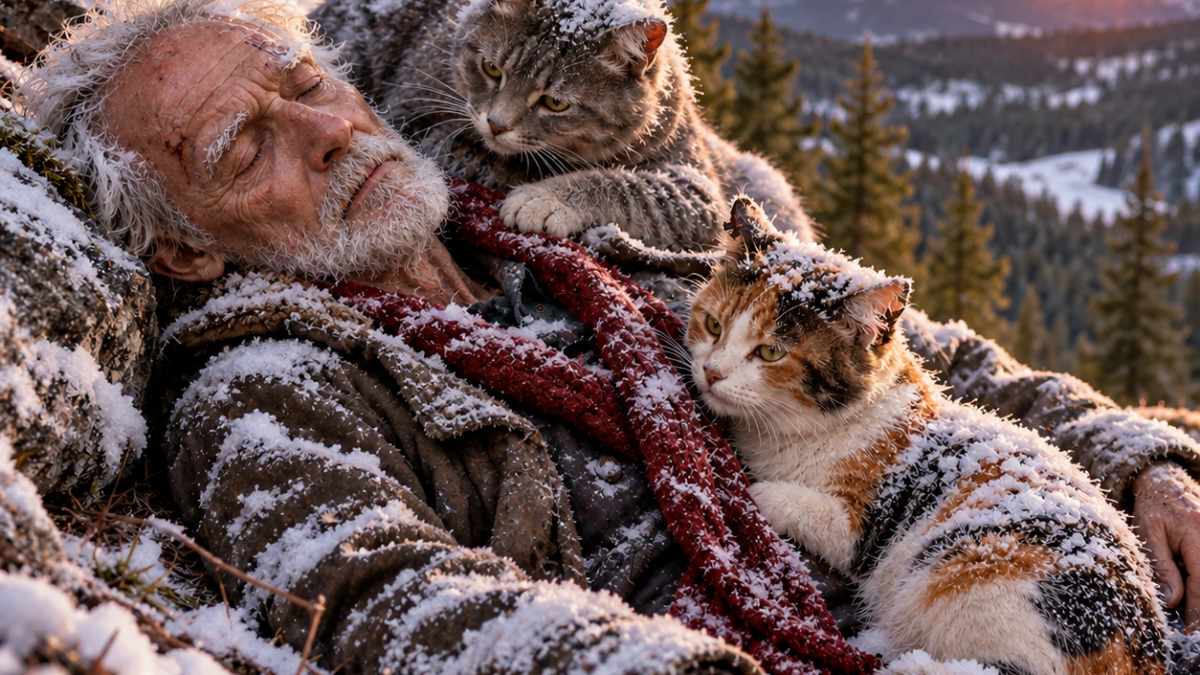
Kert’s brown jacket was partly open from fall.
I crawled beneath one side.
Motte followed immediately.
We pressed against Kert’s chest.
Just like nights at home.
But there was no heartbeat.
Motte kept lifting his head every time branch moved.
At one point he licked Kert’s beard.
Then curled closer.
I touched my nose to his forehead.
He trembled.
I do not know how long night lasted.
Cats do not measure time by clocks when clocks are gone.
We measure changes.
Cold deeper.
Stars.
Wind stronger.
Pain duller.
Motte’s cries less frequent.
My body shivering.
Snowflakes beginning.
I remember thinking about kitchen.
Bowls.
Blinds.
Empty chair.
Wooden step.
Red blanket.
I understood we might never see them again.
I do not know whether cats understand death of selves.
Probably not like humans.
But I knew cold was becoming dangerous.
My paws felt wrong.
Motte pressed harder.
I moved partly on top of him.
He was bigger but more frightened.
I groomed his ear carefully.
Blood dried there.
He purred once.
Weak.
Then stopped.
Near dawn, Motte started crying louder.
Not because Kert moved.
Because birds began waking.
Maybe he heard something.
I heard it later.
Voices.
Far above.
“Mr. Brooks!”
“Kert!”
Another voice.
Searchers.
We did not know that word.
Motte screamed.
A raw sound I had never heard.
Again.
Someone answered.
“There!”
Branches broke.
Boots slid.
People descended.
Orange jackets.
Ropes.
A woman reached us first.
“Oh my God.”
Motte moved in front of Kert.
Protective.
Growled.
The woman stopped.
“It’s okay.”
“No one’s touching you yet.”
Another person checked Kert.
I watched face.
I knew expression.
Humans have a particular stillness when there is no hope.
They wrapped him.
Motte screamed when blanket covered Kert’s face.
He attacked fabric.
Not person.
Fabric.
Claws.
Teeth.
Trying to uncover him.
A rescuer cried.
Actually cried.
“I’m sorry, sweetheart.”
They put us in carriers.
Separate.
That was first mistake.
Motte saw me taken.
He threw himself at carrier door.
Metal shook.
I did same.
Pain shot through hip.
I did not care.
Motte disappeared uphill in stranger’s hands.
I screamed until throat hurt.
At animal hospital, they put me in cage.
Warm blankets.
Pain medicine.
Water.
Food.
I wanted none.
I stared at empty space.
Kert gone.
Motte gone.
Once again, returned.
That was what my body remembered.
Not context.
Not rescue.
Not treatment.
Being left.
People came.
Soft voices.
Hands.
I retreated.
They wrote something on chart.
“Depressed.”
“Not eating.”
“Bonded partner hospitalized separately.”
Of course I was not eating.
The world had become wrong.
At night I heard dogs barking.
Metal doors.
Machines.
No Motte.
I stopped expecting.
That is dangerous.
Hope exhausts faster than hunger.
Three days later, door opened.
A technician knelt.
“Daisy?”
I stayed back.
“Someone wants to see you.”
I did not care.
Then gray shape appeared.
Bandage around head.
Walking slowly.
Motte.
For one second, medicine smell confused me.
Then he made sound.
That sound.
The same one from slope.
I moved forward so fast my hip gave.
Cage door opened wider.
Motte stepped inside.
We touched noses.
He purred.
Weak at first.
Then stronger.
I pushed forehead against his.
He collapsed beside me.
I groomed bandage edge until technician laughed through tears.
“Okay.”
“Okay.”
Then she put food down.
I ate.
That afternoon, Kert’s belongings arrived.
Brown jacket.
Harnesses.
Keys.
Wallet.
Red scarf.
Waterproof pouch.
The veterinarian, Dr. Hannah Lin, sat with Janice from rescue group.
They had been trying to reach Kert’s attorney.
Trying to understand arrangements.
Then technician felt something inside scarf lining.
Stitching.
Uneven.
Hand-sewn.
They opened carefully.
Inside was folded note.
Kert’s handwriting.
Janice read aloud.
“If something happens to me, please do not separate Daisy and Motte.”
She stopped.
Swallowed.
Then continued.
“They are not just my cats.”
“They are my family.”
“They saved me after my wife died.”
“I am only trying to make sure they can save each other when I’m gone.”
Dr. Lin looked at us.
Motte slept against my side.
Janice kept reading.
“Daisy may act angry when frightened.”
“She is not mean.”
“Give her space.”
“Motte may stop eating if Daisy is removed.”
“Please keep them where they can see each other during medical treatment whenever possible.”
That line made technician cover mouth.
They had separated us for three days.
Not cruelty.
Medical necessity and standard procedure.
But Kert had known.
He knew us better than anyone.
The waterproof pouch had everything.
Veterinary records.
Medication.
Feeding instructions.
Emergency contacts.
A savings account designated for our care.
Information from attorney.
Authorization naming Pine Hollow rescue as temporary guardian.
Most important:
written instruction that adoption must be together.
No exception.
No “if easier.”
No “unless home only wants one.”
Together.
Kert had been planning.
Not abandonment.
Protection.
He must have known something.
Maybe doctor told him heart was worse.
Maybe shortness of breath frightened him.
Maybe age alone.
Humans delay conversations with themselves until bodies force them.
Whatever reason, he had spent final week doing something cats could not understand.
Making sure love outlived him on paper.
That mattered because paper rules human world.
Cats have scent.
Humans have documents.
A few weeks later, we left hospital.
Not shelter.
A foster home first.
Quiet woman named June Avery.
Fifty-eight.
Widowed.
One-story house.
No children.
Screened porch.
No other pets.
She volunteered with rescue.
Kert had apparently met her once during planning.
Not to give us away.
To discuss what would happen after.
June placed red scarf in our bed.
Motte slept with face against it.
I did not.
Not first night.
I sat by front door.
Waiting.
Second night too.
Third.
Motte eventually stopped going to window every time a car slowed.
I took longer.
June never forced us.
That helped.
She sat on floor reading.
Exactly like Kert had first day.
Coincidence?
Maybe Janice told her.
Maybe kind people discover same methods independently.
After two weeks, I sat three feet away.
After month, beside her.
Motte accepted sooner.
Of course.
Motte loves with door unlocked.
I inspect hinges first.
June understood.
One evening thunder started.
Motte panicked.
He ran under table.
June sat on floor.
Did not reach.
Just talked.
“I know.”
“Loud.”
“You’re okay.”
Motte slowly crawled toward her.
I watched.
For one second, silhouette looked like Kert.
Not because same.
Because kindness sometimes repeats shape.
Months passed.
My hip improved.
Motte’s ear healed with new notch.
He now had battle damage and became very proud despite doing nothing heroic except falling down mountain.
June officially adopted us together.
Kert’s care fund covered medication and vet checks.
She kept his red scarf.
Washed once, gently.
The smell changed.
Motte noticed.
He cried that night.
June never washed it again.
We developed new routine.
Not replacement routine.
New.
At 6:30, June wakes.
At 6:45, coffee.
At 6:50, bowls.
Motte still eats too fast.
I still glare.
There is an empty chair at June’s table too.
Her husband’s chair.
Different grief.
Same shape.
First morning I realized, I looked at her.
She looked at me.
“Well.”
she said.
“Apparently this house collects widows.”
Technically I was not a widow.
But I understood.
Years—or perhaps only seasons; cats count differently—have passed since slope.
Motte still does something strange at night.
He leaves space beside him.
Always.
Even on cold evenings when he could stretch fully.
A narrow gap on blanket.
The place Kert used to sit and scratch under his chin.
At first I tried to occupy it.
Motte moved away.
So I stopped.
Some spaces belong to memory.
I no longer wait at door.
Not really.
Sometimes truck stops outside and my ears rise before I can help it.
Sometimes brown jacket on stranger creates brief flash.
Sometimes coffee smell reminds me of 7:15.
But I know.
Kert is not coming.
That knowledge is sad.
Not cruel.
Grief becomes less sharp when it stops arguing with reality.
Motte took longer.
He may never completely stop believing some part of Kert exists just beyond the next sound.
When thunder wakes him, I touch my nose to his.
Exactly as I did on mountain.
He settles.
People in Pine Hollow learned story.
“Two cats stayed beside owner’s body all night.”
That was headline.
Humans like that part.
Loyal cats.
Cold night.
Rescue.
Red scarf.
But headlines misunderstand.
We did not stay because heroic.
We stayed because he was ours.
That is simpler.
Kert had stayed with us first.
At shelter when nobody else wanted older cats.
Through my scratching.
Through Motte’s hiding.
Through thunderstorms.
Through bad hip days.
Through mornings when grief made him silent.
He never asked us to become easier animals before loving us.
So when he lay on that slope, we did what family does when leaving feels impossible.
We stayed.
Even when cold came.
Even when it hurt.
But there is another part humans miss.
Kert did not spend final days planning death.
He spent them planning our life.
Food.
Medicine.
Fear.
Sleeping habits.
A sentence explaining my anger.
A warning about Motte’s thunder.
Money.
Contacts.
One scarf.
One note.
Together.
That was his last act of love.
Not dramatic.
Not visible.
Nobody applauded.
He sat at kitchen table beside empty chair and wrote everything down.
The same man Pine Hollow thought was unfriendly.
The same man who barely spoke in grocery store.
The same man who lost his wife and quietly disappeared from other people’s lives.
He understood one thing perfectly.
Being left hurts.
He had been left by death.
I had been returned.
Motte had been abandoned or lost or whatever his first story was.
Kert built a house where three unwanted things stopped being unwanted.
Then when he realized he might leave first, he made sure remaining two would not lose each other.
That is what the note meant.
Not:
Take care of my cats.
Anyone can write that.
He wrote details.
Specific details are where love lives.
Daisy does not like closed doors.
Motte is afraid of thunder.
They must stay together.
He knew our small truths.
Humans say love in giant words.
Forever.
Always.
Family.
Kert said it in half tablets.
Wooden couch steps.
Three extra kibbles.
Open doors.
A red scarf.
That is why I remember him.
Not because he died on mountain.
Because he lived with us before it.
Once, months after our adoption by June, Janice came to visit.
She brought a framed photograph.
Kert on porch.
Motte sitting beside him.
Me on windowsill behind.
None of us looking camera.
She placed it on shelf.
June cried.
Motte sniffed frame.
I jumped onto table.
Janice said:
“Kert would be happy.”
Humans say things like that.
I cannot know.
I hope.
If there is somewhere Kert can see us, he would probably complain that Motte is overweight.
Then give him extra kibble.
June hung red scarf near our bed for winter.
Motte still rubs his face against it.
I pretend not to.
Sometimes after everyone sleeps, I do too.
The wool is old.
No longer smells much like Kert.
Maybe a little cedar.
Maybe I imagine.
Memory has smell long after fabric loses it.
One winter night, snow covered porch.
Wind hit windows.
Motte woke crying.
A dream.
He searched room.
Under table.
Door.
Hallway.
Then came to me.
I touched nose to his.
He lay down.
I moved closer.
Our sides pressed.
For a second I was back beneath brown jacket on mountain.
Cold.
Dark.
Kert between us.
But then June’s heater clicked.
Blanket warm.
Snow outside.
Safety inside.
I understood something I could not understand that night.
Kert had already saved us.
Not from fall.
Not from cold.
From what came after.
He knew rescuers might find bodies.
He knew shelters separate animals.
He knew older bonded cats are difficult to place together.
He knew someone might say:
Daisy is too difficult.
Motte is easier.
Or:
We have room for one.
Or:
They’ll adjust.
He refused that possibility before anyone could suggest it.
They must stay together.
Human ink.
Human law.
Human promise.
Because he understood our language even if he could not speak it.
Do not leave me.
That is what Motte cried beside his body.
Do not leave me.
That is what I had felt every time a carrier door closed in my earlier life.
Do not leave me.
That is what Kert himself had lived with after Ellen died.
So he answered us before we ever asked.
I may leave.
But you will not leave each other.
There are worse last promises.
I have known homes where love meant possession.
Humans keeping animals because they liked how we made them feel.
Kert’s love meant preparation for a future without himself.
That is rarer.
To love someone enough to imagine their life after you are gone.
To arrange it.
To pay for it.
To protect bonds that do not include you.
That is why I no longer think of him as lonely man.
He was not alone at end.
Motte was calling him.
I was beside him.
The cold came.
We stayed.
And before any of that, while still alive and drinking coffee across from Ellen’s empty chair, Kert had already made sure that when rescuers carried him away, the two creatures who loved him most would still have each other.
Motte believed Kert was only sleeping.
I knew better.
But neither of us knew the most important thing.
Kert had known we would survive him.
And he had spent his final days making certain survival would never mean being alone.

