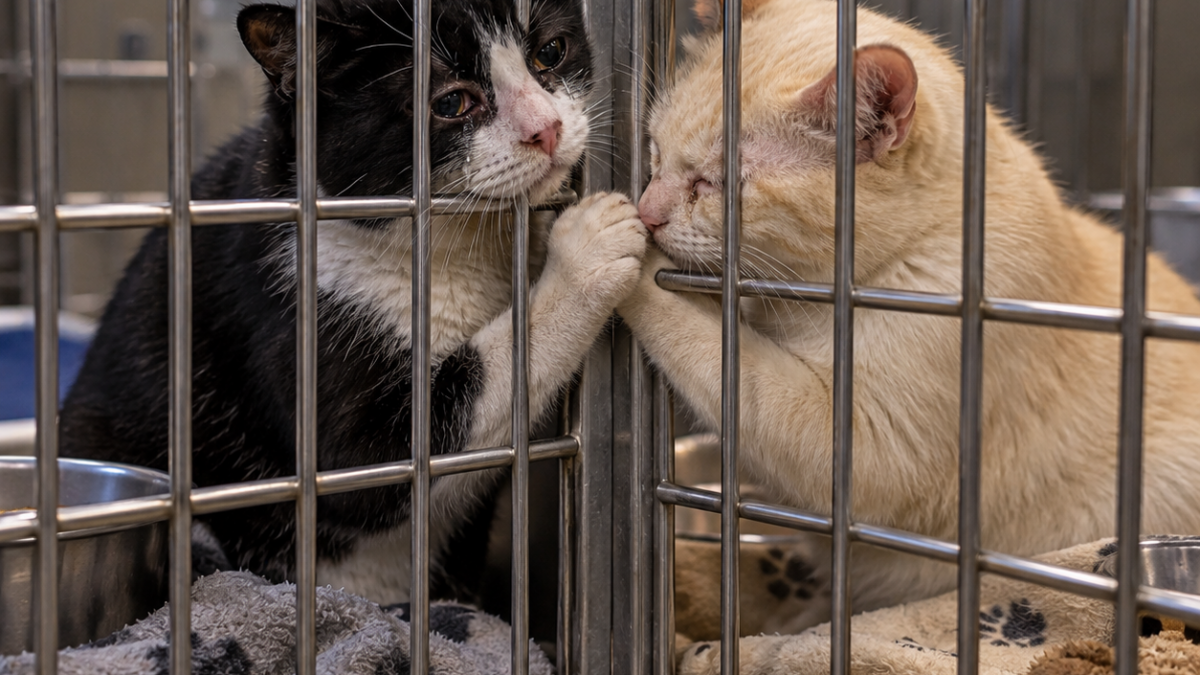
Two 8-Year-Old Cats Lost Their Home When Their Owner Entered Memory Care—Now They Spend 23 Hours a Day Separated by Wire, Waiting for One Family to Take Them Both.
PART3:
Three minutes passed.
Eleanor frowned.
“Why isn’t it…”
She looked at the machine.
Then laughed.
“Oh.”
She pressed the button.
There had been more moments like that.
At first, small enough to be funny.
Keys in the refrigerator.
Milk in the pantry.
A phone call she forgot making.
Then larger.
One afternoon Eleanor walked six blocks to the pharmacy and could not remember how to get home.
A police officer found her sitting outside the library.
She knew her name.
She knew the year.
She knew she lived in a blue house.
She could not remember the street.
Her daughter, Rachel, drove from Burlington that night.
They sat at the kitchen table while Haft and Crest slept pressed together on Eleanor’s lap.
Rachel said:
“Mom, we have to talk.”
Eleanor looked toward the window.
“No.”
“Mom.”
“I know what you’re going to say.”
“You got lost.”
“I got turned around.”
“You’ve lived here thirty-eight years.”
Eleanor’s mouth tightened.
Crest lifted his head.
Rachel lowered her voice.
“I’m scared.”
“You think I’m not?”
That stopped her.
Eleanor looked down.
Her hand rested on Haft’s back.
“I know something is happening.”
Rachel swallowed.
“How long?”
Eleanor did not answer immediately.
“A while.”
“Why didn’t you tell me?”
“Because the minute children know their mother is becoming inconvenient, everybody starts making decisions.”
Rachel flinched.
“I would never—”
“I know.”
Eleanor rubbed Crest behind one ear.
“I know you wouldn’t.”
Then, quieter:
“But I also know how this works.”
Rachel cried that night in the guest room.
Not loudly.
The next morning, Eleanor made scrambled eggs and pretended nothing had happened.
Life continued.
Doctors.
Tests.
Appointments.
Questions.
What day is it?
Who is the president?
Remember these three words.
Draw a clock.
Eleanor hated the clock.
Not because she couldn’t draw it.
Because everyone watched her as though the shape of twelve numbers could decide whether she remained herself.
Early-stage dementia became moderate.
Moderate became unsafe.
Then came the kitchen fire.
Not a major one.
A dish towel near a burner.
Smoke alarm.
Neighbor smelled it.
No one hurt.
But after that, Rachel stopped pretending more time would solve anything.
The memory care facility was thirty minutes away.
Clean.
Kind staff.
Garden.
Small room.
Safety.
Eleanor agreed only after one condition.
“The boys.”
Rachel knew.
Haft and Crest.
She had been dreading it.
The facility allowed scheduled pet visits.
Not live-in pets.
Rachel tried everything.
She called her brother Michael in Boston.
He had a dog who attacked cats.
Her cousin Denise had severe allergies.
Neighbors.
Friends.
Church members.
Former coworkers.
Eleanor’s hairdresser.
Rachel’s colleagues.
A teacher from the elementary school.
One woman nearly agreed, then her landlord said no.
A retired couple said they could take one.
Rachel asked:
“Both?”
They hesitated.
“Our apartment is small.”
“They’ve never been apart.”
“We could take the cream one.”
“No.”
Another family offered for Haft.
No Crest.
No.
No.
No.
Fourteen people.
Sixteen, eventually.
Everyone said the same thing.
“They’re wonderful.”
“They deserve a home.”
“I wish we could.”
“But two is a lot.”
Two litter boxes.
Two veterinary bills.
Two mouths.
Two carriers.
Two elderly cats with unknown future medical costs.
Two.
Nobody wanted to say it cruelly.
They didn’t have to.
Rachel understood.
The Tuesday before Eleanor moved, she sat on the living room floor with Haft and Crest.
Cardboard boxes surrounded them.
Half the house already looked unfamiliar.
Crest kept walking to places where furniture used to be.
Haft followed.
Then both returned to Eleanor.
She held them against her.
“Your mother made a mess.”
Rachel knelt beside her.
“Mom.”
“I was supposed to take care of them.”
“You did.”
“For eight years.”
“You still did.”
“What happens now?”
Rachel looked at the cats.
“I’m trying.”
“Trying isn’t a place.”
Rachel blinked hard.
“No.”
Eleanor pressed her face into Haft’s fur.
He tolerated it the way only a cat who loved someone deeply tolerates being squeezed too hard.
Crest climbed onto her leg.
Eleanor whispered:
“They sleep together.”
“I know.”
“Haft gets scared during thunderstorms.”
“I know.”
“Crest won’t eat if he can’t see Haft.”
“I know.”
“Promise me.”
Rachel knew what was coming.
“Promise me you don’t split them.”
There are promises people make because they believe they can keep them.
And promises people make because the alternative is unbearable.
Rachel said:
“I promise.”
Three days later, Eleanor left Willow Street.
She wore a blue coat.
Rachel carried a suitcase.
A staff member named Marisol met them at the memory care entrance.
Eleanor looked back at Rachel’s car.
“The boys?”
Rachel had already explained.
Temporary foster, she had said.
Not shelter.
Not yet.
She couldn’t say it.
“They’re safe.”
“Together?”
“Yes.”
Eleanor stared.
“Together?”
Rachel’s throat closed.
“Yes, Mom.”
The lie lasted less than twelve hours.
Haft and Crest spent that first night alone in the blue house.
Rachel stayed with them.
She slept on the couch.
Or tried.
At 2:17 A.M., she woke to Crest crying near Eleanor’s bedroom door.
Not loudly.
One short call.
Then another.
Haft sat behind him.
Rachel opened the door.
They entered.
Bed stripped.
Closet half empty.
Eleanor’s slippers gone.
Crest jumped onto the mattress.
Smelled the sheets.
Haft followed.
They walked in circles.
Then lay together in the center of the bare bed.
Rachel stood in the doorway and broke.
“I’m sorry.”
Neither cat looked at her.
By Monday morning, the house had to be cleared enough for sale preparation.
The shelter agreed to take them.
Green Mountain Animal Haven sat outside Montpelier in a converted veterinary building.
It was not a bad shelter.
That mattered.
People imagine shelters as either heroic sanctuaries or miserable cages.
Most are neither.
They are rooms full of limited space, people doing impossible math, animals arriving faster than homes do, volunteers stretching twenty minutes into forty because a frightened animal needs more.
The shelter director, Leah Donnelly, had worked there thirteen years.
She had learned that intake days had patterns.
Puppies drew tears.
Senior dogs drew apologies.
Cats often arrived in cardboard carriers because somebody never expected to need a real one.
Haft and Crest arrived in matching hard-shell carriers.
Good carriers.
Clean towels inside.
Medical folders taped on top.
Eight years of veterinary records.
Rachel entered first.
Her eyes were red before anyone spoke.
Leah knew immediately.
Owner death?
Eviction?
Hospital?
“What’s going on?”
Rachel looked at the carriers.
“My mother.”
Leah waited.
“She has dementia.”
“I’m sorry.”
“She moved into memory care Friday.”
Leah crouched beside the carriers.
Two sets of eyes watched her through the doors.
“They hers?”
Rachel nodded.
“Haft and Crest.”
“Bonded?”
“Completely.”
“How old?”
“Eight.”
“Any medical issues?”
“Nothing major.”
“Haft had a urinary blockage three years ago.”
“Crest had dental work last summer.”
Leah nodded.
“And they’ve always lived together?”
Rachel gave a small laugh that sounded painful.
“Always.”
“Same litter?”
“No.”
“We adopted Crest first.”
“He was maybe ten weeks.”
“Haft came two months later.”
“My mom said Crest stopped acting lonely the second Haft walked into the house.”
Leah opened the paperwork.
“No previous separation?”
Rachel shook her head.
“Not one night.”
Leah looked toward the cat room.
The shelter was full.
Three emergency intakes that weekend.
Two stray litters.
A hoarding case.
The only available adult cat spaces were two neighboring kennels.
Not one large enclosure.
Her stomach tightened.
“We don’t currently have a double kennel.”
Rachel looked up.
“What does that mean?”
“We can place them side by side.”
“Can they be together?”
“During supervised time.”
“How long?”
“As much as we can manage.”
Rachel’s face changed.
“I promised.”
Leah understood too late.
“What?”
“My mother.”
“She asked me not to separate them.”
“They’ve already lost her.”
“She said they couldn’t lose each other.”
Leah leaned against the intake desk.
“We won’t adopt them separately.”
Rachel stared.
“You promise?”
Leah knew better than to make promises casually.
She also knew what she was about to say.
“Yes.”
“Together only.”
Rachel began crying.
Not dramatic.
Just tears.
“Thank you.”
Haft came out of his carrier first.
Black-and-white tuxedo.
White chest.
White socks.
Long whiskers.
He stepped into the intake room.
Stopped.
Low body.
Tail tucked.
Crest remained inside his carrier.
Cream-colored.
Soft coat.
Slightly darker ears and tail.
Haft looked back.
Crest came out.
Immediately moved beside him.
Shoulder to shoulder.
Leah watched.
There are cats who tolerate another cat.
Cats who play.
Cats who coexist.
Then there are bonded pairs.
The difference usually reveals itself under stress.
Haft did not explore the strange room until Crest moved.
Crest did not approach Leah until Haft did.
When a metal tray dropped in the hallway, Haft flinched.
Crest turned and touched his face.
A tiny gesture.
Leah felt something settle in her chest.
“Yeah.”
Rachel looked at her.
“What?”
“They stay together.”
The kennels were across from a window.
Haft left.
Crest right.
A wire partition between.
Close enough to see.
Not close enough to touch comfortably.
When Crest entered his kennel, Haft followed the motion from the other side.
Then realized the barrier.
He pressed his nose to wire.
Crest did the same.
Rachel covered her mouth.
“I can’t.”
Leah touched her arm.
“Go.”
Rachel looked horrified.
“I shouldn’t leave them.”
“You should.”
“Staying for an hour won’t make the leaving easier.”
Rachel crouched.
“Haft.”
He looked at her.
“Crest.”
Both watched.
“I’m sorry.”
Crest blinked.
Haft sat.
Rachel whispered:
“Grandma loves you.”
Then she left.
For the first six hours, neither cat ate.
They sat opposite each other.
Not at the front of their kennels where visitors passed.
At the divider.
Haft facing Crest.
Crest facing Haft.
At 4:00, volunteer Maya Lopez arrived.
Seventeen.
High school senior.
Three afternoons a week.
She noticed immediately.
“Why are these two staring at each other?”
Leah explained.
Maya crouched.
“Oh.”
She slipped one finger through the bars.
Haft ignored it.
Crest ignored it.
Maya said:
“They don’t care about me.”
“Correct.”
“Rude.”
Leah smiled.
“They’ve had a bad weekend.”
Maya looked again.
“Can we open the divider?”
“It isn’t removable.”
“Then how do they get together?”
“During cleaning.”
That became the routine.
Every morning at 7:30, cat room cleaning started.
Kennel doors opened one at a time.
Animals moved into temporary play areas.
Haft and Crest were taken to the same small socialization room.
The first morning, Maya was there early.
She carried Haft.
Another volunteer carried Crest.
They placed them on the floor.
The reaction was immediate.
Haft walked straight to Crest.
Crest walked straight to Haft.
No hesitation.
They touched noses.
Then cheeks.
Haft rubbed his entire body along Crest’s side.
Crest began grooming Haft behind one ear.
Haft closed his eyes.
Leah stood in the doorway.
Maya whispered:
“They thought they lost each other.”
Leah said:
“Maybe.”
For twenty-two minutes, the cats stayed connected.
Explored together.
Sat in the same window.
Shared a water bowl even though two were available.
Then cleaning ended.
They had to return.
Crest entered his kennel first.
Haft resisted for the first time.
Not violently.
He planted all four paws.
Maya felt it.
“Oh no.”
Leah took him gently.
“Come on, buddy.”
Haft looked toward Crest.
Crest was already waiting at the divider.
Haft entered.
The door closed.
He went straight there.
Nose to wire.
Crest did the same.
Day two.
Same.
Day three.
Same.
By the end of week one, staff had rearranged schedules to give them thirty minutes together.
That was all they could reliably guarantee.
The shelter served thirty-seven cats.
Twenty-one dogs.
Rabbits.
Two guinea pigs.
One elderly cockatiel whose vocabulary included a word nobody wanted children to hear.
Resources did not expand because one pair was heartbreaking.
That reality made everything harder.
Visitors came.
Haft attracted people first.
Tuxedo cats photograph well.
His white paws looked like gloves.
Children pointed.
Crest had gentler appeal.
Soft cream fur.
Quiet eyes.
One family asked about Crest.
“He’s beautiful.”
Maya said:
“He comes with Haft.”
The mother looked confused.
“Comes with?”
“They’re bonded.”
“We were only planning one.”
“Then there are several wonderful single cats.”
The family chose another.
Maya considered that a victory.
Leah considered it reality.
Week two.
Haft began eating normally.
Crest ate only if his bowl sat near the divider.
They moved it.
Crest ate.
At night, the shelter cameras recorded something volunteers noticed later.
Around 11:00, when lights dimmed and the building quieted, Haft lay against the wire.
Crest mirrored him.
Backs curved.
Paws tucked.
Six inches apart.
The barrier between them.
One night, Haft stretched a white paw through.
Crest placed his paw against it.
Maya found the footage.
She watched it three times.
Then cried in the supply room.
Leah found her.
“You okay?”
“No.”
“Useful answer.”
Maya held up her phone.
“Look.”
Leah watched.
Haft’s paw.
Crest’s.
“You want to post it?”
Maya asked.
Leah hesitated.
The shelter needed visibility.
Bonded adult cats were difficult placements.
Eight-year-olds harder than kittens.
Two eight-year-olds together?
Hard.
“Post it.”
The caption stayed simple.
Haft and Crest are eight-year-old bonded companions who lost their home when their owner entered memory care.
They will be adopted together.
They had never spent a night apart before arriving here.
Now their kennels are side by side while they wait for one home with room for both.
The video got attention.
Hundreds of shares locally.
Then thousands.
Applications came.
Most failed on one fact.
Two cats.
People loved the story.
They wanted one.
A woman from New Hampshire applied for Crest.
“I already have a black-and-white cat.”
“I think Crest would fit.”
Leah said:
“They are not being separated.”
“But what if Haft gets adopted by someone else?”
“He won’t.”
“That seems unfair.”
“To who?”
The woman paused.
“To them.”
Leah looked through the office window toward the cat room.
“No.”
“I think separating them would be unfair.”
The woman withdrew.
Another applicant wanted Haft.
“Crest looks old.”
“They’re the same age.”
“Really?”
“Yes.”
“Still, I prefer Haft.”
“No.”
The shelter received angry emails.
People accused them of being too strict.
“You’re keeping cats homeless over sentimentality.”
“You could save two homes by splitting them.”
“Animals adjust.”
Leah read every message.
Some nights she wondered.
That was the part rescue organizations rarely admit publicly.
They second-guess.
Because every decision uses space.
If Haft and Crest occupied two kennels for months, two other cats might wait elsewhere.
If separating them created fast adoptions, was that better?
Leah asked the shelter veterinarian, Dr. Priya Shah.
Priya had treated both cats.
She answered carefully.
“Bonded doesn’t mean they’ll die apart.”
“I know.”
“But?”
“But we’ve observed stress linked specifically to separation.”
“Crest’s appetite.”
“Haft’s pacing.”
“Their behavior during reunion.”
“It’s significant.”
Leah sighed.
“People think we’re being emotional.”
“We are.”
Leah looked up.
Priya continued.
“Emotion isn’t automatically bad judgment.”
“If they were six months old and casually friendly, I’d say separate if needed.”
“These two?”
She shook her head.
“They’ve lost their person, home, territory, smells, routine, furniture, windows.”
“Everything.”
“Each other is the only familiar thing left.”
Leah nodded.
“So together.”
“Together.”
Week three.
Rachel visited.
She had been afraid.
Seeing them in kennels felt like proof she had failed.
Leah met her at the entrance.
“How’s your mom?”
“Some days better.”
“She asks about them.”
“What do you say?”
Rachel looked down.
“That they’re together.”
Leah did not correct her.
They opened the socialization room.
Haft and Crest entered.
Rachel sat on the floor.
At first neither approached.
Then Crest smelled her.
He froze.
Walked closer.
Rachel held out her hand.
Crest sniffed.
Then rubbed against her.
Rachel broke.
“Oh, baby.”
Haft followed.
Within minutes both were on her lap.
Rachel buried her face in their fur.
“I’m so sorry.”
Maya stood outside the door and quietly walked away.
Rachel stayed an hour.
Before leaving, she asked:
“Can my mom see them?”
Leah thought.
“Here?”
“She can’t travel easily.”
“We might be able to do a visit at the facility.”
Rachel stared.
“You’d do that?”
“We’ll need approval.”
“Health clearance.”
“Secure carriers.”
“But yes.”
Two days later, Haft and Crest returned to Eleanor.
Memory care staff prepared a private activity room.
Rachel waited beside her mother.
Eleanor had good mornings and foggy afternoons.
That day began uncertain.
She knew Rachel.
Forgot where they were.
Asked twice when Samuel was coming.
Samuel had been dead twelve years.
Then the carriers entered.
Eleanor looked.
No reaction initially.
Rachel’s heart sank.
Leah opened Crest’s carrier.
Crest stepped out.
Eleanor’s eyes changed.
“Crest?”
Rachel started crying before she could stop.
Haft emerged next.
Eleanor put both hands over her mouth.
“My boys.”
The cats recognized her immediately.
There was no hesitation.
Crest climbed onto her lap.
Haft pressed against her side.
Eleanor made a sound Rachel had not heard since childhood.
Not quite laughter.
Not quite crying.
She held them.
“Oh, where have you been?”
Rachel knelt.
“They’re safe.”
Eleanor stroked Haft.
“Did you feed them?”
“Yes.”
“Crest needs the blue bowl.”
“I know.”
“Haft doesn’t like thunderstorms.”
“I know.”
Then Eleanor looked at Rachel.
“Are they together?”
Rachel looked toward Leah.
Leah nodded.
“Yes.”
“Always?”
Rachel could not say it.
Leah answered.
“We’re making sure they stay together.”
Eleanor studied her.
“You promise?”
Leah had made that promise once already.
She made it again.
“Yes.”
Eleanor nodded.
“Good.”
Five minutes later, she asked who the cats belonged to.
Rachel had to leave the room.
Leah found her crying in the hallway.
“She forgot them.”
“For a minute.”
“She forgot them while they were sitting on her.”
Leah leaned against the wall beside her.
“But they didn’t forget her.”
That sentence became both comfort and wound.
The visit ended after forty minutes.
Eleanor kissed both cats.
Haft tolerated it.
Crest leaned into it.
Back at the shelter, they slept pressed together during social time for almost the entire afternoon.
Week four.
A local television station asked to film.
Leah declined initially.
Then changed her mind.
Visibility might find the right home.
The story aired.
Two older cats.
One owner in memory care.
One promise.
Applications tripled.
The shelter screened all.
One seemed perfect.
Susan and Mark Delaney.
Late fifties.
No children at home.
Quiet house.
Previous cats.
Indoor only.
References excellent.
They applied for both.
Leah called.
“Can you come Wednesday?”
Susan sounded thrilled.
“We’ll be there.”
Wednesday arrived.
Maya cleaned the visitation room.
Haft and Crest were brought in.
Susan and Mark entered.
Susan sat immediately on the floor.
Good sign.
Mark stayed quiet.
Another good sign.
Crest approached first.
Sniffed Susan.
Haft circled Mark’s shoes.
Within fifteen minutes, Crest accepted petting.
Haft climbed onto a chair beside Susan.
Leah felt hopeful.
Then Mark asked:
“What if one doesn’t adjust?”
Leah explained decompression.
Time.
Routine.
Then he said:
“If Haft doesn’t settle, could we return him and keep Crest?”
Everything in Leah went still.
Susan looked at him.
“Mark.”
“What?”
“I’m asking.”
Leah said:
“No.”
Mark frowned.
“Even if one is miserable?”
“We would support adjustment.”
“And if it truly failed, they would both return.”
“That seems extreme.”
“They are placed as a pair.”
Mark looked at Crest.
“He’s really the one Susan connected with.”
Susan’s face flushed.
“That’s not what I said.”
Leah knew.
The application ended politely.
They left without cats.
Maya waited until the door closed.
“Did we just lose them a home?”
Leah answered:
“That wasn’t their home.”
But that night she lay awake wondering whether certainty was a luxury.
Day thirty-two.
Day thirty-three.
Thirty-four.
The shelter posted updates.
Haft and Crest had fans now.
People donated beds.
Food.
Someone mailed matching blankets.
Someone offered to pay their adoption fee.
Helpful.
Not a home.
Eleanor declined.
Rachel called Leah.
“Mom had a bad week.”
“I’m sorry.”
“She keeps asking whether she needs to go feed them.”
Leah swallowed.
“What do you tell her?”
“That they’re together.”
Again that word.
Together.
Technically true for thirty minutes a day.
Emotionally incomplete.
Leah started moving pieces around.
A shy young cat transferred to foster care.
Two kittens adopted.
A larger double enclosure became available.
Finally.
Day thirty-six.
Maya arrived early.
Leah waited beside the empty double kennel.
“Guess what.”
Maya saw it.
“No.”
“Yes.”
They moved Haft and Crest.
Both entered from separate carriers.
Haft emerged.
Crest emerged.
No divider.
At first they seemed confused.
They checked corners.
Then realized.
Haft walked to Crest.
Crest lowered his head.
They rubbed faces.
Maya filmed.
Then the two cats curled into the same bed even though there were two.
Leah stood there longer than necessary.
“Finally.”
That night, the camera showed them sleeping tangled together.
No wire.
Day thirty-seven, Crest ate away from Haft for the first time since intake.
Day thirty-eight, Haft played with a feather toy.
Day thirty-nine, both climbed the shelf.
Behavior changed.
Not dramatically.
Enough.
Priya noticed.
“They’re less guarded.”
Leah nodded.
“Imagine that.”
The adoption rule felt easier to defend after that.
They were not simply companions.
They regulated each other.
Day forty-one.
An email arrived.
Subject:
ABOUT HAFT AND CREST.
Leah opened it.
My name is Caroline Avery. I saw the news story.
My husband, David, and I recently lost our thirteen-year-old cat, Oliver.
We said we weren’t ready again.
Then I saw Haft and Crest.
I’m not writing because they’re sad.
I’m writing because I think we might understand what they need.
Our house is quiet.
No other pets.
We both work from home.
We have space.
I know eight isn’t young.
That’s okay.
I also know adopting two older cats means possibly facing two sets of medical problems and eventually two losses.
That part scares me.
But I don’t think fear of losing them later is a good reason to leave them waiting now.
Could we meet them?
Leah read it twice.
Then sent the application.
Everything checked.
Veterinary references.
Previous cat lived to thirteen.
Indoor-only.
Stable home.
No concerns.
Visit scheduled for Saturday.
Friday night, another application arrived.
A family wanted Crest.
Only Crest.
They had seen him online.
Their daughter had fallen in love with him.
They offered triple the adoption fee.
They said they could come immediately.
Leah replied:
Haft and Crest are a bonded pair and are only available for adoption together.
The response came twenty minutes later.
This is ridiculous.
You’re denying Crest a loving family because of a human emotional projection.
Our daughter is devastated.
Please reconsider.
Leah closed the laptop.
At 7:10 the next morning, the family arrived anyway.
Mother.
Father.
Girl maybe ten.
No appointment.
The girl carried a cream-colored stuffed cat.
Leah met them in lobby.
“We emailed.”
“I know.”
“We came because we thought if you met Emily you’d understand.”
The girl looked toward the cat room.
“Can I see Crest?”
Leah hated this.
Not because the answer was difficult.
Because children make adults’ decisions feel cruel.
“You can meet both cats.”
The mother said:
“We can’t take two.”
“I understand.”
“Then why make her meet Haft?”
Leah looked at the girl.
“Because Crest has a best friend.”
Emily asked:
“His brother?”
“Not biologically.”
“But family.”
The mother sighed.
“This is exactly what I mean.”
“You’re assigning human concepts.”
Priya happened to enter.
Leah glanced at her.
Priya said calmly:
“We’re describing observed behavior.”
The father said:
“Cats adapt.”
“Many do.”
“And these might.”
“They might.”
“Then why refuse?”
Priya answered:
“Because our goal isn’t to discover whether they can survive something unnecessarily.”
Silence.
Emily looked confused.
“Can I see them?”
Leah said yes.
They stood outside the double enclosure.
Haft and Crest were sleeping together.
Crest’s chin rested across Haft’s white front paw.
Emily pressed both hands to glass.
“Oh.”
The mother softened despite herself.
Emily asked:
“Which one is Crest?”
“The cream one.”
“And Haft is the black one?”
“Yes.”
Emily watched.
“Do they sleep like that all the time?”
“Pretty much.”
The girl was silent.
Then:
“Mom.”
Her mother crouched.
“What?”
“I don’t want Crest if he has to leave Haft.”
Leah felt something loosen.
The mother closed her eyes.
“Emily…”
“He’d be sad.”
“We don’t know that.”
Emily looked again.
“I would be.”
The family left without anger.
Before they did, Emily put twenty dollars from a birthday card into the donation box.
“For both.”
That afternoon, Caroline and David Avery arrived.
No dramatic music.
No miracle feeling.
Just two people in their early sixties wearing winter coats.
Caroline carried nothing.
David carried a notebook.
Maya whispered to Leah:
“Notebook is either good or terrifying.”
Leah smiled.
“Let’s find out.”
They entered the visitation room.
Haft and Crest arrived together.
Caroline sat on the floor.
David sat in a chair.
Neither reached.
Neither called.
They waited.
Crest approached Caroline after four minutes.
Sniffed her knee.
She looked at Leah.
“Should I pet him?”
“If he asks.”
Caroline left her hand still.
Crest rubbed against it.
She stroked once.
Stopped.
Crest returned.
Good.
Haft inspected David.
David did not touch.
Haft sniffed his notebook.
David said:
“That’s my medical question list.”
Leah laughed.
Haft stepped onto his shoe.
David looked down.
“I guess we’ve begun negotiations.”
For forty-five minutes, the cats moved between them.
Not instantly affectionate.
Better.
Curious.
Calm.
Caroline asked:
“What happens if one dies first?”
Everyone went quiet.
She looked embarrassed.
“I know that’s awful.”
“No.”
Leah said.
“It’s realistic.”
Caroline rubbed Crest’s cheek.
“They’ve never been apart.”
“How do we help the survivor?”
Priya explained grief in animals.
Changes in appetite.
Searching behavior.
Routine.
Medical monitoring.
Caroline listened.
David wrote notes.
Then:
“What food do they eat?”
“What litter?”
“Which one gets the urinary diet?”
“Haft.”
“Any medications?”
“No current.”
“Preferred sleeping places?”
“Together.”
David smiled.
“Right.”
Then Caroline asked:
“Can we think overnight?”
Leah’s heart sank and then corrected itself.
Good adopters think.
“Absolutely.”
Caroline stood.
Before leaving, she crouched near the cats.
“We’ll see.”
Not:
See you tomorrow.
Not false promise.
Just:
“We’ll see.”
Day forty-two.
No call before noon.
Maya checked the phone every ten minutes.
Leah pretended not to.
At 2:13, Caroline called.
“We want them.”
Leah closed her eyes.
“Both?”
Caroline laughed softly.
“I think they’d object if we didn’t.”
Home visit completed.
Paperwork.
Adoption scheduled Thursday.
Day forty-six.
Rachel visited the shelter.
Leah told her.
Rachel started crying.
“Really?”
“Really.”
“Good people?”
“Very.”
“Together?”
“Together.”
Rachel sat with Haft and Crest.
She took photographs.
Then asked:
“Can we tell Mom?”
They drove to memory care the next morning.
Without cats this time.
Eleanor sat near a window holding a cup of tea.
She knew Rachel immediately.
Good day.
Rachel sat.
“Mom.”
“Hmm?”
“The boys have a home.”
Eleanor’s hand stopped.
“What boys?”
Rachel’s heart cracked.
“Haft and Crest.”
For several seconds, nothing.
Then memory returned like a light coming on behind a curtain.
“My cats.”
“Yes.”
“Where?”
“A couple named Caroline and David.”
“They have a quiet house.”
“No dogs.”
“They’ll be together.”
Eleanor stared.
“Together?”
“Yes.”
“Same house?”
“Same house.”
“Same room?”
“They can sleep wherever they want.”
Eleanor’s eyes filled.
“Oh.”
Rachel reached for her hand.
Eleanor whispered:
“I was afraid they’d think I left them.”
Rachel could not answer.
Eleanor stared at the snow outside.
“I didn’t.”
“I know.”
“Do they?”
Rachel had no truthful answer.
So she chose the kinder one.
“I think they know you loved them.”
Eleanor cried.
Then smiled.
“Good.”
Five minutes later, she asked whether Samuel would be home for dinner.
Rachel answered gently.
Day forty-seven.
Adoption morning.
Maya arrived before her shift.
“No school?”
Leah asked.
“I have first period free.”
“You have school.”
“I’m emotionally unavailable for school.”
Leah pointed toward the clock.
“You leave by nine.”
Caroline and David arrived at eight.
Two carriers.
Not one oversized carrier.
Leah noticed.
David explained:
“For transport safety.”
“But we’ll place them side by side.”
Notebook again.
Haft and Crest received final exams.
Healthy.
Weight stable.
Medical records copied.
Microchips updated.
Leah went through contract.
Bonded pair clause.
If placement failed, both returned.
Caroline initialed.
Then came the moment.
Maya opened the double enclosure.
Crest stepped out first.
Haft followed.
Caroline knelt.
“Hi, boys.”
Crest approached.
Haft stayed slightly behind.
Leah felt sudden fear.
Forty-seven days.
What if they came back?
What if the house overwhelmed them?
What if the adopters changed their minds?
What if everything that looked right failed?
Rescue work teaches you not to celebrate too early.
They placed Crest in one carrier.
Haft in the other.
Immediately Crest turned toward Haft.
Haft answered with one short meow.
Caroline moved the carriers together so the doors faced.
The cats could see each other.
Haft settled.
Crest settled.
David lifted one.
Caroline the other.
Maya was crying openly.
Leah pretended she wasn’t.
At the exit, Caroline stopped.
“Can we ask one strange favor?”
“What?”
“Could we take something that smells like their old owner?”
Rachel had left one.
A small blue blanket from Eleanor’s bed.
The shelter had kept it sealed except during visits because the cats settled around it.
Leah retrieved it.
Caroline held it carefully.
“We’ll put it in their room.”
Maya whispered:
“Okay, now I really hate you.”
Caroline laughed.
“Good hate?”
“Yes.”
They walked out.
Two carriers.
Side by side.
The shelter door closed.
For the first time in forty-seven days, the double kennel was empty.
Maya stood there.
“Feels wrong.”
Leah nodded.
“Best kind of wrong.”
The Avery house was a white Cape on a quiet road outside Waterbury.
Three bedrooms.
Finished basement.
Large windows.
Bird feeders.
No children.
No pets.
Caroline and David had prepared one room.
Not because they intended to keep the cats confined forever.
Because transitions go better small.
Two litter boxes.
Water.
Food.
Beds.
Hiding spots.
Scratchers.
Eleanor’s blue blanket folded on a low chair.
Carriers placed side by side.
Doors opened.
Nobody reached in.
Crest stayed inside eight minutes.
Haft eleven.
Then Crest stepped out.
Haft followed.
Of course.
They explored wall by wall.
Crest checked under bed.
Haft checked closet.
They found the blanket.
Both stopped.
Crest sniffed.
Then climbed onto it.
Haft joined.
Caroline watched from doorway.
David whispered:
“They remember.”
Caroline said:
“Maybe.”
Neither needed certainty.
The cats slept there three hours.
First night, they did not leave the room.
Caroline slept badly anyway.
At 2:00 A.M. she checked the camera.
Haft and Crest were together.
At 4:00.
Together.
At 6:15, David opened the door and sat on floor with coffee.
Crest came to him.
Haft watched.
By day three, they explored hallway.
Day five, living room.
Day six, Crest discovered the window.
Haft discovered the radiator.
Day seven, Caroline sent Leah a picture.
Both cats in the window.
Shoulders touching.
Snow outside.
Caption:
THEY FOUND THE BIRD CHANNEL.
Maya printed it.
Taped it inside the empty kennel before the next cat arrived.
Rachel received photographs too.
She brought them to Eleanor.
Some days Eleanor recognized them.
Some days not.
One afternoon she held a picture of Haft and Crest sleeping on the Avery couch.
She studied it for nearly a minute.
Then said:
“They look happy.”
Rachel smiled.
“They are.”
“Whose cats?”
Rachel swallowed.
“Yours.”
Eleanor looked again.
“Oh.”
Then she touched the photograph.
“My boys.”
The Avery household changed slowly.
Haft was bolder.
He followed David into the kitchen.
Crest preferred Caroline’s office.
Every afternoon around three, he slept behind her laptop.
They still ate near each other.
Still groomed.
Still slept together most nights.
But something else happened after about two months.
They began separating voluntarily.
Haft napped downstairs.
Crest stayed upstairs.
For an hour.
Sometimes two.
Then one would find the other.
Caroline mentioned it to Leah.
“Is that bad?”
Leah smiled.
“No.”
“What does it mean?”
“Maybe they feel safe enough not to keep visual contact every second.”
Caroline looked at Crest sleeping alone in a chair.
“That’s sad.”
“It might be the opposite.”
That stayed with her.
Security can look like distance when separation is no longer frightening.
Three months after adoption, the Averys brought Haft and Crest to visit Eleanor.
The memory care facility approved again.
Caroline was nervous.
“What if they get upset?”
Rachel said:
“They might.”
“What if she doesn’t know them?”
“She might not.”
They went anyway.
Eleanor was sitting near the garden window.
Haft came out first.
She looked.
Nothing.
Crest emerged.
Eleanor smiled politely.
“Pretty cats.”
Rachel’s eyes filled.
Caroline crouched.
“It’s okay.”
Then Haft walked toward Eleanor.
Jumped onto her chair.
He had never done that with strangers.
Eleanor looked down.
Haft placed his white paws on her lap.
Crest followed.
Something shifted.
Eleanor touched Haft’s head.
Her breathing changed.
Then:
“Haft?”
Rachel covered her mouth.
Crest climbed up.
Eleanor began crying.
“Oh, my boys.”
She held them.
Caroline turned away.
David stared at floor.
For twenty minutes, Eleanor was clear.
Not perfectly.
Enough.
She asked where they slept.
Caroline showed pictures.
Window.
Couch.
Blanket.
Eleanor smiled.
“You kept them together.”
“Yes.”
“Thank you.”
Caroline shook her head.
“They keep us together too.”
Eleanor did not understand.
Caroline did.
David’s older brother had died the year before.
Oliver, their previous cat, died months later.
Their house had become quiet.
Caroline and David grieved differently.
She wanted to talk.
He withdrew.
They spent evenings in separate rooms.
Not fighting.
Drifting.
Then Haft and Crest arrived.
Two cats who could survive uncertainty as long as they knew where the other was.
Caroline began noticing.
When David worked late in the basement, Haft followed.
Crest stayed with her.
Later, both cats reunited in the hallway.
Eventually Caroline followed too.
Small habits returned.
Coffee together.
Walks.
Meals at the table instead of in front of separate screens.
Not because cats repaired marriage like magic.
Because caring for something together gave them a shared direction while grief had been pulling them inward.
Caroline meant it.
The cats kept them together too.
Eleanor’s decline continued.
No sentimental miracle stopped that.
She forgot Rachel’s name more often.
Forgot Samuel had died.
Forgot Willow Street.
Then remembered in flashes.
The blue house.
Kitchen window.
Bird feeder.
Haft stealing turkey at Thanksgiving.
Crest falling asleep in laundry baskets.
Memory did not disappear like lights shutting off one by one.
It flickered.
Changed rooms.
Returned unexpectedly.
Rachel learned not to test.
Not:
Do you remember?
Instead:
Look who’s here.
Look at this picture.
Tell me about these cats if you want.
On Eleanor’s eightieth birthday, the Averys brought Haft and Crest.
Eleanor did not know it was her birthday.
She knew the cats.
That was enough.
She sat in a chair with Crest against her chest.
Haft curled beside her thigh.
She hummed.
Rachel had not heard that tune in years.
“Mom?”
Eleanor kept humming.
“What is that?”
Eleanor smiled.
“Samuel used to whistle it.”
Rachel cried quietly.
Memory care was full of moments like that.
Loss.
Then gift.
Then loss again.
One winter morning, Eleanor stopped eating.
Not completely.
Enough to worry staff.
Pneumonia followed.
Hospital.
Then return with hospice support.
Rachel called Caroline.
“You don’t have to.”
Caroline knew what she meant.
“We’re coming.”
Final visit.
Haft and Crest were ten now.
A little heavier.
Softer.
Haft had early kidney disease.
Crest had arthritis.
They entered Eleanor’s room.
She was sleeping.
Rachel sat beside bed.
Caroline placed the cats near her carefully.
Crest walked toward Eleanor’s hand.
Sniffed.
Then lay beside it.
Haft curled against Crest.
Eleanor did not wake.
Rachel whispered:
“She knows.”
Caroline could not say whether she did.
She said:
“They’re here.”
That was true.
For an hour, all three rested.
Eleanor.
Haft.
Crest.
Together again.
Eleanor died two days later.
Rachel called the Averys personally.
Caroline sat on kitchen floor after hanging up.
Crest approached first.
Haft followed.
She held them.
Not because they understood the phone call.
Because she did.
At the funeral, Rachel placed one photograph inside Eleanor’s casket.
Not the cats as kittens.
Not Willow Street.
A photograph from the first memory care visit.
Eleanor holding both.
Haft looking annoyed.
Crest relaxed.
Rachel wrote on the back:
THEY STAYED TOGETHER.
Years passed.
The shelter kept Haft and Crest’s photo in the staff room.
Not because it was the saddest case.
It wasn’t.
Not the most dramatic.
Not the hardest.
But because it shaped policy.
When bonded adult pairs arrived, staff evaluated carefully.
Not every pair had to remain together.
But no one dismissed bonding as sentiment anymore.
They looked.
How did they eat?
Sleep?
Respond to separation?
Reunite?
What remained familiar after loss?
Leah once told new volunteers:
“Our job isn’t to project human stories onto animals.”
“It’s also not to pretend animals have no relationships because relationships complicate adoption.”
“Observe first.”
That was Haft and Crest’s lesson.
Maya eventually went to college.
Veterinary medicine.
Years later she returned for a summer internship.
Haft and Crest were still alive.
She visited the Averys.
The cats were thirteen.
Haft moved slower.
Crest’s cream fur had silvered around his face.
Maya sat on the floor.
“Do you remember me?”
Haft sniffed her.
Crest rubbed against her leg.
Maya laughed.
“I’m taking that as yes.”
Caroline showed her Eleanor’s blanket.
Still there.
Worn now.
Folded in a basket.
The cats sometimes slept on it.
Maya touched the fabric.
“Wow.”
Caroline said:
“We never washed it much at first.”
“Eventually we had to.”
“Now I don’t know if it smells like Eleanor or us.”
Maya looked at Haft and Crest asleep together.
“Probably both.”
At fourteen, Haft’s kidney disease progressed.
Fluids.
Diet.
Medication.
Crest stayed near him during treatments.
If Caroline gave subcutaneous fluids, Crest sat beside the towel.
Sometimes groomed Haft immediately afterward.
David joked:
“Medical supervisor.”
The fear Caroline had admitted at the shelter returned.
What happens when one dies first?
She had known it was coming.
Knowing did not help.
Haft declined in late autumn.
He stopped climbing stairs.
Then stopped eating enough.
Dr. Priya Shah—now running her own clinic but still remembering them—reviewed labs.
There are conversations veterinarians hate.
This was one.
Caroline cried.
David asked practical questions because practical questions were how he survived pain.
“Could we get another month?”
“Maybe.”
“What would the month feel like?”
Priya looked at Haft.
“That’s the question.”
They chose a home euthanasia.
Crest remained in the room.
Not because they wanted to traumatize him.
Because disappearing had defined too much of their lives already.
Haft lay on Eleanor’s old blanket.
Caroline held his head.
David held one paw.
Crest sat beside him.
Priya gave sedation.
Haft relaxed.
Crest sniffed his face.
Then curled against his side.
Caroline sobbed.
“I’m sorry.”
Priya said:
“You don’t have to apologize.”
Haft’s breathing slowed.
Then stopped.
Crest remained.
For several minutes nobody moved.
Eventually Crest stood.
Sniffed Haft.
Touched noses.
Waited.
Then walked to Caroline.
That was it.
Fourteen years together.
First night apart came at age fourteen.
The thing everyone had tried to prevent finally arrived because no one could prevent it anymore.
That night Crest searched.
Bedroom.
Hall.
Stairs.
He called twice.
Caroline sat on the floor.
“I know.”
He checked the window.
Kitchen.
Blanket.
Then returned.
Would Crest survive separation?
Yes.
That had never been the point.
The question was whether he had needed to endure it years earlier when there had been a choice.
Now there was no choice.
So the Averys helped him.
Routine.
Food.
Medication.
Attention.
No immediate new cat.
Time.
For three weeks, Crest slept on Haft’s side of the bed.
Then slowly changed.
He followed David more.
Sat on Caroline’s desk again.
Watched birds.
Ate normally.
The grief did not destroy him.
It changed him.
Just like it changes people.
Rachel visited.
She brought a photograph of Eleanor.
Placed it beside the blanket.
Crest sniffed.
Lay down.
Rachel cried.
“Everybody’s gone except you.”
Caroline sat beside her.
“And us.”
Rachel nodded.
“And you.”
Crest lived another eighteen months.
Fifteen and a half.
Old.
Arthritic.
Loved.
By the time he declined, the house was full of years.
Photographs.
Stories.
Scratches on furniture.
Cat hair that never completely disappeared.
A life.
His final day was quiet.
Same blanket.
Same veterinarian.
Caroline whispered:
“Haft’s waiting.”
Then caught herself.
No one knew that.
She smiled through tears.
“Well.”
“If anybody can boss the universe around, it’s Haft.”
David laughed.
Crest went peacefully.
Afterward, the house became unbearably quiet.
Again.
Caroline told David:
“We’re not doing this again.”
David nodded.
“Never.”
Six months later, Green Mountain Animal Haven posted a bonded pair.
Two eleven-year-old sisters.
Returned after their owner died.
Caroline stared at the photo.
David saw.
“No.”
“I didn’t say anything.”
“You’re thinking loudly.”
“They’re eleven.”
“No.”
“Nobody wants two eleven-year-old cats.”
“Caroline.”
She looked at him.
“What?”
David sighed.
Then reached for the phone.
“Ask Leah if they have medical records.”
Caroline smiled.
“That’s why I married you.”
“You married me because I had health insurance.”
“Also true.”
Leah had gray hair now.
She answered the email personally.
I remember you.
The sisters do need to remain together.
Caroline replied:
Of course they do.
When the Averys arrived at the shelter, the double kennel looked almost exactly the same.
Different cats.
Different year.
Same problem.
Caroline stood there.
Remembered Haft and Crest pressed against wire.
Forty-seven days.
Waiting for one door.
She opened the visitation room.
The sisters entered.
One hid.
One watched.
David sat with his notebook.
Caroline laughed.
“You still have that thing?”
“Preparedness.”
He turned to a blank page.
Two cats.
Again.
Not replacements.
Never replacements.
Another story.
That was what Haft and Crest ultimately left behind.
Not proof that every bonded pair must never be separated.
Not a sentimental rule.
Something simpler.
When two lives have become each other’s home, you should be very careful before deciding that home is expendable merely because keeping it intact is inconvenient.
Haft and Crest lost almost everything on the same day.
Their house.
Their windows.
Their beds.
Their routines.
Their person.
Their certainty.
For forty-seven days, a wire divider stood between them because the shelter could not immediately offer anything better.
And every day, they showed the people watching exactly what remained.
One another.
They did not scream.
They did not throw themselves against the doors.
They did not make their grief dramatic enough for humans to understand easily.
They just sat close.
Haft on one side.
Crest on the other.
Noses near the wire.
Waiting for the morning opening.
Then those few precious minutes would come.
A door moved.
Space appeared.
And neither cat ever wasted a second.
Straight to each other.
Cheek to cheek.
Nose to nose.
Grooming the places the other could not reach.
Curling into the same small shape.
As if saying in the only language they needed:
You’re still here.
I’m still here.
We lost the rest.
But not this.
And maybe that was why Eleanor’s promise mattered so much.
She had understood something before everyone else did.
Her cats did not need the old blue house exactly.
They did not need her couch.
Her kitchen.
Her bird feeder.
Her blue bowls.
They would miss those things.
But they could survive change if one familiar heartbeat remained beside them.
Eleanor could not give them forever.
No one can.
She could only ask that when the world took almost everything, people not take the last thing unnecessarily.
Rachel tried.
Leah promised.
The shelter waited.
Caroline and David opened one door.
And Haft and Crest walked through it together.
Exactly the way Eleanor had asked.



