Trainers Spent Three Weeks Trying to Control an “Unbreakable” Military K9—Then an Old Veteran Stepped Forward, Spoke a Few Forgotten Words, and the Dog Stopped in Four Seconds.
PART3:
And the problem, Bruce saw, was that neither of them was speaking to the other in a language that matched the foundation built into the animal’s bones.
Niles stepped back into Bruce’s line of sight.
“You’re not hearing me.”
Bruce’s thumb pressed once against the bead.
“I heard you.”
“You heard me, but you’re still standing here.”
“Yes.”
Niles stared.
Mid-thirties, excellent posture, clean training pants, polished boots, expensive watch, the confident frustration of a man accustomed to being the most qualified person in the room.
“This dog has a behavioral profile that my entire team has been working on for three weeks,” Niles said. “It is not a spectator situation.”
Bruce’s eyes moved from Niles back to Duke.
“Then don’t perform.”
Niles stiffened.
“What did you say?”
Before Bruce answered, another man walked through the side gate.
Wendell Landry.
He moved with the unhurried gait of someone who had spent enough years in dangerous places to learn that arriving in a hurry rarely helped. He was older than Niles, younger than Bruce, with a square face, close-cropped hair, and a calm that did not ask permission to enter a room.
He stopped a few feet behind Niles, taking in the scene.
Niles mid-argument.
The gray-haired old man near the gate.
The rosary half hidden between finger and thumb.
The dog tearing at the long lead in the field.
Something shifted in Wendell’s expression.
Not surprise.
Recognition’s younger cousin.
“Niles,” Wendell said.
Niles did not take his eyes off Bruce.
“This gentleman was just leaving.”
Wendell looked at Bruce.
Bruce looked at the dog.
The dog hit the end of the lead again.
Wendell watched Bruce’s thumb move to the next bead.
Then he said three words.
“Let him watch.”
Niles turned.
“You serious?”
Wendell’s eyes remained on Bruce.
“Yes.”
“This is my session.”
“It’s still your session.”
“Then why is there a civilian audience at my field?”
Wendell’s voice stayed even.
“Because I said let him watch.”
Niles held his stare for one beat too long.
Then he stepped aside with visible irritation, the kind that needed an audience to fully form.
Bruce did not thank Wendell.
He did not need to.
He found a camp stool near the north fence post and sat down.
No one invited him.
No one came to move him.
So he watched.
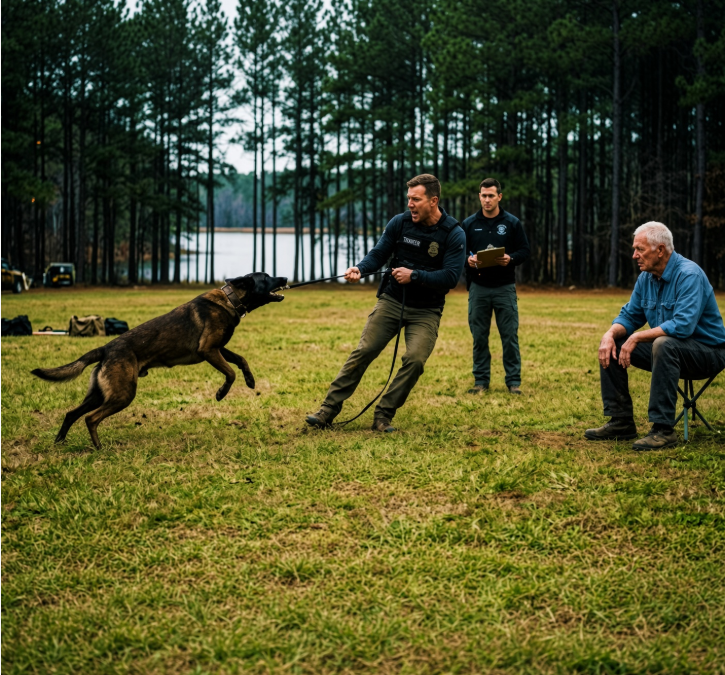
The field sat beside a flat gray lake edged with pine trees. Early morning light lay dull on the water. The air smelled of damp grass, pine resin, dog saliva, and the faint metallic tang of training equipment. A row of bite sleeves hung beneath the shade canopy. Lead lines, stakes, water bowls, clickers, and reward pouches were arranged on folding tables with the disciplined neatness of people who trusted systems.
Bruce trusted systems too.
When they matched reality.
Duke worked the long lead through another run.
The handler gave a recall under drive.
Duke spun.
Missed the timing.
Loaded left.
Dropped late on the rear leg.
Hit the end of the lead hard enough to wrench the handler’s shoulder.
Correction.
No response.
Second correction.
Escalation.
Duke’s ears went tight, not pinned in fear, not forward in aggression, but caught halfway between expectation and conflict.
Bruce leaned forward slightly.
There.
The rear leg again.
Not injury.
Sequencing.
A half-second delay after the pivot.
Like a dancer waiting for music no one else could hear.
The team cycled Duke through obstacle work.
Failure.
Contact protocol.
Failure.
Agitation control.
Failure.
Recall.
Failure.
Each failed attempt added one more layer of frustration to the field. The younger trainers grew quieter. The handler’s voice sharpened. Niles’s clipboard filled with short, angry marks.
Bruce’s hands stayed loose against his thighs.
After the third run, he took the rosary out fully.
He did not pray out loud.
He did not lift it.
He simply ran one bead under the pad of his thumb and kept his eyes on the dog.
The beads had once been oxblood brown, maybe, before years of sweat, dust, oil, and handling had deepened them almost to charcoal. A few of the links were heavier than the others where someone had repaired them without caring if the work looked pretty.
That repair had not been Bruce’s.
The rosary had come to him that way.
Glenn Krupa had carried it through two deployments before the third one.
Krupa had worn it under his sleeve during canine certification, technically against uniform regulations. Bruce had seen it. Bruce had said nothing. Some things a man carried were not the Army’s business, no matter how deep the Army believed its ownership went.
Krupa had been twenty-three.
One of the best handler candidates Bruce had ever trained.
Not loud.
Not flashy.
Not the kind of young man who wanted everyone to know he had a gift.
He possessed a rare patience that was not passivity, but deliberate control. The kind of stillness working dogs responded to the way they responded to gravity. He did not force attention. He created a place attention wanted to land.
The notification had come on a Tuesday.
Bruce had been at Fort Bragg in the middle of an evaluation when a senior NCO pulled him off the field and told him quietly. Kandahar. Joint operation. Ambush. Handler down. Dog recovered.
Bruce had nodded.
Then walked back onto the field and finished the evaluation because the dog in front of him still needed something from him, and that had always been enough to keep a man moving one more hour.
Krupa’s mother mailed the rosary six months later.
There was no long letter.
Just a note.
He would have wanted you to have it.
Bruce did not know if that was true.
He kept it anyway.
On the field, Duke hit the end of the lead again.
Bruce pressed the next bead.
Niles lasted until late morning.
By then, the team had burned through a two-hour session and Duke had not made one reliable contact. He had broken recall twice, spun out of drive three times, and turned the long lead into a weapon against every handler who touched it.
The dog was now on a tie-out near the shade canopy, pacing a tight arc.
Four steps.
Pivot.
Four steps back.
A thin continuous whine came from his throat.
Not aggression.
Not fear exactly.
Confusion under pressure.
A machine running a program that kept failing to resolve.
Niles crossed the field toward Bruce with his arms already open.
“I’ve been patient.”
Bruce looked up from the camp stool.
Not fast.
Not slow.
Niles stopped six feet away.
“Three weeks,” he said. “Three weeks of me letting you sit there because Wendell said leave it. But we just burned another session, and that dog has not made a single reliable contact. I’m not going to keep running this operation with a civilian audience.”
Bruce said nothing.
“So,” Niles continued. “One credential.”
The younger trainers looked down.
Wendell stood near the shade canopy, phone in one hand, expression unreadable.
Niles pointed toward Bruce.
“Give me one thing that earns you a seat here.”
Bruce let the silence sit.
Not to be difficult.
He simply did not appear to feel urgency the way other men did.
Finally, he said, “I was in the Army.”
Niles’s jaw moved.
“So were a lot of people.”
Bruce nodded.
“Yeah.”
That was the entire answer.
Niles looked back toward the team as if searching for witnesses to the absurdity.
“Sir,” he said, voice dropping into the tone of a man trying to be calm and missing by inches, “this is a private facility operating under contract. We have a dog that has washed out of every contact protocol we’ve run, a client deadline in eleven days, and a retirement recommendation sitting two days away. I need this field clear of people who are not contributing.”
Bruce looked toward Duke.
“What’s he doing with his rear legs?”
Niles blinked.
“What?”
“His rear legs,” Bruce said. “When he comes off the pivot.”
Niles turned despite himself.
Duke paced.
Four steps.
Pivot.
Four steps back.
The left rear leg dropped just a fraction late, not limping, not weak, but delayed—an echo waiting on a cue that never arrived.
Niles saw it.
Bruce saw the moment he saw it.
“That could be—”
“It’s not physical,” Bruce said. “You cleared him week one.”
Niles looked back at him.
Bruce’s thumb moved slightly against his thigh, as if finding a bead that was not there.
“It’s sequencing.”
“Sequencing.”
“He’s waiting for a sound that isn’t coming.”
Niles stared.
“What sound?”
Before Bruce could answer, Wendell spoke from behind them.
“That,” he said quietly, “is a very good question.”
Nobody answered.
Duke lowered his head toward the lake and whined once, high and clean. The sound traveled across the flat gray water and disappeared.
Niles walked back to the shade canopy.
When he returned, he carried a manila folder thick enough that its edges curled from humidity.
“You want credentials?” he said. “I’ll show you credentials.”
He flipped the folder open and held up the first page.
“Duke Shepard. Four years old. Belgian Malinois. Former patrol dog out of Fayetteville. Passed basic obedience and man trailing before six months. Environmental confidence rated high. Drive rated high. Food reward moderate. Toy reward high. Handler engagement high.”
He flipped another page.
“Advanced agitation: redlined. Recall under drive: redlined. Three handlers. Two master-level. One military police background.”
Another page.
“Daily sessions. Three weeks. Every protocol available for a dog this age with this behavioral history.”
He closed the folder.
“The animal is compromised.”
Bruce repeated the word quietly.
“Compromised.”
Not challenging.
Just holding it up long enough to see if it deserved to exist.
Niles’s face hardened.
“Yes.”
Duke paced his tie-out.
Four steps.
Pivot.
Four steps.
Whine.
The lake remained gray.
Wendell’s phone was in his hand now, screen angled down. His thumb moved in short, careful strokes. He had heard something earlier that morning. Two words Bruce had murmured under his breath while watching Duke’s third failed recall. Wendell had been near the pine row, downwind, close enough to catch the cadence.
Not English.
Not exactly Arabic.
Not exactly Pashto.
But close enough to something he had heard once in a windowless briefing room at Fort Bragg seven years earlier.
Language-paired canine conditioning.
High-value target operations.
Allied partner integration.
Dual-key command syntax.
Not in manuals.
Not written down.
Designed to work across coalition units without allowing the entire system to be captured if one handler was compromised.
Wendell could not remember the full designation.
He remembered thinking the concept sounded improbable.
He remembered learning, later, that improbable did not mean untrue.
His search produced almost nothing.
A declassified procurement footnote.
A partial reference.
A program designation with most of the letters missing.
But enough.
Enough for his pulse to change.
Niles was still talking.
“Three weeks,” he said. “Three certified handlers. Six weeks of combined work if you include the preliminary intake. The dog has broken all of them.”
Duke’s head snapped toward the shade canopy.
No one noticed at first except Bruce.
The stake holding the tie-out shifted in the ground.
Once.
Twice.
Bruce’s feet moved under him.
Niles continued, “So whatever retired hobby knowledge you think you’re bringing to my field—”
The stake came out.
It did not loosen dramatically.
It simply gave up.
Duke launched forward with the long line whipping behind him like a severed tail.
Eighty-five pounds of Belgian Malinois crossed the open field in a blur of muscle and unresolved drive.
Two younger trainers scrambled left.
One reached for a catch pole that was not there.
Someone shouted.
Niles dropped the folder.
Papers scattered into the grass.
Bruce was already moving.
Not fast.
Not frantic.
Forward.
As if stepping through a door he had opened a thousand times.
His left hand dropped flat against his thigh.
His right hand came up open-palmed and low, below the dog’s eye line. His body bladed slightly. Weight over the left foot. Shoulders relaxed. Chin down.
Duke came in low and fast, eyes wide, chest heaving, line dragging behind him.
Bruce waited until the dog was close enough that he could see the whites around the eyes.
Then he spoke.
Low.
Flat.
A cadence that did not belong to any public training manual.
Four syllables.
A pause.
Two more.
The sound entered the field like a key turning inside a lock.
Duke stopped.
Not slowed.
Stopped.
All four paws found the ground in a sudden, complete halt, momentum bleeding out of him as if an invisible wall had risen between one breath and the next.
His haunches dropped.
He sat directly in front of Bruce’s left boot.
Four seconds.
Maybe less.
No one moved.
Niles stood with one hand braced against the tailgate of the equipment truck, mouth open, whatever sentence he had been building now completely gone.
The younger trainers stared.
The handler who had been dragged twice that morning slowly lowered his arms.
Wendell’s phone hung at his side.
Bruce crouched in front of Duke with one deliberate movement.
No wasted motion.
He let the dog smell the back of his hand.
Duke’s nose touched him.
The dog exhaled, long and heavy, as if he had been waiting three weeks to do exactly that.
Bruce said something softer.
Two syllables.
The kind of sound a man makes to a dog he knows, even if he has never met him before.
Duke’s head lifted.
His breathing began to even.
One of the younger trainers whispered, “What did he say?”
Nobody answered.
The wind moved through the pine row.
The lake held its flat gray silence.
Niles bent to pick up the folder, then seemed to forget why he had touched it. He straightened slowly, eyes on the dog.
Wendell walked toward him.
His voice was quiet enough that only those closest heard.
“Niles.”
Niles did not look away from Duke.
“What?”
“That phrase he used.”
“What about it?”
“I heard it once.”
Niles turned.
Wendell chose his words carefully.
“Joint briefing. Classified setting. Around 2013. There was a program attached to special operations canine work. Language-paired command sequences. Designed for high-value target operations with allied partner forces.”
Niles’s jaw tightened.
Wendell continued.
“Dogs could respond across handler continuity without breaking conditioning. Dual-key syntax. You had to give the approach marker before any terminal command. Otherwise the dog could interpret the sequence as incomplete.”
He looked at Bruce.
“The phrase he used is part of that system. Not a variation. The actual sequence.”
The field went still.
Even Duke seemed quieter beneath Bruce’s hand.
“There were maybe a dozen men who could have written that sequence,” Wendell said. “Fewer who actually ran the training.”
Niles looked at Bruce.
Wendell finished softly.
“The briefing officer referred to the program lead as Master Sergeant Hoffman.”
Nobody spoke.
Bruce remained crouched in front of Duke.
His hand rested on the dog’s flank. The other hand had drifted to his shirt pocket, two fingers touching the rosary through the fabric without seeming to realize it.
Niles looked at the back of Bruce’s gray head.
There was nothing to say that would not make him smaller.
Bruce stood, picked up the long line, and gave Duke slack instead of taking it.
The dog’s head tilted.
Reading that.
Receiving it.
“Three weeks,” Wendell said, not as accusation, only as marker.
“I know,” Bruce said.
His eyes stayed on the dog.
“They were running hard corrections every time he showed agitation. Terminal command, no approach sequence, no language bridge.”
Niles stiffened, but did not interrupt.
“The dog wasn’t breaking down,” Bruce continued. “He was responding correctly to a syntax he was built on. When your commands don’t match the architecture, the dog fills the gap with the only behavior that makes sense to him.”
He looked toward Duke.
“Aggression is a reasonable answer to confusion.”
That sentence landed harder than an insult would have.
Because it was not about blame.
It was about truth.
Bruce stepped closer to Duke and spoke a short phrase, four syllables with an Arabic root and a Pashto tonal inflection on the second beat.
Duke’s ears dropped back.
Not in fear.
Recognition.
He settled his weight onto his haunches and looked at Bruce the way a dog looks at the person who finally says the sentence the world has been withholding.
“That’s the approach marker,” Bruce said.
He did not look at Niles when he said it.
“Before any command, before any expectation, you tell him the shape of the conversation. You let him know what language he’s in.”
Niles swallowed.
“We didn’t know that existed.”
“No,” Bruce said. “You didn’t.”
The words were not cruel.
That made them worse.
For the next hour, Bruce worked Duke through the sequence.
No performance.
No speeches.
No dramatic demonstration for the humbled audience.
He simply rebuilt the conversation from the first word.
Approach marker.
Hold.
Release.
Reset.
Directional cue.
Recall.
Contact.
Break.
Settle.
Each command stacked onto the one before it. Each sound carried weight because it matched the structure Duke had been waiting to hear.
The dog transformed.
Not magically.
Not instantly into perfection.
But clearly.
His body stopped fighting ghosts in the air. His ears softened. His pivots tightened. The left rear delay reduced by half once the sequence completed properly. He cleared the first obstacle line without spinning out. He recalled from moderate drive. He released from a sleeve dummy after Bruce reset the association with a lower-pressure cue and no shouting.
The trainers watched in silence.
Niles stood at the edge of the cleared area with the folder in one hand.
At first, his arms were crossed.
Then after a while, they were at his sides.
Wendell moved near Bruce at a respectful distance.
“Where do I find the full protocol?” he asked.
Bruce’s hands moved along the lead slowly.
“You don’t.”
Wendell looked at him.
“It was oral transmission only,” Bruce said. “Deliberate. Command syntax that lives in a file can be captured.”
Niles’s eyes sharpened despite himself.
Bruce continued.
“We ran paired language systems through allied units. Afghan National Army dog teams. ANA handlers working alongside our people. Commands had to function across two languages without a dictionary and without written record. If a handler was compromised, the syntax died with him.”
He gave Duke a low directional call.
The dog turned clean and came back to heel.
Bruce’s right thumb pressed once against the front of his shirt, over the pocket holding the rosary.
“Except when it didn’t.”
Wendell waited.
Bruce looked out at the lake.
The water had gone from morning gray to a flatter silver as the sun climbed higher and then began its slow slide west. The pines across the bank stood dark and still.
“Whose unit sent him through originally?” Wendell asked.
Bruce did not answer right away.
His hand went to his shirt pocket.
This time, he took the rosary out.
He held it in his palm, not moving the beads.
The entire field seemed to quiet around it.
“Kid named Glenn Krupa,” Bruce said. “Kandahar. 2011.”
Niles lowered his eyes.
Bruce turned the rosary once in his hand.
“Dog made it home. He didn’t.”
Wendell said nothing.
Niles said nothing.
No one had anything useful to place beside that.
“Krupa was one of mine,” Bruce continued. “Certified through the program. Sharpest young handler I ever put through dual-key syntax. Absorbed it faster than men twice his age. Had a feel for the difference between frustration and confusion.”
He looked at Duke.
“Good handlers listen first and talk second.”
The dog sat at Bruce’s left side, watching his face with an attentiveness that was not simple obedience.
It was older than obedience.
Trust, maybe.
Or recognition.
Bruce looked back down at the rosary.
“His mother mailed this to me six months after the notification. Said he would’ve wanted me to have it.”
He let out a quiet breath.
“Didn’t know what to do with that for a while.”
Wendell spoke carefully.
“So you carried it.”
Bruce nodded once.
“You keep it. That’s what you do. You keep it, and you carry it, and you don’t put it down because the moment you put it down, it means you forgot what it cost.”
Duke’s ears moved at the name Krupa.
Forward.
Slowly.
Not because he knew the man, maybe.
Or maybe because some part of him knew the shape of the name through the men who had built the language inside him.
Niles finally spoke.
His voice had lost all its sharp edges.
“You wrote the protocol.”
Bruce tucked the rosary back into his pocket.
“Yes.”
Niles looked at Duke.
“And we were calling him compromised.”
“You were calling the file compromised,” Bruce said. “You hadn’t met the dog yet.”
That one landed visibly.
Niles looked down at the manila folder.
Three weeks of red ink.
Three weeks of failure.
Three weeks of experts telling an animal he was wrong because they did not know the first sentence of the language he had been trained to hear.
“What do we do now?” Niles asked.
It was the first honest question he had asked all morning.
Bruce looked at him.
No triumph.
No satisfaction.
“Start over.”
Niles nodded once.
“How?”
Bruce handed him the lead.
Niles stared at it as if it weighed more than rope.
Bruce did not let go immediately.
“You don’t correct him for confusion,” he said. “You mark the beginning. You give the approach phrase before asking anything. You keep pressure low until the sequence is seated. No sleeve work for now. No full drive recall until he trusts the sound again.”
Niles nodded again.
This time, not like a man pretending to listen.
“Say it,” Bruce said.
Niles looked up.
“What?”
“What did I just tell you?”
Niles’s face tightened.
A younger trainer glanced away.
Wendell almost smiled.
Bruce waited.
Niles took a breath.
“Don’t correct confusion. Use the approach phrase first. Keep pressure low. No sleeve work. No full drive recall until the sequence is seated.”
Bruce released the lead.
“Good.”
Niles looked down at Duke.
The dog looked back, uncertain but no longer chaotic.
Niles swallowed.
“I owe him an apology.”
Bruce’s face did not change.
“No.”
Niles looked surprised.
“You owe him better handling. Dogs don’t need apologies they can’t use.”
For two weeks, the field changed.
No shouting.
No hard corrections for agitation.
No more forcing Duke into protocols that collapsed at the first syllable. Bruce came every morning and sat on the camp stool by the north fence post with the rosary in his pocket. Sometimes he worked Duke. Sometimes he made Niles work him. Sometimes he made the youngest trainer stand in the field and do nothing for ten minutes because, as Bruce said, “If you can’t be still, you have no business asking a dog to be.”
That lesson offended everyone until it helped.
Duke improved.
Day one, he completed the base approach sequence with Bruce and half of it with Niles.
Day three, he recalled from moderate distraction.
Day five, he stopped scanning backward after commands.
Day seven, the left rear delay disappeared when the cue sequence was clean.
Day nine, he ran a track through the pine row and returned with his head high instead of low.
Day twelve, Niles cried in his truck where he thought no one could see after Duke accepted a calm heel from him without tension in the line.
Bruce saw.
He said nothing.
Some things did not require witness.
On the final day of the reassessment, the client representative came.
A state agency man in a pressed polo shirt stood under the shade canopy while Niles ran Duke through the rebuilt sequence. Wendell stood beside him. Bruce sat near the fence, rosary in hand, eyes on the dog.
Duke worked clean.
Not flawless.
Clean.
Focused.
Alive.
When the session ended, Duke returned to Niles’s left side and sat.
Niles did not touch him right away.
He waited.
Then he lowered his hand slowly and rested it briefly against the dog’s shoulder.
Duke accepted it.
The representative looked at Wendell.
“So he’s cleared?”
Wendell looked at Bruce.
Bruce looked at Duke.
Duke looked toward the lake.
“He’s recovering,” Bruce said.
The representative frowned.
“That’s not a category on my form.”
“No,” Bruce said. “It wouldn’t be.”
Wendell stepped in smoothly.
“He is cleared for continued rehabilitation and phased operational reassessment. No retirement recommendation at this time.”
The man wrote that down.
Niles watched Duke and said nothing.
That afternoon, after everyone else had packed up, Bruce walked Duke down the pine road toward the lake.
Wendell followed at a distance.
Niles stayed behind near the equipment truck, training file closed in his hand.
He had not opened it in days.
Bruce stopped at the water’s edge.
Duke sat beside him.
The lead was slack between them.
The lake reflected the late light without drama. No golden miracle. No sweeping movie sky. Just gray water, dark pines, and a quiet that did not demand anything.
Wendell stopped a few feet away.
“He’ll be all right,” he said.
Bruce watched the water.
“Maybe.”
“You don’t like saying yes.”
“Yes is for people selling something.”
Wendell huffed once.
Almost a laugh.
For a while, neither spoke.
Then Wendell said, “Krupa would have been proud.”
Bruce’s jaw moved.
He did not answer.
Duke’s ears came forward at the name.
Wendell noticed.
Bruce did too.
The old veteran placed two fingers against his shirt pocket where the rosary rested.
“He would’ve solved it in twenty minutes,” Bruce said.
“Maybe.”
“No maybe.”
Wendell looked at him.
“Then why did it take us three weeks?”
Bruce glanced back toward the training field, where Niles now stood alone, coiling leads properly instead of barking orders at younger men to do it.
“Because most people would rather prove the dog wrong than admit they don’t know the first word of his language.”
Duke leaned against Bruce’s leg.
Just once.
A brief contact.
Enough.
Bruce lowered his hand and rested it on the dog’s head.
Wendell looked at the old man, the dog, the lake, the rosary hidden again in the shirt pocket, and understood something he had not understood in the briefing room seven years earlier.
Protocols did not survive because they were clever.
They survived because someone carried them.
In memory.
In cadence.
In hands that knew when not to pull the leash.
In a rosary worn smooth by grief.
In the name of a dead twenty-three-year-old handler spoken aloud beside water.
Bruce turned from the lake.
“Walk him out once more.”
Wendell thought he was talking to Niles, but Niles was too far away.
Then he realized Bruce was talking mostly to himself.
The old veteran gave a low call.
Duke came to heel without correction.
Together, man and dog moved down the pine road, unhurried, lead slack, the dog’s head up and tracking forward instead of back.
Not a demonstration.
Not proof.
Just a man and a dog that both knew what it meant to be built by someone who was not there anymore, moving together in the late light.
Behind them, Wendell remained at the lake.
The field emptied.
Truck doors closed somewhere in the trees.
Engines turned over.
Tires moved over gravel.
The sound faded until only wind remained.
Niles eventually walked down to the water’s edge and stood beside Wendell.
For a long moment, he said nothing.
Then, quietly, “I called him compromised.”
Wendell did not soften the truth.
“Yes.”
Niles nodded.
“I was wrong.”
“Yes.”
Another silence.
“What do I do with that?”
Wendell looked toward Bruce and Duke in the distance.
“You let it make you better.”
Niles swallowed.
Across the field, Bruce stopped near the north fence post, crouched, and removed the long lead from Duke’s collar. The dog did not move away. He sat, calm and steady, eyes on the old veteran’s face.
Bruce said something low.
Not the dual-key sequence.
Something else.
Private.
Duke’s ears softened.
Niles watched.
“Four seconds,” he said.
Wendell nodded.
“Three weeks of failure. Then four seconds.”
“It wasn’t four seconds,” Wendell said.
Niles looked at him.
“It was decades,” Wendell said. “It was Krupa. It was Kandahar. It was every dog Hoffman trained before this one. It was every word nobody wrote down because writing it down would make it weaker. You saw four seconds because that’s the part that happened in front of you.”
Niles looked back toward the field.
Bruce was walking toward the gate now.
Duke remained sitting in the grass where he had been left, calm, attentive, no longer pulling against a world that refused to answer correctly.
Wendell spoke the name softly.
Not to Niles.
Not to Bruce.
Not even to the dog.
Just into the gray air above the lake, where names like that belonged.
“Glenn Krupa.”
The lake did not answer.
The pines did not move.
But Duke’s ears came forward once, slowly, like somewhere inside him, the shape of that name had found a familiar door.
Bruce paused at the gate.
His hand went to the rosary in his pocket.
One bead beneath his thumb.
One breath.
Then he kept walking.

